• Skip to primary navigation
  • Skip to main content
  • Skip to primary sidebar

everywomanover29 blog

Food, Mood and Women's Health – Be your healthiest, look and feel great!

  • Blog
  • About
  • Services
  • Store
  • Resources
  • Testimonials
  • The Book
  • Contact
  • Search this site

sugar

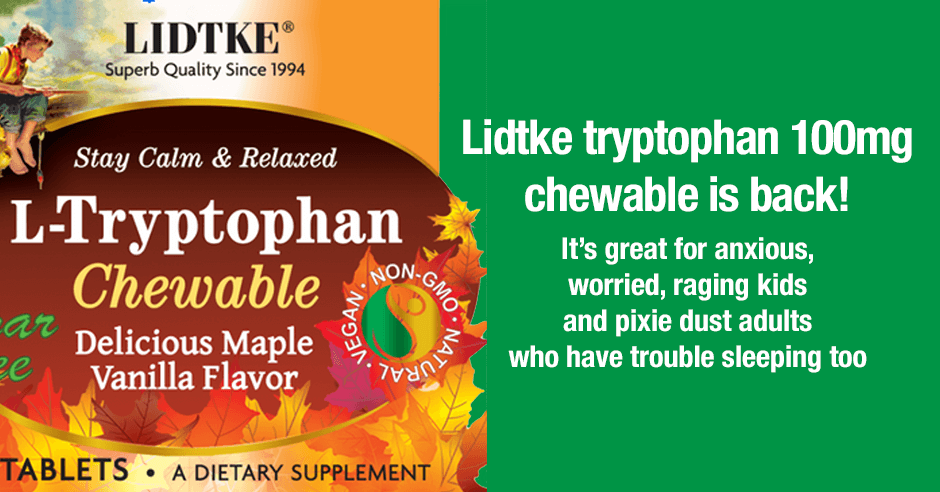
Lidtke tryptophan 100mg chewable is back! It’s great for anxious, worried, raging kids and pixie dust adults who have trouble sleeping too

June 6, 2025 By Trudy Scott 26 Comments

Lidtke tryptophan 100mg chewable

The Lidtke tryptophan 100mg chewable product has been out of stock for close to a year and it’s now back, hence this blog post. This product has been a firm favorite of mine for many years and I’ve used it successfully with children and adults with signs of low serotonin. If you’re new to tryptophan, it’s an amino acid that is a precursor or raw material for the production of your feel-good neurotransmitter called serotonin.

I’ve used this product in the past with children who are anxious, worried, raging, having problems sleeping and craving sugar and carbs. I’ve also used it with “pixie dust” clients who do well with a small dose and prefer a chewable form of tryptophan. And I often recommend clients use it to do the initial one-off trial to figure out if low serotonin is the issue (and before moving on to a typical starting dose of 500mg tryptophan twice a day).

In this blog you’ll see the label of the newly formulated tryptophan 100mg chewable and some of the many advantages of tryptophan as a low-dose chewable. You’ll also see some feedback on the previous formulation, a success story with a young girl and my personal experience too.

The newly formulated Lidtke L-Tryptophan Chewable

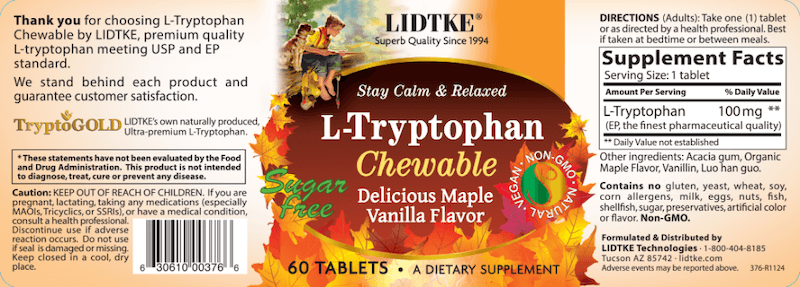
Here is the new label for the Lidtke L-Tryptophan 100mg Chewable. This product has been a firm favorite of mine for many years and the formulation has shifted over the years.
lidtke tryptophan chewable label

This formulation still contains 100mg tryptophan and a different sweetener – luo han guo, also known as monk fruit. It’s a zero-calorie natural sweetener that does not affect blood sugar. Monk fruit does belong to the gourd family and would need to be avoided if there are allergies to these foods (such as cucumbers, melons, zucchini etc).  Also, some individuals do not like the aftertaste of monk fruit.

It does contain flavors – maple and vanillin – which may be problematic for sensitive individuals. Acacia gum (or gum arabic) is low FODMAP and typically well tolerated, but may cause bloating for some.

The chewable has not been available for about a year so this is very welcome news.

Chewable tryptophan for a young girl with anxiety, rage, sleep issues and strong cravings

As I mentioned I’ve been using chewable tryptophan with success for many years. I often share the success story of a young girl with anxiety, rage, sleep issues and strong cravings for candies in documentaries and summit interviews and – and how addressing low serotonin with a chewable tryptophan quickly helped:

So sitting in my office with this young girl and her mom, we started to talk about the sweets and the candies and the need to give up the candies. She was fuming with me. She was sitting in a swivel chair. She turned her back on me and didn’t want to talk about having to give up candy at all.

I said, “Look, let’s not even talk about that, but would you take this chewable tryptophan here? And we’ll talk about it in a second.” I gave her 100 mg of the chewable tryptophan and continued discussing things with her mom.  She had no idea what it was going to do or how it would make her feel.

Within five minutes she turned her chair back, looked at me and she said, smilingly, “Yes, let’s do it. I can give up the candy.” She was smiling and she was happy.

So long story short, with this young girl, we started her on [chewable] tryptophan [and it turned things around quickly].

You can read her entire story here on the blog –  Rage, anxiety, cravings & insomnia in 11-year old girl with RAD/reactive attachment disorder: chewable tryptophan turns things around (she also went gluten-free and addressed low iron levels and the change was transformative.)

Some of the many advantages of tryptophan as a low-dose chewable

Here are some of the many advantages of tryptophan as a low-dose chewable:

  • The low dose is suitable for sensitive adults and pixie-dust folks (i.e. a small amount goes a long way)
  • It can be easily broken apart if an even lower dose works well
  • It’s pleasant tasting
  • It’s easy to have available to use on the go when traveling or out and about
  • The dose dose and taste is suitable for children and kids who are picky eaters
  • The dose dose and taste is suitable for older adults with dementia or Alzheimer’s, adults with special needs or Parkinson’s
  • One less capsule to swallow and more pleasant that tryptophan powder on the tongue
  • A good tool for doing the initial one-off trial to confirm low serotonin symptoms before embarking on titrating up to a higher dose of tryptophan

My personal experience with chewable tryptophan

Personally, I have used tryptophan over the years with much success. It’s helped me with sleep issues, the worry type of ruminating anxiety and PMS symptoms.

I also used it when I was grieving after my mom passed away and found it particularly helpful a few months after her passing when I’d start to feel more sad after dinner and go searching for sugar as a pick-up. It worked well because serotonin takes a dip later afternoon/evening.

Most of the time I’ve used 500mg and above – capsules opened and powder.

However I like to try what I recommend (if possible) so I have tried a few bottles of the previous formulation of the chewable tryptophan. It worked well and the taste and texture was pleasant. But because I do better on a higher dose I was needing to chew too many!

I have yet to try this new formulation myself but will report back as soon as I have had a chance to do so – on the taste, the texture and the effectiveness.

Positive feedback on the previous chewable tryptophan product

Until I get feedback on the new formulation, here is some general feedback from individuals in the community.

Jean is a practitioner who uses it herself and with patients:

It works within 15 minutes to stop looping thoughts/anxiety and the dose isn’t too sedating during the day. I never find it too sweet and wouldn’t let the taste keep me from such rapid relief.

I like the 100 mg chewable because it only has tryptophan and I didn’t want the other ingredients in the [Lidtke tryptophan] Complete for my needs.

I’ve had patients do well with tryptophan with the 100 mg chewable and others with the higher dose capsule.

Kelly likes the low 100mg dose compared to the 500mg capsules:

I purchased the adult pills and they were too strong. I was groggy in the morning.

Erin is also a practitioner and mom:

I have used this [the chewable tryptophan 100mg] with my 8 year old when he’s in a rage or showing signs of excessive worry and it works great! So glad it’s coming back. I recommend it to clients all the time.

Ali is also happy the chewable is coming back:

Great news!! I love the chewable and I prefer 100 mg early evening for anxiety and sleep. Sometimes 200mg but not often.

I appreciate them all sharing and hope to get updates from them when they try the new formulation.

Negative feedback on the new tryptophan chewable formulation

Update: June 14, 2025

Unfortunately, since publishing this blog and sharing on Facebook, the negative feedback has been coming in fast and furiously. Here is some of what people are sharing:

  • Melissa: “Love this company. I like that it’s chewable but it’s a large tablet and flavor is awful. Tastes like when you put maple syrup on a burnt pancake to try and cover up the burnt . I will finish the bottle though. I wish there were other chewable options, like GABA calm’s orange flavor.“
  • PS: “Revolting. Aftertaste like artificial sweetener. Smoother texture, last longer. Made me suspicious they were fake and I spat it out.“
  • Tamar: “I recently bought a few bottles of the maple sugar chewable. Taste is quite sweet and artificial, IMO. I don’t like chewing them because the product gets jammed in my teeth and stays there. I’ve been letting them dissolve, which takes a very long time.”

And these are comments from this blog:

  • Erin: “I was so excited to get this back, especially for my 8 year old son who has symptoms of ADHD rage. However, the new flavor is bitter and gets stuck in our teeth and now I can’t get him to take it!”
  • Nikki: “I got these about two weeks ago…. Truthfully I think it tastes horrible but that’s just me. Just unpleasant. Kind of sour and stale. They smell amazing but you get one in your mouth and it’s so hard to chew and swallow.” 
  • Tara: “The new formulation of the Lidtke does taste horrible. Initially I thought oh this smells lovely, tried to have my daughter take it and she said ick mom. So I said ok let me try it and ICK was right, the sweetener was gross and it did have a stale taste. So unfortunate as I had hope for this to help my daughter dealing with a lot of fears, worry, upset stomach and negative self talk at 9 yo and rage and sugar cravings.”

As of now I am NOT recommending this product.

The good news is that Nikki emailed Lidtke and shared this: “I just got an email back from Lidtke. Her name was Jessica and she stated: So, I’ve talked to the owner and let him know how many people are complaining about this new formula. He told me he was not aware it was changed and we are having a new batch made using the old formula that everyone loves. Going to take a month maybe a little more but we are definitely having this fixed.”

I appreciate her for emailing them and sharing this update. I’ve been communicating with someone else at the company and was told they have no plans to make any changes so if this is true it’s really good news!

Stay tuned for further updates and please share your own feedback in the comments below.

Additional resources when you are new to using tryptophan and other amino acids as supplements

As always, I use the symptoms questionnaire to figure out if low serotonin or other neurotransmitter imbalances may be an issue.

If you suspect low levels of any of the neurotransmitters and do not yet have my book, The Antianxiety Food Solution – How the Foods You Eat Can Help You Calm Your Anxious Mind, Improve Your Mood, and End Cravings, I highly recommend getting it and reading it before jumping in and using amino acids on your own so you are knowledgeable. And be sure to share it with the practitioner/health team you or your loved one is working with.

There is an entire chapter on the amino acids and they are discussed throughout the book in the sections on gut health, gluten, blood sugar control (this is covered in an entire chapter too), sugar cravings, anxiety and mood issues.

The book doesn’t include product names (per the publisher’s request) so this blog, The Antianxiety Food Solution Amino Acid and Pyroluria Supplements, lists the amino acids that I use with my individual clients and those in my group programs.

If, after reading this blog and my book, you don’t feel comfortable figuring things out on your own (i.e. doing the symptoms questionnaire and respective amino acids trials), a good place to get help is the GABA QuickStart Program (if you have low GABA symptoms). This is a paid online/virtual group program where you get my guidance and community support.

We are also offering the Serotonin Quickstart Program, a paid online/virtual group program where you get my guidance and community support during 5 LIVE Q&A calls.

If you are a practitioner, join us in The Balancing Neurotransmitters: the Fundamentals program. This is also a paid online/virtual program with an opportunity to interact with me and other practitioners who are also using the amino acids.

Wrapping up and your feedback

Now I’d love to hear from you – have you used the chewable tryptophan with success in the past? And how has it helped you or a loved one?

(once you try the new formulation I’d love to hear your feedback on taste, texture and effectiveness)

If you’d like to get on the notification list for the next Serotonin Quickstart Program (a paid online/virtual group program where you get my guidance and community support during 5 LIVE Q&A calls), please do so here.

If you’re a practitioner have you used chewable tryptophan with your clients/patients?

Feel free to share and ask your questions below.

Filed Under: Anxiety, Cravings, serotonin, Tryptophan Tagged With: 100mg chewable, 500mg tryptophan, adults, anxious, carbs, chewable tryptophan, children, craving, grief, kids, Lidtke tryptophan, neurotransmitter, one-off trial, pixie dust, rage, raging, sensitive, serotonin, Serotonin Quickstart, sleep, sugar, tryptophan, worried

I had chemotherapy and have not been able to get off sugar since. How long will it take 5-HTP or tryptophan to stop the cravings?

July 26, 2024 By Trudy Scott 4 Comments

aminos to stop sugar cravings

Lauren shared her struggle with sugar cravings that started after chemotherapy, asking her question on a recent tryptophan/DPA cravings blog post:

If I try the tryptophan or the 5-HTP and one or the other works, how long will I need to take them for the sugar cravings to stop?

Back in 2021 I had been off sugar for 2 years and it was easy to get off by slowing eliminating sugar. The last elimination was from my coffee and then it was easy to stay away from sugar.

I had chemotherapy for 6 months in 2022. I have not been able to get off sugar since then. After chemo ended, I had the cravings and don’t know how to end the cravings.

Any advice from you would be appreciated.

The good news is that if you have cravings that are caused by low serotonin and you find your ideal dose of tryptophan or 5-HTP, you will notice reduced sugar cravings immediately and they will be further reduced with consistent use, typically a few times a day.

The key is to figure out if your cravings are caused by low serotonin and then it’s a matter of doing a trial of either tryptophan or 5-HTP (if you get results and other low serotonin symptoms improve it’s a clue you’re on track). And then you need to figure out the ideal dose for your unique needs. I share more about all this below and additional information about other types of cravings caused by neurotransmitter imbalances (and the respective amino acids that help).

Since her cravings struggles started after chemotherapy I also discuss possible impacts on neurotransmitters and also candida (sugar cravings are very common with the candida). Read on for my response to the above question from Lauren.

Sugar cravings caused by low serotonin: tryptophan or 5-HTP may offer immediate results

As I mentioned above you will notice reduced sugar cravings immediately with either tryptophan or 5-HTP if your cravings are caused by low serotonin. A big clue with low serotonin-type sugar or carb cravings is that they are more intense in the late afternoon and evening.

A good place to start (as always) is with the symptoms questionnaire. If there are other low serotonin symptoms such as feeling more anxious, worried, fearful with a low mood and irritability etc, that further confirms it’s worth doing a trial.

Some folks do better with one than the other but I have clients start with tryptophan and then switch to 5-HTP if their results are not as expected. In both instances we open the capsule or use powders or a chewable to get instant feedback on the benefits. So in that first session Lauren should be able to say “wow my cravings have reduced from 10/10 to 5/10” within 5-10 minutes. She may also report she feels more optimistic and less worried.

It is possible that her cravings are not caused by low serotonin or that they are a combination of a number of factors.

Sugar cravings caused by other neurotransmitter imbalances, and other amino acids to the rescue

We also look at sugar cravings caused by low GABA (stress eating because of physical tension), low endorphins (comfort eating or emotional eating), low dopamine (eating for an energy boost or improved focus) and low blood sugar (eating due to crankiness and irritability).

Lauren would know if any of the above may be factors based on her scores on the symptoms questionnaire i.e. scores for cravings and other symptoms. This offers further clarification:

  1. If you eat sugar or carbs to feel happy (and especially from late afternoon into the evening) then your sugar cravings are likely due to low serotonin, and tryptophan (or 5-HTP) stops the cravings and boosts mood and reduces anxiety
  2. If you stress-eat your sugar cravings are likely due to low GABA, and GABA will stop the stress-eating and calm you down
  3. If you are a comfort-eater then it’s likely due to low endorphins and DPA will stop that feeling of “I deserve-it” kind of reward-eating or comfort-eating and also give you a hug-like mood boost
  4. If you eat sugar for an energy boost or to give your focus then it’s likely due to low catecholamines and tyrosine will stop those cravings and give you a mood and energy boost, and help with mental clarity
  5. If you have to eat sugar when you haven’t eaten in awhile it’s likely low blood sugar and glutamine on the tongue stops the sugar desire almost immediately and also helps with the low blood sugar symptoms of shakiness and irritability

As you can see there is an amino acid for each of these imbalances and it’s a matter of doing a similar trial for each one. With the correct dose, Lauren can expect quick results too, provided she finds the ideal dose for her needs.

This is the blog post Lauren posted her question on: Tryptophan and DPA (d-phenylalanine) for cravings and sleep issues (and a concern about 5-HTP and nightmares).

It’s one of many posts on the site about amino acids and sugar cravings so I encourage you to use the search feature of the blog.

Chemotherapy: impacts on serotonin and dopamine

Because chemotherapy has an impact on serotonin and dopamine, this may be where Lauren needs to start when considering which amino acids to trial. Here is some additional information on “chemobrain” or  chemotherapy-induced cognitive impairment:

… a medical complication of cancer treatment that is characterized by a general decline in cognition affecting visual and verbal memory, attention, complex problem solving skills, and motor function. It is estimated that one-third of patients who undergo chemotherapy treatment will experience cognitive impairment.

Alterations in the release and uptake of dopamine and serotonin, central nervous system neurotransmitters that play important roles in cognition, could potentially contribute to impaired intellectual performance in those impacted by chemobrain.

And this may offer an explanation as to why she hasn’t been able to quit sugar since chemotherapy.

Chemotherapy, candida albicans and sugar cravings

If none of the above approaches reduce her cravings or if they do help to some extent but are not quite enough, we have to keep looking for root causes.

A big clue is that Lauren had been able to quit sugar using willpower in the past but has struggled since chemotherapy. It’s important to consider the role this may be playing. In cancer patients who have gone through chemotherapy there is increased susceptibility to Candida albicans, “a fungal commensal and a major colonizer of the human skin, as well as of the gastrointestinal and genitourinary tracts.” This is reported to be caused primarily by “chemotherapy-induced depression of innate immune cells and weakened epithelial barriers, which are the body’s first-line defenses against fungal infections.”

Sugar cravings are very common with candida and in some cases can be so severe that no amino acids will work until the candida is addressed. Interestingly, in one candida study, short exposure to serotonin resulted in antifungal activity so it’s possible that tryptophan or 5-HTP helps.

I don’t have my candida symptoms questionnaire on the blog but you can find a mini version on page 93 of my book, The Antianxiety Food Solution and additional information and my dietary/nutrient protocol in chapter 5 of my book.

The full candida questionnaire can be found in William G. Crook’s excellent book, The Yeast Connection and Women’s Health (my Amazon link).

Additional resources when you are new to using amino acids as supplements

As always, I use the symptoms questionnaire to figure out if low low serotonin or other neurotransmitter imbalances may be an issue.

If you suspect low levels of any of the neurotransmitters and do not yet have my book, The Antianxiety Food Solution – How the Foods You Eat Can Help You Calm Your Anxious Mind, Improve Your Mood, and End Cravings, I highly recommend getting it and reading it before jumping in and using amino acids on your own so you are knowledgeable. And be sure to share it with the practitioner/health team you or your loved one is working with.

There is an entire chapter on the amino acids and they are discussed throughout the book in the sections on gut health, gluten, blood sugar control (this is covered in an entire chapter too), sugar cravings, anxiety and mood issues.

The book doesn’t include product names (per the publisher’s request) so this blog, The Antianxiety Food Solution Amino Acid and Pyroluria Supplements, lists the amino acids that I use with my individual clients and those in my group programs.

If, after reading this blog and my book, you don’t feel comfortable figuring things out on your own (i.e. doing the symptoms questionnaire and respective amino acids trials), a good place to get help is the GABA QuickStart Program (if you have low GABA symptoms too). This is a paid online/virtual group program where you get my guidance and community support.

If you are a practitioner, join us in The Balancing Neurotransmitters: the Fundamentals program. This is also a paid online/virtual program with an opportunity to interact with me and other practitioners who are also using the amino acids.

Wrapping up and your feedback

I appreciate Lauren for posting her question on the blog so I can share and we all can learn.

Now I’d love to hear from you – does any of this resonate with you? If yes, what approach helped reduce your sugar cravings after chemotherapy?

If you’re a practitioner have you seen these approaches work well with your clients/patients?

Feel free to share and ask your questions below.
Filed Under: 5-HTP, Cancer, Cravings, serotonin, Tryptophan Tagged With: 5-HTP, amino acids, candida, chemo, chemotherapy, comfort eating, cravings, dopamine, endorphins, GABA, GABA Quickstart; Balancing Neurotransmitters: the Fundamentals program for practitioners, neurotransmitters, serotonin, sleep, stress-eating, sublingually, sugar, sugar cravings, tryptophan

My son has alcohol dependence and I want to help him quit drinking with GABA and other amino acid supplements

September 8, 2023 By Trudy Scott 15 Comments

alcohol and gaba

My son has alcohol dependence and I want to help him quit drinking with GABA and other amino acid supplements. Alcohol and the benzodiazepines used in treatment both block GABA receptors, but I assume having GABA available in your system is better than none (especially as nutrition has been very poor). Have you an article on this? Thank you for your knowledge and understanding.

MJ posted this question on one of the GABA blogs and I shared a few blogs to get her started (some of those are listed below). I also shared that with addictions to alcohol (and sugar and drugs) it’s a matter of figuring out which amino acids are needed in order to balance the neurotransmitters and help you to quit with no willpower and without feeling deprived. This can differ for each person and it’s a matter of doing a trial of each amino acid based on unique needs.

He may well need GABA if he self-medicates with alcohol when under stress, but he may also need serotonin support with tryptophan or 5-HTP if he drinks when depressed and needs a mood lift.

I decided to create a new blog because it’s a much needed topic and so I could share additional resources and a table I use (see below) to help you figure out where your need may be. We use this in conjunction with the symptoms questionnaire for each neurotransmitter.

In addition to addressing her benzodiazepine question, I also shared the need to address low blood sugar, low vitamin B1 and overall nutrient status. She does mention nutrition has been poor and it often is with alcohol addiction.

Which emotions are driving the need to self-medicate with alcohol and which amino acids to trial?

This is how I help you figure out which emotions are driving the need to self-medicate with alcohol and which amino acids to trial:

How do you feel before drinking alcohol? How do you feel after drinking alcohol? Likely brain chemistry imbalance Amino acid/s to supplement
Anxious or stressed (physical anxiety) Calm or relaxed Low GABA GABA, pharmaGABA or theanine
Depressed or worried? (mental anxiety) Happy or content Low serotonin Tryptophan or 5-HTP
Tired or unfocused Energetic, alert, or focused Low catecholamines Tyrosine
Wanting a reward or treat, and sad (weepy) Rewarded or comforted Low endorphins DPA (d-phenylalanine) or DLPA
Irritable and shaky Grounded or stable Low blood sugar Glutamine

We use this in conjunction with the symptoms questionnaire for each neurotransmitter.

Many individuals with alcohol addiction have imbalances in all areas. We use the same approach when it comes to alcohol addictions that we use sugar/carb/junk food addictions i.e. we tackle one imbalance at a time so we know which amino acid is helping and how much is needed.

The amino acids play many roles in addressing alcohol addiction:

  • They help you to quit alcohol with no willpower and without feeling deprived
  • They help to mitigate many of the adverse effects of quitting (like insomnia and increased anxiety and depression)
  • They address the root cause of the addiction i.e. neurotransmitter imbalances
  • They address the emotional aspect so mood and anxiety is improved
  • They help to heal the damage that has been done to the gut: glutamine, GABA and tryptophan
  • They prevent the need to find a replacement like sugar, coffee, Diet soda and cigarettes (intake is often ramped up when drinking ceases)
  • They even help children who have had prenatal exposure to alcohol – 5-HTP benefits both adopted daughters who had prenatal exposure to alcohol: they are happier, more focused and can stay on task

PharmaGABA eases physical anxiety, amino acids ease alcohol withdrawal symptoms, and tryptophan turns you off alcohol

These blog posts illustrate the many applications of amino acids when it comes to quitting alcohol

  • PharmaGABA eases physical anxiety in a young man who has recently given up Adderall, alcohol and nicotine (some folks do better with GABA and some with pharmaGABA)
  • An amino acid supplement with DLPA, glutamine and 5-HTP eases alcohol withdrawal symptoms at an inpatient detoxification program
  • Tryptophan had the added benefit of turning me completely off alcohol when I took it to improve mood and sleep during perimenopause (this need for serotonin support could be applicable for a male too and at any age)

As I mentioned above, be sure to use the search feature to find other blogs on this site: use alcohol, addiction and sugar (and replace sugar with alcohol in the sugar blogs).

Does his prior benzodiazepine prescription prevent him from being able to use GABA?

MJ asks if her son’s prior benzodiazepine prescription will prevent him from being able to use GABA. He will need to taper very very slowly under the guidance of someone knowledgeable and with oversight by the prescribing physician.

It is true that GABA receptors can be affected by benzodiazepines but despite this, many of my clients and others in my community do get relief from GABA during the taper period and afterwards.

We do start with a very small dose – I typically have someone start with 25mg GABA and go up from there – and only use sublingual GABA (or pharmaGABA). For some very sensitive folks we will start even lower as in this example where Syd gets sleep and body anxiety benefits with just 1.5 mg to 3 mg GABA.

I share more on this blog – Rebound insomnia after tapering a benzodiazepine: will taking GABA or any other natural supplement interfere with healing?

One big caveat is that nutritional stability is key when it comes to tapering benzodiazepines. It is also imperative when it comes to addiction recovery.

Good nutritional status, low blood sugar and low vitamin B1

MJ does mention that her son’s nutrition has been poor. It often is with alcohol addiction. I also shared with her the need to address low blood sugar and overall nutrient status.

When you are new to the amino acids and anxiety nutrition solutions my book “The Antianxiety Food Solution” is an excellent resource for all of the above – and the information applies to those with addictions too.  

Here is a blog with additional information and a study on the importance of addressing low blood sugar when it comes to anxiety and also addictions – Anxiety and Hypoglycemia Symptoms Improve with Diet Modification.

This highlights the importance of consuming enough protein, fats and fiber, especially at breakfast. There is an entire chapter on blood sugar in my book – it’s that important.

Finally, low thiamine/vitamin B1 must be addressed: “alcohol misuse is the most common risk factor for thiamine deficiency.” More about this here.

A complete nutritional assessment for other issues should be done too: low vitamin D, low zinc, other vitamin B deficiencies, low magnesium, adrenal insufficiency, leaky gut and more.

Medically assisted withdrawal treatment

If you are wanting to quit alcohol and don’t have an alcohol use disorder, all of the above approaches can be safely used.

However, medically assisted withdrawal treatment may be needed in some instances: “Excessive chronic alcohol users, and particularly patients with alcohol use disorder, may present an alcohol withdrawal syndrome if they abruptly stop drinking. Alcohol withdrawal syndrome requires pharmacological treatment for the treatment of withdrawal symptoms and to prevent withdrawal complications. Medically assisted withdrawal treatment is used in alcohol treatment units, but it is also frequently required in patients admitted to hospital for other conditions.”

It’s important that this is recognized for those who need it. MJ mentions benzodiazepines were used in her son’s treatment so presumably he had medically assisted withdrawal treatment.

In this situation, once her son has safely quit alcohol everything I mention above would then apply – looking at the amino acids and nutritional status so there is no relapse. And so recovery is easier and sustainable with a stable mood and no anxiety.

Resources if you are new to using amino acids as supplements

If you suspect low levels of any of the neurotransmitters and do not yet have my book, The Antianxiety Food Solution – How the Foods You Eat Can Help You Calm Your Anxious Mind, Improve Your Mood, and End Cravings, I highly recommend getting it and reading it before jumping in and using amino acids on your own so you are knowledgeable. And be sure to share it with the practitioner/health team you or your loved one is working with.

There is an entire chapter on the amino acids and they are discussed throughout the book in the sections on gut health, gluten, blood sugar control, sugar cravings, anxiety and mood issues.

The book doesn’t include product names (per the publisher’s request) so this blog, The Antianxiety Food Solution Amino Acid and Pyroluria Supplements, lists the amino acids that I use with my individual clients and those in my group programs. You can find them all in my online store.

If, after reading this blog and my book, you don’t feel comfortable figuring things out on your own (i.e. doing the symptoms questionnaire and respective amino acids trials), a good place to get help is the GABA QuickStart Program (if you have low GABA symptoms too). This is a paid online/virtual group program where you get my guidance and community support.

If you are a practitioner, join us in The Balancing Neurotransmitters: the Fundamentals program. This is also a paid online/virtual program with an opportunity to interact with me and other practitioners who are also using the amino acids.

Have you or a loved one used the amino acids to help with alcohol dependence/alcohol use disorder?

If benzodiazepines were used in the treatment center, was GABA still helpful?

Have the amino acids helped prevent new addictions to sugar/coffee/cigarettes and improved anxiety, depression and insomnia?

If you have questions and other feedback please share in the comments too.

Filed Under: Addiction, Alcohol, Amino Acids, GABA Tagged With: 5-HTP, alcohol, alcohol dependence, amino acid, benzodiazepines, depressed, deprived, drinking, drugs, emotions, GABA, low blood sugar, low vitamin B1, Medically assisted withdrawal treatment; GABA Quickstart; Balancing Neurotransmitters: the Fundamentals program for practitioners, neurotransmitters, nutrition, pharmaGABA, quit drinking, self-medicates, serotonin, stress, sugar, tryptophan, willpower

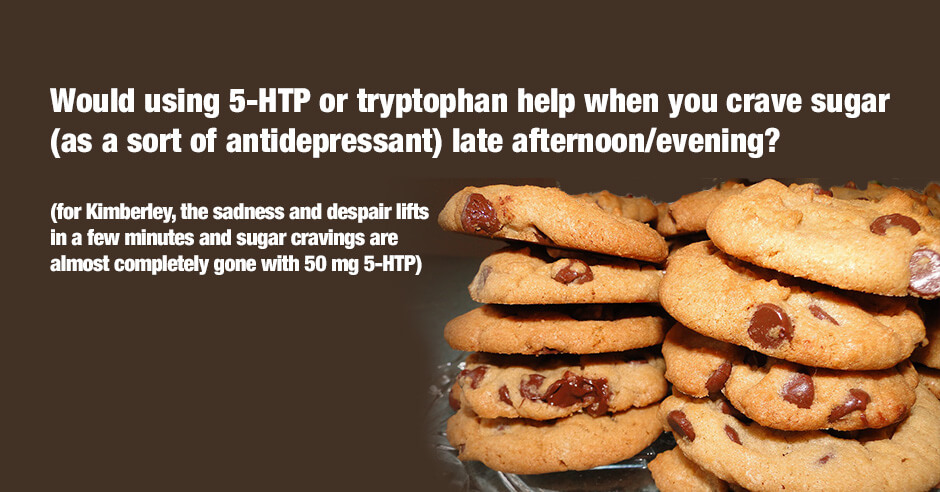
Would using 5-HTP or tryptophan help when you crave sugar (as a sort of antidepressant) late afternoon/evening?

June 2, 2023 By Trudy Scott 29 Comments

5-htp and sugar craving

Would using 5-HTP or tryptophan also help when you crave sugar (as a sort of antidepressant) late afternoon/evening? ~ Kimberley

This question was posed in response to my recent blog post about using tryptophan or 5-HTP to help with alcohol cravings/addiction in the late afternoon/evening – to help you wind down and relax, improve mood and sleep, and also as a reward/treat.

I said yes it is often the same cause when it happens late afternoon/evening and when there are other low serotonin symptoms like low mood, anxiety, worry, insomnia etc. When serotonin is low we self-medicate with wine, sugar, carbs, gluten, dairy and chocolate etc. in order to feel good, get a mood boost and reduce stress. 5-HTP or tryptophan stops the sugar cravings, acts as an antidepressant (improving mood) and eases other low serotonin symptoms too.

It turns out Kimberley was craving sugar late afternoon: “it’s definitely late afternoon for me, while I’m making dinner. Maybe it’s time to go back on 5-HTP.”

And then 2 days later she posted how quickly 5-HTP helped when she added it back mid-afternoon:

I was taking a break from tryptophan/5-HTP and realized after reading this post that that might be a mistake! So I added 5-HTP back in mid-afternoon and my sugar cravings are almost completely gone. It’s funny how I forget the symptoms of low neurotransmitters. Thanks for reminding me!

5-HTP works quickly when it’s low serotonin

How wonderful are these results for Kimberley. I never get tired of hearing feedback like this! I appreciate her sharing and giving me permission to share as a blog so you get to learn and be inspired too.

It’s not unusual for 5-HTP to work this quickly and when it does it’s a clue that the symptoms are related to low serotonin and that she found the ideal dose for her needs.

Kimberley had good results with 5-HTP in the past so she went back to what had worked for her before and it worked for her again.

But do keep in mind, some folks do better with 5-HTP and some do better with tryptophan so it’s a matter of doing a trial of each one each.

50 mg 5-HTP: the sadness and despair lifts in a few minutes

A week later she kindly came and shared additional details in the comments of the tryptophan/ 5-HTP alcohol cravings blog, saying:

It’s possible that I was already in the middle of my daily, mid-afternoon chocolate chip binge when I saw your post

I took a 50 mg 5-HTP along with my mid-afternoon Endorphigen capsule, and within just a few minutes I felt the sadness and despair that I often feel in the late afternoon, start to lift. I was astonished at how quickly it worked! I didn’t open the capsule, or chew it, I just swallowed it with water and had a snack afterwards. I really can’t thank you enough for asking that question because I was really struggling with low mood and sadness almost every day.

Even though KImberley had used 5-HTP with success in the past, she was still astonished how quickly it worked and how effective it was. She was also surprised she had forgotten her prior low serotonin symptoms:

Up until January I had taken 5-HTP in the mid-afternoon and then Tryptophan at bedtime, but I wanted to try a program to support my thyroid. That program told me that too much serotonin is often at the root of gut damage, so I weaned myself off of the 5-HTP and tryptophan. I didn’t really notice much difference, except the daily sugar cravings.

I’m not sure how I could so easily forget the symptoms of low serotonin, but I did.

Your question really was a God-send for me, Trudy. It reminded me that there was an option for feeling better (in fact, MUCH better than sugar makes me feel) that didn’t involve something that’s not good for me.

And I really did feel remarkably better the same day, and those results have continued.

Thanks again, Trudy, for continuing to bring these topics up. Some of us are forgetful and need reminding. Usually, when you have symptoms of low serotonin there are enough other issues going on in your life that it’s easy to overlook the obvious. So I’m very grateful that you asked the question, because I feel so much better able to deal with my circumstances now that I’m back on the 5-HTP. Blessings to you!

I am curious about the program that told her too much serotonin is often at the root of gut damage and if they suggested stopping 5-HTP and tryptophan. It doesn’t make any sense to me.  I’ll report back when I learn more about this.

More tired during the day and a headache: what to consider

She did mention “I’m finding myself more tired during the day and have also had a headache for the last few days.” I would suspect chocolate/caffeine withdrawal may have caused her headache.

With feeling more tired I’d also watch the dose of 5-HTP. She may find less is better for her needs.

She is also trying tryptophan at bedtime so that may be making her more tired the next day. Doing one amino acid at a time is often the best way to know how each one is affecting you.

Finding what works for your unique needs

Here are some other amino acid/sugar cravings blog posts that illustrate how we all have unique needs and different biochemical imbalances:

  • The individual amino acids glutamine, GABA, tryptophan (or 5-HTP), DPA and tyrosine are powerful for eliminating sugar cravings, often within 5 minutes

The individual amino acids glutamine, GABA, tryptophan (or 5-HTP), DPA and tyrosine are powerful for eliminating sugar cravings, often within 5 minutes. It seems that this wonderful benefit – over and above the anxiety-reducing and mood-boosting benefits – is often overlooked or poorly understood.

  • GABA for ending sugar cravings (and anxiety and insomnia)

For Melissa, an unexpected result was that she stopped craving sugar (chocolates, ice cream and truffles) after about a week of taking GABA for her travel anxiety.

It’s a matter of finding what works for your sugar cravings and unique needs. GABA worked for Melissa and yet 5-HTP works for Kimberley – for their sugar cravings.

Here is the tryptophan/5-HTP alcohol cravings blog that started the discussion: Tryptophan had the added benefit of turning me completely off alcohol when I took it to improve mood and sleep during perimenopause. In this case, tryptophan helped Victoria quit the wine that she was self-medicating with in order to feel good and relax.

Resources if you are new to using amino acids as supplements

If you are new to using amino acids as supplements, here is the Amino Acids Mood Questionnaire from The Antianxiety Food Solution (you can see all the symptoms of neurotransmitter imbalances, including low GABA, low serotonin and low endorphins).

If you suspect low levels of any of the neurotransmitters and do not yet have my book, The Antianxiety Food Solution – How the Foods You Eat Can Help You Calm Your Anxious Mind, Improve Your Mood, and End Cravings, I highly recommend getting it and reading it before jumping in and using amino acids on your own so you are knowledgeable. And be sure to share it with the practitioner/health team you or your loved one is working with.

There is an entire chapter on the amino acids and they are discussed throughout the book in the sections on gut health, gluten, blood sugar control, sugar cravings, anxiety and mood issues.

The book doesn’t include product names (per the publisher’s request) so this blog, The Antianxiety Food Solution Amino Acid and Pyroluria Supplements, lists the amino acids that I use with my individual clients and those in my group programs. You can find them all in my online store.

If, after reading this blog and my book, you don’t feel comfortable figuring things out on your own (i.e. doing the symptoms questionnaire and respective amino acids trials), a good place to get help is the GABA QuickStart Program (if you have low GABA symptoms too). This is a paid online/virtual group program where you get my guidance and community support.

If you are a practitioner, join us in The Balancing Neurotransmitters: the Fundamentals program. This is also a paid online/virtual program with an opportunity to interact with me and other practitioners who are also using the amino acids.

Has 5-HTP helped reduce your cravings and/or feelings of despair and sadness? How much helps and how quickly?

Or do you find tryptophan works better for you? If yes, how much helps and how quickly?

What sugary food/s do you self-medicate with in order to feel good?

If you’re a practitioner, do you use this approach with your clients/patients?

Feel free to post your feedback and questions here in the comments.

Filed Under: 5-HTP, Cravings, Depression, Tryptophan Tagged With: 5-HTP, addiction, alcohol cravings, amino acids, antidepressant, anxiety, carbs, crave sugar, dairy, despair, evening, GABA, gluten, insomnia, late afternoon, low serotonin, mood, neurotransmitters, relax, sadness, self-medicate, sleep, sugar, sugar cravings, the GABA Quickstart online program; and Balancing Neurotransmitters: the Fundamentals program for practitioners, tryptophan, wine, worry

What causes low serotonin? Use tryptophan/5-HTP to help with the anxiety, overwhelm and worry right away and address all the root causes

May 13, 2022 By Trudy Scott 40 Comments

what causes low serotonin

Low serotonin has a number of root causes which can be different for each person. If you do have low serotonin levels you always want to figure and address why it’s low. This can take time to figure out and resolve so you want to be using either tryptophan or 5-HTP (and sometimes both) to boost your serotonin levels and get symptom relief quickly. This helps with the worry, overwhelm, anxiety, insomnia, carb cravings, TMJ, irritability, PMS, anger, OCD, low mood and ruminations right away. It also helps with the worry and overwhelm triggered by sometimes complex and challenging root causes.

Here is a list of some of the many factors that may cause low serotonin for you:

  • stress and adrenal dysfunction (high cortisol affects your sex hormone and neurotransmitter production, inlcuding serotonin)
  • eating junk food and sugar (a Western diet “of processed or fried foods, refined grains, sugary products, and beer was associated with a higher odds of mood disorders”
  • consuming caffeine (which reduces zinc and B vitamins, needed to make serotonin)
  • not consuming enough quality animal protein (amino acids are the building blocks of our neurotransmitters, and grass fed red meat provides zinc, iron and omega-3s – all needed to make serotonin)
  • low stomach acid (meaning you can’t digest the protein you’re consuming)
  • gluten issues (leading to low serotonin and other nutritional deficiencies such as low iron, low vitamin D etc.)
  • low vitamin D (“Brain serotonin is synthesized from tryptophan by tryptophan hydroxylase 2, which is activated by vitamin D hormone”)
  • low iron/ferritin levels (iron is a cofactor for making serotonin)
  • dysbiosis and microbiome imbalances (we make so much serotonin in the gut)
  • candida (in one study short exposure to serotonin resulted in antifungal activity)
  • liver issues (affecting how you process xenoestrogens)
  • low bile production (affecting how you digest the healthy fats you’re eating)
  • sex hormone imbalances (serotonin and estrogen are very closely linked and women make less serotonin than men. In one study, tryptophan improved the low serotonin PMS symptoms)
  • thyroid imbalance (“it is postulated that one mechanism, among others, through which exogenous thyroid hormones may exert their modulatory effects in affective illness is via an increase in serotonergic neurotransmission”)
  • histamine imbalances (in one study “Acute LPS-induced inflammation increases CNS histamine and decreases CNS serotonin)”
  • the birth control pill (which lowers zinc and vitamin B6, both of which are needed for serotonin production)
  • statins (leading to cholesterol that is too low)
  • mold exposure/mycotoxins/mold poisoning
  • heavy metal toxicity such as lead (and tryptophan and ascorbic acid can help ease the anxiety)
  • Lyme disease and other co-infections (serotonin was found to be low in cerebrospinal fluid in patients with post-Lyme disease syndrome i.e. chronic Lyme)
  • collagen consumption (in susceptible folks this can lower serotonin levels)
  • seasonal allergies (“Cytokines may lead to a mood disturbance via the expression of the IDO enzyme, which shifts the synthesis of tryptophan from serotonin to kynurenine. The resultant acute tryptophan depletion results in decreased brain serotonin”)
  • genetics (one example is the MTHFR polymorphism)
  • low zinc, low vitamin B6 (and other B vitamins), low selenium, low magnesium etc. – all needed to make serotonin
  • oxalates (which can bind to zinc and deplete it)
  • a high copper diet (nut flours on Paleo diets can be problematic), copper IUD, copper pipes etc. (which can cause low zinc)
  • lack of nature (forest bathing reduces cortisol which affects serotonin production)
  • lack of exercise
  • lack of sunshine (like in the winter when serotonin declines)

When I posted some of this list on Facebook earlier this week, there was a great deal of interest, hence this blog. I’ve included one relevant link for each one so you can read further on the topic.

When I posted it I also asked this: “Have you figured out your root cause/s that are contributing to your low serotonin levels? And has tryptophan or 5-HTP helped while you’re figuring it all out?”

Leanne has mold, dysbiosis, Lyme, low vitamin D, bile issues and more

Leanne responded and gave me the go ahead to share especially if this helps someone else (I appreciate that!) She shared she has identified these root causes:

Mold. Dysbiosis. Possible Lyme/co-infections. Low vitamin D. Bile and motility issues. Liver issues. Stress. Low HCL. Those are the ones I’m aware of. And taking each and every day to work on them.  It takes time to heal

I agree it takes time to heal and can be a longer journey for some folks, especially when there are a number of underlying factors. She is in a good frame of mind, saying pragmatically, it takes time to heal. This confirms her serotonin levels are robust i.e. she is not in a state of overwhelm and worry. Sure enough, when I asked if tryptophan or 5-HTP has been helping this was her response:

5-HTP and GABA calm initially helped me in my first round of going through this back in 2015. Then I discovered l-tryptophan about a year ago and that seemed to be a better help over 5-HTP.

Since I’ve just identified that histamine is an issue and started a low histamine diet this past week I noticed less of a need for l-tryptophan as I did before. My body is calming down significantly. And my digestion is working a little better.

But I still have to address mold, SIBO, candida, parasites and possibly Lyme and underlying hidden viruses.

So I know these amino acids will play a key part in supporting me as I dive deeper into addressing them all.

It’s wonderful the amino acids have helped her so much and they will most likely continue to help. A quick comment on her preference for tryptophan over 5-HTP – some folks do better on one vs the other.

Regarding the histamine issues/root cause, it’s good that she is now addressing this. Already she needs less tryptophan (for now). Things may fluctuate in the future again as she peels away the onion layers of root causes. She may find she needs tryptophan again or a higher dose or needs to get back on the GABA.

As you can see she has been working on her health for some time. This is not unusual. Slow and steady is just fine, especially when there is so much going on.

The amino acids are intended for short-term use while diet and underlying root causes are addressed. But when the list is long this is a common reason for the ongoing need for serotonin support. Keep in mind, your list may be a short one and may be quick to resolve. And not everyone has the same root causes.

Resources if you are new to using tryptophan or 5-HTP as supplements

If you are new to using tryptophan or 5-HTP as supplements, here is the Amino Acids Mood Questionnaire from The Antianxiety Food Solution (you can see all the low serotonin symptoms).

If you suspect low levels of serotonin or any of the neurotransmitters and do not yet have my book, The Antianxiety Food Solution – How the Foods You Eat Can Help You Calm Your Anxious Mind, Improve Your Mood, and End Cravings, I highly recommend getting it and reading it before jumping in and using amino acids on your own so you are knowledgeable. And be sure to share it with the team you or your loved one is working with.

There is an entire chapter on the amino acids and they are discussed throughout the book in the sections on gut health, blood sugar control, sugar cravings, self-medicating with alcohol and more.

The book doesn’t include product names (per the publisher’s request) so this blog, The Antianxiety Food Solution Amino Acid and Pyroluria Supplements, lists the amino acids that I use with my individual clients and those in my group programs.

If you are a practitioner, join us in The Balancing Neurotransmitters: the Fundamentals program. This is also a paid online/virtual program with an opportunity to interact with me and other practitioners who are also using the amino acids.

Have you figured out your root cause/s that are contributing to your low serotonin levels? And does this give you a better understanding of your own issues?

Do you have any other root causes I may have missed? (when I posted this list on Facebook, a few people pointed out I had missed a few. I’ll update the list and continue to add as we discover new connections).

Has tryptophan and/or 5-HTP helped you feel less overwhelmed and worried while you’re figuring it all out?

Have you adjusted doses of tryptophan and/or 5-HTP as things change and root causes are addressed/resolved?

If you’re a practitioner, do you have anything to add and do your clients/patients find this useful?

If you have questions please share them here too.

Filed Under: 5-HTP, Anxiety, serotonin, Tryptophan Tagged With: 5-HTP, adrenal dysfunction, anxiety, bile issues, candida, collagen, diet junk food, dysbiosis, gluten, high cortisol, histamine, iron, Lead toxicity, low cholesterol, low stomach acid, lyme, mold, overwhelm, red meat, root causes, seasonal allergies, serotonin, stress, sugar, thyroid, tryptophan, vitamin D, What causes low serotonin?, worry

GABA helps 14-year-old with Tourette’s Syndrome (the tics and sleep), and tyrosine makes him happier and his mind sharper

January 21, 2022 By Trudy Scott 30 Comments

gaba tyrosine teenager

We typically associate low GABA, a calming neurotransmitter, with a physical-type of tension- anxiety that also often affects sleep. However there is evidence that low GABA is also a factor in other conditions. One of these conditions is Tourette’s Syndrome, which is characterized by the presence of chronic tics which can be motor/movement and vocal. In today’s blog I share some research that suggests a deficit in GABAergic transmission may contribute to symptoms in Tourette’s and a case study where a teenage boy found relief from his tics when using the amino acid GABA as a supplement. GABA also improved his sleep. He also made some dietary changes – no gluten, no sugar and no caffeine – and supplemented with magnesium and melatonin. The amino acid tyrosine, used as a supplement, also improved his low mood and focus, both of which can be issues with Tourette’s.

Kim, a mom in this community, shared this wonderful feedback about her son in response to a Facebook post a few years ago:

Because of your book, I started using GABA for my 14-year-old son with moderate to severe Tourette’s Syndrome, and the results have been significant. Highly recommended for tics, and sleep for these individuals. Thank you.

I asked her how much GABA he used and how often and she shared this:

He used 750mg GABA nightly before bed, and if tics are really active then additional 300mg. Lots of water and a balanced diet with no caffeine…. life-saver.

Keep in mind that 750mg is considered a high dose. We typically start with 125mg GABA and increase based on each person’s unique needs. There is the temptation to think “I have tics and this is a very severe condition so I need a high dose to start.” You don’t want to be thinking like this. Some people may not need this much and others may need this high dose. We always use the trial method to figure out the ideal dose.

She also shared that when he added tyrosine, he saw benefits from that amino acid supplement too:

He recently added 300mg of l-tyrosine, and it promotes happiness and a sharper mind, due to brain fog. He says he really notices a difference. He has read your book as well.

How wonderful is this? GABA helped reduce his tics and improved his sleep, and tyrosine improved his mood and focus.

I love that he’s read my book – good for him and this mom! It’s never too early to have you and your child read this information. It’s empowering for them so they understand the changes they need to make and why these amino acids, dietary changes and elimination of caffeine make such a difference.

I recently checked in to see how he is doing now and asked what other nutritional approaches helped/help other than GABA, a balanced diet and no caffeine. She shared this:

He’s gluten free, magnesium for sure for the muscle tics, and melatonin for good sleep (Touretters need a routine sleep schedule).

He’s 18 now and is doing way better as he matures, but GABA no doubt has improved his life. We promote GABA and educate others as much as possible.

All this is so great to hear and I love that they now help to educate others about GABA too.

I appreciate that she gave me permission to share, hence this post. (The image above is a stock image and not her son.)

Tourette’s Syndrome and reduced GABA function

This paper, Reduced GABAergic inhibition and abnormal sensory symptoms in children with Tourette syndrome, describes the condition and the role of reduced GABA function:

Tourette Syndrome is characterized by the presence of chronic tics. Individuals with Tourette Syndrome often report difficulty with ignoring (habituating to) tactile sensations, and some patients perceive that this contributes to a “premonitory urge” to tic. While common, the physiological basis of impaired tactile processing in Tourette Syndrome, and indeed tics themselves, remain poorly understood.

It has been well established that GABAergic processing plays an important role in shaping the neurophysiological response to tactile stimulation. Furthermore, there are multiple lines of evidence suggesting that a deficit in GABAergic transmission may contribute to symptoms found in Tourette Syndrome.

In this study, the authors used testing (magnetic resonance spectroscopy) and tasks that were vibrotactile (the perception of vibration through touch) to investigate the role of GABA and atypical sensory processing in these 8-12-year old children with Tourette Syndrome.

They found the following:

  • lower concentration of GABA in the sensorimotor cortex and “impaired performance on tactile detection and adaptation tasks, consistent with altered GABAergic function”
  • the altered/reduced GABAergic function correlated with the severity of motor tics and sensory impairments, “linking the core feature of Tourette Syndrome directly to … brain neurochemistry.”

The authors conclude that this provides a foundation for novel interventions (i.e. medications) but unfortunately do not offer the use of the amino acid GABA as one of these solutions. This is very unfortunate but not unexpected. I plan to reach out to the authors and share this case study and blog.

This research supports why GABA works so well for Kim’s son and why he needed higher amounts of GABA when his tics were more active/severe. And now I’m curious to find out if her son has/had sensory issues and how they improve/improved with GABA. I’ll report back if I hear from her about this.

It’s no surprise that GABA helps his sleep too. There is much evidence supporting this – like the the sleep promoting effects of combined GABA and 5-HTP (or GABA alone or 5-HTP alone).  I’ve also shared many GABA-sleep success stories on the blog. Here is one: Since starting GABA my child sleeps for the first time in years and really notices a difference in his carb cravings. (Use the search feature and “GABA sleep” to find additional blog posts)

Interestingly only 8% of the children in the study had generalized anxiety disorder. Given how common low GABA is in anxiety, and that low serotonin can also be a factor with tics, I would have expected anxiety to be higher.

Evidence supporting the other nutritional changes he made

There is evidence to support the other nutritional changes that Kim’s son made:

  • There are reports that “an increase in tics has been related to the consumption of caffeine and refined sugar.” The authors acknowledge that there is no one diet for Tourette’s, so as always, it’s a matter of figuring out the ideal diet for each child (or adult) with tics. Oligoantigenic diets have been identified as significantly reducing tics. This involves removing foods that can potentially cause a food sensitivity leading to tics and/or behavioral impacts and/or insomnia.
  • A gluten-free diet maintained for one year in patients with Tourette’s Syndrome was shown to markedly reduce tics and OCD in children and adults
  • Magnesium is one of the most used supplements in children with Tourette’s Syndrome. When used with probiotics, omega-3 and multivitamins “Seventy-five per cent of supplement users in the Tourette syndrome group noted improvement, mainly in motor and vocal tics, sleep quality and anxiety reduction.”
  • Melatonin is listed with a number of medications commonly prescribed for tic disorders where sleep issues are also a factor

Keep in mind that the above is not a protocol for relief from tics for everyone with Tourette’s Syndrome. It’s what worked for the unique biochemical needs of Kim’s son.

That said, this could be a framework to start with and build upon.

Tyrosine improves his mood and focus

Tyrosine helps with low catecholamines, improving the curl-up-in-bed low-energy kind of low mood and poor focus. (You can see all the symptoms here.) The typical dose is 500mg tyrosine a few times a day. Kim’s son found just 300mg to be beneficial.

Interestingly, 48% of the children in this study had attention-deficit/hyperactivity disorder (ADHD) with about half of those on stimulant medication. I wonder how many would have also benefited from tyrosine for improving their focus, as it did for Kim’s son.

You can read more about tyrosine for focus and mood, and motivation and energy here.

Resources if you are new to using GABA or tyrosine as a supplement

If you are new to using the the amino acid GABA or tyrosine as supplements, here is the Amino Acids Mood Questionnaire from The Antianxiety Food Solution (you can see the low serotonin and other low neurotransmitter symptoms) and a brief overview here: Anxiety and targeted individual amino acid supplements: a summary.

If you suspect low levels of GABA or catecholamines and do not yet have my book, The Antianxiety Food Solution – How the Foods You Eat Can Help You Calm Your Anxious Mind, Improve Your Mood, and End Cravings, I highly recommend getting it and reading it before jumping in and using amino acids so you are knowledgeable.

And be sure to share it with the team you or your loved one is working with. As I mentioned above, it’s empowering for your teen and also relatively easy reading too.

The book doesn’t include product names (per the publisher’s request) so this blog, The Antianxiety Food Solution Amino Acid and Pyroluria Supplements, lists the GABA and tyrosine products that I use with my individual clients and those in my group programs.

Have you seen results with GABA or any of the above approaches? Or has another approach helped you or your child?

If you’re a practitioner have you seen GABA and any of the above to help? What else has helped your clients/patients?

If you suffer from Tourette’s Syndrome, do you also experience ADHD, insomnia, low mood and/or anxiety?

Feel free to ask your questions here too.

Filed Under: ADHD, GABA, Insomnia Tagged With: ADHD, anxiety, caffeine, focus, GABA, gluten, low mood, magnesium, melatonin, mind sharper, nutritional, sleep, sugar, teen, tics, Tourette’s Syndrome, tyrosine, tyrosine happier

  • Page 1
  • Page 2
  • Page 3
  • Interim pages omitted …
  • Page 5
  • Go to Next Page »

Primary Sidebar

NEW! GABA QuickStart Homestudy (with special intro pricing)

gaba quickstart homestudy

Free Report

9 Great Questions Women Ask about Food, Mood and their Health

You'll also receive a complimentary subscription to my ezine "Food, Mood and Gal Stuff"


Connect with me

Popular Posts

  • Amino Acids Mood Questionnaire from The Antianxiety Food Solution
  • The Antianxiety Food Solution Amino Acid and Pyroluria Supplements
  • Pyroluria Questionnaire from The Antianxiety Food Solution
  • Collagen and gelatin lower serotonin: does this increase your anxiety and depression?
  • Tryptophan for the worry-in-your-head and ruminating type of anxiety
  • GABA for the physical-tension and stiff-and-tense-muscles type of anxiety
  • The Antianxiety Food Solution by Trudy Scott
  • Seriphos Original Formula is back: the best product for anxiety and insomnia caused by high cortisol
  • Am I an anxious introvert because of low zinc and vitamin B6? My response to Huffington Post blog
  • Vagus nerve rehab with GABA, breathing, humming, gargling and key nutrients

Recent Posts

  • What do I use instead of Seriphos to help lower high cortisol that is affecting my sleep and making me anxious at night?
  • BeSerene™ GABA/theanine cream eases severe muscle tension in her neck/shoulders, prevents her bad headaches and quells her anxiety
  • How the correct approach, dose and sublingual use of GABA can be calming and not cause a flushed and itchy face and neck
  • The amino acid glutamine improves low mood by addressing gut health, and it has calming effects too
  • Flight anxiety with heightened breath, physical tension and also fearing the worst (the role of low GABA and low serotonin)

Categories

  • 5-HTP
  • AB575
  • Addiction
  • ADHD
  • Adrenals
  • Alcohol
  • Allergies
  • Alzheimer's disease
  • Amino Acids
  • Anger
  • Antianxiety
  • Antianxiety Food Solution
  • Antidepressants
  • Anxiety
  • Anxiety and panic
  • Autism
  • Autoimmunity
  • benzodiazapines
  • Bipolar disorder
  • Books
  • Caffeine
  • Cancer
  • Candida
  • Children/Teens
  • Collagen
  • Cooking equipment
  • Coronavirus/COVID-19
  • Cravings
  • Depression
  • Detoxification
  • Diabetes
  • Diet
  • DPA/DLPA
  • Drugs
  • EFT/Tapping
  • EMF
  • EMFs
  • Emotional Eating
  • Endorphins
  • Environment
  • Essential oils
  • Events
  • Exercise
  • Fear
  • Fear of public speaking
  • Fertility and Pregnancy
  • Fish
  • Food
  • Food and mood
  • Functional neurology
  • GABA
  • Gene polymorphisms
  • General Health
  • Giving
  • Giving back
  • Glutamine
  • Gluten
  • GMOs
  • Gratitude
  • Gut health
  • Heart health/hypertension
  • Histamine
  • Hormone
  • Hyperparathyroidism
  • Hypoglycemia
  • Immune system
  • Inflammation
  • Insomnia
  • Inspiration
  • Introversion
  • Joy and happiness
  • Ketogenic diet
  • Lithium orotate
  • Looking awesome
  • Lyme disease and co-infections
  • MCAS/histamine
  • Medication
  • Men's health
  • Mental health
  • Mercury
  • Migraine
  • Mold
  • Movie
  • MTHFR
  • Multiple sclerosis
  • Music
  • NANP
  • Nature
  • Nutritional Psychiatry
  • OCD
  • Osteoporosis
  • Oxalates
  • Oxytocin
  • Pain
  • Paleo
  • Parasites
  • Parkinson’s disease
  • PCOS
  • People
  • PMS
  • Postpartum
  • PTSD/Trauma
  • Pyroluria
  • Questionnaires
  • Real whole food
  • Recipes
  • Research
  • Schizophrenia
  • serotonin
  • SIBO
  • Sleep
  • Special diets
  • Sports nutrition
  • Stress
  • Sugar addiction
  • Sugar and mood
  • Supplements
  • Teens
  • Testimonials
  • Testing
  • The Anxiety Summit
  • The Anxiety Summit 2
  • The Anxiety Summit 3
  • The Anxiety Summit 4
  • The Anxiety Summit 5
  • The Anxiety Summit 6
  • Thyroid
  • Thyroid health
  • Toxins
  • Tryptophan
  • Tyrosine
  • Uncategorized
  • Vegan/vegetarian
  • Women's health
  • Yoga

Archives

  • October 2025
  • September 2025
  • August 2025
  • July 2025
  • June 2025
  • May 2025
  • April 2025
  • March 2025
  • February 2025
  • January 2025
  • November 2024
  • October 2024
  • September 2024
  • August 2024
  • July 2024
  • June 2024
  • May 2024
  • April 2024
  • March 2024
  • February 2024
  • January 2024
  • December 2023
  • November 2023
  • October 2023
  • September 2023
  • August 2023
  • July 2023
  • June 2023
  • May 2023
  • April 2023
  • March 2023
  • February 2023
  • January 2023
  • December 2022
  • November 2022
  • October 2022
  • September 2022
  • August 2022
  • July 2022
  • June 2022
  • May 2022
  • April 2022
  • March 2022
  • February 2022
  • January 2022
  • December 2021
  • November 2021
  • October 2021
  • September 2021
  • August 2021
  • July 2021
  • June 2021
  • May 2021
  • April 2021
  • March 2021
  • February 2021
  • January 2021
  • December 2020
  • November 2020
  • October 2020
  • September 2020
  • August 2020
  • July 2020
  • June 2020
  • May 2020
  • April 2020
  • March 2020
  • February 2020
  • January 2020
  • December 2019
  • November 2019
  • October 2019
  • September 2019
  • August 2019
  • July 2019
  • June 2019
  • May 2019
  • April 2019
  • March 2019
  • February 2019
  • January 2019
  • December 2018
  • November 2018
  • October 2018
  • September 2018
  • August 2018
  • July 2018
  • June 2018
  • May 2018
  • April 2018
  • March 2018
  • February 2018
  • January 2018
  • December 2017
  • November 2017
  • October 2017
  • September 2017
  • August 2017
  • July 2017
  • June 2017
  • May 2017
  • April 2017
  • March 2017
  • February 2017
  • January 2017
  • December 2016
  • November 2016
  • October 2016
  • September 2016
  • August 2016
  • July 2016
  • June 2016
  • May 2016
  • April 2016
  • March 2016
  • February 2016
  • January 2016
  • December 2015
  • November 2015
  • October 2015
  • September 2015
  • August 2015
  • July 2015
  • June 2015
  • May 2015
  • April 2015
  • March 2015
  • February 2015
  • January 2015
  • December 2014
  • November 2014
  • October 2014
  • September 2014
  • August 2014
  • July 2014
  • June 2014
  • May 2014
  • April 2014
  • March 2014
  • February 2014
  • January 2014
  • December 2013
  • November 2013
  • October 2013
  • September 2013
  • August 2013
  • July 2013
  • June 2013
  • May 2013
  • April 2013
  • March 2013
  • February 2013
  • January 2013
  • December 2012
  • November 2012
  • October 2012
  • August 2012
  • July 2012
  • June 2012
  • May 2012
  • April 2012
  • March 2012
  • February 2012
  • January 2012
  • December 2011
  • November 2011
  • October 2011
  • September 2011
  • August 2011
  • July 2011
  • June 2011
  • May 2011
  • April 2011
  • March 2011
  • February 2011
  • January 2011
  • December 2010
  • October 2010
  • September 2010
  • July 2010
  • May 2010
  • April 2010
  • March 2010
  • February 2010
  • January 2010
  • November 2009

Share the knowledge!

The above statements have not been evaluated by the Food and Drug Administration. Products listed in this website are not intended to diagnose, treat, cure or prevent any disease.

The information provided on this site is for informational and educational purposes only and is not intended as a substitute for advice from your physician or other health care professional. You should consult with a healthcare professional before starting or modifying any diet, exercise, or supplementation program, before taking or stopping any medication, or if you have or suspect you may have a health problem.


Copyright © 2026 Trudy Scott. All Rights Reserved. | Privacy | Terms and Conditions | Refund Policy | Medical Disclaimer

Free Report

9 Great Questions Women Ask about Food, Mood and their Health

You’ll also receive a complimentary subscription to my ezine “Food, Mood and Gal Stuff”