• Skip to primary navigation
  • Skip to main content
  • Skip to primary sidebar

everywomanover29 blog

Food, Mood and Women's Health – Be your healthiest, look and feel great!

  • Blog
  • About
  • Services
  • Store
  • Resources
  • Testimonials
  • The Book
  • Newsletter
  • Contact
  • Search this site

Amino Acids

The amino acid glutamine improves low mood by addressing gut health, and it has calming effects too

October 3, 2025 By Trudy Scott 2 Comments

glutamine and low mood

Recent research has shown that the amino acid glutamine can positively affect gut health by supporting the gut microbiome, gut mucosal wall integrity, and by modulating inflammatory responses.

As modulated by the vagus nerve, via the enteric nervous system, the gut-brain connection can impact the brain’s neurochemical environment. Poor gut health can disrupt the balance of neurotransmitters, which can result in neuropsychiatric based conditions such as depression.

Glutamine supplementation may provide significant adjunctive nutritional support in cases of depression by promoting proper gut health and function.

The above is an excerpt from the paper, The role of glutamine in supporting gut health and neuropsychiatric factors, published in 2021.

The authors do note the fact that glutamine is a “fundamental precursor to the most prevalent neurotransmitters, GABA and glutamate.” This is why glutamine supplementation can be calming for many individuals and may sometimes be too stimulating for some folks. It also highlights the importance of biochemical individuality and why it’s important to find your ideal dose (more on that below).

I appreciate their call for more research on glutamine, “as well as studies which could explore using glutamine in concert with other supportive amino acids, such as GABA and tyrosine, in an effort to restore neurotransmitter equilibrium” (more on that below too).

Read on below to learn more about how glutamine directly supports gut health and what harms the gut; how to know if glutamine will be calming or too stimulating, and how much to use; and other clues that you may benefit from glutamine; and additional resources when are new to amino acids such as glutamine, GABA and others.

How glutamine directly supports gut health and what harms the gut

From the above paper, glutamine:

1) has a positive impact on sustaining the balance of the gut microbiome
2) increases the expression of tight junction proteins and the integrity of the intestinal lining (i.e. it heals leaky gut)
3) helps to minimize the inflammatory response in situations of gut mucosal irritation (i.e the inner most lining of the digestive tract).

The authors also discuss all of the many factors that are harmful for the gut: highly processed foods, refined sugars, saturated fat, and minimal healthy fatty acids and antioxidants; lack of probiotics and prebiotics; blood sugar swings; stress and high cortisol; medications and alcohol consumption. Much of this is addressed in my book “The Antianxiety Food Solution”

It’s well-worth reading the entire paper for a full understanding of the two-way gut-brain connection via the vagus nerve and the role of the microbiome when it comes to neurotransmitter production and much more.

How to know if glutamine will be calming or too stimulating, and how much to use

As mentioned above, the authors share that glutamine is a precursor to GABA, a calming neurotransmitter i.e. it is often calming.

Glutamine is also a precursor to glutamate and can be too stimulating for some, typically when very high doses are used.

The paper mentions studies that “observed the effects of glutamine supplementation used at doses of between 15 g and 30 g,” however my recommendation is to start low and slowly increase based on your unique need. I have clients and those in my programs start with 500 mg once a day and increase to 1-3 x 500 mg, up to 3 or 4 times a day.

The only way to know if it will be calming or stimulating is to do a trial alone i.e. with no other new supplements, and carefully track the effects.

I also find using glutamine powder and holding it for 1-2 minutes on the tongue is more effective and less is often needed. This has additional benefits of stopping intense sugar cravings in their tracks (more on this below).

Other clues that you may benefit from glutamine: symptoms of low blood sugar

As mentioned above, glutamine helps reduce intense sugar cravings, and prevents low blood sugar (which can actually cause anxiety and panic attacks). This aspect is not mentioned in the paper but addressing low blood sugar is yet another application of glutamine when it comes to anxiety and low mood.

Here are all the symptoms we see with low blood sugar:

  • Crave sugar, starch or alcohol any time during the day
  • Irritable, shaky, headachey – especially if going too long between meals
  • Intense cravings for sweets
  • Lightheaded if meals are missed
  • Eating relieves fatigue
  • Agitated, easily upset
  • Nervous, anxious, panic attacks

And here are some other blog posts that illustrate some of the above:

  • Reactive hypoglycemia in binge eating disorder, food addiction and intense sugar cravings, and how glutamine stops the cravings
  • Waking with a jolt, feeling shaky and anxious: low blood sugar/hypoglycemia, glutamine and eating for blood sugar stability
  • Glutamine for hypoglycemia/low blood sugar: “500mg mixed in water works in 15 minutes and keeps me going for 2 – 3 hours”
  • “A demonic urge to eat sugar and all things sweet”: glutamine opened onto the tongue stops the urge every time!

Together with low serotonin and low GABA, addressing low blood sugar is one of the most effective approaches I use with clients to help ease anxiety.  We achieve this with the use of glutamine and by controlling blood sugar by starting the day with a breakfast that includes quality animal protein.

We may also use tyrosine if there are low dopamine symptoms and d-phenylalanine if there are low endorphin symptoms, in an “effort to restore neurotransmitter equilibrium.”

Additional resources when you are new to using glutamine, GABA or tyrosine, or other amino acids as supplements

We use the symptoms questionnaire to figure out if low blood sugar (indicating a possible need for glutamine) or low GABA (indicating a possible need for GABA or theanine) or low dopamine (indicating a possible need for tyrosine) or other neurotransmitter imbalances may be an issue for you.

If you suspect low levels of any of the neurotransmitters and do not yet have my book, The Antianxiety Food Solution – How the Foods You Eat Can Help You Calm Your Anxious Mind, Improve Your Mood, and End Cravings. I highly recommend getting it and reading it before jumping in and using amino acids on your own so you are knowledgeable. And be sure to share it with the practitioner/health team you or your loved one is working with.

There is an entire chapter on the amino acids and they are discussed throughout the book in the sections on gut health, gluten, blood sugar control (this and glutamine is covered in an entire chapter too), sugar cravings, anxiety and mood issues. The importance of quality animal protein and healthy fats is also covered.

The book doesn’t include product names (per the publisher’s request) so this blog, The Antianxiety Food Solution Amino Acid and Pyroluria Supplements, lists the amino acids that I use with my individual clients and those in my group programs.

If, after reading this blog and my book, you don’t feel comfortable figuring things out on your own (i.e. doing the symptoms questionnaire and respective amino acids trials), a good place to get help is the GABA QuickStart Program (if you have low GABA symptoms too). This is a paid online/virtual group program where you get my guidance and community support.

If you need serotonin support, the Serotonin QuickStart Program is a good place to get help. This is also a paid online/virtual group program where you get my guidance on using tryptophan and 5-HTP safely, and community support during 5 LIVE Q&A calls. You can sign up to be notified when the next live launch of this program is happening.

If you are a practitioner, join us in The Balancing Neurotransmitters: the Fundamentals program. This is also a paid online/virtual program with an opportunity to interact with me and other practitioners who are also using the amino acids.

Now I’d love to hear from you…

Has glutamine helped you with your leaky gut, low mood and/or offered calming effects?

What about intense cravings for something sweet or irritability and poor focus? And other low blood sugar symptoms?

How much do you find helps? And do you use powder or capsules?

Are you interested in a program to learn more about the safe and effective use of glutamine and/or tyrosine?

Feel free to share and ask your questions below.

Filed Under: Amino Acids, Anxiety, Depression, GABA, Glutamine, Gut health Tagged With: amino acid, blood sugar, calming, cravings, depression, GABA, glutamate, glutamine, gut, gut health, gut-brain connection, Inflammation, low mood, microbiome, mood, neuropsychiatric, neurotransmitters, serotonin, stimulating, tyrosine, vagus nerve

Flight anxiety with heightened breath, physical tension and also fearing the worst (the role of low GABA and low serotonin)

September 19, 2025 By Trudy Scott Leave a Comment

flight anxiety

Do you have suggestions for supplements for flight anxiety, something to make flying bearable without heightened breath, etc, or is that out of the supplement realm?

I also have physical tension and fear the worst. Any kind of turbulence or warnings of turbulence makes me extremely nervous.

K asked this question on one of my blogs and I responded that this is very much in the supplement realm! And what we use depends on the type of anxiety someone is experiencing.

I would first consider serotonin support before and during flying – tryptophan or 5-HTP – because she fears the worst and feels extremely nervous. With low serotonin there may also be  worry and fear leading up to the trip, as well as feelings of panic and imagining the worst during the flight.

GABA support – using the amino acid GABA or theanine – should also be considered for the more physical symptoms of heightened breath and physical tension. With low GABA there can be other physical symptoms such as excessive sweating (like the palms), a racing or pounding heart and a dry mouth. These amino acids could also be used leading up to the flight and during the trip if needed.

Read on for more on my insights on using these amino acids in a situation like this, additional information about fear of flying and a success story with GABA.

Serotonin and/or GABA support for fear of flying

In an ideal situation I would want to address both low serotonin and low GABA before flying and have her use extra during the flight, as needed. It’s very likely that many of the low serotonin and low GABA symptoms are present in some way in her day to day life too.

This means she can be methodical about doing a trial of the respective amino acids and figure out the optimal dose of each in familiar surroundings – using powder, capsule opened, sublingual, chewable or liposomal.

As always we trial one at a time so we know which one is working best. Keep in mind some folks do better with tryptophan and some do better with 5-HTP so both may need to be trialed. The same can be said for GABA and theanine.

Once the product and dose of each has been figured out, she’ll need to find a suitable option for use while traveling i.e. a sublingual or chewable tablet

It’s always a comprehensive approach

It’s a comprehensive approach – amino acids AND diet so I recommend eating real whole food, quality animal protein, eating for blood sugar stability, going gluten-free, sugar-free and caffeine-free, eating healthy fats, organic vegetables and fruit and fermented foods. My book “The Antianxiety Food Solution”  is a great place to start when you are new to the amino acids and other anxiety nutrition solutions like gluten/sugar/caffeine removal, blood sugar control, gut health, pyroluria etc.

During travel it’s important to be prepared with healthy travel foods and drinks. I share some ideas here.

The definition of a specific phobia such as the fear of flying

The fear of flying is called aviophobia and it’s one of many common phobias about something specific. According to this ebook

Specific phobia is an anxiety disorder characterized by excessive and irrational fear of a particular object, situation, or activity. The anxiety response goes beyond normal apprehension and leads to avoidance behavior. The intensity of the fear is often disproportionate to the actual danger posed by the phobic stimulus.

Common examples of specific phobias include fear of heights (acrophobia), fear of spiders (arachnophobia), fear of flying (aviophobia), and fear of needles (trypanophobia). People with specific phobias may experience intense anxiety or panic attacks when exposed to the feared object or situation.

This Australian article reports that “One in six people have a significant fear that prevents them from flying, and about one in five regular flyers use alcohol or prescription drugs to “help” them through a flight, according to Victoria’s Department of Health.”

Using the amino acids to address low serotonin and/or low GABA addresses the root cause and does away with the need for alcohol and antianxiety meds (and the associated side-effects).

Cognitive behavior therapy (CBT) and exposure therapy is often recommended for aviophobia but doesn’t always help, and doesn’t address the biochemical imbalances.

A success story with GABA before and during a flight – cool as a cucumber

Melissa started using Source Naturals GABA Calm in anticipation of holiday travel and holiday gatherings and shared this:

I’m glad I saw the post about GABA on your FB page a couple weeks ago. I bought Source Naturals GABA Calm and have been taking 1-3 per day for two weeks.

I’m glad I bought it before travelling home for Christmas – I was cool as a cucumber at the airport and was much calmer when visiting family and friends compared to last year! The true test of its efficacy will be in two weeks when the semester starts. For now, I notice a general calmness and am sleeping well.

Notice that she started using it in the 2 weeks leading up to her trip and not on the flight itself.

Additional resources when you are new to using tryptophan or GABA and other amino acids as supplements

We use the symptoms questionnaire to figure out if low serotonin or low GABA or other neurotransmitter imbalances may be an issue for you.

If you suspect low levels of any of the neurotransmitters and do not yet have my book, The Antianxiety Food Solution – How the Foods You Eat Can Help You Calm Your Anxious Mind, Improve Your Mood, and End Cravings. I highly recommend getting it and reading it before jumping in and using amino acids on your own so you are knowledgeable. And be sure to share it with the practitioner/health team you or your loved one is working with.

There is an entire chapter on the amino acids and they are discussed throughout the book in the sections on gut health, gluten, blood sugar control (this is covered in an entire chapter too), sugar cravings, anxiety and mood issues. The importance of quality animal protein and healthy fats is also covered.

The book doesn’t include product names (per the publisher’s request) so this blog, The Antianxiety Food Solution Amino Acid and Pyroluria Supplements, lists the amino acids that I use with my individual clients and those in my group programs.

If, after reading this blog and my book, you don’t feel comfortable figuring things out on your own (i.e. doing the symptoms questionnaire and respective amino acids trials), a good place to get help is the GABA QuickStart Program (if you have low GABA symptoms too). This is a paid online/virtual group program where you get my guidance and community support.

If you need serotonin support, the Serotonin QuickStart Program is a good place to get help. This is also a paid online/virtual group program where you get my guidance on using tryptophan and 5-HTP safely, and community support during 5 LIVE Q&A calls. You can sign up to be notified when the next live launch of this program is happening.

If you are a practitioner, join us in The Balancing Neurotransmitters: the Fundamentals program. This is also a paid online/virtual program with an opportunity to interact with me and other practitioners who are also using the amino acids.

Have you had success using serotonin and/or GABA support for your fear of flying (or other phobia/s)? If yes, which amino acids have helped you?

Did you have any success with CBT or exposure therapy or other approaches?

Feel free to share and ask your questions below.

Filed Under: Amino Acids, Anxiety, GABA, serotonin Tagged With: 5-HTP, amino acids, anxiety, aviophobia, dry mouth, fear, fear the worst, fearing the worst, flight anxiety, flying, GABA, heightened breath, low GABA, low serotonin, nervous, panic, physical-tension, racing heart, supplement, sweating, theanine, tryptophan, turbulence, worry

How can I help my anxious daughter withdraw from vaping? She wants to quit but gets more anxious when she tries to quit!

September 5, 2025 By Trudy Scott 2 Comments

withdraw from vaping

I have been trying to help my daughter withdraw from vaping but it is proving such a vicious cycle.

She wants to quit but has anxiety and gets health anxiety when she doesn’t use the vape within a certain period – the physical withdrawal signs come thru very quickly for her – rapid heart beat, pain inside etc. which freaks her out and then she vapes…

It’s a hopeless cycle of withdrawals with horrible physical symptoms and then the emotional frustration of using vaping to manage the symptoms and feeling so frustrated with herself.

We tried 5-HTP which did not help. I make sure she gets a great protein, veg, good fat and some carbs for breakfast and she takes home made food to work but she works in hospitality and has really late night / early morning finishes and I feel like we are dealing with a lot more than the addiction here. I’d love to try and find a way to get her use down and hopefully kicked to the kerb.

If we could put her into a deep deep sleep for a few days till the toxin is washed out of her system and have a way to deal with the emotional aspect of withdrawal I think myself and so many other parents in Australia would be grateful.

Vaping is a huge problem in our young people – it’s all thru the schools too. It doesn’t smell, tastes like lollies and parents can’t detect it easily.

Louise is a mom in the community who posted this question on one of the blogs. I feel for her and her daughter and hear her concerns – vaping is a huge problem. However, there is a solution that doesn’t involve putting her daughter into a deep deep sleep – addressing neurotransmitter imbalances as a root cause.

Read on below for information on vaping and the very harmful effects (on the lungs and even bones); how to figure out which emotions are driving the need to use vaping to self-medicate and which amino acids to trial (including my insights for Louise’s daughter); why the amino acids are so powerful when it comes to vaping and other addictions; dietary aspects are foundational and important too, as are really late nights; and additional amino acid resources.

What is vaping and why is it so harmful?

This 2023 Harvard Health Publishing article, Can vaping damage your lungs? What we do (and don’t) know, provides an overview of vaping if you’re not exactly sure what is involved:

Vaping involves heating a liquid and inhaling the aerosol into the lungs. With vaping, a device such as an e-cigarette is used that heats up a liquid (called vape juice or e-liquid) until it turns into a vapor that is inhaled. These devices are commonly called vapes, mods, e-hookahs, sub-ohms, tank systems, and vape pens. They may all look a bit different, but work in similar ways.

These devices heat up various flavorings, nicotine, marijuana, or other potentially harmful substances.

The authors list the potentially harmful substances found in vapes:

  • nicotine
  • ultrafine particles that can be inhaled deep into the lungs
  • flavorings such as diacetyl, a chemical linked to a serious lung disease
  • volatile organic compounds
  • cancer-causing chemicals
  • heavy metals such as nickel, tin, and lead.

And they explain some of the serious lung problems that occur in those who vape: EVALI (e-cigarette, or vaping, product use-associated lung injury) and “popcorn lung” or bronchiolitis obliterans (BO).

One adverse effect that I seldom see mentioned is the potential harms to bone health, including “accelerating bone associated disease progression, impacting skeletal development in younger users and to advise patients following orthopaedic surgery, dental surgery, or injury to maximise bone healing.”

Unfortunately it’s the flavors in nicotine and cannabis vape products – candy/dessert, fruit, and fruit-ice combination vs tobacco flavor – that increased adolescents’ willingness to try them. “Comprehensive bans on flavored vapes would likely reduce adolescent use.”

There is growing awareness of these issues and fortunately rates of vaping are declining, however we do have to address why teens and young adults are seeking something calming or soothing such as vaping (or smoking or drinking) i.e. neurotransmitter imbalances.

How to figure out which emotions are driving the need to use vaping to self-medicate and which amino acids to trial?

This is how I would suggest this mom works with her daughter to help them figure out which emotions are driving the need to use vaping to self-medicate and which amino acids to trial:

How do you feel before vaping? How do you feel after vaping? Likely brain chemistry imbalance Amino acid/s to supplement
Anxious or stressed (physical anxiety) Calm or relaxed Low GABA GABA, pharmaGABA or theanine
Low mood, worried, fearful? (mental anxiety) Happy or content Low serotonin Tryptophan or 5-HTP
Tired, unfocused, low motivation Energetic, alert, or focused Low catecholamines, low dopamine Tyrosine
Desire for a reward or treat, sad (weepy), emotional Rewarded or comforted Low endorphins DPA (d-phenylalanine) or DLPA
Irritable and shaky Grounded or stable Low blood sugar Glutamine

We use this in conjunction with the symptoms questionnaire for each neurotransmitter and trial the respective amino acids one at a time.

I often see low GABA to be a driving reason for vaping, smoking cigarettes and drinking alcohol – they are all ways of self-medicating in order to calm down and reduce stress. And research supports this connection with “disturbances to GABA dynamics” “found to play a key role in … substance dependence and addiction.”

Louise mentions her daughter notices “physical withdrawal signs” of “rapid heart beat, pain inside” when trying to quit so it’s very possible there is a low GABA aspect to her addiction. I would consider a trial of GABA to start if she also has other low GABA symptoms.

She also shares that her daughter has “health anxiety” and freaks out when she starts to get withdrawal symptoms. If she resonates with being fearful and worried then it’s possible there is also a low serotonin aspect for her. Louise mentions that 5-HTP didn’t help but not how much they trialed or if they increased to try and find the ideal amount. If her daughter has other low serotonin symptoms I’d revisit this and also consider a trial of tryptophan as some individuals do better on one vs the other. I’d also use both as powder on the tongue in case that makes a difference.

And when I hear “hopeless” and “emotional” I would also be considering low endorphins and a trial of DPA (d-phenylalanine).

Why the amino acids are so powerful when it comes to vaping and other addictions

The amino acids play many roles in addressing a vaping addiction:

  • They address the root cause of the addiction i.e. the neurotransmitter imbalance/s
  • They help you to quit vaping with no willpower and without feeling deprived
  • They help to mitigate many of the adverse effects (like worse sleep issues and feeling more anxious)
  • They address the emotional aspect so mood and anxiety is improved
  • They prevent the need to find a replacement like sugar, coffee, Diet soda and alcohol and cigarettes (intake of any of these may increase when vaping is stopped, unless the neurotransmitter imbalances are addressed)

Many individuals with addiction issues have imbalances in all areas. We use a similar approach for vaping as we use for addictions to alcohol, cigarettes and sugar/carb/junk food i.e. we tackle one imbalance at a time so we know which amino acid is helping and how much is needed.

Dietary aspects are foundational and important too, as are really late nights and detox

I love that mom makes sure her daughter is well-nourished with real whole food – it’s foundational, as I explain in my book “The Antianxiety Food Solution.”

Louise mentions she gets a good breakfast. I’d be making sure she has good quality animal protein at breakfast in order to help with blood sugar stability as this helps with addictions too. And I’d want to make sure she takes healthy protein snacks to work too – like a boiled egg, beef jerky/biltong, a grass-fed beef stick etc.

With really late night / early morning finishes we always consider adrenal issues and address that as needed, after doing salivary testing.

And once Louise’s daughter has quit I would be focusing on detoxification of the toxins using sauna, red light, dry skin brushing and other detox approaches. And making a concerted effort to focus on improving antioxidants and other nutritional deficiencies, and assessing and working to improve her bone health.

Additional resources when you are new to using GABA, tryptophan and other amino acids as supplements

As always, I use the symptoms questionnaire to figure out if low GABA or low serotonin or other neurotransmitter imbalances may be an issue.

If you suspect low levels of any of the neurotransmitters and do not yet have my book, The Antianxiety Food Solution – How the Foods You Eat Can Help You Calm Your Anxious Mind, Improve Your Mood, and End Cravings, I highly recommend getting it and reading it before jumping in and using amino acids on your own so you are knowledgeable. And be sure to share it with the practitioner/health team you or your loved one is working with.

There is an entire chapter on the amino acids and they are discussed throughout the book in the sections on gut health, gluten, blood sugar control (this is covered in an entire chapter too), sugar cravings, anxiety and mood issues.

The book doesn’t include product names (per the publisher’s request) so this blog, The Antianxiety Food Solution Amino Acid and Pyroluria Supplements, lists the amino acids that I use with my individual clients and those in my group programs.

If, after reading this blog and my book, you don’t feel comfortable figuring things out on your own (i.e. doing the symptoms questionnaire and respective amino acids trials), a good place to get help is the GABA QuickStart Program (if you have low GABA symptoms). This is a paid online/virtual group program where you get my guidance and community support. You can sign up to be notified when the next live launch is happening.

If you need serotonin support, the Serotonin QuickStart Program is a good place to get help. This is also a paid online/virtual group program where you get my guidance on using tryptophan and 5-HTP safely, and community support during 5 LIVE Q&A calls. You can sign up to be notified when the next live launch of this program is happening.

If you are a practitioner, join us in The Balancing Neurotransmitters: the Fundamentals program. This is also a paid online/virtual program with an opportunity to interact with me and other practitioners who are also using the amino acids.

Wrapping up and your feedback

I appreciate Louise for asking this question so I could share on this blog and enlighten her and other parents whose teen and young adult children are struggling with vaping.

Does your teen or young adult child struggle with quitting vaping? And have the amino acids helped – if yes, which ones?

Have you personally had a similar issue?

And are you aware how harmful vaping is – for the lungs and even the bones?

Feel free to share and ask your questions below.
Filed Under: Addiction, Amino Acids, Anxiety, GABA, serotonin, Teens Tagged With: 5-HTP, amino acids, anxious, anxious daughter, bones, detox, DPA, emotional, endorphins, flavorings, GABA, late nights, lung damage, lungs, neurotransmitter imbalances, nicotine, protein, rapid heart beat, self-medicate, serotonin, teens, tryptophan, vaping, wants to quit, withdraw from vaping, young adults

How to use bright light therapy for increased anxiety, increased panic and SAD during the cold dark winter months

January 19, 2024 By Trudy Scott 2 Comments

bright light therapy

There is a seasonality to anxiety and panic disorder just as there are seasonal variations in mood for certain susceptible individuals:

Following a clinical observation of increased anxiety symptoms and mood changes during winter in panic disorder patients, the Seasonal Pattern Assessment Questionnaire (SPAQ) was completed by 133 patients. Global Seasonality Scores (GSS), and the prevalence of Seasonal Affective Disorder (SAD), were significantly higher than reported in general population studies.

Seasonal changes were also found in anxiety and panic attacks.

These findings suggest the possibility of a common aetiology [etiology or cause] for panic disorder and SAD, that seasonality may be a far more general phenomenon in psychopathology, and that light therapy may be a useful treatment for some panic disorder patients.

The above abstract is from this paper: Seasonality in panic disorder

If you’re new to bright light therapy or are currently using it with success and would like to learn more, I’d like to point you to this excellent review paper, Bright Light as a Personalized Precision Treatment of Mood Disorders. The authors of the above paper cover some of the basics like how to use bright light for SAD (seasonal affective disorder) or the winter blues, and for how long, possible adverse effects and who should not use bright light therapy (this last aspect is theoretical).

This information about bright light and mood disorders can be applied to anxiety and panic attacks, in addition to SAD.

As you’ll read below there are also often benefits for non seasonal depression, bipolar disorder, fatigue, sleep issues, emotional eating and other conditions too.  And bright light therapy can be used in conjunction with the amino acids tryptophan or 5-HTP, and is often used with psychiatric medications too.

How to use bright light for SAD and winter anxiety/panic and for how long?

You sit in front of the light box or full spectrum lamp – on a table or your desk – with open eyes.  Using a standing lamp as a source of light is another option.

The authors of the Bright Light paper share the following approach for SAD (seasonal affective disorder or the winter blues), all of which is applicable for increased anxiety and panic attacks in winter too):

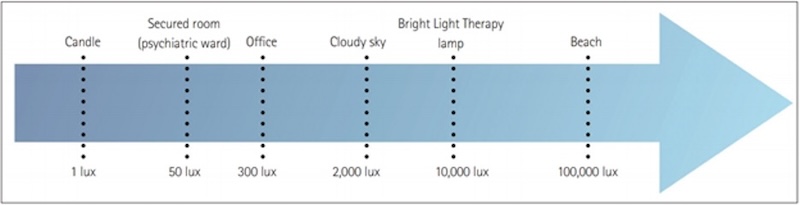
  • Start with a “duration of 30 minutes, using a light intensity of 10,000 lux.” (more on lux comparisons below)
  • “Early morning administration offers greater chances for remission” (although there is documented research and clinical results that for some folks later in the day works well too).
  • “Measured at eye level, a therapeutic distance of 60–80 cm from the light box can be seen as standard requirements (some other devices recommend a distance of 30 cm, so we advise to follow the device recommendations that take into account light parameters and distance).” Most of the lights/devices I recommend state a distance of 30 cm so it’s best to follow the manufacturer’s guidelines.
  • “Lower intensities also appear to be effective, but need longer exposure durations: 2,500 Lux for 2 hours per day or 5,000 Lux for 1 hour a day.” This means sitting further away may allow you to sit in front of the lamp/device for longer duration and get the same benefits.
  • “Significant effects appear only at 2–3 weeks of treatment.” Based on my clinical results, I have clients start to feel some improvements right away with the correct distance and a good lamp.
  • “Treatment is usually continued until the time of usual spontaneous remission in the spring or summer” (and is ideally started as fall/autumn starts to approach rather than in the middle of winter).

I’m also adding this missing and yet important fact from another paper: “The light box is angled ~30° from the line of gaze. The user does not stare directly into the light.”

They also discuss guidelines for year round use of bright light therapy for non-seasonal unipolar depression, another term for major depressive disorder. And midday or morning use for bipolar depression (when on mood stabilizers). I share more about this in my blog: Midday bright light therapy for bipolar depression. I refer you to the study for this information so it can be discussed with your doctor.

Bright light therapy for insomnia and decreased alertness/fatigue

The Bright Light paper also mentions how light therapy “may also be useful to improve sleep quality” … and … “abnormalities in circadian rhythms such as sleep phase delay syndrome, that are frequently associated in mood disorders.”

The authors also mention how light therapy can also help “decreased alertness”, presumably as a result of poor sleep.

Clinically, I see these benefits for clients in similar ways that tryptophan or 5-HTP help with sleep issues. This is related to the serotonin boosting mechanism of bright light therapy. Keep in mind anxiety and panic are symptoms of low serotonin.

What are some possible adverse effects of bright light therapy?

The authors state that bright light therapy “is well-tolerated by patients; adverse effects such as headache, eyestrain, nausea and agitation, are usually transient and mild.” Clinically, I have seldom seen clients experience headache, eyestrain and nausea.

However, I have seen agitation and other low serotonin symptoms get worse – like feeling more sad or more worried or more angry or more irritated or more sleep issues (or all of the above). Too much bright light therapy can ramp up low serotonin symptoms in a similar way that too much tryptophan or 5-HTP can. In other words, it can be overdone and more is not necessarily better. You have to find a balance and figure out what works best for your needs.

I also have clients who are prescribed antidepressants discuss light therapy with their prescribing doctor as I suspect there is the possibility of serotonin syndrome. I don’t see any reports of this in the research and a number of reports of bright light therapy being used successfully in conjunction with antidepressants.

Who should not use bright light therapy?

The authors share these contraindications: “ophthalmic disorders (cataract, macular degeneration, glaucoma, retinitis pigmentosa) and disorders affecting the retina (retinopathy, diabetes, herpes, etc.).” They recommend getting an eye examination if you are in doubt.

Other papers state that the above is theoretical and there are no documented cases of eye damage from bright light therapy. But if you suspect you may be at high risk, get the approval from your ophthalmologist and ongoing monitoring too.

Recommended lights, lamps and panels: always 10,000 lux

This blog post, Winter blues or SAD: light therapy has been updated (as of Jan 2024) with new links for recommended lights/lamps/panels, all 10,000 lux. You can also read feedback from folks who use and find the benefits of full spectrum light or bright light therapy. For example, Chrstine shared this:

My office is the darkest room in the house and I have one sitting on my desk, especially helpful in the winter. This is the second Verilux Happy Light I have used and I really like it. Living in Nevada where there is sunshine over 330 days of the year I am so accustomed to light and brightness that if I am in a dark room or space for too long it really affects me. This has been a great product for me and I can recommend it.

If you’re curious about lux, it is a unit of illumination and this paper, Light Therapy in Mood Disorders: A Brief History with Physiological Insights, includes this very useful lux comparison image:

light therapy and mood disorders
The above is shared under the Creative Commons Attribution License and can be found here .

The combination of using bright light therapy with amino acids such as tryptophan and 5-HTP

I often recommend the use of light therapy in conjunction with amino acids such as tryptophan and 5-HTP. This offers additional serotonin support and helps ease worry-type anxiety, panic attacks, low mood, insomnia, cravings and more. I discuss this combination approach in the winter blues blog.

When someone is already using amino acids with some success, we may just add light therapy and keep amino acid dosing the same or we may use higher doses of amino acids like tryptophan, 5-HTP and GABA during the winter months. We may also use both depending on the person’s unique needs.

I had one client who did really well with tryptophan: his anxiety decreased dramatically but then ramped up before winter. Increasing tryptophan was too much for him so we kept the original tryptophan dose and he started bright light therapy. This worked very well for him until the end of spring when he was able to stop the light therapy.

I also share links to increased OCD (obsessive compulsive disorder), intrusive thoughts, PMDD (premenstrual dysphoric disorder), PMS (premenstrual syndrome), binge eating/emotional eating and drinking/alcoholism in the winter months – and the role of light therapy and amino acids.

Additional resources when you are new to using tryptophan or other amino acids as supplements

We use the symptoms questionnaire to figure out if low serotonin or other neurotransmitter imbalances may be an issue for you.

If you suspect low levels of any of the neurotransmitters and do not yet have my book, The Antianxiety Food Solution – How the Foods You Eat Can Help You Calm Your Anxious Mind, Improve Your Mood, and End Cravings, I highly recommend getting it and reading it before jumping in and using amino acids on your own so you are knowledgeable. And be sure to share it with the practitioner/health team you or your loved one is working with.

There is an entire chapter on the amino acids and they are discussed throughout the book in the sections on gut health, gluten, blood sugar control, sugar cravings, anxiety and mood issues. The importance of quality animal protein is also covered.

The book doesn’t include product names (per the publisher’s request) so this blog, The Antianxiety Food Solution Amino Acid and Pyroluria Supplements, lists the amino acids that I use with my individual clients and those in my group programs.

If, after reading this blog and my book, you don’t feel comfortable figuring things out on your own (i.e. doing the symptoms questionnaire and respective amino acids trials), a good place to get help is the GABA QuickStart Program (if you have low GABA symptoms too). This is a paid online/virtual group program where you get my guidance and community support.

If you are a practitioner, join us in The Balancing Neurotransmitters: the Fundamentals program. This is also a paid online/virtual program with an opportunity to interact with me and other practitioners who are also using the amino acids.

Do you experience increased anxiety, panic attacks and/or the winter blues in the winter months? Have you had success with bright light therapy?

If yes, which full spectrum lamp have you found to be the most useful? What time of the day do you use it, how often do you use it and for what duration?

Have you used a combination of amino acids and light therapy, and adjusted up your amino acids during the colder and darker winter months?

If you’re a practitioner do you recommend light therapy to your clients/patients?

Feel free to share and ask your questions below.
Filed Under: Amino Acids, Anxiety and panic, Depression, Emotional Eating Tagged With: 000 lux, 10, 5-HTP, anxiety, Bipolar, Bright light therapy, depression, emotional eating amino acids, fatigue, GABA Quickstart; Balancing Neurotransmitters: the Fundamentals program for practitioners, how to use, light therapy, mood, panic, SAD, seasonal affective disorder, seasonality, sleep, tryptophan, winter, winter blues

My son has alcohol dependence and I want to help him quit drinking with GABA and other amino acid supplements

September 8, 2023 By Trudy Scott 15 Comments

alcohol and gaba

My son has alcohol dependence and I want to help him quit drinking with GABA and other amino acid supplements. Alcohol and the benzodiazepines used in treatment both block GABA receptors, but I assume having GABA available in your system is better than none (especially as nutrition has been very poor). Have you an article on this? Thank you for your knowledge and understanding.

MJ posted this question on one of the GABA blogs and I shared a few blogs to get her started (some of those are listed below). I also shared that with addictions to alcohol (and sugar and drugs) it’s a matter of figuring out which amino acids are needed in order to balance the neurotransmitters and help you to quit with no willpower and without feeling deprived. This can differ for each person and it’s a matter of doing a trial of each amino acid based on unique needs.

He may well need GABA if he self-medicates with alcohol when under stress, but he may also need serotonin support with tryptophan or 5-HTP if he drinks when depressed and needs a mood lift.

I decided to create a new blog because it’s a much needed topic and so I could share additional resources and a table I use (see below) to help you figure out where your need may be. We use this in conjunction with the symptoms questionnaire for each neurotransmitter.

In addition to addressing her benzodiazepine question, I also shared the need to address low blood sugar, low vitamin B1 and overall nutrient status. She does mention nutrition has been poor and it often is with alcohol addiction.

Which emotions are driving the need to self-medicate with alcohol and which amino acids to trial?

This is how I help you figure out which emotions are driving the need to self-medicate with alcohol and which amino acids to trial:

How do you feel before drinking alcohol? How do you feel after drinking alcohol? Likely brain chemistry imbalance Amino acid/s to supplement
Anxious or stressed (physical anxiety) Calm or relaxed Low GABA GABA, pharmaGABA or theanine
Depressed or worried? (mental anxiety) Happy or content Low serotonin Tryptophan or 5-HTP
Tired or unfocused Energetic, alert, or focused Low catecholamines Tyrosine
Wanting a reward or treat, and sad (weepy) Rewarded or comforted Low endorphins DPA (d-phenylalanine) or DLPA
Irritable and shaky Grounded or stable Low blood sugar Glutamine

We use this in conjunction with the symptoms questionnaire for each neurotransmitter.

Many individuals with alcohol addiction have imbalances in all areas. We use the same approach when it comes to alcohol addictions that we use sugar/carb/junk food addictions i.e. we tackle one imbalance at a time so we know which amino acid is helping and how much is needed.

The amino acids play many roles in addressing alcohol addiction:

  • They help you to quit alcohol with no willpower and without feeling deprived
  • They help to mitigate many of the adverse effects of quitting (like insomnia and increased anxiety and depression)
  • They address the root cause of the addiction i.e. neurotransmitter imbalances
  • They address the emotional aspect so mood and anxiety is improved
  • They help to heal the damage that has been done to the gut: glutamine, GABA and tryptophan
  • They prevent the need to find a replacement like sugar, coffee, Diet soda and cigarettes (intake is often ramped up when drinking ceases)
  • They even help children who have had prenatal exposure to alcohol – 5-HTP benefits both adopted daughters who had prenatal exposure to alcohol: they are happier, more focused and can stay on task

PharmaGABA eases physical anxiety, amino acids ease alcohol withdrawal symptoms, and tryptophan turns you off alcohol

These blog posts illustrate the many applications of amino acids when it comes to quitting alcohol

  • PharmaGABA eases physical anxiety in a young man who has recently given up Adderall, alcohol and nicotine (some folks do better with GABA and some with pharmaGABA)
  • An amino acid supplement with DLPA, glutamine and 5-HTP eases alcohol withdrawal symptoms at an inpatient detoxification program
  • Tryptophan had the added benefit of turning me completely off alcohol when I took it to improve mood and sleep during perimenopause (this need for serotonin support could be applicable for a male too and at any age)

As I mentioned above, be sure to use the search feature to find other blogs on this site: use alcohol, addiction and sugar (and replace sugar with alcohol in the sugar blogs).

Does his prior benzodiazepine prescription prevent him from being able to use GABA?

MJ asks if her son’s prior benzodiazepine prescription will prevent him from being able to use GABA. He will need to taper very very slowly under the guidance of someone knowledgeable and with oversight by the prescribing physician.

It is true that GABA receptors can be affected by benzodiazepines but despite this, many of my clients and others in my community do get relief from GABA during the taper period and afterwards.

We do start with a very small dose – I typically have someone start with 25mg GABA and go up from there – and only use sublingual GABA (or pharmaGABA). For some very sensitive folks we will start even lower as in this example where Syd gets sleep and body anxiety benefits with just 1.5 mg to 3 mg GABA.

I share more on this blog – Rebound insomnia after tapering a benzodiazepine: will taking GABA or any other natural supplement interfere with healing?

One big caveat is that nutritional stability is key when it comes to tapering benzodiazepines. It is also imperative when it comes to addiction recovery.

Good nutritional status, low blood sugar and low vitamin B1

MJ does mention that her son’s nutrition has been poor. It often is with alcohol addiction. I also shared with her the need to address low blood sugar and overall nutrient status.

When you are new to the amino acids and anxiety nutrition solutions my book “The Antianxiety Food Solution” is an excellent resource for all of the above – and the information applies to those with addictions too.  

Here is a blog with additional information and a study on the importance of addressing low blood sugar when it comes to anxiety and also addictions – Anxiety and Hypoglycemia Symptoms Improve with Diet Modification.

This highlights the importance of consuming enough protein, fats and fiber, especially at breakfast. There is an entire chapter on blood sugar in my book – it’s that important.

Finally, low thiamine/vitamin B1 must be addressed: “alcohol misuse is the most common risk factor for thiamine deficiency.” More about this here.

A complete nutritional assessment for other issues should be done too: low vitamin D, low zinc, other vitamin B deficiencies, low magnesium, adrenal insufficiency, leaky gut and more.

Medically assisted withdrawal treatment

If you are wanting to quit alcohol and don’t have an alcohol use disorder, all of the above approaches can be safely used.

However, medically assisted withdrawal treatment may be needed in some instances: “Excessive chronic alcohol users, and particularly patients with alcohol use disorder, may present an alcohol withdrawal syndrome if they abruptly stop drinking. Alcohol withdrawal syndrome requires pharmacological treatment for the treatment of withdrawal symptoms and to prevent withdrawal complications. Medically assisted withdrawal treatment is used in alcohol treatment units, but it is also frequently required in patients admitted to hospital for other conditions.”

It’s important that this is recognized for those who need it. MJ mentions benzodiazepines were used in her son’s treatment so presumably he had medically assisted withdrawal treatment.

In this situation, once her son has safely quit alcohol everything I mention above would then apply – looking at the amino acids and nutritional status so there is no relapse. And so recovery is easier and sustainable with a stable mood and no anxiety.

Resources if you are new to using amino acids as supplements

If you suspect low levels of any of the neurotransmitters and do not yet have my book, The Antianxiety Food Solution – How the Foods You Eat Can Help You Calm Your Anxious Mind, Improve Your Mood, and End Cravings, I highly recommend getting it and reading it before jumping in and using amino acids on your own so you are knowledgeable. And be sure to share it with the practitioner/health team you or your loved one is working with.

There is an entire chapter on the amino acids and they are discussed throughout the book in the sections on gut health, gluten, blood sugar control, sugar cravings, anxiety and mood issues.

The book doesn’t include product names (per the publisher’s request) so this blog, The Antianxiety Food Solution Amino Acid and Pyroluria Supplements, lists the amino acids that I use with my individual clients and those in my group programs. You can find them all in my online store.

If, after reading this blog and my book, you don’t feel comfortable figuring things out on your own (i.e. doing the symptoms questionnaire and respective amino acids trials), a good place to get help is the GABA QuickStart Program (if you have low GABA symptoms too). This is a paid online/virtual group program where you get my guidance and community support.

If you are a practitioner, join us in The Balancing Neurotransmitters: the Fundamentals program. This is also a paid online/virtual program with an opportunity to interact with me and other practitioners who are also using the amino acids.

Have you or a loved one used the amino acids to help with alcohol dependence/alcohol use disorder?

If benzodiazepines were used in the treatment center, was GABA still helpful?

Have the amino acids helped prevent new addictions to sugar/coffee/cigarettes and improved anxiety, depression and insomnia?

If you have questions and other feedback please share in the comments too.

Filed Under: Addiction, Alcohol, Amino Acids, GABA Tagged With: 5-HTP, alcohol, alcohol dependence, amino acid, benzodiazepines, depressed, deprived, drinking, drugs, emotions, GABA, low blood sugar, low vitamin B1, Medically assisted withdrawal treatment; GABA Quickstart; Balancing Neurotransmitters: the Fundamentals program for practitioners, neurotransmitters, nutrition, pharmaGABA, quit drinking, self-medicates, serotonin, stress, sugar, tryptophan, willpower

“Potion” of tyrosine, Endorphigen, GABA and tryptophan has been nothing less than a miracle for my depression and anxiety – how long can I remain on these?

August 11, 2023 By Trudy Scott 21 Comments

amino acids duration

Amy shares how much her particular “potion” or combination of amino acids has helped her depression and anxiety and wants to know how long she can remain on them:

I currently take 500 mg of l-tyrosine in the morning, 1 Endorphigen 2xday, 1 GABA calm 2x day and 1000 mg of tryptophan before bed with some natural calm & true calm. This “potion” has been nothing less than a miracle. I feel pretty good.

The past few years have been rough, managing depression and anxiety with frequent relapse, and I finally feel ok.

I don’t want to wean off yet and am curious as to how long I can remain on these. Is it dangerous to keep on it too long? Is there a maximum time? I follow your blog and reached out to you last year. Your information has been extremely helpful. Thank you.

I’m glad to hear Amy is doing so well on this miracle combination and finally feels ok. Before stopping the amino acids, the goal is to address diet, gut health, nutritional imbalances, toxins and all the underlying factors that lead to low catecholamines, low endorphins, low GABA and low serotonin.

It’s fine to stop taking them and see how you do and add some or all of them back if you find you still need that neurotransmitter support. This is one of a few approaches I use with clients. But here are times when it’s best to wait and continue using them (like when on the pill and when affected by seasonal depression). I share my insights on this and other ways to cut back below.

How long can you remain on amino acids and when do you consider stopping them?

There is no set time frame for staying on the amino acids. As I mentioned above you can stop taking the individual amino acids and see how you do and then add some or all of them back if you find you still need that neurotransmitter support. This is one of a few approaches I use with clients.

Other approaches include: completely stopping one amino acid at a time and monitoring symptoms or reducing the amount one amino acid at a time, also monitoring symptoms. I prefer the latter especially with someone like Amy who has been “managing depression and anxiety with frequent relapse.”

I can also hear that she has some hesitation about stopping her “potion” and going with your gut is a good thing too. She also has a few confounding factors that make me feel staying on them longer may be in her best interest. One factor is her long-term use of birth control pills.

Long term use of birth control pills and the impact on mood and nutritional status

Amy also shares about her use of the birth control pill and how she suspects it’s a factor in her depression and anxiety:

I should also mention I just went off birth control pills. I have taken them since age 16 only stopping for 3 pregnancies and breastfeeding. I am 46. I’ve been on for painful periods. I made the decision to stop for fear of clots, cardiac issues and most importantly my mental well being. I truly believe they contributed to my depression. I believe I’m in perimenopause and have higher than normal anxiety. I’m extremely worried about my periods if I stop the pill and think my amino acid supplements help these worries and I cope better. That’s why I’m reluctant to stop the supplements but still worried about long term use.

Because Amy has been using the birth control pill for around 25 years I’d have her continue with the amino acids for now and address the effects on her gut health and nutritional status first.

Women taking the pill and other hormonal contraception are more likely to be depressed. A Danish study published in JAMA Psychiatry of more than 1 million women aged 15 to 34, with no prior history of depression, were included in the study and followed for 13 years. The researchers found that those women who used the pill were 23% more likely to be depressed and  use antidepressants.

You can read more about the effects of the birth control pill on this blog and my book review of “Beyond the Pill” by Dr. Jolene Brighten. As you’ll read it causes vitamin, mineral, and antioxidant depletion (such as folate, B12, vitamin B6 and zinc).

She did actually come back and share that she tried and it didn’t work out going off the birth control pill. She was unable to manage the pain. She needs to address all these root causes first.

There is also no reason for her to be worried about long term use of the amino acids when they are clearly addressing her neurotransmitter imbalances.

The seasonal impact on mood and anxiety

I don’t have clients make changes to their amino acids in the Fall or Winter when there can be seasonal impacts on mood and anxiety. She had shared this too:

I’m more prone to depression this time of year. I think with these 2 factors [seasonal mood changes and the pill] I’ll stay on the regime until the spring.

This is a wise decision for Amy.

I would also hold off on making changes if someone is prone to airborne allergies. This is because there can be a higher need for neurotransmitter support when there are allergies.

Amy has already made many diet and lifestyle changes so she is heading in the right direction:

I have given my diet an overhaul. Not perfect but significantly less refined carbs and sugar. Plenty of fresh produce, healthy fats and protein ( especially animal). I also have committed to daily “body movement”: yoga, Pilates, max trainer, light weights or bike.

All of these changes are starting to support her overall nutritional status and resilience.

A recap of the amino acids Amy is using and the rationale for each one

If you’re new to using individual amino acids, here is a quick recap of the amino acids Amy is using and the rationale for each one.

She is using 500 mg of l-tyrosine in the morning. This supports low levels of dopamine/catchecolamines and improves the curl-up-in-bed kind of depression. You can read more about tyrosine here.

She is also using Endorphigen twice a day. This is a Lidtke product called Endorphigen and provides 500 mg  DPA/d-phenylalanine  per capsule. It raises endorphin levels, offering a mood boost, typically helping with weepiness and also emotional eating. You can read more about DPA here.

Amy is also using GABA Calm 2x day.  This is a sublingual/chewable product made by Source Naturals and is a nice low dose of 125mg per chewable. You can read more about GABA here.

And finally, she is using 1000 mg of tryptophan before bed. This supports low serotonin and improves worry-kind of anxiety and depression, ruminating, obsessive tendencies and also sleep issues. You can read more about tryptophan here.

Keep in mind this is what Amy found works for her unique needs and would have done trials of the amino acids one by one to figure out which ones to use and how much of each to use. There is no one size fits all.

It’s not unusual for folks using the amino acids to describe their results as miraculous!

Resources if you are new to using amino acids as supplements

If you are new to using amino acids as supplements, here is the Amino Acids Mood Questionnaire from The Antianxiety Food Solution (you can see all the symptoms of neurotransmitter imbalances, including low GABA, low serotonin, low dopamine, low blood sugar and low endorphins).

If you suspect low levels of any of the neurotransmitters and do not yet have my book, The Antianxiety Food Solution – How the Foods You Eat Can Help You Calm Your Anxious Mind, Improve Your Mood, and End Cravings, I highly recommend getting it and reading it before jumping in and using amino acids on your own so you are knowledgeable. And be sure to share it with the practitioner/health team you or your loved one is working with.

There is an entire chapter on the amino acids and they are discussed throughout the book in the sections on gut health, gluten, blood sugar control, sugar cravings, anxiety and mood issues.

The book doesn’t include product names (per the publisher’s request) so this blog, The Antianxiety Food Solution Amino Acid and Pyroluria Supplements, lists the amino acids that I use with my individual clients and those in my group programs. You can find them all in my online store.

If, after reading this blog and my book, you don’t feel comfortable figuring things out on your own (i.e. doing the symptoms questionnaire and respective amino acids trials), a good place to get help is the GABA QuickStart Program (if you have low GABA symptoms too). This is a paid online/virtual group program where you get my guidance and community support.

If you are a practitioner, join us in The Balancing Neurotransmitters: the Fundamentals program. This is also a paid online/virtual program with an opportunity to interact with me and other practitioners who are also using the amino acids.

Thanks to Amy for sharing her results and asking this question.

Have you seen similar benefits when using individual amino acids? If yes, which ones have helped you?

What approach have you used to stop or reduce your doses?

And have you continued using the amino acids because of the effects of the pill, seasonal mood shifts or seasonal allergies (or some other reason)?

If you have questions and feedback please share them here too.

Filed Under: Amino Acids, Anxiety, Depression, Women's health Tagged With: amino acids, catecholamines, dangerous, depression, diet, DPA, Endorphigen, endorphins, GABA, GABA Calm, GABA Quickstart online program; Balancing Neurotransmitters: the Fundamentals program for practitioners, gut health, how long, miracle, neurotransmitters, nutritional imbalances, seasonal depression, serotonin, the pill, toxins, tryptophan, tyrosine

  • Page 1
  • Page 2
  • Page 3
  • Interim pages omitted …
  • Page 13
  • Go to Next Page »

Primary Sidebar

GABA QuickStart Homestudy

gaba quickstart homestudy

Free Report

9 Great Questions Women Ask about Food, Mood and their Health

You'll also receive a complimentary subscription to my ezine "Food, Mood and Gal Stuff"


Connect with me

Popular Posts

  • Amino Acids Mood Questionnaire from The Antianxiety Food Solution
  • The Antianxiety Food Solution Amino Acid and Pyroluria Supplements
  • Pyroluria Questionnaire from The Antianxiety Food Solution
  • Collagen and gelatin lower serotonin: does this increase your anxiety and depression?
  • Tryptophan for the worry-in-your-head and ruminating type of anxiety
  • GABA for the physical-tension and stiff-and-tense-muscles type of anxiety
  • The Antianxiety Food Solution by Trudy Scott
  • Seriphos Original Formula is back: the best product for anxiety and insomnia caused by high cortisol
  • Am I an anxious introvert because of low zinc and vitamin B6? My response to Huffington Post blog
  • Vagus nerve rehab with GABA, breathing, humming, gargling and key nutrients

Recent Posts

  • Her cravings for chips and peanut butter were triggered by stress: GABA ends cravings and reduces physical tension and fear of heights
  • It is truly miraculous to be able to move through life without crippling anxiety and panic
  • GABA and tryptophan combo provide immediate and noticeable relief for tremors and cervical dystonia in just 7 days
  • Red light therapy for back and neck pain, plantar fasciitis and low mood – a complement to the amino acids GABA, DPA and tryptophan
  • What do I use instead of Seriphos to help lower high cortisol that is affecting my sleep and making me anxious at night?

Categories

  • 5-HTP
  • AB575
  • Addiction
  • ADHD
  • Adrenals
  • Alcohol
  • Allergies
  • Alzheimer's disease
  • Amino Acids
  • Anger
  • Antianxiety
  • Antianxiety Food Solution
  • Antidepressants
  • Anxiety
  • Anxiety and panic
  • Autism
  • Autoimmunity
  • benzodiazapines
  • Bipolar disorder
  • Books
  • Caffeine
  • Cancer
  • Candida
  • Children/Teens
  • Collagen
  • Cooking equipment
  • Coronavirus/COVID-19
  • Cravings
  • Depression
  • Detoxification
  • Diabetes
  • Diet
  • DPA/DLPA
  • Drugs
  • EFT/Tapping
  • EMF
  • EMFs
  • Emotional Eating
  • Endorphins
  • Environment
  • Essential oils
  • Events
  • Exercise
  • Fear
  • Fear of public speaking
  • Fertility and Pregnancy
  • Fish
  • Food
  • Food and mood
  • Functional neurology
  • GABA
  • Gene polymorphisms
  • General Health
  • Giving
  • Giving back
  • Glutamine
  • Gluten
  • GMOs
  • Gratitude
  • Gut health
  • Heart health/hypertension
  • Histamine
  • Hormone
  • Hyperparathyroidism
  • Hypoglycemia
  • Immune system
  • Inflammation
  • Insomnia
  • Inspiration
  • Introversion
  • Joy and happiness
  • Ketogenic diet
  • Lithium orotate
  • Looking awesome
  • Lyme disease and co-infections
  • MCAS/histamine
  • Medication
  • Men's health
  • Mental health
  • Mercury
  • Migraine
  • Mold
  • Movie
  • MTHFR
  • Multiple sclerosis
  • Music
  • NANP
  • Nature
  • Nutritional Psychiatry
  • OCD
  • Osteoporosis
  • Oxalates
  • Oxytocin
  • Pain
  • Paleo
  • Parasites
  • Parkinson’s disease
  • PCOS
  • People
  • PMS
  • Postpartum
  • PTSD/Trauma
  • Pyroluria
  • Questionnaires
  • Real whole food
  • Recipes
  • Research
  • Schizophrenia
  • serotonin
  • SIBO
  • Sleep
  • Special diets
  • Sports nutrition
  • Stress
  • Sugar addiction
  • Sugar and mood
  • Supplements
  • Teens
  • Testimonials
  • Testing
  • The Anxiety Summit
  • The Anxiety Summit 2
  • The Anxiety Summit 3
  • The Anxiety Summit 4
  • The Anxiety Summit 5
  • The Anxiety Summit 6
  • Thyroid
  • Thyroid health
  • Toxins
  • Tryptophan
  • Tyrosine
  • Uncategorized
  • Vegan/vegetarian
  • Women's health
  • Yoga

Archives

  • May 2026
  • April 2026
  • October 2025
  • September 2025
  • August 2025
  • July 2025
  • June 2025
  • May 2025
  • April 2025
  • March 2025
  • February 2025
  • January 2025
  • November 2024
  • October 2024
  • September 2024
  • August 2024
  • July 2024
  • June 2024
  • May 2024
  • April 2024
  • March 2024
  • February 2024
  • January 2024
  • December 2023
  • November 2023
  • October 2023
  • September 2023
  • August 2023
  • July 2023
  • June 2023
  • May 2023
  • April 2023
  • March 2023
  • February 2023
  • January 2023
  • December 2022
  • November 2022
  • October 2022
  • September 2022
  • August 2022
  • July 2022
  • June 2022
  • May 2022
  • April 2022
  • March 2022
  • February 2022
  • January 2022
  • December 2021
  • November 2021
  • October 2021
  • September 2021
  • August 2021
  • July 2021
  • June 2021
  • May 2021
  • April 2021
  • March 2021
  • February 2021
  • January 2021
  • December 2020
  • November 2020
  • October 2020
  • September 2020
  • August 2020
  • July 2020
  • June 2020
  • May 2020
  • April 2020
  • March 2020
  • February 2020
  • January 2020
  • December 2019
  • November 2019
  • October 2019
  • September 2019
  • August 2019
  • July 2019
  • June 2019
  • May 2019
  • April 2019
  • March 2019
  • February 2019
  • January 2019
  • December 2018
  • November 2018
  • October 2018
  • September 2018
  • August 2018
  • July 2018
  • June 2018
  • May 2018
  • April 2018
  • March 2018
  • February 2018
  • January 2018
  • December 2017
  • November 2017
  • October 2017
  • September 2017
  • August 2017
  • July 2017
  • June 2017
  • May 2017
  • April 2017
  • March 2017
  • February 2017
  • January 2017
  • December 2016
  • November 2016
  • October 2016
  • September 2016
  • August 2016
  • July 2016
  • June 2016
  • May 2016
  • April 2016
  • March 2016
  • February 2016
  • January 2016
  • December 2015
  • November 2015
  • October 2015
  • September 2015
  • August 2015
  • July 2015
  • June 2015
  • May 2015
  • April 2015
  • March 2015
  • February 2015
  • January 2015
  • December 2014
  • November 2014
  • October 2014
  • September 2014
  • August 2014
  • July 2014
  • June 2014
  • May 2014
  • April 2014
  • March 2014
  • February 2014
  • January 2014
  • December 2013
  • November 2013
  • October 2013
  • September 2013
  • August 2013
  • July 2013
  • June 2013
  • May 2013
  • April 2013
  • March 2013
  • February 2013
  • January 2013
  • December 2012
  • November 2012
  • October 2012
  • August 2012
  • July 2012
  • June 2012
  • May 2012
  • April 2012
  • March 2012
  • February 2012
  • January 2012
  • December 2011
  • November 2011
  • October 2011
  • September 2011
  • August 2011
  • July 2011
  • June 2011
  • May 2011
  • April 2011
  • March 2011
  • February 2011
  • January 2011
  • December 2010
  • October 2010
  • September 2010
  • July 2010
  • May 2010
  • April 2010
  • March 2010
  • February 2010
  • January 2010
  • November 2009

Share the knowledge!

The above statements have not been evaluated by the Food and Drug Administration. Products listed in this website are not intended to diagnose, treat, cure or prevent any disease.

The information provided on this site is for informational and educational purposes only and is not intended as a substitute for advice from your physician or other health care professional. You should consult with a healthcare professional before starting or modifying any diet, exercise, or supplementation program, before taking or stopping any medication, or if you have or suspect you may have a health problem.


Copyright © 2026 Trudy Scott. All Rights Reserved. | Privacy | Terms and Conditions | Refund Policy | Medical Disclaimer

Free Report

9 Great Questions Women Ask about Food, Mood and their Health

You’ll also receive a complimentary subscription to my ezine “Food, Mood and Gal Stuff”