• Skip to primary navigation
  • Skip to main content
  • Skip to primary sidebar

everywomanover29 blog

Food, Mood and Women's Health – Be your healthiest, look and feel great!

  • Blog
  • About
  • Services
  • Store
  • Resources
  • Testimonials
  • The Book
  • Newsletter
  • Contact
  • Search this site

Drugs

Medication tapering and withdrawal: an interview with Dr. Kelly Brogan

April 8, 2016 By Trudy Scott 80 Comments

mind-of-your-own-meme

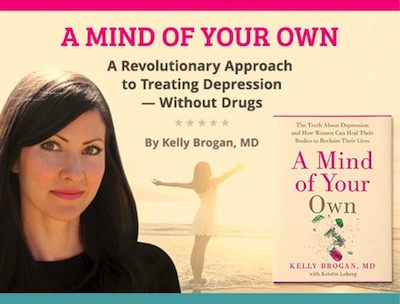
I recently had the absolute pleasure of interviewing Dr. Kelly Brogan, holistic women’s health psychiatrist and author of the new bestseller, A Mind of Your Own. I’ve had the section on medication tapering and withdrawal effects transcribed because it’s so valuable.

=================================================================

Kelly: Now much of my practice is devoted to psychiatric medications tapers. Guess what? I didn’t learn that in my training. There wasn’t a single hour of education on this subject. I have learned how to do this from patients, and really from patients globally who are educating each other and frankly educating physicians about how to engage in a safe and responsible psychiatric medication tapers……

…when you try to taper off a medication after long-term exposure, either because you’re no longer deriving that initial benefit from it, or because something has changes about your life circumstance and you want to try a different kind of healthcare maybe, they you might learn that these are some of the most habit forming medications, I would say habit forming substances, on the planet.

I wouldn’t believe this if I haven’t seen it with my very own eyes, but this is what actually compelled me to put down my prescription pad for good. After I read that book, I began to take patients, or at least offer them the opportunity to taper them off of medication. Even when we did it responsibly, I was essentially running an outpatient rehab. I mean from neurologic symptoms to psychiatric symptoms, physical symptoms, autoimmune diseases flaring, patients developing impulsive behavior and even violence. It was beyond description.

Then I began to see that actually a lot of patients around the world are talking about this. They’re talking about withdrawal from anti-depressant specifically, but of course other medications as well. Their doctors are totally ill-equipped to help them because we don’t learn about how to do this in our training. We actually in fact dismiss patients when they talk about these being addictive medications. Of course, now finally Fava is a group of researchers who have finally begun to publish the reality of this withdrawal syndrome, and how disabling it can be.

Since I have 4 grounded lifestyle interventions, and actually begun with nutrition such that I don’t even begin a medication taper until about 2 months into lifestyle change, everything is different now in my practice. I feel that once you can optimize your physiology, you really put yourself in a much, much better position to safely and strategically taper. Wow. Isn’t that something you would want to know before taking your first prescription? I certainly never told any patients that it could be like a horror show and you might never be able come off of a psychiatric medication if you’re taking it for longer than a year or so. I never informed patients of that.

A lot of what I discuss and describe in this book is in service of presenting people with a full picture of what the science has to say before they make a decision. I think we really wish that there was a magic pill. We really wish there was a safe effective quick fix. Unfortunately, what is available is really anything but that.

Trudy: Yeah. We want that quick fix. I’ve got a few follow on questions, because this is a lot of good information here. The fact that you see all these problems when people are coming off the meds, is there a time frame, or is that really dependent on each person?

Kelly: It’s very, very dependent on each person. That ends up being the take home that we are talking about. What I like to call end of one medicine. We’re talking about the fact that our levels of biochemical individuality have ever been more relevant than when we’re exploring how we interact with chemicals in our environment, in our pharmaceuticals. We really need to understand that every single person is an individual.

When I taper patients off of meds, I normally do what’s called a test dose decrease, which often is around 20% to 25% of the dose. We come down by that. Again, this is after we’ve done the initial months at least of fairly strict dietary compliance working with relaxation response, doing 20 minutes or more of movement, working on sleep. All of this has to happen first. Then we begin, and so we start with a test dose. If we see in about 2 to 4 weeks that test dose is completely well-tolerated, meaning you don’t even notice the difference, then we probably can work in bigger increments. That’s actually a godsend. These tapers, when we’re working in 10% and less doses, could take literally years.

You want to begin to learn about what your body is capable of bouncing back from. We begin with 25%. If that’s not a pretty picture, then we’ll just scale it back to about 10% of the initial dose, and work with that 10% increment at about every 2 to 4 weeks, sometimes unfortunately slower. The increment and then the speed are 2 variables that we have to learn for each patient.

I don’t know what I would do without a compounding pharmacy. While many of these medications are available in liquid form, and some of them, like Effexor for example, have beads inside a capsule, to be able to tailor and personalize the dosage to each individual patient is wonderful and that I have that option through compounding pharmacy. I work with one in Massachusetts named Johnson Compounding, and they’ve just been a wonderful support over the years to my patients.

Trudy: Wonderful. Very slow and then obviously very individualized. Now I’m very familiar with the effects of benzodiazepines and the slow taper process that’s needed for someone on the anti-anxiety benzodiazepine medication. Would you say that SSRIs can have comparable effects in some people, or are they not as bad as the benzodiazepines?

Kelly: That’s a great question. What we’ve observed in psychiatry is that there’s really been a transition from using benzodiazepine as sort of like a spot treatment to transitioning into using anti-depressants long-term. When I was in my training, the typical gold standard protocol would be to start somebody on both benzodiazepine and anti-depressant, and then taper them off to benzodiazepine and leave on the anti-depressant with the thinking being that benzodiazepine are acknowledged for their habit forming properties and anti-depressants are totally safe.

What we are learning is in fact, that group that Fava runs, with the papers that they’re putting out, they are essentially equating the anti-depressant withdrawal phenomenon to benzodiazepines. In my clinical experience, I would actually argue that SSRIs are worse with long-term exposure. A lot of people at this point, given that it’s been decades since Prozac, have been on these medications for more than 10 years. We’re really talking about a level of habituation that could be challenging to undo. It’s not that I haven’t. I struggled a lot with Klonopin for example. It’s not that I haven’t encountered challenges with benzodiazepines.

A patient in my practice I’m taking off of Lexapro a thousandth of a milligram a month. I’ve never heard of something like that. Heroin, crack, cocaine, oxycontin: show me something that would ever require that. It’s unbelievable. I think it’s at least comparable I would say, and that’s what the literature is beginning to demonstrate, is that there are actually comparable phenomenon, but we really never ever talked about anti-depressants in this way, so it really is a game changing perspective.

Trudy: The fact that you say people are not told that this could be a possibility, and the fact that you’re talking about this and writing about it I think is so important, because people need to know. They would choose not to do this if they did know. I see there is this MA bill going through [correction: being proposed – you can read more here]. It’s about benzodiazepines and people needing to consent to the fact that it’s going to possibly cause them issues. It sounds like we need to do the same with these anti-depressants.

Kelly: Absolutely, 100%.

Trudy: Now, I’ve heard that certain SSRIs are worse than others. I’ve heard that Paxil can be really bad. Have you seen a difference between different medications?

Kelly: Basically we look at half-life of these medications, and we extrapolate from there. Assuming that Prozac would be the easiest, and there are medications like Paxil and Effexor that are more challenging. In my experience, there are 2 ways of discontinuation – the field likes to call it discontinuations issues. The first is acute. It’s within 72 hours of a dose change where you can get brain zaps and headache, and gastrointestinal distress, you feel agitated. The Paxils of the world are much more likely to cause those more immediate withdrawal symptoms.

What I have found is unfortunately there’s no free lunch. There isn’t a medication that actually is effortless to come off for everyone, so that even when you’re on Prozac, for example, for a long period of time, even though it has this long half-life, it should be easy to come off of, in my experience, it can often be challenging as well. These other medications often manifest as second waves. What I have found is almost uncanny – after about 2 months, it’s almost always 6 to 8 weeks after the final dose or after a major dose change. It’s like the other shoe can drop.

You have those immediate withdrawal symptoms, and then about 2 months later, you can begin to have what has historically been categorized as a relapse. This is when your doctor will tell you, “You see, you should have never even tried to go off your medication. You need it for life. Now you know.” That’s what we’re taught to say. In fact, it’s actually a protracted withdrawal phenomenon. Again, this has now been documented that this can occur for unfortunately, I don’t want to scare anyone, it can occur for months and months and even years after the final dose. That being said, there is a medication that spares you from that arm of this problem.

Even I went for years tapering patients off of Wellbutrin and thinking, “Well, this is the easy one. I can even come down by 50% of the dose, and it’s not a problem.” Right now, I have in my practice, a patient who has been completely destabilized coming down by 25 milligrams of Wellbutrin. Again, it’s a very individualized process, and I don’t think that there are any obvious choices in terms of medications that are easier come off of after long-term exposure.

Trudy: Thank you for sharing that. It’s scary, but the good thing is that there are solutions. People on these medications must do the slow taper and make all the changes that you’ve talked about. I’m glad that you mentioned, “Don’t rush into this, make all the food changes.” We’re going to talk about some of the things that you recommend in a second, but get yourself in a better place to start making these changes. If you’re listening to this and you’re thinking, “Oh my gosh. This is terrible.” Don’t go and rush out and just stop. You simply don’t want to stop cold turkey. You want to be working with someone. Then obviously read the book and get resources so you can be in a good place when you’re starting to make these changes.

Kelly: Absolutely. That’s all incredibly important. Yes. Please don’t ever consider just stopping your medication.

Trudy: Absolutely. I have one final question on the medication aspect. You’ve got a small section in the book where you talk about using amino acids are helping people taper, and as you know, my community is very into using the amino acids. I find them very helpful for helping people with mood and anxiety issues. Can you talk a little bit about how you use the aminos and how beneficial you find them when someone is doing this taper?

Kelly: Yes. Absolutely. I am quite certain that there are many, many, many roads to physiologic and psycho spiritual resiliency. I, in no way, intend to position myself as having the answer by any means. I am very much trying to create a space for all of those who are passionate about natural healing, including yourself and our colleagues, because I think that just about everything in the natural health arena offers you the potential for very high yield, very low-risk healthcare.

I certainly don’t consider myself an expert in amino acids and don’t have a fraction of the knowledge that you have about this arena. That being said, I do use them for tapers specifically. If I use supplements I wait after a month of dietary change before introducing any supplements, mostly because I want to, I don’t know, send patients the message of what a single intervention, in terms of lifestyle, what a dietary intervention can do in terms of moving the needle of their health. I often don’t want to cloud the picture with other interventions like even supplements or even detox.

After that period, if it is necessary, I’ll often lead with some of the supplements that I talk about, whether it’s probiotic or glandulars, I use a lot based on my work with the only mentor I’ve ever had, Dr. Nicholas Gonzales. I learned a lot about using glandulars, using specific minerals, using fatty acids, that sort of thing. Well, we’re working with SSRIs. I tend to use tryptophan more often than 5-HTP. I do use tryptophan even in the 3 to 6 gram range before dinner and before bed. I would say that it’s helpful often, not in every case, with a lot of the insomnia specifically. It’s about the worst thing that can happen in the setting of a taper. It’s the kind of insomnia that’s induced by psychiatric medication taper.

I have several tricks up my sleeve, and that’s certainly one of them. Through my own self-education, and again, you may have a more sophisticated perspective on this that when you use 5-HTP or tryptophan for the longest period of time, meaning over a couple of weeks, so you want to balance it out with tyrosine or DL-phenylalanine. If we are using it for a period of time, I might incorporate that. I have found that when I work with Wellbutrin tapers, it’s extremely helpful. Tyrosine and actually an herb called mucuna support dopamine.

Then all of my patients who are tapering – I have them on a blend of amino acids.

=================================================================

We cover much more than the medication taper and withdrawal and you can listen to the entire interview here:

https://s3-us-west-2.amazonaws.com/axmisc/kelly-brogan-mind-of-your-own-interview-spr16.mp3


A Mind of Your Own: The Truth about Depression and How Women Can Heal Their Bodies to Reclaim Their Lives is superb, brave, bold, science-based (which I love!) and offers holistic solutions for depression (and anxiety). Get the book from Amazon or better yet, get a copy from your local book store (ask them to get it if they don’t carry it)!
mind-of-your-own-meme2

It launched March 16th and there is a grass-roots effort to share this book widely because of the mainstream media blackout.  Join the grassroots effort and help share this valuable message!

Take a picture with the book and post on social media with #amindofyourown and you can have an impact. You’ll also automatically show up in “hall of fame” on the tagboard.

mind-of-your-own-meme3

You can go and get the first chapter of the book if you’re on the fence (get it here: http://kellybroganmd.com/amindofyourown/?ref=35). After reading the first chapter, I know you’ll want to get the book and join the grass roots effort.

If you already have the book lets us know in the comments what you think.

Feel free to post questions on the blog and please do share your SSRI or benzodiazepine taper and withdrawal story so we can all be better informed.

PS. Both Kelly Brogan and myself will be presenting at the Mindd Conference in Sydney in May. We’ll also be presenting at IMMH/Integrative Medicine for Mental Health Conference in September in Washington DC. Come along to those events, and you can hear Kelly Brogan speak live, and you can hear me speak live as well.


Filed Under: Antidepressants, benzodiazapines, Books, Depression, Drugs, Events Tagged With: a mind of your own, antianxiety, antidepressant, anxiety, benzodiazepine, depressed, interview, Kelly Brogan, medication, SSRI, taper, withdrawal

The Anxiety Summit – New 2015 Food/Nutrient Research on Anxiety and Speaker Highlights

May 6, 2015 By Trudy Scott 107 Comments


The host of the Anxiety Summit, Trudy Scott, Food Mood Expert and Nutritionist, author of The Antianxiety Food Solution opens up the Anxiety Summit Season 3.

New 2015 Food/Nutrient Research on Anxiety and Speaker Highlights

  • Nutritional medicine as mainstream in psychiatry
  • What if nutrients could treat mental illness?
  • The gut microbiome and diet in psychiatry, and the guts of remote Amazon dwellers
  • Dietary guidelines from Brazil, exercise, mindfulness, caffeine and social interaction
  • Preschoolers on Medicaid being prescribed psychotropic drugs and other medication news
  • Speaker highlights, gems and connections

“Nutritional Medicine as Mainstream in Psychiatry” published in January this year.

Psychiatry is at an important juncture, with the current pharmacologically focused model having achieved modest benefits in addressing the burden of poor mental health worldwide. Although the determinants of mental health are complex, the emerging and compelling evidence for nutrition as a crucial factor in the high prevalence and incidence of mental disorders suggests that diet is as important to psychiatry as it is to cardiology, endocrinology, and gastroenterology. Evidence is steadily growing for the relation between dietary quality (and potential nutritional deficiencies) and mental health, and for the select use of nutrient-based supplements to address deficiencies, or as monotherapies or augmentation therapies.

The abstract concludes as follows:

We present a viewpoint from an international collaboration of academics (members of the International Society for Nutritional Psychiatry Research), in which we provide a context and overview of the current evidence in this emerging field of research, and discuss the future direction. We advocate recognition of diet and nutrition as central determinants of both physical and mental health.

I blogged about this earlier this year and you can read more here

Here is part of “What if nutrients could treat mental illness?”

We are at a tipping point in psychiatry.

The growing body of literature on the effect of nutrients on mental health is compelling enough and consistent enough for us to pay attention. It is time to revisit the role of diet and supplementary nutrients in the treatment of mental illness and to invest in this line of research.

Here are the other studies I mentioned:

  • “A randomized controlled trial to test the effect of multispecies probiotics on cognitive reactivity to sad mood”
  • “Indigenous Bacteria from the Gut Microbiota Regulate Host Serotonin Biosynthesis”

Here are 2014 dietary guidelines of Brazil  What is your takeaway? who will you teach to cook? Will you take cooking lessons?  Will you plan more family sit-down meals?

Here is the information on Preschoolers on Medicaid being prescribed psychotropic drugs – very disturbing and sad! 

And here are all the speakers of Season 3 of The Anxiety Summit.

Here are some of the words from Top of the World

A new beginning, a brand new day
All of my fears are gone away
I feel so calm, so free, so whole
Right now, I’m feeling on top of the world
You’ll find the link to download the song on the replay page. Enjoy and share!
 

A few final words from me –

  • Please don’t tolerate how you feel
  • Don’t ever give up hope and keep looking for answers until you have zero anxiety – there may be one root cause, there may be many but you can end your anxiety!
  • Finally ….“You deserve to feel your absolute best, and can and should feel on top of the world – always!”
If you are not already registered for the Anxiety Summit you can get live access to the speakers of the day here: www.theAnxietySummit.com


Missed this interview or can’t listen live? Or want this and the other great interviews for your learning library? Purchase the MP3s or MP3s + transcripts and listen when it suits you.

You can find your purchasing options here: Anxiety Summit Season 1, Anxiety Summit Season 2, and Anxiety Summit Season 3.

Filed Under: Antianxiety, Anxiety and panic, Drugs, The Anxiety Summit 3 Tagged With: anxiety, cooking, diet, drugs, microbiome, micronutrients, the anxiety summit, Trudy Scott

BOUGHT the movie – watch at no charge

February 20, 2015 By Trudy Scott 44 Comments

bought

The movie that Big Pharma, the Vaccine Industry, the Medical Establishment and Big Ag DON’T WANT YOU TO SEE!


Watch it at NO CHARGE between February 20th – March 6th (details are below)

UPDATE 3/6/15: FREE VIEWING HAS BEEN EXTENDED THRU SUNDAY MARCH 15th – ENJOY! (the drawing will be done after this so keeping sharing and adding your WOWs in the comments!)

I’m thrilled to be able to share this incredible movie viewing with you. Jeff Hayes, producer of the new film BOUGHT, is a man on a mission, and he is making it available to view at no charge for a limited time.

BOUGHT is a groundbreaking documentary that exposes the shocking truth behind drugs, vaccines and GMOs. It’s all about Big Food, Big Ag, and Big Pharma and is all about money and profits.

The movie subtitle is perfect: “Your health – now brought to you by Wall Street.”

Watch this film and hear from acclaimed experts in science, medicine, and the law, plus the activists who are raising awareness to help protect their families and will help you protect your family.

Big Pharma funding medical education

You may recognize Dr. Kelly Brogan MD., integrative psychiatrist. I interviewed her on both season 1 and season 2 of the Anxiety Summit. She talks about how Big Pharma funded her medical education. She shared how she was heavily courted by the drug industry and taken to first class restaurants. Of course, she questioned all of this and now educates her patients about real food, gut health, inflammation, curcumin, low vitamin B12 etc.

Selling a drug (the antidepressant Paxil) off-label to children

Former drug sales rep (and now whistleblower) Blair Hamrick, was fired from GlaxoSmithKline when he reported that the company was selling a drug (the antidepressant Paxil) off-label to children. The drug was indicated for 18 years and above.

In July 2012, James Cole, Deputy Attorney General announced that GlaxoSmithKline (GSK) had to pay $3 billion dollars in fines. Carmen Ortiz, US Attorney, MA, shared that GlaxoSmithKline “bribed physicians to prescribe GSK drugs using every imaginable form high-priced entertainment.”

Here is a snippet about this from the New York Times

Prosecutors said the company had tried to win over doctors by paying for trips to Jamaica and Bermuda, as well as spa treatments and hunting excursions. In the case of Paxil, prosecutors claim GlaxoSmithKline employed several tactics aimed at promoting the use of the drug in children, including helping to publish a medical journal article that misreported data from a clinical trial.

A warning was later added to the drug that Paxil, like other antidepressants, might increase the risk of suicidal thoughts in teenagers.

Prosecutors said the company had marketed Wellbutrin for conditions like weight loss and sexual dysfunction when it was approved only to treat major depressive disorder.

Blair Hamrick shared this in the movie: “I have a new respect for doctors that didn’t want drug reps in their office.” Reps are given 3 week crash courses and are taught exactly what to say to the doctors. They are persuading doctors to make decisions about patient care.

Shocking Paxil study 329

One of my favorite integrative doctors, Dr. Tami Meraglia MD., talks more about the Paxil study 329. It found that suicide ideation tripled in adolescents who were on this antidepressant. The study authors omitted – yes omitted! – these parts from the study saying the adolescents were non-compliant, instead of reporting this as a side-effect! Had this been reported in the study, Paxil would not have been approved for use in adolescents.

A message of hope and empowerment

I love that it’s a movie with a mission and also with a message of hope and empowerment. It’s bringing these issues to light so we can make sure things get changed!  

Brad and I watched the movie earlier this week and we were riveted to our seats! I highly recommend it! You may not agree with everything and much of this is controversial (especially the vaccine information) but I encourage you to simply be open to listening to both sides.

Watch it at NO CHARGE

Just sign up HERE to get access to the full video viewing – enter your name and email and you’ll receive an email with a link to watch it at your leisure

Save your spot, enjoy the video, and do tell others about it!

You can also buy copies of the DVD and transcript (as a hardcopy booklet).  There are discounts for volume sales – for schools, organizations, clubs etc. or if you’d like to buy a copy for family and friends.

Addition 2/25/15: Let’s get this message out in a REALLY big way! 

  • Watch it and make a note of  1-3 things that made you go “Wow! I have to tell my sister/mother/husband/wife/best friend/daughter/son this right now!”  Also make note of the time elapsed (e.g. 13 minute mark)
  • For each of the 1-3 things/facts that made you go wow, come back and comment on the blog with each “wow fact” + the corresponding minute mark for each one. 
  • Here is an example: “Wow! Dr. Tami Meraglia – Paxil study – suicide ideation tripled in children – they omitted these parts from the study… 15 min mark”
  • This will inspire others to go and watch these sections and will give a great synopsis with minute marks each of us can go back to.

Win a copy of The Anxiety Summit

As a thank you, once the free viewing ends, I’ll do a drawing and 3 lucky winners will each win a copy of either season 1 or season 2 of The Anxiety Summit, 25+ hours of expert interviews on nutritional solutions for anxiety. If you already own a copy you’ll get a season 3 when it airs in May.

UPDATE: 4/17/15 – the winners have been selected – congratulations to Peace, Theresa and Susan!  Thanks to everyone for comments and shares!

Filed Under: Depression, Drugs, GMOs, Movie, Toxins Tagged With: anxiety, big ag, bought, depression, drugs, Jeff Hays, pharma, vaccine industry

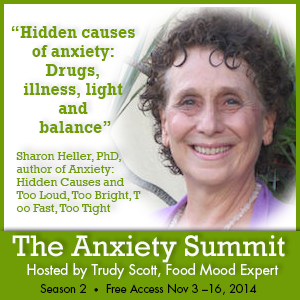
The Anxiety Summit – Hidden causes of anxiety: Drugs, illness, light and balance

November 14, 2014 By Trudy Scott 31 Comments

Sharon Heller, PhD author of Anxiety: Hidden Causes was interviewed on the Anxiety Summit by host of the Anxiety Summit, Trudy Scott, Food Mood Expert and Nutritionist, author of The Antianxiety Food Solution.

Hidden causes of anxiety: Drugs, illness, light and balance

  • How anxiety is often misdiagnosed as psychological when it’s primary cause is physical
  • Why such misdiagnoses happen
  • Physical causes of anxiety: thyroid disorders, diabetes, Cushing’s Syndrome, adrenal exhaustion
  • Common heart conditions that can cause anxiety: mitral valve prolapse and high blood pressure.
  • Infections and anxiety: Lyme disease, PANDAs
  • Over-the counter drugs that cause anxiety: lidocaine, birth control pills and more
  • Space-related phobias: Vestibular/balance and the inner ear
  • Anxiety and photosensitivity

Here are some snippets from our interview:

I think my experience is very, very common, where people are in a state of distress, they’re anxious, they’re fatigued, they’re not feeling well, and doctors don’t diagnose what their problem is. And therefore, they’re told that their problem is all in their head and put on psychotropic medication, when indeed, as it turns out, they may have some physical problem that’s causing their symptoms.

Say someone has panic attacks, which is not uncommon, and particularly, panic attacks that come out of the blue out of nowhere. All of a sudden, you know, one day you get a panic attack. Okay, a wave of panic overcomes you, your heart races, your pulse throbs, the world spins, you can hardly catch your breath, you feel as if you’re dying, you feel this horrible profound dread, even as if you’re losing your mind. So what do you do? You assume it’s psychological, so you go see a psychiatrist and they diagnose you with panic disorder, and they give you psychotropic medication, and usually these drugs do do what they’re designed to do, and they do alleviate the panic, and so you think, okay, it’s psychological.

But, you know, first of all, it may not disappear or it may come back but not as strong, because actually lots of physical conditions can cause the same symptoms and that includes hypoglycemia or low blood sugar.

Sharon shared how Superman actress Margot Kidder has bipolar and now uses amino acids. Here is the article on the Safe Harbor/Alternative Mental Health site

Here are links to Sharon’s books (I have read and highly recommend the first two)

Anxiety: Hidden Causes: Why your anxiety may not be “all in your head” but from something physical

Too Loud, Too Bright, Too Fast, Too Tight, What To Do If You Are Sensory Defensive in an Over-Stimulating World

Uptight and Off Center, How Sensory Processing Disorder Throws Adults Off Balance and How to Create Stability.

If you are not already registered for the Anxiety Summit you can get live access to the speakers of the day here www.theAnxietySummit.com

Filed Under: Antianxiety, Anxiety and panic, Drugs, The Anxiety Summit 2 Tagged With: anxiety, balance, drugs, hidden causes, illness, light, mitral valve prolapse, Sharon Heller, the anxiety summit, Trudy Scott

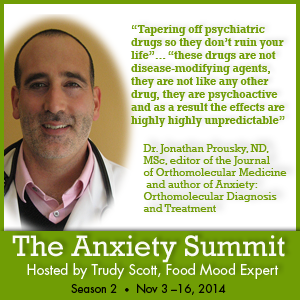
The Anxiety Summit – Tapering off psychiatric drugs so they don’t ruin your life

November 13, 2014 By Trudy Scott 53 Comments

Dr. Jonathan ProuskyQuote_Anxiety2

Dr. Jonathan Prousky, MSc, ND, editor of the Journal of Orthomolecular Medicine and author of Anxiety: Orthomolecular Diagnosis and Treatment was interviewed by host of the Anxiety Summit, Trudy Scott, Food Mood Expert and Nutritionist, author of The Antianxiety Food Solution.

Tapering off psychiatric drugs so they don’t ruin your life

  • The process of reducing or discontinuing psychotropic medications
  • Difficulties patients have in overcoming pharmacological dependence
  • Reactions when someone discontinues SSRIs and benzodiazapines
  • Tapering approach, duration and improving outcomes
  • The importance of diet and lifestyle
  • Melatonin and niacinamide during benzodiazepine withdrawal
  • Using Neurapas Balance, rhodiola and GABA during a taper protocol
  • A tapering schedule case report

Here are a few snippets from our interview:

prescribed psychiatric drugs…. They are not like any other medication. These drugs are not disease-modifying agents, so they’re not like taking a drug for diabetes. These drugs are psychoactive.

That’s exactly how they work. They influence, basically, how one thinks, feels and behaves and, of course, physiology and, as a result, their effects are highly, highly unpredictable and what I constantly see in my own practice is how doctors are failing our patients and not really discussing all of what is necessary when prescribing these drugs because these drugs tend to have some significant effects. and I don’t consider any of the effects of these psychoactive drug’s effects and they can be either positive, negative or neutral

I think what’s important for people to realize is there’s no specific clinical manifestation that would be appropriate for all patients that are on SSRI drugs, whether that’s something like Paxil or Prozac or Celexa. It doesn’t matter. There’s no one manifestation that all patients coming off those drugs are going to experience. Essentially, because these drugs have very, I would say, unpredictable psychoactive effects then, when somebody is coming off of them, the effects from tapering are also rather unpredictable. So, people can experience either regression of their symptoms that brought them to a physician in the first place and one of the reasons why they were prescribed the drug in the first place, so patients can certainly regress and start having a return of their previous symptoms. Patients can have incredible sleep issues where they just cannot sleep, and they literally are feeling so concerned and they start worrying about not being able to fall asleep even before they sleep because it becomes such an issue.

Patients can feel very restless and they can get an inner restlessness that sometimes can drive them, literally almost like, as if, they’re going crazy, it’s called agathusia. There’s like this inner restlessness that torments people. Sometimes that can even happen as they taper down. Sometimes people can develop some weird, neurological manifestations whether it’s ticks or just strange or abnormal body movements, which we call dyskinesias. Patients can start having the sweats or feelings of derealization where they don’t feel grounded in reality.

They can have brain zaps where their brain just feels like it’s being zapped or as if someone’s electrocuting them. They can feel their whole body shaking and sort of becoming very jittery or even they can have cold sweats and shiver a lot. Essentially, there’s not a manifestation that you and I couldn’t think of that couldn’t happen to somebody coming off of these drugs because, as I said, they’re so unpredictable.

During the interview we discussed a number of papers written by Dr. Prousky. Here is a link to his publications.

Here is the Harm Reduction Guide to Coming Off Psychiatric Drugs by Will Hall

Dr. Prousky discussed this paper about pharmaGABA: Relaxation and immunity enhancement effects of gamma-aminobutyric acid (GABA) administration in humans.

GABA could work effectively as a natural relaxant and its effects could be seen within 1 hour of its administration to induce relaxation and diminish anxiety.

I talked more about GABA in my interview: Targeted individual amino acids for eliminating anxiety: practical applications

Dr. Prousky shared a case study of an SSRI and rhodiola taken together leading to tachyarrhythmia: Herbal medicine–sets the heart racing!

We report the case of a young previously healthy woman who had a significant tachyarrhythmia whilst taking a combination of escitalopram and the over the counter herbal medicine Rhodiola. Escitalopram, a SSRI, increases serotonin levels in the brain by selectively inhibiting re-uptake of serotonin. It is metabolised by the cytochrome P450 (CYP) isoenzymes CYP2C19, CYP2D6 and CYP3A4. Rhodiola also increases serotonin levels by inhibiting monoamine oxidase. It is a potent inhibitor of CYP3A4 and P-Glycoprotein. Consequently both agents taken by a patient can augment serotonin levels.

Dr. Prousky discussed the risks of SSRIs during pregnancy and shared this paper: The risks of selective serotonin reuptake inhibitor use in infertile women: a review of the impact on fertility, pregnancy, neonatal health and beyond

Antidepressant use during pregnancy is associated with increased risks of miscarriage, birth defects, preterm birth, newborn behavioral syndrome, persistent pulmonary hypertension of the newborn and possible longer term neurobehavioral effects.

Dr. Prousky is the editor of the Journal of Orthomolecular medicine.

The CSOM/Canadian Society for Orthomolecular Medicine holds an annual conference in Toronto and you can learn more here. The 2015 conference will be April 24-26.

If you are not already registered for the Anxiety Summit you can get live access to the speakers of the day here www.theAnxietySummit.com

Filed Under: Anxiety and panic, benzodiazapines, Drugs, The Anxiety Summit 2 Tagged With: anxiety, Dr Jonathan Prousky, GABA, niacin, pharmaGABA, psychiatric drugs, rhodiola, SSRIs, the anxiety summit, Trudy Scott

The Anxiety Summit – Drug induced nutritional deficiencies that contribute to anxiety

November 11, 2014 By Trudy Scott 5 Comments

Dr. Peter OsborneQuote_Anxiety2

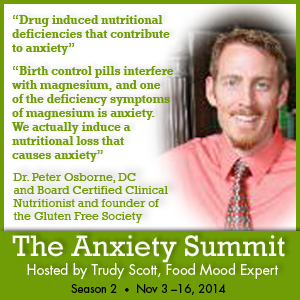
Dr. Peter Osborne, DC and Board Certified Clinical Nutritionist was interviewed by host of the Anxiety Summit, Trudy Scott, Food Mood Expert and Nutritionist, author of The Antianxiety Food Solution.

Drug induced nutritional deficiencies that contribute to anxiety

  • the victim-warrior concept for being empowered
  • what is the meaning of drug-induced nutritional deficiencies
  • drugs that contribute to anxiety through nutrition loss
    • estrogen/ birth control pill and magnesium, folate, vitamin B6
    • antibiotics: good bacteria, B vitamins esp biotin and vitamin B12, vitamin K
    • antacids: protein malnourishment
    • NSAIDs: iron, vitamin C, folate, strips mucosal layer
  • prescription meds in drinking water
  • how to test for these nutritional deficiencies
  • nutritional deficiencies caused by gluten and the Gluten-Free Society

Here are a few snippets from our interview:

Birth control pills interfere with magnesium, and one of the deficiency symptoms of magnesium is anxiety. We actually induce a nutritional loss that causes anxiety.

I think for women, one of the most common problems is actually the estrogen pill, whether they’re being taken as birth control or whether they’re being taken to help with acne or taken to control cycles or hormones. Some doctors still prescribe birth control pills or estrogen pills for bone loss, so just depending on the reason the woman might be taking it, it’s just very clear – I want to be very clear that it’s estrogen that has this impact and this effect. And before I get into it, I will also say this, because a lot of doctors ask me, “Well, what about bioidentical hormones vs. synthetic hormones?” and there is no research that has studied whether there’s a difference between the two. So I’ll just be clear that what we’re referring to, the research that we’re referring to, largely has to do with prescriptive estrogen-based hormone that is not bioidentical, so I don’t think we have any research that would delineate the difference between the two.

One of the most common nutritional side effects of estrogen prescriptive pills is magnesium loss. Now, magnesium is an extremely important mineral. It plays a role in more than 300 chemical reactions in the human body. Of those 300 chemical reactions, several of them have to do with the proper utilization and the proper metabolism of estrogen. In essence, how do women excrete estrogen so that it doesn’t build up in their system and contribute to different forms of cancer? Well, this is done through a particular enzyme system that magnesium drives or runs, and this same enzyme system – it’s actually called COMT, catechol-O-methyltransferase, which is just a fancy way of talking about this enzyme. This enzyme is – again, it’s magnesium driven. This very same enzyme is extremely important for neurochemical production in the brain and neurochemical production in the gut.

Here is a link to Ross Pelton’s book, Drug-Induced Nutrient Depletion Handbook. This is a book I come back to refer to again and again. In the interview we got the titles a bit mixed up. Drug Induced Nutritional Deficiencies is the title of Daphne Roe’s book.

Here are some links to articles about prescription drugs being present in US drinking water:

  • NBC article: 46 million in U.S. have drugs in drinking water
  • An article by the non-profit Clean Water Action
  • An interview and Q and A on NPR

Dr. Osborne founded Gluten Free Society in 2010 to help educate patients and physicians on the far reaching effects of gluten sensitivity. He is the author of Glutenology, a series of books designed to help educate the world about gluten. His gift is a video series called 7 Highly Effective Habits of the Gluten-Free Warrior

If you are not already registered for the Anxiety Summit you can get live access to the speakers of the day here www.theAnxietySummit.com

Filed Under: Antianxiety, Drugs, The Anxiety Summit 2 Tagged With: antacids, antibiotics, anxiety, birth control pill, drinking water, drug, estrogen, NSAIDs, nutritional deficiencies, Peter Osborne Ji, the anxiety summit, Trudy Scott

Primary Sidebar

GABA QuickStart Homestudy

gaba quickstart homestudy

Free Report

9 Great Questions Women Ask about Food, Mood and their Health

You'll also receive a complimentary subscription to my ezine "Food, Mood and Gal Stuff"


Connect with me

Popular Posts

  • Amino Acids Mood Questionnaire from The Antianxiety Food Solution
  • The Antianxiety Food Solution Amino Acid and Pyroluria Supplements
  • Pyroluria Questionnaire from The Antianxiety Food Solution
  • Collagen and gelatin lower serotonin: does this increase your anxiety and depression?
  • Tryptophan for the worry-in-your-head and ruminating type of anxiety
  • GABA for the physical-tension and stiff-and-tense-muscles type of anxiety
  • The Antianxiety Food Solution by Trudy Scott
  • Seriphos Original Formula is back: the best product for anxiety and insomnia caused by high cortisol
  • Am I an anxious introvert because of low zinc and vitamin B6? My response to Huffington Post blog
  • Vagus nerve rehab with GABA, breathing, humming, gargling and key nutrients

Recent Posts

  • Her cravings for chips and peanut butter were triggered by stress: GABA ends cravings and reduces physical tension and fear of heights
  • It is truly miraculous to be able to move through life without crippling anxiety and panic
  • GABA and tryptophan combo provide immediate and noticeable relief for tremors and cervical dystonia in just 7 days
  • Red light therapy for back and neck pain, plantar fasciitis and low mood – a complement to the amino acids GABA, DPA and tryptophan
  • What do I use instead of Seriphos to help lower high cortisol that is affecting my sleep and making me anxious at night?

Categories

  • 5-HTP
  • AB575
  • Addiction
  • ADHD
  • Adrenals
  • Alcohol
  • Allergies
  • Alzheimer's disease
  • Amino Acids
  • Anger
  • Antianxiety
  • Antianxiety Food Solution
  • Antidepressants
  • Anxiety
  • Anxiety and panic
  • Autism
  • Autoimmunity
  • benzodiazapines
  • Bipolar disorder
  • Books
  • Caffeine
  • Cancer
  • Candida
  • Children/Teens
  • Collagen
  • Cooking equipment
  • Coronavirus/COVID-19
  • Cravings
  • Depression
  • Detoxification
  • Diabetes
  • Diet
  • DPA/DLPA
  • Drugs
  • EFT/Tapping
  • EMF
  • EMFs
  • Emotional Eating
  • Endorphins
  • Environment
  • Essential oils
  • Events
  • Exercise
  • Fear
  • Fear of public speaking
  • Fertility and Pregnancy
  • Fish
  • Food
  • Food and mood
  • Functional neurology
  • GABA
  • Gene polymorphisms
  • General Health
  • Giving
  • Giving back
  • Glutamine
  • Gluten
  • GMOs
  • Gratitude
  • Gut health
  • Heart health/hypertension
  • Histamine
  • Hormone
  • Hyperparathyroidism
  • Hypoglycemia
  • Immune system
  • Inflammation
  • Insomnia
  • Inspiration
  • Introversion
  • Joy and happiness
  • Ketogenic diet
  • Lithium orotate
  • Looking awesome
  • Lyme disease and co-infections
  • MCAS/histamine
  • Medication
  • Men's health
  • Mental health
  • Mercury
  • Migraine
  • Mold
  • Movie
  • MTHFR
  • Multiple sclerosis
  • Music
  • NANP
  • Nature
  • Nutritional Psychiatry
  • OCD
  • Osteoporosis
  • Oxalates
  • Oxytocin
  • Pain
  • Paleo
  • Parasites
  • Parkinson’s disease
  • PCOS
  • People
  • PMS
  • Postpartum
  • PTSD/Trauma
  • Pyroluria
  • Questionnaires
  • Real whole food
  • Recipes
  • Research
  • Schizophrenia
  • serotonin
  • SIBO
  • Sleep
  • Special diets
  • Sports nutrition
  • Stress
  • Sugar addiction
  • Sugar and mood
  • Supplements
  • Teens
  • Testimonials
  • Testing
  • The Anxiety Summit
  • The Anxiety Summit 2
  • The Anxiety Summit 3
  • The Anxiety Summit 4
  • The Anxiety Summit 5
  • The Anxiety Summit 6
  • Thyroid
  • Thyroid health
  • Toxins
  • Tryptophan
  • Tyrosine
  • Uncategorized
  • Vegan/vegetarian
  • Women's health
  • Yoga

Archives

  • May 2026
  • April 2026
  • October 2025
  • September 2025
  • August 2025
  • July 2025
  • June 2025
  • May 2025
  • April 2025
  • March 2025
  • February 2025
  • January 2025
  • November 2024
  • October 2024
  • September 2024
  • August 2024
  • July 2024
  • June 2024
  • May 2024
  • April 2024
  • March 2024
  • February 2024
  • January 2024
  • December 2023
  • November 2023
  • October 2023
  • September 2023
  • August 2023
  • July 2023
  • June 2023
  • May 2023
  • April 2023
  • March 2023
  • February 2023
  • January 2023
  • December 2022
  • November 2022
  • October 2022
  • September 2022
  • August 2022
  • July 2022
  • June 2022
  • May 2022
  • April 2022
  • March 2022
  • February 2022
  • January 2022
  • December 2021
  • November 2021
  • October 2021
  • September 2021
  • August 2021
  • July 2021
  • June 2021
  • May 2021
  • April 2021
  • March 2021
  • February 2021
  • January 2021
  • December 2020
  • November 2020
  • October 2020
  • September 2020
  • August 2020
  • July 2020
  • June 2020
  • May 2020
  • April 2020
  • March 2020
  • February 2020
  • January 2020
  • December 2019
  • November 2019
  • October 2019
  • September 2019
  • August 2019
  • July 2019
  • June 2019
  • May 2019
  • April 2019
  • March 2019
  • February 2019
  • January 2019
  • December 2018
  • November 2018
  • October 2018
  • September 2018
  • August 2018
  • July 2018
  • June 2018
  • May 2018
  • April 2018
  • March 2018
  • February 2018
  • January 2018
  • December 2017
  • November 2017
  • October 2017
  • September 2017
  • August 2017
  • July 2017
  • June 2017
  • May 2017
  • April 2017
  • March 2017
  • February 2017
  • January 2017
  • December 2016
  • November 2016
  • October 2016
  • September 2016
  • August 2016
  • July 2016
  • June 2016
  • May 2016
  • April 2016
  • March 2016
  • February 2016
  • January 2016
  • December 2015
  • November 2015
  • October 2015
  • September 2015
  • August 2015
  • July 2015
  • June 2015
  • May 2015
  • April 2015
  • March 2015
  • February 2015
  • January 2015
  • December 2014
  • November 2014
  • October 2014
  • September 2014
  • August 2014
  • July 2014
  • June 2014
  • May 2014
  • April 2014
  • March 2014
  • February 2014
  • January 2014
  • December 2013
  • November 2013
  • October 2013
  • September 2013
  • August 2013
  • July 2013
  • June 2013
  • May 2013
  • April 2013
  • March 2013
  • February 2013
  • January 2013
  • December 2012
  • November 2012
  • October 2012
  • August 2012
  • July 2012
  • June 2012
  • May 2012
  • April 2012
  • March 2012
  • February 2012
  • January 2012
  • December 2011
  • November 2011
  • October 2011
  • September 2011
  • August 2011
  • July 2011
  • June 2011
  • May 2011
  • April 2011
  • March 2011
  • February 2011
  • January 2011
  • December 2010
  • October 2010
  • September 2010
  • July 2010
  • May 2010
  • April 2010
  • March 2010
  • February 2010
  • January 2010
  • November 2009

Share the knowledge!

The above statements have not been evaluated by the Food and Drug Administration. Products listed in this website are not intended to diagnose, treat, cure or prevent any disease.

The information provided on this site is for informational and educational purposes only and is not intended as a substitute for advice from your physician or other health care professional. You should consult with a healthcare professional before starting or modifying any diet, exercise, or supplementation program, before taking or stopping any medication, or if you have or suspect you may have a health problem.


Copyright © 2026 Trudy Scott. All Rights Reserved. | Privacy | Terms and Conditions | Refund Policy | Medical Disclaimer

Free Report

9 Great Questions Women Ask about Food, Mood and their Health

You’ll also receive a complimentary subscription to my ezine “Food, Mood and Gal Stuff”