• Skip to primary navigation
  • Skip to main content
  • Skip to primary sidebar

everywomanover29 blog

Food, Mood and Women's Health – Be your healthiest, look and feel great!

  • Blog
  • About
  • Services
  • Store
  • Resources
  • Testimonials
  • The Book
  • Newsletter
  • Contact
  • Search this site

sleep

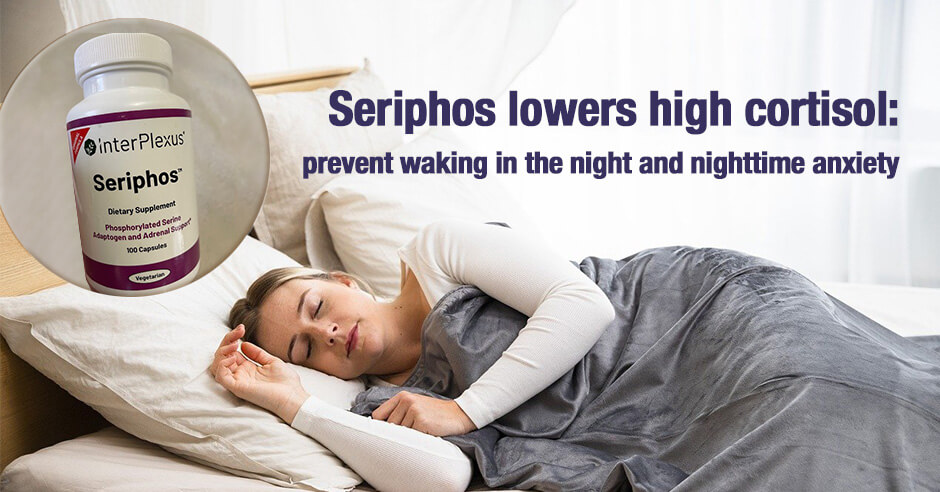
Seriphos lowers high cortisol: prevent waking in the night and nighttime anxiety

October 20, 2023 By Trudy Scott 63 Comments

seriphos and cortisol

Seriphos is my favorite nutrient for lowering high nighttime cortisol in order to reduce night waking and nighttime anxiety. I’ve used it with success in the past and have just needed it again:

After coming back from Hawaii (I was there for just under 2 weeks), I was still waking a few times each night. Sometimes I would be awake for 2-3 hours! I’m a hot mess when I don’t get sleep through the night. With just 1 Seriphos before bed for 9 days I was sleeping through the night again. It was glorious!

High cortisol can be a temporary issue after international travel i.e. caused by jetlag and out of balance circadian rhythm. I will admit that I have a number of confounding factors – like my loss and grief (my darling mom has just passed away), being sprayed with insecticide on landing in Australia (which I suspect caused severe vertigo the day after I got back), and high blood pressure (and likely higher cortisol too) after drinking too much licorice tea for my voice loss. Whatever the causes of my high cortisol, Seriphos really helped me sleep through the night.

I ran out of Seriphos 2 nights ago and I was awake for 3 hours last night. I’ll be adding it back to my nighttime protocol as soon as my order arrives.

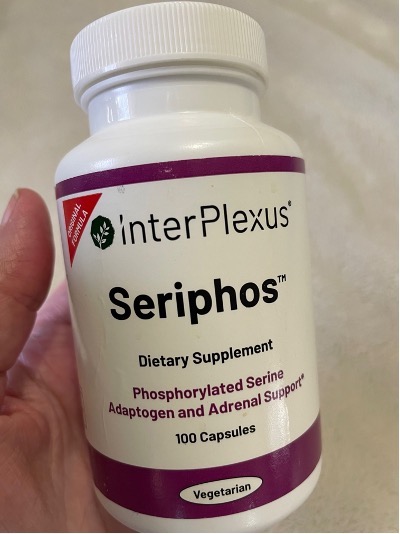
Seriphos is made by Interplexus and is a phosphorylated serine product. It is similar to the more recognized phosphatidylserine which is also used and known for lowering high cortisol – clinically and in the research.  However, clinically, I have found Seriphos to be more effective and work more quickly.

UPDATE Feb 2024: I did end up tweaking my Seriphos dose a few times. After a few weeks I decided to trial 2 per night – this worked well. Then a few weeks later I trialed 3 per night – but after a few days I realized that even though it worked well for sleep it made me too tired the next day. For this reason I went back down to 2 Seriphos at bedtime.

UPDATE August 2024: I’m now using just 1 Seriphos at night and have added ox bile supplementation and a bright light panel in the morning because of bile issues. More on this below.

Seriphos for high cortisol due to trauma, loss of beloved cat and more

When I posted this on Facebook, I had a number of folks share how Seriphos has also helped them.

Kathy shared this: “I take two Seriphos at night for high cortisol that causes insomnia. It works well for me and helps me to relax. I have a significant trauma background that keeps me in fight or flight, so Seriphos is a must have at night. I do take a break from time to time if I am going through a less stressful time.”

Hopefully Kathy is also working on the trauma, doing trauma work and even incorporating other nutritional approaches which help so much with recovery – like zinc, vitamin D, a B complex, GABA and tryptophan etc. Taking a break from time to time is a good plan – I share more about this below.

Kim shared this: “Seriphos is a life saver – I started it when I was having cortisol/adrenaline issues a few years ago and have continued using it. I don’t ever want to be without Seriphos. A little over a month ago I unexpectedly lost my youngest cat. She was emaciated when I rescued her over 4 years ago and we turned around health issues. I feel so sad that she was dealt such a bad hand but we got her a loving home. My animals are everything to me and the grief is so difficult. She was a character and I love her so much.”

She uses one capsule in the evening but also uses a capsule during the day if she feels off. Hopefully Kim is also doing trauma work and other nutritional support too.

Janie shared this: “I have used it, years ago when my cortisol was off the charts, morning and at night. I was awake every night until 2am, unable to sleep. Seriphos certainly helped.”

She used 1 Seriphos per day for about 3 months.

Patricia said: “Please remember that there is Original Seriphos and the next gen Seriphos. I was one of thousands of people who had used original Seriphos for sleep and then they changed their formulation without telling us and then so very many of us were wide awake at night until we realized that they had changed the formulation.”

This happened in 2016/2017 and I blogged about that whole fiasco here –  Seriphos Original Formula is back: the best product for anxiety and insomnia caused by high cortisol. You can read many other success stories on the blog and in the comments.

Address the causes of your high cortisol: jetlag, grief, toxins, licorice intake

As you can see from my example there can be a number of causes of high cortisol and you always want to address these causes while using Seriphos so you can eventually stop using it:

  • International travel i.e. caused by jetlag and out of balance circadian rhythm. I’m home so this is no longer a contributing issue.
  • Loss and grief can have physiological effects and high cortisol is one of many effects: “It appears that cortisol remains elevated for at least the first 6 months of bereavement. For some, cortisol elevation may become chronic”. The loss of my darling mom is going to take time but I am making time for grieving and I’m nurturing myself. As I navigate this period in my life I’ll continue to share what has helped me. I suspect I may need Seriphos for longer than the usual 3 months.
  • Being sprayed with insecticide on landing in Australia (which I suspect caused severe vertigo the day after I got back). It’s well-recognized that environmental toxins are hormone disruptors and affect the hypothalamic-pituitary-adrenal (HPA) axis and cortisol. I’m addressing this with active detoxification and my portable infrared sauna.
  • High blood pressure and likely higher cortisol too after drinking too much licorice tea for my voice loss. I have stopped the licorice consumption and my blood pressure is back to normal.

Other possible causes of high cortisol include day to day stresses, food sensitivities such as gluten, high sugar consumption, parasites and so on. Each factor needs to be addressed.

I do recommend Salivary cortisol testing before using Seriphos

Salivary cortisol testing is something I do with all my clients anyway. And I do recommend salivary cortisol testing before using Seriphos and the other cortisol-lowering nutrients mentioned below.

I will admit that I didn’t follow my own recommendation because I’ve had high nighttime cortisol in the past and recognized the symptoms. I had also identified all the above root causes and I desperately needed to sleep. I now have an adrenal saliva test kit on hand and will report back when I get the results.

Seriphos will only work for waking in the night if cortisol is high

One woman shared “I have never slept through the night in years. It would be delightful to get to the morning without waking.” Seriphos will very likely help if her cortisol is high.

Keep in mind there are many causes of not being able to sleep through the night and Seriphos will not help if cortisol is not high. Other root causes for insomnia/waking in the night (and nighttime anxiety) we consider and investigate are:

  • Low GABA and low serotonin (I always start with these while waiting for salivary cortisol results to come back),
  • Low melatonin

The following factors need to be addressed as root causes of sleep issues, anxiety and other symptoms (like gut issues, pain etc.), and also keep in mind that they are very possibly contributing to your high cortisol too:

  • Gluten and other food sensitivities
  • Caffeine and sugar intake
  • Oxalate issues and/or toxins exposure affecting bile production (this affected my sleep last year)
  • EMFs
  • Parasites and other gut issues like IBS/SIBO etc.
  • Disrupted circadian rhythms connected to liver/gallbladder/bile issues – more on that and bright light here. (Research does support a connection between high cortisol and cholestasis i.e. “stagnation, or at least a marked reduction, in bile secretion and flow.”)

A few folks reported they had tried Seriphos without success and it may well be that they don’t have high cortisol. Or they would possibly benefit from another approach to lower their cortisol (more on this below).

What are my options if I have high cortisol at night and Seriphos has the opposite effect?

One person said it had the opposite reaction. Joanne shared this: “Seriphos had the opposite effect on me. [One Seriphos] gave me extreme anxiety, kept me awake all night. Saliva tested consistently high cortisol at night so it should have helped. Been trying to work out why it would and how it might inform how I treat my insomnia.”

I’ve had a few clients do better with less than the recommended 3 per day and one not being able to use it at all. I suspect an allergic reaction or that it’s just too high a dose for some folks. The capsule could be opened and less could be used.

If this doesn’t work, other options for lowering high cortisol include lactium/hydrolyzed casein, Relora® (which contains Magnolia officinalis and Phellodendron amurense), essential oils such as bergamot and some herbal adaptogens. You can also read about some phosphatidylserine products I looked into when the Seriphos product was changed.

Forest bathing also helps to lower high cortisol levels and I recommend it for everyone.

Where does using Seriphos fit into everything else that I’m doing to address my insomnia and/or anxiety?

I typically don’t start with Seriphos right away with clients unless we know cortisol is high. As mentioned above I always start with assessing for low GABA and low serotonin and we do trials of the respective amino acids based on the symptoms questionnaire.

I also assess for low blood sugar and dietary factors like gluten, caffeine, sugar, quality animal protein intake etc. as covered in my book “The Antianxiety Food Solution.” More about my book here.  It does include a chapter on the amino acids and how to use them too.

Then we start to dig deeper and would consider Seriphos or lactium for anxiety caused by high night time or even high morning cortisol or high cortisol at other times of the day.

With many folks all of the above often applies. And we continue with assessing for each of the 60+ nutritional and biochemical root causes of anxiety/waking in the night (which does include liver/gallbladder/bile issues).

Where do I purchase Seriphos and how much do I use? What about taking a break?
seriphos

You can purchase Seriphos from my online store (Fullscript – only available to USA customers – use this link to set up an account) and you can also find it on iherb (use this link to save 5%).

The bottle states to use 1 capsule with water 15 minutes before a meal. Clinically, using 1-3 capsules a few hours before the high cortisol seems to be most effective. For 2-4am waking this typically means taking Seriphos right before bed. In some instances, taking 1 on waking in the night can help too (for a maximum of 3).

With high cortisol in the night and on waking, I have clients use Seriphos before bed and lactium on waking.

It is recommended to take a one-month break after 3 months of Seriphos use. Ideally, once the root causes of high cortisol are addressed, you should be able to stop anyway.  Or take a break, retest cortisol and then continue.

I’ll share some research and how Seriphos differs from phosphatidylserine in a follow-up blog if there is enough interest.

I appreciate all the feedback from these women in my community.

Have you used Seriphos (a phosphorylated serine product) to help with high cortisol and waking in the night/nighttime anxiety caused by any of the?

What do you suspect the cause(s) of your high cortisol is or was? And have you confirmed high cortisol with a saliva cortisol test?

Have any of the other products mentioned above helped to reduce high cortisol? If yes, have you compared them with Seriphos?

Let me know if you’re interested in a follow-up blog that includes some research and how Seriphos differs from phosphatidylserine.

Feel free to share and ask your questions below.
Filed Under: Adrenals, Anxiety, Insomnia, Stress, Toxins Tagged With: 000 lux, 10, anxiety, Balancing Neurotransmitters: the Fundamentals program for practitioners, bile liver, bright light, bright light panel, cholestasis, circadian rhythm, cognitive performance, cortisol, daytime sleepiness, disturbed sleep, GABA, GABA Quickstart, grief, high blood pressure, high cortisol, insecticide, Interplexus, jet lag, jetlag, licorice tea for my voice loss, melatonin, mood, nighttime anxiety, phosphatidylserine, phosphorylated serine, primary biliary cholangitis, salivary cortisol testing, seriphos, serotonin, sleep, sleep quality, sleep timing, trauma, tryptophan, vertigo, waking, waking early

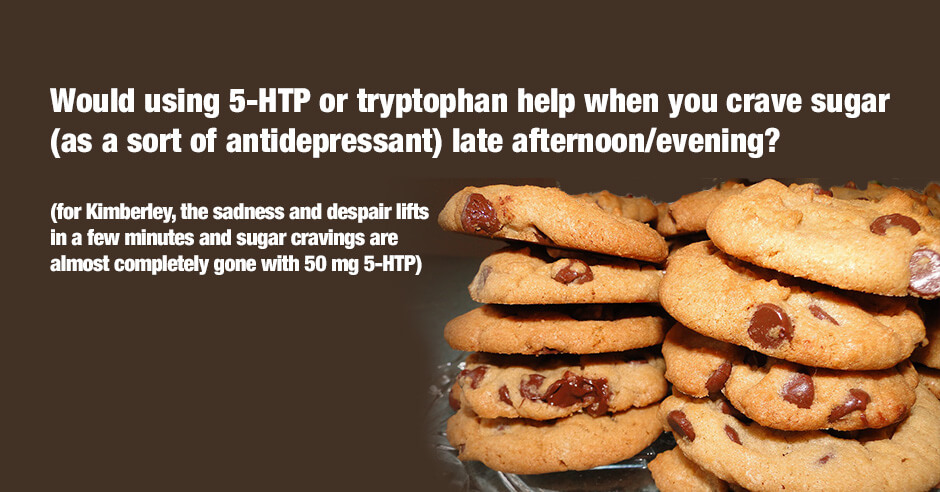
Would using 5-HTP or tryptophan help when you crave sugar (as a sort of antidepressant) late afternoon/evening?

June 2, 2023 By Trudy Scott 29 Comments

5-htp and sugar craving

Would using 5-HTP or tryptophan also help when you crave sugar (as a sort of antidepressant) late afternoon/evening? ~ Kimberley

This question was posed in response to my recent blog post about using tryptophan or 5-HTP to help with alcohol cravings/addiction in the late afternoon/evening – to help you wind down and relax, improve mood and sleep, and also as a reward/treat.

I said yes it is often the same cause when it happens late afternoon/evening and when there are other low serotonin symptoms like low mood, anxiety, worry, insomnia etc. When serotonin is low we self-medicate with wine, sugar, carbs, gluten, dairy and chocolate etc. in order to feel good, get a mood boost and reduce stress. 5-HTP or tryptophan stops the sugar cravings, acts as an antidepressant (improving mood) and eases other low serotonin symptoms too.

It turns out Kimberley was craving sugar late afternoon: “it’s definitely late afternoon for me, while I’m making dinner. Maybe it’s time to go back on 5-HTP.”

And then 2 days later she posted how quickly 5-HTP helped when she added it back mid-afternoon:

I was taking a break from tryptophan/5-HTP and realized after reading this post that that might be a mistake! So I added 5-HTP back in mid-afternoon and my sugar cravings are almost completely gone. It’s funny how I forget the symptoms of low neurotransmitters. Thanks for reminding me!

5-HTP works quickly when it’s low serotonin

How wonderful are these results for Kimberley. I never get tired of hearing feedback like this! I appreciate her sharing and giving me permission to share as a blog so you get to learn and be inspired too.

It’s not unusual for 5-HTP to work this quickly and when it does it’s a clue that the symptoms are related to low serotonin and that she found the ideal dose for her needs.

Kimberley had good results with 5-HTP in the past so she went back to what had worked for her before and it worked for her again.

But do keep in mind, some folks do better with 5-HTP and some do better with tryptophan so it’s a matter of doing a trial of each one each.

50 mg 5-HTP: the sadness and despair lifts in a few minutes

A week later she kindly came and shared additional details in the comments of the tryptophan/ 5-HTP alcohol cravings blog, saying:

It’s possible that I was already in the middle of my daily, mid-afternoon chocolate chip binge when I saw your post

I took a 50 mg 5-HTP along with my mid-afternoon Endorphigen capsule, and within just a few minutes I felt the sadness and despair that I often feel in the late afternoon, start to lift. I was astonished at how quickly it worked! I didn’t open the capsule, or chew it, I just swallowed it with water and had a snack afterwards. I really can’t thank you enough for asking that question because I was really struggling with low mood and sadness almost every day.

Even though KImberley had used 5-HTP with success in the past, she was still astonished how quickly it worked and how effective it was. She was also surprised she had forgotten her prior low serotonin symptoms:

Up until January I had taken 5-HTP in the mid-afternoon and then Tryptophan at bedtime, but I wanted to try a program to support my thyroid. That program told me that too much serotonin is often at the root of gut damage, so I weaned myself off of the 5-HTP and tryptophan. I didn’t really notice much difference, except the daily sugar cravings.

I’m not sure how I could so easily forget the symptoms of low serotonin, but I did.

Your question really was a God-send for me, Trudy. It reminded me that there was an option for feeling better (in fact, MUCH better than sugar makes me feel) that didn’t involve something that’s not good for me.

And I really did feel remarkably better the same day, and those results have continued.

Thanks again, Trudy, for continuing to bring these topics up. Some of us are forgetful and need reminding. Usually, when you have symptoms of low serotonin there are enough other issues going on in your life that it’s easy to overlook the obvious. So I’m very grateful that you asked the question, because I feel so much better able to deal with my circumstances now that I’m back on the 5-HTP. Blessings to you!

I am curious about the program that told her too much serotonin is often at the root of gut damage and if they suggested stopping 5-HTP and tryptophan. It doesn’t make any sense to me.  I’ll report back when I learn more about this.

More tired during the day and a headache: what to consider

She did mention “I’m finding myself more tired during the day and have also had a headache for the last few days.” I would suspect chocolate/caffeine withdrawal may have caused her headache.

With feeling more tired I’d also watch the dose of 5-HTP. She may find less is better for her needs.

She is also trying tryptophan at bedtime so that may be making her more tired the next day. Doing one amino acid at a time is often the best way to know how each one is affecting you.

Finding what works for your unique needs

Here are some other amino acid/sugar cravings blog posts that illustrate how we all have unique needs and different biochemical imbalances:

  • The individual amino acids glutamine, GABA, tryptophan (or 5-HTP), DPA and tyrosine are powerful for eliminating sugar cravings, often within 5 minutes

The individual amino acids glutamine, GABA, tryptophan (or 5-HTP), DPA and tyrosine are powerful for eliminating sugar cravings, often within 5 minutes. It seems that this wonderful benefit – over and above the anxiety-reducing and mood-boosting benefits – is often overlooked or poorly understood.

  • GABA for ending sugar cravings (and anxiety and insomnia)

For Melissa, an unexpected result was that she stopped craving sugar (chocolates, ice cream and truffles) after about a week of taking GABA for her travel anxiety.

It’s a matter of finding what works for your sugar cravings and unique needs. GABA worked for Melissa and yet 5-HTP works for Kimberley – for their sugar cravings.

Here is the tryptophan/5-HTP alcohol cravings blog that started the discussion: Tryptophan had the added benefit of turning me completely off alcohol when I took it to improve mood and sleep during perimenopause. In this case, tryptophan helped Victoria quit the wine that she was self-medicating with in order to feel good and relax.

Resources if you are new to using amino acids as supplements

If you are new to using amino acids as supplements, here is the Amino Acids Mood Questionnaire from The Antianxiety Food Solution (you can see all the symptoms of neurotransmitter imbalances, including low GABA, low serotonin and low endorphins).

If you suspect low levels of any of the neurotransmitters and do not yet have my book, The Antianxiety Food Solution – How the Foods You Eat Can Help You Calm Your Anxious Mind, Improve Your Mood, and End Cravings, I highly recommend getting it and reading it before jumping in and using amino acids on your own so you are knowledgeable. And be sure to share it with the practitioner/health team you or your loved one is working with.

There is an entire chapter on the amino acids and they are discussed throughout the book in the sections on gut health, gluten, blood sugar control, sugar cravings, anxiety and mood issues.

The book doesn’t include product names (per the publisher’s request) so this blog, The Antianxiety Food Solution Amino Acid and Pyroluria Supplements, lists the amino acids that I use with my individual clients and those in my group programs. You can find them all in my online store.

If, after reading this blog and my book, you don’t feel comfortable figuring things out on your own (i.e. doing the symptoms questionnaire and respective amino acids trials), if you need serotonin support, the Serotonin QuickStart Program is a good place to start. This is a paid online/virtual group program where you get my guidance on using tryptophan and 5-HTP safely, and community support during 5 LIVE Q&A calls. You can sign up to be notified when the next live launch of this program is happening. We take a deep dive into product options including Lidtke products and others if you’re not able to access Lidtke.

Low GABA can cause physical tension and overwhelm, affect sleep and cause stress eating. If you also have low GABA symptoms, the next step to get help is the GABA QuickStart Program. This is also a paid online/virtual group program where you get my guidance and community support. Another option is the budget-friendly GABA QuickStart Homestudy program.

Wrapping up

Now I’d love to hear from you ….

Has 5-HTP helped reduce your cravings and/or feelings of despair and sadness? How much helps and how quickly?

Or do you find tryptophan works better for you? If yes, how much helps and how quickly?

What sugary food/s do you self-medicate with in order to feel good?

If you’re a practitioner, do you use this approach with your clients/patients?

Feel free to post your feedback and questions here in the comments.

Filed Under: 5-HTP, Cravings, Depression, Tryptophan Tagged With: 5-HTP, addiction, alcohol cravings, amino acids, antidepressant, anxiety, carbs, crave sugar, dairy, despair, evening, GABA, gluten, insomnia, late afternoon, low serotonin, mood, neurotransmitters, relax, sadness, self-medicate, sleep, sugar, sugar cravings, the GABA Quickstart online program; and Balancing Neurotransmitters: the Fundamentals program for practitioners, tryptophan, wine, worry

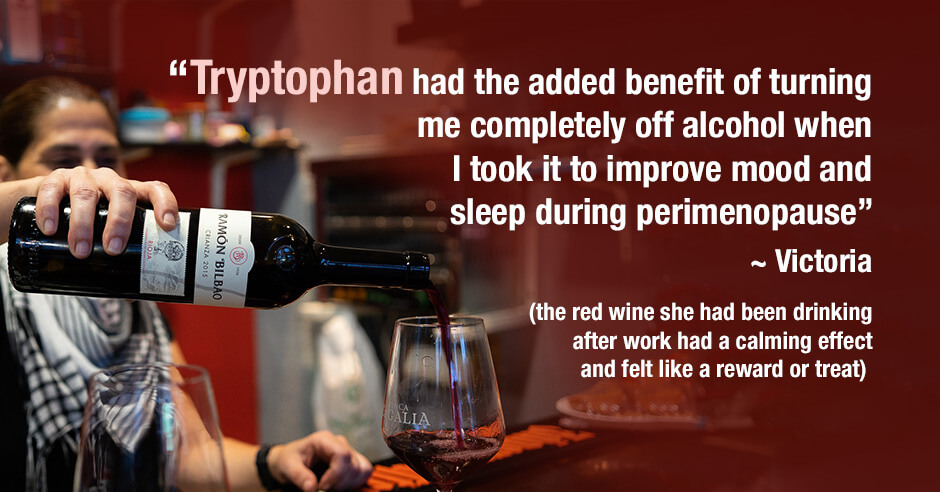
Tryptophan had the added benefit of turning me completely off alcohol when I took it to improve mood and sleep during perimenopause

May 12, 2023 By Trudy Scott 33 Comments

tryptophan alcohol

I started taking tryptophan 3 years ago to improve mood and sleep (not recognizing I was in perimenopause which it helped), but had the added benefit of turning me completely off alcohol! Lol. What serendipitous timing! I use amino therapy with pretty much all my perimenopause patients now. Thanks to you and Julia Ross’s work. Forever grateful.

Victoria shared this wonderful feedback about the benefits she experienced with tryptophan on a recent Facebook thread and kindly gave me permission to share.

Self-medicating with wine (and other alcoholic beverages) is common when we are anxious or stressed and typically we use it to wind down at the end of the day and to fit in socially. This is common when GABA levels are low and also happens due to low serotonin which declines from mid-afternoon into the evening.

I asked what she had been drinking and how often? And if it was calming for her? This was her response:

Red wine the minute I walked in the door in the evening. I guess it was calming… maybe more reward driven? It would be my reward for getting home from work via picking kids up from sport and doing a grocery shop and … (fill in the blank) that we working mums do and then having to walk straight into the kitchen to start on dinner.

The wine was like my little treat or reward to motivate me to just keep moving with my chores. No time to sit and unwind, just pour the wine and start chopping! Lol… I had tried to stop before but just couldn’t pick up a knife without the wine glass!

Within days, the tryptophan made the wine taste like cat’s pee! Haven’t touched it since. No desire at all. Almost hypnosis like?

How much tryptophan Victoria used and how did it help her quit?

Victoria used the Now Tryptophan 1000 mg at 3pm and 9pm for about a year, eventually stopping it and saying: “Alcohol still does not interest me at all.”

What wonderful results! A typical starting dose for tryptophan is 500 mg midafternoon and evening and she increased this to find her ideal dose of 1000 mg twice a day. She did report that 5-HTP didn’t work for her the way tryptophan did. This is not unusual as some folks do better with one versus the other.   

She has a great explanation regarding how tryptophan helped her quit without having to use willpower. She had no time to sit and unwind ….. so she was experiencing some of the calming aspects of getting serotonin support with the amino acid tryptophan. This is a very common benefit.

Serotonin appears to regulate the secretion of beta-endorphins

It is interesting that Victoria mentions a reward/treat benefit which is often due to low endorphins rather than low serotonin. This paper, Roles of β-Endorphin in Stress, Behavior, Neuroinflammation, and Brain Energy Metabolism, states that β-endorphins, in addition to their “potent analgesic effects” i.e. pain relief (both physical and emotional pain), are also involved in “reward-centric and homeostasis-restoring behaviors.”

However, as stated in this same paper, beta-endorphins play a role in stress-relief (common with working moms like Victoria) and are closely connected with serotonin. In fact “serotonin appears to regulate the secretion of β-endorphins” and vice versa. The body is fascinating and so smart.

Amino acids for alcohol addiction: 5-HTP, DLPA and glutamine

We know that amino acids help with alcohol cravings and addiction and have even been used in inpatient settings. This blog illustrates this well – An amino acid supplement with DLPA, glutamine and 5-HTP (and a few other nutrients) eases alcohol withdrawal symptoms at an inpatient detoxification program.

The study authors state that: “the physiological craving for alcohol may be the result of a deficiency of the naturally occurring opiate like substances as well as other neurochemical deficits (i.e., dopaminergic, GABAergic, and serotonergic).

Both tryptophan and 5-HTP support low serotonin worry-type anxiety, low mood and insomnia. Victoria happened to benefit from tryptophan. Someone else may benefit more from 5-HTP or DLPA or glutamine or a combination as illustrated in the above study. And even GABA, which can help with stress-drinking or stress-eating, as well as physical anxiety.

DPA and DLPA support endorphins and provide the reward/treat benefits from red wine that Victoria mentions.  You can read about the difference between DPA and DLPA here.

What if you have afternoon and evening sugar cravings instead of wine?

You may self-medicate with sugar, carbs, gluten, dairy instead of wine. Late afternoon/evening cravings are typically related to low serotonin when there are other low serotonin symptoms like low mood, anxiety, ruminations, worry, insomnia, PMS etc. You can see all the low serotonin symptoms here.

In this case, tryptophan or 5-HTP can be used in a similar way to stop the cravings with no willpower required and no feelings of being deprived. You’ll also experience reduced anxiety, improved mood and better sleep. Read more about this on this blog: Would using 5-HTP or tryptophan help when you crave sugar (as a sort of antidepressant) late afternoon/evening?

Other changes Victoria made and how is she doing now?

Victoria did also share that hot flushes “got me in the end though and I gave in to body identical progesterone for the final year of peri” and takes estradiol transdermally now that she is in menopause. Based on seeing these benefits while in perimenopause, she is now trialing tryptophan again for increased irritability. That is a huge plus with amino acids: once we’ve experienced the benefits, you have them at our disposal again and again in the future as your hormones or situation starts to change.

I love that she now uses tryptophan with her patients. She is a physio/physical therapist and exercise scientist turned Functional Health Practitioner having studied with IFM during the pandemic.

Of course, I thanked her for the kind words and shared how fortunate I was to work in Julia Ross’ clinic for 2 years. I also appreciate her for sharing this feedback and allowing me to share it here as a blog post so you get to learn, be inspired and have hope.

And finally, all this illustrates that there is no one-size-fits-all and we often get unexpected side-benefits when using amino acids.

Tryptophan and 5-HTP product options

Victoria happens to respond well to tryptophan and yet some folks do better with 5-HTP so it’s a matter of doing a trial of each.

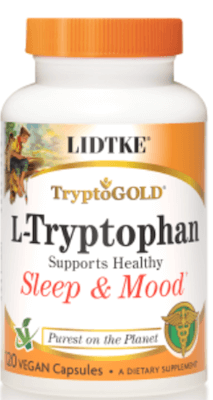
lydke l-tryptophan
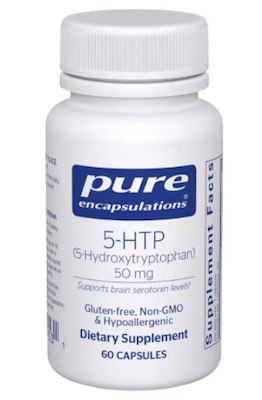
pure 5htp

Products I recommend include Lidtke 500 mg Tryptophan, and Pure Encapsulations 50 mg 5-HTP.  You can purchase these from my online store (Fullscript – only available to US customers – use this link to set up an account).

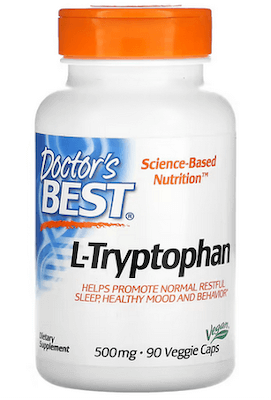
nature's best l-tryptophan
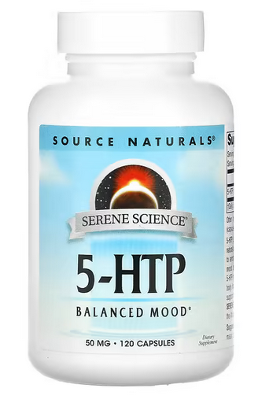
source natural 5-htp

If you’re not in the US, Doctor’s Best L-Tryptophan 500mg and Source Naturals 50 mg 5-HTP  are products I recommend on iherb (use this link to save 5%).

Resources if you are new to using amino acids as supplements

If you are new to using amino acids as supplements, here is the Amino Acids Mood Questionnaire from The Antianxiety Food Solution (you can see all the symptoms of neurotransmitter imbalances, including low GABA, low serotonin and low endorphins).

If you suspect low levels of any of the neurotransmitters and do not yet have my book, The Antianxiety Food Solution – How the Foods You Eat Can Help You Calm Your Anxious Mind, Improve Your Mood, and End Cravings, I highly recommend getting it and reading it before jumping in and using amino acids on your own so you are knowledgeable. And be sure to share it with the practitioner/health team you or your loved one is working with.

There is an entire chapter on the amino acids and they are discussed throughout the book in the sections on gut health, gluten, blood sugar control, sugar cravings, anxiety and mood issues.

The book doesn’t include product names (per the publisher’s request) so this blog, The Antianxiety Food Solution Amino Acid and Pyroluria Supplements, lists the amino acids that I use with my individual clients and those in my group programs. You can find them all in my online store.

If, after reading this blog and my book, you don’t feel comfortable figuring things out on your own (i.e. doing the symptoms questionnaire and respective amino acids trials), if you need serotonin support, the Serotonin QuickStart Program is a good place to start. This is a paid online/virtual group program where you get my guidance on using tryptophan and 5-HTP safely, and community support during 5 LIVE Q&A calls. You can sign up to be notified when the next live launch of this program is happening. We take a deep dive into product options including Lidtke products and others if you’re not able to access Lidtke.

Low GABA can also affect sleep and cause stress eating. If you also have low GABA symptoms, the next step to get help is the GABA QuickStart Program. This is also a paid online/virtual group program where you get my guidance and community support. Another option is the budget-friendly GABA QuickStart Homestudy Program.

If you are a practitioner, join us in The Balancing Neurotransmitters: the Fundamentals program. This is also a paid online/virtual program with an opportunity to interact with me and other practitioners who are also using the amino acids.

Wrapping up

Now I’d love to hear from you ….

Has tryptophan helped you quit alcohol easily when you could not do so with willpower alone?

Does tryptophan also help with your low mood, anxiety and sleep issues?

What about 5-HTP (some folks do better on one versus the other)?

And has either tryptophan or 5-HTP helped with other afternoon/evening cravings like sugar and other carbs?

If you have questions and other feedback please share it here too.

Filed Under: Addiction, Amino Acids, Anxiety, Tryptophan Tagged With: 5-HTP, alcohol, alcohol addiction, amino acids, anxious, beta-endorphins, calming, DLPA, evening, GABA, GABA Quickstart online program; Balancing Neurotransmitters: the Fundamentals program for practitioners, glutamine, mid-afternoon, mood, perimenopause, red wine, reward, self-medicating, serotonin, sleep, stressed, sugar cravings, treat, tryptophan, wine

GABA and Silexan (an oral lavender product) for anxiety, panic attacks, agoraphobia, insomnia and stressful events like travel/social events

February 24, 2023 By Trudy Scott 29 Comments

gaba and silexan

When sharing a study on the benefits of Silexan, a proprietary formulation of oral lavender essential oil (used as a supplement), I received this feedback from Kat. She uses both Silexan and GABA with success, depending on the situation:

I used Silexan (CalmAid) here in the USA, for 7 weeks and had wonderful results!!

I was having daily constant panic attacks… agoraphobia and insomnia. They put me on several SSRIs to which I had severe reactions to. The Silexan saved me! I was able to get my life back. I used it nightly and it helped tremendously with sleep and anxiety. I heard about it through The Carlat Report Psych podcast and website after a desperate search to find something to help.

It’s a product that I highly recommend to everyone I know who suffers with anxiety. I now use it only as needed. There are no side effects except a perfume burp but that’s tolerable for me! It can be stopped without any withdrawal effects.

And this is how she responded when I asked if she had previously done a trial of GABA or tryptophan and how Silexan compared to the amino acids.

I use the GABA during times where the panic is increasing (GABA Calm 1/2 tablet, sublingually).

I use the Silexan when I have something stressful planned like travel, social events etc. Silexan works so well without any side effects and can be stopped without any withdrawal effects.

The GABA is an immediate effect vs the Silexan which is slower acting but lasts throughout the day.

What wonderful results for Kat. I thanked her for sharing and voiced my concern with CalmAid and some of the other products that contain Silexan: they contain canola oil. I just wish they stopped making this with canola oil! I share more about this below and another product option that doesn’t use canola oil.

GABA or Silexan? Kat’s sweet spot, serotonin and pyroluria

If you’re wondering where you should start – GABA or Silexan? If you’ve been following my work or even starting to use GABA, you’ll know I always start clients with GABA when they have low GABA symptoms of physical anxiety and tension.

I agree with Kat – it’s very typical for GABA to provide immediate results. I did also share with her that in order to get longer lasting effects GABA does need to be used 3-4 x day, between meals. This means that, for her, GABA may offer similar results to Silexan by slowly building up her GABA levels.

However, Kat has found the sweet spot she needs by using this combination so I would stick with this approach.

If she did decide to stop using Silexan in the future, tryptophan may be needed too – for low serotonin worry-type anxiety symptoms. She did mention that she doesn’t currently use tryptophan and Silexan also affects serotonin levels.  

I do love that Kat plans for stressful events and uses Silexan in these situations. She does mention needing it for social events so I’d suggest looking into pyroluria too. More here on this social anxiety condition and how zinc, vitamin B6 and other key nutrients can help.

Kat’s dietary changes, no caffeine, no sugar and cravings?

I also asked if she has also made dietary changes and quit caffeine, alcohol and sugar. Kat shared that she doesn’t drink any caffeine and hasn’t since 2015. Good for her – caffeine is a major anxiety trigger. She does recognize that her anxiety gets worse when she’s eating a lot of processed foods/gluten/dairy/soy and she limits these.

I said it’s best to avoid these trigger foods altogether. This is often easier said than done! The amino acids help so much to break the addiction and eliminate the need to use willpower: GABA for stress-eating, tryptophan or 5-HTP if her cravings happen mostly in the afternoon and evening, and DPA if comfort foods are her reward. More on the amino acids and cravings here.

I thanked Kat for sharing her wonderful results and asked for permission to share as a blog.  I always appreciate being able to do this so I can continue to educate and inspire. This also shows how there is no-one size fits all.

Silexan research on anxiety and insomnia

This is the study I shared on Facebook – Prescription of Silexan Is Associated with Less Frequent General Practitioner Repeat Consultations Due to Disturbed Sleep Compared to Benzodiazepine Receptor Agonists: A Retrospective Database Analysis

The prescription of Silexan to adult patients consulting general practitioners (GPs) for disturbed sleep results in less frequent repeat consultations than Z-drugs (including zolpidem, zopiclone, and zaleplon).

This may support Silexan’s role as an efficacious, self-enabling, well-tolerated, and sustained treatment option.

Because Silexan is a proven anxiolytic, its impact in improving undiagnosed anxiety disorders may have had a lasting effect for certain patients.

As explained in this same paper, “Silexan is an active substance with an essential oil produced from Lavandula angustifolia flowers.” It’s a proprietary lavender oil that complies with and exceeds the European Pharmacopoeia quality definition for the monograph lavender oil. “Several studies have shown positive effects of Silexan on symptoms of subsyndromal/mild anxiety or GAD [generalized anxiety disorder] compared to conventional treatment or placebo groups.”

Silexan and other oral lavender products

The proprietary product of Silexan, with 80mg of Lavandula angustifolia essential oil, is found in a number of products:

  • Nature’s Way CalmAid ® (this is the product Kat used/uses)
  • Integrative Therapeutics Lavela ™
  • Seremind ® (in Australia)

This supplement, NFH Lavender SAP, does not use the proprietary Silexan but does contain 80mg of organic lavender (Lavandula angustifolia) essential oil. This product is my preference since it contains olive oil and not canola oil like the others mentioned above.

All of the above are available in my online supplement store (for US purchases only). Nature’s Way CalmAid ® is also available on iherb.

Dosing recommendations for adults is 1 softgel once or twice daily with a full glass of water. There is a caution not to use while pregnant, nursing, or for children under 12 years of age.

GABA for anxiety, insomnia, sugar cravings, sensorimotor skills and immunity

I share case studies and research about GABA all the time so I’ll just share links to some of the past GABA blogs in case you’re new to GABA (a calming amino acid and neurotransmitter):

  • GABA for ending sugar cravings (and anxiety and insomnia)
  • GABA is a life saver for anxiety, theanine helps at night (insomnia) and 5-HTP makes a significant difference in lessening daily pain
  • GABA and theanine for easing anxiety, improving sleep and supporting immunity
  • Half a crushed GABA Calm for my autistic child: sleep, anxiety and sensorimotor skills (writing, horse riding and swimming) improve

Resources if you are new to using GABA and other amino acids as supplements

If you are new to using GABA or any of the other amino acids as supplements, here is the Amino Acids Mood Questionnaire from The Antianxiety Food Solution (you can see all the symptoms of neurotransmitter imbalances, including low GABA and low serotonin).

If you suspect low levels of any of the neurotransmitters and do not yet have my book, The Antianxiety Food Solution – How the Foods You Eat Can Help You Calm Your Anxious Mind, Improve Your Mood, and End Cravings, I highly recommend getting it and reading it before jumping in and using amino acids on your own so you are knowledgeable. And be sure to share it with the practitioner/health team you or your loved one is working with.

There is an entire chapter on the amino acids and they are discussed throughout the book in the sections on gut health, gluten, blood sugar control, sugar cravings, self-medicating with alcohol and more.

The book doesn’t include product names (per the publisher’s request) so this blog, The Antianxiety Food Solution Amino Acid and Pyroluria Supplements, lists the amino acids that I use with my individual clients and those in my group programs. You can find them all in my online store. The above oral lavender products are available in my online store too.

If, after reading this blog and my book, you don’t feel comfortable figuring things out on your own (i.e. doing the symptoms questionnaire and respective amino acids trials), a good place to get help is the GABA QuickStart Program (if you have low GABA symptoms). This is a paid online/virtual group program where you get my guidance and community support.

If you are a practitioner, join us in The Balancing Neurotransmitters: the Fundamentals program. This is also a paid online/virtual program with an opportunity to interact with me and other practitioners who are also using the amino acids.

Have you found that an oral lavender product such as Silexan (used as a supplement) helps with your anxiety, panic attacks and/or sleep?

Have you used the NFH Lavender SAP product with similar success to other Silexan products?

Do you also use the amino acid GABA (sublingually) and in what situations do you use GABA vs oral lavender?

How much of each do you use?

If you have other questions and feedback please share them here too.

Filed Under: Anxiety, GABA, Insomnia Tagged With: Agoraphobia, anxiety, essential oil supplement, GABA, GABA Calm, lavender, Nature’s Way CalmAid, NFH Lavender SAP, oral lavender, panic attacks, pyroluria, resources if you are new to the amino acids; the GABA Quickstart online program; and Balancing Neurotransmitters: the Fundamentals program for practitioners, serotonin, Silexan, sleep, social events, stressful events, sugar cravings, travel

Half a crushed GABA Calm for my autistic child: sleep, anxiety and sensorimotor skills (writing, horse riding and swimming) improve

January 6, 2023 By Trudy Scott 28 Comments

gaba calm and autistic child

The inhibitory neurotransmitter GABA (gamma-aminobutyric acid) and the main excitatory neurotransmitter glutamate released by neurons in the cerebellum play an important role in sensory processing in autism. Research shows GABA to be low and glutamate to be elevated in autism spectrum disorders. While we don’t have any research supporting the amino acid GABA (used as a supplement) to raise GABA levels (and counter high glutamate levels) in autism, we do have much clinical evidence i.e. GABA can have a major impact on sensorimotor skills, as well as improving sleep, anxiety and social interaction. Today I’m sharing feedback from a mom whose autistic child is experiencing these benefits. Here is Vic’s feedback in her own words:

I use half a GABA tablet crushed in liquid for my autistic child (the Source Naturals you recommend) and it definitely helps. A whole GABA tablet and we see increased waking in the night but half seems perfect.

I’m using GABA in combination with 5-HTP. GABA was added after 5-HTP because it didn’t feel enough on its own and sleep and anxiety definitely improved at that point. We tried L–tryptophan first without success.

Sleep and sensorimotor skills have improved since weaning off an SSRI and onto the above combination as her willingness to engage with social interaction. We are also working on OT (occupational therapy) and retained reflexes and so improvements may be from that too.

Oh also supplementing b6, but not zinc as she refused it due to taste (which from reading means she probably doesn’t need it)

On a personal note there’s no way I’d manage to get her to drink [GABA Oolong] tea with her taste sensitivities – same reason I’m crushing rather than sublingual so practically speaking Source Naturals GABA is much easier than copying what they did in the study.

Vic is referring to the GABA Oolong tea study – GABA Oolong tea in children with autism: improvements in sensorimotor skills, autism profiles, anxiety and sleep (new research).

This very small (nine children) recent study found “significant improvement in manual dexterity and some large individual improvements in balance, sensory responsivity, DSM-5 criteria and cortisol levels with GABA tea.” They ingested the equivalent of 39.2 mg GABA for the day.

Sensorimotor skills that have improved: pen and pencil use, horse riding and swimming

I was thrilled to see her wonderful feedback in the comments section of the above blog and shared my delight, asking her which sensorimotor skills have improved. Vic shared this:

Sensorimotor wise, the biggest improvement I’ve noticed is her pen and pencil use – she’s actually being able to write and draw what she wants better than she was and she’s less avoidant of it in general. Her hand/eye referencing is noticeably better and her pressure control with a writing implement.

Her balance and core strength is improving (OT feel core strength generally doesn’t come properly until those internal senses are functioning) – her horse riding instructor commented on the change in how she is able to hold herself on a horse – especially when the horse got an unexpected itch the other week and she could simply adjust her body without conscious effort. Before she would have wobbled if a horse had done that.

She’s now teaching herself to swim as she has a better sense of body awareness to coordinate her limbs to all be doing what she wants.

So yeah mostly vestibular, proprioception and interoception are all working better!

As you’ll read below, research does show that GABA plays a role in sensorimotor difficulties in autism.

Some of my feedback on the GABA product and dosing, and adding it after 5-HTP

In case you’re not familiar with the Source Naturals GABA Calm product, it’s a sublingual tablet that contains 125 mg GABA (and some other ingredients). It’s typically used as a sublingual i.e. held in the mouth and dissolved, but this mom has figured out that crushing it and mixing it in liquid works best for her daughter.

To see these results with only 62 mg GABA is impressive. But as I’ve shared before, dosage does depend on your unique needs and there can be a large variation in dosing. As mentioned above, in the GABA Oolong autism study, the equivalent of 39.2 mg GABA was used daily.

That said, I did say I’d consider exploring a GABA only product at night if there are still some low GABA symptoms that remain. This could also be mixed in water.

Given that her daughter is doing occupational therapy too and also using 5-HTP and vitamin B6 (since low serotonin and pyroluria/social anxiety is common in autism) it can be challenging to tease out how much has improved with GABA alone. Vic did add GABA after having started 5-HTP and this is the best way to know what is helping which symptoms i.e. using a layered approach.

It’s also good that she figured out 5-HTP was beneficial when tryptophan wasn’t. It’s not unusual that some folks do better on one vs the other.

GABA does play a role sensorimotor difficulties in autism – the research

As reported in this 2016 paper, The Role of Sensorimotor Difficulties in Autism Spectrum Conditions:

In addition to difficulties in social communication, current diagnostic criteria for autism spectrum conditions also incorporate sensorimotor difficulties, repetitive motor movements, and atypical reactivity to sensory input.

GABA does play a role in sensorimotor difficulties as reported in this same paper. Here are some of the highlights:

  • The inhibitory neurotransmitter GABA (gamma-aminobutyric acid) and the main excitatory neurotransmitter glutamate released by [neurons in the cerebellum] play an important role in sensory discrimination in autism. GABA is known to decrease the firing of neurons , thereby reducing and inhibiting sensory feedback.
  • GABAergic functioning has been implicated in tactile reactivity.
  • Reductions in GABAergic system have been discovered in brain tissue: with significant reductions in GABAA receptors, 63% reduction in comparison to controls, and a reduction by 61% of the glutamic acid decarboxylase protein (the enzyme responsible for converting glutamate into GABA).
  • Increased glutamate levels (excitatory neurotransmitter) in blood and platelets have been found in autism subjects, suggesting impaired conversion of glutamate to GABA, consequently increasing the excitatory state of the brain.

In the section on future directions, the authors conclude that addressing the deficiency of the inhibitory neurotransmitter GABA in the cerebellum of those with autism, “could have a global impact on sensorimotor planning, cognitive and social development.” They recommend a non-evasive GABA substitute such as oolong tea.

Elsewhere in the paper, they mention the amino acid l-theanine which “blocks the binding of l-glutamic acid to glutamate receptors in the brain, thereby perhaps aiding the improvement in motor activity by increasing inhibition of movement.”

I’d like to propose that the amino acid GABA is the subject of future research, given what we see clinically.

Resources if you are new to using amino acids as supplements

If you are new to using GABA or any of the other amino acids as supplements, here is the Amino Acids Mood Questionnaire from The Antianxiety Food Solution (you can see all the symptoms of neurotransmitter imbalances, including low GABA and low serotonin).

If you suspect low levels of any of the neurotransmitters and do not yet have my book, The Antianxiety Food Solution – How the Foods You Eat Can Help You Calm Your Anxious Mind, Improve Your Mood, and End Cravings, I highly recommend getting it and reading it before jumping in and using amino acids on your own so you are knowledgeable. And be sure to share it with the practitioner/health team you or your loved one is working with.

There is an entire chapter on the amino acids and they are discussed throughout the book in the sections on gut health, gluten, blood sugar control, sugar cravings, self-medicating with alcohol and more.

The book doesn’t include product names (per the publisher’s request) so this blog, The Antianxiety Food Solution Amino Acid and Pyroluria Supplements, lists the amino acids that I use with my individual clients and those in my group programs. You can find them all in my online store.

If, after reading this blog and my book, you don’t feel comfortable figuring things out on your own (i.e. doing the symptoms questionnaire and respective amino acids trials), a good place to get help is the GABA QuickStart Program (if you have low GABA symptoms). This is a paid online/virtual group program where you get my guidance and community support.

Another option is the budget-friendly GABA QuickStart Homestudy program.

If you also need serotonin support, the Serotonin QuickStart Program is a good place to get help. This is also a paid online/virtual group program where you get my guidance on using tryptophan and 5-HTP safely, and community support during 5 LIVE Q&A calls. You can sign up to be notified when the next live launch of this program is happening.

If you are a practitioner, join us in The Balancing Neurotransmitters: the Fundamentals program. This is also a paid online/virtual program with an opportunity to interact with me and other practitioners who are also using the amino acids.

Wrapping up and your feedback

I’m so happy for this young girl and she and her family must be thrilled with her results. I really do appreciate Vic for sharing this outcome – it’s so inspiring and also motivating if you are a parent.

Have you used the amino acid GABA personally or with clients/patients and observed improvements in sensorimotor skills? How much and what benefits have you seen?  Which product have you used? Please do share if the diagnosis is autism spectrum disorder or something else.

Have you also seen improvements with anxiety, sleep and social skills when using the amino acid GABA?

Feel free to post your questions and feedback in the comments below.

Filed Under: Anxiety, Autism, GABA, Insomnia Tagged With: 5-HTP, anxiety, autism, autistic child, GABA, GABA Calm, GABA Oolong tea with her taste sensitivities, GABA Quickstart online program; and Balancing Neurotransmitters: the Fundamentals program for practitioners, glutamate, horse riding, neurotransmitter, sensorimotor skills, sensory, sleep, social interaction, swimming, vitamin B6, writing

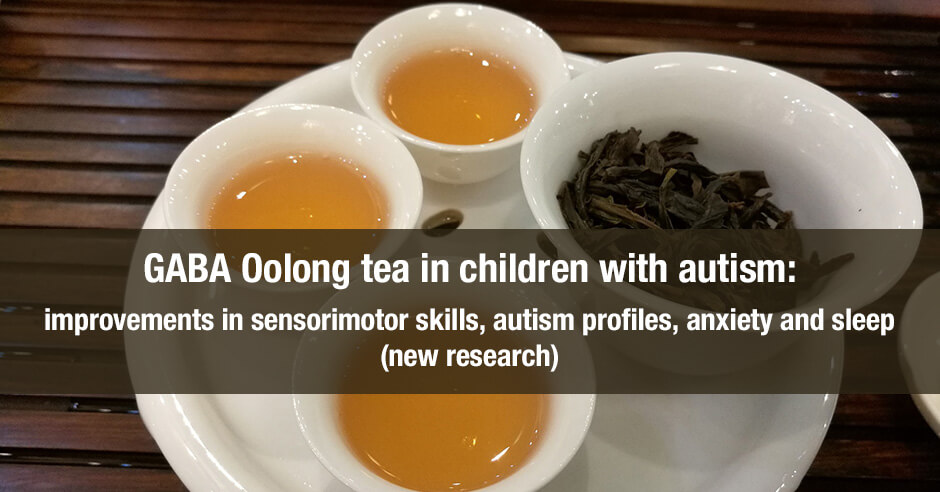
GABA Oolong tea in children with autism: improvements in sensorimotor skills, autism profiles, anxiety and sleep (new research)

December 2, 2022 By Trudy Scott 14 Comments

gaba woolong tea and autism

A small feasibility study, A double-blind, placebo-controlled, randomised-designed GABA tea study in children diagnosed with autism spectrum conditions, explored the effect of drinking GABA Oolong tea on sensorimotor skills, autism profiles, anxieties and sleep of children with autism.

It was a very small study with nine children (5 male and 4 female) but the results were very promising… “significant improvement in manual dexterity and some large individual improvements in balance, sensory responsivity, DSM-5 criteria and cortisol levels with GABA tea.”

In addition to reducing anxiety (in all but one participant – more on that below), the paper lists the following additional information related to sensory issues, cortisol levels and sleep:

  • Results also demonstrated that sensory responsivity improved in two-thirds of the participants and autism symptomology decreased in over half, with four of these individuals being positively re-classified on the DSM-5 scale
  • Differences between evening and morning cortisol levels, deemed the ‘carryover’ effect and cortisol awakening levels were also decreased in over two thirds of the participants, which we attribute to a reduction in stress response which may have helped to reduce sensorimotor responsivity in individuals with autism.
  • Contrary to our hypotheses, GABA Oolong tea did not appear to impact sleep, with no discernible differences noted in a range of sleep parameters compared with the placebo, despite parents’ subjective reports that their children appeared to sleep more deeply.

They conclude as follows … “These results suggest that sensorimotor abilities, anxiety levels and DSM-5 symptomology of children with autism can benefit from the administration of GABA in the form of Oolong tea.”

What is GABA Oolong tea?

When I shared this study and results on Facebook, I had a few people ask if they could simply add the amino acid GABA to their Oolong tea: “Is it just brewed tea with GABA powder added? Or does someone make a specific tea? I can totally add some GABA to my daily tea.”

It’s not regular oolong tea with GABA added, instead it’s specially fermented to increase GABA levels naturally. Amber GABA Oolong tea by Meileaf is the actual tea used in the study and they share this on the product page.

The farmers achieve this by alternating the leaves between air and a nitrogen rich environment (with no air) during the oxidation phase. This is done over a matter of hours and naturally increases the GABA levels in the tea leaves.

They also share this: “In order to be called GABA tea, the leaves must contain at least 150 mg of GABA per 100g (normal oolong has about 6 mg so that is 25 times higher).”

GABA Oolong tea does also contain theanine, caffeine and epigallocatechin gallate. There is a large part of the study dedicated to theanine so feel free to read that at your leisure.

How much GABA was ingested by study participants?

It was a surprisingly low dose of GABA! They were given 4 cups a day of the GABA Oolong tea and this provided a total of 39.2mg GABA for the day. The authors share this about the amount of daily GABA the study participants received:

With the GABA Oolong tea the dose would be approximately 280 mg per 100 g tea. Based on using 3.5 g per tea portion this equates to 9.8 mg of GABA; multiplied by 4 throughout the day, being 39.2 mg of GABA.

I’ve reached out to confirm which tea was used in the study since Meileaf mentions that this tea contains 205 mg of GABA per 100 g whereas the study states there was 280 mg GABA per 100 g tea. I see consistency with assessing GABA levels accurately being a possible issue (more on that below).

One of the first questions I had was how could such a small amount – 39.2 mg GABA for the day –  be so effective? I typically have clients start with 125 mg GABA and they may end up using this dose 3 or 4 x day (so 375 to 500 mg GABA total for the day.)

That said, we are all unique and as I’ve shared, there can be an extremely large variation in dosing.  In this blog I share how Syd gets sleep and body anxiety benefits with just 1.5 mg to 3 mg GABA and yet Christina’s agoraphobic client was able to leave the house with 3000 mg GABA.

My other questions: the placebo, caffeine, a histamine reaction, low cortisol and B1 depletion

With new research there are always many factors to consider and I have a number of other questions I’d love to see addressed:

  • Why did the placebo tea also contain GABA? It had 22.2 mg per day of GABA – about half that found in the GABA Oolong tea.
  • GABA Oolong tea does contain small amounts of caffeine and how would this affect susceptible individuals? One child was more anxious – was it due to caffeine or was it too much GABA for his needs or a histamine reaction due to the fermentation process (or something else)?
  • Do we need to be concerned about long term use and depletion of vitamin B1/thiamine which happens with regular tea.
  • And what about the effects if someone already has low cortisol levels?
  • Will there be standard levels and accurate measures of GABA in the various GABA Oolong teas that we can rely on? This applies to consumers and practitioners wanting to try this approach and for ongoing research.
  • How much of the effect was also due to addressing dehydration and helping with dietary oxalate issues which are known to be common in autism?

Hopefully new ongoing research with more participants will shed light on some of these questions.

I’d also love to see head to head research comparing GABA Oolong tea with supplementation of the amino acid GABA, and a study where both are used for possible synergistic effects.

I do appreciate that the authors attempt to address the GABA blood brain barrier (BBB) debate and how GABA could work, focusing on a permeable blood brain barrier in epilepsy and increased epilepsy in autism. This angle is new to me. I’ve addressed the leaky BBB at length here in my interview with Dr. Kharrazian (it’s a theory) and one of my interviews on a prior Anxiety Summit (there are many possible mechanisms and the peripheral effects).

If you’re new to symptoms of low GABA (and cases highlighting the calming effects of the amino acid GABA used as as a supplement)

GABA (gamma aminobutyric acid) is a calming neurotransmitter and the calming amino acid GABA used as a supplement can raise GABA levels. With low GABA levels you’ll feel a physical-tension and stiff-and-tense-muscles type of anxiety.

The other symptoms we see with low GABA are panic attacks, physical tension in certain settings like public speaking or driving, and the need to self-medicate to calm down, often with alcohol but sometimes with carbs and sugary foods. Insomnia can also be due to low GABA and you’ll experience physical tension (rather than the ruminating thoughts which is the low serotonin type of insomnia – although it’s not uncommon to experience both). GABA also helps with muscle spasms and pain relief when muscles are tight.

Here are are some case studies where you can read about the calming effects (and other benefits) of the amino acid GABA used as as a supplement:

  • GABA is a life saver for anxiety, theanine helps at night (insomnia) and 5-HTP makes a significant difference in lessening daily pain
  • Drastic reduction in intrusive thoughts, anxiety and fears (and better sleep) with GABA, tryptophan, 5-HTP and the pyroluria protocol
  • GABA, Heartmath and EFT ease Micki’s mold-induced anxiety and panic attacks
  • GABA, Rescue Remedy & essential oils for eliminating dental anxiety
  • GABA for children: ADHD, focus issues, irritability, anxiety and tantrums

Resources if you are new to using GABA and other amino acids as supplements

If you are new to using GABA or any of the other amino acids as supplements, here is the Amino Acids Mood Questionnaire from The Antianxiety Food Solution (you can see all the symptoms of neurotransmitter imbalances, including low GABA and low serotonin).

If you suspect low levels of any of the neurotransmitters and do not yet have my book, The Antianxiety Food Solution – How the Foods You Eat Can Help You Calm Your Anxious Mind, Improve Your Mood, and End Cravings, I highly recommend getting it and reading it before jumping in and using amino acids on your own so you are knowledgeable. And be sure to share it with the practitioner/health team you or your loved one is working with.

There is an entire chapter on the amino acids and they are discussed throughout the book in the sections on gut health, gluten, blood sugar control, sugar cravings, self-medicating with alcohol and more.

The book doesn’t include product names (per the publisher’s request) so this blog, The Antianxiety Food Solution Amino Acid and Pyroluria Supplements, lists the amino acids that I use with my individual clients and those in my group programs. You can find them all in my online store.

If, after reading this blog and my book, you don’t feel comfortable figuring things out on your own (i.e. doing the symptoms questionnaire and respective amino acids trials), a good place to get help is the GABA QuickStart Program (if you have low GABA symptoms). This is a paid online/virtual group program where you get my guidance and community support.

If you are a practitioner, join us in The Balancing Neurotransmitters: the Fundamentals program. This is also a paid online/virtual program with an opportunity to interact with me and other practitioners who are also using the amino acids.

Have you used GABA Oolong tea with clients/patients or personally? How much and what benefits have you seen?  Which product have you used?

If you’ve also used the amino acid GABA sublingually and with success, I’d love to hear how much (and which product) and how it compares with GABA Oolong tea for anxiety, insomnia, sensorimotor skills and/or autism symptoms (as applicable to you, your child or other family member and/or your client/patient)?

If you have questions please share them here too.

Filed Under: Anxiety, Autism, GABA, Insomnia Tagged With: amino acid, anxiety, autism, autism profiles, B1 depletion, balance, BBB, blood brain barrier, caffeine, calming, children, cortisol, GABA, GABA Oolong tea, GABA Quickstart online program; Balancing Neurotransmitters: the Fundamentals program for practitioners, histamine, insomnia, manual dexterity, research, sensorimotor skills, sensory responsivity, sleep, study

  • « Go to Previous Page
  • Page 1
  • Page 2
  • Page 3
  • Page 4
  • Page 5
  • Page 6
  • Interim pages omitted …
  • Page 13
  • Go to Next Page »

Primary Sidebar

GABA QuickStart Homestudy

gaba quickstart homestudy

Free Report

9 Great Questions Women Ask about Food, Mood and their Health

You'll also receive a complimentary subscription to my ezine "Food, Mood and Gal Stuff"


Connect with me

Popular Posts

  • Amino Acids Mood Questionnaire from The Antianxiety Food Solution
  • The Antianxiety Food Solution Amino Acid and Pyroluria Supplements
  • Pyroluria Questionnaire from The Antianxiety Food Solution
  • Collagen and gelatin lower serotonin: does this increase your anxiety and depression?
  • Tryptophan for the worry-in-your-head and ruminating type of anxiety
  • GABA for the physical-tension and stiff-and-tense-muscles type of anxiety
  • The Antianxiety Food Solution by Trudy Scott
  • Seriphos Original Formula is back: the best product for anxiety and insomnia caused by high cortisol
  • Am I an anxious introvert because of low zinc and vitamin B6? My response to Huffington Post blog
  • Vagus nerve rehab with GABA, breathing, humming, gargling and key nutrients

Recent Posts

  • Her cravings for chips and peanut butter were triggered by stress: GABA ends cravings and reduces physical tension and fear of heights
  • It is truly miraculous to be able to move through life without crippling anxiety and panic
  • GABA and tryptophan combo provide immediate and noticeable relief for tremors and cervical dystonia in just 7 days
  • Red light therapy for back and neck pain, plantar fasciitis and low mood – a complement to the amino acids GABA, DPA and tryptophan
  • What do I use instead of Seriphos to help lower high cortisol that is affecting my sleep and making me anxious at night?

Categories

  • 5-HTP
  • AB575
  • Addiction
  • ADHD
  • Adrenals
  • Alcohol
  • Allergies
  • Alzheimer's disease
  • Amino Acids
  • Anger
  • Antianxiety
  • Antianxiety Food Solution
  • Antidepressants
  • Anxiety
  • Anxiety and panic
  • Autism
  • Autoimmunity
  • benzodiazapines
  • Bipolar disorder
  • Books
  • Caffeine
  • Cancer
  • Candida
  • Children/Teens
  • Collagen
  • Cooking equipment
  • Coronavirus/COVID-19
  • Cravings
  • Depression
  • Detoxification
  • Diabetes
  • Diet
  • DPA/DLPA
  • Drugs
  • EFT/Tapping
  • EMF
  • EMFs
  • Emotional Eating
  • Endorphins
  • Environment
  • Essential oils
  • Events
  • Exercise
  • Fear
  • Fear of public speaking
  • Fertility and Pregnancy
  • Fish
  • Food
  • Food and mood
  • Functional neurology
  • GABA
  • Gene polymorphisms
  • General Health
  • Giving
  • Giving back
  • Glutamine
  • Gluten
  • GMOs
  • Gratitude
  • Gut health
  • Heart health/hypertension
  • Histamine
  • Hormone
  • Hyperparathyroidism
  • Hypoglycemia
  • Immune system
  • Inflammation
  • Insomnia
  • Inspiration
  • Introversion
  • Joy and happiness
  • Ketogenic diet
  • Lithium orotate
  • Looking awesome
  • Lyme disease and co-infections
  • MCAS/histamine
  • Medication
  • Men's health
  • Mental health
  • Mercury
  • Migraine
  • Mold
  • Movie
  • MTHFR
  • Multiple sclerosis
  • Music
  • NANP
  • Nature
  • Nutritional Psychiatry
  • OCD
  • Osteoporosis
  • Oxalates
  • Oxytocin
  • Pain
  • Paleo
  • Parasites
  • Parkinson’s disease
  • PCOS
  • People
  • PMS
  • Postpartum
  • PTSD/Trauma
  • Pyroluria
  • Questionnaires
  • Real whole food
  • Recipes
  • Research
  • Schizophrenia
  • serotonin
  • SIBO
  • Sleep
  • Special diets
  • Sports nutrition
  • Stress
  • Sugar addiction
  • Sugar and mood
  • Supplements
  • Teens
  • Testimonials
  • Testing
  • The Anxiety Summit
  • The Anxiety Summit 2
  • The Anxiety Summit 3
  • The Anxiety Summit 4
  • The Anxiety Summit 5
  • The Anxiety Summit 6
  • Thyroid
  • Thyroid health
  • Toxins
  • Tryptophan
  • Tyrosine
  • Uncategorized
  • Vegan/vegetarian
  • Women's health
  • Yoga

Archives

  • May 2026
  • April 2026
  • October 2025
  • September 2025
  • August 2025
  • July 2025
  • June 2025
  • May 2025
  • April 2025
  • March 2025
  • February 2025
  • January 2025
  • November 2024
  • October 2024
  • September 2024
  • August 2024
  • July 2024
  • June 2024
  • May 2024
  • April 2024
  • March 2024
  • February 2024
  • January 2024
  • December 2023
  • November 2023
  • October 2023
  • September 2023
  • August 2023
  • July 2023
  • June 2023
  • May 2023
  • April 2023
  • March 2023
  • February 2023
  • January 2023
  • December 2022
  • November 2022
  • October 2022
  • September 2022
  • August 2022
  • July 2022
  • June 2022
  • May 2022
  • April 2022
  • March 2022
  • February 2022
  • January 2022
  • December 2021
  • November 2021
  • October 2021
  • September 2021
  • August 2021
  • July 2021
  • June 2021
  • May 2021
  • April 2021
  • March 2021
  • February 2021
  • January 2021
  • December 2020
  • November 2020
  • October 2020
  • September 2020
  • August 2020
  • July 2020
  • June 2020
  • May 2020
  • April 2020
  • March 2020
  • February 2020
  • January 2020
  • December 2019
  • November 2019
  • October 2019
  • September 2019
  • August 2019
  • July 2019
  • June 2019
  • May 2019
  • April 2019
  • March 2019
  • February 2019
  • January 2019
  • December 2018
  • November 2018
  • October 2018
  • September 2018
  • August 2018
  • July 2018
  • June 2018
  • May 2018
  • April 2018
  • March 2018
  • February 2018
  • January 2018
  • December 2017
  • November 2017
  • October 2017
  • September 2017
  • August 2017
  • July 2017
  • June 2017
  • May 2017
  • April 2017
  • March 2017
  • February 2017
  • January 2017
  • December 2016
  • November 2016
  • October 2016
  • September 2016
  • August 2016
  • July 2016
  • June 2016
  • May 2016
  • April 2016
  • March 2016
  • February 2016
  • January 2016
  • December 2015
  • November 2015
  • October 2015
  • September 2015
  • August 2015
  • July 2015
  • June 2015
  • May 2015
  • April 2015
  • March 2015
  • February 2015
  • January 2015
  • December 2014
  • November 2014
  • October 2014
  • September 2014
  • August 2014
  • July 2014
  • June 2014
  • May 2014
  • April 2014
  • March 2014
  • February 2014
  • January 2014
  • December 2013
  • November 2013
  • October 2013
  • September 2013
  • August 2013
  • July 2013
  • June 2013
  • May 2013
  • April 2013
  • March 2013
  • February 2013
  • January 2013
  • December 2012
  • November 2012
  • October 2012
  • August 2012
  • July 2012
  • June 2012
  • May 2012
  • April 2012
  • March 2012
  • February 2012
  • January 2012
  • December 2011
  • November 2011
  • October 2011
  • September 2011
  • August 2011
  • July 2011
  • June 2011
  • May 2011
  • April 2011
  • March 2011
  • February 2011
  • January 2011
  • December 2010
  • October 2010
  • September 2010
  • July 2010
  • May 2010
  • April 2010
  • March 2010
  • February 2010
  • January 2010
  • November 2009

Share the knowledge!

The above statements have not been evaluated by the Food and Drug Administration. Products listed in this website are not intended to diagnose, treat, cure or prevent any disease.

The information provided on this site is for informational and educational purposes only and is not intended as a substitute for advice from your physician or other health care professional. You should consult with a healthcare professional before starting or modifying any diet, exercise, or supplementation program, before taking or stopping any medication, or if you have or suspect you may have a health problem.


Copyright © 2026 Trudy Scott. All Rights Reserved. | Privacy | Terms and Conditions | Refund Policy | Medical Disclaimer

Free Report

9 Great Questions Women Ask about Food, Mood and their Health

You’ll also receive a complimentary subscription to my ezine “Food, Mood and Gal Stuff”