• Skip to primary navigation
  • Skip to main content
  • Skip to primary sidebar

everywomanover29 blog

Food, Mood and Women's Health – Be your healthiest, look and feel great!

  • Blog
  • About
  • Services
  • Store
  • Resources
  • Testimonials
  • The Book
  • Newsletter
  • Contact
  • Search this site

5-HTP

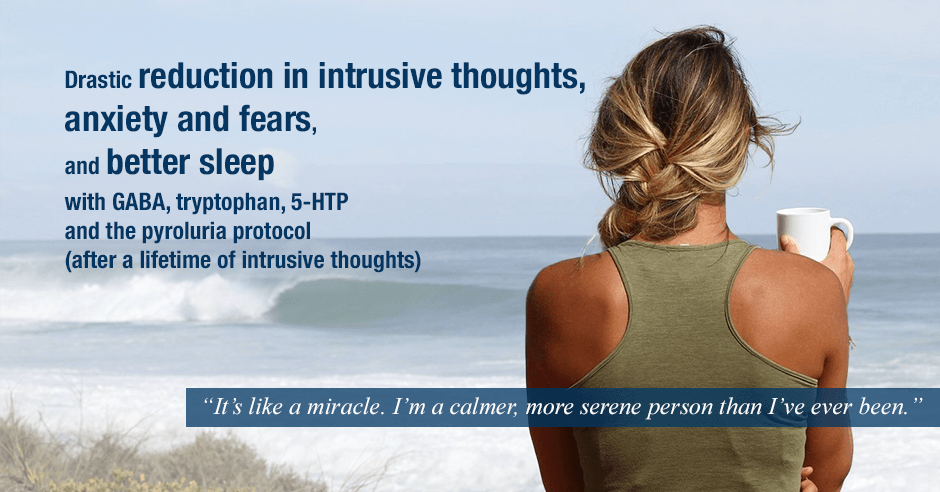
Drastic reduction in intrusive thoughts, anxiety and fears (and better sleep) with GABA, tryptophan, 5-HTP and the pyroluria protocol

May 6, 2022 By Trudy Scott 33 Comments

intrusive thoughts reduction

It’s not uncommon for an adult woman to have had intrusive thoughts her entire life and not even recognize that they are connected to her anxiety levels. She is often unaware that there is anything she can do to actually ease her anxiety and reduce the bad thoughts (such as fearing horrible things happening to her husband and children). Enter the amino acids: GABA, tryptophan, 5-HTP and the pyroluria protocol (zinc, vitamin B6 and evening primrose oil). They can do all of this and more. Kimberly shared her own experience and success on a blog post about intrusive thoughts and these specific nutrients. Here is her story in her own words:

Oh my goodness, I’m realizing after reading this, that intrusive thoughts are something I’ve had my entire life. As a child, this manifested in thoughts of what might happen to my one stable parent when we were apart. More recently, I feared horrible things happening to my husband or children. Like the author of the original blog wrote, these intrusive thoughts reflect a greater anxiety. But I didn’t realize this until I began experimenting with your protocols.

I first tried GABA when I felt extremely anxious, but not on a regular basis. Next, I added the pyroluria protocol, which did bring some relief to the intrusive thoughts. Fast forward to today, when I also take 5-HTP, tryptophan and GABA regularly and have noticed a drastic reduction in those thoughts/fears. It’s like a miracle.

My fear level is maybe 15% of what it used to be, if that.

I also find that I can use extra GABA at night if I wake up and can’t shut off my mind. It works like a charm to help me get back to sleep. What a blessing to have these amino acids.

I’m a calmer, more serene person than I’ve ever been, without (for the most part) the crippling, irrational fears I used to experience. Thank you, as always, Trudy. You are also a tremendous blessing.

I thanked her for sharing and said how glad I was that she is connecting more and more dots. It’s very common to suddenly realize you’ve had these intrusive thoughts your entire life. With her  amazing results, combining all the above nutrients she is a poster child for this approach that I use with my clients. I’m thrilled for her miracle outcome and so very happy for her.

I’m sharing her story here as a new blog so I can provide her with some additional approaches to explore and so you can see how these amino acids and other nutrients have worked for someone else (and get your own insights.) I’m also sharing my feedback on how she approached things.

Additional approaches to her to explore: adjusting what is working for her now

Her fear level is maybe 15% of what it used to be but ideally we want to improve on that by fine-tuning what she is doing and capitalize on what is working. Know this – it’s not unreasonable to expect that to get to zero!

If we were working together this is what I’d suggest (assuming she hasn’t already done this):

  • Review the low GABA and low serotonin questionnaires and adjust the GABA and/or tryptophan/5-HTP based on any symptoms that remain with a score above zero.
  • After that, if there are still some troubling low serotonin symptoms experiment with different doses and timings of tryptophan and 5-HTP – some people do better on one vs the other
  • Also, if there are still some troubling low GABA symptoms, experiment with a few different GABA products. I’ve had folks try up to 5 different products before they find the perfect one for their needs
  • If she can see the social anxiety and other pyroluria signs remain, we’d adjust zinc, vitamin B6 (and possibly add P5P) and evening primrose oil.

With all of the above, I’d have her do one change at a time and carefully document everything in her food-mood log.

Identifying if the remaining fear/intrusive thoughts are more pronounced in the second half of her cycle

It may simply be a matter of identifying if the remaining fear/intrusive thoughts are more pronounced in the second half of her cycle i.e. after ovulation. As I shared on the blog, one study showed that “women in the ‘early luteal’ phase… had more than three times as many intrusive thoughts.”

She may need to adjust the amino acids up during this period and it may be that over the next 2 months she sees these symptoms resolve with her current approach, as her hormones become balanced. It’s typical to see this in 2-3 months.

My feedback on her approach

Here is my feedback on how she did things and why I love her approach:

  • She experimented with GABA some of the time – as needed – based on what she was learning from me from blogs, my book and interviews.
  • She made one change at a time, adding the pyroluria protocol next
  • Then she added tryptophan and 5-HTP (hopefully one at a time)
  • And then her use of the amino acids became regular. This last aspect of consistency is a needle mover for so many of my clients.
  • She now tweaks things and takes extra GABA at night if needed. This may be needed after a tough day or if you’ve been glutened or exposed to insecticides.

I will add that the sequence could have been varied and still have had a similar successful outcome, for example, amino acid consistency from day 1 and then adding the pyroluria protocol (this is what I typically do with clients).

However, it’s my goal to empower women like Kimberly to take charge, learn, make changes, listen to their bodies, learn some more and adjust to see further improvements. It makes me immensely happy when I hear that she is a calmer, more serene person than she’s ever been. I feel confident that she’ll be able to get to zero intrusive thoughts with the tips I shared above.

She may or may not also need to consider other possible root causes of intrusive thoughts: low magnesium, low iron, diet (a low carb/high fat intrusive thoughts case study) and gluten issues.

Psychiatric medication discontinuation syndrome, Lyme disease, mold toxicity, heavy metals, toxins, infections, TBI and trauma can also be factors with intrusive thoughts and anxiety, but with her huge improvement I’d suspect these root causes are unlikely for her.

Resources if you are new to using the amino acids and pyroluria supplements

If you are new to using GABA or tryptophan/5-HTP as a supplement, here is the Amino Acids Mood Questionnaire from The Antianxiety Food Solution (you can see all the low GABA and low serotonin symptoms).

If you suspect low levels of any of the neurotransmitters and do not yet have my book, The Antianxiety Food Solution – How the Foods You Eat Can Help You Calm Your Anxious Mind, Improve Your Mood, and End Cravings, I highly recommend getting it and reading it before jumping in and using amino acids on your own so you are knowledgeable. And be sure to share it with the team you or your loved one is working with.

There is an entire chapter on the amino acids and they are discussed throughout the book in the sections on gut health, blood sugar control, sugar cravings, self-medicating with alcohol and more.

My book also has an entire chapter on pyroluria (with the protocol and questionnaire). The questionnaire is on the blog too, together with many other related posts (simply search for pyroluria).

The book doesn’t include product names (per the publisher’s request) so this blog, The Antianxiety Food Solution Amino Acid and Pyroluria Supplements, lists the amino acids that I use with my individual clients and those in my group programs.

If, after reading this blog and my book, you don’t feel comfortable figuring things out on your own (i.e. doing the symptoms questionnaire and respective amino acids trials), a good place to get help is the GABA Quickstart Program. This is a paid online/virtual group program where you get my guidance and community support.

If you are a practitioner, join us in The Balancing Neurotransmitters: the Fundamentals program. This is also a paid online/virtual program with an opportunity to interact with me and other practitioners who are also using the amino acids.

Do you experience intrusive thoughts or did you have them in the past? Feel free to describe them if you feel comfortable doing so.

And did you think you’d be able to reduce the horrible intrusive thoughts with a nutritional approach?

What helped reduce them for you? If you used a similar approach, how did it look for you?

If you’re a practitioner, have you found this approach to help reduce intrusive thoughts and ease anxiety in your clients/patients?

If you have questions please share them here too.
Filed Under: 5-HTP, Anxiety, GABA, Insomnia, OCD, Tryptophan Tagged With: 5-HTP, amino acids, anxiety, anxious, calmer, can’t shut off my mind, empowering women, evening primrose oil, fear, feared horrible things, fears, GABA, GABA Quickstart program, intrusive thoughts, luteal phase, more serene, practitioner training, pyroluria protocol, sleep, tryptophan, vitamin B6, zinc

An amino acid supplement with DLPA, glutamine and 5-HTP eases alcohol withdrawal symptoms at an inpatient detoxification program

April 8, 2022 By Trudy Scott 18 Comments

amino acid and alcohol

An amino acid supplement with DLPA, glutamine and 5-HTP (and a few other nutrients) eases alcohol withdrawal symptoms at an inpatient detoxification program. Other than anxiety (I’ll share more on this below), there was also a significant decrease in psychiatric symptoms. Here is an excerpt from the study, The use of a food supplementation with D-phenylalanine, L-glutamine and L-5-hydroxytriptophan in the alleviation of alcohol withdrawal symptoms:

We described the use of a food supplementation with D-phenylalanine, L-glutamine and L-5-hydroxytryptophan in the alleviation of alcohol withdrawal symptoms in patients starting a detoxification therapy.

Since abstinence from ethanol causes a hypodopaminergic and a hypoopioidergic environment in the reward system circuits, manifesting with withdrawal symptoms, food supplements that contains D-phenylalanine, a peptidase inhibitor (of opioid inactivation) and L-amino-acids (for dopamine synthesis) were used to replenish a lack in neurotransmitters and alleviate the symptoms of alcohol withdrawal.

First I cover some translation issues and then more about the actual product and study results. I also share my commentary on the amino acids and dosing used in the study (and the fact that anxiety did not resolve). I include how to apply this information if you have a loved one in an alcohol treatment/rehab program or if you recognize social drinking is an issue for you. And I wrap up with additional resources if you are new to using GABA as a supplement, the GABA Quickstart online program and the practitioner training.

The study was completed and published in Slovenia and there are a few translation issues I’d like to clarify:

  • The study title states D-phenylalanine (DPA) was in the amino acid product, however DL-phenylalanine (DLPA) was actually used. You can read about the difference between DPA and DLPA here. In summary, DPLA works on both dopamine and endorphin support and DPA works on endorphin support only.
  • As you can see from the excerpt above, hypodopaminergic refers to low dopamine and hypoopioidergic refers to low endorphins. During withdrawal from ethanol/alcohol, both low dopamine and low endorphins cause withdrawal symptoms.
  • L-5-hydroxytryptophan is incorrectly spelled as L-5-hydroxytriptophan and reward system is incorrectly spelled as reword system. (Clarifications are provided for facilitating online searches in the research literature.)

More about the product, the study and the conclusion

It was a small randomized, double blind study with just 20 patients and the amino acid product was used for 40 days of the inpatient alcohol detox or rehab program.

This is the actual combination product used:

300 mg DLPA

150 mg glutamine

5 mg 5-HTP

1 mg  vitamin B6

50 mg calcium gluconate

25 mg magnesium oxide

0.01 mg folic acid

Psychiatric symptoms were measured using the SCL- 90R and included assessing for “somatization, obsessive-compulsive, interpersonal sensitivity, depression, anxiety, hostility, phobic anxiety, paranoid, and psychoticism.” During their rehab there was a significant decrease in these categories of psychiatric symptoms in the study group, except for their anxiety symptoms.

The authors conclude that “abstinence causes a major stress for the patients. The use of a food supplement containing D-phenylalanine [it was actually DL-phenylalanine], L-glutamine and L-5-hydroxytryptophan alleviates the withdrawal symptoms.”

As expected, once alcohol consumption was stopped, cortisol levels, liver enzymes and total bilirubin all decreased in the study group and the control group.

My commentary on the amino acids and dosing used in the study (and the fact that anxiety did not resolve)

Keep in mind the same dosing was used for all study participants. What I use clinically with folks with low levels of these neurotransmitters, is an individualized approach based on each person’s needs, for endorphin and dopamine support (from the DLPA), blood sugar support (from glutamine) and serotonin support (from 5-HTP). This means identifying symptoms in each category and doing a trial of each respective amino acid, starting low and increasing based on symptom resolution.

Given that anxiety symptoms didn’t resolve in the study group, I would have loved to see the amino acid GABA included, also dosed according to individual needs. GABA helps ease the physical tension-type anxiety and low GABA tension often drives the need to self-medicate with alcohol in order to relax and fit in socially.

The authors do mention GABA too: “the physiological craving for alcohol may be the result of a deficiency of the naturally occurring opiate like substances as well as other neurochemical deficits (i.e., dopaminergic, GABAergic, and serotonergic).

Also, an animal study shows that GABA helps with gut damage caused by alcohol consumption, so there is this additional benefit.

A higher dose of glutamine and/or 5-HTP may have also helped ease anxiety. They used 150 mg glutamine whereas a typical starting dose for glutamine is 500 mg (and we increase from there). Going up to 1000 mg to 1500 mg three or 4 times a day is not unusual and is typically very beneficial for alcoholics – for blood sugar stability, an additional calming effect and for healing the leaky gut which has been damaged by the alcohol consumption.

With regards to 5-HTP, they used 5 mg 5-HTP which is considered extremely low. I wonder if it was in fact 50 mg, which is a typical starting dose? Going up to 150 mg 5-HTP use 2 or 3 times a day is not unusual. Serotonin support with 5-HTP (or tryptophan) is very beneficial for the worry-type of ruminating anxiety.

For some individuals DLPA may have been too stimulating and contributing to anxiety via a dopamine boost. For these individuals, DPA may have been a better option for endorphin support.

I am not in favor of folic acid and prefer methylfolate, and although magnesium is an important cofactor for neurotransmitter production, magnesium oxide does not provide much usable magnesium.

Outside of the amino acids and other nutrients used, a vitamin B1 (thiamine) deficiency would need to be addressed and any other deficiencies (such as all the B vitamins, zinc, vitamin D, magnesium etc.) caused by chronic alcohol consumption. This is not a comprehensive list and a full functional workup will help to identify all possible deficiencies.

Despite my quibbles, the outcome of the study is very encouraging, I appreciate the researchers and I hope to see it replicated and refined in other settings.

How to apply this information if you have a loved one in an alcohol treatment/rehab program

Unfortunately the amino acids are seldom incorporated at in-patient detox and rehab centers but they should be. Your options are to:

  • Share this study and my blog with the treatment center
  • Educate yourself (on using the questionnaire and doing the amino acid trials) so you can use them with your loved one once rehab is over. This is key for preventing a relapse and for swapping alcohol addiction for sugar or caffeine or nicotine addiction.
  • Introduce one amino acid at a time so you can figure out which one/s they need and how much
  • Read my book, The Antianxiety Food Solution – How the Foods You Eat Can Help You Calm Your Anxious Mind, Improve Your Mood, and End Cravings, and share a copy with the treatment center (and your loved one and their treatment team)
  • Address diet, nutritional deficiencies and gut health

Keep in mind that the amino acids are used with success for cocaine, heroin and other drug addictions.

How to apply this information if you recognize social drinking is an issue for you

New research shares that “low-level alcohol consumption is commonly perceived as being inconsequential or even beneficial for overall health, with some reports suggesting that it may protect against dementia or cardiovascular risks”, however, as the authors suggest “even low-level alcohol consumption is associated with premature brain aging.”

Social drinking is the norm and is way too prevalent. And it’s often used as a calming measure in order to relax and fit in socially.  If this sounds like you:

  • Educate yourself (on using the questionnaire and doing the amino acid trials) so you can use them to quit drinking easily with no willpower and no feelings of being deprived. This is key for preventing the swapping out the need for alcohol (to relax or fit in socially) with a sugar or caffeine or nicotine addiction. In this case, GABA helps a young man who has recently given up alcohol, Adderall and nicotine.
  • Introduce one amino acid at a time so you can figure out which one/s you need and how much
  • Read my book, The Antianxiety Food Solution – How the Foods You Eat Can Help You Calm Your Anxious Mind, Improve Your Mood, and End Cravings, and share a copy with your loved one/spouse/partner and practitioners/therapists.
  • Address diet, nutritional deficiencies and gut health

Resources if you are new to using the amino acids as supplement

If you are new to using the amino acids as supplements, here is the Amino Acids Mood Questionnaire from The Antianxiety Food Solution (you can see all the low neurotransmitter symptoms).

If you suspect low levels of any of the neurotransmitters and do not yet have my book, The Antianxiety Food Solution – How the Foods You Eat Can Help You Calm Your Anxious Mind, Improve Your Mood, and End Cravings, I highly recommend getting it and reading it before jumping in and using amino acids on your own so you are knowledgeable. And be sure to share it with the team you or your loved one is working with.

There is a section on alcohol but keep in mind that all the sections on sugar craving/addiction apply to alcohol addiction and self-medicating with alcohol too. Some individuals use alcohol to numb out and some use sugar. Many use both and once alcohol addiction is addressed, it’s often replaced with sugar and caffeine addiction. This is why addressing neurotransmitter imbalances is key.

The book doesn’t include product names (per the publisher’s request) so this blog, The Antianxiety Food Solution Amino Acid and Pyroluria Supplements, lists the amino acids that I use with my individual clients and those in my group programs.

If you don’t feel comfortable reading my book and figuring things out on your own (doing the symptoms questionnaire and doing respective trials), you can get guidance from me in the GABA Quickstart Program (online/virtual).

If you are a practitioner, join us in The Balancing Neurotransmitters: the Fundamentals program. It’s an opportunity to interact with me and other practitioners who are also using the amino acids.

Have you used amino acids with success as part of an alcohol detox program (for yourself or for a loved one)? Or to help stop social drinking of alcohol?

Which neurotransmitter imbalances were driving your need to self-medicate with alcohol and which amino acids helped?

If you’re a practitioner do you use the amino acids (via an individualized approach) to help with alcohol withdrawal and cessation with your patients and/or clients?

Feel free to ask your questions here too.

Filed Under: 5-HTP, Addiction, Amino Acids, Anxiety, DPA/DLPA, GABA, Glutamine, Tryptophan Tagged With: 5-HTP, alcohol, alcohol withdrawal symptoms, amino acid supplement, anxiety, B1, calming, d-phenylalanine, detox, dl-phenylalanine, DLPA, GABA, GABA Quickstart, glutamine, gut, hypodopaminergic, hypoopioidergic, inpatient detoxification program, L-5-hydroxytriptophan, L-glutamine, practitioner training, psychiatric symptoms, rehab, social drinking, tension, Thiamine, worry

Does 5-HTP make you “wired-tired” and affect your sleep when cortisol is high? (“yes” and “not sure” and “no, 5-HTP was miraculous!”)

January 14, 2022 By Trudy Scott 38 Comments

5-htp and sleep

Both 5-HTP and tryptophan are amino acid supplements that are known to help to boost serotonin levels so you can feel happy, calm, sleep well and not crave carbs in the afternoon/evening. They also help with panic attacks and phobias, lack of confidence, depression, negativity, imposter syndrome, PMS, irritability, anger issues, pain/fibromyalgia, TMJ and anger. I typically have my clients with low serotonin symptoms start with a trial of tryptophan because I see such excellent results with this amino acid. That being said, some people simply do better on one versus the other and you may do better with 5-HTP.

There is one big caveat with 5-HTP. I don’t recommend 5-HTP when a client has elevated cortisol levels because we know that it can raise cortisol levels in certain individuals. This can leave you feeling agitated, cranky, as well as “wired and tired” at the same time. You may be able to relate to this if you’ve ever used 5-HTP to help with anxiety and insomnia and ended up feeling more anxious and more wide-awake despite your exhaustion and need for sleep.

Today you’ll hear actual feedback from members of my community who responded to a past blog post: 5-HTP can raise salivary cortisol: does this cause a “wired-tired” feeling?.

Read on to hear how one woman found that 5-HTP did lead to her feeling wired and tired and how 5-HTP made sleep worse and worse in another; how one woman wasn’t sure if 5-HTP caused her disturbed sleep and waking in the night; and how one man found that 5-HTP was miraculous for his wife.  In each instance I offer input and next steps if necessary.  As you can see their responses were very different and my hope is that you may see yourself in some of these “cases” and learn more about using the amino acids.

And be sure to read the original blog post if you’d like to check out the study and some of my feedback on it and using 5-HTP.

5-HTP did lead to feeling wired and tired and made sleep worse and worse

Gloria shared  how 5-HTP did not help her sleep and made her feel wired and tired. She figured out the tryptophan did work for her:

I so appreciate your blog and have learned so much that is helpful. I tried 5-HTP and it did not help me sleep. I do much better on Lidtke tryptophan. The 5-HTP did make me feel wired and tired. I also have that reaction to GABA Calm because of the taurine and do much better on GABA-T SAP. Thank you for all your research.

I appreciate her sharing and am so pleased she has good results with tryptophan. The Lidtke brand is the one I have the most success with. The GABA-T SAP is a combination of GABA and theanine and is another product I recommend and see good results with.

Alexandra knew she had high night time cortisol and yet has been taking 5-HTP at the recommendation of her psychiatrist and her sleep was getting worse and worse. She shared this on the above blog post:

Your posts do not stop amazing me! I have been diagnosed with HPA axis dysfunction with high cortisol at night, my psychiatrist had me on 200 mg of 5-HTP and my sleep was getting worse and worse! I had to stop taking it because I was going to get the DUTCH test done by Geneva and noticed I slept much better without it…. I am so grateful for your posts!

I appreciate her for sharing and glad she made the connection. Hopefully she shared this information with her doctor too.

The 200mg 5-HTP dose is considered relatively high, certainly as a starting dose. I start clients on 50mg and increase based on symptoms so I assume she worked up to taking 200mg.

When 5-HTP is making things worse we switch to tryptophan, also starting low and increasing based on need. Keep in mind that 50mg 5-HTP is equivalent to 500mg tryptophan but I like to have clients start low when making a switch and increase based on results.

It’s always important to address the high cortisol levels (with Seriphos and other adrenal support). And to consider checking for parasites, changes in sex hormones, SIBO (small intestinal bacterial overgrowth), gluten issues and other food intolerances, toxin exposure, new EMF exposure, medication side-effects, mold toxicity and infections – all of which can affect sleep and may impact cortisol levels.

Not sure if 5-HTP caused disturbed sleep and waking in the night

Merrily experienced some really good results using 5-HTP, starting low and working up to her ideal dose of 200mg. And then she started experiencing disturbed sleep and wasn’t sure if it was the 5-HTP:

Because of mood issues – dysthymia [low mood], irritability, negative thoughts, and low energy, my doctor recommended 5-HTP. I started on 50mg 5-HTP and have worked up to 200mg daily (which I’ve been taking at bedtime for over 2 years now). On the occasions when I cut back, mood issues returned which does suggest to me it’s working.

Lately I am experiencing problems with disturbed sleep, waking during the night which I had not associated with the 5-HTP. Shall I switch to tryptophan?

Thank you so much for your blogs, your book and lectures. You really make a difference Trudy!

She has a few options. One is to cut back the 5-HTP again and see if her mood issues return. If they don’t return and sleep improves she can stay on the lower dose but may need to increase it temporarily during the winter time

Another option is to space out her dosing and take less at night and some mid-afternoon.

Finally she could switch to tryptophan. As I mentioned above, 50mg 5-HTP is equivalent to 500mg tryptophan but I like to have clients start low when making a switch and increase based on results.

If these approaches don’t work it would be useful to test salivary cortisol levels to see if her cortisol levels are now high and if yes, address this with Seriphos and other adrenal support as I mentioned for Alexandra above. And to consider checking the same root causes that can affect sleep and cause high cortisol levels.

No, 5-HTP was miraculous for his wife!

When serotonin levels are low and cortisol is not high, results with 5-HTP can be miraculous for some individuals. Russell shared how much his wife benefitted from just 50mg 5-HTP twice a day:

I treated my wife with 5-HTP when she suffered from work burn out, depression and menopause. This all hit at once.

I spent hours researching what I could to relieve the night sweats, mood swings etc. and came upon 5-HTP. I used 50 mg 5-HTP, one before bedtime and the other on waking up and it basically fixed everything that was associated with the problems mentioned above.It was miraculous to say the least and my wife was also very happy.

I’m thrilled for his wife and thanked him for sharing the wonderful results she has experienced with 5-HTP.

If her results were not sustained, I’d suggest taking her doses mid-afternoon and before bed as this is when serotonin is lowest. Otherwise, I’d say continue as above.

Keep in mind that 50mg 5-HTP twice a day is a typical starting dose and we increase from there. In her case, this was sufficient and she did not need to increase her dose or take additional doses during the day.

Positive research and positive case studies

My intention is not to scare you away from doing a trial of 5-HTP if you have low serotonin symptoms, but rather to educate. As with all nutritional approaches, there is no one-size-fits-all so we just need to be smart with using amino acids.

There are also many studies supporting the serotonin-boosting effects of 5-HTP:

  • Sleep promoting effects of combined GABA and 5-HTP: new research
  • Fibromyalgia: tryptophan or 5-HTP for anxiety, depression, pain and insomnia
  • 5-HTP in Parkinson’s disease: benefits for depression, levodopa-induced motor complications, anxiety and sleep issues
  • Pharmacotherapeutic management of sleep disorders in children with neurodevelopmental disorders

These blog posts illustrate other positive case studies where 5-HTP was extremely beneficial:

  • 5-HTP benefits both adopted daughters who had prenatal exposure to alcohol: they are happier, more focused and can stay on task
  • ADHD: 5-HTP melts have been a miracle for one of my adopted kids

I see wonderful results like this all the time, but always keep the high cortisol and “wired and tired” potential issues in the back of my mind.

Unfortunately many practitioners only ever recommend 5-HTP due to their concerns about tryptophan.

Resources if you are new to using 5-HTP (or tryptophan) as a supplement

If you are new to using the the amino acid 5-HTP (or tryptophan) as a supplements, here is the Amino Acids Mood Questionnaire from The Antianxiety Food Solution (you can see the low serotonin and other low neurotransmitter symptoms) and a brief overview here: Anxiety and targeted individual amino acid supplements: a summary.

If you suspect low levels of serotonin and do not yet have my book, The Antianxiety Food Solution – How the Foods You Eat Can Help You Calm Your Anxious Mind, Improve Your Mood, and End Cravings, I highly recommend getting it and reading it before jumping in and using amino acids so you are knowledgeable. And be sure to share it with the team you or your loved one is working with.

The book doesn’t include product names (per the publisher’s request) so this blog, The Antianxiety Food Solution Amino Acid and Pyroluria Supplements, lists the 5-HTP and tryptophan products that I use with my individual clients and those in my group programs.

Have you used 5-HTP with success? Or have you used it and felt “wired-tired” with an impact on your sleep? Have you correlated the success or failure of your 5-HTP use with your salivary cortisol levels?

What approaches have you used to lower your cortisol levels?

If you switched from 5-HTP to tryptophan did you have success with that?

If you’re a practitioner is this something you see with your clients/patients and take into consideration?

Feel free to ask your questions here too.

Filed Under: 5-HTP, Adrenals, Anxiety, Insomnia, serotonin Tagged With: 5-HTP, anxiety, anxious, calm, cortisol, happy, high cortisol, panic, phobia, serotonin, sleep, tryptophan, wired and tired, wired-tired

Increasing tryptophan or 5-HTP temporarily when a winter dip in serotonin causes more severe anxiety, OCD and/or the winter blues

December 24, 2021 By Trudy Scott 30 Comments

tryptophan and 5htp during winter

Don’t forget that serotonin takes a dip in winter when the days are shorter and there is less light. If you’re currently using tryptophan or 5-HTP to boost low serotonin and ease low serotonin symptoms – worry-type anxiety, panic attacks, insomnia, ruminations, PMS, irritability, negativity, perfectionism, obsessiveness, lack of confidence, anger/rage, afternoon/evening cravings – you may find you need to increase your dose for a few months.

This will especially be the case if you check off winter blues or more severe winter anxiety (yes it’s a thing and published in the research) on the low serotonin symptoms list.

I shared this on Facebook last week and the feedback ranged from surprised to curious to confirmatory.

In this blog I’m sharing some of the feedback and some of the supporting evidence, as well as other factors to consider.

The addition of 5-HTP in the morning and a light box

Kathy thanked me for the reminder and shared the changes she makes in the winter months:

Thanks for the reminder! I need to increase my dose this time of year… I can feel myself feeling “down”. I take 500 mg Tryptophan before bed and 100 mg 5-HTP in the morning before breakfast. I also use a light box in the morning while eating breakfast, which helps.

This is an increase from her typical dosing in the spring and summer when she only takes tryptophan at night before bed.

She also only uses her light box or SAD (seasonal affective disorder) lamp in winter. You can read more about SAD/full spectrum lamps here. They are also a wonderful way to boost serotonin and mood in the winter.

My daughter’s anxiety and OCD goes through the roof

Mark shared about his daughter’s anxiety and OCD (obsessive compulsive disorder):

Every year from October – March, my daughter’s anxiety and OCD goes through the roof. At first we thought it was the transition from summer to school, then the craziness of the winter holidays and suspected mold allergy. Now, based on this information, a winter/less light induced dip in serotonin may be an additional factor we hadn’t considered. We’ll try adjusting her 5-HTP dose and see if we gain some improvement. Thanks for the tip.

It’s really common for families to attribute the more severe anxiety and OCD to the stress and craziness of the winter holidays. And of course suspected mold issues do need to be looked into and addressed. But even then, the dip in serotonin can compound all these factors.

Planned tryptophan bump for Christmas sugar cravings and holiday family stress

Carol shared this about her plans to temporarily boost serotonin:

I am one of those light weights that was able to do one 500 mg pill a day of tryptophan. But I do think that it would help to bump it up to two a day to get me through the Christmas sugar cravings AND holiday family stressful get togethers! I’m all about taking the minimum effective dose but this is helpful to know that there could be a temporary boost just to get you through this time!

It’s wonderful that 500mg tryptophan is enough for her and I’m all for a minimum effective dose! However the winter dip in serotonin – and increased sugar cravings and family stress – is a common reason many folks bump up the dose for a month or more.

You may also find you made the change intuitively. Linda shared this: “I had made the adjustment. I just did not realize the reason why.”

A question about timing of 5-HTP and what to do in Spring

Suzanne shared that she uses a SAD light (also called a light box) and finds that it helps. She asks:

Can I just take the 5-HTP on days with no sun or is it better to have it build up in my system? When spring rolls around, do I taper off or can I just stop taking it?

This is my feedback: I haven’t had anyone just use 5-HTP on cloudy days but it’s worth a trial.  If you are noticing increased anxiety and mood changes only on cloudy days and using the SAD lamp on those days helps, then using 5-HTP on those days may be enough. If not, use 5-HTP consistently/daily through the winter months.

Amino acids do not need to be tapered but I find my clients do better when they are reduced over a few weeks. Some folks also choose to just stop taking them and do fine.

I appreciate all the feedback and the great questions. I’ll report back when I hear how Mark’s daughter does with the adjusted 5-HTP and how Carol does with the bump in tryptophan (and any other feedback I get from these folks).

Some of the research and possible mechanisms

There are many studies that support serotonin changes and seasonal variations in mood. Here are just two of them:

  • Effect of sunlight and season on serotonin turnover in the brain “Alterations in monoaminergic neurotransmission in the brain are thought to underlie seasonal variations in mood, behaviour, and affective disorders… turnover of serotonin by the brain was lowest in winter. Moreover, the rate of production of serotonin by the brain was directly related to the prevailing duration of bright sunlight… Our findings are further evidence for the notion that changes in release of serotonin by the brain underlie mood seasonality and seasonal affective disorder.”
  • Sunshine, Serotonin, and Skin: A Partial Explanation for Seasonal Patterns in Psychopathology? “one contributory facet may be the role of sunshine on human skin. Human skin has an inherent serotonergic system that appears capable of generating serotonin.”

Other factors to consider: low vitamin D, sugar, pyroluria and phenols

There are other low-serotonin related factors to consider too:

  • Low vitamin D is common in the winter and sufficient levels are needed for making serotonin. This paper, Vitamin D and the omega-3 fatty acids control serotonin synthesis and action, part 2: relevance for ADHD, bipolar disorder, schizophrenia, and impulsive behavior describes how“Brain serotonin is synthesized from tryptophan by tryptophan hydroxylase 2, which is transcriptionally activated by vitamin D hormone. Inadequate levels of vitamin D (∼70% of the population) and omega-3 fatty acids are common, suggesting that brain serotonin synthesis is not optimal.”
  • The increased consumption of sugar at this time can lead to reduced zinc, magnesium and B vitamins (like vitamin B6 and thiamine) and this can further reduce serotonin levels, which relies on these nutrients as cofactors for production. By boosting serotonin with additional tryptophan or 5-HTP you can actually reduce some of the cravings.
  • If you have the social anxiety condition called pyroluria, the added stress of family and holiday gatherings can also contribute to zinc and vitamin B6 being dumped, and further impacting serotonin production.
  • Christmas tree phenols can be a trigger for anger, meltdowns, anxiety, hyperactivity, insomnia, aggression, self-injury and autistic symptoms in susceptible individuals

Resources if you are new to using tryptophan and 5-HTP as supplements

If you are new to using the amino acids as supplements, here is the Amino Acids Mood Questionnaire from The Antianxiety Food Solution (you can see the low serotonin symptoms here) and a brief overview here, Anxiety and targeted individual amino acid supplements: a summary.

If you suspect low serotonin or low levels of any of the neurotransmitters and do not yet have my book, The Antianxiety Food Solution – How the Foods You Eat Can Help You Calm Your Anxious Mind, Improve Your Mood, and End Cravings, I highly recommend getting it and reading it before jumping in and using amino acids so you are knowledgeable. And be sure to share it with the team you or your loved one is working with.

The book doesn’t include product names (per the publisher’s request) so this blog, The Antianxiety Food Solution Amino Acid and Pyroluria Supplements, lists the amino acid products that I use with my individual clients and those in my group programs.

If, after reading this blog and my book, you don’t feel comfortable figuring things out on your own (i.e. doing the symptoms questionnaire and respective amino acids trials), a good place to get help is the GABA QuickStart Program (if you have low GABA symptoms). This is a paid online/virtual group program where you get my guidance and community support. 

Another option is the budget-friendly GABA QuickStart Homestudy program.

If you also need serotonin support, the Serotonin QuickStart Program is a good place to get help. This is also a paid online/virtual group program where you get my guidance on using tryptophan and 5-HTP safely, and community support during 5 LIVE Q&A calls. You can sign up to be notified when the next live launch of this program is happening.

If you are a practitioner, join us in The Balancing Neurotransmitters: the Fundamentals program. This is also a paid online/virtual program with an opportunity to interact with me and other practitioners who are also using the amino acids.

Wrapping up and your feedback

Have you noticed this winter dip in serotonin and made adjustments to your 5-HTP or tryptophan? And do you feel less anxious, less obsessive, not as low and with fewer sugar cravings?

Do you find that using a SAD lamp/full spectrum light at this time helps even further?

Were you aware that serotonin dipped in winter and could be playing a role for you? Or did you think it was just the stress and overwhelm of the holidays (and /or some of the emotional upheaval some of us face at this time)?

If you’re a practitioner, have you seen this with clients or patients?

Have you also noticed you need to adjust your GABA and other amino acids at this time too (both GABA and dopamine show seasonality)?

Feel free to ask your questions here too.

Filed Under: 5-HTP, Anxiety, Depression, serotonin, Tryptophan Tagged With: 5-HTP, anger, anxiety, dip in serotonin, holiday family stress, insomnia, irritability, lack of confidence, less light, light box, low vitamin D, negativity, obsessiveness, OCD, panic attacks, perfectionism, Phenols, PMS, pyroluria, rage, ruminations, serotonin, shorter days, skin, sugar, sugar cravings, tryptophan, winter, winter blues, worry-type anxiety

What if overthinking, fear, anxiety and worry (caused by low serotonin) is holding you back instead of low motivation/low dopamine?

July 2, 2021 By Trudy Scott 50 Comments

overthinking

One of the first things that comes to mind when someone is stuck and not able to get things done is low motivation caused by low catecholamines/low dopamine. But what if overthinking, fear, anxiety and worry (caused by low serotonin) is holding you back instead? The following case may help you figure it out if any of this applies to you.

William asked this question on one of the tyrosine blogs, justifiably thinking he may need tyrosine to get unstuck:

Excellent article. I may try tyrosine. I have anxiety and shut down when I am about to start something or my mind overthinks and I shut down with worry. I have problems sleeping. I take a group of things…GABA, glycine, 5-HTP but still wake at 3am.

Anyway I always have GOOD intentions of doing things when I wake in the morning….then it goes downhill. I was not always like this but got worse with STRESS from work and now I FIGHT myself to actually do something I used to LOVE to do. Makes me MAD!

I actually am AFRAID just thinking about taking Tyrosine {Not funny}

I FEAR so much it becomes stupid. I think of doing things and SHUT DOWN with worry.

I want my life back…life is too short to suffer knowing HELP is so close. What do you think? Love your articles…

I think this is a great question many others in my community may relate to so I’ve decided to do this as a blog post with his question and a longer response.

I thanked him for his kind words, saying I can’t offer advice via the blog but can share that we need to be careful with tyrosine when someone has sleep issues or anxiety. I also offered some brief thoughts which I’ll elaborate on here so you can understand my thinking as I work with someone.

Is it low motivation caused by low catecholamines/low dopamine?

The first thing that comes to mind when someone is stuck and not able to get things done is low catecholamines and low dopamine. The classic signs are lack of motivation, fatigue, poor focus and feeling depressed, often using sugary foods or drinks for an energy pick-up (especially in the afternoon).

William may feel that he has low motivation and needs tyrosine because he can’t get things done or he starts something and can’t complete it.

His intentions are good but he has to push himself or as he says “fight myself” to get things done. Because of this he feels tyrosine may be the next amino acid he should trial.

Why I would investigate and address low serotonin

William says he has anxiety and also has trouble sleeping. This could be related to low serotonin and/or low GABA.

However when someone has anxiety and insomnia and I hear the following words/phrases, I immediately think low serotonin should be investigated and addressed:

  • “My mind overthinks”
  • “I shut down with worry”
  • “I actually am AFRAID just thinking about taking Tyrosine”
  • “I fear so much”

All of the above can hold you back and look like low motivation when it is actually worry and fear that is holding you back.

Typically, with low serotonin, you could also second-guess things you do, experience negative self-talk, have a lack of confidence when doing things, get stuck because of perfectionism and may even feel like an imposter. You may also be very controlling and want to do it all yourself and not be willing to delegate – this can hold you back too.

All this and anything else on the list of low serotonin symptoms would further suggest we need to address this first.

Finding the ideal serotonin support for his needs

He is currently taking GABA, glycine and 5-HTP but still wakes at 3am. And he is still anxious.

I would work to optimize 5-HTP dosing (increasing every few days to see if more helps) or switch to tryptophan if the increased dose isn’t helping. Some folks do better one one versus the other and 5-HTP can raise cortisol in some instances causing a wired-tired feeling.

I’d do the same with GABA once the ideal dose of 5-HTP or tryptophan is found. This helps improve sleep and reduce anxiety too.

And I’d look into high cortisol in case this is causing his 3am awakenings.

Once he has ideal serotonin support for his needs, the overthinking will stop, the worry will go away and his fears will vanish – and he will be able to complete things he starts.

Being well rested because of a great night’s sleep is going to help a great deal too.

There may be a need for tyrosine now or later

I may be wrong and there may in fact be a need for tyrosine now. These cases illustrate tyrosine helping when it didn’t seem it would:

  • Tyrosine for alleviating anxiety and panic attacks and creating a feeling of calm focus
  • Tyrosine erases severe performance anxiety in a female musician: no more shaking, sweating, panic attacks and passing out

There may also be a need for tyrosine later and a trial will provide the answers.

Right now William is “AFRAID just thinking about taking Tyrosine” but once his serotonin levels are ideal he should no longer have this fear.

Resources if you are new to using the amino acids as supplements

If you are new to using the amino acids tryptophan/5-HTP, GABA or  tyrosine as supplements, here is the Amino Acids Mood Questionnaire from The Antianxiety Food Solution and a brief overview here, Anxiety and targeted individual amino acid supplements: a summary.

If you suspect low levels of any of the neurotransmitters and do not yet have my book, The Antianxiety Food Solution – How the Foods You Eat Can Help You Calm Your Anxious Mind, Improve Your Mood, and End Cravings, I highly recommend getting it and reading it before jumping in and using amino acids so you are knowledgeable.

The book doesn’t include product names (per the publisher’s request) so this blog, The Antianxiety Food Solution Amino Acid and Pyroluria Supplements, lists the amino acid products that I use with my individual clients and those in my group programs.

As with all individual amino acids we use them for quick relief of symptoms. And we also always focus on the foundations like diet, the gut, adrenals and stress levels.

We appreciate William for asking this question so we all get to learn. Hopefully he’ll jump on and add to the discussion and share his results later.

Can you relate to his lack of motivation showing up as fear, worry and overthinking instead and holding you back?

What about these other low serotonin symptoms keeping you stuck: second-guessing, negative self-talk, lack of confidence, perfectionism, imposter syndrome and controlling?

Has using tryptophan or 5-HTP allowed you to get past some of this so you can get things done?

Did you also have to address low dopamine and actual low motivation, poor focus and fatigue with tyrosine?

Feel free to post any questions here too.

Filed Under: 5-HTP, Anxiety, serotonin, Tryptophan Tagged With: 5-HTP, afraid, anxiety, controlling, fear, GABA, holding you back, imposter, low dopamine, low motivation, low serotonin, my mind overthinks, overthinking, perfectionist, problems sleeping, shut down, stuck, tryptophan, tyrosine, unstuck, worry

5-HTP and/or tryptophan to help with increased anxiety, panic attacks and depression caused by spring allergies

April 23, 2021 By Trudy Scott 24 Comments

5-htp, tryptophan, and spring allergies

Many of my clients experience increased anxiety, more severe panic attacks and worse depression when their spring allergies are flaring up. Do they feel like this simply because they feel so bad physically or could there be some underlying biochemistry that triggers their worsening mental health symptoms? I explain below how low serotonin is one possible root cause that can be addressed nutritionally with tryptophan and/or 5-HTP. Other factors to consider are the impact on the adrenals and GABA levels.

Today’s blog is inspired by Unten, who is part of my Facebook community. She asked this question:

I find that always during spring my anxiety and panic attacks get much worse when there’s lots of pollen and dust and other allergens in the air (at least here in Finland)…could this be true and not just “in my head”?

And then someone else responded saying:

I have noticed the same for me as well here in the USA.

My response to both of them is that it is not just in your head. There is plenty of research supporting this connection and we see it clinically too.

This paper, Changes in Severity of Allergy and Anxiety Symptoms Are Positively Correlated in Patients with Recurrent Mood Disorders Who Are Exposed to Seasonal Peaks of Aeroallergens, confirmed a significant positive association between allergy scores and anxiety scores and reports some possible mechanisms:

  1. The psychological effects of being ill, as well as impairments of sleep secondary to nasal obstruction or inflammation may affect mood.
  2. Cytokines may lead to a mood disturbance via the expression of the enzyme indoleamine-2,3-dioxygenase, which shifts the synthesis of tryptophan from serotonin to kynurenine. The resultant acute tryptophan depletion results in decreased brain serotonin, which may contribute to both depression and anxiety.
  3. Cytokines released during allergic inflammation may affect the brain directly, via nerves, surrounding tissue, or via regions that do not have a blood brain barrier, such as the circumventricular organs.
  4. Cytokines may also be involved in changes in the hypothalamic-pituitary-adrenal (HPA) axis… A sustained increase in activity in the HPA axis is associated with severe anxiety.
  5. Cytokines might lead to a physiological change in GABAA receptor functioning

I’ll discuss some possible solutions below.

Tryptophan and/or 5-HTP for low serotonin support if needed

The second bullet above is a good reason to consider serotonin support with tryptophan or 5-HTP.  If you have anxiety or panic attacks (and other low serotonin symptoms), we always want to figure out if low serotonin is a possible cause and address it, regardless of the circumstances/trigger (seasonal allergies in this instance).

Here are some useful blogs related to low serotonin and the amino acids:

  • You can see all the low serotonin symptoms here.
  • You can see the 5-HTP and tryptophan products I use with my clients here on the supplements blog.

Christine’s increased depression due to seasonal allergies improves a few days after starting 5-HTP and tryptophan

When I posted the above possible mechanisms on Facebook, Christine thanked me and shared her surprise:

I had no idea! This explains my increased depression lately. I didn’t know there was a correlation, but it makes complete sense now.  I’m in the Midwest. I’ve always had issues in March and April because of my seasonal allergies.

When I asked if she has used tryptophan or 5-HTP and bumped up the dose when she is suffering during seasonal allergies, she responded:

I just learned about both of these [amino acids]. I just bought your book and I am starting to use them. I don’t know if they take a while to start working?

I responded saying the amino acids work very quickly if they are needed and serotonin is low. It was not surprising to me that Christine shared her great results a few days later:

I’ve been using 5-HTP and tryptophan. I’m feeling so much better now. Thank you!

If your anxiety or depression is caused by low serotonin, you can expect to feel some relief right away provided you find the ideal dose for your unique needs. For some it’s a solution right away and for others it can take some adjusting up and down and trialing with 5-HTP and/or tryptophan to find the right combination.

Adrenal support and/or Seriphos if needed

The fourth bullet under the possible mechanisms above, is a good reason to also consider adrenal support: herbal adaptogens such a rhodiola and licorice, B vitamins, extra pantothenic acid and vitamin C. I also recommend using something like Seriphos to lower high cortisol if needed.  Another option is Relora®, a combination of Magnolia officinalis and Phellodendron amurense which lowers cortisol and reduces stress and anxiety.

Low GABA support if needed

The fifth bullet above is a good reason to consider GABA support with GABA or theanine if you have the low GABA type of physical tension that is made worse during your seasonal allergies. Just like with low serotonin we always want to figure out if low GABA is a possible cause of the anxiety and address it, even if it’s being made worse because of seasonal allergies.

You can see all the low GABA symptoms here and GABA products I use with my clients here on the supplements blog.

Address all root cause of anxiety/depression and the seasonal allergies

As always, it’s not only the low serotonin and/or high cortisol we need to address. We must always do a full functional workup looking at diet, nutritional deficiencies, digestion, all hormones, toxins and infections (and so on) so we can address all possible root causes.

Of course, identifying and addressing the root causes of the seasonal allergies is important too. This blog, Hay Fever: 9 Natural Ways to Treat Seasonal Allergy Symptoms by Dr. Josh Axe, outlines many dietary and lifestyle changes that can have a big impact. You’ll notice that much of this is foundational to my work.

Stress reduction is key and serotonin/GABA support help so much in this regard. So does zinc which is needed for both the production of serotonin and GABA, and enhanced immunity.

The blog also states that quercetin helps with seasonal allergies because it “stops the production and release of histamine.” Interestingly, quercetin also protects  against stress-induced anxiety and depression in animal studies (here is a link to one such study).

Thanks to these folks for asking good questions and for allowing me to share here.

My first take-away is not to ever tolerate not feeling your best (if that’s confusing – you deserve to feel your best always!) and always ask questions and look for connections.  My second take-away is to encourage you and others in my community to be empowered and take action. So kudos to Christine for jumping and purchasing my book, The Antianxiety Food Solution, reading it and being smart about using the amino acids.

Have you found that higher doses of tryptophan or 5-HTP helps with reducing the more severe anxiety, the depression/low mood and/or the increased panic attacks you experience during allergy season?

What about other low serotonin symptoms such as insomnia, cravings and PMS? Are they worse during allergy season?

Have you found addressing low GABA anxiety with higher doses of GABA helps when you have seasonal allergies?

Have you tested your cortisol levels during allergy season and found that adrenal support helps too? Keep in mind it will take longer to see results if this is the case.

Feel free to post your questions and feedback in the comments below.

Filed Under: 5-HTP, Allergies, Anxiety, Tryptophan Tagged With: 5-HTP, allergens, anxiety, cravings, cytokines, depression, dust, GABA, HPA axis, IDO, insomnia, panic attacks, pollen, quercetin, seasonal allergies, serotonin, spring allergies, tryptophan, zinc

  • « Go to Previous Page
  • Page 1
  • Page 2
  • Page 3
  • Page 4
  • Go to Next Page »

Primary Sidebar

GABA QuickStart Homestudy

gaba quickstart homestudy

Free Report

9 Great Questions Women Ask about Food, Mood and their Health

You'll also receive a complimentary subscription to my ezine "Food, Mood and Gal Stuff"


Connect with me

Popular Posts

  • Amino Acids Mood Questionnaire from The Antianxiety Food Solution
  • The Antianxiety Food Solution Amino Acid and Pyroluria Supplements
  • Pyroluria Questionnaire from The Antianxiety Food Solution
  • Collagen and gelatin lower serotonin: does this increase your anxiety and depression?
  • Tryptophan for the worry-in-your-head and ruminating type of anxiety
  • GABA for the physical-tension and stiff-and-tense-muscles type of anxiety
  • The Antianxiety Food Solution by Trudy Scott
  • Seriphos Original Formula is back: the best product for anxiety and insomnia caused by high cortisol
  • Am I an anxious introvert because of low zinc and vitamin B6? My response to Huffington Post blog
  • Vagus nerve rehab with GABA, breathing, humming, gargling and key nutrients

Recent Posts

  • Her cravings for chips and peanut butter were triggered by stress: GABA ends cravings and reduces physical tension and fear of heights
  • It is truly miraculous to be able to move through life without crippling anxiety and panic
  • GABA and tryptophan combo provide immediate and noticeable relief for tremors and cervical dystonia in just 7 days
  • Red light therapy for back and neck pain, plantar fasciitis and low mood – a complement to the amino acids GABA, DPA and tryptophan
  • What do I use instead of Seriphos to help lower high cortisol that is affecting my sleep and making me anxious at night?

Categories

  • 5-HTP
  • AB575
  • Addiction
  • ADHD
  • Adrenals
  • Alcohol
  • Allergies
  • Alzheimer's disease
  • Amino Acids
  • Anger
  • Antianxiety
  • Antianxiety Food Solution
  • Antidepressants
  • Anxiety
  • Anxiety and panic
  • Autism
  • Autoimmunity
  • benzodiazapines
  • Bipolar disorder
  • Books
  • Caffeine
  • Cancer
  • Candida
  • Children/Teens
  • Collagen
  • Cooking equipment
  • Coronavirus/COVID-19
  • Cravings
  • Depression
  • Detoxification
  • Diabetes
  • Diet
  • DPA/DLPA
  • Drugs
  • EFT/Tapping
  • EMF
  • EMFs
  • Emotional Eating
  • Endorphins
  • Environment
  • Essential oils
  • Events
  • Exercise
  • Fear
  • Fear of public speaking
  • Fertility and Pregnancy
  • Fish
  • Food
  • Food and mood
  • Functional neurology
  • GABA
  • Gene polymorphisms
  • General Health
  • Giving
  • Giving back
  • Glutamine
  • Gluten
  • GMOs
  • Gratitude
  • Gut health
  • Heart health/hypertension
  • Histamine
  • Hormone
  • Hyperparathyroidism
  • Hypoglycemia
  • Immune system
  • Inflammation
  • Insomnia
  • Inspiration
  • Introversion
  • Joy and happiness
  • Ketogenic diet
  • Lithium orotate
  • Looking awesome
  • Lyme disease and co-infections
  • MCAS/histamine
  • Medication
  • Men's health
  • Mental health
  • Mercury
  • Migraine
  • Mold
  • Movie
  • MTHFR
  • Multiple sclerosis
  • Music
  • NANP
  • Nature
  • Nutritional Psychiatry
  • OCD
  • Osteoporosis
  • Oxalates
  • Oxytocin
  • Pain
  • Paleo
  • Parasites
  • Parkinson’s disease
  • PCOS
  • People
  • PMS
  • Postpartum
  • PTSD/Trauma
  • Pyroluria
  • Questionnaires
  • Real whole food
  • Recipes
  • Research
  • Schizophrenia
  • serotonin
  • SIBO
  • Sleep
  • Special diets
  • Sports nutrition
  • Stress
  • Sugar addiction
  • Sugar and mood
  • Supplements
  • Teens
  • Testimonials
  • Testing
  • The Anxiety Summit
  • The Anxiety Summit 2
  • The Anxiety Summit 3
  • The Anxiety Summit 4
  • The Anxiety Summit 5
  • The Anxiety Summit 6
  • Thyroid
  • Thyroid health
  • Toxins
  • Tryptophan
  • Tyrosine
  • Uncategorized
  • Vegan/vegetarian
  • Women's health
  • Yoga

Archives

  • May 2026
  • April 2026
  • October 2025
  • September 2025
  • August 2025
  • July 2025
  • June 2025
  • May 2025
  • April 2025
  • March 2025
  • February 2025
  • January 2025
  • November 2024
  • October 2024
  • September 2024
  • August 2024
  • July 2024
  • June 2024
  • May 2024
  • April 2024
  • March 2024
  • February 2024
  • January 2024
  • December 2023
  • November 2023
  • October 2023
  • September 2023
  • August 2023
  • July 2023
  • June 2023
  • May 2023
  • April 2023
  • March 2023
  • February 2023
  • January 2023
  • December 2022
  • November 2022
  • October 2022
  • September 2022
  • August 2022
  • July 2022
  • June 2022
  • May 2022
  • April 2022
  • March 2022
  • February 2022
  • January 2022
  • December 2021
  • November 2021
  • October 2021
  • September 2021
  • August 2021
  • July 2021
  • June 2021
  • May 2021
  • April 2021
  • March 2021
  • February 2021
  • January 2021
  • December 2020
  • November 2020
  • October 2020
  • September 2020
  • August 2020
  • July 2020
  • June 2020
  • May 2020
  • April 2020
  • March 2020
  • February 2020
  • January 2020
  • December 2019
  • November 2019
  • October 2019
  • September 2019
  • August 2019
  • July 2019
  • June 2019
  • May 2019
  • April 2019
  • March 2019
  • February 2019
  • January 2019
  • December 2018
  • November 2018
  • October 2018
  • September 2018
  • August 2018
  • July 2018
  • June 2018
  • May 2018
  • April 2018
  • March 2018
  • February 2018
  • January 2018
  • December 2017
  • November 2017
  • October 2017
  • September 2017
  • August 2017
  • July 2017
  • June 2017
  • May 2017
  • April 2017
  • March 2017
  • February 2017
  • January 2017
  • December 2016
  • November 2016
  • October 2016
  • September 2016
  • August 2016
  • July 2016
  • June 2016
  • May 2016
  • April 2016
  • March 2016
  • February 2016
  • January 2016
  • December 2015
  • November 2015
  • October 2015
  • September 2015
  • August 2015
  • July 2015
  • June 2015
  • May 2015
  • April 2015
  • March 2015
  • February 2015
  • January 2015
  • December 2014
  • November 2014
  • October 2014
  • September 2014
  • August 2014
  • July 2014
  • June 2014
  • May 2014
  • April 2014
  • March 2014
  • February 2014
  • January 2014
  • December 2013
  • November 2013
  • October 2013
  • September 2013
  • August 2013
  • July 2013
  • June 2013
  • May 2013
  • April 2013
  • March 2013
  • February 2013
  • January 2013
  • December 2012
  • November 2012
  • October 2012
  • August 2012
  • July 2012
  • June 2012
  • May 2012
  • April 2012
  • March 2012
  • February 2012
  • January 2012
  • December 2011
  • November 2011
  • October 2011
  • September 2011
  • August 2011
  • July 2011
  • June 2011
  • May 2011
  • April 2011
  • March 2011
  • February 2011
  • January 2011
  • December 2010
  • October 2010
  • September 2010
  • July 2010
  • May 2010
  • April 2010
  • March 2010
  • February 2010
  • January 2010
  • November 2009

Share the knowledge!

The above statements have not been evaluated by the Food and Drug Administration. Products listed in this website are not intended to diagnose, treat, cure or prevent any disease.

The information provided on this site is for informational and educational purposes only and is not intended as a substitute for advice from your physician or other health care professional. You should consult with a healthcare professional before starting or modifying any diet, exercise, or supplementation program, before taking or stopping any medication, or if you have or suspect you may have a health problem.


Copyright © 2026 Trudy Scott. All Rights Reserved. | Privacy | Terms and Conditions | Refund Policy | Medical Disclaimer

Free Report

9 Great Questions Women Ask about Food, Mood and their Health

You’ll also receive a complimentary subscription to my ezine “Food, Mood and Gal Stuff”