• Skip to primary navigation
  • Skip to main content
  • Skip to primary sidebar

everywomanover29 blog

Food, Mood and Women's Health – Be your healthiest, look and feel great!

  • Blog
  • About
  • Services
  • Store
  • Resources
  • Testimonials
  • The Book
  • Contact
  • Search this site

amino acids

Rebound insomnia after tapering a benzodiazepine: will taking GABA or any other natural supplement interfere with healing?

August 26, 2022 By Trudy Scott 16 Comments

rebound insomnia after tapering

This question was posted on one of the GABA blog posts by Fran, asking about about using GABA for insomnia shortly after having tapered a benzodiazepine she had used for 15 years:

I am a senior who took benzodiazepines (clonazepam) on advice of my doctor for sleep because of chronic fatigue for 15 years. Last year I weaned myself off the medication and it has been just over 10 months. No one tells you that when you stop taking them you go into a rebound insomnia phase and it can last a long time. The doctor still won’t admit that!

I joined benzo buddies, a group I found out about on your site and found much encouragement from the posts of many brave and determined people. One post mentioned that the drug actually overrides your GABA receptors so when you stop taking it they have to heal to become active again. My question is: Will taking GABA or any other natural supplement interfere with that healing. The writer of the post feels taking nothing is best for the brain to return to normal and that only time will do that.

I said I was sorry to hear about her struggles with her benzodiazepine prescription. Sadly it’s all too common and it’s seldom that folks are cautioned about the rebound insomnia and other issues seen with benzodiazepines.

I love benzo buddies and other benzo support groups and often recommend that clients join one of these groups for the community support aspect. I am really happy that Fran found encouragement.

However, I  respectfully disagree with their message that GABA supplements or other supplements should not be used and that you should just wait for time to heal. We want to use everything at our disposal in order to heal as quickly as possible. And quality sleep is imperative for healing.

Also many of the most severely affected folks are part of these support groups, so it may well be all that they know, hence the advice they dispense.

Many do get relief with GABA during and post benzo taper and it won’t affect long-term healing (with a very low dose)

It is true that GABA receptors can be affected by benzodiazepines but despite this, many of my clients and others in my community do get relief from GABA during this period. Since we are all unique, some folks may have an issue, so we always do a trial with GABA if someone has rebound insomnia (and other low GABA symptoms of physical tension/anxiety, stiff and tense muscles, stress eating etc).

When someone can’t tolerate GABA they will know very quickly – typically in 1-2 days. If you can’t tolerate GABA it may feel the same as someone who takes GABA and doesn’t need it (i.e. GABA isn’t low) or when someone takes too much. This could make you feel light-headed, dizzy, feel a flush and/or feel too tired. You may even feel more anxious. Vitamin C is a wonderful antidote to all this and these short-term adverse reactions won’t interfere with long-term healing.

We also start with a very small dose – I typically have someone start with 25mg GABA and go up from there – and only use sublingual GABA. For some very sensitive folks we will start even lower as in this example where Syd gets sleep and body anxiety benefits with just 1.5 mg to 3 mg GABA.

Other nutrients that may also help with insomnia

We may also use other nutrients to help with sleep support and rebound anxiety (which is also common) and other symptoms, all based on each person’s unique needs. These may include tryptophan or 5-HTP if serotonin is also low (this can affect sleep and cause worry/ruminating type anxiety), melatonin if that is low (either sublingual or timed-release) and Seriphos if cortisol is high too. We may also combine GABA with theanine (research shows the combination may help some folks).

A full functional medicine and nutritional workup is recommended in order to be as nutritionally stable as possible. Ideally this happens before tapering starts but even if it’s done after the fact it can help with healing and symptom relief. Addressing histamine imbalances is one factor to consider as this can impact sleep (more on that below).

This is an important question that many folks ask so I appreciate her asking so I could share it as a blog post for others in a similar situation.

I am waiting to hear back about what happened when she did use GABA and how much she used. She mentioned that she did take GABA for a time at first but it only worked for a while. I find that during the taper and post taper, GABA needs can fluctuate as healing starts to take place. I have clients adjust up and down as needed.

More on benzodiazepine withdrawal and histamine issues

These medications have the most debilitating withdrawal reactions in all of medicine and Valium blocks DAO/impacts histamine levels:

  • World Benzodiazepine Awareness Day 2017: Awareness and Anxiety Nutrition Solutions

Benzodiazepines (Xanax, Klonopin, Ativan, Valium, Librium, and others) as well as Z-drugs (Ambien, Lunesta and others), which are similar, have the most debilitating withdrawal reactions in all of medicine.

This happens in regular, everyday people who are taking the medications exactly as their doctor prescribed. It also happens to people on what they think are “low doses” and is not just a “high dose” problem.

  • The benzodiazepine valium blocks DAO and impacts histamine levels: wisdom from Yasmina Ykelenstam and a tribute to her brilliance

Many people doing a benzodiazepine taper are often switched to Valium which is a DAO [diamine oxidase blocker (or histamine liberator)] and this further prevents histamine from being removed from the body [and can lead to increased anxiety].

Dyes are also triggers…the pink Xanax can be problematic.

GABA is as effective as benzodiazepines (which should only be prescribed for short-term use)

Many folks who have used benzos in the past, find GABA to be as effective. Another woman in my community, Dee, shared that she had taken Xanax in the past for panic attacks and her functional medicine doctor suggested GABA Calm as she wanted a natural product. This is her encouraging feedback: “I was amazed how it works just like the Xanax did – instant calm feeling within 10 mins of taking 2 capsules. I use them as needed when I am having heightened stress and anxiety.”

Ideally we want to use GABA instead of one of the benzodiazepines – which are all too commonly prescribed for anxiety, insomnia and pain – in order to avoid tolerance issues, dependence and withdrawal/tapering issues. The fact that they are used long term – like 15 years for Fran – further compounds the issues. Even a few months can be problematic for some folks. It’s important to be aware that this class of medication is intended for short-term use  i.e. 2-4 weeks only.

Resources if you are new to using the GABA and other amino acids as supplements

If you are new to using GABA and any of other the amino acids as supplements, here is the Amino Acids Mood Questionnaire from The Antianxiety Food Solution (you can see all the symptoms of neurotransmitter imbalances, including low GABA).

If you suspect low levels of any of the neurotransmitters and do not yet have my book, The Antianxiety Food Solution – How the Foods You Eat Can Help You Calm Your Anxious Mind, Improve Your Mood, and End Cravings, I highly recommend getting it and reading it before jumping in and using amino acids on your own so you are knowledgeable. And be sure to share it with the practitioner/health team you or your loved one is working with.

There is an entire chapter on the amino acids and they are discussed throughout the book in the sections on gut health, gluten, blood sugar control, sugar cravings, self-medicating with alcohol and more.

The book doesn’t include product names (per the publisher’s request) so this blog, The Antianxiety Food Solution Amino Acid and Pyroluria Supplements, lists the amino acids that I use with my individual clients and those in my group programs. You can find them all in my online store.

If, after reading this blog and my book, you don’t feel comfortable figuring things out on your own (i.e. doing the symptoms questionnaire and respective amino acids trials), a good place to get help is the GABA QuickStart Program (if you have low GABA symptoms). This is a paid online/virtual group program where you get my guidance and community support.

If you are a practitioner, join us in The Balancing Neurotransmitters: the Fundamentals program. This is also a paid online/virtual program with an opportunity to interact with me and other practitioners who are also using the amino acids.

Have you used GABA with success while tapering a benzodiazepine or shortly after tapering is complete?

Have you used other nutrients to help while tapering or post taper? If yes, which ones?

Did you find that GABA was not helpful? (which product and how much did you use?)

If you have questions please share them here too.
Filed Under: Anxiety, benzodiazapines, GABA, Insomnia Tagged With: 5-HTP, amino acids, Balancing Neurotransmitters: the Fundamentals program for practitioners, benzo buddies, benzodiazepine, clonazepam, DAO enzyme, GABA, GABA Quickstart program, GABA receptors, healing, histamine, insomnia, medication, melatonin, natural supplement, Rebound insomnia, seriphos, sleep, tapering, theanine, tryptophan, Xanax

Low lithium questionnaire and how we use lithium orotate with the amino acids

August 19, 2022 By Trudy Scott 44 Comments

low lithium questionnaire

This is the low lithium questionnaire that I use with new clients in order for us to figure out if a trial of low dose lithium, in the form of lithium orotate, may be helpful. The hallmark of low lithium is a rollercoaster of emotions. Keep in mind that this is just one of 12 questionnaires that I have my clients complete. Many of the following symptoms can have multiple causes, the labs may relate to other deficiencies and the conditions have other root causes. This questionnaire simply provides additional evidence that lithium orotate may help.

We typically do a lithium orotate trial, starting with 5 mg once a day, and going up to 10 mg twice a day. We do this after we have started trialing the respective amino acids for low serotonin, low GABA, low endorphins, low catecholamines and low blood sugar. A big clue that lithium orotate may be helpful (when many of the symptoms below are checked off) is when the amino acids for low serotonin (tryptophan or 5-HTP), low GABA (GABA or theanine), low endorphins (DPA or DLPA), low catecholamines (tyrosine or DLPA) and low blood sugar (glutamine) are not as effective as expected (based on the amino acids mood/neurotransmitter questionnaire).

Low lithium questionnaire

Symptoms
Mood swings (a rollercoaster of emotions)
Addictions and/or cravings
Depressed
Low self-esteem
Boredom
Easily distracted
Rebellious, disruptive behavior and/or aggressiveness
Irritability
Restless/internal anxiety (similar to low serotonin worry/ruminating anxiety)
Restless/external anxiety (similar to low GABA physical anxiety)
Anxiety ups and downs (fluctuations)
Melancholic pessimism
Suicidal thoughts
Disorganized with planning difficulties
Focus issues/ADHD
Insomnia
Procrastination and/or no initiative
Jack of all trades, master of none
Impulsive and/or lacking tact
Poor insight
Risky behavior
Cognitive issues
Migraines or cluster headaches

Effectiveness of amino acids
The amino acids for low serotonin, low GABA, low endorphins, low catecholamines and low blood sugar are not as effective as expected (based on the amino acids mood/neurotransmitter questionnaire)

Labs
Low white blood cell count
Low red blood cell count
Anemia
Low platelet count

Conditions
Anorexia nervosa
Heart disease (heart arrhythmias, history of heart attack)
Raised blood sugar or diabetes
Kleptomania
Alcoholism
Alzheimer’s disease
Fibromyalgia
Bipolar II
Gout
Hyperthyroidism
Nearsightedness or glaucoma
Herpes infections (current or prone to them)

If you are new to low dose lithium / lithium orotate

As I share in this blog, Upping my tryptophan and lithium orotate have been absolutely profound for me: I’ve been depression free and anxiety free for over a year, I’ve used lithium orotate with many clients and use it when folks have mood swings and anxiety ups and downs. It’s harder for the amino acids to work when there is a moving goal post and lithium orotate evens things out.

You can read Katrin’s wonderful results: “Upping my tryptophan dose and also including and upping the dose of lithium orotate has been absolutely profound for me. I’m off my SSRI/antidepressant (which I was off and on for a number of years). I’ve been depression/anxiety free for over a year. So fantastic.”

The above blog also includes additional information on the differences between low dose lithium / lithium orotate and prescription lithium carbonate. The latter is used at much higher doses and does have side-effects.

One of the many ways lithium works is via the impact on neurotransmitter production. This paper, Potential Mechanisms of Action of Lithium in Bipolar Disorder, states this: “At a neuronal level, lithium reduces excitatory (dopamine and glutamate) but increases inhibitory (GABA) neurotransmission.” It also increases protective proteins such as BDNF (brain-derived neurotrophic factor), helps reduce oxidative stress and is neuroprotective. This paper is referring to lithium carbonate and not lithium orotate but until we have more research on lithium orotate, I feel comfortable extrapolating, given what I’ve seen clinically with lithium orotate.

I’ve also blogged about low dose or microdose lithium here: Microdose lithium formulation is capable of halting signs of advanced Alzheimer’s and improving cognition. In a study published in 2020, “a team of researchers has shown that, when given in a formulation that facilitates passage to the brain, lithium in doses up to 400 times lower than what is currently being prescribed for mood disorders is capable of both halting signs of advanced Alzheimer’s pathology and of recovering lost cognitive abilities.”  In this study, they used lithium citrate in similar doses as the lithium orotate i.e  3.2 mg to 6.4 mg NP03 based on 70kg of body weight (which is around 154.3 lbs).

Resources if you are new to using the amino acids as supplements (and where to get lithium orotate)

If you are new to using any of the amino acids as supplements, here is the Amino Acids Mood Questionnaire from The Antianxiety Food Solution (you can see all the symptoms of neurotransmitter imbalances).

If you suspect low levels of any of the neurotransmitters and do not yet have my book, The Antianxiety Food Solution – How the Foods You Eat Can Help You Calm Your Anxious Mind, Improve Your Mood, and End Cravings, I highly recommend getting it and reading it before jumping in and using amino acids on your own so you are knowledgeable. And be sure to share it with the practitioner/health team you or your loved one is working with.

There is an entire chapter on the amino acids and they are discussed throughout the book in the sections on gut health, gluten, blood sugar control, sugar cravings, self-medicating with alcohol and more.

The book doesn’t include product names (per the publisher’s request) so this blog, The Antianxiety Food Solution Amino Acid and Pyroluria Supplements, lists the amino acids that I use with my individual clients and those in my group programs.

You can find the amino acid products I use and a number of different lithium orotate products in my online Fullscript store.

If, after reading this blog and my book, you don’t feel comfortable figuring things out on your own (i.e. doing the symptoms questionnaire and respective amino acids trials), a good place to get help is the GABA QuickStart Program (if you have low GABA symptoms). This is a paid online/virtual group program where you get my guidance and community support. There are many moms in the program who are having much success with their kids.

If you are a practitioner, join us in The Balancing Neurotransmitters: the Fundamentals program. This is also a paid online/virtual program with an opportunity to interact with me and other practitioners who are also using the amino acids.

Do you resonate with any of the above and have you used lithium orotate with success?

Was the rollercoaster of emotions and fluctuating anxiety a hallmark for you before using lithium orotate?

If you’re a practitioner, do you use lithium orotate with your clients or patients?

If you have questions please share them here too.
Filed Under: Anxiety, Depression, GABA, Lithium orotate Tagged With: addiction, ADHD, aggressiveness, Alzheimer’s disease, amino acids, anxious, boredom, catecholamines, cognitive, endorphins, GABA, insomnia, irritable, lithium, lithium orotate, low blood sugar, low dose lithium, Low lithium questionnaire, low self-esteem, mood swings, rebellious, rollercoaster of emotions, serotonin, tryptophan

Non-celiac gluten sensitivity manifestations outside the gut: foggy mind, depression, anxiety, neuropathy, joint pain, headache, fatigue and IBS

July 1, 2022 By Trudy Scott 2 Comments

non-celiac gluten sensitivity

Celiac disease is “a digestive and autoimmune disorder that can damage your small intestine. People with celiac disease might experience symptoms like diarrhea, bloating, gas, anemia and growth issues. Celiac disease can be triggered by a protein called gluten. Gluten is found in grains, like wheat, barley and rye” (and oats that are contaminated with gluten). This description by the Cleveland Clinic is well-understood and recognized.

However, what is less recognized and understood, is extra-intestinal (or outside the gut) manifestations of non-celiac gluten sensitivity.  A paper published in 2018, Extra-intestinal manifestations of non-celiac gluten sensitivity: An expanding paradigm lists a number of symptoms and conditions that gluten consumption may cause and/or contribute to, even when you do not have celiac disease.

These can include: ‘foggy mind’; psychiatric diseases such as depression, anxiety and even psychosis; gluten ataxia, gluten neuropathy and gluten encephalopathy (causing memory and cognitive problems); joint and muscle pain, and leg or arm numbness; headache and fatigue;  irritable bowel syndrome (IBS); autoimmune disorders; and and fibromyalgia.

This blog post highlights excerpts from the 2018 non-celiac gluten sensitivity paper and stories from real people who have experienced relief when removing gluten from their diets. And resources if you find you need neurotransmitter support to help break the addiction and not feel deprived.

This is from the abstract of the above paper:

Non celiac gluten sensitivity (NCGS) is a syndrome characterized by a cohort of symptoms related to the ingestion of gluten-containing food in subjects who are not affected by celiac disease (CD) or wheat allergy. The possibility of systemic manifestations in this condition has been suggested by some reports.

  • In most cases they are characterized by vague symptoms such as ‘foggy mind’, headache, fatigue, joint and muscle pain, leg or arm numbness even if more specific complaints have been described.
  • NCGS has an immune-related background. Indeed there is strong evidence that a selective activation of innate immunity may be the trigger for NCGS inflammatory response. The most common autoimmune disorders associated with NCGS are Hashimoto thyroiditis, dermatitis herpetiformis, psoriasis and rheumatologic diseases.
  • A possible neurological involvement has been underlined by NCGS association with gluten ataxia, gluten neuropathy and gluten encephalopathy.
  • NCGS patients may show even psychiatric diseases such as depression, anxiety and psychosis.
  • Finally, a link with functional disorders (irritable bowel syndrome and fibromyalgia) is a topic under discussion.

We see all this clinically so it’s wonderful to see this being addressed in the research. However, the authors are saying we need more research and better studies:

the novelty of this matter has generated an expansion of literature data with the unavoidable consequence that some reports are often based on low levels of evidence. Therefore, only studies performed on large samples with the inclusion of control groups will be able to clearly establish whether the large information from the literature regarding extra-intestinal NCGS manifestations could be supported by evidence-based agreements.

Until then we use what we know works clinically: a gluten-free diet and observation of symptom resolution. We also use amino acids to balance brain chemicals so we break the addiction and don’t feel deprived (more on that below). Nutritional deficiencies caused by damage to the gut/leaky gut also need to be addressed, as well as healing the leaky gut and dysbiosis.

I shared the study abstract on Facebook asking for feedback and the response was so overwhelming that I can only share some of the feedback. I will do follow-up posts sharing more detailed information from their healing journeys.

Caroline had bloating, pain and chronic sadness, and discovered  “joie de vivre”

Caroline confirmed that she has gluten sensitivity saying she stopped eating wheat in 2011:

Within a few months, my chronic sadness disappeared and I discovered the “joie de vivre”. It also allowed me to get rid of my swelling belly (bloating). Every evening I looked like a woman 2-3 months pregnant. [this likely falls into the irritable bowel syndrome category mentioned in the paper]

The pain in my joints also ended up disappearing.

I read so much about gluten once I started to realize it had changed my life to quit eating that stuff that now I’m convinced grains shouldn’t be part of human food, and I mean all grains (botanically speaking).

I think grains should at least be taken off all the menus in all hospitals, especially the psychiatric ones.

I adore her “joie de vivre” feedback and am so happy for her! I had this same feeling of pure joy when I went gluten-free. And I get so much feedback like this from clients who had no idea life could be so much better.

I also agree with her sentiment about gluten and grains being an issue too, especially in psychiatric settings.

Daphne was emotionally dysregulated with negative feelings and a pressure headache

Daphne shared what she calls an odd effect that she gets soon after eating bread: roiling emotions:

I get emotionally dysregulated. Negative feelings surface in various degrees, for me primarily anger and the reviewing of the incidents that caused it (aka ruminating thoughts?); less often sadness, disappointment, and overwhelm (that usually surfaces on its own anyway).

I also get what I call ‘bread head.’ I get a pressure headache from between my eyebrows, up the center of my head to my crown.

An additional effect: ‘the hangover’. Overnight the pressure headache subsides and the next day my whole head feels heavy and I am slower physically and mentally, and my hands in particular are achy

Also, I have had chicken bumps on my skin my whole life, until I stopped eating bread. I still have some, maybe from rice, potato and corn reactions. Starch is not my friend.

As I mentioned above, many folks are surprised at the emotional changes they see when eating gluten. Daphne called it an odd effect but her response is a very typical extra-intestinal (outside the gut) psychiatric response. And yes starches and grains are an issue for many folks.

Other feedback: fibromyalgia pain, brain fog, depression, cystic acne, anxiety, body aches, fatigue, PCOS and hypothyroidism

Here is some feedback from a few other women. As you can see the symptoms can vary per person:

  • “Removal of gluten and all grains has improved my fibromyalgia pain symptoms … The difference in pain was so dramatic that it was worth it.”
  • “It makes such a difference with my brain fog and depression! And cystic acne. If I have gluten, I have cystic acne for about 2 weeks.”
  • “My joint pain, anxiety, and depression are much improved when I avoid gluten (and corn.)”
  • “Yes! Within 15 min of ingesting gluten containing food I get all over body aches, fatigue and brain fog. It’s very unpleasant. I cut gluten out of my diet simply because I can’t function properly while eating it. I also have had episodes of reactive hypoglycemia from it too.”
  • “Removing gluten has cured my hypothyroidism. Also has improved my PCOS, anxiety and depression.”

Stay tuned for a follow-up blog with more from their healing journeys and additional insights from me.

Using the amino acids to help break the gluten addiction and feel less deprived

Sometimes it’s difficult to figure out why you crave or are addicted to gluten. It can be challenging to determine which part of your brain chemistry it’s affecting, and you may not associate cravings with mood issues.

Your drug-of-choice is something you self-medicate with and it is something that makes you feel good or “normal.” It could be starchy gluten-containing foods like bread or pasta or cookies. It could also be candy, chocolate, ice-cream, coffee, sodas, wine/beer, cigarettes, marijuana, a prescription medication like Prozac, street drugs, or even shopping or exercise.

Cravings for these substances (or behaviors) typically indicate a brain chemistry imbalance, so it’s very helpful to identify how the substances you crave affect you. This will help you determine which amino acids you might supplement to address the imbalance.

Use your “drug-of-choice” from your gluten or grain list (perhaps you love bread or chocolate chip muffins) and the chart below to help you determine what brain chemistry imbalance may be affecting you and which amino acid you may benefit from.

How you feel before How you feel after Brain chemistry imbalance Amino acid to supplement
Anxious or stressed Calm or relaxed Low GABA GABA
Depressed or anxious Happy or content Low serotonin Tryptophan or 5-HTP
Tired or unfocused Energetic, alert, or focused Low catecholamines Tyrosine
Wanting a reward or sad Rewarded or comforted Low endorphins DPA (d-phenylalanine)
Irritable and shaky Grounded or stable Low blood sugar Glutamine

Once you address that brain chemical imbalance, it’s easy to quit and you won’t feel deprived.

You can read more about why you crave on this blog post

Resources if you are new to using the amino acids as supplements

If you are new to using any of the amino acids as supplements, here is the Amino Acids Mood Questionnaire from The Antianxiety Food Solution (you can see all the symptoms of neurotransmitter imbalances).

If you suspect low levels of any of the neurotransmitters and do not yet have my book, The Antianxiety Food Solution – How the Foods You Eat Can Help You Calm Your Anxious Mind, Improve Your Mood, and End Cravings, I highly recommend getting it and reading it before jumping in and using amino acids on your own so you are knowledgeable. And be sure to share it with the practitioner/health team you or your loved one is working with.

There is an entire chapter on the amino acids and they are discussed throughout the book in the sections on gut health, gluten, blood sugar control, sugar cravings, self-medicating with alcohol and more. There is also an entire chapter on gluten and grains if this is new to you.

The book doesn’t include product names (per the publisher’s request) so this blog, The Antianxiety Food Solution Amino Acid and Pyroluria Supplements, lists the amino acids that I use with my individual clients and those in my group programs.

If, after reading this blog and my book, you don’t feel comfortable figuring things out on your own (i.e. doing the symptoms questionnaire and respective amino acids trials), a good place to get help is the GABA Quickstart Program (if you have low GABA symptoms). This is a paid online/virtual group program where you get my guidance and community support. There are many moms in the program who are having much success with their kids.

If you are a practitioner, join us in The Balancing Neurotransmitters: the Fundamentals program. This is also a paid online/virtual program with an opportunity to interact with me and other practitioners who are also using the amino acids.

With much appreciation for these women for sharing their stories. I’d love to get some of these published as case studies to further add to the evidence.

Do you have (or suspect you may have) non celiac gluten sensitivity (NCGS)?

And has gluten removal resolved any of the above issues? And have you seen an improvement in gut issues too?

Have you observed other improvements since eating gluten and/or grain-free?

Did you find the amino acids helped you break your addiction and feel less deprived?

Or are you stuck and still eating gluten and have no idea where to start on quitting? If this is you, would a webinar series help?

If you have questions please share them here too.
Filed Under: Anxiety, Endorphins, GABA, Gluten, Pain, serotonin Tagged With: "joie de vivre", addiction, amino acids, anxiety, Autoimmunity, bloating, body aches, brain fog, celiac, cystic acne, depression, deprived, emotionally dysregulated, extra-intestinal, fatigue, Fibromyalgia, foggy mind, GABA, GABA Quickstart program, gluten, gluten encephalopathy, headache, hypothyroidism, IBS, joint pain, NCGS, negative feelings, neuropathy, Non-celiac gluten sensitivity, outside the gut, PCOS, psychosis, sadness, wheat

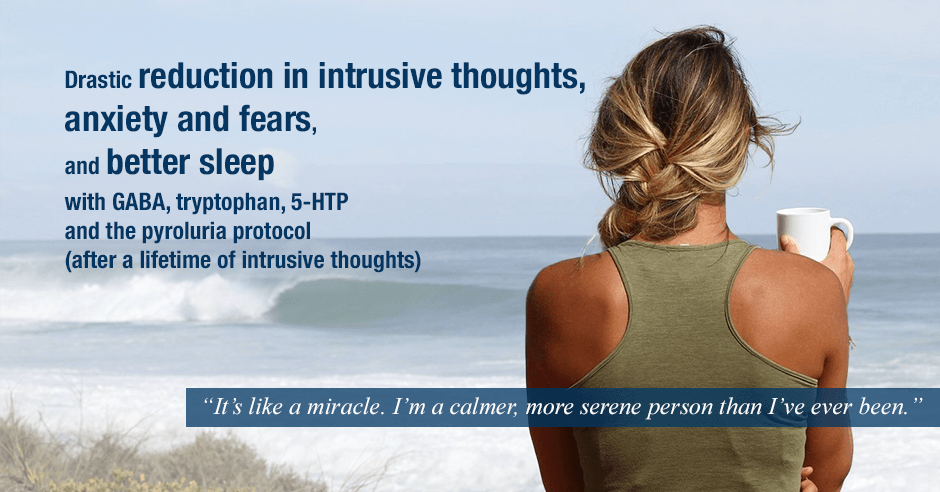
Drastic reduction in intrusive thoughts, anxiety and fears (and better sleep) with GABA, tryptophan, 5-HTP and the pyroluria protocol

May 6, 2022 By Trudy Scott 33 Comments

intrusive thoughts reduction

It’s not uncommon for an adult woman to have had intrusive thoughts her entire life and not even recognize that they are connected to her anxiety levels. She is often unaware that there is anything she can do to actually ease her anxiety and reduce the bad thoughts (such as fearing horrible things happening to her husband and children). Enter the amino acids: GABA, tryptophan, 5-HTP and the pyroluria protocol (zinc, vitamin B6 and evening primrose oil). They can do all of this and more. Kimberly shared her own experience and success on a blog post about intrusive thoughts and these specific nutrients. Here is her story in her own words:

Oh my goodness, I’m realizing after reading this, that intrusive thoughts are something I’ve had my entire life. As a child, this manifested in thoughts of what might happen to my one stable parent when we were apart. More recently, I feared horrible things happening to my husband or children. Like the author of the original blog wrote, these intrusive thoughts reflect a greater anxiety. But I didn’t realize this until I began experimenting with your protocols.

I first tried GABA when I felt extremely anxious, but not on a regular basis. Next, I added the pyroluria protocol, which did bring some relief to the intrusive thoughts. Fast forward to today, when I also take 5-HTP, tryptophan and GABA regularly and have noticed a drastic reduction in those thoughts/fears. It’s like a miracle.

My fear level is maybe 15% of what it used to be, if that.

I also find that I can use extra GABA at night if I wake up and can’t shut off my mind. It works like a charm to help me get back to sleep. What a blessing to have these amino acids.

I’m a calmer, more serene person than I’ve ever been, without (for the most part) the crippling, irrational fears I used to experience. Thank you, as always, Trudy. You are also a tremendous blessing.

I thanked her for sharing and said how glad I was that she is connecting more and more dots. It’s very common to suddenly realize you’ve had these intrusive thoughts your entire life. With her  amazing results, combining all the above nutrients she is a poster child for this approach that I use with my clients. I’m thrilled for her miracle outcome and so very happy for her.

I’m sharing her story here as a new blog so I can provide her with some additional approaches to explore and so you can see how these amino acids and other nutrients have worked for someone else (and get your own insights.) I’m also sharing my feedback on how she approached things.

Additional approaches to her to explore: adjusting what is working for her now

Her fear level is maybe 15% of what it used to be but ideally we want to improve on that by fine-tuning what she is doing and capitalize on what is working. Know this – it’s not unreasonable to expect that to get to zero!

If we were working together this is what I’d suggest (assuming she hasn’t already done this):

  • Review the low GABA and low serotonin questionnaires and adjust the GABA and/or tryptophan/5-HTP based on any symptoms that remain with a score above zero.
  • After that, if there are still some troubling low serotonin symptoms experiment with different doses and timings of tryptophan and 5-HTP – some people do better on one vs the other
  • Also, if there are still some troubling low GABA symptoms, experiment with a few different GABA products. I’ve had folks try up to 5 different products before they find the perfect one for their needs
  • If she can see the social anxiety and other pyroluria signs remain, we’d adjust zinc, vitamin B6 (and possibly add P5P) and evening primrose oil.

With all of the above, I’d have her do one change at a time and carefully document everything in her food-mood log.

Identifying if the remaining fear/intrusive thoughts are more pronounced in the second half of her cycle

It may simply be a matter of identifying if the remaining fear/intrusive thoughts are more pronounced in the second half of her cycle i.e. after ovulation. As I shared on the blog, one study showed that “women in the ‘early luteal’ phase… had more than three times as many intrusive thoughts.”

She may need to adjust the amino acids up during this period and it may be that over the next 2 months she sees these symptoms resolve with her current approach, as her hormones become balanced. It’s typical to see this in 2-3 months.

My feedback on her approach

Here is my feedback on how she did things and why I love her approach:

  • She experimented with GABA some of the time – as needed – based on what she was learning from me from blogs, my book and interviews.
  • She made one change at a time, adding the pyroluria protocol next
  • Then she added tryptophan and 5-HTP (hopefully one at a time)
  • And then her use of the amino acids became regular. This last aspect of consistency is a needle mover for so many of my clients.
  • She now tweaks things and takes extra GABA at night if needed. This may be needed after a tough day or if you’ve been glutened or exposed to insecticides.

I will add that the sequence could have been varied and still have had a similar successful outcome, for example, amino acid consistency from day 1 and then adding the pyroluria protocol (this is what I typically do with clients).

However, it’s my goal to empower women like Kimberly to take charge, learn, make changes, listen to their bodies, learn some more and adjust to see further improvements. It makes me immensely happy when I hear that she is a calmer, more serene person than she’s ever been. I feel confident that she’ll be able to get to zero intrusive thoughts with the tips I shared above.

She may or may not also need to consider other possible root causes of intrusive thoughts: low magnesium, low iron, diet (a low carb/high fat intrusive thoughts case study) and gluten issues.

Psychiatric medication discontinuation syndrome, Lyme disease, mold toxicity, heavy metals, toxins, infections, TBI and trauma can also be factors with intrusive thoughts and anxiety, but with her huge improvement I’d suspect these root causes are unlikely for her.

Resources if you are new to using the amino acids and pyroluria supplements

If you are new to using GABA or tryptophan/5-HTP as a supplement, here is the Amino Acids Mood Questionnaire from The Antianxiety Food Solution (you can see all the low GABA and low serotonin symptoms).

If you suspect low levels of any of the neurotransmitters and do not yet have my book, The Antianxiety Food Solution – How the Foods You Eat Can Help You Calm Your Anxious Mind, Improve Your Mood, and End Cravings, I highly recommend getting it and reading it before jumping in and using amino acids on your own so you are knowledgeable. And be sure to share it with the team you or your loved one is working with.

There is an entire chapter on the amino acids and they are discussed throughout the book in the sections on gut health, blood sugar control, sugar cravings, self-medicating with alcohol and more.

My book also has an entire chapter on pyroluria (with the protocol and questionnaire). The questionnaire is on the blog too, together with many other related posts (simply search for pyroluria).

The book doesn’t include product names (per the publisher’s request) so this blog, The Antianxiety Food Solution Amino Acid and Pyroluria Supplements, lists the amino acids that I use with my individual clients and those in my group programs.

If, after reading this blog and my book, you don’t feel comfortable figuring things out on your own (i.e. doing the symptoms questionnaire and respective amino acids trials), a good place to get help is the GABA Quickstart Program. This is a paid online/virtual group program where you get my guidance and community support.

If you are a practitioner, join us in The Balancing Neurotransmitters: the Fundamentals program. This is also a paid online/virtual program with an opportunity to interact with me and other practitioners who are also using the amino acids.

Do you experience intrusive thoughts or did you have them in the past? Feel free to describe them if you feel comfortable doing so.

And did you think you’d be able to reduce the horrible intrusive thoughts with a nutritional approach?

What helped reduce them for you? If you used a similar approach, how did it look for you?

If you’re a practitioner, have you found this approach to help reduce intrusive thoughts and ease anxiety in your clients/patients?

If you have questions please share them here too.
Filed Under: 5-HTP, Anxiety, GABA, Insomnia, OCD, Tryptophan Tagged With: 5-HTP, amino acids, anxiety, anxious, calmer, can’t shut off my mind, empowering women, evening primrose oil, fear, feared horrible things, fears, GABA, GABA Quickstart program, intrusive thoughts, luteal phase, more serene, practitioner training, pyroluria protocol, sleep, tryptophan, vitamin B6, zinc

What is the difference between DPA and DLPA (amino acids) and which one do I use for weepiness, heart-ache, pain and energy?

March 11, 2022 By Trudy Scott 75 Comments

dpa and dlpa

Today we address a very common question I get: “What is the difference between DPA and DLPA?” The follow-up question is this: “And what symptoms do they help with?” These are both amino acids that help to boost certain feel-good neurotransmitters. DPA (d-phenylalanine) supports endorphins, whereas DLPA (dl-phenylalanine) supports both endorphins (to a lesser extent than DPA) and catecholamines (to a lesser extent than tyrosine).

Depending on your imbalances and symptoms, they could help with weepiness, heart-ache, comfort eating, emotional support, pain relief, better focus and energy, and even improved motivation.  

I mostly recommend DPA (which I call a-hug-in-a-bottle) and share the reasons why below, but some people do really well with DLPA. It’s a matter of figuring out the best one and dose for your unique needs.

DPA for low endorphin symptoms

DPA (d-phenylalanine) is an amino acid that destroys the enzyme that breaks down endorphins. Endorphins are feel-good chemicals that you experience with an endorphin rush when you go for a run or when someone gives you a big hug, when you show kindness to someone or an individual does something nice for you.

Taking the amino acid, DPA, as a supplement helps to raise your endorphins and helps when you feel weepy and overly emotional and reduces the need to self-medicate with treats as a reward or for comfort.

This amino acid is a favorite with so many of my clients and community because it makes them feel so lovely … a warm and fuzzy feeling. I often call it a-hug-in-a-bottle!

Here are the low endorphin symptoms I have my clients rate if they are considering a trial of DPA:

  • Heightened sensitivity to emotional pain
  • Heightened sensitivity to physical pain
  • Crying or tearing up easily
  • Eating to soothe your mood, or comfort eating
  • Really, really loving certain foods, behaviors, drugs, or alcohol
  • Craving a reward or numbing treat

Tyrosine for low catecholamine symptoms

Tyrosine is the amino acid that boosts catecholamines and helps with focus, motivation, energy (especially when you crave carbs for energy) and the blah kind of depression. It’s wonderful for helping you easily quit coffee/caffeine (when you are using it to “self-medicate” due to low catecholamines). It also provides support for the thyroid.

Here are the low catecholamine symptoms I have my clients rate if they are considering a trial of the amino acid tyrosine:

  • Depression and apathy
  • Easily bored
  • Lack of energy
  • Lack of focus
  • Lack of drive and low motivation
  • Attention deficit disorder
  • Procrastination and indecisiveness
  • Craving carbs, alcohol, caffeine, or drugs for energy

DLPA for both low endorphin and low catecholamine symptoms

If someone has both low endorphin and low catecholamine symptoms, a trial of DLPA could be considered.  DLPA supports both endorphins (to a lesser extent than DPA alone) and also catecholamines (to a lesser extent than tyrosine used alone). You could think of it as doing half and half of each.

Low endorphin symptoms:

  • Heightened sensitivity to emotional pain
  • Heightened sensitivity to physical pain
  • Crying or tearing up easily
  • Eating to soothe your mood, or comfort eating
  • Really, really loving certain foods, behaviors, drugs, or alcohol
  • Craving a reward or numbing treat

And low catecholamine symptoms:

  • Depression and apathy
  • Easily bored
  • Lack of energy
  • Lack of focus
  • Lack of drive and low motivation
  • Attention deficit disorder
  • Procrastination and indecisiveness
  • Craving carbs, alcohol, caffeine, or drugs for energy

Why I prefer my clients use DPA and tyrosine, rather than DLPA

Many people do well with DLPA (you can read one example below) but over the years I have streamlined my amino acid recommendations and seldom suggest DLPA. Here are the reasons why I prefer DPA:

  • DPA is not stimulating and doesn’t affect sleep. However, DLPA can be stimulating for anxious folks (and the majority of my clients have anxiety). For this reason, DLPA can not be used later than 3pm as it can affect sleep and for some folks with really bad sleep issues it can’t be tolerated later than mid-morning (in a similar way to tyrosine).
  • I like to have clients use DPA alone so we can clearly identify the benefits they are experiencing for their low endorphin symptoms and then use tyrosine alone so we can clearly identify their low catecholamine benefits.
  • There are no precautions or contraindications with DPA. However, DLPA has the same precautions as tyrosine. This limits using it for endorphin support. These are the precautions:
    • Overactive thyroid/Grave’s disease: tyrosine, DLPA (avoid)
    • Phenylketonuria (PKU): tyrosine, DLPA (avoid)
    • Melanoma: tyrosine, DLPA (avoid)
    • High Blood pressure: tyrosine, DLPA (watch)
    • Migraine headaches: tyrosine, DLPA (watch)
    • Bipolar disorder: tyrosine, DLPA, glutamine (watch)
  • The women I work with who do have low endorphin symptoms have reported superior benefits from DPA compared to DLPA, especially for emotional pain and emotional eating.
  • Some folks can’t tolerate tyrosine and these same folks have a hard time with DLPA.

The one disadvantage with DPA is that it’s not as widely and readily available as DLPA. It often needs to be purchased online (I list some brands below).

Here is some feedback from folks to give you an idea how these amino acids have helped them.

As you’ll see, there are some individuals who do well with DLPA so it’s really a matter of looking at the symptoms and doing a trial.

DPA helps Missy with weepiness and a deep heart-ache (and tastes like dark chocolate)

Missy shares how DPA helped her deep heart-ache sort of feeling:

I have found I was using this product incorrectly. If you are feeling fine, you do not feel much of anything from it. But today I was weepy and felt that deep, heart-ache sort of feeling. I chewed 1000 mgs (2 capsules) and it DID help lift that awful feeling within 15 minutes.

Notice that she said if you’re feeling fine you don’t feel much at all. This is true of all the amino acids – they only make a difference when you need them.

Missy said that she chewed the capsule, however around 2019, the gelatin capsule was replaced with a cellulose capsule. It’s much more palatable when it’s opened up into the mouth. I blog more about opening the capsule here.

She also reported what about half my clients say:

Tastes like slightly bitter dark chocolate 🙂

The remainder of my clients don’t like the taste at all, although many say the taste grows on them. I’ve always been in the dark chocolate camp and find it quite pleasant tasting.

DLPA helps Toby with energy and pain relief (he has CFS and fibromyalgia)

Toby has a diagnosis of CFS (chronic fatigue syndrome) and fibromyalgia and shared how DLPA helps him:

I’ve played around with (I think) all variations of these aminos and have found unequivocally (in the sense of definite and fast observable changes as opposed to none) that DLPA is the one that works for me. I have wondered what that means. I am male, 45, diagnosed with CFS and fibromyalgia and have speculated that in lay terms the DLPA gives me a bit of energy and pain relief (endorphins). Is that a logical conclusion?

He posted an image of the DLPA product he used and said this:

After putting it on my tongue, very quickly I get an agreeable boost in energy and pain relief. I have not experienced this with DPA or tyrosine.

Based on what I’ve covered above with the symptoms you can see that Toby has made a very logical conclusion. He is getting both endorphin support (the pain relief) and catecholamine support (the energy).

Resources if you are new to using DPA or DLPA as supplements

If you are new to using the amino acids DPA or DLPA as supplements, here is the Amino Acids Mood Questionnaire from The Antianxiety Food Solution (you can see the low endorphin and low catecholamine symptoms.)

If you suspect low levels of endorphins and/or low levels of catecholamine and do not yet have my book, The Antianxiety Food Solution – How the Foods You Eat Can Help You Calm Your Anxious Mind, Improve Your Mood, and End Cravings, I highly recommend getting it and reading it before jumping in and using amino acids on your own so you are knowledgeable. And be sure to share it with the team you or your loved one is working with. Blog posts like this are intended to add value to the chapter on amino acids, which contains detailed information on doses and time of the day for dosing.

The book doesn’t include product names (per the publisher’s request) so this blog, The Antianxiety Food Solution Amino Acid and Pyroluria Supplements, lists the DPA and DLPA products that I use with my individual clients and those in my group programs.

For DPA I have used the Lidtke Endorphigen product for years and it’s a firm favorite with my clients (and I’ve used it myself).

I recently purchased  a bottle of Doctor’s Best D-Phenylalanine to test and it works just as well as the Lidtke product.

If you are a practitioner, join us in The Balancing Neurotransmitters: the Fundamentals program. It’s an opportunity to interact with me and other practitioners who are also using the amino acids.

Do you have any of the low endorphin and/or low catecholamine symptoms and have you seen benefit with DPA, DLPA and/or tyrosine?  If yes, please share what benefits.

Has this blog provided clarification on DPA vs DLPA, and will you be changing how you use these amino acids going forward?

If you’re a practitioner please share what you use with clients/patients.

Feel free to ask your questions here too.

Filed Under: Amino Acids, Emotional Eating, Pain, Women's health Tagged With: amino acids, anxiety, anxious, catecholamines, cfs, comfort eating, d-phenylalanine, Dark chocolate, dl-phenylalanine, DLPA, DPA, emotional support, endorphins, energy, Fibromyalgia, focus, heart-ache, hug, insomnia, motivation, neurotransmitters, pain, symptoms, tyrosine, weepiness, What is the difference between DPA and DLPA

Tryptophan doesn’t work, then it does and then it doesn’t: could it be hormonal shifts, dietary factors and/or parasites?

November 26, 2021 By Trudy Scott 19 Comments

tryptophan result

Have you been in a situation where tryptophan doesn’t work, then it does work, and then sometimes it doesn’t work as expected? There is a reasonable explanation as to why it may not work initially – too much or too little was used. The variable results and the need to switch between lower and higher doses on an ongoing basis can happen but it’s not very pronounced unless there is a specific reason. In this blog I cover some of these reasons – hormone shifts, dietary factors and parasites/other digestive issues.

I’m writing this blog in response to a question that was posted on one of my speaker pages on the Anxiety Summit: Gut-Brain Axis. This is the actual question:

I tried to use tryptophan the first time (whole capsule) and got really high. Some time later I tried again, but used 1/4 of a capsule and had a good result. A few weeks later 1/4 of the capsule didn’t work at night. So I went up to half a capsule. And that’s where  I am now. But some nights (very rare) I can only get good results from a whole capsule. I use it along with the same amount of GABA. Is that a normal reaction for tryptophan?

I don’t know what brand of tryptophan she was using but assume 500mg was her starting dose and she now shifts between 125 mg (¼ capsule) and 250 mg (½ capsule) with variable results.

It’s not unusual for someone to not feel great on 500 mg if that dose is too much for their unique needs. She did the right thing by lowering her dose.  It’s also reasonable that someone may find 500 mg as an initial dose isn’t enough to reduce symptoms.

The variable results and the need to switch between 125 mg and 250 mg can happen but it’s not very pronounced unless there is a specific reason. Some of these reasons include hormone shifts, dietary factors, parasites/other digestive issues, thyroid issues, low lithium, product quality and environmental factors. More on all this below.

Hormone shifts/more serotonin is needed in the luteal phase

I have my clients track when the variability happens, with female clients documenting their cycles. Some women need more serotonin support in the luteal phase i.e. after ovulation and right up to before their periods. Some may even need additional tryptophan for the first few days of their periods too.

Write about tryptophan working well in the luteal phase in this blog – Tryptophan for PMS: premenstrual dysphoria, mood swings, tension, and irritability

In a study published in 1999, A placebo-controlled clinical trial of L-tryptophan in premenstrual dysphoria, tryptophan was found to reduce symptoms of PMS when used in the luteal phase or second half of the cycle (i.e. after ovulation):

37 patients with premenstrual dysphoric disorder were treated with L-tryptophan 6 g per day, and 34 were given placebo. The treatments were administered under double-blind conditions for 17 days, from the time of ovulation to the third day of menstruation, during three consecutive menstrual cycles.

They looked at dysphoria, which is defined as a state of unease or generalized dissatisfaction with life, plus mood swings, tension (and anxiety), and irritability and they found a 34.5% reduction of symptoms with tryptophan compared to 10.4% with placebo.

The paper concludes: “that these results suggest that increasing serotonin synthesis during the late luteal phase of the menstrual cycle has a beneficial effect in patients with premenstrual dysphoric disorder.”

It’s a small study but the results are powerful and it’s something I see clinically with my clients. The one big difference is that I typically have clients using tryptophan throughout the month.

But if you are seeing tryptophan work and then not work at similar times each month this is something to consider and track. And then if need be, increase and decrease tryptophan accordingly (and track again).

Dietary factors – collagen, gluten, sugar, wine and coffee

There are other factors to consider too and dietary impacts is one. For example, collagen leads to a higher need for tryptophan in susceptible individuals (due to it’s serotonin-lowering effects – I blog about this here)

Another dietary factor is accidental gluten exposure in susceptible individuals or a newly discovered gluten issue

High sugar intake, alcohol and/or caffeine consumption may also be a factor – contributing to added stress for the adrenals and depletions in zinc and the B vitamins. This can contribute to lowered serotonin and a need for a higher dose of tryptophan.

Now imagine if it’s just before her period and she adds collagen to her diet and she also eats out and gets zapped by gluten. Triple whammy for this woman!

And she goes to a party and happens to indulge in cocktails or wine, and then goes on a binge at the dessert table, followed by a few cups of coffee (or even one dessert and one cup of coffee).

A food-mood log really helps you figure things out.  And then, if need be, increase and decrease tryptophan accordingly.  And track again and address the dietary issues.

Parasites and other gut issues

If she has a very pronounced shift in symptoms for 4-5 days around a full moon each month – more severe insomnia, more anxious, more depressed – I would want to check for parasites.

I would also want to check for other digestion issues like dysbiosis, SIBO (small intestinal bacterial overgrowth), candida and liver health as they may all be factors. With SIBO and candida, dietary slip-ups may make symptoms worse right after the slip-up, for example increased bloating making sleep and anxiety worse.

Using tryptophan sublingually/opened on the tongue may bypass some of the digestive/liver  issues until they are resolved.

As mentioned above, if need be, increase and decrease tryptophan accordingly. And track again and address the underlying issues.

Other factors to rule out – thyroid, lithium, environmental factors and the product

Two other underlying root causes we always want to rule out when we see variable results using tryptophan (and any of the amino acids) are Hashimoto’s thyroiditis (because we can have variable thyroid results – sometimes hypo/low and sometimes hyper/high) and low levels of lithium (because this can affect the results we see with all the amino acids).

And we always check environmental factors like mold, EMFs and outside stresses. And look for infections like Lyme disease or EBV.  If the basics are not unearthing the solution we continue to dig deeper and do a full functional medicine workup. And adjust the tryptophan as needed.

And finally the quality of the product is key. I find Lidtke Tryptophan to be better than many other brands. I’ve also had many clients switch to Lidtke tryptophan and see better results and often need a lower dose.

Resources if you are new to using tryptophan and the amino acids as supplements

If you are new to using the amino acids tryptophan/5-HTP and the other amino acids as supplements, here is the Amino Acids Mood Questionnaire from The Antianxiety Food Solution (you can see the low serotonin symptoms here) and a brief overview here, Anxiety and targeted individual amino acid supplements: a summary.

If you suspect low serotonin or low levels of any of the neurotransmitters and do not yet have my book, The Antianxiety Food Solution – How the Foods You Eat Can Help You Calm Your Anxious Mind, Improve Your Mood, and End Cravings, I highly recommend getting it and reading it before jumping in and using amino acids so you are knowledgeable. And be sure to share it with the team you or your loved one is working with.

The book doesn’t include product names (per the publisher’s request) so this blog, The Antianxiety Food Solution Amino Acid and Pyroluria Supplements, lists the amino acid products that I use with my individual clients and those in my group programs.

I always appreciate good questions like this and hope this feedback has helped her and you too if you’ve experienced something like this (or if you do in the future). In case you’re wondering, this question was posted after someone tuned into my interview, “GABA & Tryptophan: Gut-Anxiety Connections” on the Anxiety Summit 5: Gut-Brain Axis.

Have you had a variable response to tryptophan (or 5-HTP) and can you relate to any of this?

What did you figure out to be the reason?

Feel free to ask your questions here too.

Filed Under: Anxiety, Depression, Gut health, serotonin, Tryptophan Tagged With: amino acids, anxiety, coffee, collagen, depressed, diet, environmental, GABA, gluten, gut, hormonal shifts, lithium, liver, luteal phase, neurotransmitter, parasites, quality, serotonin, sugar, thyroid, tryptophan, variable, wine

  • « Go to Previous Page
  • Page 1
  • Interim pages omitted …
  • Page 6
  • Page 7
  • Page 8
  • Page 9
  • Page 10
  • Interim pages omitted …
  • Page 18
  • Go to Next Page »

Primary Sidebar

NEW! GABA QuickStart Homestudy (with special intro pricing)

gaba quickstart homestudy

Free Report

9 Great Questions Women Ask about Food, Mood and their Health

You'll also receive a complimentary subscription to my ezine "Food, Mood and Gal Stuff"


Connect with me

Popular Posts

  • Amino Acids Mood Questionnaire from The Antianxiety Food Solution
  • The Antianxiety Food Solution Amino Acid and Pyroluria Supplements
  • Pyroluria Questionnaire from The Antianxiety Food Solution
  • Collagen and gelatin lower serotonin: does this increase your anxiety and depression?
  • Tryptophan for the worry-in-your-head and ruminating type of anxiety
  • GABA for the physical-tension and stiff-and-tense-muscles type of anxiety
  • The Antianxiety Food Solution by Trudy Scott
  • Seriphos Original Formula is back: the best product for anxiety and insomnia caused by high cortisol
  • Am I an anxious introvert because of low zinc and vitamin B6? My response to Huffington Post blog
  • Vagus nerve rehab with GABA, breathing, humming, gargling and key nutrients

Recent Posts

  • What do I use instead of Seriphos to help lower high cortisol that is affecting my sleep and making me anxious at night?
  • BeSerene™ GABA/theanine cream eases severe muscle tension in her neck/shoulders, prevents her bad headaches and quells her anxiety
  • How the correct approach, dose and sublingual use of GABA can be calming and not cause a flushed and itchy face and neck
  • The amino acid glutamine improves low mood by addressing gut health, and it has calming effects too
  • Flight anxiety with heightened breath, physical tension and also fearing the worst (the role of low GABA and low serotonin)

Categories

  • 5-HTP
  • AB575
  • Addiction
  • ADHD
  • Adrenals
  • Alcohol
  • Allergies
  • Alzheimer's disease
  • Amino Acids
  • Anger
  • Antianxiety
  • Antianxiety Food Solution
  • Antidepressants
  • Anxiety
  • Anxiety and panic
  • Autism
  • Autoimmunity
  • benzodiazapines
  • Bipolar disorder
  • Books
  • Caffeine
  • Cancer
  • Candida
  • Children/Teens
  • Collagen
  • Cooking equipment
  • Coronavirus/COVID-19
  • Cravings
  • Depression
  • Detoxification
  • Diabetes
  • Diet
  • DPA/DLPA
  • Drugs
  • EFT/Tapping
  • EMF
  • EMFs
  • Emotional Eating
  • Endorphins
  • Environment
  • Essential oils
  • Events
  • Exercise
  • Fear
  • Fear of public speaking
  • Fertility and Pregnancy
  • Fish
  • Food
  • Food and mood
  • Functional neurology
  • GABA
  • Gene polymorphisms
  • General Health
  • Giving
  • Giving back
  • Glutamine
  • Gluten
  • GMOs
  • Gratitude
  • Gut health
  • Heart health/hypertension
  • Histamine
  • Hormone
  • Hyperparathyroidism
  • Hypoglycemia
  • Immune system
  • Inflammation
  • Insomnia
  • Inspiration
  • Introversion
  • Joy and happiness
  • Ketogenic diet
  • Lithium orotate
  • Looking awesome
  • Lyme disease and co-infections
  • MCAS/histamine
  • Medication
  • Men's health
  • Mental health
  • Mercury
  • Migraine
  • Mold
  • Movie
  • MTHFR
  • Multiple sclerosis
  • Music
  • NANP
  • Nature
  • Nutritional Psychiatry
  • OCD
  • Osteoporosis
  • Oxalates
  • Oxytocin
  • Pain
  • Paleo
  • Parasites
  • Parkinson’s disease
  • PCOS
  • People
  • PMS
  • Postpartum
  • PTSD/Trauma
  • Pyroluria
  • Questionnaires
  • Real whole food
  • Recipes
  • Research
  • Schizophrenia
  • serotonin
  • SIBO
  • Sleep
  • Special diets
  • Sports nutrition
  • Stress
  • Sugar addiction
  • Sugar and mood
  • Supplements
  • Teens
  • Testimonials
  • Testing
  • The Anxiety Summit
  • The Anxiety Summit 2
  • The Anxiety Summit 3
  • The Anxiety Summit 4
  • The Anxiety Summit 5
  • The Anxiety Summit 6
  • Thyroid
  • Thyroid health
  • Toxins
  • Tryptophan
  • Tyrosine
  • Uncategorized
  • Vegan/vegetarian
  • Women's health
  • Yoga

Archives

  • October 2025
  • September 2025
  • August 2025
  • July 2025
  • June 2025
  • May 2025
  • April 2025
  • March 2025
  • February 2025
  • January 2025
  • November 2024
  • October 2024
  • September 2024
  • August 2024
  • July 2024
  • June 2024
  • May 2024
  • April 2024
  • March 2024
  • February 2024
  • January 2024
  • December 2023
  • November 2023
  • October 2023
  • September 2023
  • August 2023
  • July 2023
  • June 2023
  • May 2023
  • April 2023
  • March 2023
  • February 2023
  • January 2023
  • December 2022
  • November 2022
  • October 2022
  • September 2022
  • August 2022
  • July 2022
  • June 2022
  • May 2022
  • April 2022
  • March 2022
  • February 2022
  • January 2022
  • December 2021
  • November 2021
  • October 2021
  • September 2021
  • August 2021
  • July 2021
  • June 2021
  • May 2021
  • April 2021
  • March 2021
  • February 2021
  • January 2021
  • December 2020
  • November 2020
  • October 2020
  • September 2020
  • August 2020
  • July 2020
  • June 2020
  • May 2020
  • April 2020
  • March 2020
  • February 2020
  • January 2020
  • December 2019
  • November 2019
  • October 2019
  • September 2019
  • August 2019
  • July 2019
  • June 2019
  • May 2019
  • April 2019
  • March 2019
  • February 2019
  • January 2019
  • December 2018
  • November 2018
  • October 2018
  • September 2018
  • August 2018
  • July 2018
  • June 2018
  • May 2018
  • April 2018
  • March 2018
  • February 2018
  • January 2018
  • December 2017
  • November 2017
  • October 2017
  • September 2017
  • August 2017
  • July 2017
  • June 2017
  • May 2017
  • April 2017
  • March 2017
  • February 2017
  • January 2017
  • December 2016
  • November 2016
  • October 2016
  • September 2016
  • August 2016
  • July 2016
  • June 2016
  • May 2016
  • April 2016
  • March 2016
  • February 2016
  • January 2016
  • December 2015
  • November 2015
  • October 2015
  • September 2015
  • August 2015
  • July 2015
  • June 2015
  • May 2015
  • April 2015
  • March 2015
  • February 2015
  • January 2015
  • December 2014
  • November 2014
  • October 2014
  • September 2014
  • August 2014
  • July 2014
  • June 2014
  • May 2014
  • April 2014
  • March 2014
  • February 2014
  • January 2014
  • December 2013
  • November 2013
  • October 2013
  • September 2013
  • August 2013
  • July 2013
  • June 2013
  • May 2013
  • April 2013
  • March 2013
  • February 2013
  • January 2013
  • December 2012
  • November 2012
  • October 2012
  • August 2012
  • July 2012
  • June 2012
  • May 2012
  • April 2012
  • March 2012
  • February 2012
  • January 2012
  • December 2011
  • November 2011
  • October 2011
  • September 2011
  • August 2011
  • July 2011
  • June 2011
  • May 2011
  • April 2011
  • March 2011
  • February 2011
  • January 2011
  • December 2010
  • October 2010
  • September 2010
  • July 2010
  • May 2010
  • April 2010
  • March 2010
  • February 2010
  • January 2010
  • November 2009

Share the knowledge!

The above statements have not been evaluated by the Food and Drug Administration. Products listed in this website are not intended to diagnose, treat, cure or prevent any disease.

The information provided on this site is for informational and educational purposes only and is not intended as a substitute for advice from your physician or other health care professional. You should consult with a healthcare professional before starting or modifying any diet, exercise, or supplementation program, before taking or stopping any medication, or if you have or suspect you may have a health problem.


Copyright © 2026 Trudy Scott. All Rights Reserved. | Privacy | Terms and Conditions | Refund Policy | Medical Disclaimer

Free Report

9 Great Questions Women Ask about Food, Mood and their Health

You’ll also receive a complimentary subscription to my ezine “Food, Mood and Gal Stuff”