• Skip to primary navigation
  • Skip to main content
  • Skip to primary sidebar

everywomanover29 blog

Food, Mood and Women's Health – Be your healthiest, look and feel great!

  • Blog
  • About
  • Services
  • Store
  • Resources
  • Testimonials
  • The Book
  • Contact
  • Search this site

vagus nerve

The amino acid glutamine improves low mood by addressing gut health, and it has calming effects too

October 3, 2025 By Trudy Scott 2 Comments

glutamine and low mood

Recent research has shown that the amino acid glutamine can positively affect gut health by supporting the gut microbiome, gut mucosal wall integrity, and by modulating inflammatory responses.

As modulated by the vagus nerve, via the enteric nervous system, the gut-brain connection can impact the brain’s neurochemical environment. Poor gut health can disrupt the balance of neurotransmitters, which can result in neuropsychiatric based conditions such as depression.

Glutamine supplementation may provide significant adjunctive nutritional support in cases of depression by promoting proper gut health and function.

The above is an excerpt from the paper, The role of glutamine in supporting gut health and neuropsychiatric factors, published in 2021.

The authors do note the fact that glutamine is a “fundamental precursor to the most prevalent neurotransmitters, GABA and glutamate.” This is why glutamine supplementation can be calming for many individuals and may sometimes be too stimulating for some folks. It also highlights the importance of biochemical individuality and why it’s important to find your ideal dose (more on that below).

I appreciate their call for more research on glutamine, “as well as studies which could explore using glutamine in concert with other supportive amino acids, such as GABA and tyrosine, in an effort to restore neurotransmitter equilibrium” (more on that below too).

Read on below to learn more about how glutamine directly supports gut health and what harms the gut; how to know if glutamine will be calming or too stimulating, and how much to use; and other clues that you may benefit from glutamine; and additional resources when are new to amino acids such as glutamine, GABA and others.

How glutamine directly supports gut health and what harms the gut

From the above paper, glutamine:

1) has a positive impact on sustaining the balance of the gut microbiome
2) increases the expression of tight junction proteins and the integrity of the intestinal lining (i.e. it heals leaky gut)
3) helps to minimize the inflammatory response in situations of gut mucosal irritation (i.e the inner most lining of the digestive tract).

The authors also discuss all of the many factors that are harmful for the gut: highly processed foods, refined sugars, saturated fat, and minimal healthy fatty acids and antioxidants; lack of probiotics and prebiotics; blood sugar swings; stress and high cortisol; medications and alcohol consumption. Much of this is addressed in my book “The Antianxiety Food Solution”

It’s well-worth reading the entire paper for a full understanding of the two-way gut-brain connection via the vagus nerve and the role of the microbiome when it comes to neurotransmitter production and much more.

How to know if glutamine will be calming or too stimulating, and how much to use

As mentioned above, the authors share that glutamine is a precursor to GABA, a calming neurotransmitter i.e. it is often calming.

Glutamine is also a precursor to glutamate and can be too stimulating for some, typically when very high doses are used.

The paper mentions studies that “observed the effects of glutamine supplementation used at doses of between 15 g and 30 g,” however my recommendation is to start low and slowly increase based on your unique need. I have clients and those in my programs start with 500 mg once a day and increase to 1-3 x 500 mg, up to 3 or 4 times a day.

The only way to know if it will be calming or stimulating is to do a trial alone i.e. with no other new supplements, and carefully track the effects.

I also find using glutamine powder and holding it for 1-2 minutes on the tongue is more effective and less is often needed. This has additional benefits of stopping intense sugar cravings in their tracks (more on this below).

Other clues that you may benefit from glutamine: symptoms of low blood sugar

As mentioned above, glutamine helps reduce intense sugar cravings, and prevents low blood sugar (which can actually cause anxiety and panic attacks). This aspect is not mentioned in the paper but addressing low blood sugar is yet another application of glutamine when it comes to anxiety and low mood.

Here are all the symptoms we see with low blood sugar:

  • Crave sugar, starch or alcohol any time during the day
  • Irritable, shaky, headachey – especially if going too long between meals
  • Intense cravings for sweets
  • Lightheaded if meals are missed
  • Eating relieves fatigue
  • Agitated, easily upset
  • Nervous, anxious, panic attacks

And here are some other blog posts that illustrate some of the above:

  • Reactive hypoglycemia in binge eating disorder, food addiction and intense sugar cravings, and how glutamine stops the cravings
  • Waking with a jolt, feeling shaky and anxious: low blood sugar/hypoglycemia, glutamine and eating for blood sugar stability
  • Glutamine for hypoglycemia/low blood sugar: “500mg mixed in water works in 15 minutes and keeps me going for 2 – 3 hours”
  • “A demonic urge to eat sugar and all things sweet”: glutamine opened onto the tongue stops the urge every time!

Together with low serotonin and low GABA, addressing low blood sugar is one of the most effective approaches I use with clients to help ease anxiety.  We achieve this with the use of glutamine and by controlling blood sugar by starting the day with a breakfast that includes quality animal protein.

We may also use tyrosine if there are low dopamine symptoms and d-phenylalanine if there are low endorphin symptoms, in an “effort to restore neurotransmitter equilibrium.”

Additional resources when you are new to using glutamine, GABA or tyrosine, or other amino acids as supplements

We use the symptoms questionnaire to figure out if low blood sugar (indicating a possible need for glutamine) or low GABA (indicating a possible need for GABA or theanine) or low dopamine (indicating a possible need for tyrosine) or other neurotransmitter imbalances may be an issue for you.

If you suspect low levels of any of the neurotransmitters and do not yet have my book, The Antianxiety Food Solution – How the Foods You Eat Can Help You Calm Your Anxious Mind, Improve Your Mood, and End Cravings. I highly recommend getting it and reading it before jumping in and using amino acids on your own so you are knowledgeable. And be sure to share it with the practitioner/health team you or your loved one is working with.

There is an entire chapter on the amino acids and they are discussed throughout the book in the sections on gut health, gluten, blood sugar control (this and glutamine is covered in an entire chapter too), sugar cravings, anxiety and mood issues. The importance of quality animal protein and healthy fats is also covered.

The book doesn’t include product names (per the publisher’s request) so this blog, The Antianxiety Food Solution Amino Acid and Pyroluria Supplements, lists the amino acids that I use with my individual clients and those in my group programs.

If, after reading this blog and my book, you don’t feel comfortable figuring things out on your own (i.e. doing the symptoms questionnaire and respective amino acids trials), a good place to get help is the GABA QuickStart Program (if you have low GABA symptoms too). This is a paid online/virtual group program where you get my guidance and community support.

If you need serotonin support, the Serotonin QuickStart Program is a good place to get help. This is also a paid online/virtual group program where you get my guidance on using tryptophan and 5-HTP safely, and community support during 5 LIVE Q&A calls. You can sign up to be notified when the next live launch of this program is happening.

If you are a practitioner, join us in The Balancing Neurotransmitters: the Fundamentals program. This is also a paid online/virtual program with an opportunity to interact with me and other practitioners who are also using the amino acids.

Now I’d love to hear from you…

Has glutamine helped you with your leaky gut, low mood and/or offered calming effects?

What about intense cravings for something sweet or irritability and poor focus? And other low blood sugar symptoms?

How much do you find helps? And do you use powder or capsules?

Are you interested in a program to learn more about the safe and effective use of glutamine and/or tyrosine?

Feel free to share and ask your questions below.

Filed Under: Amino Acids, Anxiety, Depression, GABA, Glutamine, Gut health Tagged With: amino acid, blood sugar, calming, cravings, depression, GABA, glutamate, glutamine, gut, gut health, gut-brain connection, Inflammation, low mood, microbiome, mood, neuropsychiatric, neurotransmitters, serotonin, stimulating, tyrosine, vagus nerve

Exploring the Therapeutic Potential of Gamma-Aminobutyric Acid (GABA) in Stress and Depressive Disorders through the Gut–Brain Axis

January 31, 2025 By Trudy Scott 4 Comments

gaba and stress disorder

Research conducted on individuals with depression reveals that major depressive disorders (MDDs) coincide with diminished levels of the inhibitory neurotransmitter γ-aminobutyric acid (GABA) in the brain, as well as modifications in the subunit composition of the primary receptors (GABAA receptors) responsible for mediating GABAergic inhibition.

Furthermore, there is substantial evidence supporting the significant role of GABA in regulating stress within the brain, which is a pivotal vulnerability factor in mood disorders. GABA is readily available and approved as a food supplement in many countries.

Although there is substantial evidence indicating that orally ingested GABA may affect GABA receptors in peripheral tissues, there is comparatively less evidence supporting its direct action within the brain.

Emerging evidence highlights that oral GABA intake may exert beneficial effects on the brain and psyche through the gut–brain axis. While GABA enjoys wide consumer acceptance in Eastern Asian markets, with many consumers reporting favorable effects on stress regulation, mood, and sleep, rigorous independent research is still largely lacking.

Basic research, coupled with initial clinical findings, makes GABA an intriguing neuro-nutritional compound deserving of clinical studies in individuals with depression and other psychological problems.

This is the abstract from a recently published review paper: Exploring the Therapeutic Potential of Gamma-Aminobutyric Acid in Stress and Depressive Disorders through the Gut–Brain Axis

Does GABA exert calming and mood benefits via the gut-brain axis or is it really just a placebo effect? This paper discusses both possibilities. I’m excited by the former (and share more about this below) but I do not agree with the latter. Based on my clinical and personal experience, the calming effects of the amino acid GABA, used as a supplement (when you have low GABA symptoms/levels and used in a very specific way), is not a placebo effect. I also discuss this and share some cases that clearly confirm there is no placebo effect. Read on to be enlightened and encouraged about the power of GABA.

GABA and the microbiota-gut-brain axis

The authors describe the microbiome-gut-brain axis as “the bidirectional communication between the gastrointestinal tract, including its resident microbiota and the brain, linking emotional and cognitive centers of the brain with peripheral intestinal functions.”

They acknowledge that while we don’t quite understand the exact mechanisms of this bidirectional communication, “the vagus nerve, the endocrine and immune system, and the synthesis and metabolism of metabolites and neurotransmitters in the gut are critically involved.” This is exciting given what we know about the blood brain barrier.

If you are new to this concept of the gut-brain axis or want to read some of the latest updates, I encourage you to read the paper and learn about the benefits of probiotics (such as Lactobacillus and Bifidobacterium, and Lactococcus, Enterococcus, Streptococcus, and Leuconostoc) and prebiotics i.e. psychobiotics; and fermented foods – for mood improvement and stress reduction.

You’ll read this about GABA (both as a metabolite produced by the microbiome and as a supplement):

  • found in the enteric nervous system it contributes significantly to gut-brain axis functions and related disorders, including depression, anxiety, inflammatory, and cardiovascular disorders (they refer to GABA as a crucial ‘postbiotic’ i.e. a metabolite produced by the microbiome)
  • while GABA may not directly cross the blood-brain barrier in humans, an indirect influence through the enteric nervous system could potentially provide a viable pathway for the impact of GABA dietary supplements
  • although the connection between oral GABA administration i.e. GABA supplementation, the vagal nerve, and GABA levels in the brain has not been firmly established, considering the existing evidence, it represents a promising avenue for future research.

The last two bullets are worth emphasizing because one of the most common myths is that “GABA supplements don’t work because GABA is too big a molecule to get across the blood brain barrier.”  It really doesn’t need to get through the blood brain barrier in order to be calming.

I share more about this in a blog I published in 2023 – you can read it here.

GABA is a lifesaver and helps with mycotoxin-induced anxiety

Joie has Sjogren’s, Hashimoto’s, fibromyalgia & collagenous colitis (all diagnosed after severe mold exposure) and shares how GABA

has been a life saver for me (for my anxiety), and I share this with all I know who experience anxiety. I also use L-theanine at night because of insomnia. The 5-HTP has helped somewhat for sleep. L-tryptophan didn’t seem to make a difference. However the 5-HTP has made a significant difference in lessening my daily pain levels, which I am most grateful for.

Micki Contini, MS CNC, a board-certified holistic health and nutrition consultant, is a friend and colleague whose life was hugely impacted by mold toxicity. She shares this about how GABA helped her:

As they started tearing my house apart for remediation, I started eating GABA Calm like candy. At the beginning I had to have a lot more than I do now. GABA Calm takes me down a notch and I feel my shoulder coming away from my ears and I get closer to relaxing.

Here are a few other blogs that illustrate just how calming GABA can be when used as a supplement:

  • GABA Calm is a game changer for husband’s sound and tactile hypersensitivity, significant coordination problems and his anxiety
  • Her mum just passed away and although she is sad, GABA allows her to sit with a feeling of peace and calm most of the time
  • GABA worked amazingly for 18-year-old during a MCAS/histamine flare, helping with OCD, anxiety, rage and skin issues

If GABA works it’s a placebo effect?!

I find this statement in the conclusion of the review to be confusing given all that the authors share about the gut-brain axis, vagus nerve and bidirectional communication:

The dietary supplement form of GABA is readily accessible to consumers. While many individuals assert that they derive advantages from using these products, it remains uncertain whether these supplements provide benefits beyond what could be attributed to a placebo effect.

Their argument about conflict of interest and small sample sizes when it comes to studies doesn’t hold water with me.

As I mentioned above, based on my clinical experience, the calming effects of the amino acid GABA, used as a supplement when you have low GABA levels (and used in a very specific way), is not a placebo effect.

The following two cases clearly confirm there is no placebo effect (and these are just a few of many which I plan to share with the authors).

My 6 year old was having panic attacks getting out of the car for Kindergarten

My 6 year old son was having panic attacks getting out of the car going to Kindergarten and taking two GABA Calm has completely relieved him of his fears. He has been going for 3 straight weeks in a row.

I thought it may be low serotonin since this happened last winter as well but I gave him 5-HTP for a couple months and it didn’t seem to affect him and his anxiety. We had to have him repeat Kinder this year.

But wow, the GABA has been fabulous and Kindergarten is in full swing because of your help.

Lisa, a mom in the community, shared these wonderful results about her son. This is most definitely not a placebo effect.

You can read the entire story on the blog here. The school is actually in shock at how well carpooling is going for him.

GABA lessens anxiety, agitation and defiance in 98 year old mother who has been “sundowning” for a couple of years

My mother is 98 and has been “sundowning” for a couple of years. It starts around 3pm, sometimes earlier. Some days it’s no big deal. It is on those other days when she starts and then it goes to anxiety, agitation, then she can get sort of defiant which is so not her. She is a gentle soul, friendly, and kind so this is difficult on her as well as our family.

I just started to use my pestle and mortar to crush up a 125 mg GABA CALM supplement (Source Naturals) and I mix a little into her flavored yogurt when I start to see her having difficulty. I give it to her throughout the day. She only gets the 125 mg amount so I feel safe with that.

I believe that I do notice it lessens her anxiety. I pray that this will be helpful for her because that anxiety can be really draining for her. I have not noticed any adverse reactions.

This is another heartwarming success story shared by Marsha who used GABA Calm with her mother. It’s yet another one that is not a placebo effect either. You can read the entire blog post here.

My personal GABA results are also not a placebo effect

I can also share from first-hand experience that GABA was a life-saver for me in my late 30s when I had no idea what a panic attack was and knew very little about GABA other than the fact it calmed me down very quickly!

I still use GABA in various situations to this day: to help with back spasms after a fall, to help with rectal spasms, to help with throat spasms/pain caused by crying (after the loss of my darling mom), to help me sleep solidly and before doing an on-stage presentation, and much more.

GABA is effective and safe when used in a very specific way

Many people use GABA and report it didn’t work or that they had a strange or uncomfortable reaction to their GABA supplement (such as tingles or flush or feeling dizzy). I’m on a mission to educate folks how GABA is effective and safe when used in a very specific way:

  • Only if you have low GABA levels and symptoms of physical tension, overwhelm, fears, anxiousness, stiff and tense muscles, stress eating, drinking to calm down or fit in socially (you can see all the symptoms here)
  • Starting with a low dose of around 125mg (and less if you’re sensitive)
  • Only using it as a sublingual, powder or capsule opened on to the tongue, liposomal or GABA cream (to see results in 1-10 mins and to bypass the digestive system)
  • Titrating up (and sometimes back down) to find the ideal dose for your unique needs
  • Being open to trialing different products and forms and sometimes combining GABA with theanine
  • Understanding that there can be nuances to using GABA, making one change at a time and not giving up too soon
  • Tracking carefully and course-correcting as needed

I educate anxious individuals about all of the above and offer guidance and encouragement in the GABA Quickstart 2.0 online group 5 week program.

I hope this summary, the review paper and the cases leave you feeling enlightened and encouraged about the power of calming GABA.

Additional resources when you are new to using GABA and other amino acids as supplements

As always, I use the symptoms questionnaire to figure out if low GABA or other neurotransmitter imbalances may be an issue.

If you suspect low levels of any of the neurotransmitters and do not yet have my book, The Antianxiety Food Solution – How the Foods You Eat Can Help You Calm Your Anxious Mind, Improve Your Mood, and End Cravings, I highly recommend getting it and reading it before jumping in and using amino acids on your own so you are knowledgeable. And be sure to share it with the practitioner/health team you or your loved one is working with.

There is an entire chapter on the amino acids and they are discussed throughout the book in the sections on gut health, gluten, blood sugar control (this is covered in an entire chapter too), sugar cravings, anxiety and mood issues.

The book doesn’t include product names (per the publisher’s request) so this blog, The Antianxiety Food Solution Amino Acid and Pyroluria Supplements, lists the amino acids that I use with my individual clients and those in my group programs.

If, after reading this blog and my book, you don’t feel comfortable figuring things out on your own (i.e. doing the symptoms questionnaire and respective amino acids trials), a good place to get help is the GABA QuickStart Program (if you have low GABA symptoms). This is a paid online/virtual group program where you get my guidance and community support.

If you are a practitioner, join us in The Balancing Neurotransmitters: the Fundamentals program. This is also a paid online/virtual program with an opportunity to interact with me and other practitioners who are also using the amino acids.

Wrapping up and your feedback

Have you experienced the benefits of GABA for stress and/or low mood? Do you believe it’s more than a placebo effect?

And are you excited to understand the possible mechanisms and read the research? Or do you just want to know how GABA could help you and how to use it?

Have you tried GABA without success or only had limited success? Feel free to share and I’ll provide my feedback.

Feel free to ask your questions below.

Filed Under: Anxiety, Depression, GABA Tagged With: amino acid, anxiety, anxiousness, calming, depressive disorder, drinking, fears, GABA, GABA Quickstart, gamma-aminobutyric acid, gut-brain axis, inhibitory neurotransmitter, low mood, neurotransmitter, overwhelm, physical-tension, placebo effect, sleep, stiff and tense muscles, stress, stress-eating, vagus nerve

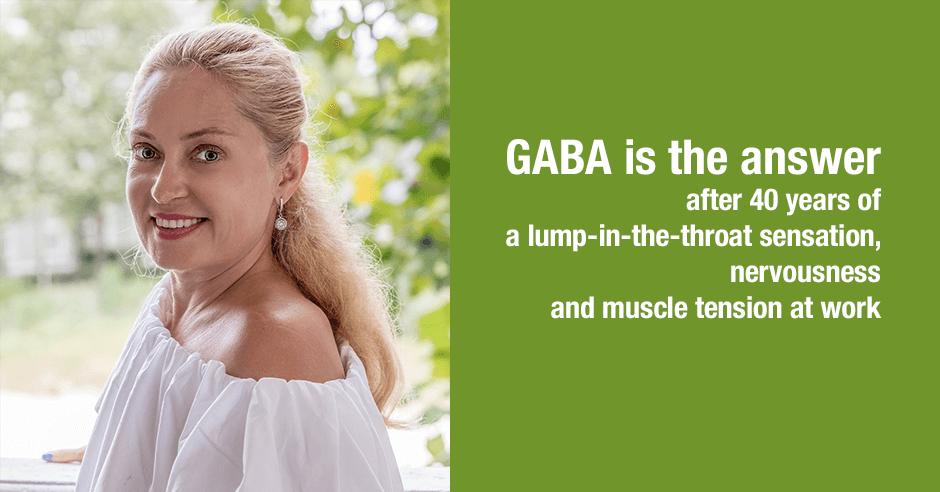
GABA is the answer after 40 years of a lump-in-the-throat sensation, nervousness and muscle tension at work

November 20, 2020 By Trudy Scott 18 Comments

gaba answer to muscle tension

Earlier this year, I published a blog post on the sensation of having a lump in the throat when you feel anxious. It’s called globus pharyngeus which is defined as “the painless sensation of a lump in the throat and may be described as a foreign body sensation, a tightening or choking feeling.”

Globus means globe/sphere and it can actually feel like you have a golf-ball sized object in your throat. It’s very uncomfortable and quite terrifying outside of the anxiety that is often the trigger. I share my lump-in-the-throat story and my success with GABA in this blog: Anxiety and globus pharyngeus (lump in the throat): GABA to the rescue?

Pam recently shared her wonderful success with GABA on the above blog, after having dealt with what she calls “her throat thing” for 40 years!

I have dealt with this throat thing since I was a teenager. I’m now 57. It was only when I saw what you wrote about how yours came back after a scary airplane incident that I made the connection that GABA could help me. I saw that in the summer of 2019, so I spent about 40 years dealing with this until I found the GABA answer!

Mine comes up when speaking in front of others, such as work meetings, or even just one-on-one work discussions, and it was getting consistently worse. I would be swallowing constantly and trying to talk. Absolutely awful. Of course everyone could see it happening.

GABA solved this for me, and I can’t even describe how grateful I am!

How wonderful are these results! I am so happy for her and thanked her for coming back and sharing in the comments.  I also asked some follow-up questions so I can continue to learn and so I can share so you get to learn too:

  • How much GABA helps and how do you take it (when you know you’ll be in this situation or a few times a day to get your levels up)?
  • Did you ever use a prescribed medication or were recommended something?
  • Have you seen any other benefits from using GABA – improved sleep, reduced anxiety in other situations, reduced cravings?
  • Have you made other changes too – like dietary changes such as gluten/sugar/caffeine/alcohol removal?

She shared this about timing and how GABA helps with anxiety-related physical/muscle tension and nervousness:

I take GABA Calm … one upon waking, 1 mid-morning, and 1 mid- afternoon. I take an extra one right at the time of a meeting.

That is the only change I made. I’ve never been on any prescription medication.

Other than the specific throat issue, I notice I’m generally less physically tense, with muscles not getting so knotted up in my face, scalp, neck, shoulders, and back, which is wonderful.

I work at a computer job, which causes lots of muscle tension, but I feel that anxiety-related muscle tension has reduced.

I notice that my muscles have less of that “immediate tightness” upon seeing someone whom I’m nervous to interact with.

This timing and dosage of GABA Calm is typically what I use with clients and what works so it was great to hear that it’s working for her. I was also so pleased to hear the anxiety-related muscle tension and nervousness has reduced too. This is also to be expected.

I did remind her to keep in mind that the amino acids are intended for short-term use. This could be a few weeks up to 6-12 months depending on each person. While using the GABA, I have my clients start to address all the dietary changes, gut health, nutritional deficiencies (zinc and B6 are needed to make neurotransmitters and key with pyroluria), toxin exposure (like BPA, phthalates, pesticides, fluoride etc), infections (like Lyme and co-infections, parasites, PANDAS/PANS) etc. and everything else that may be causing low GABA levels (as we covered in The Anxiety Summit 6).

Vagus nerve support is also key. I cover what I did for my vagus nerve in this blog that Pam referred to: Vagus nerve rehab with GABA, breathing, humming, gargling and key nutrients

Globus pharyngeus or this sensation of the-lump-in-the throat is way more common than most people realize and mainstream medicine seldom has a solution. Medications that are commonly prescribed for globus pharyngeus are benzodiazepines, antidepressants/SSRIs and sometimes PPIs/proton pump inhibitors. Cognitive behavior therapy has some success in some instances but it’s always best to get to the root cause of low GABA and address that with the amino acid GABA. And then figure out why GABA is low and address that too.

If you’re new to the amino acids here is a quick summary about GABA: low levels of GABA, a calming neurotransmitter can lead to anxiety, fears and panic attacks. With low GABA, the anxiety is a physical kind of anxiety with muscle tension or muscle spasms.  I propose that low GABA may be one possible root cause of globus pharyngeus.

I appreciate Pam for sharing her story and I’m sharing it here in order to give you practical solutions and hope. If she can find a solution to her 40-year the-lump-in-the throat and physical tension issues then anything is possible.

Please also share your lump-in-the-throat story and what has helped you.  Or if you’re a practitioner, do share how you have helped your clients/patients who experienced this sensation.

Feel free to post your questions here too.

Filed Under: Anxiety Tagged With: anxiety, choking, foreign body sensation, GABA, GABA Calm, globus pharyngeus, lump in the throat, lump-in-the-throat sensation, muscle tension, nervousness, tension, tightening, vagus nerve

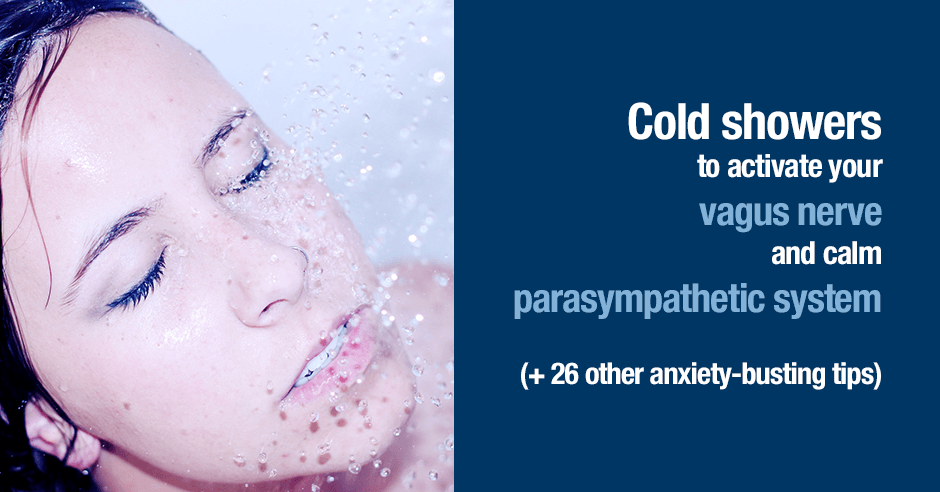
Cold showers to activate your vagus nerve and calm parasympathetic system (+ 26 other anxiety-busting tips)

October 5, 2020 By Trudy Scott 4 Comments

cold showers

I’ve been sharing about  early registration for my next summit… Anxiety Summit 6: Toxins/Meds/Infections!  (I’m the host of this one!)

I’ll continue to share interview snippets leading up to the summit but I want to make sure you know about another one of the summit registrations gifts: 27 Anxiety-Busting Strategies eGuide

anxiety busting strtegies

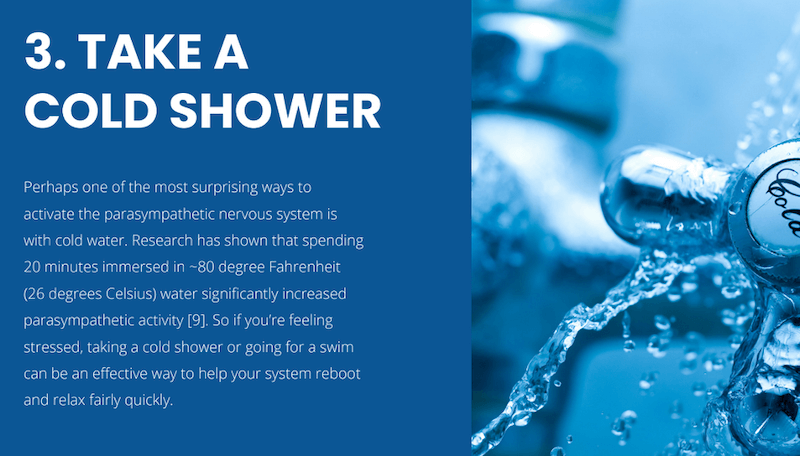
Here is one of the 27 anxiety-busting tips …#3 Take a cold shower!

cold shower

Taking a cold shower or turning the hot water off after your shower and getting under the cold water for a minute or two activates the calming parasympathetic system because it has an impact on the vagus nerve.

I always do the 2 minute cold shower after my regular shower – in summer and winter – and I highly recommend it! You’d think it would be a no-no in the middle of winter but even though there is the initial shock, you feel so good afterwards. It’s such a simple intervention! Try it and let me know how you feel!

We cover this and many other ways to activate the vagus nerve in the interview with Dr. Eva Detko – Vagus Nerve Infection and Anxiety.  It’s an in-depth interview and we cover:

  • VanElzakker’s CFS/vagus nerve infection research
  • the vagus nerve role in brain-gut axis
  • lactobacillus and GABA
  • the vagus nerve and globus pharyngeus (lump in the throat when anxious)
  • how antidepressants may adversely impact the vagus nerve
  • psychosensory havening and more

Another related interview is the one with Melissa Gallico – Fluoride: Neurotoxicity, Anxiety, Acne and Hypothyroidism.  We talk about concerns about fluoride in your shower water. You’ll also learn about other surprising sources of fluoride such as black tea, kombucha and wine!

Some questions for you:

  • Have you used this approach with success and how do you feel afterwards?
  • Do you continue through winter or would you consider this?
  • Have you used variations of this, such as swimming in the ocean or pool in cool or cold weather?
  • What other vagus nerve activation approaches do you use?

Here’s to no more anxiety and you feeling on top of the world again! And getting value out of other 26 tips starting today.

You’ve heard me say the Anxiety Summit has been called “a bouquet of hope!”  My wish for you is that this summit is your bouquet of hope!

I hope you’ll join me and these incredible speakers, be enlightened and find YOUR solutions!

When you download the eGuide you’ll get automatic access to the summit.

Get the 27 Anxiety-Busting Strategies eGuide

And do stay tuned for the summit roadmap – it’s almost ready and will be a great cross-reference of root-causes/triggers, solutions and conditions.

Filed Under: Anxiety Tagged With: activate, anxiety, anxiety summit 6, anxiety-busting tips, calming, Cold showers, cold water, Eva Detko, fluoride, kombucha, parasympathetic system, vagus nerve, vagus nerve infection

Anxiety and globus pharyngeus (lump in the throat): GABA to the rescue?

July 3, 2020 By Trudy Scott 69 Comments

globus pharyngeus and gaba

Low levels of GABA, a calming neurotransmitter can lead to anxiety, fears and panic attacks. With low GABA, the anxiety is a physical kind of anxiety with muscle tension or muscle spasms.  Today you’ll read how low GABA may be one possible root cause of globus pharyngeus, which you may have experienced as a rather scary golf-ball-like lump or constriction in the throat.

Let me describe globus pharyngeus and then I’ll share my story with globus pharyngeus, why low GABA may be a factor (and supplemental sublingual GABA to the rescue) and other possible root causes that should be considered.

This 2015 paper, Globus pharyngeus: an update for general practice, defines it as follows:

Globus pharyngeus or globus sensation is the painless sensation of a lump in the throat and may be described as a foreign body sensation, a tightening or choking feeling.

Globus means globe or sphere and it can actually feel like you have a golf-ball sized object in your throat.

You may have experienced it without even knowing the medical name. Only a few of my clients and those in my community have ever heard the term. I also only learned about the name many years after my episode.

What is very surprising is that, according to the above paper, up to 45% of the population have experienced it.

My story with globus pharyngeus

I’m one of the 45% and for me it was a terrifying experience.  As you may know, I experienced anxiety, PMS, fears and panic attacks in my late 30s and early 40s (it’s why I do this work).

Fortunately I only had one episode. It truly felt like I had a golf-ball in my throat and was horrifying. I knew I needed to swallow so I could get rid of this obstruction but at the same time I was terrified to swallow in case it got stuck and choked and killed me.

I remember going to the mirror to try and see this golf-ball sized object in my throat. I was so surprised that I couldn’t see anything.

Looking back, I suspect the addition of GABA Calm to my protocol prevented further episodes. I was also using progesterone cream at the time and this promotes GABA production too.

I’ve had many clients report that looking back they also realized their episodes stopped once they addressed their low GABA levels.

I was also under a great deal of stress at the time: work stress (long hours and my adrenals were a mess) and physical stress (due to amalgam removal, gluten issues, perimenopausal changes and much more).

Globus pharyngeus and GABA

The fact that the throat or pharynx “is a muscular tube that runs from the back of your nose down into your neck” is one reason for considering a muscle spasm and low GABA as a root cause.

The amino acid GABA, when used sublingually, eases muscle spasms within 15 seconds to 2 minutes. Some examples where we see this:

  • Physical tension with anxiety
  • Rectal spasms or proctalgia fugax
  • Throat spasms caused by vagus nerve issues

If you’re in the midst of an episode it’s impossible to open a capsule of GABA into your mouth. Until a client knows how much they can tolerate we start with 100-125 mg and increased based on the trial.  Taking the powder and dabbing it with a wet finger and putting the finger to the inside cheek a few times is the best way for quick relief.

A product that is GABA-only in a capsule such as Enzymatic Therapy GABA or ProThera 500mg GABA are my choices for in-the moment relief (more on these in my supplement store here).

Source Naturals GABA Calm is my most popular GABA product and is my choice for everyday use.

Of course, I recommend this approach to doing nothing. The authors state: “simple reassurance may be all that is required” or “Advise patients to resist the urge to dry swallow.” We can do better.

Once your GABA levels are sufficient, it’s less likely to happen unless you’re under a great deal of stress and/or there are psychological factors at play:

There is increased reporting of stressful life events prior to development of symptoms and research suggests that as many as 96% of patients with globus sensation report an exacerbation of symptoms during times of emotional intensity.

During times of added stress, folks may experience other “physical symptoms such as palpitations, poor sleep, and feelings of panic.”

Other root causes and possible solutions

The above paper does also list other root causes and solutions that would need to be investigated if GABA doesn’t help or possibly in conjunction with GABA support: tonsil issues, hiatus hernia, reflux in 23 -68% of individuals (I would look for the root cause rather than using a proton pump inhibitor/PPI), sinusitis, post-nasal drip, goitre, an actual foreign body, high consumption of alcohol/caffeine/tobacco and cancer (which they state is rare).

Interestingly, speech and language therapy has been shown to improve globus pharyngeus in two studies, possibly due to the reassurance experienced.

The paper concludes as follows:

Finally the link between anxiety and globus sensation must be considered. Evidence supports the use of cognitive behavioural therapy, but very little evidence exists for the use of anxiolytics or antidepressants.

I’ll add to this: the link between low GABA and globus sensation must also be considered, especially if you experience the physical type of low GABA anxiety. GABA to the rescue!

Based on the research, low serotonin, vagus nerve function, thyroid health and h/pylori may also be factors. I suspect food sensitivities play a role. And pyroluria too, because of the additional loss of zinc and vitamin B6 which is needed for GABA production. I’ll leave all this for a follow-up blog.

Have you experienced a globus sensation episode? And what did it feel like?

Did you get a diagnosis or is the term new to you?

Has GABA helped … in the moment or if you look back on your use of GABA for anxiety?

Did you discover other root causes and solutions? Please do share.

Please share if  you have pyroluria and your episodes were triggered by a very stressful event

And feel free to post your questions.

If you’re a practitioner I’d love to hear your feedback too.

Filed Under: Amino Acids, Anxiety, GABA Tagged With: anxiety, choked, choking, constriction in the throat, GABA, GABA Calm, globus pharyngeus, golf ball, lump in the throat, panic attack, spasm, swallow, vagus nerve

Social anxiety caused by pyroluria: oxytocin, the vagus nerve, pectus excavatum and Ehlers-Danlos Syndrome

June 12, 2020 By Trudy Scott 19 Comments

social anxiety pyroluria

Pyroluria is associated with a type of anxiety characterized by social anxiety, avoidance of crowds, a feeling of inner tension, and bouts of depression. If you have pyroluria you may experience varying degrees of anxiety or fear, often starting in childhood, and you usually manage to cover it up and push through. You may build your life around one person, become more of a loner over time, have difficulty handling stress or change, and have heightened anxiety symptoms when under more stress.

It’s not well-recognized in the medical profession and has long been considered a genetic condition. More recently some practitioners have been proposing that it may be triggered by environmental toxins and that it’s not only genetic. Either way, symptoms can start to resolve within a week when low levels of zinc and vitamin B6, together with some other nutrients are addressed. Stress management is key. This can be emotional stress and the stress of toxin exposure, infections like Lyme disease, mold toxicity and even low blood sugar and gluten issues.

We would typically not connect social anxiety/pyroluria with low oxytocin, vagus nerve function or connective tissue disorders but if you read on you’ll see there are some interesting connections.

Oxytocin, social anxiety and zinc

Research has found that oxytocin levels correlate strongly with levels of social anxiety. A paper published in the Journal of Psychiatric Research looked at how variations in the oxytocin receptor (OXTR) gene is associated with an increased risk of anxiety, stress and depression in individuals with a history of exposure to early life stress. Supporting low levels of oxytocin can ease the threats of social interactions.

What is interesting is that zinc, a key nutrient for pyroluria, is needed for binding oxytocin to its receptor. You can read more about all this here: Oxytocin, social anxiety, pyroluria and autism

Sociability improves vagus nerve function and thriving at home alone

Increased sociability helps improve vagus nerve function. It’s all good and well to recommend getting out and hanging out with more people but if you have pyroluria it’s really challenging. It’s also hard work, very stressful and the added stress makes your pyroluria symptoms worse so it becomes a vicious cycle.

You can read all about this here: Increased sociability improves vagus nerve function: the role of social anxiety, pyroluria and low zinc. There is an updated section on social isolation during coronavirus and how some people are thriving being home alone.

Pectus excavatum and Ehlers-Danlos Syndrome

Pectus excavatum is an indentation in the chest wall and is related to problems with connective tissue. When it comes to pyroluria and pectus excavatum, this is what we see in common: social anxiety and depression, low zinc and low vitamin B6, dental crowding and sometimes Ehlers-Danlos Syndrome (EDS). I write more about this here: Pectus excavatum and pyroluria: is there a connection?.

I’ve written an entire blog on Joint hypermobility / Ehlers-Danlos Syndrome and pyroluria. Anxiety, depression, attention deficit (and hyperactivity) disorder, autism spectrum disorders, and obsessive-compulsive personality disorders are all common with EDS. Many folks with EDS report better less social anxiety, improved mood and often improved physical symptoms/reduced pain on the pyroluria protocol of zinc, vitamin B6, evening primrose oil and a good copper-free multi.

Resources for you

  • My book The Antianxiety Food Solution (my Amazon affiliate link) has an entire chapter on pyroluria. Read it and become a savvy health-advocate for yourself. Share a copy with your doctor and point out the references.
  • Here is the pyroluria questionnaire. Here is a blog if you’re new to pyroluria and the associated conditions.
  • You can find the pyroluria products in my supplement store here.

Please do share if you have pyroluria or score high on the questionnaire and have seen improvements in your social anxiety and any physical symptoms.

Filed Under: Anxiety, Pyroluria Tagged With: anxiety, Ehlers-Danlos Syndrome, oxytocin, Pectus Excavatum, pyroluria, social anxiety, vagus nerve, vitamin B6, zinc

  • Page 1
  • Page 2
  • Page 3
  • Go to Next Page »

Primary Sidebar

NEW! GABA QuickStart Homestudy (with special intro pricing)

gaba quickstart homestudy

Free Report

9 Great Questions Women Ask about Food, Mood and their Health

You'll also receive a complimentary subscription to my ezine "Food, Mood and Gal Stuff"


Connect with me

Popular Posts

  • Amino Acids Mood Questionnaire from The Antianxiety Food Solution
  • The Antianxiety Food Solution Amino Acid and Pyroluria Supplements
  • Pyroluria Questionnaire from The Antianxiety Food Solution
  • Collagen and gelatin lower serotonin: does this increase your anxiety and depression?
  • Tryptophan for the worry-in-your-head and ruminating type of anxiety
  • GABA for the physical-tension and stiff-and-tense-muscles type of anxiety
  • The Antianxiety Food Solution by Trudy Scott
  • Seriphos Original Formula is back: the best product for anxiety and insomnia caused by high cortisol
  • Am I an anxious introvert because of low zinc and vitamin B6? My response to Huffington Post blog
  • Vagus nerve rehab with GABA, breathing, humming, gargling and key nutrients

Recent Posts

  • What do I use instead of Seriphos to help lower high cortisol that is affecting my sleep and making me anxious at night?
  • BeSerene™ GABA/theanine cream eases severe muscle tension in her neck/shoulders, prevents her bad headaches and quells her anxiety
  • How the correct approach, dose and sublingual use of GABA can be calming and not cause a flushed and itchy face and neck
  • The amino acid glutamine improves low mood by addressing gut health, and it has calming effects too
  • Flight anxiety with heightened breath, physical tension and also fearing the worst (the role of low GABA and low serotonin)

Categories

  • 5-HTP
  • AB575
  • Addiction
  • ADHD
  • Adrenals
  • Alcohol
  • Allergies
  • Alzheimer's disease
  • Amino Acids
  • Anger
  • Antianxiety
  • Antianxiety Food Solution
  • Antidepressants
  • Anxiety
  • Anxiety and panic
  • Autism
  • Autoimmunity
  • benzodiazapines
  • Bipolar disorder
  • Books
  • Caffeine
  • Cancer
  • Candida
  • Children/Teens
  • Collagen
  • Cooking equipment
  • Coronavirus/COVID-19
  • Cravings
  • Depression
  • Detoxification
  • Diabetes
  • Diet
  • DPA/DLPA
  • Drugs
  • EFT/Tapping
  • EMF
  • EMFs
  • Emotional Eating
  • Endorphins
  • Environment
  • Essential oils
  • Events
  • Exercise
  • Fear
  • Fear of public speaking
  • Fertility and Pregnancy
  • Fish
  • Food
  • Food and mood
  • Functional neurology
  • GABA
  • Gene polymorphisms
  • General Health
  • Giving
  • Giving back
  • Glutamine
  • Gluten
  • GMOs
  • Gratitude
  • Gut health
  • Heart health/hypertension
  • Histamine
  • Hormone
  • Hyperparathyroidism
  • Hypoglycemia
  • Immune system
  • Inflammation
  • Insomnia
  • Inspiration
  • Introversion
  • Joy and happiness
  • Ketogenic diet
  • Lithium orotate
  • Looking awesome
  • Lyme disease and co-infections
  • MCAS/histamine
  • Medication
  • Men's health
  • Mental health
  • Mercury
  • Migraine
  • Mold
  • Movie
  • MTHFR
  • Multiple sclerosis
  • Music
  • NANP
  • Nature
  • Nutritional Psychiatry
  • OCD
  • Osteoporosis
  • Oxalates
  • Oxytocin
  • Pain
  • Paleo
  • Parasites
  • Parkinson’s disease
  • PCOS
  • People
  • PMS
  • Postpartum
  • PTSD/Trauma
  • Pyroluria
  • Questionnaires
  • Real whole food
  • Recipes
  • Research
  • Schizophrenia
  • serotonin
  • SIBO
  • Sleep
  • Special diets
  • Sports nutrition
  • Stress
  • Sugar addiction
  • Sugar and mood
  • Supplements
  • Teens
  • Testimonials
  • Testing
  • The Anxiety Summit
  • The Anxiety Summit 2
  • The Anxiety Summit 3
  • The Anxiety Summit 4
  • The Anxiety Summit 5
  • The Anxiety Summit 6
  • Thyroid
  • Thyroid health
  • Toxins
  • Tryptophan
  • Tyrosine
  • Uncategorized
  • Vegan/vegetarian
  • Women's health
  • Yoga

Archives

  • October 2025
  • September 2025
  • August 2025
  • July 2025
  • June 2025
  • May 2025
  • April 2025
  • March 2025
  • February 2025
  • January 2025
  • November 2024
  • October 2024
  • September 2024
  • August 2024
  • July 2024
  • June 2024
  • May 2024
  • April 2024
  • March 2024
  • February 2024
  • January 2024
  • December 2023
  • November 2023
  • October 2023
  • September 2023
  • August 2023
  • July 2023
  • June 2023
  • May 2023
  • April 2023
  • March 2023
  • February 2023
  • January 2023
  • December 2022
  • November 2022
  • October 2022
  • September 2022
  • August 2022
  • July 2022
  • June 2022
  • May 2022
  • April 2022
  • March 2022
  • February 2022
  • January 2022
  • December 2021
  • November 2021
  • October 2021
  • September 2021
  • August 2021
  • July 2021
  • June 2021
  • May 2021
  • April 2021
  • March 2021
  • February 2021
  • January 2021
  • December 2020
  • November 2020
  • October 2020
  • September 2020
  • August 2020
  • July 2020
  • June 2020
  • May 2020
  • April 2020
  • March 2020
  • February 2020
  • January 2020
  • December 2019
  • November 2019
  • October 2019
  • September 2019
  • August 2019
  • July 2019
  • June 2019
  • May 2019
  • April 2019
  • March 2019
  • February 2019
  • January 2019
  • December 2018
  • November 2018
  • October 2018
  • September 2018
  • August 2018
  • July 2018
  • June 2018
  • May 2018
  • April 2018
  • March 2018
  • February 2018
  • January 2018
  • December 2017
  • November 2017
  • October 2017
  • September 2017
  • August 2017
  • July 2017
  • June 2017
  • May 2017
  • April 2017
  • March 2017
  • February 2017
  • January 2017
  • December 2016
  • November 2016
  • October 2016
  • September 2016
  • August 2016
  • July 2016
  • June 2016
  • May 2016
  • April 2016
  • March 2016
  • February 2016
  • January 2016
  • December 2015
  • November 2015
  • October 2015
  • September 2015
  • August 2015
  • July 2015
  • June 2015
  • May 2015
  • April 2015
  • March 2015
  • February 2015
  • January 2015
  • December 2014
  • November 2014
  • October 2014
  • September 2014
  • August 2014
  • July 2014
  • June 2014
  • May 2014
  • April 2014
  • March 2014
  • February 2014
  • January 2014
  • December 2013
  • November 2013
  • October 2013
  • September 2013
  • August 2013
  • July 2013
  • June 2013
  • May 2013
  • April 2013
  • March 2013
  • February 2013
  • January 2013
  • December 2012
  • November 2012
  • October 2012
  • August 2012
  • July 2012
  • June 2012
  • May 2012
  • April 2012
  • March 2012
  • February 2012
  • January 2012
  • December 2011
  • November 2011
  • October 2011
  • September 2011
  • August 2011
  • July 2011
  • June 2011
  • May 2011
  • April 2011
  • March 2011
  • February 2011
  • January 2011
  • December 2010
  • October 2010
  • September 2010
  • July 2010
  • May 2010
  • April 2010
  • March 2010
  • February 2010
  • January 2010
  • November 2009

Share the knowledge!

The above statements have not been evaluated by the Food and Drug Administration. Products listed in this website are not intended to diagnose, treat, cure or prevent any disease.

The information provided on this site is for informational and educational purposes only and is not intended as a substitute for advice from your physician or other health care professional. You should consult with a healthcare professional before starting or modifying any diet, exercise, or supplementation program, before taking or stopping any medication, or if you have or suspect you may have a health problem.


Copyright © 2026 Trudy Scott. All Rights Reserved. | Privacy | Terms and Conditions | Refund Policy | Medical Disclaimer

Free Report

9 Great Questions Women Ask about Food, Mood and their Health

You’ll also receive a complimentary subscription to my ezine “Food, Mood and Gal Stuff”