• Skip to primary navigation
  • Skip to main content
  • Skip to primary sidebar

everywomanover29 blog

Food, Mood and Women's Health – Be your healthiest, look and feel great!

  • Blog
  • About
  • Services
  • Store
  • Resources
  • Testimonials
  • The Book
  • Contact
  • Search this site

neurotransmitters

“Potion” of tyrosine, Endorphigen, GABA and tryptophan has been nothing less than a miracle for my depression and anxiety – how long can I remain on these?

August 11, 2023 By Trudy Scott 21 Comments

amino acids duration

Amy shares how much her particular “potion” or combination of amino acids has helped her depression and anxiety and wants to know how long she can remain on them:

I currently take 500 mg of l-tyrosine in the morning, 1 Endorphigen 2xday, 1 GABA calm 2x day and 1000 mg of tryptophan before bed with some natural calm & true calm. This “potion” has been nothing less than a miracle. I feel pretty good.

The past few years have been rough, managing depression and anxiety with frequent relapse, and I finally feel ok.

I don’t want to wean off yet and am curious as to how long I can remain on these. Is it dangerous to keep on it too long? Is there a maximum time? I follow your blog and reached out to you last year. Your information has been extremely helpful. Thank you.

I’m glad to hear Amy is doing so well on this miracle combination and finally feels ok. Before stopping the amino acids, the goal is to address diet, gut health, nutritional imbalances, toxins and all the underlying factors that lead to low catecholamines, low endorphins, low GABA and low serotonin.

It’s fine to stop taking them and see how you do and add some or all of them back if you find you still need that neurotransmitter support. This is one of a few approaches I use with clients. But here are times when it’s best to wait and continue using them (like when on the pill and when affected by seasonal depression). I share my insights on this and other ways to cut back below.

How long can you remain on amino acids and when do you consider stopping them?

There is no set time frame for staying on the amino acids. As I mentioned above you can stop taking the individual amino acids and see how you do and then add some or all of them back if you find you still need that neurotransmitter support. This is one of a few approaches I use with clients.

Other approaches include: completely stopping one amino acid at a time and monitoring symptoms or reducing the amount one amino acid at a time, also monitoring symptoms. I prefer the latter especially with someone like Amy who has been “managing depression and anxiety with frequent relapse.”

I can also hear that she has some hesitation about stopping her “potion” and going with your gut is a good thing too. She also has a few confounding factors that make me feel staying on them longer may be in her best interest. One factor is her long-term use of birth control pills.

Long term use of birth control pills and the impact on mood and nutritional status

Amy also shares about her use of the birth control pill and how she suspects it’s a factor in her depression and anxiety:

I should also mention I just went off birth control pills. I have taken them since age 16 only stopping for 3 pregnancies and breastfeeding. I am 46. I’ve been on for painful periods. I made the decision to stop for fear of clots, cardiac issues and most importantly my mental well being. I truly believe they contributed to my depression. I believe I’m in perimenopause and have higher than normal anxiety. I’m extremely worried about my periods if I stop the pill and think my amino acid supplements help these worries and I cope better. That’s why I’m reluctant to stop the supplements but still worried about long term use.

Because Amy has been using the birth control pill for around 25 years I’d have her continue with the amino acids for now and address the effects on her gut health and nutritional status first.

Women taking the pill and other hormonal contraception are more likely to be depressed. A Danish study published in JAMA Psychiatry of more than 1 million women aged 15 to 34, with no prior history of depression, were included in the study and followed for 13 years. The researchers found that those women who used the pill were 23% more likely to be depressed and  use antidepressants.

You can read more about the effects of the birth control pill on this blog and my book review of “Beyond the Pill” by Dr. Jolene Brighten. As you’ll read it causes vitamin, mineral, and antioxidant depletion (such as folate, B12, vitamin B6 and zinc).

She did actually come back and share that she tried and it didn’t work out going off the birth control pill. She was unable to manage the pain. She needs to address all these root causes first.

There is also no reason for her to be worried about long term use of the amino acids when they are clearly addressing her neurotransmitter imbalances.

The seasonal impact on mood and anxiety

I don’t have clients make changes to their amino acids in the Fall or Winter when there can be seasonal impacts on mood and anxiety. She had shared this too:

I’m more prone to depression this time of year. I think with these 2 factors [seasonal mood changes and the pill] I’ll stay on the regime until the spring.

This is a wise decision for Amy.

I would also hold off on making changes if someone is prone to airborne allergies. This is because there can be a higher need for neurotransmitter support when there are allergies.

Amy has already made many diet and lifestyle changes so she is heading in the right direction:

I have given my diet an overhaul. Not perfect but significantly less refined carbs and sugar. Plenty of fresh produce, healthy fats and protein ( especially animal). I also have committed to daily “body movement”: yoga, Pilates, max trainer, light weights or bike.

All of these changes are starting to support her overall nutritional status and resilience.

A recap of the amino acids Amy is using and the rationale for each one

If you’re new to using individual amino acids, here is a quick recap of the amino acids Amy is using and the rationale for each one.

She is using 500 mg of l-tyrosine in the morning. This supports low levels of dopamine/catchecolamines and improves the curl-up-in-bed kind of depression. You can read more about tyrosine here.

She is also using Endorphigen twice a day. This is a Lidtke product called Endorphigen and provides 500 mg  DPA/d-phenylalanine  per capsule. It raises endorphin levels, offering a mood boost, typically helping with weepiness and also emotional eating. You can read more about DPA here.

Amy is also using GABA Calm 2x day.  This is a sublingual/chewable product made by Source Naturals and is a nice low dose of 125mg per chewable. You can read more about GABA here.

And finally, she is using 1000 mg of tryptophan before bed. This supports low serotonin and improves worry-kind of anxiety and depression, ruminating, obsessive tendencies and also sleep issues. You can read more about tryptophan here.

Keep in mind this is what Amy found works for her unique needs and would have done trials of the amino acids one by one to figure out which ones to use and how much of each to use. There is no one size fits all.

It’s not unusual for folks using the amino acids to describe their results as miraculous!

Resources if you are new to using amino acids as supplements

If you are new to using amino acids as supplements, here is the Amino Acids Mood Questionnaire from The Antianxiety Food Solution (you can see all the symptoms of neurotransmitter imbalances, including low GABA, low serotonin, low dopamine, low blood sugar and low endorphins).

If you suspect low levels of any of the neurotransmitters and do not yet have my book, The Antianxiety Food Solution – How the Foods You Eat Can Help You Calm Your Anxious Mind, Improve Your Mood, and End Cravings, I highly recommend getting it and reading it before jumping in and using amino acids on your own so you are knowledgeable. And be sure to share it with the practitioner/health team you or your loved one is working with.

There is an entire chapter on the amino acids and they are discussed throughout the book in the sections on gut health, gluten, blood sugar control, sugar cravings, anxiety and mood issues.

The book doesn’t include product names (per the publisher’s request) so this blog, The Antianxiety Food Solution Amino Acid and Pyroluria Supplements, lists the amino acids that I use with my individual clients and those in my group programs. You can find them all in my online store.

If, after reading this blog and my book, you don’t feel comfortable figuring things out on your own (i.e. doing the symptoms questionnaire and respective amino acids trials), a good place to get help is the GABA QuickStart Program (if you have low GABA symptoms too). This is a paid online/virtual group program where you get my guidance and community support.

If you are a practitioner, join us in The Balancing Neurotransmitters: the Fundamentals program. This is also a paid online/virtual program with an opportunity to interact with me and other practitioners who are also using the amino acids.

Thanks to Amy for sharing her results and asking this question.

Have you seen similar benefits when using individual amino acids? If yes, which ones have helped you?

What approach have you used to stop or reduce your doses?

And have you continued using the amino acids because of the effects of the pill, seasonal mood shifts or seasonal allergies (or some other reason)?

If you have questions and feedback please share them here too.
Filed Under: Amino Acids, Anxiety, Depression, Women's health Tagged With: amino acids, catecholamines, dangerous, depression, diet, DPA, Endorphigen, endorphins, GABA, GABA Calm, GABA Quickstart online program; Balancing Neurotransmitters: the Fundamentals program for practitioners, gut health, how long, miracle, neurotransmitters, nutritional imbalances, seasonal depression, serotonin, the pill, toxins, tryptophan, tyrosine

Pathological Demand Avoidance (PDA) in children with autism – how much is behavioral and how much is due to low serotonin?

June 9, 2023 By Trudy Scott 14 Comments

pda in children with autism

Pathological Demand Avoidance (PDA) is a condition associated with Autism Spectrum Disorder (ASD). It is a rare behavioral phenotype of ASD that is characterized by an overwhelming or obsessional need to resist or avoid demands, which can often lead to sensory overwhelm causing meltdowns and violent outbursts.

Although children in general may often try to avoid demands, children with PDA engage in avoidant behaviors at a greater level.

The key underlying factor is the extreme levels of anxiety associated with a loss of control, which can feel like a panic attack. Because of high levels of anxiety, they will often respond with a “No” even to tasks or activities that they normally enjoy and can spend a great deal of energy trying to gain control of situations and people.

(from an Australian PDA article: What is Pathological Demand Avoidance (PDA) and how can we address it? so I changed the spelling of behavioural and characterised to be American)

This is a typical overview of PDA and the common recommendations (as outlined in the above article) are all behavioral interventions: be an active listener and build trust, depersonalize requests, provide indirect praise, use humor and so on. Many parents find these helpful but the biochemical imbalances that trigger these behaviors are being ignored and/or there is a lack of awareness. I’d like to change this so more children and teens get quick relief.

There may be many different root causes such as low serotonin, low GABA, low blood sugar, gluten sensitivities, low zinc, low vitamin B6, low vitamin D, toxins, infections, phenols, salicylates etc. Today I’m going to discuss low serotonin and my rationale for reaching this conclusion. It’s also one of the quickest root causes to confirm (more on that below).

My rationale for proposing that Pathological Demand Avoidance (PDA) in children with autism is related to low serotonin

If we take the description above, all of these symptoms are classically found when a child (or adult) has low serotonin:

  • Extreme levels of anxiety
  • Can feel like a panic attack
  • Overwhelm
  • Meltdowns and violent outbursts
  • Loss of control
  • Spending a great deal of energy trying to gain control of situations and people (i.e. controlling)
  • Obsessional need to resist (any kind of obsessing is common when serotonin is low)

The second reason I suspect low serotonin with PDA is the timing of these behaviors i.e. later in the day. The article mentions that “A child with PDA can be very calm, cool and compliant at school and behave much worse at home. This is not because of incompetent parenting but because they have reached their tolerance levels and need to release that suppressed anxiety.”

This may well be a factor, however low serotonin symptoms are recognized as being more severe in the afternoon/evening when serotonin levels start to decline. If these children have low serotonin then it makes sense that these symptoms would start to increase once they get home.

My third reason is that low serotonin is common in autism/autism spectrum disorder (ASD).

Low serotonin is common in autism/autism spectrum disorder (ASD)

This paper, Vitamin D hormone regulates serotonin synthesis. Part 1: relevance for autism, summarizes it as follows: “The disruption of the serotonergic system is one of the most consistent observations associated with autism. Serotonin in the brain promotes prosocial behavior and correct assessment of emotional social cues.”  

Their recommendations are vitamin D and tryptophan supplementation which they say “may be a simple method of increasing brain serotonin without negative side effects.”

Testing for low levels of vitamin D and supplementing accordingly is important.

Are there other low serotonin symptoms and using a trial of tryptophan to confirm

As mentioned above, low serotonin is also one of the quickest root causes to confirm. As always, regardless of the diagnosis, we assess for low serotonin by rating symptoms on a scale of 1 to 10 (with 10 being most severe) and do a trial of tryptophan (chewed or a capsule opened on to the tongue). You will have your answer very quickly because we rate improvements in symptoms in the next 5 to 30 minutes.

In addition to the above symptoms we also look for these: worry-in-your-head and ruminating type of anxiety, phobias, lack of confidence, depression, negativity, imposter syndrome, PMS, irritability, insomnia and afternoon/evening cravings for carbs and sugar.

Lidtke is the only brand of tryptophan that I recommend simply because I see it work so well and because of quality issues with tryptophan in the past. Here are the Lidtke tryptophan products I recommend:

  • Lidtke Chewable Tryptophan 100 mg is a good for doing a trial and works when lower doses are needed as with children.
  • Lidtke Tryptophan 500 mg can be used for doing a trial. I open the capsule and use 100mg for a child. Going forward this product is helpful when higher doses are needed, especially at night. When opened it doesn’t taste very good but can be mixed with inositol or even glutamine powder or mashed banana.

You can read more on this blog: Tryptophan for the worry-in-your-head and ruminating type of anxiety, see the full list of low serotonin symptoms here and find the tryptophan products on the supplements blog here.

If you’re new to PDA, the DSM and low serotonin/other biochemical factors

Professor Elizabeth Newson was a developmental psychologist known for her work with children in the autism spectrum. This is her 2003 paper on the topic – Pathological demand avoidance syndrome: a necessary distinction within the pervasive developmental disorders

It’s not part of the DSM-5, the standard classification of mental disorders used by mental health professionals in the United States. This article, A Brief History of Pathological Demand Avoidance, offers a good backstory and shares why families want it to be part of the DSM.

Whether or not it becomes a distinct condition or autism subtype in the DSM, I’d like to see low serotonin (and likely low vitamin D) being recognized as one root cause. And acknowledging that there may be many other biochemical/nutritional approaches that should also be explored.

These symptoms are listed in the above article, in addition to avoidance behaviors, and all could fall into typical low serotonin symptoms:

  • verbal and physical aggression when feeling loss of control
  • self-injurious behavior
  • property destruction
  • refusal to participate in self-care such as bathing or brushing teeth (is this depression?)
  • inability to attend social events (is this fear and social anxiety?)
  • controlling what noises are allowed in a home, such as no music, or only certain music
  • inability to allow parents to have friends visit the home (is this also controlling?)
  • are often combative with siblings
  • issues with food, what to eat, when to eat, who to eat with
  • conflict with siblings

As mentioned above we also look into low GABA and low blood sugar (trials of GABA and glutamine will give quick confirmation too), gluten sensitivity, low zinc, low vitamin B6, toxins, infections, phenols, salicylates and so on. Of course, Nutritional and Dietary Intervention for Autism Spectrum Disorder is crucial.

Some success stories and connecting the dots with low serotonin

These two success stories illustrate how successful tryptophan and GABA can be and also how quickly they offer relief:

  • Rage, anxiety, cravings & insomnia in 11-year old girl with RAD/reactive attachment disorder: chewable tryptophan turns things around
  • Half a crushed GABA Calm for my autistic child: sleep, anxiety and sensorimotor skills (writing, horse riding and swimming) improve

This blog post illustrates similar low serotonin symptoms and end-of-the-day timing in adults with Alzheimer’s – Sundowning in Alzheimer’s and dementia: melatonin/tryptophan for the agitation, restlessness, anxiety, disturbed sleep and aggression. It’s low serotonin that is the cause, regardless of the diagnosis.

This blog illustrates another mechanism for these types of disruptive behaviors: Christmas tree phenols as a trigger for anger, meltdowns, anxiety, hyperactivity, insomnia, aggression, self-injury and autistic symptoms? There is a serotonin connection when there are phenol issues too.

Resources if you are new to using amino acids as supplements

If you are new to using amino acids as supplements, here is the Amino Acids Mood Questionnaire from The Antianxiety Food Solution (you can see all the symptoms of neurotransmitter imbalances, including low GABA, low serotonin and low endorphins).

If you suspect low levels of any of the neurotransmitters and do not yet have my book, The Antianxiety Food Solution – How the Foods You Eat Can Help You Calm Your Anxious Mind, Improve Your Mood, and End Cravings, I highly recommend getting it and reading it before jumping in and using amino acids on your own so you are knowledgeable. And be sure to share it with the practitioner/health team you or your loved one is working with.

There is an entire chapter on the amino acids and they are discussed throughout the book in the sections on gut health, gluten, blood sugar control, sugar cravings, anxiety and mood issues.

The book doesn’t include product names (per the publisher’s request) so this blog, The Antianxiety Food Solution Amino Acid and Pyroluria Supplements, lists the amino acids that I use with my individual clients and those in my group programs. You can find them all in my online store.

If, after reading this blog and my book, you don’t feel comfortable figuring things out on your own (i.e. doing the symptoms questionnaire and respective amino acids trials), if you need serotonin support, the Serotonin QuickStart Program is a good place to start. This is a paid online/virtual group program where you get my guidance on using tryptophan and 5-HTP safely, and community support during 5 LIVE Q&A calls. You can sign up to be notified when the next live launch of this program is happening. We take a deep dive into product options including Lidtke products and others if you’re not able to access Lidtke.

If you also have low GABA symptoms, the next step to get help is the GABA QuickStart Program.This is also a paid online/virtual group program where you get my guidance and community support. Another option is the budget-friendly GABA QuickStart Homestudy program.

If you are a practitioner, join us in The Balancing Neurotransmitters: the Fundamentals program. This is also a paid online/virtual program with an opportunity to interact with me and other practitioners who are also using the amino acids.

Now I’d like to hear from you

Have you been told your child may have Pathological Demand Avoidance (PDA)? Have you only been offered behavioral change tools and how have they helped?

Has low serotonin (and other biochemistry imbalances) been discussed too?

What symptoms does your child have and are things worse later in the day?

Has tryptophan helped reduce the above low serotonin symptoms in your child? How much helps and how quickly?

Or do you find 5-HTP works better? If yes, how much helps and how quickly?

What other biochemical changes have helped?

If you’re a practitioner, are you hearing about increased discussion of Pathological Demand Avoidance (PDA) and do you address low serotonin with your clients/patients?

Feel free to post your feedback and questions here in the comments.

Filed Under: Anger, Anxiety, Autism, Children/Teens, Depression, Tryptophan Tagged With: amino acids, anxiety, ASD, autism, behavioral, behavioural, biochemical imbalances, control, demands, GABA, gluten, infections, low blood sugar, low GABA, low serotonin, meltdowns, neurotransmitters, obsessional, outbursts, overwhelming, panic attack, Pathological Demand Avoidance, PDA, Phenols, salicylates, sensory overwhelm, the GABA Quickstart online program; and Balancing Neurotransmitters: the Fundamentals program for practitioners, toxins, tryptophan, violent, vitamin D

Would using 5-HTP or tryptophan help when you crave sugar (as a sort of antidepressant) late afternoon/evening?

June 2, 2023 By Trudy Scott 29 Comments

5-htp and sugar craving

Would using 5-HTP or tryptophan also help when you crave sugar (as a sort of antidepressant) late afternoon/evening? ~ Kimberley

This question was posed in response to my recent blog post about using tryptophan or 5-HTP to help with alcohol cravings/addiction in the late afternoon/evening – to help you wind down and relax, improve mood and sleep, and also as a reward/treat.

I said yes it is often the same cause when it happens late afternoon/evening and when there are other low serotonin symptoms like low mood, anxiety, worry, insomnia etc. When serotonin is low we self-medicate with wine, sugar, carbs, gluten, dairy and chocolate etc. in order to feel good, get a mood boost and reduce stress. 5-HTP or tryptophan stops the sugar cravings, acts as an antidepressant (improving mood) and eases other low serotonin symptoms too.

It turns out Kimberley was craving sugar late afternoon: “it’s definitely late afternoon for me, while I’m making dinner. Maybe it’s time to go back on 5-HTP.”

And then 2 days later she posted how quickly 5-HTP helped when she added it back mid-afternoon:

I was taking a break from tryptophan/5-HTP and realized after reading this post that that might be a mistake! So I added 5-HTP back in mid-afternoon and my sugar cravings are almost completely gone. It’s funny how I forget the symptoms of low neurotransmitters. Thanks for reminding me!

5-HTP works quickly when it’s low serotonin

How wonderful are these results for Kimberley. I never get tired of hearing feedback like this! I appreciate her sharing and giving me permission to share as a blog so you get to learn and be inspired too.

It’s not unusual for 5-HTP to work this quickly and when it does it’s a clue that the symptoms are related to low serotonin and that she found the ideal dose for her needs.

Kimberley had good results with 5-HTP in the past so she went back to what had worked for her before and it worked for her again.

But do keep in mind, some folks do better with 5-HTP and some do better with tryptophan so it’s a matter of doing a trial of each one each.

50 mg 5-HTP: the sadness and despair lifts in a few minutes

A week later she kindly came and shared additional details in the comments of the tryptophan/ 5-HTP alcohol cravings blog, saying:

It’s possible that I was already in the middle of my daily, mid-afternoon chocolate chip binge when I saw your post

I took a 50 mg 5-HTP along with my mid-afternoon Endorphigen capsule, and within just a few minutes I felt the sadness and despair that I often feel in the late afternoon, start to lift. I was astonished at how quickly it worked! I didn’t open the capsule, or chew it, I just swallowed it with water and had a snack afterwards. I really can’t thank you enough for asking that question because I was really struggling with low mood and sadness almost every day.

Even though KImberley had used 5-HTP with success in the past, she was still astonished how quickly it worked and how effective it was. She was also surprised she had forgotten her prior low serotonin symptoms:

Up until January I had taken 5-HTP in the mid-afternoon and then Tryptophan at bedtime, but I wanted to try a program to support my thyroid. That program told me that too much serotonin is often at the root of gut damage, so I weaned myself off of the 5-HTP and tryptophan. I didn’t really notice much difference, except the daily sugar cravings.

I’m not sure how I could so easily forget the symptoms of low serotonin, but I did.

Your question really was a God-send for me, Trudy. It reminded me that there was an option for feeling better (in fact, MUCH better than sugar makes me feel) that didn’t involve something that’s not good for me.

And I really did feel remarkably better the same day, and those results have continued.

Thanks again, Trudy, for continuing to bring these topics up. Some of us are forgetful and need reminding. Usually, when you have symptoms of low serotonin there are enough other issues going on in your life that it’s easy to overlook the obvious. So I’m very grateful that you asked the question, because I feel so much better able to deal with my circumstances now that I’m back on the 5-HTP. Blessings to you!

I am curious about the program that told her too much serotonin is often at the root of gut damage and if they suggested stopping 5-HTP and tryptophan. It doesn’t make any sense to me.  I’ll report back when I learn more about this.

More tired during the day and a headache: what to consider

She did mention “I’m finding myself more tired during the day and have also had a headache for the last few days.” I would suspect chocolate/caffeine withdrawal may have caused her headache.

With feeling more tired I’d also watch the dose of 5-HTP. She may find less is better for her needs.

She is also trying tryptophan at bedtime so that may be making her more tired the next day. Doing one amino acid at a time is often the best way to know how each one is affecting you.

Finding what works for your unique needs

Here are some other amino acid/sugar cravings blog posts that illustrate how we all have unique needs and different biochemical imbalances:

  • The individual amino acids glutamine, GABA, tryptophan (or 5-HTP), DPA and tyrosine are powerful for eliminating sugar cravings, often within 5 minutes

The individual amino acids glutamine, GABA, tryptophan (or 5-HTP), DPA and tyrosine are powerful for eliminating sugar cravings, often within 5 minutes. It seems that this wonderful benefit – over and above the anxiety-reducing and mood-boosting benefits – is often overlooked or poorly understood.

  • GABA for ending sugar cravings (and anxiety and insomnia)

For Melissa, an unexpected result was that she stopped craving sugar (chocolates, ice cream and truffles) after about a week of taking GABA for her travel anxiety.

It’s a matter of finding what works for your sugar cravings and unique needs. GABA worked for Melissa and yet 5-HTP works for Kimberley – for their sugar cravings.

Here is the tryptophan/5-HTP alcohol cravings blog that started the discussion: Tryptophan had the added benefit of turning me completely off alcohol when I took it to improve mood and sleep during perimenopause. In this case, tryptophan helped Victoria quit the wine that she was self-medicating with in order to feel good and relax.

Resources if you are new to using amino acids as supplements

If you are new to using amino acids as supplements, here is the Amino Acids Mood Questionnaire from The Antianxiety Food Solution (you can see all the symptoms of neurotransmitter imbalances, including low GABA, low serotonin and low endorphins).

If you suspect low levels of any of the neurotransmitters and do not yet have my book, The Antianxiety Food Solution – How the Foods You Eat Can Help You Calm Your Anxious Mind, Improve Your Mood, and End Cravings, I highly recommend getting it and reading it before jumping in and using amino acids on your own so you are knowledgeable. And be sure to share it with the practitioner/health team you or your loved one is working with.

There is an entire chapter on the amino acids and they are discussed throughout the book in the sections on gut health, gluten, blood sugar control, sugar cravings, anxiety and mood issues.

The book doesn’t include product names (per the publisher’s request) so this blog, The Antianxiety Food Solution Amino Acid and Pyroluria Supplements, lists the amino acids that I use with my individual clients and those in my group programs. You can find them all in my online store.

If, after reading this blog and my book, you don’t feel comfortable figuring things out on your own (i.e. doing the symptoms questionnaire and respective amino acids trials), a good place to get help is the GABA QuickStart Program (if you have low GABA symptoms too). This is a paid online/virtual group program where you get my guidance and community support.

If you are a practitioner, join us in The Balancing Neurotransmitters: the Fundamentals program. This is also a paid online/virtual program with an opportunity to interact with me and other practitioners who are also using the amino acids.

Has 5-HTP helped reduce your cravings and/or feelings of despair and sadness? How much helps and how quickly?

Or do you find tryptophan works better for you? If yes, how much helps and how quickly?

What sugary food/s do you self-medicate with in order to feel good?

If you’re a practitioner, do you use this approach with your clients/patients?

Feel free to post your feedback and questions here in the comments.

Filed Under: 5-HTP, Cravings, Depression, Tryptophan Tagged With: 5-HTP, addiction, alcohol cravings, amino acids, antidepressant, anxiety, carbs, crave sugar, dairy, despair, evening, GABA, gluten, insomnia, late afternoon, low serotonin, mood, neurotransmitters, relax, sadness, self-medicate, sleep, sugar, sugar cravings, the GABA Quickstart online program; and Balancing Neurotransmitters: the Fundamentals program for practitioners, tryptophan, wine, worry

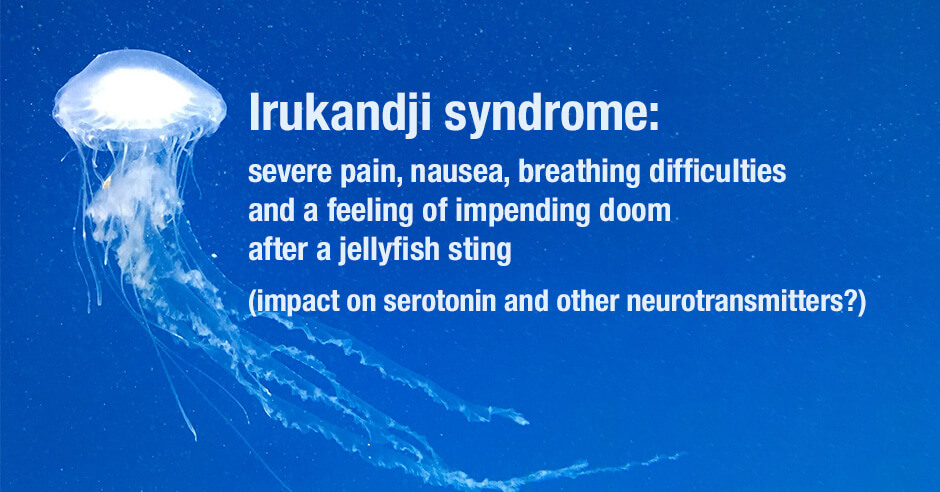
Irukandji syndrome: severe pain, nausea, breathing difficulties and a feeling of impending doom (impact on serotonin and other neurotransmitters?)

December 30, 2022 By Trudy Scott 14 Comments

Irukandji syndrome

Irukandji syndrome is in the news again. In addition to the jellyfish sting causing severe pain, nausea and breathing difficulties, the research states there is a feeling of impending doom after you’re stung. I’m sharing this current news from Australia and a recent study because I’m curious about the mechanisms and short- and long-term impacts on serotonin and other neurotransmitters, likely affecting anxiety, depression, pain and insomnia. And I’d like to help create awareness since there is not 100% consensus on what to do right away after a sting and less awareness in the medical community than I feel comfortable with.

From the ABC article published this week in Australia: “Another child has been flown to Hervey Bay Hospital with a suspected Irukandji sting after swimming in a creek off Wathumba Road on K’gari (Fraser Island) in Queensland, Australia on Wednesday afternoon.

The key points of the article:

  • “Three young girls and a boy have been flown to hospital with suspected Irukandji stings in the past two days
  • The jellyfish stings can cause severe pain, nausea and breathing difficulties
  • A Toxicologist is calling for more research into their movements and physiology”

The yahoo news article expanded on the symptoms: “They have this severe body pain, often low back pain, nausea, vomiting, and this feeling of impending doom that sort of lays over the top of this whole thing.”

I found the latter interesting as impending doom is a classic sign of low serotonin. So I went digging into the research. I was enlightened and surprised by what I found.

Raising awareness on this worldwide increasing threat

This 2022 paper, Raising Awareness on the Clinical and Forensic Aspects of Jellyfish Stings: A Worldwide Increasing Threat is eye-opening and concerning and also mentions the impending doom symptom.

Irukandji syndrome is a severe illness produced by the envenomation i.e. injection of venom, of some species of small jellyfish from the Cubozoa class, known as box jellyfish.

It consists of a clinical picture dominated by systemic symptoms similar to a catecholamine surge, including hypertension, tachycardia, intense pain, and muscle cramping, eventually leading to pulmonary edema, shock and cerebral hemorrhage.

Also listed are symptoms of anxiety, restlessness, headache, localized sweating and impending doom.  A feeling of impending doom is a classic symptom of low serotonin.

With regards to Irukandji syndrome it’s becoming a worldwide problem: “The first cases described happened in the northern Australian territories. However, similar disorders have been observed all over the tropical waters, including Thailand, the Caribbean, Florida, and Hawaii.”

The good news is that the authors state “Irukandji syndrome is typically not deadly, especially if supportive care is given early” and “not all encounters with species capable of producing Irukandji syndrome result in this clinical state.” They also share that typically the severe pain only lasts a few hours but do mention one case where “pain recurred up to a year later.” I discuss possible longer term effects below.

As you read the paper, be aware there are many types of jellyfish with many different mechanisms. Cubozoa includes the deadliest jellyfish species and includes Carukia barnesi and Chironex fleckeri. (commonly known as the Australian box jelly). It’s the Carukia barnesi that causes Irukandji syndrome.

The images in the above paper are graphic so be warned.

There is not 100% consensus on what to do right away

What is also really concerning is that there is not 100% consensus on what to do right away. This 2017 paper, Cubozoan Sting-Site Seawater Rinse, Scraping, and Ice Can Increase Venom Load: Upending Current First Aid Recommendations, published by Hawaiian researchers, found the “best outcomes occurred with the use of venom-inhibiting technologies (Sting No More® products)” and they state not to use a sea water rinse. They also found vinegar and heat treatment were less effective with certain types of jellyfish.

And yet the tentative recommendation from the above 2022 paper is to use vinegar, heat, sea water, and careful removal of remaining tentacles with tweezers quickly because only “about 1% of nematocysts (stinging cells) discharge upon initial contact.” They do suggest using Sting No More® before removing tentacles in order to deactivate the nematocysts.

I’m not sharing any of the above as conclusive in all situations but more to illustrate what both papers state: further research is needed in different places of the world, as different jellyfish species seem to react differently to the treatments.

There is also less awareness in the medical community than I feel comfortable with hence my desire to share this so you are more aware if you or a family member is stung by a jellyfish.

Are there possible long-term impacts on anxiety, depression, pain and insomnia? (and the potential role of amino acids)

Just like we have long-term impacts on anxiety, depression, pain and insomnia with Lyme disease and other infections like Bartonella – due to effects on serotonin, GABA and other neurotransmitters – do we need to consider these long term impacts after a jellyfish sting too?

I have to wonder if there are also longer term impacts given the trauma of the situation and the many medications that are needed to save your life: nitroglycerin, opioids, benzodiazepines and others.

If mood, anxiety, pain and sleep issues persist after the acute recovery phase (which can take up to 3 months and more) and there are other signs of low serotonin, GABA, dopamine and endorphins, it’s important to consider the use of targeted amino acids. I recommend tryptophan or 5-HTP for low serotonin symptoms (worry type of anxiety, insomnia and low mood), GABA for low GABA symptoms (physical anxiety and tension), tyrosine for low dopamine symptoms (depressed with low energy and poor focus) and DPA for low endorphin symptoms (pain and weepiness).

It would be wonderful to see research in this area.

Is there a possible role for GABA right after the sting too?

Given there is “hypertension, tachycardia, intense pain, and muscle cramping”, would the amino acid GABA help?

With Irukandji syndrome, “there have been reports of blood pressures as high as 300/180 mmHg” (normal is 120/80 mmHg). In one study, 80mg GABA was found to reduce mild hypertension and it’s possible that a higher dose of GABA may help right after the sting. It may also help to alleviate pain and muscle tension/muscle cramping too.

It would be wonderful to see research on GABA use right after the sting too.

Resources if you are new to using amino acids as supplements

If you are new to using GABA or any of the other amino acids as supplements, here is the Amino Acids Mood Questionnaire from The Antianxiety Food Solution (you can see all the symptoms of neurotransmitter imbalances, including low GABA and low serotonin).

If you suspect low levels of any of the neurotransmitters and do not yet have my book, The Antianxiety Food Solution – How the Foods You Eat Can Help You Calm Your Anxious Mind, Improve Your Mood, and End Cravings, I highly recommend getting it and reading it before jumping in and using amino acids on your own so you are knowledgeable. And be sure to share it with the practitioner/health team you or your loved one is working with.

There is an entire chapter on the amino acids and they are discussed throughout the book in the sections on gut health, gluten, blood sugar control, sugar cravings, self-medicating with alcohol and more.

The book doesn’t include product names (per the publisher’s request) so this blog, The Antianxiety Food Solution Amino Acid and Pyroluria Supplements, lists the amino acids that I use with my individual clients and those in my group programs. You can find them all in my online store.

If, after reading this blog and my book, you don’t feel comfortable figuring things out on your own (i.e. doing the symptoms questionnaire and respective amino acids trials), a good place to get help is the GABA QuickStart Program (if you have low GABA symptoms). This is a paid online/virtual group program where you get my guidance and community support.

If you are a practitioner, join us in The Balancing Neurotransmitters: the Fundamentals program. This is also a paid online/virtual program with an opportunity to interact with me and other practitioners who are also using the amino acids.

I do hope these 4 young Australian children are doing well after having been stung.

Have you or a family member been stung by a jellyfish? Where did it happen and what type of jellyfish? What symptoms did you experience? What was the treatment and what was recovery like?

Have you or your family member had any long-term lingering symptoms of anxiety, depression, pain and insomnia? Have the amino acids or other solutions helped?

If you’re a practitioner have you seen long-term lingering symptoms of anxiety, depression, pain and insomnia in your clients/patients who have had a jellyfish sting?

Feel free to post your questions and feedback in the comments below.

Filed Under: Anxiety, Depression, GABA, Pain, serotonin Tagged With: a feeling of impending doom, amino acids, and Balancing Neurotransmitters: the Fundamentals program for practitioners, anxiety, box jellyfish, breathing difficulties, Carukia barnesi, Cubozoa, depression, DPA, GABA, GABA Quickstart online program, insomnia, Irukandji jellyfish, nausea, neurotransmitters, pain, serotonin, severe pain, tryptophan

What is the difference between DPA and DLPA (amino acids) and which one do I use for weepiness, heart-ache, pain and energy?

March 11, 2022 By Trudy Scott 75 Comments

dpa and dlpa

Today we address a very common question I get: “What is the difference between DPA and DLPA?” The follow-up question is this: “And what symptoms do they help with?” These are both amino acids that help to boost certain feel-good neurotransmitters. DPA (d-phenylalanine) supports endorphins, whereas DLPA (dl-phenylalanine) supports both endorphins (to a lesser extent than DPA) and catecholamines (to a lesser extent than tyrosine).

Depending on your imbalances and symptoms, they could help with weepiness, heart-ache, comfort eating, emotional support, pain relief, better focus and energy, and even improved motivation.  

I mostly recommend DPA (which I call a-hug-in-a-bottle) and share the reasons why below, but some people do really well with DLPA. It’s a matter of figuring out the best one and dose for your unique needs.

DPA for low endorphin symptoms

DPA (d-phenylalanine) is an amino acid that destroys the enzyme that breaks down endorphins. Endorphins are feel-good chemicals that you experience with an endorphin rush when you go for a run or when someone gives you a big hug, when you show kindness to someone or an individual does something nice for you.

Taking the amino acid, DPA, as a supplement helps to raise your endorphins and helps when you feel weepy and overly emotional and reduces the need to self-medicate with treats as a reward or for comfort.

This amino acid is a favorite with so many of my clients and community because it makes them feel so lovely … a warm and fuzzy feeling. I often call it a-hug-in-a-bottle!

Here are the low endorphin symptoms I have my clients rate if they are considering a trial of DPA:

  • Heightened sensitivity to emotional pain
  • Heightened sensitivity to physical pain
  • Crying or tearing up easily
  • Eating to soothe your mood, or comfort eating
  • Really, really loving certain foods, behaviors, drugs, or alcohol
  • Craving a reward or numbing treat

Tyrosine for low catecholamine symptoms

Tyrosine is the amino acid that boosts catecholamines and helps with focus, motivation, energy (especially when you crave carbs for energy) and the blah kind of depression. It’s wonderful for helping you easily quit coffee/caffeine (when you are using it to “self-medicate” due to low catecholamines). It also provides support for the thyroid.

Here are the low catecholamine symptoms I have my clients rate if they are considering a trial of the amino acid tyrosine:

  • Depression and apathy
  • Easily bored
  • Lack of energy
  • Lack of focus
  • Lack of drive and low motivation
  • Attention deficit disorder
  • Procrastination and indecisiveness
  • Craving carbs, alcohol, caffeine, or drugs for energy

DLPA for both low endorphin and low catecholamine symptoms

If someone has both low endorphin and low catecholamine symptoms, a trial of DLPA could be considered.  DLPA supports both endorphins (to a lesser extent than DPA alone) and also catecholamines (to a lesser extent than tyrosine used alone). You could think of it as doing half and half of each.

Low endorphin symptoms:

  • Heightened sensitivity to emotional pain
  • Heightened sensitivity to physical pain
  • Crying or tearing up easily
  • Eating to soothe your mood, or comfort eating
  • Really, really loving certain foods, behaviors, drugs, or alcohol
  • Craving a reward or numbing treat

And low catecholamine symptoms:

  • Depression and apathy
  • Easily bored
  • Lack of energy
  • Lack of focus
  • Lack of drive and low motivation
  • Attention deficit disorder
  • Procrastination and indecisiveness
  • Craving carbs, alcohol, caffeine, or drugs for energy

Why I prefer my clients use DPA and tyrosine, rather than DLPA

Many people do well with DLPA (you can read one example below) but over the years I have streamlined my amino acid recommendations and seldom suggest DLPA. Here are the reasons why I prefer DPA:

  • DPA is not stimulating and doesn’t affect sleep. However, DLPA can be stimulating for anxious folks (and the majority of my clients have anxiety). For this reason, DLPA can not be used later than 3pm as it can affect sleep and for some folks with really bad sleep issues it can’t be tolerated later than mid-morning (in a similar way to tyrosine).
  • I like to have clients use DPA alone so we can clearly identify the benefits they are experiencing for their low endorphin symptoms and then use tyrosine alone so we can clearly identify their low catecholamine benefits.
  • There are no precautions or contraindications with DPA. However, DLPA has the same precautions as tyrosine. This limits using it for endorphin support. These are the precautions:
    • Overactive thyroid/Grave’s disease: tyrosine, DLPA (avoid)
    • Phenylketonuria (PKU): tyrosine, DLPA (avoid)
    • Melanoma: tyrosine, DLPA (avoid)
    • High Blood pressure: tyrosine, DLPA (watch)
    • Migraine headaches: tyrosine, DLPA (watch)
    • Bipolar disorder: tyrosine, DLPA, glutamine (watch)
  • The women I work with who do have low endorphin symptoms have reported superior benefits from DPA compared to DLPA, especially for emotional pain and emotional eating.
  • Some folks can’t tolerate tyrosine and these same folks have a hard time with DLPA.

The one disadvantage with DPA is that it’s not as widely and readily available as DLPA. It often needs to be purchased online (I list some brands below).

Here is some feedback from folks to give you an idea how these amino acids have helped them.

As you’ll see, there are some individuals who do well with DLPA so it’s really a matter of looking at the symptoms and doing a trial.

DPA helps Missy with weepiness and a deep heart-ache (and tastes like dark chocolate)

Missy shares how DPA helped her deep heart-ache sort of feeling:

I have found I was using this product incorrectly. If you are feeling fine, you do not feel much of anything from it. But today I was weepy and felt that deep, heart-ache sort of feeling. I chewed 1000 mgs (2 capsules) and it DID help lift that awful feeling within 15 minutes.

Notice that she said if you’re feeling fine you don’t feel much at all. This is true of all the amino acids – they only make a difference when you need them.

Missy said that she chewed the capsule, however around 2019, the gelatin capsule was replaced with a cellulose capsule. It’s much more palatable when it’s opened up into the mouth. I blog more about opening the capsule here.

She also reported what about half my clients say:

Tastes like slightly bitter dark chocolate 🙂

The remainder of my clients don’t like the taste at all, although many say the taste grows on them. I’ve always been in the dark chocolate camp and find it quite pleasant tasting.

DLPA helps Toby with energy and pain relief (he has CFS and fibromyalgia)

Toby has a diagnosis of CFS (chronic fatigue syndrome) and fibromyalgia and shared how DLPA helps him:

I’ve played around with (I think) all variations of these aminos and have found unequivocally (in the sense of definite and fast observable changes as opposed to none) that DLPA is the one that works for me. I have wondered what that means. I am male, 45, diagnosed with CFS and fibromyalgia and have speculated that in lay terms the DLPA gives me a bit of energy and pain relief (endorphins). Is that a logical conclusion?

He posted an image of the DLPA product he used and said this:

After putting it on my tongue, very quickly I get an agreeable boost in energy and pain relief. I have not experienced this with DPA or tyrosine.

Based on what I’ve covered above with the symptoms you can see that Toby has made a very logical conclusion. He is getting both endorphin support (the pain relief) and catecholamine support (the energy).

Resources if you are new to using DPA or DLPA as supplements

If you are new to using the amino acids DPA or DLPA as supplements, here is the Amino Acids Mood Questionnaire from The Antianxiety Food Solution (you can see the low endorphin and low catecholamine symptoms.)

If you suspect low levels of endorphins and/or low levels of catecholamine and do not yet have my book, The Antianxiety Food Solution – How the Foods You Eat Can Help You Calm Your Anxious Mind, Improve Your Mood, and End Cravings, I highly recommend getting it and reading it before jumping in and using amino acids on your own so you are knowledgeable. And be sure to share it with the team you or your loved one is working with. Blog posts like this are intended to add value to the chapter on amino acids, which contains detailed information on doses and time of the day for dosing.

The book doesn’t include product names (per the publisher’s request) so this blog, The Antianxiety Food Solution Amino Acid and Pyroluria Supplements, lists the DPA and DLPA products that I use with my individual clients and those in my group programs.

For DPA I have used the Lidtke Endorphigen product for years and it’s a firm favorite with my clients (and I’ve used it myself).

I recently purchased  a bottle of Doctor’s Best D-Phenylalanine to test and it works just as well as the Lidtke product.

If you are a practitioner, join us in The Balancing Neurotransmitters: the Fundamentals program. It’s an opportunity to interact with me and other practitioners who are also using the amino acids.

Do you have any of the low endorphin and/or low catecholamine symptoms and have you seen benefit with DPA, DLPA and/or tyrosine?  If yes, please share what benefits.

Has this blog provided clarification on DPA vs DLPA, and will you be changing how you use these amino acids going forward?

If you’re a practitioner please share what you use with clients/patients.

Feel free to ask your questions here too.

Filed Under: Amino Acids, Emotional Eating, Pain, Women's health Tagged With: amino acids, anxiety, anxious, catecholamines, cfs, comfort eating, d-phenylalanine, Dark chocolate, dl-phenylalanine, DLPA, DPA, emotional support, endorphins, energy, Fibromyalgia, focus, heart-ache, hug, insomnia, motivation, neurotransmitters, pain, symptoms, tyrosine, weepiness, What is the difference between DPA and DLPA

PharmaGABA eases physical anxiety in a young man who has recently given up Adderall, alcohol and nicotine

December 11, 2020 By Trudy Scott 45 Comments

pharmaGABA and physical anxiety

Today’s blog is about a young man diagnosed with ADD (attention deficit disorder) in his early twenties and prescribed Adderal (a stimulant). He was a cigarette smoker and drank alcohol too. His mother shared this encouraging feedback about the recent changes he has made and the benefits he reports with pharmaGABA on a recent blog. She aslo has a question about the GABA timing.

If you’re new to the low GABA type of anxiety, here is a recap: with low GABA the anxiety is the physical anxiety type with stiff and tense muscles and there is often the need to self-medicate with alcohol in order to relax, feel calm and fit in socially. Cigarettes can also be calming for many folks. Anxiety can cause poor focus issues and the inability to focus can drive up anxiety.

Here is her feedback and question:

I have a son that just started GABA after I recommended it from following you all these years. He has given up Adderall, alcohol, and nicotine all this past six months and is feeling so much better than the past ten years of his life. He is 32. He had been diagnosed with ADD in his early twenties.

He has symptoms that fall under low GABA and tried a chewable PharmaGABA 100mg tablet yesterday. He took 2 tablets (200mg total) with his meals three times the past two days and said he felt it work immediately. I told him I thought perhaps on a podcast I heard dosing 30 minutes before meals or an hour after was best?

This was my feedback for this mom about the timing of the pharmaGABA:

  • It’s wonderful to hear that the chewable pharmaGABA worked immediately to ease his low GABA physical anxiety symptoms
  • The amino acid GABA is best used away from protein so, yes, 30 minutes before meals with protein or an hour after is best.
  • Your son will likely find he needs less GABA doing it this way and it’ll be more effective.

I had this encouragement and feedback about quitting and using GABA:

  • Good for him getting off Adderall and quitting alcohol and nicotine. It can be tough when using just will-power alone.
  • The amino acids actually make it easier to quit because of the self-medication aspect and alcohol and nicotine are often used as a way to ease anxiety.
  • Even so, addressing low GABA levels after the fact will make it so much easier for him to stay away from nicotine and alcohol without having to use will-power.
  • There is also research showing that GABA may offer gut protection after alcohol consumption
  • As I mention above, anxiety can cause poor focus issues and the inability to focus can drive up anxiety. GABA can help improve focus and reduce anxiety)

Imbalances of other neurotransmitter (like low serotonin and low endorphins)

If I was working with young man I would also consider imbalances of other neurotransmitter too (like low serotonin and low endorphins) especially because alcohol and nicotine addictions are so often replaced by sugar and carb addictions.

In this randomized, double blind study, The use of a food supplementation with D-phenylalanine (DPA), L-glutamine and L-5-hydroxytriptophan in the alleviation of alcohol withdrawal symptoms, amino acids were “used to replenish a lack in neurotransmitters and alleviate the symptoms of alcohol withdrawal.”

In the study 20 patients were given these amino acids before quitting alcohol and this combination was found to alleviate withdrawal symptoms. Based on my experience even when will-power is used to quit (as in this case), many of these withdrawal symptoms linger.

Another reason to look at all the neurotransmitter imbalances is that low blood sugar and gut damage is often a factor with drinkers so glutamine may also be helpful for blood sugar stability and gut healing.

Finally, poor focus can also be caused by low catecholamines, so looking into this and considering a trial with tyrosine may also be worthwhile. This may also prevent the caffeine addiction we see once someone quits alcohol too.

Addressing his diet and probable nutrient deficiencies would be the next step for him. Also looking into adrenal health, possible candida and gut issues and food sensitivities.

Additional resources when you are new to using GABA and other amino acids as supplements

As always, I use the symptoms questionnaire to figure out if low GABA may be an issue. The low GABA symptoms include: physical tension, overwhelm, fears, anxiousness, stiff and tense muscles, sleep issues, feelings of panic and stress-eating and drinking.

If you suspect low levels of any of the neurotransmitters and do not yet have my book, The Antianxiety Food Solution – How the Foods You Eat Can Help You Calm Your Anxious Mind, Improve Your Mood, and End Cravings, I highly recommend getting it and reading it before jumping in and using amino acids on your own so you are knowledgeable. And be sure to share it with the practitioner/health team you or your loved one is working with.

There is an entire chapter on the amino acids and they are discussed throughout the book in the sections on gut health, gluten, blood sugar control (this is covered in an entire chapter too), sugar cravings, anxiety and mood issues.

The book doesn’t include product names (per the publisher’s request) so this blog, The Antianxiety Food Solution Amino Acid and Pyroluria Supplements, lists the amino acids that I use with my individual clients and those in my group programs.

If, after reading this blog and my book, you don’t feel comfortable figuring things out on your own (i.e. doing the symptoms questionnaire and respective amino acids trials), a good place to get help is the GABA QuickStart Program (if you have low GABA symptoms). This is a paid online/virtual group program where you get my guidance and community support.

If you are a practitioner, join us in The Balancing Neurotransmitters: the Fundamentals program. This is also a paid online/virtual program with an opportunity to interact with me and other practitioners who are also using the amino acids.

Wrapping up and your feedback

I appreciate this mom for sharing and applaud her for telling her son about GABA. I also take my hat off to this young man for making these huge changes in his life and being willing to try GABA.

Have you successfully used GABA or any of the other amino acid to help quit alcohol or cigarettes? Or have you used them after you quit to prevent sygar cravings taking the place of alcohol or cigarettes?

Has GABA or pharmGABA helped ease the physical anxiety you experienced and also helped with focus issues?

Feel free to post your questions here on the blog too.

Filed Under: Anxiety Tagged With: 5-HTP, ADD, alcohol, anxiety, GABA, glutamine, low blood sugar, neurotransmitters, nicotine, pharmaGABA, serotonin

  • « Go to Previous Page
  • Page 1
  • Page 2
  • Page 3
  • Page 4
  • Go to Next Page »

Primary Sidebar

NEW! GABA QuickStart Homestudy (with special intro pricing)

gaba quickstart homestudy

Free Report

9 Great Questions Women Ask about Food, Mood and their Health

You'll also receive a complimentary subscription to my ezine "Food, Mood and Gal Stuff"


Connect with me

Popular Posts

  • Amino Acids Mood Questionnaire from The Antianxiety Food Solution
  • The Antianxiety Food Solution Amino Acid and Pyroluria Supplements
  • Pyroluria Questionnaire from The Antianxiety Food Solution
  • Collagen and gelatin lower serotonin: does this increase your anxiety and depression?
  • Tryptophan for the worry-in-your-head and ruminating type of anxiety
  • GABA for the physical-tension and stiff-and-tense-muscles type of anxiety
  • The Antianxiety Food Solution by Trudy Scott
  • Seriphos Original Formula is back: the best product for anxiety and insomnia caused by high cortisol
  • Am I an anxious introvert because of low zinc and vitamin B6? My response to Huffington Post blog
  • Vagus nerve rehab with GABA, breathing, humming, gargling and key nutrients

Recent Posts

  • What do I use instead of Seriphos to help lower high cortisol that is affecting my sleep and making me anxious at night?
  • BeSerene™ GABA/theanine cream eases severe muscle tension in her neck/shoulders, prevents her bad headaches and quells her anxiety
  • How the correct approach, dose and sublingual use of GABA can be calming and not cause a flushed and itchy face and neck
  • The amino acid glutamine improves low mood by addressing gut health, and it has calming effects too
  • Flight anxiety with heightened breath, physical tension and also fearing the worst (the role of low GABA and low serotonin)

Categories

  • 5-HTP
  • AB575
  • Addiction
  • ADHD
  • Adrenals
  • Alcohol
  • Allergies
  • Alzheimer's disease
  • Amino Acids
  • Anger
  • Antianxiety
  • Antianxiety Food Solution
  • Antidepressants
  • Anxiety
  • Anxiety and panic
  • Autism
  • Autoimmunity
  • benzodiazapines
  • Bipolar disorder
  • Books
  • Caffeine
  • Cancer
  • Candida
  • Children/Teens
  • Collagen
  • Cooking equipment
  • Coronavirus/COVID-19
  • Cravings
  • Depression
  • Detoxification
  • Diabetes
  • Diet
  • DPA/DLPA
  • Drugs
  • EFT/Tapping
  • EMF
  • EMFs
  • Emotional Eating
  • Endorphins
  • Environment
  • Essential oils
  • Events
  • Exercise
  • Fear
  • Fear of public speaking
  • Fertility and Pregnancy
  • Fish
  • Food
  • Food and mood
  • Functional neurology
  • GABA
  • Gene polymorphisms
  • General Health
  • Giving
  • Giving back
  • Glutamine
  • Gluten
  • GMOs
  • Gratitude
  • Gut health
  • Heart health/hypertension
  • Histamine
  • Hormone
  • Hyperparathyroidism
  • Hypoglycemia
  • Immune system
  • Inflammation
  • Insomnia
  • Inspiration
  • Introversion
  • Joy and happiness
  • Ketogenic diet
  • Lithium orotate
  • Looking awesome
  • Lyme disease and co-infections
  • MCAS/histamine
  • Medication
  • Men's health
  • Mental health
  • Mercury
  • Migraine
  • Mold
  • Movie
  • MTHFR
  • Multiple sclerosis
  • Music
  • NANP
  • Nature
  • Nutritional Psychiatry
  • OCD
  • Osteoporosis
  • Oxalates
  • Oxytocin
  • Pain
  • Paleo
  • Parasites
  • Parkinson’s disease
  • PCOS
  • People
  • PMS
  • Postpartum
  • PTSD/Trauma
  • Pyroluria
  • Questionnaires
  • Real whole food
  • Recipes
  • Research
  • Schizophrenia
  • serotonin
  • SIBO
  • Sleep
  • Special diets
  • Sports nutrition
  • Stress
  • Sugar addiction
  • Sugar and mood
  • Supplements
  • Teens
  • Testimonials
  • Testing
  • The Anxiety Summit
  • The Anxiety Summit 2
  • The Anxiety Summit 3
  • The Anxiety Summit 4
  • The Anxiety Summit 5
  • The Anxiety Summit 6
  • Thyroid
  • Thyroid health
  • Toxins
  • Tryptophan
  • Tyrosine
  • Uncategorized
  • Vegan/vegetarian
  • Women's health
  • Yoga

Archives

  • October 2025
  • September 2025
  • August 2025
  • July 2025
  • June 2025
  • May 2025
  • April 2025
  • March 2025
  • February 2025
  • January 2025
  • November 2024
  • October 2024
  • September 2024
  • August 2024
  • July 2024
  • June 2024
  • May 2024
  • April 2024
  • March 2024
  • February 2024
  • January 2024
  • December 2023
  • November 2023
  • October 2023
  • September 2023
  • August 2023
  • July 2023
  • June 2023
  • May 2023
  • April 2023
  • March 2023
  • February 2023
  • January 2023
  • December 2022
  • November 2022
  • October 2022
  • September 2022
  • August 2022
  • July 2022
  • June 2022
  • May 2022
  • April 2022
  • March 2022
  • February 2022
  • January 2022
  • December 2021
  • November 2021
  • October 2021
  • September 2021
  • August 2021
  • July 2021
  • June 2021
  • May 2021
  • April 2021
  • March 2021
  • February 2021
  • January 2021
  • December 2020
  • November 2020
  • October 2020
  • September 2020
  • August 2020
  • July 2020
  • June 2020
  • May 2020
  • April 2020
  • March 2020
  • February 2020
  • January 2020
  • December 2019
  • November 2019
  • October 2019
  • September 2019
  • August 2019
  • July 2019
  • June 2019
  • May 2019
  • April 2019
  • March 2019
  • February 2019
  • January 2019
  • December 2018
  • November 2018
  • October 2018
  • September 2018
  • August 2018
  • July 2018
  • June 2018
  • May 2018
  • April 2018
  • March 2018
  • February 2018
  • January 2018
  • December 2017
  • November 2017
  • October 2017
  • September 2017
  • August 2017
  • July 2017
  • June 2017
  • May 2017
  • April 2017
  • March 2017
  • February 2017
  • January 2017
  • December 2016
  • November 2016
  • October 2016
  • September 2016
  • August 2016
  • July 2016
  • June 2016
  • May 2016
  • April 2016
  • March 2016
  • February 2016
  • January 2016
  • December 2015
  • November 2015
  • October 2015
  • September 2015
  • August 2015
  • July 2015
  • June 2015
  • May 2015
  • April 2015
  • March 2015
  • February 2015
  • January 2015
  • December 2014
  • November 2014
  • October 2014
  • September 2014
  • August 2014
  • July 2014
  • June 2014
  • May 2014
  • April 2014
  • March 2014
  • February 2014
  • January 2014
  • December 2013
  • November 2013
  • October 2013
  • September 2013
  • August 2013
  • July 2013
  • June 2013
  • May 2013
  • April 2013
  • March 2013
  • February 2013
  • January 2013
  • December 2012
  • November 2012
  • October 2012
  • August 2012
  • July 2012
  • June 2012
  • May 2012
  • April 2012
  • March 2012
  • February 2012
  • January 2012
  • December 2011
  • November 2011
  • October 2011
  • September 2011
  • August 2011
  • July 2011
  • June 2011
  • May 2011
  • April 2011
  • March 2011
  • February 2011
  • January 2011
  • December 2010
  • October 2010
  • September 2010
  • July 2010
  • May 2010
  • April 2010
  • March 2010
  • February 2010
  • January 2010
  • November 2009

Share the knowledge!

The above statements have not been evaluated by the Food and Drug Administration. Products listed in this website are not intended to diagnose, treat, cure or prevent any disease.

The information provided on this site is for informational and educational purposes only and is not intended as a substitute for advice from your physician or other health care professional. You should consult with a healthcare professional before starting or modifying any diet, exercise, or supplementation program, before taking or stopping any medication, or if you have or suspect you may have a health problem.


Copyright © 2026 Trudy Scott. All Rights Reserved. | Privacy | Terms and Conditions | Refund Policy | Medical Disclaimer

Free Report

9 Great Questions Women Ask about Food, Mood and their Health

You’ll also receive a complimentary subscription to my ezine “Food, Mood and Gal Stuff”