• Skip to primary navigation
  • Skip to main content
  • Skip to primary sidebar

everywomanover29 blog

Food, Mood and Women's Health – Be your healthiest, look and feel great!

  • Blog
  • About
  • Services
  • Store
  • Resources
  • Testimonials
  • The Book
  • Contact
  • Search this site

SSRI

Is DPA stimulating; can it be used with kids and someone with bipolar disorder; can it be used with a benzo/SSRI? (and other questions)

July 22, 2022 By Trudy Scott 12 Comments

dpa questions

DPA (d-phenylalanine) is an amino acid that destroys the enzyme that breaks down endorphins. Endorphins are feel-good chemicals that you experience with an endorphin rush when you go for a run or when someone gives you a big hug, when you show kindness to someone or someone does something nice for you. The amino acid DPA helps to raise your endorphins. With low endorphins you can feel very weepy, overly emotional, be extra sensitive to emotional pain, be sensitive to physical pain, and indulge in comfort/reward eating. Today I’m sharing some questions (and my feedback) as to whether it’s stimulating, can it be used with kids and someone with bipolar disorder, can it be used with a benzo/SSRI and more.

Misha has had success with DPA and wants to know if it is considered too stimulating. Here is her feedback and question:

I first tried DPA after reading about it on your blog and found it helpful for raising my mood. The DPA definitely helped curb my weepiness. I used Lidtke Endorphigen 1 cap/day. I have chronic Lyme which creates severe difficulty with sleep, anxiety and depression. Six months ago my neurologist took me off DPA saying it would be too stimulating to my nervous system.

I have since begun using DPA again; I really need the endorphin boost. Do you have any insights on whether DPA is considered stimulating? Whether it interferes with sleep (unfortunately my sleep is bad whether I take DPA or not)? Or suggestions for time of day to take it?

Here is my feedback for Misha: There is no evidence that DPA is too stimulating whereas DLPA (dl-phenylalanine) is known to be stimulating (it works like a combination of DPA and tyrosine).

And when I hear all this it tells me the person needs endorphin support:

  • “found it helpful for raising my mood”
  • “The DPA definitely helped curb my weepiness”
  • “I have since begun using DPA again; I really need the endorphin boost”

That said anything is possible which is why using the amino acids is based on the questionnaire and trials to see how a person responds. The best way to know if sleep is affected is to monitor sleep when using it and when not using it. She says her sleep is bad whether she takes DPA or not so I would recommend going back to her neurologist, sharing this information and the fact that it’s helping her so much. And look for other causes of her sleep issues.

Anna asks if DPA and other amino acids are safe for kids and how high doses? This is her question:

My 10 yr old has been diagnosed with social anxiety and she ticks off most of the boxes for low endorphins, low GABA, low serotonin. She’s very sensitive and very very emotional. We tried, but can’t seem to find a naturopath that can help her much. I feel after a while they all reach a dead end. I have been following you for a year and recently got your book. It looks relatively easy to follow, however I’m a bit reluctant, as she’s a kid.

My feedback: I work with women and once they have figured out the amino acids and neurotransmitter imbalances themselves they find it much easier to help their children who often have similar issues. When that is not the case working with a practitioner is ideal. That being said many moms become informed and educated enough to trial the amino acids on their own (like this mom who had her daughter use GABA with much success).

Anna says her daughter is very sensitive and very very emotional so I’d consider using 125 mg DPA to start (500 mg is an adult starting dose).With kids we also always start with dietary changes as laid out in my book. A good place to start is with a gluten-free and sugar-free diet and DPA (and the other amino acids) can help curb the cravings and feelings of deprivation.

Anon has bipolar disorder and likes comfort foods. This is her question:

I have bipolar disorder and wonder if the DPA will send me into a manic state. It’s one of the reasons I can’t take anti-depressants or stimulants otherwise I go manic. But I can eat for comfort so I only have food in the house I’m going to eat according to meal schedules. So I want to try the DPA.

Here is my feedback: I have not seen DPA to be an issue with bipolar disorder and it’s fabulous when you are a comfort-eater. If you have bipolar disorder and are on medications, it’s always advised to discuss new supplements with your prescribing doctor. You can share that DPA is not on the list of amino acids that have precautions with bipolar disorder.

I would not recommend the use of DLPA (dl-phenylalanine) with bipolar disorder because some of this increases dopamine (which can trigger a manic state).

Kristie is doing a benzodiazepine taper and would like to use DPA:

I am currently going through a benzo taper & there are numerous wonderful products that I am unable to mix with benzos. Would this be safe for me?

This is my feedback: I have not had issues with DPA with clients who are doing a benzo taper and there are no documented contraindications. DPA can help with some of the emotional blunting caused by benzos and the emotional fragility we often see during a benzo taper.  I know some of the great benzo support groups say not to use GABA but I find it very helpful when tapering too.

The medication question is a common one. Someone else described her depression as weepy and is using the SSRI. There are also no documented contraindications when using DPA with a SSRI. But again, best to discuss with the prescribing doctor.

Arleen has a question about blood pressure and the DPA product I recommend (Lidtke Endorphigen):

1) Is this product gluten free and 2) What effect if any would it have on blood pressure (mine is naturally low)

Here is my feedback: Lidtke Endorphigen is gluten-free and I have not seen it or other DPA products to be an issue with low blood pressure.

Jan wants to use GABA and DPA. She asks:

Can I use Gaba 125mg and also take DPA? Would either offset the other?

If someone has low GABA symptoms and GABA helps with the physcal anxiety and they also have low endorphin symptoms and DPA helps then they are absolutely fine to use together and even at the same time. However, I have clients trial one at a time in order to find the ideal dose and so you know how each one is working.

Resources if you are new to using the amino acids as supplements

If you are new to using any of the amino acids as supplements, here is the Amino Acids Mood Questionnaire from The Antianxiety Food Solution (you can see all the symptoms of neurotransmitter imbalances, including low endorphins).

If you suspect low levels of any of the neurotransmitters and do not yet have my book, The Antianxiety Food Solution – How the Foods You Eat Can Help You Calm Your Anxious Mind, Improve Your Mood, and End Cravings, I highly recommend getting it and reading it before jumping in and using amino acids on your own so you are knowledgeable. And be sure to share it with the practitioner/health team you or your loved one is working with.

There is an entire chapter on the amino acids and they are discussed throughout the book in the sections on gut health, gluten, blood sugar control, sugar cravings, self-medicating with alcohol and more.

The book doesn’t include product names (per the publisher’s request) so as mentioned above, this blog, The Antianxiety Food Solution Amino Acid and Pyroluria Supplements, lists the amino acids that I use with my individual clients and those in my group programs.

As mentioned above, Lidtke Endorphigen is the DPA product I’ve had the most success with (and it can be found in my online store). Doctor’s Best D-phenylalanine is also a good product.

If, after reading this blog and my book, you don’t feel comfortable figuring things out on your own (i.e. doing the symptoms questionnaire and respective amino acids trials), a good place to get help is the GABA Quickstart Program (if you have low GABA symptoms). This is a paid online/virtual group program where you get my guidance and community support. There are many moms in the program who are having much success with their kids.

You can then use this knowledge to then trial DPA and other amino acids or move on to the Amazing Aminos for Anxiety Program and get help there.

If you are a practitioner, join us in The Balancing Neurotransmitters: the Fundamentals program. This is also a paid online/virtual program with an opportunity to interact with me and other practitioners who are also using the amino acids with success with their clients/patients.

Have you used DPA with success and if yes how has it helped?

If you’re a practitioner, do you use DPA with your clients/patients?

If you have questions please share them here too.
Filed Under: Amino Acids, DPA/DLPA, Endorphins, Supplements Tagged With: amino acid, anxiety, Balancing Neurotransmitters: the Fundamentals, benzo, bipolar disorder, comfort/reward eating, d-phenylalanine, DPA, emotional, emotional pain, endorphin-boosting, endorphins, GABA, GABA Quickstart program, kids, low blood pressure, mood, physical pain, SSRI, stimulating, weepiness, weepy

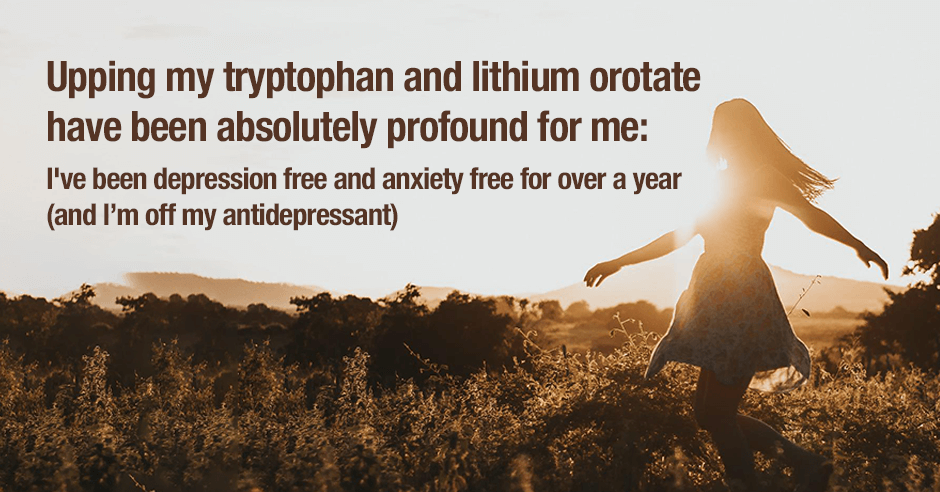
Upping my tryptophan and lithium orotate have been absolutely profound for me: I’ve been depression free and anxiety free for over a year

July 8, 2022 By Trudy Scott 66 Comments

tryptophan and lithium orotate

Upping my tryptophan dose and also including and upping the dose of lithium orotate has been absolutely profound for me.

I’m off my SSRI/antidepressant (which I was off and on for a number of years). I’ve been depression/anxiety free for over a year. So fantastic.

Everyone is bioindividual, of course, so please avoid using my dosing regime, but it wasn’t until I increased the lithium orotate to 20mg a day – 10mg in the AM and PM.

Life changing

Katrin shared this wonderful feedback on Facebook and I’m sharing this today in order to illustrate how much tryptophan dosing can vary, when you may need to up your dosage of tryptophan, how the addition of lithium orotate may be the missing link, and increasing it may help further and to offer hope (as always). And I share my insights and some additional information on lithium orotate.

Katrin was inspired by a post of mine where I discussed increasing tryptophan over and above 500mg twice a day and only taking it when needed). She shared this:

I was taking 3g tryptophan split up between the hours of 2pm and bedtime. 3 grams was what I increased to after floundering on 500mg afternoon and evening.  I don’t take it every day (as per your great suggestion of not taking an amino acid if you feel you don’t need to.) But if I’m having a stressful week etc and my serotonin tanks, I’ll start to take it again.

After the initial increase of lithium orotate, in conjunction with the tryptophan increase, that’s when I started to feel the real difference – the icing on the cake, so to speak (sugar-free, gluten free icing and cake, of course). Lithium orotate was the game changer.

She started with 5mg lithium orotate twice a day and then increased it to 10mg twice a day and has recently reduced this (more on this below).

Is there a role for lithium orotate in psychiatry?

If you’re new to lithium orotate, this editorial, Is there a role for lithium orotate in psychiatry?, is a useful introduction. Here are a few highlights:

  • The growing evidence from epidemiological studies mirror the cellular studies that suggest lithium is perhaps a crucial trace element necessary for optimum brain functioning. All these studies imply that adequate lithium intake may be neuroprotective. Conversely, inadequate lithium intake (especially in vulnerable individuals) may predispose and/or perpetuate a range of psychiatric and neurodegenerative conditions.
  • If further studies confirm this hypothesis, then a safe and effective lithium mineral supplement will be needed to correct this specific mineral deficiency. Advocates of lithium orotate argue that such a supplement already exists and that it is both safe and effective.
  • Lithium orotate has been used worldwide, mainly by non-medical health practitioners for over 30  years

Lithium orotate is used at low doses and the dosing is much lower and in a different form to prescription lithium (carbonate) that is prescribed for bipolar disorder. The above editorial explains some of the differences and standard daily dose:

To further illustrate the differences in the daily doses of elemental lithium between the orotate and carbonate forms, a single 120 mg tablet of lithium orotate contains about 5mg of elemental lithium. This is only 10% of the dose of elemental lithium that you would find in a single 250 mg tablet of lithium carbonate, which would have about 50 mg of elemental lithium.

There are no established (medical) guidelines for the daily dose of lithium orotate. However, the standard dose prescribed by alternative health practitioners is a single tablet of 120 mg of lithium orotate a day (which is equivalent to 5 mg of elemental lithium).

The authors conclude with this: “There have only been a few small trials done in humans, and they showed that lithium orotate was effective, safe and generally well tolerated.” Until we have more human trials we have to rely on what we see clinically.  And based on what I’ve seen and the feedback from colleagues, there is most definitely a role for lithium orotate in psychiatry.

Lithium orotate works when there are mood swings and anxiety ups and downs

I’ve used lithium orotate with many clients and use it when folks have mood swings and anxiety ups and downs. It’s harder for the amino acids to work when there is a moving goal post and lithium orotate evens things out. Katrin said she resonates with this and this may be why the lithium orotate works so well for her.

There are not many studies on lithium orotate, although it’s exciting that there has been an increase in the last few years. This small study done in 1994, Effects of nutritional lithium supplementation on mood, mentions the “mood-improving and stabilizing effect.”  They used a yeast based lithium supplement of 400 μg (which is just  0.4 mg) for former drug users of mostly heroin and crystal methamphetamine.

The above editorial states the following reported benefits of taking lithium orotate:

feeling calmer; experiencing fewer or less intense depressive, hypomanic or mixed affective symptoms; being less impulsive; experiencing less frequent and less intense suicidal thoughts or aggressive impulses; reduced consumption of alcohol and not getting as easily upset by stressors.

I also use a low lithium questionnaire with clients. A number of symptoms/signs other than mood swings  provide a clue that you may have low lithium levels and lithium orotate may need to be trialed.

My insights on Katrin’s approach to increasing her tryptophan and adding/increasing lithium orotate

Katrin increased the tryptophan to 3g and added lithium orotate at the same time. I recommend changing one thing at a time i.e. do a trial or tryptophan, then increase the tryptophan for better results (increasing slowly from 500mg 2 x day to 1000mg 2 x day and then 1500mg 2 x day, and tracking symptom improvements); then add lithium orotate; and then increase lithium orotate for even better results. But if it’s done the way Katrin did it, you simply unwind things so you can figure out what is really working for you.

Keep in mind, the starting dose for tryptophan is 500mg twice a day and lithium orotate is 5mg once a day. I would never recommend that anyone starts on 3g tryptophan or 20mg lithium orotate.

Experimenting with different doses and combinations

Katrin stayed at this dosing and combination of tryptophan and lithium orotate for close to a year. When something is working well, you understandably don’t want to change things. But more recently she has been experimenting with different doses and combinations. She is what is is doing now:

  • “currently trying lithium orotate by itself, during the day while only taking 1g tryptophan at night before bed.”
  • “now I only take a lithium orotate dose of 5mg twice a day and I do that every second day. It’s working for me.”

This is the perfect way to adjust things and if she finds the new combination doesn’t work over the coming weeks and months she can adjust again.

Also, keep in mind that your needs change as your hormones fluctuate, when you’re under more stress, with seasonal changes (winter time/winter blues and due to seasonal allergies), if you’re exposed to a toxin such as lead (it can impact serotonin levels) or parasites etc.

It goes without saying that diet must be addressed too – gluten-free, sugar-free, caffeine-free, real whole food, quality animal protein, organic vegetables and fruit, fermented foods and healthy fats.

Resources if you are new to using the amino acids as supplements

If you are new to using any of the amino acids as supplements, here is the Amino Acids Mood Questionnaire from The Antianxiety Food Solution (you can see all the symptoms of neurotransmitter imbalances).

If you suspect low levels of any of the neurotransmitters and do not yet have my book, The Antianxiety Food Solution – How the Foods You Eat Can Help You Calm Your Anxious Mind, Improve Your Mood, and End Cravings, I highly recommend getting it and reading it before jumping in and using amino acids on your own so you are knowledgeable. And be sure to share it with the practitioner/health team you or your loved one is working with.

There is an entire chapter on the amino acids and they are discussed throughout the book in the sections on gut health, gluten, blood sugar control, sugar cravings, self-medicating with alcohol and more. There is also an entire chapter on gluten and grains if this is new to you.

The book doesn’t include product names (per the publisher’s request) so this blog, The Antianxiety Food Solution Amino Acid and Pyroluria Supplements, lists the amino acids that I use with my individual clients and those in my group programs.

You can find the Lidtke Tryptophan products I use and a number of different lithium orotate products in my online Fullscript store.

If, after reading this blog and my book, you don’t feel comfortable figuring things out on your own (i.e. doing the symptoms questionnaire and respective amino acids trials), a good place to get help is the GABA QuickStart Program (if you have low GABA symptoms). This is a paid online/virtual group program where you get my guidance and community support. There are many moms in the program who are having much success with their kids.

If you need serotonin support, the Serotonin QuickStart Program is a good place to get help. This is also a paid online/virtual group program where you get my guidance on using tryptophan and 5-HTP safely, and community support during 5 LIVE Q&A calls. You can sign up to be notified when the next live launch of this program is happening.

If you are a practitioner, join us in The Balancing Neurotransmitters: the Fundamentals program. This is also a paid online/virtual program with an opportunity to interact with me and other practitioners who are also using the amino acids.

Wrapping up and your feedback

With much appreciation for Katrin for sharing her wonderful success story – I’m so thrilled for her! I’d love to get this published as case studies to further add to the evidence. If you are a researcher or have a resource for me please do let me know.

Did  you need to adjust your tryptophan dose for easing your anxiety, depression and other low serotonin symptoms? What adjustments did you make?

Have you found the addition of lithium orotate has helped keep things more even so the amino acids are more effective? What dosing works for you?

If you’re a practitioner, do you find the addition of lithium orotate to be helpful for your patients/clients?

If you have questions please share them here too.

Filed Under: Anxiety, Depression, Lithium orotate, serotonin, Tryptophan Tagged With: antidepressant, anxiety, Balancing Neurotransmitters: the Fundamentals program for practitioners, depression, dosing can vary, lithium carbonate, lithium orotate, mood swings, prescription lithium, psychiatry, serotonin, SSRI, stabilizing, tryptophan

SSRI/antidepressant impact on the microbiome, discontinuation syndrome and safe tapering

October 16, 2021 By Trudy Scott 2 Comments


Antidepressants can have an antibiotic effect, causing dysbiosis and impacting serotonin, GABA and dopamine production. This can cause psychiatric symptoms and even suicidal thoughts or behaviors. Various SSRI (selective serotonin reuptake inhibitors) and SNRI (serotonin norepinephrine reuptake inhibitors) have more of an effect than others. And the top known side effects for SSRIs are gut symptoms: nausea, diarrhea and vomiting.

These medications are seldom prescribed with informed consent and can cause severe psychological, cognitive, physical and neurological withdrawal side effects (also known as discontinuation syndrome). A functional medicine and nutritional approach using 5-HTP, GABA, theanine and glycine can often be used to smooth the taper process.

Dr. Achina Stein addresses all this in her interview, SSRI Impact on the Microbiome and Safe SSRI Tapering, on The Anxiety Summit 5: Gut-Brain Axis.

achina stein and trudy scott

We cover the following:

  • Antibiotic effect of antidepressants: dysbiosis and impacts on serotonin/GABA/dopamine
  • Withdrawal/discontinuation syndrome symptoms of SSRIs and benzodiazepines
  • 5-HTP, GABA, theanine and glycine to smooth the taper process

Here are a few snippets from our interview.

We start with a discussion on the antibiotic effect of antidepressants and a review of this paper – Serotonin Reuptake Inhibitors and the Gut Microbiome: Significance of the Gut Microbiome in Relation to Mechanism of Action, Treatment Response, Side Effects, and Tachyphylaxis.

Dr. Stein comments on this study sharing how SSRIs affect the gut and microbiome in many different ways:

  • “This paper is important. It’s one of several papers that talk about how the SSRIs or serotonin reuptake inhibitors affect the gastrointestinal tract. And as you know, the gastrointestinal tract is really full of serotonin.
  • SSRIs, as well as other psychotropic medications, actually exert an antibiotic effect, which can have a direct consequence in disrupting the integrity and stability of the gut microbiome.
  • And the ones that are most likely to do that are Sertraline, fluoxetine, and paroxetine in that order. And it’s followed by fluvoxamine, escitalopram, and citalopram, having the least impact.
  • What they’re noticing is that this antibiotic effect actually results in dysbiosis.
  • The top known side effects for SSRIs are gut symptoms: nausea, diarrhea, vomiting.
  • We know that the gut microbiome has a significant effect on emotions, behaviors, and metabolic changes.
  • And it’s involved in the metabolism of drugs, and this combination is what really causes psychiatric symptoms and even suicidal thoughts or behaviors.”

She also talks about the bidirectional gut-brain connection/communication, the microbiome and short-chain fatty acids (which are a common theme you’ll hear throughout the summit):

  • “There is this huge connection between the gut microbiome and the brain.
  • And there’s also other indirect communication pathways because we’ve always wondered, well, how does this happen that the gut is connected to the brain?
  • So the other pathways which are more indirect are the hypothalamic-pituitary-adrenal axis.
  • And there’s also an immune-mediated connection where there’s a communication between short-chain fatty acids and microglia in the brain.
  • So short-chain fatty acids are the main metabolites produced by the microbiota in the large intestine through bacterial fermentation of indigestible polysaccharides, which are dietary fiber and resistant starch. And they possess neuroactive properties. So they influence the communication between these short-chain fatty acids between the gut and the microglia of the brain.
  • And it’s a bidirectional communication too.”

And we talk about tachyphylaxis or the poop-out effect of antidepressants.

The discussion on the SSRI (selective serotonin reuptake inhibitors) and SNRI (serotonin norepinephrine reuptake inhibitors) discontinuation syndrome (or withdrawal symptoms) is eye-opening and sobering, Here are just a few of the many psychological symptoms that she says patients may experience when tapering:

I’m just going to read them off because I think it’s important for people to know: mood swings, unstable moods, hypomania, hyperarousal, anxiety, medication-induced agitation – which is described as being caffeinated – impulsive behavior, aggression, irritability, crying spells, lowered mood or depression.

Dr. Stein also shares the many cognitive, physical and neurological side effects, and how she works with her patients with a functional medicine and nutritional approach to try and mitigate the side effects. She likes to use 5-HTP, GABA, theanine and glycine to smooth the taper process.

We also have a lengthy discussion about informed consent and the fact that it’s not happening and should be.

We do a deep dive into all this and much more.

The interviews that dove-tail well with this topic are as follows:

  • My interviews, GABA & Tryptophan: Gut-Anxiety Connections and Glutamine, DPA and Tyrosine for Anxiety and Sugar Cravings. The amino acids help during the  tapering process and help you make the dietary changes.
  • Thiamine Deficiency in Anxiety and Gut Health (Part 1 and 2) with Chandler Marrs. She talks about how medications can deplete thiamine. Could this contribute to some of the severe discontinuation syndrome symptoms we see?
  • Anxiety, Gut-Brain Communication and Diet with David Perlmutter, MD, FACN, ABIHM. This one gives you an excellent overview of the gut-brain communication and fermented foods, short-chain fatty acids and histone deacetylases (HDACs).
  • Gut-Brain Axis and Mental Health with Peter Bongiorno, ND, LAc. This is also a great overview on the mental health impacts of the microbiome. He goes deep into serotonin and GABA production mechanisms.

I encourage you to tune in if you have:

  • Anxiety & feel overwhelmed & stressed by little things
  • Panic attacks &/or obsessive thoughts or behaviors
  • Social anxiety/pyroluria
  • Phobias or fears (flying, spiders or even driving on a highway)

And also if you suffer from…

  • Food sensitivities, IBS/SIBO, parasites or gallbladder issues
  • Constipation, diarrhea, bloating, gas, pain & other digestive issues
  • Leaky gut, a leaky blood-brain barrier or vagus nerve issues

Join us if you are also an emotional eater with intense sugar cravings (and know you suffer from low blood sugar), experience insomnia, low mood, PMS, poor focus and/or low motivation.

This is THE online event to learn about the powerful individual amino acids – GABA, theanine, tryptophan, 5-HTP, glutamine, DPA and tyrosine – to quickly ease anxiety and help with gut symptoms while you are dealing with other root causes which take longer to address. (They also help with cravings as with this example, and sleep and immunity).

With research-based anxiety nutritional solutions and practical steps, you can determine your root causes, ease your anxiety and prevent it from coming back so you can feel on top of the world again!

If you are a practitioner, please join us too and find advanced solutions for your clients or patients too!

You’ve heard me say the Anxiety Summit has been called “a bouquet of hope!”  My wish for you is that this summit is your bouquet of hope!

I hope you’ll join me and these incredible speakers, be enlightened and find YOUR solutions!

Here’s to no more anxiety and you feeling on top of the world again!

Learn more/purchase now


How have antidepressants impacted your gut and digestion?

Have you experienced discontinuation syndrome when tapering from an SSRI or SNRI or benzodiazepines? And have diet and the amino acids helped smooth the taper process?

Feel free to post your questions here too.

Filed Under: Antidepressants, Anxiety, Depression, The Anxiety Summit 5 Tagged With: 5-HTP, antibiotic, antidepressant, anxiety summit, cognitive, discontinuation syndrome, dopamine, Dr. Achina Stein, dysbiosis, functional medicine, GABA, glycine, gut-brain, informed consent, microbiome, neurological, nutritional, physical, psychiatric symptoms, psychological, safe tapering, serotonin, SNRI, SSRI, Suicidal, taper, theanine, withdrawal side effects

Night eating syndrome: is low serotonin a root cause and is tryptophan a solution?

April 9, 2021 By Trudy Scott 28 Comments

night eating syndrome

According to this paper, Circadian Rhythm Profiles in Women with Night Eating Syndrome, “Patients with night eating syndrome (NES) – first described in 1955 – demonstrate a phase delay in the circadian pattern of food intake, manifested by evening hyperphagia, nocturnal awakenings with food intake, and morning anorexia.”

I would start by asking this question: is low serotonin a root cause and is tryptophan a possible solution? I’ll share why below and where to start in order to find a solution.

Before I do that let me explain the terminology used in the above quote: Circadian means it happens every 24 hours, hyperphagia is obsessive food-seeking behavior, nocturnal awakenings are waking in the night and anorexia refers to restricted eating in the morning.

There is no research supporting the use of serotonin support with either tryptophan or 5-HTP for night eating syndrome but I would still start here for the following reasons:

  • this behavior happens in the evening and at night and it’s well recognized that serotonin levels are lower later in the day and at night
  • carbohydrate cravings and addictions occur with low serotonin and cravings are most intense later in the day (typically afternoon and evening)
  • obsessive behaviors are common with low serotonin
  • insomnia or night-time waking is a common symptom with low serotonin
  • doing a trial with either of these amino acids will very quickly confirm if low serotonin is a contributing factor or will rule it out

I would also have my client look at other low serotonin symptoms which would help confirm that low serotonin may be a factor for them: worry-type of anxiety, ruminations, PMS, irritability, rage or anger, TMJ, panic attacks, perfectionism, depression, low self-esteem and so on. You can see all the low serotonin symptoms here.

We typically start with a trial of tryptophan simply because so many of my clients do so well with it. The other reason is that 5-HTP can raise cortisol and cause a wired-tired feeling. That being said, some folks do better on one vs the other so if tryptophan doesn’t help then we trial 5-HTP.  You can see the products I use with my clients here on the supplements blog.

I would love to see tryptophan or 5-HTP being more extensively – because it works so effectively and quickly, and is addressing the root cause – but also because there is research that does support the serotonin connection to night eating syndrome:

  • Night eating syndome has been associated with “depression, emotional eating, sleep problems, and food addiction as well as with being overweight or with having obesity (especially as people age)” – all low serotonin symptoms.
  • Night eating patients are “responsive to selective serotonin reuptake inhibitor treatment” (antidepressant/SSRI treatment)
  • Bright light therapy may help with night eating because of it’s “serotonergic antidepressant mechanisms of action.” Night eating syndrome also shares features with seasonal affective disorder (SAD) and it’s not uncommon to experience both. The winter blues or SAD is common with low serotonin. I write more about SAD and bright light here.

I’d also consider low blood sugar as a contributing factor. We would need to rule out the use of the sleep medication Ambien/Zolpidem which has been shown to cause amnesia and sleep related eating disorders which resolves when the medication is stopped.

As always, it’s not only the low serotonin we need to address. Tryptophan or 5-HTP offer quick relief but we must always do a full functional workup looking at diet, nutritional deficiencies, digestion, all hormones, toxins and infections (and so on) so we can address all possible root causes – and why serotonin is low in the first place.

I share some possible reasons for low serotonin on this blog on imposter syndrome. Imposter syndrome is another common sign of low serotonin.

Have you been diagnosed with night eating syndrome or do you feel you possibly fit the profile? Does it happen every night and what foods are you drawn to? Which low serotonin symptoms can you relate to and has tryptophan or 5-HTP helped? What about light therapy? And was an  antidepressant prescribed?

Feel free to post your questions and feedback in the comments below.

Filed Under: 5-HTP, Anxiety, Insomnia, Tryptophan Tagged With: 5-HTP, Ambien, anxiety, blood sugar, circadian, food intake, hyperphagia, insomnia, morning anorexia, NES, night eating, Night eating syndrome, nocturnal awakenings, obsessive, panic, SAD, serotonin, SSRI, tryptophan, waking, worry

GABA for easing physical anxiety and tension: some questions and answers

April 2, 2021 By Trudy Scott 79 Comments

gaba q and a

GABA is an amino acid used as a supplement to ease low GABA levels. With low GABA you’ll experience physical-tension and stiff-and-tense-muscles type of anxiety, panic attacks and insomnia. You may feel the need to self-medicate to calm down, often with alcohol but sometimes with carbs and sugary foods. GABA also helps with muscle spasms and provides pain relief when muscles are tight.

When I share my GABA blogs on Facebook I receive so many great questions (some basic questions and some more complex). Today I’m going to share some of these and my answers so you can get the benefits too.

Let’s start with the basic questions about using GABA.

Amanda asks:

What time of the day is best to take GABA?

The best time is 1 to 4 x a day, depending on your symptoms, between meals and always away from protein so it doesn’t compete for absorption with the other amino acids.

Brian asks:

What dose do you recommend starting at?

I have clients start with 125mg and go up from there based on how they respond i.e. are they getting symptom resolution.

Based on the above 2 questions it’s clear that Amanda and Brian are new to using the amino acid GABA. If you are new to using GAB and the other amino acids (and other anxiety nutrition solutions like gluten/sugar/caffeine removal, blood sugar control, gut health, pyroluria etc.) my book “The Antianxiety Food Solution” is a great place to start.

I don’t cover specific brands in my book because brand formulations change and come and go so this is a great question from Olivia who asks:

Which brand would you recommend? thank you

My favorite is Source Naturals GABA Calm but since it’s been in short supply during the pandemic I list many other GABA options here. I’ve updated the main supplements blog with these additional GABA options too.

Now for some of the more advanced questions:

Salome asks:

I’m super sensitive to supplements (Histamine Intolerance / MCAS / Multiple chemical sensitivity). Are there any potential reactions from taking GABA that you know of?

As far as I know there are none (clinically or in the research) but, as always, the best is to do a trial. For clients who are very sensitive we start super low and may use 1/8 to 1/4 of the starting dose of 125mg GABA, and increase from there if there are no adverse effects.

Dena asks:

Does GABA help the same way Xanax does? I only take 0.5mg Xanax a few times a week when I really need it but if GABA works I’d like to try it but worry it won’t help like Xanax does. It calms me down and makes me feel normal

Many of my clients report back that GABA works just like Xanax used to work for them. But do keep in mind it’s important to work with your prescribing doctor and that the benzodiazepine taper should be very very slow. And it’s important to be aware that for some folks tapering can be very challenging (more on that here).

Boyd asks:

In New Zealand GABA is classed as a prohibited Class B drug so what can be used as an alternative for anxiety?

Taurine or theanine are good options if GABA is not available and mail order is not an option. Glutamine can be calming for some folks who are able to convert some of it to GABA. For others it can be too stimulating if it converts to glutamate. Addressing gut health and using precursors like magnesium, zinc and vitamin B6 are also key but this takes longer to see results.

Debbie asks:

Can u take GABA if taking a very low dose SSRI (sertraline). I’ve had to start it because I couldn’t find a GABA product when I needed it.

GABA is safe to take with an SSRI (antidepressant) but this should always be discussed with the prescribing doctor.  Also, keep in mind that Sertraline works on serotonin so GABA may not be the best solution and  tryptophan or 5-HTP may be. Looking at the low GABA and low serotonin symptoms and doing a trial is the best way to figure this out.

Cornina asks:

What could be used instead of Ativan for travel anxiety?

I would trial GABA if the anxiety is more physical with neck tension and butterflies in the stomach or tummy pain. I would trial tryptophan or 5-HTP if it’s mental like imagining-the- worst or if you have a phobia about flying or you are worrying and obsessing. Ideally you would want to build up levels before travelling and also use the amino acids as needed while traveling. Keep in mind that both GABA and serotonin support may be needed.

Kelly asks:

Is 4,000 mg of Now GABA too much for a person to take a day. This person is 86 years old.

This dose of 4,000mg GABA is high so I’d want to know if she is seeing benefits (and what benefits) and having any adverse reactions. I’d also want to know what product and how it’s being used (swallowed or opened on to the tongue).

I asked the above and Kelly shared this additional information:

Yes, it lessens the anxiety but also makes her very sleepy. She doesn’t take that many mg every day. She just swallows it.

When the GABA capsules are opened less can be used. Also, taking it at night helps improve sleep and avoids the sleepiness in the day and the anxiety-relief benefits often carry over to the next day too. We commonly experiment with different timings and dosing to find what works best for the client as there is no one-size fits all.

Rhonda asks:

Which would be best for a truck driver that drives all night – GABA or 5-HTP?

For someone who drives all night and wants to sleep in the day I would want to know why he or she can’t sleep (assuming it’s related to disrupted circadian rhythm). If it’s physical tension then I’d trial GABA, and if it’s worry and over-thinking then I’d trial 5-HTP or tryptophan for serotonin support. Often a combination is helpful, Research shows the sleep promoting effects of combined GABA and 5-HTP for some folks.

We appreciate these folks for asking questions and allowing me to share here on the blog.

As always, it’s not only the low GABA we need to address. GABA offers quick relief but we must always do a full functional workup looking at diet, nutritional deficiencies, digestion, all hormones, toxins and infections (and so on) so we can address all possible root causes.

Have these GABA questions and answers been helpful? Have you seen benefits from using GABA and do you have questions?

Feel free to post your questions and feedback in the comments below.

And join us on Facebook – TrudyScottAntianxietyFoodSolution – to read and ask questions there too.

Filed Under: Anxiety, GABA Tagged With: 5-HTP, anxiety, benzodiazepine, dosing, GABA, histamine, insomnia, MCAS, physical anxiety, serotonin, SSRI, tension, travel anxiety, truck driver, tryptophan

ADHD: 5-HTP melts have been a miracle for one of my adopted kids

January 15, 2021 By Trudy Scott 77 Comments

ADHD and 5-HTP

A mom in my community responded to an ADHD blog sharing how 5-HTP melts have been a miracle for one of her adopted children – after one week! 5-HTP is not where I typically start with ADHD so I quizzed her to get more details and then went looking for the research to understand the mechanisms. This blog shares her rationale for using 5-HTP, the truly wonderful results her son experienced, some of the research and some possible serotonin/dopamine mechanisms. This is what she posted:

5-HTP melts have been a miracle for one of my adopted kids. He had lots of trauma and off the charts ADHD. 5-HTP is better than methylphenidate (Ritalin) and we are now weaning off the non-stimulants.

Just 80mg 5-HTP in the morning is all he needs. He was super ADHD, he had a para (teacher’s aide) in public school for years to keep him on track and this year at a school for ADHD the teachers were complaining that he was never on task.

Now after a week it has changed his life. I am so thankful for the anxiety summit. Thank you Trudy

This is truly wonderful to hear! I responded saying how thrilled I was to hear the impact it was having and asked why this mom decided to try 5-HTP? This amino acid, which is a serotonin precursor, is not typically my first choice for alleviating ADHD symptoms. I consider low GABA (and using GABA) or low catecholamines (and using tyrosine), together with dietary changes, blood sugar control, and assessing for low zinc, low iron and low omega-3s – as a starting point.

I wanted to know if he had low serotonin symptoms such as the worry, ruminating, and obsessive type of anxiety which could have possibly been driving the ADHD symptoms? Were there any other symptoms that were a clue that low serotonin may be a factor: insomnia (with fatigue the next day impacting focus) or sugar cravings in the afternoon/evening (causing blood sugar swings affecting focus and mood)?

Why she used 5-HTP and which low serotonin symptoms he had

This was her response about why she used 5-HTP and which low serotonin symptoms he had:

We have tried all the amino acids over the years. I tried 5-HTP this time because SSRIs were the only class of medication he has not tried. I thought maybe it was worth a try and I also found this study: Comparative study of efficacy of 1-5-hydroxytryptophan and fluoxetine in patients presenting with first depressive episode (where the therapeutic efficacy of 5-HTP was considered as equal to that of the SSRI fluoxetine).

As for cravings or insomnia: he is a kid who loves sugar so I’m not sure if it’s a craving or typical. He takes 0.3mg of melatonin each night because guanfacine, the non-stimulant, prevents the production of melatonin.

She also mentioned that she has followed me for years and that DPA, an endorphin-boosting amino acid, works for her. She is a dietitian and shares my handouts and blog posts with her clients, so she clearly felt comfortable experimenting with the amino acids with her son.

5-HTP products and dosing

I also asked which product they were using and how she landed at 80mg. She wanted a fast-acting supplement that would dissolve in his mouth and purchased Natrol 5-HTP:

They are 100mg but we are breaking off a little because he was falling asleep in class.

I reminded her that 5-HTP (or tryptophan) is typically best used late afternoon and evening so if someone is falling asleep in the day I’d switch to bedtime dosing.  If he needs it during the day for the ADHD symptoms then reducing the dose is the smart thing to do.

I love the sublingual/melt aspect of this product for quick results and because children do so well with a product that tastes pleasant.

However, I do not recommend this particular product because of very mixed ingredients information online. I have not seen the bottle of the actual product used but some of the online information states the product is gluten-free and soy-free and yet other information states it does contains gluten and soy. In some places they state it contains sucralose and an artificial flavor and in other places you see xylitol and natural flavor. This is all rather concerning. I’ll update this section as soon as I can confirm.

What does this mean for this mom? Now that she has figured out that 5-HTP helps her son, it’s best to find a better quality product so as not to cause other problems.

There are two chewable products in my online supplement store that come close to this product:

  • Serotrex Chewable: Two chewables contain 200mg theanine and 60mg 5-HTP. This could be used in the day or at night.
  • Designs for Health Insomnitol Chewables: Two chewables contain 10mg vitamin B6, 500mg inositol, 200mg theanine, 100mg 5-HTP and 3mg melatonin. This would need to be used at night instead.

Both of these contain theanine. Research shows that theanine reduces anxiety and improves cognition via “improvements in verbal fluency (especially letter fluency) and improvements in executive function (planning, multi-tasking etc).”

The research on 5-HTP and tryptophan for ADHD

This paper, The effects of 5-hydroxytryptophan on attention and central serotonin neurochemistry in the rhesus macaque, shares that

Individuals with depression and anxiety typically experience impaired executive function and emotional cognition, symptoms that are generally studied by examining disruptions in attention.

This study used 5-HTP as an intramuscular injection, rather than using it orally but the authors did report the following:

Our findings provide unique causal and mechanistic evidence suggesting that enhancing central serotonergic function results in categorically distinct changes in fundamental cognitive operations such as attention.

This paper, Does serotonin deficit mediate susceptibility to ADHD? summarizes the role of serotonin in ADHD, the interplay with dopamine and the use of oral tryptophan (a serotonin precursor similar to 5-HTP):

  • A chronic deficit of serotonin at the synapse may trigger symptoms of childhood ADHD (developmentally inappropriate levels of hyperactivity, impulsivity and inattention).
  • Studies from animal models of ADHD indicate intimate interplay between serotonin and dopaminergic neurotransmission.
  • Selective serotonin re-uptake inhibitors (SSRIs)…as non-stimulant drugs acting on the serotonin system are … clinically effective.
  • Oral administration of l-tryptophan, the amino acid precursor of serotonin, significantly alleviates ADHD symptoms.
  • Serotoninergic gene variants are associated with increased risk of ADHD.

I appreciate this mom for giving me permission to share here on the blog so we can inspire hope (and I wish for more and more improvements for this young boy):

My son is a 10-year old RAD (reactive attachment disorder) kid that was meth exposed and adopted at 3 years old. 5-HTP has worked so well. He has not thrown a fit in a month. Before fits were a daily occurrence. This might give hope to other parents.

Additional resources when you are new to using GABA, 5-HTP and other amino acids as supplements

As always, I use the symptoms questionnaire to figure out if low serotonin or low GABA or other neurotransmitter imbalances may be an issue.

If you suspect low levels of any of the neurotransmitters and do not yet have my book, The Antianxiety Food Solution – How the Foods You Eat Can Help You Calm Your Anxious Mind, Improve Your Mood, and End Cravings, I highly recommend getting it and reading it before jumping in and using amino acids on your own so you are knowledgeable. And be sure to share it with the practitioner/health team you or your loved one is working with.

There is an entire chapter on the amino acids and they are discussed throughout the book in the sections on gut health, gluten, blood sugar control (this is covered in an entire chapter too), sugar cravings, anxiety and mood issues.

The book doesn’t include product names (per the publisher’s request) so this blog, The Antianxiety Food Solution Amino Acid and Pyroluria Supplements, lists the amino acids that I use with my individual clients and those in my group programs.

If, after reading this blog and my book, you don’t feel comfortable figuring things out on your own (i.e. doing the symptoms questionnaire and respective amino acids trials), a good place to get help is the GABA QuickStart Program (if you have low GABA symptoms). This is a paid online/virtual group program where you get my guidance and community support.

If you are a practitioner, join us in The Balancing Neurotransmitters: the Fundamentals program. This is also a paid online/virtual program with an opportunity to interact with me and other practitioners who are also using the amino acids.

Wrapping up and your feedback

Have you found that 5-HTP (or tryptophan) helps/helped you or your child with ADHD symptoms? If yes, do you feel the ADHD was caused in part because of anxiety and/or fear and/or feeling inadequate and/or perfectionism and/or poor sleep (all signs of low serotonin)? Or were the main symptoms poor focus, low energy, low motivation and depression caused by low catecholamines/low dopamine? Or a mixture of both?

If you’re a practitioner working with children or adults with ADHD, have you had good results with 5-HTP or tryptophan?

Please do share in the comments below.

Filed Under: ADHD, Anxiety, Children/Teens Tagged With: 5-HTP, ADHD, attention, cravings, dopamine, fits, focus, GABA, hyperactivity, impulsivity, inattention, insomnia, meth, RAD, reactive attachment disorder, Ritalin, serotonin, SSRI, sugar, tryptophan, tyrosine

  • Page 1
  • Page 2
  • Page 3
  • Go to Next Page »

Primary Sidebar

NEW! GABA QuickStart Homestudy (with special intro pricing)

gaba quickstart homestudy

Free Report

9 Great Questions Women Ask about Food, Mood and their Health

You'll also receive a complimentary subscription to my ezine "Food, Mood and Gal Stuff"


Connect with me

Popular Posts

  • Amino Acids Mood Questionnaire from The Antianxiety Food Solution
  • The Antianxiety Food Solution Amino Acid and Pyroluria Supplements
  • Pyroluria Questionnaire from The Antianxiety Food Solution
  • Collagen and gelatin lower serotonin: does this increase your anxiety and depression?
  • Tryptophan for the worry-in-your-head and ruminating type of anxiety
  • GABA for the physical-tension and stiff-and-tense-muscles type of anxiety
  • The Antianxiety Food Solution by Trudy Scott
  • Seriphos Original Formula is back: the best product for anxiety and insomnia caused by high cortisol
  • Am I an anxious introvert because of low zinc and vitamin B6? My response to Huffington Post blog
  • Vagus nerve rehab with GABA, breathing, humming, gargling and key nutrients

Recent Posts

  • What do I use instead of Seriphos to help lower high cortisol that is affecting my sleep and making me anxious at night?
  • BeSerene™ GABA/theanine cream eases severe muscle tension in her neck/shoulders, prevents her bad headaches and quells her anxiety
  • How the correct approach, dose and sublingual use of GABA can be calming and not cause a flushed and itchy face and neck
  • The amino acid glutamine improves low mood by addressing gut health, and it has calming effects too
  • Flight anxiety with heightened breath, physical tension and also fearing the worst (the role of low GABA and low serotonin)

Categories

  • 5-HTP
  • AB575
  • Addiction
  • ADHD
  • Adrenals
  • Alcohol
  • Allergies
  • Alzheimer's disease
  • Amino Acids
  • Anger
  • Antianxiety
  • Antianxiety Food Solution
  • Antidepressants
  • Anxiety
  • Anxiety and panic
  • Autism
  • Autoimmunity
  • benzodiazapines
  • Bipolar disorder
  • Books
  • Caffeine
  • Cancer
  • Candida
  • Children/Teens
  • Collagen
  • Cooking equipment
  • Coronavirus/COVID-19
  • Cravings
  • Depression
  • Detoxification
  • Diabetes
  • Diet
  • DPA/DLPA
  • Drugs
  • EFT/Tapping
  • EMF
  • EMFs
  • Emotional Eating
  • Endorphins
  • Environment
  • Essential oils
  • Events
  • Exercise
  • Fear
  • Fear of public speaking
  • Fertility and Pregnancy
  • Fish
  • Food
  • Food and mood
  • Functional neurology
  • GABA
  • Gene polymorphisms
  • General Health
  • Giving
  • Giving back
  • Glutamine
  • Gluten
  • GMOs
  • Gratitude
  • Gut health
  • Heart health/hypertension
  • Histamine
  • Hormone
  • Hyperparathyroidism
  • Hypoglycemia
  • Immune system
  • Inflammation
  • Insomnia
  • Inspiration
  • Introversion
  • Joy and happiness
  • Ketogenic diet
  • Lithium orotate
  • Looking awesome
  • Lyme disease and co-infections
  • MCAS/histamine
  • Medication
  • Men's health
  • Mental health
  • Mercury
  • Migraine
  • Mold
  • Movie
  • MTHFR
  • Multiple sclerosis
  • Music
  • NANP
  • Nature
  • Nutritional Psychiatry
  • OCD
  • Osteoporosis
  • Oxalates
  • Oxytocin
  • Pain
  • Paleo
  • Parasites
  • Parkinson’s disease
  • PCOS
  • People
  • PMS
  • Postpartum
  • PTSD/Trauma
  • Pyroluria
  • Questionnaires
  • Real whole food
  • Recipes
  • Research
  • Schizophrenia
  • serotonin
  • SIBO
  • Sleep
  • Special diets
  • Sports nutrition
  • Stress
  • Sugar addiction
  • Sugar and mood
  • Supplements
  • Teens
  • Testimonials
  • Testing
  • The Anxiety Summit
  • The Anxiety Summit 2
  • The Anxiety Summit 3
  • The Anxiety Summit 4
  • The Anxiety Summit 5
  • The Anxiety Summit 6
  • Thyroid
  • Thyroid health
  • Toxins
  • Tryptophan
  • Tyrosine
  • Uncategorized
  • Vegan/vegetarian
  • Women's health
  • Yoga

Archives

  • October 2025
  • September 2025
  • August 2025
  • July 2025
  • June 2025
  • May 2025
  • April 2025
  • March 2025
  • February 2025
  • January 2025
  • November 2024
  • October 2024
  • September 2024
  • August 2024
  • July 2024
  • June 2024
  • May 2024
  • April 2024
  • March 2024
  • February 2024
  • January 2024
  • December 2023
  • November 2023
  • October 2023
  • September 2023
  • August 2023
  • July 2023
  • June 2023
  • May 2023
  • April 2023
  • March 2023
  • February 2023
  • January 2023
  • December 2022
  • November 2022
  • October 2022
  • September 2022
  • August 2022
  • July 2022
  • June 2022
  • May 2022
  • April 2022
  • March 2022
  • February 2022
  • January 2022
  • December 2021
  • November 2021
  • October 2021
  • September 2021
  • August 2021
  • July 2021
  • June 2021
  • May 2021
  • April 2021
  • March 2021
  • February 2021
  • January 2021
  • December 2020
  • November 2020
  • October 2020
  • September 2020
  • August 2020
  • July 2020
  • June 2020
  • May 2020
  • April 2020
  • March 2020
  • February 2020
  • January 2020
  • December 2019
  • November 2019
  • October 2019
  • September 2019
  • August 2019
  • July 2019
  • June 2019
  • May 2019
  • April 2019
  • March 2019
  • February 2019
  • January 2019
  • December 2018
  • November 2018
  • October 2018
  • September 2018
  • August 2018
  • July 2018
  • June 2018
  • May 2018
  • April 2018
  • March 2018
  • February 2018
  • January 2018
  • December 2017
  • November 2017
  • October 2017
  • September 2017
  • August 2017
  • July 2017
  • June 2017
  • May 2017
  • April 2017
  • March 2017
  • February 2017
  • January 2017
  • December 2016
  • November 2016
  • October 2016
  • September 2016
  • August 2016
  • July 2016
  • June 2016
  • May 2016
  • April 2016
  • March 2016
  • February 2016
  • January 2016
  • December 2015
  • November 2015
  • October 2015
  • September 2015
  • August 2015
  • July 2015
  • June 2015
  • May 2015
  • April 2015
  • March 2015
  • February 2015
  • January 2015
  • December 2014
  • November 2014
  • October 2014
  • September 2014
  • August 2014
  • July 2014
  • June 2014
  • May 2014
  • April 2014
  • March 2014
  • February 2014
  • January 2014
  • December 2013
  • November 2013
  • October 2013
  • September 2013
  • August 2013
  • July 2013
  • June 2013
  • May 2013
  • April 2013
  • March 2013
  • February 2013
  • January 2013
  • December 2012
  • November 2012
  • October 2012
  • August 2012
  • July 2012
  • June 2012
  • May 2012
  • April 2012
  • March 2012
  • February 2012
  • January 2012
  • December 2011
  • November 2011
  • October 2011
  • September 2011
  • August 2011
  • July 2011
  • June 2011
  • May 2011
  • April 2011
  • March 2011
  • February 2011
  • January 2011
  • December 2010
  • October 2010
  • September 2010
  • July 2010
  • May 2010
  • April 2010
  • March 2010
  • February 2010
  • January 2010
  • November 2009

Share the knowledge!

The above statements have not been evaluated by the Food and Drug Administration. Products listed in this website are not intended to diagnose, treat, cure or prevent any disease.

The information provided on this site is for informational and educational purposes only and is not intended as a substitute for advice from your physician or other health care professional. You should consult with a healthcare professional before starting or modifying any diet, exercise, or supplementation program, before taking or stopping any medication, or if you have or suspect you may have a health problem.


Copyright © 2026 Trudy Scott. All Rights Reserved. | Privacy | Terms and Conditions | Refund Policy | Medical Disclaimer

Free Report

9 Great Questions Women Ask about Food, Mood and their Health

You’ll also receive a complimentary subscription to my ezine “Food, Mood and Gal Stuff”