• Skip to primary navigation
  • Skip to main content
  • Skip to primary sidebar

everywomanover29 blog

Food, Mood and Women's Health – Be your healthiest, look and feel great!

  • Blog
  • About
  • Services
  • Store
  • Resources
  • Testimonials
  • The Book
  • Contact
  • Search this site

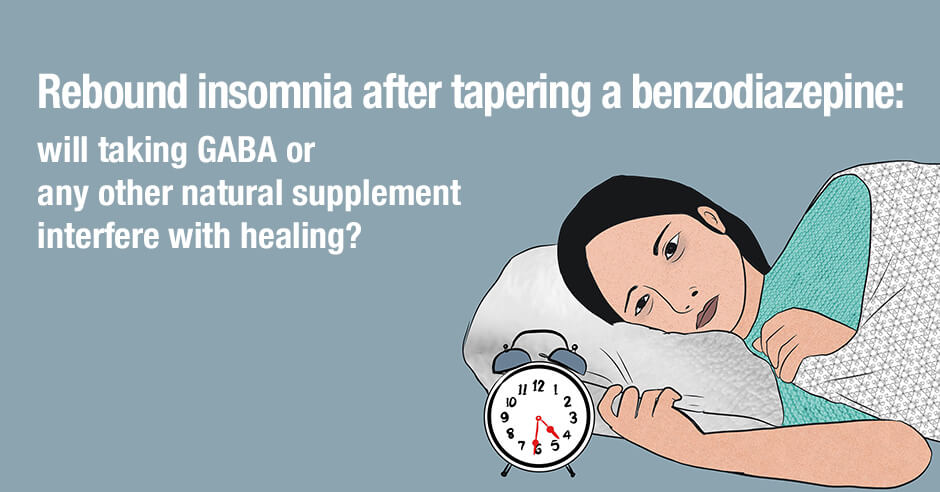
Rebound insomnia after tapering a benzodiazepine: will taking GABA or any other natural supplement interfere with healing?

August 26, 2022 By Trudy Scott 16 Comments

rebound insomnia after tapering

This question was posted on one of the GABA blog posts by Fran, asking about about using GABA for insomnia shortly after having tapered a benzodiazepine she had used for 15 years:

I am a senior who took benzodiazepines (clonazepam) on advice of my doctor for sleep because of chronic fatigue for 15 years. Last year I weaned myself off the medication and it has been just over 10 months. No one tells you that when you stop taking them you go into a rebound insomnia phase and it can last a long time. The doctor still won’t admit that!

I joined benzo buddies, a group I found out about on your site and found much encouragement from the posts of many brave and determined people. One post mentioned that the drug actually overrides your GABA receptors so when you stop taking it they have to heal to become active again. My question is: Will taking GABA or any other natural supplement interfere with that healing. The writer of the post feels taking nothing is best for the brain to return to normal and that only time will do that.

I said I was sorry to hear about her struggles with her benzodiazepine prescription. Sadly it’s all too common and it’s seldom that folks are cautioned about the rebound insomnia and other issues seen with benzodiazepines.

I love benzo buddies and other benzo support groups and often recommend that clients join one of these groups for the community support aspect. I am really happy that Fran found encouragement.

However, I  respectfully disagree with their message that GABA supplements or other supplements should not be used and that you should just wait for time to heal. We want to use everything at our disposal in order to heal as quickly as possible. And quality sleep is imperative for healing.

Also many of the most severely affected folks are part of these support groups, so it may well be all that they know, hence the advice they dispense.

Many do get relief with GABA during and post benzo taper and it won’t affect long-term healing (with a very low dose)

It is true that GABA receptors can be affected by benzodiazepines but despite this, many of my clients and others in my community do get relief from GABA during this period. Since we are all unique, some folks may have an issue, so we always do a trial with GABA if someone has rebound insomnia (and other low GABA symptoms of physical tension/anxiety, stiff and tense muscles, stress eating etc).

When someone can’t tolerate GABA they will know very quickly – typically in 1-2 days. If you can’t tolerate GABA it may feel the same as someone who takes GABA and doesn’t need it (i.e. GABA isn’t low) or when someone takes too much. This could make you feel light-headed, dizzy, feel a flush and/or feel too tired. You may even feel more anxious. Vitamin C is a wonderful antidote to all this and these short-term adverse reactions won’t interfere with long-term healing.

We also start with a very small dose – I typically have someone start with 25mg GABA and go up from there – and only use sublingual GABA. For some very sensitive folks we will start even lower as in this example where Syd gets sleep and body anxiety benefits with just 1.5 mg to 3 mg GABA.

Other nutrients that may also help with insomnia

We may also use other nutrients to help with sleep support and rebound anxiety (which is also common) and other symptoms, all based on each person’s unique needs. These may include tryptophan or 5-HTP if serotonin is also low (this can affect sleep and cause worry/ruminating type anxiety), melatonin if that is low (either sublingual or timed-release) and Seriphos if cortisol is high too. We may also combine GABA with theanine (research shows the combination may help some folks).

A full functional medicine and nutritional workup is recommended in order to be as nutritionally stable as possible. Ideally this happens before tapering starts but even if it’s done after the fact it can help with healing and symptom relief. Addressing histamine imbalances is one factor to consider as this can impact sleep (more on that below).

This is an important question that many folks ask so I appreciate her asking so I could share it as a blog post for others in a similar situation.

I am waiting to hear back about what happened when she did use GABA and how much she used. She mentioned that she did take GABA for a time at first but it only worked for a while. I find that during the taper and post taper, GABA needs can fluctuate as healing starts to take place. I have clients adjust up and down as needed.

More on benzodiazepine withdrawal and histamine issues

These medications have the most debilitating withdrawal reactions in all of medicine and Valium blocks DAO/impacts histamine levels:

  • World Benzodiazepine Awareness Day 2017: Awareness and Anxiety Nutrition Solutions

Benzodiazepines (Xanax, Klonopin, Ativan, Valium, Librium, and others) as well as Z-drugs (Ambien, Lunesta and others), which are similar, have the most debilitating withdrawal reactions in all of medicine.

This happens in regular, everyday people who are taking the medications exactly as their doctor prescribed. It also happens to people on what they think are “low doses” and is not just a “high dose” problem.

  • The benzodiazepine valium blocks DAO and impacts histamine levels: wisdom from Yasmina Ykelenstam and a tribute to her brilliance

Many people doing a benzodiazepine taper are often switched to Valium which is a DAO [diamine oxidase blocker (or histamine liberator)] and this further prevents histamine from being removed from the body [and can lead to increased anxiety].

Dyes are also triggers…the pink Xanax can be problematic.

GABA is as effective as benzodiazepines (which should only be prescribed for short-term use)

Many folks who have used benzos in the past, find GABA to be as effective. Another woman in my community, Dee, shared that she had taken Xanax in the past for panic attacks and her functional medicine doctor suggested GABA Calm as she wanted a natural product. This is her encouraging feedback: “I was amazed how it works just like the Xanax did – instant calm feeling within 10 mins of taking 2 capsules. I use them as needed when I am having heightened stress and anxiety.”

Ideally we want to use GABA instead of one of the benzodiazepines – which are all too commonly prescribed for anxiety, insomnia and pain – in order to avoid tolerance issues, dependence and withdrawal/tapering issues. The fact that they are used long term – like 15 years for Fran – further compounds the issues. Even a few months can be problematic for some folks. It’s important to be aware that this class of medication is intended for short-term use  i.e. 2-4 weeks only.

Resources if you are new to using the GABA and other amino acids as supplements

If you are new to using GABA and any of other the amino acids as supplements, here is the Amino Acids Mood Questionnaire from The Antianxiety Food Solution (you can see all the symptoms of neurotransmitter imbalances, including low GABA).

If you suspect low levels of any of the neurotransmitters and do not yet have my book, The Antianxiety Food Solution – How the Foods You Eat Can Help You Calm Your Anxious Mind, Improve Your Mood, and End Cravings, I highly recommend getting it and reading it before jumping in and using amino acids on your own so you are knowledgeable. And be sure to share it with the practitioner/health team you or your loved one is working with.

There is an entire chapter on the amino acids and they are discussed throughout the book in the sections on gut health, gluten, blood sugar control, sugar cravings, self-medicating with alcohol and more.

The book doesn’t include product names (per the publisher’s request) so this blog, The Antianxiety Food Solution Amino Acid and Pyroluria Supplements, lists the amino acids that I use with my individual clients and those in my group programs. You can find them all in my online store.

If, after reading this blog and my book, you don’t feel comfortable figuring things out on your own (i.e. doing the symptoms questionnaire and respective amino acids trials), a good place to get help is the GABA QuickStart Program (if you have low GABA symptoms). This is a paid online/virtual group program where you get my guidance and community support.

If you are a practitioner, join us in The Balancing Neurotransmitters: the Fundamentals program. This is also a paid online/virtual program with an opportunity to interact with me and other practitioners who are also using the amino acids.

Have you used GABA with success while tapering a benzodiazepine or shortly after tapering is complete?

Have you used other nutrients to help while tapering or post taper? If yes, which ones?

Did you find that GABA was not helpful? (which product and how much did you use?)

If you have questions please share them here too.
Filed Under: Anxiety, benzodiazapines, GABA, Insomnia Tagged With: 5-HTP, amino acids, Balancing Neurotransmitters: the Fundamentals program for practitioners, benzo buddies, benzodiazepine, clonazepam, DAO enzyme, GABA, GABA Quickstart program, GABA receptors, healing, histamine, insomnia, medication, melatonin, natural supplement, Rebound insomnia, seriphos, sleep, tapering, theanine, tryptophan, Xanax

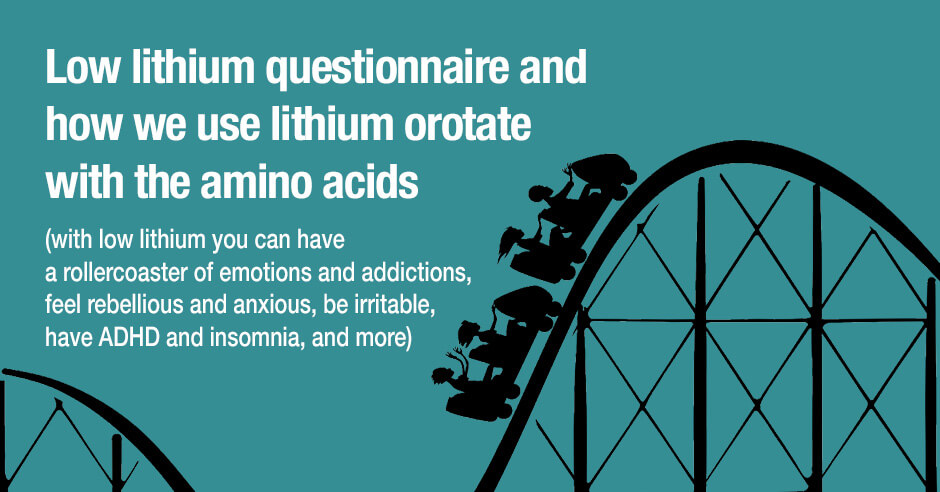
Low lithium questionnaire and how we use lithium orotate with the amino acids

August 19, 2022 By Trudy Scott 44 Comments

low lithium questionnaire

This is the low lithium questionnaire that I use with new clients in order for us to figure out if a trial of low dose lithium, in the form of lithium orotate, may be helpful. The hallmark of low lithium is a rollercoaster of emotions. Keep in mind that this is just one of 12 questionnaires that I have my clients complete. Many of the following symptoms can have multiple causes, the labs may relate to other deficiencies and the conditions have other root causes. This questionnaire simply provides additional evidence that lithium orotate may help.

We typically do a lithium orotate trial, starting with 5 mg once a day, and going up to 10 mg twice a day. We do this after we have started trialing the respective amino acids for low serotonin, low GABA, low endorphins, low catecholamines and low blood sugar. A big clue that lithium orotate may be helpful (when many of the symptoms below are checked off) is when the amino acids for low serotonin (tryptophan or 5-HTP), low GABA (GABA or theanine), low endorphins (DPA or DLPA), low catecholamines (tyrosine or DLPA) and low blood sugar (glutamine) are not as effective as expected (based on the amino acids mood/neurotransmitter questionnaire).

Low lithium questionnaire

Symptoms
Mood swings (a rollercoaster of emotions)
Addictions and/or cravings
Depressed
Low self-esteem
Boredom
Easily distracted
Rebellious, disruptive behavior and/or aggressiveness
Irritability
Restless/internal anxiety (similar to low serotonin worry/ruminating anxiety)
Restless/external anxiety (similar to low GABA physical anxiety)
Anxiety ups and downs (fluctuations)
Melancholic pessimism
Suicidal thoughts
Disorganized with planning difficulties
Focus issues/ADHD
Insomnia
Procrastination and/or no initiative
Jack of all trades, master of none
Impulsive and/or lacking tact
Poor insight
Risky behavior
Cognitive issues
Migraines or cluster headaches

Effectiveness of amino acids
The amino acids for low serotonin, low GABA, low endorphins, low catecholamines and low blood sugar are not as effective as expected (based on the amino acids mood/neurotransmitter questionnaire)

Labs
Low white blood cell count
Low red blood cell count
Anemia
Low platelet count

Conditions
Anorexia nervosa
Heart disease (heart arrhythmias, history of heart attack)
Raised blood sugar or diabetes
Kleptomania
Alcoholism
Alzheimer’s disease
Fibromyalgia
Bipolar II
Gout
Hyperthyroidism
Nearsightedness or glaucoma
Herpes infections (current or prone to them)

If you are new to low dose lithium / lithium orotate

As I share in this blog, Upping my tryptophan and lithium orotate have been absolutely profound for me: I’ve been depression free and anxiety free for over a year, I’ve used lithium orotate with many clients and use it when folks have mood swings and anxiety ups and downs. It’s harder for the amino acids to work when there is a moving goal post and lithium orotate evens things out.

You can read Katrin’s wonderful results: “Upping my tryptophan dose and also including and upping the dose of lithium orotate has been absolutely profound for me. I’m off my SSRI/antidepressant (which I was off and on for a number of years). I’ve been depression/anxiety free for over a year. So fantastic.”

The above blog also includes additional information on the differences between low dose lithium / lithium orotate and prescription lithium carbonate. The latter is used at much higher doses and does have side-effects.

One of the many ways lithium works is via the impact on neurotransmitter production. This paper, Potential Mechanisms of Action of Lithium in Bipolar Disorder, states this: “At a neuronal level, lithium reduces excitatory (dopamine and glutamate) but increases inhibitory (GABA) neurotransmission.” It also increases protective proteins such as BDNF (brain-derived neurotrophic factor), helps reduce oxidative stress and is neuroprotective. This paper is referring to lithium carbonate and not lithium orotate but until we have more research on lithium orotate, I feel comfortable extrapolating, given what I’ve seen clinically with lithium orotate.

I’ve also blogged about low dose or microdose lithium here: Microdose lithium formulation is capable of halting signs of advanced Alzheimer’s and improving cognition. In a study published in 2020, “a team of researchers has shown that, when given in a formulation that facilitates passage to the brain, lithium in doses up to 400 times lower than what is currently being prescribed for mood disorders is capable of both halting signs of advanced Alzheimer’s pathology and of recovering lost cognitive abilities.”  In this study, they used lithium citrate in similar doses as the lithium orotate i.e  3.2 mg to 6.4 mg NP03 based on 70kg of body weight (which is around 154.3 lbs).

Resources if you are new to using the amino acids as supplements (and where to get lithium orotate)

If you are new to using any of the amino acids as supplements, here is the Amino Acids Mood Questionnaire from The Antianxiety Food Solution (you can see all the symptoms of neurotransmitter imbalances).

If you suspect low levels of any of the neurotransmitters and do not yet have my book, The Antianxiety Food Solution – How the Foods You Eat Can Help You Calm Your Anxious Mind, Improve Your Mood, and End Cravings, I highly recommend getting it and reading it before jumping in and using amino acids on your own so you are knowledgeable. And be sure to share it with the practitioner/health team you or your loved one is working with.

There is an entire chapter on the amino acids and they are discussed throughout the book in the sections on gut health, gluten, blood sugar control, sugar cravings, self-medicating with alcohol and more.

The book doesn’t include product names (per the publisher’s request) so this blog, The Antianxiety Food Solution Amino Acid and Pyroluria Supplements, lists the amino acids that I use with my individual clients and those in my group programs.

You can find the amino acid products I use and a number of different lithium orotate products in my online Fullscript store.

If, after reading this blog and my book, you don’t feel comfortable figuring things out on your own (i.e. doing the symptoms questionnaire and respective amino acids trials), a good place to get help is the GABA QuickStart Program (if you have low GABA symptoms). This is a paid online/virtual group program where you get my guidance and community support. There are many moms in the program who are having much success with their kids.

If you are a practitioner, join us in The Balancing Neurotransmitters: the Fundamentals program. This is also a paid online/virtual program with an opportunity to interact with me and other practitioners who are also using the amino acids.

Do you resonate with any of the above and have you used lithium orotate with success?

Was the rollercoaster of emotions and fluctuating anxiety a hallmark for you before using lithium orotate?

If you’re a practitioner, do you use lithium orotate with your clients or patients?

If you have questions please share them here too.
Filed Under: Anxiety, Depression, GABA, Lithium orotate Tagged With: addiction, ADHD, aggressiveness, Alzheimer’s disease, amino acids, anxious, boredom, catecholamines, cognitive, endorphins, GABA, insomnia, irritable, lithium, lithium orotate, low blood sugar, low dose lithium, Low lithium questionnaire, low self-esteem, mood swings, rebellious, rollercoaster of emotions, serotonin, tryptophan

The importance of addressing pyroluria with chronic Lyme disease (and co-infections), MCAS (Mast Cell Activation Syndrome) and other chronic illnesses

August 5, 2022 By Trudy Scott 27 Comments

addressing pyroluria

Pyroluria is a social anxiety condition that responds well to zinc, vitamin B6, evening primrose oil and a few other key nutrients, typically resulting in resolution of social anxiety symptoms within a few weeks with the correct combination and dosing. However there is much more to pyroluria than meets the eye. Addressing this biochemical imbalance is crucial for recovery from chronic Lyme disease (and co-infections), MCAS (Mast Cell Activation Syndrome) and other chronic illnesses caused by heavy metal toxicity, mold toxicity, multiple chemical sensitivities and Ehlers Danlos syndrome (amongst others).

Dr. Neil Nathan, MD, author of Toxic: Heal Your Body from Mold Toxicity, Lyme Disease, Multiple Chemical Sensitivities, and Chronic Environmental Illness (2018), shares this about pyroluria and chronic illness:

This biochemical imbalance is surprisingly common in chronically ill patients, and missing this diagnosis (by neglecting to test for and treat it) also denies us the opportunity to provide a simple, benign treatment that can help quiet down patients’ already overstimulated nervous systems.

(Here is my Amazon link to his book, which is excellent)

For over 15 years Dr. Dietrich Klinghardt has been saying you won’t see success with Lyme disease without also addressing pyroluria. He has seen a correlation with all his patients with chronic illness and pyroluria.

Let me quote from an article by Scott Forsgren, FDN-P and Dr. Dietrich Klinghardt, MD PhD: Kryptopyrroluria (aka Hemopyrrollactamuria): A Major Piece of the Puzzle in Overcoming Chronic Lyme Disease (a Townsend letter article published in 2017):

Based on testing with a lab in Holland, Klinghardt has found the incidence of KPU [Kryptopyrroluria or pyroluria] in Lyme disease to be 80% or higher; incidence of KPU over 75% in patients with heavy metal toxicity (lead, mercury, aluminum, cadmium, and others) and in children with autism over 80%.

These are very significant percentages of the patient population with chronic illness that may benefit from a treatment program that addresses KPU.

They also state what has long been known when it comes to pyroluria: symptoms are made worse by stress and “chronic infections, such as Lyme disease, may themselves serve as a trigger for the condition (of pyroluria).”

When it comes to MCAS, an updated version of this same article states that:

Klinghardt has worked with biochemists in Germany that are beginning to link KPU with mastocytosis or mast cell activation syndrome (MCAS).

They have observed that KPU treatment repairs the heme molecule, which notably stabilizes the mast cells and lowers the response to these relative rises in histamine.

I use the term pyroluria in this article, throughout my blog and in my book. It was coined by Carl Pfeiffer, MD PhD in the 1970s (after its discovery by Abram Hoffer in 1958). You’ll see these other terms used in various articles and in some of the older research: kryptopyrroluria (KPU), hemopyrrollactamuria (HPU), pyrrole disorder, mauve factor and sometimes malvaria.

As I shared in my interview with Dr. Kelly MCann on the summit, The Many Manifestations of Mast Cell Activation, it would be wonderful to get the terminology standardized and to get some case studies published. This would allow it to gain more acceptance in the mainstream and in functional medicine.

These papers, Discerning the Mauve Factor, Part 1 and 2, highlight some of the mechanisms as to why addressing pyroluria is so important:

  • “Treatment with nutrients – particularly vitamin B6 and zinc – reduces urinary excretion of HPL and improves diverse neurobehavioral symptoms in subjects with elevated urinary HPL.
  • Heightened HPL excretion classically associates with emotional stress, which in turn is known to associate with oxidative stress.
  • HPL correlated inversely with plasma glutathione
  • HPL is a promising biomarker for oxidative stress. HPL is known to cause non-erythroid heme depression, which lowers zinc, increases nitric oxide, and increases oxidative stress.”

The Forsgren/Klinghardt article above, covers additional mechanisms. With regards to MCAS specifically, the pyroluria supplements – zinc, vitamin B and evening primrose oil – all play a role in reducing histamine, providing immune support and reducing inflammation. And they provide nutritional support for the anxiety and mental health aspects of the condition – directly for pyroluria and indirectly via neurotransmitter support (since they are necessary cofactors for making serotonin and GABA).

Here is some of the research I gathered on some of the ways zinc, vitamin B6 and evening primrose oil (EPO) may help when it comes to MCAS:

  • This paper, Role of Zinc Signaling in the Regulation of Mast Cell-, Basophil-, and T Cell-Mediated Allergic Responses, states that “zinc signaling dysregulation is a leading health problem in inflammatory disease and allergy…. These findings may lead to future therapeutic applications for suppressing inflammatory or allergic responses.”
  • In this paper, Effect of pyridoxine on histamine liberation and degranulation of rat mast cells, the authors share that vitamin B6 “significantly inhibited rat mast cell degranulation and histamine release induced by egg albumin allergen.” This paper also discusses the lack of toxicity of vitamin B6 and “the possibility that other mechanisms of action may be involved, such as the improvement in tryptophan metabolism.”
  • This paper, Alterations of mast cell mediator production and release by gamma-linolenic and docosahexaenoic acid/DHA, was looking at mastocytoma (a type of mastocytosis) using a cell line as a model for canine atopic dermatitis (cells were incubated with the wasp venom peptide.) They found that “GLA decreased histamine release …and DHA diminished prostaglandin production.” Evening primrose oil is a source of GLA and fish oil is a source of DHA.

If you’re new to MCAS, Dr. Jill Carnahan has an excellent overview here: Mast Cell Activation Syndrome: Here’s What You Need to Know When Histamine Goes Haywire and I’ve blogged about PharmaGABA often being an issue and making anxiety worse when you have MCAS or histamine issues.

The ramifications of this biochemical imbalance are far-reaching

Here is the pyroluria questionnaire / symptoms list (from my book, The Antianxiety Food Solution). It has been updated with recently with additional conditions. You can read about pyroluria prevalence and associated conditions here.

Here are some of my pyroluria blog posts you may find useful (click each of the linked articles to read further). As you will see the ramifications of this biochemical imbalance are far-reaching:

  • Alice in Wonderland Syndrome – is there a pyroluria connection?
  • I was called a vulture for preying on sensitive people in a social anxiety group – because I mentioned pyroluria and a nutritional solution
  • Intrusive thoughts are a thing with anxiety: low GABA, low serotonin, pyroluria (low zinc & vitamin B6) and hormone imbalances as possible causes
  • Increased sociability improves vagus nerve function: the role of social anxiety, pyroluria and low zinc
  • Joint hypermobility / Ehlers-Danlos Syndrome and pyroluria?

Feel free to use the search feature on the blog to find additional information about pyroluria. I have written about it extensively. I have it myself and it’s really common – I see it in about 80% of my community – so I am pretty passionate about the topic.

Resources if you are new to pyroluria

If you are new to pyroluria, there is an entire chapter on the topic in my book, The Antianxiety Food Solution – How the Foods You Eat Can Help You Calm Your Anxious Mind, Improve Your Mood, and End Cravings. I highly recommend getting it and reading it before jumping in and using the pyroluria supplements on your own. And be sure to share it with the practitioner/health team you or your loved one is working with. We need the wider practitioner community to be aware of this condition and the importance of addressing it.

I use individual amino acids such as GABA and tryptophan with all my anxious clients and we always layer in the pyroluria protocol. There is also an entire chapter on the amino acids and they are discussed throughout the book in the sections on gut health, gluten, blood sugar control, sugar cravings, self-medicating with alcohol and more.

The book doesn’t include product names (per the publisher’s request) so this blog, The Antianxiety Food Solution Amino Acid and Pyroluria Supplements, lists the amino acids and pyroluria supplements that I use with my individual clients and those in my group programs.

If you are a practitioner, join us in The Balancing Neurotransmitters: the Fundamentals program. This is a paid online/virtual program with an opportunity to interact with me and other practitioners who are also using the amino acids and pyroluria protocol with success with their clients/patients.

Have you used the pyroluria protocol as part of your recovery from chronic Lyme disease or MCAS (or another chronic illness)?

Did you learn about this from your practitioner or elsewhere? (please share where)

If you’re a practitioner, is the pyroluria protocol part of your  plan for clients and patients? And has it been a game-changer for them?

If you have questions please share them here too.
Filed Under: Lyme disease and co-infections, MCAS/histamine, Pyroluria Tagged With: Alice in Wonderland Syndrome, Balancing Neurotransmitters: the Fundamentals program for practitioners, chronic illnesses, chronic Lyme disease, Dr. Dietrich Klinghardt Kryptopyrroluria, Ehlers-Danlos Syndrome, evening primrose oil, heavy metal toxicity, Hemopyrrollactamuria, intrusive thoughts, KPU, lyme, mast cell activation syndrome, MCAS, mold toxicity, multiple chemical sensitivities, pyroluria, social anxiety, vagus, vitamin B6, zinc

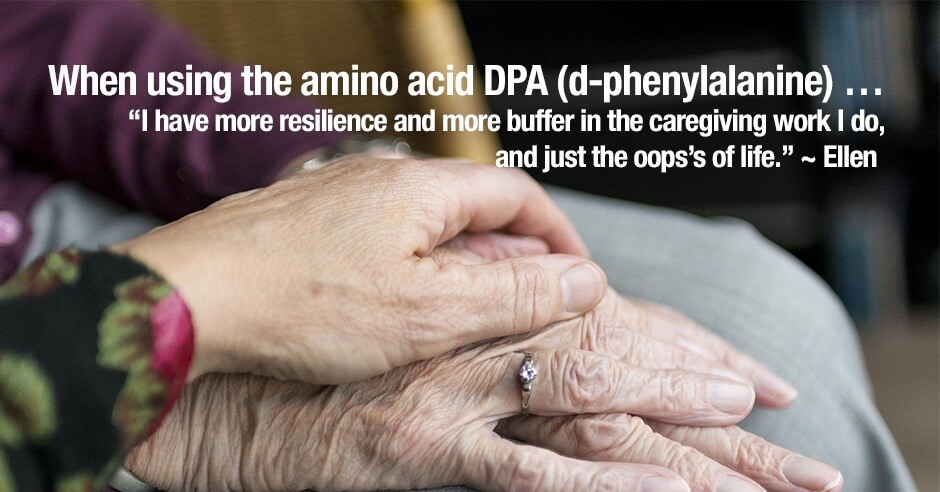
When using the amino acid DPA (d-phenylalanine) I have more resilience and more buffer in the caregiving work I do, and just the oops’s of life

July 29, 2022 By Trudy Scott 10 Comments

using dpa

I had not investigated DPA as I am a joyful, happy person. But recently I have been so depleted that I benefitted much from taking licorice to boost cortisol (who knew cortisol isn’t always to be lowered?)

Your presentation convinced me to try DPA as when I get depleted enough I get weepy (not sadness, just from being physically drained). Wow. I used a 500 mg dose of Lidke Endorphigen in the afternoon, and that has made a startling difference. I have more resilience now, more buffer, in the caregiving work I do, and just the oops’s of life.

I have been an avid note-taker of your summits and the interviews you give on the summits of others, and have recommended your book and blog to precious ones looking for answers to their health challenges.

Because of your diligence, I have been greatly helped by using GABA, 5-HTP (seems to work better for me than tryptophan), and tyrosine (so my thyroid glandular works more effectively).

Thank you ever so much for presenting information with evidence backing in a way that truly meets my curious, investigative, analytical mind. I love to know the whys and hows of things.

Ellen shared this feedback on one of the blogs after she heard me talk about DPA and low endorphins on The Anxiety Summit 5: Gut-Brain Axis. I’m sharing her wonderful results to give you a practical resource if you find yourself depleted and needing resilience as a caregiver. I’m also sharing this in order to illustrate that it’s not always easy to know when to trial a certain amino acid.

Ellen commented that she appreciated understanding the whys and hows of things. She is referring to my explanation of how DPA (d-phenylalanine) works. It’s an amino acid that destroys the enzyme that breaks down endorphins and thereby helps to raise your endorphins. With low endorphins you can feel very weepy, overly emotional, be extra sensitive to emotional pain, be sensitive to physical pain, and indulge in comfort/reward eating. You also often don’t feel joy.

Even though she was well versed in the use of GABA, 5-HTP and tyrosine (and seeing results), she had not investigated DPA. She described herself as a joyful and happy person so she didn’t think she needed DPA.

But her caregiving work (and other health and life challenges) had left her depleted and she started to feel weepy. And she is happy to share that DPA reversed that feeling. I’m thrilled for her and appreciate her for sharing.

The DPA product, how best to use it and how it differs from DLPA

Ellen mentions Lidtke Endorphigen which contains 500 mg of DPA. This product has been a long-time firm favorite with my clients and those in my community.

I used to recommend simply chewing the capsule to get the quickest and best effects and this worked well when it was produced in a gelatin capsule. Now it’s made with a cellulose capsule and chewing doesn’t work at all well, so opening the capsule (or just biting off the top) and tipping the powder into your mouth works best.

I’m often asked about the difference between DPA and DLPA (dl-phenylalanine) so if you have this question you can read more about that here.

Some of the supporting research

Research supports the use of DPA for helping to ease depression and the fact that caregivers are prone to an emotional burden.

  • D-phenylalanine and other enkephalinase inhibitors as pharmacological agents: implications for some important therapeutic application

It is proposed that the enkephalinase [a subgroup of endorphins] inhibitors may be effective in a number of human “endorphin deficiency diseases” such as depression…

  • Burden and quality of life of caregivers for hemodialysis patients

Caregivers of hemodialysis patients may experience a significant burden and an adverse effect on their quality of life. Emotional aspects of caregivers (particularly female spouses) and patients are important predictors of burden.

The study mentions that “Social support and psychological interventions should be considered to improve caregiver life and patient outcomes.”

There is no research that I am aware of that has found DPA to be beneficial for caregivers but until we have that research, let’s include nutritional support based on clinical results we see.

This case, Caregiving Burden, Stress, and Health Effects Among Family Caregivers of Adult Cancer Patients, illustrates what many caregivers experience: “extremely high levels of psychological distress, including anxiety, depression, worry and extreme loneliness.”

Ellen was already using GABA, 5-HTP and tyrosine when she added DPA, so as a caregiver she was already addressing her low GABA physical-type anxiety (with GABA), low serotonin worry-type anxiety (with 5-HTP) and low dopamine low-energy/low mood (with tyrosine). Adding DPA was the cherry-on-the-top for her weepiness and low resilience, and gave her more of a buffer.

Resources if you are new to using the amino acids as supplements

If you are new to using any of the amino acids as supplements, here is the Amino Acids Mood Questionnaire from The Antianxiety Food Solution (you can see all the symptoms of neurotransmitter imbalances, including low endorphins).

If you suspect low levels of any of the neurotransmitters and do not yet have my book, The Antianxiety Food Solution – How the Foods You Eat Can Help You Calm Your Anxious Mind, Improve Your Mood, and End Cravings, I highly recommend getting it and reading it before jumping in and using amino acids on your own so you are knowledgeable. And be sure to share it with the practitioner/health team you or your loved one is working with.

There is an entire chapter on the amino acids and they are discussed throughout the book in the sections on gut health, gluten, blood sugar control, sugar cravings, self-medicating with alcohol and more.

The book doesn’t include product names (per the publisher’s request) so as mentioned above, this blog, The Antianxiety Food Solution Amino Acid and Pyroluria Supplements, lists the amino acids that I use with my individual clients and those in my group programs.

As mentioned above, Lidtke Endorphigen is the DPA product I’ve had the most success with (and it can be found in my online store). Doctor’s Best D-phenylalanine is also a good product.

If, after reading this blog and my book, you don’t feel comfortable figuring things out on your own (i.e. doing the symptoms questionnaire and respective amino acids trials), a good place to get help is the GABA Quickstart Program (if you have low GABA symptoms). This is a paid online/virtual group program where you get my guidance and community support. There are many moms in the program who are having much success with their kids.

You can then use this knowledge to then trial DPA and other amino acids or move on to the Amazing Aminos for Anxiety Program and get help there.

If you are a practitioner, join us in The Balancing Neurotransmitters: the Fundamentals program. This is also a paid online/virtual program with an opportunity to interact with me and other practitioners who are also using the amino acids with success with their clients/patients.

If you’re a caregiver have you used DPA with success and if yes how has it helped? And do you feel more resilient?

Has GABA, 5-HTP (or tryptophan) and tyrosine also helped you?

What else helps you as a caregiver and what advice would you share with others taking care of a loved one?

If you’re a practitioner, do you use DPA with your clients/patients?

If you have questions please share them here too.
Filed Under: Amino Acids, DPA/DLPA, Endorphins, Supplements Tagged With: 5-HTP, anxiety, Balancing Neurotransmitters: the Fundamentals program for practitioners, buffer, caregiver, caregiving work, comfort/reward eating, d-phenylalanine, depleted, depression, DLPA, DPA, emotional burden, emotional pain, endorphins, GABA, GABA Quickstart program, joy, joyful, Lidke Endorphigen, physical pain, resilience, tyrosine, weepiness, weepy

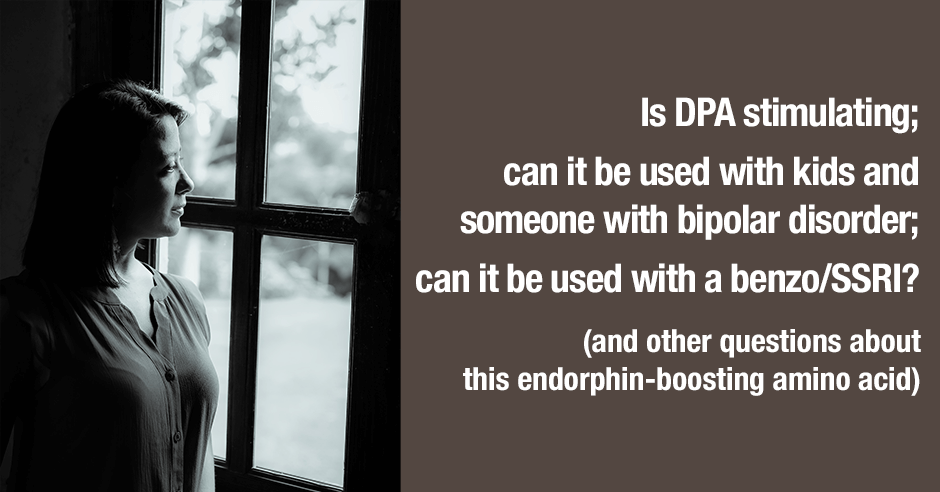
Is DPA stimulating; can it be used with kids and someone with bipolar disorder; can it be used with a benzo/SSRI? (and other questions)

July 22, 2022 By Trudy Scott 12 Comments

dpa questions

DPA (d-phenylalanine) is an amino acid that destroys the enzyme that breaks down endorphins. Endorphins are feel-good chemicals that you experience with an endorphin rush when you go for a run or when someone gives you a big hug, when you show kindness to someone or someone does something nice for you. The amino acid DPA helps to raise your endorphins. With low endorphins you can feel very weepy, overly emotional, be extra sensitive to emotional pain, be sensitive to physical pain, and indulge in comfort/reward eating. Today I’m sharing some questions (and my feedback) as to whether it’s stimulating, can it be used with kids and someone with bipolar disorder, can it be used with a benzo/SSRI and more.

Misha has had success with DPA and wants to know if it is considered too stimulating. Here is her feedback and question:

I first tried DPA after reading about it on your blog and found it helpful for raising my mood. The DPA definitely helped curb my weepiness. I used Lidtke Endorphigen 1 cap/day. I have chronic Lyme which creates severe difficulty with sleep, anxiety and depression. Six months ago my neurologist took me off DPA saying it would be too stimulating to my nervous system.

I have since begun using DPA again; I really need the endorphin boost. Do you have any insights on whether DPA is considered stimulating? Whether it interferes with sleep (unfortunately my sleep is bad whether I take DPA or not)? Or suggestions for time of day to take it?

Here is my feedback for Misha: There is no evidence that DPA is too stimulating whereas DLPA (dl-phenylalanine) is known to be stimulating (it works like a combination of DPA and tyrosine).

And when I hear all this it tells me the person needs endorphin support:

  • “found it helpful for raising my mood”
  • “The DPA definitely helped curb my weepiness”
  • “I have since begun using DPA again; I really need the endorphin boost”

That said anything is possible which is why using the amino acids is based on the questionnaire and trials to see how a person responds. The best way to know if sleep is affected is to monitor sleep when using it and when not using it. She says her sleep is bad whether she takes DPA or not so I would recommend going back to her neurologist, sharing this information and the fact that it’s helping her so much. And look for other causes of her sleep issues.

Anna asks if DPA and other amino acids are safe for kids and how high doses? This is her question:

My 10 yr old has been diagnosed with social anxiety and she ticks off most of the boxes for low endorphins, low GABA, low serotonin. She’s very sensitive and very very emotional. We tried, but can’t seem to find a naturopath that can help her much. I feel after a while they all reach a dead end. I have been following you for a year and recently got your book. It looks relatively easy to follow, however I’m a bit reluctant, as she’s a kid.

My feedback: I work with women and once they have figured out the amino acids and neurotransmitter imbalances themselves they find it much easier to help their children who often have similar issues. When that is not the case working with a practitioner is ideal. That being said many moms become informed and educated enough to trial the amino acids on their own (like this mom who had her daughter use GABA with much success).

Anna says her daughter is very sensitive and very very emotional so I’d consider using 125 mg DPA to start (500 mg is an adult starting dose).With kids we also always start with dietary changes as laid out in my book. A good place to start is with a gluten-free and sugar-free diet and DPA (and the other amino acids) can help curb the cravings and feelings of deprivation.

Anon has bipolar disorder and likes comfort foods. This is her question:

I have bipolar disorder and wonder if the DPA will send me into a manic state. It’s one of the reasons I can’t take anti-depressants or stimulants otherwise I go manic. But I can eat for comfort so I only have food in the house I’m going to eat according to meal schedules. So I want to try the DPA.

Here is my feedback: I have not seen DPA to be an issue with bipolar disorder and it’s fabulous when you are a comfort-eater. If you have bipolar disorder and are on medications, it’s always advised to discuss new supplements with your prescribing doctor. You can share that DPA is not on the list of amino acids that have precautions with bipolar disorder.

I would not recommend the use of DLPA (dl-phenylalanine) with bipolar disorder because some of this increases dopamine (which can trigger a manic state).

Kristie is doing a benzodiazepine taper and would like to use DPA:

I am currently going through a benzo taper & there are numerous wonderful products that I am unable to mix with benzos. Would this be safe for me?

This is my feedback: I have not had issues with DPA with clients who are doing a benzo taper and there are no documented contraindications. DPA can help with some of the emotional blunting caused by benzos and the emotional fragility we often see during a benzo taper.  I know some of the great benzo support groups say not to use GABA but I find it very helpful when tapering too.

The medication question is a common one. Someone else described her depression as weepy and is using the SSRI. There are also no documented contraindications when using DPA with a SSRI. But again, best to discuss with the prescribing doctor.

Arleen has a question about blood pressure and the DPA product I recommend (Lidtke Endorphigen):

1) Is this product gluten free and 2) What effect if any would it have on blood pressure (mine is naturally low)

Here is my feedback: Lidtke Endorphigen is gluten-free and I have not seen it or other DPA products to be an issue with low blood pressure.

Jan wants to use GABA and DPA. She asks:

Can I use Gaba 125mg and also take DPA? Would either offset the other?

If someone has low GABA symptoms and GABA helps with the physcal anxiety and they also have low endorphin symptoms and DPA helps then they are absolutely fine to use together and even at the same time. However, I have clients trial one at a time in order to find the ideal dose and so you know how each one is working.

Resources if you are new to using the amino acids as supplements

If you are new to using any of the amino acids as supplements, here is the Amino Acids Mood Questionnaire from The Antianxiety Food Solution (you can see all the symptoms of neurotransmitter imbalances, including low endorphins).

If you suspect low levels of any of the neurotransmitters and do not yet have my book, The Antianxiety Food Solution – How the Foods You Eat Can Help You Calm Your Anxious Mind, Improve Your Mood, and End Cravings, I highly recommend getting it and reading it before jumping in and using amino acids on your own so you are knowledgeable. And be sure to share it with the practitioner/health team you or your loved one is working with.

There is an entire chapter on the amino acids and they are discussed throughout the book in the sections on gut health, gluten, blood sugar control, sugar cravings, self-medicating with alcohol and more.

The book doesn’t include product names (per the publisher’s request) so as mentioned above, this blog, The Antianxiety Food Solution Amino Acid and Pyroluria Supplements, lists the amino acids that I use with my individual clients and those in my group programs.

As mentioned above, Lidtke Endorphigen is the DPA product I’ve had the most success with (and it can be found in my online store). Doctor’s Best D-phenylalanine is also a good product.

If, after reading this blog and my book, you don’t feel comfortable figuring things out on your own (i.e. doing the symptoms questionnaire and respective amino acids trials), a good place to get help is the GABA Quickstart Program (if you have low GABA symptoms). This is a paid online/virtual group program where you get my guidance and community support. There are many moms in the program who are having much success with their kids.

You can then use this knowledge to then trial DPA and other amino acids or move on to the Amazing Aminos for Anxiety Program and get help there.

If you are a practitioner, join us in The Balancing Neurotransmitters: the Fundamentals program. This is also a paid online/virtual program with an opportunity to interact with me and other practitioners who are also using the amino acids with success with their clients/patients.

Have you used DPA with success and if yes how has it helped?

If you’re a practitioner, do you use DPA with your clients/patients?

If you have questions please share them here too.
Filed Under: Amino Acids, DPA/DLPA, Endorphins, Supplements Tagged With: amino acid, anxiety, Balancing Neurotransmitters: the Fundamentals, benzo, bipolar disorder, comfort/reward eating, d-phenylalanine, DPA, emotional, emotional pain, endorphin-boosting, endorphins, GABA, GABA Quickstart program, kids, low blood pressure, mood, physical pain, SSRI, stimulating, weepiness, weepy

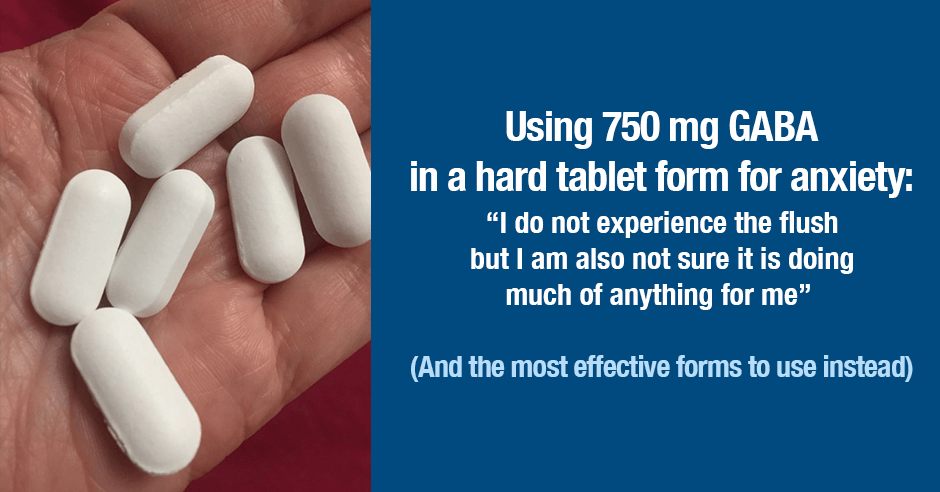
Using 750 mg GABA in a hard tablet form for anxiety: I do not experience the flush but I am also not sure it is doing much of anything for me

July 15, 2022 By Trudy Scott 21 Comments

gaba hard tablet

Today I’m addressing a question from someone in this community about a particular GABA product and her confusion about dosing with 750mg and using a hard tablet (she calls it a pill). When she uses it she doesn’t notice any effect i.e. no calming benefits and no adverse niacin-type tingly flush either. This is what she asked:

Not sure if “Source Naturals GABA Calm Mind” is on your list, but I thought it was one you had recommended at one time? Anyway, these are pills that cannot be opened like a capsule and 1 pill = 750 mg.

Personally, I had the tingly flush when I used a different product that WAS a capsule and opened it on my tongue…unfortunately I do not recall dosage or product name but I purchased at Whole Foods.

With this particular product (Source Naturals GABA Calm Mind) in pill form, although the dosage could be higher, I do not experience the flush…(however, I also am not sure it is doing much of anything for me).

This is my feedback for her: I have never recommended the Source Naturals GABA Calm Mind 750 mg tablet ever (she calls it a pill but I know she is referring to the hard tablets).

These are not a very effective way to use GABA. As you can see, she doesn’t feel it’s doing anything for her in terms of easing her anxiety and being calming. With a high dose of GABA we also often see a niacin-like flush or tingling and yet with this pill/tablet form she didn’t experience this either. GABA is much more effective when used sublingually or opening a capsule (and starting low at 125mg). More on this below.

But I’m not surprised she is confused and asking this question. The Source Naturals GABA Calm Mind has a very similar bottle/name/label to Source Naturals GABA Calm (the sublingual with 125mg GABA) and there is also a Source Naturals GABA Calm Mind 750 mg capsules (which can be opened).

She mentions the tingly flush when using a different product that was a capsule and opened on to her tongue. I’d suspect the tingling happened with a 500 mg GABA or 750 mg GABA product as this is a common dosage found in health stores. Opening the capsule and using less is best when starting out.

If you have to break it it’s a tablet and much less effective

All this logic applies to any brand of hard GABA tablet. Someone just shared on Facebook that she had purchased a GABA product in the Netherlands and broke it in half in order to use a lower dose. If you have to break it it’s a tablet and much less effective and possibly not at all effective. Be sure to read the front and back of the bottle and avoid hard tablets.

From time to time someone will see some benefit with a GABA tablet that is swallowed but it’s usually minimal.

The most effective forms of GABA to use

Here is a quick recap if you’re new to GABA. It’s an amino acid that is used as a supplement to boost GABA levels (a calming neurotransmitter) and ease physical tension type anxiety symptoms. It’s most effective when used sublingually, or as a powder or by using a GABA capsule opened on to the tongue or as a liposomal product.

When using GABA it must ideally be in one of these forms for the best effects:

  • Capsule form so the gelatin or cellulose capsule can be opened and the contents sprinkled onto the tongue, or some of it depending on dosing (NFH GABA-T SAP is a good example of this one – it contains GABA and theanine)
  • Sublingual form which is sucked/held in the mouth (Source Naturals GABA Calm 125mg is a good example of this – this is the GABA product that I have the most success with and it’s easy to use when out and about; PharmaGABA chewables are another option)
  • Powder form which is measured out using special tiny measuring spoon and sprinkled on to the tongue (Healthwise and Bulk Nutrients are good examples of this one)
  • Liposomal form which is sprayed into the mouth and held for a few minutes (Designs for Health Liposomal Neurocalm and Quicksilver Scientific Liposomal GABA with L-Theanine are good examples of this form)

This blog, Antianxiety Food Solution Amino Acid and Pyroluria Supplements, lists the amino acids that I use with my individual clients and those in my group programs. You can find a list of selected GABA products.

Here are a few success stories where the above different forms have been used:

  • Drastic reduction in intrusive thoughts, anxiety and fears (and better sleep) with GABA, tryptophan, 5-HTP and the pyroluria protocol
  • Keep GABA powder handy for choking episodes, stridor and panic (and find the ideal dose and be consistent for prevention/easing anxiety)
  • GABA helps 14-year-old with Tourette’s Syndrome (the tics and sleep), and tyrosine makes him happier and his mind sharper
  • GABA, Heartmath and EFT ease Micki’s mold-induced anxiety and panic attacks
  • PharmaGABA eases physical anxiety in a young man who has recently given up Adderall, alcohol and nicotine
  • GABA is the answer after 40 years of a lump-in-the-throat sensation, nervousness and muscle tension at work

Resources if you are new to using the amino acids as supplements

If you are new to using any of the amino acids as supplements, here is the Amino Acids Mood Questionnaire from The Antianxiety Food Solution (you can see all the symptoms of neurotransmitter imbalances, including low GABA).

If you suspect low levels of any of the neurotransmitters and do not yet have my book, The Antianxiety Food Solution – How the Foods You Eat Can Help You Calm Your Anxious Mind, Improve Your Mood, and End Cravings, I highly recommend getting it and reading it before jumping in and using amino acids on your own so you are knowledgeable. And be sure to share it with the practitioner/health team you or your loved one is working with.

There is an entire chapter on the amino acids and they are discussed throughout the book in the sections on gut health, gluten, blood sugar control, sugar cravings, self-medicating with alcohol and more.

The book doesn’t include product names (per the publisher’s request) so as mentioned above, this blog, The Antianxiety Food Solution Amino Acid and Pyroluria Supplements, lists the amino acids that I use with my individual clients and those in my group programs.

If, after reading this blog and my book, you don’t feel comfortable figuring things out on your own (i.e. doing the symptoms questionnaire and respective amino acids trials), a good place to get help is the GABA QuickStart Program (if you have low GABA symptoms). This is a paid online/virtual group program where you get my guidance and community support. There are many moms in the program who are having much success with their kids.

If you are a practitioner, join us in The Balancing Neurotransmitters: the Fundamentals program. This is also a paid online/virtual program with an opportunity to interact with me and other practitioners who are also using the amino acids with success with their clients/patients.

Did you use a GABA product that didn’t work for you before finding the ideal product and dose?

Please share which product didn’t work (was it a hard tablet?) and what did work for you. And be sure to share how it helps to ease your physical anxiety, insomnia, pain, intrusive thoughts and cravings (for sugar or alcohol).

Have you experienced the niacin-like flush or tingle from using too high a dose of GABA? How much did that and which product?

If you’re a practitioner, which forms of GABA do you find the most success with?

If you have questions please share them here too.

Filed Under: Amino Acids, Anxiety, GABA, Supplements Tagged With: 125mg, 750 mg GABA, anxiety, Balancing Neurotransmitters: the Fundamentals, calming, choking, flush, GABA, GABA Calm, GABA Quickstart program, hard tablet, intrusive thoughts, lump-in-the-throat sensation, mold-induced anxiety, muscle tension, nervousness, niacin-type flush, not doing much, opening a capsule, panic, pharmaGABA, pill, sleep, Source Naturals GABA Calm Mind, sublingual, tics, tingly, Tourette’s Syndrome

  • « Go to Previous Page
  • Page 1
  • Interim pages omitted …
  • Page 17
  • Page 18
  • Page 19
  • Page 20
  • Page 21
  • Interim pages omitted …
  • Page 159
  • Go to Next Page »

Primary Sidebar

NEW! GABA QuickStart Homestudy (with special intro pricing)

gaba quickstart homestudy

Free Report

9 Great Questions Women Ask about Food, Mood and their Health

You'll also receive a complimentary subscription to my ezine "Food, Mood and Gal Stuff"


Connect with me

Popular Posts

  • Amino Acids Mood Questionnaire from The Antianxiety Food Solution
  • The Antianxiety Food Solution Amino Acid and Pyroluria Supplements
  • Pyroluria Questionnaire from The Antianxiety Food Solution
  • Collagen and gelatin lower serotonin: does this increase your anxiety and depression?
  • Tryptophan for the worry-in-your-head and ruminating type of anxiety
  • GABA for the physical-tension and stiff-and-tense-muscles type of anxiety
  • The Antianxiety Food Solution by Trudy Scott
  • Seriphos Original Formula is back: the best product for anxiety and insomnia caused by high cortisol
  • Am I an anxious introvert because of low zinc and vitamin B6? My response to Huffington Post blog
  • Vagus nerve rehab with GABA, breathing, humming, gargling and key nutrients

Recent Posts

  • What do I use instead of Seriphos to help lower high cortisol that is affecting my sleep and making me anxious at night?
  • BeSerene™ GABA/theanine cream eases severe muscle tension in her neck/shoulders, prevents her bad headaches and quells her anxiety
  • How the correct approach, dose and sublingual use of GABA can be calming and not cause a flushed and itchy face and neck
  • The amino acid glutamine improves low mood by addressing gut health, and it has calming effects too
  • Flight anxiety with heightened breath, physical tension and also fearing the worst (the role of low GABA and low serotonin)

Categories

  • 5-HTP
  • AB575
  • Addiction
  • ADHD
  • Adrenals
  • Alcohol
  • Allergies
  • Alzheimer's disease
  • Amino Acids
  • Anger
  • Antianxiety
  • Antianxiety Food Solution
  • Antidepressants
  • Anxiety
  • Anxiety and panic
  • Autism
  • Autoimmunity
  • benzodiazapines
  • Bipolar disorder
  • Books
  • Caffeine
  • Cancer
  • Candida
  • Children/Teens
  • Collagen
  • Cooking equipment
  • Coronavirus/COVID-19
  • Cravings
  • Depression
  • Detoxification
  • Diabetes
  • Diet
  • DPA/DLPA
  • Drugs
  • EFT/Tapping
  • EMF
  • EMFs
  • Emotional Eating
  • Endorphins
  • Environment
  • Essential oils
  • Events
  • Exercise
  • Fear
  • Fear of public speaking
  • Fertility and Pregnancy
  • Fish
  • Food
  • Food and mood
  • Functional neurology
  • GABA
  • Gene polymorphisms
  • General Health
  • Giving
  • Giving back
  • Glutamine
  • Gluten
  • GMOs
  • Gratitude
  • Gut health
  • Heart health/hypertension
  • Histamine
  • Hormone
  • Hyperparathyroidism
  • Hypoglycemia
  • Immune system
  • Inflammation
  • Insomnia
  • Inspiration
  • Introversion
  • Joy and happiness
  • Ketogenic diet
  • Lithium orotate
  • Looking awesome
  • Lyme disease and co-infections
  • MCAS/histamine
  • Medication
  • Men's health
  • Mental health
  • Mercury
  • Migraine
  • Mold
  • Movie
  • MTHFR
  • Multiple sclerosis
  • Music
  • NANP
  • Nature
  • Nutritional Psychiatry
  • OCD
  • Osteoporosis
  • Oxalates
  • Oxytocin
  • Pain
  • Paleo
  • Parasites
  • Parkinson’s disease
  • PCOS
  • People
  • PMS
  • Postpartum
  • PTSD/Trauma
  • Pyroluria
  • Questionnaires
  • Real whole food
  • Recipes
  • Research
  • Schizophrenia
  • serotonin
  • SIBO
  • Sleep
  • Special diets
  • Sports nutrition
  • Stress
  • Sugar addiction
  • Sugar and mood
  • Supplements
  • Teens
  • Testimonials
  • Testing
  • The Anxiety Summit
  • The Anxiety Summit 2
  • The Anxiety Summit 3
  • The Anxiety Summit 4
  • The Anxiety Summit 5
  • The Anxiety Summit 6
  • Thyroid
  • Thyroid health
  • Toxins
  • Tryptophan
  • Tyrosine
  • Uncategorized
  • Vegan/vegetarian
  • Women's health
  • Yoga

Archives

  • October 2025
  • September 2025
  • August 2025
  • July 2025
  • June 2025
  • May 2025
  • April 2025
  • March 2025
  • February 2025
  • January 2025
  • November 2024
  • October 2024
  • September 2024
  • August 2024
  • July 2024
  • June 2024
  • May 2024
  • April 2024
  • March 2024
  • February 2024
  • January 2024
  • December 2023
  • November 2023
  • October 2023
  • September 2023
  • August 2023
  • July 2023
  • June 2023
  • May 2023
  • April 2023
  • March 2023
  • February 2023
  • January 2023
  • December 2022
  • November 2022
  • October 2022
  • September 2022
  • August 2022
  • July 2022
  • June 2022
  • May 2022
  • April 2022
  • March 2022
  • February 2022
  • January 2022
  • December 2021
  • November 2021
  • October 2021
  • September 2021
  • August 2021
  • July 2021
  • June 2021
  • May 2021
  • April 2021
  • March 2021
  • February 2021
  • January 2021
  • December 2020
  • November 2020
  • October 2020
  • September 2020
  • August 2020
  • July 2020
  • June 2020
  • May 2020
  • April 2020
  • March 2020
  • February 2020
  • January 2020
  • December 2019
  • November 2019
  • October 2019
  • September 2019
  • August 2019
  • July 2019
  • June 2019
  • May 2019
  • April 2019
  • March 2019
  • February 2019
  • January 2019
  • December 2018
  • November 2018
  • October 2018
  • September 2018
  • August 2018
  • July 2018
  • June 2018
  • May 2018
  • April 2018
  • March 2018
  • February 2018
  • January 2018
  • December 2017
  • November 2017
  • October 2017
  • September 2017
  • August 2017
  • July 2017
  • June 2017
  • May 2017
  • April 2017
  • March 2017
  • February 2017
  • January 2017
  • December 2016
  • November 2016
  • October 2016
  • September 2016
  • August 2016
  • July 2016
  • June 2016
  • May 2016
  • April 2016
  • March 2016
  • February 2016
  • January 2016
  • December 2015
  • November 2015
  • October 2015
  • September 2015
  • August 2015
  • July 2015
  • June 2015
  • May 2015
  • April 2015
  • March 2015
  • February 2015
  • January 2015
  • December 2014
  • November 2014
  • October 2014
  • September 2014
  • August 2014
  • July 2014
  • June 2014
  • May 2014
  • April 2014
  • March 2014
  • February 2014
  • January 2014
  • December 2013
  • November 2013
  • October 2013
  • September 2013
  • August 2013
  • July 2013
  • June 2013
  • May 2013
  • April 2013
  • March 2013
  • February 2013
  • January 2013
  • December 2012
  • November 2012
  • October 2012
  • August 2012
  • July 2012
  • June 2012
  • May 2012
  • April 2012
  • March 2012
  • February 2012
  • January 2012
  • December 2011
  • November 2011
  • October 2011
  • September 2011
  • August 2011
  • July 2011
  • June 2011
  • May 2011
  • April 2011
  • March 2011
  • February 2011
  • January 2011
  • December 2010
  • October 2010
  • September 2010
  • July 2010
  • May 2010
  • April 2010
  • March 2010
  • February 2010
  • January 2010
  • November 2009

Share the knowledge!

The above statements have not been evaluated by the Food and Drug Administration. Products listed in this website are not intended to diagnose, treat, cure or prevent any disease.

The information provided on this site is for informational and educational purposes only and is not intended as a substitute for advice from your physician or other health care professional. You should consult with a healthcare professional before starting or modifying any diet, exercise, or supplementation program, before taking or stopping any medication, or if you have or suspect you may have a health problem.


Copyright © 2026 Trudy Scott. All Rights Reserved. | Privacy | Terms and Conditions | Refund Policy | Medical Disclaimer

Free Report

9 Great Questions Women Ask about Food, Mood and their Health

You’ll also receive a complimentary subscription to my ezine “Food, Mood and Gal Stuff”