• Skip to primary navigation
  • Skip to main content
  • Skip to primary sidebar

everywomanover29 blog

Food, Mood and Women's Health – Be your healthiest, look and feel great!

  • Blog
  • About
  • Services
  • Store
  • Resources
  • Testimonials
  • The Book
  • Contact
  • Search this site

PTSD

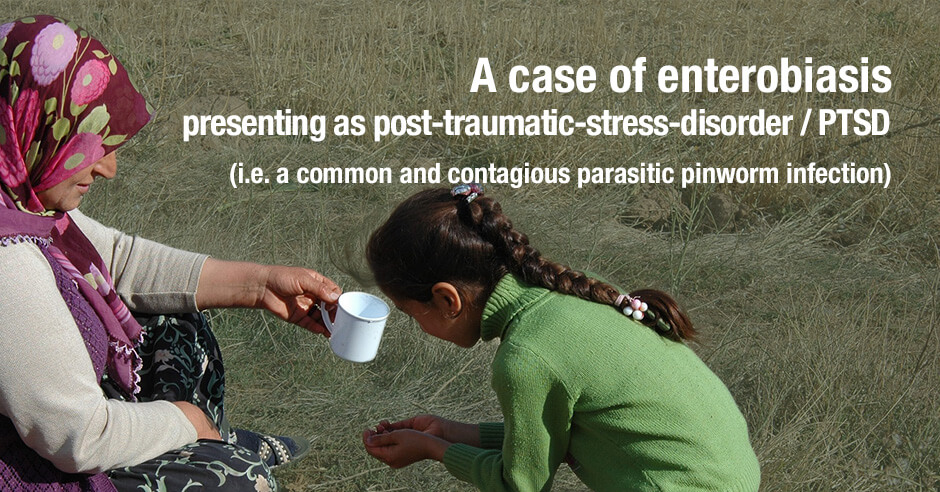
A case of enterobiasis presenting as post-traumatic-stress-disorder / PTSD (i.e. a common and parasitic pinworm infection)

February 3, 2023 By Trudy Scott 11 Comments

case of enterobiasis

Enterobiasis (oxyuriasis) is a common infection in humans caused by Enterobius vermicularis (E. vermicularis), a human intestinal helminth. Because of the easy way of its transmission among people, it has an extremely high prevalence in overcrowded conditions, such as nurseries and primary schools. Oxyuriasis’s symptoms are extremely diverse in children, ranging from nausea, diarrhea, insomnia, irritability, recurrent cellulitis, loss of appetite, nightmares and endometritis.

Here we report a curious case of oxyuriasis in the settings of a refugee camp in Greece. The patient was a 10-year old Syrian female, who presented with unusual and vague symptoms like insomnia and irritability. Given the violent background of the Syrian warzone that the patient had escaped, she was firstly diagnosed with post traumatic stress disorder (PTSD) before eventually getting correctly diagnosed with enterobiasis.

This infection is the first documented case of enterobiasis in the settings of a refugee camp and can highlight the unsanitary living conditions that refugees have to endure in those camps.

The above is the abstract from a 2017 paper: A case of enterobiasis presenting as post-traumatic-stress-disorder (PTSD): a curious case of the infection with predominant mental health symptoms, presenting for the first time in the settings of a refugee camp

In addition to her symptoms of insomnia and irritability, she had a decreased appetite and mild abdominal (tummy) pain. She was also experiencing nausea and vomiting and had a slightly raised body temperature (subfebrile). She was severely malnourished and had lost 3kg/6.6lbs in 5 days.

Because of the violent nature of her situation she was initially seen by a psychologist but her symptoms worsened in a few days. When this young girl complained about itching in the perianal area (around her anus), the clinic reassessed her and scars around the anal area from the scratches.

They then confirmed enterobiasis/pinworm after using a piece of clear adhesive tape “to collect a specimen from the perianal surface of the girl, for three consecutive mornings … A microscopic examination showed the presence of oval shaped eggs, which is typical for the specific helminth [parasitic worm].”

She was treated with “two doses of albendazole, with each dose two weeks apart, in order to avoid reinfection …. And after a 3 month follow-up period, the patient remains asymptomatic without any signs of recurrence.”

An overview of pinworm infections, symptoms, tape test and treatment approaches

This WebMD article offers an overview of pinworm infections, the symptoms, the tape test and treatment approaches.

As you’ll read it’s not only a problem in refugee camps – it’s “very common in elementary school-aged children” and it’s the most common kind of worm infection in the United States. “Most of the time, pinworm infections don’t cause serious problems.” However, when one child (or adult) gets a pinworm infection it can easily be spread to the entire family.  The Syrian refugee paper mentions the whole family was tested.

Systemic infection: female health issues and gut health

The WebMD authors also state, “in rare cases, and especially if you have a lot of them, the pinworms can travel from the anal area up the vagina to the uterus, fallopian tubes, and around the pelvic organs. This can cause inflammation of the vagina (vulvovaginitis).”

I first learned about these serious systemic issues in women from naturopathic doctor Rachel Arthur at a conference in Australia. Contrary to the WedMD article, she believes this is not rare and more common than you’d expect, contributing to hormonal imbalances and even infertility.

The research confirms the impacts of pinworm on the gut, with reports of pinworm associated with appendicitis, pinworm in the liver, pinworms contributing to dysbiosis and pinworm being a factor in inflammatory bowel disease.

The WebMD article doesn’t mention the mental health symptoms and mechanisms but you can read more about that (and my interview with Dr. Jay Davidson) below.

Annual deworming and concerns about drug resistance?

I’m not going to get into anti-parasitic medications and herbal alternatives in this blog post – Dr. Jay talks about mimosa pudica seeds and Dr. Rachel recommends chondroitin sulfate – but do I want to mention that there are many public policy papers calling for annual deworming procedures for everyone. It’s also mentioned in the above Syrian refugee paper, as is hand-washing for prevention.

And many folks recall annual deworming concoctions as a child and did/do the same with their children.

There is, however, the concern about antiparasitic drug resistance similar to what is being seen with antibiotics and antiviral drugs.

If you are new to parasites and their impacts on mood issues, anxiety and insomnia and more

If you are new to parasites, here are some insights from an interview I did with Dr. Jay Davidson on The Anxiety Summit 5: Gut Brain Axis. The topic of our interview is – Parasites, Anxiety and TUDCA for Your Liver. He shares this:

The Greek meaning of parasite is one that sits at another’s table. So essentially think of a parasite as it’s taking things from you. It’s taking nutrients, it’s taking key things that your body needs and literally off of you, not to the point that it’s killing you because then you’re not a good host to give a good environment. So it’s basically just kind of sucking you dry.

We discussed symptoms individuals may experience: mood issues, anxiety and insomnia (especially around full moon). He shared that with insomnia “the big issue that I see is restless sleep where you toss, you turn, you wake often. You can’t just be relaxed when you sleep. Parasites get active when you go to bed. The more active they are within your body and the more you’re trying to calm down, the more your body is getting stressed out. This is where teeth grinding happens when you sleep.

This is very typical and likely the kinds of insomnia symptoms this young refugee girl experienced too. Pinworm is more active at night so the itching around her anus and the need to scratch would have affected her sleep too. This is a classic sign of pinworm.

With regards to anxiety and mood issues and possible mechanisms, Dr. Jay shares how parasites contribute to neurotransmitter imbalances:

Parasites will eat the protein you eat and not allow your body to break down that protein into amino acids. That’s why amino acid therapy can be so beneficial symptomatically and change people’s lives, because they’re getting these amino acids that they’re not getting when they have parasites.

When we digest protein, the amino acids are needed to help us make neurotransmitters. With his amino acid comments, he is making reference to my work with the amino acid tryptophan to support your low serotonin worry-type of anxiety symptoms and the amino acid GABA to support your low GABA physical-anxiety type symptoms. They are wonderful for quick relief of anxiety and mood symptoms, and even help sleep problems too. But as he says “you always want to make sure to go to the underlying cause to remove the parasitic infection.”

Other symptoms of parasitic infection that we discuss at length: restless legs and calf cramping, diarrhea, bowel urgency, SIBO (small intestinal bacterial overgrowth), vertical wrinkles above your mouth, nail-biting, food sensitivities, bed-wetting and night sweats. These are all symptoms that we need to look for and then consider stool testing and/or the sticky tape test/clear adhesive tape test for pinworm (as mentioned in the Syrian refugee paper and WebMD article above).

If you missed this interview and/or summit, you can find the purchase link on the above blog and here.

Tryptophan is not working (possibly because of parasites) and toxoplasma gondii (and GABA/anxiety)

Here is some additional reading on parasites on my site and in the literature:

  • Tryptophan doesn’t work, then it does and then it doesn’t: could it be hormonal shifts, dietary factors and/or parasites? As I share here, if you have a very pronounced shift in symptoms for 4-5 days around a full moon each month – more severe insomnia, more anxious, more depressed – I would want to check for parasites (as well as hormonal impacts and everything else covered on this blog).
  • Toxoplasma gondii: schizophrenia, bipolar disorder, OCD and unresolved anxiety? As I share in this blog, toxoplasma gondii is a microscopic parasite that infects cats and can be found in the soil – research shows it may be a factor in schizophrenia, bipolar disorder and OCD in susceptible individuals. Could toxoplasma gondii could be one of the root causes of unresolved anxiety? I believe so and feel it’s under-rated.
  • In this study, Toxoplasma gondii Infections Alter GABAergic Synapses and Signaling in the Central Nervous System, the authors share that “toxoplasma interferes with GABA signaling in the brain …playing a role in seizures and other neurological complications seen in Toxoplasma-infected individuals.” This particular parasite disrupts the workings of the glutamic acid decarboxylase 67 enzyme (GAD67), used to make GABA from glutamate, and very likely contributes to increased anxiety symptoms too.

Resources if you are new to using tryptophan, GABA and other amino acids as supplements

If you are new to using tryptophan, GABA or any of the other amino acids as supplements, here is the Amino Acids Mood Questionnaire from The Antianxiety Food Solution (you can see all the symptoms of neurotransmitter imbalances, including low GABA and low serotonin).

If you suspect low levels of any of the neurotransmitters and do not yet have my book, The Antianxiety Food Solution – How the Foods You Eat Can Help You Calm Your Anxious Mind, Improve Your Mood, and End Cravings, I highly recommend getting it and reading it before jumping in and using amino acids on your own so you are knowledgeable. And be sure to share it with the practitioner/health team you or your loved one is working with.

There is an entire chapter on the amino acids and they are discussed throughout the book in the sections on gut health, gluten, blood sugar control, sugar cravings, self-medicating with alcohol and more.

The book doesn’t include product names (per the publisher’s request) so this blog, The Antianxiety Food Solution Amino Acid and Pyroluria Supplements, lists the amino acids that I use with my individual clients and those in my group programs. You can find them all in my online store.

If, after reading this blog and my book, you don’t feel comfortable figuring things out on your own (i.e. doing the symptoms questionnaire and respective amino acids trials), a good place to get help is the GABA QuickStart Program (if you have low GABA symptoms). This is a paid online/virtual group program where you get my guidance and community support.

If you are a practitioner, join us in The Balancing Neurotransmitters: the Fundamentals program. This is also a paid online/virtual program with an opportunity to interact with me and other practitioners who are also using the amino acids.

If you or a family member have had a pinworm infection, what symptoms did you experience and was the entire family affected?

Have you had hormonal and/or pelvic issues and/or gut issues as a result of systemic infection with pinworm?

How have other parasitic infections impacted your health?

How familiar are you with the fact that pinworm and other parasites can affect your mood, anxiety and sleep, as well as cause gut issues?

If you’re interested in learning more about testing and herbal protocols please let me know. If you’d like to share what has worked for you please do share too.

If you have other questions and feedback please share them here too.
Filed Under: Anxiety, Gut health, Insomnia, Parasites, PTSD/Trauma Tagged With: amino acids, anxiety, diarrhea, Enterobiasis, female health, GABA, insomnia, irritability, itching anal area, loss of appetite, mental health, mood, nausea, Nightmares, parasite, parasitic, pinworm, post-traumatic-stress-disorder, PTSD, Syrian, tape, the GABA Quickstart online program; and Balancing Neurotransmitters: the Fundamentals program for practitioners, toxoplasma gondii, tryptophan

Around my period I definitely feel the need for extra tryptophan if I’ve had some extra heavy emotional stuff come up that I need to process

December 10, 2021 By Trudy Scott 6 Comments

period and extra tryptophan

Many women find that they need additional nutritional support i.e. tryptophan for serotonin support (and often GABA too) around their periods. Today’s case study highlights the hormonal shifts that may lead to a situation where it appears tryptophan doesn’t work, then it does work, and then sometimes it doesn’t work as expected. The variable results and the need to switch between lower and higher doses on an ongoing basis can occur with PMS (premenstrual syndrome) PMDD (premenstrual dysphoric disorder, a severe, sometimes disabling extension of premenstrual syndrome). The variable results can also be more pronounced while recovering from trauma.

This case study is a follow-on from a blog I recently published: Tryptophan doesn’t work, then it does and then it doesn’t: could it be hormonal shifts, dietary factors and/or parasites?

Here is Kimberley’s feedback on the Facebook post that discussed these variable results. She shared how her hormonal shifts led to a need for additional tryptophan and 5-HTP:

Around my period I definitely feel the need for extra tryptophan. My PMDD symptoms have decreased since I started using tryptophan/5-HTP, but sometimes I need a bit more if I’ve had some extra heavy emotional stuff come up that I need to process (since that always happens with my period!).

I thanked her for sharing and said how happy I was for her. I also asked what symptoms have decreased and how much? I also asked how much tryptophan and 5-HTP she uses before her period and then around her period?

I was also curious if she just experimented with different doses until she figured it out or had she heard me talk about the PMDD tryptophan study: A placebo-controlled clinical trial of L-tryptophan in premenstrual dysphoria. In this study tryptophan was found to reduce symptoms of PMS when used in the luteal phase or second half of the cycle (i.e. after ovulation).

Her low serotonin symptoms have decreased as much as 75-80 percent

Kimberley confirmed that she had read the above study and related blog post – Tryptophan for PMS: premenstrual dysphoria, mood swings, tension, and irritability – and more about her symptoms:

I had read the blog you referenced, which is one of the reasons I tried tryptophan in the first place.

I was experiencing a lot of emotional distress, feelings of downright despair that left me miserable both during my period and ovulation (half the month, every month, which was truly awful). Those have definitely decreased, sometimes as much as 75-80 percent, other times they’re worse and I feel like I need more support.

I usually take 1x Lidtke 5-HTP (50mg) mid-afternoon and 1x Lidtke Tryptophan (500mg) at bedtime, but yesterday I increased to 2x Lidtke Tryptophan and do feel an improvement in my mood this morning.

I experimented to get the right dose of both amino acids, initially increasing to the maximum you recommend, and then slowly decreasing to what I’m taking now when I found I didn’t feel well when I took too much.

I just reread the blog you linked above and realized I should be using GABA every day to support progesterone (instead of just as needed for anxiety). Thanks for the reminder!

I love that after reading the blog she was inspired and motivated to experiment with different doses when she is/was feeling so bad. I encouraged her to continue trialing different doses at various times of the month especially in the second half of the month. I also reminded her that some folks do better with tryptophan and some do better with 5-HTP when it comes to low serotonin symptoms. And to continue to look at why serotonin is low and address that. Low GABA (related to low progesterone) can cause increased anxiety at this time and is a common issue with PMS/PMDD.

(You can see the entire list of low serotonin and low GABA symptoms here.)

She plans to continue experimenting with tryptophan and 5-HTP and may also try switching over to just 5-HTP and see if that changes anything. It’s unlikely that she would benefit from much higher doses of either as she shared “I don’t seem to be able to take more than 2 caps of either one without getting uncomfortable symptoms, though.”

Exercise and yoga for her low serotonin and PMDD

She did share how much exercise helps her mood, why she isn’t able to exercise as much:

The biggest thing I know to do to address low serotonin is add more exercise into my life, but this has been hard lately because I’ve had a couple of different viruses recently that left my exercise intolerance worse than it had been. I’m trying to support my mitochondria right now and add light exercise back in slowly.

Exercise is a wonderful way to raise serotonin levels and aerobic exercise has been shown to reduce the symptoms of PMS too. Yoga may be an option while she is recovering. In one study, yoga was found to be beneficial for PMS: “Alpha-brain waves production due to regular yoga practice are directly related with state of peace, creativity, mood elevation, relaxation, and release of serotonin, thus leading yoga practitioners feel more relaxed.”

Trauma: cortisol, serotonin, dopamine and estradiol

Kimberley also shared how how trauma plays into her situation:

I think some of the reasons for my health issues, low neurotransmitters, etc., are trauma related and I’ve been working through Dr. Aimie Apigian’s programs for that. But that’s another story.

I respect Dr. Aimie Apigian’s work in trauma and somatic experiencing and acknowledge this aspect must be addressed too. I love that Dr. Aimie brings this together with a functional medicine approach, looking at biology/biochemistry too. Recent trauma research confirms that there are major biochemical mechanisms involved in PTSD (post-traumatic stress disorder). These can include impacts to cortisol, serotonin and dopamine levels. And women are more vulnerable to these effects.

A 2021 paper, Estradiol, stress reactivity, and daily affective experiences in trauma-exposed women discusses high cortisol and more severe symptoms around their periods when estradiol (one of the estrogens) is low. As I mentioned above, estrogen and serotonin are closely related. The authors state this:“For women who are cycling, it may be useful to understand how the menstrual cycle affects their symptoms. When you can explain what’s happening biologically, it often becomes less threatening.”

Yoga may provide added psychological benefits as she works through her past trauma too.

Kimberly gave me permission to share her story and this is always something I appreciate so others in my community can learn from these types of experiences. If needed, I hope this her story gives you confidence to experiment with different doses and combinations around your period.

She also benefits from the comments from others on Facebook and the comments here on the blog, our back and forth, and this blog post.

She promised to keep me posted on how she goes and I’ll be sure to share when I hear back from her.

Resources if you are new to using tryptophan, 5-HTP and GABA and the amino acids as supplements

If you are new to using the amino acids as supplements, here is the Amino Acids Mood Questionnaire from The Antianxiety Food Solution (you can see the low GABA symptoms here) and a brief overview here, Anxiety and targeted individual amino acid supplements: a summary.

If you suspect low GABA or low levels of any of the neurotransmitters and do not yet have my book, The Antianxiety Food Solution – How the Foods You Eat Can Help You Calm Your Anxious Mind, Improve Your Mood, and End Cravings, I highly recommend getting it and reading it before jumping in and using amino acids so you are knowledgeable. And be sure to share it with the team you or your loved one is working with.

The book doesn’t include product names (per the publisher’s request) so this blog, The Antianxiety Food Solution Amino Acid and Pyroluria Supplements, lists the amino acid products that I use with my individual clients and those in my group programs.

Have you found you need additional tryptophan/5-HTP or GABA around your period? How have you experimented and how does it help you?

If you’re a practitioner, have you seen this with clients or patients?

Do you also feel better with exercise and/or yoga?

And are/were your variable results more pronounced while recovering from trauma?

Feel free to ask your questions here too.

Filed Under: Anxiety, GABA, PMS, PTSD/Trauma, serotonin, Women's health Tagged With: 5-HTP, anxiety, biochemical, cortisol, despair, dopamine, emotional distress, emotional stuff, estradiol, estrogen, exercise, GABA, hormonal shifts, miserable, my period, PMDD, PMS premenstrual syndrome, premenstrual dysphoric disorder, PTSD, serotonin, stress, trauma, tryptophan, yoga

Using both tryptophan and GABA supplements together for easing anxiety: questions and answers

June 11, 2021 By Trudy Scott 71 Comments

tryptophan and gaba for anxiety

I get many questions about using both tryptophan and GABA supplements together for easing anxiety and today I’m sharing some of these questions and my answers. This will also give you the opportunity to ask questions you may have related to using both these amino acids together. You’ll also read about some reasons for the confusion about when to use GABA vs tryptophan, some success stories and some research.

Let’s start with this question since it’s one that I get asked many many times:

Should one use GABA and tryptophan together for helping with anxiety symptoms?

I have many clients who need and use both but it’s because they have low GABA and also have low serotonin, both driving different types of anxiety symptoms. It’s important to recognize that each amino acid supplement addresses a very different set of symptoms.

With low GABA levels they will have physical anxiety, tension, stiff and tense muscles and often self-medicate with alcohol in order to relax. Sleep may also be a problem with lying awake feeling tense. Because they also have low serotonin they will have the worry-in-the head type of anxiety, ruminations, and obsessions. They may also have panic attacks, negativity, anger, irritability, PMS, TMJ, lack of confidence and insomnia. (Here is a list of all the low serotonin and low GABA symptoms).

You should only use GABA and tryptophan together if you have both low GABA and low serotonin symptoms.  This will address these particular root causes.

My anxiety has improved significantly with GABA, should I also try tryptophan/5-HTP?

This is another common question I get about using tryptophan and GABA supplements together (paraphrased from one of the blog comments so I could share my feedback here):

I’m using GABA and my anxiety has improved significantly, however, the anxiety I feel in my body immediately upon waking is still bothersome. What would you recommend for the anxiety in my body on waking (that improves when I get out of bed, start moving around and as the day progresses)?

Could I try 5-HTP/tryptophan in addition to GABA?

We always want to capitalize on what is already working. GABA has improved her anxiety significantly, so I’d want to have her figure out how much it’s improved (for example from say 10/10 with 10 being worse to 5/10 with the GABA). Then we’d bump up the GABA to see if additional gains are seen. This could mean a higher dose at night and could also mean a small dose in the morning on waking. And then figure out the improvement and adjust up again if needed.

There is no reason why she shouldn’t try either tryptophan or 5-HTP too but only if she also has other low serotonin symptoms other than morning anxiety. And also, only once she has established the ideal dose for the GABA. She mentions “the anxiety in my body” so I suspect it’s the low GABA physical-tension type of anxiety. We often see low GABA and low serotonin go hand in hand so it’s very likely she’ll also benefit from serotonin support too.

Some reasons for the confusion about when to use GABA vs tryptophan

One reason for this confusion is that there are many combination products on the market that contain both GABA and tryptophan (and other nutrients). The company is trying to make a one-size-fits-all product in the hope it will help many folks. The problem is that it’s not individualized to your unique needs – which may be low GABA or low serotonin or both. Even if it is low GABA and low serotonin that you suffer from, a combination product may not work if, for example, you need a very small amount of GABA and need a much higher dose of tryptophan.

Another reason is that many well-meaning practitioners do not help their client/patients make the distinction between low serotonin and low GABA symptoms. This happens because they often don’t understand this either.

Another reason is that many folks jump in and start using these amino acids without really understanding how and why they work, how to use them and what to look out for. It’s why I highly recommend that everyone planning to use them reads my book first, The Antianxiety Food Solution.

GABA and tryptophan have helped immensely with ruminating thoughts and PTSD – can I stay on them indefinitely?

KJ posted these great results and her question on the blog:

Hi Trudy, I love your blogs and I’ve read your book, The Anti-Anxiety Food Solution – excellent! I have been taking GABA and tryptophan for about 6 months and they have helped me immensely with ruminating thoughts and PTSD. Sometimes I try to go off GABA and Tryptophan for a day or two, but the ruminating thoughts come back, so my question is, can I stay on GABA and Tryptophan indefinitely? I am 59, have no health problems and take no prescription medications.

It’s super to hear GABA and tryptophan have helped with her ruminating thoughts and symptoms of PTSD. I shared that there is no research on long-term use and we should always keep looking for the reasons serotonin and GABA are low and try to address these. Since she has my book I assume she has also implemented all the diet recommendations (no gluten, no caffeine, no sugar, eating for blood sugar control etc), addressed her gut health (candida, parasites, digestive enzymes etc) and looked at low zinc and low vitamin B6 too. There are many other factors to consider – I list 60+ nutritional and biochemical causes of anxiety here.

Jessica says GABA and tryptophan have been life-changing

Here is some feedback from Jessica about how GABA and tryptophan has been life-changing for her – and in only a matter of weeks:

I started taking Gaba and tryptophan about 3 weeks ago after reading about the benefits on this page. It’s been life changing!

I take 1000mg tryptophan at night and 100mg GABA in the morning. Ruminations and obsessive thoughts are almost non-existent now. I have less tension in the jaw and neck. I feel like I’m able to deal with everyday stressors that were overwhelming me prior to starting these supplements.

She started with the tryptophan and added the GABA after about a week.

Jessica clearly had both low serotonin and low GABA symptoms. The ruminations, obsessive thoughts and overwhelm were likely related to low serotonin. The jaw and neck tension are classic low GABA but serotonin support also helps with TMJ too.

Paula would not be able to sleep without GABA and tryptophan

Paula shared this feedback on the blog post where I write about GABA, Heartmath and EFT easing Micki’s mold-induced anxiety and panic attacks:

This was an interesting article because I use both GABA and Tryptophan and would not be able to sleep if I did not use them. I have also had chronic mold exposure. It never occurred to me that the reason I have to take these things in order to sleep is due to the mold in my system.

Toxic mold can impact neurotransmitter production and GABA and tryptophan can provide some relief while the mold is being addressed.

Some research where tryptophan and GABA have been used with success

Here is some research where tryptophan and GABA (and similar amino acids) have been used with success:

  • Essential tremor, dystonia, anxiety and cravings – diet, GABA, tryptophan, zinc and vitamin B6

This study shares the case of a 13-year-old boy with an essential tremor that caused severe functional impairment. He responded to a Mediterranean diet and supplementation with GABA and tryptophan and was able to resume his plans to pursue a musical career as a guitar player.

  • A randomized targeted amino acid therapy with behaviourally at-risk adopted children

The combination of theanine (an amino acid which also supports GABA levels) and 5-HTP (another precursor to serotonin) led to “significant decreases in parent reports of the children’s behaviour problems.”

Resources if you are new to using GABA and tryptophan as  supplements

If you are new to using the amino acid tyrosine as a supplement, here is the Amino Acids Mood Questionnaire from The Antianxiety Food Solution and a brief overview here, Anxiety and targeted individual amino acid supplements: a summary.

As I mentioned above, if you suspect low levels of any of the neurotransmitters and do not yet have my book, The Antianxiety Food Solution – How the Foods You Eat Can Help You Calm Your Anxious Mind, Improve Your Mood, and End Cravings, I highly recommend getting it and reading it before jumping in and using amino acids so you are knowledgeable.

The book doesn’t include product names (per the publisher’s request) so this blog, The Antianxiety Food Solution Amino Acid and Pyroluria Supplements, lists the GABA and tryptophan products that I use with my individual clients and those in my group programs.

As with all individual amino acids we use GABA and tryptophan for quick relief of symptoms. And we also always focus on the foundations like diet, the gut, adrenals and stress levels.

If, after reading this blog and my book, you don’t feel comfortable figuring things out on your own (i.e. doing the symptoms questionnaire and respective amino acids trials), a good place to get help is the GABA QuickStart Program (if you have low GABA symptoms). This is a paid online/virtual group program where you get my guidance and community support. 

If you are a practitioner, join us in The Balancing Neurotransmitters: the Fundamentals program. This is also a paid online/virtual program with an opportunity to interact with me and other practitioners who are also using the amino acids.

Do you have questions about using GABA and tryptophan together?

Have you used the combination of GABA and tryptophan with success? How did they help you and what was your timing and dosing?

Feel free to post your other related questions here too.


Filed Under: Anxiety, GABA, Tryptophan Tagged With: anxiety, can I stay on them indefinitely, GABA, obsessions, physical anxiety, PTSD, ruminations, serotonin, sleep, stiff and tense muscles, tension, TMJ, together, tryptophan, worry

This Is Your Brain on Food by Uma Naidoo, MD (video interview and review)

August 21, 2020 By Trudy Scott 6 Comments

brain on food

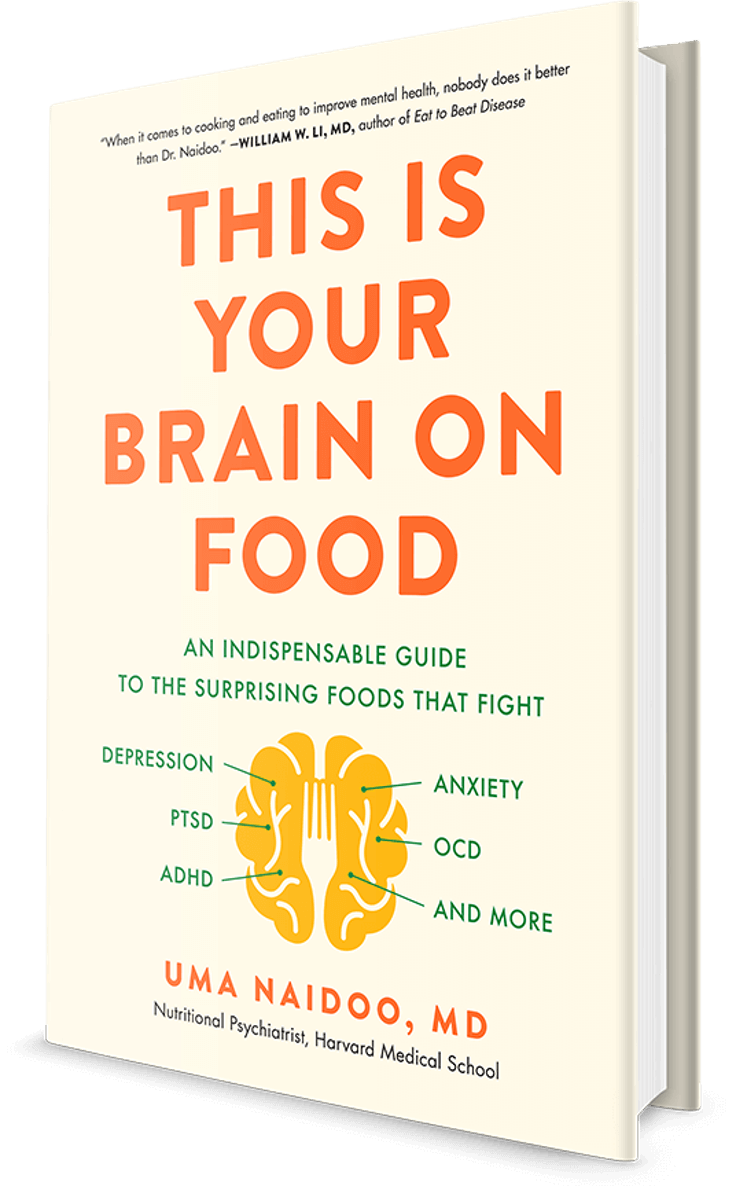
Dr. Uma Naidoo has a wonderful new book called This Is Your Brain on Food: An Indispensable Guide to the Surprising Foods that Fight Depression, Anxiety, PTSD, OCD, ADHD, and More (my Amazon link)

Her big bold message is this “Until we solve nutritional problems, no amount of medication and psychotherapy is going to be able to stem the tide of mental issues in our society.”  This is something I wholeheartedly agree with!

I had the wonderful opportunity to interview Dr. Naidoo and we talked about the benefits of fermented foods and social anxiety, vitamin D and anxiety, dietary sources of polyphenols for ADHD and much more:

  • A 2015 study, Fermented foods, neuroticism, and social anxiety, reports that people eating fermented foods saw a reduction in their social anxiety and neurotic traits
  • Dr. Naidoo recommends unflavored kefir (which can be used to make a creamy dressing), miso, fermented vegetables and kombucha (watch the added sugars)
  • I mention kombucha as a source of fluoride (watch if you have issues with fluoride)
  • Vitamin D and anxiety: we discuss a 2019 study, Effect of Vitamin D Supplement on Mood Status and Inflammation in Vitamin D Deficient Type 2 Diabetic Women with Anxiety: A Randomized Clinical Trial

51 women with type 2 diabetes and vitamin D deficiency were randomly allocated to receive one oral pearl of 50,000 IU vitamin D3 (26 women) or a placebo (25 women) fortnightly for 16 weeks

Anxiety score changes were significantly lower in vitamin D group than the controls

  • Dr . Naidoo recommends these sources of vitamin D: egg yolks, salmon, mushrooms and sun exposure (sun through a window doesn’t count)
  • Dietary polyphenols and ADHD: We talk about a 2018 study, Rationale for Dietary Antioxidant Treatment of ADHD

Dietary polyphenols… have antioxidant capacities as well as immunoregulatory effects and, therefore, appear appropriate in ADHD therapy.

  • Dr. Naidoo recommends these sources of polyphenols: berries and other fruit, vegetables, extra virgin olive oil.
  • I’m fascinated by the fact that polyphenols “act as a low-dose toxin that trains the body to mount an immune response in a process called hormesis” (there are many geeky gems like this in the book)
  • Dr. Naidoo shares the story of her 36 year old patient with severe anxiety. He was a binge eater and also had a history of alcohol abuse. Vitamin B1 (250mg) was every effective for him…“In animal studies, thiamine appears to reduce stress-like responses because it protects the hippocampus”
  • We talk about chamomile tea and how it helps with sleep. There are some cautions if you’re on a blood thinner prescription or going to have surgery. Pregnant women should also avoid it.
  • Dr. Naidoo shares a delicious Golden Milk recipe with tips on how to use turmeric (one her favorite spices and inspired by her grandmother’s cooking) with black pepper. You’ll find this in the recipes section.
  • Dr Naidoo also shares one of her favorite comfort foods – a yummy lentil soup recipe called dal in south Indian cuisines. It’s a great source of fiber, plant-based protein and is very affordable. And really healthy when cooked with vegetables and spices like mustard seeds, ginger, garlic and turmeric. She shares a tip to improve the flavors – making tadka (listen to the interview below, enjoy and be inspired!)


It’s a wonderful book that I highly recommend if:

  • you are new to nutritional psychiatry and the power of food
  • you are a seasoned foodie and want to geek out on mechanisms and the science
  • you want to learn about foods and nutrients (all science-based) specifically for depression, anxiety, PTSD, OCD, ADHD and insomnia
  • you are a practitioner and want to learn and share a wonderful book with your patients or clients

I read it cover to cover and picked up so many gems. I also loved reading about her memories of cooking with her Pinetown granny (Pinetown is just outside Durban where we both happened to grow up)!

We do have a few professional differences of opinion that I feel I should mention:

  • I am not in favor of canola oil and I’d switch out the recipes that call for canola oil with olive oil
  • I have a difficult time extrapolating high-fat diets in rat studies to concerns about saturated fat consumption in humans (given the nature of the rat chow in many of these studies)
  • I’m more concerned with portion-size of carbs than I am with portion-size of healthy fats (and typically recommend full-fat coconut milk, and chicken and turkey with skin-on)
  • I find grass-red meat to be beneficial for my clients with anxiety and mood issues
  • Many of my anxious clients cannot tolerate any caffeine and I consider 14 alcoholic drinks a week for men and 7 alcoholic drinks a week for women to be excessive
  • I prefer stove-top and oven cooking to using a microwave.

This is the official book blurb:

Did you know that blueberries can help you cope with the aftereffects of trauma? That salami can cause depression, or that boosting Vitamin D intake can help treat anxiety?

When it comes to diet, most people’s concerns involve weight loss, fitness, cardiac health, and longevity. But what we eat affects more than our bodies; it also affects our brains. And recent studies have shown that diet can have a profound impact on mental health conditions ranging from ADHD to depression, anxiety, sleep disorders, OCD, dementia and beyond.

A triple threat in the food space, Dr. Uma Naidoo is a board-certified psychiatrist, nutrition specialist, and professionally trained chef. In This Is Your Brain on Food, she draws on cutting-edge research to explain the many ways in which food contributes to our mental health, and shows how a sound diet can help treat and prevent a wide range of psychological and cognitive health issues.

Packed with fascinating science, actionable nutritional recommendations, and delicious, brain-healthy recipes, This Is Your Brain on Food is the go-to guide to optimizing your mental health with food.

Uma Naidoo, MD is board-certified psychiatrist (Harvard Medical School), professional chef (Cambridge School of Culinary Arts), and nutrition specialist (Cornell University). She is currently the Director of Nutritional and Lifestyle Psychiatry at Massachusetts General Hospital (MGH), where she consults on nutritional interventions for the psychiatrically and medically ill; Director of Nutritional Psychiatry at the Massachusetts General Hospital Academy; and has a private practice in Newton, MA. She also teaches at The Cambridge School of Culinary Arts.

Dr. Naidoo speaks frequently at conferences at Harvard, for Goop audiences, the New York City Jewish Community Center (JCC), and Ivy Boston. She blogs for Harvard Health and Psychology Today and completed a unique video cooking series for the MGH Academy which teaches Nutritional Psychiatry using culinary techniques in the kitchen.

You can get your copy of This Is Your Brain on Food here (my Amazon link) and find additional information about Dr. Naidoo here and the book here.

Let us know what you think in the comments below and be sure to leave Dr. Naidoo a review once you read your copy!

Feel free to post your questions here too.

Filed Under: Anxiety, Books Tagged With: ADHD, anxiety, brain, chamomile tea, dal, depression, Dr. Uma Naidoo, fermented food, food, insomnia, OCD, polyphenols, PTSD, sleep, This Is Your Brain on Food, turmeric, Uma Naidoo, vitamin D

I am an emotional eater and eat sugar as a reward and find myself craving it when I am fatigued. Do you have clients on more than one amino acid?!

July 24, 2020 By Trudy Scott 24 Comments


emotional eating and amino acides

This is a question I received from a stressed out mom in my community. She has identified when she craves sugar and the emotion connected to her cravings. Now she has questions about how to trial and use amino acids to stop her cravings, get her energy back and feel emotionally stable:

I know I am an emotional eater, I know I eat sugar as a reward and I do find myself craving it when I am fatigued. I also seem to crave it after a very savory meal; especially one with garlic. What is THAT about?! Do you have clients on more than one amino acid?!

I have been a caregiver for my son (multiple disabilities) for 30 years; he has uncontrolled seizures and my husband has PTSD. It is a stressful household.

This is what I shared with her about the brain chemical imbalances and amino acids:

  • Many of my clients need more than one amino acid but it’s best to trial one at a time. When I hear my client say they eat sugar as a reward we immediately consider a trial of DPA (d-phenylalanine) especially if they are also overly emotional/weepy and also have physical pain.
  • When I hear my client say “I do find myself craving sugar when I am fatigued” we consider low catecholamines and a trial of tyrosine especially if they also have poor focus, low motivation and a flat mood. If the fatigue is caused by low blood sugar this can cause fatigue, irritability/crankiness and anxiety and a trial of glutamine may be a better option. If the DPA helps the emotional-reward-eating after a week or two, then we may do a trial of tyrosine and/or glutamine (one at a time) and use them in addition to the DPA.
  • When I hear “sugar cravings after a savory meal” we consider low serotonin and a trial of tryptophan if it’s after lunch or dinner. Serotonin dips in the afternoon and evening triggering this type of craving. With low serotonin we also see worry, anxiety, depression, anger, PMS, insomnia and irritability. Let’s assume the DPA helps and the tyrosine helps with the fatigue, then we’d consider a trial of tryptophan and add that.

So yes I do have many clients needing more than one amino acid! But we always trial one at a time and find a good baseline before adding the next one or doing a new trial if the first one didn’t give expected results.

With regards to which amino acid trial to do first, I always ask my client which area is causing the most problem or distress in your life and we start there. Since she mentioned emotional eating and then fatigue and then cravings after a savory meal, this sequence may be best for her. But addressing the fatigue with tyrosine first may be a better approach for someone else.

With regards to cravings after a savory meal we also look into how much protein and healthy fats the client has in that meal. I don’t know why garlic would be a trigger other than it’s possibly stirring up candida. Candida is also a big factor when it comes to sugar cravings, fatigue and feeling sad/emotional so we would also possibly need to address this too.

Adrenal and sleep support is also key and I recommend this resource for additional caregiver support for her – The psychological trauma of coronavirus – nutritional support for doctors, nurses and their loved ones.

For her husband’s PTSD I recommend this resource – PTSD from 3 tours in Afghanistan: Can GABA help with the anxiety?

For her son’s seizures I recommend this paper, Ketogenic Diet and Epilepsy: What We Know So Far, and working with a practitioner who could offer consultation and guidance on a ketogenic diet.  Another useful resource is this one – Use of Cannabidiol in the Treatment of Epilepsy: Efficacy and Security in Clinical Trials.

If you suspect low levels of any any of the neurotransmitters and are new to using the amino acids and do not have my book I highly recommend getting it and reading it before jumping in to taking supplements: The Antianxiety Food Solution – How the Foods You Eat Can Help You Calm Your Anxious Mind, Improve Your Mood, and End Cravings.

There is a complete chapter on the amino acids and one for pyroluria, plus information on real whole food, sugar and blood sugar, gluten, digestion and much more.  If you’re not a reader there is now also an audible version.

Here is the Amino Acids Mood Questionnaire from The Antianxiety Food Solution and additional information on Anxiety and targeted individual amino acid supplements: a summary

Please also read and follow these Amino Acid Precautions.

This lists The Antianxiety Food Solution Amino Acid and Pyroluria Supplements that I use with my individual clients and those in my group programs. You’ll find DPA, tyrosine and tryptophan listed here.

Please share your emotional eating and sugar craving success story if you have one using DPA.

And let us know if tyrosine helps with your fatigue and low-energy driven sugar cravings?

And does tryptophan help your afternoon and evening sugar cravings?

Feel free to post your questions here too.

Filed Under: Cravings Tagged With: anxiety, DPA, emotional eating, endorphins, energy, fatigue, glutamine, insomnia, low mood, pain, PTSD, seizures, serotonin, stressed, sugar, tryptophan, worry

The psychological trauma of coronavirus – nutritional support for doctors, nurses and their loved ones

April 3, 2020 By Trudy Scott 13 Comments

psychological trauma coronavirus

If you are a nurse or doctor or providing support in any capacity in hospitals and other essential services during this coronavirus pandemic you need nutritional support.  You may be feeling on edge and anxious, worried about the future, concerned and angry about the lack of personal protective equipment (PPE), fearful for your safety and terrified about bringing the virus back to your family, exhausted and yet not able to sleep, feeling overly emotional and weepy about your patients (and decisions you are making or you anticipate having to make), and starting to have nightmares.

I’m not downplaying the enormity of the stress and trauma you are already facing and will continue to face, but we must not forget that nutrients (and nature and exercise) have a role to play in PTSD and trauma. They help to make you more resilient and mitigate some of the effects of trauma, and they also support healing and recovery.

When you feel calmer and you sleep better, you indirectly support your immune function too. There is also research that directly supports the role that GABA plays in improving immune function (more on this below).

B-complex and a multi-vitamin for everyone

If this is all that can be managed, a B-complex and a good multi-vitamin would be my first choice for everyone. I wrote this blog during Hurricane Harvey: Nutrition solutions for psychological stress after a natural disaster. It’s equally applicable now. Simply replace “after a natural disaster” with “during the coronavirus pandemic.”

My colleagues Bonnie Kaplin and Julia Rucklidge published this paper in 2015: A randomised trial of nutrient supplements to minimise psychological stress after a natural disaster. They found that folks traumatised after New Zealand earthquakes and floods in southern Alberta, Canada, showed significantly greater improvement in stress and anxiety when consuming a B-Complex and/or broad-spectrum mineral/vitamin formula.

In a newly published article in the Calgary Herald, Dr. Kaplan explains how these nutrients act as co-factors for making serotonin, GABA and dopamine and that “we should all consider a B-complex and/or a broad-spectrum nutrient formula on a daily basis to strengthen our mental resilience.”

My second recommendation is GABA and/or theanine

Supporting low levels of GABA, the calming neurotransmitter, eases your anxiety, improves your sleep and supports your immunity. When you feel calmer and you sleep better, you indirectly support your immune function too:

the physiological response to psychological stressors can dramatically impact the functioning of the immune system (from this paper)

We also have research that directly supports the role that GABA plays when it comes to improving immune function.

We want you to stay emotionally and physically strong and so does your family!

I write more about this here: GABA and theanine for easing anxiety, improving sleep and supporting immunity.  I share advice if you’re currently using GABA/theanine or have used it in the past, and a summary if you’re new to low GABA anxiety symptoms and using GABA/theanine.

Melatonin and serotonin support

I have my clients use a sublingual melatonin for going to sleep and a timed-release melatonin for staying asleep, and it’s another recommendation I’m making.

Melatonin improves sleep, helps ease anxiety and fear and may help with PTSD:

  • A double-blind, placebo-controlled crossover trial concludes that “melatonin may be an effective treatment for shift work nurses with difficulty falling asleep.”
  • Low levels of melatonin are common in military-related PTSD.
  • Melatonin modulates fear and “may serve as an agent for the treatment of PTSD”.

This in press and pre-proof paper reports on melatonin: COVID-19: Melatonin as a potential adjuvant treatment:

Melatonin, a well-known anti-inflammatory and anti-oxidative molecule, is protective against ALI/ARDS [acute lung injury/acute respiratory distress syndrome] caused by viral and other pathogens. Melatonin is effective in critical care patients by reducing vessel permeability, anxiety, sedation use, and improving sleeping quality, which might also be beneficial for better clinical outcomes for COVID-19 patients. Notably, melatonin has a high safety profile.

This is very promising for offering added protection if you are working on the front-line and for  your patients too.

Serotonin is the precursor to melatonin and the amino acid tryptophan is one of the raw materials for making serotonin. I would also include tryptophan or 5-HTP for supporting serotonin levels to help with the worry and anxiety in the head, lying awake ruminating, feelings of fear, anger, depression, worry and negative thinking.

Try to get into nature for the pure joy of it and to lower your cortisol

Do your absolute best to try and get some nature. I share some simple options in this blog:

  • Get out into nature at least one day a week i.e. do some “forest bathing”
  • Take a short detour and drive to work via a tree-lined street
  • Look at some images of nature: sit and stare at a giant poster or even watch a show on National Geographic

Beyond the pure joy of spending time in nature, there is research supporting all of the above in playing a role in reducing anxiety, feeling more positive and calm, reducing cortisol levels and helping with recovery from stressful situations.

tree-lined street

Do this workout a few times a week for mood support

Here is a great workout from Dr. Zach Bush, MD. He recommends doing it 3 x day and starting with 10 reps of each of the 4 exercises and building up to 20 reps of each one:

The Four Minute Workout is a new concept of exercise that revolves around the body’s ability to use Nitric Oxide for muscle growth. This is an efficient anaerobic workout that can be done multiple times per day. The more frequently you do it, the better your results.

In this blog, I write how signals from our large leg muscles alter our brain and nervous system and improve mood.

If it’s your loved-one on the front-lines be sure to take care of yourself too

All of this nutritional support is also important if you are the mother or husband or wife or sister or brother etc. who is anxious and worrying about your loved one. You need to be strong for them so be sure to take care of you too.

Even if you are not working on the front-line or don’t know anyone doing so, if you are experiencing any of the above emotions, you need nutritional support too.

The New York Times article

It was reading this very somber and eye-opening article in the New York Times that promoted me to write this blog: The Psychological Trauma That Awaits Our Doctors and Nurses

The angst that clinicians may experience when asked to withdraw ventilators for reasons not related to the welfare of their patients should not be underestimated,” warn the authors of the article in The New England Journal of Medicine.“It may lead to debilitating and disabling distress.

We look at veterans and thank them for their service, never being able to fully comprehend what they’ve been through. The same may soon be true of some of our health care professionals. We may think we know. But we don’t.

No-one should have to make these choices and our hearts break for you and the families who are being impacted.

Louisiana article conveys the gravity of the situation like no other

Unfortunately it is happening already. This article conveys the gravity of the situation like no other and I’ve been pouring through everything – an account from a respiratory therapist in a Louisiana hospital (published two weeks ago.) We have been hearing similar stories from Italy for over a month now. Be warned – it’s horrifying!

It does include this statement… “The medical details in this story were vetted by an infectious disease doctor, a cardiologist and an internist at three different hospitals. All of the information about ARDS, the condition that the respiratory therapist describes, was fact-checked against peer-reviewed articles and UpToDate, a resource for physicians to check current standards in care, clinical features, and expected complications and outcomes.”

Because but I’m not familiar with this publication, I also checked with colleagues who are doctors and this is medically accurate.

While we don’t want to create panic I want to understand what doctors and nurses are facing so I can help. I do also believe we all deserve to know the facts, so we can truly support our doctors and nurses, and so we take this very seriously and stay home!

My biggest wish

It is my biggest wish that we can prevent much of this heart-ache and trauma going forwards, by preventing the spread of this virus and preventing the need for ventilators by helping sick individuals recover more quickly or prevent folks getting sick in the first place.

I do know of many incredible functional medicine practitioners who are creating task forces and working behind the scenes putting together proposals to present to governors, governments and mainstream medicine.

The products I mention and eating real whole food

The products I recommend to my clients are Designs for Health B Supreme and Designs for Health Twice Daily Multi.

You can find the GABA, theanine, tryptophan and 5-HTP on the supplements blog here.

If you are working in a hospital or medical setting or essential services

  • Please reach out if you need help with any of this – how to implement these recommendation or where to get the products
  • If you’re already doing this please share so we can encourage others to support themselves

And if your loved ones or friends in healthcare need support

  • Please share this blog with them and help them get access to these nutrients
  • I also encourage you to read my book – The Antianxiety Food Solution – How the Foods You Eat Can Help You Calm Your Anxious Mind, Improve Your Mood, and End Cravings – and give them the highlights about eating real whole food, quality animal protein, organic veggies and fruits, fermented foods, healthy fats, avoiding caffeine and sugar, eating for blood sugar control etc.
  • Please share if you know ways we can get this information (and nutrients) into the hands of more of our front-line workers
  • My focus is nutrition and nutrients but they also need someone to talk to so give them a call and be a listening ear. Also, help them find an online therapy service if they feel they need it. It’s encouraging to see more and more of this being made available.

One final comment – these are the bare essentials. In an ideal world, with more time, it would be best to work with a functional medicine practitioner and nutritionist and figure out your exact nutritional needs.

Filed Under: Anxiety Tagged With: B-complex, cortisol, doctors, exercise, GABA, hope, hospital, melatonin, multi-vitamin, nature, nurses, psychological trauma, PTSD, serotonin, tryptophan

  • Page 1
  • Page 2
  • Page 3
  • Go to Next Page »

Primary Sidebar

NEW! GABA QuickStart Homestudy (with special intro pricing)

gaba quickstart homestudy

Free Report

9 Great Questions Women Ask about Food, Mood and their Health

You'll also receive a complimentary subscription to my ezine "Food, Mood and Gal Stuff"


Connect with me

Popular Posts

  • Amino Acids Mood Questionnaire from The Antianxiety Food Solution
  • The Antianxiety Food Solution Amino Acid and Pyroluria Supplements
  • Pyroluria Questionnaire from The Antianxiety Food Solution
  • Collagen and gelatin lower serotonin: does this increase your anxiety and depression?
  • Tryptophan for the worry-in-your-head and ruminating type of anxiety
  • GABA for the physical-tension and stiff-and-tense-muscles type of anxiety
  • The Antianxiety Food Solution by Trudy Scott
  • Seriphos Original Formula is back: the best product for anxiety and insomnia caused by high cortisol
  • Am I an anxious introvert because of low zinc and vitamin B6? My response to Huffington Post blog
  • Vagus nerve rehab with GABA, breathing, humming, gargling and key nutrients

Recent Posts

  • What do I use instead of Seriphos to help lower high cortisol that is affecting my sleep and making me anxious at night?
  • BeSerene™ GABA/theanine cream eases severe muscle tension in her neck/shoulders, prevents her bad headaches and quells her anxiety
  • How the correct approach, dose and sublingual use of GABA can be calming and not cause a flushed and itchy face and neck
  • The amino acid glutamine improves low mood by addressing gut health, and it has calming effects too
  • Flight anxiety with heightened breath, physical tension and also fearing the worst (the role of low GABA and low serotonin)

Categories

  • 5-HTP
  • AB575
  • Addiction
  • ADHD
  • Adrenals
  • Alcohol
  • Allergies
  • Alzheimer's disease
  • Amino Acids
  • Anger
  • Antianxiety
  • Antianxiety Food Solution
  • Antidepressants
  • Anxiety
  • Anxiety and panic
  • Autism
  • Autoimmunity
  • benzodiazapines
  • Bipolar disorder
  • Books
  • Caffeine
  • Cancer
  • Candida
  • Children/Teens
  • Collagen
  • Cooking equipment
  • Coronavirus/COVID-19
  • Cravings
  • Depression
  • Detoxification
  • Diabetes
  • Diet
  • DPA/DLPA
  • Drugs
  • EFT/Tapping
  • EMF
  • EMFs
  • Emotional Eating
  • Endorphins
  • Environment
  • Essential oils
  • Events
  • Exercise
  • Fear
  • Fear of public speaking
  • Fertility and Pregnancy
  • Fish
  • Food
  • Food and mood
  • Functional neurology
  • GABA
  • Gene polymorphisms
  • General Health
  • Giving
  • Giving back
  • Glutamine
  • Gluten
  • GMOs
  • Gratitude
  • Gut health
  • Heart health/hypertension
  • Histamine
  • Hormone
  • Hyperparathyroidism
  • Hypoglycemia
  • Immune system
  • Inflammation
  • Insomnia
  • Inspiration
  • Introversion
  • Joy and happiness
  • Ketogenic diet
  • Lithium orotate
  • Looking awesome
  • Lyme disease and co-infections
  • MCAS/histamine
  • Medication
  • Men's health
  • Mental health
  • Mercury
  • Migraine
  • Mold
  • Movie
  • MTHFR
  • Multiple sclerosis
  • Music
  • NANP
  • Nature
  • Nutritional Psychiatry
  • OCD
  • Osteoporosis
  • Oxalates
  • Oxytocin
  • Pain
  • Paleo
  • Parasites
  • Parkinson’s disease
  • PCOS
  • People
  • PMS
  • Postpartum
  • PTSD/Trauma
  • Pyroluria
  • Questionnaires
  • Real whole food
  • Recipes
  • Research
  • Schizophrenia
  • serotonin
  • SIBO
  • Sleep
  • Special diets
  • Sports nutrition
  • Stress
  • Sugar addiction
  • Sugar and mood
  • Supplements
  • Teens
  • Testimonials
  • Testing
  • The Anxiety Summit
  • The Anxiety Summit 2
  • The Anxiety Summit 3
  • The Anxiety Summit 4
  • The Anxiety Summit 5
  • The Anxiety Summit 6
  • Thyroid
  • Thyroid health
  • Toxins
  • Tryptophan
  • Tyrosine
  • Uncategorized
  • Vegan/vegetarian
  • Women's health
  • Yoga

Archives

  • October 2025
  • September 2025
  • August 2025
  • July 2025
  • June 2025
  • May 2025
  • April 2025
  • March 2025
  • February 2025
  • January 2025
  • November 2024
  • October 2024
  • September 2024
  • August 2024
  • July 2024
  • June 2024
  • May 2024
  • April 2024
  • March 2024
  • February 2024
  • January 2024
  • December 2023
  • November 2023
  • October 2023
  • September 2023
  • August 2023
  • July 2023
  • June 2023
  • May 2023
  • April 2023
  • March 2023
  • February 2023
  • January 2023
  • December 2022
  • November 2022
  • October 2022
  • September 2022
  • August 2022
  • July 2022
  • June 2022
  • May 2022
  • April 2022
  • March 2022
  • February 2022
  • January 2022
  • December 2021
  • November 2021
  • October 2021
  • September 2021
  • August 2021
  • July 2021
  • June 2021
  • May 2021
  • April 2021
  • March 2021
  • February 2021
  • January 2021
  • December 2020
  • November 2020
  • October 2020
  • September 2020
  • August 2020
  • July 2020
  • June 2020
  • May 2020
  • April 2020
  • March 2020
  • February 2020
  • January 2020
  • December 2019
  • November 2019
  • October 2019
  • September 2019
  • August 2019
  • July 2019
  • June 2019
  • May 2019
  • April 2019
  • March 2019
  • February 2019
  • January 2019
  • December 2018
  • November 2018
  • October 2018
  • September 2018
  • August 2018
  • July 2018
  • June 2018
  • May 2018
  • April 2018
  • March 2018
  • February 2018
  • January 2018
  • December 2017
  • November 2017
  • October 2017
  • September 2017
  • August 2017
  • July 2017
  • June 2017
  • May 2017
  • April 2017
  • March 2017
  • February 2017
  • January 2017
  • December 2016
  • November 2016
  • October 2016
  • September 2016
  • August 2016
  • July 2016
  • June 2016
  • May 2016
  • April 2016
  • March 2016
  • February 2016
  • January 2016
  • December 2015
  • November 2015
  • October 2015
  • September 2015
  • August 2015
  • July 2015
  • June 2015
  • May 2015
  • April 2015
  • March 2015
  • February 2015
  • January 2015
  • December 2014
  • November 2014
  • October 2014
  • September 2014
  • August 2014
  • July 2014
  • June 2014
  • May 2014
  • April 2014
  • March 2014
  • February 2014
  • January 2014
  • December 2013
  • November 2013
  • October 2013
  • September 2013
  • August 2013
  • July 2013
  • June 2013
  • May 2013
  • April 2013
  • March 2013
  • February 2013
  • January 2013
  • December 2012
  • November 2012
  • October 2012
  • August 2012
  • July 2012
  • June 2012
  • May 2012
  • April 2012
  • March 2012
  • February 2012
  • January 2012
  • December 2011
  • November 2011
  • October 2011
  • September 2011
  • August 2011
  • July 2011
  • June 2011
  • May 2011
  • April 2011
  • March 2011
  • February 2011
  • January 2011
  • December 2010
  • October 2010
  • September 2010
  • July 2010
  • May 2010
  • April 2010
  • March 2010
  • February 2010
  • January 2010
  • November 2009

Share the knowledge!

The above statements have not been evaluated by the Food and Drug Administration. Products listed in this website are not intended to diagnose, treat, cure or prevent any disease.

The information provided on this site is for informational and educational purposes only and is not intended as a substitute for advice from your physician or other health care professional. You should consult with a healthcare professional before starting or modifying any diet, exercise, or supplementation program, before taking or stopping any medication, or if you have or suspect you may have a health problem.


Copyright © 2026 Trudy Scott. All Rights Reserved. | Privacy | Terms and Conditions | Refund Policy | Medical Disclaimer

Free Report

9 Great Questions Women Ask about Food, Mood and their Health

You’ll also receive a complimentary subscription to my ezine “Food, Mood and Gal Stuff”