• Skip to primary navigation
  • Skip to main content
  • Skip to primary sidebar

everywomanover29 blog

Food, Mood and Women's Health – Be your healthiest, look and feel great!

  • Blog
  • About
  • Services
  • Store
  • Resources
  • Testimonials
  • The Book
  • Contact
  • Search this site

panic attacks

Is the term ‘broken brain’ hopeful and real or too negative and scary?

January 12, 2018 By Trudy Scott 18 Comments

If you experience anxiety, panic attacks, depression, memory or cognitive issues, ADHD or poor focus and someone suggests you may be suffering from a broken brain are you intrigued and hopeful that something that is broken can now be fixed OR do you consider the term broken brain too negative and scary?

I received this feedback from someone in my community when I shared my recent Broken Brain interview with Dr. Mark Hyman:

I’m looking forward to seeing the [Broken Brain] documentaries however I dislike the title. Everything that you say and think is affecting your brain. For me Broken is not a word with healing potencies but suggests that is something very bad happening in the brain. And maybe that is the case, but how we interpret our symptoms is very crucial for healing. In my opinion it could be Healing the Brain or something like that. I think is very important that the title implies positivity not fear!

I shared this feedback with her: “Thanks for sharing – you’re the 4th person in a day to say this. Prior to your feedback and hearing from 3 mental health colleagues earlier today I had not considered the name would invoke negativity and fear. One of my mental health colleagues shared with me that “referring to people as ‘broken’ is really stigmatizing and inappropriate.”

My thinking is that just like a leg is broken, the brain can be broken and can just as easily be fixed when we address the root causes. I’ve also watched the series (during the test run late last year) and have seen the wisdom, caring and compassion of the experts and Dr. Hyman, as well as the solutions and message of hope. I suspect that has swayed my opinion too. But I do see your point on being positive and solution-oriented without the fear aspect.”

What do you think?

It’s important that I serve my community well – and that’s you! If something concerns you I want to know so I can address it.  I also want you to know that I’m offering solutions hope and not wanting to create fear and negativity, so I posed this question on Facebook (together with the above feedback from the blog):

I’d love to hear your thoughts on the title of Dr. Hyman’s new Broken Brain docu-series?

What do you think? Good title? Bad title? And why?

The positive feedback: enlightening, fixable, hopeful

The majority of responses were positive feedback. Here are many of them:

  • Mary Anne McEvoy: I rather like the title. When I read the word “Broken” it brought my awareness to: “WOW – the brain can actually get ‘broken’!” I want to see the docu-series because of the word broken.
  • Cathcart Louque: I don’t mind the title at all. I work in mental health (as a Care Manger for a non-profit mental health organization helping low income people) and see “broken brains” everyday which could be so much better by diet, exercise, meditation etc. I wish something would shake people up into wanting to have better brain health. Dementia and Alzheimer’s can be at work ten, twenty, thirty years before it manifests but people continue to make bad choices. I hope his videos will bring enlightenment to many and more will be proactive! Me included 😀! Daily healthy choices are not always the easiest but boy it’s so worth it.
  • Susan McDuffie: This title may really speak to those who feel in dire straits. ‘Have tried everything, read everything, and still struggle.’ Sometimes it’s the darker words that actually resonate with people.
  • Wyndie: I’m not afraid of the word broken – it’s true. Some things break. But broken things can be fixed. When I hear that title, I don’t hear negative, I hear reality.
  • Holly Higgins, NTP: I love the title. It’s catchy, alliterative, and it’s the exact words that so many of my clients use to describe how they feel. I’ve heard this phrase over and over by people who feel like they’ve been harmed by psychiatry or have never felt like their brain was working right. We are all going to have different reactions. It’s clear from the content of the series and the character of the people involved that this was not meant to be offensive.
  • Marthe: I actually liked the title. I thought it was powerful and, to me, it inferred that brain issues are becoming common occurrences and that there are ways to heal.
  • Leslie Montano: It’s just a title. I like the alliteration. It’s catchy, easy to remember, and certainly effective in that way for marketing. It not stigmatizing, it is not directly calling any person broken, it is speaking about a part of the body generally. Things that are broken can be repaired. There is hope. And personally, 2 years ago before I fixed my diet and lifestyle, I felt broken. Broken brain explains EXACTLY what was going on and how I was feeling.
  • Sharleen McDowall: As a psychologist, I like the title. I see the title the same way you do – just like a broken leg. I think the title conveys a strong message and it is needed to spark the conversation about how we are treating our brains. Also, Dr. Hyman’s message focuses on how the broken brain can be healed which is very positive.
  • Lee Ann Foster: First of all, it’s a good, empowering series giving people a lot of useful and hope-inspiring information to care for their brain related issues. Secondly, as a 30-year old functional neuropsychology practice, Neurosource, in which we get to root issues and help re-regulate brain function through evidence based technologies and lifestyle interventions, we find that many people are relieved when we show them through 3-D neuroimaging how their brain is dysregulated – or one could say broken. We find people feel hopeful when they see their issues are physiological in nature (and can be helped), versus giving them stigmatized and often inaccurate or unhelpful mental health diagnostic labels that mean very little aside from labeling for insurance and pharmaceutical purposes. Just my two cents.
  • Pierce: For me the first step in healing is acknowledging that I’m broken at the moment. Then I focus on moving forward and healing for the long term.
  • Deena Louise: My son has tuberous sclerosis that has left him severely disabled with autism, MR and uncontrolled epilepsy….when my daughter, who is younger than him by 6 years, was able to understand that he was “different” than neurotypical people, she asked what was wrong with him….why didn’t he talk. She didn’t understand autism, so we just told her he had a broken brain. Some things can be fixed and some things can’t. She understood it when we said it that way. I think the title is fine…broken is just a word used to describe something that isn’t working right at the moment. Dealing with anxiety, menopause, insomnia and panic…my brain definitely feels broken! I can’t wait to watch the series, I don’t care what he calls it. I am grateful for all of these lovely functional medicine docs and scientists giving of their time and expertise to help so many.

The less than positive feedback: worthless, negative, insensitive

Three mental health professionals felt the term broken brain was stigmatizing but other than this, surprisingly few people had negative feedback. A few people resonated with words like repair or mend instead of broken, saying most people think of broken as worthless and negative, and can’t be fixed. One mom felt it was insensitive to the real struggles of depression and anxiety. Here are a few specific comments:

  • Donna: Broken brains aren’t as easily fixable as broken legs. Broken brain means Alzheimer’s or stroke or something equally scary to me. I think another word could have been used to get the point across…. whatever a broken but fixable brain is…
  • Missy Ruth: Our brains are not broken. They regenerate and grow and change and are incredible. However, they certainly can feel like they are not operating like we wish they would. Labeling the brain as “broken” is an example of inflammatory linguistics, and as human beings we create fear by using terms that exaggerate. We scare ourselves. Nobody’s brain is broken.

If you don’t like the term broken brain, I’m hoping you will get some inspiration and feel some level of comfort from the positive comments above and watch it anyway. You will see there are solutions, compassion and hope!

Also, many of my clients who use words like “negative, worthless, scary and fear”, do feel better when we look into low serotonin and address low levels with tryptophan or 5-HTP. Also, addressing gluten issues, poor gut health, low GABA, low zinc and so on – everything body-related that can affect the mind and brain. All of this is covered in the docuseries, other then the use of targeted amino acids, which I cover extensively in my book The Antianxiety Food Solution, in my newsletters and elsewhere on this blog.

An apology: integrity, compassion and hope

I really want to hear your thoughts but also want to offer Dr. Hyman’s apology if you are offended by the term broken brain. As soon as his team started getting feedback they issued this statement on his behalf:

Thank you for your comment. We completely understand what you are saying and we agree. So much of this docuseries is about Dr. Hyman’s personal health crisis and how he treated his own brain disorder. During this time Dr. Hyman felt like he had a broken brain. This is why we decided to call the title Broken Brain because the foundation of the series is about his personal journey. However, we do not think that everyone who is dealing with a brain disorder or a developmental disorder has a broken brain. We know that all individuals, including those with brain conditions, are fully complete people, each with their unique spirit. We hope that you’ll watch the series and understand that more than anything it’s about hope and about moving toward our best health!

I find this very thoughtful and it clearly reflects the level of his integrity and compassion.

In case you’re just hearing about the Broken Brain for the first time, you can watch my highlights video interview with Dr. Hyman (together with the transcript).

So, what do YOU think? Is broken brain a good title or term? Or a bad title or term? And why?

(With appreciation if you already provided feedback and for giving me permission to share it here. This is a good discussion to have!)
Filed Under: Antianxiety, Events Tagged With: anxiety, broken brain, depression, Dr. Mark Hyman, hopeful, Negative, panic attacks

How to Beat Anxiety and Resolve Panic Attacks with Targeted Amino Acids: Wellness Mama podcast

September 15, 2017 By Trudy Scott 20 Comments

Today I share my wonderful interview with Katie, the “Wellness Mama”. We talk about my favorite topic: How to Beat Anxiety and Resolve Panic Attacks with Targeted Amino Acids with some extra questions about pregnancy and nursing that I’m not often asked about. Katie is mom to 6 children and many in her community are moms too.

Here is some of what we cover in our interview:

  • nutritional deficiencies commonly linked to anxiety, depression, and other problems
  • my own story of recovery from severe panic attacks
  • why perfectionism and worry might have more to do with body chemistry than your personality
  • all about the key anti-anxiety amino acids: GABA, theanine, tryptophan, 5-HTP (and others)
  • how low vitamin D, low zinc, high copper, and other nutritional factors add to anxiety
  • the low zinc and high copper play a role in postpartum depression
  • the potential neurotransmitter issue that leads to cravings
  • biochemical reasons some people are introverted or socially anxious
  • guidance for pregnant moms who can’t take amino acids (and what to do if you’re nursing)
  • the way an MTHFR mutation is linked to anxiety and how to resolve it

Here is a snippet of our interview on the topic of how to assess for low neurotransmitters and do a trial of GABA or tryptophan, and how quickly they work:

Just like you test your vitamin D levels – that’ll tell you that you’ve got low levels and you need to supplement with vitamin D, then you’ll retest and see that your levels have come up. With the amino acids and the low neurotransmitters, I find using a questionnaire is the best way to assess the fact that you may have low GABA and you may have low serotonin. Then you do a trial of the amino acid based on your unique needs, and then you redo the questionnaire and you see how things have changed.

If you use these targeted individual amino acids based on your unique need, you can see results very quickly – within five minutes, and then over the course of the next few weeks you should be seeing results very quickly. Some people will say, “I’m not seeing any impact, should I keep trying, you know, how long should I be aiming for.” The thing that, about the amino is that are so amazing, is that you get results right away. If you don’t get results, it means it’s not enough or it means you don’t need it. The anxiety is not caused by low serotonin or low GABA.

I also talk about my personal experience with low serotonin and perfectionism:

I discovered low serotonin was a factor because although the GABA helped with the physical anxiety and the panic attacks, I still had this perfectionism issue. I remember working in that computer job and being called up to do an appraisal. And they told me I was too much of a perfectionist and I needed to let go a little bit. I couldn’t believe anyone could think that was a bad thing. So it was interesting how, as you start to implement some of these, you start to realize some of these other things that you may think is just a personality thing or it’s just me, it’s just the way I am – you realize that some of these things can be related to biochemical imbalances.

As I mention above Katie does ask me about using the amino acids during pregnancy and while nursing:

I don’t recommend anyone take them during pregnancy. It’s difficult advice for me to give because I know that there are so many issues with SSRIs during pregnancy. Because we don’t have the research, it’s not something that I can recommend. If you are prone to anxiety or you’ve had anxiety, get that sorted out before you get pregnant. I know, that’s easier said than done. A lot of women really want to get pregnant now or they are pregnant and then they realize that they’ve got the anxiety. So that’s a very difficult situation.

Once you’ve had the baby, if you are having really bad anxiety, obviously you’ve got to talk to your doctor and make sure that they are okay with you taking the amino acids right after nursing and then waiting four to six hours before nursing again. It is one way to do it. And then monitoring the baby to make sure that they are okay. There are actually two studies that came out recently showing that tryptophan and tyrosine, doesn’t seem to be an issue in breast milk.

You can listen to the entire interview (and download the interview mp3 file and read the transcript) via the Wellness Mama podcast #105 blog.

For additional information on products over and above those we covered in the interview here are some recent blogs:

  • GABA for the physical tension kind of anxiety
  • tryptophan for the worry-in-the-head anxiety

Katie, is the “Wellness Mama” and her goal is to help other families live more naturally through practical tips, real food recipes, natural beauty and cleaning tutorials, natural remedies and more. Her blog is a wealth of information and if you don’t tune in to her podcasts and get her newsletter I encourage you to check her out.

Here are a few really good ones to get you started (although they really are all excellent!):

  • Epsom Salt: 21 Surprising Uses & Benefits for Health, Beauty, and Home (the first one is to use it for a relaxing bath soak, a favorite of mine; another is a recipe for a soothing magnesium lotion)
  • Homemade Remineralizing Toothpaste Recipe (Natural + Simple)
  • Homemade HE Laundry Detergent Recipe (Laundry Soap) (this was a hot topic on a recent facebook discussion)

She shares this on her site: “my real goal with the blog is to help you and to create lasting changes so that our children can grow up in a better world.” I just love her mission and passion and all the very practical and safe solutions she offers!

Filed Under: Amino Acids Tagged With: amino acids, anxiety, GABA, Katie, nursing, panic attacks, pregnancy, tryptophan, Wellness Mama

The Antianxiety Food Solution: This Book Is a Total Game Changer!!

July 21, 2017 By Trudy Scott 7 Comments

I write multiple blogs each week and the website is a wealth of information (be sure to check the comments too – I love the community feedback and questions and learn so much from you!) BUT the foundation of all that I teach and how I work with my anxious clients is outlined in great detail in my book The Antianxiety Food Solution, so I recommend this essential reading to make the basic food changes (for some people that’s all they need to do), and before using any of the nutrients, and especially before using targeted individual amino acids.  

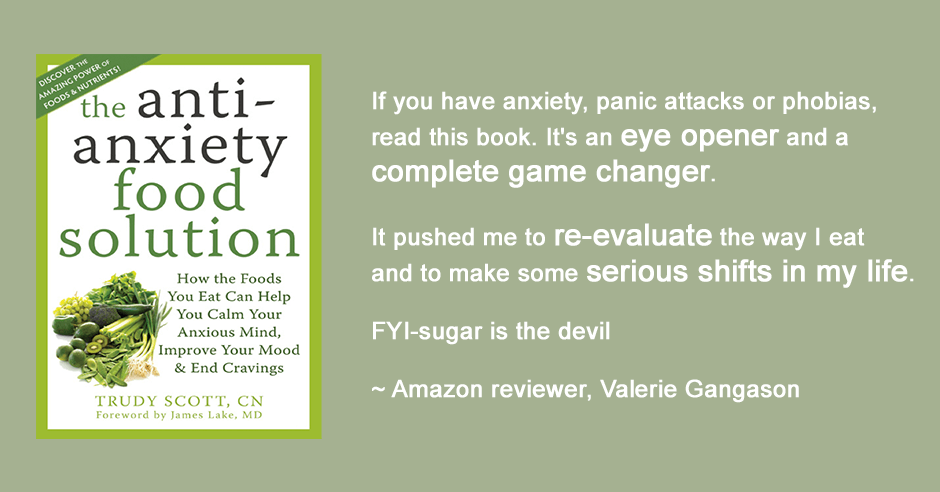
Valerie Gangason posted this wonderful review on Amazon recently: This Book Is a Total Game Changer!!

If you have anxiety, panic attacks or phobias, read this book. It’s an eye opener and a complete game changer. It pushed me to re-evaluate the way I eat and to make some serious shifts in my life. FYI-sugar is the devil

I love the comment about sugar being the devil and commend her for re-evaluating how she eats and for making those serious shifts. It’s how you get results and I ever get tired of feedback like this.

Grab your copy from Amazon here if you don’t yet have it. If you already have a copy I’d love a review on Amazon please! And if you have an older copy with no index you can grab a copy of the index here

Feel free to share your great results or ask questions in the comments.

Filed Under: Books Tagged With: anxiety, anxious, eat, panic attacks, phobias, sugar, the antianxiety food solution, Trudy Scott

Tryptophan and ascorbic acid for anxiety caused by lead toxicity

August 19, 2016 By Trudy Scott 18 Comments

lead-toxicity

Lead toxicity is a factor when it comes to anxiety, panic disorder, phobias and depression, even with low levels of lead exposure.

This 2010 paper, published in the Archives of General Psychiatry, Blood lead levels and major depressive disorder, panic disorder, and generalized anxiety disorder in U.S. young adults reports the following:

In this sample of young adults with low levels of lead exposure, higher blood lead was associated with increased odds of major depression and panic disorder. Exposure to lead at levels generally considered safe could result in adverse mental health outcomes.

The paper discusses a possible mechanism of action i.e. lead disruption of neurotransmitter production (of the catecholamines and serotonin):

If lead exposure contributes to the etiology of these disorders, the mechanism of action could involve perturbation of neurochemistry, such as brain monoamine neurotransmission.

Lead exposure is known to disrupt catecholaminergic systems, and depression and anxiety disorders are strongly associated with disturbances in these systems.

Studies in animals show that chronic lead exposure can decrease serotoninergic activity in several brain regions including the nucleus accumbens, frontal cortex, and brainstem.

It is surprising that generalized anxiety disorder was not associated with increased lead levels in this study but other research does find anxiety correlations:

  • bone lead (a biomarker of cumulative lead exposure) was associated with phobic anxiety and depression among older women who are premenopausal or who consistently take postmenopausal HRT
  • blood lead concentrations were associated with increased risk of behavioral problems and anxiety in Chinese preschool children
  • bone and blood lead levels were significantly associated with an increased risk of phobic anxiety in middle-aged to elderly men

Addressing lead and other heavy metal toxicity is not to be taken lightly and can often be quite a lengthy process. Finding a knowledgeable practitioner who understands chelation is important. We covered much of this in my interview with Dr. John Dempster on season 4 of the Anxiety Summit – Anxiety and heavy metals: chelation of mercury and lead

The good news is that while you are working on lead detoxification there is promising research that supports what I see in my clients: using the amino acid tryptophan reduces and often completely eliminates anxiety, panic attacks and depression while you are dealing with other underlying issues. In this instance it’s the lead toxicity but it could also be Lyme disease or gluten sensitivity or Hashimoto’s thyroiditis and many other conditions.

The animal study I’m referring to was published at University of Lagos paper in 2012: Neurobehavioural and neurotoxic effects of L-ascorbic acid and L-tryptophan in lead exposed rats and states that:

The sub-chronic exposure to lead decreased brain serotonin, while causing oxidative stress by decreasing reduced glutathione levels, antioxidant enzyme activity and increasing lipid peroxidation and brain protein contents.

Ascorbic acid attenuated [or reduced] both lead induced neuronal oxidative stress, and abnormalities in behaviour.

Tryptophan ameliorated [or improved] lead-altered neurobehaviour [such as anxiety and aggression].

Co-administration of ascorbic acid and tryptophan on lead exposed rats showed a reversal in all indices assessed towards the physiological state of control. This suggests that ascorbic and tryptophan can be used to compliment chelating therapy in lead neurotoxicity.

I don’t know if you can extrapolate the dosages from the rat to a human weight-wise but since I have a curious mind I did some calculations: it turns out that they used a rough equivalent of 2000mg of ascorbic acid and 1000mg of tryptophan for an adult human. The starting dose for tryptophan is typically 500mg, and less if you’re sensitive or a “pixie dust” person. I would start here and do an amino acid trial, increasing over a few weeks until anxiety symptoms start to resolve. You can read more about the amino acids process here

Have you used tryptophan (or other amino acids like GABA) to reduce or improve anxiety symptoms with success, while dealing with a bigger underlying issue such as lead toxicity?

If you’re a practitioner, have you helped your clients/patients with tryptophan while dealing with lead toxicity?

Filed Under: Anxiety and panic Tagged With: amino acids, anxiety, ascorbic acid, Lead toxicity, panic attacks, Panic disorder, serotonin, tryptophan, vitamin C

GABA, the calming amino acid: expert opinions

December 11, 2015 By Trudy Scott 69 Comments

gaba-opinions

GABA (gamma-aminobutyric acid) is one of my top nutrient recommendations for clients with physical tension, anxiety, overwhelm and panic attacks. I’m often asked if it really works and is it even worth taking so here is some feedback from practitioners from the Anxiety Summit, all of whom I consider experts on the topic.

Julia Ross, MFT, pioneer in the field of amino acid therapy, my mentor and the author of The Mood Cure and The Diet Cure shares this wisdom about GABA during our interview: Eliminating Anxiety: Amino Acid Therapy and Adrenal Balancing on season 1 of the Anxiety Summit:

Among other things, GABA relaxes the nerves in the muscles in the body. One of the most common kinds of feedback that we get from people who are doing a GABA trial is that it seems to take effect so quickly. This may be because, unlike tryptophan, which has to be converted into serotonin, GABA is the neurotransmitter and the amino acid all in one and requires no conversion.

There isn’t often a GABA discussion when the topic of the blood-brain-barrier doesn’t come up and whether GABA actually does work. Of course Julia addresses this too:

There is a myth going around, based on one old study, that GABA doesn’t cross into the brain, that it doesn’t cross the blood-brain barrier. But there are other studies that show that it does [here is a paper published earlier this year], and our clinical experience is overwhelming. This is the most popular trial that we do, the GABA trial, using only 100 mg. It zips right into the brain, and people immediately feel relaxed physically and mentally.

I see this with my clients on a daily basis and I can certainly attest to that personally too. I like to share that I was a “GABA girl”: when I had my terrible anxiety and panic attacks in my late 30s anxiety, GABA worked beautifully for me. It was amazing and life-changing! Zero anxiety and no more panic attacks!  

We are all individual and you may find that theanine works better for you than GABA. Julia talks about this too:

I would say about 15 to 20 percent of people who need this GABA-type relief of the tension and stress, don’t seem to get it from GABA. In those cases, most of them do get it from the amino acid, l-theanine, instead, in our experience.

Dr. Josh Friedman, is dear friend, colleague and integrative psychotherapist who uses amino acids and other nutritional approaches in his practice. I also had the honor of interviewing him on season 1 of the Anxiety Summit. I ask him if he uses GABA with his patients and what he thinks about the naysayers. I just love his answer:

[GABA] is definitely something I use. I am not a biochemist, so I actually don’t really know whether it crosses the blood/brain barrier, nor do I care actually. The first question should be, is it harmful? Are any of these things going to cause harm? And the answer with all the amino acids are no, they’re not going to cause harm, especially when compared to psychiatric medicines. The second question is, does it work? Is it helpful for our patients that we see in our practice?

GABA certainly worked for Meme Grant, GAPS Practitioner, Nutritional Therapist, FNTP, and fellow African. She had anxiety, panic attacks, didn’t enjoy speaking in public, had insomnia and was an emotional eater. I also interviewed her in season 1 and she shared this:

I took GABA for the first time in the afternoon and had no panic attacks that afternoon, and I took one in the evening and I did that for a couple of weeks, and I haven’t seen a panic attack since.

I find that many people do well with a combination of GABA and one or more of theanine, taurine and glycine. All of these are calming amino acids and since we are all unique you may find that one of these combinations work better for you.

Dr. Hyla Cass, M.D. board-certified in psychiatry and integrative medicine and the author of Natural Highs and The Addicted Brain and How to Break Free, talks about this in our interview: The Addicted Brain and How to Break Free   

If someone has anxiety, it’s not a Valium or a Xanax deficiency. It could be a GABA deficiency. And that could be due to stress. So if you’re low in GABA, there are some really cool things to take – theanine, glycine, taurine. The different nutrients work together and when we add them together, it’s more than the sum of its parts. So adding glycine and GABA together is going to give you a better result and you don’t have to use as much as each of the individual ones. So that’s nature’s Valium.

Jonathan Prousky, ND, MSc, editor of the Journal of Orthomolecular Medicine and author of Anxiety: Orthomolecular Diagnosis and Treatment shares this in our season 2 interview: Tapering off psychiatric drugs so they do not ruin your life

I have found GABA to be invariably helpful and I don’t really know exactly how GABA works but I know it to be very, very safe and, to me, that is fundamentally important. It’s not associated with any withdrawal, with any tolerance, with any habituation, so people can try it without a lot of concern.

Dr. Prousky uses both regular crystalline GABA and pharmaGABA but prefers the latter. He uses it as part of his SRR model for helping his patients taper of psychiatric drugs such as benzodiazepines. SRR stands for sedation, relaxation and regulation:

  • Sedation: one gets the sedating effects of GABA (he uses pharmaGABA at a dose of 100-200 mg)
  • Relaxation: niacin at a dose of 250-500 mg (immediate-release)
  • Regulation: melatonin (generally about 3mg) to helps regulate the sleep-and-wake cycles

GABA really does work if your anxiety is a result of low GABA levels. As Julia so wisely says:

On a scale of zero to ten, zero is not an unrealistic goal when it comes to anxiety.  It’s really the human potential and GABA [and tryptophan] give us access to it.

So we have many expert opinions but the best way to figure out if GABA works is to try it. You’ll know within 5 minutes if it’s working for you. This is one of the reasons I love the amino acids: you get results right away and it makes you feel less anxious right away, giving you hope while you deal with other factors that may be contributing to your anxiety.

How much GABA do we need and how do we take it? I find that GABA is most effective when taken sublingually. Source Naturals GABA Calm is a great sublingual that contains 125mg GABA, 50mg Glycine, 20mg taurine, some magnesium and 25mg N-Acetyl L-Tyrosine. I also really like Nutritional Fundamentals for Health GABA-T SAP which contains 300mg GABA 300 mg and 150mg theanine. This is pleasant-tasting when opened on to the tongue and seems to be most effective when held there for about 2 minutes.   GABA products that contain 500mg and 750mg are often too much for most of my clients.

You can find these and other GABA products that I recommend here

If you’d like to learn more about GABA from the above experts, you can get details of the Anxiety Summits here 

You’ll also learn about many other nutritional and biochemical causes of anxiety: gut health and the microbiome, hormone imbalance, methylation issues, other low neurotransmitter levels, pyroluria (causing social anxiety), oxalates/gluten (special diets), pyschoneuroendocrinology, heavy metals, poor liver health, adrenal issues like high cortisol, mold, candida, parasites and much more!

Have you used GABA or any of the other calming amino acids and found benefits? Please share what product and how much worked for you?

If you have not tried GABA, were you a naysayer but now feel more inclined to look into this?

Filed Under: Amino Acids, GABA Tagged With: anxiety, anxiety summit, calming amino acid, GABA, Hyla Cass, Julia Ross, panic attacks, Trudy Scott

The Anxiety Summit – How Gluten Elimination Healed Me and Eliminated my Anxiety

May 16, 2015 By Trudy Scott 16 Comments


Lebby Salinas, The Fooducator®, certified health & wellness coach, is interviewed  by host of the Anxiety Summit, Trudy Scott, Food Mood Expert and Nutritionist, author of The Antianxiety Food Solution.

How Gluten Elimination Healed Me and Eliminated my Anxiety

  • Lebby’s gluten story and how she nearly died
  • The gluten testing she did and what she learned
  • The C.R.A.P diet
  • Community work and the Fooducation® Movie Series
  • Buying local produce

Lebby Salinas suffered from many food allergies and illnesses that conventional medicine couldn’t diagnose or cure; at one point, becoming very ill and needing to be hospitalized. After many years and many thousands of dollars, she took her health into her own hands.

Lebby took Hippocrates at his word and began to “Let food be thy medicine and medicine be thy food.” She discovered that it was more about what was wrong with the foods she was eating, not what was wrong with her body.

She shared how her healing journey is a continual journey shared this:

When you have anxiety you are told to just think positive and just change your thoughts and I like to say just change your food!

Most of her life she had been eating what is referred to as the S.A.D. diet (Standard American Diet) consisting of a lot of what she calls C.R.A.P. 

C= carbonated and sugared drinks

R= refined sugar

A= artificial flavors and dyes and

P = processed foods

The first time someone suggested a connection between food and mood and anxiety she found the idea so foreign.   It was only later that she figured out how bad gluten was for her health and how it made her so sick and caused anxiety and panic attacks.

Dr. Charles Parker, holistic psychiatrist, was the first doctor who recommended that she eliminate gluten and dairy, rather than prescribe her antidepressants. This was based on IgG food sensitivity testing.

Later the doctors at another hospital said she didn’t have celiac disease, could eat gluten, looked at her like she was “a bit crazy” and prescribed Xanax to calm her down. She was sent home and her husband was told to get her things in order.

Lebby shared how she was then referred to Dr. Tom O’Bryan, he did the Cyrex test and said she needed to do the elimination diet and heal her gut or she would likely die.

She shared that doing the Cyrex testing and working with Dr. Tom “literally saved my life!” And that he is going to write up a paper on her illness and great results.

You may recall my great interview with Dr. Tom on season 2 of the Anxiety Summit: Gluten’s impact on the inflamed brain: reducing anxiety and depression

Here is one of the great statements Dr. Tom made during our interview:

No human on the planet can digest gluten! Whether or not it causes symptoms like anxiety or depression or arthritis why eat anything that would cause inflammation!

Dr. Tom also talked about his new product during our interview: 

Glutenza™ is a gluten pulverizing formula uniquely designed with powerful enzymes, prebiotics and probiotics to break down gluten proteins by targeting both internal and external peptide bonds. Glutenza™ goes beyond the traditional DPPIV enzyme, offering superior degradation of gluten proteins by breaking down unhydrolyzed gluten peptides.

Dr. Tom is host of the well-known summit called ‘The Gluten Summit – A Grain of Truth’  (the interviews are excellent and are highly recommended if you want to learn more about gluten issues).

The training that Lebby did once she had recovered was through Dr. Tom’s office and is called the Certified Gluten-free Practitioner training.

I love that Lebby has taken what she learned and now helps others in their healing journeys, as The Fooducator®,  and a certified health & wellness coach. The more she studied health, food, and nutrition, the more passionate she became about sharing with others the power of holistic health and the power that “real food” has in nourishing and healing our bodies, minds and spirits.

One thing she has started is community effort to help improve the health and wellness of communities via the Fooducation® Movie Series that works towards “Changing lives one movie at a time.”™ 

Here are some of her “Fooducator approved movies you absolutely have to watch”: Fat Sick and Nearly Dead, The Future of Food and Ingredients.   You can watch some trailers on her site GetFooducated

lebby salinas getfooducated

If you are not already registered for the Anxiety Summit you can get live access to the speakers of the day here: www.theAnxietySummit.com

Missed this interview or can’t listen live? Or want this and the other great interviews for your learning library? Purchase the MP3s or MP3s + transcripts and listen when it suits you.

You can find your purchasing options here: Anxiety Summit Season 1, Anxiety Summit Season 2, and Anxiety Summit Season 3.

Filed Under: Antianxiety, Gluten, The Anxiety Summit 3 Tagged With: anxiety, Dr Tom O'Bryan, gluten, Glutenza, Lebby Salinas, panic attacks, the anxiety summit, The Fooducator, Trudy Scott

  • « Go to Previous Page
  • Page 1
  • Interim pages omitted …
  • Page 3
  • Page 4
  • Page 5

Primary Sidebar

NEW! GABA QuickStart Homestudy (with special intro pricing)

gaba quickstart homestudy

Free Report

9 Great Questions Women Ask about Food, Mood and their Health

You'll also receive a complimentary subscription to my ezine "Food, Mood and Gal Stuff"


Connect with me

Popular Posts

  • Amino Acids Mood Questionnaire from The Antianxiety Food Solution
  • The Antianxiety Food Solution Amino Acid and Pyroluria Supplements
  • Pyroluria Questionnaire from The Antianxiety Food Solution
  • Collagen and gelatin lower serotonin: does this increase your anxiety and depression?
  • Tryptophan for the worry-in-your-head and ruminating type of anxiety
  • GABA for the physical-tension and stiff-and-tense-muscles type of anxiety
  • The Antianxiety Food Solution by Trudy Scott
  • Seriphos Original Formula is back: the best product for anxiety and insomnia caused by high cortisol
  • Am I an anxious introvert because of low zinc and vitamin B6? My response to Huffington Post blog
  • Vagus nerve rehab with GABA, breathing, humming, gargling and key nutrients

Recent Posts

  • What do I use instead of Seriphos to help lower high cortisol that is affecting my sleep and making me anxious at night?
  • BeSerene™ GABA/theanine cream eases severe muscle tension in her neck/shoulders, prevents her bad headaches and quells her anxiety
  • How the correct approach, dose and sublingual use of GABA can be calming and not cause a flushed and itchy face and neck
  • The amino acid glutamine improves low mood by addressing gut health, and it has calming effects too
  • Flight anxiety with heightened breath, physical tension and also fearing the worst (the role of low GABA and low serotonin)

Categories

  • 5-HTP
  • AB575
  • Addiction
  • ADHD
  • Adrenals
  • Alcohol
  • Allergies
  • Alzheimer's disease
  • Amino Acids
  • Anger
  • Antianxiety
  • Antianxiety Food Solution
  • Antidepressants
  • Anxiety
  • Anxiety and panic
  • Autism
  • Autoimmunity
  • benzodiazapines
  • Bipolar disorder
  • Books
  • Caffeine
  • Cancer
  • Candida
  • Children/Teens
  • Collagen
  • Cooking equipment
  • Coronavirus/COVID-19
  • Cravings
  • Depression
  • Detoxification
  • Diabetes
  • Diet
  • DPA/DLPA
  • Drugs
  • EFT/Tapping
  • EMF
  • EMFs
  • Emotional Eating
  • Endorphins
  • Environment
  • Essential oils
  • Events
  • Exercise
  • Fear
  • Fear of public speaking
  • Fertility and Pregnancy
  • Fish
  • Food
  • Food and mood
  • Functional neurology
  • GABA
  • Gene polymorphisms
  • General Health
  • Giving
  • Giving back
  • Glutamine
  • Gluten
  • GMOs
  • Gratitude
  • Gut health
  • Heart health/hypertension
  • Histamine
  • Hormone
  • Hyperparathyroidism
  • Hypoglycemia
  • Immune system
  • Inflammation
  • Insomnia
  • Inspiration
  • Introversion
  • Joy and happiness
  • Ketogenic diet
  • Lithium orotate
  • Looking awesome
  • Lyme disease and co-infections
  • MCAS/histamine
  • Medication
  • Men's health
  • Mental health
  • Mercury
  • Migraine
  • Mold
  • Movie
  • MTHFR
  • Multiple sclerosis
  • Music
  • NANP
  • Nature
  • Nutritional Psychiatry
  • OCD
  • Osteoporosis
  • Oxalates
  • Oxytocin
  • Pain
  • Paleo
  • Parasites
  • Parkinson’s disease
  • PCOS
  • People
  • PMS
  • Postpartum
  • PTSD/Trauma
  • Pyroluria
  • Questionnaires
  • Real whole food
  • Recipes
  • Research
  • Schizophrenia
  • serotonin
  • SIBO
  • Sleep
  • Special diets
  • Sports nutrition
  • Stress
  • Sugar addiction
  • Sugar and mood
  • Supplements
  • Teens
  • Testimonials
  • Testing
  • The Anxiety Summit
  • The Anxiety Summit 2
  • The Anxiety Summit 3
  • The Anxiety Summit 4
  • The Anxiety Summit 5
  • The Anxiety Summit 6
  • Thyroid
  • Thyroid health
  • Toxins
  • Tryptophan
  • Tyrosine
  • Uncategorized
  • Vegan/vegetarian
  • Women's health
  • Yoga

Archives

  • October 2025
  • September 2025
  • August 2025
  • July 2025
  • June 2025
  • May 2025
  • April 2025
  • March 2025
  • February 2025
  • January 2025
  • November 2024
  • October 2024
  • September 2024
  • August 2024
  • July 2024
  • June 2024
  • May 2024
  • April 2024
  • March 2024
  • February 2024
  • January 2024
  • December 2023
  • November 2023
  • October 2023
  • September 2023
  • August 2023
  • July 2023
  • June 2023
  • May 2023
  • April 2023
  • March 2023
  • February 2023
  • January 2023
  • December 2022
  • November 2022
  • October 2022
  • September 2022
  • August 2022
  • July 2022
  • June 2022
  • May 2022
  • April 2022
  • March 2022
  • February 2022
  • January 2022
  • December 2021
  • November 2021
  • October 2021
  • September 2021
  • August 2021
  • July 2021
  • June 2021
  • May 2021
  • April 2021
  • March 2021
  • February 2021
  • January 2021
  • December 2020
  • November 2020
  • October 2020
  • September 2020
  • August 2020
  • July 2020
  • June 2020
  • May 2020
  • April 2020
  • March 2020
  • February 2020
  • January 2020
  • December 2019
  • November 2019
  • October 2019
  • September 2019
  • August 2019
  • July 2019
  • June 2019
  • May 2019
  • April 2019
  • March 2019
  • February 2019
  • January 2019
  • December 2018
  • November 2018
  • October 2018
  • September 2018
  • August 2018
  • July 2018
  • June 2018
  • May 2018
  • April 2018
  • March 2018
  • February 2018
  • January 2018
  • December 2017
  • November 2017
  • October 2017
  • September 2017
  • August 2017
  • July 2017
  • June 2017
  • May 2017
  • April 2017
  • March 2017
  • February 2017
  • January 2017
  • December 2016
  • November 2016
  • October 2016
  • September 2016
  • August 2016
  • July 2016
  • June 2016
  • May 2016
  • April 2016
  • March 2016
  • February 2016
  • January 2016
  • December 2015
  • November 2015
  • October 2015
  • September 2015
  • August 2015
  • July 2015
  • June 2015
  • May 2015
  • April 2015
  • March 2015
  • February 2015
  • January 2015
  • December 2014
  • November 2014
  • October 2014
  • September 2014
  • August 2014
  • July 2014
  • June 2014
  • May 2014
  • April 2014
  • March 2014
  • February 2014
  • January 2014
  • December 2013
  • November 2013
  • October 2013
  • September 2013
  • August 2013
  • July 2013
  • June 2013
  • May 2013
  • April 2013
  • March 2013
  • February 2013
  • January 2013
  • December 2012
  • November 2012
  • October 2012
  • August 2012
  • July 2012
  • June 2012
  • May 2012
  • April 2012
  • March 2012
  • February 2012
  • January 2012
  • December 2011
  • November 2011
  • October 2011
  • September 2011
  • August 2011
  • July 2011
  • June 2011
  • May 2011
  • April 2011
  • March 2011
  • February 2011
  • January 2011
  • December 2010
  • October 2010
  • September 2010
  • July 2010
  • May 2010
  • April 2010
  • March 2010
  • February 2010
  • January 2010
  • November 2009

Share the knowledge!

The above statements have not been evaluated by the Food and Drug Administration. Products listed in this website are not intended to diagnose, treat, cure or prevent any disease.

The information provided on this site is for informational and educational purposes only and is not intended as a substitute for advice from your physician or other health care professional. You should consult with a healthcare professional before starting or modifying any diet, exercise, or supplementation program, before taking or stopping any medication, or if you have or suspect you may have a health problem.


Copyright © 2026 Trudy Scott. All Rights Reserved. | Privacy | Terms and Conditions | Refund Policy | Medical Disclaimer

Free Report

9 Great Questions Women Ask about Food, Mood and their Health

You’ll also receive a complimentary subscription to my ezine “Food, Mood and Gal Stuff”