• Skip to primary navigation
  • Skip to main content
  • Skip to primary sidebar

everywomanover29 blog

Food, Mood and Women's Health – Be your healthiest, look and feel great!

  • Blog
  • About
  • Services
  • Store
  • Resources
  • Testimonials
  • The Book
  • Contact
  • Search this site

collagen

The correlation between terrible anxiety/panic attacks and collagen

July 25, 2025 By Trudy Scott 14 Comments

collagen and anxiety

Bea shared her collagen experience and insights on one of the collagen blogs:

I discovered the correlation between terrible anxiety and collagen myself several years ago! Couldn’t find any data about it then so just assumed I was a weirdo. But then my 26 yr old daughter started having terrible panic attacks. And bam! She too had started a collagen supplement! So I realized at least 2 ladies have this trouble! Got me to think about how many women seek anti-aging help with collagen and then also end up on prescriptions to help calm terrible anxiety without seeing the connection. Practitioners don’t seem to know about this. But every vitamin shop I visit hears from me on the anxiety/collagen connection. Perhaps grassroots word of mouth will help others eventually.

And yesssss… for me, bone broth is equally horrible!! Even if it is simmered for only 30 mins.

Thank you for explaining, Trudy!! How fascinating to learn it’s the drop in serotonin! I’ve never tried Tryptophan… just a bit nervous. But I think it’s time. I sure need the bone broth for my waning gut health. And I’m weary of ruminating thoughts lately! Thank you immensely for shining a needed light on how these amino acids help! I only wish I could share lunch with you and pass along my grateful hug!

God bless you, Trudy!

I’m so glad Dea found this correlation for herself and her daughter! Collagen use is on the rise and there is little awareness about these effects on serotonin levels in susceptible individuals. Read on for many of the anti-aging benefits of collagen, more information about tryptophan depletion studies, another similar story, other possible causes, and other blog resources on this topic.

Collagen use as we age: for skin, joints and bone health

Her comment about an increase in collagen use for anti-aging is so true. This 2023 paper, Collagen supplementation in skin and orthopedic diseases: A review of the literature, discusses the many age-related benefits of collagen:

hydrolyzed collagen supplementation promotes skin changes, such as decreased wrinkle formation; increased skin elasticity; increased hydration; increased collagen content, density, and synthesis, which are factors closely associated with aging-related skin damage.

Regarding orthopedic changes, collagen supplementation increases bone strength, density, and mass; improves joint stiffness/mobility, and functionality; and reduces pain. These aspects are associated with bone loss due to aging and damage caused by strenuous physical activity.

This paper mentions these aspects about collagen, that it’s low in tryptophan and that it is not a complete protein i.e. it’s a low biological value protein:

  • Notably, collagen is a low-tryptophan protein, an essential amino acid for humans.
  • Collagen is a source of conditionally essential amino acids (glycine and proline), which are important in some physiological situations.
  • Collagen is a low biological value protein, since its amino acid composition is poor in essential amino acids. However, it has a positive intrinsic value because its amino acid composition is equivalent to that of human connective tissue.

This supports what we have learned from acute tryptophan depletion studies causing low serotonin.

Tryptophan-depletion studies to study the relationship between low serotonin and depression

Here is my first blog explaining acute tryptophan depletion studies (published in 2017) – Collagen and gelatin lower serotonin: does this increase your anxiety and depression?.

Tryptophan-depletion studies have been done for years, as a way to study the relationship between low serotonin and depression.  Often a tryptophan-deficient amino acid mixture is used for this purpose.  More recently, collagen and gelatin are being used.

Collagen and gelatin are an excellent source of these amino acids: proline, glycine, glutamine and arginine, but they do not contain the amino acid tryptophan.

This paper, Pharmacokinetics of acute tryptophan depletion using a gelatin-based protein in male and female Wistar rats summarizes what we find in a number of studies that use gelatin for the purpose of lowering serotonin levels, in order to study the relationship between serotonin and behavior:

The essential amino acid tryptophan is the precursor of the neurotransmitter serotonin. By depleting the body of tryptophan, brain tryptophan and serotonin levels are temporarily reduced. In this paper, several experiments are described in which dose and treatment effects of acute tryptophan depletion (ATD) using a gelatin-based protein-carbohydrate mixture were studied in male and female Wistar rats.

I encourage you to read the above blog to learn about who may be more susceptible to these effects.

I also share my personal experience with collagen consumption and can totally relate to Bea’s story and what clients and those in my community have shared.

Toni used collagen for 8 months – anxiety and panic attacks are off the charts

Toni experienced something similar:

I’ve been using Organic collagen for about 8 months now… love the hair and skin results. My tummy felt better at first but not currently. My anxiety and panic attacks are off the charts: panic attacks, heart racing, sweating, brain fog. I want to escape – like fight or flight. Definitely obsessing and fears. Memory difficulty. I have an upcoming GI appointment to check for Candida /SIBO… but I had no idea this could add to my anxiety. I’ll be looking forward to more information, Seriously.

And a few weeks after stopping the collagen she shared this:

I stopped using collagen. Since then, my anxiety and panic have decreased by less than half. Mild in comparison. I’m definitely taking a long break.

Instead of stopping collagen altogether, my advice is to figure out if low serotonin is the cause and address this with tryptophan or 5-HTP so collagen can be used for its many anti-aging and health benefits.

Is their anxiety due to reduced serotonin or histamine, glutamate or oxalate issues

Keep in mind tryptophan will help and allow collagen, gelatin and broth to be consumed without the increase in anxiety and panic attacks (and sleep issues) only if it is due to low serotonin.

Presumably both Dea and her daughter have other low serotonin symptoms – in addition to anxiety and panic attacks – such as sleep issues, worry, fears, afternoon/evening cravings etc (here is the list of symptoms).  As you can see from Toni’s feedback (above), she does have many low serotonin symptoms.

A trial of tryptophan and symptom reduction (initially until the ideal dose is found) will confirm symptoms are related to low serotonin very quickly. This will also help Dea with her nervousness and ruminating thoughts, help her daughter ease the feelings of panic and help Toni too.

It’s also often helpful to also rule out histamine, glutamate and oxalate issues from collagen, gelatin and broth intake – as all of these factors can contribute to an increase in anxiousness too.

Additional blog posts on the topic of collagen

In case you are new to these potential issues, here are additional blog posts on the topic:

  • Collagen causes anxiety and sleep problems for some people. I would never have connected the dots but apparently I am one of those people
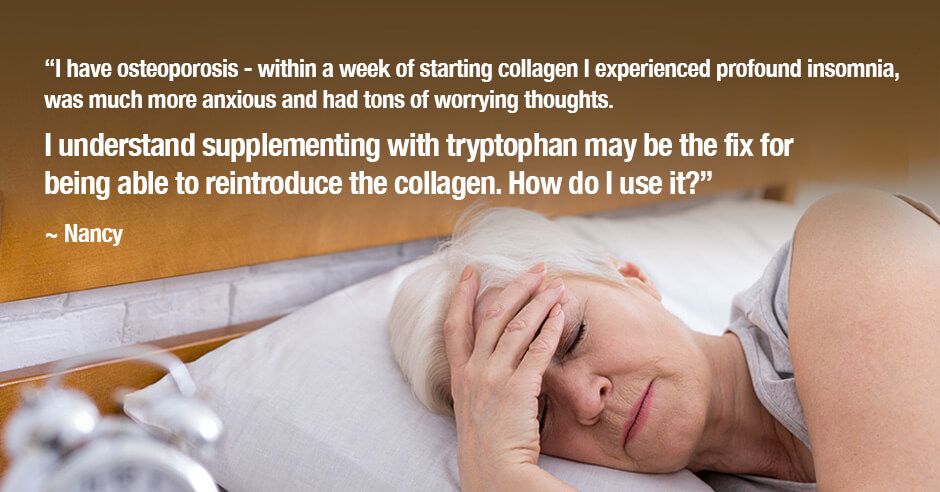
  • I have osteoporosis – within a week of starting collagen I experienced profound insomnia, was much more anxious and had tons of worrying thoughts
  • Collagen causes increased anxiety, low mood, irritability, insomnia, gut issues and an itchy skin: some questions and my answers
  • Gelatin triggers Enid’s anxiety in 2 weeks but also lowers her high blood sugar
  • Collagen Can Cause Anxiety and Insomnia with Trudy Scott: The Anxiety Summit 5

If you are new to this topic and are still skeptical about all this, do read the many comments and stories on these blogs. It’s a way more common issue than you’d think!

Additional resources when you are new to using tryptophan and other amino acids as supplements

As always, I use the symptoms questionnaire to figure out if low serotonin or other neurotransmitter imbalances may be an issue.

If you suspect low levels of any of the neurotransmitters and do not yet have my book, The Antianxiety Food Solution – How the Foods You Eat Can Help You Calm Your Anxious Mind, Improve Your Mood, and End Cravings, I highly recommend getting it and reading it before jumping in and using amino acids on your own so you are knowledgeable. And be sure to share it with the practitioner/health team you or your loved one is working with.

There is an entire chapter on the amino acids and they are discussed throughout the book in the sections on gut health, gluten, blood sugar control (this is covered in an entire chapter too), sugar cravings, anxiety and mood issues.

The book doesn’t include product names (per the publisher’s request) so this blog, The Antianxiety Food Solution Amino Acid and Pyroluria Supplements, lists the amino acids that I use with my individual clients and those in my group programs.

If, after reading this blog and my book, you don’t feel comfortable figuring things out on your own (i.e. doing the symptoms questionnaire and respective amino acids trials), a good place to get help is the GABA QuickStart Program (if you have low GABA symptoms). This is a paid online/virtual group program where you get my guidance and community support. You can sign up to be notified when the next live launch is happening.

If you need serotonin support, the Serotonin QuickStart Program is a good place to get help. This is also a paid online/virtual group program where you get my guidance on using tryptophan and 5-HTP safely, and community support during 5 LIVE Q&A calls. You can sign up to be notified when the next live launch of this program is happening.

If you are a practitioner, join us in The Balancing Neurotransmitters: the Fundamentals program. This is also a paid online/virtual program with an opportunity to interact with me and other practitioners who are also using the amino acids.

Wrapping up and your feedback

I appreciate Dea for sharing her story on the blog and for sharing this information at vitamin stores – we do need more awareness, hence this new blog on the topic to further help create awareness.

It’s very likely that this is one big contributing factor to the rise in anxiety and sleep issues in perimenopause and menopause. And this is probably made worse because so many practitioners are still not aware.

I thanked her for her kind words, and said I’ll take a virtual lunch and a virtual hug from her.

Have you experienced any adverse effects from collagen, gelatin or bone broth?

Have you been able to continue using them by adding tryptophan?

And why do you use collagen/how is it helping?

If you’re a practitioner are you aware of this issue for certain susceptible individuals?

Feel free to share and ask your questions below.
Filed Under: Anxiety, Collagen, Depression, Insomnia, serotonin Tagged With: amino acids, anti-aging, anxiety, brain fog, collagen, fears, GABA Quickstart, gut health, hair, heart racing, nervous, obsessing, panic, panic attacks, practitioners, ruminating thoughts, serotonin, Serotonin Quickstart, skin, sweating, tryptophan, tryptophan depletion studies

I have osteoporosis – within a week of starting collagen I experienced profound insomnia, was much more anxious and had tons of worrying thoughts

August 18, 2023 By Trudy Scott 10 Comments

osteoporosis collagen tryptophan

Nancy shares her unpleasant experience when using collagen for her osteoporosis and asks how she can use tryptophan and possibly add the collagen back:

I have osteoporosis and recently started taking a collagen peptide product (Fortibone). At the same time, I started taking a bone support formula containing calcium, magnesium, vitamin D, vitamin K2, boron, etc.

Within a week I began experiencing such PROFOUND insomnia. I felt like I was wide awake and could not drift off till 4 am each morning. Also, when I laid down at night, I was much more anxious than I normally am and had tons of worrying thoughts flitting thru my mind.

Within a couple weeks of the insomnia starting, I thankfully caught your talk about collagen and folks who are susceptible to it, at the 2023 Osteoporosis Summit. The puzzle pieces clicked together; I’m a MAO-A. I immediately stopped the collagen and the bone support supplement.

I understand supplementing with tryptophan may be the fix for being able to reintroduce the collagen.

I appreciate her for sharing her experience on one of my collagen blogs and thanked her, saying how glad I was that she heard my interview about this.

Collagen and gelatin lower serotonin in susceptible individuals

Intake of collagen (and gelatin) can lower serotonin in susceptible individuals and cause these symptoms she experienced. I first blogged about this in 2017 but it’s still not common knowledge even amongst practitioners and companies selling collagen products.

The good news is that awareness is growing. Dr. R. Keith McCormick does mention the serotonin-collagen connection in his excellent book Great Bones – Taking Control of Your Osteoporosis  (my Amazon link). He does not, however, offer tryptophan as a solution.

If this is new to you, this blog post describes why it happens (i.e. collagen does not contain any tryptophan), lists many of the tryptophan depletion studies and who may be more susceptible to this effect – Collagen and gelatin lower serotonin: does this increase your anxiety and depression?

Here is a more recent blog on the topic too: Collagen causes increased anxiety, low mood, irritability, insomnia, gut issues and an itchy skin: some questions and my answers

The causes of these symptoms can be due to the serotonin-lowering effects of collagen but also the dietary oxalate impact, a histamine reaction and/or a glutamate reaction to collagen.

Could supplementing with tryptophan be the fix for being able to reintroduce the collagen?

Nancy said “I understand supplementing with tryptophan may be the fix for being able to reintroduce the collagen.” Hearing her symptoms – profound insomnia, increased anxiety and worrying thoughts flitting through her mind – led me to the same conclusion, especially since they all started soon after starting collagen.

We know she has the MAOA (monoamine oxidase A) genetic polymorphism – this does make her more susceptible to the serotonin-lowering effects of collagen. Other factors that may make her more susceptible (explained in the 2017 blog above) are current or prior depression and/or OCD (obsessive compulsive disorder) or family history of these conditions and being a smoker. In addition to a MAOA defect is having a 5-HTTLPR genetic polymorphism.

To confirm the likely low serotonin connection, it would have been helpful to know if she also experienced other low serotonin symptoms: panic attacks and phobias, lack of confidence, depression, negativity, imposter syndrome, PMS, irritability, anger issues and afternoon/evening cravings.

It would also be helpful to know if her symptoms resolved when she stopped using the collagen.

But the best way to confirm is to do a trial of tryptophan and observe if these symptoms resolve when using collagen.

How to use tryptophan in a situation like this?

She asked these specific questions about using tryptophan:

I bought the Lidtke brand which is a 500 mg. capsule. How do I dose this? I realize you said to trial dose it but:

1) what time of day is best to take it?

2) is it taken on an empty stomach or can it be taken with food?

3) should I start taking the tryptophan BEFORE restarting the collagen and be watching for the night time anxiety/insomnia symptoms to reappear?

4) if the insomnia, anxiety do reappear, how much do I titrate up and is there a max dose of tryptophan? If I’m taking more than one capsule a day, should they be taken at one time or divided throughout the day?

Tryptophan is always taken midafternoon and evening on an empty stomach/away from protein and increased until there is symptom resolution.

For clients in a similar situation who have stopped the collagen but still have insomnia, anxiety and worry symptoms, I have them start on tryptophan before adding back collagen and adjust the tryptophan dose up if needed once collagen is reintroduced.

If symptoms resolved when the collagen was stopped, tryptophan would be trialed as soon as symptoms show up when collagen is reintroduced.

With tryptophan, 500 mg is a typical starting dose but less may work in a situation like this. I’ve had clients use up to 1500 mg tryptophan 2 x day. It’s really individualized with no one-size fits all.

I did mention my book, The Antianxiety Food Solution, as an excellent resource for Nancy. There is an entire chapter on the amino acids and how to use them. I recommend everyone read it before using any of the amino acids as supplements.

Resources if you are new to using amino acids as supplements

If you are new to using amino acids as supplements, here is the Amino Acids Mood Questionnaire from The Antianxiety Food Solution (you can see all the symptoms of neurotransmitter imbalances, including low GABA, low serotonin, low dopamine, low blood sugar and low endorphins).

If you suspect low levels of any of the neurotransmitters and do not yet have my book, The Antianxiety Food Solution – How the Foods You Eat Can Help You Calm Your Anxious Mind, Improve Your Mood, and End Cravings, (as I mentioned above) I highly recommend getting it and reading it before jumping in and using amino acids on your own so you are knowledgeable. And be sure to share it with the practitioner/health team you or your loved one is working with.

There is an entire chapter on the amino acids and they are discussed throughout the book in the sections on gut health, gluten, blood sugar control, sugar cravings, anxiety and mood issues.

The book doesn’t include product names (per the publisher’s request) so this blog, The Antianxiety Food Solution Amino Acid and Pyroluria Supplements, lists the amino acids that I use with my individual clients and those in my group programs. You can find them all in my online store.

If, after reading this blog and my book, you don’t feel comfortable figuring things out on your own (i.e. doing the symptoms questionnaire and respective amino acids trials), a good place to get help is the GABA QuickStart Program (if you have low GABA symptoms too). This is a paid online/virtual group program where you get my guidance and community support.

If you are a practitioner, join us in The Balancing Neurotransmitters: the Fundamentals program. This is also a paid online/virtual program with an opportunity to interact with me and other practitioners who are also using the amino acids.

Thanks to Nancy for sharing her experience with collagen and asking this question.

Have you used collagen for bone health/osteoporosis or for other reasons? And have you experienced insomnia, and increased anxiety and worrying?

Were your symptoms due to low serotonin and did tryptophan allow you to continue with collagen or add it back if you stopped it?

Or were your symptoms caused by oxalates in collagen, a histamine reaction and/or a glutamate reaction?

Has Fortibone led to improvements in your bone health? If yes, how long have you been using it and which collagen product (a number of products contain Fortibone)?

If you have questions and feedback please share them here too.

Filed Under: Anxiety, Collagen, Depression, Osteoporosis, Tryptophan Tagged With: amino acids; anxiety, anxious, collagen, collagen peptide, Fortibone, GABA Quickstart online program; Balancing Neurotransmitters: the Fundamentals program for practitioners, gelatin, how to use, insomnia, MAOA, osteoporosis, serotonin, serotonin-lowering, susceptible, tryptophan, wide awake, worrying thoughts

Collagen causes increased anxiety, low mood, irritability, insomnia, gut issues and an itchy skin: some questions and my answers

September 2, 2022 By Trudy Scott 37 Comments

collagen anxiety

Today we have some feedback from folks on some of the negative impacts they experienced when consuming collagen. I’m sharing their questions and the feedback I gave them in the hope this will help you too. Not everyone experiences unpleasant symptoms when consuming collagen but those who are susceptible may experience the following: increased anxiety or new anxiety, feeling low, inability to sleep or worsening sleep, tension, irritability, gut issues, itchy skin, frequent urination, a bad mood, worsening psoriasis, blepharitis, panic attacks and a disrupted menstrual cycle.

The causes of these symptoms can be due to the serotonin-lowering effects of collagen, the dietary oxalate impact, a histamine reaction and/or a glutamate reaction to collagen.

Beth shares how she feels low and anxious after using marine collagen for five days:

Have just recently begun receiving your emails. I read the above article and wanted to let you know of my experience. I started taking Vital Proteins marine collagen to see if it would improve sun damage to my skin. I took one scoop for about five days. On the fifth day I felt very low. So low that it made me somewhat anxious. As I have trouble with anxiety I stopped it immediately. Felt better the next day. The container lists 19 amino acids including tryptophan but the amount of it is zero mg. I hadn’t noticed that when I started taking it. After reading your article I’m fairly sure that that is why I felt depressed.

I shared this: for individuals who have observed a mood dip or increase in anxiety since using collagen or gelatin, I suggest they stop using collagen/gelatin and see how they feel, then add it back and see how they feel (sometimes more than once if they are not certain).

If they do see a correlation, look at the low serotonin symptoms and do a trial of tryptophan or 5-HTP (after checking the precautions) to see if this improves their low mood and reduces their anxiety when using collagen/gelatin. This confirms if their symptoms are due to the serotonin-lowering effects and allows them to continue using it for the benefits it provides.

Be sure to read the above collagen/serotonin blog for some of the research on what makes some folks more susceptible to the serotonin-lowering effects: a current depression/anxiety or history of depression/anxiety (even a family history), prior use of antidepressants, OCD / obsessive compulsive disorder, MAOA and/or 5-HTTLPR (the serotonin transporter gene) polymorphisms, smokers or former smokers, and women polydrug ecstasy users. This is not a conclusive list.

It’s interesting that she mentions her product has tryptophan listed with zero mg. When I looked online I didn’t see it listed on the product at all. Maybe it’s a change they have made to the label.

I also  shared  that when you are new to the amino acids (and other anxiety nutrition solutions like real whole food, quality animal protein, fermented foods, organic produce, health fats, gluten/sugar/caffeine removal, blood sugar control, gut health, pyroluria etc) my book “The Antianxiety Food Solution” is a great place to start.

The above question and the following questions come from the popular blog, Collagen and gelatin lower serotonin: does this increase your anxiety and depression?

How long after stopping bone broth does it take for this anxious feeling to leave?

Diane asks about bone broth and collagen and how it causes extreme anxiety and sleep problems:

I just finished your book and have to say how awesome it is ! A wealth of information. As I am struggling with many of the issues, I do have a question on bone broth and collagen. I have definitely noticed extreme anxiety and inability to sleep with bone broth and collagen supplement.(plus spring allergies are at play as well) I even tried a piece of Turkey with my bone broth this week to see if that helped. I have such gut issues I was really hoping to use bone broth. Anyway, my question is how long after stopping bone broth does it take for this anxious feeling to leave? Days or weeks? I want it cleared out before I try adding tryptophan with the broth.

I thanked her for the great feedback on my book. It’s wonderful to have the foundational stuff in place and she’s getting that from my book.

I don’t have an answer on how long symptoms can last as it’s very individualized. Typically if the effects are caused by serotonin being lowered, using either tryptophan or 5-HTP can result in significantly less anxiety and better sleep in a few days, provided the optimal dose is used.

Keep in mind that spring allergies can often make things worse and more tryptophan or 5-HTP may be needed during the allergy period. The dose would then need to be reduced once allergy season has passed. I blog about spring allergies and increased anxiety here.

My advice would be to use the tryptophan or 5-HTP to resolve the anxiety and insomnia and then once resolved, consider adding back the collagen and monitoring how she is doing. At this time she may need to bump up her tryptophan or 5-HTP yet again.

Is it a histamine reaction rather than low serotonin? (or an oxalate or glutamate reaction?)

Kelly believes her symptoms may be a histamine reaction and not caused by low serotonin:

If you become anxious, tense, irritable, can’t sleep AND have some issues with itchy skin, frequent urination, worsened gut issues, etc., then it’s a histamine problem from the collagen/glycine, and not serotonin at all.

I shared that these symptoms could actually be both since low serotonin can also cause anxiety, tension, irritability and insomnia. But I agree the itchy skin, frequent urination, worsened gut issues are a big clue it’s a histamine issue too or perhaps only a histamine issue.  Gut issues would happen with both low serotonin and histamine.

I’d start with a trial of tryptophan or 5-HTP because if it is low serotonin you will know very quickly. You can see what symptoms resolve and by how much.

Challenges with dietary oxalates could cause all the symptoms she experiences. So it’s a matter of figuring it out for each person. If you already know you have histamine or oxalate issues it’s also relatively easy to figure out by simply stopping the collagen and/or adding the counter-measures you typically use – like quercetin for histamine reactions and calcium citrate for oxalate issues.

It’s possible that some of these symptoms are a glutamate reaction too – like anxiety, tension, irritability and insomnia – and the amino acid GABA may help in this instance.

A bad mood, insomnia, psoriasis, blepharitis, panic attacks, hormone imbalance – oxalates or serotonin-lowering effects?

Em shares how she had a really bad mood, full blown insomnia, worsening psoriasis, blepharitis, panic attacks and disrupted menstrual cycle:

I am soooo glad I found this article. I started taking Oslo Skin Labs collagen (Verisol, so it is considered good quality) half way through December 2021. Looking back, that is when the problems started. I started sleeping restlessly and it got really bad in January. Full blown insomnia. My psoriasis got much worse, the blepharitis too. I have severe Endometriosis and was worried that if these other inflammation issues (psoriasis causes skin inflammation and blepharitis causes eye inflammation) were worse then maybe my endo was worse also since that can’t be checked on the outside.

Besides the inflammation symptoms I was experiencing extremely bad moods, feeling tense to the point of bordering on panic attacks and also a disrupted menstrual cycle.

I have been on Amitriptyline for 1,5 years and it worked wonders on my mood and sleep and I just couldn’t figure out why it wasn’t working any more. Then I realized that the only thing I changed was adding collagen to my diet in my fruit/vegetable smoothie ( I don’t drink coffee). So I started Googeling and found your article and stopped the collagen immediately. Have stopped for 2 days now and already my eyes are less red and inflamed. Pfew! It’s crazy and also scary how serious the side effects of collagen have been.

Do you think that besides the tryptophan lowering side effect that also the histamine might have played a part in my case? I don’t dare try the collagen with tryptophan supplement as the potential side effects are too serious to play around with. But I’m very bummed out about missing out on the skin and hair benefits.

Would love to hear your thoughts. I follow a vegetarian diet by the way and eat super healthy.

With Em I’d suspect an oxalate issue first because of the worsening psoriasis, blepharitis and endometriosis. She is also a vegetarian and this diet is often high in dietary oxalates. I write about oxalates and pain here.

However, with the “bad moods, feeling tense to the point of bordering on panic attacks and also a disrupted menstrual cycle”, I’d also suspect a serotonin-lowering impact. As mentioned above, a history of mood issues and antidepressant use can be a predisposing factor.  She would need to work with her prescribing doctor if she wanted to use tryptophan or 5-HTP because Amitriptyline has the potential to cause serotonin syndrome.

It’s also possible that her symptoms are caused in part by a histamine or glutamate reaction too.

With appreciation for helping to create awareness about these issues with collagen

I have much appreciation for each of these women for asking these questions and sharing their symptoms so we can all learn. There is not much awareness about collagen being problematic for some susceptible folks and it’s a very rude awakening when you start using something for the health benefits and have a bad reaction.  Hopefully their stories and others like this will help create more awareness.

The good news is that once you identify your cause/s and address them as above, you can often continue to consume collagen.

Resources if you are new to using tryptophan/5-HTP and other amino acids as supplements

If you are new to using any of the amino acids as supplements, here is the Amino Acids Mood Questionnaire from The Antianxiety Food Solution (you can see all the symptoms of neurotransmitter imbalances, including low serotonin and low GABA).

If you suspect low levels of any of the neurotransmitters and do not yet have my book, The Antianxiety Food Solution – How the Foods You Eat Can Help You Calm Your Anxious Mind, Improve Your Mood, and End Cravings, I highly recommend getting it and reading it before jumping in and using amino acids on your own so you are knowledgeable. And be sure to share it with the practitioner/health team you or your loved one is working with.

There is an entire chapter on the amino acids and they are discussed throughout the book in the sections on gut health, gluten, blood sugar control, sugar cravings, self-medicating with alcohol and more.

The book doesn’t include product names (per the publisher’s request) so this blog, The Antianxiety Food Solution Amino Acid and Pyroluria Supplements, lists the amino acids that I use with my individual clients and those in my group programs. You can find them all in my online store.

If, after reading this blog and my book, you don’t feel comfortable figuring things out on your own (i.e. doing the symptoms questionnaire and respective amino acids trials), a good place to get help is the GABA QuickStart Program (if you have low GABA symptoms). This is a paid online/virtual group program where you get my guidance and community support.

If you are a practitioner, join us in The Balancing Neurotransmitters: the Fundamentals program. This is also a paid online/virtual program with an opportunity to interact with me and other practitioners who are also using the amino acids.

Have you experienced any adverse symptoms when using collagen? Please share the symptoms so we can all learn from each other .

And were you able to figure out if it was due to low serotonin, a histamine or glutamate reaction or because of dietary oxalates?

If it was low serotonin, has tryptophan or 5-HTP helped so you can continue to use collagen?

If you have questions please share them here too.

Filed Under: 5-HTP, Anxiety, Collagen, GABA, Insomnia, Tryptophan Tagged With: a bad mood, an itchy skin, anxiety, Balancing Neurotransmitters: the Fundamentals program for practitioners, blepharitis, collagen, dietary oxalate, disrupted menstrual cycle, frequent urination, GABA Quickstart program, glutamate reaction, gut issues, histamine reaction, insomnia, irritability, low mood, panic attacks, serotonin-lowering effects, tension, worsening psoriasis

What causes low serotonin? Use tryptophan/5-HTP to help with the anxiety, overwhelm and worry right away and address all the root causes

May 13, 2022 By Trudy Scott 40 Comments

what causes low serotonin

Low serotonin has a number of root causes which can be different for each person. If you do have low serotonin levels you always want to figure and address why it’s low. This can take time to figure out and resolve so you want to be using either tryptophan or 5-HTP (and sometimes both) to boost your serotonin levels and get symptom relief quickly. This helps with the worry, overwhelm, anxiety, insomnia, carb cravings, TMJ, irritability, PMS, anger, OCD, low mood and ruminations right away. It also helps with the worry and overwhelm triggered by sometimes complex and challenging root causes.

Here is a list of some of the many factors that may cause low serotonin for you:

  • stress and adrenal dysfunction (high cortisol affects your sex hormone and neurotransmitter production, inlcuding serotonin)
  • eating junk food and sugar (a Western diet “of processed or fried foods, refined grains, sugary products, and beer was associated with a higher odds of mood disorders”
  • consuming caffeine (which reduces zinc and B vitamins, needed to make serotonin)
  • not consuming enough quality animal protein (amino acids are the building blocks of our neurotransmitters, and grass fed red meat provides zinc, iron and omega-3s – all needed to make serotonin)
  • low stomach acid (meaning you can’t digest the protein you’re consuming)
  • gluten issues (leading to low serotonin and other nutritional deficiencies such as low iron, low vitamin D etc.)
  • low vitamin D (“Brain serotonin is synthesized from tryptophan by tryptophan hydroxylase 2, which is activated by vitamin D hormone”)
  • low iron/ferritin levels (iron is a cofactor for making serotonin)
  • dysbiosis and microbiome imbalances (we make so much serotonin in the gut)
  • candida (in one study short exposure to serotonin resulted in antifungal activity)
  • liver issues (affecting how you process xenoestrogens)
  • low bile production (affecting how you digest the healthy fats you’re eating)
  • sex hormone imbalances (serotonin and estrogen are very closely linked and women make less serotonin than men. In one study, tryptophan improved the low serotonin PMS symptoms)
  • thyroid imbalance (“it is postulated that one mechanism, among others, through which exogenous thyroid hormones may exert their modulatory effects in affective illness is via an increase in serotonergic neurotransmission”)
  • histamine imbalances (in one study “Acute LPS-induced inflammation increases CNS histamine and decreases CNS serotonin)”
  • the birth control pill (which lowers zinc and vitamin B6, both of which are needed for serotonin production)
  • statins (leading to cholesterol that is too low)
  • mold exposure/mycotoxins/mold poisoning
  • heavy metal toxicity such as lead (and tryptophan and ascorbic acid can help ease the anxiety)
  • Lyme disease and other co-infections (serotonin was found to be low in cerebrospinal fluid in patients with post-Lyme disease syndrome i.e. chronic Lyme)
  • collagen consumption (in susceptible folks this can lower serotonin levels)
  • seasonal allergies (“Cytokines may lead to a mood disturbance via the expression of the IDO enzyme, which shifts the synthesis of tryptophan from serotonin to kynurenine. The resultant acute tryptophan depletion results in decreased brain serotonin”)
  • genetics (one example is the MTHFR polymorphism)
  • low zinc, low vitamin B6 (and other B vitamins), low selenium, low magnesium etc. – all needed to make serotonin
  • oxalates (which can bind to zinc and deplete it)
  • a high copper diet (nut flours on Paleo diets can be problematic), copper IUD, copper pipes etc. (which can cause low zinc)
  • lack of nature (forest bathing reduces cortisol which affects serotonin production)
  • lack of exercise
  • lack of sunshine (like in the winter when serotonin declines)

When I posted some of this list on Facebook earlier this week, there was a great deal of interest, hence this blog. I’ve included one relevant link for each one so you can read further on the topic.

When I posted it I also asked this: “Have you figured out your root cause/s that are contributing to your low serotonin levels? And has tryptophan or 5-HTP helped while you’re figuring it all out?”

Leanne has mold, dysbiosis, Lyme, low vitamin D, bile issues and more

Leanne responded and gave me the go ahead to share especially if this helps someone else (I appreciate that!) She shared she has identified these root causes:

Mold. Dysbiosis. Possible Lyme/co-infections. Low vitamin D. Bile and motility issues. Liver issues. Stress. Low HCL. Those are the ones I’m aware of. And taking each and every day to work on them.  It takes time to heal

I agree it takes time to heal and can be a longer journey for some folks, especially when there are a number of underlying factors. She is in a good frame of mind, saying pragmatically, it takes time to heal. This confirms her serotonin levels are robust i.e. she is not in a state of overwhelm and worry. Sure enough, when I asked if tryptophan or 5-HTP has been helping this was her response:

5-HTP and GABA calm initially helped me in my first round of going through this back in 2015. Then I discovered l-tryptophan about a year ago and that seemed to be a better help over 5-HTP.

Since I’ve just identified that histamine is an issue and started a low histamine diet this past week I noticed less of a need for l-tryptophan as I did before. My body is calming down significantly. And my digestion is working a little better.

But I still have to address mold, SIBO, candida, parasites and possibly Lyme and underlying hidden viruses.

So I know these amino acids will play a key part in supporting me as I dive deeper into addressing them all.

It’s wonderful the amino acids have helped her so much and they will most likely continue to help. A quick comment on her preference for tryptophan over 5-HTP – some folks do better on one vs the other.

Regarding the histamine issues/root cause, it’s good that she is now addressing this. Already she needs less tryptophan (for now). Things may fluctuate in the future again as she peels away the onion layers of root causes. She may find she needs tryptophan again or a higher dose or needs to get back on the GABA.

As you can see she has been working on her health for some time. This is not unusual. Slow and steady is just fine, especially when there is so much going on.

The amino acids are intended for short-term use while diet and underlying root causes are addressed. But when the list is long this is a common reason for the ongoing need for serotonin support. Keep in mind, your list may be a short one and may be quick to resolve. And not everyone has the same root causes.

Resources if you are new to using tryptophan or 5-HTP as supplements

If you are new to using tryptophan or 5-HTP as supplements, here is the Amino Acids Mood Questionnaire from The Antianxiety Food Solution (you can see all the low serotonin symptoms).

If you suspect low levels of serotonin or any of the neurotransmitters and do not yet have my book, The Antianxiety Food Solution – How the Foods You Eat Can Help You Calm Your Anxious Mind, Improve Your Mood, and End Cravings, I highly recommend getting it and reading it before jumping in and using amino acids on your own so you are knowledgeable. And be sure to share it with the team you or your loved one is working with.

There is an entire chapter on the amino acids and they are discussed throughout the book in the sections on gut health, blood sugar control, sugar cravings, self-medicating with alcohol and more.

The book doesn’t include product names (per the publisher’s request) so this blog, The Antianxiety Food Solution Amino Acid and Pyroluria Supplements, lists the amino acids that I use with my individual clients and those in my group programs.

If you are a practitioner, join us in The Balancing Neurotransmitters: the Fundamentals program. This is also a paid online/virtual program with an opportunity to interact with me and other practitioners who are also using the amino acids.

Have you figured out your root cause/s that are contributing to your low serotonin levels? And does this give you a better understanding of your own issues?

Do you have any other root causes I may have missed? (when I posted this list on Facebook, a few people pointed out I had missed a few. I’ll update the list and continue to add as we discover new connections).

Has tryptophan and/or 5-HTP helped you feel less overwhelmed and worried while you’re figuring it all out?

Have you adjusted doses of tryptophan and/or 5-HTP as things change and root causes are addressed/resolved?

If you’re a practitioner, do you have anything to add and do your clients/patients find this useful?

If you have questions please share them here too.

Filed Under: 5-HTP, Anxiety, serotonin, Tryptophan Tagged With: 5-HTP, adrenal dysfunction, anxiety, bile issues, candida, collagen, diet junk food, dysbiosis, gluten, high cortisol, histamine, iron, Lead toxicity, low cholesterol, low stomach acid, lyme, mold, overwhelm, red meat, root causes, seasonal allergies, serotonin, stress, sugar, thyroid, tryptophan, vitamin D, What causes low serotonin?, worry

Tryptophan doesn’t work, then it does and then it doesn’t: could it be hormonal shifts, dietary factors and/or parasites?

November 26, 2021 By Trudy Scott 19 Comments

tryptophan result

Have you been in a situation where tryptophan doesn’t work, then it does work, and then sometimes it doesn’t work as expected? There is a reasonable explanation as to why it may not work initially – too much or too little was used. The variable results and the need to switch between lower and higher doses on an ongoing basis can happen but it’s not very pronounced unless there is a specific reason. In this blog I cover some of these reasons – hormone shifts, dietary factors and parasites/other digestive issues.

I’m writing this blog in response to a question that was posted on one of my speaker pages on the Anxiety Summit: Gut-Brain Axis. This is the actual question:

I tried to use tryptophan the first time (whole capsule) and got really high. Some time later I tried again, but used 1/4 of a capsule and had a good result. A few weeks later 1/4 of the capsule didn’t work at night. So I went up to half a capsule. And that’s where  I am now. But some nights (very rare) I can only get good results from a whole capsule. I use it along with the same amount of GABA. Is that a normal reaction for tryptophan?

I don’t know what brand of tryptophan she was using but assume 500mg was her starting dose and she now shifts between 125 mg (¼ capsule) and 250 mg (½ capsule) with variable results.

It’s not unusual for someone to not feel great on 500 mg if that dose is too much for their unique needs. She did the right thing by lowering her dose.  It’s also reasonable that someone may find 500 mg as an initial dose isn’t enough to reduce symptoms.

The variable results and the need to switch between 125 mg and 250 mg can happen but it’s not very pronounced unless there is a specific reason. Some of these reasons include hormone shifts, dietary factors, parasites/other digestive issues, thyroid issues, low lithium, product quality and environmental factors. More on all this below.

Hormone shifts/more serotonin is needed in the luteal phase

I have my clients track when the variability happens, with female clients documenting their cycles. Some women need more serotonin support in the luteal phase i.e. after ovulation and right up to before their periods. Some may even need additional tryptophan for the first few days of their periods too.

Write about tryptophan working well in the luteal phase in this blog – Tryptophan for PMS: premenstrual dysphoria, mood swings, tension, and irritability

In a study published in 1999, A placebo-controlled clinical trial of L-tryptophan in premenstrual dysphoria, tryptophan was found to reduce symptoms of PMS when used in the luteal phase or second half of the cycle (i.e. after ovulation):

37 patients with premenstrual dysphoric disorder were treated with L-tryptophan 6 g per day, and 34 were given placebo. The treatments were administered under double-blind conditions for 17 days, from the time of ovulation to the third day of menstruation, during three consecutive menstrual cycles.

They looked at dysphoria, which is defined as a state of unease or generalized dissatisfaction with life, plus mood swings, tension (and anxiety), and irritability and they found a 34.5% reduction of symptoms with tryptophan compared to 10.4% with placebo.

The paper concludes: “that these results suggest that increasing serotonin synthesis during the late luteal phase of the menstrual cycle has a beneficial effect in patients with premenstrual dysphoric disorder.”

It’s a small study but the results are powerful and it’s something I see clinically with my clients. The one big difference is that I typically have clients using tryptophan throughout the month.

But if you are seeing tryptophan work and then not work at similar times each month this is something to consider and track. And then if need be, increase and decrease tryptophan accordingly (and track again).

Dietary factors – collagen, gluten, sugar, wine and coffee

There are other factors to consider too and dietary impacts is one. For example, collagen leads to a higher need for tryptophan in susceptible individuals (due to it’s serotonin-lowering effects – I blog about this here)

Another dietary factor is accidental gluten exposure in susceptible individuals or a newly discovered gluten issue

High sugar intake, alcohol and/or caffeine consumption may also be a factor – contributing to added stress for the adrenals and depletions in zinc and the B vitamins. This can contribute to lowered serotonin and a need for a higher dose of tryptophan.

Now imagine if it’s just before her period and she adds collagen to her diet and she also eats out and gets zapped by gluten. Triple whammy for this woman!

And she goes to a party and happens to indulge in cocktails or wine, and then goes on a binge at the dessert table, followed by a few cups of coffee (or even one dessert and one cup of coffee).

A food-mood log really helps you figure things out.  And then, if need be, increase and decrease tryptophan accordingly.  And track again and address the dietary issues.

Parasites and other gut issues

If she has a very pronounced shift in symptoms for 4-5 days around a full moon each month – more severe insomnia, more anxious, more depressed – I would want to check for parasites.

I would also want to check for other digestion issues like dysbiosis, SIBO (small intestinal bacterial overgrowth), candida and liver health as they may all be factors. With SIBO and candida, dietary slip-ups may make symptoms worse right after the slip-up, for example increased bloating making sleep and anxiety worse.

Using tryptophan sublingually/opened on the tongue may bypass some of the digestive/liver  issues until they are resolved.

As mentioned above, if need be, increase and decrease tryptophan accordingly. And track again and address the underlying issues.

Other factors to rule out – thyroid, lithium, environmental factors and the product

Two other underlying root causes we always want to rule out when we see variable results using tryptophan (and any of the amino acids) are Hashimoto’s thyroiditis (because we can have variable thyroid results – sometimes hypo/low and sometimes hyper/high) and low levels of lithium (because this can affect the results we see with all the amino acids).

And we always check environmental factors like mold, EMFs and outside stresses. And look for infections like Lyme disease or EBV.  If the basics are not unearthing the solution we continue to dig deeper and do a full functional medicine workup. And adjust the tryptophan as needed.

And finally the quality of the product is key. I find Lidtke Tryptophan to be better than many other brands. I’ve also had many clients switch to Lidtke tryptophan and see better results and often need a lower dose.

Resources if you are new to using tryptophan and the amino acids as supplements

If you are new to using the amino acids tryptophan/5-HTP and the other amino acids as supplements, here is the Amino Acids Mood Questionnaire from The Antianxiety Food Solution (you can see the low serotonin symptoms here) and a brief overview here, Anxiety and targeted individual amino acid supplements: a summary.

If you suspect low serotonin or low levels of any of the neurotransmitters and do not yet have my book, The Antianxiety Food Solution – How the Foods You Eat Can Help You Calm Your Anxious Mind, Improve Your Mood, and End Cravings, I highly recommend getting it and reading it before jumping in and using amino acids so you are knowledgeable. And be sure to share it with the team you or your loved one is working with.

The book doesn’t include product names (per the publisher’s request) so this blog, The Antianxiety Food Solution Amino Acid and Pyroluria Supplements, lists the amino acid products that I use with my individual clients and those in my group programs.

I always appreciate good questions like this and hope this feedback has helped her and you too if you’ve experienced something like this (or if you do in the future). In case you’re wondering, this question was posted after someone tuned into my interview, “GABA & Tryptophan: Gut-Anxiety Connections” on the Anxiety Summit 5: Gut-Brain Axis.

Have you had a variable response to tryptophan (or 5-HTP) and can you relate to any of this?

What did you figure out to be the reason?

Feel free to ask your questions here too.

Filed Under: Anxiety, Depression, Gut health, serotonin, Tryptophan Tagged With: amino acids, anxiety, coffee, collagen, depressed, diet, environmental, GABA, gluten, gut, hormonal shifts, lithium, liver, luteal phase, neurotransmitter, parasites, quality, serotonin, sugar, thyroid, tryptophan, variable, wine

5-HTP for a calm brain, and a racing mind at night: questions and answers

April 16, 2021 By Trudy Scott 39 Comments

5-HTP q and a

5-HTP is an amino acid, made from the seeds of an African plant, Griffonia simplicifolia, and used as a supplement to ease low serotonin symptoms. With low levels of serotonin you’ll experience the worry-type of anxiety with ruminations, obsessing, panic attacks, insomnia (often lying awake worrying). This type of anxiety is different from the low GABA physical/tension type anxiety. Other low serotonin symptoms include low mood/depression, late afternoon and evening carbohydrate cravings, pain, digestive/IBS symptoms, PMS, irritability, rage and anger, TMJ, low confidence, imposter syndrome and perfectionism.

When I share my low serotonin blogs on Facebook I receive so many great questions about 5-HTP. Today I’m going to share some of these questions and my answers so you can get the benefits too.

Gail asks why 5-HTP stopped working for her when it had been working so amazingly well:

I took 5-HTP and it worked amazingly….for about 6 months. Then it did nothing. Any idea why?

I took 100 mg per day. It’s hard to explain, but it calmed my brain down. I wasn’t so quick to blurt things out during the day and at night I was able to sleep because my mind wasn’t racing. Nothing else changed at that time. That was a few years ago, I think I’ll buy more and try again

I would guess that something did shift around the 6 month mark and would try and identify what it was so you know for the future. It could have been accidental gluten exposure (from the diet or even cosmetics), hormonal shifts (perimenopause or menopause), adding collagen or gelatin on a regular basis (this can lower serotonin in susceptible folks) and/or changes in thyroid health.

If you have pyroluria and were exposed to major stresses (life stresses or toxic mold etc.) you’d lose vitamin B6 and this could affect serotonin production. The addition of the birth control pill and antidepressants can also deplete vitamin B6. I share some possible reasons for low serotonin on this blog on imposter syndrome (as mentioned above, imposter syndrome is a common sign of low serotonin).

With these wonderful benefits Gail experienced, trialing 5-HTP again is worth considering. Because 5-HTP works so quickly she’ll feel that sense of calm right away and she won’t blurt things out during the day (possibly caused by lack of confidence and/or irritability and/or anger?). Also, her mind won’t race at night, she’ll fall asleep quickly and will stay asleep, waking rested, calm, happy, confident and optimistic.

And in future if something like this happens again, I’d try to identify the cause and bump up 5-HTP temporarily.

Wendy asks about headaches as an adverse effect:

What do you recommend if 5-HTP gives you headaches?

Headaches are not a common adverse effect with 5-HTP (compared to the amino acid tyrosine which is recognized to cause headaches and migraines in susceptible folks).

Even if you are seeing benefits – for the worry-type anxiety and other low serotonin symptoms – with 5-HTP you don’t ever want to push through with something like headaches and continue to take it. I have clients use less 5-HTP and observe if they still see the benefits with no headaches.

We also make sure low serotonin is the issue. If it’s not then any amount of 5-HTP will either do nothing or cause adverse effects. If the issue is low serotonin then I have clients do a trial of  tryptophan.

If the 5-HTP is being used to ease low mood/depression caused by low catecholamine or low endorphins depression then neither 5-HTP or tryptophan is going to help and may cause adverse effects. And tyrosine and/or DPA are better choices.

Gerry asks this question after my interview on Your Best Sleep Ever Summit:

Great talk Trudy. When you want to increase serotonin, do you take both 5-HTP & tryptophan or just one or the other?

They can be used alone or both can be used together. I like to have clients add one new amino acid supplement at a time so we know what is working before confounding things with another one. I typically start with tryptophan for low serotonin support simply because I have such good results with it and because 5-HTP can raise cortisol in some folks.

We start with tryptophan mid-afternoon and evening (after doing a trial earlier in the day to make sure it helps).  If tryptophan causes adverse effects or doesn’t work then we do a trial of 5-HTP and then use it afternoon and evening (when serotonin levels tend to drop).

If tryptophan is working in the afternoon and evening, and additional support for worry or ruminations or panic or anxiety is needed earlier in the day, we may consider 5-HTP which can often also help improve focus. We may also consider tryptophan earlier in the day too.

It’s very individualized and we may mix and match to find the ideal combination and dosing based on trials and symptom resolution. It’s important to be aware that some folks do better on 5-HTP and some do better on tryptophan.

Here are some useful blogs related to low serotonin and the amino acids:

  • You can see all the low serotonin symptoms here.
  • Fibromyalgia: tryptophan or 5-HTP for anxiety, depression, pain and insomnia
  • You can see the 5-HTP and tryptophan products I use with my clients here on the supplements blog.
  • You may find this helpful too – GABA for easing physical anxiety and tension: some questions and answers.

As always, it’s not only the low serotonin we need to address. 5-HTP offers quick relief but we must always do a full functional workup looking at diet, nutritional deficiencies, digestion, all hormones, toxins and infections (and so on) so we can address all possible root causes – and why serotonin is low in the first place.

Thanks to these folks for asking good questions and for allowing me to share here.

What questions do you have about 5-HTP?

Which low serotonin symptoms can you relate to and has 5-HTP or tryptophan helped? Or have you found success with a combination.

Feel free to post your questions and feedback in the comments below.

Filed Under: 5-HTP, Anxiety, Insomnia, Tryptophan Tagged With: 5-HTP, anxiety, calm, collagen, cravings, Fibromyalgia, gluten, Headaches, hormonal, insomnia, night, obsessing, panic, racing mind, ruminations, serotonin, stopped working, thyroid, tryptophan, worry

  • Page 1
  • Page 2
  • Page 3
  • Go to Next Page »

Primary Sidebar

NEW! GABA QuickStart Homestudy (with special intro pricing)

gaba quickstart homestudy

Free Report

9 Great Questions Women Ask about Food, Mood and their Health

You'll also receive a complimentary subscription to my ezine "Food, Mood and Gal Stuff"


Connect with me

Popular Posts

  • Amino Acids Mood Questionnaire from The Antianxiety Food Solution
  • The Antianxiety Food Solution Amino Acid and Pyroluria Supplements
  • Pyroluria Questionnaire from The Antianxiety Food Solution
  • Collagen and gelatin lower serotonin: does this increase your anxiety and depression?
  • Tryptophan for the worry-in-your-head and ruminating type of anxiety
  • GABA for the physical-tension and stiff-and-tense-muscles type of anxiety
  • The Antianxiety Food Solution by Trudy Scott
  • Seriphos Original Formula is back: the best product for anxiety and insomnia caused by high cortisol
  • Am I an anxious introvert because of low zinc and vitamin B6? My response to Huffington Post blog
  • Vagus nerve rehab with GABA, breathing, humming, gargling and key nutrients

Recent Posts

  • What do I use instead of Seriphos to help lower high cortisol that is affecting my sleep and making me anxious at night?
  • BeSerene™ GABA/theanine cream eases severe muscle tension in her neck/shoulders, prevents her bad headaches and quells her anxiety
  • How the correct approach, dose and sublingual use of GABA can be calming and not cause a flushed and itchy face and neck
  • The amino acid glutamine improves low mood by addressing gut health, and it has calming effects too
  • Flight anxiety with heightened breath, physical tension and also fearing the worst (the role of low GABA and low serotonin)

Categories

  • 5-HTP
  • AB575
  • Addiction
  • ADHD
  • Adrenals
  • Alcohol
  • Allergies
  • Alzheimer's disease
  • Amino Acids
  • Anger
  • Antianxiety
  • Antianxiety Food Solution
  • Antidepressants
  • Anxiety
  • Anxiety and panic
  • Autism
  • Autoimmunity
  • benzodiazapines
  • Bipolar disorder
  • Books
  • Caffeine
  • Cancer
  • Candida
  • Children/Teens
  • Collagen
  • Cooking equipment
  • Coronavirus/COVID-19
  • Cravings
  • Depression
  • Detoxification
  • Diabetes
  • Diet
  • DPA/DLPA
  • Drugs
  • EFT/Tapping
  • EMF
  • EMFs
  • Emotional Eating
  • Endorphins
  • Environment
  • Essential oils
  • Events
  • Exercise
  • Fear
  • Fear of public speaking
  • Fertility and Pregnancy
  • Fish
  • Food
  • Food and mood
  • Functional neurology
  • GABA
  • Gene polymorphisms
  • General Health
  • Giving
  • Giving back
  • Glutamine
  • Gluten
  • GMOs
  • Gratitude
  • Gut health
  • Heart health/hypertension
  • Histamine
  • Hormone
  • Hyperparathyroidism
  • Hypoglycemia
  • Immune system
  • Inflammation
  • Insomnia
  • Inspiration
  • Introversion
  • Joy and happiness
  • Ketogenic diet
  • Lithium orotate
  • Looking awesome
  • Lyme disease and co-infections
  • MCAS/histamine
  • Medication
  • Men's health
  • Mental health
  • Mercury
  • Migraine
  • Mold
  • Movie
  • MTHFR
  • Multiple sclerosis
  • Music
  • NANP
  • Nature
  • Nutritional Psychiatry
  • OCD
  • Osteoporosis
  • Oxalates
  • Oxytocin
  • Pain
  • Paleo
  • Parasites
  • Parkinson’s disease
  • PCOS
  • People
  • PMS
  • Postpartum
  • PTSD/Trauma
  • Pyroluria
  • Questionnaires
  • Real whole food
  • Recipes
  • Research
  • Schizophrenia
  • serotonin
  • SIBO
  • Sleep
  • Special diets
  • Sports nutrition
  • Stress
  • Sugar addiction
  • Sugar and mood
  • Supplements
  • Teens
  • Testimonials
  • Testing
  • The Anxiety Summit
  • The Anxiety Summit 2
  • The Anxiety Summit 3
  • The Anxiety Summit 4
  • The Anxiety Summit 5
  • The Anxiety Summit 6
  • Thyroid
  • Thyroid health
  • Toxins
  • Tryptophan
  • Tyrosine
  • Uncategorized
  • Vegan/vegetarian
  • Women's health
  • Yoga

Archives

  • October 2025
  • September 2025
  • August 2025
  • July 2025
  • June 2025
  • May 2025
  • April 2025
  • March 2025
  • February 2025
  • January 2025
  • November 2024
  • October 2024
  • September 2024
  • August 2024
  • July 2024
  • June 2024
  • May 2024
  • April 2024
  • March 2024
  • February 2024
  • January 2024
  • December 2023
  • November 2023
  • October 2023
  • September 2023
  • August 2023
  • July 2023
  • June 2023
  • May 2023
  • April 2023
  • March 2023
  • February 2023
  • January 2023
  • December 2022
  • November 2022
  • October 2022
  • September 2022
  • August 2022
  • July 2022
  • June 2022
  • May 2022
  • April 2022
  • March 2022
  • February 2022
  • January 2022
  • December 2021
  • November 2021
  • October 2021
  • September 2021
  • August 2021
  • July 2021
  • June 2021
  • May 2021
  • April 2021
  • March 2021
  • February 2021
  • January 2021
  • December 2020
  • November 2020
  • October 2020
  • September 2020
  • August 2020
  • July 2020
  • June 2020
  • May 2020
  • April 2020
  • March 2020
  • February 2020
  • January 2020
  • December 2019
  • November 2019
  • October 2019
  • September 2019
  • August 2019
  • July 2019
  • June 2019
  • May 2019
  • April 2019
  • March 2019
  • February 2019
  • January 2019
  • December 2018
  • November 2018
  • October 2018
  • September 2018
  • August 2018
  • July 2018
  • June 2018
  • May 2018
  • April 2018
  • March 2018
  • February 2018
  • January 2018
  • December 2017
  • November 2017
  • October 2017
  • September 2017
  • August 2017
  • July 2017
  • June 2017
  • May 2017
  • April 2017
  • March 2017
  • February 2017
  • January 2017
  • December 2016
  • November 2016
  • October 2016
  • September 2016
  • August 2016
  • July 2016
  • June 2016
  • May 2016
  • April 2016
  • March 2016
  • February 2016
  • January 2016
  • December 2015
  • November 2015
  • October 2015
  • September 2015
  • August 2015
  • July 2015
  • June 2015
  • May 2015
  • April 2015
  • March 2015
  • February 2015
  • January 2015
  • December 2014
  • November 2014
  • October 2014
  • September 2014
  • August 2014
  • July 2014
  • June 2014
  • May 2014
  • April 2014
  • March 2014
  • February 2014
  • January 2014
  • December 2013
  • November 2013
  • October 2013
  • September 2013
  • August 2013
  • July 2013
  • June 2013
  • May 2013
  • April 2013
  • March 2013
  • February 2013
  • January 2013
  • December 2012
  • November 2012
  • October 2012
  • August 2012
  • July 2012
  • June 2012
  • May 2012
  • April 2012
  • March 2012
  • February 2012
  • January 2012
  • December 2011
  • November 2011
  • October 2011
  • September 2011
  • August 2011
  • July 2011
  • June 2011
  • May 2011
  • April 2011
  • March 2011
  • February 2011
  • January 2011
  • December 2010
  • October 2010
  • September 2010
  • July 2010
  • May 2010
  • April 2010
  • March 2010
  • February 2010
  • January 2010
  • November 2009

Share the knowledge!

The above statements have not been evaluated by the Food and Drug Administration. Products listed in this website are not intended to diagnose, treat, cure or prevent any disease.

The information provided on this site is for informational and educational purposes only and is not intended as a substitute for advice from your physician or other health care professional. You should consult with a healthcare professional before starting or modifying any diet, exercise, or supplementation program, before taking or stopping any medication, or if you have or suspect you may have a health problem.


Copyright © 2026 Trudy Scott. All Rights Reserved. | Privacy | Terms and Conditions | Refund Policy | Medical Disclaimer

Free Report

9 Great Questions Women Ask about Food, Mood and their Health

You’ll also receive a complimentary subscription to my ezine “Food, Mood and Gal Stuff”