• Skip to primary navigation
  • Skip to main content
  • Skip to primary sidebar

everywomanover29 blog

Food, Mood and Women's Health – Be your healthiest, look and feel great!

  • Blog
  • About
  • Services
  • Store
  • Resources
  • Testimonials
  • The Book
  • Contact
  • Search this site

irritability

GABA is not the same as gabapentin. GABA (gamma-aminobutyric acid) is an amino acid supplement; gabapentin is a prescription medication

December 23, 2022 By Trudy Scott 53 Comments

gaba and gabapentin

One common question I hear from folks who are new to my work is this: “is GABA the same as gabapentin?”  Quite frankly it has always surprised me to get this question since they are different words – why would you think they are the same? But I’d carefully explain the difference, educate the person and move on. A few months ago I shared a blog post on how the amino acid GABA was effective for an 11 year old with ADHD, irritability, anxiety and tantrums and someone asked this question again: “GABA sold at health store or prescription Gabapentin?”

I decided it was finally time to ask why she thought they may be the same thing. I first explained what GABA is (an amino acid supplement), shared some links to products and said “no, not prescription Gabapentin – I’m curious why you’d think that?”

She replied that “some people refer to GABA the same as Gabapentin” and thanked me for the clarification.

I appreciate her response but it did still concern me that the amino acid GABA is lumped together with prescription gabapentin. My next step was a facebook post sharing the above dialogue and asking my community there for feedback: “Have you heard GABA and gabapentin used interchangeably? Did you think they were the same thing at one stage?”

The response was enlightening, hence this blog post to provide clarification if you’re not sure either or if you know exactly what GABA is but have had confused conversations with your practitioner, family members, friends and/or colleagues. And to also get your feedback on this topic.

GABA is not the same as gabapentin. GABA (gamma-aminobutyric acid) is an amino acid supplement and neurotransmitter; gabapentin is a prescription medication. They are often used interchangeably (as you’ll read below) and should not be!

GABA and gabapentin is used interchangeably by a variety of practitioners

Here are some of the many responses showing how GABA and gabapentin is used interchangeably by a variety of practitioners:

Jennifer shared this: Yes in the vet world, gabapentin is often called gaba. Not surprising since western medicine likes to pretend that supplements don’t exist. I didn’t know GABA existed as a supplement for many years. I always explain what it is when I talk about it, to make sure there’s no confusion.

Val shared this: I was just at the dentist and I shared that I take Gaba to help me sleep. She said “Gabapentin?” I said “no I don’t take a synthetic medication, instead I take Gaba which is an amino acid.” It’s good to share with all who are willing to listen.

Katie shared this: I have never heard them used interchangeably but, whenever I talk about GABA, I say “GABA otc amino acid, not gabapentin the prescription” to be extra clear and educational.

Heather said: I was wondering this earlier in the week. My husband’s [nurse practitioner] suggested gabapentin temporarily for a back injury but she used the term “gaba”. I quickly got clarification. Hopefully she won’t do that again. But I understand it. Her field is all pain management.

Theresa shared this: Nurses who don’t know medicine often do that. I’ve found that [gaba] is listed in my med list when they don’t seem to know the difference.

Laura shared this: I always knew that they were different but I have had psychiatrists use them interchangeably. 

Bonnie shared this: I mentioned GABA to my dad’s nurse and she got all upset, thinking I meant Gabapentin. At the time I didn’t know it was two different things. Dad was in the hospital and I suggested gaba to calm him. She said, no, no, no! I didn’t realize we were speaking of two different things.

Lisa shared this: When I told my primary doctor [an MD] that I was taking Gaba instead of prescription drugs she asked “gabapentin?” I said “no, Gaba which is a supplement”. She looked confused.

Lindy shared this: It’s a common assumption. I think some GPs (general practitioners) shorten gapapentin to gaba.

Jane shared this: “Yes – I am very careful to say the “supplement GABA.” I mentioned it to an Anesthesiologist when I had surgery. I normally don’t tell the medical profession my supplements – they have no idea what they are. I do specify the “supplement GABA” to holistic providers – I don’t want any misunderstanding. I was on Gabapentin and Lyrica for a long time. Horrific medications with severe consequences

If you relate to any of this feedback, keep sharing in order to educate, explain the difference and clarify to make sure there is no confusion.

What is GABA?

If you are new to the amino acid GABA, it’s a supplement that is used to raise low GABA (the neurotransmitter) levels and ease the physical-tension and stiff-and-tense-muscles type of anxiety.

The other symptoms we see with low GABA are panic attacks, physical tension in certain settings like public speaking or driving, and the need to self-medicate to calm down, often with alcohol but sometimes with carbs and sugary foods. Insomnia can also be due to low GABA and you’ll experience physical tension (rather than the ruminating thoughts which is the low serotonin type of insomnia – although it’s not uncommon to experience both). GABA also helps with muscle spasms and pain relief when muscles are tight.

You can read this blog, GABA for the physical-tension and stiff-and-tense-muscles type of anxiety for my biggest takeaways for using GABA effectively.  I also share a number of GABA products and some feedback from folks who have experienced the benefits. One example is this:

I have used GABA (several brands, just open a capsule and sprinkle a small amount under the tongue) for years now, with calming results within minutes.

With regards to the question about GABA being available in health stores: there are amino acid supplements that are available over the counter at a health store and also via my online health store here (these are products I have vetted and use with clients).

Here is the blog I referred to above: GABA for children: ADHD, focus issues, irritability, anxiety and tantrums. My blog is a wealth of information when it comes to GABA so be sure to use the search feature.

What is gabapentin?

Per the Cleveland Clinic site:

Gabapentin is a prescription medication known as a gamma aminobutyric acid (GABA) analogue. GABA reduces the excitability of nerve cells (neurons) in the brain, which play a role in seizures and the transmission of pain signals. Gabapentin mirrors the effects of GABA calming excited neurons. Gabapentin is in a class of medications called anticonvulsants.

It’s been approved for seizures and nerve pain caused by shingles, however, off-label use is common when it comes to other types of pain, anxiety and depression. This  paper, Outpatient Off-Label Gabapentin Use for Psychiatric Indications Among U.S. Adults, 2011-2016 warns of

risks associated with gabapentin combined with central nervous system depressant (CNS-D) drugs, which are commonly prescribed in psychiatric treatment….Over 6 years, 58.4% of off-label gabapentin visits listed one or more concomitant CNS-D medications, most frequently antidepressants (24.3%), opioids (22.9%), and benzodiazepines (17.3%).

The above Cleveland Clinic site lists some brand names – Horizant®, Gralise® and Neurontin® – but it is known by many different names in other countries. You can look it up in your country here.

You’ll also see all the side effects and the fact that dependence and withdrawal is downplayed despite the growing evidence that these are very real issues. More on that below.

There are many issues with gabapentin dependence and withdrawal

This blog post is really about terminology and the interchangeable use of GABA and gabapentin, but if you’re new to gabapentin, it’s important to be aware that there are many issues with dependence and withdrawal (often similar to benzodiazepines):

  • Withdrawal symptoms after gabapentin discontinuation

On day 3 of hospitalization, she developed restlessness, disorientation, confusion, agitation, and anxiety. She was presumed to be suffering from ethanol withdrawal and was treated with benzodiazepines but had no improvement in symptoms. During days 4 and 5, the patient became increasingly confused, agitated, and anxious, with complaints of headache, light sensitivity, and increasing nervousness. On day 5, gabapentin was reinitiated, and the patient’s confusion and agitation improved that evening. The next morning, the patient was calm, alert, and cooperative.

  • Akathisia induced by gabapentin withdrawal

To our knowledge, this is the first reported cases of akathisia induced by gabapentin withdrawal. Available case reports suggest that gabapentin withdrawal can occur at doses ranging from 400-8000 mg/day. Patients experienced symptoms similar to those that develop with benzodiazepine withdrawal and were taking gabapentin for as little as 3 weeks to as long as 5 years.

  • Gabapentin dependence and withdrawal requiring an 18-month taper in a patient with alcohol use disorder: a case report

This case highlights the need for patient-centered slow tapers in patients with severe gabapentin dependence and withdrawal.

The withdrawal took 18 months.

There is one case report of macular edema after gabapentin use and gabapentinoid (pregabalin/Lyrica) more so than gabapentin/Neurontin) prescriptions increased risk of suicidal behavior and unintentional overdose.

This 2017 paper, Gabapentin and pregabalin: do the benefits outweigh the harms? summarizes as follows: “Prescribers should be aware of the very limited clinical evidence for use of gabapentin and pregabalin outside their licensed indications, as well as their capacity to do harm.”

The amino acid GABA has none of these issues.

Why it may be confusing for practitioners

Other than the fact that gabapentin is described as a GABA analogue, I can see why it may be confusing for practitioners who don’t yet know about my work and the amino acid GABA.

The fact that GABA is an amino acid supplement and also a neurotransmitter may also be contributing to some of the confusion.

The other fact that I believe is adding to the confusion is because of how gabapentin is often referred to in the research. Let’s take this 2020 paper as an example: γ-Aminobutyric Acid and Derivatives Reduce the Incidence of Acute Pain after Herpes Zoster – A Systematic Review and Meta-analysis

It has γ-aminobutyric acid and derivatives in the paper title and as part of the aim, is mentioned in the results and elsewhere too:

  • The aim of the present study was to investigate the effectiveness of GABA and its derivatives in reducing acute pain incidence in patients having HZ.
  • The results showed that the treatment with GABA and its derivatives significantly reduced the number of patients with acute zoster pain.
  • There is no guideline for using and dosing GABA and its derivatives to prevent acute HZ pain.

And elsewhere they refer to GABA-like compounds:

  • The optimal dosage of GABA-like compounds is still to be determined.
  • Nevertheless, the presently available data indicate that the application of GABA-like compounds in this respect is very promising.

The entire review is about gabapentin/neurontin and is not about the amino acid GABA at all, even though the search terms used for this paper included: gamma-aminobutyric acid and gaba.

This is just one example of many such papers. I know what the amino acid GABA is and I was initially confused when reading the title and abstract, and even when reading the full paper (initially hopeful the paper would also be discussing the amino acid GABA).

Resources if you are new to using GABA and other amino acids as supplements

If you are new to using GABA or any of the other amino acids as supplements, here is the Amino Acids Mood Questionnaire from The Antianxiety Food Solution (you can see all the symptoms of neurotransmitter imbalances, including low GABA and low serotonin).

If you suspect low levels of any of the neurotransmitters and do not yet have my book, The Antianxiety Food Solution – How the Foods You Eat Can Help You Calm Your Anxious Mind, Improve Your Mood, and End Cravings, I highly recommend getting it and reading it before jumping in and using amino acids on your own so you are knowledgeable. And be sure to share it with the practitioner/health team you or your loved one is working with.

There is an entire chapter on the amino acids and they are discussed throughout the book in the sections on gut health, gluten, blood sugar control, sugar cravings, self-medicating with alcohol and more.

The book doesn’t include product names (per the publisher’s request) so this blog, The Antianxiety Food Solution Amino Acid and Pyroluria Supplements, lists the amino acids that I use with my individual clients and those in my group programs. You can find them all in my online store.

If, after reading this blog and my book, you don’t feel comfortable figuring things out on your own (i.e. doing the symptoms questionnaire and respective amino acids trials), a good place to get help is the GABA QuickStart Program (if you have low GABA symptoms). This is a paid online/virtual group program where you get my guidance and community support.

If you are a practitioner, join us in The Balancing Neurotransmitters: the Fundamentals program. This is also a paid online/virtual program with an opportunity to interact with me and other practitioners who are also using the amino acids.

I appreciate these women for sharing their interactions with practitioners so we can all be enlightened.

Have you heard GABA and gabapentin used interchangeably? Did you think they were the same thing at one stage?

How do you refer to GABA and gabapentin in order to avoid confusion?

If you’ve been prescribed gabapentin what was/is it prescribed for? And did you/do you also have a prescription for an antidepressant, opioid or benzodiazepine?

Have you had/do you have any issues using gabapentin?

Have you had success using the amino acid GABA? If yes, what for?

Feel free to post your questions and feedback in the comments below.
Filed Under: Anxiety, GABA, Medication Tagged With: ADHD, amino acid, Antidepressants, anxiety, benzodiazepines, dependence, depression, GABA, GABA Quickstart online program; Balancing Neurotransmitters: the Fundamentals program for practitioners, gabapentin, gamma-aminobutyric acid, irritability, is GABA the same as gabapentin?, medication, off-label use, opioids, pain, prescription, some people refer to GABA the same as Gabapentin, supplement, withdrawal

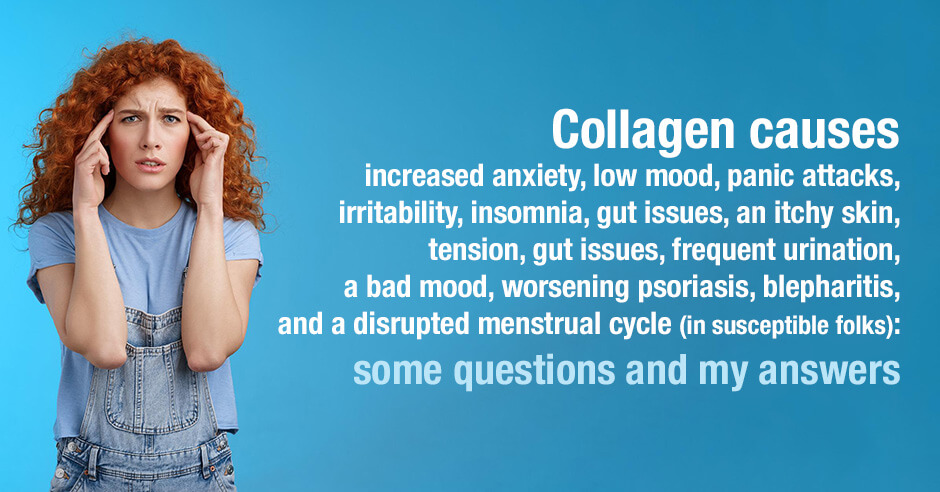
Collagen causes increased anxiety, low mood, irritability, insomnia, gut issues and an itchy skin: some questions and my answers

September 2, 2022 By Trudy Scott 37 Comments

collagen anxiety

Today we have some feedback from folks on some of the negative impacts they experienced when consuming collagen. I’m sharing their questions and the feedback I gave them in the hope this will help you too. Not everyone experiences unpleasant symptoms when consuming collagen but those who are susceptible may experience the following: increased anxiety or new anxiety, feeling low, inability to sleep or worsening sleep, tension, irritability, gut issues, itchy skin, frequent urination, a bad mood, worsening psoriasis, blepharitis, panic attacks and a disrupted menstrual cycle.

The causes of these symptoms can be due to the serotonin-lowering effects of collagen, the dietary oxalate impact, a histamine reaction and/or a glutamate reaction to collagen.

Beth shares how she feels low and anxious after using marine collagen for five days:

Have just recently begun receiving your emails. I read the above article and wanted to let you know of my experience. I started taking Vital Proteins marine collagen to see if it would improve sun damage to my skin. I took one scoop for about five days. On the fifth day I felt very low. So low that it made me somewhat anxious. As I have trouble with anxiety I stopped it immediately. Felt better the next day. The container lists 19 amino acids including tryptophan but the amount of it is zero mg. I hadn’t noticed that when I started taking it. After reading your article I’m fairly sure that that is why I felt depressed.

I shared this: for individuals who have observed a mood dip or increase in anxiety since using collagen or gelatin, I suggest they stop using collagen/gelatin and see how they feel, then add it back and see how they feel (sometimes more than once if they are not certain).

If they do see a correlation, look at the low serotonin symptoms and do a trial of tryptophan or 5-HTP (after checking the precautions) to see if this improves their low mood and reduces their anxiety when using collagen/gelatin. This confirms if their symptoms are due to the serotonin-lowering effects and allows them to continue using it for the benefits it provides.

Be sure to read the above collagen/serotonin blog for some of the research on what makes some folks more susceptible to the serotonin-lowering effects: a current depression/anxiety or history of depression/anxiety (even a family history), prior use of antidepressants, OCD / obsessive compulsive disorder, MAOA and/or 5-HTTLPR (the serotonin transporter gene) polymorphisms, smokers or former smokers, and women polydrug ecstasy users. This is not a conclusive list.

It’s interesting that she mentions her product has tryptophan listed with zero mg. When I looked online I didn’t see it listed on the product at all. Maybe it’s a change they have made to the label.

I also  shared  that when you are new to the amino acids (and other anxiety nutrition solutions like real whole food, quality animal protein, fermented foods, organic produce, health fats, gluten/sugar/caffeine removal, blood sugar control, gut health, pyroluria etc) my book “The Antianxiety Food Solution” is a great place to start.

The above question and the following questions come from the popular blog, Collagen and gelatin lower serotonin: does this increase your anxiety and depression?

How long after stopping bone broth does it take for this anxious feeling to leave?

Diane asks about bone broth and collagen and how it causes extreme anxiety and sleep problems:

I just finished your book and have to say how awesome it is ! A wealth of information. As I am struggling with many of the issues, I do have a question on bone broth and collagen. I have definitely noticed extreme anxiety and inability to sleep with bone broth and collagen supplement.(plus spring allergies are at play as well) I even tried a piece of Turkey with my bone broth this week to see if that helped. I have such gut issues I was really hoping to use bone broth. Anyway, my question is how long after stopping bone broth does it take for this anxious feeling to leave? Days or weeks? I want it cleared out before I try adding tryptophan with the broth.

I thanked her for the great feedback on my book. It’s wonderful to have the foundational stuff in place and she’s getting that from my book.

I don’t have an answer on how long symptoms can last as it’s very individualized. Typically if the effects are caused by serotonin being lowered, using either tryptophan or 5-HTP can result in significantly less anxiety and better sleep in a few days, provided the optimal dose is used.

Keep in mind that spring allergies can often make things worse and more tryptophan or 5-HTP may be needed during the allergy period. The dose would then need to be reduced once allergy season has passed. I blog about spring allergies and increased anxiety here.

My advice would be to use the tryptophan or 5-HTP to resolve the anxiety and insomnia and then once resolved, consider adding back the collagen and monitoring how she is doing. At this time she may need to bump up her tryptophan or 5-HTP yet again.

Is it a histamine reaction rather than low serotonin? (or an oxalate or glutamate reaction?)

Kelly believes her symptoms may be a histamine reaction and not caused by low serotonin:

If you become anxious, tense, irritable, can’t sleep AND have some issues with itchy skin, frequent urination, worsened gut issues, etc., then it’s a histamine problem from the collagen/glycine, and not serotonin at all.

I shared that these symptoms could actually be both since low serotonin can also cause anxiety, tension, irritability and insomnia. But I agree the itchy skin, frequent urination, worsened gut issues are a big clue it’s a histamine issue too or perhaps only a histamine issue.  Gut issues would happen with both low serotonin and histamine.

I’d start with a trial of tryptophan or 5-HTP because if it is low serotonin you will know very quickly. You can see what symptoms resolve and by how much.

Challenges with dietary oxalates could cause all the symptoms she experiences. So it’s a matter of figuring it out for each person. If you already know you have histamine or oxalate issues it’s also relatively easy to figure out by simply stopping the collagen and/or adding the counter-measures you typically use – like quercetin for histamine reactions and calcium citrate for oxalate issues.

It’s possible that some of these symptoms are a glutamate reaction too – like anxiety, tension, irritability and insomnia – and the amino acid GABA may help in this instance.

A bad mood, insomnia, psoriasis, blepharitis, panic attacks, hormone imbalance – oxalates or serotonin-lowering effects?

Em shares how she had a really bad mood, full blown insomnia, worsening psoriasis, blepharitis, panic attacks and disrupted menstrual cycle:

I am soooo glad I found this article. I started taking Oslo Skin Labs collagen (Verisol, so it is considered good quality) half way through December 2021. Looking back, that is when the problems started. I started sleeping restlessly and it got really bad in January. Full blown insomnia. My psoriasis got much worse, the blepharitis too. I have severe Endometriosis and was worried that if these other inflammation issues (psoriasis causes skin inflammation and blepharitis causes eye inflammation) were worse then maybe my endo was worse also since that can’t be checked on the outside.

Besides the inflammation symptoms I was experiencing extremely bad moods, feeling tense to the point of bordering on panic attacks and also a disrupted menstrual cycle.

I have been on Amitriptyline for 1,5 years and it worked wonders on my mood and sleep and I just couldn’t figure out why it wasn’t working any more. Then I realized that the only thing I changed was adding collagen to my diet in my fruit/vegetable smoothie ( I don’t drink coffee). So I started Googeling and found your article and stopped the collagen immediately. Have stopped for 2 days now and already my eyes are less red and inflamed. Pfew! It’s crazy and also scary how serious the side effects of collagen have been.

Do you think that besides the tryptophan lowering side effect that also the histamine might have played a part in my case? I don’t dare try the collagen with tryptophan supplement as the potential side effects are too serious to play around with. But I’m very bummed out about missing out on the skin and hair benefits.

Would love to hear your thoughts. I follow a vegetarian diet by the way and eat super healthy.

With Em I’d suspect an oxalate issue first because of the worsening psoriasis, blepharitis and endometriosis. She is also a vegetarian and this diet is often high in dietary oxalates. I write about oxalates and pain here.

However, with the “bad moods, feeling tense to the point of bordering on panic attacks and also a disrupted menstrual cycle”, I’d also suspect a serotonin-lowering impact. As mentioned above, a history of mood issues and antidepressant use can be a predisposing factor.  She would need to work with her prescribing doctor if she wanted to use tryptophan or 5-HTP because Amitriptyline has the potential to cause serotonin syndrome.

It’s also possible that her symptoms are caused in part by a histamine or glutamate reaction too.

With appreciation for helping to create awareness about these issues with collagen

I have much appreciation for each of these women for asking these questions and sharing their symptoms so we can all learn. There is not much awareness about collagen being problematic for some susceptible folks and it’s a very rude awakening when you start using something for the health benefits and have a bad reaction.  Hopefully their stories and others like this will help create more awareness.

The good news is that once you identify your cause/s and address them as above, you can often continue to consume collagen.

Resources if you are new to using tryptophan/5-HTP and other amino acids as supplements

If you are new to using any of the amino acids as supplements, here is the Amino Acids Mood Questionnaire from The Antianxiety Food Solution (you can see all the symptoms of neurotransmitter imbalances, including low serotonin and low GABA).

If you suspect low levels of any of the neurotransmitters and do not yet have my book, The Antianxiety Food Solution – How the Foods You Eat Can Help You Calm Your Anxious Mind, Improve Your Mood, and End Cravings, I highly recommend getting it and reading it before jumping in and using amino acids on your own so you are knowledgeable. And be sure to share it with the practitioner/health team you or your loved one is working with.

There is an entire chapter on the amino acids and they are discussed throughout the book in the sections on gut health, gluten, blood sugar control, sugar cravings, self-medicating with alcohol and more.

The book doesn’t include product names (per the publisher’s request) so this blog, The Antianxiety Food Solution Amino Acid and Pyroluria Supplements, lists the amino acids that I use with my individual clients and those in my group programs. You can find them all in my online store.

If, after reading this blog and my book, you don’t feel comfortable figuring things out on your own (i.e. doing the symptoms questionnaire and respective amino acids trials), a good place to get help is the GABA QuickStart Program (if you have low GABA symptoms). This is a paid online/virtual group program where you get my guidance and community support.

If you are a practitioner, join us in The Balancing Neurotransmitters: the Fundamentals program. This is also a paid online/virtual program with an opportunity to interact with me and other practitioners who are also using the amino acids.

Have you experienced any adverse symptoms when using collagen? Please share the symptoms so we can all learn from each other .

And were you able to figure out if it was due to low serotonin, a histamine or glutamate reaction or because of dietary oxalates?

If it was low serotonin, has tryptophan or 5-HTP helped so you can continue to use collagen?

If you have questions please share them here too.

Filed Under: 5-HTP, Anxiety, Collagen, GABA, Insomnia, Tryptophan Tagged With: a bad mood, an itchy skin, anxiety, Balancing Neurotransmitters: the Fundamentals program for practitioners, blepharitis, collagen, dietary oxalate, disrupted menstrual cycle, frequent urination, GABA Quickstart program, glutamate reaction, gut issues, histamine reaction, insomnia, irritability, low mood, panic attacks, serotonin-lowering effects, tension, worsening psoriasis

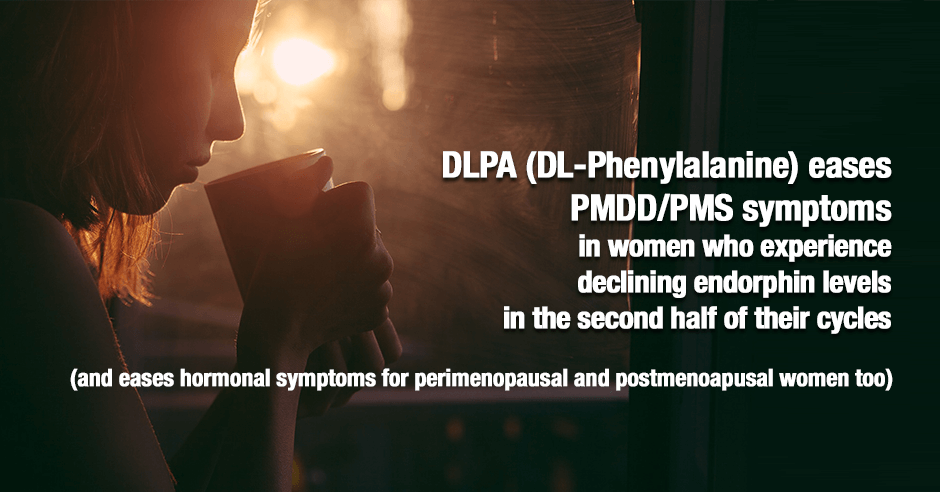
DLPA (DL-Phenylalanine) eases PMDD/PMS symptoms in women who experience declining endorphin levels in the second half of their cycles

March 18, 2022 By Trudy Scott 23 Comments

dlpa

Mood swings, intense sugar cravings, comfort/binge eating, sadness, anxiety, crying, cramps and increased pain, irritability, anger, fatigue, cognitive dysfunction, overwhelm, feelings of unease and dissatisfaction, aggression, heartache, and/or insomnia are common for many women during the second half of the menstrual cycle i.e. in the luteal phase. You may relate to all or some of these symptoms. And you may have been diagnosed with or may identify with PMS (premenstrual syndrome) or PMDD (premenstrual dysphoric disorder – similar to PMS but more serious).

Research shows improvements of these symptoms with the amino acids tryptophan (which provides serotonin support) and GABA (which supports GABA levels). Although there is no research that the pyroluria protocol improves symptoms it’s something I see clinically all the time. (I’ve written about this extensively and share more on this below)

A really interesting study published in 1989 identified low endorphins and low catecholamines as a probable cause for some women – Prevention of Late Luteal Phase Dysphoric Disorder Symptoms with DL-Phenylalanine in Women with Abrupt β-Endorphin Decline: A Pilot Study

I recently came across the above paper and prior to this, had not considered this as a primary root cause. Here is the excerpt from the abstract:

Twenty-two women with late luteal phase dysphoric disorder were treated with DL-phenylalanine during the 15 days prior to menses in a double-blind crossover study.

DL-Phenylalanine was shown to be more effective than placebo in attenuating many symptoms characteristic of luteal phase dysphoric disorder. This amino acid was chosen because of its hypothesized actions in attenuating the symptoms associated with the sharp decline in central β-endorphin levels during the late luteal phase in women with luteal phase dysphoric disorder.

Let’s review a few terms… Late luteal phase dysphoric disorder is a synonym for PMDD. The luteal phase is one stage of the menstrual cycle and occurs after ovulation and before your period. When you feel dysphoric you feel very unhappy, uneasy, or dissatisfied. With the downward endorphin shift at this time, period pain and other pain can be worse, and weepiness and emotional symptoms increase. The need for comfort or reward eating also increases. The study authors suggest these PMDD symptoms may “closely resemble those seen during morphine or heroin withdrawal.”

Based on my experience I do feel comfortable extrapolating these findings to PMS and even peri and post-menopausal women who experience some or all of these symptoms (other than actual periods and period issues in post-menopausal women).

Study participants, dosing and timing of DLPA and improvements

The participants in the study were white, middle-class, and between 24 and 29. Each woman took one 750 mg of DLPA at breakfast and lunch for the 15 days prior to the expected onset of their periods.

In the study groups, it was found that “initial improvement started at the end of the first month of DLPA therapy. Continued therapy brought increased relief from symptoms by the end of the second month. Interestingly, the greatest period of improvement occurred during the washout period” at the end of the third month possibly due to a delayed action of DL-phenylalanine.

The authors make the following conclusion:

DL-phenylalanine was found to be safe, well-accepted, and without significant side effects. The significant improvement it produced with many of the symptoms characteristic of Late Luteal Phase Dysphoric Disorder [PMDD] suggests that it may prove a useful addition to the therapeutic armamentarium for this syndrome.

Keep in mind that a typical starting dose of DLPA is 500mg used 2-3 x per day and it’s typically used between meals for best effects. Ideal is also to customize dosing to your unique needs. In this study, everyone received the same dose at the same time. For these reasons it’s even more impressive to see results like they did.

It makes sense but I have just not used DPLA alone and only in the second half of the cycle

It’s a very small pilot study but given my experience with the amino acids DLPA, DPA and tyrosine, and the vast number of women I have worked with who had symptoms like the above, it makes sense. Using the above three amino acids in combination with dietary changes, tryptophan, GABA and the pyroluria protocol, this approach has offered relief for many of my clients. I have just not used DPLA alone and only in the second half of the cycle.

In case you’re wondering why I mention the three amino acids DLPA, DPA and tyrosine above, it’s because:

  • DLPA (the amino acid used in this study) supports both endorphins and catecholamines (dopamine is one of them)
  • Or DPA (supports endorphins only) can be used with tyrosine (supports catecholamines only) instead of DLPA which does both

I blog about the differences between DLPA and DPA here, together with all the symptoms we look at when considering doing a trial.

In this study, they used DLPA which boosts endorphins and catecholamines. As I share in my DPA vs DLPA blog, I prefer DPA (d-phenylalanine) for endorphin support when symptoms are severe. But DPA is not always available so DLPA is a good alternative, assuming the person can handle the catecholamine support. Some people can’t and there are some contraindications too.

I’d love to see follow-on research covering the following:

  • A larger group of women using DLPA
  • Individualizing the dosing of DLPA to each person’s unique needs
  • Correlating results with the low endorphin and low catecholamine symptoms questionnaire
  • Comparing DLPA alone with a combination of DPA + tyrosine (with each individualized based on unique needs)

Serotonin and GABA support for PMS/PMDD, and the pyroluria protocol

In this paper, Premenstrual Dysphoric Disorder the authors share that PMDD

comprises emotional and physical symptoms and functional impairment that lie on the severe end of the continuum of premenstrual symptoms. Women with PMDD have a differential response to normal hormonal fluctuations.

It’s recognized that serotonin and GABA play a role:

This susceptibility may involve the serotonin system, altered sensitivity of the GABAA receptor to the neurosteroid allopregnanalone [a naturally occurring neurosteroid which is made from the hormone progesterone], and altered brain circuitry involving emotional and cognitive functions.

They share SSRIs that are considered as the first-line treatment. Second-line treatments include oral contraceptives, calcium, chasteberry, and cognitive-behavioral therapy.

However, as I share in this blog, research supports the use of tryptophan – Tryptophan for PMS: premenstrual dysphoria, mood swings, tension, and irritability

A study published in 1999, A placebo-controlled clinical trial of L-tryptophan in premenstrual dysphoria, tryptophan was found to reduce symptoms of PMS when used in the luteal phase or second half of the cycle (i.e. after ovulation).

I mention GABA in this blog and the fact that many anxious women I work with also have pyroluria or signs of low zinc and low vitamin B6 and adding these nutrients, together with evening primrose oil, provide additional hormonal and neurotransmitter support, and help with the social anxiety.

Resources if you are new to using DLPA (or other amino acids) as supplements

If you are new to using DLPA or the other amino acids as supplements, here is the Amino Acids Mood Questionnaire from The Antianxiety Food Solution (you can see the low endorphin and low catecholamine symptoms.)

If you suspect low levels of endorphins and/or low levels of catecholamine and do not yet have my book, The Antianxiety Food Solution – How the Foods You Eat Can Help You Calm Your Anxious Mind, Improve Your Mood, and End Cravings, I highly recommend getting it and reading it before jumping in and using amino acids on your own so you are knowledgeable. And be sure to share it with the team you or your loved one is working with. Blog posts like this are intended to add value to the chapter on amino acids, which contains detailed information on doses and time of the day for dosing.

The book doesn’t include product names (per the publisher’s request) so this blog, The Antianxiety Food Solution Amino Acid and Pyroluria Supplements, lists the amino acid products that I use with my individual clients and those in my group programs.

If you are a practitioner, join us in The Balancing Neurotransmitters: the Fundamentals program. It’s an opportunity to interact with me and other practitioners who are also using the amino acids.

Have you considered that there may be different types of PMS (premenstrual syndrome) or PMDD (premenstrual dysphoric disorder) i.e. a different combination of root causes and therefore different solutions?

And have you had success with DLPA alone (providing both endorphin and dopamine support) or by using a combination of DPA (endorphin support only) and tyrosine (catecholamine support only).

If you’re peri or post menopausal have you also seen success with any of these amino acids?

Have the other amino acids, tryptophan and GABA or the pyroluria protocol helped too?

If you’re a practitioner please share what you’ve seen with clients/patients.

Feel free to ask your questions here too.

Filed Under: Amino Acids, Anxiety, Hormone, PMS, Women's health Tagged With: aggression, anger, anxiety, catecholamines, Cognitive dysfunction, comfort/binge eating, cramps, crying, dissatisfaction, dl-phenylalanine, DLPA, endorphin, fatigue, feelings of unease, GABA, heartache, increased pain, insomnia, intense sugar cravings, irritability, luteal phase. premenstrual syndrome, menstrual cycle, mood swings, overwhelm, PMDD, PMS, premenstrual dysphoric disorder, pyroluria, sadness, second half of their cycles, serotonin, tryptophan

Increasing tryptophan or 5-HTP temporarily when a winter dip in serotonin causes more severe anxiety, OCD and/or the winter blues

December 24, 2021 By Trudy Scott 30 Comments

tryptophan and 5htp during winter

Don’t forget that serotonin takes a dip in winter when the days are shorter and there is less light. If you’re currently using tryptophan or 5-HTP to boost low serotonin and ease low serotonin symptoms – worry-type anxiety, panic attacks, insomnia, ruminations, PMS, irritability, negativity, perfectionism, obsessiveness, lack of confidence, anger/rage, afternoon/evening cravings – you may find you need to increase your dose for a few months.

This will especially be the case if you check off winter blues or more severe winter anxiety (yes it’s a thing and published in the research) on the low serotonin symptoms list.

I shared this on Facebook last week and the feedback ranged from surprised to curious to confirmatory.

In this blog I’m sharing some of the feedback and some of the supporting evidence, as well as other factors to consider.

The addition of 5-HTP in the morning and a light box

Kathy thanked me for the reminder and shared the changes she makes in the winter months:

Thanks for the reminder! I need to increase my dose this time of year… I can feel myself feeling “down”. I take 500 mg Tryptophan before bed and 100 mg 5-HTP in the morning before breakfast. I also use a light box in the morning while eating breakfast, which helps.

This is an increase from her typical dosing in the spring and summer when she only takes tryptophan at night before bed.

She also only uses her light box or SAD (seasonal affective disorder) lamp in winter. You can read more about SAD/full spectrum lamps here. They are also a wonderful way to boost serotonin and mood in the winter.

My daughter’s anxiety and OCD goes through the roof

Mark shared about his daughter’s anxiety and OCD (obsessive compulsive disorder):

Every year from October – March, my daughter’s anxiety and OCD goes through the roof. At first we thought it was the transition from summer to school, then the craziness of the winter holidays and suspected mold allergy. Now, based on this information, a winter/less light induced dip in serotonin may be an additional factor we hadn’t considered. We’ll try adjusting her 5-HTP dose and see if we gain some improvement. Thanks for the tip.

It’s really common for families to attribute the more severe anxiety and OCD to the stress and craziness of the winter holidays. And of course suspected mold issues do need to be looked into and addressed. But even then, the dip in serotonin can compound all these factors.

Planned tryptophan bump for Christmas sugar cravings and holiday family stress

Carol shared this about her plans to temporarily boost serotonin:

I am one of those light weights that was able to do one 500 mg pill a day of tryptophan. But I do think that it would help to bump it up to two a day to get me through the Christmas sugar cravings AND holiday family stressful get togethers! I’m all about taking the minimum effective dose but this is helpful to know that there could be a temporary boost just to get you through this time!

It’s wonderful that 500mg tryptophan is enough for her and I’m all for a minimum effective dose! However the winter dip in serotonin – and increased sugar cravings and family stress – is a common reason many folks bump up the dose for a month or more.

You may also find you made the change intuitively. Linda shared this: “I had made the adjustment. I just did not realize the reason why.”

A question about timing of 5-HTP and what to do in Spring

Suzanne shared that she uses a SAD light (also called a light box) and finds that it helps. She asks:

Can I just take the 5-HTP on days with no sun or is it better to have it build up in my system? When spring rolls around, do I taper off or can I just stop taking it?

This is my feedback: I haven’t had anyone just use 5-HTP on cloudy days but it’s worth a trial.  If you are noticing increased anxiety and mood changes only on cloudy days and using the SAD lamp on those days helps, then using 5-HTP on those days may be enough. If not, use 5-HTP consistently/daily through the winter months.

Amino acids do not need to be tapered but I find my clients do better when they are reduced over a few weeks. Some folks also choose to just stop taking them and do fine.

I appreciate all the feedback and the great questions. I’ll report back when I hear how Mark’s daughter does with the adjusted 5-HTP and how Carol does with the bump in tryptophan (and any other feedback I get from these folks).

Some of the research and possible mechanisms

There are many studies that support serotonin changes and seasonal variations in mood. Here are just two of them:

  • Effect of sunlight and season on serotonin turnover in the brain “Alterations in monoaminergic neurotransmission in the brain are thought to underlie seasonal variations in mood, behaviour, and affective disorders… turnover of serotonin by the brain was lowest in winter. Moreover, the rate of production of serotonin by the brain was directly related to the prevailing duration of bright sunlight… Our findings are further evidence for the notion that changes in release of serotonin by the brain underlie mood seasonality and seasonal affective disorder.”
  • Sunshine, Serotonin, and Skin: A Partial Explanation for Seasonal Patterns in Psychopathology? “one contributory facet may be the role of sunshine on human skin. Human skin has an inherent serotonergic system that appears capable of generating serotonin.”

Other factors to consider: low vitamin D, sugar, pyroluria and phenols

There are other low-serotonin related factors to consider too:

  • Low vitamin D is common in the winter and sufficient levels are needed for making serotonin. This paper, Vitamin D and the omega-3 fatty acids control serotonin synthesis and action, part 2: relevance for ADHD, bipolar disorder, schizophrenia, and impulsive behavior describes how“Brain serotonin is synthesized from tryptophan by tryptophan hydroxylase 2, which is transcriptionally activated by vitamin D hormone. Inadequate levels of vitamin D (∼70% of the population) and omega-3 fatty acids are common, suggesting that brain serotonin synthesis is not optimal.”
  • The increased consumption of sugar at this time can lead to reduced zinc, magnesium and B vitamins (like vitamin B6 and thiamine) and this can further reduce serotonin levels, which relies on these nutrients as cofactors for production. By boosting serotonin with additional tryptophan or 5-HTP you can actually reduce some of the cravings.
  • If you have the social anxiety condition called pyroluria, the added stress of family and holiday gatherings can also contribute to zinc and vitamin B6 being dumped, and further impacting serotonin production.
  • Christmas tree phenols can be a trigger for anger, meltdowns, anxiety, hyperactivity, insomnia, aggression, self-injury and autistic symptoms in susceptible individuals

Resources if you are new to using tryptophan and 5-HTP as supplements

If you are new to using the amino acids as supplements, here is the Amino Acids Mood Questionnaire from The Antianxiety Food Solution (you can see the low serotonin symptoms here) and a brief overview here, Anxiety and targeted individual amino acid supplements: a summary.

If you suspect low serotonin or low levels of any of the neurotransmitters and do not yet have my book, The Antianxiety Food Solution – How the Foods You Eat Can Help You Calm Your Anxious Mind, Improve Your Mood, and End Cravings, I highly recommend getting it and reading it before jumping in and using amino acids so you are knowledgeable. And be sure to share it with the team you or your loved one is working with.

The book doesn’t include product names (per the publisher’s request) so this blog, The Antianxiety Food Solution Amino Acid and Pyroluria Supplements, lists the amino acid products that I use with my individual clients and those in my group programs.

If, after reading this blog and my book, you don’t feel comfortable figuring things out on your own (i.e. doing the symptoms questionnaire and respective amino acids trials), a good place to get help is the GABA QuickStart Program (if you have low GABA symptoms). This is a paid online/virtual group program where you get my guidance and community support. 

Another option is the budget-friendly GABA QuickStart Homestudy program.

If you also need serotonin support, the Serotonin QuickStart Program is a good place to get help. This is also a paid online/virtual group program where you get my guidance on using tryptophan and 5-HTP safely, and community support during 5 LIVE Q&A calls. You can sign up to be notified when the next live launch of this program is happening.

If you are a practitioner, join us in The Balancing Neurotransmitters: the Fundamentals program. This is also a paid online/virtual program with an opportunity to interact with me and other practitioners who are also using the amino acids.

Wrapping up and your feedback

Have you noticed this winter dip in serotonin and made adjustments to your 5-HTP or tryptophan? And do you feel less anxious, less obsessive, not as low and with fewer sugar cravings?

Do you find that using a SAD lamp/full spectrum light at this time helps even further?

Were you aware that serotonin dipped in winter and could be playing a role for you? Or did you think it was just the stress and overwhelm of the holidays (and /or some of the emotional upheaval some of us face at this time)?

If you’re a practitioner, have you seen this with clients or patients?

Have you also noticed you need to adjust your GABA and other amino acids at this time too (both GABA and dopamine show seasonality)?

Feel free to ask your questions here too.

Filed Under: 5-HTP, Anxiety, Depression, serotonin, Tryptophan Tagged With: 5-HTP, anger, anxiety, dip in serotonin, holiday family stress, insomnia, irritability, lack of confidence, less light, light box, low vitamin D, negativity, obsessiveness, OCD, panic attacks, perfectionism, Phenols, PMS, pyroluria, rage, ruminations, serotonin, shorter days, skin, sugar, sugar cravings, tryptophan, winter, winter blues, worry-type anxiety

Rage, anxiety, cravings & insomnia in 11-year old girl with RAD/reactive attachment disorder: chewable tryptophan turns things around

May 28, 2021 By Trudy Scott 21 Comments

rad and tryptophan

Today I’m sharing the case of an 11-year-old girl who had huge rage issues, was angry much of the time, suffered from terrible anxiety, had crazy sugar cravings (for bread and colored candies) and had dreadful insomnia. Because of the insomnia she was also very fatigued and this likely drove some of her cravings and irritability too. She was adopted and had been diagnosed with RAD (reactive attachment disorder). During our first session, chewable tryptophan turns things around quickly – she smiles and is willing to make changes and quit the sugar and gluten. We also address low iron levels and with these 4 nutritional interventions this child’s behavior improves dramatically.

This book chapter, Reactive Attachment Disorder, states how The Diagnostic and Statistical Manual 5th Edition (DSM-5) classifies reactive attachment disorder as follows:

a trauma- and stressor-related condition of early childhood caused by social neglect or maltreatment. Affected children have difficulty forming emotional attachments to others, show a decreased ability to experience positive emotion, cannot seek or accept physical or emotional closeness, and may react violently when held, cuddled, or comforted. Behaviorally, affected children are unpredictable, difficult to console, and difficult to discipline. Moods fluctuate erratically, and children may seem to live in a “flight, fight, or freeze” mode. Most have a strong desire to control their environment and make their own decisions. Spontaneous changes in the child’s routine, attempts to discipline the child, or even unsolicited invitations of comfort may elicit rage, violence, or self-injurious behavior.

Reactive attachment disorder/RAD and low serotonin

There is no research on tryptophan helping to address RAD symptoms or trauma, but based on her low serotonin symptoms, a trial of tryptophan was the first thing I considered.

There is, however, evidence to indicate the role of low serotonin in RAD, as indicated by a study where antidepressants were successfully used. The authors mention how:

The absence of responsive and consistent caretaking can subject the developing brain to an inordinate amount of physiological stress, leading to increased cortisol production and consequential inefficiencies in the serotonin and the growth-hormone releasing systems.

Although not specific to RAD, another paper looking at trauma states that:

Serotonin and dopamine levels were found to be abnormal in the presence of PTSD.

As the field of nutritional psychiatry grows, I expect to see more and more research supporting the use of tryptophan and other amino acids for those suffering from symptoms like this. Symptoms that are caused by imbalances that are triggered by the trauma in their lives.

We know that therapy, EFT, EMDR and other approaches are crucial for trauma recovery (this family had already done some of this work) but we must start to incorporate nutritional support too.

The case study

Here are the details of this case study and the nutritional interventions. As I mentioned above, because of her severe rage episodes, a trial of tryptophan was the first thing I considered:

She was referred to me by a friend. The family didn’t have much money. And so, we had to really try and figure out a few simple interventions that we could use that were going to be effective.

This young girl had been adopted. She was diagnosed with reactive attachment disorder and her anger issues were just phenomenal. The mom had to physically put her body around her and hold her down when she was having one of her fits because she was worried that she was going to hurt herself and hurt other people.

She also had anxiety, huge cravings for colored candies and insomnia. She was so fatigued because she wasn’t sleeping well.

So sitting in my office with this young girl and her mom, we started to talk about the sweets and the candies and the need to give up the candies. She was fuming with me. She was sitting in a swivel chair. She turned her back on me and didn’t want to talk about having to give up candy at all.

I said, “Look, let’s not even talk about that, but would you take this chewable tryptophan here? And we’ll talk about it in a second.” I gave her 100 mg of the chewable tryptophan and continued discussing things with her mom.  She had no idea what it was going to do or how it would make her feel.

Within five minutes she turned her chair back, looked at me and she said, smilingly, “Yes, let’s do it. I can give up the candy.” She was smiling and she was happy.

So long story short, with this young girl, we started her on [chewable] tryptophan [and it turned things around quickly].

Chewable tryptophan – when I use it and when I don’t

I typically use 500mg Lidtke tryptophan for the adult clients I work with and prefer this company’s product because it is really high quality. It really does work better than many other tryptophan products on the market.

Lidtke also makes a chewable 100mg tryptophan which is also high quality, and the product I used with this young girl. Here are some benefits of this 100mg product:

  • It’s useful for doing the initial trial in order to figure out if tryptophan is going to help with low serotonin symptoms in children – because it’s a lower dose.
  • It’s especially useful for children for ongoing use (typically midafternoon and evening) because it’s a lower dose.
  • It’s also useful for adults who are “pixie dust” folks and do better with a lower dose of supplements in general or respond more severely to medications/alcohol/chemicals. We may start with a trial of the 100mg chewable and increase from there, also typically midafternoon and evening.

I don’t use the chewable 100mg tryptophan under these circumstances:

  • When the child (or adult) finds that 5 x100mg works for them at each time they need it. In this instance it’s best to switch to a 500mg tryptophan. Using it swallowed may work or it may need to be opened onto the tongue.
  • When the child (or adult) starts to consume the chewables like candy. They are sweet and do taste good and I’ve seen this happen. Because you are continually consuming something sweet you may end up over-consuming them if sugar addiction is one of your issues. You may also end up taking too much tryptophan.

If the chewable tryptophan is not available where you live, using a small amount of a powdered tryptophan or opening a capsule of the 500mg tryptophan is an option. Since it tastes bitter it can be mixed with mashed banana or inositol. (You can find all the Lidtke products in my online supplement store. The link is in the resources section below.)

Gluten and candies were also a huge issue, and she had low iron

There was more to her issues than only low serotonin:

Gluten was also a huge issue, so we got her off gluten and the candies. The tryptophan helped with this” (i.e. it made it easy to break the addiction and not feel deprived).

Tryptophan also helped her sleep. And it helped with the severe rage issues.

Obviously the gluten was contributing to the rage issues as well.

Her iron and ferritin levels were really low (possibly as a result of her gluten issues). So we added an iron supplement, and animal protein/red meat.

So with just four interventions – the gluten, the animal protein, getting her iron levels up and the tryptophan – this kid was just a new kid.

Here are some articles that are related to the above:

  • The role of low serotonin, low vitamin B6 and low iron in anxiety and panic attacks
  • Integrative Medicine Approach to Pediatric Obsessive-Compulsive Disorder and Anxiety I write about a study where gluten was found to be the cause of a childhood case of obsessive-compulsive disorder (OCD)
  • Tryptophan for my teenager: she laughs and smiles, her OCD and anxiety has lessened, and she is more goal oriented and focused on school.

Keep in mind there is not a one-size-fits-all and these 4 simple nutritional interventions – tryptophan, gluten removal, adding red meat and addressing low iron – happened to be the combination that worked for this young girl.

Resources if you are new to using tryptophan as a supplement

If you are new to using the amino acid tryptophan as a supplement, here is the Amino Acids Mood Questionnaire from The Antianxiety Food Solution and a brief overview here, Anxiety and targeted individual amino acid supplements: a summary.

If you suspect low serotonin symptoms and do not yet have my book, The Antianxiety Food Solution – How the Foods You Eat Can Help You Calm Your Anxious Mind, Improve Your Mood, and End Cravings, I highly recommend getting it and reading it before jumping in and using amino acids so you are knowledgeable.

The book doesn’t include product names (per the publisher’s request) so this blog, The Antianxiety Food Solution Amino Acid and Pyroluria Supplements, lists Lidtke chewable tryptophan 100mg, Lidtke tryptophan 500mg and other products that I use with my individual clients and those in my group programs.

We use an amino acid like tryptophan for quick relief of symptoms, like I did in this instance. Then we focus on the foundations like diet – like no gluten and red meat in this instance – and address all other imbalances, like her low iron. If cortisol was high we would have addressed that.

This case deserves it’s own blog post

In case you’re wondering, I first shared this case study in my interview, “Calming Anxiety, Aggression and OCD with Amino Acids and Food”, on the ADHD and Autism Summit in May 2021. Due to the interest in this case and the use of chewable tryptophan, I felt it deserved a deeper dive and its own blog post with links to some of the research and some practical information about the chewable tryptophan.

Have you used this chewable tryptophan product with success – personally, with your child or with a patient/client?

Have you found that addressing serotonin with tryptophan (or 5-HTP) helps resolve symptoms in a child diagnosed with RAD or a child with rage issues? What about helping with sleep problems, easing anxiety and stopping cravings too?

Have you addressed low iron levels and seen improvements with the removal of gluten too.

Feel free to post your questions here too.


Filed Under: Anxiety, Children/Teens, PTSD/Trauma, serotonin, Tryptophan Tagged With: adopted low iron, angry, anxiety, behavior, chewable tryptophan, cravings, fatigue, gluten, insomnia, irritability, nutritional interventions, nutritional psychiatry, RAD, rage, reactive attachment disorder, self-injurious behavior, serotonin, sugar, trauma, unpredictable, violence, young girl

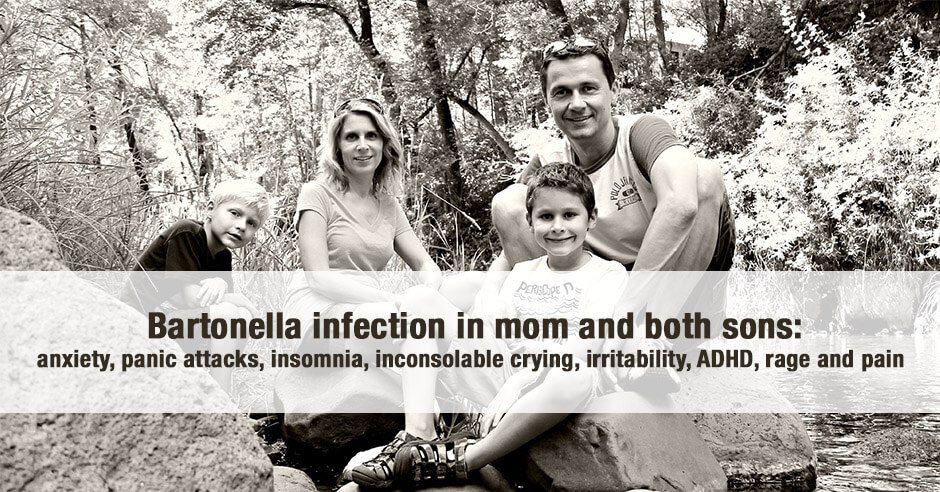
Bartonella infection in mom and both sons: anxiety, panic attacks, insomnia, inconsolable crying, irritability, ADHD, rage and pain

March 12, 2021 By Trudy Scott 32 Comments

bartonella infection

A mom and both her sons experienced a variety of emotional/mood and pain symptoms between them as a result of a Bartonella infection: anxiety, panic attacks, insomnia, irritability, inconsolable crying, ADHD, rage, eye pain, joint pain and pain in the legs. This family case study was published in Parasites and Vectors in 2013. I would love to see individual amino acids being used to ease some of these symptoms while the infection is being treated (more on this below).

Here are some of the emotional and mood-related symptoms they experienced:

  • the mother and both sons developed recurrent rash-like skin lesions, disruptive sleep patterns and both boys developed anxiety accompanied by episodes of inconsolable crying, irritability, and panic attacks
  • subsequent to the spider infestation of the apartment, [the mother] developed fatigue, memory difficulties, headaches, irritability, eye pain, insomnia, chest pain, blurred vision, shortness of breath, rash and skin lesions and anxiety attacks.
  • The youngest son… awakened at night crying and complaining of pain in his legs
  • The older son experienced increased irritability and rage episodes. In addition, the boy’s teacher indicated a lack of attention during class, and suggested that the child might have an Attention Deficit Hyperactivity Disorder (ADHD).

The youngest son also developed severe neurological symptoms and was diagnosed with Guillain-Barre syndrome and Chronic Inflammatory Demyelinating Polyradiculoneuropathy.

You can read the full investigation, timing, sequence of events and all the symptoms in the paper: Bartonella henselae infection in a family experiencing neurological and neurocognitive abnormalities after woodlouse hunter spider bites

Creating awareness, motivating, inspiring and educating

I’d like to highlight some of the reasons for sharing this paper:

  • creating more awareness about the emotional/mood symptoms that can occur with a Bartonella henselae infection
  • educating about this infection in general so other families can find solutions quicker than this family did
  • motivating and inspiring you to not give up looking for answers for you and your family – this mom suspected Bartonella infection after doing internet searches (almost 3 years after all this started)
  • creating more awareness about possible hosts other than ticks (in this case woodlice and woodlice hunter spiders)
  • highlighting how family members exposed to the same infection can have different symptoms and how some family members may not be infected at all (in this case the father was not affected)
  • highlighting that some individuals (the mom in this case) do not recall being bitten and yet still get sick
  • educating on how amino acids can offer much symptom relief during the investigation and treatment of the infection (more on this below)

Treatment with antibiotics and Chinese herbs

This family was successfully treated with antibiotics and other medications once it was determined Bartonella was the cause of their symptoms:

The parents report that the [youngest] child is actively socializing with other children and now runs and plays like he had never done before.

Following this antibiotic course, the mother reported substantial overall improvement and was almost symptom free. However, she continues to experience occasional irritability, confusion, dizziness, nausea, and pain involving the shoulder, hip and the bottoms of her feet.

One of the common symptoms of Bartonella is burning feet and this article, How to Put Out the Fire in Your Burning Bartonella Feet, mentions a herb from the Zhang protocol:

In Chinese herbal medicine, an herb called “houttuynia” is classified as “Clearing Heat and Relieving Toxicity.” This herb has been successfully used to treat Bartonella by a Chinese physician in New York named Dr. Q. Zhang. This herb has antibacterial and antiviral properties in addition to clearing heat and toxins. Fortunately this herb can be combined with other herbs to help relieve Bartonella symptoms.

I mention this because I am personally familiar with the Zhang protocol, having used it when working with Dr. Darin Ingels to address my Lyme disease (Borrelia). Dr. Ingels is the author of  The Lyme Solution and writes about the Zhang protocol in this excellent book.

Using amino acids to address anxiety, panic attacks, sleep problems, crying and pain

Individual amino acids, used as supplements, can offer much symptom relief during the investigation and treatment of the Bartonella infection, however they are seldom recommended. I would love to see this change and become the norm.

In this blog post, GABA helps with Lyme anxiety (while addressing the underlying disease), Tricia shares that “Lyme, Bartonella and Babesia are all known to cause anxiety and other psychological disorders ranging from mild to very severe.” She also shares that her daughter used GABA:

We’ve used Source Naturals GABA Calm sublinguals with good results. I learned about GABA helping anxiety and because I was treating my young daughter I purchased this because it was easy for her to take.

Looking at some of the emotional symptoms this family experienced, and how the amino acids could have helped:

  • anxiety, irritability, and panic attacks: can be eased by using tryptophan/5-HTP
  • disruptive sleep patterns and waking: can be helped by using calming GABA
  • inconsolable crying: can be eased by using DPA to boost endorphins
  • headaches, pain in the legs, shoulders and elsewhere: can be eased with DPA and/or tryptophan
  • rage episodes: can be eased with tryptophan/5-HTP
  • ADHD: can be helped with GABA in some instances and 5-HTP in other instances

I feel for this poor family. It certainly was a very complex family case and reflects the need to dig deep to find the root cause. And I appreciate the case being written up so more awareness can be created.

Have you or your family experienced something like this? And has your practitioner introduced you to the amino acids for some symptom relief while they are addressing the infection/s?

If you’re a practitioner working with Lyme disease and coinfections such as Bartonella, have you seen cases similar to this one? Do you use amino acids for some symptom relief while addressing the infection/s?

Feel free to post your questions and feedback in the comments below.
Filed Under: ADHD, Anxiety, Children/Teens, Lyme disease and co-infections Tagged With: ADHD, amino acids, anxiety, Bartonella henselae infection, Bartonella infection, burning feet, DPA, emotional, eye pain, GABA, inconsolable crying, insomnia, irritability, joint pain, Lyme anxiety, mood, neurocognitive, neurological, pain, pain in the legs, panic attacks, rage, sleep, The Lyme Solution book, tryptophan, woodlouse hunter spider bites, Zhang protocol

  • « Go to Previous Page
  • Page 1
  • Page 2
  • Page 3
  • Go to Next Page »

Primary Sidebar

NEW! GABA QuickStart Homestudy (with special intro pricing)

gaba quickstart homestudy

Free Report

9 Great Questions Women Ask about Food, Mood and their Health

You'll also receive a complimentary subscription to my ezine "Food, Mood and Gal Stuff"


Connect with me

Popular Posts

  • Amino Acids Mood Questionnaire from The Antianxiety Food Solution
  • The Antianxiety Food Solution Amino Acid and Pyroluria Supplements
  • Pyroluria Questionnaire from The Antianxiety Food Solution
  • Collagen and gelatin lower serotonin: does this increase your anxiety and depression?
  • Tryptophan for the worry-in-your-head and ruminating type of anxiety
  • GABA for the physical-tension and stiff-and-tense-muscles type of anxiety
  • The Antianxiety Food Solution by Trudy Scott
  • Seriphos Original Formula is back: the best product for anxiety and insomnia caused by high cortisol
  • Am I an anxious introvert because of low zinc and vitamin B6? My response to Huffington Post blog
  • Vagus nerve rehab with GABA, breathing, humming, gargling and key nutrients

Recent Posts

  • What do I use instead of Seriphos to help lower high cortisol that is affecting my sleep and making me anxious at night?
  • BeSerene™ GABA/theanine cream eases severe muscle tension in her neck/shoulders, prevents her bad headaches and quells her anxiety
  • How the correct approach, dose and sublingual use of GABA can be calming and not cause a flushed and itchy face and neck
  • The amino acid glutamine improves low mood by addressing gut health, and it has calming effects too
  • Flight anxiety with heightened breath, physical tension and also fearing the worst (the role of low GABA and low serotonin)

Categories

  • 5-HTP
  • AB575
  • Addiction
  • ADHD
  • Adrenals
  • Alcohol
  • Allergies
  • Alzheimer's disease
  • Amino Acids
  • Anger
  • Antianxiety
  • Antianxiety Food Solution
  • Antidepressants
  • Anxiety
  • Anxiety and panic
  • Autism
  • Autoimmunity
  • benzodiazapines
  • Bipolar disorder
  • Books
  • Caffeine
  • Cancer
  • Candida
  • Children/Teens
  • Collagen
  • Cooking equipment
  • Coronavirus/COVID-19
  • Cravings
  • Depression
  • Detoxification
  • Diabetes
  • Diet
  • DPA/DLPA
  • Drugs
  • EFT/Tapping
  • EMF
  • EMFs
  • Emotional Eating
  • Endorphins
  • Environment
  • Essential oils
  • Events
  • Exercise
  • Fear
  • Fear of public speaking
  • Fertility and Pregnancy
  • Fish
  • Food
  • Food and mood
  • Functional neurology
  • GABA
  • Gene polymorphisms
  • General Health
  • Giving
  • Giving back
  • Glutamine
  • Gluten
  • GMOs
  • Gratitude
  • Gut health
  • Heart health/hypertension
  • Histamine
  • Hormone
  • Hyperparathyroidism
  • Hypoglycemia
  • Immune system
  • Inflammation
  • Insomnia
  • Inspiration
  • Introversion
  • Joy and happiness
  • Ketogenic diet
  • Lithium orotate
  • Looking awesome
  • Lyme disease and co-infections
  • MCAS/histamine
  • Medication
  • Men's health
  • Mental health
  • Mercury
  • Migraine
  • Mold
  • Movie
  • MTHFR
  • Multiple sclerosis
  • Music
  • NANP
  • Nature
  • Nutritional Psychiatry
  • OCD
  • Osteoporosis
  • Oxalates
  • Oxytocin
  • Pain
  • Paleo
  • Parasites
  • Parkinson’s disease
  • PCOS
  • People
  • PMS
  • Postpartum
  • PTSD/Trauma
  • Pyroluria
  • Questionnaires
  • Real whole food
  • Recipes
  • Research
  • Schizophrenia
  • serotonin
  • SIBO
  • Sleep
  • Special diets
  • Sports nutrition
  • Stress
  • Sugar addiction
  • Sugar and mood
  • Supplements
  • Teens
  • Testimonials
  • Testing
  • The Anxiety Summit
  • The Anxiety Summit 2
  • The Anxiety Summit 3
  • The Anxiety Summit 4
  • The Anxiety Summit 5
  • The Anxiety Summit 6
  • Thyroid
  • Thyroid health
  • Toxins
  • Tryptophan
  • Tyrosine
  • Uncategorized
  • Vegan/vegetarian
  • Women's health
  • Yoga

Archives

  • October 2025
  • September 2025
  • August 2025
  • July 2025
  • June 2025
  • May 2025
  • April 2025
  • March 2025
  • February 2025
  • January 2025
  • November 2024
  • October 2024
  • September 2024
  • August 2024
  • July 2024
  • June 2024
  • May 2024
  • April 2024
  • March 2024
  • February 2024
  • January 2024
  • December 2023
  • November 2023
  • October 2023
  • September 2023
  • August 2023
  • July 2023
  • June 2023
  • May 2023
  • April 2023
  • March 2023
  • February 2023
  • January 2023
  • December 2022
  • November 2022
  • October 2022
  • September 2022
  • August 2022
  • July 2022
  • June 2022
  • May 2022
  • April 2022
  • March 2022
  • February 2022
  • January 2022
  • December 2021
  • November 2021
  • October 2021
  • September 2021
  • August 2021
  • July 2021
  • June 2021
  • May 2021
  • April 2021
  • March 2021
  • February 2021
  • January 2021
  • December 2020
  • November 2020
  • October 2020
  • September 2020
  • August 2020
  • July 2020
  • June 2020
  • May 2020
  • April 2020
  • March 2020
  • February 2020
  • January 2020
  • December 2019
  • November 2019
  • October 2019
  • September 2019
  • August 2019
  • July 2019
  • June 2019
  • May 2019
  • April 2019
  • March 2019
  • February 2019
  • January 2019
  • December 2018
  • November 2018
  • October 2018
  • September 2018
  • August 2018
  • July 2018
  • June 2018
  • May 2018
  • April 2018
  • March 2018
  • February 2018
  • January 2018
  • December 2017
  • November 2017
  • October 2017
  • September 2017
  • August 2017
  • July 2017
  • June 2017
  • May 2017
  • April 2017
  • March 2017
  • February 2017
  • January 2017
  • December 2016
  • November 2016
  • October 2016
  • September 2016
  • August 2016
  • July 2016
  • June 2016
  • May 2016
  • April 2016
  • March 2016
  • February 2016
  • January 2016
  • December 2015
  • November 2015
  • October 2015
  • September 2015
  • August 2015
  • July 2015
  • June 2015
  • May 2015
  • April 2015
  • March 2015
  • February 2015
  • January 2015
  • December 2014
  • November 2014
  • October 2014
  • September 2014
  • August 2014
  • July 2014
  • June 2014
  • May 2014
  • April 2014
  • March 2014
  • February 2014
  • January 2014
  • December 2013
  • November 2013
  • October 2013
  • September 2013
  • August 2013
  • July 2013
  • June 2013
  • May 2013
  • April 2013
  • March 2013
  • February 2013
  • January 2013
  • December 2012
  • November 2012
  • October 2012
  • August 2012
  • July 2012
  • June 2012
  • May 2012
  • April 2012
  • March 2012
  • February 2012
  • January 2012
  • December 2011
  • November 2011
  • October 2011
  • September 2011
  • August 2011
  • July 2011
  • June 2011
  • May 2011
  • April 2011
  • March 2011
  • February 2011
  • January 2011
  • December 2010
  • October 2010
  • September 2010
  • July 2010
  • May 2010
  • April 2010
  • March 2010
  • February 2010
  • January 2010
  • November 2009

Share the knowledge!

The above statements have not been evaluated by the Food and Drug Administration. Products listed in this website are not intended to diagnose, treat, cure or prevent any disease.

The information provided on this site is for informational and educational purposes only and is not intended as a substitute for advice from your physician or other health care professional. You should consult with a healthcare professional before starting or modifying any diet, exercise, or supplementation program, before taking or stopping any medication, or if you have or suspect you may have a health problem.


Copyright © 2026 Trudy Scott. All Rights Reserved. | Privacy | Terms and Conditions | Refund Policy | Medical Disclaimer

Free Report

9 Great Questions Women Ask about Food, Mood and their Health

You’ll also receive a complimentary subscription to my ezine “Food, Mood and Gal Stuff”