• Skip to primary navigation
  • Skip to main content
  • Skip to primary sidebar

everywomanover29 blog

Food, Mood and Women's Health – Be your healthiest, look and feel great!

  • Blog
  • About
  • Services
  • Store
  • Resources
  • Testimonials
  • The Book
  • Contact
  • Search this site

GABA Calm

How much GABA should I use for my anxiety? It depends on your unique needs (and there is an extremely large variation in dosing)

February 25, 2022 By Trudy Scott 54 Comments

gaba dosage and needs

GABA is a calming amino acid, used as a supplement, to ease low GABA levels. With low GABA you’ll experience physical-tension and stiff-and-tense-muscles type of anxiety, panic attacks and insomnia. You may feel the need to self-medicate to calm down, often with alcohol but sometimes with carbs and sugary foods. GABA also helps with muscle spasms and provides pain relief when muscles are tight.

One of the most common questions I get from individuals who are excited to hear about the benefits of GABA but are totally new to using this amino acid is: “How much GABA should I use for my anxiety?” Even individuals who may be familiar with GABA and have even experimented with it themselves and are seeing some benefits may also have this question.

Most are not aware of the extremely large variations in dosing that may work for different individuals. Today I’ll share some examples to illustrate both the wonderful benefits and this range of dosing which can be as much as a 1000x to 2000x variation in some instances!

Syd gets sleep and body anxiety benefits with just 1.5 mg to 3 mg GABA

As you can see in this first example, Syd gets sleep and body anxiety benefits with just 1.5 mg to 3 mg GABA. She shared this on a recent blog post where I discussed how using too much GABA can cause a niacin-like flushing sensation

I think it’s useful to note that some, like me, start out with tiny doses and still get benefits with no side effects. I take around 1.5 mg to 3 mg GABA at a time and it works for me! Really helps me sleep at night.

I also take approximately 1.5mg if I feel body anxiety. I divide a melt-able 25mg tablet into 8ths or less. (Very approximate, of course. Sometimes it’s just crumbs!)

Right now, anything higher and I’m a wet noodle the next day, meaning I feel super depleted and can hardly stand up. But, no niacin flush-like symptoms.

I appreciate her sharing and I’m so glad she found her ideal dose. As you can see it’s really really low. We call folks like Syd “pixie dust” people because they do really well with tiny tiny doses. It also shows that some folks get flushed with too much GABA and some don’t. Syd just feels depleted.

In case you’re wondering which product Syd is using, it’s the Kal 25 mg GABA, which she breaks apart.

To give this perspective, a typical starting dose is 125mg GABA for adults and half that for children. I share more below on this and how to use the symptoms questionnaires and do a trial.

Christina’s agoraphobic client was able to leave the house with 3000 mg GABA

A colleague, Christina Veselak, MS, LMFT, CN shared this feedback about her client who had agoraphobia i.e. fear of outdoor spaces:

I once had a profoundly anxious, agoraphobic client who I sent home with instructions to trial GABA until she either got relief from her anxiety or an adverse reaction. She came back a few days later to say that she had arrived at 3000 mg of GABA in the morning as her ideal dose.

That dose allowed her not only to leave her bedroom but also leave her house, socialize and babysit her hyperactive grandsons!

Most of my other clients could not tolerate anything near to that dose without getting an adverse reaction but it was perfect for her.

This really adds perspective to the range of doses that folks may respond to. This dosage is 1000x higher than Syd’s maximum dose and 2000x higher than her lowest dose!

Let’s address this question: How much GABA should I use for my anxiety?

The answer is this – it depends on your unique needs and biochemistry. I know it’s not the answer you (and almost everyone else too) probably want to hear but there really is no one-size-fits-all when it comes to GABA and the other amino acids.

The best way to determine if you may have low GABA and may benefit from using GABA is to look at the low GABA symptoms, rate them on a scale of 1-10, with 10 being worst, do a trial of GABA and rate the symptoms again right afterwards (in the next 2 to 30 minutes).

Here are the symptoms.

From there you continue to adjust up (or down) over the next few weeks to find your ideal dose. If you go too high you may experience an uncomfortable tingling niacin-like flush.

I can share this: for GABA, 125mg is a typical starting dose for adults that I use with my clients. Half that or less is a good ballpark for starting a trial for children. As with all the amino acids, they are always best used sublingually and taken away from protein.

Below is an example from someone who figured out 1-3 of the 125 mg GABA Calm product was ideal for her own needs.

Melissa is much calmer, sleeps well and stopped craving sweets with 125 mg to 375 mg GABA Calm a day

Melissa started using Source Naturals GABA Calm in anticipation of holiday travel and holiday gatherings and shared how much she benefited:

I have been taking 1-3 per day for two weeks. I’m glad I bought it before traveling home for Christmas – I was cool as a cucumber at the airport and was much calmer when visiting family and friends compared to last year!

The true test of its efficacy will be in two weeks when the semester starts. For now, I notice a general calmness and am sleeping well.

An unexpected result was that I stopped craving sweets after about a week of taking it!

And how wonderful for her! And we have much appreciation for her sharing her success.

These results at this dosage are pretty typical for the majority of my clients. Of course there may need to be adjustments seasonally (possibly needing less after the holidays and closer to spring) or more around her period or more with added stresses in her life.

You can read more about the GABA Calm product she used here (you can find it in my online supplement store too).  

Resources if you are new to using GABA as a supplement

If you are new to using the the amino acid GABA as a supplement, here is the Amino Acids Mood Questionnaire from The Antianxiety Food Solution (you can see the low GABA and other low neurotransmitter symptoms)

If you suspect low levels of GABA or low serotonin and do not yet have my book, The Antianxiety Food Solution – How the Foods You Eat Can Help You Calm Your Anxious Mind, Improve Your Mood, and End Cravings, I highly recommend getting it and reading it before jumping in and using amino acids on your own so you are knowledgeable. And be sure to share it with the team you or your loved one is working with.

The book doesn’t include product names (per the publisher’s request) so this blog, The Antianxiety Food Solution Amino Acid and Pyroluria Supplements, lists the GABA products that I use with my individual clients and those in my group programs.

If you don’t feel comfortable reading my book, doing the low GABA symptoms questionnaire and doing trials of GABA on your own, you can get guidance from me in the GABA Quickstart Program.

If you are a practitioner, join us in The Balancing Neurotransmitters: the Fundamentals program. AS you’ve learned today, there are many nuances and best practices when using the amino acids. And it’s an opportunity to interact with me and other practitioners who are also using the amino acids.

What have you found to be your ideal dose of GABA? And how has it helped you?

What dose did you start with and did you go too high and then have to back down again to get to your ideal dose? (be sure to share which product worked for you too)

Are you surprised to learn about this huge variation in dosing GABA?  And if yes do you feel  inspired to experiment with your current dosing?

If you’re a practitioner have you seen these variations?

Feel free to ask your questions here too.
Filed Under: Anxiety, GABA, Insomnia, Sugar addiction Tagged With: Agoraphobia, alcohol, anxiety, calming amino acid, carbs, GABA, GABA Calm, GABA Quickstart program, how much, insomnia, pain, panic attacks, physical-tension, self-medicate, sleep, sugary foods, to calm down, unique needs, variation in dosing

GABA lozenge relieves excruciating pelvic floor/rectal pain and spasms within 30 seconds: a solution for proctalgia fugax

December 3, 2021 By Trudy Scott 28 Comments

gaba lorenze

Have you experienced excruciating pain in the rectum as a result of spasms in your anal sphincter? You may not even know this condition is called proctalgia fugax and you may struggle with the agonizing pelvic floor pain with no quick solution. You may also not get much help from your doctor because the management of proctalgia fugax remains challenging.

The good news is that there is a simple solution that eases the spasms and stops the pain very quickly, typically in less than 2 minutes and sometimes as quickly as 30 seconds. Ashlee discovered how quickly a GABA lozenge worked to give her immediate relief from her scary and excruciatingly painful spasms.

Here is Ashlee’s wonderful feedback on the blog I wrote on this topic a few years ago after this started happening to me:

I want to personally thank you for this article and option of GABA to relieve the excruciating pain I was having.

After research I realized that my pelvic floor was having spasms. Such a new and scary feeling to have been having, and finding your advice and immediate relief of GABA changed everything!

Of course the scariest part initially is the pain and the “what is happening feeling!” But it’s quickly followed up with “when will this happen again, where will I be, and what do I do in that situation?”

I would highly recommend the GABA lozenges which I got at the vitamin store down the street. I carry them in a little baggie with me now just in case an episode happens. I did have an episode happen when I was on site of a job, and thankfully had the GABA lozenge to immediately relieve the pain, literally (within 30 seconds!! INCREDIBLE!)

The option otherwise (and what I did when it first happened) was to soak in a warm bath or with a heating pad, which obviously is not an option if you are at work or not at home.

The other options as suggested online are even scarier… resorting to electric shock up the rectum to ease the spasms! Yikes!

I thanked her for sharing how well the GABA lozenge works for her, saying how happy I am for her! I also let her know that I’d love to share it as a new blog post because it offers so much hope to others (hence this blog).

GABA Calm lozenge and other low GABA symptoms

I assume Ashlee is referring to Source Naturals GABA Calm lozenges which contains 125mg of GABA and is a sublingual lozenge. They do really work this quickly for spasms, pain and anxiety too. GABA always works best when used in a sublingual form like this or when a GABA capsule is opened onto the tongue.

I agree with her – it’s a good plan to keep GABA on hand in case she gets the spasms during the day. I also recommend having GABA next to the bed because it often seems to happen in the middle of the night.

I did ask if using GABA has also helped with easing her other low GABA symptoms. These can include:

  • physical anxiety and overwhelm
  • intrusive thoughts
  • stiff and tense muscles or other muscle spasms/pain
  • insomnia (often the type where you lie awake feeling stiff and tense)
  • stress eating carbs or sugary treats
  • self-medicating with wine or other alcoholic beverages in order to relax and fit in

You can see the entire list of low GABA symptoms here.

(I’ll share an update when I hear back from Ashlee.)

My experience, definition of proctalgia fugax, incidence and overview

I acknowledged her comment about it being very scary the first time it happens. I first blogged about this after it happened to me in 2017 and I figured out GABA worked very quickly for my excruciatingly painful spasms. It was really scary!

You can read about my experience and triggers on this blog: How GABA eases agonizing rectal pain and spasms in under 2 minutes.

The above blog also

  • defines this condition called proctalgia fugax which leads to rectal spasms and sharp fleeting pain in the lower rectum or anus. In some people it can be more than fleeting and is often described as excruciating and agonizing
  • shares how others describe the pain and how common it is (up to 18% of the population, more common in women and affects individuals between 30 and 60 years of age).
  • discusses heating pads as a solution (they also work but can take 20 minutes to take effect and that is simply too long when you are moaning and writhing in pain)
  • mentions medications that are commonly prescribed
  • describes using 30-60 seconds of finger pressure as one possible solution
  • reviews the BEST solution – sublingual GABA. Theanine and taurine can also help

Electrical stimulation of the anorectal muscles or botox – as treatment approaches

When I had first researched this a few years ago, I had not read about “electric shock up the rectum to ease the spasms” that Ashlee mentioned in her comment.  I went looking and found this on Webmd:

For severe proctalgia fugax, electrical stimulation of the anorectal muscles may provide relief. This treatment option involves inserting a small, finger-sized probe into the rectum and using a low voltage current to relax spastic muscles through vibration.

This may be similar to the 30-60 seconds on finger pressure I described but I’ll take the GABA supplement thank you!

This article also mentions botox injections which I am aware is often done. But this opens up another whole can of worms with toxicity issues and the risk of increased panic attacks with botox.

I also share additional information here: How to address rectal spasms with GABA, pelvic floor work, gluten removal and squats

Management of proctalgia fugax remains challenging and treatment outcomes modest at best

A paper, Proctalgia Syndromes: Update in Diagnosis and Management, published June 2020 by gastroenterology departments in Ireland, Romania, Italy and the USA recognizes that “functional anorectal pain syndromes” are complicated and “are a neglected yet often disabling clinical entity resulting in significant economic and psychological burden to the patient.”

They acknowledge that “management of proctalgia fugax remains challenging and treatment outcomes modest at best” and conclude that “further investigation of treatment approaches in proctalgia fugax is required.”

I plan to reach out to the authors and share these wonderful results that individuals are reporting with the use of sublingual GABA. I would also love to get some case studies published so this approach becomes common knowledge.

Resources if you are new to using GABA and the amino acids as supplements

If you are new to using the amino acids GABA and the other amino acids as supplements, here is the Amino Acids Mood Questionnaire from The Antianxiety Food Solution (you can see the low GABA symptoms here) and a brief overview here, Anxiety and targeted individual amino acid supplements: a summary.

If you suspect low GABA or low levels of any of the neurotransmitters and do not yet have my book, The Antianxiety Food Solution – How the Foods You Eat Can Help You Calm Your Anxious Mind, Improve Your Mood, and End Cravings, I highly recommend getting it and reading it before jumping in and using amino acids so you are knowledgeable. And be sure to share it with the team you or your loved one is working with.

The book doesn’t include product names (per the publisher’s request) so this blog, The Antianxiety Food Solution Amino Acid and Pyroluria Supplements, lists the amino acid products that I use with my individual clients and those in my group programs.

Have you ever experienced this rectal pain and spasms/proctalgia fugax? Has GABA worked for you? What else has helped?

If GABA helped ease the spasms and pain, how quickly did it work and what product did you use? Did it help with some of the other low GABA symptoms too?

Have you been able to figure out possible triggers or root causes other than low GABA?

If you’re a practitioner, have you seen this with clients or patients and has GABA helped them?

Feel free to ask your questions here too.
Filed Under: Anxiety, GABA, Pain Tagged With: agonizing, anal sphincter, anorectal muscles, anxiety. Physical anxiety, botox as treatment, electrical stimulation, excruciating, GABA, GABA Calm, GABA lozenge, insomnia, muscle tension, pelvic floor pain, Proctalgia fugax, rectal pain, rectum, scary, spasms, warm bath. heating pad

GABA Calm is in short supply – what other GABA products are there for easing anxiety?

January 22, 2021 By Trudy Scott 90 Comments

gaba calm alternatives

Sheila contacted me via the blog asking about Source Naturals GABA Calm ~ I am from Brussels/Belgium. I cannot find the Source Naturals GABA Calm sublingual anymore. The one you recommend. I’ve been recommending this for years to clients since I read your book “The Antianxiety Food Solution.” I already contacted Source Naturals a few times but no response. Do you know why they have stopped selling this in Europe?

After doing some checking around and contacting Source Naturals it seems there is a world-wide shortage of Source Naturals GABA Calm 125mg lozenges. When I reached out to them I was told it’s indefinite (with no reason why) and to check back at the end of January. Two other people were told it would be available mid-January and mid-February so the messages are mixed.

Today I’m sharing some other GABA product options until GABA Calm comes back or in case it doesn’t or if there is another shortage in the future. It’s such a pity since it is so effective for so many folks as you can see in these blogs:

  • Source Naturals GABA Calm™: Why I recommend it for anxiety
  • GABA Calm instead of Xanax for panic attacks, heightened stress and anxiety: questions and my feedback
  • GABA for children: ADHD, focus issues, irritability, anxiety and tantrums

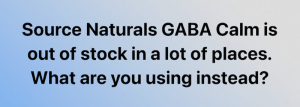
I also posted this message on Facebook to let my community there know and to find out what they were using instead.

gaba calm alternative question facebook

This is some of the feedback I received:

  • Mary ~ Oh my goodness! I just found it in my local Vitamin Shoppe tonight! There was one bottle left.
  • Diana ~I noticed. My son uses this, I’m a little worried.

I shared that there are other products that will hopefully work as well and asked everyone who was using something else: Do  you use it opened onto the tongue or swallowed? And if you’ve used Source Naturals GABA Calm in the past how does it compare for you?

A number of people said they like Thorne pharmaGABA capsules, someone said she like Now GABA Powder and a few people like Natural Factors pharmaGABA chewables:

  • Tara ~ I’ve only used Thorne PharmaGABA because of how it’s derived [fermented]. I just swallow the capsule and I’m immediately calm within 5-15 mins. I was previously prescribed a benzo & this is much better. 100mg is all I take when I feel a panic attack coming on. I’ve been thru a few years of absolute hell of benzo withdrawal coming off of my klonopin prescription. The GABA feels almost the exact same as the benzo except the benzo would actually cause rebound panic attacks (I didn’t realize it at the time) & the GABA does not.
  • Jane ~I use Now Foods GABA powder. A little under the tongue works well.I have found both effective. Powder good for rapid effect at home (1/4 teaspoon as needed). GABA Calm good to take out with you.
  • Meesh ~ I use the Natural Factors pharmaGABA (100mg) and it works great. I use it in combo with L-theanine 250mg (which also contains 20mg of magnesium)… and the combination is magic

I’ve updated the supplements blog with the above products and a few additional similar products so you have many options to select from based on your unique needs and taste preferences, and what’s available at the time:

  • Thorne PharmaGABA-100: the label says Gamma-Aminobutyric Acid (GABA) 100 mg but it also states that the product uses Pharma Foods International’s Gamma-Aminobutyric Acid (PharmaGABA®).  This is also pleasant-tasting when opened on to the tongue and is most effective when used this way. [AS OF NOV 24, 2021 THIS MAY ALSO BE UNAVAILABLE]
  • Thorne PharmaGABA-250: as above but contains 250mg of PharmaGABA®. This is also pleasant-tasting when opened on to the tongue and is most effective when used this way. [AS OF NOV 24, 2021 THIS MAY ALSO BE UNAVAILABLE]
  • Designs for Health PharmaGABA Chewables: gamma-amino butyric acid (pharmaGABA) 200 mg in 2 chewable tablets. It’s quick-acting and convenient like GABA-Calm because it’s chewable. This does contain xylitol, natural flavors, stevia and some other ingredients so taste may be a factor and xylitol can cause gas, bloating and diarrhea when too much is consumed.
  • Natural Factors PharmaGABA: gamma-amino butyric acid (pharmaGABA) 200 mg in 2 chewable tablets. It’s quick-acting and convenient like GABA-Calm because it’s chewable. However it also contains organic cane sugar and natural fruit flavors so it’s a little too candy-like for my preference, especially if you have low GABA-related sugar cravings. Also 2 chewable tablets – 4g of carbs which is almost 1 teaspoon of sugar!
    [January 22, 2021: I’ve included this as a stand-by option for occasional use until Source Naturals GABA Calm is readily available again or if Designs for Health PharmaGABA Chewables are not available.]
  • Now Foods GABA Powder: 1/4 Level Teaspoon (500mg). This is pleasant-tasting when opened on to the tongue and is most effective when used this way. The only challenge with powder like this is making sure you don’t use too much by mistake. And it’s especially challenging when you only need 100mg.
  • Quicksilver Scientific Liposomal GABA with L-Theanine: 2ml (4 Pumps) provides (Gamma Amino Butyric Acid) 240mg, L-Theanine 100mg and Phosphatidylcholine 120mg (from purified sunflower seed lecithin). It does contain ethanol so would not be suitable for alcoholics or young children.
  • GABA-Pro Calming Effect Chewable: This is a chewable that contains 100 mg of pharmaGABA in 1 tablet. It is pharmaGABA even though the product says GABA-Pro on the front and the label states Gamma Amino Butyric Acid (GABA). This product is a reasonable replacement for Source Naturals GABA Calm.  It does contain natural flavors and xylitol.
  • GABA-Pro Calming Effect: This contains 100 mg of pharmaGABA in 1 tablet. It is pharmaGABA even though the product says GABA-Pro on the front and the label states Gamma Amino Butyric Acid (GABA). This capsule can be opened onto the tongue.  It does contain rice flour which can be an issue if you have a rice allergy/sensitivity and/or SIBO.

I do want to add that Nutritional Fundamentals for Health GABA-T SAP is still a firm favorite of mine: gamma-Aminobutyric acid (GABA) 300 mg, l-Theanine 150 mg. This is pleasant-tasting when opened on to the tongue and works very well when GABA Calm can’t be used (because of the tyrosine or taste or sugar alcohols). It is also often used with GABA Calm – like GABA Calm in the day and GABA-T SAP at night or some combination.  I find best results when it is used opened on to the tongue and it offers a feeling of calm focus. It could easily be used as a substitute for GABA Calm in the short-term.

In case you’re new to GABA you can read more about it here: GABA for the physical-tension and stiff-and-tense-muscles type of anxiety.

UPDATE Nov 24, 2021:
=================

Source Naturals GABA Calm is in short supply again, so I’ve updated this blog with some other options (above) because the Thorne Products may also be unavailable for now:

  • GABA-Pro Calming Effect Chewable
  • GABA-Pro Calming Effect

Is Source Naturals GABA Calm a favorite of yours? And how has it helped you?  What have you found works as well – for physical anxiety, tension, insomnia, pain, sugar cravings, muscle spasms – when it’s not available?

If you’ve used a GABA product in capsules, do you use it opened onto the tongue or swallowed? And if you’ve used Source Naturals GABA Calm in the past how does it compare for you?

If you’re a practitioner do you use GABA Calm and/or other GABA products?

Please do share in the comments below and let me know if you found this helpful or if you have questions. And thanks for the questions and contributions so far!

Filed Under: Amino Acids, Anxiety, GABA Tagged With: ADHD, chewable, cravings, GABA, GABA Calm, insomnia, irritability, opened onto tongue, panic, pharmaGABA, powder, Source Naturals GABA Calm, sublingual, sugar, tension

GABA is the answer after 40 years of a lump-in-the-throat sensation, nervousness and muscle tension at work

November 20, 2020 By Trudy Scott 18 Comments

gaba answer to muscle tension

Earlier this year, I published a blog post on the sensation of having a lump in the throat when you feel anxious. It’s called globus pharyngeus which is defined as “the painless sensation of a lump in the throat and may be described as a foreign body sensation, a tightening or choking feeling.”

Globus means globe/sphere and it can actually feel like you have a golf-ball sized object in your throat. It’s very uncomfortable and quite terrifying outside of the anxiety that is often the trigger. I share my lump-in-the-throat story and my success with GABA in this blog: Anxiety and globus pharyngeus (lump in the throat): GABA to the rescue?

Pam recently shared her wonderful success with GABA on the above blog, after having dealt with what she calls “her throat thing” for 40 years!

I have dealt with this throat thing since I was a teenager. I’m now 57. It was only when I saw what you wrote about how yours came back after a scary airplane incident that I made the connection that GABA could help me. I saw that in the summer of 2019, so I spent about 40 years dealing with this until I found the GABA answer!

Mine comes up when speaking in front of others, such as work meetings, or even just one-on-one work discussions, and it was getting consistently worse. I would be swallowing constantly and trying to talk. Absolutely awful. Of course everyone could see it happening.

GABA solved this for me, and I can’t even describe how grateful I am!

How wonderful are these results! I am so happy for her and thanked her for coming back and sharing in the comments.  I also asked some follow-up questions so I can continue to learn and so I can share so you get to learn too:

  • How much GABA helps and how do you take it (when you know you’ll be in this situation or a few times a day to get your levels up)?
  • Did you ever use a prescribed medication or were recommended something?
  • Have you seen any other benefits from using GABA – improved sleep, reduced anxiety in other situations, reduced cravings?
  • Have you made other changes too – like dietary changes such as gluten/sugar/caffeine/alcohol removal?

She shared this about timing and how GABA helps with anxiety-related physical/muscle tension and nervousness:

I take GABA Calm … one upon waking, 1 mid-morning, and 1 mid- afternoon. I take an extra one right at the time of a meeting.

That is the only change I made. I’ve never been on any prescription medication.

Other than the specific throat issue, I notice I’m generally less physically tense, with muscles not getting so knotted up in my face, scalp, neck, shoulders, and back, which is wonderful.

I work at a computer job, which causes lots of muscle tension, but I feel that anxiety-related muscle tension has reduced.

I notice that my muscles have less of that “immediate tightness” upon seeing someone whom I’m nervous to interact with.

This timing and dosage of GABA Calm is typically what I use with clients and what works so it was great to hear that it’s working for her. I was also so pleased to hear the anxiety-related muscle tension and nervousness has reduced too. This is also to be expected.

I did remind her to keep in mind that the amino acids are intended for short-term use. This could be a few weeks up to 6-12 months depending on each person. While using the GABA, I have my clients start to address all the dietary changes, gut health, nutritional deficiencies (zinc and B6 are needed to make neurotransmitters and key with pyroluria), toxin exposure (like BPA, phthalates, pesticides, fluoride etc), infections (like Lyme and co-infections, parasites, PANDAS/PANS) etc. and everything else that may be causing low GABA levels (as we covered in The Anxiety Summit 6).

Vagus nerve support is also key. I cover what I did for my vagus nerve in this blog that Pam referred to: Vagus nerve rehab with GABA, breathing, humming, gargling and key nutrients

Globus pharyngeus or this sensation of the-lump-in-the throat is way more common than most people realize and mainstream medicine seldom has a solution. Medications that are commonly prescribed for globus pharyngeus are benzodiazepines, antidepressants/SSRIs and sometimes PPIs/proton pump inhibitors. Cognitive behavior therapy has some success in some instances but it’s always best to get to the root cause of low GABA and address that with the amino acid GABA. And then figure out why GABA is low and address that too.

If you’re new to the amino acids here is a quick summary about GABA: low levels of GABA, a calming neurotransmitter can lead to anxiety, fears and panic attacks. With low GABA, the anxiety is a physical kind of anxiety with muscle tension or muscle spasms.  I propose that low GABA may be one possible root cause of globus pharyngeus.

I appreciate Pam for sharing her story and I’m sharing it here in order to give you practical solutions and hope. If she can find a solution to her 40-year the-lump-in-the throat and physical tension issues then anything is possible.

Please also share your lump-in-the-throat story and what has helped you.  Or if you’re a practitioner, do share how you have helped your clients/patients who experienced this sensation.

Feel free to post your questions here too.

Filed Under: Anxiety Tagged With: anxiety, choking, foreign body sensation, GABA, GABA Calm, globus pharyngeus, lump in the throat, lump-in-the-throat sensation, muscle tension, nervousness, tension, tightening, vagus nerve

Anxiety and globus pharyngeus (lump in the throat): GABA to the rescue?

July 3, 2020 By Trudy Scott 69 Comments

globus pharyngeus and gaba

Low levels of GABA, a calming neurotransmitter can lead to anxiety, fears and panic attacks. With low GABA, the anxiety is a physical kind of anxiety with muscle tension or muscle spasms.  Today you’ll read how low GABA may be one possible root cause of globus pharyngeus, which you may have experienced as a rather scary golf-ball-like lump or constriction in the throat.

Let me describe globus pharyngeus and then I’ll share my story with globus pharyngeus, why low GABA may be a factor (and supplemental sublingual GABA to the rescue) and other possible root causes that should be considered.

This 2015 paper, Globus pharyngeus: an update for general practice, defines it as follows:

Globus pharyngeus or globus sensation is the painless sensation of a lump in the throat and may be described as a foreign body sensation, a tightening or choking feeling.

Globus means globe or sphere and it can actually feel like you have a golf-ball sized object in your throat.

You may have experienced it without even knowing the medical name. Only a few of my clients and those in my community have ever heard the term. I also only learned about the name many years after my episode.

What is very surprising is that, according to the above paper, up to 45% of the population have experienced it.

My story with globus pharyngeus

I’m one of the 45% and for me it was a terrifying experience.  As you may know, I experienced anxiety, PMS, fears and panic attacks in my late 30s and early 40s (it’s why I do this work).

Fortunately I only had one episode. It truly felt like I had a golf-ball in my throat and was horrifying. I knew I needed to swallow so I could get rid of this obstruction but at the same time I was terrified to swallow in case it got stuck and choked and killed me.

I remember going to the mirror to try and see this golf-ball sized object in my throat. I was so surprised that I couldn’t see anything.

Looking back, I suspect the addition of GABA Calm to my protocol prevented further episodes. I was also using progesterone cream at the time and this promotes GABA production too.

I’ve had many clients report that looking back they also realized their episodes stopped once they addressed their low GABA levels.

I was also under a great deal of stress at the time: work stress (long hours and my adrenals were a mess) and physical stress (due to amalgam removal, gluten issues, perimenopausal changes and much more).

Globus pharyngeus and GABA

The fact that the throat or pharynx “is a muscular tube that runs from the back of your nose down into your neck” is one reason for considering a muscle spasm and low GABA as a root cause.

The amino acid GABA, when used sublingually, eases muscle spasms within 15 seconds to 2 minutes. Some examples where we see this:

  • Physical tension with anxiety
  • Rectal spasms or proctalgia fugax
  • Throat spasms caused by vagus nerve issues

If you’re in the midst of an episode it’s impossible to open a capsule of GABA into your mouth. Until a client knows how much they can tolerate we start with 100-125 mg and increased based on the trial.  Taking the powder and dabbing it with a wet finger and putting the finger to the inside cheek a few times is the best way for quick relief.

A product that is GABA-only in a capsule such as Enzymatic Therapy GABA or ProThera 500mg GABA are my choices for in-the moment relief (more on these in my supplement store here).

Source Naturals GABA Calm is my most popular GABA product and is my choice for everyday use.

Of course, I recommend this approach to doing nothing. The authors state: “simple reassurance may be all that is required” or “Advise patients to resist the urge to dry swallow.” We can do better.

Once your GABA levels are sufficient, it’s less likely to happen unless you’re under a great deal of stress and/or there are psychological factors at play:

There is increased reporting of stressful life events prior to development of symptoms and research suggests that as many as 96% of patients with globus sensation report an exacerbation of symptoms during times of emotional intensity.

During times of added stress, folks may experience other “physical symptoms such as palpitations, poor sleep, and feelings of panic.”

Other root causes and possible solutions

The above paper does also list other root causes and solutions that would need to be investigated if GABA doesn’t help or possibly in conjunction with GABA support: tonsil issues, hiatus hernia, reflux in 23 -68% of individuals (I would look for the root cause rather than using a proton pump inhibitor/PPI), sinusitis, post-nasal drip, goitre, an actual foreign body, high consumption of alcohol/caffeine/tobacco and cancer (which they state is rare).

Interestingly, speech and language therapy has been shown to improve globus pharyngeus in two studies, possibly due to the reassurance experienced.

The paper concludes as follows:

Finally the link between anxiety and globus sensation must be considered. Evidence supports the use of cognitive behavioural therapy, but very little evidence exists for the use of anxiolytics or antidepressants.

I’ll add to this: the link between low GABA and globus sensation must also be considered, especially if you experience the physical type of low GABA anxiety. GABA to the rescue!

Based on the research, low serotonin, vagus nerve function, thyroid health and h/pylori may also be factors. I suspect food sensitivities play a role. And pyroluria too, because of the additional loss of zinc and vitamin B6 which is needed for GABA production. I’ll leave all this for a follow-up blog.

Have you experienced a globus sensation episode? And what did it feel like?

Did you get a diagnosis or is the term new to you?

Has GABA helped … in the moment or if you look back on your use of GABA for anxiety?

Did you discover other root causes and solutions? Please do share.

Please share if  you have pyroluria and your episodes were triggered by a very stressful event

And feel free to post your questions.

If you’re a practitioner I’d love to hear your feedback too.

Filed Under: Amino Acids, Anxiety, GABA Tagged With: anxiety, choked, choking, constriction in the throat, GABA, GABA Calm, globus pharyngeus, golf ball, lump in the throat, panic attack, spasm, swallow, vagus nerve

Theanine for easing stress and anxiety, and improving cognition and sleep in healthy adults

January 24, 2020 By Trudy Scott 46 Comments

theanine for anxiety

L-Theanine is a “unique non-protein amino acid found in green tea” which according to the study below, has shown benefits when used short-term or acutely as a supplement for it’s anti-stress effects, reducing anxiety, improving sleep quality, improving cognition and even easing depression.

This 2019 study, Effects of L-Theanine Administration on Stress-Related Symptoms and Cognitive Functions in Healthy Adults: A Randomized Controlled Trial, aimed to examine the effects of four weeks use of l-theanine:

on stress-related symptoms and cognitive functions in healthy adults. Participants were 30 individuals (nine men and 21 women; aged 20-69) who had no major psychiatric illness.

The trial was randomized, placebo-controlled, crossover, and double-blind.

L-theanine (200 mg/day of Suntheanine), was used by study participants before going to bed each night and was used for four-weeks.

Study participants who used the theanine for two weeks observed the following:

  • For sleep: Reductions in sleep latency (the amount of time it takes to fall asleep), sleep disturbance and less use of sleep medication
  • For cognitive function: Improvements in verbal fluency (especially letter fluency) and improvements in executive function (planning, multi-tasking etc)

The Japanese versions of The Self-rating Depression Scale, State-Trait Anxiety Inventory-trait, and Pittsburgh Sleep Quality Index (PSQI) scores decreased and the study concludes as follows:

Our findings suggest that L-theanine has the potential to promote mental health in the general population with stress-related ailments and cognitive impairments.

The authors also note that “there were no significant adverse events, demonstrating the safety of four weeks of L-theanine administration.”

As expected, the participants saw increases in serum theanine concentrations.

Some of the reported possible mechanisms of action

Here are some of the reported possible mechanisms of action of theanine from some studies referenced in his paper:

  • via glutamate receptors (improving cognitive dysfunction)
  • as a neuroprotective agent and “increases in brain serotonin, dopamine, GABA levels” (improving mood and focus and reducing anxiety)
  • enhances hippocampal activity (the hippocampus has a major role in learning and memory)
  • via a proposed increase in the expression of brain-derived neurotrophic factor (BDNF) in the hippocampus (BDNF is a protein implicated in the stress response, long-term memory, Alzheimer’s disease, and psychiatric disorders)

Impacts on cortisol levels?

What is unusual and inconsistent with previous studies, is the fact that there was “no significant effect on cortisol or immunoglobulin A levels in the saliva or serum.”  The authors report that “the reduction of salivary cortisol and immunoglobulin A levels may be a short term, recoverable effect of L-theanine administration.”  

Update Sept 2025:

In this 2021 paper, A Randomized, Triple-Blind, Placebo-Controlled, Crossover Study to Investigate the Efficacy of a Single Dose of AlphaWave®l-Theanine on Stress in a Healthy Adult Population “there was a significant reduction in salivary cortisol with a single dose of AlphaWave® l-Theanine relative to the placebo, immediately following the stress-inducing task 1 h post-dose.”

In other words, within an hour of taking AlphaWave l-theanine, cortisol levels were lower. This paper also mentions that in a previous study, cortisol levels were only lower 3 hours after taking theanine.

Suntheanine and AlphaWave are different theanine products, each produced by their own  proprietary manufacturing process. There are a number of other l-theanine products/manufacturing processes and this may explain why some individuals do well on some theanine products and not others, and why impacts on cortisol levels may vary.

Theanine or GABA – which one to use when?

I typically start my clients with a trial of GABA Calm for low GABA symptoms like physical tension, stress and overwhelm, panic attacks and insomnia. If we are not getting all the expected benefits with GABA and there is a need for added cognitive benefits then we’ll consider adding theanine too. Some folks find one works better than the other and some like a combination (at the same time or theanine in the day/GABA at night or GABA in the day/theanine at night).

I recently reached out on facebook asking:

“Theanine or GABA? Which do you prefer for anxiety and why? How much helps? And any other benefits (like reduced body pain, better thinking/cognition, easing IBS (irritable bowel syndrome) and gut pain, reduced cravings, less negative self-talk etc)? Or do you like a combination of both?”

As you can see from these varied responses it’s a matter or trialing both to find what works for each person’s unique needs:

  • Lorraine shared this: “They are both good, but I reach for GABA Calm first.. 2 or 3 lozenges. If anxiety doesn’t leave quickly with GABA ( which works well for a panic attack), and I continue to have anxiety humming along in the background, then I’ll reach for theanine.”
  • Jackie shared this: “I take 200mg theanine in morning, then 100mg GABA around 4pm, when the kids get home from school. I had a panic attack in the middle of the night last week, took GABA 100 mg, then seemed to calm down.” I asked if theanine gives her a feeling of calm focus and she said: “yes, I think so. I noticed if I take 200mg of GABA, it makes me drowsy.”
  • Evelyn shared this: “I use both at night for sleep. If I could only use one it would be l-theanine.” Theanine is more consistently helpful for stress reduction and sleep for me. I use 200mg. When I use GABA it’s 500mg of chewables.”
  • Sara shared this: “GABA during the day, theanine at night.”
  • Karine shared this: “GABA!! The Source Naturals Theanine Serene with Holy Basil is really good. But GABA Calm (also Source Naturals which is a sublingual lozenge) is the only thing for a severe issue/episode and helps me concentrate right before an important presentation at work etc. Pure GABA from any supplier is good for long periods where you need a boost or to tone down general anxiety. I also bought a probiotic that also includes GABA (Jarrodophilus Mood) and notice it improves digestion too.”

Some of my top GABA/theanine products

You can find my favorite GABA/theanine combination product, a theanine-only product and my most popular GABA products on the supplements blog here (and with details for how to set up an account for my online store)

Nutritional Fundamentals for Health GABA-T SAP: 300mg GABA, 150mg theanine. This is pleasant-tasting when opened on to the tongue and works very well when GABA Calm can’t be used.

Pure Encapsulations L-Theanine: 200mg theanine. This is also pleasant-tasting when opened on to the tongue. Unlike like GABA, it can also be swallowed.

Source Naturals GABA Calm. This is a pleasant-tasting sublingual product that is my most popular and most effective form of GABA I use with my clients. It can be used in conjunction with theanine.

Enzymatic Therapy GABA: 250 mg GABA. This is also pleasant-tasting when opened on to the tongue and works very well when GABA Calm can’t be used. It can also be used in conjunction with theanine.

BeSerene IR (instant relief): a topical GABA/theanine cream which can be used in conjunction with other GABA and theanine products or instead of them.

Additional resources when you are new to using GABA or theanine and other amino acids as supplements

We use the symptoms questionnaire to figure out if low serotonin or low GABA or low dopamine or other neurotransmitter imbalances may be an issue for you.

If you suspect low levels of any of the neurotransmitters and do not yet have my book, The Antianxiety Food Solution – How the Foods You Eat Can Help You Calm Your Anxious Mind, Improve Your Mood, and End Cravings. I highly recommend getting it and reading it before jumping in and using amino acids on your own so you are knowledgeable. And be sure to share it with the practitioner/health team you or your loved one is working with.

There is an entire chapter on the amino acids and they are discussed throughout the book in the sections on gut health, gluten, blood sugar control (this is covered in an entire chapter too), sugar cravings, anxiety and mood issues. The importance of quality animal protein and healthy fats is also covered.

The book doesn’t include product names (per the publisher’s request) so this blog, The Antianxiety Food Solution Amino Acid and Pyroluria Supplements, lists the amino acids that I use with my individual clients and those in my group programs.

If, after reading this blog and my book, you don’t feel comfortable figuring things out on your own (i.e. doing the symptoms questionnaire and respective amino acids trials), a good place to get help is the GABA QuickStart Program (if you have low GABA symptoms too). This is a paid online/virtual group program where you get my guidance and community support.

If you need serotonin support, the Serotonin QuickStart Program is a good place to get help. This is also a paid online/virtual group program where you get my guidance on using tryptophan and 5-HTP safely, and community support during 5 LIVE Q&A calls. You can sign up to be notified when the next live launch of this program is happening.

If you are a practitioner, join us in The Balancing Neurotransmitters: the Fundamentals program. This is also a paid online/virtual program with an opportunity to interact with me and other practitioners who are also using the amino acids.

Now I’d love to hear from you

Please let us know … theanine or GABA: which do you prefer for anxiety and why? How much helps? And any other benefits (like reduced body pain, better thinking/cognition, easing IBS gut pain, reduced cravings, less negative self-talk etc)? Or do you like a combination of both?”

Feel free to share and ask your questions below.

Filed Under: Amino Acids Tagged With: adults, anxiety, BDNF, cognition, cognitive function, GABA, GABA Calm, panic attack, sleep, stress, theanine

  • « Go to Previous Page
  • Page 1
  • Page 2
  • Page 3
  • Page 4
  • Page 5
  • Page 6
  • Go to Next Page »

Primary Sidebar

NEW! GABA QuickStart Homestudy (with special intro pricing)

gaba quickstart homestudy

Free Report

9 Great Questions Women Ask about Food, Mood and their Health

You'll also receive a complimentary subscription to my ezine "Food, Mood and Gal Stuff"


Connect with me

Popular Posts

  • Amino Acids Mood Questionnaire from The Antianxiety Food Solution
  • The Antianxiety Food Solution Amino Acid and Pyroluria Supplements
  • Pyroluria Questionnaire from The Antianxiety Food Solution
  • Collagen and gelatin lower serotonin: does this increase your anxiety and depression?
  • Tryptophan for the worry-in-your-head and ruminating type of anxiety
  • GABA for the physical-tension and stiff-and-tense-muscles type of anxiety
  • The Antianxiety Food Solution by Trudy Scott
  • Seriphos Original Formula is back: the best product for anxiety and insomnia caused by high cortisol
  • Am I an anxious introvert because of low zinc and vitamin B6? My response to Huffington Post blog
  • Vagus nerve rehab with GABA, breathing, humming, gargling and key nutrients

Recent Posts

  • What do I use instead of Seriphos to help lower high cortisol that is affecting my sleep and making me anxious at night?
  • BeSerene™ GABA/theanine cream eases severe muscle tension in her neck/shoulders, prevents her bad headaches and quells her anxiety
  • How the correct approach, dose and sublingual use of GABA can be calming and not cause a flushed and itchy face and neck
  • The amino acid glutamine improves low mood by addressing gut health, and it has calming effects too
  • Flight anxiety with heightened breath, physical tension and also fearing the worst (the role of low GABA and low serotonin)

Categories

  • 5-HTP
  • AB575
  • Addiction
  • ADHD
  • Adrenals
  • Alcohol
  • Allergies
  • Alzheimer's disease
  • Amino Acids
  • Anger
  • Antianxiety
  • Antianxiety Food Solution
  • Antidepressants
  • Anxiety
  • Anxiety and panic
  • Autism
  • Autoimmunity
  • benzodiazapines
  • Bipolar disorder
  • Books
  • Caffeine
  • Cancer
  • Candida
  • Children/Teens
  • Collagen
  • Cooking equipment
  • Coronavirus/COVID-19
  • Cravings
  • Depression
  • Detoxification
  • Diabetes
  • Diet
  • DPA/DLPA
  • Drugs
  • EFT/Tapping
  • EMF
  • EMFs
  • Emotional Eating
  • Endorphins
  • Environment
  • Essential oils
  • Events
  • Exercise
  • Fear
  • Fear of public speaking
  • Fertility and Pregnancy
  • Fish
  • Food
  • Food and mood
  • Functional neurology
  • GABA
  • Gene polymorphisms
  • General Health
  • Giving
  • Giving back
  • Glutamine
  • Gluten
  • GMOs
  • Gratitude
  • Gut health
  • Heart health/hypertension
  • Histamine
  • Hormone
  • Hyperparathyroidism
  • Hypoglycemia
  • Immune system
  • Inflammation
  • Insomnia
  • Inspiration
  • Introversion
  • Joy and happiness
  • Ketogenic diet
  • Lithium orotate
  • Looking awesome
  • Lyme disease and co-infections
  • MCAS/histamine
  • Medication
  • Men's health
  • Mental health
  • Mercury
  • Migraine
  • Mold
  • Movie
  • MTHFR
  • Multiple sclerosis
  • Music
  • NANP
  • Nature
  • Nutritional Psychiatry
  • OCD
  • Osteoporosis
  • Oxalates
  • Oxytocin
  • Pain
  • Paleo
  • Parasites
  • Parkinson’s disease
  • PCOS
  • People
  • PMS
  • Postpartum
  • PTSD/Trauma
  • Pyroluria
  • Questionnaires
  • Real whole food
  • Recipes
  • Research
  • Schizophrenia
  • serotonin
  • SIBO
  • Sleep
  • Special diets
  • Sports nutrition
  • Stress
  • Sugar addiction
  • Sugar and mood
  • Supplements
  • Teens
  • Testimonials
  • Testing
  • The Anxiety Summit
  • The Anxiety Summit 2
  • The Anxiety Summit 3
  • The Anxiety Summit 4
  • The Anxiety Summit 5
  • The Anxiety Summit 6
  • Thyroid
  • Thyroid health
  • Toxins
  • Tryptophan
  • Tyrosine
  • Uncategorized
  • Vegan/vegetarian
  • Women's health
  • Yoga

Archives

  • October 2025
  • September 2025
  • August 2025
  • July 2025
  • June 2025
  • May 2025
  • April 2025
  • March 2025
  • February 2025
  • January 2025
  • November 2024
  • October 2024
  • September 2024
  • August 2024
  • July 2024
  • June 2024
  • May 2024
  • April 2024
  • March 2024
  • February 2024
  • January 2024
  • December 2023
  • November 2023
  • October 2023
  • September 2023
  • August 2023
  • July 2023
  • June 2023
  • May 2023
  • April 2023
  • March 2023
  • February 2023
  • January 2023
  • December 2022
  • November 2022
  • October 2022
  • September 2022
  • August 2022
  • July 2022
  • June 2022
  • May 2022
  • April 2022
  • March 2022
  • February 2022
  • January 2022
  • December 2021
  • November 2021
  • October 2021
  • September 2021
  • August 2021
  • July 2021
  • June 2021
  • May 2021
  • April 2021
  • March 2021
  • February 2021
  • January 2021
  • December 2020
  • November 2020
  • October 2020
  • September 2020
  • August 2020
  • July 2020
  • June 2020
  • May 2020
  • April 2020
  • March 2020
  • February 2020
  • January 2020
  • December 2019
  • November 2019
  • October 2019
  • September 2019
  • August 2019
  • July 2019
  • June 2019
  • May 2019
  • April 2019
  • March 2019
  • February 2019
  • January 2019
  • December 2018
  • November 2018
  • October 2018
  • September 2018
  • August 2018
  • July 2018
  • June 2018
  • May 2018
  • April 2018
  • March 2018
  • February 2018
  • January 2018
  • December 2017
  • November 2017
  • October 2017
  • September 2017
  • August 2017
  • July 2017
  • June 2017
  • May 2017
  • April 2017
  • March 2017
  • February 2017
  • January 2017
  • December 2016
  • November 2016
  • October 2016
  • September 2016
  • August 2016
  • July 2016
  • June 2016
  • May 2016
  • April 2016
  • March 2016
  • February 2016
  • January 2016
  • December 2015
  • November 2015
  • October 2015
  • September 2015
  • August 2015
  • July 2015
  • June 2015
  • May 2015
  • April 2015
  • March 2015
  • February 2015
  • January 2015
  • December 2014
  • November 2014
  • October 2014
  • September 2014
  • August 2014
  • July 2014
  • June 2014
  • May 2014
  • April 2014
  • March 2014
  • February 2014
  • January 2014
  • December 2013
  • November 2013
  • October 2013
  • September 2013
  • August 2013
  • July 2013
  • June 2013
  • May 2013
  • April 2013
  • March 2013
  • February 2013
  • January 2013
  • December 2012
  • November 2012
  • October 2012
  • August 2012
  • July 2012
  • June 2012
  • May 2012
  • April 2012
  • March 2012
  • February 2012
  • January 2012
  • December 2011
  • November 2011
  • October 2011
  • September 2011
  • August 2011
  • July 2011
  • June 2011
  • May 2011
  • April 2011
  • March 2011
  • February 2011
  • January 2011
  • December 2010
  • October 2010
  • September 2010
  • July 2010
  • May 2010
  • April 2010
  • March 2010
  • February 2010
  • January 2010
  • November 2009

Share the knowledge!

The above statements have not been evaluated by the Food and Drug Administration. Products listed in this website are not intended to diagnose, treat, cure or prevent any disease.

The information provided on this site is for informational and educational purposes only and is not intended as a substitute for advice from your physician or other health care professional. You should consult with a healthcare professional before starting or modifying any diet, exercise, or supplementation program, before taking or stopping any medication, or if you have or suspect you may have a health problem.


Copyright © 2026 Trudy Scott. All Rights Reserved. | Privacy | Terms and Conditions | Refund Policy | Medical Disclaimer

Free Report

9 Great Questions Women Ask about Food, Mood and their Health

You’ll also receive a complimentary subscription to my ezine “Food, Mood and Gal Stuff”