• Skip to primary navigation
  • Skip to main content
  • Skip to primary sidebar

everywomanover29 blog

Food, Mood and Women's Health – Be your healthiest, look and feel great!

  • Blog
  • About
  • Services
  • Store
  • Resources
  • Testimonials
  • The Book
  • Contact
  • Search this site

fears

Understanding the function of the GABAergic system and its potential role in rheumatoid arthritis (for pain, anxiety, sleep issues and more)

January 3, 2025 By Trudy Scott 2 Comments

GABAergic system and its potential role in rheumatoid arthritis

This is a great question posed by a woman in my GABA/anxiety online group program:

Can GABA be good for rheumatoid arthritis, and in its early stages? If so, in what ways would someone see signs of improvement with GABA?

When I looked into some of the recent research on GABA and rheumatoid arthritis I was fascinated. A 2023 review paper, Understanding the function of the GABAergic system and its potential role in rheumatoid arthritis, discusses the relationship between rheumatoid arthritis (RA), an autoimmune condition, and GABA (gamma-amino butyric acid), a calming neurotransmitter.

The authors discuss “a new mechanism of action in RA” and the fact that “bidirectional communication occurs between the brain and immune system…and neuroinflammatory responses in the brain.”

The paper discusses GABA and neurosignalling, immunomodulatory effects and inflammation, stating that the:

GABAergic system may modulate the abnormal pain response in RA patients.

So to answer her question, if she has low GABA levels we would expect to see some reduction in her RA pain.

As always, we look for the signs and symptoms of low GABA regardless of the diagnosis or possible diagnosis. So if someone has low GABA symptoms of physical tension, overwhelm, fears, anxiousness, stiff and tense muscles, focus issues, pain, stress eating or drinking to calm down, and poor sleep, we consider a trial of the amino acid GABA, and could expect improvements in all or some of the above symptoms.

I would also recommend that she tracks markers of inflammation (like hs CRP, IL-6, IL-1β, and TNF-α) and RA markers to see if they shift in a positive direction with her use of GABA too.

I share more below about the incidence of anxiety and sleep issues in rheumatoid arthritis and some of the mechanisms covered in the review paper. Also, there are lab tests to track and there are other nutritional approaches for supporting an autoimmune condition such as RA.

Some of the mechanisms covered in the review paper

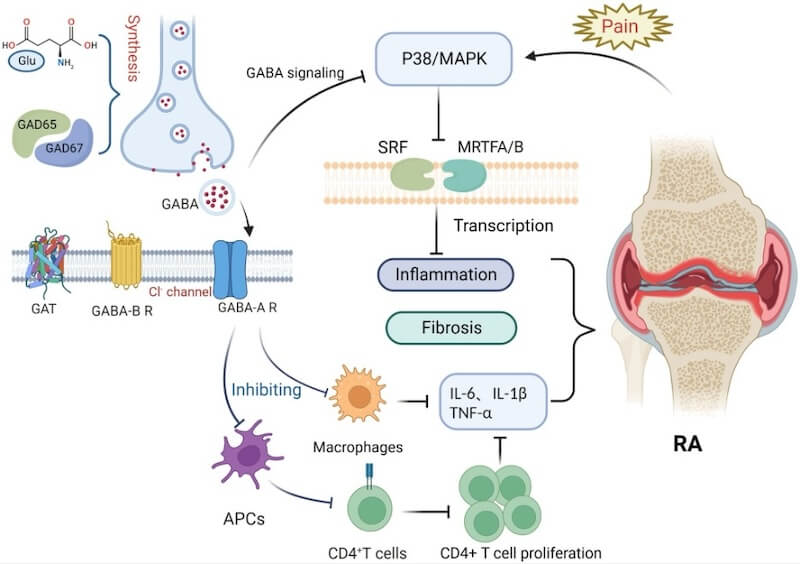
This image from the paper and the explanation provides some insights on the mechanisms at play.

  • Glutamate interacts with glutamate decarboxylase (GAD65 and GAD67) to produce gamma-aminobutyric acid (GABA).
  • Binding of GABA to GABA-A receptors inhibits macrophage activation and decreases the release of inflammatory factors such as IL-6, IL-1β, and TNF-α. Antigen presentation by antigen-presenting cells, however, is impaired, inhibiting CD4+ T cell proliferation and differentiation and reducing the expression of inflammatory factors such as IL-6, IL-1β, and TNF-α.
  • Pain signaling activates the P38/MAPK pathway, whereas GABA binding to GABA-A receptors inhibits P38/MAPK. The P38/MAPK signaling pathway contributes to inflammation and is involved in the activation of myocardin-related transcription factor A (MRTFA), myocardin-related transcription factor B (MRTFB), and serum response factor (SRF) that played key roles in fibroblast activation.
gaba and rheumatoid arthritis
Figure 1. Understanding the function of the GABAergic system and its potential role in rheumatoid arthritis

The authors don’t mention the use of the amino acid GABA as a supplement for RA but do list a number of clinical trials (mostly diabetes patients) where GABA has been used with success. It’s a start and I look forward to future research in this area.

Anxiety, depression, insomnia, cognitive issues and stress-eating in RA

This paper, Psychiatric aspects of rheumatoid arthritis: Review of literature, reports that

Among the major psychiatric disorders found in RA, the anxiety and depressive disorders are prevalent (13 to 48% of patients), as well as suicide, insomnia and tiredness. The impairment of quality of life is markedly after age 65.

This paper, A 30-Day Adjunct Wellness Intervention for the Management of Extra-Articular Symptoms of Rheumatoid Arthritis: A Formative Study, also mentions “cognitive and physical dysfunction” and “stress-related eating” in addition to anxiety, depression and insomnia in RA patients.

Doing a trial of GABA (and other amino acids such as tryptophan and d-phenylalanine/ DPA), will confirm which symptoms are related to which neurotransmitter deficiencies. It’s exciting to consider a very possible role of GABA and other amino acids given the fact that “individuals with rheumatoid arthritis (RA) continually fall short of treatment targets using standard drug therapies alone”

Looking further than GABA and other amino acids: a gluten-free diet and other root causes

With RA we obviously want to address more than just GABA (and other amino acids). Gluten removal is recommended but I do want to mention that the research is surprisingly mixed. This paper, Efficacy of gluten-free diet in patients with rheumatoid arthritis states that

Gluten seems to be a glycoprotein with a clinically relevant inflammatory effect. Several observational studies and anecdotal cases reported a correlation between gluten and various diseases, including autoimmune diseases, such as rheumatoid arthritis. This study aimed to evaluate whether gluten-free diet could be effective in controlling inflammation and ongoing rheumatoid arthritis symptoms.

We report 4 cases of patients with long-standing rheumatoid arthritis with no response to several conventional and biotechnological drugs, treated with a gluten-free diet concurrently with the drug therapy. Our patients presented different degrees of response to the diet, in terms of disease remission and improvement of symptoms. Our cases confirm that a gluten-free diet may improve symptoms of rheumatoid arthritis, even in patients resistant to conventional drug therapies.

Many other papers dismiss the role of gluten and inflammatory diets. This one is an example of a number of similar papers.

The benefits of addressing neurotransmitter imbalances with GABA and other amino acids means the addiction is stopped and quitting bread and cookies now no longer requires willpower,

Here are some autoimmune recipe resources:

  • The Autoimmune Solution Cookbook by Amy Myers MD
  • The Autoimmune Fix by Dr. Tom O’Bryan: gluteomorphins, casomorphins and withdrawal
  • Hashimoto’s Food Pharmacology, a new recipe book by Dr. Izabella Wentz

In addition to dietary changes, a full functional medicine approach is warranted as there is much research supporting the benefits of the following for RA: omega-3 fatty acids, olive oil, low vitamin B6, addressing heavy metals such as mercury and much much more.

I cover 60+ root causes of anxiety here – I’d be carefully assessing each of these root causes for RA too.

Additional resources when you are new to using GABA and other amino acids as supplements

As always, I use the symptoms questionnaire to figure out if low serotonin or low GABA or other neurotransmitter imbalances may be an issue.

If you suspect low levels of any of the neurotransmitters and do not yet have my book, The Antianxiety Food Solution – How the Foods You Eat Can Help You Calm Your Anxious Mind, Improve Your Mood, and End Cravings, I highly recommend getting it and reading it before jumping in and using amino acids on your own so you are knowledgeable. And be sure to share it with the practitioner/health team you or your loved one is working with.

There is an entire chapter on the amino acids and they are discussed throughout the book in the sections on gut health, gluten, blood sugar control (this is covered in an entire chapter too), sugar cravings, anxiety and mood issues.

The book doesn’t include product names (per the publisher’s request) so this blog, The Antianxiety Food Solution Amino Acid and Pyroluria Supplements, lists the amino acids that I use with my individual clients and those in my group programs.

If, after reading this blog and my book, you don’t feel comfortable figuring things out on your own (i.e. doing the symptoms questionnaire and respective amino acids trials), a good place to get help is the GABA QuickStart Program (if you have low GABA symptoms). This is a paid online/virtual group program where you get my guidance and community support, and is where this question was asked of me during one of the live Q&A calls.

If you are a practitioner, join us in The Balancing Neurotransmitters: the Fundamentals program. This is also a paid online/virtual program with an opportunity to interact with me and other practitioners who are also using the amino acids.

Wrapping up and your feedback

Do you have rheumatoid arthritis (RA) or another autoimmune condition and has GABA helped?

Were you aware of these possible connections?

What about dietary and nutritional approaches?

Feel free to share your feedback and ask your questions below.
Filed Under: Anxiety, GABA, Pain Tagged With: amino acids, anxiety, anxious, anxiousness, autoimmune, calming, drinking, fears, focus, GABA, GABA Quickstart, GABAergic system, Inflammation, neurotransmitter, overwhelm, pain, physical-tension, rheumatoid arthritis, sleep issues, stiff and tense muscles, stress-eating

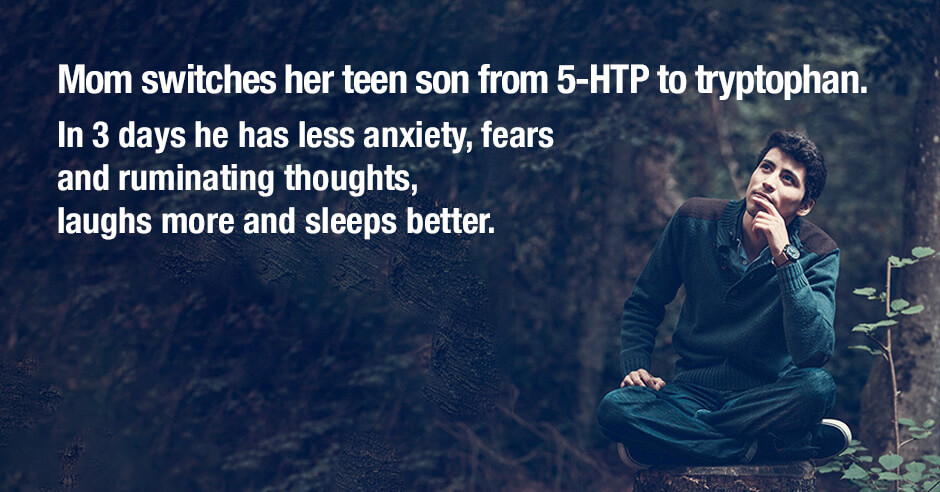
Mom switches her teen son from 5-HTP to tryptophan. In 3 days he has less anxiety, fears and ruminating thoughts, laughs more and sleeps better.

February 16, 2024 By Trudy Scott 40 Comments

5-HTP to Tryptophan

My son has autism and OCD. I took him off fluvoxamine in May and used cbd and some other things and he was doing fine up until this past winter. He began having irrational fears and ruminating thoughts/fears that would not stop! I started 5-HTP, theanine, B12, probiotics with him for the last month and did not see any improvement. I was ready to go back to the medication when I came across your blog and information.

I assumed 5-HTP would be better for OCD, but after reading your comments you mentioned that you just switch to tryptophan if the 5-HTP is not working. I had tryptophan at home already. That night I emptied half a capsule into a little stevia flavored water and had him hold it in his mouth for a minute.

He was a different kid after that!!!! This is just the 3rd day but even his teachers are telling me he is doing really well and is less anxious at school. I am so thankful! I am now giving him 500mg in the morning and early evening.

I bought some inositol and plan to try adding that in the afternoons to see if that will help as well. I believe that he has PANDAS. He is a hand washer, and spits a lot, and has lots of other quirks that I would love to see decrease.

I have hope again! I am buying your book so that I can get a good plan going for him. If you have any other suggestions for him please let me know!!

This wonderful feedback was posted in the comments of one of the tryptophan blogs. I’m so thrilled for this mom and young man (he’s almost 20). I thanked her for sharing all this on the blog and offered to share additional generic feedback via a new blog post. I also asked for additional feedback on exactly how the tryptophan helped (more on that below).

Read on to learn how tryptophan helped with his ruminating thoughts, fears, crying and improved his sleep. And my insights about the ideal timing of tryptophan, finding the optimal dose and why it may work when 5-HTP doesn’t. I also share some insights about inositol and  OCD (obsessive compulsive disorder).

Low serotonin symptoms and the questions I had about his symptoms

I do hope he continues to see these benefits. Seeing such amazing results in 3 days is always what we’re looking for and it’s not unexpected to get such profound results so quickly!

I had some additional questions so I could share some general feedback as to how I work in situations like this. I wanted to know his age and if the switch to tryptophan helped any of his OCD symptoms and if yes how many notches improvement?

And which of the classic low serotonin symptoms the tryptophan helped and by how much: anxiety? irrational fears? and ruminating thoughts/fears? anything else? (all the low serotonin symptoms here)

Knowing this helps me know if I’m on track with a client i.e. the tryptophan is helping with low serotonin symptoms. And it also helps me decide we should consider increasing the dose and possibly adjust the number of times to use tryptophan. I share more about this below.

Tryptophan helps reduce his ruminating thoughts, fear and anxiety. And he’s laughing more and sleeps better

She shared some specific examples as to how much the tryptophan helps reduce his ruminating thoughts, fear and anxiety. And he’s laughing more and it helps him sleep:

He would often call me or text me throughout the day with questions about his health, and he would come to me 10-15 times in the afternoons/evenings, for about 3 weeks or so, and ask me the same questions about a rare disease that he believed he had.

He would cry and shake with fear and anxiety at some point and I would need to reassure him over and over again that he did not have this disease, and that it was literally impossible for him to have it.

After starting the tryptophan supplements 2x500mg morning/early evening he did not come to me at all and seemed content the 1st day.

Yesterday, he didn’t get the 2nd tryptophan until 5pm so he did come to me with 1 question/concern. I reassured him and he seemed fine especially after his supplement. Then 1 more question later that night but he accepted my reassurance both times and let it go.

So that was a big difference compared to the last 4 weeks. He was also laughing at some cartoon he was watching which I had not seen him do for a month either. Anxiety is less. He is sleeping better too. So far he still seems to believe the irrational things.

Tryptophan is clearly helping so many of his symptoms but we have more opportunities for further gains with tryptophan.

Tryptophan for low serotonin: dosing and timing

As I share in my book and other blog posts, typically 500 mg tryptophan twice a day is a good starting dose, used away from protein mid-afternoon and evening. It’s used like this because serotonin starts to decline in the afternoon. We increase based on individual needs to find the ideal dose. We may also add tryptophan or 5-HTP earlier in the day.

In a situation like this, if we were working together, I’d consider the following:

  • Adding a mid-afternoon dose of tryptophan
  • A switch to just afternoon and evening dosing (unless the morning dose was used for a specific reason i.e. morning symptoms)
  • Adding a second dose of tryptophan each time (he is using Nature Stacks Serotonin Brain Food and I’d recommend Lidtke 500 mg tryptophan for the second dose each time because it contains only tryptophan)

With changes we do one thing at a time and track symptom improvements carefully.

Tryptophan vs 5-HTP?

I commend her for figuring out the switch from 5-HTP to tryptophan.

It’s a well known fact that some folks just do better on one vs the other and if 5-HTP isn’t working I’ll have clients switch to tryptophan and vice versa. I typically start with tryptophan because it seems to be better tolerated. The biggest issue that I see with 5-HTP is that it’s often not tolerated if you have high cortisol. It can also cause nightmares for some folks.

Precaution about serotonin syndrome with tryptophan/5-HTP

There are precautions when using certain amino acids and I always review them with all my clients. If they have been prescribed an SSRI, I have them discuss the use of tryptophan/5-HTP with their prescribing doctor so they can be monitored for serotonin syndrome. With careful monitoring and doctor approval I feel comfortable having my clients use tryptophan/5-HTP 6 hours away from their one and only SSRI.

If they are using more than one SSRI and/or a combination of psychiatric medications, the use of tryptophan/5-HTP is not advised.

None of the above applied in this situation but it’s important to be aware of.

Inositol and OCD: when to consider adding it?

OCD or even mildly obsessive behaviors or thoughts can be a sign of low serotonin. I will do a trial of tryptophan as above and for some folks it’s often enough. Sometimes tryptophan at least helps to some degree and when it’s not enough, adding inositol (a B vitamin) takes it to the next level.

For many folks 500 -1000 mg capsules are typically recommended but this is a really low dose for OCD. The powdered form is really effective because you can increase as needed. You can actually go as high as 18g. I start low, with 1-2g in kids and adults, and keep going up by 2g a week until the obsessive symptoms disappear. More on inositol and OCD here.

GABA, dopamine and endorphin support too

She mentions that her son “seems to be low serotonin, low GABA (1st 1/2 of the list), low endorphins and low catecholamines” so other amino acids are likely to be of benefit too.

As always we used the neurotransmitter symptoms questionnaire and do trials of each amino acid: GABA for low GABA symptoms, DPA for low endorphins and tyrosine for low dopamine. These trials of each one are done one at a time with careful tracking to find the ideal dose before layering in the next amino acid.

Using the amino acids so it’s easy to reduce sugar and go gluten-free

I also asked what dietary changes he has already made and she responded: “We are in the  process of reducing sugar and going back to gluten-free as much as possible but this will be hardest to stick to. Have done a keto-like and gluten-free-casein-free diet on and off since he was 4 years old.”

This is a great start and using the amino acids help reduce cravings and make it easy to reduce sugar and go gluten-free.

There is a sugar cravings aspect to all the neurotransmitter imbalances. The type of craving can be found on the above symptoms questionnaire. It’s not uncommon to need support in more than one area:

  • Low serotonin – tryptophan or 5-HTP for afternoon/evening cravings
  • Low endorphins – DPA for comfort/reward eating
  • Low catecholamines – tyrosine for low energy sugar cravings
  • Low GABA – GABA for stress eating

You can read more about this here: The individual amino acids glutamine, GABA, tryptophan (or 5-HTP), DPA and tyrosine are powerful for eliminating sugar cravings, often within 5 minutes

I’m glad she is getting a copy of my book The Antianxiety Food Solution. It has all the foundational dietary information, sections on cravings and a chapter on the amino acids.

It also has a chapter on pyroluria, which is very common in autism and something I help most of my clients address. Here is the pyroluria questionnaire.

Tryptophan and inositol product options

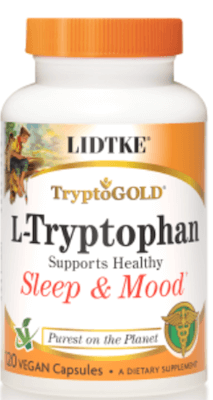
lydke l-tryptophan
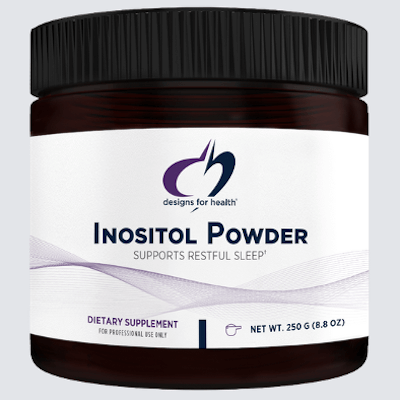
inositol powder

Products I recommend include Lidtke 500 mg Tryptophan and Designs for Health Inositol Powder.  You can purchase these from my online store (Fullscript – only available to US customers – use this link to set up an account).

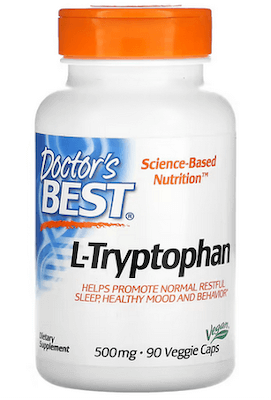
doctor's best l-tryptophan
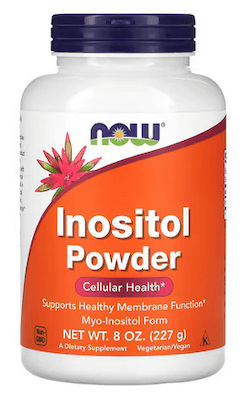
now inositol powder

If you’re not in the US, Doctor’s Best L-Tryptophan 500mg and Now Inositol Powder are products I recommend on iherb (use this link to save 5%).

Additional resources when you are new to using tryptophan and other amino acids as supplements

We use the symptoms questionnaire to figure out if low serotonin or other neurotransmitter imbalances may be an issue for you.

If you suspect low levels of any of the neurotransmitters and do not yet have my book, The Antianxiety Food Solution – How the Foods You Eat Can Help You Calm Your Anxious Mind, Improve Your Mood, and End Cravings, I highly recommend getting it and reading it before jumping in and using amino acids on your own so you are knowledgeable. And be sure to share it with the practitioner/health team you or your loved one is working with.

There is an entire chapter on the amino acids and they are discussed throughout the book in the sections on gut health, gluten, blood sugar control (this is covered in an entire chapter too), sugar cravings, anxiety and mood issues. The importance of quality animal protein and healthy fats is also covered.

The book doesn’t include product names (per the publisher’s request) so this blog, The Antianxiety Food Solution Amino Acid and Pyroluria Supplements, lists the amino acids that I use with my individual clients and those in my group programs.

If, after reading this blog and my book, you don’t feel comfortable figuring things out on your own (i.e. doing the symptoms questionnaire and respective amino acids trials), if you need serotonin support, the Serotonin QuickStart Program is a good place to start. This is a paid online/virtual group program where you get my guidance on using tryptophan and 5-HTP safely, and community support during 5 LIVE Q&A calls. You can sign up to be notified when the next live launch of this program is happening. We take a deep dive into product options including Lidtke products and others if you’re not able to access Lidtke.

If you also have low GABA symptoms, the next step to get help is the GABA QuickStart Program. This is also a paid online/virtual group program where you get my guidance and community support. Another option is the budget-friendly GABA QuickStart Homestudy program.

If you are a practitioner, join us in The Balancing Neurotransmitters: the Fundamentals program. This is also a paid online/virtual program with an opportunity to interact with me and other practitioners who are also using the amino acids.

Now I’d like to hear from you

Have you had success with tryptophan for anxiety, fears, crying and ruminations? And has it also helped with sleep, how happy you feel and reduced cravings? Has it also helped with OCD?

Did you first trial 5-HTP and then found tryptophan worked better or vice versa?

If yes, what dose and when do you use it?

What about using inositol to further reduce OCD? And what dose helped?

If you’re a practitioner do you use tryptophan and/or inositol with clients/patients with these low serotonin symptoms?

And please let me know if it’s helpful that I’m now including product recommendations and where to get them?

Feel free to share and ask your questions below.

Filed Under: Anxiety and panic, Children/Teens, Cravings, OCD, Tryptophan Tagged With: 5-HTP, amino acids, anxiety, anxious, autism, crying, fears, GABA Quickstart; Balancing Neurotransmitters: the Fundamentals program for practitioners, inositol, laughs, neurotransmitters, obsessive compulsive disorder, OCD, ruminating thoughts, ruminations, sleeps, teen, tryptophan

My 6 year old was having panic attacks getting out of the car for Kindergarten: GABA has completely relieved him of his fears

January 27, 2023 By Trudy Scott 12 Comments

gaba for fears

My 6 year old son was having panic attacks getting out of the car going to Kindergarten and taking two GABA Calm has completely relieved him of his fears. He has been going for 3 straight weeks in a row.

I thought it may be low serotonin since this happened last winter as well but I gave him 5-HTP for a couple months and it didn’t seem to affect him and his anxiety. We had to have him repeat Kinder this year.

But wow, the GABA has been fabulous and Kindergarten is in full swing because of your help.

This is from Lisa, a mom in the community. I never get tired of getting feedback like this – how wonderful for this young boy and his family. She shared this very positive outcome on one of the GABA blogs, asking this question (which I address below):

Quick question…does the GABA have to be taken on an empty stomach to work? We try to give it as soon as he is awake and wait to eat for 15-20 mins but sometimes it’s not possible.

The timing of GABA and tracking symptoms

I share that GABA is best taken on an empty stomach and ideally 30 minutes away from protein-containing food. But I also say that the way she is having him use it is clearly working for him. In a situation like this it’s simple enough to track the outcome on days they do wait 15-20 mins and on days when it’s not possible to wait the 15-20 mins (and make a note of how close to food he does take GABA). How is his anxiety, fears and panic attacks in these two situations?

Lisa shared that GABA works well in both instances:

We will keep doing the no food for 15-20 minutes after taking it because it is obviously working. We’ve only had it happen where he eats after about 5 mins and it seems to still do the job.

This sounds like a great plan. If they can, I would also do a trial waiting the full 30 minutes and see how he does on those days. She may find with the longer duration he only needs one GABA Calm.

It may also be that because GABA is being used in a sublingual manner like this, it can be used closer to food. Perhaps a trial right after food is worthwhile. I’m sure it will reduce some of the early morning stress and rush getting ready for Kindergarten.

I also confirmed with her that he is using the Source Naturals GABA Calm product. This is the sublingual product (with just 125mg of GABA and a few other ingredients) that I have so much success with. You can read more about it here – Source Naturals GABA Calm™: Why I recommend it for anxiety.

The school is in shock at how well carpooling is going for him

I love that the school is now in shock and that this mom went with her instinct and pulled him out of school the first year his fears showed up:

We just got a call from the school today and they are in shock at how well carpooling is going for him. They wanted to know what I was doing, ha! He had been a star student so they were shocked when he started to have meltdowns and panic attacks, running away and into traffic about 3 months into school. We deal with a bit of ADHD at home (it’s manageable with the diet) but anxiety is what most see on the outside.

We are repeating Kindergarten because half way through last year he started to panic getting out of the car. The previous school wanted to grab him out of the car and have me drive off. They said he would calm down better without me. What? Just what I want to do is traumatize my child at the start of his academic life. I pulled him and we waited since he was on the younger side and put him in a fabulous charter school this year.

The GABA has taken all those fears out and has been a huge bridge for him to get to school.

I do hope Lisa told the school exactly what he’s doing with GABA and how quickly it’s helped him. So many children are struggling with anxiety and mental health issues and could do with nutritional support like GABA and some of the dietary changes he had made before using GABA (more on that below).

5-HTP didn’t help and why a switch to tryptophan may have helped

You’ll notice she mentioned that 5-HTP had not helped the previous year:

I thought it may be low serotonin since this happened last winter as well but I gave him 5-HTP for a couple months and it didn’t seem to affect him and his anxiety.

Fear and panic attacks are common with low serotonin so it’s good that she did a trial of 5-HTP. Here are some of my insights:

  • I would not have someone use 5-HTP for a couple of months – the amino acids work quickly so a week or possibly two should be enough to decide whether to continue or stop
  • You always want to increase until you find the ideal dose. I’m not sure how Lisa approached this aspect.
  • When there are low serotonin symptoms and 5-HTP doesn’t work, we switch to tryptophan. 5-HTP works well for some and tryptophan works better for others. You can see all the low serotonin symptoms here

It’s possible her son may still benefit from additional serotonin support. Or it may be that the GABA is all he needs. With ADHD it may be worth investigating tyrosine too.

Dietary changes: gluten, dairy, phenols and high histamine foods

It’s important to always address the foundational diet so I checked with Lisa about dietary changes. This is key to not needing long-term GABA supplementation (once other causes of low GABA are addressed – such as Lyme disease, phthalates, aspartame, gut health etc). She shared this about his diet:

He has always been gluten free and dairy free (only goats milk as a baby). We follow the Feingold Diet and try to stay away from high histamine foods as it causes his anger and anxiety to be worse.

It’s great she has made these foundational dietary changes with gluten and dairy – both can exacerbate mood issues. The Feingold diet eliminates phenols. Both phenols and high histamine foods can be problematic for many children too, as she reports.

All these dietary factors are so key but even then additional neurotransmitter support is often needed and in this instance it’s GABA that he clearly needs. Because of his issue with histamines it’s possible he may not have tolerated pharmaGABA (a fermented GABA) so GABA Calm was a good first choice for the initial trial.

Pyroluria testing – why I often don’t use this urine test

I know he has some imbalances so we need to do an OAT test and pyroluria test (I have pyroluria so I know he is bound to have it). Money is the issue at the moment so the GABA chewables have been a true lifesaver. I can’t thank you enough!

I let her know that I don’t often have clients do the urine test for pyroluria because of the false negatives. He’s doing really well but children with pyroluria are really good at masking and pushing through (and so are adults, as I’m sure Lisa already knows). The pyroluria protocol (zinc, vitamin B6 and evening primrose oil) provide raw materials for neurotransmitter production and can help with ADHD symptoms too. We simply do a trial of the protocol when symptoms exist and determine if they are helping.

I love her comment: “the GABA chewables have been a true lifesaver.” This and the outcome for this 6 year old is the reason I love the amino acids.  They offer incredible results and relief from anxiety, fears and panic attacks, while you are working through testing (like the OAT and others) and other contributing root causes.

I said her feedback is really inspiring and I’d love to share it as a blog post for other families. She kindly responded with this:

You can definitely write up a blog post about it. If I can help other families going through the same thing it was all worth it. If you have any other questions don’t hesitate to ask. Thank you again for sharing all your knowledge.

I appreciate her willingness to post their success and her permission to share as a blog post.

Resources if you are new to using GABA and other amino acids as supplements

If you are new to using GABA or any of the other amino acids as supplements, here is the Amino Acids Mood Questionnaire from The Antianxiety Food Solution (you can see all the symptoms of neurotransmitter imbalances, including low GABA and low serotonin).

If you suspect low levels of any of the neurotransmitters and do not yet have my book, The Antianxiety Food Solution – How the Foods You Eat Can Help You Calm Your Anxious Mind, Improve Your Mood, and End Cravings, I highly recommend getting it and reading it before jumping in and using amino acids on your own so you are knowledgeable. And be sure to share it with the practitioner/health team you or your loved one is working with.

There is an entire chapter on the amino acids and they are discussed throughout the book in the sections on gut health, gluten, blood sugar control, sugar cravings, self-medicating with alcohol and more.

The book doesn’t include product names (per the publisher’s request) so this blog, The Antianxiety Food Solution Amino Acid and Pyroluria Supplements, lists the amino acids that I use with my individual clients and those in my group programs. You can find them all in my online store.

If, after reading this blog and my book, you don’t feel comfortable figuring things out on your own (i.e. doing the symptoms questionnaire and respective amino acids trials), a good place to get help is the GABA QuickStart Program (if you have low GABA symptoms). This is a paid online/virtual group program where you get my guidance and community support.

If you are a practitioner, join us in The Balancing Neurotransmitters: the Fundamentals program. This is also a paid online/virtual program with an opportunity to interact with me and other practitioners who are also using the amino acids.

Have one of your children experienced similar results with GABA offering relief for anxiety, fears and panic attacks? Which GABA product helped your child and how much helped?

When using sublingual or chewable GABA products like GABA Calm, have you found the timing in relation to foods being important?

What dietary changes has your child also made and how have they helped?

If you have questions and feedback please share them here too.

Filed Under: Anxiety, Children/Teens, GABA Tagged With: 5-HTP, 6 year old, amino acids, anxiety, Balancing Neurotransmitters: the Fundamentals program, dietary changes, empty stomach, fears, GABA, GABA Calm, GABA Quickstart online program, Kindergarten, panic attacks, practitioners, pyroluria, school, serotonin, Timing, tracking, tryptophan

Does 5-HTP (an amino acid) cause nightmares or does it help prevent nightmares (and also support low serotonin symptoms)?

October 7, 2022 By Trudy Scott 24 Comments

5-htp and nightmares

How do you do with using the amino acid 5-HTP for supporting your low serotonin symptoms of anxiety, worry, ruminating, fears, depression and insomnia?  Does it help or does it cause nightmares? On a recent Facebook thread someone shared that 5-HTP causes really bad nightmares, so she had to stop using it. A few others posted saying 5-HTP also caused them nightmares. I’ve not had any clients report nightmares, so I was surprised to hear this feedback.  However, most folks on the same Facebook thread shared that 5-HTP works very well for them and does not cause nightmares. There is also research that supports the use of 5-HTP for night terrors. I suspect it may have to do with low vitamin B6 and share more on that below.

Here is her experience with 5-HTP and nightmares and some of my feedback:

I don’t know how anyone takes 5-HTP. The horrific nightmares I got from taking it made me stop 50 mg. I tried 3 times thinking it was a fluke and it happened every time. Too scary for me.

My first try was suggested from my Naturopath, Metagenics SeroSyn. 200 mg. First morning waking up I had a nightmare so bad I can’t even share it. I also woke up feeling unable to wake up, drugged almost. So I waited, did more research and googled 5-HTP and nightmares just to see if there was a connection. I found it. I read to lower the dosage. So I went to Pure Encapsulations 50 mg. Same thing happened. I tried 2 more times, same thing happened. When I researched, I found so many people talking about “vivid dreams” and after my last attempt the dream was so real I thought my son was in my home when I woke up and had to process reality from my dream. That did it for me. Now I’m terrified of it. Just my own experience. I did get help from depression though! But I cannot go through one evil for another. Now I’m stuck looking for help and answers.

I thanked her for sharing and agreed it does help to do a few experiments to be sure it was the 5-HTP. I also shared that I would not consider the Metagenics SeroSyn a good 5-HTP to test because of all the other ingredients. But it also happened with Pure Encapsulations 50 mg 5-HTP – that was a good test to confirm.

I also shared that some folks do better on 5-HTP and some on tryptophan so if 5-HTP did help with low serotonin symptoms then I’d consider a trial of tryptophan especially since she did say using the 5-HTP helped with her depression.

We would also look for other ways to support serotonin – saffron, turmeric, St. John’s Wort, theanine (it supports GABA, serotonin and dopamine) and of course diet (real whole food, quality animal protein, no gluten/sugar/caffeine, fermented foods, organic vegetables and fruit, healthy fats etc), gut health and more.

I’d also look into and address low zinc and low vitamin B6 as both are needed to make serotonin and the other neurotransmitters. More on low vitamin B6, pyroluria and nightmares below.

Here is some of the feedback from other folks who also had issues with 5-HTP:

  • 5-HTP didn’t mix well with my body either. Taken at night, horrible dreams, and 50mg Pure Encapsulations formula in the morning made me feel so dark, spaced out and terrible nausea.
  • I appreciate this post. I had nightmares from a magnesium supplement that included 5-HTP! Now I know I’m not alone.

And here is some of the feedback from folks who do well with 5-HTP (the majority of those who responded):

  • I take 100 mg of 5-HTP in the morning (Natural Factors) and about 350 mg of tryptophan before bed (Lidtke). It works well for me. No nightmares although I do dream a lot. Mostly noticed improvement in mood and ruminating thoughts. Also taking Sam-e which also helps.
  • I take chewable natural factors Tranquil Sleep. It contains other ingredients (like theanine) as well but it’s really easy to dose. If I take 2 it’s too much. I get weird dreams and a headache. So 1 1/2 it is.
  • 5-htp helped me so much! But I had to take it in the morning. 250mg was perfect for me. I was using this for my debilitating anxiety which would keep me in flight or fight all day and I would ruminate. Really helped me along with therapy. I no longer need it.
  • I’ve just started taking 50mg 5-HTP at night. It’s a micronized version I buy from a compounding chemist in Australia. No negative side effects so far.
  • Grateful for the reminder … I did great on 5-htp myself. Have had all dose amounts, given at different times too. I deal with chronic pain and trauma/stress.
  • My sister gets anxiety on 5-HTP but it helps me so much! I have not tracked regular consumption compared to my sleep (I get too much REM without it and wake up exhausted). I also no longer need it as a daily and can take it as needed. I take 200mg, forget the brand but it’s a single ingredient.
  • I take 50 mg of 5-HTP from Seeking Health and do very well on it. It has helped me with depression, worry, fear, more energy and motivation and no nightmares.
  • I take the Now brand, 100mg at bedtime along with the same brand of L theanine. No nightmares and I’ve been doing this for about 5 years.
  • I use 50mg Seeking Health 5-HTP and I love it. It gives me energy and motivation, helps with intrusive thoughts and anxiety. I’ve used the Jarrow brand in the past without results. No nightmares. P5P, on the other hand, I cannot take. It gives me such clear, vivid nightmares I would wake up crying. Never again.

We are all unique and there is clearly no one-size fits all.

Low vitamin B6 can cause nightmares or poor dream recall

It’s well recognized that low vitamin B6 can cause nightmares or poor dream recall. In this study, Effects of Vitamin B6 (Pyridoxine) and a B Complex Preparation on Dreaming and Sleep (which was randomized, double-blind and placebo-controlled), 100 participants from across Australia were given 240 mg vitamin B6 (pyridoxine hydrochloride) before bed for five consecutive days. Other study participants were given a B complex. This is the outcome of the study:

  • vitamin B6 significantly increased the amount of dream content participants recalled but did not significantly affect dream vividness, bizarreness, or color, nor did it significantly affect other sleep-related variables
  • participants in the B complex group showed significantly lower self-rated sleep quality and significantly higher tiredness on waking

This vitamin B6/dream recall research is of particular interest to me because of my work with pyroluria, a social anxiety condition which responds really well to supplementation with zinc, vitamin B6 or P5P (pyridoxal-5-phosphate) or a combination of both, and a few other key nutrients.  Here is the pyroluria questionnaire.

One of the classic signs of pyroluria is poor dream recall, stressful or bizarre dreams, or nightmares, signs which the late Carl Pfeiffer, MD attributed to low vitamin B6 status. He suggested that your dreams and dream recall serve as a good indicator of your need for vitamin B6. You should dream every night and you should remember your dreams. They should be pleasant – the kind of dreams where you wake up and want to close your eyes and continue dreaming.

Could it be that folks who get nightmares with 5-HTP, happen to also have pyroluria? Or perhaps they simply have low vitamin B6 status? I have all my anxious clients supplement with vitamin B6 and/or P5P and this may be why nightmares with 5-HTP was news to me.

5-HTP can increase cortisol – does this affect nightmares?

There is research and clinical evidence supporting that, for some individuals, 5-HTP can raise cortisol. I’ve blogged about this here:

This is not always the case. Someone in the same Facebook thread shared this: “My cortisol measured above the reference range, but 5-HTP is the only thing I’ve found that’s helping me sleep recently.”

I’m not aware of a high cortisol-nightmare connection but it’s possible. In one study, nightmares triggered high cortisol the next morning, but I donut this has relevance in this situation.

5-HTP induces long-term improvement of sleep terrors in children

There clearly is a subset of folks who don’t do well with 5-HTP and yet there is evidence that it can actually improve sleep terrors. In a small open label clinical trial of 45 children, it was found that 5-HTP was able to “modulate the arousal level in children and to induce a long-term improvement of sleep terrors” (in the majority of children in the trial). There were 34 male and 11 female children ranging in age from 3.2-10.6 years.

After the first visit, L -5-HTP was administered (2 mg/kg per day) at bedtime to 31 randomly selected patients for a single period of 20 consecutive days. After 1 month of treatment, 29/31 (93.5%) of patients showed a positive response. In the comparison group without drug therapy, after 1 month, the episodes disappeared only in four children (28.6%) while ten children (71.4%) showed the persistence of episodes with the same frequency as before. After 6 months, 26/31 (83.9%) of children treated with L -5HTP were sleep terror-free, while in five children (16.1%) sleep terror episodes persisted. Of the children in the comparison group, ten (71.4%) continued to show sleep terrors at 6-month follow-up.

If we assume a 10-year-old weighs, 70lb or close to 32kg, they would have been given 60mg 5-HTP (i.e. 2 mg/kg).

Typical adult dosing of 5-HTP is 50mg twice a day, mid-afternoon and evening. For a 10-year-old we may start with a quarter of this dose i.e. 12.5mg or 25mg 5-HTP twice a day, for a total of 25mg or 50mg a day – which is close to what was used in this study.

You can read more about this in the paper here: L -5-Hydroxytryptophan treatment of sleep terrors in children

Resources if you are new to using 5-HTP and other amino acids as supplements

If you are new to using any of the amino acids as supplements, here is the Amino Acids Mood Questionnaire from The Antianxiety Food Solution (you can see all the symptoms of neurotransmitter imbalances, including low serotonin and low GABA).

If you suspect low levels of any of the neurotransmitters and do not yet have my book, The Antianxiety Food Solution – How the Foods You Eat Can Help You Calm Your Anxious Mind, Improve Your Mood, and End Cravings, I highly recommend getting it and reading it before jumping in and using amino acids on your own so you are knowledgeable. And be sure to share it with the practitioner/health team you or your loved one is working with.

There is an entire chapter on the amino acids and they are discussed throughout the book in the sections on gut health, gluten, blood sugar control, sugar cravings, self-medicating with alcohol and more.

The book doesn’t include product names (per the publisher’s request) so this blog, The Antianxiety Food Solution Amino Acid and Pyroluria Supplements, lists the amino acids that I use with my individual clients and those in my group programs. You can find them all in my online store.

If, after reading this blog and my book, you don’t feel comfortable figuring things out on your own (i.e. doing the symptoms questionnaire and respective amino acids trials), a good place to get help is the GABA QuickStart Program (if you have low GABA symptoms). This is a paid online/virtual group program where you get my guidance and community support.

If you are a practitioner, join us in The Balancing Neurotransmitters: the Fundamentals program. This is also a paid online/virtual program with an opportunity to interact with me and other practitioners who are also using the amino acids.

How do you do with 5-HTP for low mood, worry-type of low serotonin anxiety, cravings, PMS, negative self-talk, anger/rage/irritability, insomnia, ruminating thoughts, winter blues etc? Does it help?

Or does it give you nightmares that are bad enough that you have had to stop?

Please share how much you used? And if tryptophan or other serotonin support helped instead?

Did the addition of vitamin B6 or P5P help prevent the nightmares when using 5-HTP?

And do you have pyroluria or suspect you may have it? Do you have high cortisol?

If you’re a practitioner I’d love to hear your experiences with 5-HTP and nightmares.

If you have questions please share them here too.

Filed Under: 5-HTP, Anxiety, Insomnia Tagged With: 5-HTP, amino acid, anxiety, Balancing Neurotransmitters: the Fundamentals program for practitioners, cortisol, depression, fears, GABA Quickstart program, insomnia, low serotonin, night terrors, Nightmares, P5P, pyroluria, ruminating, sleep, vitamin B6, worry

Drastic reduction in intrusive thoughts, anxiety and fears (and better sleep) with GABA, tryptophan, 5-HTP and the pyroluria protocol

May 6, 2022 By Trudy Scott 33 Comments

intrusive thoughts reduction

It’s not uncommon for an adult woman to have had intrusive thoughts her entire life and not even recognize that they are connected to her anxiety levels. She is often unaware that there is anything she can do to actually ease her anxiety and reduce the bad thoughts (such as fearing horrible things happening to her husband and children). Enter the amino acids: GABA, tryptophan, 5-HTP and the pyroluria protocol (zinc, vitamin B6 and evening primrose oil). They can do all of this and more. Kimberly shared her own experience and success on a blog post about intrusive thoughts and these specific nutrients. Here is her story in her own words:

Oh my goodness, I’m realizing after reading this, that intrusive thoughts are something I’ve had my entire life. As a child, this manifested in thoughts of what might happen to my one stable parent when we were apart. More recently, I feared horrible things happening to my husband or children. Like the author of the original blog wrote, these intrusive thoughts reflect a greater anxiety. But I didn’t realize this until I began experimenting with your protocols.

I first tried GABA when I felt extremely anxious, but not on a regular basis. Next, I added the pyroluria protocol, which did bring some relief to the intrusive thoughts. Fast forward to today, when I also take 5-HTP, tryptophan and GABA regularly and have noticed a drastic reduction in those thoughts/fears. It’s like a miracle.

My fear level is maybe 15% of what it used to be, if that.

I also find that I can use extra GABA at night if I wake up and can’t shut off my mind. It works like a charm to help me get back to sleep. What a blessing to have these amino acids.

I’m a calmer, more serene person than I’ve ever been, without (for the most part) the crippling, irrational fears I used to experience. Thank you, as always, Trudy. You are also a tremendous blessing.

I thanked her for sharing and said how glad I was that she is connecting more and more dots. It’s very common to suddenly realize you’ve had these intrusive thoughts your entire life. With her  amazing results, combining all the above nutrients she is a poster child for this approach that I use with my clients. I’m thrilled for her miracle outcome and so very happy for her.

I’m sharing her story here as a new blog so I can provide her with some additional approaches to explore and so you can see how these amino acids and other nutrients have worked for someone else (and get your own insights.) I’m also sharing my feedback on how she approached things.

Additional approaches to her to explore: adjusting what is working for her now

Her fear level is maybe 15% of what it used to be but ideally we want to improve on that by fine-tuning what she is doing and capitalize on what is working. Know this – it’s not unreasonable to expect that to get to zero!

If we were working together this is what I’d suggest (assuming she hasn’t already done this):

  • Review the low GABA and low serotonin questionnaires and adjust the GABA and/or tryptophan/5-HTP based on any symptoms that remain with a score above zero.
  • After that, if there are still some troubling low serotonin symptoms experiment with different doses and timings of tryptophan and 5-HTP – some people do better on one vs the other
  • Also, if there are still some troubling low GABA symptoms, experiment with a few different GABA products. I’ve had folks try up to 5 different products before they find the perfect one for their needs
  • If she can see the social anxiety and other pyroluria signs remain, we’d adjust zinc, vitamin B6 (and possibly add P5P) and evening primrose oil.

With all of the above, I’d have her do one change at a time and carefully document everything in her food-mood log.

Identifying if the remaining fear/intrusive thoughts are more pronounced in the second half of her cycle

It may simply be a matter of identifying if the remaining fear/intrusive thoughts are more pronounced in the second half of her cycle i.e. after ovulation. As I shared on the blog, one study showed that “women in the ‘early luteal’ phase… had more than three times as many intrusive thoughts.”

She may need to adjust the amino acids up during this period and it may be that over the next 2 months she sees these symptoms resolve with her current approach, as her hormones become balanced. It’s typical to see this in 2-3 months.

My feedback on her approach

Here is my feedback on how she did things and why I love her approach:

  • She experimented with GABA some of the time – as needed – based on what she was learning from me from blogs, my book and interviews.
  • She made one change at a time, adding the pyroluria protocol next
  • Then she added tryptophan and 5-HTP (hopefully one at a time)
  • And then her use of the amino acids became regular. This last aspect of consistency is a needle mover for so many of my clients.
  • She now tweaks things and takes extra GABA at night if needed. This may be needed after a tough day or if you’ve been glutened or exposed to insecticides.

I will add that the sequence could have been varied and still have had a similar successful outcome, for example, amino acid consistency from day 1 and then adding the pyroluria protocol (this is what I typically do with clients).

However, it’s my goal to empower women like Kimberly to take charge, learn, make changes, listen to their bodies, learn some more and adjust to see further improvements. It makes me immensely happy when I hear that she is a calmer, more serene person than she’s ever been. I feel confident that she’ll be able to get to zero intrusive thoughts with the tips I shared above.

She may or may not also need to consider other possible root causes of intrusive thoughts: low magnesium, low iron, diet (a low carb/high fat intrusive thoughts case study) and gluten issues.

Psychiatric medication discontinuation syndrome, Lyme disease, mold toxicity, heavy metals, toxins, infections, TBI and trauma can also be factors with intrusive thoughts and anxiety, but with her huge improvement I’d suspect these root causes are unlikely for her.

Resources if you are new to using the amino acids and pyroluria supplements

If you are new to using GABA or tryptophan/5-HTP as a supplement, here is the Amino Acids Mood Questionnaire from The Antianxiety Food Solution (you can see all the low GABA and low serotonin symptoms).

If you suspect low levels of any of the neurotransmitters and do not yet have my book, The Antianxiety Food Solution – How the Foods You Eat Can Help You Calm Your Anxious Mind, Improve Your Mood, and End Cravings, I highly recommend getting it and reading it before jumping in and using amino acids on your own so you are knowledgeable. And be sure to share it with the team you or your loved one is working with.

There is an entire chapter on the amino acids and they are discussed throughout the book in the sections on gut health, blood sugar control, sugar cravings, self-medicating with alcohol and more.

My book also has an entire chapter on pyroluria (with the protocol and questionnaire). The questionnaire is on the blog too, together with many other related posts (simply search for pyroluria).

The book doesn’t include product names (per the publisher’s request) so this blog, The Antianxiety Food Solution Amino Acid and Pyroluria Supplements, lists the amino acids that I use with my individual clients and those in my group programs.

If, after reading this blog and my book, you don’t feel comfortable figuring things out on your own (i.e. doing the symptoms questionnaire and respective amino acids trials), a good place to get help is the GABA Quickstart Program. This is a paid online/virtual group program where you get my guidance and community support.

If you are a practitioner, join us in The Balancing Neurotransmitters: the Fundamentals program. This is also a paid online/virtual program with an opportunity to interact with me and other practitioners who are also using the amino acids.

Do you experience intrusive thoughts or did you have them in the past? Feel free to describe them if you feel comfortable doing so.

And did you think you’d be able to reduce the horrible intrusive thoughts with a nutritional approach?

What helped reduce them for you? If you used a similar approach, how did it look for you?

If you’re a practitioner, have you found this approach to help reduce intrusive thoughts and ease anxiety in your clients/patients?

If you have questions please share them here too.

Filed Under: 5-HTP, Anxiety, GABA, Insomnia, OCD, Tryptophan Tagged With: 5-HTP, amino acids, anxiety, anxious, calmer, can’t shut off my mind, empowering women, evening primrose oil, fear, feared horrible things, fears, GABA, GABA Quickstart program, intrusive thoughts, luteal phase, more serene, practitioner training, pyroluria protocol, sleep, tryptophan, vitamin B6, zinc

Huge rise in anxiety in college students (and other mental health issues): amino acid supplements and nutritional psychiatry as a solution.

May 21, 2021 By Trudy Scott 17 Comments

anxiety in college students

Is your son or daughter finding college/university overwhelming? Is he or she battling with new or worsening anxiety, worrying about results, has fears about success or fitting in, lying awake imagining the worst outcomes or maybe feeling like a perfectionist and getting stuck? Perhaps they have poor self-confidence, feel like an imposter and may even have panic attacks.  These signs and symptoms are all common with the low serotonin-type of worry-in-the-head anxiety, which may also include PMS (premenstrual syndrome), obsessive tendencies and anger issues.

They may also be experiencing the low GABA type of tension-anxiety, where they lie awake at night stiff and tense and self-medicate with too much sugar, carbs, junk food and/or alcohol (and maybe even pot and other drugs). There may be intrusive thoughts too and panic attacks also triggered by low GABA.

What about focus issues/ADHD and low motivation, no ability to follow-through on tasks and projects, procrastination and missing deadlines? These are all classic signs of low catecholamine, which also includes low energy, and feeling depressed/sad/low/flat. Your son or daughter may just want to crawl up in their dorm bed and not do anything or may spend hours doing mindless activities like binge watching Netflix or scrolling mindlessly through social media.

All of these signs and symptoms point to low levels of neurotransmitters or brain chemicals: low serotonin, low GABA and low dopamine. We need the right raw materials to make these neurotransmitters and the majority of college cafeterias are not providing nutrient-dense foods and/or foods that are unique for each person’s biochemistry (more on this below).

The huge rise in anxiety and other mental health issues in college students

It’s no wonder that we are seeing a huge rise in anxiety and other mental health issues in college students. Way too many students are dropping out and so many are struggling unnecessarily.

This 2019 Harvard blog post shares some alarming stats:

Anxiety in college is very common. According to the American College Health Association Fall 2018 National College Health Assessment, 63% of college students in the US felt overwhelming anxiety in the past year. In the same survey, 23% reported being diagnosed or treated by a mental health professional for anxiety in the past year.

This article in Nature earlier this year, The problem is greater than it’s ever been’: US universities urged to invest in mental-health resources, highlights points from US National Academies of Sciences, Engineering, and Medicine report:

  • 68% of university presidents listed student mental health as one of their most pressing issues
  • the dropout rate for students with diagnosed mental-health problems ranges from 43% to as high as 86%
  • The students who said that they had more trouble with anxiety or depression after the lockdown also reported greater alcohol use

It states that faculty members should “receive formal training to address and support student well-being” and “students should learn about mental-health issues as part of their introductory training.” They also say “Hiring more counsellors could be an important step, but counsellors alone can’t turn the tide.” I agree with all this but recommend adding nutritional psychiatry awareness, training and resources too.

Poor diet and nutritional deficiencies are a major contributing factor even though it’s seldom discussed. The good news is that there are relatively simple solutions – amino acids as supplements for quick relief and diet as the foundation – but it does take work.

Using amino acids as supplements for quick relief

Amino acids, used as supplements, are a quick way to offer immediate relief of symptoms:  tryptophan or 5-HTP (for the low serotonin worry-type anxiety), GABA (for the tension-type anxiety) and tyrosine (for the low dopamine poor-focus and low symptoms). Here are some examples:

  • A 23-year-old female college student, adopted and exposed to alcohol while in the womb, has some learning struggles. She doesn’t want to miss a day of taking 5-HTP, because she says that “it keeps her on her toes,” which she says means that it “keeps me focused,” when studying.
  • Tyrosine helped a young man who was learning new software: “Within an hour the stress just melted away!”, alleviating his anxiety and panic attacks and creating a feeling of calm focus.
  • A newly qualified nutritionist shared how she suffered badly from imposter syndrome at the end of her nutrition degree and she felt socially awkward in so many outings and situations. Her anxiety and stress were through the roof and her sleep was poor. She said these wonderful results: “What really tipped the balance was the supplementation of tyrosine, tryptophan & GABA.”

If you are new to the amino acids, here is the Amino Acids Mood Questionnaire from The Antianxiety Food Solution and additional information on Anxiety and targeted individual amino acid supplements: a summary

This lists The Antianxiety Food Solution Amino Acid and Pyroluria Supplements that I use with my individual clients and those in my group programs.

We use the amino acids for quick relief of symptoms and then focus on the foundations like diet and address other imbalances.

Diet as the foundation for students i.e. nutritional psychiatry

I first blogged about nutritional psychiatry in 2015 when the ISNPR position statement was published in World Psychiatry, the official journal of the World Psychiatric Association. This 2019 paper, Nutritional psychiatry: Towards improving mental health by what you eat provides an overview of the emerging field of nutritional psychiatry:

Does it matter what we eat for our mental health? Accumulating data suggests that this may indeed be the case and that diet and nutrition are not only critical for human physiology and body composition, but also have significant effects on mood and mental wellbeing. While the determining factors of mental health are complex, increasing evidence indicates a strong association between a poor diet and the exacerbation of mood disorders, including anxiety and depression, as well as other neuropsychiatric conditions.

The 2017 SMILES Trial is the first randomized controlled diet depression study and ONE THIRD of the dietary intervention group saw improvements in their depression symptoms.  This was just diet alone and switching from processed/junk food to real food with no specific dietary restrictions. Participants also reported improvements in anxiety symptoms. And the authors even addressed the cost factor, stating it was more affordable to eat this way.

Research supports this connection in college students. This is one of a growing number of studies, Eating behavior and relationships with stress, anxiety, depression and insomnia in university students, that concludes that:

unhealthy eating patterns are common in university populations and are related to anxiety, stress, and depression. Educational interventions to reduce unhealthy food consumption in university students can also result in psychological health improvements and/or vice versa.

Unfortunately, as students get more anxious and depressed their food choices get worse (especially for male students) and it becomes a vicious cycle. This paper, Examining the Role of Anxiety and Depression in Dietary Choices among College Students, reports:

Overall, a decrease in total caloric intake and an increase in sugar consumption were found as self-reported symptoms of anxiety and depression increased. In addition, there were sex differences in the relationship between depression and food choices. Men consumed more saturated fat as well as less fruits and vegetables as self-reported symptoms of depression increased. Results suggest symptoms of depression are a greater risk factor for poor nutrition in male college students than females.

It’s time for colleges/universities to recognize all this and teach about nutritional psychiatry. My book, The Antianxiety Food Solution is an excellent starting point for students, parents and educators (together with other blogs on this site).

Checking out cafeterias and cooking options

When looking at colleges are you also looking at what the cafeteria offers and if they cater for special diets (like gluten-free, dairy-free, Paleo etc) and/or offer real whole food, organic vegetables and fruit, grass-fed meat, wild fish and fermented foods?

Can students use a slow cooker, blender, Instant Pot or electric frying pan in their dorms?

Is there a dorm kitchen and can they take their own pots and pans (so non-stick pans can be avoided) and any of the above appliances?

Are there nearby living options that include a kitchen and a store with quality food for purchase?

I feel colleges/universities should be rated on all of the above in addition to everything else.

It all starts at home before they leave for college

Having a good college cafeteria and dorm kitchens is one step in the right direction, but these young adults also need to understand the impact of a breakfast of bagels and coffee or not having breakfast or the fact that gluten may trigger a panic attack and make them sad. They need to know how to shop and cook if there is a shared dorm kitchen or apartment. And they need to make the right choices when they do eat in the cafeteria or nearby restaurants (assuming good options are available). This all starts at home with you before they leave for college.

Katie shares this about her daughter who plans to use the college cafeteria for some meals and also cook in the apartment kitchen on weekends:

My daughter was just saying today how glad she is that she doesn’t have to figure out [the connection between increased anxiety, fatigue, brain fog, sadness and what they are eating] while learning how to live on her own and go to college. I changed how I ate 8 years ago for my PCOS and about 3 years ago she decided to give it a try after feeling so horrible but seeing my change. I’m so proud of her for embracing a healthier lifestyle in her teen years when everyone around her is subsisting off energy drinks and vending machine food. It makes me think that if we offer them a little education, they’ll make good choices for themselves.

This mom can also feel proud that she led by example for her daughter (and I appreciate them for letting me share here).

But I believe the colleges need to play a role in this too. They are providing food and this is a perfect educational opportunity that will serve their students (and future generations), solve the mental health crisis they are struggling with and prevent drop-outs (which is having an impact on their bottom-line).

Do you believe colleges/universities should be rated on all of the above in addition to everything else? What have you done to check out cafeterias and cooking options for your daughter or son?

Has your son or daughter benefited from any of the amino acids or eating real whole food (and according to their own needs?

Do you work in a college and are you seeing this rise in anxiety and depression? If yes, how do we get these changes implemented?

How do we educate students once they are at college (other than making sure campus food is excellent):

  • a lifestyle/diet/anxiety app with resources and tracking?
  • online training with a nutritionist/coach and access to an online forum and live Q&As?
  • one-on-one campus nutrition coaches?
  • make nutritional psychiatry part of the curriculum?
  • produce a documentary following the lives of students on campus and showing the transformation they experience?

Feel free to post your questions and ideas here too.


Filed Under: Anxiety, Diet, GABA, Nutritional Psychiatry, serotonin Tagged With: ADHD, alcohol, amino acid supplements, anxiety, cafeteria, carbs, college, college students, cooking, daughter, fears, focus issues, GABA, imposter, junk food, low motivation, mental health, nutritional psychiatry, overwhelming, panic attacks, perfectionist, procrastination, rise in anxiety, serotonin, son, stuck, sugar, tension, tryptophan, tyrosine, university, worry, worrying

  • « Go to Previous Page
  • Page 1
  • Page 2
  • Page 3
  • Go to Next Page »

Primary Sidebar

NEW! GABA QuickStart Homestudy (with special intro pricing)

gaba quickstart homestudy

Free Report

9 Great Questions Women Ask about Food, Mood and their Health

You'll also receive a complimentary subscription to my ezine "Food, Mood and Gal Stuff"


Connect with me

Popular Posts

  • Amino Acids Mood Questionnaire from The Antianxiety Food Solution
  • The Antianxiety Food Solution Amino Acid and Pyroluria Supplements
  • Pyroluria Questionnaire from The Antianxiety Food Solution
  • Collagen and gelatin lower serotonin: does this increase your anxiety and depression?
  • Tryptophan for the worry-in-your-head and ruminating type of anxiety
  • GABA for the physical-tension and stiff-and-tense-muscles type of anxiety
  • The Antianxiety Food Solution by Trudy Scott
  • Seriphos Original Formula is back: the best product for anxiety and insomnia caused by high cortisol
  • Am I an anxious introvert because of low zinc and vitamin B6? My response to Huffington Post blog
  • Vagus nerve rehab with GABA, breathing, humming, gargling and key nutrients

Recent Posts

  • What do I use instead of Seriphos to help lower high cortisol that is affecting my sleep and making me anxious at night?
  • BeSerene™ GABA/theanine cream eases severe muscle tension in her neck/shoulders, prevents her bad headaches and quells her anxiety
  • How the correct approach, dose and sublingual use of GABA can be calming and not cause a flushed and itchy face and neck
  • The amino acid glutamine improves low mood by addressing gut health, and it has calming effects too
  • Flight anxiety with heightened breath, physical tension and also fearing the worst (the role of low GABA and low serotonin)

Categories

  • 5-HTP
  • AB575
  • Addiction
  • ADHD
  • Adrenals
  • Alcohol
  • Allergies
  • Alzheimer's disease
  • Amino Acids
  • Anger
  • Antianxiety
  • Antianxiety Food Solution
  • Antidepressants
  • Anxiety
  • Anxiety and panic
  • Autism
  • Autoimmunity
  • benzodiazapines
  • Bipolar disorder
  • Books
  • Caffeine
  • Cancer
  • Candida
  • Children/Teens
  • Collagen
  • Cooking equipment
  • Coronavirus/COVID-19
  • Cravings
  • Depression
  • Detoxification
  • Diabetes
  • Diet
  • DPA/DLPA
  • Drugs
  • EFT/Tapping
  • EMF
  • EMFs
  • Emotional Eating
  • Endorphins
  • Environment
  • Essential oils
  • Events
  • Exercise
  • Fear
  • Fear of public speaking
  • Fertility and Pregnancy
  • Fish
  • Food
  • Food and mood
  • Functional neurology
  • GABA
  • Gene polymorphisms
  • General Health
  • Giving
  • Giving back
  • Glutamine
  • Gluten
  • GMOs
  • Gratitude
  • Gut health
  • Heart health/hypertension
  • Histamine
  • Hormone
  • Hyperparathyroidism
  • Hypoglycemia
  • Immune system
  • Inflammation
  • Insomnia
  • Inspiration
  • Introversion
  • Joy and happiness
  • Ketogenic diet
  • Lithium orotate
  • Looking awesome
  • Lyme disease and co-infections
  • MCAS/histamine
  • Medication
  • Men's health
  • Mental health
  • Mercury
  • Migraine
  • Mold
  • Movie
  • MTHFR
  • Multiple sclerosis
  • Music
  • NANP
  • Nature
  • Nutritional Psychiatry
  • OCD
  • Osteoporosis
  • Oxalates
  • Oxytocin
  • Pain
  • Paleo
  • Parasites
  • Parkinson’s disease
  • PCOS
  • People
  • PMS
  • Postpartum
  • PTSD/Trauma
  • Pyroluria
  • Questionnaires
  • Real whole food
  • Recipes
  • Research
  • Schizophrenia
  • serotonin
  • SIBO
  • Sleep
  • Special diets
  • Sports nutrition
  • Stress
  • Sugar addiction
  • Sugar and mood
  • Supplements
  • Teens
  • Testimonials
  • Testing
  • The Anxiety Summit
  • The Anxiety Summit 2
  • The Anxiety Summit 3
  • The Anxiety Summit 4
  • The Anxiety Summit 5
  • The Anxiety Summit 6
  • Thyroid
  • Thyroid health
  • Toxins
  • Tryptophan
  • Tyrosine
  • Uncategorized
  • Vegan/vegetarian
  • Women's health
  • Yoga

Archives

  • October 2025
  • September 2025
  • August 2025
  • July 2025
  • June 2025
  • May 2025
  • April 2025
  • March 2025
  • February 2025
  • January 2025
  • November 2024
  • October 2024
  • September 2024
  • August 2024
  • July 2024
  • June 2024
  • May 2024
  • April 2024
  • March 2024
  • February 2024
  • January 2024
  • December 2023
  • November 2023
  • October 2023
  • September 2023
  • August 2023
  • July 2023
  • June 2023
  • May 2023
  • April 2023
  • March 2023
  • February 2023
  • January 2023
  • December 2022
  • November 2022
  • October 2022
  • September 2022
  • August 2022
  • July 2022
  • June 2022
  • May 2022
  • April 2022
  • March 2022
  • February 2022
  • January 2022
  • December 2021
  • November 2021
  • October 2021
  • September 2021
  • August 2021
  • July 2021
  • June 2021
  • May 2021
  • April 2021
  • March 2021
  • February 2021
  • January 2021
  • December 2020
  • November 2020
  • October 2020
  • September 2020
  • August 2020
  • July 2020
  • June 2020
  • May 2020
  • April 2020
  • March 2020
  • February 2020
  • January 2020
  • December 2019
  • November 2019
  • October 2019
  • September 2019
  • August 2019
  • July 2019
  • June 2019
  • May 2019
  • April 2019
  • March 2019
  • February 2019
  • January 2019
  • December 2018
  • November 2018
  • October 2018
  • September 2018
  • August 2018
  • July 2018
  • June 2018
  • May 2018
  • April 2018
  • March 2018
  • February 2018
  • January 2018
  • December 2017
  • November 2017
  • October 2017
  • September 2017
  • August 2017
  • July 2017
  • June 2017
  • May 2017
  • April 2017
  • March 2017
  • February 2017
  • January 2017
  • December 2016
  • November 2016
  • October 2016
  • September 2016
  • August 2016
  • July 2016
  • June 2016
  • May 2016
  • April 2016
  • March 2016
  • February 2016
  • January 2016
  • December 2015
  • November 2015
  • October 2015
  • September 2015
  • August 2015
  • July 2015
  • June 2015
  • May 2015
  • April 2015
  • March 2015
  • February 2015
  • January 2015
  • December 2014
  • November 2014
  • October 2014
  • September 2014
  • August 2014
  • July 2014
  • June 2014
  • May 2014
  • April 2014
  • March 2014
  • February 2014
  • January 2014
  • December 2013
  • November 2013
  • October 2013
  • September 2013
  • August 2013
  • July 2013
  • June 2013
  • May 2013
  • April 2013
  • March 2013
  • February 2013
  • January 2013
  • December 2012
  • November 2012
  • October 2012
  • August 2012
  • July 2012
  • June 2012
  • May 2012
  • April 2012
  • March 2012
  • February 2012
  • January 2012
  • December 2011
  • November 2011
  • October 2011
  • September 2011
  • August 2011
  • July 2011
  • June 2011
  • May 2011
  • April 2011
  • March 2011
  • February 2011
  • January 2011
  • December 2010
  • October 2010
  • September 2010
  • July 2010
  • May 2010
  • April 2010
  • March 2010
  • February 2010
  • January 2010
  • November 2009

Share the knowledge!

The above statements have not been evaluated by the Food and Drug Administration. Products listed in this website are not intended to diagnose, treat, cure or prevent any disease.

The information provided on this site is for informational and educational purposes only and is not intended as a substitute for advice from your physician or other health care professional. You should consult with a healthcare professional before starting or modifying any diet, exercise, or supplementation program, before taking or stopping any medication, or if you have or suspect you may have a health problem.


Copyright © 2026 Trudy Scott. All Rights Reserved. | Privacy | Terms and Conditions | Refund Policy | Medical Disclaimer

Free Report

9 Great Questions Women Ask about Food, Mood and their Health

You’ll also receive a complimentary subscription to my ezine “Food, Mood and Gal Stuff”