• Skip to primary navigation
  • Skip to main content
  • Skip to primary sidebar

everywomanover29 blog

Food, Mood and Women's Health – Be your healthiest, look and feel great!

  • Blog
  • About
  • Services
  • Store
  • Resources
  • Testimonials
  • The Book
  • Newsletter
  • Contact
  • Search this site

cravings

Rage, anxiety, cravings & insomnia in 11-year old girl with RAD/reactive attachment disorder: chewable tryptophan turns things around

May 28, 2021 By Trudy Scott 21 Comments

rad and tryptophan

Today I’m sharing the case of an 11-year-old girl who had huge rage issues, was angry much of the time, suffered from terrible anxiety, had crazy sugar cravings (for bread and colored candies) and had dreadful insomnia. Because of the insomnia she was also very fatigued and this likely drove some of her cravings and irritability too. She was adopted and had been diagnosed with RAD (reactive attachment disorder). During our first session, chewable tryptophan turns things around quickly – she smiles and is willing to make changes and quit the sugar and gluten. We also address low iron levels and with these 4 nutritional interventions this child’s behavior improves dramatically.

This book chapter, Reactive Attachment Disorder, states how The Diagnostic and Statistical Manual 5th Edition (DSM-5) classifies reactive attachment disorder as follows:

a trauma- and stressor-related condition of early childhood caused by social neglect or maltreatment. Affected children have difficulty forming emotional attachments to others, show a decreased ability to experience positive emotion, cannot seek or accept physical or emotional closeness, and may react violently when held, cuddled, or comforted. Behaviorally, affected children are unpredictable, difficult to console, and difficult to discipline. Moods fluctuate erratically, and children may seem to live in a “flight, fight, or freeze” mode. Most have a strong desire to control their environment and make their own decisions. Spontaneous changes in the child’s routine, attempts to discipline the child, or even unsolicited invitations of comfort may elicit rage, violence, or self-injurious behavior.

Reactive attachment disorder/RAD and low serotonin

There is no research on tryptophan helping to address RAD symptoms or trauma, but based on her low serotonin symptoms, a trial of tryptophan was the first thing I considered.

There is, however, evidence to indicate the role of low serotonin in RAD, as indicated by a study where antidepressants were successfully used. The authors mention how:

The absence of responsive and consistent caretaking can subject the developing brain to an inordinate amount of physiological stress, leading to increased cortisol production and consequential inefficiencies in the serotonin and the growth-hormone releasing systems.

Although not specific to RAD, another paper looking at trauma states that:

Serotonin and dopamine levels were found to be abnormal in the presence of PTSD.

As the field of nutritional psychiatry grows, I expect to see more and more research supporting the use of tryptophan and other amino acids for those suffering from symptoms like this. Symptoms that are caused by imbalances that are triggered by the trauma in their lives.

We know that therapy, EFT, EMDR and other approaches are crucial for trauma recovery (this family had already done some of this work) but we must start to incorporate nutritional support too.

The case study

Here are the details of this case study and the nutritional interventions. As I mentioned above, because of her severe rage episodes, a trial of tryptophan was the first thing I considered:

She was referred to me by a friend. The family didn’t have much money. And so, we had to really try and figure out a few simple interventions that we could use that were going to be effective.

This young girl had been adopted. She was diagnosed with reactive attachment disorder and her anger issues were just phenomenal. The mom had to physically put her body around her and hold her down when she was having one of her fits because she was worried that she was going to hurt herself and hurt other people.

She also had anxiety, huge cravings for colored candies and insomnia. She was so fatigued because she wasn’t sleeping well.

So sitting in my office with this young girl and her mom, we started to talk about the sweets and the candies and the need to give up the candies. She was fuming with me. She was sitting in a swivel chair. She turned her back on me and didn’t want to talk about having to give up candy at all.

I said, “Look, let’s not even talk about that, but would you take this chewable tryptophan here? And we’ll talk about it in a second.” I gave her 100 mg of the chewable tryptophan and continued discussing things with her mom.  She had no idea what it was going to do or how it would make her feel.

Within five minutes she turned her chair back, looked at me and she said, smilingly, “Yes, let’s do it. I can give up the candy.” She was smiling and she was happy.

So long story short, with this young girl, we started her on [chewable] tryptophan [and it turned things around quickly].

Chewable tryptophan – when I use it and when I don’t

I typically use 500mg Lidtke tryptophan for the adult clients I work with and prefer this company’s product because it is really high quality. It really does work better than many other tryptophan products on the market.

Lidtke also makes a chewable 100mg tryptophan which is also high quality, and the product I used with this young girl. Here are some benefits of this 100mg product:

  • It’s useful for doing the initial trial in order to figure out if tryptophan is going to help with low serotonin symptoms in children – because it’s a lower dose.
  • It’s especially useful for children for ongoing use (typically midafternoon and evening) because it’s a lower dose.
  • It’s also useful for adults who are “pixie dust” folks and do better with a lower dose of supplements in general or respond more severely to medications/alcohol/chemicals. We may start with a trial of the 100mg chewable and increase from there, also typically midafternoon and evening.

I don’t use the chewable 100mg tryptophan under these circumstances:

  • When the child (or adult) finds that 5 x100mg works for them at each time they need it. In this instance it’s best to switch to a 500mg tryptophan. Using it swallowed may work or it may need to be opened onto the tongue.
  • When the child (or adult) starts to consume the chewables like candy. They are sweet and do taste good and I’ve seen this happen. Because you are continually consuming something sweet you may end up over-consuming them if sugar addiction is one of your issues. You may also end up taking too much tryptophan.

If the chewable tryptophan is not available where you live, using a small amount of a powdered tryptophan or opening a capsule of the 500mg tryptophan is an option. Since it tastes bitter it can be mixed with mashed banana or inositol. (You can find all the Lidtke products in my online supplement store. The link is in the resources section below.)

Gluten and candies were also a huge issue, and she had low iron

There was more to her issues than only low serotonin:

Gluten was also a huge issue, so we got her off gluten and the candies. The tryptophan helped with this” (i.e. it made it easy to break the addiction and not feel deprived).

Tryptophan also helped her sleep. And it helped with the severe rage issues.

Obviously the gluten was contributing to the rage issues as well.

Her iron and ferritin levels were really low (possibly as a result of her gluten issues). So we added an iron supplement, and animal protein/red meat.

So with just four interventions – the gluten, the animal protein, getting her iron levels up and the tryptophan – this kid was just a new kid.

Here are some articles that are related to the above:

  • The role of low serotonin, low vitamin B6 and low iron in anxiety and panic attacks
  • Integrative Medicine Approach to Pediatric Obsessive-Compulsive Disorder and Anxiety I write about a study where gluten was found to be the cause of a childhood case of obsessive-compulsive disorder (OCD)
  • Tryptophan for my teenager: she laughs and smiles, her OCD and anxiety has lessened, and she is more goal oriented and focused on school.

Keep in mind there is not a one-size-fits-all and these 4 simple nutritional interventions – tryptophan, gluten removal, adding red meat and addressing low iron – happened to be the combination that worked for this young girl.

Resources if you are new to using tryptophan as a supplement

If you are new to using the amino acid tryptophan as a supplement, here is the Amino Acids Mood Questionnaire from The Antianxiety Food Solution and a brief overview here, Anxiety and targeted individual amino acid supplements: a summary.

If you suspect low serotonin symptoms and do not yet have my book, The Antianxiety Food Solution – How the Foods You Eat Can Help You Calm Your Anxious Mind, Improve Your Mood, and End Cravings, I highly recommend getting it and reading it before jumping in and using amino acids so you are knowledgeable.

The book doesn’t include product names (per the publisher’s request) so this blog, The Antianxiety Food Solution Amino Acid and Pyroluria Supplements, lists Lidtke chewable tryptophan 100mg, Lidtke tryptophan 500mg and other products that I use with my individual clients and those in my group programs.

We use an amino acid like tryptophan for quick relief of symptoms, like I did in this instance. Then we focus on the foundations like diet – like no gluten and red meat in this instance – and address all other imbalances, like her low iron. If cortisol was high we would have addressed that.

This case deserves it’s own blog post

In case you’re wondering, I first shared this case study in my interview, “Calming Anxiety, Aggression and OCD with Amino Acids and Food”, on the ADHD and Autism Summit in May 2021. Due to the interest in this case and the use of chewable tryptophan, I felt it deserved a deeper dive and its own blog post with links to some of the research and some practical information about the chewable tryptophan.

Have you used this chewable tryptophan product with success – personally, with your child or with a patient/client?

Have you found that addressing serotonin with tryptophan (or 5-HTP) helps resolve symptoms in a child diagnosed with RAD or a child with rage issues? What about helping with sleep problems, easing anxiety and stopping cravings too?

Have you addressed low iron levels and seen improvements with the removal of gluten too.

Feel free to post your questions here too.
 

Filed Under: Anxiety, Children/Teens, PTSD/Trauma, serotonin, Tryptophan Tagged With: adopted low iron, angry, anxiety, behavior, chewable tryptophan, cravings, fatigue, gluten, insomnia, irritability, nutritional interventions, nutritional psychiatry, RAD, rage, reactive attachment disorder, self-injurious behavior, serotonin, sugar, trauma, unpredictable, violence, young girl

5-HTP and/or tryptophan to help with increased anxiety, panic attacks and depression caused by spring allergies

April 23, 2021 By Trudy Scott 24 Comments

5-htp, tryptophan, and spring allergies

Many of my clients experience increased anxiety, more severe panic attacks and worse depression when their spring allergies are flaring up. Do they feel like this simply because they feel so bad physically or could there be some underlying biochemistry that triggers their worsening mental health symptoms? I explain below how low serotonin is one possible root cause that can be addressed nutritionally with tryptophan and/or 5-HTP. Other factors to consider are the impact on the adrenals and GABA levels.

Today’s blog is inspired by Unten, who is part of my Facebook community. She asked this question:

I find that always during spring my anxiety and panic attacks get much worse when there’s lots of pollen and dust and other allergens in the air (at least here in Finland)…could this be true and not just “in my head”?

And then someone else responded saying:

I have noticed the same for me as well here in the USA.

My response to both of them is that it is not just in your head. There is plenty of research supporting this connection and we see it clinically too.

This paper, Changes in Severity of Allergy and Anxiety Symptoms Are Positively Correlated in Patients with Recurrent Mood Disorders Who Are Exposed to Seasonal Peaks of Aeroallergens, confirmed a significant positive association between allergy scores and anxiety scores and reports some possible mechanisms:

  1. The psychological effects of being ill, as well as impairments of sleep secondary to nasal obstruction or inflammation may affect mood.
  2. Cytokines may lead to a mood disturbance via the expression of the enzyme indoleamine-2,3-dioxygenase, which shifts the synthesis of tryptophan from serotonin to kynurenine. The resultant acute tryptophan depletion results in decreased brain serotonin, which may contribute to both depression and anxiety.
  3. Cytokines released during allergic inflammation may affect the brain directly, via nerves, surrounding tissue, or via regions that do not have a blood brain barrier, such as the circumventricular organs.
  4. Cytokines may also be involved in changes in the hypothalamic-pituitary-adrenal (HPA) axis… A sustained increase in activity in the HPA axis is associated with severe anxiety.
  5. Cytokines might lead to a physiological change in GABAA receptor functioning

I’ll discuss some possible solutions below.

Tryptophan and/or 5-HTP for low serotonin support if needed

The second bullet above is a good reason to consider serotonin support with tryptophan or 5-HTP.  If you have anxiety or panic attacks (and other low serotonin symptoms), we always want to figure out if low serotonin is a possible cause and address it, regardless of the circumstances/trigger (seasonal allergies in this instance).

Here are some useful blogs related to low serotonin and the amino acids:

  • You can see all the low serotonin symptoms here.
  • You can see the 5-HTP and tryptophan products I use with my clients here on the supplements blog.

Christine’s increased depression due to seasonal allergies improves a few days after starting 5-HTP and tryptophan

When I posted the above possible mechanisms on Facebook, Christine thanked me and shared her surprise:

I had no idea! This explains my increased depression lately. I didn’t know there was a correlation, but it makes complete sense now.  I’m in the Midwest. I’ve always had issues in March and April because of my seasonal allergies.

When I asked if she has used tryptophan or 5-HTP and bumped up the dose when she is suffering during seasonal allergies, she responded:

I just learned about both of these [amino acids]. I just bought your book and I am starting to use them. I don’t know if they take a while to start working?

I responded saying the amino acids work very quickly if they are needed and serotonin is low. It was not surprising to me that Christine shared her great results a few days later:

I’ve been using 5-HTP and tryptophan. I’m feeling so much better now. Thank you!

If your anxiety or depression is caused by low serotonin, you can expect to feel some relief right away provided you find the ideal dose for your unique needs. For some it’s a solution right away and for others it can take some adjusting up and down and trialing with 5-HTP and/or tryptophan to find the right combination.

Adrenal support and/or Seriphos if needed

The fourth bullet under the possible mechanisms above, is a good reason to also consider adrenal support: herbal adaptogens such a rhodiola and licorice, B vitamins, extra pantothenic acid and vitamin C. I also recommend using something like Seriphos to lower high cortisol if needed.  Another option is Relora®, a combination of Magnolia officinalis and Phellodendron amurense which lowers cortisol and reduces stress and anxiety.

Low GABA support if needed

The fifth bullet above is a good reason to consider GABA support with GABA or theanine if you have the low GABA type of physical tension that is made worse during your seasonal allergies. Just like with low serotonin we always want to figure out if low GABA is a possible cause of the anxiety and address it, even if it’s being made worse because of seasonal allergies.

You can see all the low GABA symptoms here and GABA products I use with my clients here on the supplements blog.

Address all root cause of anxiety/depression and the seasonal allergies

As always, it’s not only the low serotonin and/or high cortisol we need to address. We must always do a full functional workup looking at diet, nutritional deficiencies, digestion, all hormones, toxins and infections (and so on) so we can address all possible root causes.

Of course, identifying and addressing the root causes of the seasonal allergies is important too. This blog, Hay Fever: 9 Natural Ways to Treat Seasonal Allergy Symptoms by Dr. Josh Axe, outlines many dietary and lifestyle changes that can have a big impact. You’ll notice that much of this is foundational to my work.

Stress reduction is key and serotonin/GABA support help so much in this regard. So does zinc which is needed for both the production of serotonin and GABA, and enhanced immunity.

The blog also states that quercetin helps with seasonal allergies because it “stops the production and release of histamine.” Interestingly, quercetin also protects  against stress-induced anxiety and depression in animal studies (here is a link to one such study).

Thanks to these folks for asking good questions and for allowing me to share here.

My first take-away is not to ever tolerate not feeling your best (if that’s confusing – you deserve to feel your best always!) and always ask questions and look for connections.  My second take-away is to encourage you and others in my community to be empowered and take action. So kudos to Christine for jumping and purchasing my book, The Antianxiety Food Solution, reading it and being smart about using the amino acids.

Have you found that higher doses of tryptophan or 5-HTP helps with reducing the more severe anxiety, the depression/low mood and/or the increased panic attacks you experience during allergy season?

What about other low serotonin symptoms such as insomnia, cravings and PMS? Are they worse during allergy season?

Have you found addressing low GABA anxiety with higher doses of GABA helps when you have seasonal allergies?

Have you tested your cortisol levels during allergy season and found that adrenal support helps too? Keep in mind it will take longer to see results if this is the case.

Feel free to post your questions and feedback in the comments below.

Filed Under: 5-HTP, Allergies, Anxiety, Tryptophan Tagged With: 5-HTP, allergens, anxiety, cravings, cytokines, depression, dust, GABA, HPA axis, IDO, insomnia, panic attacks, pollen, quercetin, seasonal allergies, serotonin, spring allergies, tryptophan, zinc

5-HTP for a calm brain, and a racing mind at night: questions and answers

April 16, 2021 By Trudy Scott 39 Comments

5-HTP q and a

5-HTP is an amino acid, made from the seeds of an African plant, Griffonia simplicifolia, and used as a supplement to ease low serotonin symptoms. With low levels of serotonin you’ll experience the worry-type of anxiety with ruminations, obsessing, panic attacks, insomnia (often lying awake worrying). This type of anxiety is different from the low GABA physical/tension type anxiety. Other low serotonin symptoms include low mood/depression, late afternoon and evening carbohydrate cravings, pain, digestive/IBS symptoms, PMS, irritability, rage and anger, TMJ, low confidence, imposter syndrome and perfectionism.

When I share my low serotonin blogs on Facebook I receive so many great questions about 5-HTP. Today I’m going to share some of these questions and my answers so you can get the benefits too.

Gail asks why 5-HTP stopped working for her when it had been working so amazingly well:

I took 5-HTP and it worked amazingly….for about 6 months. Then it did nothing. Any idea why?

I took 100 mg per day. It’s hard to explain, but it calmed my brain down. I wasn’t so quick to blurt things out during the day and at night I was able to sleep because my mind wasn’t racing. Nothing else changed at that time. That was a few years ago, I think I’ll buy more and try again

I would guess that something did shift around the 6 month mark and would try and identify what it was so you know for the future. It could have been accidental gluten exposure (from the diet or even cosmetics), hormonal shifts (perimenopause or menopause), adding collagen or gelatin on a regular basis (this can lower serotonin in susceptible folks) and/or changes in thyroid health.

If you have pyroluria and were exposed to major stresses (life stresses or toxic mold etc.) you’d lose vitamin B6 and this could affect serotonin production. The addition of the birth control pill and antidepressants can also deplete vitamin B6. I share some possible reasons for low serotonin on this blog on imposter syndrome (as mentioned above, imposter syndrome is a common sign of low serotonin).

With these wonderful benefits Gail experienced, trialing 5-HTP again is worth considering. Because 5-HTP works so quickly she’ll feel that sense of calm right away and she won’t blurt things out during the day (possibly caused by lack of confidence and/or irritability and/or anger?). Also, her mind won’t race at night, she’ll fall asleep quickly and will stay asleep, waking rested, calm, happy, confident and optimistic.

And in future if something like this happens again, I’d try to identify the cause and bump up 5-HTP temporarily.

Wendy asks about headaches as an adverse effect:

What do you recommend if 5-HTP gives you headaches?

Headaches are not a common adverse effect with 5-HTP (compared to the amino acid tyrosine which is recognized to cause headaches and migraines in susceptible folks).

Even if you are seeing benefits – for the worry-type anxiety and other low serotonin symptoms – with 5-HTP you don’t ever want to push through with something like headaches and continue to take it. I have clients use less 5-HTP and observe if they still see the benefits with no headaches.

We also make sure low serotonin is the issue. If it’s not then any amount of 5-HTP will either do nothing or cause adverse effects. If the issue is low serotonin then I have clients do a trial of  tryptophan.

If the 5-HTP is being used to ease low mood/depression caused by low catecholamine or low endorphins depression then neither 5-HTP or tryptophan is going to help and may cause adverse effects. And tyrosine and/or DPA are better choices.

Gerry asks this question after my interview on Your Best Sleep Ever Summit:

Great talk Trudy. When you want to increase serotonin, do you take both 5-HTP & tryptophan or just one or the other?

They can be used alone or both can be used together. I like to have clients add one new amino acid supplement at a time so we know what is working before confounding things with another one. I typically start with tryptophan for low serotonin support simply because I have such good results with it and because 5-HTP can raise cortisol in some folks.

We start with tryptophan mid-afternoon and evening (after doing a trial earlier in the day to make sure it helps).  If tryptophan causes adverse effects or doesn’t work then we do a trial of 5-HTP and then use it afternoon and evening (when serotonin levels tend to drop).

If tryptophan is working in the afternoon and evening, and additional support for worry or ruminations or panic or anxiety is needed earlier in the day, we may consider 5-HTP which can often also help improve focus. We may also consider tryptophan earlier in the day too.

It’s very individualized and we may mix and match to find the ideal combination and dosing based on trials and symptom resolution. It’s important to be aware that some folks do better on 5-HTP and some do better on tryptophan.

Here are some useful blogs related to low serotonin and the amino acids:

  • You can see all the low serotonin symptoms here.
  • Fibromyalgia: tryptophan or 5-HTP for anxiety, depression, pain and insomnia
  • You can see the 5-HTP and tryptophan products I use with my clients here on the supplements blog.
  • You may find this helpful too – GABA for easing physical anxiety and tension: some questions and answers.

As always, it’s not only the low serotonin we need to address. 5-HTP offers quick relief but we must always do a full functional workup looking at diet, nutritional deficiencies, digestion, all hormones, toxins and infections (and so on) so we can address all possible root causes – and why serotonin is low in the first place.

Thanks to these folks for asking good questions and for allowing me to share here.

What questions do you have about 5-HTP?

Which low serotonin symptoms can you relate to and has 5-HTP or tryptophan helped? Or have you found success with a combination.

Feel free to post your questions and feedback in the comments below.

Filed Under: 5-HTP, Anxiety, Insomnia, Tryptophan Tagged With: 5-HTP, anxiety, calm, collagen, cravings, Fibromyalgia, gluten, Headaches, hormonal, insomnia, night, obsessing, panic, racing mind, ruminations, serotonin, stopped working, thyroid, tryptophan, worry

GABA Calm is in short supply – what other GABA products are there for easing anxiety?

January 22, 2021 By Trudy Scott 90 Comments

gaba calm alternatives

Sheila contacted me via the blog asking about Source Naturals GABA Calm ~ I am from Brussels/Belgium. I cannot find the Source Naturals GABA Calm sublingual anymore. The one you recommend. I’ve been recommending this for years to clients since I read your book “The Antianxiety Food Solution.” I already contacted Source Naturals a few times but no response. Do you know why they have stopped selling this in Europe?

After doing some checking around and contacting Source Naturals it seems there is a world-wide shortage of Source Naturals GABA Calm 125mg lozenges. When I reached out to them I was told it’s indefinite (with no reason why) and to check back at the end of January. Two other people were told it would be available mid-January and mid-February so the messages are mixed.

Today I’m sharing some other GABA product options until GABA Calm comes back or in case it doesn’t or if there is another shortage in the future. It’s such a pity since it is so effective for so many folks as you can see in these blogs:

  • Source Naturals GABA Calm™: Why I recommend it for anxiety
  • GABA Calm instead of Xanax for panic attacks, heightened stress and anxiety: questions and my feedback
  • GABA for children: ADHD, focus issues, irritability, anxiety and tantrums

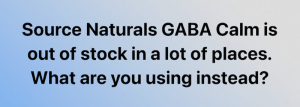
I also posted this message on Facebook to let my community there know and to find out what they were using instead.

gaba calm alternative question facebook

This is some of the feedback I received:

  • Mary ~ Oh my goodness! I just found it in my local Vitamin Shoppe tonight! There was one bottle left.
  • Diana ~I noticed. My son uses this, I’m a little worried.

I shared that there are other products that will hopefully work as well and asked everyone who was using something else: Do  you use it opened onto the tongue or swallowed? And if you’ve used Source Naturals GABA Calm in the past how does it compare for you?

A number of people said they like Thorne pharmaGABA capsules, someone said she like Now GABA Powder and a few people like Natural Factors pharmaGABA chewables:

  • Tara ~ I’ve only used Thorne PharmaGABA because of how it’s derived [fermented]. I just swallow the capsule and I’m immediately calm within 5-15 mins. I was previously prescribed a benzo & this is much better. 100mg is all I take when I feel a panic attack coming on. I’ve been thru a few years of absolute hell of benzo withdrawal coming off of my klonopin prescription. The GABA feels almost the exact same as the benzo except the benzo would actually cause rebound panic attacks (I didn’t realize it at the time) & the GABA does not.
  • Jane ~I use Now Foods GABA powder. A little under the tongue works well.I have found both effective. Powder good for rapid effect at home (1/4 teaspoon as needed). GABA Calm good to take out with you.
  • Meesh ~ I use the Natural Factors pharmaGABA (100mg) and it works great. I use it in combo with L-theanine 250mg (which also contains 20mg of magnesium)… and the combination is magic

I’ve updated the supplements blog with the above products and a few additional similar products so you have many options to select from based on your unique needs and taste preferences, and what’s available at the time:

  • Thorne PharmaGABA-100: the label says Gamma-Aminobutyric Acid (GABA) 100 mg but it also states that the product uses Pharma Foods International’s Gamma-Aminobutyric Acid (PharmaGABA®).  This is also pleasant-tasting when opened on to the tongue and is most effective when used this way. [AS OF NOV 24, 2021 THIS MAY ALSO BE UNAVAILABLE]
  • Thorne PharmaGABA-250: as above but contains 250mg of PharmaGABA®. This is also pleasant-tasting when opened on to the tongue and is most effective when used this way. [AS OF NOV 24, 2021 THIS MAY ALSO BE UNAVAILABLE]
  • Designs for Health PharmaGABA Chewables: gamma-amino butyric acid (pharmaGABA) 200 mg in 2 chewable tablets. It’s quick-acting and convenient like GABA-Calm because it’s chewable. This does contain xylitol, natural flavors, stevia and some other ingredients so taste may be a factor and xylitol can cause gas, bloating and diarrhea when too much is consumed.
  • Natural Factors PharmaGABA: gamma-amino butyric acid (pharmaGABA) 200 mg in 2 chewable tablets. It’s quick-acting and convenient like GABA-Calm because it’s chewable. However it also contains organic cane sugar and natural fruit flavors so it’s a little too candy-like for my preference, especially if you have low GABA-related sugar cravings. Also 2 chewable tablets – 4g of carbs which is almost 1 teaspoon of sugar!
    [January 22, 2021: I’ve included this as a stand-by option for occasional use until Source Naturals GABA Calm is readily available again or if Designs for Health PharmaGABA Chewables are not available.]
  • Now Foods GABA Powder: 1/4 Level Teaspoon (500mg). This is pleasant-tasting when opened on to the tongue and is most effective when used this way. The only challenge with powder like this is making sure you don’t use too much by mistake. And it’s especially challenging when you only need 100mg.
  • Quicksilver Scientific Liposomal GABA with L-Theanine: 2ml (4 Pumps) provides (Gamma Amino Butyric Acid) 240mg, L-Theanine 100mg and Phosphatidylcholine 120mg (from purified sunflower seed lecithin). It does contain ethanol so would not be suitable for alcoholics or young children.
  • GABA-Pro Calming Effect Chewable: This is a chewable that contains 100 mg of pharmaGABA in 1 tablet. It is pharmaGABA even though the product says GABA-Pro on the front and the label states Gamma Amino Butyric Acid (GABA). This product is a reasonable replacement for Source Naturals GABA Calm.  It does contain natural flavors and xylitol.
  • GABA-Pro Calming Effect: This contains 100 mg of pharmaGABA in 1 tablet. It is pharmaGABA even though the product says GABA-Pro on the front and the label states Gamma Amino Butyric Acid (GABA). This capsule can be opened onto the tongue.  It does contain rice flour which can be an issue if you have a rice allergy/sensitivity and/or SIBO.

I do want to add that Nutritional Fundamentals for Health GABA-T SAP is still a firm favorite of mine: gamma-Aminobutyric acid (GABA) 300 mg, l-Theanine 150 mg. This is pleasant-tasting when opened on to the tongue and works very well when GABA Calm can’t be used (because of the tyrosine or taste or sugar alcohols). It is also often used with GABA Calm – like GABA Calm in the day and GABA-T SAP at night or some combination.  I find best results when it is used opened on to the tongue and it offers a feeling of calm focus. It could easily be used as a substitute for GABA Calm in the short-term.

In case you’re new to GABA you can read more about it here: GABA for the physical-tension and stiff-and-tense-muscles type of anxiety.

UPDATE Nov 24, 2021:
=================

Source Naturals GABA Calm is in short supply again, so I’ve updated this blog with some other options (above) because the Thorne Products may also be unavailable for now:

  • GABA-Pro Calming Effect Chewable
  • GABA-Pro Calming Effect

Is Source Naturals GABA Calm a favorite of yours? And how has it helped you?  What have you found works as well – for physical anxiety, tension, insomnia, pain, sugar cravings, muscle spasms – when it’s not available?

If you’ve used a GABA product in capsules, do you use it opened onto the tongue or swallowed? And if you’ve used Source Naturals GABA Calm in the past how does it compare for you?

If you’re a practitioner do you use GABA Calm and/or other GABA products?

Please do share in the comments below and let me know if you found this helpful or if you have questions. And thanks for the questions and contributions so far!

Filed Under: Amino Acids, Anxiety, GABA Tagged With: ADHD, chewable, cravings, GABA, GABA Calm, insomnia, irritability, opened onto tongue, panic, pharmaGABA, powder, Source Naturals GABA Calm, sublingual, sugar, tension

ADHD: 5-HTP melts have been a miracle for one of my adopted kids

January 15, 2021 By Trudy Scott 77 Comments

ADHD and 5-HTP

A mom in my community responded to an ADHD blog sharing how 5-HTP melts have been a miracle for one of her adopted children – after one week! 5-HTP is not where I typically start with ADHD so I quizzed her to get more details and then went looking for the research to understand the mechanisms. This blog shares her rationale for using 5-HTP, the truly wonderful results her son experienced, some of the research and some possible serotonin/dopamine mechanisms. This is what she posted:

5-HTP melts have been a miracle for one of my adopted kids. He had lots of trauma and off the charts ADHD. 5-HTP is better than methylphenidate (Ritalin) and we are now weaning off the non-stimulants.

Just 80mg 5-HTP in the morning is all he needs. He was super ADHD, he had a para (teacher’s aide) in public school for years to keep him on track and this year at a school for ADHD the teachers were complaining that he was never on task.

Now after a week it has changed his life. I am so thankful for the anxiety summit. Thank you Trudy

This is truly wonderful to hear! I responded saying how thrilled I was to hear the impact it was having and asked why this mom decided to try 5-HTP? This amino acid, which is a serotonin precursor, is not typically my first choice for alleviating ADHD symptoms. I consider low GABA (and using GABA) or low catecholamines (and using tyrosine), together with dietary changes, blood sugar control, and assessing for low zinc, low iron and low omega-3s – as a starting point.

I wanted to know if he had low serotonin symptoms such as the worry, ruminating, and obsessive type of anxiety which could have possibly been driving the ADHD symptoms? Were there any other symptoms that were a clue that low serotonin may be a factor: insomnia (with fatigue the next day impacting focus) or sugar cravings in the afternoon/evening (causing blood sugar swings affecting focus and mood)?

Why she used 5-HTP and which low serotonin symptoms he had

This was her response about why she used 5-HTP and which low serotonin symptoms he had:

We have tried all the amino acids over the years. I tried 5-HTP this time because SSRIs were the only class of medication he has not tried. I thought maybe it was worth a try and I also found this study: Comparative study of efficacy of 1-5-hydroxytryptophan and fluoxetine in patients presenting with first depressive episode (where the therapeutic efficacy of 5-HTP was considered as equal to that of the SSRI fluoxetine).

As for cravings or insomnia: he is a kid who loves sugar so I’m not sure if it’s a craving or typical. He takes 0.3mg of melatonin each night because guanfacine, the non-stimulant, prevents the production of melatonin.

She also mentioned that she has followed me for years and that DPA, an endorphin-boosting amino acid, works for her. She is a dietitian and shares my handouts and blog posts with her clients, so she clearly felt comfortable experimenting with the amino acids with her son.

5-HTP products and dosing

I also asked which product they were using and how she landed at 80mg. She wanted a fast-acting supplement that would dissolve in his mouth and purchased Natrol 5-HTP:

They are 100mg but we are breaking off a little because he was falling asleep in class.

I reminded her that 5-HTP (or tryptophan) is typically best used late afternoon and evening so if someone is falling asleep in the day I’d switch to bedtime dosing.  If he needs it during the day for the ADHD symptoms then reducing the dose is the smart thing to do.

I love the sublingual/melt aspect of this product for quick results and because children do so well with a product that tastes pleasant.

However, I do not recommend this particular product because of very mixed ingredients information online. I have not seen the bottle of the actual product used but some of the online information states the product is gluten-free and soy-free and yet other information states it does contains gluten and soy. In some places they state it contains sucralose and an artificial flavor and in other places you see xylitol and natural flavor. This is all rather concerning. I’ll update this section as soon as I can confirm.

What does this mean for this mom? Now that she has figured out that 5-HTP helps her son, it’s best to find a better quality product so as not to cause other problems.

There are two chewable products in my online supplement store that come close to this product:

  • Serotrex Chewable: Two chewables contain 200mg theanine and 60mg 5-HTP. This could be used in the day or at night.
  • Designs for Health Insomnitol Chewables: Two chewables contain 10mg vitamin B6, 500mg inositol, 200mg theanine, 100mg 5-HTP and 3mg melatonin. This would need to be used at night instead.

Both of these contain theanine. Research shows that theanine reduces anxiety and improves cognition via “improvements in verbal fluency (especially letter fluency) and improvements in executive function (planning, multi-tasking etc).”

The research on 5-HTP and tryptophan for ADHD

This paper, The effects of 5-hydroxytryptophan on attention and central serotonin neurochemistry in the rhesus macaque, shares that

Individuals with depression and anxiety typically experience impaired executive function and emotional cognition, symptoms that are generally studied by examining disruptions in attention.

This study used 5-HTP as an intramuscular injection, rather than using it orally but the authors did report the following:

Our findings provide unique causal and mechanistic evidence suggesting that enhancing central serotonergic function results in categorically distinct changes in fundamental cognitive operations such as attention.

This paper, Does serotonin deficit mediate susceptibility to ADHD? summarizes the role of serotonin in ADHD, the interplay with dopamine and the use of oral tryptophan (a serotonin precursor similar to 5-HTP):

  • A chronic deficit of serotonin at the synapse may trigger symptoms of childhood ADHD (developmentally inappropriate levels of hyperactivity, impulsivity and inattention).
  • Studies from animal models of ADHD indicate intimate interplay between serotonin and dopaminergic neurotransmission.
  • Selective serotonin re-uptake inhibitors (SSRIs)…as non-stimulant drugs acting on the serotonin system are … clinically effective.
  • Oral administration of l-tryptophan, the amino acid precursor of serotonin, significantly alleviates ADHD symptoms.
  • Serotoninergic gene variants are associated with increased risk of ADHD.

I appreciate this mom for giving me permission to share here on the blog so we can inspire hope (and I wish for more and more improvements for this young boy):

My son is a 10-year old RAD (reactive attachment disorder) kid that was meth exposed and adopted at 3 years old. 5-HTP has worked so well. He has not thrown a fit in a month. Before fits were a daily occurrence. This might give hope to other parents.

Additional resources when you are new to using GABA, 5-HTP and other amino acids as supplements

As always, I use the symptoms questionnaire to figure out if low serotonin or low GABA or other neurotransmitter imbalances may be an issue.

If you suspect low levels of any of the neurotransmitters and do not yet have my book, The Antianxiety Food Solution – How the Foods You Eat Can Help You Calm Your Anxious Mind, Improve Your Mood, and End Cravings, I highly recommend getting it and reading it before jumping in and using amino acids on your own so you are knowledgeable. And be sure to share it with the practitioner/health team you or your loved one is working with.

There is an entire chapter on the amino acids and they are discussed throughout the book in the sections on gut health, gluten, blood sugar control (this is covered in an entire chapter too), sugar cravings, anxiety and mood issues.

The book doesn’t include product names (per the publisher’s request) so this blog, The Antianxiety Food Solution Amino Acid and Pyroluria Supplements, lists the amino acids that I use with my individual clients and those in my group programs.

If, after reading this blog and my book, you don’t feel comfortable figuring things out on your own (i.e. doing the symptoms questionnaire and respective amino acids trials), a good place to get help is the GABA QuickStart Program (if you have low GABA symptoms). This is a paid online/virtual group program where you get my guidance and community support.

If you are a practitioner, join us in The Balancing Neurotransmitters: the Fundamentals program. This is also a paid online/virtual program with an opportunity to interact with me and other practitioners who are also using the amino acids.

Wrapping up and your feedback

Have you found that 5-HTP (or tryptophan) helps/helped you or your child with ADHD symptoms? If yes, do you feel the ADHD was caused in part because of anxiety and/or fear and/or feeling inadequate and/or perfectionism and/or poor sleep (all signs of low serotonin)? Or were the main symptoms poor focus, low energy, low motivation and depression caused by low catecholamines/low dopamine? Or a mixture of both?

If you’re a practitioner working with children or adults with ADHD, have you had good results with 5-HTP or tryptophan?

Please do share in the comments below.

Filed Under: ADHD, Anxiety, Children/Teens Tagged With: 5-HTP, ADHD, attention, cravings, dopamine, fits, focus, GABA, hyperactivity, impulsivity, inattention, insomnia, meth, RAD, reactive attachment disorder, Ritalin, serotonin, SSRI, sugar, tryptophan, tyrosine

Anxiety case study: a very very slow SSRI taper with tryptophan and other nutritional support

August 28, 2020 By Trudy Scott 14 Comments

anxiety case study

Today I’m sharing an update from someone in my community who is tapering from an SSRI (Cipralex/lexapro) in the best way possible – very methodically and doing a very very slow taper, using compounded medication and nutritional support. It is a team approach with a supportive doctor monitoring for serotonin syndrome, her pharmacist compounding her medication and input from me.

She has an excellent diet that contains enough healthy protein and fats, plenty of vegetables, and no sugar or caffeine. She has the basic nutrients covered and is on the pyroluria protocol (these nutrients help make serotonin). She is using the amino acid tryptophan for serotonin support as she tapers. And she is out walking in nature and practicing mindfulness.

All of this sets her up for success and being able to avoid antidepressant discontinuation syndrome.

Here is her story:

I began tapering off 10 mg of Cipralex in November 2017. I have my little “Support Team” that includes a compounding pharmacist and my GP. Feeling very fortunate that I have these people as my taper has not exactly gone as planned (although far better than my last two attempts)

Originally, the plan was to go down by 10% of the dose and stay at that dose for 4 weeks. That didn’t work for me. I was fine when I dropped from 10mg to 9, but after my next 10% drop I experienced that familiar withdrawal hell. I got a little scared, but stuck with it, and decided to stay at that dose for a bit longer. While I leveled out, I did a lot of reading about how SSRIs work. I learned about the 1/2 life of Cipralex (all SSRIs have a different 1/2 life) and what was actually happening physiologically as my body adjusts to the lower dose. It’s a recovery process.

With that new knowledge, I decided to try another approach. I knew I couldn’t handle a drop of 10%. So, I started to taper at a rate of 0.1mg once a week (far less than 10%!). By day three at the new dose, I could feel the withdrawal, but it was far less severe. Small drops=small “withdrawal wave”. I discovered that I am able to manage a 2% drop of the current dose and I have been able to drop that % each week. So, I’m still reducing by 8% a month, which means I am close to the original plan of dropping by 10% a month. At this time I am at 6.24mg.

Yes, it is a very slow process and I have a long way to go, but it’s working. I have read that some people have to reduce by 1% of their current dose and remain at that dose for 4 weeks to allow their body the time to heal and adjust to life on the lower dose. Having the liquid compound has made such a difference! You sure would have difficulty accurately shaving off a pill by 2%!! If anyone is trying to come off of this drug, do your best to find a compounding pharmacist!

I find that I must stick to a very healthy diet. I eat a lot of fresh, raw and cooked vegetables. I mean a LOT of vegetables. I eat good sources of protein and walk for at least 45 min almost every day. I steer clear of sugar and caffeine. Both make my withdrawal much worse.

Every day I take omega 3, vitamin C, vitamin D, vitamin B complex. I take the supplements for pyroluria, vitamin B6, evening primrose oil and zinc. I take magnesium at night. I took Trudy’s amino acids course online and did all of the amino acid trials. I discovered all I really need is tryptophan. It has made a huge difference for me. Yes, I take Lidke tryptophan. For us Canadians, it can be ordered online.

I practice mindfulness. I’ve read a lot about the anxious brain (the reason I took Cipralex in the first place) so I understand what is happening now, what is real and what is just noise in my head.

Antidepressant discontinuation syndrome

This is the best way to taper SSRI medications in order to avoid withdrawal effects, also known as discontinuation syndrome which can be very severe for some folks.

Accordingly to this paper, Antidepressant discontinuation syndrome occurs in about 20% of patients who reduce the dose or abruptly stop an antidepressant that they have been taking for one month. This paper states that “symptoms are usually mild….occur within two to four days after drug cessation and usually last one to two weeks.”

It also states that occasionally symptoms “may persist up to one year…and if the same or a similar drug is started, the symptoms will resolve within one to three days.”

I typically hear from individuals who fall into the category of severe symptoms that are persisting past 2 weeks. It’s not uncommon to see symptoms continue for a year and often longer in some cases.

Also from the above paper, is the mnemonic FINISH which summarizes these symptoms:

  • Flu-like symptoms (lethargy, fatigue, headache, achiness, sweating)
  • Insomnia (with vivid dreams or nightmares)
  • Nausea (sometimes vomiting)
  • Imbalance (dizziness, vertigo, light-headedness)
  • Sensory disturbances (“burning,” “tingling,” “electric-like” or “shock-like” sensations) and
  • Hyperarousal (anxiety, irritability, agitation, aggression, mania, jerkiness).”

How you will feel if your serotonin is low and how to learn more

With low serotonin you will have the worry-in-your-head and ruminating type of anxiety, panic attacks and phobias, lack of confidence, depression, negativity, imposter syndrome, PMS, irritability, anger issues, insomnia and afternoon/evening cravings.

If you suspect low serotonin symptoms and are new to using the amino acids and do not have my book I highly recommend getting it and reading it before jumping in to taking supplements and navigating this with your prescribing physician: The Antianxiety Food Solution – How the Foods You Eat Can Help You Calm Your Anxious Mind, Improve Your Mood, and End Cravings. You may need to lend him/her a copy of my book too.

There is a complete chapter on the amino acids and one for pyroluria, plus information on real whole food, sugar and blood sugar, gluten, digestion and much more.  If you’re not a reader there is now also an audible version.

Here is the Amino Acids Mood Questionnaire from The Antianxiety Food Solution and additional information on Anxiety and targeted individual amino acid supplements: a summary

Please also read and follow these Amino Acid Precautions.

This lists The Antianxiety Food Solution Amino Acid and Pyroluria Supplements that I use with my individual clients and those in my group programs – you will find the Lidtke Tryptophan here. You can also read more about why I prefer the Lidtke tryptophan on this blog.

I would like to end off by saying how much I appreciate this woman and others sharing their stories like this so we can all learn!

Please also share your taper story and what you did to make it easier.  If you had challenges share those too. Let us know if you can relate to any of the above FINISH symptoms and how long they lasted.

Feel free to post your questions here too.
Filed Under: Anxiety, Tryptophan Tagged With: achiness, aggression, agitation, antidepressant, anxiety, B6, burning, cravings, diet, Dizziness, fatigue, flu-like symptoms, headache, insomnia, irritability, jerkiness, lethargy, light-headedness, mania, nausea, Nightmares, nutritional support, panic, serotonin, shock-like sensations, SSRI, SSRI taper, sweating, tingling, tryptophan, vertigo, vivid dreams, vomiting, worry, zinc

  • « Go to Previous Page
  • Page 1
  • Page 2
  • Page 3
  • Page 4
  • Page 5
  • Go to Next Page »

Primary Sidebar

GABA QuickStart Homestudy

gaba quickstart homestudy

Free Report

9 Great Questions Women Ask about Food, Mood and their Health

You'll also receive a complimentary subscription to my ezine "Food, Mood and Gal Stuff"


Connect with me

Popular Posts

  • Amino Acids Mood Questionnaire from The Antianxiety Food Solution
  • The Antianxiety Food Solution Amino Acid and Pyroluria Supplements
  • Pyroluria Questionnaire from The Antianxiety Food Solution
  • Collagen and gelatin lower serotonin: does this increase your anxiety and depression?
  • Tryptophan for the worry-in-your-head and ruminating type of anxiety
  • GABA for the physical-tension and stiff-and-tense-muscles type of anxiety
  • The Antianxiety Food Solution by Trudy Scott
  • Seriphos Original Formula is back: the best product for anxiety and insomnia caused by high cortisol
  • Am I an anxious introvert because of low zinc and vitamin B6? My response to Huffington Post blog
  • Vagus nerve rehab with GABA, breathing, humming, gargling and key nutrients

Recent Posts

  • Her cravings for chips and peanut butter were triggered by stress: GABA ends cravings and reduces physical tension and fear of heights
  • It is truly miraculous to be able to move through life without crippling anxiety and panic
  • GABA and tryptophan combo provide immediate and noticeable relief for tremors and cervical dystonia in just 7 days
  • Red light therapy for back and neck pain, plantar fasciitis and low mood – a complement to the amino acids GABA, DPA and tryptophan
  • What do I use instead of Seriphos to help lower high cortisol that is affecting my sleep and making me anxious at night?

Categories

  • 5-HTP
  • AB575
  • Addiction
  • ADHD
  • Adrenals
  • Alcohol
  • Allergies
  • Alzheimer's disease
  • Amino Acids
  • Anger
  • Antianxiety
  • Antianxiety Food Solution
  • Antidepressants
  • Anxiety
  • Anxiety and panic
  • Autism
  • Autoimmunity
  • benzodiazapines
  • Bipolar disorder
  • Books
  • Caffeine
  • Cancer
  • Candida
  • Children/Teens
  • Collagen
  • Cooking equipment
  • Coronavirus/COVID-19
  • Cravings
  • Depression
  • Detoxification
  • Diabetes
  • Diet
  • DPA/DLPA
  • Drugs
  • EFT/Tapping
  • EMF
  • EMFs
  • Emotional Eating
  • Endorphins
  • Environment
  • Essential oils
  • Events
  • Exercise
  • Fear
  • Fear of public speaking
  • Fertility and Pregnancy
  • Fish
  • Food
  • Food and mood
  • Functional neurology
  • GABA
  • Gene polymorphisms
  • General Health
  • Giving
  • Giving back
  • Glutamine
  • Gluten
  • GMOs
  • Gratitude
  • Gut health
  • Heart health/hypertension
  • Histamine
  • Hormone
  • Hyperparathyroidism
  • Hypoglycemia
  • Immune system
  • Inflammation
  • Insomnia
  • Inspiration
  • Introversion
  • Joy and happiness
  • Ketogenic diet
  • Lithium orotate
  • Looking awesome
  • Lyme disease and co-infections
  • MCAS/histamine
  • Medication
  • Men's health
  • Mental health
  • Mercury
  • Migraine
  • Mold
  • Movie
  • MTHFR
  • Multiple sclerosis
  • Music
  • NANP
  • Nature
  • Nutritional Psychiatry
  • OCD
  • Osteoporosis
  • Oxalates
  • Oxytocin
  • Pain
  • Paleo
  • Parasites
  • Parkinson’s disease
  • PCOS
  • People
  • PMS
  • Postpartum
  • PTSD/Trauma
  • Pyroluria
  • Questionnaires
  • Real whole food
  • Recipes
  • Research
  • Schizophrenia
  • serotonin
  • SIBO
  • Sleep
  • Special diets
  • Sports nutrition
  • Stress
  • Sugar addiction
  • Sugar and mood
  • Supplements
  • Teens
  • Testimonials
  • Testing
  • The Anxiety Summit
  • The Anxiety Summit 2
  • The Anxiety Summit 3
  • The Anxiety Summit 4
  • The Anxiety Summit 5
  • The Anxiety Summit 6
  • Thyroid
  • Thyroid health
  • Toxins
  • Tryptophan
  • Tyrosine
  • Uncategorized
  • Vegan/vegetarian
  • Women's health
  • Yoga

Archives

  • May 2026
  • April 2026
  • October 2025
  • September 2025
  • August 2025
  • July 2025
  • June 2025
  • May 2025
  • April 2025
  • March 2025
  • February 2025
  • January 2025
  • November 2024
  • October 2024
  • September 2024
  • August 2024
  • July 2024
  • June 2024
  • May 2024
  • April 2024
  • March 2024
  • February 2024
  • January 2024
  • December 2023
  • November 2023
  • October 2023
  • September 2023
  • August 2023
  • July 2023
  • June 2023
  • May 2023
  • April 2023
  • March 2023
  • February 2023
  • January 2023
  • December 2022
  • November 2022
  • October 2022
  • September 2022
  • August 2022
  • July 2022
  • June 2022
  • May 2022
  • April 2022
  • March 2022
  • February 2022
  • January 2022
  • December 2021
  • November 2021
  • October 2021
  • September 2021
  • August 2021
  • July 2021
  • June 2021
  • May 2021
  • April 2021
  • March 2021
  • February 2021
  • January 2021
  • December 2020
  • November 2020
  • October 2020
  • September 2020
  • August 2020
  • July 2020
  • June 2020
  • May 2020
  • April 2020
  • March 2020
  • February 2020
  • January 2020
  • December 2019
  • November 2019
  • October 2019
  • September 2019
  • August 2019
  • July 2019
  • June 2019
  • May 2019
  • April 2019
  • March 2019
  • February 2019
  • January 2019
  • December 2018
  • November 2018
  • October 2018
  • September 2018
  • August 2018
  • July 2018
  • June 2018
  • May 2018
  • April 2018
  • March 2018
  • February 2018
  • January 2018
  • December 2017
  • November 2017
  • October 2017
  • September 2017
  • August 2017
  • July 2017
  • June 2017
  • May 2017
  • April 2017
  • March 2017
  • February 2017
  • January 2017
  • December 2016
  • November 2016
  • October 2016
  • September 2016
  • August 2016
  • July 2016
  • June 2016
  • May 2016
  • April 2016
  • March 2016
  • February 2016
  • January 2016
  • December 2015
  • November 2015
  • October 2015
  • September 2015
  • August 2015
  • July 2015
  • June 2015
  • May 2015
  • April 2015
  • March 2015
  • February 2015
  • January 2015
  • December 2014
  • November 2014
  • October 2014
  • September 2014
  • August 2014
  • July 2014
  • June 2014
  • May 2014
  • April 2014
  • March 2014
  • February 2014
  • January 2014
  • December 2013
  • November 2013
  • October 2013
  • September 2013
  • August 2013
  • July 2013
  • June 2013
  • May 2013
  • April 2013
  • March 2013
  • February 2013
  • January 2013
  • December 2012
  • November 2012
  • October 2012
  • August 2012
  • July 2012
  • June 2012
  • May 2012
  • April 2012
  • March 2012
  • February 2012
  • January 2012
  • December 2011
  • November 2011
  • October 2011
  • September 2011
  • August 2011
  • July 2011
  • June 2011
  • May 2011
  • April 2011
  • March 2011
  • February 2011
  • January 2011
  • December 2010
  • October 2010
  • September 2010
  • July 2010
  • May 2010
  • April 2010
  • March 2010
  • February 2010
  • January 2010
  • November 2009

Share the knowledge!

The above statements have not been evaluated by the Food and Drug Administration. Products listed in this website are not intended to diagnose, treat, cure or prevent any disease.

The information provided on this site is for informational and educational purposes only and is not intended as a substitute for advice from your physician or other health care professional. You should consult with a healthcare professional before starting or modifying any diet, exercise, or supplementation program, before taking or stopping any medication, or if you have or suspect you may have a health problem.


Copyright © 2026 Trudy Scott. All Rights Reserved. | Privacy | Terms and Conditions | Refund Policy | Medical Disclaimer

Free Report

9 Great Questions Women Ask about Food, Mood and their Health

You’ll also receive a complimentary subscription to my ezine “Food, Mood and Gal Stuff”