• Skip to primary navigation
  • Skip to main content
  • Skip to primary sidebar

everywomanover29 blog

Food, Mood and Women's Health – Be your healthiest, look and feel great!

  • Blog
  • About
  • Services
  • Store
  • Resources
  • Testimonials
  • The Book
  • Contact
  • Search this site

calming

A weighted blanket increases pre-sleep salivary concentrations of melatonin in young, healthy adults – a new study

October 28, 2022 By Trudy Scott 7 Comments

weighted blanket melatonin

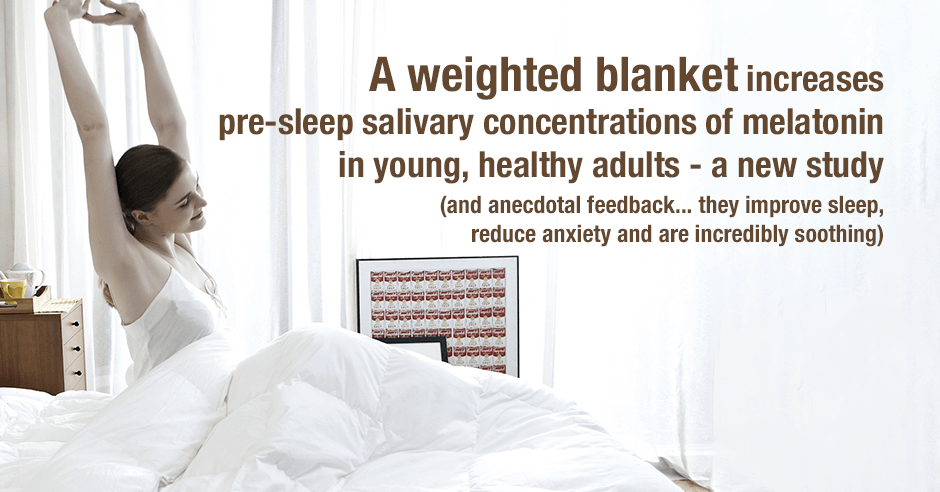
A new paper published earlier this month, A weighted blanket increases pre-sleep salivary concentrations of melatonin in young, healthy adults provides yet another mechanism supporting the benefits of a weighted blanket for improving sleep and also reducing anxiety – an increase in melatonin. The authors share that “Weighted blankets have emerged as a potential non-pharmacological intervention to ease conditions such as insomnia and anxiety. Despite a lack of experimental evidence, these alleged effects are frequently attributed to a reduced activity of the endogenous stress systems and an increased release of hormones such as oxytocin and melatonin.”

Here are some of the details from the study:

  • It was a small in-laboratory crossover study and included 26 young and healthy participants (15 men and 11 women)
  • The heavier weighted blanket was about 12% of their body weight
  • The following were measured: “salivary concentrations of the stress hormone cortisol, salivary alpha-amylase activity (as an indicative metric of sympathetic nervous system activity), subjective sleepiness, and sleep duration.”

The only difference found was a 1 hour increase of salivary melatonin from 10pm to lights off at 11pm. It was about 32% higher when using the heavier weighted blanket.

No other differences were found in terms of subjective sleepiness and total sleep duration.

The study concludes as follows:

Our study is the first to suggest that using a weighted blanket may result in a more significant release of melatonin at bedtime. Future studies should investigate whether the stimulatory effect on melatonin secretion is observed on a nightly basis when frequently using a weighted blanket over weeks to months. It remains to be determined whether the observed increase in melatonin may be therapeutically relevant for the previously described effects of the weighted blanket on insomnia and anxiety.

The authors only identified an increase in pre-sleep melatonin in this study. But keep in mind these limitations of the study: participants did not have insomnia or anxiety, and they were young (and melatonin declines as we age). The authors didn’t find an improvement in subjective feedback on better sleep and they did not measure subjective changes in anxiety levels – which I don’t find surprising.

However, as you’ll read below, many individuals in my community responded favorably when I posted this new study on Facebook, sharing how using their weighted blankets does improve their sleep and reduce their anxiety.  I share some of the anecdotal feedback below.

Feedback from real people: improved sleep, calm body, soothing and less anxiety

Here is some of the feedback from folks in my Facebook community:

Krys shares this: Ever since I started using a weighted blanket my sleep has improved. I think I need a heavier one. I believe the one I have is only 12 lbs. I was born in Poland, and we always had very heavy covers. Usually feather filled comforters, which made me feel secure and helped with sleep. I have a lot of past trauma and did not notice the weighted  blanket to be confining.

Christine shares this “I love my weighted blanket and sleep much better with it. I definitely sleep more soundly…less waking up. I bought it about 3 months ago and plan to use it year round. It is a faux fur glass bead filled one….it is super flexible and I can tuck it in and around all the nooks and crannies around my body. I considered a flatter, more stiff one but preferred the tucking option.” Christine’s weighted blanket is 15lbs and she plans to use an electric blanket to warm it up in winter (and switch it off /unplug it, before getting into bed).

Courtney shares this: “I started with a 12lb, then 20lb, now I have a 25lb one lol. I absolutely love my weighted blanket and can not sleep without it…I use it year round, it’s not hot but yet keeps you warm. And I feel like the weight keeps you from tossing and turning as much. It feels like a hug lol.”  The hug comment makes me wonder if they provide endorphin support too.

MaryKatherine shares this: “Wow that is seriously amazing. They definitely help me. I love weighted blankets…I feel almost instant calm in my body when I use weighted blankets. It does take 10-15 min for full effect.”

Tana shares this: “I love  my weighted blanket. It helps me relax. I sleep so much better.”

And then she shared this: “After this post I thought I should let my teenage daughter try my weighted blanket . She has anxiety and poor sleep habits. She loved it. I will be ordering her one.”  How wonderful is this?

Brenda shares this: “Love mine… I find it helps my AM anxiety. I’m kind of a hot sleeper, so I can’t keep it on for long, but I pull it up in the early morning, and it just gives a nice feeling of safety almost. I know a guy who does this with his dog when he’s having PTSD anxiety attacks.”

Willow shares this: “I have a cooling weighted blanket that I use all year. It is completely magical. I bought it hoping to sleep better but I didn’t expect it to be so incredibly soothing. Mine is 100% organic bamboo with glass beads. I find the cooling cover perfect all year. I honestly LOVE this improvement in my life.”

Katie shares this: “I love mine! I got one for each of my kids too. For my son I got a lighter one for kids, though he prefers my heavier adult blanket. He has ADHD and anxiety and really loves the weight. We all sleep deeper and fall asleep faster. Sometimes I use mine during the day when anxiety is especially high and it helps to calm my nervous system.”

Many folks are going to need additional nutritional support for their anxiety and insomnia

One person shared this: “I love my weighted blankets but it took awhile to get used to the heaviness on me… It’s not a miracle particularly if my stress and anxiety is much higher but I’d rather have it then not. It’s more helpful if I’m calmer.”

I agree. Many folks are going to need additional nutritional support for their anxiety and insomnia. This is where my work with addressing low GABA and low serotonin comes into play. Also, we may need to consider high cortisol and always need to address gut health, diet, caffeine/sugar/gluten intake, parasites, EMFs and everything covered in my book “The Antianxiety Food Solution.”

Here are a few (of many) useful resources from the blog:

  • GABA and theanine mixture improves sleep and eases anxiety
  • Rage, anxiety, cravings & insomnia in 11-year old girl with RAD/reactive attachment disorder: chewable tryptophan turns things around
  • Lactium® (alpha-s1 casein hydrolysate/hydrolyzed casein) for lowering high cortisol, reducing anxiety and improving sleep

Feel free to use the search feature to find additional anxiety and sleep resources and success stories.

Resources if you are new to using GABA, tryptophan and other amino acids as supplements

If you are new to using any of the amino acids as supplements, here is the Amino Acids Mood Questionnaire from The Antianxiety Food Solution (you can see all the symptoms of neurotransmitter imbalances, including low GABA and low serotonin).

If you suspect low levels of any of the neurotransmitters and do not yet have my book, The Antianxiety Food Solution – How the Foods You Eat Can Help You Calm Your Anxious Mind, Improve Your Mood, and End Cravings, I highly recommend getting it and reading it before jumping in and using amino acids on your own so you are knowledgeable. And be sure to share it with the practitioner/health team you or your loved one is working with.

There is an entire chapter on the amino acids and they are discussed throughout the book in the sections on gut health, gluten, blood sugar control, sugar cravings, self-medicating with alcohol and more.

The book doesn’t include product names (per the publisher’s request) so this blog, The Antianxiety Food Solution Amino Acid and Pyroluria Supplements, lists the amino acids that I use with my individual clients and those in my group programs. You can find them all in my online store.

If, after reading this blog and my book, you don’t feel comfortable figuring things out on your own (i.e. doing the symptoms questionnaire and respective amino acids trials), a good place to get help is the GABA QuickStart Program (if you have low GABA symptoms). This is a paid online/virtual group program where you get my guidance and community support.

If you are a practitioner, join us in The Balancing Neurotransmitters: the Fundamentals program. This is also a paid online/virtual program with an opportunity to interact with me and other practitioners who are also using the amino acids.

Have you had success with a weighted blanket …for sleep issues and anxiety?

If you have seen these benefits with a weighted blanket:

  • I’m also curious if you’ve observed reductions in sugar cravings, less anger issues, less irritability, less PMS symptoms, less negativity and less worry and panic attacks? These are all symptoms of low serotonin. I suspect that if there is an increase in melatonin there may also be an increase in serotonin (which is used to make melatonin).
  • Have you noticed any other benefits?
  • Be sure to share which weighted blanket you have, what percentage of your weight it is, and how often you use it.
  • Have some of the nutritional approaches helped too?

If you have not seen benefits or didn’t like using one, please feel free to share your experiences.

If you’re a practitioner, do you recommend a weighted blanket to your clients/patients?

If you have questions please share them here too.
Filed Under: Anxiety, GABA, Insomnia, serotonin Tagged With: amino acids; the GABA Quickstart online program; Balancing Neurotransmitters: the Fundamentals program for practitioners, anxiety, calm body, calming, cortisol, GABA, healthy adults, insomnia, lactium, melatonin, oxytocin, pre-sleep salivary melatonin, sleep, sleep duration, sleepiness, soothing, theanine, tryptophan, weighted blanket, young

Using 750 mg GABA in a hard tablet form for anxiety: I do not experience the flush but I am also not sure it is doing much of anything for me

July 15, 2022 By Trudy Scott 21 Comments

gaba hard tablet

Today I’m addressing a question from someone in this community about a particular GABA product and her confusion about dosing with 750mg and using a hard tablet (she calls it a pill). When she uses it she doesn’t notice any effect i.e. no calming benefits and no adverse niacin-type tingly flush either. This is what she asked:

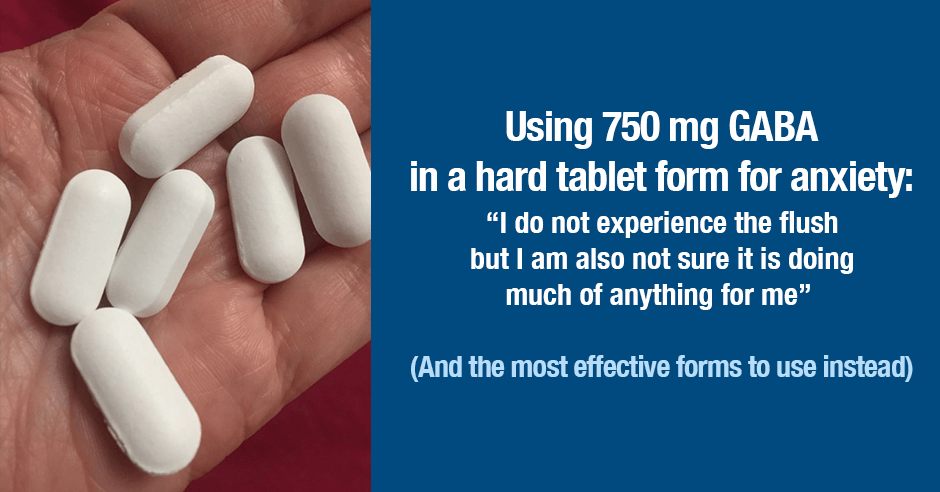
Not sure if “Source Naturals GABA Calm Mind” is on your list, but I thought it was one you had recommended at one time? Anyway, these are pills that cannot be opened like a capsule and 1 pill = 750 mg.

Personally, I had the tingly flush when I used a different product that WAS a capsule and opened it on my tongue…unfortunately I do not recall dosage or product name but I purchased at Whole Foods.

With this particular product (Source Naturals GABA Calm Mind) in pill form, although the dosage could be higher, I do not experience the flush…(however, I also am not sure it is doing much of anything for me).

This is my feedback for her: I have never recommended the Source Naturals GABA Calm Mind 750 mg tablet ever (she calls it a pill but I know she is referring to the hard tablets).

These are not a very effective way to use GABA. As you can see, she doesn’t feel it’s doing anything for her in terms of easing her anxiety and being calming. With a high dose of GABA we also often see a niacin-like flush or tingling and yet with this pill/tablet form she didn’t experience this either. GABA is much more effective when used sublingually or opening a capsule (and starting low at 125mg). More on this below.

But I’m not surprised she is confused and asking this question. The Source Naturals GABA Calm Mind has a very similar bottle/name/label to Source Naturals GABA Calm (the sublingual with 125mg GABA) and there is also a Source Naturals GABA Calm Mind 750 mg capsules (which can be opened).

She mentions the tingly flush when using a different product that was a capsule and opened on to her tongue. I’d suspect the tingling happened with a 500 mg GABA or 750 mg GABA product as this is a common dosage found in health stores. Opening the capsule and using less is best when starting out.

If you have to break it it’s a tablet and much less effective

All this logic applies to any brand of hard GABA tablet. Someone just shared on Facebook that she had purchased a GABA product in the Netherlands and broke it in half in order to use a lower dose. If you have to break it it’s a tablet and much less effective and possibly not at all effective. Be sure to read the front and back of the bottle and avoid hard tablets.

From time to time someone will see some benefit with a GABA tablet that is swallowed but it’s usually minimal.

The most effective forms of GABA to use

Here is a quick recap if you’re new to GABA. It’s an amino acid that is used as a supplement to boost GABA levels (a calming neurotransmitter) and ease physical tension type anxiety symptoms. It’s most effective when used sublingually, or as a powder or by using a GABA capsule opened on to the tongue or as a liposomal product.

When using GABA it must ideally be in one of these forms for the best effects:

  • Capsule form so the gelatin or cellulose capsule can be opened and the contents sprinkled onto the tongue, or some of it depending on dosing (NFH GABA-T SAP is a good example of this one – it contains GABA and theanine)
  • Sublingual form which is sucked/held in the mouth (Source Naturals GABA Calm 125mg is a good example of this – this is the GABA product that I have the most success with and it’s easy to use when out and about; PharmaGABA chewables are another option)
  • Powder form which is measured out using special tiny measuring spoon and sprinkled on to the tongue (Healthwise and Bulk Nutrients are good examples of this one)
  • Liposomal form which is sprayed into the mouth and held for a few minutes (Designs for Health Liposomal Neurocalm and Quicksilver Scientific Liposomal GABA with L-Theanine are good examples of this form)

This blog, Antianxiety Food Solution Amino Acid and Pyroluria Supplements, lists the amino acids that I use with my individual clients and those in my group programs. You can find a list of selected GABA products.

Here are a few success stories where the above different forms have been used:

  • Drastic reduction in intrusive thoughts, anxiety and fears (and better sleep) with GABA, tryptophan, 5-HTP and the pyroluria protocol
  • Keep GABA powder handy for choking episodes, stridor and panic (and find the ideal dose and be consistent for prevention/easing anxiety)
  • GABA helps 14-year-old with Tourette’s Syndrome (the tics and sleep), and tyrosine makes him happier and his mind sharper
  • GABA, Heartmath and EFT ease Micki’s mold-induced anxiety and panic attacks
  • PharmaGABA eases physical anxiety in a young man who has recently given up Adderall, alcohol and nicotine
  • GABA is the answer after 40 years of a lump-in-the-throat sensation, nervousness and muscle tension at work

Resources if you are new to using the amino acids as supplements

If you are new to using any of the amino acids as supplements, here is the Amino Acids Mood Questionnaire from The Antianxiety Food Solution (you can see all the symptoms of neurotransmitter imbalances, including low GABA).

If you suspect low levels of any of the neurotransmitters and do not yet have my book, The Antianxiety Food Solution – How the Foods You Eat Can Help You Calm Your Anxious Mind, Improve Your Mood, and End Cravings, I highly recommend getting it and reading it before jumping in and using amino acids on your own so you are knowledgeable. And be sure to share it with the practitioner/health team you or your loved one is working with.

There is an entire chapter on the amino acids and they are discussed throughout the book in the sections on gut health, gluten, blood sugar control, sugar cravings, self-medicating with alcohol and more.

The book doesn’t include product names (per the publisher’s request) so as mentioned above, this blog, The Antianxiety Food Solution Amino Acid and Pyroluria Supplements, lists the amino acids that I use with my individual clients and those in my group programs.

If, after reading this blog and my book, you don’t feel comfortable figuring things out on your own (i.e. doing the symptoms questionnaire and respective amino acids trials), a good place to get help is the GABA QuickStart Program (if you have low GABA symptoms). This is a paid online/virtual group program where you get my guidance and community support. There are many moms in the program who are having much success with their kids.

If you are a practitioner, join us in The Balancing Neurotransmitters: the Fundamentals program. This is also a paid online/virtual program with an opportunity to interact with me and other practitioners who are also using the amino acids with success with their clients/patients.

Did you use a GABA product that didn’t work for you before finding the ideal product and dose?

Please share which product didn’t work (was it a hard tablet?) and what did work for you. And be sure to share how it helps to ease your physical anxiety, insomnia, pain, intrusive thoughts and cravings (for sugar or alcohol).

Have you experienced the niacin-like flush or tingle from using too high a dose of GABA? How much did that and which product?

If you’re a practitioner, which forms of GABA do you find the most success with?

If you have questions please share them here too.
Filed Under: Amino Acids, Anxiety, GABA, Supplements Tagged With: 125mg, 750 mg GABA, anxiety, Balancing Neurotransmitters: the Fundamentals, calming, choking, flush, GABA, GABA Calm, GABA Quickstart program, hard tablet, intrusive thoughts, lump-in-the-throat sensation, mold-induced anxiety, muscle tension, nervousness, niacin-type flush, not doing much, opening a capsule, panic, pharmaGABA, pill, sleep, Source Naturals GABA Calm Mind, sublingual, tics, tingly, Tourette’s Syndrome

An amino acid supplement with DLPA, glutamine and 5-HTP eases alcohol withdrawal symptoms at an inpatient detoxification program

April 8, 2022 By Trudy Scott 18 Comments

amino acid and alcohol

An amino acid supplement with DLPA, glutamine and 5-HTP (and a few other nutrients) eases alcohol withdrawal symptoms at an inpatient detoxification program. Other than anxiety (I’ll share more on this below), there was also a significant decrease in psychiatric symptoms. Here is an excerpt from the study, The use of a food supplementation with D-phenylalanine, L-glutamine and L-5-hydroxytriptophan in the alleviation of alcohol withdrawal symptoms:

We described the use of a food supplementation with D-phenylalanine, L-glutamine and L-5-hydroxytryptophan in the alleviation of alcohol withdrawal symptoms in patients starting a detoxification therapy.

Since abstinence from ethanol causes a hypodopaminergic and a hypoopioidergic environment in the reward system circuits, manifesting with withdrawal symptoms, food supplements that contains D-phenylalanine, a peptidase inhibitor (of opioid inactivation) and L-amino-acids (for dopamine synthesis) were used to replenish a lack in neurotransmitters and alleviate the symptoms of alcohol withdrawal.

First I cover some translation issues and then more about the actual product and study results. I also share my commentary on the amino acids and dosing used in the study (and the fact that anxiety did not resolve). I include how to apply this information if you have a loved one in an alcohol treatment/rehab program or if you recognize social drinking is an issue for you. And I wrap up with additional resources if you are new to using GABA as a supplement, the GABA Quickstart online program and the practitioner training.

The study was completed and published in Slovenia and there are a few translation issues I’d like to clarify:

  • The study title states D-phenylalanine (DPA) was in the amino acid product, however DL-phenylalanine (DLPA) was actually used. You can read about the difference between DPA and DLPA here. In summary, DPLA works on both dopamine and endorphin support and DPA works on endorphin support only.
  • As you can see from the excerpt above, hypodopaminergic refers to low dopamine and hypoopioidergic refers to low endorphins. During withdrawal from ethanol/alcohol, both low dopamine and low endorphins cause withdrawal symptoms.
  • L-5-hydroxytryptophan is incorrectly spelled as L-5-hydroxytriptophan and reward system is incorrectly spelled as reword system. (Clarifications are provided for facilitating online searches in the research literature.)

More about the product, the study and the conclusion

It was a small randomized, double blind study with just 20 patients and the amino acid product was used for 40 days of the inpatient alcohol detox or rehab program.

This is the actual combination product used:

300 mg DLPA

150 mg glutamine

5 mg 5-HTP

1 mg  vitamin B6

50 mg calcium gluconate

25 mg magnesium oxide

0.01 mg folic acid

Psychiatric symptoms were measured using the SCL- 90R and included assessing for “somatization, obsessive-compulsive, interpersonal sensitivity, depression, anxiety, hostility, phobic anxiety, paranoid, and psychoticism.” During their rehab there was a significant decrease in these categories of psychiatric symptoms in the study group, except for their anxiety symptoms.

The authors conclude that “abstinence causes a major stress for the patients. The use of a food supplement containing D-phenylalanine [it was actually DL-phenylalanine], L-glutamine and L-5-hydroxytryptophan alleviates the withdrawal symptoms.”

As expected, once alcohol consumption was stopped, cortisol levels, liver enzymes and total bilirubin all decreased in the study group and the control group.

My commentary on the amino acids and dosing used in the study (and the fact that anxiety did not resolve)

Keep in mind the same dosing was used for all study participants. What I use clinically with folks with low levels of these neurotransmitters, is an individualized approach based on each person’s needs, for endorphin and dopamine support (from the DLPA), blood sugar support (from glutamine) and serotonin support (from 5-HTP). This means identifying symptoms in each category and doing a trial of each respective amino acid, starting low and increasing based on symptom resolution.

Given that anxiety symptoms didn’t resolve in the study group, I would have loved to see the amino acid GABA included, also dosed according to individual needs. GABA helps ease the physical tension-type anxiety and low GABA tension often drives the need to self-medicate with alcohol in order to relax and fit in socially.

The authors do mention GABA too: “the physiological craving for alcohol may be the result of a deficiency of the naturally occurring opiate like substances as well as other neurochemical deficits (i.e., dopaminergic, GABAergic, and serotonergic).

Also, an animal study shows that GABA helps with gut damage caused by alcohol consumption, so there is this additional benefit.

A higher dose of glutamine and/or 5-HTP may have also helped ease anxiety. They used 150 mg glutamine whereas a typical starting dose for glutamine is 500 mg (and we increase from there). Going up to 1000 mg to 1500 mg three or 4 times a day is not unusual and is typically very beneficial for alcoholics – for blood sugar stability, an additional calming effect and for healing the leaky gut which has been damaged by the alcohol consumption.

With regards to 5-HTP, they used 5 mg 5-HTP which is considered extremely low. I wonder if it was in fact 50 mg, which is a typical starting dose? Going up to 150 mg 5-HTP use 2 or 3 times a day is not unusual. Serotonin support with 5-HTP (or tryptophan) is very beneficial for the worry-type of ruminating anxiety.

For some individuals DLPA may have been too stimulating and contributing to anxiety via a dopamine boost. For these individuals, DPA may have been a better option for endorphin support.

I am not in favor of folic acid and prefer methylfolate, and although magnesium is an important cofactor for neurotransmitter production, magnesium oxide does not provide much usable magnesium.

Outside of the amino acids and other nutrients used, a vitamin B1 (thiamine) deficiency would need to be addressed and any other deficiencies (such as all the B vitamins, zinc, vitamin D, magnesium etc.) caused by chronic alcohol consumption. This is not a comprehensive list and a full functional workup will help to identify all possible deficiencies.

Despite my quibbles, the outcome of the study is very encouraging, I appreciate the researchers and I hope to see it replicated and refined in other settings.

How to apply this information if you have a loved one in an alcohol treatment/rehab program

Unfortunately the amino acids are seldom incorporated at in-patient detox and rehab centers but they should be. Your options are to:

  • Share this study and my blog with the treatment center
  • Educate yourself (on using the questionnaire and doing the amino acid trials) so you can use them with your loved one once rehab is over. This is key for preventing a relapse and for swapping alcohol addiction for sugar or caffeine or nicotine addiction.
  • Introduce one amino acid at a time so you can figure out which one/s they need and how much
  • Read my book, The Antianxiety Food Solution – How the Foods You Eat Can Help You Calm Your Anxious Mind, Improve Your Mood, and End Cravings, and share a copy with the treatment center (and your loved one and their treatment team)
  • Address diet, nutritional deficiencies and gut health

Keep in mind that the amino acids are used with success for cocaine, heroin and other drug addictions.

How to apply this information if you recognize social drinking is an issue for you

New research shares that “low-level alcohol consumption is commonly perceived as being inconsequential or even beneficial for overall health, with some reports suggesting that it may protect against dementia or cardiovascular risks”, however, as the authors suggest “even low-level alcohol consumption is associated with premature brain aging.”

Social drinking is the norm and is way too prevalent. And it’s often used as a calming measure in order to relax and fit in socially.  If this sounds like you:

  • Educate yourself (on using the questionnaire and doing the amino acid trials) so you can use them to quit drinking easily with no willpower and no feelings of being deprived. This is key for preventing the swapping out the need for alcohol (to relax or fit in socially) with a sugar or caffeine or nicotine addiction. In this case, GABA helps a young man who has recently given up alcohol, Adderall and nicotine.
  • Introduce one amino acid at a time so you can figure out which one/s you need and how much
  • Read my book, The Antianxiety Food Solution – How the Foods You Eat Can Help You Calm Your Anxious Mind, Improve Your Mood, and End Cravings, and share a copy with your loved one/spouse/partner and practitioners/therapists.
  • Address diet, nutritional deficiencies and gut health

Resources if you are new to using the amino acids as supplement

If you are new to using the amino acids as supplements, here is the Amino Acids Mood Questionnaire from The Antianxiety Food Solution (you can see all the low neurotransmitter symptoms).

If you suspect low levels of any of the neurotransmitters and do not yet have my book, The Antianxiety Food Solution – How the Foods You Eat Can Help You Calm Your Anxious Mind, Improve Your Mood, and End Cravings, I highly recommend getting it and reading it before jumping in and using amino acids on your own so you are knowledgeable. And be sure to share it with the team you or your loved one is working with.

There is a section on alcohol but keep in mind that all the sections on sugar craving/addiction apply to alcohol addiction and self-medicating with alcohol too. Some individuals use alcohol to numb out and some use sugar. Many use both and once alcohol addiction is addressed, it’s often replaced with sugar and caffeine addiction. This is why addressing neurotransmitter imbalances is key.

The book doesn’t include product names (per the publisher’s request) so this blog, The Antianxiety Food Solution Amino Acid and Pyroluria Supplements, lists the amino acids that I use with my individual clients and those in my group programs.

If you don’t feel comfortable reading my book and figuring things out on your own (doing the symptoms questionnaire and doing respective trials), you can get guidance from me in the GABA Quickstart Program (online/virtual).

If you are a practitioner, join us in The Balancing Neurotransmitters: the Fundamentals program. It’s an opportunity to interact with me and other practitioners who are also using the amino acids.

Have you used amino acids with success as part of an alcohol detox program (for yourself or for a loved one)? Or to help stop social drinking of alcohol?

Which neurotransmitter imbalances were driving your need to self-medicate with alcohol and which amino acids helped?

If you’re a practitioner do you use the amino acids (via an individualized approach) to help with alcohol withdrawal and cessation with your patients and/or clients?

Feel free to ask your questions here too.

Filed Under: 5-HTP, Addiction, Amino Acids, Anxiety, DPA/DLPA, GABA, Glutamine, Tryptophan Tagged With: 5-HTP, alcohol, alcohol withdrawal symptoms, amino acid supplement, anxiety, B1, calming, d-phenylalanine, detox, dl-phenylalanine, DLPA, GABA, GABA Quickstart, glutamine, gut, hypodopaminergic, hypoopioidergic, inpatient detoxification program, L-5-hydroxytriptophan, L-glutamine, practitioner training, psychiatric symptoms, rehab, social drinking, tension, Thiamine, worry

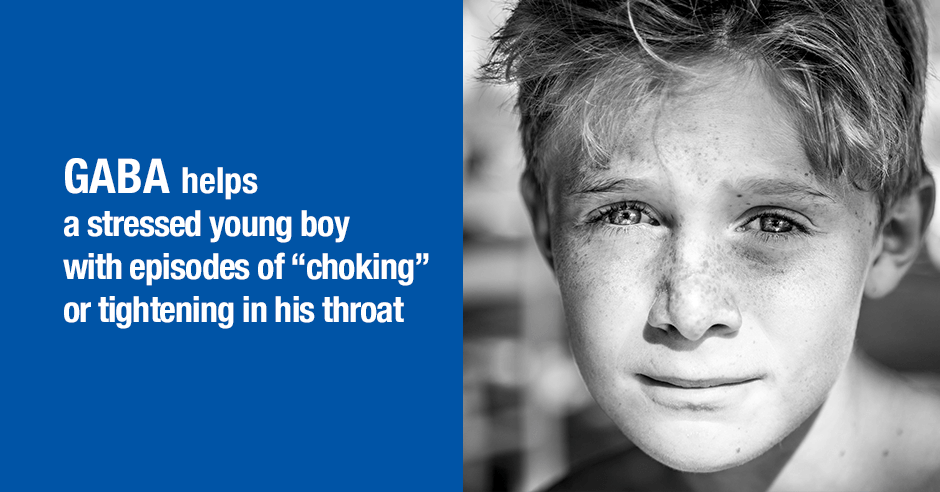
GABA helps a stressed young boy with episodes of “choking” or tightening in his throat

December 25, 2020 By Trudy Scott 34 Comments

gaba throat relief

Earlier this year I blogged about how the calming amino acid GABA is often a solution for both anxiety and globus pharyngeus (lump in the throat) and a mom shared this about her son’s episodes of “choking” or tightening in his throat (to the point that he cannot swallow), especially when school stress gets high:

My son, (8 y.o.) has a history of public school use of physical aversion intervention for behaviors that result from a significant language impairment often reports “choking” or tightening in his throat to the point that he cannot swallow. When school stress gets high, he ceases to swallow his saliva which creates a long period of “spitting” out substances including food and natural spit as he is fearful of “choking” to death. During panic attacks he immediately reports “choking” which furthers his panic. You are the first practitioner I have come across that has explained the relationship between globus pharyngeus, stress reaction and low GABA levels. I always felt his throat tightening (involuntary muscle response) was a stress response but was not aware of it’s connection to GABA levels. Thank you for this informative piece!

I voiced my concern for what her son was going through and how I can’t imagine how scary it must be for someone his age, asking her to keep us updated on his progress.

And just over a month later she reported the success her son was having with GABA:

We started a GABA supplement which has positively impacted my son. While he still struggles with hypersalivation when in distress or anxious, his self-reports of feeling like he is “choking” or his throat is closing, has not been present since GABA has been started. We are about a month in and I am inspired that we will continue to have progress. I have been referring to your work as a source to everyone I know that struggles with anxiety. Thank you for all that you do from a very grateful parent.

What wonderful results for her son! Getting feedback like this warms my heart and I appreciate her for sharing so I can share here.

I did ask what GABA product he was using, how much/how often he uses it and how quickly he noticed an improvement but did not hear back. My recommendation is 125mg to start for adults and less for children and I like the GABA Calm product as it’s a sublingual form and easy to use for kids.

I also commented on the fact that he still has “hypersalivation when in distress or anxious.” I would focus on trying to reduce the anxiety with higher doses of GABA and also consider addressing low serotonin because of the anxiety, panic attacks and being “fearful of “choking” to death”.

The anxiety could trigger hypersalivation but the hypersalivation could also be as a result of a food sensitivity like gluten or dairy. Both these and other food sensitivities could also contribute to low GABA/low serotonin and be a trigger for anxiety.

Of course, bullying at school should always be considered and so should the social anxiety condition pyroluria, speech therapy, gut health and vagus nerve support.

Could this be a case of laryngopharyngeal reflux (LPR)?

I always like to try and connect the dots and wonder if this could be a case of laryngopharyngeal reflux (LPR)?  I don’t know but it’s possible. This paper, Laryngopharyngeal reflux: A confounding cause of aerodigestive dysfunction, states that LPR is “defined by the retrograde passage of gastric contents beyond the upper oesophageal sphincter, with contamination of the larynx, pharynx and lungs” and states that “half of the laryngeal complaints referred to ear, nose and throat (ENT) services are ultimately diagnosed as LPR.

It also mentions globus pharyngeus and dysphagia (which is difficulty swallowing), sharing that changes in pH suggest reflux occurs in “50% of patients with hoarseness, 64% with globus, 55% with chronic cough and 35% with dysphagia.”

This same paper reports that “30% of patients with LPR-like symptoms report anxiety, compared with 6% of healthy controls.”

Prevalence of reflux disease in children and LPR symptoms by age

This paper, Laryngopharyngeal Reflux Disease in Children, reports that “Although the exact prevalence is unknown, it is estimated that nearly 1 in 5 children likely suffers from reflux disease.” This 1 in 5 number is for both GERD (gastroesophageal reflux disease) and LPR.

The authors also share that it usually presents with a different set of symptoms depending on age:

  • Infants typically present with regurgitation, vomiting, dysphagia [difficulty swallowing], anorexia, failure to thrive, apnea, recurrent croup, laryngomalacia [softening of the laryngeal structure], subglottic stenosis [narrowing of the airway], or chronic respiratory issues.
  • School-age children tend to demonstrate chronic cough, dyspnea [shortness of breath], dysphonia [hoarseness], persistent sore throat, halitosis [bad breath], and globus sensation.
  • Older children may also complain of regurgitation, heartburn, vomiting, nausea, or have chronic respiratory issues.

Low levels of GABA, a calming neurotransmitter

In case you’re new to GABA: low levels of GABA, a calming neurotransmitter can lead to anxiety, fears and panic attacks. With low GABA, the anxiety is a physical kind of anxiety with muscle tension or muscle spasms. Low GABA may be one possible root cause of globus pharyngeus, which leads to a rather scary golf-ball-like lump or constriction in the throat – or as this young boy describes, episodes of “choking” or tightening in his throat.

The amino acid GABA raises GABA levels and in this instance helps ease this tightening, choking or throat muscle spasms.

To be clear, there is no research (yet) on the use of the amino acid GABA for these types of symptoms, however in one study gabapentin was compared to baclofen for the treatment of gastro-oesophageal reflux-induced chronic cough and in another study there were improvements with both proton pump inhibitors and gabapentin for globus pharyngeus. If GABA works I’m all for it, rather than these  medications, which do have a long list of side-effects.

Has your child been diagnosed with globus pharyngeus or laryngopharyngeal reflux disease?

Have you observed episodes like this in your child, personally or with clients/patients and has GABA helped?

Have you found other contributing factors like low serotonin, food sensitivities, gut issues, vagus nerve issues or pyroluria?

Feel free to post your questions here on the blog too.

Filed Under: Anxiety, Children/Teens, GABA Tagged With: anxiety, anxious, calming, choking, episodes of choking, GABA, GERD, globus pharyngeus, hypersalivation, laryngopharyngeal reflux, LPR, lump in the throat, reflux, serotonin, stress, stressed, throat tightening, tightening in his throat

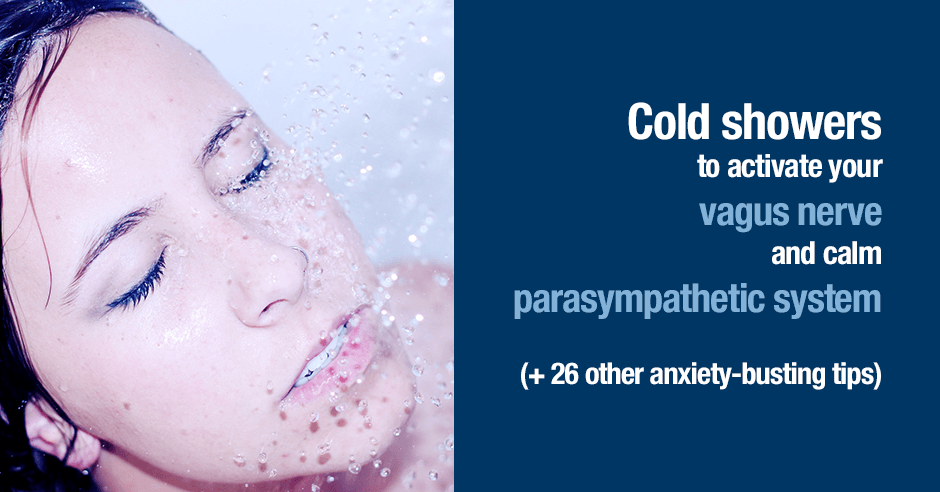
Cold showers to activate your vagus nerve and calm parasympathetic system (+ 26 other anxiety-busting tips)

October 5, 2020 By Trudy Scott 4 Comments

cold showers

I’ve been sharing about  early registration for my next summit… Anxiety Summit 6: Toxins/Meds/Infections!  (I’m the host of this one!)

I’ll continue to share interview snippets leading up to the summit but I want to make sure you know about another one of the summit registrations gifts: 27 Anxiety-Busting Strategies eGuide

anxiety busting strtegies

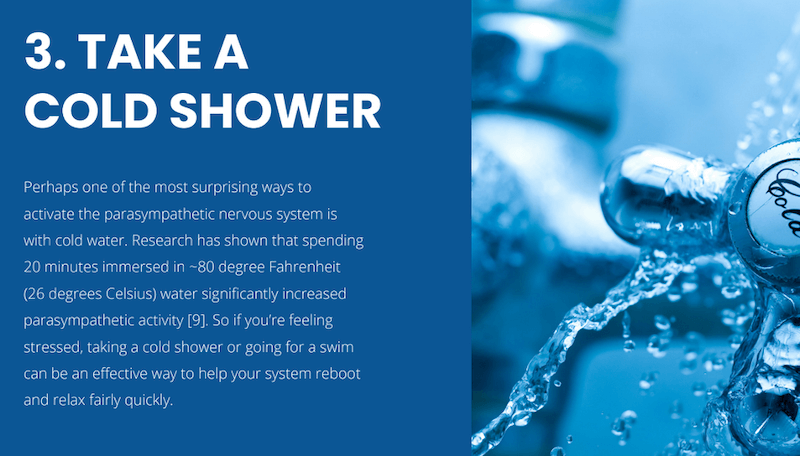
Here is one of the 27 anxiety-busting tips …#3 Take a cold shower!

cold shower

Taking a cold shower or turning the hot water off after your shower and getting under the cold water for a minute or two activates the calming parasympathetic system because it has an impact on the vagus nerve.

I always do the 2 minute cold shower after my regular shower – in summer and winter – and I highly recommend it! You’d think it would be a no-no in the middle of winter but even though there is the initial shock, you feel so good afterwards. It’s such a simple intervention! Try it and let me know how you feel!

We cover this and many other ways to activate the vagus nerve in the interview with Dr. Eva Detko – Vagus Nerve Infection and Anxiety.  It’s an in-depth interview and we cover:

  • VanElzakker’s CFS/vagus nerve infection research
  • the vagus nerve role in brain-gut axis
  • lactobacillus and GABA
  • the vagus nerve and globus pharyngeus (lump in the throat when anxious)
  • how antidepressants may adversely impact the vagus nerve
  • psychosensory havening and more

Another related interview is the one with Melissa Gallico – Fluoride: Neurotoxicity, Anxiety, Acne and Hypothyroidism.  We talk about concerns about fluoride in your shower water. You’ll also learn about other surprising sources of fluoride such as black tea, kombucha and wine!

Some questions for you:

  • Have you used this approach with success and how do you feel afterwards?
  • Do you continue through winter or would you consider this?
  • Have you used variations of this, such as swimming in the ocean or pool in cool or cold weather?
  • What other vagus nerve activation approaches do you use?

Here’s to no more anxiety and you feeling on top of the world again! And getting value out of other 26 tips starting today.

You’ve heard me say the Anxiety Summit has been called “a bouquet of hope!”  My wish for you is that this summit is your bouquet of hope!

I hope you’ll join me and these incredible speakers, be enlightened and find YOUR solutions!

When you download the eGuide you’ll get automatic access to the summit.

Get the 27 Anxiety-Busting Strategies eGuide

And do stay tuned for the summit roadmap – it’s almost ready and will be a great cross-reference of root-causes/triggers, solutions and conditions.

Filed Under: Anxiety Tagged With: activate, anxiety, anxiety summit 6, anxiety-busting tips, calming, Cold showers, cold water, Eva Detko, fluoride, kombucha, parasympathetic system, vagus nerve, vagus nerve infection

Stunning lavender labyrinth in Michigan: meditative benefits for anxiety

June 28, 2019 By Trudy Scott Leave a Comment

lavender labyrinth

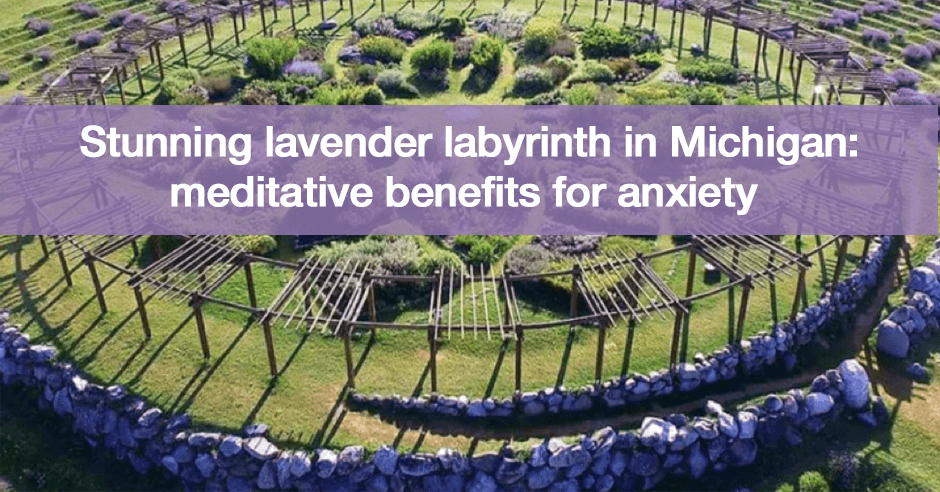
There is a stunning lavender labyrinth in Michigan – Lavender Labyrinth at Cherry Point Farm and Market, and just seeing the image with all the beautiful purple lavender makes me feel relaxed and smiling. Imagine being there and smelling all that lavender too!

We now know labyrinths have meditative benefits when it comes to anxiety and stress. They share this on their site:

The labyrinth is an ancient spiral pattern which, when walked, is thought to be a spiritual journey, and symbolic of one’s path in life.  In recent years, labyrinths have undergone a dramatic revival as a meditation, relaxation, and spiritual tool.  Unlike a maze, a labyrinth is a continuous circuit and you cannot get lost.

I recently shared a Facebook post of the above superb image. The post was so popular I want to share it here too for you to enjoy too.

Christine Fothergill shared this: “I’ve been there! It’s on cherry country near our house!!!! Tons of medicinal herbs in that garden too!”

Diane Lalomia, who lives nearby shared that “it is quite a magical place to get lost in.” She also offered these tips for visiting:

  • The lavender is usually in full bloom around the first week of July. The last week of June through the middle of July is the best time to visit.
  • It’s a very serene place
  • The lavender is usually in flower and has the strongest scent.
  • The nearest big city (for flying into the area) would be Grand Rapids. The lavender maze is in Shelby, MI which is just a little over an hour from Grand Rapids.
  • Nearby is also Silver Lake and if you plan on staying a day or two, Sleeping Bear Dunes is one of the 7 wonders of the world

She also shared these additional photos that she took and kindly gave me permission to post on this blog.

cherry point

cherry point

cherry point

There are papers on the meditative benefits of labyrinth walking. This paper, Effects of Reflective Labyrinth Walking Assessed Using a Questionnaire, reports this background information:

Meditation as it is currently known is an ancient practice, which can be traced back to Asian traditions. With the proper technique, a state of physical relaxation and respiratory balance can be reached naturally and spontaneously. This paper considers meditative labyrinth walking to be a unique expression of Dr. Lauren Artress’ work, who studied and applied the image of the labyrinth on the floor of the Chartres Cathedral in France.

The conclusion of this cross-sectional non-randomized study with 30 participants is as follows:

This study showed that the practice of labyrinth walking is a physical, emotional, and sensory experience. On the clinical level, correlating this experience to the planning of care seems to be particularly relevant.

With all that lavender you also get the calming benefits from that too. In one study, Essential oil inhalation on blood pressure and salivary cortisol levels in prehypertensive and hypertensive subjects, 83 participants who were hypertensive (high blood pressure) or prehypertensive were asked to inhale an essential oil blend of lavender, ylang-ylang, marjoram, and neroli with the following ratio (20 : 15 : 10 : 2).

The study group experienced the relaxation effects of this particular blend of essential oils leading to:

  • significant decreases in the concentration of salivary cortisol
  • reduced blood pressure
  • and stress reduction.

You can read more about this study here.

Be sure to check out Cherry Point Farm and Market for more information and other lovely images. With appreciation to them for permission to share the image on my blog and to Diane for her images and tips. Here’s a link to her new photography website.

Have you experienced the meditative benefits of labyrinth walking? Have you been to this this lavender labyrinth? And did you find it calming?

We’d love to hear about your experiences.

Filed Under: Nature Tagged With: anxiety, calming, Cherry Point Farm and Market, labyrinth, lavender, meditative

  • « Go to Previous Page
  • Page 1
  • Page 2
  • Page 3
  • Page 4
  • Page 5
  • Go to Next Page »

Primary Sidebar

NEW! GABA QuickStart Homestudy (with special intro pricing)

gaba quickstart homestudy

Free Report

9 Great Questions Women Ask about Food, Mood and their Health

You'll also receive a complimentary subscription to my ezine "Food, Mood and Gal Stuff"


Connect with me

Popular Posts

  • Amino Acids Mood Questionnaire from The Antianxiety Food Solution
  • The Antianxiety Food Solution Amino Acid and Pyroluria Supplements
  • Pyroluria Questionnaire from The Antianxiety Food Solution
  • Collagen and gelatin lower serotonin: does this increase your anxiety and depression?
  • Tryptophan for the worry-in-your-head and ruminating type of anxiety
  • GABA for the physical-tension and stiff-and-tense-muscles type of anxiety
  • The Antianxiety Food Solution by Trudy Scott
  • Seriphos Original Formula is back: the best product for anxiety and insomnia caused by high cortisol
  • Am I an anxious introvert because of low zinc and vitamin B6? My response to Huffington Post blog
  • Vagus nerve rehab with GABA, breathing, humming, gargling and key nutrients

Recent Posts

  • What do I use instead of Seriphos to help lower high cortisol that is affecting my sleep and making me anxious at night?
  • BeSerene™ GABA/theanine cream eases severe muscle tension in her neck/shoulders, prevents her bad headaches and quells her anxiety
  • How the correct approach, dose and sublingual use of GABA can be calming and not cause a flushed and itchy face and neck
  • The amino acid glutamine improves low mood by addressing gut health, and it has calming effects too
  • Flight anxiety with heightened breath, physical tension and also fearing the worst (the role of low GABA and low serotonin)

Categories

  • 5-HTP
  • AB575
  • Addiction
  • ADHD
  • Adrenals
  • Alcohol
  • Allergies
  • Alzheimer's disease
  • Amino Acids
  • Anger
  • Antianxiety
  • Antianxiety Food Solution
  • Antidepressants
  • Anxiety
  • Anxiety and panic
  • Autism
  • Autoimmunity
  • benzodiazapines
  • Bipolar disorder
  • Books
  • Caffeine
  • Cancer
  • Candida
  • Children/Teens
  • Collagen
  • Cooking equipment
  • Coronavirus/COVID-19
  • Cravings
  • Depression
  • Detoxification
  • Diabetes
  • Diet
  • DPA/DLPA
  • Drugs
  • EFT/Tapping
  • EMF
  • EMFs
  • Emotional Eating
  • Endorphins
  • Environment
  • Essential oils
  • Events
  • Exercise
  • Fear
  • Fear of public speaking
  • Fertility and Pregnancy
  • Fish
  • Food
  • Food and mood
  • Functional neurology
  • GABA
  • Gene polymorphisms
  • General Health
  • Giving
  • Giving back
  • Glutamine
  • Gluten
  • GMOs
  • Gratitude
  • Gut health
  • Heart health/hypertension
  • Histamine
  • Hormone
  • Hyperparathyroidism
  • Hypoglycemia
  • Immune system
  • Inflammation
  • Insomnia
  • Inspiration
  • Introversion
  • Joy and happiness
  • Ketogenic diet
  • Lithium orotate
  • Looking awesome
  • Lyme disease and co-infections
  • MCAS/histamine
  • Medication
  • Men's health
  • Mental health
  • Mercury
  • Migraine
  • Mold
  • Movie
  • MTHFR
  • Multiple sclerosis
  • Music
  • NANP
  • Nature
  • Nutritional Psychiatry
  • OCD
  • Osteoporosis
  • Oxalates
  • Oxytocin
  • Pain
  • Paleo
  • Parasites
  • Parkinson’s disease
  • PCOS
  • People
  • PMS
  • Postpartum
  • PTSD/Trauma
  • Pyroluria
  • Questionnaires
  • Real whole food
  • Recipes
  • Research
  • Schizophrenia
  • serotonin
  • SIBO
  • Sleep
  • Special diets
  • Sports nutrition
  • Stress
  • Sugar addiction
  • Sugar and mood
  • Supplements
  • Teens
  • Testimonials
  • Testing
  • The Anxiety Summit
  • The Anxiety Summit 2
  • The Anxiety Summit 3
  • The Anxiety Summit 4
  • The Anxiety Summit 5
  • The Anxiety Summit 6
  • Thyroid
  • Thyroid health
  • Toxins
  • Tryptophan
  • Tyrosine
  • Uncategorized
  • Vegan/vegetarian
  • Women's health
  • Yoga

Archives

  • October 2025
  • September 2025
  • August 2025
  • July 2025
  • June 2025
  • May 2025
  • April 2025
  • March 2025
  • February 2025
  • January 2025
  • November 2024
  • October 2024
  • September 2024
  • August 2024
  • July 2024
  • June 2024
  • May 2024
  • April 2024
  • March 2024
  • February 2024
  • January 2024
  • December 2023
  • November 2023
  • October 2023
  • September 2023
  • August 2023
  • July 2023
  • June 2023
  • May 2023
  • April 2023
  • March 2023
  • February 2023
  • January 2023
  • December 2022
  • November 2022
  • October 2022
  • September 2022
  • August 2022
  • July 2022
  • June 2022
  • May 2022
  • April 2022
  • March 2022
  • February 2022
  • January 2022
  • December 2021
  • November 2021
  • October 2021
  • September 2021
  • August 2021
  • July 2021
  • June 2021
  • May 2021
  • April 2021
  • March 2021
  • February 2021
  • January 2021
  • December 2020
  • November 2020
  • October 2020
  • September 2020
  • August 2020
  • July 2020
  • June 2020
  • May 2020
  • April 2020
  • March 2020
  • February 2020
  • January 2020
  • December 2019
  • November 2019
  • October 2019
  • September 2019
  • August 2019
  • July 2019
  • June 2019
  • May 2019
  • April 2019
  • March 2019
  • February 2019
  • January 2019
  • December 2018
  • November 2018
  • October 2018
  • September 2018
  • August 2018
  • July 2018
  • June 2018
  • May 2018
  • April 2018
  • March 2018
  • February 2018
  • January 2018
  • December 2017
  • November 2017
  • October 2017
  • September 2017
  • August 2017
  • July 2017
  • June 2017
  • May 2017
  • April 2017
  • March 2017
  • February 2017
  • January 2017
  • December 2016
  • November 2016
  • October 2016
  • September 2016
  • August 2016
  • July 2016
  • June 2016
  • May 2016
  • April 2016
  • March 2016
  • February 2016
  • January 2016
  • December 2015
  • November 2015
  • October 2015
  • September 2015
  • August 2015
  • July 2015
  • June 2015
  • May 2015
  • April 2015
  • March 2015
  • February 2015
  • January 2015
  • December 2014
  • November 2014
  • October 2014
  • September 2014
  • August 2014
  • July 2014
  • June 2014
  • May 2014
  • April 2014
  • March 2014
  • February 2014
  • January 2014
  • December 2013
  • November 2013
  • October 2013
  • September 2013
  • August 2013
  • July 2013
  • June 2013
  • May 2013
  • April 2013
  • March 2013
  • February 2013
  • January 2013
  • December 2012
  • November 2012
  • October 2012
  • August 2012
  • July 2012
  • June 2012
  • May 2012
  • April 2012
  • March 2012
  • February 2012
  • January 2012
  • December 2011
  • November 2011
  • October 2011
  • September 2011
  • August 2011
  • July 2011
  • June 2011
  • May 2011
  • April 2011
  • March 2011
  • February 2011
  • January 2011
  • December 2010
  • October 2010
  • September 2010
  • July 2010
  • May 2010
  • April 2010
  • March 2010
  • February 2010
  • January 2010
  • November 2009

Share the knowledge!

The above statements have not been evaluated by the Food and Drug Administration. Products listed in this website are not intended to diagnose, treat, cure or prevent any disease.

The information provided on this site is for informational and educational purposes only and is not intended as a substitute for advice from your physician or other health care professional. You should consult with a healthcare professional before starting or modifying any diet, exercise, or supplementation program, before taking or stopping any medication, or if you have or suspect you may have a health problem.


Copyright © 2026 Trudy Scott. All Rights Reserved. | Privacy | Terms and Conditions | Refund Policy | Medical Disclaimer

Free Report

9 Great Questions Women Ask about Food, Mood and their Health

You’ll also receive a complimentary subscription to my ezine “Food, Mood and Gal Stuff”