• Skip to primary navigation
  • Skip to main content
  • Skip to primary sidebar

everywomanover29 blog

Food, Mood and Women's Health – Be your healthiest, look and feel great!

  • Blog
  • About
  • Services
  • Store
  • Resources
  • Testimonials
  • The Book
  • Contact
  • Search this site

antidepressant

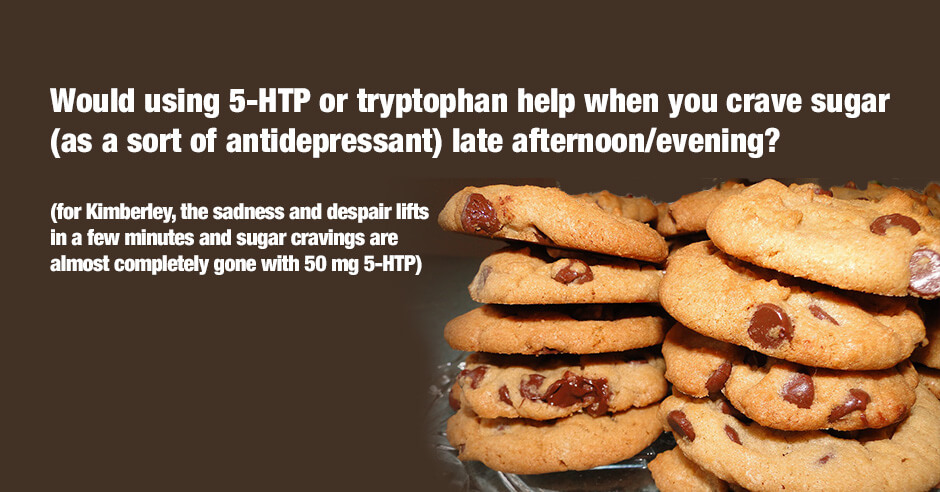
Would using 5-HTP or tryptophan help when you crave sugar (as a sort of antidepressant) late afternoon/evening?

June 2, 2023 By Trudy Scott 29 Comments

5-htp and sugar craving

Would using 5-HTP or tryptophan also help when you crave sugar (as a sort of antidepressant) late afternoon/evening? ~ Kimberley

This question was posed in response to my recent blog post about using tryptophan or 5-HTP to help with alcohol cravings/addiction in the late afternoon/evening – to help you wind down and relax, improve mood and sleep, and also as a reward/treat.

I said yes it is often the same cause when it happens late afternoon/evening and when there are other low serotonin symptoms like low mood, anxiety, worry, insomnia etc. When serotonin is low we self-medicate with wine, sugar, carbs, gluten, dairy and chocolate etc. in order to feel good, get a mood boost and reduce stress. 5-HTP or tryptophan stops the sugar cravings, acts as an antidepressant (improving mood) and eases other low serotonin symptoms too.

It turns out Kimberley was craving sugar late afternoon: “it’s definitely late afternoon for me, while I’m making dinner. Maybe it’s time to go back on 5-HTP.”

And then 2 days later she posted how quickly 5-HTP helped when she added it back mid-afternoon:

I was taking a break from tryptophan/5-HTP and realized after reading this post that that might be a mistake! So I added 5-HTP back in mid-afternoon and my sugar cravings are almost completely gone. It’s funny how I forget the symptoms of low neurotransmitters. Thanks for reminding me!

5-HTP works quickly when it’s low serotonin

How wonderful are these results for Kimberley. I never get tired of hearing feedback like this! I appreciate her sharing and giving me permission to share as a blog so you get to learn and be inspired too.

It’s not unusual for 5-HTP to work this quickly and when it does it’s a clue that the symptoms are related to low serotonin and that she found the ideal dose for her needs.

Kimberley had good results with 5-HTP in the past so she went back to what had worked for her before and it worked for her again.

But do keep in mind, some folks do better with 5-HTP and some do better with tryptophan so it’s a matter of doing a trial of each one each.

50 mg 5-HTP: the sadness and despair lifts in a few minutes

A week later she kindly came and shared additional details in the comments of the tryptophan/ 5-HTP alcohol cravings blog, saying:

It’s possible that I was already in the middle of my daily, mid-afternoon chocolate chip binge when I saw your post

I took a 50 mg 5-HTP along with my mid-afternoon Endorphigen capsule, and within just a few minutes I felt the sadness and despair that I often feel in the late afternoon, start to lift. I was astonished at how quickly it worked! I didn’t open the capsule, or chew it, I just swallowed it with water and had a snack afterwards. I really can’t thank you enough for asking that question because I was really struggling with low mood and sadness almost every day.

Even though KImberley had used 5-HTP with success in the past, she was still astonished how quickly it worked and how effective it was. She was also surprised she had forgotten her prior low serotonin symptoms:

Up until January I had taken 5-HTP in the mid-afternoon and then Tryptophan at bedtime, but I wanted to try a program to support my thyroid. That program told me that too much serotonin is often at the root of gut damage, so I weaned myself off of the 5-HTP and tryptophan. I didn’t really notice much difference, except the daily sugar cravings.

I’m not sure how I could so easily forget the symptoms of low serotonin, but I did.

Your question really was a God-send for me, Trudy. It reminded me that there was an option for feeling better (in fact, MUCH better than sugar makes me feel) that didn’t involve something that’s not good for me.

And I really did feel remarkably better the same day, and those results have continued.

Thanks again, Trudy, for continuing to bring these topics up. Some of us are forgetful and need reminding. Usually, when you have symptoms of low serotonin there are enough other issues going on in your life that it’s easy to overlook the obvious. So I’m very grateful that you asked the question, because I feel so much better able to deal with my circumstances now that I’m back on the 5-HTP. Blessings to you!

I am curious about the program that told her too much serotonin is often at the root of gut damage and if they suggested stopping 5-HTP and tryptophan. It doesn’t make any sense to me.  I’ll report back when I learn more about this.

More tired during the day and a headache: what to consider

She did mention “I’m finding myself more tired during the day and have also had a headache for the last few days.” I would suspect chocolate/caffeine withdrawal may have caused her headache.

With feeling more tired I’d also watch the dose of 5-HTP. She may find less is better for her needs.

She is also trying tryptophan at bedtime so that may be making her more tired the next day. Doing one amino acid at a time is often the best way to know how each one is affecting you.

Finding what works for your unique needs

Here are some other amino acid/sugar cravings blog posts that illustrate how we all have unique needs and different biochemical imbalances:

  • The individual amino acids glutamine, GABA, tryptophan (or 5-HTP), DPA and tyrosine are powerful for eliminating sugar cravings, often within 5 minutes

The individual amino acids glutamine, GABA, tryptophan (or 5-HTP), DPA and tyrosine are powerful for eliminating sugar cravings, often within 5 minutes. It seems that this wonderful benefit – over and above the anxiety-reducing and mood-boosting benefits – is often overlooked or poorly understood.

  • GABA for ending sugar cravings (and anxiety and insomnia)

For Melissa, an unexpected result was that she stopped craving sugar (chocolates, ice cream and truffles) after about a week of taking GABA for her travel anxiety.

It’s a matter of finding what works for your sugar cravings and unique needs. GABA worked for Melissa and yet 5-HTP works for Kimberley – for their sugar cravings.

Here is the tryptophan/5-HTP alcohol cravings blog that started the discussion: Tryptophan had the added benefit of turning me completely off alcohol when I took it to improve mood and sleep during perimenopause. In this case, tryptophan helped Victoria quit the wine that she was self-medicating with in order to feel good and relax.

Resources if you are new to using amino acids as supplements

If you are new to using amino acids as supplements, here is the Amino Acids Mood Questionnaire from The Antianxiety Food Solution (you can see all the symptoms of neurotransmitter imbalances, including low GABA, low serotonin and low endorphins).

If you suspect low levels of any of the neurotransmitters and do not yet have my book, The Antianxiety Food Solution – How the Foods You Eat Can Help You Calm Your Anxious Mind, Improve Your Mood, and End Cravings, I highly recommend getting it and reading it before jumping in and using amino acids on your own so you are knowledgeable. And be sure to share it with the practitioner/health team you or your loved one is working with.

There is an entire chapter on the amino acids and they are discussed throughout the book in the sections on gut health, gluten, blood sugar control, sugar cravings, anxiety and mood issues.

The book doesn’t include product names (per the publisher’s request) so this blog, The Antianxiety Food Solution Amino Acid and Pyroluria Supplements, lists the amino acids that I use with my individual clients and those in my group programs. You can find them all in my online store.

If, after reading this blog and my book, you don’t feel comfortable figuring things out on your own (i.e. doing the symptoms questionnaire and respective amino acids trials), a good place to get help is the GABA QuickStart Program (if you have low GABA symptoms too). This is a paid online/virtual group program where you get my guidance and community support.

If you are a practitioner, join us in The Balancing Neurotransmitters: the Fundamentals program. This is also a paid online/virtual program with an opportunity to interact with me and other practitioners who are also using the amino acids.

Has 5-HTP helped reduce your cravings and/or feelings of despair and sadness? How much helps and how quickly?

Or do you find tryptophan works better for you? If yes, how much helps and how quickly?

What sugary food/s do you self-medicate with in order to feel good?

If you’re a practitioner, do you use this approach with your clients/patients?

Feel free to post your feedback and questions here in the comments.
Filed Under: 5-HTP, Cravings, Depression, Tryptophan Tagged With: 5-HTP, addiction, alcohol cravings, amino acids, antidepressant, anxiety, carbs, crave sugar, dairy, despair, evening, GABA, gluten, insomnia, late afternoon, low serotonin, mood, neurotransmitters, relax, sadness, self-medicate, sleep, sugar, sugar cravings, the GABA Quickstart online program; and Balancing Neurotransmitters: the Fundamentals program for practitioners, tryptophan, wine, worry

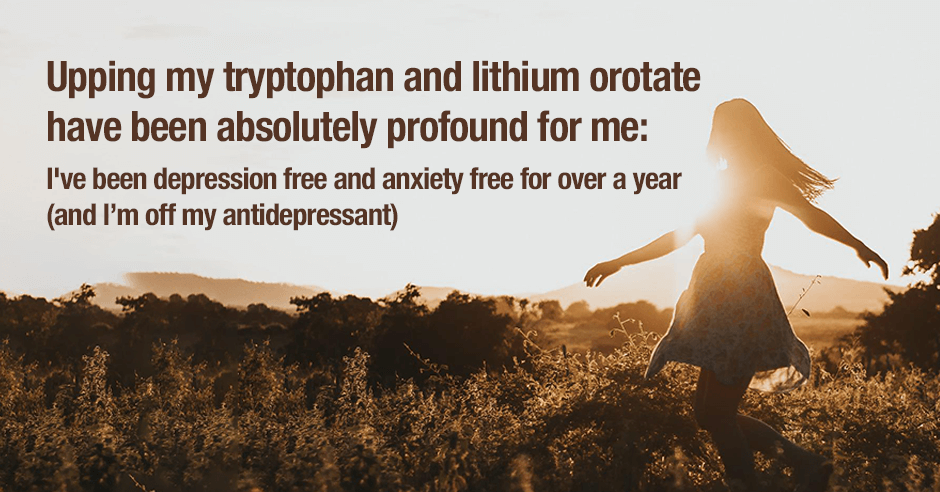
Upping my tryptophan and lithium orotate have been absolutely profound for me: I’ve been depression free and anxiety free for over a year

July 8, 2022 By Trudy Scott 66 Comments

tryptophan and lithium orotate

Upping my tryptophan dose and also including and upping the dose of lithium orotate has been absolutely profound for me.

I’m off my SSRI/antidepressant (which I was off and on for a number of years). I’ve been depression/anxiety free for over a year. So fantastic.

Everyone is bioindividual, of course, so please avoid using my dosing regime, but it wasn’t until I increased the lithium orotate to 20mg a day – 10mg in the AM and PM.

Life changing

Katrin shared this wonderful feedback on Facebook and I’m sharing this today in order to illustrate how much tryptophan dosing can vary, when you may need to up your dosage of tryptophan, how the addition of lithium orotate may be the missing link, and increasing it may help further and to offer hope (as always). And I share my insights and some additional information on lithium orotate.

Katrin was inspired by a post of mine where I discussed increasing tryptophan over and above 500mg twice a day and only taking it when needed). She shared this:

I was taking 3g tryptophan split up between the hours of 2pm and bedtime. 3 grams was what I increased to after floundering on 500mg afternoon and evening.  I don’t take it every day (as per your great suggestion of not taking an amino acid if you feel you don’t need to.) But if I’m having a stressful week etc and my serotonin tanks, I’ll start to take it again.

After the initial increase of lithium orotate, in conjunction with the tryptophan increase, that’s when I started to feel the real difference – the icing on the cake, so to speak (sugar-free, gluten free icing and cake, of course). Lithium orotate was the game changer.

She started with 5mg lithium orotate twice a day and then increased it to 10mg twice a day and has recently reduced this (more on this below).

Is there a role for lithium orotate in psychiatry?

If you’re new to lithium orotate, this editorial, Is there a role for lithium orotate in psychiatry?, is a useful introduction. Here are a few highlights:

  • The growing evidence from epidemiological studies mirror the cellular studies that suggest lithium is perhaps a crucial trace element necessary for optimum brain functioning. All these studies imply that adequate lithium intake may be neuroprotective. Conversely, inadequate lithium intake (especially in vulnerable individuals) may predispose and/or perpetuate a range of psychiatric and neurodegenerative conditions.
  • If further studies confirm this hypothesis, then a safe and effective lithium mineral supplement will be needed to correct this specific mineral deficiency. Advocates of lithium orotate argue that such a supplement already exists and that it is both safe and effective.
  • Lithium orotate has been used worldwide, mainly by non-medical health practitioners for over 30  years

Lithium orotate is used at low doses and the dosing is much lower and in a different form to prescription lithium (carbonate) that is prescribed for bipolar disorder. The above editorial explains some of the differences and standard daily dose:

To further illustrate the differences in the daily doses of elemental lithium between the orotate and carbonate forms, a single 120 mg tablet of lithium orotate contains about 5mg of elemental lithium. This is only 10% of the dose of elemental lithium that you would find in a single 250 mg tablet of lithium carbonate, which would have about 50 mg of elemental lithium.

There are no established (medical) guidelines for the daily dose of lithium orotate. However, the standard dose prescribed by alternative health practitioners is a single tablet of 120 mg of lithium orotate a day (which is equivalent to 5 mg of elemental lithium).

The authors conclude with this: “There have only been a few small trials done in humans, and they showed that lithium orotate was effective, safe and generally well tolerated.” Until we have more human trials we have to rely on what we see clinically.  And based on what I’ve seen and the feedback from colleagues, there is most definitely a role for lithium orotate in psychiatry.

Lithium orotate works when there are mood swings and anxiety ups and downs

I’ve used lithium orotate with many clients and use it when folks have mood swings and anxiety ups and downs. It’s harder for the amino acids to work when there is a moving goal post and lithium orotate evens things out. Katrin said she resonates with this and this may be why the lithium orotate works so well for her.

There are not many studies on lithium orotate, although it’s exciting that there has been an increase in the last few years. This small study done in 1994, Effects of nutritional lithium supplementation on mood, mentions the “mood-improving and stabilizing effect.”  They used a yeast based lithium supplement of 400 μg (which is just  0.4 mg) for former drug users of mostly heroin and crystal methamphetamine.

The above editorial states the following reported benefits of taking lithium orotate:

feeling calmer; experiencing fewer or less intense depressive, hypomanic or mixed affective symptoms; being less impulsive; experiencing less frequent and less intense suicidal thoughts or aggressive impulses; reduced consumption of alcohol and not getting as easily upset by stressors.

I also use a low lithium questionnaire with clients. A number of symptoms/signs other than mood swings  provide a clue that you may have low lithium levels and lithium orotate may need to be trialed.

My insights on Katrin’s approach to increasing her tryptophan and adding/increasing lithium orotate

Katrin increased the tryptophan to 3g and added lithium orotate at the same time. I recommend changing one thing at a time i.e. do a trial or tryptophan, then increase the tryptophan for better results (increasing slowly from 500mg 2 x day to 1000mg 2 x day and then 1500mg 2 x day, and tracking symptom improvements); then add lithium orotate; and then increase lithium orotate for even better results. But if it’s done the way Katrin did it, you simply unwind things so you can figure out what is really working for you.

Keep in mind, the starting dose for tryptophan is 500mg twice a day and lithium orotate is 5mg once a day. I would never recommend that anyone starts on 3g tryptophan or 20mg lithium orotate.

Experimenting with different doses and combinations

Katrin stayed at this dosing and combination of tryptophan and lithium orotate for close to a year. When something is working well, you understandably don’t want to change things. But more recently she has been experimenting with different doses and combinations. She is what is is doing now:

  • “currently trying lithium orotate by itself, during the day while only taking 1g tryptophan at night before bed.”
  • “now I only take a lithium orotate dose of 5mg twice a day and I do that every second day. It’s working for me.”

This is the perfect way to adjust things and if she finds the new combination doesn’t work over the coming weeks and months she can adjust again.

Also, keep in mind that your needs change as your hormones fluctuate, when you’re under more stress, with seasonal changes (winter time/winter blues and due to seasonal allergies), if you’re exposed to a toxin such as lead (it can impact serotonin levels) or parasites etc.

It goes without saying that diet must be addressed too – gluten-free, sugar-free, caffeine-free, real whole food, quality animal protein, organic vegetables and fruit, fermented foods and healthy fats.

Resources if you are new to using the amino acids as supplements

If you are new to using any of the amino acids as supplements, here is the Amino Acids Mood Questionnaire from The Antianxiety Food Solution (you can see all the symptoms of neurotransmitter imbalances).

If you suspect low levels of any of the neurotransmitters and do not yet have my book, The Antianxiety Food Solution – How the Foods You Eat Can Help You Calm Your Anxious Mind, Improve Your Mood, and End Cravings, I highly recommend getting it and reading it before jumping in and using amino acids on your own so you are knowledgeable. And be sure to share it with the practitioner/health team you or your loved one is working with.

There is an entire chapter on the amino acids and they are discussed throughout the book in the sections on gut health, gluten, blood sugar control, sugar cravings, self-medicating with alcohol and more. There is also an entire chapter on gluten and grains if this is new to you.

The book doesn’t include product names (per the publisher’s request) so this blog, The Antianxiety Food Solution Amino Acid and Pyroluria Supplements, lists the amino acids that I use with my individual clients and those in my group programs.

You can find the Lidtke Tryptophan products I use and a number of different lithium orotate products in my online Fullscript store.

If, after reading this blog and my book, you don’t feel comfortable figuring things out on your own (i.e. doing the symptoms questionnaire and respective amino acids trials), a good place to get help is the GABA QuickStart Program (if you have low GABA symptoms). This is a paid online/virtual group program where you get my guidance and community support. There are many moms in the program who are having much success with their kids.

If you need serotonin support, the Serotonin QuickStart Program is a good place to get help. This is also a paid online/virtual group program where you get my guidance on using tryptophan and 5-HTP safely, and community support during 5 LIVE Q&A calls. You can sign up to be notified when the next live launch of this program is happening.

If you are a practitioner, join us in The Balancing Neurotransmitters: the Fundamentals program. This is also a paid online/virtual program with an opportunity to interact with me and other practitioners who are also using the amino acids.

Wrapping up and your feedback

With much appreciation for Katrin for sharing her wonderful success story – I’m so thrilled for her! I’d love to get this published as case studies to further add to the evidence. If you are a researcher or have a resource for me please do let me know.

Did  you need to adjust your tryptophan dose for easing your anxiety, depression and other low serotonin symptoms? What adjustments did you make?

Have you found the addition of lithium orotate has helped keep things more even so the amino acids are more effective? What dosing works for you?

If you’re a practitioner, do you find the addition of lithium orotate to be helpful for your patients/clients?

If you have questions please share them here too.

Filed Under: Anxiety, Depression, Lithium orotate, serotonin, Tryptophan Tagged With: antidepressant, anxiety, Balancing Neurotransmitters: the Fundamentals program for practitioners, depression, dosing can vary, lithium carbonate, lithium orotate, mood swings, prescription lithium, psychiatry, serotonin, SSRI, stabilizing, tryptophan

SSRI/antidepressant impact on the microbiome, discontinuation syndrome and safe tapering

October 16, 2021 By Trudy Scott 2 Comments


Antidepressants can have an antibiotic effect, causing dysbiosis and impacting serotonin, GABA and dopamine production. This can cause psychiatric symptoms and even suicidal thoughts or behaviors. Various SSRI (selective serotonin reuptake inhibitors) and SNRI (serotonin norepinephrine reuptake inhibitors) have more of an effect than others. And the top known side effects for SSRIs are gut symptoms: nausea, diarrhea and vomiting.

These medications are seldom prescribed with informed consent and can cause severe psychological, cognitive, physical and neurological withdrawal side effects (also known as discontinuation syndrome). A functional medicine and nutritional approach using 5-HTP, GABA, theanine and glycine can often be used to smooth the taper process.

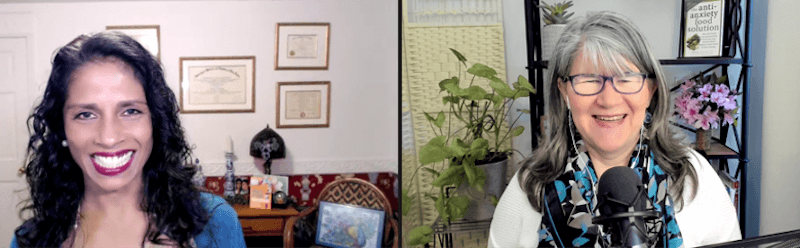
Dr. Achina Stein addresses all this in her interview, SSRI Impact on the Microbiome and Safe SSRI Tapering, on The Anxiety Summit 5: Gut-Brain Axis.

achina stein and trudy scott

We cover the following:

  • Antibiotic effect of antidepressants: dysbiosis and impacts on serotonin/GABA/dopamine
  • Withdrawal/discontinuation syndrome symptoms of SSRIs and benzodiazepines
  • 5-HTP, GABA, theanine and glycine to smooth the taper process

Here are a few snippets from our interview.

We start with a discussion on the antibiotic effect of antidepressants and a review of this paper – Serotonin Reuptake Inhibitors and the Gut Microbiome: Significance of the Gut Microbiome in Relation to Mechanism of Action, Treatment Response, Side Effects, and Tachyphylaxis.

Dr. Stein comments on this study sharing how SSRIs affect the gut and microbiome in many different ways:

  • “This paper is important. It’s one of several papers that talk about how the SSRIs or serotonin reuptake inhibitors affect the gastrointestinal tract. And as you know, the gastrointestinal tract is really full of serotonin.
  • SSRIs, as well as other psychotropic medications, actually exert an antibiotic effect, which can have a direct consequence in disrupting the integrity and stability of the gut microbiome.
  • And the ones that are most likely to do that are Sertraline, fluoxetine, and paroxetine in that order. And it’s followed by fluvoxamine, escitalopram, and citalopram, having the least impact.
  • What they’re noticing is that this antibiotic effect actually results in dysbiosis.
  • The top known side effects for SSRIs are gut symptoms: nausea, diarrhea, vomiting.
  • We know that the gut microbiome has a significant effect on emotions, behaviors, and metabolic changes.
  • And it’s involved in the metabolism of drugs, and this combination is what really causes psychiatric symptoms and even suicidal thoughts or behaviors.”

She also talks about the bidirectional gut-brain connection/communication, the microbiome and short-chain fatty acids (which are a common theme you’ll hear throughout the summit):

  • “There is this huge connection between the gut microbiome and the brain.
  • And there’s also other indirect communication pathways because we’ve always wondered, well, how does this happen that the gut is connected to the brain?
  • So the other pathways which are more indirect are the hypothalamic-pituitary-adrenal axis.
  • And there’s also an immune-mediated connection where there’s a communication between short-chain fatty acids and microglia in the brain.
  • So short-chain fatty acids are the main metabolites produced by the microbiota in the large intestine through bacterial fermentation of indigestible polysaccharides, which are dietary fiber and resistant starch. And they possess neuroactive properties. So they influence the communication between these short-chain fatty acids between the gut and the microglia of the brain.
  • And it’s a bidirectional communication too.”

And we talk about tachyphylaxis or the poop-out effect of antidepressants.

The discussion on the SSRI (selective serotonin reuptake inhibitors) and SNRI (serotonin norepinephrine reuptake inhibitors) discontinuation syndrome (or withdrawal symptoms) is eye-opening and sobering, Here are just a few of the many psychological symptoms that she says patients may experience when tapering:

I’m just going to read them off because I think it’s important for people to know: mood swings, unstable moods, hypomania, hyperarousal, anxiety, medication-induced agitation – which is described as being caffeinated – impulsive behavior, aggression, irritability, crying spells, lowered mood or depression.

Dr. Stein also shares the many cognitive, physical and neurological side effects, and how she works with her patients with a functional medicine and nutritional approach to try and mitigate the side effects. She likes to use 5-HTP, GABA, theanine and glycine to smooth the taper process.

We also have a lengthy discussion about informed consent and the fact that it’s not happening and should be.

We do a deep dive into all this and much more.

The interviews that dove-tail well with this topic are as follows:

  • My interviews, GABA & Tryptophan: Gut-Anxiety Connections and Glutamine, DPA and Tyrosine for Anxiety and Sugar Cravings. The amino acids help during the  tapering process and help you make the dietary changes.
  • Thiamine Deficiency in Anxiety and Gut Health (Part 1 and 2) with Chandler Marrs. She talks about how medications can deplete thiamine. Could this contribute to some of the severe discontinuation syndrome symptoms we see?
  • Anxiety, Gut-Brain Communication and Diet with David Perlmutter, MD, FACN, ABIHM. This one gives you an excellent overview of the gut-brain communication and fermented foods, short-chain fatty acids and histone deacetylases (HDACs).
  • Gut-Brain Axis and Mental Health with Peter Bongiorno, ND, LAc. This is also a great overview on the mental health impacts of the microbiome. He goes deep into serotonin and GABA production mechanisms.

I encourage you to tune in if you have:

  • Anxiety & feel overwhelmed & stressed by little things
  • Panic attacks &/or obsessive thoughts or behaviors
  • Social anxiety/pyroluria
  • Phobias or fears (flying, spiders or even driving on a highway)

And also if you suffer from…

  • Food sensitivities, IBS/SIBO, parasites or gallbladder issues
  • Constipation, diarrhea, bloating, gas, pain & other digestive issues
  • Leaky gut, a leaky blood-brain barrier or vagus nerve issues

Join us if you are also an emotional eater with intense sugar cravings (and know you suffer from low blood sugar), experience insomnia, low mood, PMS, poor focus and/or low motivation.

This is THE online event to learn about the powerful individual amino acids – GABA, theanine, tryptophan, 5-HTP, glutamine, DPA and tyrosine – to quickly ease anxiety and help with gut symptoms while you are dealing with other root causes which take longer to address. (They also help with cravings as with this example, and sleep and immunity).

With research-based anxiety nutritional solutions and practical steps, you can determine your root causes, ease your anxiety and prevent it from coming back so you can feel on top of the world again!

If you are a practitioner, please join us too and find advanced solutions for your clients or patients too!

You’ve heard me say the Anxiety Summit has been called “a bouquet of hope!”  My wish for you is that this summit is your bouquet of hope!

I hope you’ll join me and these incredible speakers, be enlightened and find YOUR solutions!

Here’s to no more anxiety and you feeling on top of the world again!

Learn more/purchase now


How have antidepressants impacted your gut and digestion?

Have you experienced discontinuation syndrome when tapering from an SSRI or SNRI or benzodiazepines? And have diet and the amino acids helped smooth the taper process?

Feel free to post your questions here too.

Filed Under: Antidepressants, Anxiety, Depression, The Anxiety Summit 5 Tagged With: 5-HTP, antibiotic, antidepressant, anxiety summit, cognitive, discontinuation syndrome, dopamine, Dr. Achina Stein, dysbiosis, functional medicine, GABA, glycine, gut-brain, informed consent, microbiome, neurological, nutritional, physical, psychiatric symptoms, psychological, safe tapering, serotonin, SNRI, SSRI, Suicidal, taper, theanine, withdrawal side effects

Anxiety case study: a very very slow SSRI taper with tryptophan and other nutritional support

August 28, 2020 By Trudy Scott 14 Comments

anxiety case study

Today I’m sharing an update from someone in my community who is tapering from an SSRI (Cipralex/lexapro) in the best way possible – very methodically and doing a very very slow taper, using compounded medication and nutritional support. It is a team approach with a supportive doctor monitoring for serotonin syndrome, her pharmacist compounding her medication and input from me.

She has an excellent diet that contains enough healthy protein and fats, plenty of vegetables, and no sugar or caffeine. She has the basic nutrients covered and is on the pyroluria protocol (these nutrients help make serotonin). She is using the amino acid tryptophan for serotonin support as she tapers. And she is out walking in nature and practicing mindfulness.

All of this sets her up for success and being able to avoid antidepressant discontinuation syndrome.

Here is her story:

I began tapering off 10 mg of Cipralex in November 2017. I have my little “Support Team” that includes a compounding pharmacist and my GP. Feeling very fortunate that I have these people as my taper has not exactly gone as planned (although far better than my last two attempts)

Originally, the plan was to go down by 10% of the dose and stay at that dose for 4 weeks. That didn’t work for me. I was fine when I dropped from 10mg to 9, but after my next 10% drop I experienced that familiar withdrawal hell. I got a little scared, but stuck with it, and decided to stay at that dose for a bit longer. While I leveled out, I did a lot of reading about how SSRIs work. I learned about the 1/2 life of Cipralex (all SSRIs have a different 1/2 life) and what was actually happening physiologically as my body adjusts to the lower dose. It’s a recovery process.

With that new knowledge, I decided to try another approach. I knew I couldn’t handle a drop of 10%. So, I started to taper at a rate of 0.1mg once a week (far less than 10%!). By day three at the new dose, I could feel the withdrawal, but it was far less severe. Small drops=small “withdrawal wave”. I discovered that I am able to manage a 2% drop of the current dose and I have been able to drop that % each week. So, I’m still reducing by 8% a month, which means I am close to the original plan of dropping by 10% a month. At this time I am at 6.24mg.

Yes, it is a very slow process and I have a long way to go, but it’s working. I have read that some people have to reduce by 1% of their current dose and remain at that dose for 4 weeks to allow their body the time to heal and adjust to life on the lower dose. Having the liquid compound has made such a difference! You sure would have difficulty accurately shaving off a pill by 2%!! If anyone is trying to come off of this drug, do your best to find a compounding pharmacist!

I find that I must stick to a very healthy diet. I eat a lot of fresh, raw and cooked vegetables. I mean a LOT of vegetables. I eat good sources of protein and walk for at least 45 min almost every day. I steer clear of sugar and caffeine. Both make my withdrawal much worse.

Every day I take omega 3, vitamin C, vitamin D, vitamin B complex. I take the supplements for pyroluria, vitamin B6, evening primrose oil and zinc. I take magnesium at night. I took Trudy’s amino acids course online and did all of the amino acid trials. I discovered all I really need is tryptophan. It has made a huge difference for me. Yes, I take Lidke tryptophan. For us Canadians, it can be ordered online.

I practice mindfulness. I’ve read a lot about the anxious brain (the reason I took Cipralex in the first place) so I understand what is happening now, what is real and what is just noise in my head.

Antidepressant discontinuation syndrome

This is the best way to taper SSRI medications in order to avoid withdrawal effects, also known as discontinuation syndrome which can be very severe for some folks.

Accordingly to this paper, Antidepressant discontinuation syndrome occurs in about 20% of patients who reduce the dose or abruptly stop an antidepressant that they have been taking for one month. This paper states that “symptoms are usually mild….occur within two to four days after drug cessation and usually last one to two weeks.”

It also states that occasionally symptoms “may persist up to one year…and if the same or a similar drug is started, the symptoms will resolve within one to three days.”

I typically hear from individuals who fall into the category of severe symptoms that are persisting past 2 weeks. It’s not uncommon to see symptoms continue for a year and often longer in some cases.

Also from the above paper, is the mnemonic FINISH which summarizes these symptoms:

  • Flu-like symptoms (lethargy, fatigue, headache, achiness, sweating)
  • Insomnia (with vivid dreams or nightmares)
  • Nausea (sometimes vomiting)
  • Imbalance (dizziness, vertigo, light-headedness)
  • Sensory disturbances (“burning,” “tingling,” “electric-like” or “shock-like” sensations) and
  • Hyperarousal (anxiety, irritability, agitation, aggression, mania, jerkiness).”

How you will feel if your serotonin is low and how to learn more

With low serotonin you will have the worry-in-your-head and ruminating type of anxiety, panic attacks and phobias, lack of confidence, depression, negativity, imposter syndrome, PMS, irritability, anger issues, insomnia and afternoon/evening cravings.

If you suspect low serotonin symptoms and are new to using the amino acids and do not have my book I highly recommend getting it and reading it before jumping in to taking supplements and navigating this with your prescribing physician: The Antianxiety Food Solution – How the Foods You Eat Can Help You Calm Your Anxious Mind, Improve Your Mood, and End Cravings. You may need to lend him/her a copy of my book too.

There is a complete chapter on the amino acids and one for pyroluria, plus information on real whole food, sugar and blood sugar, gluten, digestion and much more.  If you’re not a reader there is now also an audible version.

Here is the Amino Acids Mood Questionnaire from The Antianxiety Food Solution and additional information on Anxiety and targeted individual amino acid supplements: a summary

Please also read and follow these Amino Acid Precautions.

This lists The Antianxiety Food Solution Amino Acid and Pyroluria Supplements that I use with my individual clients and those in my group programs – you will find the Lidtke Tryptophan here. You can also read more about why I prefer the Lidtke tryptophan on this blog.

I would like to end off by saying how much I appreciate this woman and others sharing their stories like this so we can all learn!

Please also share your taper story and what you did to make it easier.  If you had challenges share those too. Let us know if you can relate to any of the above FINISH symptoms and how long they lasted.

Feel free to post your questions here too.

Filed Under: Anxiety, Tryptophan Tagged With: achiness, aggression, agitation, antidepressant, anxiety, B6, burning, cravings, diet, Dizziness, fatigue, flu-like symptoms, headache, insomnia, irritability, jerkiness, lethargy, light-headedness, mania, nausea, Nightmares, nutritional support, panic, serotonin, shock-like sensations, SSRI, SSRI taper, sweating, tingling, tryptophan, vertigo, vivid dreams, vomiting, worry, zinc

Beyond the Pill by Dr. Jolene Brighten – my book review

February 15, 2019 By Trudy Scott 9 Comments

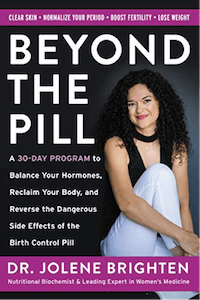
I really wish this book – Beyond the Pill A 30-Day Program to Balance Your Hormones, Reclaim Your Body, and Reverse the Dangerous Side Effects of the Birth Control Pill by Dr. Jolene Brighten – was available when I was in my 30s and on the pill.

Dr. Jolene mentions a study in the Journal of the American Medical Association which reports the following:

women who began the pill were more likely to be prescribed an antidepressant – which means it contributes to a bit more than moodiness.

This was not a small study and included over one million women.

Symptoms caused by the pill and the damage it does to your body

This book, Beyond the Pill, provides a comprehensive list of symptoms caused by the pill:

  • hormonal confusion: missing or irregular periods, light or heavy periods, short cycles, infertility, headaches
  • digestive problems: leaky gut, gut dysbiosis, inflammatory bowel disease
  • energy reduction: fatigue, adrenal and thyroid dysfunction
  • skin issues: hair loss, dry skin
  • mood disruption: depression, anxiety
  • lady part disturbance: low libido (Oh, hell no!), vaginal dryness, chronic infection, pain with sex
  • vitamin, mineral, and antioxidant depletion (such as folate, B12, and magnesium) (I’ll add vitamin B6 to this list too – it is mentioned elsewhere in the book)

The pill does further damage to your body and also:

  • intensifies the risk of blood clots, which lead to strokes
  • increases the risk of breast, cervical, and liver cancers
  • increases the risk of diabetes
  • raises the risk of heart attacks
  • triggers autoimmune disease

Truth-bombs about how the pill works

She shares plenty of truth-bombs about how the pill works – like these gems:

As long as you’re on the pill, your brain and ovaries aren’t talking, which can seriously affect all your hormones.

When you take that week of placebo pills, you’re not actually getting a period because you never ovulated. Instead, this is what is called a withdrawal bleed (I did not know this!)

Post–birth control syndrome (PBCS)

I first became aware of Dr. Jolene’s brilliance in this area when she started writing about Post–birth control syndrome (PBCS) a few years ago. PBCS is “is a constellation of symptoms women experience when they discontinue hormonal birth control.” She has found the symptoms of PBCS – hormonal irregularities like no period or heavy bleeding, acne, mood swings and anxiety, headaches, infertility, pill-induced PCOS (polycystic ovarian syndrome), hypothyroidism, gut issues and even autoimmune symptoms – typically occur in the first 4-6 months after stopping the pill. To make it easy for you the PBCS symptoms are all laid out in a handy quiz in the book.

She has found these symptoms won’t go away without taking the necessary steps that include detox, gut repair, healing the thyroid and adrenals, addressing metabolic health or blood sugar control, boosting mood, improving libido and addressing nutritional deficiencies that the pill has caused. This is all covered in the book as a 30-day program to balance your hormones, reclaim your body, and reverse the dangerous side effects of the birth control pill.

I really appreciate that Dr. Jolene shares this:

I want you to know I’m not anti-pill. Nope. I’m pro–informed consent, which means doctors giving you all the information you need to consent to taking birth control.

This book will help you understand what those hormonal symptoms mean, how the pill is affecting your body, and what to do if you either need to stay on it or are ready to get off it.

Addressing low vitamin B6, low serotonin and low GABA

Here are a few of the nutritional supporting approaches she covers (all supported by research) that are very applicable for support for anxiety specifically and relevant to what you’ve been learning from me: addressing low vitamin B6, low serotonin and low GABA.

Because the pill depletes vitamin B6, she recommends up to 100mg per day for PMS and mood-related symptoms, and symptoms of PBCS. (I know vitamin B6 is controversial and she does acknowledge this).

Dr Jolene identifies the concerning and far-reaching effects of the pill on serotonin: “studies have shown that women on the pill don’t metabolize tryptophan normally” affecting both serotonin and melatonin production, reducing kynurenic acid and raising high-sensitivity C-reactive protein (hs-CRP), a marker of inflammation and immune system activation, and shifting the “tryptophan pathway… toward quinolinic acid production, which is inflammatory and harmful to the brain.”

I would have loved to see more about tryptophan and 5-HTP and even vitamin B6 (given that it is crucial for the conversion of tryptophan away from quinolinic acid) in this section of the book. Using tryptophan as a supplement is only briefly mentioned and 50-100mg 5-HTP is only recommended for serotonin-related cravings. As you may know from my work using targeted trials of the amino acid tryptophan and/or 5-HTP offers very quick anxiety relief and  support for PMS within 3 cycles. Fortunately, you can fill in the gaps and use what I teach about these amino acids in conjunction with everything else in the book.

I do love that she adds to our knowledge base with other tips, sharing that the botanicals “passionflower and skullcap support healthy serotonin production by reducing quinolinic acid production.” This was new to me and I’m intrigued.

I love what she writes about progesterone inducing “a sense of calm and a deep sense of love and connection by stimulating gamma-aminobutyric acid (GABA) receptors.”  Theanine and taurine (a precursor of GABA) are recommended and taurine is also part of her detox and adrenal protocols which I love.

However, I use GABA itself extensively in my work and find it to be more effective than theanine or taurine for the anxiety symptoms – it’s a firm favorite for the majority of my anxious clients. Again, you can fill in the gaps and check out what I share about GABA for very quick anxiety relief and PMS support.


My other favorite sections: libido and orgasms, and liver detox

Some of my other favorite sections include the libido section and her wonderful information about orgasms – she shares the myriad of health benefits of orgasms and recommends once-weekly orgasms but need I say more than this comment from Dr. Jolene:

Women can have four different types of orgasm throughout the month because of the hormonal changes we experience. Dude, this is a serious reason to consider ending that pill pack.

I couldn’t resist including this advice for anxiety and insomnia:

Trouble with anxiety? Have sex. Trouble with insomnia? Have sex. When you have an orgasm and release oxytocin, it relaxes you, calms your mind, and enables you to get a good night’s sleep. Besides oxytocin, your body releases vasopressin during orgasm, a hormone that often accompanies the release of melatonin.

If you do have low libido Dr. Jolene has this covered.

I also love the liver detox chapter and so will you. You’ll learn that the pill can cause benign liver tumors and can contribute to gallstones and gallbladder disease. She also shares this about the synthetic estrogen in birth control pills and the liver/libido connection:

There is some concern that long-term exposure to the synthetic estrogen in birth control pills actually alters your liver genes to make higher levels of SHBG (sex hormone binding globulin) for the rest of your life. Unfortunately, SHBG also binds up your testosterone. The result is a libido that’s nonexistent.

She also has you covered on how to detox as part of this wonderfully comprehensive hormone balancing program.

The official book blurb

Out of the 100 million women – almost 11 million in the United States alone – who are on the pill, roughly 60 percent take it for non-contraceptive reasons like painful periods, endometriosis, PCOS, and acne. While the birth control pill is widely prescribed as a quick-fix solution to a variety of women’s health conditions, taking it can also result in other more serious and dangerous health consequences.

Did you know that women on the pill are more likely to be prescribed an antidepressant? That they are at significantly increased risk for autoimmune disease, heart attack, thyroid and adrenal disorders, and even breast and cervical cancer? That the pill can even cause vaginal dryness, unexplained hair loss, flagging libido, extreme fatigue, and chronic infection.

As if women didn’t have enough to worry about, that little pill we’re taking to manage our symptoms is only making things worse.

This book is perfect for you if

  • You’re a woman in your child-bearing years and are currently on the pill, considering the pill, have been on the pill in the past and had issues, and even did well on the pill in the past
  • You’re a woman like me and past the birth control age and yet are intrigued to get a better understanding of how you may have been affected by the pill in the past and also want a better understanding of your body and hormonal health going forward
  • You have a daughter or grand-daughter or niece or friend you can gift a copy to
  • You are a practitioner who works with women
  • You are a curious male with women in your life and would like to understand them better so you can continue to have the healthiest relationship possible.

I’m already recommending this book and will continue to recommend it going forward!

This much-needed solution-based and heavily referenced book released January 29. It’s ground-breaking information and I’m thrilled to be sharing it with you!

Grab your copy of Beyond the Pill (my Amazon link) and find additional information here.

I now recognize that post–birth control syndrome (PBCS) was part the perfect storm that contributed to my anxiety and panic attacks in my late 30s (and a whole host of other symptoms). Personally, I found the entire book fascinating reading, and wish I’d had access to this material while I was in the midst of trying to figure things out.

Fortunately, GABA and tryptophan helped immensely with my anxiety and PMS (together with everything else I did) and I eventually discovered FAM (Fertility Awareness Method). But wish I’d know about this safer option when I was younger. Dr. Jolene is a big fan of FAM and covers it extensively in the book, sharing what I found to be true: it works even if it seems scary at first AND you get to learn so much about your body.

Please feel free to share your experiences with the birth control pill (both good and bad), why it was prescribed and what you learn from this book that can help others in your situation. Feel free to post questions here too.

Filed Under: Books, GABA, serotonin, Women's health Tagged With: antidepressant, anxiety, BCP, Beyond the Pill, Dr. Jolene Brighten, GABA, insomnia, libido, orgasm, post-birth control syndrome, serotonin, the birth control pill, the pill

How do I taper tryptophan without withdrawal symptoms: a tight band around my head, brain zaps and agitated free-floating anxiety?

September 21, 2018 By Trudy Scott 43 Comments

I have not had any clients experience the need to taper or slowly wean their tryptophan dose or report tapering side-effects similar to those they experienced when tapering off an antidepressant. However, I recently had someone ask this question on the blog (and then had someone else ask a similar question) so I’m sharing these questions and my responses in the hope of gleaning some additional information (and educating you if this applies to you). I never say never and am always learning. I’m also very interested to know how common this is and what some of the underlying factors could be.

Here is the question that was asked by Lara (we’ll call her Lara) and slightly paraphrased for clarity:

I’ve been taking 1500 mg of tryptophan for 3 months, and it has helped a lot with sleep and depression. I dropped to 1000 mg about a week ago then 500mg just to see how I’d do without it. I didn’t think it was numbing my feelings, but I am experiencing a return of feeling good.

I’ve been on antidepressants before and I am feeling the same withdrawal effects as when I weaned off meds. This is exactly why I chose to not go back to pharmaceuticals. It was difficult to wean off. How do I taper tryptophan without experiencing withdrawal symptoms? Thank you for your valuable knowledge.

These are the kinds of questions I’d ask a client in this situation:

  • Was the 1500mg helping and which low serotonin symptoms were eased?
  • How did this change when you reduced to 1000mg and then reduced to 500mg? i.e. did the low serotonin symptoms come back?
  • Which antidepressant are you comparing these affects to? And how long ago did you wean off the antidepressant?
  • Which brand of tryptophan you are using? (I find Lidtke is the best quality)

Keep in mind that we always want to be sure it’s not a one-off situation. In order to be sure someone is observing mild adverse effects from a supplement I’ll often have my client stop it and then add it back to make sure. And sometimes more than once.

In this instance repeating the process may be a good idea i.e. going back to 1000mg and then 1500mg and then reducing again, carefully documenting in a food mood supplement log.

It turns out that Lara was using the Lidtke tryptophan and she was seeing wonderful benefits for her low serotonin symptoms with none of the typical SSRI side-effects:

the 1500mg before bed with a small carb helped me get to sleep and stay asleep. It also helped with anxiety and depression during day. I tend to be a worrier, have social anxiety, and get stuck with negative thoughts about myself and others. And have very little interest in life.

I was on Zoloft from 2005 – 2009. Got off of that and did Lexapro for only 6 months in 2012. The Zoloft was life changing for me but I did not like the side effects and being on an antidepressant for the rest of my life.

The tryptophan is superior to these SSRIs [selective serotonin reuptake inhibitors] – no sexual side effects, no weight gain, or anhedonia [inability to feel pleasure in normally pleasurable activities].

She describes how she reduced the tryptophan and how her withdrawal symptoms were similar to those she experienced when tapering off her SSRIs in the past:

The withdrawal effects were felt when dropping from 1500mg to 1000mg, to 500mg, then zero over 2 days and they lasted about 3 days. By the 4th day I was no longer feeling bad.

The symptoms are hard to explain – it felt like a tight band around my head, also brain zaps (this is a common SSRI withdrawal symptom many describe feeling in their head).

The worst of it was a deep agitated free-floating anxiety like you’re walking along the edge of a cliff and there’s a physical pain in your gut. Fortunately, it was only present from waking up till around 2pm.

These are questions I’d ask or wonder about

As I mentioned in the introduction, I have not had any clients experience the need to taper or slowly wean their tryptophan dose or report tapering side-effects similar to those they experienced when tapering off an antidepressant. But if this is an issue some individuals experience I’d like to know about it

I’d also like to know how long the tapering side-effects of tryptophan last and how severe the symptoms are. In Lara’s case the symptoms were pretty severe but fortunately they only lasted 3 days which is very much shorter than SSRI tapers.

There could be confounding factors and here are additional questions I’d ask or wonder about if a client experienced similar adverse tapering effects. These are questions you could ask yourself if you have experienced this when stopping tryptophan abruptly:

  • Could the prior use of SSRI prescriptions be a factor? (but I have worked with many clients with prior use of SSRIs and not have tryptophan tapering issues)
  • What else has changed in terms of stress, diet, hidden gluten exposure, or even the something like a recent introduction of collagen (which may deplete serotonin levels in susceptible folks)?
  • Are there hormonal changes that could affect serotonin levels – like in a woman with PMS or perimenopausal or menopausal symptoms? (again, I’ve worked with many women of all ages and haven’t observed this to be an issue)
  • If you are prone to the winter blues and reduced winter serotonin, could stopping the tryptophan in the winter play a role? (I have had clients have SSRI tapering issues in winter because of being prone to the winter blues and choose to work with their doctors on their SSRI taper in the spring and summer for this reason)
  • Could this also be an issue with summer blues in hot states like Arizona?
  • Could any of these play a role: a recent medical procedure, a course of antibiotics (especially fluoroquinolones) or antifungals, poor gut health, a new infection, decreased immunity or increased inflammation?
  • Could low levels of these nutrients play a role: vitamin B6, ferritin, magnesium and zinc?
  • Would using high doses of vitamin C during the “taper” help reduce some of the symptoms? (this works well as an antidote when you take tryptophan and don’t need it and want to negate some of the negative effects, so may help in this situation)

Stopped tryptophan and felt very angry and down

The other question I had about tryptophan weaning is this one from someone who shared that she had suggested tryptophan for a friend. This friend was

experiencing a lot of ruminating and anxiety. She responded beautifully and felt great. About a year later, she tried to stop taking it, and said she felt very angry and down. Is there a weaning process for the tryptophan?

This could possibly be related to the above and you could pose similar questions but based on on what I see with clients I feel this is more of a matter of stopping the tryptophan too soon while she still had low serotonin – especially if the ruminating and anxiety came back. Feeling angry and down are classic signs of low serotonin.

The questions asked were specifically about tryptophan but they could also possibly apply to some individuals who stop 5-HTP abruptly.

I’d love to hear if you’ve experienced anything like this with either tryptophan or 5-HTP and if yes please share your answers to some of the above questions.

Right now, I’m afraid I don’t have an answer for you on how to taper tryptophan without these withdrawal symptoms: a tight band around the head, brain zaps and agitated free-floating anxiety. Right now, I’m not sure how big an issue this is. If it is common, I’m hoping some of the feedback I receive may provide some answers.

Filed Under: Tryptophan Tagged With: 5-HTP, agitated, angry, antidepressant, anxiety, anxious, brain zaps, down, symptoms, taper, tryptophan, withdrawal

  • Page 1
  • Page 2
  • Go to Next Page »

Primary Sidebar

NEW! GABA QuickStart Homestudy (with special intro pricing)

gaba quickstart homestudy

Free Report

9 Great Questions Women Ask about Food, Mood and their Health

You'll also receive a complimentary subscription to my ezine "Food, Mood and Gal Stuff"


Connect with me

Popular Posts

  • Amino Acids Mood Questionnaire from The Antianxiety Food Solution
  • The Antianxiety Food Solution Amino Acid and Pyroluria Supplements
  • Pyroluria Questionnaire from The Antianxiety Food Solution
  • Collagen and gelatin lower serotonin: does this increase your anxiety and depression?
  • Tryptophan for the worry-in-your-head and ruminating type of anxiety
  • GABA for the physical-tension and stiff-and-tense-muscles type of anxiety
  • The Antianxiety Food Solution by Trudy Scott
  • Seriphos Original Formula is back: the best product for anxiety and insomnia caused by high cortisol
  • Am I an anxious introvert because of low zinc and vitamin B6? My response to Huffington Post blog
  • Vagus nerve rehab with GABA, breathing, humming, gargling and key nutrients

Recent Posts

  • What do I use instead of Seriphos to help lower high cortisol that is affecting my sleep and making me anxious at night?
  • BeSerene™ GABA/theanine cream eases severe muscle tension in her neck/shoulders, prevents her bad headaches and quells her anxiety
  • How the correct approach, dose and sublingual use of GABA can be calming and not cause a flushed and itchy face and neck
  • The amino acid glutamine improves low mood by addressing gut health, and it has calming effects too
  • Flight anxiety with heightened breath, physical tension and also fearing the worst (the role of low GABA and low serotonin)

Categories

  • 5-HTP
  • AB575
  • Addiction
  • ADHD
  • Adrenals
  • Alcohol
  • Allergies
  • Alzheimer's disease
  • Amino Acids
  • Anger
  • Antianxiety
  • Antianxiety Food Solution
  • Antidepressants
  • Anxiety
  • Anxiety and panic
  • Autism
  • Autoimmunity
  • benzodiazapines
  • Bipolar disorder
  • Books
  • Caffeine
  • Cancer
  • Candida
  • Children/Teens
  • Collagen
  • Cooking equipment
  • Coronavirus/COVID-19
  • Cravings
  • Depression
  • Detoxification
  • Diabetes
  • Diet
  • DPA/DLPA
  • Drugs
  • EFT/Tapping
  • EMF
  • EMFs
  • Emotional Eating
  • Endorphins
  • Environment
  • Essential oils
  • Events
  • Exercise
  • Fear
  • Fear of public speaking
  • Fertility and Pregnancy
  • Fish
  • Food
  • Food and mood
  • Functional neurology
  • GABA
  • Gene polymorphisms
  • General Health
  • Giving
  • Giving back
  • Glutamine
  • Gluten
  • GMOs
  • Gratitude
  • Gut health
  • Heart health/hypertension
  • Histamine
  • Hormone
  • Hyperparathyroidism
  • Hypoglycemia
  • Immune system
  • Inflammation
  • Insomnia
  • Inspiration
  • Introversion
  • Joy and happiness
  • Ketogenic diet
  • Lithium orotate
  • Looking awesome
  • Lyme disease and co-infections
  • MCAS/histamine
  • Medication
  • Men's health
  • Mental health
  • Mercury
  • Migraine
  • Mold
  • Movie
  • MTHFR
  • Multiple sclerosis
  • Music
  • NANP
  • Nature
  • Nutritional Psychiatry
  • OCD
  • Osteoporosis
  • Oxalates
  • Oxytocin
  • Pain
  • Paleo
  • Parasites
  • Parkinson’s disease
  • PCOS
  • People
  • PMS
  • Postpartum
  • PTSD/Trauma
  • Pyroluria
  • Questionnaires
  • Real whole food
  • Recipes
  • Research
  • Schizophrenia
  • serotonin
  • SIBO
  • Sleep
  • Special diets
  • Sports nutrition
  • Stress
  • Sugar addiction
  • Sugar and mood
  • Supplements
  • Teens
  • Testimonials
  • Testing
  • The Anxiety Summit
  • The Anxiety Summit 2
  • The Anxiety Summit 3
  • The Anxiety Summit 4
  • The Anxiety Summit 5
  • The Anxiety Summit 6
  • Thyroid
  • Thyroid health
  • Toxins
  • Tryptophan
  • Tyrosine
  • Uncategorized
  • Vegan/vegetarian
  • Women's health
  • Yoga

Archives

  • October 2025
  • September 2025
  • August 2025
  • July 2025
  • June 2025
  • May 2025
  • April 2025
  • March 2025
  • February 2025
  • January 2025
  • November 2024
  • October 2024
  • September 2024
  • August 2024
  • July 2024
  • June 2024
  • May 2024
  • April 2024
  • March 2024
  • February 2024
  • January 2024
  • December 2023
  • November 2023
  • October 2023
  • September 2023
  • August 2023
  • July 2023
  • June 2023
  • May 2023
  • April 2023
  • March 2023
  • February 2023
  • January 2023
  • December 2022
  • November 2022
  • October 2022
  • September 2022
  • August 2022
  • July 2022
  • June 2022
  • May 2022
  • April 2022
  • March 2022
  • February 2022
  • January 2022
  • December 2021
  • November 2021
  • October 2021
  • September 2021
  • August 2021
  • July 2021
  • June 2021
  • May 2021
  • April 2021
  • March 2021
  • February 2021
  • January 2021
  • December 2020
  • November 2020
  • October 2020
  • September 2020
  • August 2020
  • July 2020
  • June 2020
  • May 2020
  • April 2020
  • March 2020
  • February 2020
  • January 2020
  • December 2019
  • November 2019
  • October 2019
  • September 2019
  • August 2019
  • July 2019
  • June 2019
  • May 2019
  • April 2019
  • March 2019
  • February 2019
  • January 2019
  • December 2018
  • November 2018
  • October 2018
  • September 2018
  • August 2018
  • July 2018
  • June 2018
  • May 2018
  • April 2018
  • March 2018
  • February 2018
  • January 2018
  • December 2017
  • November 2017
  • October 2017
  • September 2017
  • August 2017
  • July 2017
  • June 2017
  • May 2017
  • April 2017
  • March 2017
  • February 2017
  • January 2017
  • December 2016
  • November 2016
  • October 2016
  • September 2016
  • August 2016
  • July 2016
  • June 2016
  • May 2016
  • April 2016
  • March 2016
  • February 2016
  • January 2016
  • December 2015
  • November 2015
  • October 2015
  • September 2015
  • August 2015
  • July 2015
  • June 2015
  • May 2015
  • April 2015
  • March 2015
  • February 2015
  • January 2015
  • December 2014
  • November 2014
  • October 2014
  • September 2014
  • August 2014
  • July 2014
  • June 2014
  • May 2014
  • April 2014
  • March 2014
  • February 2014
  • January 2014
  • December 2013
  • November 2013
  • October 2013
  • September 2013
  • August 2013
  • July 2013
  • June 2013
  • May 2013
  • April 2013
  • March 2013
  • February 2013
  • January 2013
  • December 2012
  • November 2012
  • October 2012
  • August 2012
  • July 2012
  • June 2012
  • May 2012
  • April 2012
  • March 2012
  • February 2012
  • January 2012
  • December 2011
  • November 2011
  • October 2011
  • September 2011
  • August 2011
  • July 2011
  • June 2011
  • May 2011
  • April 2011
  • March 2011
  • February 2011
  • January 2011
  • December 2010
  • October 2010
  • September 2010
  • July 2010
  • May 2010
  • April 2010
  • March 2010
  • February 2010
  • January 2010
  • November 2009

Share the knowledge!

The above statements have not been evaluated by the Food and Drug Administration. Products listed in this website are not intended to diagnose, treat, cure or prevent any disease.

The information provided on this site is for informational and educational purposes only and is not intended as a substitute for advice from your physician or other health care professional. You should consult with a healthcare professional before starting or modifying any diet, exercise, or supplementation program, before taking or stopping any medication, or if you have or suspect you may have a health problem.


Copyright © 2026 Trudy Scott. All Rights Reserved. | Privacy | Terms and Conditions | Refund Policy | Medical Disclaimer

Free Report

9 Great Questions Women Ask about Food, Mood and their Health

You’ll also receive a complimentary subscription to my ezine “Food, Mood and Gal Stuff”