• Skip to primary navigation
  • Skip to main content
  • Skip to primary sidebar

everywomanover29 blog

Food, Mood and Women's Health – Be your healthiest, look and feel great!

  • Blog
  • About
  • Services
  • Store
  • Resources
  • Testimonials
  • The Book
  • Newsletter
  • Contact
  • Search this site

Tryptophan

Using both tryptophan and GABA supplements together for easing anxiety: questions and answers

June 11, 2021 By Trudy Scott 71 Comments

tryptophan and gaba for anxiety

I get many questions about using both tryptophan and GABA supplements together for easing anxiety and today I’m sharing some of these questions and my answers. This will also give you the opportunity to ask questions you may have related to using both these amino acids together. You’ll also read about some reasons for the confusion about when to use GABA vs tryptophan, some success stories and some research.

Let’s start with this question since it’s one that I get asked many many times:

Should one use GABA and tryptophan together for helping with anxiety symptoms?

I have many clients who need and use both but it’s because they have low GABA and also have low serotonin, both driving different types of anxiety symptoms. It’s important to recognize that each amino acid supplement addresses a very different set of symptoms.

With low GABA levels they will have physical anxiety, tension, stiff and tense muscles and often self-medicate with alcohol in order to relax. Sleep may also be a problem with lying awake feeling tense. Because they also have low serotonin they will have the worry-in-the head type of anxiety, ruminations, and obsessions. They may also have panic attacks, negativity, anger, irritability, PMS, TMJ, lack of confidence and insomnia. (Here is a list of all the low serotonin and low GABA symptoms).

You should only use GABA and tryptophan together if you have both low GABA and low serotonin symptoms.  This will address these particular root causes.

My anxiety has improved significantly with GABA, should I also try tryptophan/5-HTP?

This is another common question I get about using tryptophan and GABA supplements together (paraphrased from one of the blog comments so I could share my feedback here):

I’m using GABA and my anxiety has improved significantly, however, the anxiety I feel in my body immediately upon waking is still bothersome. What would you recommend for the anxiety in my body on waking (that improves when I get out of bed, start moving around and as the day progresses)?

Could I try 5-HTP/tryptophan in addition to GABA?

We always want to capitalize on what is already working. GABA has improved her anxiety significantly, so I’d want to have her figure out how much it’s improved (for example from say 10/10 with 10 being worse to 5/10 with the GABA). Then we’d bump up the GABA to see if additional gains are seen. This could mean a higher dose at night and could also mean a small dose in the morning on waking. And then figure out the improvement and adjust up again if needed.

There is no reason why she shouldn’t try either tryptophan or 5-HTP too but only if she also has other low serotonin symptoms other than morning anxiety. And also, only once she has established the ideal dose for the GABA. She mentions “the anxiety in my body” so I suspect it’s the low GABA physical-tension type of anxiety. We often see low GABA and low serotonin go hand in hand so it’s very likely she’ll also benefit from serotonin support too.

Some reasons for the confusion about when to use GABA vs tryptophan

One reason for this confusion is that there are many combination products on the market that contain both GABA and tryptophan (and other nutrients). The company is trying to make a one-size-fits-all product in the hope it will help many folks. The problem is that it’s not individualized to your unique needs – which may be low GABA or low serotonin or both. Even if it is low GABA and low serotonin that you suffer from, a combination product may not work if, for example, you need a very small amount of GABA and need a much higher dose of tryptophan.

Another reason is that many well-meaning practitioners do not help their client/patients make the distinction between low serotonin and low GABA symptoms. This happens because they often don’t understand this either.

Another reason is that many folks jump in and start using these amino acids without really understanding how and why they work, how to use them and what to look out for. It’s why I highly recommend that everyone planning to use them reads my book first, The Antianxiety Food Solution.

GABA and tryptophan have helped immensely with ruminating thoughts and PTSD – can I stay on them indefinitely?

KJ posted these great results and her question on the blog:

Hi Trudy, I love your blogs and I’ve read your book, The Anti-Anxiety Food Solution – excellent! I have been taking GABA and tryptophan for about 6 months and they have helped me immensely with ruminating thoughts and PTSD. Sometimes I try to go off GABA and Tryptophan for a day or two, but the ruminating thoughts come back, so my question is, can I stay on GABA and Tryptophan indefinitely? I am 59, have no health problems and take no prescription medications.

It’s super to hear GABA and tryptophan have helped with her ruminating thoughts and symptoms of PTSD. I shared that there is no research on long-term use and we should always keep looking for the reasons serotonin and GABA are low and try to address these. Since she has my book I assume she has also implemented all the diet recommendations (no gluten, no caffeine, no sugar, eating for blood sugar control etc), addressed her gut health (candida, parasites, digestive enzymes etc) and looked at low zinc and low vitamin B6 too. There are many other factors to consider – I list 60+ nutritional and biochemical causes of anxiety here.

Jessica says GABA and tryptophan have been life-changing

Here is some feedback from Jessica about how GABA and tryptophan has been life-changing for her – and in only a matter of weeks:

I started taking Gaba and tryptophan about 3 weeks ago after reading about the benefits on this page. It’s been life changing!

I take 1000mg tryptophan at night and 100mg GABA in the morning. Ruminations and obsessive thoughts are almost non-existent now. I have less tension in the jaw and neck. I feel like I’m able to deal with everyday stressors that were overwhelming me prior to starting these supplements.

She started with the tryptophan and added the GABA after about a week.

Jessica clearly had both low serotonin and low GABA symptoms. The ruminations, obsessive thoughts and overwhelm were likely related to low serotonin. The jaw and neck tension are classic low GABA but serotonin support also helps with TMJ too.

Paula would not be able to sleep without GABA and tryptophan

Paula shared this feedback on the blog post where I write about GABA, Heartmath and EFT easing Micki’s mold-induced anxiety and panic attacks:

This was an interesting article because I use both GABA and Tryptophan and would not be able to sleep if I did not use them. I have also had chronic mold exposure. It never occurred to me that the reason I have to take these things in order to sleep is due to the mold in my system.

Toxic mold can impact neurotransmitter production and GABA and tryptophan can provide some relief while the mold is being addressed.

Some research where tryptophan and GABA have been used with success

Here is some research where tryptophan and GABA (and similar amino acids) have been used with success:

  • Essential tremor, dystonia, anxiety and cravings – diet, GABA, tryptophan, zinc and vitamin B6

This study shares the case of a 13-year-old boy with an essential tremor that caused severe functional impairment. He responded to a Mediterranean diet and supplementation with GABA and tryptophan and was able to resume his plans to pursue a musical career as a guitar player.

  • A randomized targeted amino acid therapy with behaviourally at-risk adopted children

The combination of theanine (an amino acid which also supports GABA levels) and 5-HTP (another precursor to serotonin) led to “significant decreases in parent reports of the children’s behaviour problems.”

Resources if you are new to using GABA and tryptophan as  supplements

If you are new to using the amino acid tyrosine as a supplement, here is the Amino Acids Mood Questionnaire from The Antianxiety Food Solution and a brief overview here, Anxiety and targeted individual amino acid supplements: a summary.

As I mentioned above, if you suspect low levels of any of the neurotransmitters and do not yet have my book, The Antianxiety Food Solution – How the Foods You Eat Can Help You Calm Your Anxious Mind, Improve Your Mood, and End Cravings, I highly recommend getting it and reading it before jumping in and using amino acids so you are knowledgeable.

The book doesn’t include product names (per the publisher’s request) so this blog, The Antianxiety Food Solution Amino Acid and Pyroluria Supplements, lists the GABA and tryptophan products that I use with my individual clients and those in my group programs.

As with all individual amino acids we use GABA and tryptophan for quick relief of symptoms. And we also always focus on the foundations like diet, the gut, adrenals and stress levels.

If, after reading this blog and my book, you don’t feel comfortable figuring things out on your own (i.e. doing the symptoms questionnaire and respective amino acids trials), a good place to get help is the GABA QuickStart Program (if you have low GABA symptoms). This is a paid online/virtual group program where you get my guidance and community support. 

If you are a practitioner, join us in The Balancing Neurotransmitters: the Fundamentals program. This is also a paid online/virtual program with an opportunity to interact with me and other practitioners who are also using the amino acids.

Do you have questions about using GABA and tryptophan together?

Have you used the combination of GABA and tryptophan with success? How did they help you and what was your timing and dosing?

Feel free to post your other related questions here too.
 

Filed Under: Anxiety, GABA, Tryptophan Tagged With: anxiety, can I stay on them indefinitely, GABA, obsessions, physical anxiety, PTSD, ruminations, serotonin, sleep, stiff and tense muscles, tension, TMJ, together, tryptophan, worry

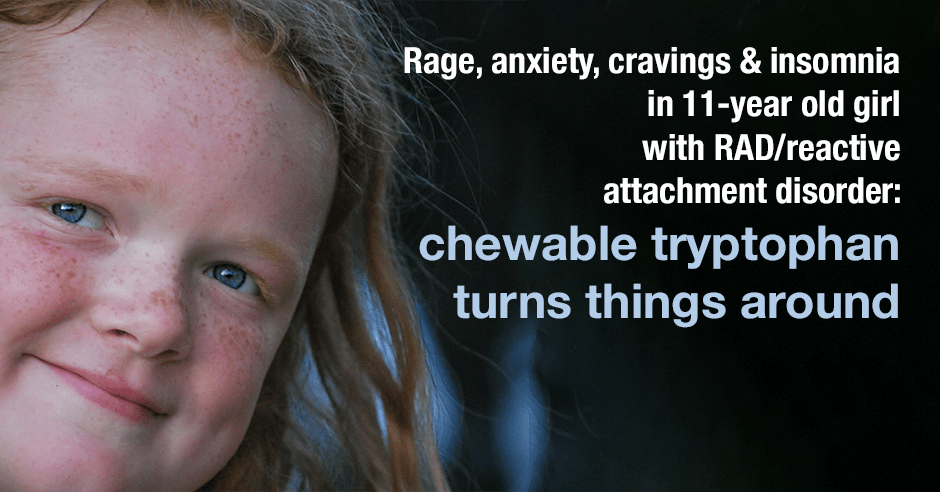
Rage, anxiety, cravings & insomnia in 11-year old girl with RAD/reactive attachment disorder: chewable tryptophan turns things around

May 28, 2021 By Trudy Scott 21 Comments

rad and tryptophan

Today I’m sharing the case of an 11-year-old girl who had huge rage issues, was angry much of the time, suffered from terrible anxiety, had crazy sugar cravings (for bread and colored candies) and had dreadful insomnia. Because of the insomnia she was also very fatigued and this likely drove some of her cravings and irritability too. She was adopted and had been diagnosed with RAD (reactive attachment disorder). During our first session, chewable tryptophan turns things around quickly – she smiles and is willing to make changes and quit the sugar and gluten. We also address low iron levels and with these 4 nutritional interventions this child’s behavior improves dramatically.

This book chapter, Reactive Attachment Disorder, states how The Diagnostic and Statistical Manual 5th Edition (DSM-5) classifies reactive attachment disorder as follows:

a trauma- and stressor-related condition of early childhood caused by social neglect or maltreatment. Affected children have difficulty forming emotional attachments to others, show a decreased ability to experience positive emotion, cannot seek or accept physical or emotional closeness, and may react violently when held, cuddled, or comforted. Behaviorally, affected children are unpredictable, difficult to console, and difficult to discipline. Moods fluctuate erratically, and children may seem to live in a “flight, fight, or freeze” mode. Most have a strong desire to control their environment and make their own decisions. Spontaneous changes in the child’s routine, attempts to discipline the child, or even unsolicited invitations of comfort may elicit rage, violence, or self-injurious behavior.

Reactive attachment disorder/RAD and low serotonin

There is no research on tryptophan helping to address RAD symptoms or trauma, but based on her low serotonin symptoms, a trial of tryptophan was the first thing I considered.

There is, however, evidence to indicate the role of low serotonin in RAD, as indicated by a study where antidepressants were successfully used. The authors mention how:

The absence of responsive and consistent caretaking can subject the developing brain to an inordinate amount of physiological stress, leading to increased cortisol production and consequential inefficiencies in the serotonin and the growth-hormone releasing systems.

Although not specific to RAD, another paper looking at trauma states that:

Serotonin and dopamine levels were found to be abnormal in the presence of PTSD.

As the field of nutritional psychiatry grows, I expect to see more and more research supporting the use of tryptophan and other amino acids for those suffering from symptoms like this. Symptoms that are caused by imbalances that are triggered by the trauma in their lives.

We know that therapy, EFT, EMDR and other approaches are crucial for trauma recovery (this family had already done some of this work) but we must start to incorporate nutritional support too.

The case study

Here are the details of this case study and the nutritional interventions. As I mentioned above, because of her severe rage episodes, a trial of tryptophan was the first thing I considered:

She was referred to me by a friend. The family didn’t have much money. And so, we had to really try and figure out a few simple interventions that we could use that were going to be effective.

This young girl had been adopted. She was diagnosed with reactive attachment disorder and her anger issues were just phenomenal. The mom had to physically put her body around her and hold her down when she was having one of her fits because she was worried that she was going to hurt herself and hurt other people.

She also had anxiety, huge cravings for colored candies and insomnia. She was so fatigued because she wasn’t sleeping well.

So sitting in my office with this young girl and her mom, we started to talk about the sweets and the candies and the need to give up the candies. She was fuming with me. She was sitting in a swivel chair. She turned her back on me and didn’t want to talk about having to give up candy at all.

I said, “Look, let’s not even talk about that, but would you take this chewable tryptophan here? And we’ll talk about it in a second.” I gave her 100 mg of the chewable tryptophan and continued discussing things with her mom.  She had no idea what it was going to do or how it would make her feel.

Within five minutes she turned her chair back, looked at me and she said, smilingly, “Yes, let’s do it. I can give up the candy.” She was smiling and she was happy.

So long story short, with this young girl, we started her on [chewable] tryptophan [and it turned things around quickly].

Chewable tryptophan – when I use it and when I don’t

I typically use 500mg Lidtke tryptophan for the adult clients I work with and prefer this company’s product because it is really high quality. It really does work better than many other tryptophan products on the market.

Lidtke also makes a chewable 100mg tryptophan which is also high quality, and the product I used with this young girl. Here are some benefits of this 100mg product:

  • It’s useful for doing the initial trial in order to figure out if tryptophan is going to help with low serotonin symptoms in children – because it’s a lower dose.
  • It’s especially useful for children for ongoing use (typically midafternoon and evening) because it’s a lower dose.
  • It’s also useful for adults who are “pixie dust” folks and do better with a lower dose of supplements in general or respond more severely to medications/alcohol/chemicals. We may start with a trial of the 100mg chewable and increase from there, also typically midafternoon and evening.

I don’t use the chewable 100mg tryptophan under these circumstances:

  • When the child (or adult) finds that 5 x100mg works for them at each time they need it. In this instance it’s best to switch to a 500mg tryptophan. Using it swallowed may work or it may need to be opened onto the tongue.
  • When the child (or adult) starts to consume the chewables like candy. They are sweet and do taste good and I’ve seen this happen. Because you are continually consuming something sweet you may end up over-consuming them if sugar addiction is one of your issues. You may also end up taking too much tryptophan.

If the chewable tryptophan is not available where you live, using a small amount of a powdered tryptophan or opening a capsule of the 500mg tryptophan is an option. Since it tastes bitter it can be mixed with mashed banana or inositol. (You can find all the Lidtke products in my online supplement store. The link is in the resources section below.)

Gluten and candies were also a huge issue, and she had low iron

There was more to her issues than only low serotonin:

Gluten was also a huge issue, so we got her off gluten and the candies. The tryptophan helped with this” (i.e. it made it easy to break the addiction and not feel deprived).

Tryptophan also helped her sleep. And it helped with the severe rage issues.

Obviously the gluten was contributing to the rage issues as well.

Her iron and ferritin levels were really low (possibly as a result of her gluten issues). So we added an iron supplement, and animal protein/red meat.

So with just four interventions – the gluten, the animal protein, getting her iron levels up and the tryptophan – this kid was just a new kid.

Here are some articles that are related to the above:

  • The role of low serotonin, low vitamin B6 and low iron in anxiety and panic attacks
  • Integrative Medicine Approach to Pediatric Obsessive-Compulsive Disorder and Anxiety I write about a study where gluten was found to be the cause of a childhood case of obsessive-compulsive disorder (OCD)
  • Tryptophan for my teenager: she laughs and smiles, her OCD and anxiety has lessened, and she is more goal oriented and focused on school.

Keep in mind there is not a one-size-fits-all and these 4 simple nutritional interventions – tryptophan, gluten removal, adding red meat and addressing low iron – happened to be the combination that worked for this young girl.

Resources if you are new to using tryptophan as a supplement

If you are new to using the amino acid tryptophan as a supplement, here is the Amino Acids Mood Questionnaire from The Antianxiety Food Solution and a brief overview here, Anxiety and targeted individual amino acid supplements: a summary.

If you suspect low serotonin symptoms and do not yet have my book, The Antianxiety Food Solution – How the Foods You Eat Can Help You Calm Your Anxious Mind, Improve Your Mood, and End Cravings, I highly recommend getting it and reading it before jumping in and using amino acids so you are knowledgeable.

The book doesn’t include product names (per the publisher’s request) so this blog, The Antianxiety Food Solution Amino Acid and Pyroluria Supplements, lists Lidtke chewable tryptophan 100mg, Lidtke tryptophan 500mg and other products that I use with my individual clients and those in my group programs.

We use an amino acid like tryptophan for quick relief of symptoms, like I did in this instance. Then we focus on the foundations like diet – like no gluten and red meat in this instance – and address all other imbalances, like her low iron. If cortisol was high we would have addressed that.

This case deserves it’s own blog post

In case you’re wondering, I first shared this case study in my interview, “Calming Anxiety, Aggression and OCD with Amino Acids and Food”, on the ADHD and Autism Summit in May 2021. Due to the interest in this case and the use of chewable tryptophan, I felt it deserved a deeper dive and its own blog post with links to some of the research and some practical information about the chewable tryptophan.

Have you used this chewable tryptophan product with success – personally, with your child or with a patient/client?

Have you found that addressing serotonin with tryptophan (or 5-HTP) helps resolve symptoms in a child diagnosed with RAD or a child with rage issues? What about helping with sleep problems, easing anxiety and stopping cravings too?

Have you addressed low iron levels and seen improvements with the removal of gluten too.

Feel free to post your questions here too.


Filed Under: Anxiety, Children/Teens, PTSD/Trauma, serotonin, Tryptophan Tagged With: adopted low iron, angry, anxiety, behavior, chewable tryptophan, cravings, fatigue, gluten, insomnia, irritability, nutritional interventions, nutritional psychiatry, RAD, rage, reactive attachment disorder, self-injurious behavior, serotonin, sugar, trauma, unpredictable, violence, young girl

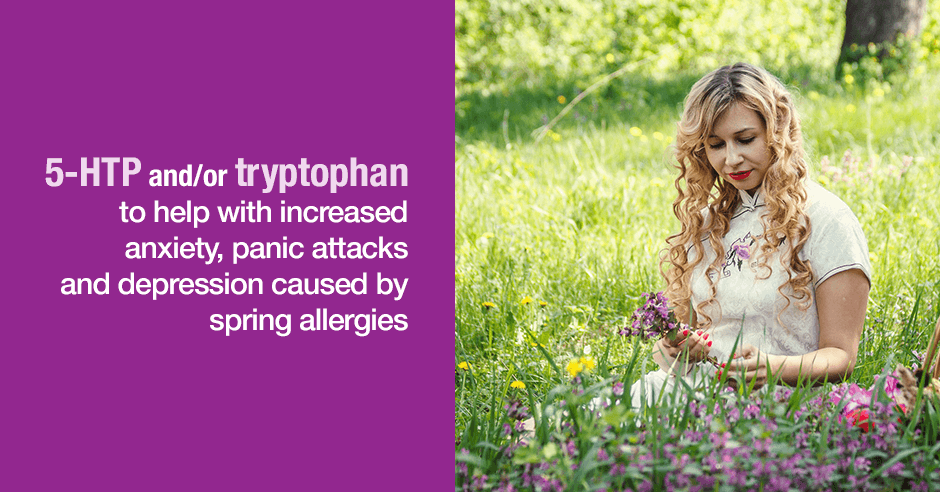
5-HTP and/or tryptophan to help with increased anxiety, panic attacks and depression caused by spring allergies

April 23, 2021 By Trudy Scott 24 Comments

5-htp, tryptophan, and spring allergies

Many of my clients experience increased anxiety, more severe panic attacks and worse depression when their spring allergies are flaring up. Do they feel like this simply because they feel so bad physically or could there be some underlying biochemistry that triggers their worsening mental health symptoms? I explain below how low serotonin is one possible root cause that can be addressed nutritionally with tryptophan and/or 5-HTP. Other factors to consider are the impact on the adrenals and GABA levels.

Today’s blog is inspired by Unten, who is part of my Facebook community. She asked this question:

I find that always during spring my anxiety and panic attacks get much worse when there’s lots of pollen and dust and other allergens in the air (at least here in Finland)…could this be true and not just “in my head”?

And then someone else responded saying:

I have noticed the same for me as well here in the USA.

My response to both of them is that it is not just in your head. There is plenty of research supporting this connection and we see it clinically too.

This paper, Changes in Severity of Allergy and Anxiety Symptoms Are Positively Correlated in Patients with Recurrent Mood Disorders Who Are Exposed to Seasonal Peaks of Aeroallergens, confirmed a significant positive association between allergy scores and anxiety scores and reports some possible mechanisms:

  1. The psychological effects of being ill, as well as impairments of sleep secondary to nasal obstruction or inflammation may affect mood.
  2. Cytokines may lead to a mood disturbance via the expression of the enzyme indoleamine-2,3-dioxygenase, which shifts the synthesis of tryptophan from serotonin to kynurenine. The resultant acute tryptophan depletion results in decreased brain serotonin, which may contribute to both depression and anxiety.
  3. Cytokines released during allergic inflammation may affect the brain directly, via nerves, surrounding tissue, or via regions that do not have a blood brain barrier, such as the circumventricular organs.
  4. Cytokines may also be involved in changes in the hypothalamic-pituitary-adrenal (HPA) axis… A sustained increase in activity in the HPA axis is associated with severe anxiety.
  5. Cytokines might lead to a physiological change in GABAA receptor functioning

I’ll discuss some possible solutions below.

Tryptophan and/or 5-HTP for low serotonin support if needed

The second bullet above is a good reason to consider serotonin support with tryptophan or 5-HTP.  If you have anxiety or panic attacks (and other low serotonin symptoms), we always want to figure out if low serotonin is a possible cause and address it, regardless of the circumstances/trigger (seasonal allergies in this instance).

Here are some useful blogs related to low serotonin and the amino acids:

  • You can see all the low serotonin symptoms here.
  • You can see the 5-HTP and tryptophan products I use with my clients here on the supplements blog.

Christine’s increased depression due to seasonal allergies improves a few days after starting 5-HTP and tryptophan

When I posted the above possible mechanisms on Facebook, Christine thanked me and shared her surprise:

I had no idea! This explains my increased depression lately. I didn’t know there was a correlation, but it makes complete sense now.  I’m in the Midwest. I’ve always had issues in March and April because of my seasonal allergies.

When I asked if she has used tryptophan or 5-HTP and bumped up the dose when she is suffering during seasonal allergies, she responded:

I just learned about both of these [amino acids]. I just bought your book and I am starting to use them. I don’t know if they take a while to start working?

I responded saying the amino acids work very quickly if they are needed and serotonin is low. It was not surprising to me that Christine shared her great results a few days later:

I’ve been using 5-HTP and tryptophan. I’m feeling so much better now. Thank you!

If your anxiety or depression is caused by low serotonin, you can expect to feel some relief right away provided you find the ideal dose for your unique needs. For some it’s a solution right away and for others it can take some adjusting up and down and trialing with 5-HTP and/or tryptophan to find the right combination.

Adrenal support and/or Seriphos if needed

The fourth bullet under the possible mechanisms above, is a good reason to also consider adrenal support: herbal adaptogens such a rhodiola and licorice, B vitamins, extra pantothenic acid and vitamin C. I also recommend using something like Seriphos to lower high cortisol if needed.  Another option is Relora®, a combination of Magnolia officinalis and Phellodendron amurense which lowers cortisol and reduces stress and anxiety.

Low GABA support if needed

The fifth bullet above is a good reason to consider GABA support with GABA or theanine if you have the low GABA type of physical tension that is made worse during your seasonal allergies. Just like with low serotonin we always want to figure out if low GABA is a possible cause of the anxiety and address it, even if it’s being made worse because of seasonal allergies.

You can see all the low GABA symptoms here and GABA products I use with my clients here on the supplements blog.

Address all root cause of anxiety/depression and the seasonal allergies

As always, it’s not only the low serotonin and/or high cortisol we need to address. We must always do a full functional workup looking at diet, nutritional deficiencies, digestion, all hormones, toxins and infections (and so on) so we can address all possible root causes.

Of course, identifying and addressing the root causes of the seasonal allergies is important too. This blog, Hay Fever: 9 Natural Ways to Treat Seasonal Allergy Symptoms by Dr. Josh Axe, outlines many dietary and lifestyle changes that can have a big impact. You’ll notice that much of this is foundational to my work.

Stress reduction is key and serotonin/GABA support help so much in this regard. So does zinc which is needed for both the production of serotonin and GABA, and enhanced immunity.

The blog also states that quercetin helps with seasonal allergies because it “stops the production and release of histamine.” Interestingly, quercetin also protects  against stress-induced anxiety and depression in animal studies (here is a link to one such study).

Thanks to these folks for asking good questions and for allowing me to share here.

My first take-away is not to ever tolerate not feeling your best (if that’s confusing – you deserve to feel your best always!) and always ask questions and look for connections.  My second take-away is to encourage you and others in my community to be empowered and take action. So kudos to Christine for jumping and purchasing my book, The Antianxiety Food Solution, reading it and being smart about using the amino acids.

Have you found that higher doses of tryptophan or 5-HTP helps with reducing the more severe anxiety, the depression/low mood and/or the increased panic attacks you experience during allergy season?

What about other low serotonin symptoms such as insomnia, cravings and PMS? Are they worse during allergy season?

Have you found addressing low GABA anxiety with higher doses of GABA helps when you have seasonal allergies?

Have you tested your cortisol levels during allergy season and found that adrenal support helps too? Keep in mind it will take longer to see results if this is the case.

Feel free to post your questions and feedback in the comments below.

Filed Under: 5-HTP, Allergies, Anxiety, Tryptophan Tagged With: 5-HTP, allergens, anxiety, cravings, cytokines, depression, dust, GABA, HPA axis, IDO, insomnia, panic attacks, pollen, quercetin, seasonal allergies, serotonin, spring allergies, tryptophan, zinc

5-HTP for a calm brain, and a racing mind at night: questions and answers

April 16, 2021 By Trudy Scott 39 Comments

5-HTP q and a

5-HTP is an amino acid, made from the seeds of an African plant, Griffonia simplicifolia, and used as a supplement to ease low serotonin symptoms. With low levels of serotonin you’ll experience the worry-type of anxiety with ruminations, obsessing, panic attacks, insomnia (often lying awake worrying). This type of anxiety is different from the low GABA physical/tension type anxiety. Other low serotonin symptoms include low mood/depression, late afternoon and evening carbohydrate cravings, pain, digestive/IBS symptoms, PMS, irritability, rage and anger, TMJ, low confidence, imposter syndrome and perfectionism.

When I share my low serotonin blogs on Facebook I receive so many great questions about 5-HTP. Today I’m going to share some of these questions and my answers so you can get the benefits too.

Gail asks why 5-HTP stopped working for her when it had been working so amazingly well:

I took 5-HTP and it worked amazingly….for about 6 months. Then it did nothing. Any idea why?

I took 100 mg per day. It’s hard to explain, but it calmed my brain down. I wasn’t so quick to blurt things out during the day and at night I was able to sleep because my mind wasn’t racing. Nothing else changed at that time. That was a few years ago, I think I’ll buy more and try again

I would guess that something did shift around the 6 month mark and would try and identify what it was so you know for the future. It could have been accidental gluten exposure (from the diet or even cosmetics), hormonal shifts (perimenopause or menopause), adding collagen or gelatin on a regular basis (this can lower serotonin in susceptible folks) and/or changes in thyroid health.

If you have pyroluria and were exposed to major stresses (life stresses or toxic mold etc.) you’d lose vitamin B6 and this could affect serotonin production. The addition of the birth control pill and antidepressants can also deplete vitamin B6. I share some possible reasons for low serotonin on this blog on imposter syndrome (as mentioned above, imposter syndrome is a common sign of low serotonin).

With these wonderful benefits Gail experienced, trialing 5-HTP again is worth considering. Because 5-HTP works so quickly she’ll feel that sense of calm right away and she won’t blurt things out during the day (possibly caused by lack of confidence and/or irritability and/or anger?). Also, her mind won’t race at night, she’ll fall asleep quickly and will stay asleep, waking rested, calm, happy, confident and optimistic.

And in future if something like this happens again, I’d try to identify the cause and bump up 5-HTP temporarily.

Wendy asks about headaches as an adverse effect:

What do you recommend if 5-HTP gives you headaches?

Headaches are not a common adverse effect with 5-HTP (compared to the amino acid tyrosine which is recognized to cause headaches and migraines in susceptible folks).

Even if you are seeing benefits – for the worry-type anxiety and other low serotonin symptoms – with 5-HTP you don’t ever want to push through with something like headaches and continue to take it. I have clients use less 5-HTP and observe if they still see the benefits with no headaches.

We also make sure low serotonin is the issue. If it’s not then any amount of 5-HTP will either do nothing or cause adverse effects. If the issue is low serotonin then I have clients do a trial of  tryptophan.

If the 5-HTP is being used to ease low mood/depression caused by low catecholamine or low endorphins depression then neither 5-HTP or tryptophan is going to help and may cause adverse effects. And tyrosine and/or DPA are better choices.

Gerry asks this question after my interview on Your Best Sleep Ever Summit:

Great talk Trudy. When you want to increase serotonin, do you take both 5-HTP & tryptophan or just one or the other?

They can be used alone or both can be used together. I like to have clients add one new amino acid supplement at a time so we know what is working before confounding things with another one. I typically start with tryptophan for low serotonin support simply because I have such good results with it and because 5-HTP can raise cortisol in some folks.

We start with tryptophan mid-afternoon and evening (after doing a trial earlier in the day to make sure it helps).  If tryptophan causes adverse effects or doesn’t work then we do a trial of 5-HTP and then use it afternoon and evening (when serotonin levels tend to drop).

If tryptophan is working in the afternoon and evening, and additional support for worry or ruminations or panic or anxiety is needed earlier in the day, we may consider 5-HTP which can often also help improve focus. We may also consider tryptophan earlier in the day too.

It’s very individualized and we may mix and match to find the ideal combination and dosing based on trials and symptom resolution. It’s important to be aware that some folks do better on 5-HTP and some do better on tryptophan.

Here are some useful blogs related to low serotonin and the amino acids:

  • You can see all the low serotonin symptoms here.
  • Fibromyalgia: tryptophan or 5-HTP for anxiety, depression, pain and insomnia
  • You can see the 5-HTP and tryptophan products I use with my clients here on the supplements blog.
  • You may find this helpful too – GABA for easing physical anxiety and tension: some questions and answers.

As always, it’s not only the low serotonin we need to address. 5-HTP offers quick relief but we must always do a full functional workup looking at diet, nutritional deficiencies, digestion, all hormones, toxins and infections (and so on) so we can address all possible root causes – and why serotonin is low in the first place.

Thanks to these folks for asking good questions and for allowing me to share here.

What questions do you have about 5-HTP?

Which low serotonin symptoms can you relate to and has 5-HTP or tryptophan helped? Or have you found success with a combination.

Feel free to post your questions and feedback in the comments below.

Filed Under: 5-HTP, Anxiety, Insomnia, Tryptophan Tagged With: 5-HTP, anxiety, calm, collagen, cravings, Fibromyalgia, gluten, Headaches, hormonal, insomnia, night, obsessing, panic, racing mind, ruminations, serotonin, stopped working, thyroid, tryptophan, worry

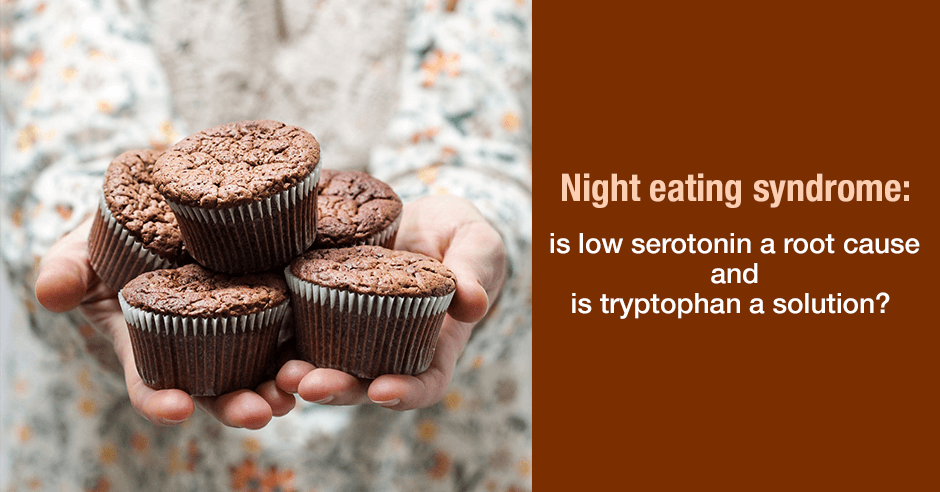
Night eating syndrome: is low serotonin a root cause and is tryptophan a solution?

April 9, 2021 By Trudy Scott 28 Comments

night eating syndrome

According to this paper, Circadian Rhythm Profiles in Women with Night Eating Syndrome, “Patients with night eating syndrome (NES) – first described in 1955 – demonstrate a phase delay in the circadian pattern of food intake, manifested by evening hyperphagia, nocturnal awakenings with food intake, and morning anorexia.”

I would start by asking this question: is low serotonin a root cause and is tryptophan a possible solution? I’ll share why below and where to start in order to find a solution.

Before I do that let me explain the terminology used in the above quote: Circadian means it happens every 24 hours, hyperphagia is obsessive food-seeking behavior, nocturnal awakenings are waking in the night and anorexia refers to restricted eating in the morning.

There is no research supporting the use of serotonin support with either tryptophan or 5-HTP for night eating syndrome but I would still start here for the following reasons:

  • this behavior happens in the evening and at night and it’s well recognized that serotonin levels are lower later in the day and at night
  • carbohydrate cravings and addictions occur with low serotonin and cravings are most intense later in the day (typically afternoon and evening)
  • obsessive behaviors are common with low serotonin
  • insomnia or night-time waking is a common symptom with low serotonin
  • doing a trial with either of these amino acids will very quickly confirm if low serotonin is a contributing factor or will rule it out

I would also have my client look at other low serotonin symptoms which would help confirm that low serotonin may be a factor for them: worry-type of anxiety, ruminations, PMS, irritability, rage or anger, TMJ, panic attacks, perfectionism, depression, low self-esteem and so on. You can see all the low serotonin symptoms here.

We typically start with a trial of tryptophan simply because so many of my clients do so well with it. The other reason is that 5-HTP can raise cortisol and cause a wired-tired feeling. That being said, some folks do better on one vs the other so if tryptophan doesn’t help then we trial 5-HTP.  You can see the products I use with my clients here on the supplements blog.

I would love to see tryptophan or 5-HTP being more extensively – because it works so effectively and quickly, and is addressing the root cause – but also because there is research that does support the serotonin connection to night eating syndrome:

  • Night eating syndome has been associated with “depression, emotional eating, sleep problems, and food addiction as well as with being overweight or with having obesity (especially as people age)” – all low serotonin symptoms.
  • Night eating patients are “responsive to selective serotonin reuptake inhibitor treatment” (antidepressant/SSRI treatment)
  • Bright light therapy may help with night eating because of it’s “serotonergic antidepressant mechanisms of action.” Night eating syndrome also shares features with seasonal affective disorder (SAD) and it’s not uncommon to experience both. The winter blues or SAD is common with low serotonin. I write more about SAD and bright light here.

I’d also consider low blood sugar as a contributing factor. We would need to rule out the use of the sleep medication Ambien/Zolpidem which has been shown to cause amnesia and sleep related eating disorders which resolves when the medication is stopped.

As always, it’s not only the low serotonin we need to address. Tryptophan or 5-HTP offer quick relief but we must always do a full functional workup looking at diet, nutritional deficiencies, digestion, all hormones, toxins and infections (and so on) so we can address all possible root causes – and why serotonin is low in the first place.

I share some possible reasons for low serotonin on this blog on imposter syndrome. Imposter syndrome is another common sign of low serotonin.

Have you been diagnosed with night eating syndrome or do you feel you possibly fit the profile? Does it happen every night and what foods are you drawn to? Which low serotonin symptoms can you relate to and has tryptophan or 5-HTP helped? What about light therapy? And was an  antidepressant prescribed?

Feel free to post your questions and feedback in the comments below.

Filed Under: 5-HTP, Anxiety, Insomnia, Tryptophan Tagged With: 5-HTP, Ambien, anxiety, blood sugar, circadian, food intake, hyperphagia, insomnia, morning anorexia, NES, night eating, Night eating syndrome, nocturnal awakenings, obsessive, panic, SAD, serotonin, SSRI, tryptophan, waking, worry

Tryptophan calms comfort eating, eases self-doubt, reduces uncontrollable late night snacking and results in a lot more peace around food.

March 26, 2021 By Trudy Scott 26 Comments

tryptophan calms

Zoe shares her life long story about comfort eating, her insecurities and self-doubt in her teens, the comfort-foods that allowed her to “escape” and how addressing low serotonin at 41 years of age led to her feeling a lot more peace around food. The effects of one chewable tryptophan were instant! Here is her story in her own words, some insights from me and possible next steps for Zoe to consider.

Historically I had comfort eaten and felt insecure and had lots of self-doubt. This led to trying alcohol and cocaine in my early 20s, plus I’m a vegetarian so I think I blew through all my natural serotonin by the time I tried tryptophan at 41!

I think [low] serotonin was huge for me and tryptophan helped calm my comfort eating.

My comfort eating started at secondary school, around 14, an escape from my feelings when I got home from school. I would eat mashed potatoes with loads of butter or a Sara Lee Chocolate gateau.

Thinking about it now, I realize I was craving carbohydrates and I would eat till I felt sick. I craved feeling really full and sadly was bulimic for a few years there as a teenager. I think my feelings of not feeling good enough/unloved drove me to comfort eating and not feeling understood. I would eat, be sick then do an exercise video before my parents even got home! It may also have been hormonal as I get PMS. I also have PCOS (polycystic ovarian syndrome).

Good news is I tried tryptophan last summer and the effects were instant.

I hadn’t read the instructions properly so ate a Lidtke chewable tryptophan tablet with my meal and instantly felt the effect. I stopped eating and feeling hungry instantly. I took the chewables for a couple of months then went onto Lidtke 500mg for another few months.

I do still have a tendency to snack late at night but it’s gone from totally uncontrollable 8 or 9 out of 10 to a 3 or 4 out of 10. I don’t crave food anywhere near as much as I used to and I have a lot more peace around food now.

Thank you for being the one to introduce me to them, you are a super star.

A few thoughts from me

This is a wonderful outcome and I’m thrilled for her transformation! I also appreciate Zoe giving me permission to share here so you can be inspired and have hope!

A few thoughts from me:

  • PMS/dysphoria is common with low serotonin levels and research shows that tryptophan can help ease symptoms in a few cycles
  • Low levels of serotonin and endorphins can lead to alcohol consumption and experimenting with drugs as a means of self-medication. This can often be replaced with sugar addiction and cravings which are also a way to self-medicate.
  • Low serotonin is a factor with bulimia, although it’s typically an under-recognized factor when it comes to eating disorders.

I share where I’d start if we were working together and possible next steps below.

How did she use tryptophan and which products did she use?

Zoe initially used the Lidtke chewable (each one is 100mg) for a few months: ”I used the Lidtke chewable as I don’t need much to feel the effects of aminos!”

Then she switched to the Lidtke 500mg: “I was taking 500mg mixed with banana on an empty stomach every day for about 6 months.”

This amount of tryptophan would be considered low for most folks. 500mg is a typical starting dose often used 1-2 mid-afternoon and 1-2 in the evening.

You may see all her low serotonin symptoms and think she has a lot going on and will likely need large doses of tryptophan for serotonin support. But you never know how much tryptophan will work until you do a trial.

Low endorphins and DPA for eliminating comfort eating

Zoe actually posted much of the above in response to a question I posted on Facebook about eliminating comfort eating and the amino acid called DPA (d-phenylalanine). DPA typically helps the kind of eating where you feel “I deserve this or this is my reward or this is my treat.” Until you address low endorphins with DPA, you may also feel eating these foods are numbing – as in numbing or blocking emotional pain.

She shared “Yes I’ve tried DPLA and it had a very nice effect.” But as you’ve read above, low serotonin was a bigger issue for Zoe and it was the tryptophan that really helped calm her comfort eating.

DLPA or DPA?

I reminded her that DPLA (dl-phenylalanine) is quite different from DPA (d-phenylalanine). DLPA works on boosting low catecholamines (improving low motivation, poor focus and fatigue and stay-in-bed kind of depression) and to a small extent also low endorphins. DPA works purely on boosting low endorphins.

But Zoe did see benefits from DLPA:

DPLA made me feel very content with my life. I felt very happy where I was all of a sudden, instead of feeling the need to chase something better all the time. I’ve never had just straight DPA, I’ve found it hard to find.

It’s not uncommon to see low serotonin and low endorphins in situations like this.

Tryptophan is no longer helping: my feedback and other ideas

Zoe did also share this about the 500mg tryptophan no longer helping like it used to:

The tryptophan doesn’t seem to have the same effect on me anymore sadly but that maybe because I’m ‘topped up’ but I did wonder if I had ruined the quality of my tryptophan by storing it on top of my microwave (so they were heating up).

I’ll try the [Lidtke] Tryptophan Complete this time and hope they work as I do still get a bit of PMS which seemed to go away for a while.

I did hear about mixing it with inositol being a possible solution too?

Here is my feedback on some of this, where I’d start if we were working together and possible next steps:

  • My favorite DPA product is also made by Lidtke and it’s called Endorphigen. It may help with the last remaining snacking
  • However, timing wise late-night snacks for carbs tends to be low serotonin. I would try again with Lidtke 500mg (the microwave heat may have been an issue), considering a trial of 1000mg, trialing the Lidtke Tryptophan Complete (as she may be missing the cofactors to make serotonin) and even consider going back to the chewable Lidtke tryptophan which worked so well initially.
  • I would also look at other factors that may be lowering serotonin levels: has gluten snuck back in or is there any accidental exposure? Has she started consuming collagen and/or gelatin which can lower serotonin in susceptible folks?
  • I would consider trialing inositol if there is an obsessive tendency to the snacking. It does help with PCOS too.
  • She had said “I thought GABA would be amazing for me but it wasn’t.” Since GABA helps with PCOS and PMS, I would revisit GABA trials using different forms, higher doses and making sure trials are sublingual. Progesterone or herbs that support progesterone is another option.
  • I agree with Zoe’s comments about being a vegetarian. Low levels of neurotransmitters are common and we cover the benefits of grass-fed red meat for women in my interview with Dr. Felice Jacka on the first Anxiety Summit. I’d encourage adding some quality animal protein if she’s open to it.
  • For vegetarians, we often also add a free form amino acid blend with tryptophan, especially if adding animal protein is a no-no.
  • I would also consider pyroluria (the social anxiety condition) too as PMS is common, pyrolurics are often vegetarians, and the pyroluria protocol provides necessary cofactors for making serotonin. Zinc is often low in vegetarians too.
  • I would also assess for low iron and low B12 (also often low in vegetarians) and needed for serotonin production; and look into the BCP (birth control pill) or other meds that may be lowering serotonin.
  • I would have her doctor check thyroid health as low thyroid can reduce the effectiveness of the amino acids

As with everyone, a full functional workup looking at diet, nutritional deficiencies, digestion, all hormones, toxins and infections (and so on) is key to address all possible root causes.

Have you found that tryptophan calmed your comfort eating, reduced your self-doubt and late night carb snacking and led to feelings of peace around food? Did it also reduce PMS and other low serotonin symptoms?

If you’re a practitioner working with women who comfort-eat and have typical low serotonin symptoms, have you found tryptophan to help?

Feel free to post your questions and feedback in the comments below.

Filed Under: Cravings, serotonin, Tryptophan Tagged With: alcohol, bulimia, cocaine, comfort eating, craving, GABA, insecure, PCOS, peace, peace around food, PMS, pyroluria, self-doubt, self-medication, serotonin, snacking, thyroid, tryptophan, unloved, vegetarian

  • « Go to Previous Page
  • Page 1
  • Interim pages omitted …
  • Page 5
  • Page 6
  • Page 7
  • Page 8
  • Page 9
  • Interim pages omitted …
  • Page 11
  • Go to Next Page »

Primary Sidebar

GABA QuickStart Homestudy

gaba quickstart homestudy

Free Report

9 Great Questions Women Ask about Food, Mood and their Health

You'll also receive a complimentary subscription to my ezine "Food, Mood and Gal Stuff"


Connect with me

Popular Posts

  • Amino Acids Mood Questionnaire from The Antianxiety Food Solution
  • The Antianxiety Food Solution Amino Acid and Pyroluria Supplements
  • Pyroluria Questionnaire from The Antianxiety Food Solution
  • Collagen and gelatin lower serotonin: does this increase your anxiety and depression?
  • Tryptophan for the worry-in-your-head and ruminating type of anxiety
  • GABA for the physical-tension and stiff-and-tense-muscles type of anxiety
  • The Antianxiety Food Solution by Trudy Scott
  • Seriphos Original Formula is back: the best product for anxiety and insomnia caused by high cortisol
  • Am I an anxious introvert because of low zinc and vitamin B6? My response to Huffington Post blog
  • Vagus nerve rehab with GABA, breathing, humming, gargling and key nutrients

Recent Posts

  • Her cravings for chips and peanut butter were triggered by stress: GABA ends cravings and reduces physical tension and fear of heights
  • It is truly miraculous to be able to move through life without crippling anxiety and panic
  • GABA and tryptophan combo provide immediate and noticeable relief for tremors and cervical dystonia in just 7 days
  • Red light therapy for back and neck pain, plantar fasciitis and low mood – a complement to the amino acids GABA, DPA and tryptophan
  • What do I use instead of Seriphos to help lower high cortisol that is affecting my sleep and making me anxious at night?

Categories

  • 5-HTP
  • AB575
  • Addiction
  • ADHD
  • Adrenals
  • Alcohol
  • Allergies
  • Alzheimer's disease
  • Amino Acids
  • Anger
  • Antianxiety
  • Antianxiety Food Solution
  • Antidepressants
  • Anxiety
  • Anxiety and panic
  • Autism
  • Autoimmunity
  • benzodiazapines
  • Bipolar disorder
  • Books
  • Caffeine
  • Cancer
  • Candida
  • Children/Teens
  • Collagen
  • Cooking equipment
  • Coronavirus/COVID-19
  • Cravings
  • Depression
  • Detoxification
  • Diabetes
  • Diet
  • DPA/DLPA
  • Drugs
  • EFT/Tapping
  • EMF
  • EMFs
  • Emotional Eating
  • Endorphins
  • Environment
  • Essential oils
  • Events
  • Exercise
  • Fear
  • Fear of public speaking
  • Fertility and Pregnancy
  • Fish
  • Food
  • Food and mood
  • Functional neurology
  • GABA
  • Gene polymorphisms
  • General Health
  • Giving
  • Giving back
  • Glutamine
  • Gluten
  • GMOs
  • Gratitude
  • Gut health
  • Heart health/hypertension
  • Histamine
  • Hormone
  • Hyperparathyroidism
  • Hypoglycemia
  • Immune system
  • Inflammation
  • Insomnia
  • Inspiration
  • Introversion
  • Joy and happiness
  • Ketogenic diet
  • Lithium orotate
  • Looking awesome
  • Lyme disease and co-infections
  • MCAS/histamine
  • Medication
  • Men's health
  • Mental health
  • Mercury
  • Migraine
  • Mold
  • Movie
  • MTHFR
  • Multiple sclerosis
  • Music
  • NANP
  • Nature
  • Nutritional Psychiatry
  • OCD
  • Osteoporosis
  • Oxalates
  • Oxytocin
  • Pain
  • Paleo
  • Parasites
  • Parkinson’s disease
  • PCOS
  • People
  • PMS
  • Postpartum
  • PTSD/Trauma
  • Pyroluria
  • Questionnaires
  • Real whole food
  • Recipes
  • Research
  • Schizophrenia
  • serotonin
  • SIBO
  • Sleep
  • Special diets
  • Sports nutrition
  • Stress
  • Sugar addiction
  • Sugar and mood
  • Supplements
  • Teens
  • Testimonials
  • Testing
  • The Anxiety Summit
  • The Anxiety Summit 2
  • The Anxiety Summit 3
  • The Anxiety Summit 4
  • The Anxiety Summit 5
  • The Anxiety Summit 6
  • Thyroid
  • Thyroid health
  • Toxins
  • Tryptophan
  • Tyrosine
  • Uncategorized
  • Vegan/vegetarian
  • Women's health
  • Yoga

Archives

  • May 2026
  • April 2026
  • October 2025
  • September 2025
  • August 2025
  • July 2025
  • June 2025
  • May 2025
  • April 2025
  • March 2025
  • February 2025
  • January 2025
  • November 2024
  • October 2024
  • September 2024
  • August 2024
  • July 2024
  • June 2024
  • May 2024
  • April 2024
  • March 2024
  • February 2024
  • January 2024
  • December 2023
  • November 2023
  • October 2023
  • September 2023
  • August 2023
  • July 2023
  • June 2023
  • May 2023
  • April 2023
  • March 2023
  • February 2023
  • January 2023
  • December 2022
  • November 2022
  • October 2022
  • September 2022
  • August 2022
  • July 2022
  • June 2022
  • May 2022
  • April 2022
  • March 2022
  • February 2022
  • January 2022
  • December 2021
  • November 2021
  • October 2021
  • September 2021
  • August 2021
  • July 2021
  • June 2021
  • May 2021
  • April 2021
  • March 2021
  • February 2021
  • January 2021
  • December 2020
  • November 2020
  • October 2020
  • September 2020
  • August 2020
  • July 2020
  • June 2020
  • May 2020
  • April 2020
  • March 2020
  • February 2020
  • January 2020
  • December 2019
  • November 2019
  • October 2019
  • September 2019
  • August 2019
  • July 2019
  • June 2019
  • May 2019
  • April 2019
  • March 2019
  • February 2019
  • January 2019
  • December 2018
  • November 2018
  • October 2018
  • September 2018
  • August 2018
  • July 2018
  • June 2018
  • May 2018
  • April 2018
  • March 2018
  • February 2018
  • January 2018
  • December 2017
  • November 2017
  • October 2017
  • September 2017
  • August 2017
  • July 2017
  • June 2017
  • May 2017
  • April 2017
  • March 2017
  • February 2017
  • January 2017
  • December 2016
  • November 2016
  • October 2016
  • September 2016
  • August 2016
  • July 2016
  • June 2016
  • May 2016
  • April 2016
  • March 2016
  • February 2016
  • January 2016
  • December 2015
  • November 2015
  • October 2015
  • September 2015
  • August 2015
  • July 2015
  • June 2015
  • May 2015
  • April 2015
  • March 2015
  • February 2015
  • January 2015
  • December 2014
  • November 2014
  • October 2014
  • September 2014
  • August 2014
  • July 2014
  • June 2014
  • May 2014
  • April 2014
  • March 2014
  • February 2014
  • January 2014
  • December 2013
  • November 2013
  • October 2013
  • September 2013
  • August 2013
  • July 2013
  • June 2013
  • May 2013
  • April 2013
  • March 2013
  • February 2013
  • January 2013
  • December 2012
  • November 2012
  • October 2012
  • August 2012
  • July 2012
  • June 2012
  • May 2012
  • April 2012
  • March 2012
  • February 2012
  • January 2012
  • December 2011
  • November 2011
  • October 2011
  • September 2011
  • August 2011
  • July 2011
  • June 2011
  • May 2011
  • April 2011
  • March 2011
  • February 2011
  • January 2011
  • December 2010
  • October 2010
  • September 2010
  • July 2010
  • May 2010
  • April 2010
  • March 2010
  • February 2010
  • January 2010
  • November 2009

Share the knowledge!

The above statements have not been evaluated by the Food and Drug Administration. Products listed in this website are not intended to diagnose, treat, cure or prevent any disease.

The information provided on this site is for informational and educational purposes only and is not intended as a substitute for advice from your physician or other health care professional. You should consult with a healthcare professional before starting or modifying any diet, exercise, or supplementation program, before taking or stopping any medication, or if you have or suspect you may have a health problem.


Copyright © 2026 Trudy Scott. All Rights Reserved. | Privacy | Terms and Conditions | Refund Policy | Medical Disclaimer

Free Report

9 Great Questions Women Ask about Food, Mood and their Health

You’ll also receive a complimentary subscription to my ezine “Food, Mood and Gal Stuff”