• Skip to primary navigation
  • Skip to main content
  • Skip to primary sidebar

everywomanover29 blog

Food, Mood and Women's Health – Be your healthiest, look and feel great!

  • Blog
  • About
  • Services
  • Store
  • Resources
  • Testimonials
  • The Book
  • Newsletter
  • Contact
  • Search this site

Events

Is the term ‘broken brain’ hopeful and real or too negative and scary?

January 12, 2018 By Trudy Scott 18 Comments

If you experience anxiety, panic attacks, depression, memory or cognitive issues, ADHD or poor focus and someone suggests you may be suffering from a broken brain are you intrigued and hopeful that something that is broken can now be fixed OR do you consider the term broken brain too negative and scary?

I received this feedback from someone in my community when I shared my recent Broken Brain interview with Dr. Mark Hyman:

I’m looking forward to seeing the [Broken Brain] documentaries however I dislike the title. Everything that you say and think is affecting your brain. For me Broken is not a word with healing potencies but suggests that is something very bad happening in the brain. And maybe that is the case, but how we interpret our symptoms is very crucial for healing. In my opinion it could be Healing the Brain or something like that. I think is very important that the title implies positivity not fear!

I shared this feedback with her: “Thanks for sharing – you’re the 4th person in a day to say this. Prior to your feedback and hearing from 3 mental health colleagues earlier today I had not considered the name would invoke negativity and fear. One of my mental health colleagues shared with me that “referring to people as ‘broken’ is really stigmatizing and inappropriate.”

My thinking is that just like a leg is broken, the brain can be broken and can just as easily be fixed when we address the root causes. I’ve also watched the series (during the test run late last year) and have seen the wisdom, caring and compassion of the experts and Dr. Hyman, as well as the solutions and message of hope. I suspect that has swayed my opinion too. But I do see your point on being positive and solution-oriented without the fear aspect.”

What do you think?

It’s important that I serve my community well – and that’s you! If something concerns you I want to know so I can address it.  I also want you to know that I’m offering solutions hope and not wanting to create fear and negativity, so I posed this question on Facebook (together with the above feedback from the blog):

I’d love to hear your thoughts on the title of Dr. Hyman’s new Broken Brain docu-series?

What do you think? Good title? Bad title? And why?

The positive feedback: enlightening, fixable, hopeful

The majority of responses were positive feedback. Here are many of them:

  • Mary Anne McEvoy: I rather like the title. When I read the word “Broken” it brought my awareness to: “WOW – the brain can actually get ‘broken’!” I want to see the docu-series because of the word broken.
  • Cathcart Louque: I don’t mind the title at all. I work in mental health (as a Care Manger for a non-profit mental health organization helping low income people) and see “broken brains” everyday which could be so much better by diet, exercise, meditation etc. I wish something would shake people up into wanting to have better brain health. Dementia and Alzheimer’s can be at work ten, twenty, thirty years before it manifests but people continue to make bad choices. I hope his videos will bring enlightenment to many and more will be proactive! Me included 😀! Daily healthy choices are not always the easiest but boy it’s so worth it.
  • Susan McDuffie: This title may really speak to those who feel in dire straits. ‘Have tried everything, read everything, and still struggle.’ Sometimes it’s the darker words that actually resonate with people.
  • Wyndie: I’m not afraid of the word broken – it’s true. Some things break. But broken things can be fixed. When I hear that title, I don’t hear negative, I hear reality.
  • Holly Higgins, NTP: I love the title. It’s catchy, alliterative, and it’s the exact words that so many of my clients use to describe how they feel. I’ve heard this phrase over and over by people who feel like they’ve been harmed by psychiatry or have never felt like their brain was working right. We are all going to have different reactions. It’s clear from the content of the series and the character of the people involved that this was not meant to be offensive.
  • Marthe: I actually liked the title. I thought it was powerful and, to me, it inferred that brain issues are becoming common occurrences and that there are ways to heal.
  • Leslie Montano: It’s just a title. I like the alliteration. It’s catchy, easy to remember, and certainly effective in that way for marketing. It not stigmatizing, it is not directly calling any person broken, it is speaking about a part of the body generally. Things that are broken can be repaired. There is hope. And personally, 2 years ago before I fixed my diet and lifestyle, I felt broken. Broken brain explains EXACTLY what was going on and how I was feeling.
  • Sharleen McDowall: As a psychologist, I like the title. I see the title the same way you do – just like a broken leg. I think the title conveys a strong message and it is needed to spark the conversation about how we are treating our brains. Also, Dr. Hyman’s message focuses on how the broken brain can be healed which is very positive.
  • Lee Ann Foster: First of all, it’s a good, empowering series giving people a lot of useful and hope-inspiring information to care for their brain related issues. Secondly, as a 30-year old functional neuropsychology practice, Neurosource, in which we get to root issues and help re-regulate brain function through evidence based technologies and lifestyle interventions, we find that many people are relieved when we show them through 3-D neuroimaging how their brain is dysregulated – or one could say broken. We find people feel hopeful when they see their issues are physiological in nature (and can be helped), versus giving them stigmatized and often inaccurate or unhelpful mental health diagnostic labels that mean very little aside from labeling for insurance and pharmaceutical purposes. Just my two cents.
  • Pierce: For me the first step in healing is acknowledging that I’m broken at the moment. Then I focus on moving forward and healing for the long term.
  • Deena Louise: My son has tuberous sclerosis that has left him severely disabled with autism, MR and uncontrolled epilepsy….when my daughter, who is younger than him by 6 years, was able to understand that he was “different” than neurotypical people, she asked what was wrong with him….why didn’t he talk. She didn’t understand autism, so we just told her he had a broken brain. Some things can be fixed and some things can’t. She understood it when we said it that way. I think the title is fine…broken is just a word used to describe something that isn’t working right at the moment. Dealing with anxiety, menopause, insomnia and panic…my brain definitely feels broken! I can’t wait to watch the series, I don’t care what he calls it. I am grateful for all of these lovely functional medicine docs and scientists giving of their time and expertise to help so many.

The less than positive feedback: worthless, negative, insensitive

Three mental health professionals felt the term broken brain was stigmatizing but other than this, surprisingly few people had negative feedback. A few people resonated with words like repair or mend instead of broken, saying most people think of broken as worthless and negative, and can’t be fixed. One mom felt it was insensitive to the real struggles of depression and anxiety. Here are a few specific comments:

  • Donna: Broken brains aren’t as easily fixable as broken legs. Broken brain means Alzheimer’s or stroke or something equally scary to me. I think another word could have been used to get the point across…. whatever a broken but fixable brain is…
  • Missy Ruth: Our brains are not broken. They regenerate and grow and change and are incredible. However, they certainly can feel like they are not operating like we wish they would. Labeling the brain as “broken” is an example of inflammatory linguistics, and as human beings we create fear by using terms that exaggerate. We scare ourselves. Nobody’s brain is broken.

If you don’t like the term broken brain, I’m hoping you will get some inspiration and feel some level of comfort from the positive comments above and watch it anyway. You will see there are solutions, compassion and hope!

Also, many of my clients who use words like “negative, worthless, scary and fear”, do feel better when we look into low serotonin and address low levels with tryptophan or 5-HTP. Also, addressing gluten issues, poor gut health, low GABA, low zinc and so on – everything body-related that can affect the mind and brain. All of this is covered in the docuseries, other then the use of targeted amino acids, which I cover extensively in my book The Antianxiety Food Solution, in my newsletters and elsewhere on this blog.

An apology: integrity, compassion and hope

I really want to hear your thoughts but also want to offer Dr. Hyman’s apology if you are offended by the term broken brain. As soon as his team started getting feedback they issued this statement on his behalf:

Thank you for your comment. We completely understand what you are saying and we agree. So much of this docuseries is about Dr. Hyman’s personal health crisis and how he treated his own brain disorder. During this time Dr. Hyman felt like he had a broken brain. This is why we decided to call the title Broken Brain because the foundation of the series is about his personal journey. However, we do not think that everyone who is dealing with a brain disorder or a developmental disorder has a broken brain. We know that all individuals, including those with brain conditions, are fully complete people, each with their unique spirit. We hope that you’ll watch the series and understand that more than anything it’s about hope and about moving toward our best health!

I find this very thoughtful and it clearly reflects the level of his integrity and compassion.

In case you’re just hearing about the Broken Brain for the first time, you can watch my highlights video interview with Dr. Hyman (together with the transcript).

So, what do YOU think? Is broken brain a good title or term? Or a bad title or term? And why?

(With appreciation if you already provided feedback and for giving me permission to share it here. This is a good discussion to have!)

Filed Under: Antianxiety, Events Tagged With: anxiety, broken brain, depression, Dr. Mark Hyman, hopeful, Negative, panic attacks

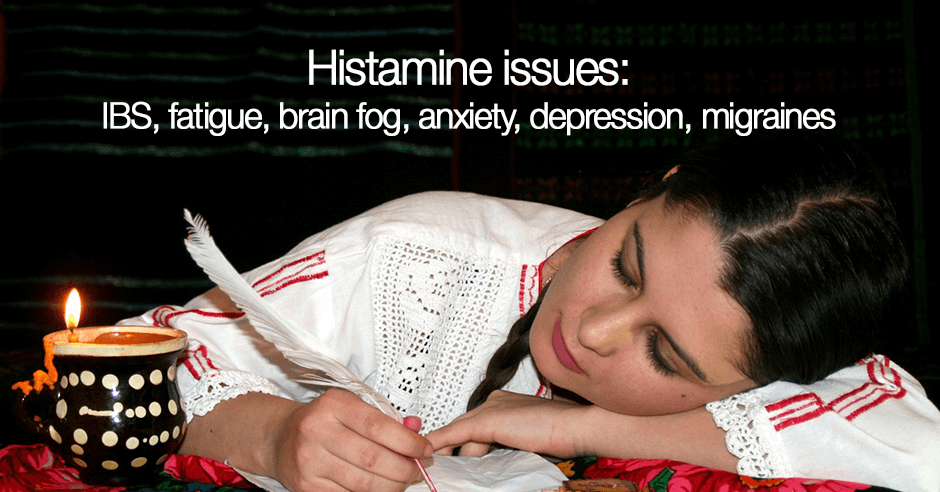
Histamine issues: IBS, fatigue, brain fog, anxiety, depression, migraines

January 11, 2018 By Trudy Scott 10 Comments

Dr. Ben Lynch is hosting the Dirty Genes Summit Jan 22-39 and he shares this about you and your genes:

You are not a victim of circumstance… born with bad genes, destined to die of whatever your family tree has genetically bequeathed you.

The way your genes express is unique – and it can change throughout your life. 

Knowing how to create that change is vitally important and you’ll see how clear this is in his wonderful histamine interview with Yasmina Ykelenstam of Healing Histamine.

I love the bucket analogy where Yasmina shares about histamine and inflammation:

Imagine the body as a giant bucket and there is only so much inflammation you can put into it before our inflammation causing behaviors that you can fill it up with before you spill over symptoms. So let’s say you fill it with a few high histamine foods; then you feel it up with stress; then you fill it up to being exposed to animal hair (dander); then pollen season starts; and woah, we’re right, right, right at the top; and then we eat an apple which is not high histamine, it doesn’t cause inflammation, in fact, it’s anti-inflammatory; and suddenly we spill over because the active digestion itself is an inflammatory process.

We blame the poor little apple and not the hamburger we ate the week ago that started the inflammation bucket filling up. We don’t blame the puppy because we love the doggy so much. We certainly don’t blame our stress because we don’t want to take too hard a look at our lives and how difficult it would be for us to make changes, steps to take real steps to handle our stress and to start meditating or to remove stressful processes from our life because that’s just too much for us to handle

She shares how you can combat some of this by adding foods with

anti-properties: anti-histamine and anti-inflammatory properties…I just stopped eating the wrong high histamine foods, the processed ones, the sugary ones, the ones that added nothing to my life beyond the two seconds in my mouth.

Dr. Lynch asks Yasmina to list symptoms she experienced in this midst of her histamine issues (many of which are commonly seen in individuals with histamine issues)

IBS, which is mostly loose stools or being totally bound up so you can’t go to the bathroom for 8 days and they tend to go back and forth… severe swelling of the stomach – what I call basketball stomach… At my worse, it was projectile vomiting and constant nausea, and constant until it went away… chronic migraines. I once had migraines every day for six months before they went away. Common symptoms include dizziness, brain fog, low blood pressure, feeling dizzy when you stand up… really, inability to think straight is a really, really big one. It’s kind of like somebody almost puts a wet blanket over your brain. It tends to happen after you eat.

She also shares how fatigue after eating is often an issue. And how intolerance to alcohol is a factor, specifically red wine:

Most people do better with tequila, vodka, rum and gin, although alcohol paralyzes the thiamine oxidase, histamine degrading enzyme.

There is also a mental health impact from histamine issues – histamine is a neurotransmitter – and Yasmina shares how this may impact you:

…it affects dopamine, GABA, serotonin, and it can make us depressed. It can also make us manic as I discovered in my teens. It can mimic the symptoms of bipolar disorder and also schizophrenia. There’s been a few interesting studies where certain types of antihistamines that are not available on the market were able to reverse schizophrenia symptoms better than antipsychotic medications.

Anxiety is also a very, very big histamine symptom and whenever I see somebody who has a histamine problem, they do tend to be quite stressed out and kind of the chicken or the egg, which came first. But definitely histamine causes more stress and anxiety and that again is in the medical research.

This statement about symptoms rotating was new to me and may be new to you too:

It has to be consistent and then it goes away and then it comes back again. That’s what’s really confusing about histamine because: 1. It mimics many disorders, and 2. The symptoms rotate

All in all, this is a fascinating interview and well worth listening to!

Join the summit and you will learn that your genes can be turned off or on and this event will teach:

  • How Do Your Genes Impact You?
  • How to Clean Your Genes With Food
  • About Your Genes and Your Mental Health
  • How to Alter Your Genetic Expression
  • The Building Blocks of Healthy Families (and generations!)
  • An Understanding of How Your Genes Work
  • Genetic Testing and How to Clean Up Your Genes for the Long Term

Register for the Dirty Genes Summit here – to hear this entire interview and learn from Dr. Ben Lynch and the other experts he interviews.

Hope you can join!

Filed Under: Anxiety, Events, Histamine Tagged With: anxiety, Ben Lynch, dirty genes summit, histamine, IBS, Yasmina Ykelenstam

Serotonin, leaky gut and leaky brain on The Broken Brain docuseries

January 8, 2018 By Trudy Scott 2 Comments

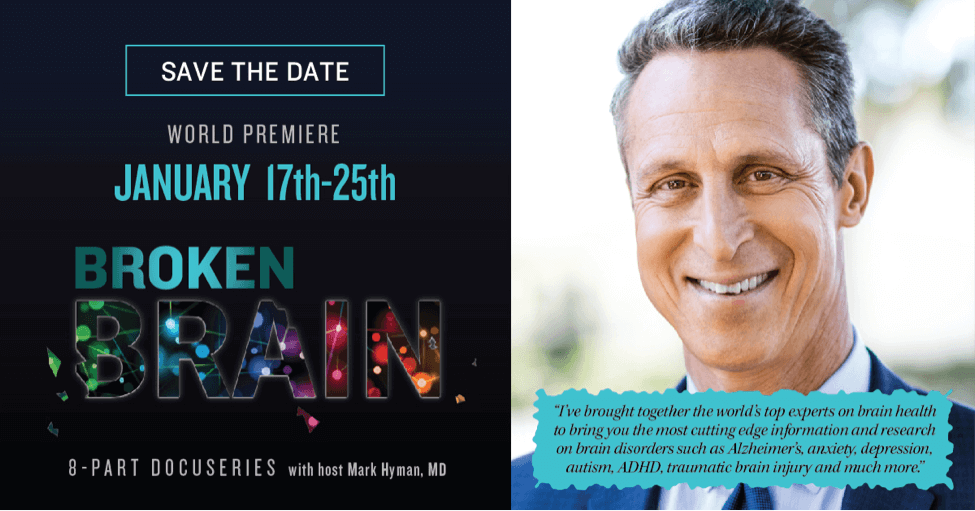
The Broken Brain docusersies, hosted by Dr. Mark Hyman airs January 17-25th .

Here are some wise words of wisdom from 3 of the 57 expert speakers – on the powerful gut-brain connection (covered on day 2).

And let us not forget the term Dr. Hyman uses to describe this: somatopsychic = mental symptoms caused by bodily illness. Issues in the gut – like food sensitivities, dysbiosis, SIBO, inflammation, parasites and so on – may be some of the root causes of your anxiety and/or depression. This is also known as body-mind medicine, which is different from mind-body medicine.

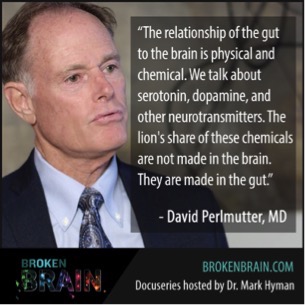
The relationship of the gut to the brain is physical and chemical. We talk about serotonin, dopamine and other neurotransmitters. The lion’s share of these chemicals are not made in the brain. They are made in the gut. ~ Dr. David Permlutter, MD, author of Grain Brain and Brain Maker

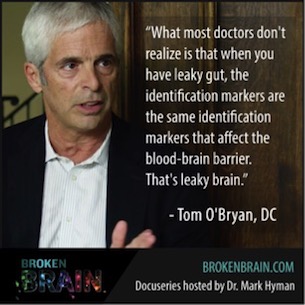
What most doctors don’t realize is that when you have leaky gut, the identification markers are the same identification markers that affect the blood-brain barrier. That’s leaky brain. ~ Dr. Tom O’Bryan, DC, author of The Autoimmune Fix

When our gut becomes inflamed, it produces chemicals the cross our blood brain barrier, and suppress the activity in the frontal cortex. And that produces all the telltale signs and symptoms of depression [and anxiety]. ~ Chris Kresser, MS, Lac, author of Unconventional Medicine

Save the date for the 8 -part Broken Brain docusersies, hosted by Dr. Mark Hyman – and register here. It airs January 17-25th

Here’s a list of ALL the episodes, to showcase just some of what you will have access to. Each episode will be available for 24 hours, at no-cost!

  1. The Broken Brain Epidemic / Dr. Hyman’s Story (January 17)
  2. Gut Brain Connection: Getting to The Root of a Broken Brain (January 18)
  3. Losing Your Mind (Alzheimer’s, Dementia, MS, and More) (January 19)
  4. ADHD and Autism (January 20)
  5. Depression & Anxiety (January 21)
  6. Traumatic Brain Injury: Accidents, Sports, and More (January 22)
  7. 7 Steps to An UltraMind (Part 1) (January 23)
  8. 7 Steps to An UltraMind (Part 2) (January 24)

Enjoy!

Filed Under: Events Tagged With: broken brain, Chris Kresser, David Permlutter, mark hyman, tom o’bryan

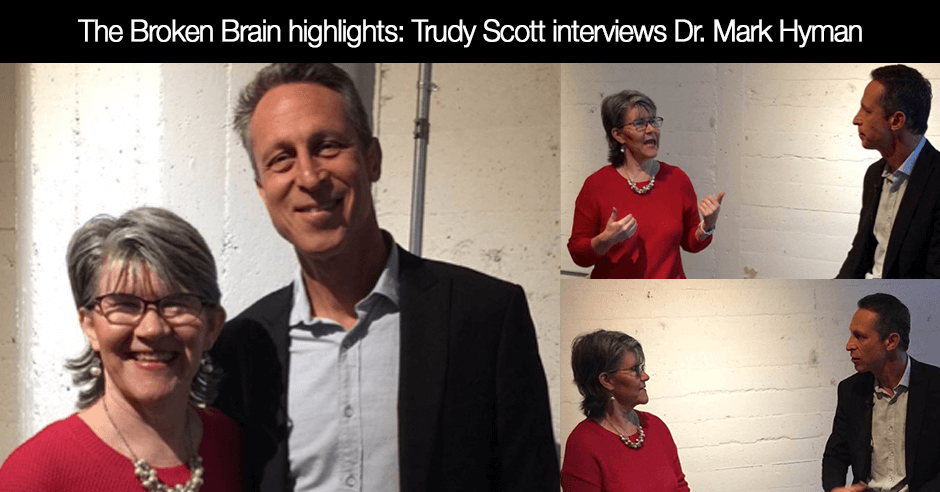
The Broken Brain highlights: Trudy Scott interviews Dr. Mark Hyman

January 3, 2018 By Trudy Scott 6 Comments

I’m really excited to share my in-person video interview with Dr. Mark Hyman, MD. It’s an interview I arranged because I’m so excited about his Broken Brain docu-series which will start airing on January 17th. You may have seen it when they recently did a test launch but if you haven’t yet seen the series it is well-worth watching and is highly recommended! (Registration link here)

In this interview with Dr. Hyman we talk about root causes of anxiety, depression, dementia, Alzheimer’s disease and ADHD: medication side-effects, diet, the microbiome, nutritional deficiencies, brain chemical imbalances, heavy metal toxicities and more; he shares his personal mercury toxicity story and the why behind the Broken Brain series; we cover off-label medications, trauma, labels and functional medicine.

I love the term he uses to describe body-mind medicine (which is different from mind-body medicine): somatopsychic = mental symptoms caused by bodily illness i.e. all of the above root causes.

One of the big reasons I’m supporting The Broken Brain docu-sersies is that it offers solutions and plenty of hope!

Here is the interview and transcript.

(there are captions on the video – if you don’t see them be sure to click the CC on the bottom right)

Trudy: – Welcome, it’s Trudy Scott here, food mood expert, certified nutritionist, author of The Antianxiety Food Solution, host of The Anxiety Summit, and today I’ve got the pleasure of interviewing Dr. Mark Hyman, who is the creator and host of the new Broken Brain series, and I’m just really excited to be here. I’ve been such a fan of yours for so many years. I know my community knows who you are, and they’re really excited about the Broken Brain series. I wanted to get together with you, and give some highlights, and talk about firstly why you created the Broken Brain series, and you’ve got a story behind your passion about it.

Dr. Mark Hyman: – I do. I do. Thank you for having me. Yeah, so about 20 years ago, I went from being a very healthy young doctor to having a broken brain, and a broken body, and it turned out it was from mercury poisoning that I got when I was in China, and I just developed severe chronic fatigue, where I couldn’t focus, I couldn’t remember, I couldn’t think, I couldn’t pay attention, I was depressed, I couldn’t sleep, I felt just completely not myself, and through that journey, was able to discover this world of functional medicine, which I thought was fairly developed at the time, but was really just in its infancy, and through discovering functional medicine, I was able to repair my own system, and fix my broken brain. I began to apply this with patients, seeing all kinds of things, without really knowing what I was doing, I was just treating people’s physical systems, fixing their gut, helping their immune system, cleaning up their diet, optimizing their nutritional status, balancing their hormones, and all their mental problems would get better. Their anxiety would get better, their depression would get better, and I wasn’t actually treating the depression or anxiety. Autism, ADD, memory issues, dementia, all these things would start to get better, and I began to realize that the body was driving a lot of this brain dysfunction, and that if you fix the body, a lot of the brain disorders would get better, that it wasn’t a primarily a mental problem, but it was a physical problem. Just as there’s a mind body effect, which is real, there’s also a body mind effect and that hadn’t been really talked about, so I wrote a book called The UltraMind Solution 10 years ago, which outlined this model, and then really this has been an incredible 10 years of brain research that I felt needed updating, and so we created a documentary series online looking at the new research, and how this applies, and the things that I noticed 10, 15, 20 years ago are now becoming more and more accepted and understood as real, and so we’re able to actually work with people in a very specific and direct way to help heal their broken brains, and to help people recover from things that we thought were really irreversible, not just anxiety, depression, but ADD, autism, dementia, Parkinson’s, all sort of issues that affect the brain that have a very different approach that can be used to repair and heal.

Trudy: – That’s so powerful, and I love that you talk about this effect that the body has on the brain, because we know about mind body medicine, you talk about that in the series, about how we can use our mind to affect our health, but you use this term. Tell me what the term is that you use that talks about how physical issues in our body, nutritional deficiencies, imbalances, can actually affect the brain.

Dr. Mark Hyman: – You mean the body mind effect?

Trudy: – Yes.

Dr. Mark Hyman – Yeah.

Trudy: – You’ve give it a term, and it was called?

Dr. Mark Hyman: – Oh, somatopsychic.

Trudy: – Somatopsychic, yes.

Dr. Mark Hyman: – We think of psychosomatic, but there’s also a somatopsychic phenomena. I would say if you have mercury poisoning, or you have a thyroid problem, or you have abnormal gut flora, or you’re vitamin D deficient, or B12 deficient, it’s very hard to have a proper functioning brain. You can’t just say someone’s got depression, that’s what’s causing their hopelessness, and helplessness, and sadness, and maybe many other things, it could be psychological, it could be a trauma, but it also could be so many other factors, and they often are overlooked and ignored, and when I start peeling back the layers of what’s happening with these people, and looking underneath the hood, and looking through the functional medicine lens at the body as a system, and correcting the imbalances, it’s shocking to me what happens. I always remember when I start applying this, I was like, wow, you got better? I can’t believe it. You shouldn’t really get better, according to Western medicine.

Trudy: – Amazing, and you mention trauma. Even if someone has experienced trauma, if their nutritional status is good, they’re able to deal with it better.

Dr. Mark Hyman: – Right.

Trudy: – And maybe have less symptoms of post-traumatic stress.

Dr. Mark Hyman: – That’s right.

Trudy: – If they have a good nutritional status, and there’s a lot of good research supporting that.

Dr. Mark Hyman: – Absolutely.

Trudy: – You talk about that in the series as well.

Dr. Mark Hyman: – Yeah, absolutely. Your brain has the ability to be resilient, but if you’re nutritionally depleted, and if you’re having all sorts of inflammatory problems, if you’re eating foods you’re reacting to, or allergic to, your brain can’t work properly, so your baseline is going be much lower, but if you fix all those things, then your capacity to deal with your psychological issues, it’s not that they don’t exist, it’s that your ability to cope with them, to work through them, to heal and repair the more difficult things, which are early life traumas, or abuse, or addiction, these are much easier to deal with once you fix the basic constitution of the person.

Trudy: – Right. Now one thing that you talk about a lot in the Broken Brain series, which I really appreciate, is the fact that there’s so much over-medication.

Dr. Mark Hyman: – Yeah.

Trudy: – Can you talk a little about it today? And I know with your story, you also had anxiety, depression, and you were prescribed medications as well.

Dr. Mark Hyman: – Yeah.

Trudy: – So this is common.

Dr. Mark Hyman: – Yeah.

Trudy: – You talk about antipsychotics. You shared some pretty scary stats on the increase that we see.

Dr. Mark Hyman: – When you look at it, it kind of goes up and down, but psychiatric medication as a whole, is the number two or three most prescribed category of drugs in America, and increasing across the globe, and it’s being used instead of dealing with the real issues, and they don’t really even work that well. I mean, anxiety medications can work, but antidepressants have been shown really not to work that well for mild to moderate depression. For severe depression, they can be helpful, and they can be life saving for some people, but they’re not a panacea, and when I was a kid, there was that one kid in the class, Patty Ainsworth, who was a troublemaker. Now it’s like 10% of the class is on ADD medication. That’s a problem.

Trudy: – It is.

Dr. Mark Hyman: – And when we see one in four people have depression in their lifetime, and if the knee jerk reaction is medication, it just sort of gives people a sense of numbness, but it doesn’t really deal with the issue. So I think we are way over-medicated, and on top of that, there’s pushing of medications for off-label use, which means that they’re not approved for those indications. So they’re doing this for kids with antipsychotics, and they’re actually been sued. So the pharma companies have been held liable for promoting these drugs for off-label uses, which they’re not allowed to do, for kids. They get fined billions of dollars, but they don’t care because they’ve made umpteen more billions, and they just see it as a marketing expense. So it’s really discouraging to see what happens to the pharmaceutical use in this space, because even for example, ADD is so fixable by dealing with the root causes, and most of us not are not even trained how to think that way.

Trudy: – That’s why I love the Broken Brian series, because it offers a message of hope, offers some practical solutions, and it empowers the person who’s suffering from the brain disorder, whatever it is, anxiety, depression, dementia, you name it, empowers them with solutions, and I think the other thing is it’s going to give curious practitioners who are not on board with this functional medicine approach some insights into what the future may hold, which I think is very promising.

Dr. Mark Hyman: – Yeah. It’s very powerful. I remember this guy who read my book, The UltraMind Solution, which is really what the Broken Brain series is based on, and he was a doctor, and he had a kid with autism, and he said, “We’re so desperate. Our kids was five, he wasn’t talking. We just started with the diet. We just got him off gluten, casein, and a few days later, all of a sudden, he started talking in full sentences,” and this is a skeptical physician who witnessed this, and I see this all the time. Patients, for example, have Alzheimer’s, or dementia, or diagnosed with dementia, and it turns out they have other issues. They have heavy metal poisoning, or they might have Lyme disease in the brain, or they might have severe nutritional deficiencies, or they might be insulin resistant with high levels of sugar in their diet that are affecting their brain, and you can fix those things. There may still be issues left over, but it’s going to be much easier to deal with those after.

Trudy: – Get to the root cause, and address those root causes.

Dr. Mark Hyman: – That’s right. That’s the purpose of functional medicine, which is a medicine of why, not what, and we have all these labels, but you know, if someone comes into my office, and they’re hopeless, and helpless, have no interest in life, can’t focus, can’t sleep, don’t want to have sex, I know what’s wrong with you. Depression, but depression isn’t the cause of those symptoms, it’s the name of the symptoms. It doesn’t tell you what’s really wrong with that person. It’s could be a host of things, from low thyroid, to gluten, to mercury poisoning, to vitamin D deficiency, to B12 deficiency, to insulin resistance. All these factors can lead to depression. Same syndrome, but different causes. So I’m much more interested in addressing the causes, then you don’t have to use the medication.

Trudy: – And some people have an issue with gluten, and have autism symptoms, and someone else can have depression or anxiety or dementia.

Dr. Mark Hyman: – That’s right.

Trudy: – So it can affect different people in a different way.

Dr. Mark Hyman: – That’s a very good point. So in functional medicine, we see that one disease can have many causes, but on the other hand, one causative factor can create many diseases. For example, heavy metals may cause dementia, or autism, or depression, or anxiety, or insomnia, or gut issues can cause all these various things that are not one disease, or for example gluten, like you mentioned, can cause autoimmune disease, can cause cancer, can cause diabetes, can cause osteoporosis, can cause anemia, can cause depression, can cause even dementia. So how do you begin to think about it? Our current naming of diseases doesn’t make any sense. So all the labeling, if you look at the diagnostic criteria, we have something called the DSM-5, which is the diagnostic and statistical manual that categorizes and catalogs all the psychiatric disorders, and they’re all categorized by symptoms. So it’s all descriptive. It’s says if you have these five symptoms, you have this, but it doesn’t tell you why, and it doesn’t really help you, other than giving you a label, which doesn’t mean anything about helping you understand what’s really going on.

Trudy: – And then you’re on a medication that’s going to give you side effects, and not actually get to the root cause of the problem.

Dr. Mark Hyman: – Right.

Trudy: – And yeah, just make some nutritional changes, addressing the thyroid, getting off gluten, addressing the gut – big session in the Broken Brain series.

Dr. Mark Hyman: – Yeah, it’s huge.

Trudy: – The gut brain connection.

Dr. Mark Hyman: – I mean, we’re just learning about this. For example, for years one of the main ways I treated the brain was fixing the gut, and that means optimizing the flora, getting rid of bad bugs, helping heal leaky gut, and we just did it, we didn’t really have a deep understanding other than we knew the microbiome was important, but now we know, for example, that there are more bacterial molecules in your blood than your own molecules, that you have 10 times as many bacterial cells in you as your own cells, 100 times as much bacterial DNA, and that DNA is all producing proteins, and all those proteins, you have 20,000 genes, there’s two million genes of bacteria in you, and they’re all producing molecules that are entering your blood stream, and driving all sorts of biological reactions, that aren’t even human molecules. So we have to begin to sort of how do those affect the brain and what’s going on? And it’s very powerful.

Trudy: – And so much research in this area, it’s just growing and growing.

Dr. Mark Hyman: – Yeah.

Trudy: – So you mentioned earlier that you wanted to do this because of all the new research. There is so much research on the gut brain connection, nutritional psychiatry. Dr. Drew Ramsey talks about this recent study on depression, and just getting people onto a real whole foods diet, and how 30% saw remission of symptoms, just changing their diet.

Dr. Mark Hyman: – Of course.

Trudy: – Not even going gluten free. So it’s powerful. These small changes can have powerful effects.

Dr. Mark Hyman: – Profound, profound effects

Trudy: – Well, thank you so much.

Dr. Mark Hyman – Thank you.

Trudy: – For your wonderful work that you do. And for making time today. I highly recommend the Broken Brain series with Dr. Mark Hyman, all the wonderful experts.

Dr. Mark Hyman: – Oh, so many. We’ve got 57 experts.

Trudy: – Amazing, some of our favorite functional medicine practitioners.

Dr. Mark Hyman: – Yeah.

Trudy: – Thank you.

Dr. Mark Hyman: – Thank you.

(I’m a tad disappointed that there is the background noise of people talking – and apologize – but I am hoping the great content overrides this and it’s not too distracting.)

Save the date for the 8 -part Broken Brain docusersies, hosted by Dr. Mark Hyman – and register here. It airs January 17-25th

Here’s a list of ALL the episodes, to showcase just some of what you will have access to. Each episode will be available for 24 hours, at no-cost!

  1. The Broken Brain Epidemic / My Story (January 17)
  2. Gut Brain Connection: Getting to The Root of a Broken Brain (January 18)
  3. Losing Your Mind (Alzheimer’s, Dementia, MS, and More) (January 19)
  4. ADHD and Autism (January 20)
  5. Depression & Anxiety (January 21)
  6. Traumatic Brain Injury: Accidents, Sports, and More (January 22)
  7. 7 Steps to An UltraMind (Part 1) (January 23)
  8. 7 Steps to An UltraMind (Part 2) (January 24)

I hope you enjoy it and get as much out of it as I did!

I actually flew from Sydney to LA for this opportunity to meet and interview him, and share more about the Broken Brain series, and I’m so glad I did! It was the first time I’d met Dr. Hyman in person and it truly was an honor to be in the company of this great man who is doing so much in the functional medicine world! Again, here is that link to register

Please share if any of this resonates with you – what solutions you have found have helped you and/or what you are working on addressing now?

AN UPDATE: there has been some feedback on the term “broken brain” being too negative and even scary so I gathered some feedback and share it in this blog: Is the term ‘broken brain’ hopeful and real or too negative and scary? I really want to hear your thoughts if you are offended by the term broken brain.  I also want to share Dr. Hyman’s apology.

Filed Under: Anxiety, Depression, Events, Gut health, Mental health, Mercury Tagged With: ADHD, alzheimer's, anxiety, broken brain, depression, functional medicine, mark hyman, Trudy Scott

Copper toxicity: anxiety, phobias, ADHD on the Heavy Metals Summit

December 23, 2017 By Trudy Scott 32 Comments

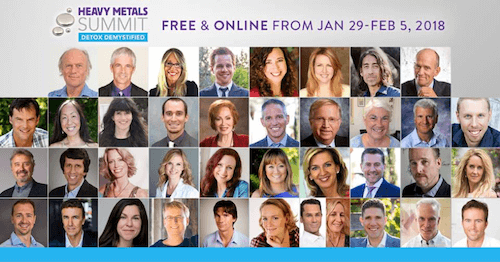
One of my favorite functional medicine practitioners, Ann Louise Gittleman covers the issue of excess copper on the Heavy Metals Summit, which airs online Jan 29 to Feb 5, 2018.

The topic is – Copper: The Double-Edged Sword – and she shares how copper is probably the most insidious of the toxic metals:

I think what lead was to the ancient Romans, copper is to modern day Americans. And I think it may be the fundamental cause of many of our orphan illnesses, our mystery illnesses, and debilitating and aging biochemical imbalances.

She shares some of the sources of copper that are most prevalent in contributing to excess copper levels and toxicity:

I think first and foremost we have to look at copper plumbing, copper cookware, which is all the rage in this day and time. There’s naturally occurring copper in water. Birth control pills can be a source of copper, because of excessive amounts of estrogen and estrogen is connected to copper the way zinc is connected to progesterone.

There are copper IUDs that are very popular amongst so many of our young women. Even dental amalgams, if they are put in your mouth post 1976 can have a very high copper amalgam percentage. And then, of course, there are fungicides for swimming pools and foods. So that’s just the beginning.

Then there’s the copper that you’re getting in common foods. Whether it’s soy; whether it’s GMO soy or not. You’re getting that in tempeh, tofu, soy protein powders. Nuts and seeds, like cashew nuts and sesame seeds. Avocados; a very healthy fat, but high in copper nevertheless. And some of our shellfish. Then you’ve got your regular tea, your green tea, your white tea, your black tea, your bran, and even your brewer’s yeast.

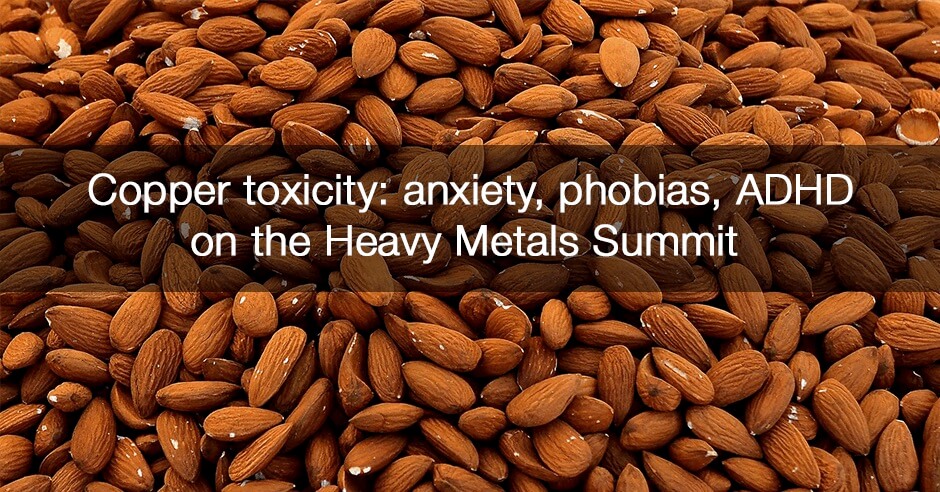
One of the biggest factors that I see contributing to high copper in my clients who have low zinc and anxiety, is all the baking being done with nuts flours such as almond flour! The next two areas I see as being most problematic for women, is the birth control pill and copper IUDs.  

Ann Louise talks about how excess copper can affect you: hyperactivity and ADD, thyroid issues, tooth decay, dementia, urinary tract infections, candida and functional hypoglycemia.

She also covers the following anxiety symptoms, which I commonly see in my clients and community: nervousness, phobias and unresolved fears, depression and even stuttering.

Here are my contributions to this important discussion:

  • High copper and low zinc (because these two balance each other out), is one of the most common imbalances I see in my community of anxious individuals, and especially in women because of the hormonal influence.
  • Other than removing the source of the copper, one way to address this is via zinc supplementation. If anxiety is a factor, addressing low serotonin and low GABA with amino acids like tryptophan and GABA helps until zinc increases and copper decreases.
  • Good levels of zinc are also needed to make the neurotransmitters so once levels rise (as we get rid of excess copper) we can start to make our own.

Wendy Myers, Christine Schaffner, ND, and Dietrich Klinghardt, MD, PhD, have spent the last few months gathering the right experts, information and protocols to help you understand the danger of heavy metals like copper, mercury, lead, cadmium and others, and what to do about them.

Every day, they help their patients regain health, in some part through heavy metal detoxification. People with incorrect diagnoses of multiple sclerosis, fibromyalgia, anxiety and depression, insomnia, or thyroid issues, just to name a few, have found relief through innovative and individualized protocols to reduce the burden of heavy metals.

Register here to join us on The Heavy Metals Summit January 29 – February 5, 2018. See you on the summit! I know I’m going to learn a lot too!

Have you had issues with high copper and low zinc?

Feel free to comment or post a question below.

Filed Under: Events, Toxins Tagged With: ADHD, anxiety, copper, fear, heavy metals summit, nervousness, phobias, toxicity, zinc

Pyroluria can feel pretty exhausting

December 10, 2017 By Trudy Scott 26 Comments

If you’re new to pyroluria, it is a social anxiety condition, where physical and emotional symptoms are caused by deficiencies of vitamin B6 and zinc. As well as feeling anxious, shy, or fearful or experiencing inner tension since childhood (and often hiding these feelings from others), digestive symptoms are common and we cover these in my interview Low zinc, social anxiety/pyroluria and the gut on the virtual conference called Better Belly Project 2.0, hosted by Summer Bock, one of the leading gut health experts.

What you’ll learn:

  • How to figure out if you have the social anxiety called pyroluria and what key nutrients are missing in these cases
  • The zinc connection to the microbiome, digestion and social anxiety
  • Digestion symptoms we see in pyroluria
  • Is introversion a personality trait or a biochemical imbalance?
  • Can collagen and gelatin make you more depressed and anxious?

I talk about how you can feel when you have pyroluria and how I can relate to all this:

You may feel uncomfortable in group sittings, you may feel uncomfortable with interacting with large crowds of people. A lot of people will say, “I’m really good at speaking on stage, but don’t make me mingle with the people after I presented on stage because then I’ve got to interact with a lot of people.” You’ve got this inner tension where you deal with it, and you cover it up, and you push through.

I can totally relate because I have pyroluria myself. This is why I’m so passionate about sharing this topic because I grew up pushing through and dealing with it. I remember the first day of school, wanting to walk to school on my own. I didn’t want my mom to take me into school. I was always this person who kind of pushed through and forced myself to do things.

We get through life like that, but it can get pretty exhausting. With my whole anxiety that started in my late 30s, which was a result of this perfect storm, it was gluten sensitivity, and adrenal issues, and low serotonin, and low GABA. And part of my perfect storm was this pyroluria that I discovered. I find that a lot of my clients will push through, and they’ll deal with this, for many, many years.

But, as things start to shift, as they’re starting to go into perimenopause, and the hormones are getting disrupted, and they’re becoming more stressed, and they’ve got adrenal issues going on, and they discover they’ve got food sensitivities. This all conspires together to make their symptoms much worse. Then, they find they can’t socialize, or when they are socializing, they just feel so anxious, it’s just debilitating, and they can’t actually function.

There are overlaps with the pyroluria questionnaire and an introverts questionnaire I came across on the Huffington post. Based on feedback from 100s in my community I’m proposing that introversion is not a personality trait, or maybe it’s not all personality, but there’s this biochemical component.

We also have a great discussion about collagen and gelatin, which can help to heal the gut, but may also be depleting serotonin levels and increasing anxiety/depression in some susceptible individuals:

I actually did a mini-survey with the people in my Facebook community, and I said, “Anyone using collagen or gelatin, have you noticed an increase in anxiety, an increase in depression, agitation, heart palpitations, insomnia?” I got very varied response. Half of the people said yes, they felt worse, more anxious, more depressed. Another 40% said no, they feel great. Then, interestingly enough, there was a few people that said they use collagen and gelatin to actually lower their serotonin levels.

If you aren’t yet signed up you can see the event schedule and register here for Better Belly Project 2.0. It runs through December 14th and Summer is interviewing 49 experts who are leaders in the field of digestive health.

Here are some topics you may also enjoy:

  • What To Do If Your Gut Isn’t Getting Better: Jennifer Fugo (also today)
  • Leaky Gut and Your Child: Dr. Elisa Song (also today)
  • 17 Right and Wrong Ways to Eat Ferments: Summer Bock (also today)
  • Treatment Options for Chronic Yeast Issues. What is the evidence?: Dr. Jessica Drummond (coming up tomorrow)
  • Metals That Impact Gut Function: Wendy Myers (coming up in a few days)

I hope you enjoy my interview and these other expert interviews!

Do you have pyroluria and can you relate to any of this? Feel free to leave your comments and questions and comments below.

Filed Under: Events, Pyroluria Tagged With: better belly project, pyroluria, summer bock

  • « Go to Previous Page
  • Page 1
  • Interim pages omitted …
  • Page 4
  • Page 5
  • Page 6
  • Page 7
  • Page 8
  • Interim pages omitted …
  • Page 35
  • Go to Next Page »

Primary Sidebar

GABA QuickStart Homestudy

gaba quickstart homestudy

Free Report

9 Great Questions Women Ask about Food, Mood and their Health

You'll also receive a complimentary subscription to my ezine "Food, Mood and Gal Stuff"


Connect with me

Popular Posts

  • Amino Acids Mood Questionnaire from The Antianxiety Food Solution
  • The Antianxiety Food Solution Amino Acid and Pyroluria Supplements
  • Pyroluria Questionnaire from The Antianxiety Food Solution
  • Collagen and gelatin lower serotonin: does this increase your anxiety and depression?
  • Tryptophan for the worry-in-your-head and ruminating type of anxiety
  • GABA for the physical-tension and stiff-and-tense-muscles type of anxiety
  • The Antianxiety Food Solution by Trudy Scott
  • Seriphos Original Formula is back: the best product for anxiety and insomnia caused by high cortisol
  • Am I an anxious introvert because of low zinc and vitamin B6? My response to Huffington Post blog
  • Vagus nerve rehab with GABA, breathing, humming, gargling and key nutrients

Recent Posts

  • Her cravings for chips and peanut butter were triggered by stress: GABA ends cravings and reduces physical tension and fear of heights
  • It is truly miraculous to be able to move through life without crippling anxiety and panic
  • GABA and tryptophan combo provide immediate and noticeable relief for tremors and cervical dystonia in just 7 days
  • Red light therapy for back and neck pain, plantar fasciitis and low mood – a complement to the amino acids GABA, DPA and tryptophan
  • What do I use instead of Seriphos to help lower high cortisol that is affecting my sleep and making me anxious at night?

Categories

  • 5-HTP
  • AB575
  • Addiction
  • ADHD
  • Adrenals
  • Alcohol
  • Allergies
  • Alzheimer's disease
  • Amino Acids
  • Anger
  • Antianxiety
  • Antianxiety Food Solution
  • Antidepressants
  • Anxiety
  • Anxiety and panic
  • Autism
  • Autoimmunity
  • benzodiazapines
  • Bipolar disorder
  • Books
  • Caffeine
  • Cancer
  • Candida
  • Children/Teens
  • Collagen
  • Cooking equipment
  • Coronavirus/COVID-19
  • Cravings
  • Depression
  • Detoxification
  • Diabetes
  • Diet
  • DPA/DLPA
  • Drugs
  • EFT/Tapping
  • EMF
  • EMFs
  • Emotional Eating
  • Endorphins
  • Environment
  • Essential oils
  • Events
  • Exercise
  • Fear
  • Fear of public speaking
  • Fertility and Pregnancy
  • Fish
  • Food
  • Food and mood
  • Functional neurology
  • GABA
  • Gene polymorphisms
  • General Health
  • Giving
  • Giving back
  • Glutamine
  • Gluten
  • GMOs
  • Gratitude
  • Gut health
  • Heart health/hypertension
  • Histamine
  • Hormone
  • Hyperparathyroidism
  • Hypoglycemia
  • Immune system
  • Inflammation
  • Insomnia
  • Inspiration
  • Introversion
  • Joy and happiness
  • Ketogenic diet
  • Lithium orotate
  • Looking awesome
  • Lyme disease and co-infections
  • MCAS/histamine
  • Medication
  • Men's health
  • Mental health
  • Mercury
  • Migraine
  • Mold
  • Movie
  • MTHFR
  • Multiple sclerosis
  • Music
  • NANP
  • Nature
  • Nutritional Psychiatry
  • OCD
  • Osteoporosis
  • Oxalates
  • Oxytocin
  • Pain
  • Paleo
  • Parasites
  • Parkinson’s disease
  • PCOS
  • People
  • PMS
  • Postpartum
  • PTSD/Trauma
  • Pyroluria
  • Questionnaires
  • Real whole food
  • Recipes
  • Research
  • Schizophrenia
  • serotonin
  • SIBO
  • Sleep
  • Special diets
  • Sports nutrition
  • Stress
  • Sugar addiction
  • Sugar and mood
  • Supplements
  • Teens
  • Testimonials
  • Testing
  • The Anxiety Summit
  • The Anxiety Summit 2
  • The Anxiety Summit 3
  • The Anxiety Summit 4
  • The Anxiety Summit 5
  • The Anxiety Summit 6
  • Thyroid
  • Thyroid health
  • Toxins
  • Tryptophan
  • Tyrosine
  • Uncategorized
  • Vegan/vegetarian
  • Women's health
  • Yoga

Archives

  • May 2026
  • April 2026
  • October 2025
  • September 2025
  • August 2025
  • July 2025
  • June 2025
  • May 2025
  • April 2025
  • March 2025
  • February 2025
  • January 2025
  • November 2024
  • October 2024
  • September 2024
  • August 2024
  • July 2024
  • June 2024
  • May 2024
  • April 2024
  • March 2024
  • February 2024
  • January 2024
  • December 2023
  • November 2023
  • October 2023
  • September 2023
  • August 2023
  • July 2023
  • June 2023
  • May 2023
  • April 2023
  • March 2023
  • February 2023
  • January 2023
  • December 2022
  • November 2022
  • October 2022
  • September 2022
  • August 2022
  • July 2022
  • June 2022
  • May 2022
  • April 2022
  • March 2022
  • February 2022
  • January 2022
  • December 2021
  • November 2021
  • October 2021
  • September 2021
  • August 2021
  • July 2021
  • June 2021
  • May 2021
  • April 2021
  • March 2021
  • February 2021
  • January 2021
  • December 2020
  • November 2020
  • October 2020
  • September 2020
  • August 2020
  • July 2020
  • June 2020
  • May 2020
  • April 2020
  • March 2020
  • February 2020
  • January 2020
  • December 2019
  • November 2019
  • October 2019
  • September 2019
  • August 2019
  • July 2019
  • June 2019
  • May 2019
  • April 2019
  • March 2019
  • February 2019
  • January 2019
  • December 2018
  • November 2018
  • October 2018
  • September 2018
  • August 2018
  • July 2018
  • June 2018
  • May 2018
  • April 2018
  • March 2018
  • February 2018
  • January 2018
  • December 2017
  • November 2017
  • October 2017
  • September 2017
  • August 2017
  • July 2017
  • June 2017
  • May 2017
  • April 2017
  • March 2017
  • February 2017
  • January 2017
  • December 2016
  • November 2016
  • October 2016
  • September 2016
  • August 2016
  • July 2016
  • June 2016
  • May 2016
  • April 2016
  • March 2016
  • February 2016
  • January 2016
  • December 2015
  • November 2015
  • October 2015
  • September 2015
  • August 2015
  • July 2015
  • June 2015
  • May 2015
  • April 2015
  • March 2015
  • February 2015
  • January 2015
  • December 2014
  • November 2014
  • October 2014
  • September 2014
  • August 2014
  • July 2014
  • June 2014
  • May 2014
  • April 2014
  • March 2014
  • February 2014
  • January 2014
  • December 2013
  • November 2013
  • October 2013
  • September 2013
  • August 2013
  • July 2013
  • June 2013
  • May 2013
  • April 2013
  • March 2013
  • February 2013
  • January 2013
  • December 2012
  • November 2012
  • October 2012
  • August 2012
  • July 2012
  • June 2012
  • May 2012
  • April 2012
  • March 2012
  • February 2012
  • January 2012
  • December 2011
  • November 2011
  • October 2011
  • September 2011
  • August 2011
  • July 2011
  • June 2011
  • May 2011
  • April 2011
  • March 2011
  • February 2011
  • January 2011
  • December 2010
  • October 2010
  • September 2010
  • July 2010
  • May 2010
  • April 2010
  • March 2010
  • February 2010
  • January 2010
  • November 2009

Share the knowledge!

The above statements have not been evaluated by the Food and Drug Administration. Products listed in this website are not intended to diagnose, treat, cure or prevent any disease.

The information provided on this site is for informational and educational purposes only and is not intended as a substitute for advice from your physician or other health care professional. You should consult with a healthcare professional before starting or modifying any diet, exercise, or supplementation program, before taking or stopping any medication, or if you have or suspect you may have a health problem.


Copyright © 2026 Trudy Scott. All Rights Reserved. | Privacy | Terms and Conditions | Refund Policy | Medical Disclaimer

Free Report

9 Great Questions Women Ask about Food, Mood and their Health

You’ll also receive a complimentary subscription to my ezine “Food, Mood and Gal Stuff”