• Skip to primary navigation
  • Skip to main content
  • Skip to primary sidebar

everywomanover29 blog

Food, Mood and Women's Health – Be your healthiest, look and feel great!

  • Blog
  • About
  • Services
  • Store
  • Resources
  • Testimonials
  • The Book
  • Newsletter
  • Contact
  • Search this site

Antianxiety

Anxiety, ADHD, autism and insomnia: how a weighted blanket helps

April 22, 2016 By Trudy Scott 20 Comments

anxiety-weighted-blanket

I shared this article on facebook recently: Sleeping With Weighted Blankets Helps Insomnia And Anxiety

Traditionally, weighted blankets are used as part of occupational therapy for children experiencing sensory disorders, anxiety, stress or issues related to autism. ‘In psychiatric care, weighted blankets are one of our most powerful tools for helping people who are anxious, upset, and possibly on the verge of losing control,’ says Karen Moore, OTR/L, an occupational therapist in Franconia, N.H.

The response was so positive I promised I would share some blog posts with more information, so here we are. The first is to share some additional information and stories from people who have seen results or heard positive things about their use.

A 2008 study published in Occupational Therapy in Mental Health, observed the effects of a 30lb weighted blanket in a sample of 32 adults: Exploring the Safety and Therapeutic Effects of Deep Pressure Stimulation Using a Weighted Blanket. These results were observed

  • 63% reported lower anxiety after use
  • 78% preferred the weighted blanket as a calming modality

When I shared the article I asked a few questions. The first one: Have you used weighted blankets personally, or with children or recommended them to patients/clients?

The feedback I received was amazing! Lynn shared this magic blanket comment for ADHD and anxiety:

Someone close to me got one for her foster child, who suffers from emotional dysregulation, ADHD, and anxiety. It works like magic– in fact the child calls it his “magic blanket.”

She also shared this about her younger brother who is autistic and mute:

When we were young children, he would suffer terrible insomnia and agitation whenever there was a full moon. My older brother and I would take turns sleeping with him on full moon nights because that comforted him somewhat. We figured out as small children that we could get him to calm down and go to sleep by draping one leg and one arm across him. I think it was the heaviness and pressure of our limbs that settled his anxiety. Our parents could not do it, I suppose because their limbs were too large. So when I learned about Temple Grandin’s solution [more on that below], it made sense to me. Interesting, hmm

Phaedra commented saying some of us like to sleep with heavy blankets even in the summer and said this:

Deep pressure is calming and nurturing. Helps us get into our bodies and stimulates our proprioception (awareness of our body in space). I use weighted yoga bags filled with sand. Simply placing one across the chest or anywhere else on the body can be calming.

Diane shared that she used to write for a company called Mosaic Weighted Blankets and one of her jobs was to interview customers as testimonials:

I can’t tell you how blown away I was with my first few interviews. Parents of kids having autism, Asperger’s, special needs kids, kids having night terrors…it truly brought them (kids and the entire family) great peace and an ability to sleep through the night, almost immediately in many cases.

Adults also gained benefits, especially relating to issues with PTSD and restless legs syndrome.

The weight is part of the reason it provides calming…the pellets also provided something for the kids to touch/manipulate while they were trying to go to sleep. Mosaic’s blog should still have a lot of good articles on the benefits and how it is also used by occupational therapists. They can be on the expensive side if you compare it to a blanket, but if you compare it to the need for less medications and such it could be a very viable option.

There are many companies as well as sites showing how to make them yourself, just be sure you are focusing on the “pressure” effect and not the “heavy”…these blankets are not the same as just throwing 6 thick blankets on someone.

She also shared this article she wrote: Sensory Processing Disorder Treatment, Mosaic Weighted Blankets
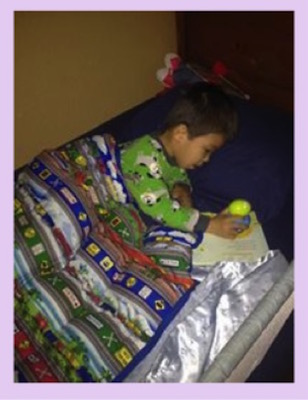
Mosaic-Weighted-Blankets
Source: Mosaic Weighted Blankets

Tara lives in the UK and uses a medium weight duvet/comforter and has two very useful tricks/tips to hopefully get similar benefits if you don’t have access to a weighted blanket:

GREAT thread, everyone! Thanks so much! I find deep pressure *very* soothing. I don’t have a weighted blanket, but we do sleep with a 10.5 tog duvet [spring/autumn weight comforter – tog is a British measure of warmth pretty much year-round. (Ah, the “joy” of living in the UK. Not!)

good-sleep

That said, here are two other tricks: 1) if your climate allows (i.e. it’s not too hot), make yourself a *full* hot water bottle and tuck your feet *under* it. This will put some weight/pressure on your body and will feel comforting. (I’m thinking this could even be done with cold water if it’s too hot where you live.)

And 2) if you don’t have a weighted blanket, but find yourself struggling with insomnia, lie on your side and tuck your arms between your legs (so that your arms are “sandwiched” between your legs and the gravity of the leg on top presses onto your arms). It’s not the same as having the full weight of something on you, but you will be creating a bit of deep pressure all the same. I’m not an OT (I wish I were!) but if you think about what the best thing to do with a small baby is – swaddle it!!! A weighted blanket makes total sense! It’s calming to our nervous system because it “contains” us (but not in an oppressive, limiting way).

I have not verified if these two trick/tips do in fact work the same way but it makes sense that they would so feel free to share if you’ve found they work for you. I personally love the hot water bottle feeling and have always done this for as long as I can remember. I will also often start off sleeping in the arms-sandwiched position and then end up in arms folded position, sort of hugging myself. I had no idea why except that it just feels good.  

Tara mentioned also Temple Grandin’s deep pressure squeeze machine.

Temple Grandin (one of my heroes!) actually made her own deep pressure “machine” when she was little – she intuitively knew that it would help and soothe her. I’m not saying that anyone here is on the spectrum, but I have a hunch – tell me where I’m wrong – that a whole bunch of us have super “highly tuned” nervous systems! Thanks so much for all you do, Trudy and thanks to everyone in this group/community/village!

Based on the response this facebook post generated many of us have super “highly tuned” nervous systems, myself included!

Many years ago I had read about device in her book: Thinking in Pictures, My Life with Autism many years ago. She is a fascinating woman and it’s a great read!  I see there is now an updated version.
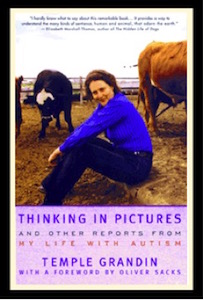
thinking-in-pictures

Here is a little more about her: Temple Grandin PhD is an American professor of animal science at Colorado State University, world-renowned autism spokesperson and consultant to the livestock industry on animal behavior. On her website it states that she is now the most accomplished and well-known adult with autism in the world.

She writes about her squeeze machine and how it helped her anxiety and oversensitivity to touch here: Calming Effects of Deep Touch Pressure in Patients with Autistic Disorder, College Students, and Animals

I will describe here a deep touch pressure device (“squeeze machine”) that I developed to help me overcome problems of oversensitivity to touch, and that allays my nervousness. Reactions of other people to the squeeze machine, including children with autistic disorder and attention-deficit hyperactivity disorder (ADHD) are also reported.

When I posted this on facebook I also asked: “Do you have a source you can recommend -organic cotton cloth, non-plastic beads?”

I received some great resources but none that use organic cotton cloth and non-plastic beads. Some companies use stones and/or glass beads and one company has the option to send in your own fabric so you could buy your own organic cotton.  

I just feel that with sensitive individuals, having organic cotton and beads that are not plastic is the best option, especially since many of you will spend quite a bit of time under these blankets or wrapped in them.

I appreciate having the opportunity to share all the great facebook comments here. Thanks if you contributed to the discussion!. If you’d like to see all the responses here is link to the facebook post. Join us on facebook and be part of future discussions. We have a lot of fun and some healthy and sometimes heated debates too!

Stay tuned for part 2 where I will share resources for buying a weighted blanket. I’ll also share more of the research on how these weighted blankets work, resources for making one plus how to know what weight is best for you.

If you’ve used a weighted blanket for anxiety, stress reduction, ADHD or insomnia please do share how you liked it and how it helped you. Have you used one personally, or with children or recommended them to patients/clients?

If you have a resource that offers organic cotton cloth with non-plastic beads please do share it.

Filed Under: Antianxiety, Autism, Sleep Tagged With: insomnia, weighted blancket

Benzodiazepines: informed consent? Your support is needed

March 25, 2016 By Trudy Scott 20 Comments

Benzodiazepine Bill

If you’ve been following me for a while you know how opposed I am to the long-term use of benzodiazepines. These medications are only intended to be prescribed for no longer than 2 weeks at the most. But I really do think they should not be prescribed at all.

I was very pleased when Alison Page reached out to me asking if I’d share what’s happening in Massachusetts. It’s a proposed bill that would require informed consent for benzodiazepine use: Call To Action: Massachusetts Bill H4062 for Informed Benzodiazepine Use is Official

I’ve blogged extensively about benzodiazepine dangers and mention them when I present at conferences and on summits. Here are a selection of blog posts:

  • The possible increased risk of Alzheimer’s disease (and I share some of Alison’s story in this one): Benzodiazepines linked to increased Alzheimer’s risk and other serious concerns
  • Nicole Beurkens shares her experiences with benzodiazepines: Benzodiazepines do patients more harm than good
  • The webinar replay of the talk I did for Hawthorn University: Say NO to benzodiazepines for anxiety! (webinar replay)

The Massachusetts Bill H4062 is calling for written informed consent from the doctor stating the risks of taking this class of drugs. Here are the Specifics of the bill:

Anyone receiving a benzodiazepine prescription will receive written informed consent from their doctor stating the risks of taking this class of drugs. The consent form will ensure that patient’s understand that benzodiazepines and sleep aids can lead to physical dependence, and in some cases, addiction. The informed consent form will also specify that this drug can, in some cases, cause an injury to the nervous system and dangerous and/or disabling withdrawal reaction. The consent form will also specify that long-term use is contraindicated.

Benzodiazepine prescriptions will be written on brightly colored paper to ensure that patients know that they are receiving a potentially harmful substance that could lead to physiological dependence or addiction.

No patient will be taken off benzodiazepines or sleep aids without their full consent. No patient will be “cold turkeyed” off their prescription. For patient’s choosing to come off, a safe taper schedule will be implemented.

Drug labels will indicate that long-term use is contraindicated.

If you would like to help this bill pass and gain momentum, Alison shares how you can reach out to Massachusetts state senators and representatives. They are also asking you to share your personal stories of benzodiazepine harm. These stories will be presented as evidence to the Joint Committee as they decide whether or not the bill moves forward. All the details on how to do this can be found here.

These are good initial steps to create awareness for both anxious individuals, and doctors who are not aware of the terrible effects so many suffer.

We certainly appreciate the efforts of people like Alison, who is a benzodiazepine survivor herself. She took prescribed benzodiazepines off and on for 16 months and was rapidly tapered off. She ended up with a severe central nervous system injury which has taken years to recover from. As a result of her experience, Alison is now an activist on behalf of psychiatric survivors and works to raise awareness about the dangers of psychiatric drugs and treatment methods.

One of her wonderful projects is the creation of an art book entitled Healing from Psychiatry: An Artist’s Perspective. She has close to 50 contributors from all over the world who have suffered or are suffering as a result of psychiatric treatments and medications.

Update 3/28/16:

Geraldine Burns worked closely with Representative Paul McMurtry to have this first of a kind bill filed in the United States.  This bill was filed in Massachussetts on February 24, 2016, and it received the official bill number H.4062 – An Act Relative to Benzodiazepines and Non-Benzodiazepine Hypnotics.

Geraldine shared this information about her pioneering work in helping to get the word out about the potential dangers of benzodiazepines: 

In 1999 I started the first Internet support group for people wishing to withdraw from tranquilizers or already off and having problems.  This was the first group of its kind and before it closed had closes to 4,000 members internationally.  The group was started to offer 24 hour/7 days a week support to people who have been made ill by prescription medications, to learn about symptoms of withdrawal, learn about tapering methods, and natural methods of healing.

She is dedicated to the responsible and informed use of addictive prescription drugs: Education, Advocacy, Research and Support.  And she was instrumental in having Professor C. Heather Ashton, Professor Emeritus from the University of Newcastle write her manual “Benzodiazepines: How They Work and How to Withdraw” also known as The Ashton Manual.  This manual has now been translated into 11 other languages and can be found online at www.benzo.org.uk

In 2006, Geraldine launched the website BenzoBookReview  after she was given the rights by eleven internationally known authors of books that had been written on the subject of tranquilizers of which some were no longer being published.  She worked to have some of them revised and updated so they could bring the most up-to-date information on tranquilizers and sleeping pills to the public. 

Currently she is being filmed for the documentary As Prescribed  which is a film project about benzodiazepine dependency and discontinuation syndrome. Here is a snippet about this documentary that is being produced by Holly Hardman:

There is a formidable health epidemic in our midst. Its sufferers tend to be “good patients” following doctor’s orders. Perhaps their doctors prescribed Ativan, Xanax, Valium, or Klonopin – common names for a class of anxiolytic drugs known as benzodiazepines. Perhaps the drug was given to calm nerves, promote sleep, balance moods, or just to make life a little easier. Too often these good patients begin to experience strange symptoms and develop mysterious illnesses that plague them for years, upending their lives. Too often they are told that the drugs could not be their problem. By following personal stories and investigating growing medical evidence, As Prescribed questions the prescribing practices and consequences of these popular, not-so-innocent drugs.

We appreciate Geraldine and Alison and everyone involved with this bill, and all the advocates like Holly and others who are working so tirelessly to create awareness.

Please do share your story with benzodiazepines too.  The more who hear this information, the more can be helped.   And please share this blog if you care and know of anyone using these medications and looking for help, and to folks who may be considering these medications or may be prescribed them in the future.  

Update 3/29/16:

The Massachusetts Benzo Bill H4062: Informed consent for benzodiazepines and non benzodiazepine hypnotics  was just scheduled to be heard by the Joint Committee on Mental Health and Substance Abuse on Monday, April 4th.  The committee will then decide whether the bill moves forward to the house and senate, goes to study, or is denied.

If the bill “goes to study” it is essentially dead in the water until the next legislative session, and in that case, the bill often dies. It is important that we rally around the bill to make sure it passes during this session.

The bill will ensure that patients get informed consent about the potential dangers of benzos, if they are already on the drug, they will have the choice of whether or not to come off, and if they do choose to come off, a safe slow taper will be implemented. The bill specifies that it is the patient who decides whether or not they would like to come off their benzodiazepine.

What Can you do to Help?

  1. Attend the public hearing and testify on Monday, April 4th, 2016 at 1:00pm in Hearing Room A-1 at the Massachusetts State House 
  2. E-mail your support of this bill. It is most important that the committee hears from Massachusetts residents, but anyone from around the world is welcome to write in support of Bill H4062. 

Please see the comment from Alison Page below (on 3/28/16).  She shares all the details on the above 2 steps: how to testify and who and what to email.

Update: 4/8/16

Alison emailed me with an update about the hearing for Bill H4062: Informed consent for benzodiazepines and non-benzodiazepine hypnotics. The hearing took place on Monday, April 4 at 1PM at the Massachusetts State House in Boston, MA.

She shared a new blog link with all the updates.  This is an overview of what will be happening next:

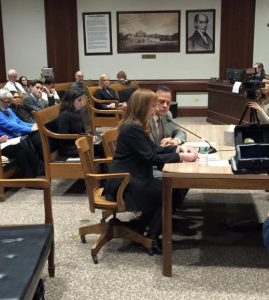
The committee hearing the testimonies will be reviewing all of the written testimonies of the people unable to attend the hearing, and will then decide whether or not the bill moves forward to the House and Senate. The discussion, parts of which you can watch in the video below, clarified some important points in the legislation and gave survivors an opportunity to tell their stories.

Alison also shares some additional background about the bill and benzodiazepines, and a detailed account of what happened at the hearing (same link as above).

geraldine burns MA benzodiazepine hearing april 2016
Geraldine Burns, benzodiazepines survivor who brought the “benzo bill” to representative McMurtry’s attention, speaks about her journey through long-term benzodiazepine use, the subsequent injury it caused to her nervous system, and the many years it took to recover once she was off the drug (used with permission: Alison Page)

Alison also shares her personal experiences too and how emotional and yet cathartic it was to be there to testify:

There were a lot of tears at the hearing. The personal testimonies from survivors and caretakers were poignant, honest, vulnerable, and moving. This is the first time that the “benzo community” has had the opportunity to openly tell their stories in a platform that could influence legislation so that other people will not get harmed by prescribed benzodiazepines.

I was so proud to be there and witness the courage, camaraderie, resilience, advocacy, and vulnerability of fellow survivors. This is the first time I have met these people, who I’ve talked to online for years, and who I consider dear friends. This is the first time I have visited Boston since coming off benzodiazepines several years ago, so it was a personal victory, as well.

Testifying was cathartic, both for the individuals and for the “benzo community” as a whole. This legislation is our chance to be heard. As one survivor said, through tears, to the committee, “Do not let my suffering be in vain. I beg you to pass this bill.”

Action steps to keep the momentum going:

  • Continue to send your stories
  • Reach out to Massachusetts representatives, senators, and governors and ask them to vote yes on this bill
  • Start talking about this and sharing stories in other states
  • Follow updates and “calls to action” for Bill H4062 on the new Benzodiazepines Bill Facebook page

Thanks to everyone who went to testify! 

And thank you if you  commented here, shared this post and sent in your story.

If you have questions for Alison or Geraldine or me you can post them in the comments below.


Filed Under: Antianxiety, benzodiazapines Tagged With: alison page, anxiety, As Prescribed, benzodiazepine, consent, Geraldine Burns, Holly Hardman, Massachusetts Bill H4062

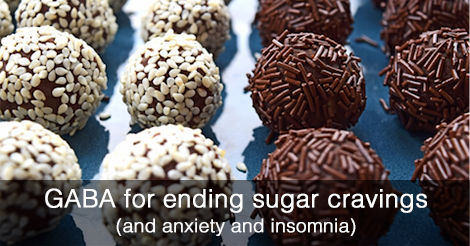
GABA for ending sugar cravings (and anxiety and insomnia)

January 8, 2016 By Trudy Scott 50 Comments

In a recent blog post I shared some feedback from people who have tried various GABA products with success: GABA, the calming amino acid: products and results

Taken orally it works to relax, calm, ease anxiety and social anxiety, quiet the mind, help with insomnia and sleeping better, reduces neck tension, removes uneasiness and worry, and gives hope (as you can read in the above blog post).

What I didn’t mention is that GABA can also reduce and often eliminate cravings totally.

Melissa discovered this was a wonderful side-benefit (we like side-benefits vs side-effects!) when she recently added Source Naturals GABA Calm in anticipation of holiday travel and holiday gatherings.   She recently posted this comment on the above blog:

I’m glad I saw the post about GABA on your FB page a couple weeks ago, which led me to this article. I bought Source Naturals GABA Calm and have been taking 1-3 per day for two weeks. I’m glad I bought it before travelling home for Christmas – I was cool as a cucumber at the airport and was much calmer when visiting family and friends compared to last year! The true test of its efficacy will be in two weeks when the semester starts. For now, I notice a general calmness and am sleeping well.

An unexpected result was that I stopped craving sweets after about a week of taking it! I didn’t even realize this until I was grocery shopping and out of habit walked towards the ice cream – I stopped and realized I didn’t want ice cream. So I walked toward the chocolate – same reaction. For once in my life, I was not craving sweets. I made truffles for a NYE party and only ate two. But what is really shocking is that the leftovers are still in my refrigerator two days later and I haven’t touched them. I don’t understand what is going on! Can this be the GABA Calm (active ingredients: magnesium, GABA, Glycine, L-Tyrosine, Taurine)? I don’t think it’s the small amount of magnesium because I already do magnesium oil foot baths, so I suspect it’s one of the other ingredients.

Thanks so much for this article on GABA and recommendations

I love that she was calm during her travels, was much calmer when visiting family and friends compared to last year and is even sleeping better.   And she is clearly delighted about the lack of sugar cravings!

By addressing low GABA levels we can end stress-eating

Here are my answers to her question about those sugar cravings:

  • we can crave for many reasons and one reason can be due to low GABA levels
  • we stress eat (or drink more wine or other alcoholic beverages) when our GABA levels are low
  • by addressing the low GABA levels sugar cravings can disappear completely as in Melissa’s case (ice-cream, chocolates and truffles)
  • the GABA, glycine and taurine actively boost GABA, the magnesium is a co-factor for making GABA and the small amount of tyrosine counters the GABA so you don’t feel too relaxed

Often we also need to address other neurotransmitter imbalances and candida/gut health too

In many cases GABA can help partially and you may also need to address low serotonin (you’ll have afternoon/evening cravings), low dopamine (you crave sugar for focus and energy), low blood sugar (you are cranky and have an intense desire for something sweet) or low endorphins (you crave to self-soothe or comfort). Here is the amino acid questionnaire so you can figure out if you may have low levels of any of the above brain chemicals. If you are low, using the correlating amino acids can address both mood issues and cravings.

You may also need to address candida, dysbiosis or parasites as these factors can also cause sugar cravings since many “bugs” feed off sugar.

Common questions about GABA: the BBB question, phenibut, best forms and more

Update Dec 2016: I’ve written a number of blog posts on GABA since this was published. These hopefully address all the “how does GABA work? it can’t get through the blood brain barrier!” questions I am so often asked, and cover some of the research behind how effective this amino acid can be if your cravings, anxiety and insomnia have low GABA as a root cause:

  • Why I recommend GABA for anxiety instead of phenibut
  • GABA the calming amino acid: common questions I get asked
  • The Anxiety Summit – GABA: Blood brain barrier controversy, concerns, best forms and how to do a trial for eliminating anxiety
  • Sleep promoting effects of combined GABA and 5-HTP: new research
  • GABA rapidly absorbed and tolerated – benefits for anxiety and diabetes

Additional resources when you are new to using GABA and other amino acids as supplements

As always, I use the symptoms questionnaire to figure out if low GABA or other neurotransmitter imbalances may be an issue.

If you suspect low levels of any of the neurotransmitters and do not yet have my book, The Antianxiety Food Solution – How the Foods You Eat Can Help You Calm Your Anxious Mind, Improve Your Mood, and End Cravings, I highly recommend getting it and reading it before jumping in and using amino acids on your own so you are knowledgeable. And be sure to share it with the practitioner/health team you or your loved one is working with.

There is an entire chapter on the amino acids and they are discussed throughout the book in the sections on gut health, gluten, blood sugar control (this is covered in an entire chapter too), sugar cravings, anxiety and mood issues.

The book doesn’t include product names (per the publisher’s request) so this blog, The Antianxiety Food Solution Amino Acid and Pyroluria Supplements, lists the amino acids that I use with my individual clients and those in my group programs.

If, after reading this blog and my book, you don’t feel comfortable figuring things out on your own (i.e. doing the symptoms questionnaire and respective amino acids trials), a good place to get help is the GABA QuickStart Program (if you have low GABA symptoms). This is a paid online/virtual group program where you get my guidance and community support. Another option is the budget-friendly GABA QuickStart Homestudy program.

If you also need serotonin support, the Serotonin QuickStart Program is a good place to get help. This is also a paid online/virtual group program where you get my guidance on using tryptophan and 5-HTP safely, and community support during 5 LIVE Q&A calls. You can sign up to be notified when the next live launch of this program is happening.

If you are a practitioner, join us in The Balancing Neurotransmitters: the Fundamentals program. This is also a paid online/virtual program with an opportunity to interact with me and other practitioners who are also using the amino acids.

Wrapping up and your feedback

I always love to get feedback like this, so thanks to Melissa for sharing! It warms my heart to hear the impact that an amazing amino acid like GABA can have and because I get to share stories like this to give others like you hope!

Do you have a GABA story to share? Has using GABA helped you?

Or have one of the other amino acids helped you ease your sugar cravings and anxiety?

Filed Under: Antianxiety, GABA, Sugar addiction Tagged With: sugar cravings

Healthy ME Summit: Overcoming Depression and Anxiety

January 6, 2016 By Trudy Scott 10 Comments

healthy-me-summit

The “Healthy ME Summit: Overcoming Depression and Anxiety” online event starts this week!

You will discover 50 of the brightest and most brilliant minds in the field of mental health and wellness. The interviews are a collection of experts, as well as individuals sharing their inspirational personal experiences. The culmination of both of these points of view provides you with the answers and solutions to your mental health challenges.

It runs January 7-17, 2016. It’s being hosted from Australia so keep this in mind with regards to the time difference.

As with other online summits each day’s interviews will be available for FREE for a period of 24 hours. They will begin at 10 A.M. Australian Eastern Time and end the next day 9.59 A.M. Here’s the link for time conversion:

http://www.timeanddate.com/worldclock/converter.html

And here’s an example of the time difference: January 7th 10am Australian Eastern Time is January 6th 3pm Pacific time USA/ 6pm Eastern time USA. If you’re in the USA, this means each day new speakers will air at 3pm Pacific time USA/ 6pm Eastern time USA AND it starts on January 6th!

I recently shared some snippets from the excellent interview with Carolyn Ledowsky, Naturopath, Herbalist, Nutritionist: MTHFR, Depression & Anxiety (her interview is on day 1). You can read more here:
https://www.everywomanover29.com/blog/mthfr-depression-and-anxiety-with-carolyn-ledowsky/

Here are a few of the other speakers (including yours truly):

healthy-me-felice-jacka

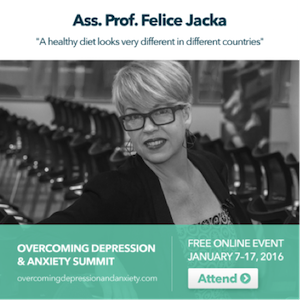
Professor Felice Jacka, Principal Research Fellow: Does Junk Food Shrink Your Brain (her interview is on day 5)

A healthy diet looks very different in different countries

healthy-me-tom-obryan

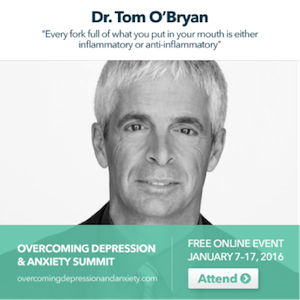
Dr. Tom O’Bryan, International Speaker, Educator: How Wheat Harms the Brain (his interview is on day 3)

Every forkful of what you put in your mouth is either inflammatory or anti-inflammatory

healthy-me-therese-kerr

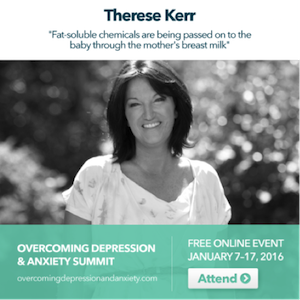
Therese Kerr, Author, Speaker, Health Ambassador: Chemicals in Cosmetics to Avoid (her interview is on day 4)

Fat-soluble chemicals are being passed on to the baby through the mother’s breast milk.

healthy-me-trudy-scott

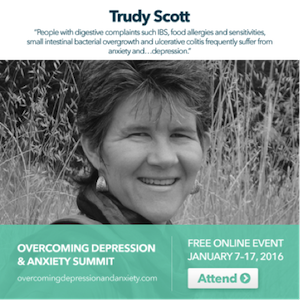
Trudy Scott, Author, Nutritionist, Food Mood Expert: Nutritional Solutions for Anxiety (my interview is on day 3)

People with digestive complaints such as IBS, food allergies and food sensitivities, small intestinal bacterial overgrowth and ulcerative colitis frequently suffer from anxiety and depression.

I’m thrilled to be included in this line-up of experts and I cover how to address anxiety (and depression) using targeted amino acids GABA and tryptophan. I also talk about nutrients for the social anxiety condition called pyroluria (in case you haven’t yet heard me present on these topics – if you have, be sure to tune in to other great interviews).

Hope you can join us! You can learn more and register here:
http://overcomingdepressionandanxiety.com/infuisonsoft.php?p=TrudyScott&w=hme


Filed Under: Antianxiety, Depression, Events Tagged With: Healthy ME Summit

Essential oils to help alleviate anxiety and improve sleep

January 1, 2016 By Trudy Scott 18 Comments

essential oils and anxiety

There are a number of essential oils that are currently in use as aromatherapy agents to relieve anxiety, stress, and depression, and often improve sleep too. Here is some feedback from individuals who use essential oils and share some of their favorites and some ways that they use them.

Tana really likes myrtle and a combination product called Peace and Calming:

My favorite for anxiety is Young Living Myrtle. I originally bought it to use for thyroid support and found it really helped when I felt anxious. Now I wouldn’t be without it. Another favorite of mine is Peace and Calming [which contains tangerine, orange, ylang ylang, patchouli, vetiver, bergamot and some others]

Drew likes to use a blend of oils:

I diffuse a blend of oils including lavender around bed time in my LUMIE Bodyclock Iris 500 which helps create a wonderful calming sleep haven. Low level warm lighting switched on too.

Joy uses her essential oils in candles, incense, or in a homemade spray and shares that she:

loves lavender oil and sandalwood oil for relieving anxiety. I either have them in candles, incense, or in a homemade spray.

Laura has great way of using her essential oils when she is out and about. She shares:

I love lavender, frankincense and geranium (rose geranium when I can find it). I use them in our home and I like to put a couple drops on cotton balls to carry in a sandwich bag. There are times when I like to take them with me.

Evan’s son uses essential oils for anxiety and insomnia:

My son uses Peace & calming with lavender in the diffuser and/or Valor (sometimes vetiver) on his wrists for anxiety and sleepless nights.

There is, of course, research supporting how many of these essential oils help to reduce anxiety. This paper looks at myrtle and the GABA connection: Anxiolytic-like effects and mechanism of (-)-myrtenol and states that:

results suggest that MYR [myrtle] presents anxiolytic-like activity and that effect can be mediated by GABAergic transmission

Here are a few of the many papers supporting aromatherapy for anxiety and stress:

  • Bergamot: Citrus bergamia essential oil: from basic research to clinical application
  • Lavender, ylangylang, and bergamot: The effects of the inhalation method using essential oils on blood pressure and stress responses of clients with essential hypertension
  • Lavender, rose, orange, bergamot, lemon, sandalwood, clary sage, Roman chamomile, and rose-scented geranium: Essential oils and anxiolytic aromatherapy

Here is systematic review published October 2015: A Systematic Review of the Anxiolytic-Like Effects of Essential Oils in Animal Models

The essential oil with the best profile is Lavendula angustifolia, which has already been tested in controlled clinical trials with positive results. Citrus aurantium using different routes of administration also showed significant effects in several animal models, and was corroborated by different research groups. Other promising essential oils are Citrus sinensis and bergamot oil, which showed certain clinical anxiolytic actions; along with Achillea wilhemsii, Alpinia zerumbet, Citrus aurantium, and Spiranthera odoratissima, which, like Lavendula angustifolia, appear to exert anxiolytic-like effects without GABA/benzodiazepine activity, thus differing in their mechanisms of action from the benzodiazepines.

Have you used any essential oils for anxiety? I’d love to hear which are your favorites and how you’ve used them? Do you/did you use only essential oils or other approaches to help your anxiety too? Do you continue to use them? Do you recommend them to clients or patients?

I love lavender (it’s in my facewash) and neroli (I use this as a spray instead of using perfume). I also travel with lavender essential oil in case sleep is an issue in noisy hotels.

Filed Under: Antianxiety, Sleep Tagged With: essential oils

Healing Anxiety through the Gut on the Heal Your Gut Summit

December 28, 2015 By Trudy Scott 8 Comments

Gut dysfunction can be linked to virtually every disease and can cause conditions like autoimmunity, fatigue, depression, anxiety and panic attacks, food sensitivities, chronic pain, allergies and many more. These conditions are by and large preventable.

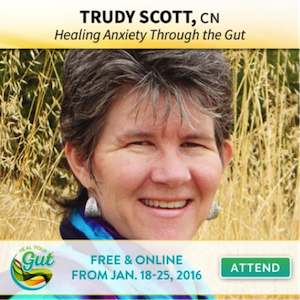
healthygutsummit-trudy

Gut issues and anxiety often go hand-in hand and my interview addresses Healing Anxiety through the Gut:

Can you relate to the following phrases? “I have butterflies in my stomach,” “I can feel it in my gut,” or “I just have this awful feeling in the pit of my stomach.” These aren’t just figures of speech.

It can be difficult to assess which came first. Is the anxiety affecting your digestion, or did poor digestion lead to anxiety or make anxiety worse? Sometimes it’s a mixture of both, and both need to be addressed.

Digestive disorders are very common in the United States. Over a third of all adults are affected by some kind of digestive disorder, and each year forty-five million people visit the doctor for reflux, constipation, irritable bowel syndrome (IBS), liver disease, and other digestive complaints.

Studies have found that people with digestive complaints such IBS, food allergies and sensitivities, small intestinal bacterial overgrowth and ulcerative colitis frequently suffer from anxiety and also depression too.

One study found that 50 to 90 percent of people with IBS who visited a doctor for treatment also suffered from various anxiety disorders (panic disorder, generalized anxiety disorder, social phobia, and post-traumatic stress disorder) and major depression.

There are many factors that can be considered when it comes to anxiety and gut health: the microbiome and psychobiotics (or good bacteria), low serotonin and an amino acid like tryptophan, low levels of stomach acid, low zinc, food sensitivities and much more.

heal-your-gut-summit

Join us for this fabulous upcoming online event that is being hosted by 3 of my favorite people: Dr. Josh Axe, who specializes in functional medicine and is on a mission to transform the health of millions all across the world; Donna Gates, the international best-selling author of The Body Ecology Diet and Dr. Eric L. Zielinski, a sought-after natural health educator, motivational speaker and author, and host of the well-known Essential Oils Summit.

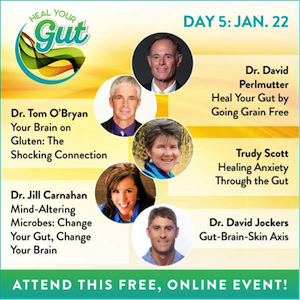
I’m honored to have been invited to present with this excellent line-up of speakers that include:

  • Josh Axe, DNM, DC, CNS: 5 Steps to Heal Leaky Gut
  • Leo Galland, MD: Why Allergies Could Be Signaling Bigger Problems
  • David Perlmutter, MD: Heal Your Gut by Going Grain Free
  • Ty Bollinger: Boost Immunity with Gut-Immune-Cancer Connection

Here are some of the great speakers who I’ll be presenting with on day 5 of the summit:

healthygutsummit-speakers

I hope you can join us! You can register here https://ju127.isrefer.com/go/healyourgutreg/trudyscottcn/

Filed Under: Antianxiety, Events Tagged With: anxiety, Heal Your Gut Summit, IBS, microbiome, serotonin, Trudy Scott

  • « Go to Previous Page
  • Page 1
  • Interim pages omitted …
  • Page 3
  • Page 4
  • Page 5
  • Page 6
  • Page 7
  • Interim pages omitted …
  • Page 20
  • Go to Next Page »

Primary Sidebar

GABA QuickStart Homestudy

gaba quickstart homestudy

Free Report

9 Great Questions Women Ask about Food, Mood and their Health

You'll also receive a complimentary subscription to my ezine "Food, Mood and Gal Stuff"


Connect with me

Popular Posts

  • Amino Acids Mood Questionnaire from The Antianxiety Food Solution
  • The Antianxiety Food Solution Amino Acid and Pyroluria Supplements
  • Pyroluria Questionnaire from The Antianxiety Food Solution
  • Collagen and gelatin lower serotonin: does this increase your anxiety and depression?
  • Tryptophan for the worry-in-your-head and ruminating type of anxiety
  • GABA for the physical-tension and stiff-and-tense-muscles type of anxiety
  • The Antianxiety Food Solution by Trudy Scott
  • Seriphos Original Formula is back: the best product for anxiety and insomnia caused by high cortisol
  • Am I an anxious introvert because of low zinc and vitamin B6? My response to Huffington Post blog
  • Vagus nerve rehab with GABA, breathing, humming, gargling and key nutrients

Recent Posts

  • Her cravings for chips and peanut butter were triggered by stress: GABA ends cravings and reduces physical tension and fear of heights
  • It is truly miraculous to be able to move through life without crippling anxiety and panic
  • GABA and tryptophan combo provide immediate and noticeable relief for tremors and cervical dystonia in just 7 days
  • Red light therapy for back and neck pain, plantar fasciitis and low mood – a complement to the amino acids GABA, DPA and tryptophan
  • What do I use instead of Seriphos to help lower high cortisol that is affecting my sleep and making me anxious at night?

Categories

  • 5-HTP
  • AB575
  • Addiction
  • ADHD
  • Adrenals
  • Alcohol
  • Allergies
  • Alzheimer's disease
  • Amino Acids
  • Anger
  • Antianxiety
  • Antianxiety Food Solution
  • Antidepressants
  • Anxiety
  • Anxiety and panic
  • Autism
  • Autoimmunity
  • benzodiazapines
  • Bipolar disorder
  • Books
  • Caffeine
  • Cancer
  • Candida
  • Children/Teens
  • Collagen
  • Cooking equipment
  • Coronavirus/COVID-19
  • Cravings
  • Depression
  • Detoxification
  • Diabetes
  • Diet
  • DPA/DLPA
  • Drugs
  • EFT/Tapping
  • EMF
  • EMFs
  • Emotional Eating
  • Endorphins
  • Environment
  • Essential oils
  • Events
  • Exercise
  • Fear
  • Fear of public speaking
  • Fertility and Pregnancy
  • Fish
  • Food
  • Food and mood
  • Functional neurology
  • GABA
  • Gene polymorphisms
  • General Health
  • Giving
  • Giving back
  • Glutamine
  • Gluten
  • GMOs
  • Gratitude
  • Gut health
  • Heart health/hypertension
  • Histamine
  • Hormone
  • Hyperparathyroidism
  • Hypoglycemia
  • Immune system
  • Inflammation
  • Insomnia
  • Inspiration
  • Introversion
  • Joy and happiness
  • Ketogenic diet
  • Lithium orotate
  • Looking awesome
  • Lyme disease and co-infections
  • MCAS/histamine
  • Medication
  • Men's health
  • Mental health
  • Mercury
  • Migraine
  • Mold
  • Movie
  • MTHFR
  • Multiple sclerosis
  • Music
  • NANP
  • Nature
  • Nutritional Psychiatry
  • OCD
  • Osteoporosis
  • Oxalates
  • Oxytocin
  • Pain
  • Paleo
  • Parasites
  • Parkinson’s disease
  • PCOS
  • People
  • PMS
  • Postpartum
  • PTSD/Trauma
  • Pyroluria
  • Questionnaires
  • Real whole food
  • Recipes
  • Research
  • Schizophrenia
  • serotonin
  • SIBO
  • Sleep
  • Special diets
  • Sports nutrition
  • Stress
  • Sugar addiction
  • Sugar and mood
  • Supplements
  • Teens
  • Testimonials
  • Testing
  • The Anxiety Summit
  • The Anxiety Summit 2
  • The Anxiety Summit 3
  • The Anxiety Summit 4
  • The Anxiety Summit 5
  • The Anxiety Summit 6
  • Thyroid
  • Thyroid health
  • Toxins
  • Tryptophan
  • Tyrosine
  • Uncategorized
  • Vegan/vegetarian
  • Women's health
  • Yoga

Archives

  • May 2026
  • April 2026
  • October 2025
  • September 2025
  • August 2025
  • July 2025
  • June 2025
  • May 2025
  • April 2025
  • March 2025
  • February 2025
  • January 2025
  • November 2024
  • October 2024
  • September 2024
  • August 2024
  • July 2024
  • June 2024
  • May 2024
  • April 2024
  • March 2024
  • February 2024
  • January 2024
  • December 2023
  • November 2023
  • October 2023
  • September 2023
  • August 2023
  • July 2023
  • June 2023
  • May 2023
  • April 2023
  • March 2023
  • February 2023
  • January 2023
  • December 2022
  • November 2022
  • October 2022
  • September 2022
  • August 2022
  • July 2022
  • June 2022
  • May 2022
  • April 2022
  • March 2022
  • February 2022
  • January 2022
  • December 2021
  • November 2021
  • October 2021
  • September 2021
  • August 2021
  • July 2021
  • June 2021
  • May 2021
  • April 2021
  • March 2021
  • February 2021
  • January 2021
  • December 2020
  • November 2020
  • October 2020
  • September 2020
  • August 2020
  • July 2020
  • June 2020
  • May 2020
  • April 2020
  • March 2020
  • February 2020
  • January 2020
  • December 2019
  • November 2019
  • October 2019
  • September 2019
  • August 2019
  • July 2019
  • June 2019
  • May 2019
  • April 2019
  • March 2019
  • February 2019
  • January 2019
  • December 2018
  • November 2018
  • October 2018
  • September 2018
  • August 2018
  • July 2018
  • June 2018
  • May 2018
  • April 2018
  • March 2018
  • February 2018
  • January 2018
  • December 2017
  • November 2017
  • October 2017
  • September 2017
  • August 2017
  • July 2017
  • June 2017
  • May 2017
  • April 2017
  • March 2017
  • February 2017
  • January 2017
  • December 2016
  • November 2016
  • October 2016
  • September 2016
  • August 2016
  • July 2016
  • June 2016
  • May 2016
  • April 2016
  • March 2016
  • February 2016
  • January 2016
  • December 2015
  • November 2015
  • October 2015
  • September 2015
  • August 2015
  • July 2015
  • June 2015
  • May 2015
  • April 2015
  • March 2015
  • February 2015
  • January 2015
  • December 2014
  • November 2014
  • October 2014
  • September 2014
  • August 2014
  • July 2014
  • June 2014
  • May 2014
  • April 2014
  • March 2014
  • February 2014
  • January 2014
  • December 2013
  • November 2013
  • October 2013
  • September 2013
  • August 2013
  • July 2013
  • June 2013
  • May 2013
  • April 2013
  • March 2013
  • February 2013
  • January 2013
  • December 2012
  • November 2012
  • October 2012
  • August 2012
  • July 2012
  • June 2012
  • May 2012
  • April 2012
  • March 2012
  • February 2012
  • January 2012
  • December 2011
  • November 2011
  • October 2011
  • September 2011
  • August 2011
  • July 2011
  • June 2011
  • May 2011
  • April 2011
  • March 2011
  • February 2011
  • January 2011
  • December 2010
  • October 2010
  • September 2010
  • July 2010
  • May 2010
  • April 2010
  • March 2010
  • February 2010
  • January 2010
  • November 2009

Share the knowledge!

The above statements have not been evaluated by the Food and Drug Administration. Products listed in this website are not intended to diagnose, treat, cure or prevent any disease.

The information provided on this site is for informational and educational purposes only and is not intended as a substitute for advice from your physician or other health care professional. You should consult with a healthcare professional before starting or modifying any diet, exercise, or supplementation program, before taking or stopping any medication, or if you have or suspect you may have a health problem.


Copyright © 2026 Trudy Scott. All Rights Reserved. | Privacy | Terms and Conditions | Refund Policy | Medical Disclaimer

Free Report

9 Great Questions Women Ask about Food, Mood and their Health

You’ll also receive a complimentary subscription to my ezine “Food, Mood and Gal Stuff”