• Skip to primary navigation
  • Skip to main content
  • Skip to primary sidebar

everywomanover29 blog

Food, Mood and Women's Health – Be your healthiest, look and feel great!

  • Blog
  • About
  • Services
  • Store
  • Resources
  • Testimonials
  • The Book
  • Contact
  • Search this site

TMJ

Using tryptophan and GABA amino acid supplements together for anxiety, sleep, ruminations and TMJ: questions and answers

February 23, 2024 By Trudy Scott 18 Comments

amino acids q and a

I am taking 250 mg tryptophan, 100-200 mg GABA. Tryptophan is helping with rumination. GABA is helping with feeling less tension in the body. I am also taking 500mg DPA. DLPA used to help me but I thought it was too stimulating so I’m trying DPA now. I couldn’t feel much when taking it on its own.

But the combination of tryptophan, DPA & GABA is generally helping me to feel less wound up. I still struggle with rumination and I have a really difficult time making decisions. I get really overwhelmed when I have a lot of decisions to make – it sends me in a tailspin and leads to more rumination. I’m not sure which amino acid would be good for that?

I generally have trouble relaxing and feeling calm and I feel the tension in my body. I am not sure if I should try increasing the dosage of one of the above?

I am wondering, is it important to take l-tyrosine to balance the tryptophan since tryptophan can lower dopamine over time? Or is the DPA enough since it’s a precursor to tyrosine?

I get many questions like this about using both tryptophan and GABA amino acid supplements together for easing anxiety and today I’m sharing some of these questions and my answers. This will also give you the opportunity to ask questions you may have related to using both these amino acids together. You’ll also read many success stories like the above and how to tweak the amino acids for optimal results.

Read on for my response to the above question from TT and other questions about using GABA and tryptophan together –  how to measure GABA and serotonin levels for using with teens, adding tryptophan for sleep separately from GABA, how to test both for jaw clenching, and the precaution about serotonin syndrome.

My response and feedback for TT – adjustments for even better results

My response and feedback for TT … It’s wonderful that this combination is helping so much. It’s a great start but there are adjustments I’d consider to get even better results. The tryptophan dose is low, with a typical starting dose of 500mg so I’d consider increasing this a few times over a few weeks to see if the ruminations decrease even further. This may also help with the overwhelm and decision making.

Increasing the GABA over a few weeks (after the trial of increased tryptophan) may well improve her ongoing tension and inability to relax. I’d want to make sure she is using GABA sublingually for the best effects.

She asks about the need to take tyrosine to balance the tryptophan but I don’t have clients do this as a rule of thumb and only have clients take tyrosine if they have symptoms of low dopamine. In this instance since TT mentions difficulties with decision-making, a trial of tyrosine may be worth considering, after she has increased tryptophan and increased GABA. More about tyrosine benefits here.

I do want to mention that DPA is not a precursor to dopamine but DLPA does offer some dopamine support. I share more about the differences between DPA and DLPA here.

I want to give my teens GABA and tryptophan – how do I measure GABA and serotonin levels?

I have two teenagers ages 14 and 16 who suffer from anxiety and depression. My daughter has more difficulty with depression and my son with ruminating thoughts . My father had similar issues. We have tried supplements, and medications that help a little.

I want to try giving them GABA and tryptophan, but to make sure that they in fact meet the criteria you describe. Is there a lab test that measures GABA and serotonin levels? Also, how can I figure out the dose and times to give them?

Here is my feedback for Maria …. The best way to determine if someone may have low GABA/serotonin is to look at the low GABA/serotonin symptoms questionnaire (here is that link), rate 1 or 2 symptoms on a scale of 1-10 with 10 being worst, do an initial one-off trial of the respective amino acid and rate the symptoms again right afterwards (in the next 2 to 30 minutes). Based on this we decide if we’ll continue with the amino acid and how much to use.

Dosing is unique to each person’s needs and timing differs for each amino acid – tryptophan is best mid-afternoon and evening and GABA throughout the day and evening if needed too.

I don’t use the urinary neurotransmitter test as it’s not considered an accurate assessment. I blogged about this here.

It’s a comprehensive approach – amino acids AND diet. This mom mentions supplements and medications but nothing about what their diets are like right now – gluten-free, sugar-free, caffeine-free, eating protein at breakfast for blood sugar control, real whole foods, grass-fed red meat, wild fish, fermented foods etc?

I also suggest my book “The Antianxiety Food Solution”  as a great place to start when you are new to the amino acids and other anxiety nutrition solutions like gluten/sugar/caffeine removal, blood sugar control, gut health, pyroluria etc.

And this blog is a wonderful example and gives hope to moms – Tryptophan for my teenager: she laughs and smiles, her OCD and anxiety has lessened, and she is more goal oriented and focused on school. It’s one of many similar blogs so be sure to use the search feature to find others.

GABA and theanine help my anxiety, if I add tryptophan for sleep should I take it separately?

I have taken Gaba and L-theanine for anxiety for the last few years on and off as recommended by a doctor, it really does help although I still have sleeping problems. I also have a lot of symptoms on your low serotonin list so if I add tryptophan to see if it helps with sleep should I take it with the Gaba or separately?

Here is my response and feedback for Diane … I was glad to hear GABA and theanine are helping with the anxiety. I have many clients with low serotonin and low GABA symptoms take GABA, theanine and tryptophan at bedtime at the same time for improving sleep that is caused by low serotonin.

Diane has already identified that she has a lot of low serotonin symptoms from the questionnaire, so like I shared for Maria above, a trial is worth considering.

We always want to capitalize on what is already working so when GABA/theanine is helping with anxiety and offers some help with sleep we will often increase that before considering a trial of tryptophan.

I’m assuming she is addressing dietary factors too and other root causes that may also affect her sleep – like low blood sugar and high cortisol.

Would GABA or tryptophan help with jaw clenching and how do I test to see if they would help?

Would Gaba or tryptophan help with jaw clenching, not grinding, which I assume is an anxiety thing even when I’m unaware of any anxiety? Since I already use Gaba on and off for anxiety or if I can’t sleep (only taking 200 mg) how would I go about testing tryptophan to see if it would help for clenching?

Here is my feedback for Diane … Jaw clenching/TMJ (temporomandibular joint) issues can be related to both low GABA because of the muscle tension and also when serotonin is low.

In the same way we do a trial with the amino acids for anxiety or low self-esteem (or another symptom like cravings) we would do a trial for the jaw clenching i.e. rate the severity on a scale of 1-10 with 10 being worst, do a trial of tryptophan and then GABA (separately) and rate the symptoms again right afterwards (in the next 2 to 30 minutes). And go from there, increasing each as needed (one at a time) and tracking symptom improvement.

Here is a case as an example: Tryptophan ends TMJ pain, headaches and worry, and improves mood and sleep.

Precaution about serotonin syndrome with tryptophan/5-HTP

There are precautions when using certain amino acids and I always review them with all my clients. If they have been prescribed an SSRI, I have them discuss the use of tryptophan/5-HTP with their prescribing doctor so they can be monitored for serotonin syndrome. With careful monitoring and doctor approval I feel comfortable having my clients use tryptophan/5-HTP 6 hours away from their one and only SSRI.

If they are using more than one SSRI and/or a combination of psychiatric medications, the use of tryptophan/5-HTP is not advised.

None of the above applied in these situations but it’s important to be aware of.

Tryptophan and GABA product options
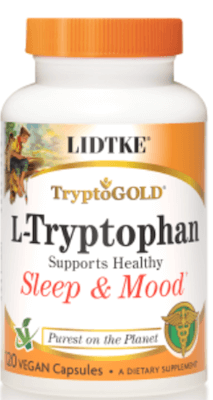
lydke l-tryptophan
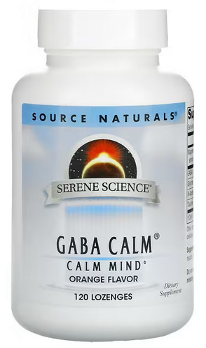
gaba calm
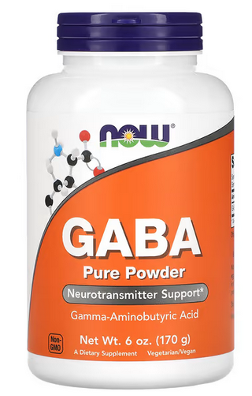
gaba pure poder

Products I recommend include Lidtke 500 mg Tryptophan, Source Naturals GABA Calm lozenges and Now GABA Powder.  You can purchase these from my online store (Fullscript – only available to US customers – use this link to set up an account).
nature's best l-tryptophan
gaba calm
gaba pure poder

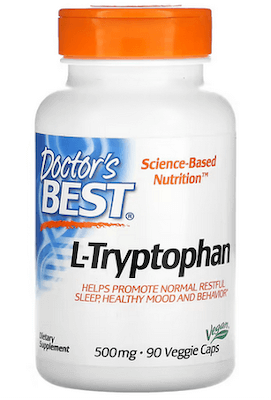
If you’re not in the US, Doctor’s Best L-Tryptophan 500mg and Source Naturals GABA Calm lozenges and Now GABA Powder are products I recommend on iherb (use this link to save 5%).

Additional resources when you are new to using tryptophan or GABA and other amino acids as supplements

We use the symptoms questionnaire to figure out if low serotonin or low GABA or other neurotransmitter imbalances may be an issue for you.

If you suspect low levels of any of the neurotransmitters and do not yet have my book, The Antianxiety Food Solution – How the Foods You Eat Can Help You Calm Your Anxious Mind, Improve Your Mood, and End Cravings, I highly recommend getting it and reading it before jumping in and using amino acids on your own so you are knowledgeable. And be sure to share it with the practitioner/health team you or your loved one is working with.

There is an entire chapter on the amino acids and they are discussed throughout the book in the sections on gut health, gluten, blood sugar control (this is covered in an entire chapter too), sugar cravings, anxiety and mood issues. The importance of quality animal protein and healthy fats is also covered.

The book doesn’t include product names (per the publisher’s request) so this blog, The Antianxiety Food Solution Amino Acid and Pyroluria Supplements, lists the amino acids that I use with my individual clients and those in my group programs.

If, after reading this blog and my book, you don’t feel comfortable figuring things out on your own (i.e. doing the symptoms questionnaire and respective amino acids trials), if you need serotonin support, the Serotonin QuickStart Program is a good place to start. This is a paid online/virtual group program where you get my guidance on using tryptophan and 5-HTP safely, and community support during 5 LIVE Q&A calls. You can sign up to be notified when the next live launch of this program is happening. We take a deep dive into product options including Lidtke products and others if you’re not able to access Lidtke.

Low GABA can also affect sleep and cause stress eating. If you also have low GABA symptoms, the next step to get help is the GABA QuickStart Program. This is also a paid online/virtual group program where you get my guidance and community support. Another option is the budget-friendly GABA QuickStart Homestudy Program.

If you are a practitioner, join us in The Balancing Neurotransmitters: the Fundamentals program. This is also a paid online/virtual program with an opportunity to interact with me and other practitioners who are also using the amino acids.

This blog is a follow-on from the previous blog on this topic so be sure to read that blog too. It also features many valuable questions in the comments and my responses, hence this new post. I hope this has been helpful for you.

Wrapping up

Now I’d love to hear from you…

Have you had success using GABA and tryptophan together for anxiety, insomnia, ruminations, depression, overwhelm, TMJ etc?

Have you tweaked your dosing to find the ideal doses for your needs?

If yes, what doses and which products have helped?

If you’re a practitioner do you use tryptophan and GABA with clients/patients with these low serotonin and low GABA symptoms?

And please let me know if it’s helpful that I’m now including product recommendations and where to get them?

Feel free to share and ask your questions below.
Filed Under: Anxiety and panic, Children/Teens, GABA, Insomnia, Tryptophan Tagged With: amino acid supplements, anxiety, dopamine, GABA, GABA Quickstart; Balancing Neurotransmitters: the Fundamentals program for practitioners, jaw clenching, making decisions, neurotransmitters, ruminations, serotonin, serotonin syndrome, sleep, teens, tension, TMJ, tryptophan, tyrosine

Using both tryptophan and GABA supplements together for easing anxiety: questions and answers

June 11, 2021 By Trudy Scott 71 Comments

tryptophan and gaba for anxiety

I get many questions about using both tryptophan and GABA supplements together for easing anxiety and today I’m sharing some of these questions and my answers. This will also give you the opportunity to ask questions you may have related to using both these amino acids together. You’ll also read about some reasons for the confusion about when to use GABA vs tryptophan, some success stories and some research.

Let’s start with this question since it’s one that I get asked many many times:

Should one use GABA and tryptophan together for helping with anxiety symptoms?

I have many clients who need and use both but it’s because they have low GABA and also have low serotonin, both driving different types of anxiety symptoms. It’s important to recognize that each amino acid supplement addresses a very different set of symptoms.

With low GABA levels they will have physical anxiety, tension, stiff and tense muscles and often self-medicate with alcohol in order to relax. Sleep may also be a problem with lying awake feeling tense. Because they also have low serotonin they will have the worry-in-the head type of anxiety, ruminations, and obsessions. They may also have panic attacks, negativity, anger, irritability, PMS, TMJ, lack of confidence and insomnia. (Here is a list of all the low serotonin and low GABA symptoms).

You should only use GABA and tryptophan together if you have both low GABA and low serotonin symptoms.  This will address these particular root causes.

My anxiety has improved significantly with GABA, should I also try tryptophan/5-HTP?

This is another common question I get about using tryptophan and GABA supplements together (paraphrased from one of the blog comments so I could share my feedback here):

I’m using GABA and my anxiety has improved significantly, however, the anxiety I feel in my body immediately upon waking is still bothersome. What would you recommend for the anxiety in my body on waking (that improves when I get out of bed, start moving around and as the day progresses)?

Could I try 5-HTP/tryptophan in addition to GABA?

We always want to capitalize on what is already working. GABA has improved her anxiety significantly, so I’d want to have her figure out how much it’s improved (for example from say 10/10 with 10 being worse to 5/10 with the GABA). Then we’d bump up the GABA to see if additional gains are seen. This could mean a higher dose at night and could also mean a small dose in the morning on waking. And then figure out the improvement and adjust up again if needed.

There is no reason why she shouldn’t try either tryptophan or 5-HTP too but only if she also has other low serotonin symptoms other than morning anxiety. And also, only once she has established the ideal dose for the GABA. She mentions “the anxiety in my body” so I suspect it’s the low GABA physical-tension type of anxiety. We often see low GABA and low serotonin go hand in hand so it’s very likely she’ll also benefit from serotonin support too.

Some reasons for the confusion about when to use GABA vs tryptophan

One reason for this confusion is that there are many combination products on the market that contain both GABA and tryptophan (and other nutrients). The company is trying to make a one-size-fits-all product in the hope it will help many folks. The problem is that it’s not individualized to your unique needs – which may be low GABA or low serotonin or both. Even if it is low GABA and low serotonin that you suffer from, a combination product may not work if, for example, you need a very small amount of GABA and need a much higher dose of tryptophan.

Another reason is that many well-meaning practitioners do not help their client/patients make the distinction between low serotonin and low GABA symptoms. This happens because they often don’t understand this either.

Another reason is that many folks jump in and start using these amino acids without really understanding how and why they work, how to use them and what to look out for. It’s why I highly recommend that everyone planning to use them reads my book first, The Antianxiety Food Solution.

GABA and tryptophan have helped immensely with ruminating thoughts and PTSD – can I stay on them indefinitely?

KJ posted these great results and her question on the blog:

Hi Trudy, I love your blogs and I’ve read your book, The Anti-Anxiety Food Solution – excellent! I have been taking GABA and tryptophan for about 6 months and they have helped me immensely with ruminating thoughts and PTSD. Sometimes I try to go off GABA and Tryptophan for a day or two, but the ruminating thoughts come back, so my question is, can I stay on GABA and Tryptophan indefinitely? I am 59, have no health problems and take no prescription medications.

It’s super to hear GABA and tryptophan have helped with her ruminating thoughts and symptoms of PTSD. I shared that there is no research on long-term use and we should always keep looking for the reasons serotonin and GABA are low and try to address these. Since she has my book I assume she has also implemented all the diet recommendations (no gluten, no caffeine, no sugar, eating for blood sugar control etc), addressed her gut health (candida, parasites, digestive enzymes etc) and looked at low zinc and low vitamin B6 too. There are many other factors to consider – I list 60+ nutritional and biochemical causes of anxiety here.

Jessica says GABA and tryptophan have been life-changing

Here is some feedback from Jessica about how GABA and tryptophan has been life-changing for her – and in only a matter of weeks:

I started taking Gaba and tryptophan about 3 weeks ago after reading about the benefits on this page. It’s been life changing!

I take 1000mg tryptophan at night and 100mg GABA in the morning. Ruminations and obsessive thoughts are almost non-existent now. I have less tension in the jaw and neck. I feel like I’m able to deal with everyday stressors that were overwhelming me prior to starting these supplements.

She started with the tryptophan and added the GABA after about a week.

Jessica clearly had both low serotonin and low GABA symptoms. The ruminations, obsessive thoughts and overwhelm were likely related to low serotonin. The jaw and neck tension are classic low GABA but serotonin support also helps with TMJ too.

Paula would not be able to sleep without GABA and tryptophan

Paula shared this feedback on the blog post where I write about GABA, Heartmath and EFT easing Micki’s mold-induced anxiety and panic attacks:

This was an interesting article because I use both GABA and Tryptophan and would not be able to sleep if I did not use them. I have also had chronic mold exposure. It never occurred to me that the reason I have to take these things in order to sleep is due to the mold in my system.

Toxic mold can impact neurotransmitter production and GABA and tryptophan can provide some relief while the mold is being addressed.

Some research where tryptophan and GABA have been used with success

Here is some research where tryptophan and GABA (and similar amino acids) have been used with success:

  • Essential tremor, dystonia, anxiety and cravings – diet, GABA, tryptophan, zinc and vitamin B6

This study shares the case of a 13-year-old boy with an essential tremor that caused severe functional impairment. He responded to a Mediterranean diet and supplementation with GABA and tryptophan and was able to resume his plans to pursue a musical career as a guitar player.

  • A randomized targeted amino acid therapy with behaviourally at-risk adopted children

The combination of theanine (an amino acid which also supports GABA levels) and 5-HTP (another precursor to serotonin) led to “significant decreases in parent reports of the children’s behaviour problems.”

Resources if you are new to using GABA and tryptophan as  supplements

If you are new to using the amino acid tyrosine as a supplement, here is the Amino Acids Mood Questionnaire from The Antianxiety Food Solution and a brief overview here, Anxiety and targeted individual amino acid supplements: a summary.

As I mentioned above, if you suspect low levels of any of the neurotransmitters and do not yet have my book, The Antianxiety Food Solution – How the Foods You Eat Can Help You Calm Your Anxious Mind, Improve Your Mood, and End Cravings, I highly recommend getting it and reading it before jumping in and using amino acids so you are knowledgeable.

The book doesn’t include product names (per the publisher’s request) so this blog, The Antianxiety Food Solution Amino Acid and Pyroluria Supplements, lists the GABA and tryptophan products that I use with my individual clients and those in my group programs.

As with all individual amino acids we use GABA and tryptophan for quick relief of symptoms. And we also always focus on the foundations like diet, the gut, adrenals and stress levels.

If, after reading this blog and my book, you don’t feel comfortable figuring things out on your own (i.e. doing the symptoms questionnaire and respective amino acids trials), a good place to get help is the GABA QuickStart Program (if you have low GABA symptoms). This is a paid online/virtual group program where you get my guidance and community support. 

If you are a practitioner, join us in The Balancing Neurotransmitters: the Fundamentals program. This is also a paid online/virtual program with an opportunity to interact with me and other practitioners who are also using the amino acids.

Do you have questions about using GABA and tryptophan together?

Have you used the combination of GABA and tryptophan with success? How did they help you and what was your timing and dosing?

Feel free to post your other related questions here too.


Filed Under: Anxiety, GABA, Tryptophan Tagged With: anxiety, can I stay on them indefinitely, GABA, obsessions, physical anxiety, PTSD, ruminations, serotonin, sleep, stiff and tense muscles, tension, TMJ, together, tryptophan, worry

5-HTP can raise salivary cortisol: does this cause a “wired-tired” feeling?

August 14, 2020 By Trudy Scott 48 Comments

5-htp salivary

Are you aware that 5-HTP – an amino acid supplement that supports serotonin levels – can raise cortisol levels and leave you feeling “wired-tired”? You may be able to relate to this if you’ve ever used 5-HTP to help with anxiety and insomnia and ended up feeling more anxious and more wide-awake despite your exhaustion and need for sleep. You feel “wired-tired” and it’s not pleasant at all.

Both 5-HTP and tryptophan, used as supplements, help to boost serotonin levels so you can feel happy, calm, sleep well and not crave carbs in the afternoon/evening. They also help with panic attacks and phobias, lack of confidence, depression, negativity, imposter syndrome, PMS, irritability, anger issues, pain/fibromyalgia, TMJ and anger. I typically have my clients with low serotonin symptoms start with a trial of tryptophan because I see such excellent results with this amino acid. That being said, some people simply do better on one versus the other and you may do better with 5-HTP.

However there is one big caveat with 5-HTP. I don’t recommend 5-HTP when a client has elevated cortisol levels because we know that it can raise cortisol levels in certain individuals. This can leave you feeling agitated, cranky, as well as wired and yet tired at the same time.

In this 2002 study, L-5-hydroxytryptophan induced increase in salivary cortisol in panic disorder patients and healthy volunteers

Salivary cortisol levels were measured in 24 panic disorder patients and 24 healthy volunteers, following ingestion of 200 mg L-5-hydroxytryptophan or placebo.

The experiment was carried out in the afternoon, “when basal cortisol secretion is more stable.” The first saliva sample was obtained at 1pm and the subjects ingested the 200mg 5-HTP at 2pm. Additional saliva samples were obtained at 2:30pm, 3:00pm and 3:30pm.

They report the following:

A significant rise in cortisol was observed in both patients and controls following ingestion of L-5-hydroxytryptophan. No such effects were seen in the placebo condition.

Here are a few additional comments and my thoughts:

  • This study was done to find evidence for “serotonin receptor hypersensitivity in panic disorder” and not specifically to test for the effects of 5-HTP on cortisol levels but it serves this purpose rather nicely (and it’s one of many similar studies, some of which measure plasma cortisol levels)
  • Keep in mind 200mg of 5-HTP is a large starting dose. It’s typical to start with 50mg so may be a factor to consider
  • In this study they did not assess cortisol levels beyond the 1.5 hours from ingestion of the 5-HTP. It would have been useful to see when levels started to go down
  • We would want to consider the ramifications of using 5-HTP for weeks (whether it’s 50 or 200mg). What impact would that have on cortisol and the adrenals? (I am not aware of a study like this having been done)
  • I’m also not aware of a study being done with 50mg but if you feel worse and feel “wired-tired” with 5-HTP and switch to tryptophan (the equivalent starting dose is 500mg) and your anxiety and other low serotonin symptoms resolve then you have found your solution
  • You may be wondering: “could I use 5-HTP to raise my low cortisol levels”? Theoretically yes and possibly very short-term. But I would question the timing since 5-HTP and tryptophan are best dosed mid-afternoon and later. This is when we would expect our cortisol levels to be on the downward slope as we end our day. I’d also want to nourish the adrenals with B vitamins and herbal adaptogen and remove the trigger/s that are leading to low cortisol.

If you suspect low serotonin symptoms and are new to using the amino acids and do not have my book I highly recommend getting it and reading it before jumping in to taking supplements: The Antianxiety Food Solution – How the Foods You Eat Can Help You Calm Your Anxious Mind, Improve Your Mood, and End Cravings.

There is a complete chapter on the amino acids and one for pyroluria, plus information on real whole food, sugar and blood sugar, gluten, digestion and much more.  If you’re not a reader there is now also an audible version.

Here is the Amino Acids Mood Questionnaire from The Antianxiety Food Solution and additional information on Anxiety and targeted individual amino acid supplements: a summary

Please also read and follow these Amino Acid Precautions.

This lists The Antianxiety Food Solution Amino Acid and Pyroluria Supplements that I use with my individual clients and those in my group programs.

Have you used 5-HTP with success? Or have you used it and felt “wired-tired”? Have you correlated the success or failure of your 5-HTP use with your salivary cortisol levels?

If you switched from 5-HTP to tryptophan did you have success with that?

If you’re a practitioner is this something you see with your clients/patients and take into consideration?

Feel free to post your questions here too.

Filed Under: Antianxiety Tagged With: 5-HTP, adrenals, amino acid, anger, anger issues, calm, cortisol, depression, Fibromyalgia, happy, Imposter syndrome, irritability, L-5-hydroxytryptophan, negativity, pain, panic attacks, Panic disorder, phobias, PMS, serotonin, sleep, TMJ, tryptophan, wired-tired

Tryptophan ends TMJ pain, headaches and worry, and improves mood and sleep: a success story

July 17, 2020 By Trudy Scott 32 Comments

tryptophan success story

Today I’m sharing a success story on how the amino acid tryptophan, taken as a supplement, ends  TMJ (temporomandibular joint) pain and headaches in a woman in my community. She had the added benefits of an improved mood and less worrying and her sleep improved too.

There is evidence to support the low serotonin connection to TMJ and pain like fibromyalgia and I share that research below.

Before I share the success story, in case you’re new to neurotransmitter imbalances, the other symptoms we see with low serotonin are the worrying-type of anxiety, panic attacks and phobias, lack of confidence, depression, negativity, imposter syndrome, PMS, irritability, anger issues, insomnia and afternoon/evening cravings. Tryptophan can be used to boost serotonin levels and improve these symptoms as you’ll see below.

Right after speaking on the recent Trauma and Mind-Body Super Conference, Renee shared her wonderful success story on Facebook:

Out of all the interviews I felt yours gave the most actionable steps. I was taking amitriptyline for TMJ and didn’t like the side effects, however what other options did I have? Not many according to my GP [general practitioner]. Luckily I found your suggestion of tryptophan. And I can’t explain how much of a change it made! I weaned off the medicine and took tryptophan instead and not only did it help the TMJ but also helped me feel more even emotionally.

I am being referred for trauma therapy and I am optimistic that I will be discomfort free soon.

So huge thanks for sharing your knowledge. It helped me at a time when I was really starting to think there were no ‘natural’ options and conventional meds were all I could take.

I checked in with her, thanking her and acknowledging her wonderful feedback. I also asked how much tryptophan made this difference and how quickly she saw an improvement. And what side-effects she was seeing with the medication. She shared this:

I am a week into taking tryptophan, and I’m taking 500mg. I saw improvements with the TMJ within an hour of taking it. My jaw felt loose and I had no headaches, I also felt more ‘even’ mood wise. Like an underlying worry had gone. [worry is a classic symptom of low serotonin – more on that here]

I also had some stress yesterday that usually would have made me crumble, but instead I was able to stand up for myself and see subjectively the extent of the issue and resolve it. I am amazed!

My original medication (amitriptyline) had given me extreme dry mouth, which I found hard to manage, the headaches were also not relieved as much as I had hoped, plus I was having sessions of palpitations.

I haven’t had any palpitations from the day I started tryptophan whereas the dry mouth took some time to subside.

These really are wonderful results and typical that we’d see results this quickly with tryptophan if the root cause of the TMJ and headaches is low serotonin. It can sometimes take a few weeks to find the ideal dose but Renee found it with the initial trial amount of 500mg.

Sleep improved but made her too sleepy too early (some of the medication side-effects went away too)

The tryptophan also improved her sleep (and the palpitations and dry mouth side-effects from the medication stopped):

I was struggling to get to sleep and stay asleep, suffering bouts of insomnia, prior to any medication. I still am sleeping well taking tryptophan which I am pleased about.

She did however share that the timing of the tryptophan was making her too sleepy too early in the evening and she was planning to shift the timing:

I am finding tryptophan is making me feel drowsy in the evening, so I am trying different times during the day to take it. Hopefully I can push back the tiredness to perhaps 8/9 at night to coincide with bedtime.

My advice to her was that I have my clients use tryptophan MA (mid-afternoon) and evening and if MA makes them too sleepy they just do an evening dose. That can be enough for TMJ the next day. Sometimes more than 1 x 500mg in the evening is needed for easing TMJ and headache pain that night and the next day too.

I did check with her about weaning off the medication as cold-turkey quitting of psychiatric medications are dangerous and not advised. She shared this:

I weaned off over 1 week, but I was only on it for 8 weeks in total before I found tryptophan.

A slow taper under the guidance of the prescribing doctor is always recommended (more on this for amitriptyline/Elavil withdrawal here).

Some research supporting this serotonin/TMJ connection

  • Plasma tryptophan and kynurenine in females with temporomandibular disorders and fibromyalgia – An exploratory pilot study

…both temporomandibular disorders myalgia (TMDM) and fibromyalgia (FM) have been linked to central and peripheral changes in serotonin availability.” (tryptophan is not used in this study which also makes the serotonin/anxiety connection)

  • The effects of dietary tryptophan on chronic maxillofacial pain and experimental pain tolerance

Over the 4 weeks of the study, there was a greater reduction in reported clinical pain and a greater increase in pain tolerance threshold in the tryptophan group than in the placebo group. The tryptophan group was given “three grams of tryptophan in conjunction with a high carbohydrate, low fat, low protein diet.”

Additional resources when you are new to using tryptophan and other amino acids as supplements

As always, I use the symptoms questionnaire to figure out if low serotonin or other neurotransmitter imbalances may be an issue.

If you suspect low levels of any of the neurotransmitters and do not yet have my book, The Antianxiety Food Solution – How the Foods You Eat Can Help You Calm Your Anxious Mind, Improve Your Mood, and End Cravings, I highly recommend getting it and reading it before jumping in and using amino acids on your own so you are knowledgeable. And be sure to share it with the practitioner/health team you or your loved one is working with.

There is an entire chapter on the amino acids and they are discussed throughout the book in the sections on gut health, gluten, blood sugar control (this is covered in an entire chapter too), sugar cravings, anxiety and mood issues.

The book doesn’t include product names (per the publisher’s request) so this blog,The Antianxiety Food Solution Amino Acid and Pyroluria Supplements, lists the amino acids that I use with my individual clients and those in my group programs.

If, after reading this blog and my book, you don’t feel comfortable figuring things out on your own (i.e. doing the symptoms questionnaire and respective amino acids trials), a good place to get help is the GABA QuickStart Program (if you have low GABA symptoms). This is a paid online/virtual group program where you get my guidance and community support. You can sign up to be notified when the next live launch is happening.

If you need serotonin support, the Serotonin QuickStart Program is a good place to get help. This is also a paid online/virtual group program where you get my guidance on using tryptophan and 5-HTP safely, and community support during 5 LIVE Q&A calls. You can sign up to be notified when the next live launch of this program is happening.

If you are a practitioner, join us in The Balancing Neurotransmitters: the Fundamentals program. This is also a paid online/virtual program with an opportunity to interact with me and other practitioners who are also using the amino acids.

Wrapping up and your feedback

I appreciate Renee sharing her success story and I’m thrilled with her results.

Please share your TMJ/headache tryptophan success story if you have one (and how much tryptophan or 5-HTP helped you).

What about mood, anxiety and sleep (and any other low serotonin symptoms) – did they improve too?

And do share if other nutrients or approaches have helped.

And feel free to post your questions here too.

Filed Under: Anxiety, Pain, Tryptophan Tagged With: anxiety, Headaches, insomnia, mood, pain, palpitations, serotonin, sleep, temporomandibular joint pain, TMJ, TMJ pain, tryptophan, worry

Botox injections (cosmetic or non-cosmetic): are they a root cause of anxiety and panic attacks?

March 6, 2020 By Trudy Scott 71 Comments

botox injections

New research shows Botox injections are being considered for severe depression and bipolar disorder because it stops frowning and this lack of frowning has a positive impact on neurotransmitters and mood. I recently posted this on Facebook and asked this question:

I’m curious if you have had Botox injections or would consider it (for cosmetic reasons) or perhaps for migraines, dystonia, proctalgia fugax or depression/bipolar?

If you have had Botox injections are you happy with the result or did you have any adverse effects like increased anxiety, panic attacks or anything else?

The response was varied with most folks saying they would never consider using Botox for cosmetic reasons, some folks saying they used Botox for cosmetic reasons and had issues and some folks saying they’ve used Botox for cosmetic reasons and love it, and others who have used Botox for non-cosmetic reasons.

All the practitioners who commented have concerns about Botox saying results are mixed with some of their clients having severe reactions and some doing fine. As I looked further into this topic I’ve gained additional insights and my biggest concern for you, and my community, is that Botox can lead to very severe anxiety and panic attacks.

I encourage you to keep an open mind about my Botox concerns if you have chronic anxiety that is not resolving and it started (or got worse) after receiving Botox injections, or if  you’re considering Botox injections.

Anxiety, panic attacks, inability to handle stress, body shaking

I gained my biggest insights from the Botox Dysport (Side Effects) Support group. Someone suggested I look into this group and I requested an invite to join so I could learn more. So many of the members of this support group  report anxiety, panic attacks, inability to handle stress, body shaking and problems connecting socially.  This is what one member shared:

…just joining the dots, I’ve been unwell for a few years since getting Botox but didn’t put it together until having it last week and going into panic attacks / ER.

Since then extreme anxiety and I’ve ended up in a mental health facility on benzodiazepines (ativan/valium). Reactions / withdrawal has been severe, have started to put it all together whilst reading through this page.

I’m realising that my decline, immune system failure (chronic epstein barr) fatigue, loss of motivation, loss of appetite, shaking in my body, muscle atrophy, anxiety, no motivation to connect socially, can’t handle any stress, can’t relax, tinnitus, breathing trouble and the list goes on is from botox…. scared to say the least as doesn’t seem to be a solution, I was worried to get Botox originally and obviously am eating myself up with regret, thought I would share if anyone has a similar story.

There are many similar posts to this one and it’s heart-breaking, especially because they say they are not being heard by their doctors.

I had a short online conversation with one of the moderators and she shared they suspect Botox is impacting the hypothalamic-pituitary-adrenal (HPA) axis leading to high cortisol and causing their anxiety symptoms. Many of the members find relief with Seriphos, which is a phosphorylated serine product I’ve had great success with. Here is my blog post on Seriphos for anxiety and insomnia related to high cortisol.

I asked if any of the members find GABA or serotonin support helpful and for some GABA helps ease the physical tension and for other members tryptophan or 5-HTP helps ease the worry type of anxiety. However for others, the amino acids seem to have a paradoxical effect and make symptoms worse.

I’ve never been in favor of Botox for cosmetic reasons simply because I’m not a fan of putting foreign objects/toxins into the body and because I believe in aging gracefully with confidence. I do find that many women feel the need for cosmetic Botox injections and other ways to try and look younger (such as breast implants and hair dye) because of low self-esteem and lack of confidence caused by low serotonin.

Botox for non-cosmetic purposes

Botox is also used for non-cosmetic purposes. Some of my neurologist colleagues also have concerns about cosmetic use and will only use Botox injections for the following:

  • severe cases of dystonia
  • migraines (to relax forehead muscles)
  • proctalgia fugax /rectal spasms

Botox may also be used for multiple sclerosis (MS) symptoms, pelvic pain and bladder issues, for TMJ, after a stroke and for chronic anal fissures in colitis (sphincter spasms can prevent anal fissures from healing).

I would love to see safer approaches for non-cosmetic Botox injections being researched and explored by practitioners. For example:

  • Relief of dystonia symptoms using diet, GABA, tryptophan, zinc and vitamin B6
  • Sublingual GABA to help to relax forehead muscles in those with migraines
  • Sublingual GABA for the extremely painful proctalgia fugax. Could this also be considered in colitis patients?

Botox for mental health – we can do better with nutritional psychiatry

At the beginning of this blog I mentioned the new research that shows Botox injections are being considered for severe depression and bipolar disorder because it stops frowning. This lack of frowning has a positive impact on neurotransmitters and mood.

A study published in 2018, Clinical analysis of 86 botulism cases caused by cosmetic injection of botulinum toxin (BoNT), reports that botulism is a severe side effect of Botox injections with symptoms including: “headache, dizziness, insomnia, fatigue, blurred vision, eye opening difficulty, slurred speech, dysphagia [difficulty swallowing], constipation, and anxiety.”

The authors report these symptoms occur in the first 36 days after the Botox injections and that all symptoms resolved after botulinum antitoxin serum injections.

This conclusion clearly doesn’t address why there are so many folks in the Botox Dysport (Side Effects) Support group continue to experience long-term severe symptoms.

We also have research reporting a possible connection between Botox injections and thyroid autoimmunity.

I feel we can do better especially with what we know about nutritional psychiatry, the use of targeted individual amino acids, nutrients like lithium orotate, the gut-brain connections and everything covered in my book The Antianxiety Food Solution (my Amazon link) and on this blog.

A note of appreciation

I’d like to end with a note of appreciation to everyone who commented on my Facebook post, to the members of Botox Dysport (Side Effects) Support group on facebook (with over 5700 members as of this writing).

I’d also like to thank Diane Kazer for asking bold questions about Botox injections as part of her Non-Toxic Beauty Revolution Summit which addresses Botox, breast implant illness, toxins in your cosmetics and so much more. In my interview we talked extensively about the low serotonin/low self-esteem connections which I feel is a big missing piece for helping women who feel the desire or need to use cosmetic Botox in order to feel good and love themselves.

Diane writes about Botox here: Is Botox Safe? Top 3 Concerns & What to do if you’ve had it, sharing a brief history of botox, what she has uncovered about toxicity issues and possible detox solutions.

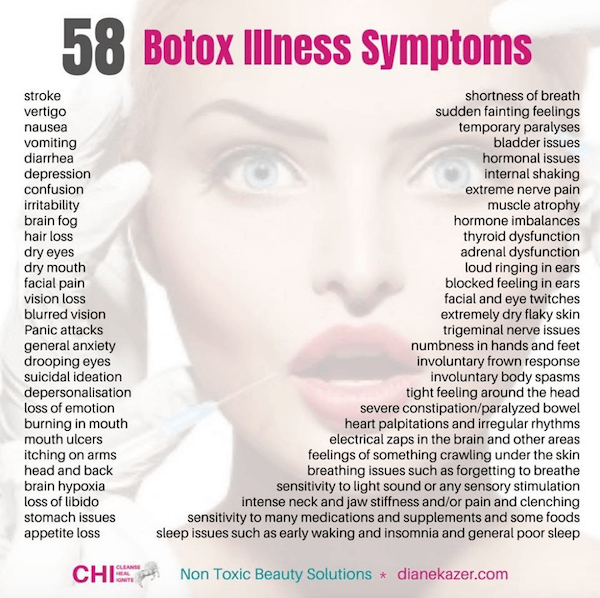
She also created this list of 58 Botox Illness Symptoms which she gave me permission to share here. She compiled this list from 1000+ people who have had Botox injections.

58 botox illness symptoms

Because of Diane asking questions and this initial research I’ve done, I’m adding a question about past history of Botox injections to my client intake form and will be gathering more information from my community of anxious women to see if there are patterns as to why some folks have such bad reactions.

I do feel we need to be asking if Botox injections (cosmetic or non-cosmetic) are a possible root cause of anxiety and panic attacks because they are adding to the toxic burden in susceptible folks.

But I do acknowledge it’s challenging to unwind all the contributing factors because it depends on what is going on with each person, such as their gut health, other medications (benzodiazepines themselves can be problematic), past trauma, infections, poor adrenal health, low GABA, low serotonin, poor detox capacity, low bile production, genetics etc. Unfortunately there is no way to know in advance who will be harmed and if Botox is the tipping point.

Please comment below if you’ve had Botox injections and had adverse reactions or have benefited from them with no adverse reactions. And if you have not had Botox would you ever consider it? Feel free to post your questions too.

Filed Under: Anxiety, Thyroid, Toxins Tagged With: 5-HTP, anxiety, bladder, Botox, botox injections, cosmetic, dystonia, GABA, low confidence, low serotonin, migraines, MS, panic attacks, pelvic, self-esteem, serotonin, TMJ, tryptophan

Primary Sidebar

NEW! GABA QuickStart Homestudy (with special intro pricing)

gaba quickstart homestudy

Free Report

9 Great Questions Women Ask about Food, Mood and their Health

You'll also receive a complimentary subscription to my ezine "Food, Mood and Gal Stuff"


Connect with me

Popular Posts

  • Amino Acids Mood Questionnaire from The Antianxiety Food Solution
  • The Antianxiety Food Solution Amino Acid and Pyroluria Supplements
  • Pyroluria Questionnaire from The Antianxiety Food Solution
  • Collagen and gelatin lower serotonin: does this increase your anxiety and depression?
  • Tryptophan for the worry-in-your-head and ruminating type of anxiety
  • GABA for the physical-tension and stiff-and-tense-muscles type of anxiety
  • The Antianxiety Food Solution by Trudy Scott
  • Seriphos Original Formula is back: the best product for anxiety and insomnia caused by high cortisol
  • Am I an anxious introvert because of low zinc and vitamin B6? My response to Huffington Post blog
  • Vagus nerve rehab with GABA, breathing, humming, gargling and key nutrients

Recent Posts

  • What do I use instead of Seriphos to help lower high cortisol that is affecting my sleep and making me anxious at night?
  • BeSerene™ GABA/theanine cream eases severe muscle tension in her neck/shoulders, prevents her bad headaches and quells her anxiety
  • How the correct approach, dose and sublingual use of GABA can be calming and not cause a flushed and itchy face and neck
  • The amino acid glutamine improves low mood by addressing gut health, and it has calming effects too
  • Flight anxiety with heightened breath, physical tension and also fearing the worst (the role of low GABA and low serotonin)

Categories

  • 5-HTP
  • AB575
  • Addiction
  • ADHD
  • Adrenals
  • Alcohol
  • Allergies
  • Alzheimer's disease
  • Amino Acids
  • Anger
  • Antianxiety
  • Antianxiety Food Solution
  • Antidepressants
  • Anxiety
  • Anxiety and panic
  • Autism
  • Autoimmunity
  • benzodiazapines
  • Bipolar disorder
  • Books
  • Caffeine
  • Cancer
  • Candida
  • Children/Teens
  • Collagen
  • Cooking equipment
  • Coronavirus/COVID-19
  • Cravings
  • Depression
  • Detoxification
  • Diabetes
  • Diet
  • DPA/DLPA
  • Drugs
  • EFT/Tapping
  • EMF
  • EMFs
  • Emotional Eating
  • Endorphins
  • Environment
  • Essential oils
  • Events
  • Exercise
  • Fear
  • Fear of public speaking
  • Fertility and Pregnancy
  • Fish
  • Food
  • Food and mood
  • Functional neurology
  • GABA
  • Gene polymorphisms
  • General Health
  • Giving
  • Giving back
  • Glutamine
  • Gluten
  • GMOs
  • Gratitude
  • Gut health
  • Heart health/hypertension
  • Histamine
  • Hormone
  • Hyperparathyroidism
  • Hypoglycemia
  • Immune system
  • Inflammation
  • Insomnia
  • Inspiration
  • Introversion
  • Joy and happiness
  • Ketogenic diet
  • Lithium orotate
  • Looking awesome
  • Lyme disease and co-infections
  • MCAS/histamine
  • Medication
  • Men's health
  • Mental health
  • Mercury
  • Migraine
  • Mold
  • Movie
  • MTHFR
  • Multiple sclerosis
  • Music
  • NANP
  • Nature
  • Nutritional Psychiatry
  • OCD
  • Osteoporosis
  • Oxalates
  • Oxytocin
  • Pain
  • Paleo
  • Parasites
  • Parkinson’s disease
  • PCOS
  • People
  • PMS
  • Postpartum
  • PTSD/Trauma
  • Pyroluria
  • Questionnaires
  • Real whole food
  • Recipes
  • Research
  • Schizophrenia
  • serotonin
  • SIBO
  • Sleep
  • Special diets
  • Sports nutrition
  • Stress
  • Sugar addiction
  • Sugar and mood
  • Supplements
  • Teens
  • Testimonials
  • Testing
  • The Anxiety Summit
  • The Anxiety Summit 2
  • The Anxiety Summit 3
  • The Anxiety Summit 4
  • The Anxiety Summit 5
  • The Anxiety Summit 6
  • Thyroid
  • Thyroid health
  • Toxins
  • Tryptophan
  • Tyrosine
  • Uncategorized
  • Vegan/vegetarian
  • Women's health
  • Yoga

Archives

  • October 2025
  • September 2025
  • August 2025
  • July 2025
  • June 2025
  • May 2025
  • April 2025
  • March 2025
  • February 2025
  • January 2025
  • November 2024
  • October 2024
  • September 2024
  • August 2024
  • July 2024
  • June 2024
  • May 2024
  • April 2024
  • March 2024
  • February 2024
  • January 2024
  • December 2023
  • November 2023
  • October 2023
  • September 2023
  • August 2023
  • July 2023
  • June 2023
  • May 2023
  • April 2023
  • March 2023
  • February 2023
  • January 2023
  • December 2022
  • November 2022
  • October 2022
  • September 2022
  • August 2022
  • July 2022
  • June 2022
  • May 2022
  • April 2022
  • March 2022
  • February 2022
  • January 2022
  • December 2021
  • November 2021
  • October 2021
  • September 2021
  • August 2021
  • July 2021
  • June 2021
  • May 2021
  • April 2021
  • March 2021
  • February 2021
  • January 2021
  • December 2020
  • November 2020
  • October 2020
  • September 2020
  • August 2020
  • July 2020
  • June 2020
  • May 2020
  • April 2020
  • March 2020
  • February 2020
  • January 2020
  • December 2019
  • November 2019
  • October 2019
  • September 2019
  • August 2019
  • July 2019
  • June 2019
  • May 2019
  • April 2019
  • March 2019
  • February 2019
  • January 2019
  • December 2018
  • November 2018
  • October 2018
  • September 2018
  • August 2018
  • July 2018
  • June 2018
  • May 2018
  • April 2018
  • March 2018
  • February 2018
  • January 2018
  • December 2017
  • November 2017
  • October 2017
  • September 2017
  • August 2017
  • July 2017
  • June 2017
  • May 2017
  • April 2017
  • March 2017
  • February 2017
  • January 2017
  • December 2016
  • November 2016
  • October 2016
  • September 2016
  • August 2016
  • July 2016
  • June 2016
  • May 2016
  • April 2016
  • March 2016
  • February 2016
  • January 2016
  • December 2015
  • November 2015
  • October 2015
  • September 2015
  • August 2015
  • July 2015
  • June 2015
  • May 2015
  • April 2015
  • March 2015
  • February 2015
  • January 2015
  • December 2014
  • November 2014
  • October 2014
  • September 2014
  • August 2014
  • July 2014
  • June 2014
  • May 2014
  • April 2014
  • March 2014
  • February 2014
  • January 2014
  • December 2013
  • November 2013
  • October 2013
  • September 2013
  • August 2013
  • July 2013
  • June 2013
  • May 2013
  • April 2013
  • March 2013
  • February 2013
  • January 2013
  • December 2012
  • November 2012
  • October 2012
  • August 2012
  • July 2012
  • June 2012
  • May 2012
  • April 2012
  • March 2012
  • February 2012
  • January 2012
  • December 2011
  • November 2011
  • October 2011
  • September 2011
  • August 2011
  • July 2011
  • June 2011
  • May 2011
  • April 2011
  • March 2011
  • February 2011
  • January 2011
  • December 2010
  • October 2010
  • September 2010
  • July 2010
  • May 2010
  • April 2010
  • March 2010
  • February 2010
  • January 2010
  • November 2009

Share the knowledge!

The above statements have not been evaluated by the Food and Drug Administration. Products listed in this website are not intended to diagnose, treat, cure or prevent any disease.

The information provided on this site is for informational and educational purposes only and is not intended as a substitute for advice from your physician or other health care professional. You should consult with a healthcare professional before starting or modifying any diet, exercise, or supplementation program, before taking or stopping any medication, or if you have or suspect you may have a health problem.


Copyright © 2026 Trudy Scott. All Rights Reserved. | Privacy | Terms and Conditions | Refund Policy | Medical Disclaimer

Free Report

9 Great Questions Women Ask about Food, Mood and their Health

You’ll also receive a complimentary subscription to my ezine “Food, Mood and Gal Stuff”