• Skip to primary navigation
  • Skip to main content
  • Skip to primary sidebar

everywomanover29 blog

Food, Mood and Women's Health – Be your healthiest, look and feel great!

  • Blog
  • About
  • Services
  • Store
  • Resources
  • Testimonials
  • The Book
  • Newsletter
  • Contact
  • Search this site

anxiety

Say NO to benzodiazepines for anxiety!

September 3, 2015 By Trudy Scott 61 Comments

no-to-benzodiazepines

Professor Malcolm H. Lader says it well: 

It is more difficult to withdraw people from benzodiazepines than it is from heroin. 

For this reason we need to say NO to benzodiazepines for anxiety (and other conditions)!

Benzodiazepines are a class of psychoactive drugs that work by enhancing the effect of the calming neurotransmitter GABA, and are used to treat anxiety, insomnia, pain, muscle spasms and a range of other conditions. They are widely prescribed, particularly among elderly patients and may even be used off-label with children with autism.

Use of this medication is very controversial.  We know long term use leads to tolerance, dependence, and many adverse psychological effects and even physical effects. Short term use is generally considered safe but even using them for 2 – 4 weeks can lead to problems for certain individuals.  

In this presentation I’ll be providing an overview of benzodiazepines; when they are used; who they are prescribed to; details about tolerance, dependence, and the many adverse effects; how to taper, including nutritional support during the taper; what to do instead of saying yes to a benzodiazepine prescription in the first place; and additional resources.

This will be a webinar for Hawthorn University and will be on Tuesday Sept 15 at 4pm PST. Register for the webinar here:
https://attendee.gotowebinar.com/register/2859158311212769537

I’d love questions/feedback/comments/your benzodiazepine experiences and topics you’d like me to address during this presentation.

Filed Under: benzodiazapines, Events Tagged With: adverse effects, anxiety, benzodiazepine, dependence, GABAtolerance, how to taper

Low serotonin MAY often be a factor in anxiety and depression

July 17, 2015 By Trudy Scott 25 Comments

 low-serotonin-anxiety

I recently received the following series of questions/comments (all from the same person) on my blog Targeted Individual Amino Acids for Eliminating Anxiety: Practical Applications and would like to share some of what I shared, plus some additional information.

  1. Do you believe in the serotonin hypothesis? And that low serotonin is a factor in anxiety and/or depression? The serotonin hypothesis is a sales pitch from the pharmaceutical industry to sell psychotropic drugs. It is therefore very worrying that nutritional therapists found a market for sufferers and medicine addicts!

  2. There is no test you can take today that show low serotonin in the brain? So where is the evidence?

  3. Please read the books by Robert Whitaker, Peter Breggin and David Healy. Please read this article Things your Doctor Should tell You About Antidepressants and watch this Peter Breggin video

I’m sharing my response because these questions do come up periodically and you may hear other practitioners make similar statements. This is my response:

Yes, I do believe that low serotonin MAY be a factor in anxiety and/or depression (and research shows this to be a fact). I say MAY because anxiety and/or depression could have one of many possible causes – low serotonin, blood sugar instability, poor diet, not eating enough protein, sugar, caffeine, gluten, low dopamine (for depression), pyroluria, inflammation etc.

There is much evidence supporting low serotonin and depression/anxiety. Here are a few recent papers published in 2015:

  • “These findings suggest that the anxiolytic effect of dark cycle restraint is mediated by corticosterone, serotonin or γ-aminobutyric acid-independent mechanisms”
  • “Our results demonstrate that 5-HT [serotonin] deficiency leads to increased susceptibility to social defeat stress (SDS), a model of psychosocial stress”
  • “These findings link the serotonin transporter gene to affective circuitry findings in anxiety and depression psychopathology”
  • “Serotonin, tryptophan metabolism and the brain-gut-microbiome axis”

In response to the question about testing serotonin levels: you can actually test serotonin levels via platelet testing. It’s the test that correlates most closely with CSF levels. A lab called European Laboratory of Nutrients (ELN)/formerly Vitamin Diagnostics offers this platelet serotonin test. It’s not a test that I use as I rely on the Amino Acid Questionnaire and response to the amino acids.   I do not use Urinary Neurotransmitter testing.

With regards to the great article from Mad in America – I totally support these facts (for many individuals):

“antidepressant medications appear to do more harm than good as treatments for depression” and all the “harmful effects on other processes in the body” like digestion, sexual function, cognition etc.

I also respect Dr Peter Breggin’s concerns (in the youtube video) about biochemical imbalances in your brain being caused by the antidepressant drugs you are taking (such as Prozac or Paxil) and why we want to avoid them.

We know that anxiety and depression is not only caused by life stresses and trauma. There are physical biochemical imbalances, nutritional deficiencies, gut problems, food sensitivities, heavy metals and many more causes. I discussed 60+ Nutritional & Biochemical Causes of Anxiety during season 3 of the Anxiety Summit.

Low serotonin is just one of these possible contributing factors and we can address this with dietary and lifestyle changes:

  • Dietary changes include real whole food, grass-fed red meat, no sugar, no gluten, oily fish, healthy fats etc
  • Lifestyle changes include light therapy and exercise

Here are a few recent studies supporting the above:

  • “The effects of dietary tryptophan on affective disorders”
  • “Kefir protective effects against nicotine cessation-induced anxiety and cognition impairments in rats” (kefir is rich in tryptophan)
  • “Stress-Induced Depression Is Alleviated by Aerobic Exercise Through Up-Regulation of 5-Hydroxytryptamine 1A Receptors in rats”

The amino acid supplements tryptophan and 5-HTP are very powerful for providing immediate results of improved mood and reduced anxiety while the other factors are being addressed.   We really need more research on the supplements. Here are two papers:

  • “The effect of raising and lowering tryptophan levels on human mood and social behavior”
  • “5-Hydroxytryptophan: a clinically-effective serotonin precursor”

By boosting serotonin levels in my clients, I see incredible results on a daily basis. And with all this serotonin anxiety/depression research (literally thousands and thousands of papers), it just amazes me when I hear someone say that low serotonin is not a factor. It’s not THE ONLY factor, but is often one of any contributing factors.

If you are anxious or depressed and are still unconvinced, I encourage you to do the Amino Acid Questionnaire and a trial of tryptophan or 5-HTP and see how you respond. I’ve listed some brands I like on this blog: The Antianxiety Food Solution Amino Acid and Pyroluria Supplements.

If you don’t need convincing and have seen great results by boosting your serotonin levels please do share your experiences in the comments below so we can inspire others to look into this approach so they can feel wonderful too.

Filed Under: Antianxiety, Depression, Food and mood Tagged With: amino acids, anxiety, depression, serotonin

The Antianxiety Food Solution Amino Acid and Pyroluria Supplements

June 26, 2015 By Trudy Scott 674 Comments

antianxiety food solution and amino acids

Here are my amino acid and pyroluria supplement recommendations. These are the products I use with my one-one clients and those doing my online group programs.

You can find most of these products in my online store at Fullscript – you’ll find details here on how to set up and account (you just need to do this once) and make your purchase.

Purchase products through our Fullscript virtual dispensary.

Questionnaires and information

My publisher would not allow me to make specific product recommendations in my book so this list is a courtesy to those of you who have purchased the book.

If you do not have my book I highly recommend getting it and reading it before jumping in to taking supplements: The Antianxiety Food Solution – How the Foods You Eat Can Help You Calm Your Anxious Mind, Improve Your Mood, and End Cravings

There is a complete chapter on the amino acids and one for pyroluria, plus information on real whole food, sugar and blood sugar, gluten, digestion and much more.

Once you have read it you can use these blogs as summaries (they do contain some information that is not in my book).

Here is the Amino Acids Mood Questionnaire from The Antianxiety Food Solution and additional information on Anxiety and targeted individual amino acid supplements: a summary

Please read and follow these Amino Acid Precautions

Here is the Pyroluria Questionnaire from The Antianxiety Food Solution and additional information on Pyroluria, social anxiety, introversion: a summary

Here is a useful post: Pyroluria/social anxiety protocol: why aren’t I getting results? (trouble-shooting checklist)

Supplements for Low Blood Sugar (anxious, shaky between meals and intense sugar cravings)

Glutamine helps with low blood sugar, may help eliminate the strong desire for something sweet when opened on to the tongue, and is very healing for the digestive system

  • Pure Encapsulations L-Glutamine 500mg:  L-glutamine (free-form) 500 mg, vitamin C (as ascorbyl palmitate) 5 mg. The capsules can be swallowed or the capsule can be opened on to the tongue
  • Designs for Health Glutamine Powder: This is a powdered glutamine that you can use right on your tongue or even mixed in water. The taste is quite pleasant.

Supplements for low GABA (stiff and tense muscles, anxious, panic attacks, use sugar/wine to relax)

GABA helps to raise GABA levels.  I find GABA to be most effective when taken sublingually or opened on to the tongue. I find GABA to be more effective than pharmaGABA for most of my clients. I don’t ever use Phenibut (which the FDA recently removed from non-prescription use).  Here are some GABA products that I like and use with clients.

Source Naturals GABA Calm (lozenges): This is a pleasant-tasting sublingual product that is my most popular and the most effective form of GABA I use with my clients. It is a lozenge that contains 125mg GABA, 5mg magnesium, 50mg glycine, 25mg tyrosine and 20 mg taurine. [AS OF NOV 24, 2021 THIS PRODUCT IS IN SHORT SUPPLY AGAIN]

[Note: this product is a lozenge with 125mg GABA and is not to be confused with the Source Naturals, GABA Calm Mind, 750 mg tablets]

Nutritional Fundamentals for Health GABA-T SAP: gamma-Aminobutyric acid (GABA) 300 mg, l-Theanine 150 mg. This is pleasant-tasting when opened on to the tongue and works very well when GABA Calm can’t be used.  I find best results when it is used opened on to the tongue.

Thorne PharmaGABA-100:  the label says Gamma-Aminobutyric Acid (GABA) 100 mg but it also states that the product uses Pharma Foods International’s Gamma-Aminobutyric Acid (PharmaGABA®).  This is also pleasant-tasting when opened on to the tongue and is most effective when used this way. [AS OF NOV 24, 2021 THIS MAY BE UNAVAILABLE]

Thorne PharmaGABA-250: as above but contains 250mg of PharmaGABA®.  This is also pleasant-tasting when opened on to the tongue and is most effective when used this way. [AS OF NOV 24, 2021 THIS MAY BE UNAVAILABLE]

Designs for Health PharmaGABA Chewables: gamma-amino butyric acid (pharmaGABA) 200 mg in 2 chewable tablets.  It’s quick-acting and convenient like GABA-Calm because it’s chewable. This does contain xylitol, natural flavors, stevia and some other ingredients so taste may be a factor and xylitol can cause gas, bloating and diarrhea when too much is consumed.

Natural Factors PharmaGABA: gamma-amino butyric acid (pharmaGABA) 200 mg in 2 chewable tablets. It’s quick-acting and convenient like GABA-Calm because it’s chewable. However it also contains organic cane sugar and natural fruit flavors so it’s a little too candy-like for my preference, especially if you have low GABA-related sugar cravings. Also 2 chewable tablets – 4g of carbs which is almost 1 teaspoon of sugar!

[January 22, 2021/November 24, 2021: I’ve included this as a stand-by option for occasional use when Source Naturals GABA Calm is in short supply or if Designs for Health PharmaGABA Chewables are not available.]


Now Foods GABA Powder: 1/4 Level Teaspoon (500mg). This is pleasant-tasting when opened on to the tongue and is most effective when used this way.  The only challenge with powder like this is making sure you don’t use too much by mistake. And it’s especially challenging when you only need 100mg.  A mini measuring spoon set like this one (my Amazon link) is so easy and convenient to use and allows for accurate dosing.

Quicksilver Scientific Liposomal GABA with L-Theanine: 2ml (4 Pumps) provides (Gamma Amino Butyric Acid) 240mg, L-Theanine 100mg and Phosphatidylcholine 120mg (from purified sunflower seed lecithin). Spray and hold 30 seconds before swallowing. It does contain ethanol so would not be suitable for alcoholics or young children.

GABA-Pro Calming Effect Chewable: This is a chewable that contains 100 mg of pharmaGABA in 1 tablet. It is pharmaGABA even though the product says GABA-Pro on the front and the label states Gamma Amino Butyric Acid (GABA). It does contain natural flavors and xylitol. [This product is a reasonable replacement for Source Naturals GABA Calm when it’s not available (Nov 24, 2021)]

GABA-Pro Calming Effect: This contains 100 mg of pharmaGABA in 1 tablet. It is pharmaGABA even though the product says GABA-Pro on the front and the label states Gamma Amino Butyric Acid (GABA). This capsule can be opened onto the tongue.  It does contain rice flour which can be an issue if you have a rice allergy/sensitivity and/or SIBO.

Designs for Health Stress Arrest: Niacin (niacinamide) 100 mg, Vitamin B6 (pyridoxine HCL) 10 mg, Pantothenic acid (d-calcium pantothenate) 100 mg, GABA 300 mg, Glycine 200 mg

Supplements for low serotonin (worry, rumination, negativity, afternoon and evening cravings and insomnia)

Tryptophan and/or 5-HTP can help to raise low serotonin. I typically recommend starting with tryptophan and don’t recommend 5-HTP if you have high cortisol as it can raise cortisol. Some people do better on tryptophan and some do better on 5-HTP.

Lidtke l-tryptophan 500mg:  I only recommend the Lidtke brand for tryptophan as quality is a big consideration when it comes to this amino acid. This can be opened and/or chewed but doesn’t taste good. It can be mixed with inositol powder to make it more pleasant (see below) or with mashed banana. NOTE: This is not the same as the Lidtke Tryptophan Complete which has ingredients other than tryptophan making it more difficult to titrate up.

Lidtke l-Tryptophan Chewable: tablets contain 200mg L-Tryptophan per 2 tablets. This chewable form is both good and bad. It’s good because it’s a nice 100mg of tryptophan per tablet, is chewable, tastes good and is suitable for kids and “pixie dust” individuals (who need a very small amount). The bad aspect is that it does contain sugar and is quite sweet. Because you are continually consuming something sweet you may end up over-consuming them if sugar addiction is your issue.

Pure Encapsulations 5-HTP 50mg:  Some of my clients do better on 5-HTP and some find taking this during the day and tryptophan at night works well for them.

Designs for Health Inositol: is fabulous for obsessive thoughts/behaviors that the tryptophan isn’t quite enough for. It’s also been shown to be very helpful for OCD itself. The powder has a slightly sweet taste and I recommend taking it in the powdered form. You can take up to 18g a day but I suggest starting with 2g a day and building up as needed. I think it  makes a great addition for mixing into the nasty tasting tryptophan – I suggest starting with 2g inositol per 500mg tryptophan.

Douglas Labs 1mg melatonin sublingual: If the tryptophan isn’t enough for sleep issues, adding this often helps if you can’t fall asleep (and if it’s a low serotonin/low melatonin issue). Start with one and increase to 3 as needed

Douglas Labs 3mg melatonin prolonged release: If the tryptophan isn’t enough for sleep, adding this often helps if you wake in the night and if it’s a low serotonin/low melatonin issue. Start with one and increase to 2 as needed.

Supplement for low endorphins (comfort and reward eating, weepy, pain issues)

DPA or D-Phenylalanine is the amino acid that helps to raise endorphins and eliminates the comfort/reward eating and the feelings of “I deserve this” and LOVING certain foods

Lidtke Endorphigen 500mg: Riboflavin 5mg, Pyridoxal 5-phosphate 5mg (enzymatic form of vitamin B6), D-Phenylalanine 500mg. This is also one of my top products that I recommend. I used to recommend simply chewing the capsule to get the quickest and best effects and this worked well when it was produced in a gelatin capsule. Now it’s made with a cellulose capsule and chewing doesn’t work at all well so opening the capsule (or just biting off the top) and tipping the powder into your mouth works well. It does taste quite pleasant – some of my clients think it has a dark chocolate-like taste. A few people don’t like the taste at all but even then, it can be very effective when low endorphins are an issue.

Supplement for low catecholamines (tired, coffee-drinking, blahs, poor focus, low motivation)

Tyrosine is the amino acid that helps to raise low catecholamines and can often help you quit coffee if you “self-medicate” due to low catecholamines.

Progressive Labs tyrosine 500mg: 500mg l-tyrosine.  This is the last amino acid I trial with my anxious clients because it can make you more anxious (although with one client it reduced her anxiety because she was able to focus better at work).

Vitamin C for negating the effects of any amino acid

Vitamin C 1000mg is used to negate the effects of any amino acid. I used to use EmergenC but this still contains folic acid, so here are some good alternate vitamin C recommendations:

Designs for Health C + Biofizz: Vitamin C 2569 mg (as Ascorbic Acid, Calcium Ascorbate, Magnesium Ascorbate) Quercetin 20 mg Hesperidin 20 mg Rutin 10 mg. This one mixes nicely in water and can also be added to a smoothie but tastes quite sweet for many people. I personally prefer less of a sweet taste.

Designs for Health Buffered Vitamin C: Vitamin C (as ascorbic acid) 2000 mg, Calcium (as calcium ascorbate) 80 mg, Magnesium (as magnesium ascorbate) 160 mg, Potassium (as potassium bicarbonate) 200 mg. This one doesn’t mix very well in water and can also be added to a smoothie. The taste is not very pleasant.

The supplements for pyroluria

Zinc, vitamin B6, evening primrose oil and a good copper-free multivitamin are what I use for my clients with pyroluria or for those who score above 15 on the questionnaire:

Solaray OptiZinc 30mg. Zinc (as Zinc Monomethionine [OptiZinc®] 30 mg, Vitamin B6 (as Pyridoxine HCl) 20 mg. The zinc in this form seems to be well absorbed by many of my clients and is available over the counter. This also does not contain copper. Be aware as there are other OptiZinc products on the market that do contain copper (Source Naturals is one example)

Douglas Labs Opti-Zinc: Zinc (from 150 mg Zinc Monomethionine) 30 mg. The zinc in this form seems to be well absorbed by many of my clients. This also does not contain copper.

Metagenics Zinc Drink:  Zinc sulphate monohydrate in a base of distilled water. Each 2 tsp provides Zinc sulfate monohydrate 8 mg. Use this for testing your zinc status as described here: Zinc deficiency is common: using liquid zinc status test as an assessment tool

Here are a selection of 100 mg Vitamin B6/pyridoxine products. Use dream recall as a way to monitor if it’s working, plus social anxiety and mood improvements. If this doesn’t work you may need to use the activated form in conjunction with or instead of this one (see below)

Progressive Labs 100mg Vitamin B6 (contains rice flour)

NOW 100mg Vitamin B6 (contains rice flour)

Vital Nutrients 100mg Vitamin B6  (Only B6 and glycine)

Klaire Labs 250mg Vitamin B6 (Use this one if you find you do better with more i.e. 250mg)

Pure Encapsulations P5P 50 (activated B-6): pyridoxal 5 phosphate (activated B6) 50 mg, vitamin C (as ascorbyl palmitate) 3 mg. This activated form of B6 may be needed if the 100-500 mg B6/pyridoxine doesn’t work or may be needed in addition to vitamin B6/pyridoxine. Use dream recall as a way to monitor if it’s working, plus social anxiety and mood improvements.

Designs For Health P5P 50mg: another good product with pyridoxal 5 phosphate (activated B6) 50 mg

Now Foods Super Primrose 1300mg: Evening Primrose Oil (Oenothera blennis) (Seed) 1.3 g (1300 mg) – 120 count. GLA is often low in pyroluria and EPO helps with zinc absorption and PMS symptoms.

Designs for Health Twice Daily Multi: This is a good copper-free multi. It also contains Folates (NatureFolate™ blend) 400 mcg instead of folic acid (no DFH products contain folic acid).

Free form amino acids and magnesium

Pure Encapsulations Amino Replete: A free form amino acid powder blend that does contain tryptophan. It does contain fructose, flavors and luo han guo

Allergy Research Free Aminos: A free form amino acid blend in capsules. It contains 5-HTP and not tryptophan. I’d prefer it if it had tryptophan.

Designs for Health Amino Acid Supreme: A free form amino acid blend powder that does contain tryptophan. It is sweetened with stevia and contains natural flavors.

Designs for Health Magnesium Malate 360mg

Liquid and powder options for children

Here are some liquid and powder options for children (or for adults, if you have a hard time swallowing pills):

Carlson 100mg B6: Use dream recall (and no more nightmares) as a way to monitor if it’s working, plus improvements in social anxiety and mood.

Designs for Health 50mg P5P (with a little zinc and magnesium): This is the activated form of B6. Use dream recall (and no more nightmares) as a way to monitor if it’s working, plus improvements in social anxiety and mood.

Pure Encapsulations 15mg Zinc gluconate: A liquid zinc option.

Metagenics 15mg Zinc (as zinc sulfate): A liquid zinc option.

Designs for Health Zinc Challenge: Zinc sulphate monohydrate in a base of distilled water. Each 2 tsp provides Zinc sulfate monohydrate 8 mg. I use this for testing zinc status but it could be used as a supplement too.

BodyBio evening primrose oil: Gamma Linolenic Acid/GLA (omega-6) 473 mg. GLA is often low in pyroluria and EPO helps with zinc absorption, eczema and PMS symptoms.

Klaire Labs Vitaspectrum multivitamin/mineral: This is a great copper-free, iron-free powdered multi for kids. You can mix the powder directly into room temperature or cold foods or beverages just before serving.

Pure Encapsulations Amino Replete: A free form amino acid powder blend that does contain tryptophan. It does contain fructose, flavors and luo han guo.

Pure Encapsulations Magnesium Citrate 250mg powder

Designs for Health Magnesium Bisglycinate Chelate 300 mg powder: This one does have stevia and natural flavors

Also see chewable tryptophan, GABA Calm and inositol powder, plus powdered Vitamin C (all listed above).

Purchase products through our Fullscript virtual dispensary.


What about international orders?

Unfortunately, Fullscript does not ship internationally.

So we suggest folks try an intermediary shipping service like www.shipito.com (we haven’t used them as of yet, so do your own research, and if they or someone else does work out please let us know in the comments below).

An alternative is to use iHerb to get similar products, as they ship worldwide and may even have a branch in your country for free shipping.

Here is the link for iHerb and to get 5% off, and if you are interested in iHerb’s exclusive brands to get 10% off here.


Filed Under: Amino Acids, Antianxiety, Anxiety and panic, Pyroluria, Supplements Tagged With: amin acids, anxiety, GABA, pyroluria, the antianxiety food solution, Trudy Scott, tryptophan, vitamin B6, zinc

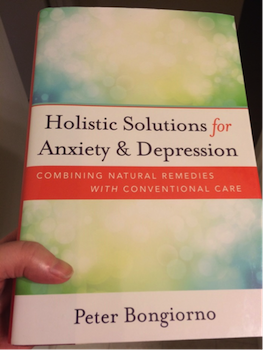
Holistic Solutions for Anxiety and Depression: review

June 12, 2015 By Trudy Scott 84 Comments

holistic-solutions-anxiety

Although it is written for therapists I feel that Holistic Solutions for Anxiety and Depression: Combining Natural Remedies with Conventional Care, written by Dr. Peter Bongiorno, ND, is a great resource for anyone working with individuals with anxiety or depression, and this includes nutritionists.

As a nutritionist who works primarily with women with anxiety, I was so pleased to receive a physical review copy of this wonderful book. I did purchase the kindle but a real book is just so much nicer!

It’s also perfect for the anxious individual who taking charge of their own health and wants to become more empowered. It would also be a perfect book for the anxious person to share with their open-minded therapist or doctor.

Here are some of the reasons why I really enjoyed this book:

  • The extensive coverage of diet – Dr. Bongiorno favors a Mediterranean diet and cites research supporting this way of eating for mental health (I’d add more red meat and skip the grains, especially gluten)
  • The recommendation to eat crunchy vegetables based on the research about crunchy foods making us feel happier and calmer
  • The coverage of nutrients such as 5-HTP and tryptophan. Dr. Bongiorono will use 5-HTP first (he feels its “more effective at crossing the blood brain barrier) , whereas I tend to start with tryptophan. But he does say that “when dosed accordingly, tryptophan appears to be quite safe and effective.”    
  • The coverage of GABA: “GABA supplementation helps open chloride channels in neurons, which hyperpolarizes them, so that the positive charges remain on one side of the membrane, which inactivates the nerve cell. This slows firing and calms the brain.”
  • The coverage of vitamin B3: one way it helps mood is “its ability to inhibit the liver enzyme tryptophan pyrrolase. This enzyme breaks down tryptophan making it less available to produce serotonin. Vitamin B3 is also responsible for activating the enzyme that converts tryptophan to 5-hydroxytryptophan.”    
  • The coverage of lithium orotate: “It is suggested that lithium’s beneficial effects on mood may be due to its oxytocin-raising properties.” He suggests using it with an oxytocin-raising massage! Oxytocin also helps with social anxiety: Oxytocin and social anxiety, pyroluria and depression?
  • The fascinating discussion of the 5-HT1A receptor and oxytocin
  • The history of the discovery of serotonin (clams used it to keep their shells closed)
  • The coverage of light therapy, getting house-plants and a mind-body approach

As you can see, it includes plenty of geeky science, something I really love!

I had the pleasure of interviewing Dr. Bongiorno on The Anxiety Summit – our topic: Serotonin and Anxiety, Happiness, Digestion and our Hormones. Dr. Bongiorno’s speaking is as eloquent, factual and caring as his writing.

Dr. Bongiorno has been kind enough to offer a copy of his book as a giveaway. We’ll do a drawing and select one lucky reader and announce the winner next Friday. If you’d like to be entered in to the drawing simply comment below and share:

  • why you’d like to win the book
  • which section you’re most excited about reading and why (just go to the Amazon preview and check out the table of contents)
  • which holistic approaches you already use with patients/clients or you’ve used yourself

This drawing is open to practitioners and non-practitioners alike.

Peter Bongiorno, ND, a doctor of naturopathic medicine, is co-director of InnerSource Natural Health and Acupuncture in New York City. President of the New York Association of Naturopathic Physicians, he is a contributor to numerous blogs and online magazines, including DrOz.com and Sharecare.com, and is regularly interviewed as a natural medicine expert on national television and radio.

Filed Under: Anxiety and panic, Books, Depression, The Anxiety Summit 3 Tagged With: 5-HTP, anxiety, anxiety summit, depression, GABA, holistic, Peter Bongiorno, serotonin, tryptophan

60+ Nutritional & Biochemical Causes of Anxiety

May 19, 2015 By Trudy Scott 50 Comments

nutritional causes of anxiety

I shared these 60+ Nutritional & Biochemical Causes of Anxiety on my closing call  of the The Anxiety Summit season 3. Since then I’ve kept this list updated as I find additional research, connections and case studies.  In conjunction with my book “The Antianxiety Food Solution”, interviews and other blogs, I hope this list will help you put the puzzle pieces together to resolve your anxiety. 

Keep in mind it’s not uncommon to have many root causes so if it feels too overwhelming, addressing low serotonin and/or low GABA first, really does help with the overwhelm, fear, anxiety and negativity.

The Foundational Causes from The Antianxiety Food Solution :

  1. Food – real whole food, organic (pesticides may be problematic), quality protein (grass-fed, wild, pastured), healthy fats; avoid junk/processed food with additives/colors/trans fats/GMOs
  2. Sugar – depletes zinc and magnesium and fills us up. We should not feel the need for treats/fruit should satisfy our desire for sweet
  3. Low blood sugar – breakfast/protein/healthy snacks/no coffee
  4. Caffeine/Coffee – even decaf coffee may be an issue. Coffee has high-levels of pesticides, affects blood sugar and affects hormones
  5. Tobacco – depletes key nutrients like zinc, vitamin C
  6. alcohol – depletes key nutrients like zinc, vitamin C
  7. Food sensitivities – gluten (plus glyphosates/roundup affect serotonin/zinc etc), dairy, GAPs, grains
  8. Digestive system – low HCl
  9. Digestive system – Low good bacteria/probiotics
  10. Digestive system – other enzymes are low
  11. Digestive system – candida
  12. Digestive system – parasites
  13. Digestive system – leaky gut
  14. Digestive system – liver/gallbladder issues
  15. Digestive system – SIBO
  16. Brain chemicals/neurotransmitters: low GABA (covered in detail in season 4 of the Anxiety Summit)
  17. Brain chemicals/neurotransmitters: low serotonin
  18. Brain chemicals/neurotransmitters: low endorphins
  19. Brain chemicals/neurotransmitters: low catecholamines (need for coffee/sugar) or high catecholamines. Gut health, what you eat, coffee, gluten all affect the brain chemicals
  20. Pyroluria/social anxiety – zinc, vitamin B6 and EPO (addressing this improves brain chemical imbalances and hormone imbalances)
  21. A need for zinc
  22. A need for vitamin B6
  23. A need for EPO
  24. Toxins/pesticides/plastics/BPA
  25. Medication side-effects/withdrawal (benzos are the worst)
  26. Sex hormones imbalances (especially low progesterone)
  27. Thyroid problems – hyperthyroid/Hashimoto’s thyroiditis can cause anxiety symptoms; low thyroid symptoms – amino acids are not as effective
  28. Adrenals issues: cortisol imbalance can affect how you handle stress, digestion, inflammation; high cortisol can have direct impact on anxiety levels
  29. Low total cholesterol (<150)
  30. Low levels of vitamin D, magnesium, vitamin C
  31. Low levels of vitamin B12
  32. Low levels of folate
  33. Low levels of iron (test ferritin)
  34. Not getting exercise
  35. Not working on stress-reduction (tai chi, meditation, guided imagery, yoga)
  36. Not getting out in nature
  37. Not getting at least 8 hours of sleep
[the above are all covered in great detail in my book  The Antianxiety Food Solution ]

Other possible nutritional/biochemical/physical causes of anxiety/depression

  1. Drug-induced nutrient deficiencies (for example: the birth control pill depletes vitamin B6, folate, magnesium)
  2. MVP (mitral valve prolapse) – it feel like the “heart is skipping a beat” (magnesium may help)
  3. Infections – strep can cause OCD/PANDAS/PANS. Also consider: H/Pylori, Lyme disease, clostridia
  4. Heavy metals like mercury or lead.  We covered mercury in season 2 – Your hidden mercury burden: A likely root cause of the other root causes of anxiety and mercury/lead detox in season 4 with Dr. John Dempster
  5. Anything that increases inflammation in the body (high CRP is a good clue)
  6. Herbicide/Roundup use in the home/garden
  7. Genetic polymorphisms – MTHFR, COMT, MAOA, GAD – Dr. Ben Lynch is an excellent resource and has shared his expertise on season 2 – Anxiety: Biochemical and genetic predispositionsand season 3 – How Methylfolate can make you Feel Worse and even Cause Anxiety
  8. Apolipoprotein E ?4 (ApoE ?4) gene polymorphism
  9. Other possible hormone issues: high prolactin, low oxytocin
  10. Histamine reaction to certain foods (Yasmina covers this in her interview in season 3: Histamine-containing Foods: their Role in Anxiety, Depression and Schizophrenia )
  11. Oxalates reaction (berries, leafy greens, nuts). A good resource is lowoxalateinfo
  12. SIBO and FODMAPs/fructose malabsorption (affects serotonin levels)
  13. Too much of some nutrients: fish oil, a B complex, tyrosine, folate
  14. Low lithium (impacts GABA levels)
  15. Copper toxicity i.e. high copper and low zinc
  16. EMFs, air pollution, noise pollution, cell phone use, smart meters
  17. Marijuana use – used recreationally or as medical marijuana (Dr. Hyla Cass covers this in season 4 of the Anxiety Summit – cognitive issues, anxiety, psychosis, schizophrenia, social anxiety)
  18. Toxic mold exposure (Dr. Jill Carnahan covers this in season 3)
  19. Fluoride exposure
  20. Poor mouth health
  21. Toxoplasma gondii
  22. Metals/chemicals/drugs in the tap water
  23. Low leptin (signals satiety/fullness) and high ghrelin
  24. Over-the counter drugs, inner ear issues/cochlear damage, light sensitivity (Sharon Heller shared Hidden Causes of Anxiety on season 2)
  25. Physical pain (from an injury)
  26. Gas leaks
  27. Plastics/BPA
  28. Accutane, the acne drug can lead to psychiatric disorders in some people

May 14, 2016 updates after Season 4 of the Anxiety Summit:

66. Leptin resistance, obesity, skinny-fat and high body fat % (Mike Mutzel covers this in season 4 – anxiety, inflammation, microbiome, PTSD, cortisol and HPA axis)

67. Fluoroquinolone antibiotics (Lisa Bloomquist covers this in season 4 – anxiety, psychosis, connective tissue damage, mitochondrial impacts)

68. Low histamine/histapenia/overmethylation or high histamine/histadelia/undermethylation – read more here and the season 4 interview with Dr. William Walsh

69. Lack of community and social connection (James Maskell covers this in season 4)

Note: these causes do not include psychological or physical trauma or abuse (both past and current).

If the idea of 60+ causes feels too overwhelming and scary for you start with the basic food changes and look at the Amino Acids Mood Questionnaire from The Antianxiety Food Solution. GABA and serotonin support benefits most of my clients.  You can see how to do a trial here  and find the products I use with my clients here – such as tryptophan and GABA.

Missed this interview or can’t listen live? Or want this and the other great interviews for your learning library? Purchase the MP3s or MP3s + transcripts and listen when it suits you.

You can find your purchasing options here: Anxiety Summit Season 1, Anxiety Summit Season 2, and Anxiety Summit Season 3.

Filed Under: Amino Acids, Antianxiety, Food and mood, Gluten, Real whole food, The Anxiety Summit 3 Tagged With: amino acid questionnaire, anxiety, biochemical, nutritional, real whole food, the anxiety summit, Trudy Scott

The Anxiety Summit – 60+ Nutritional & Biochemical Causes of Anxiety and Recommended Supplements

May 19, 2015 By Trudy Scott 88 Comments


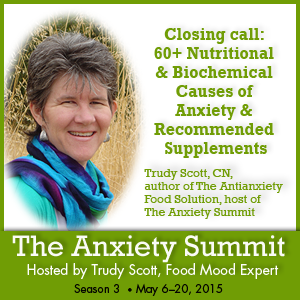
Trudy Scott, host of The Anxiety Summit, Food Mood Expert and Nutritionist, author of The Antianxiety Food Solution presents:

Closing call: 60+ Nutritional & Biochemical Causes of Anxiety and Recommended Supplements

  • 60+ Nutritional/biochemical causes of anxiety and associated solutions
  • 4 degrees/levels of anxiety I see and response to the 60+ causes
  • The unique ability of the body to heal
  • Testing I use with my clients and what tests I’d run if everyone had unlimited funds
  • My recommendations:  supplements
  • My message of hope

I mentioned the speaker blog posts.  You can access them all here: The Anxiety Summit Season 3: All the speakers and topics

I also referred back to speakers and topics from season 1 and 2 so here are those links:

The Anxiety Summit Season 2: All the speakers and topics

The Anxiety Summit: All the speakers and topics (this is summit 1)

If the idea of 60+ causes feels too overwhelming and scary for you here is the Amino Acids Mood Questionnaire from The Antianxiety Food Solution. Serotonin support in the form of tryptophan or 5-HTP may help

As Dr. Peter Bongiorno said in his interview: Serotonin and Anxiety, Happiness, Digestion and our Hormones

There can be multiple factors involved as to why someone has anxiety. How you’re going to work through these factors successfully is going to be very different for each person.

Here is the list of the 60+ Nutritional/biochemical causes of anxiety.  (Just click on this link to see all of them)

Here is the list of supplements: The Antianxiety Food Solution Amino Acid and Pyroluria Supplements (Just click on this link to see all of them)

Here is the: Nutritional testing for figuring out the root cause/s of your anxiety (Just click on this link to see all of them)

If you are not already registered for the Anxiety Summit you can get live access to the speakers of the day here: www.theAnxietySummit.com

Missed this interview or can’t listen live? Or want this and the other great interviews for your learning library? Purchase the MP3s or MP3s + transcripts and listen when it suits you.

You can find your purchasing options here: Anxiety Summit Season 1, Anxiety Summit Season 2, and Anxiety Summit Season 3.

Filed Under: Amino Acids, Antianxiety, Food and mood, Gluten, Real whole food, The Anxiety Summit 3 Tagged With: amino acid questionnaire, anxiety, biochemical, nutritional, real whole food, supplements, the anxiety summit, Trudy Scott

  • « Go to Previous Page
  • Page 1
  • Interim pages omitted …
  • Page 70
  • Page 71
  • Page 72
  • Page 73
  • Page 74
  • Interim pages omitted …
  • Page 96
  • Go to Next Page »

Primary Sidebar

GABA QuickStart Homestudy

gaba quickstart homestudy

Free Report

9 Great Questions Women Ask about Food, Mood and their Health

You'll also receive a complimentary subscription to my ezine "Food, Mood and Gal Stuff"


Connect with me

Popular Posts

  • Amino Acids Mood Questionnaire from The Antianxiety Food Solution
  • The Antianxiety Food Solution Amino Acid and Pyroluria Supplements
  • Pyroluria Questionnaire from The Antianxiety Food Solution
  • Collagen and gelatin lower serotonin: does this increase your anxiety and depression?
  • Tryptophan for the worry-in-your-head and ruminating type of anxiety
  • GABA for the physical-tension and stiff-and-tense-muscles type of anxiety
  • The Antianxiety Food Solution by Trudy Scott
  • Seriphos Original Formula is back: the best product for anxiety and insomnia caused by high cortisol
  • Am I an anxious introvert because of low zinc and vitamin B6? My response to Huffington Post blog
  • Vagus nerve rehab with GABA, breathing, humming, gargling and key nutrients

Recent Posts

  • Her cravings for chips and peanut butter were triggered by stress: GABA ends cravings and reduces physical tension and fear of heights
  • It is truly miraculous to be able to move through life without crippling anxiety and panic
  • GABA and tryptophan combo provide immediate and noticeable relief for tremors and cervical dystonia in just 7 days
  • Red light therapy for back and neck pain, plantar fasciitis and low mood – a complement to the amino acids GABA, DPA and tryptophan
  • What do I use instead of Seriphos to help lower high cortisol that is affecting my sleep and making me anxious at night?

Categories

  • 5-HTP
  • AB575
  • Addiction
  • ADHD
  • Adrenals
  • Alcohol
  • Allergies
  • Alzheimer's disease
  • Amino Acids
  • Anger
  • Antianxiety
  • Antianxiety Food Solution
  • Antidepressants
  • Anxiety
  • Anxiety and panic
  • Autism
  • Autoimmunity
  • benzodiazapines
  • Bipolar disorder
  • Books
  • Caffeine
  • Cancer
  • Candida
  • Children/Teens
  • Collagen
  • Cooking equipment
  • Coronavirus/COVID-19
  • Cravings
  • Depression
  • Detoxification
  • Diabetes
  • Diet
  • DPA/DLPA
  • Drugs
  • EFT/Tapping
  • EMF
  • EMFs
  • Emotional Eating
  • Endorphins
  • Environment
  • Essential oils
  • Events
  • Exercise
  • Fear
  • Fear of public speaking
  • Fertility and Pregnancy
  • Fish
  • Food
  • Food and mood
  • Functional neurology
  • GABA
  • Gene polymorphisms
  • General Health
  • Giving
  • Giving back
  • Glutamine
  • Gluten
  • GMOs
  • Gratitude
  • Gut health
  • Heart health/hypertension
  • Histamine
  • Hormone
  • Hyperparathyroidism
  • Hypoglycemia
  • Immune system
  • Inflammation
  • Insomnia
  • Inspiration
  • Introversion
  • Joy and happiness
  • Ketogenic diet
  • Lithium orotate
  • Looking awesome
  • Lyme disease and co-infections
  • MCAS/histamine
  • Medication
  • Men's health
  • Mental health
  • Mercury
  • Migraine
  • Mold
  • Movie
  • MTHFR
  • Multiple sclerosis
  • Music
  • NANP
  • Nature
  • Nutritional Psychiatry
  • OCD
  • Osteoporosis
  • Oxalates
  • Oxytocin
  • Pain
  • Paleo
  • Parasites
  • Parkinson’s disease
  • PCOS
  • People
  • PMS
  • Postpartum
  • PTSD/Trauma
  • Pyroluria
  • Questionnaires
  • Real whole food
  • Recipes
  • Research
  • Schizophrenia
  • serotonin
  • SIBO
  • Sleep
  • Special diets
  • Sports nutrition
  • Stress
  • Sugar addiction
  • Sugar and mood
  • Supplements
  • Teens
  • Testimonials
  • Testing
  • The Anxiety Summit
  • The Anxiety Summit 2
  • The Anxiety Summit 3
  • The Anxiety Summit 4
  • The Anxiety Summit 5
  • The Anxiety Summit 6
  • Thyroid
  • Thyroid health
  • Toxins
  • Tryptophan
  • Tyrosine
  • Uncategorized
  • Vegan/vegetarian
  • Women's health
  • Yoga

Archives

  • May 2026
  • April 2026
  • October 2025
  • September 2025
  • August 2025
  • July 2025
  • June 2025
  • May 2025
  • April 2025
  • March 2025
  • February 2025
  • January 2025
  • November 2024
  • October 2024
  • September 2024
  • August 2024
  • July 2024
  • June 2024
  • May 2024
  • April 2024
  • March 2024
  • February 2024
  • January 2024
  • December 2023
  • November 2023
  • October 2023
  • September 2023
  • August 2023
  • July 2023
  • June 2023
  • May 2023
  • April 2023
  • March 2023
  • February 2023
  • January 2023
  • December 2022
  • November 2022
  • October 2022
  • September 2022
  • August 2022
  • July 2022
  • June 2022
  • May 2022
  • April 2022
  • March 2022
  • February 2022
  • January 2022
  • December 2021
  • November 2021
  • October 2021
  • September 2021
  • August 2021
  • July 2021
  • June 2021
  • May 2021
  • April 2021
  • March 2021
  • February 2021
  • January 2021
  • December 2020
  • November 2020
  • October 2020
  • September 2020
  • August 2020
  • July 2020
  • June 2020
  • May 2020
  • April 2020
  • March 2020
  • February 2020
  • January 2020
  • December 2019
  • November 2019
  • October 2019
  • September 2019
  • August 2019
  • July 2019
  • June 2019
  • May 2019
  • April 2019
  • March 2019
  • February 2019
  • January 2019
  • December 2018
  • November 2018
  • October 2018
  • September 2018
  • August 2018
  • July 2018
  • June 2018
  • May 2018
  • April 2018
  • March 2018
  • February 2018
  • January 2018
  • December 2017
  • November 2017
  • October 2017
  • September 2017
  • August 2017
  • July 2017
  • June 2017
  • May 2017
  • April 2017
  • March 2017
  • February 2017
  • January 2017
  • December 2016
  • November 2016
  • October 2016
  • September 2016
  • August 2016
  • July 2016
  • June 2016
  • May 2016
  • April 2016
  • March 2016
  • February 2016
  • January 2016
  • December 2015
  • November 2015
  • October 2015
  • September 2015
  • August 2015
  • July 2015
  • June 2015
  • May 2015
  • April 2015
  • March 2015
  • February 2015
  • January 2015
  • December 2014
  • November 2014
  • October 2014
  • September 2014
  • August 2014
  • July 2014
  • June 2014
  • May 2014
  • April 2014
  • March 2014
  • February 2014
  • January 2014
  • December 2013
  • November 2013
  • October 2013
  • September 2013
  • August 2013
  • July 2013
  • June 2013
  • May 2013
  • April 2013
  • March 2013
  • February 2013
  • January 2013
  • December 2012
  • November 2012
  • October 2012
  • August 2012
  • July 2012
  • June 2012
  • May 2012
  • April 2012
  • March 2012
  • February 2012
  • January 2012
  • December 2011
  • November 2011
  • October 2011
  • September 2011
  • August 2011
  • July 2011
  • June 2011
  • May 2011
  • April 2011
  • March 2011
  • February 2011
  • January 2011
  • December 2010
  • October 2010
  • September 2010
  • July 2010
  • May 2010
  • April 2010
  • March 2010
  • February 2010
  • January 2010
  • November 2009

Share the knowledge!

The above statements have not been evaluated by the Food and Drug Administration. Products listed in this website are not intended to diagnose, treat, cure or prevent any disease.

The information provided on this site is for informational and educational purposes only and is not intended as a substitute for advice from your physician or other health care professional. You should consult with a healthcare professional before starting or modifying any diet, exercise, or supplementation program, before taking or stopping any medication, or if you have or suspect you may have a health problem.


Copyright © 2026 Trudy Scott. All Rights Reserved. | Privacy | Terms and Conditions | Refund Policy | Medical Disclaimer

Free Report

9 Great Questions Women Ask about Food, Mood and their Health

You’ll also receive a complimentary subscription to my ezine “Food, Mood and Gal Stuff”