• Skip to primary navigation
  • Skip to main content
  • Skip to primary sidebar

everywomanover29 blog

Food, Mood and Women's Health – Be your healthiest, look and feel great!

  • Blog
  • About
  • Services
  • Store
  • Resources
  • Testimonials
  • The Book
  • Newsletter
  • Contact
  • Search this site

anxiety

Seasonal PMDD/PMS and hormonal binge eating, wine drinking and anxiety – symptoms ramp up from October

November 17, 2023 By Trudy Scott 3 Comments

seasonal PMDD/PMS

Someone in the community asked for help for the seasonal aspect of her PMDD symptoms i.e. more severe symptoms in winter  …

My PMDD symptoms massively increase around the beginning of October right through to March. Would love some advice.

The binge eating and wine drinking is becoming habitual

She specifically mentions binge eating and wine drinking but I assume her other PMDD symptoms – such as anxiety, tension, anger, irritability, depression, sadness, hopelessness, insomnia, overwhelm, low energy, breast tenderness, headaches, pain, bloating, and/ or weight gain –  are more severe at this time too.

As you can see, her symptoms are much more severe from October through March (winter in the Northern Hemisphere). If you live in the Southern Hemisphere you could expect more severe symptoms from May through September (or thereabouts).

There is a seasonal aspect to PMDD (premenstrual dysphoric disorder) and PMS (premenstrual syndrome and other hormonal imbalances.  It’s not well recognized despite the fact that it’s documented in the research and seen clinically.

My feedback for her is to look into and address low serotonin, low GABA and/or low endorphins with the respective amino acids (adjusting up and down based on the season and symptoms), using recognized SAD (seasonal affective disorder) approaches and addressing pyroluria if needed (the nutrients are cofactors for neurotransmitter production.) I share more about each of these approaches and the research below.

The research: patients with PMDD have substantial seasonal patterns in mood and premenstrual symptoms

Premenstrual dysphoric disorder (PMDD) “accounts for the most severe form of PMS with the greatest impairment of women’s functioning and perceived quality of life, often prompting them to seek treatment.”

This older paper from 1997, Seasonality of symptoms in women with late luteal phase dysphoric disorder

  • Out of 100 patients treated in a subspecialty clinic in a university teaching hospital, “a significantly higher rate of seasonal affective disorder (38% versus 8%) as determined by Seasonal Pattern Assessment Questionnaire criteria.”
  • Also, 25% of the patients with seasonal variations in their premenstrual symptoms, consider them marked or a severe problem

The authors conclude that:

These results suggest that patients with LLPDD [or PMDD] have substantial seasonal patterns in mood and premenstrual symptoms. These seasonal patterns have implications for the clinical assessment and treatment of LLPDD [or PMDD]. For example, light therapy may be beneficial for women with seasonal worsening of LLPDD [or PMDD].

As you look at the research keep in mind the fact that late luteal dysphoric disorder (LLDD),“is now known as premenstrual dysphoric disorder (PMDD)”, as mentioned in the above paper and other older studies.

Seasonal variations in serotonin and GABA

Seasonal variations in serotonin have long been documented with much research on the winter blues. This paper, The chronobiology and neurobiology of winter seasonal affective disorder describes winter seasonal affective disorder (SAD) as “a mood disorder characterized by the predictable onset of depression in the fall/winter months, with spontaneous remissions in the spring/summer period.” They also state that “The typical patient with SAD is a premenopausal woman who experiences carbohydrate craving, hypersomnia, and prominent fatigue during winter depressive episodes.”

There is less awareness about GABA seasonality but GABA levels may also be lower in the winter months. In this animal study, Effect of the pineal gland on 5-hydroxytryptamine and γ-aminobutyric acid secretion in the hippocampus of male rats during the summer and winter, it is reported that: “GABA secretion in the hippocampus of rats had a seasonal rhythm consisting of increased secretion in summer and decreased secretion in the winter.”  I share more about this and the seasonality of GABA here.

It makes sense that supporting these lower levels in winter is going to help with the more severe PMDD symptoms that correlate with each neurotransmitter imbalance.

One solution: address low levels of neurotransmitters with amino acids

As you can see the PMDD symptoms mentioned above could fall into the categories of low GABA, low serotonin and/or low endorphins (and possibly low dopamine/catecholamines and low blood sugar too: binge eating, wine drinking, anxiety, tension, anger, irritability, depression, sadness, hopelessness, insomnia, overwhelm, low energy, breast tenderness, headaches, pain, bloating, and/ or weight gain.

(You can read this StatPearls ebook for the full description of the above symptoms: Premenstrual Dysphoric Disorder)

It’s for this reason I always have clients with PMDD (and other hormonal issues) do the Amino Acids Mood Questionnaire and trials of the respective amino acids.

Using a food mood log and tracking what time of day you binge eat and drink wine (and  all the other symptoms) is a clue as to which amino acids may help most. I would expect tryptophan, GABA and DPA would be at the top of the list, and possibly tyrosine and glutamine too.

Because of the seasonality aspect, a higher dose is likely to be needed in the winter time so if you’re just starting your amino acid trails keep this in mind. If you are already using amino acids with success in summer, then bumping up the amounts during winter is going to help further. And then be sure to reduce amounts once winter is over.

Hopefully you’ve also been working on diet, gut health, liver health, adrenal function, toxin removal and other factors to reduce or eliminate PMDD/PMS so the amino acids are not needed long term.

How targeted individual amino acids may help – some examples

As you can see from one study, tryptophan can help with premenstrual dysphoria/sadness, mood swings, tension, and irritability.

Low endorphins and low dopamine may also be a factor. I share more on this blog: DLPA (DL-Phenylalanine) eases PMDD/PMS symptoms in women who experience declining endorphin levels in the second half of their cycles

Here are some specific amino acid cases around binge eating/cravings and excessive wine drinking:

  • Would using 5-HTP or tryptophan help when you crave sugar (as a sort of antidepressant) late afternoon/evening?
  • Tryptophan had the added benefit of turning me completely off alcohol when I took it to improve mood and sleep during perimenopause
  • GABA for ending sugar cravings (and anxiety and insomnia)

None of the above are specific to seasonal changes in symptoms but illustrate the use of amino acids.

Supportive solutions: a SAD lamp when serotonin is low and addressing pyroluria

The late luteal phase dysphoric disorder paper above doesn’t mention amino acids (which is unfortunate but not surprising)  but it does mention light therapy. I do recommend the use of a SAD lamp (full spectrum light) when there are low serotonin symptoms that get more severe in the winter.

With PMDD/PMS and other hormonal imbalances, we also always consider pyroluria and the use of higher amounts of zinc, vitamin B6 and evening primrose oil. The “stress” of winter and increased sugar consumption can deplete zinc and vitamin B6 for everyone but more so if you have pyroluria. These nutrients are also key for hormonal imbalances.

Additional resources when you are new to using amino acids as supplements

We use the symptoms questionnaire to figure out if low GABA or low serotonin or low endorphins or low dopamine or low blood sugar may be an issue with your seasonal PMDD/PMS.

If you suspect low levels of any of the neurotransmitters and do not yet have my book, The Antianxiety Food Solution – How the Foods You Eat Can Help You Calm Your Anxious Mind, Improve Your Mood, and End Cravings, I highly recommend getting it and reading it before jumping in and using amino acids on your own so you are knowledgeable. And be sure to share it with the practitioner/health team you or your loved one is working with.

There is an entire chapter on the amino acids and they are discussed throughout the book in the sections on gut health, gluten, blood sugar control, sugar cravings, anxiety and mood issues.

The book doesn’t include product names (per the publisher’s request) so this blog, The Antianxiety Food Solution Amino Acid and Pyroluria Supplements, lists the amino acids that I use with my individual clients and those in my group programs. You can find them all in my online store.

If, after reading this blog and my book, you don’t feel comfortable figuring things out on your own (i.e. doing the symptoms questionnaire and respective amino acids trials), a good place to get help is the GABA QuickStart Program (if you have low GABA symptoms too). This is a paid online/virtual group program where you get my guidance and community support.

Another option is the budget-friendly GABA QuickStart Homestudy program.

If you also need serotonin support, the Serotonin QuickStart Program is a good place to get help. This is also a paid online/virtual group program where you get my guidance on using tryptophan and 5-HTP safely, and community support during 5 LIVE Q&A calls. You can sign up to be notified when the next live launch of this program is happening.

If you are a practitioner, join us in The Balancing Neurotransmitters: the Fundamentals program. This is also a paid online/virtual program with an opportunity to interact with me and other practitioners who are also using the amino acids.

Now I’d like to hear from you

Does any of this resonate with you? If yes, has any of the above helped with the seasonal aspect of your PMDD, PMS or other hormonal issues?

Feel free to share and ask your questions below.
Filed Under: Anxiety, Cravings, GABA, Tryptophan, Women's health Tagged With: amino acids, anger, anxiety, Balancing Neurotransmitters: the Fundamentals program for practitioners, binge eating, depression, endorphins, GABA, GABA Quickstart, hopelessness, hormonal, insomnia, irritability, PMDD, PMS, premenstrual dysphoric disorder, premenstrual syndrome, sadness, seasonal affective disorder, seasonal PMDD, seasonal PMS, serotonin, tension, wine drinking, winter, winter blues

Glutamine for hypoglycemia/low blood sugar: “500mg mixed in water works in 15 minutes and keeps me going for 2 – 3 hours”

November 3, 2023 By Trudy Scott 27 Comments

glutamine and hypoglycemia

Cat shared this feedback about how effective just 500mg of glutamine is for her low blood sugar and how quickly it helps:

I recently followed one of your posts on GABA down the rabbit hole to a linked blog post and then to another post where I found a mention of using glutamine for hypoglycemia. This is the only reference that I have read on this in 35 years of research on the subject. I follow a low carb, higher protein, healthy fat diet, but still suffer low blood sugar issues consistently at one particular time of the day. After so many years of eating a second breakfast to prevent the lows, I was ready to give any other healthy option a try.

It works!!! I found a powder that I mix approximately 500 mg of with water. It works within about 15 minutes and keeps me going for about 2 – 3 hours — long enough to reach a reasonable time for lunch.

I’m thrilled to have this option as anytime that I travel, low blood sugar becomes a huge issue as I suffer from ketotic hypoglycemia and end up with massive headaches and vomiting for 6-8 hours.

You have freed me from a huge weight! Thank you and hugs!

(And thank you for researching and sharing the tremendously helpful information in your books, webinar presentations and blogs.)

Thank you Cat for sharing your success and you are most welcome! I’m sharing this as a blog post because you may also be new to this.

Glutamine dosing, using powder vs capsules and using it on the tongue

Cat finds 500 mg glutamine works well for her unique needs. This is a good starting dose. I see many folks start too high, like 5000 mg / 5 g and up multiple times a day, and it’s not necessary. However, we increase based on individual needs and you may find you do need to use 500 mg -1000 mg two to three times a day.

Using a glutamine powder is a great way to use it especially if you find you do need more than 500 mg each time.

One thing I mentioned to Cat is when you use glutamine powder directly on to the tongue (rather than mixed in water), the benefits are seen more quickly i.e. right away rather than having to wait 15 minutes.

If you do start with glutamine capsules, be sure to open the capsule on the tongue too, But watch for fillers which can be irritating to some folks. Powders are typically glutamine-only and don’t taste bad at all. But when traveling, capsules may be a better option (at least when on a plane).

Ketotic hypoglycemia, adrenal dysfunction and breakfast

Ketotic Hypoglycemia International defines ketotic hypoglycemia as “a condition characterized by low blood sugar (glucose) and elevated ketones, typically occurring after fasting, like sleeping overnight. Ketotic hypoglycemia (KH) is not a disease itself but rather a symptom or a clinical presentation that can occur as a result of various underlying conditions.” I’ve asked Cat if she is aware as to what is causing her ketotic hypoglycemia and I’ll report back.

I have also asked if she has had salivary cortisol testing done as adrenal dysfunction plays a role in all types of low blood sugar and will need to be addressed. This can take awhile to test and figure out nutritional support. Until then, glutamine is wonderful for preventing low blood sugar episodes.

I’m also curious what her breakfasts look like and will update the blog when I find out. Cat does mention that she follows “a low carb, higher protein, healthy fat diet” so I assume her first breakfast is a good one. But it’s always something to confirm.  As you can see on this blog, Anxiety and Hypoglycemia Symptoms Improve with Diet Modification, a healthy breakfast is key for blood sugar stability and preventing anxiety.

Low blood sugar symptoms and all the ways glutamine may help

This is the blog she commented on: Glutamine for calming, intense sugar cravings, gut healing and low blood sugar

I share all the symptoms we see with low blood sugar:

  • Crave sugar, starch or alcohol any time during the day
  • Irritable, shaky, headachey – especially if going too long between meals
  • Intense cravings for sweets
  • Lightheaded if meals are missed
  • Eating relieves fatigue
  • Agitated, easily upset
  • Nervous, anxious, panic attacks

As you can see, in addition to helping with low blood sugar symptoms, glutamine has calming properties (low blood sugar can also cause anxiety and panic attacks), helps reduce intense sugar cravings (sometimes described as a demonic urge to eat all things sweet and also helps with healing a leaky gut. Be sure to read these two blogs I’ve linked to above.

Glutamine has also been researched to help with addiction recovery. In this blog, An amino acid supplement with DLPA, glutamine and 5-HTP eases alcohol withdrawal symptoms at an inpatient detoxification program, glutamine is paired with two other amino acids.

Resources if you are new to using glutamine and other amino acids as supplements

We use the symptoms questionnaire to figure out if low blood sugar may be an issue for you.

If you suspect blood sugar or low levels of any of the neurotransmitters and do not yet have my book, The Antianxiety Food Solution – How the Foods You Eat Can Help You Calm Your Anxious Mind, Improve Your Mood, and End Cravings, I highly recommend getting it and reading it before jumping in and using amino acids on your own so you are knowledgeable. And be sure to share it with the practitioner/health team you or your loved one is working with.

There is an entire chapter on the amino acids and they are discussed throughout the book in the sections on gut health, gluten, blood sugar control (this topic has an entire chapter), sugar cravings, anxiety and mood issues.

The book doesn’t include product names (per the publisher’s request) so this blog, The Antianxiety Food Solution Amino Acid and Pyroluria Supplements, lists the amino acids that I use with my individual clients and those in my group programs. You can find them all in my online store.

If, after reading this blog and my book, you don’t feel comfortable figuring things out on your own (i.e. doing the symptoms questionnaire and respective amino acids trials), a good place to get help is the GABA QuickStart Program (if you have low GABA symptoms too). This is a paid online/virtual group program where you get my guidance and community support.

If you are a practitioner, join us in The Balancing Neurotransmitters: the Fundamentals program. This is also a paid online/virtual program with an opportunity to interact with me and other practitioners who are also using the amino acids.

I really appreciate Cat for sharing her story and giving me permission to share as a blog.

Has glutamine helped you with low blood sugar/hypoglycemia? If yes, in what way has it helped – reduced anxiety, less sugar cravings (or other addictions), and not as irritable and cranky/angry?

And how much helps and how quickly? Are you using it on the tongue?

Has glutamine  also helped with leaky gut?

If you’re a practitioner are you using glutamine this way with your clients/patients?

Feel free to share and ask your questions below.
Filed Under: Anger, Anxiety, Cravings, Glutamine, Hypoglycemia Tagged With: addictions, adrenal dysfunction, amino acids, anxiety, breakfast, capsules, cravings, GABA, GABA Quickstart; Balancing Neurotransmitters: the Fundamentals program for practitioners, glutamine, Headaches, Hypoglycemia, irritability, ketotic hypoglycemia, leaky gut, low blood sugar, low carb, on the tongue, powder, vomiting

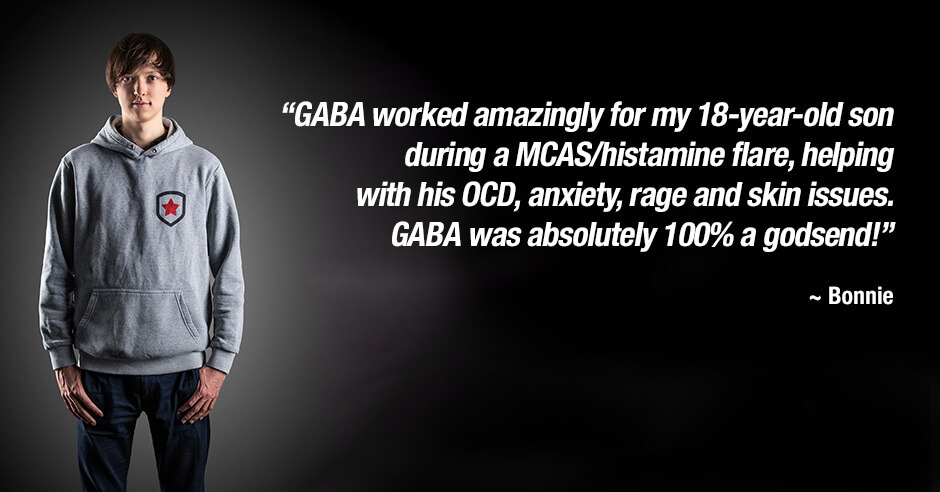
GABA worked amazingly for 18-year-old during a MCAS/histamine flare, helping with OCD, anxiety, rage and skin issues

October 27, 2023 By Trudy Scott Leave a Comment

gaba mcas

Bonnie shared how effective GABA was for her 18 year old son with suspected MCAS (mast cell activation syndrome/histamine issues) and his associated anxiety/OCD/rage and skin issues:

GABA worked amazingly for us during a flare! Flares began with OCD [obsessive compulsive disorder]and anxiety increasing before our eyes and then the rage followed.

He would wake up very early and his upper back, shoulders and upper chest would have acne all over, this would come and go, but never completely go.

GABA capsules worked in 20 minutes and thanks to you Trudy, I read and found GABA chewables worked in 5 minutes. We used to buy GABA all the time to stop the flares and to prevent them from coming! The GABA was absolutely 100% a godsend!

Once I started focusing on keeping histamine down, we don’t buy or use GABA much! Haven’t had a flare in almost a year!!

It’s so wonderful to hear that GABA helped Bonnie’s son so much. No MCAS/histamine flare in a year!

I checked with Bonnie and they primarily used 3 x Source Naturals GABA Calm chewables (each one contains 125 mg GABA). They initially used up to 3 x 250 mg GABA if he was having a really bad flare, 1 if he was not so bad and 2 if somewhere between.

Histamine issues frequently cause physical tension and anxiety so we’d expect GABA to help. Wth rage and OCD, we typically consider low serotonin as a possible cause but in her son’s case, GABA clearly was his root cause. I share another case where GABA helped ease symptoms of anger, rage, and dark moods.

It’s been a long road – ruling out PDD-NOS, PANDAS and PANS

But as amazing as GABA was for him there was more to it and it has been a long road for him. Bonnie shared this too: “At 4 years old he was diagnosed with PDD-NOS, then at 5 years old they said no it’s PANDAS, and at 6 years old no it’s PANS.”

Pervasive Developmental Disorder – Not Otherwise Specified (PDD-NOS) refers to a group of disorders characterized by impairment in the development of social interaction, verbal and non-verbal communication, imaginative activity and a limited number of interests and activities that tend to be repetitive.

Both PANDAS and PANS are associated with OCD, rages and other mental health issues which are often sudden onset and caused by infections – PANDAS is Pediatric Autoimmune Neuropsychiatric Disorders Associated with Streptococcal Infections, and PANS is when the severe onset of OCD symptoms is linked to another infection. More on these conditions here. It’s important to either rule out or address these conditions.

They tried several doctors and several protocols over the years: “B12 injections early but only saw a small gain. No reactions for years whatever we tried. IV treatment about 5 years ago was the second time we had gains.

Histamine was off the chart and flares were worse during allergy season and better in winter

I share all this to give you hope and to send the message that you don’t want to ever give up. Even with few gains, Bonnie persevered and started making the connections with allergies. She shared this: “During these years 2 different allergy tests matched and histamine was off the chart for both, but 2 different doctors did not address it. Maybe there was no connection then.”

She noticed flares were worse during the beginning of allergy season and better in winter, and started to histamine support:

We use DAO enzymes with high histamine foods. We tried quercetin, isoquercetin and curcumin with no gains. Started stinging nettles and bromelain and they are definitely helping us with gains.

Our son seems to be much better, being more social and we are just seeing better connections socially.

Just started Seeking Health Serotonin Nutrients to see if this can further add gains. Probably a different topic now! Sorry so long!! Love to share!!!

Bonnie noticed her son’s flares were better in winter but keep in mind there may be seasonality of GABA with worsening anxiety, insomnia and intrusive thoughts in winter (and the need for increased GABA supplementation). I blog about this here.

The research: Neurotransmitter and neuropeptide regulation of mast cell function

Bonnie shared her son’s results in response to a Facebook post where I shared the research that GABA (a well-known inhibitory neurotransmitter) helps with MCAS/mast cell activation syndrome and histamine issues.

This 2020 paper, Neurotransmitter and neuropeptide regulation of mast cell function: a systematic review, reports that:

Some reports link GABA to the inhibition of MC (mast cell) activation in allergies. GABA suppresses degranulation in rat basophilic leukemia RBL-2H3 cells via the GABA(B) receptor on the cell surface

….The administration of GABA in a dose-dependent manner reduced the development of AD [atopic dermatitis] – like skin lesions in mice by suppressing serum IgE and splenocyte IL-4 production.

(Keep in mind that the RBL-2H3 cell line mentioned in the above research is a commonly used histamine-releasing cell line used in inflammation, allergy and immunological research.)

My additional feedback about serotonin support and pyroluria

They also used (and still use) 5 mg lithium orotate and 100 mg 5-HTP. Bonnie will soon be stopping one at a time to see if that makes a difference. I’ll share what she reports back.

Bonnie mentions wanting to trial a combination product for serotonin support. I shared with her that I prefer individual amino acids so we know what’s helping. This is especially important with sensitive folks who may react to any one of the ingredients. My choice would be exploring 5-HTP further or doing a trial of tryptophan instead of 5-HTP (or possibly a combination of both) if there are still low serotonin symptoms.

She also mentions that her son is “more social and we are just seeing better connections socially.” This is great but if she feels he could make even more social gains I’d encourage looking into the pyroluria protocol too. There are many added benefits of addressing pyroluria (a social anxiety condition) when someone has MCAS, histamine issues, Lyme or another chronic condition. The zinc, vitamin B6 and other nutrients also support neurotransmitter production.

Resources if you are new to using amino acids as supplements

We use the symptoms questionnaire to figure out if low GABA or low serotonin may be an issue.

If you suspect low levels of any of the neurotransmitters and do not yet have my book, The Antianxiety Food Solution – How the Foods You Eat Can Help You Calm Your Anxious Mind, Improve Your Mood, and End Cravings, I highly recommend getting it and reading it before jumping in and using amino acids on your own so you are knowledgeable. And be sure to share it with the practitioner/health team you or your loved one is working with.

There is an entire chapter on the amino acids and they are discussed throughout the book in the sections on gut health, gluten, blood sugar control, sugar cravings, anxiety and mood issues.

The book doesn’t include product names (per the publisher’s request) so this blog, The Antianxiety Food Solution Amino Acid and Pyroluria Supplements, lists the amino acids that I use with my individual clients and those in my group programs. You can find them all in my online store.

If, after reading this blog and my book, you don’t feel comfortable figuring things out on your own (i.e. doing the symptoms questionnaire and respective amino acids trials), a good place to get help is the GABA QuickStart Program (if you have low GABA symptoms too). This is a paid online/virtual group program where you get my guidance and community support.

If you are a practitioner, join us in The Balancing Neurotransmitters: the Fundamentals program. This is also a paid online/virtual program with an opportunity to interact with me and other practitioners who are also using the amino acids.

I really appreciate Bonnie for sharing her son’s story and giving me permission to share as a blog.

Has GABA helped with your symptoms (or your loved one’s symptoms) triggered by MCAS/mast cell activation syndrome and histamine issues – like anxiety, insomnia, OCD, racing heart, rage, allergy symptoms and even rashes/dermatitis?

Do you also find that the sublingual/chewable GABA Calm product worked/works quicker than swallowed GABA products?

Has addressing pyroluria helped MCAS/histamine issues and social anxiety?

Feel free to share and ask your questions below.
Filed Under: Anger, Anxiety, GABA, MCAS/histamine, OCD Tagged With: acne, allergy season, amino acids, anger, anxiety, flare, GABA, GABA Calm, GABA Quickstart; Balancing Neurotransmitters, histamine flare, mast cell activation syndrome, MCAS, OCD, PANDAS, PANS, pyroluria, rage, serotonin, skin issues

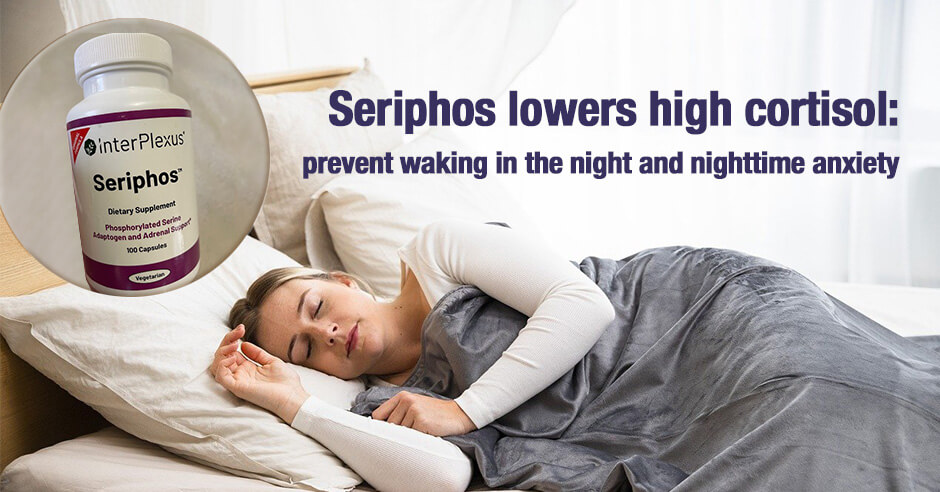
Seriphos lowers high cortisol: prevent waking in the night and nighttime anxiety

October 20, 2023 By Trudy Scott 63 Comments

seriphos and cortisol

Seriphos is my favorite nutrient for lowering high nighttime cortisol in order to reduce night waking and nighttime anxiety. I’ve used it with success in the past and have just needed it again:

After coming back from Hawaii (I was there for just under 2 weeks), I was still waking a few times each night. Sometimes I would be awake for 2-3 hours! I’m a hot mess when I don’t get sleep through the night. With just 1 Seriphos before bed for 9 days I was sleeping through the night again. It was glorious!

High cortisol can be a temporary issue after international travel i.e. caused by jetlag and out of balance circadian rhythm. I will admit that I have a number of confounding factors – like my loss and grief (my darling mom has just passed away), being sprayed with insecticide on landing in Australia (which I suspect caused severe vertigo the day after I got back), and high blood pressure (and likely higher cortisol too) after drinking too much licorice tea for my voice loss. Whatever the causes of my high cortisol, Seriphos really helped me sleep through the night.

I ran out of Seriphos 2 nights ago and I was awake for 3 hours last night. I’ll be adding it back to my nighttime protocol as soon as my order arrives.

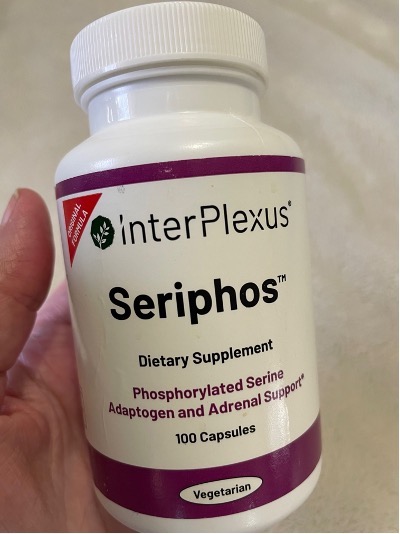
Seriphos is made by Interplexus and is a phosphorylated serine product. It is similar to the more recognized phosphatidylserine which is also used and known for lowering high cortisol – clinically and in the research.  However, clinically, I have found Seriphos to be more effective and work more quickly.

UPDATE Feb 2024: I did end up tweaking my Seriphos dose a few times. After a few weeks I decided to trial 2 per night – this worked well. Then a few weeks later I trialed 3 per night – but after a few days I realized that even though it worked well for sleep it made me too tired the next day. For this reason I went back down to 2 Seriphos at bedtime.

UPDATE August 2024: I’m now using just 1 Seriphos at night and have added ox bile supplementation and a bright light panel in the morning because of bile issues. More on this below.

Seriphos for high cortisol due to trauma, loss of beloved cat and more

When I posted this on Facebook, I had a number of folks share how Seriphos has also helped them.

Kathy shared this: “I take two Seriphos at night for high cortisol that causes insomnia. It works well for me and helps me to relax. I have a significant trauma background that keeps me in fight or flight, so Seriphos is a must have at night. I do take a break from time to time if I am going through a less stressful time.”

Hopefully Kathy is also working on the trauma, doing trauma work and even incorporating other nutritional approaches which help so much with recovery – like zinc, vitamin D, a B complex, GABA and tryptophan etc. Taking a break from time to time is a good plan – I share more about this below.

Kim shared this: “Seriphos is a life saver – I started it when I was having cortisol/adrenaline issues a few years ago and have continued using it. I don’t ever want to be without Seriphos. A little over a month ago I unexpectedly lost my youngest cat. She was emaciated when I rescued her over 4 years ago and we turned around health issues. I feel so sad that she was dealt such a bad hand but we got her a loving home. My animals are everything to me and the grief is so difficult. She was a character and I love her so much.”

She uses one capsule in the evening but also uses a capsule during the day if she feels off. Hopefully Kim is also doing trauma work and other nutritional support too.

Janie shared this: “I have used it, years ago when my cortisol was off the charts, morning and at night. I was awake every night until 2am, unable to sleep. Seriphos certainly helped.”

She used 1 Seriphos per day for about 3 months.

Patricia said: “Please remember that there is Original Seriphos and the next gen Seriphos. I was one of thousands of people who had used original Seriphos for sleep and then they changed their formulation without telling us and then so very many of us were wide awake at night until we realized that they had changed the formulation.”

This happened in 2016/2017 and I blogged about that whole fiasco here –  Seriphos Original Formula is back: the best product for anxiety and insomnia caused by high cortisol. You can read many other success stories on the blog and in the comments.

Address the causes of your high cortisol: jetlag, grief, toxins, licorice intake

As you can see from my example there can be a number of causes of high cortisol and you always want to address these causes while using Seriphos so you can eventually stop using it:

  • International travel i.e. caused by jetlag and out of balance circadian rhythm. I’m home so this is no longer a contributing issue.
  • Loss and grief can have physiological effects and high cortisol is one of many effects: “It appears that cortisol remains elevated for at least the first 6 months of bereavement. For some, cortisol elevation may become chronic”. The loss of my darling mom is going to take time but I am making time for grieving and I’m nurturing myself. As I navigate this period in my life I’ll continue to share what has helped me. I suspect I may need Seriphos for longer than the usual 3 months.
  • Being sprayed with insecticide on landing in Australia (which I suspect caused severe vertigo the day after I got back). It’s well-recognized that environmental toxins are hormone disruptors and affect the hypothalamic-pituitary-adrenal (HPA) axis and cortisol. I’m addressing this with active detoxification and my portable infrared sauna.
  • High blood pressure and likely higher cortisol too after drinking too much licorice tea for my voice loss. I have stopped the licorice consumption and my blood pressure is back to normal.

Other possible causes of high cortisol include day to day stresses, food sensitivities such as gluten, high sugar consumption, parasites and so on. Each factor needs to be addressed.

I do recommend Salivary cortisol testing before using Seriphos

Salivary cortisol testing is something I do with all my clients anyway. And I do recommend salivary cortisol testing before using Seriphos and the other cortisol-lowering nutrients mentioned below.

I will admit that I didn’t follow my own recommendation because I’ve had high nighttime cortisol in the past and recognized the symptoms. I had also identified all the above root causes and I desperately needed to sleep. I now have an adrenal saliva test kit on hand and will report back when I get the results.

Seriphos will only work for waking in the night if cortisol is high

One woman shared “I have never slept through the night in years. It would be delightful to get to the morning without waking.” Seriphos will very likely help if her cortisol is high.

Keep in mind there are many causes of not being able to sleep through the night and Seriphos will not help if cortisol is not high. Other root causes for insomnia/waking in the night (and nighttime anxiety) we consider and investigate are:

  • Low GABA and low serotonin (I always start with these while waiting for salivary cortisol results to come back),
  • Low melatonin

The following factors need to be addressed as root causes of sleep issues, anxiety and other symptoms (like gut issues, pain etc.), and also keep in mind that they are very possibly contributing to your high cortisol too:

  • Gluten and other food sensitivities
  • Caffeine and sugar intake
  • Oxalate issues and/or toxins exposure affecting bile production (this affected my sleep last year)
  • EMFs
  • Parasites and other gut issues like IBS/SIBO etc.
  • Disrupted circadian rhythms connected to liver/gallbladder/bile issues – more on that and bright light here. (Research does support a connection between high cortisol and cholestasis i.e. “stagnation, or at least a marked reduction, in bile secretion and flow.”)

A few folks reported they had tried Seriphos without success and it may well be that they don’t have high cortisol. Or they would possibly benefit from another approach to lower their cortisol (more on this below).

What are my options if I have high cortisol at night and Seriphos has the opposite effect?

One person said it had the opposite reaction. Joanne shared this: “Seriphos had the opposite effect on me. [One Seriphos] gave me extreme anxiety, kept me awake all night. Saliva tested consistently high cortisol at night so it should have helped. Been trying to work out why it would and how it might inform how I treat my insomnia.”

I’ve had a few clients do better with less than the recommended 3 per day and one not being able to use it at all. I suspect an allergic reaction or that it’s just too high a dose for some folks. The capsule could be opened and less could be used.

If this doesn’t work, other options for lowering high cortisol include lactium/hydrolyzed casein, Relora® (which contains Magnolia officinalis and Phellodendron amurense), essential oils such as bergamot and some herbal adaptogens. You can also read about some phosphatidylserine products I looked into when the Seriphos product was changed.

Forest bathing also helps to lower high cortisol levels and I recommend it for everyone.

Where does using Seriphos fit into everything else that I’m doing to address my insomnia and/or anxiety?

I typically don’t start with Seriphos right away with clients unless we know cortisol is high. As mentioned above I always start with assessing for low GABA and low serotonin and we do trials of the respective amino acids based on the symptoms questionnaire.

I also assess for low blood sugar and dietary factors like gluten, caffeine, sugar, quality animal protein intake etc. as covered in my book “The Antianxiety Food Solution.” More about my book here.  It does include a chapter on the amino acids and how to use them too.

Then we start to dig deeper and would consider Seriphos or lactium for anxiety caused by high night time or even high morning cortisol or high cortisol at other times of the day.

With many folks all of the above often applies. And we continue with assessing for each of the 60+ nutritional and biochemical root causes of anxiety/waking in the night (which does include liver/gallbladder/bile issues).

Where do I purchase Seriphos and how much do I use? What about taking a break?

seriphos

You can purchase Seriphos from my online store (Fullscript – only available to USA customers – use this link to set up an account) and you can also find it on iherb (use this link to save 5%).

The bottle states to use 1 capsule with water 15 minutes before a meal. Clinically, using 1-3 capsules a few hours before the high cortisol seems to be most effective. For 2-4am waking this typically means taking Seriphos right before bed. In some instances, taking 1 on waking in the night can help too (for a maximum of 3).

With high cortisol in the night and on waking, I have clients use Seriphos before bed and lactium on waking.

It is recommended to take a one-month break after 3 months of Seriphos use. Ideally, once the root causes of high cortisol are addressed, you should be able to stop anyway.  Or take a break, retest cortisol and then continue.

I’ll share some research and how Seriphos differs from phosphatidylserine in a follow-up blog if there is enough interest.

I appreciate all the feedback from these women in my community.

Have you used Seriphos (a phosphorylated serine product) to help with high cortisol and waking in the night/nighttime anxiety caused by any of the?

What do you suspect the cause(s) of your high cortisol is or was? And have you confirmed high cortisol with a saliva cortisol test?

Have any of the other products mentioned above helped to reduce high cortisol? If yes, have you compared them with Seriphos?

Let me know if you’re interested in a follow-up blog that includes some research and how Seriphos differs from phosphatidylserine.

Feel free to share and ask your questions below.
Filed Under: Adrenals, Anxiety, Insomnia, Stress, Toxins Tagged With: 000 lux, 10, anxiety, Balancing Neurotransmitters: the Fundamentals program for practitioners, bile liver, bright light, bright light panel, cholestasis, circadian rhythm, cognitive performance, cortisol, daytime sleepiness, disturbed sleep, GABA, GABA Quickstart, grief, high blood pressure, high cortisol, insecticide, Interplexus, jet lag, jetlag, licorice tea for my voice loss, melatonin, mood, nighttime anxiety, phosphatidylserine, phosphorylated serine, primary biliary cholangitis, salivary cortisol testing, seriphos, serotonin, sleep, sleep quality, sleep timing, trauma, tryptophan, vertigo, waking, waking early

GABA and taurine reduce high blood pressure: the anxiety connection and what do when on blood pressure medication or if blood pressure is already low

September 1, 2023 By Trudy Scott 18 Comments

gaba and taurine

Gamma-amino butyric acid (GABA) is an amino acid that used as a supplement to help ease physical anxiety and help with insomnia, and a host of other symptoms ranging from pain to throat spasms (you can see the most recent list of symptoms here)

Research shows that GABA lowers blood pressure too. This has implications if you have high blood pressure/hypertension and are currently taking blood pressure medication or if you happen to have low blood pressure. The latter is already a precaution I review with my clients i.e. to watch the use of GABA when blood pressure is low. But we do need to add another precaution to cover folks already on blood pressure medications. Read on to learn about these precautions and what they may mean for you, and to read about the GABA (and taurine) hypertension research. And the fact that anxiety is common when you have high blood pressure and can actually be a driving factor.

This paper, United States Pharmacopeia (USP) Safety Review of Gamma-Aminobutyric Acid (GABA), published in 2021, reports the results of a 4-week study that investigated the tolerability of GABA supplementation in mildly hypertensive but otherwise healthy adults:

The authors first established an optimum dose in mildly hypertensive subjects (SBP/systolic blood pressure between 130 and 180 mm Hg) who were randomized to receive oral doses of GABA at 0 (placebo), 20, 40, or 80 mg/day for 4 weeks.

An intake of 80 mg/day of GABA was associated with a significant reduction of the BP in adults with mild hypertension, and no adverse effects were reported.

A subsequent study evaluated long-term effects of GABA at 80 mg daily versus placebo in mildly hypertensive subjects for 8 weeks:

At the end of the 8-week study, SBP [systolic blood pressure i.e. the top number] and DBP [diastolic blood pressure i.e. the bottom number] were on average 5% lower in all the subjects who received 80 mg/day of GABA compared to participants in the placebo group whose blood pressure levels remained above normal.

This is a substantial reduction when 80 mg of GABA a day is considered a very low dose. I typically have my anxious clients start with 125mg GABA and increase from there. They may end up using 125 mg GABA 3 or 4 times a day and sometimes 250 mg a few times a day.

I’m not suggesting using only GABA or taurine (more on this below) when blood pressure is high as there can be many variables and root causes. I would, however, like to see GABA be given more consideration, especially when anxiety is a symptom too.

The existing GABA precautions: a new one if you are taking medication for high blood pressure

If you are currently taking blood pressure medication for high blood pressure and plan to do a trial of GABA, it’s worth monitoring your blood pressure and discussing with your prescribing doctor. GABA may lower your blood pressure enough that your medication can be reduced or possibly stopped.  The above paper states this:

Because some studies showed that GABA was associated with decreases in blood pressure, it is conceivable that concurrent use of GABA with anti-hypertensive medications could increase risk of hypotension [low blood pressure].

I have now added this as a new precaution – High blood pressure and on blood pressure medications: GABA, taurine. You can see it on the Amino Acid Precautions blog.

The existing GABA precautions: watch when you have low blood pressure and don’t use when pregnant or nursing

As you can read in the amino acids chapter of my book and on the above precautions blog, there is already a precaution stating to watch the use of GABA when you have low blood pressure. It’s worth being aware of but is not something I’ve actually seen to be an issue. Occasionally folks reduce their GABA dose because they feel light-headed.

This precaution is already addressed – not to use GABA when pregnant or nursing – but it’s worth repeating here as it’s a frequent question I am asked . The above paper states:

Caution is advised for pregnant and lactating women since GABA can affect neurotransmitters and the endocrine system, i.e., increases in growth hormone and prolactin levels.

Taurine: hypertension, stroke and heart disease

You’ll notice taurine grouped with GABA on the list of precautions. Based on the research, this amino acid also helps reduce blood pressure and is cardio-protective: “Advances in extensive studies on experimental models indicate that taurine is preventive against hypertension, stroke and atherosclerotic arterial diseases.”

This is one of the proposed mechanisms of taurine for lowering blood pressure : “The preventive mechanisms of taurine were ascribed to sympathetic modulation for reducing blood pressure (BP) and anti-inflammatory action.” GABA works in a similar way.

The same precautions would apply: low blood pressure and high blood pressure with blood pressure medication.

As I mentioned above, there is more to hypertension than adding only taurine or GABA. This book by Dr. Mark Houston MD, is an excellent resource – What Your Doctor May Not Tell You About(TM): Hypertension: The Revolutionary Nutrition and Lifestyle Program to Help Fight High Blood Pressure (my Amazon link).

He does mention taurine and recommends 1 to 1.5 g of taurine twice a day for high blood pressure. He does not mention GABA supplementation but does mention how vitamin B6 is important for GABA and serotonin production and improving sympathetic function.

Stress, anxiety and fear affect blood pressure and GABA helps

Dr. Houston shares that “numerous studies have linked stress, anxiety, fear and other negative emotions to an elevation in blood pressure. Conversely, as stress decreases, so does blood pressure. ”

This supports my comments above about giving GABA more consideration when it comes to high blood pressure, especially when anxiety is a symptom too. Here are some cases studies:

  • GABA for the physical-tension and stiff-and-tense-muscles type of anxiety
  • PCOS (polycystic ovarian syndrome): GABA helped ease lifelong anxiety, wean off anxiety medication, ovulate each month and stop PCOS meds
  • Multiple sclerosis: low GABA research and the amino acid GABA for anxiety, muscle stiffness, swallowing/voice issues and pain
  • GABA lessens anxiety, agitation and defiance in 98 year old mother who has been “sundowning” for a couple of years

When GABA is not available taurine is a viable option for anxiety and hypertension.

Resources if you are new to using amino acids as supplements

If you suspect low levels of any of the neurotransmitters and do not yet have my book, The Antianxiety Food Solution – How the Foods You Eat Can Help You Calm Your Anxious Mind, Improve Your Mood, and End Cravings, I highly recommend getting it and reading it before jumping in and using amino acids on your own so you are knowledgeable. And be sure to share it with the practitioner/health team you or your loved one is working with.

There is an entire chapter on the amino acids and they are discussed throughout the book in the sections on gut health, gluten, blood sugar control, sugar cravings, anxiety and mood issues.

The book doesn’t include product names (per the publisher’s request) so this blog, The Antianxiety Food Solution Amino Acid and Pyroluria Supplements, lists the amino acids that I use with my individual clients and those in my group programs. You can find them all in my online store.

If, after reading this blog and my book, you don’t feel comfortable figuring things out on your own (i.e. doing the symptoms questionnaire and respective amino acids trials), a good place to get help is the GABA QuickStart Program (if you have low GABA symptoms too). This is a paid online/virtual group program where you get my guidance and community support.

If you are a practitioner, join us in The Balancing Neurotransmitters: the Fundamentals program. This is also a paid online/virtual program with an opportunity to interact with me and other practitioners who are also using the amino acids.

If you have low blood pressure, has GABA (or taurine) been an issue for you?

Do you have high blood pressure and has GABA (or taurine) lowered it? If yes, how much did you use and how much did your blood pressure improve? And did you have to adjust your blood pressure medication (and which one)?

Has GABA (or taurine) helped ease your physical anxiety and other low GABA symptoms?

If you have questions and other feedback please share in the comments too.

Filed Under: Anxiety, GABA Tagged With: amino acids, anxiety, Balancing Neurotransmitters: the Fundamentals program for practitioners, blood pressure medication, fear, GABA, GABA Quickstart, heart disease, high blood pressure, hypertension, hypertensive, insomnia, low blood pressure, nursing, pain, precaution, pregnant, stress, stroke, systolic blood pressure, taurine, throat spasms

Side stitch when running or exercising: the anxiety/stress connection (and the pyroluria protocol of zinc and vitamin B6 as a solution?)

August 4, 2023 By Trudy Scott 21 Comments

side stitch and anxiety

If you get a painful side stitch when running or doing other exercise or experienced a side stitch  when you were a kid, you may be as intrigued as I was to learn there is new research that points to an anxiety/stress connection. This cross-sectional observational study was done involving an anonymous survey of one hundred sixty-eight male and female adults who were running at least 10 miles/16 km per week.

The conclusion of this study, Thorn in Your Side or Thorn in Your Head? Anxiety and Stress as Correlates of Exercise-Related Transient Abdominal Pain, is as follows: “anxiety and stress are associated with the presence of ETAP.” A runner’s side stitch is referred to as ETAP i.e. exercise-related transient abdominal pain. The authors mention the fact that this is the first study to reveal this anxiety/stress connection. This is relevant given the numerous recent studies looking for a cause and no definitive solutions.

This research is also really intriguing to me given what Dr. Carl Pfeiffer MD, PhD, identified 50+ years ago in the 1970s i.e. side stitches are common in those with pyroluria/social anxiety. What’s important is the fact that the pyroluria nutrient protocol eases social anxiety and prevents side stitches in my clients. You’ll read feedback from individuals in the community who resonate with this research and the pyroluria connections. I share more about pyroluria below in case it’s new to you and a possible cause of the side stitch pain.

My feedback and feedback from others in the community

I have pyroluria and always got a left side stitch as a kid, in my teens when running and playing squash and in my 20s/30s when running. And then they stopped (and the social anxiety and related symptoms resolved) when I addressed my pyroluria with zinc, B6 and EPO, and a copper-free multi that contains manganese. I see these kinds of results with my clients all the time so a light-bulb went off when I read this new research .

I shared this research and the anxiety/stress/pyroluria connection on Facebook and asked: did you/do you get side stitches when running/exercising? Here is some of the feedback I received, where the pyroluria protocol did help.

Kameka shared this: “I had side stitches as a kid and as an adult. Running was the main exercise that caused it and it was usually the left side. Now that you mention it, I haven’t had them since I started supplementing for pyroluria. Also, my social anxiety is sooo much better as well!”

She did the symptoms questionnaire and the pyroluria urine test (which can give false negative results) and confirmed she takes vitamin B6, zinc, magnesium, and primrose oil.

Bec shared this: “I hated PE at high school for that reason. While everyone was running, I was suffering from side stitches (I think it was my right side) and having breaks. I have pyroluria with lots of symptoms. I do well with zinc and P5P.”

Not everyone reported an improvement with the protocol but many folks resonated with the side stitch/pyroluria connections:

Megan said: “Couldn’t run as a kid. A stitch every time. I can’t recall which side, never really paid too much attention. Looking at the pyroluria symptoms, I think I may have always had it.”

Janie exclaimed: “Oh, boy, did I!” (while distance running). She finds it hard to remember but thinks it may have been on her right side. She also shared that “tests for zinc come back normal, but I have many of the [pyroluria] symptoms, especially the less common ones. I scored high. I always want breakfast but all the other questions fit me like a glove, like pieces of a puzzle with my photo on the box.

My lack of dream recall is another sign. I take 25 mg of methylated B6, but still no dreams. The question regarding being seated in the middle of a restaurant…THAT IS ME!! My throat will feel like it’s closing up, so much tension.”

I explained that most zinc testing is not accurate and that we increase until we get symptom resolution. I also referred her to the pyroluria chapter in my book.

Susie shared this: “Yes I always got side stitches so I gave up running. I suspected pyroluria but not sure if I have it.”

Leah said “I’d say my daughter and I both [had side stitches] more when we were younger. Both socially anxious and pyroluria. Less exercising now too.”

Information if you’re new to pyroluria

Pyroluria is frequently associated with a type of anxiety characterized by social anxiety, avoidance of crowds, a feeling of inner tension, and bouts of depression. People with this problem experience varying degrees of anxiety or fear, often starting in childhood, but they usually manage to cover it up and push through. They tend to build their life around one person, become more of a loner over time, have difficulty handling stress or change, and have heightened anxiety symptoms when under more stress.

Also on the list of symptoms is this one: “Upper abdominal pain on your left side under the ribs or, as a child, having a stitch in your side as you ran.”

Addressing low levels of the mineral zinc and vitamin B6, together with some other nutrients and stress management, are key to addressing these symptoms.

Here is the complete symptoms questionnaire on the blog. This questionnaire can also be found in the pyroluria chapter in my book, The Antianxiety Food Solution. You’ll find the detailed supplement protocol and additional information on how to assess for low zinc and low vitamin B6 in this chapter too.

You can read more about the prevalence and associated conditions here. It’s most often considered a genetic condition but is possibly environmentally triggered too.

There are many pyroluria blog posts where I cover various aspects such as the importance of addressing pyroluria for recovery from MCAS and Lyme, pyroluria and Ehlers Danlos Syndrome, pyroluria and intrusive thoughts and many more. I encourage you to use the search feature on the blog.

A possible cause of the side stitch in pyroluria

Here is an excerpt from a paper published in 1974 by Dr. Pfeiffer and colleagues, Treatment of Pyroluric Schizophrenia Malvaria With Large Doses of Pyridoxine and zinc, describing why the side pain probably occurs:

This 15-year-old upper middle-class patient (now 19 after studying for four years) represents a case of nutrient deficiency in which vitamins (specifically B6) and the trace minerals manganese and zinc were inadequate for the development of normal knee joints and normal brain function.

The deficiency was sufficiently severe at its peak to cause prolonged psychosis, atypical seizures, arthritis, amenorrhea, constipation, and splenic pain. The pain is probably due to hemolytic crisis in which red cell fragments engorge the Kupfer cells of the spleen and liver, extend the capsule, and cause pain. The double deficiency is produced by the formation of KP [kryptopyrroles] which combines with pyridoxal and zinc.

Based on the above and other publications by Dr. Pfeiffer, when the stitch happens on the left side, my understanding is that the pain is in the spleen. And when it happens on the right side, the pain is in the liver area. Most individuals with pyroluria say they felt/feel their side stitch on the left side. Either way it appears to be caused by low zinc, low vitamin B6 and the other nutrients needed by those with pyroluria. And resolved when on the pyroluria protocol.

I would love to see these ETAP researchers take their anxiety/stress research one step further and identify how common pyroluria is in runners who get side stitches and if the pyroluria protocol prevents the side stitches.

My book as a resource and pyroluria supplements

As mentioned above, there is an entire chapter on pyroluria in my book, The Antianxiety Food Solution – How the Foods You Eat Can Help You Calm Your Anxious Mind, Improve Your Mood, and End Cravings, I highly recommend getting it and reading it before jumping in and addressing these deficiencies. And be sure to share it with the practitioner/health team you or your loved one is working with.

Keep in mind that these nutrients are cofactors for making neurotransmitters and are a key part of my protocol when working with individual amino acids.

The book doesn’t include product names (per the publisher’s request) so this blog, The Antianxiety Food Solution Amino Acid and Pyroluria Supplements, lists the pyroluria supplements and amino acids that I use with my individual clients and those in my group programs. You can find them all in my online store.

If you are a practitioner, join us in The Balancing Neurotransmitters: the Fundamentals program. This is also a paid online/virtual program with an opportunity to interact with me and other practitioners who are also using the amino acids and pyroluria protocol.

Thanks to everyone who contributed to the discussion on Facebook. Now I would love to hear from you so I can approach the authors with their feedback and yours too.

Did you get a side stitch as a kid and did it affect your ability to take part in school sports?

Do you still get a side stitch when running or doing other exercises? If yes, does it hold you back and with which exercise?

Did/does the side stitch occur on the left or right side?

And do you have pyroluria? (based on the symptoms questionnaire and/or pyroluria urine test)?

Does the pyroluria protocol prevent your painful side stitches? And had you made the connection to pyroluria/anxiety/stress?

Are you seeing a similar pattern with your kid/s? (pyroluria, side stitch and the protocol helps them too)

If you have questions and feedback please share them here too.

Filed Under: Anxiety, Exercise, Pyroluria Tagged With: anxiety, Carl Pfeiffer, ETAP, exercise, exercise-related transient abdominal pain, exercising, liver, painful side stitch, pyroluria, running, side stitch, social anxiety, spleen, stress, vitamin B6, zinc

  • « Go to Previous Page
  • Page 1
  • Interim pages omitted …
  • Page 4
  • Page 5
  • Page 6
  • Page 7
  • Page 8
  • Interim pages omitted …
  • Page 96
  • Go to Next Page »

Primary Sidebar

GABA QuickStart Homestudy

gaba quickstart homestudy

Free Report

9 Great Questions Women Ask about Food, Mood and their Health

You'll also receive a complimentary subscription to my ezine "Food, Mood and Gal Stuff"


Connect with me

Popular Posts

  • Amino Acids Mood Questionnaire from The Antianxiety Food Solution
  • The Antianxiety Food Solution Amino Acid and Pyroluria Supplements
  • Pyroluria Questionnaire from The Antianxiety Food Solution
  • Collagen and gelatin lower serotonin: does this increase your anxiety and depression?
  • Tryptophan for the worry-in-your-head and ruminating type of anxiety
  • GABA for the physical-tension and stiff-and-tense-muscles type of anxiety
  • The Antianxiety Food Solution by Trudy Scott
  • Seriphos Original Formula is back: the best product for anxiety and insomnia caused by high cortisol
  • Am I an anxious introvert because of low zinc and vitamin B6? My response to Huffington Post blog
  • Vagus nerve rehab with GABA, breathing, humming, gargling and key nutrients

Recent Posts

  • Her cravings for chips and peanut butter were triggered by stress: GABA ends cravings and reduces physical tension and fear of heights
  • It is truly miraculous to be able to move through life without crippling anxiety and panic
  • GABA and tryptophan combo provide immediate and noticeable relief for tremors and cervical dystonia in just 7 days
  • Red light therapy for back and neck pain, plantar fasciitis and low mood – a complement to the amino acids GABA, DPA and tryptophan
  • What do I use instead of Seriphos to help lower high cortisol that is affecting my sleep and making me anxious at night?

Categories

  • 5-HTP
  • AB575
  • Addiction
  • ADHD
  • Adrenals
  • Alcohol
  • Allergies
  • Alzheimer's disease
  • Amino Acids
  • Anger
  • Antianxiety
  • Antianxiety Food Solution
  • Antidepressants
  • Anxiety
  • Anxiety and panic
  • Autism
  • Autoimmunity
  • benzodiazapines
  • Bipolar disorder
  • Books
  • Caffeine
  • Cancer
  • Candida
  • Children/Teens
  • Collagen
  • Cooking equipment
  • Coronavirus/COVID-19
  • Cravings
  • Depression
  • Detoxification
  • Diabetes
  • Diet
  • DPA/DLPA
  • Drugs
  • EFT/Tapping
  • EMF
  • EMFs
  • Emotional Eating
  • Endorphins
  • Environment
  • Essential oils
  • Events
  • Exercise
  • Fear
  • Fear of public speaking
  • Fertility and Pregnancy
  • Fish
  • Food
  • Food and mood
  • Functional neurology
  • GABA
  • Gene polymorphisms
  • General Health
  • Giving
  • Giving back
  • Glutamine
  • Gluten
  • GMOs
  • Gratitude
  • Gut health
  • Heart health/hypertension
  • Histamine
  • Hormone
  • Hyperparathyroidism
  • Hypoglycemia
  • Immune system
  • Inflammation
  • Insomnia
  • Inspiration
  • Introversion
  • Joy and happiness
  • Ketogenic diet
  • Lithium orotate
  • Looking awesome
  • Lyme disease and co-infections
  • MCAS/histamine
  • Medication
  • Men's health
  • Mental health
  • Mercury
  • Migraine
  • Mold
  • Movie
  • MTHFR
  • Multiple sclerosis
  • Music
  • NANP
  • Nature
  • Nutritional Psychiatry
  • OCD
  • Osteoporosis
  • Oxalates
  • Oxytocin
  • Pain
  • Paleo
  • Parasites
  • Parkinson’s disease
  • PCOS
  • People
  • PMS
  • Postpartum
  • PTSD/Trauma
  • Pyroluria
  • Questionnaires
  • Real whole food
  • Recipes
  • Research
  • Schizophrenia
  • serotonin
  • SIBO
  • Sleep
  • Special diets
  • Sports nutrition
  • Stress
  • Sugar addiction
  • Sugar and mood
  • Supplements
  • Teens
  • Testimonials
  • Testing
  • The Anxiety Summit
  • The Anxiety Summit 2
  • The Anxiety Summit 3
  • The Anxiety Summit 4
  • The Anxiety Summit 5
  • The Anxiety Summit 6
  • Thyroid
  • Thyroid health
  • Toxins
  • Tryptophan
  • Tyrosine
  • Uncategorized
  • Vegan/vegetarian
  • Women's health
  • Yoga

Archives

  • May 2026
  • April 2026
  • October 2025
  • September 2025
  • August 2025
  • July 2025
  • June 2025
  • May 2025
  • April 2025
  • March 2025
  • February 2025
  • January 2025
  • November 2024
  • October 2024
  • September 2024
  • August 2024
  • July 2024
  • June 2024
  • May 2024
  • April 2024
  • March 2024
  • February 2024
  • January 2024
  • December 2023
  • November 2023
  • October 2023
  • September 2023
  • August 2023
  • July 2023
  • June 2023
  • May 2023
  • April 2023
  • March 2023
  • February 2023
  • January 2023
  • December 2022
  • November 2022
  • October 2022
  • September 2022
  • August 2022
  • July 2022
  • June 2022
  • May 2022
  • April 2022
  • March 2022
  • February 2022
  • January 2022
  • December 2021
  • November 2021
  • October 2021
  • September 2021
  • August 2021
  • July 2021
  • June 2021
  • May 2021
  • April 2021
  • March 2021
  • February 2021
  • January 2021
  • December 2020
  • November 2020
  • October 2020
  • September 2020
  • August 2020
  • July 2020
  • June 2020
  • May 2020
  • April 2020
  • March 2020
  • February 2020
  • January 2020
  • December 2019
  • November 2019
  • October 2019
  • September 2019
  • August 2019
  • July 2019
  • June 2019
  • May 2019
  • April 2019
  • March 2019
  • February 2019
  • January 2019
  • December 2018
  • November 2018
  • October 2018
  • September 2018
  • August 2018
  • July 2018
  • June 2018
  • May 2018
  • April 2018
  • March 2018
  • February 2018
  • January 2018
  • December 2017
  • November 2017
  • October 2017
  • September 2017
  • August 2017
  • July 2017
  • June 2017
  • May 2017
  • April 2017
  • March 2017
  • February 2017
  • January 2017
  • December 2016
  • November 2016
  • October 2016
  • September 2016
  • August 2016
  • July 2016
  • June 2016
  • May 2016
  • April 2016
  • March 2016
  • February 2016
  • January 2016
  • December 2015
  • November 2015
  • October 2015
  • September 2015
  • August 2015
  • July 2015
  • June 2015
  • May 2015
  • April 2015
  • March 2015
  • February 2015
  • January 2015
  • December 2014
  • November 2014
  • October 2014
  • September 2014
  • August 2014
  • July 2014
  • June 2014
  • May 2014
  • April 2014
  • March 2014
  • February 2014
  • January 2014
  • December 2013
  • November 2013
  • October 2013
  • September 2013
  • August 2013
  • July 2013
  • June 2013
  • May 2013
  • April 2013
  • March 2013
  • February 2013
  • January 2013
  • December 2012
  • November 2012
  • October 2012
  • August 2012
  • July 2012
  • June 2012
  • May 2012
  • April 2012
  • March 2012
  • February 2012
  • January 2012
  • December 2011
  • November 2011
  • October 2011
  • September 2011
  • August 2011
  • July 2011
  • June 2011
  • May 2011
  • April 2011
  • March 2011
  • February 2011
  • January 2011
  • December 2010
  • October 2010
  • September 2010
  • July 2010
  • May 2010
  • April 2010
  • March 2010
  • February 2010
  • January 2010
  • November 2009

Share the knowledge!

The above statements have not been evaluated by the Food and Drug Administration. Products listed in this website are not intended to diagnose, treat, cure or prevent any disease.

The information provided on this site is for informational and educational purposes only and is not intended as a substitute for advice from your physician or other health care professional. You should consult with a healthcare professional before starting or modifying any diet, exercise, or supplementation program, before taking or stopping any medication, or if you have or suspect you may have a health problem.


Copyright © 2026 Trudy Scott. All Rights Reserved. | Privacy | Terms and Conditions | Refund Policy | Medical Disclaimer

Free Report

9 Great Questions Women Ask about Food, Mood and their Health

You’ll also receive a complimentary subscription to my ezine “Food, Mood and Gal Stuff”