• Skip to primary navigation
  • Skip to main content
  • Skip to primary sidebar

everywomanover29 blog

Food, Mood and Women's Health – Be your healthiest, look and feel great!

  • Blog
  • About
  • Services
  • Store
  • Resources
  • Testimonials
  • The Book
  • Newsletter
  • Contact
  • Search this site

GABA

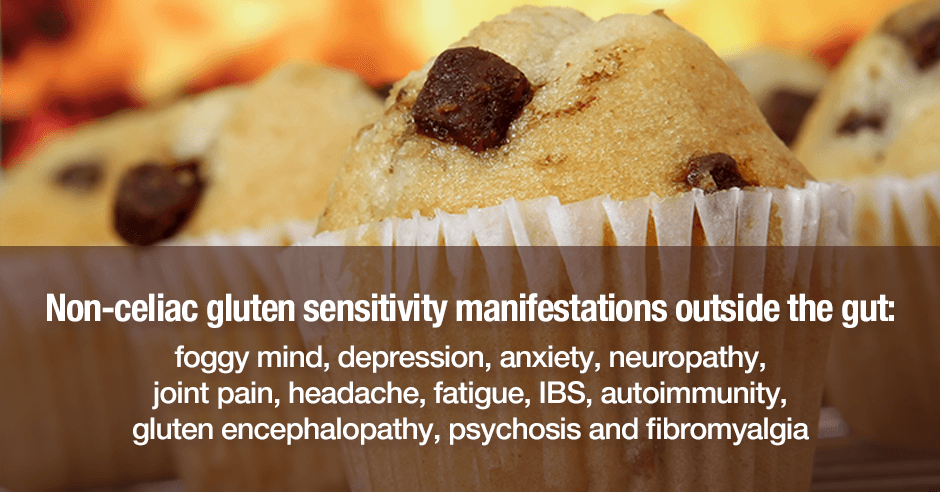
Non-celiac gluten sensitivity manifestations outside the gut: foggy mind, depression, anxiety, neuropathy, joint pain, headache, fatigue and IBS

July 1, 2022 By Trudy Scott 2 Comments

non-celiac gluten sensitivity

Celiac disease is “a digestive and autoimmune disorder that can damage your small intestine. People with celiac disease might experience symptoms like diarrhea, bloating, gas, anemia and growth issues. Celiac disease can be triggered by a protein called gluten. Gluten is found in grains, like wheat, barley and rye” (and oats that are contaminated with gluten). This description by the Cleveland Clinic is well-understood and recognized.

However, what is less recognized and understood, is extra-intestinal (or outside the gut) manifestations of non-celiac gluten sensitivity.  A paper published in 2018, Extra-intestinal manifestations of non-celiac gluten sensitivity: An expanding paradigm lists a number of symptoms and conditions that gluten consumption may cause and/or contribute to, even when you do not have celiac disease.

These can include: ‘foggy mind’; psychiatric diseases such as depression, anxiety and even psychosis; gluten ataxia, gluten neuropathy and gluten encephalopathy (causing memory and cognitive problems); joint and muscle pain, and leg or arm numbness; headache and fatigue;  irritable bowel syndrome (IBS); autoimmune disorders; and and fibromyalgia.

This blog post highlights excerpts from the 2018 non-celiac gluten sensitivity paper and stories from real people who have experienced relief when removing gluten from their diets. And resources if you find you need neurotransmitter support to help break the addiction and not feel deprived.

This is from the abstract of the above paper:

Non celiac gluten sensitivity (NCGS) is a syndrome characterized by a cohort of symptoms related to the ingestion of gluten-containing food in subjects who are not affected by celiac disease (CD) or wheat allergy. The possibility of systemic manifestations in this condition has been suggested by some reports.

  • In most cases they are characterized by vague symptoms such as ‘foggy mind’, headache, fatigue, joint and muscle pain, leg or arm numbness even if more specific complaints have been described.
  • NCGS has an immune-related background. Indeed there is strong evidence that a selective activation of innate immunity may be the trigger for NCGS inflammatory response. The most common autoimmune disorders associated with NCGS are Hashimoto thyroiditis, dermatitis herpetiformis, psoriasis and rheumatologic diseases.
  • A possible neurological involvement has been underlined by NCGS association with gluten ataxia, gluten neuropathy and gluten encephalopathy.
  • NCGS patients may show even psychiatric diseases such as depression, anxiety and psychosis.
  • Finally, a link with functional disorders (irritable bowel syndrome and fibromyalgia) is a topic under discussion.

We see all this clinically so it’s wonderful to see this being addressed in the research. However, the authors are saying we need more research and better studies:

the novelty of this matter has generated an expansion of literature data with the unavoidable consequence that some reports are often based on low levels of evidence. Therefore, only studies performed on large samples with the inclusion of control groups will be able to clearly establish whether the large information from the literature regarding extra-intestinal NCGS manifestations could be supported by evidence-based agreements.

Until then we use what we know works clinically: a gluten-free diet and observation of symptom resolution. We also use amino acids to balance brain chemicals so we break the addiction and don’t feel deprived (more on that below). Nutritional deficiencies caused by damage to the gut/leaky gut also need to be addressed, as well as healing the leaky gut and dysbiosis.

I shared the study abstract on Facebook asking for feedback and the response was so overwhelming that I can only share some of the feedback. I will do follow-up posts sharing more detailed information from their healing journeys.

Caroline had bloating, pain and chronic sadness, and discovered  “joie de vivre”

Caroline confirmed that she has gluten sensitivity saying she stopped eating wheat in 2011:

Within a few months, my chronic sadness disappeared and I discovered the “joie de vivre”. It also allowed me to get rid of my swelling belly (bloating). Every evening I looked like a woman 2-3 months pregnant. [this likely falls into the irritable bowel syndrome category mentioned in the paper]

The pain in my joints also ended up disappearing.

I read so much about gluten once I started to realize it had changed my life to quit eating that stuff that now I’m convinced grains shouldn’t be part of human food, and I mean all grains (botanically speaking).

I think grains should at least be taken off all the menus in all hospitals, especially the psychiatric ones.

I adore her “joie de vivre” feedback and am so happy for her! I had this same feeling of pure joy when I went gluten-free. And I get so much feedback like this from clients who had no idea life could be so much better.

I also agree with her sentiment about gluten and grains being an issue too, especially in psychiatric settings.

Daphne was emotionally dysregulated with negative feelings and a pressure headache

Daphne shared what she calls an odd effect that she gets soon after eating bread: roiling emotions:

I get emotionally dysregulated. Negative feelings surface in various degrees, for me primarily anger and the reviewing of the incidents that caused it (aka ruminating thoughts?); less often sadness, disappointment, and overwhelm (that usually surfaces on its own anyway).

I also get what I call ‘bread head.’ I get a pressure headache from between my eyebrows, up the center of my head to my crown.

An additional effect: ‘the hangover’. Overnight the pressure headache subsides and the next day my whole head feels heavy and I am slower physically and mentally, and my hands in particular are achy

Also, I have had chicken bumps on my skin my whole life, until I stopped eating bread. I still have some, maybe from rice, potato and corn reactions. Starch is not my friend.

As I mentioned above, many folks are surprised at the emotional changes they see when eating gluten. Daphne called it an odd effect but her response is a very typical extra-intestinal (outside the gut) psychiatric response. And yes starches and grains are an issue for many folks.

Other feedback: fibromyalgia pain, brain fog, depression, cystic acne, anxiety, body aches, fatigue, PCOS and hypothyroidism

Here is some feedback from a few other women. As you can see the symptoms can vary per person:

  • “Removal of gluten and all grains has improved my fibromyalgia pain symptoms … The difference in pain was so dramatic that it was worth it.”
  • “It makes such a difference with my brain fog and depression! And cystic acne. If I have gluten, I have cystic acne for about 2 weeks.”
  • “My joint pain, anxiety, and depression are much improved when I avoid gluten (and corn.)”
  • “Yes! Within 15 min of ingesting gluten containing food I get all over body aches, fatigue and brain fog. It’s very unpleasant. I cut gluten out of my diet simply because I can’t function properly while eating it. I also have had episodes of reactive hypoglycemia from it too.”
  • “Removing gluten has cured my hypothyroidism. Also has improved my PCOS, anxiety and depression.”

Stay tuned for a follow-up blog with more from their healing journeys and additional insights from me.

Using the amino acids to help break the gluten addiction and feel less deprived

Sometimes it’s difficult to figure out why you crave or are addicted to gluten. It can be challenging to determine which part of your brain chemistry it’s affecting, and you may not associate cravings with mood issues.

Your drug-of-choice is something you self-medicate with and it is something that makes you feel good or “normal.” It could be starchy gluten-containing foods like bread or pasta or cookies. It could also be candy, chocolate, ice-cream, coffee, sodas, wine/beer, cigarettes, marijuana, a prescription medication like Prozac, street drugs, or even shopping or exercise.

Cravings for these substances (or behaviors) typically indicate a brain chemistry imbalance, so it’s very helpful to identify how the substances you crave affect you. This will help you determine which amino acids you might supplement to address the imbalance.

Use your “drug-of-choice” from your gluten or grain list (perhaps you love bread or chocolate chip muffins) and the chart below to help you determine what brain chemistry imbalance may be affecting you and which amino acid you may benefit from.

How you feel before How you feel after Brain chemistry imbalance Amino acid to supplement
Anxious or stressed Calm or relaxed Low GABA GABA
Depressed or anxious Happy or content Low serotonin Tryptophan or 5-HTP
Tired or unfocused Energetic, alert, or focused Low catecholamines Tyrosine
Wanting a reward or sad Rewarded or comforted Low endorphins DPA (d-phenylalanine)
Irritable and shaky Grounded or stable Low blood sugar Glutamine

Once you address that brain chemical imbalance, it’s easy to quit and you won’t feel deprived.

You can read more about why you crave on this blog post

Resources if you are new to using the amino acids as supplements

If you are new to using any of the amino acids as supplements, here is the Amino Acids Mood Questionnaire from The Antianxiety Food Solution (you can see all the symptoms of neurotransmitter imbalances).

If you suspect low levels of any of the neurotransmitters and do not yet have my book, The Antianxiety Food Solution – How the Foods You Eat Can Help You Calm Your Anxious Mind, Improve Your Mood, and End Cravings, I highly recommend getting it and reading it before jumping in and using amino acids on your own so you are knowledgeable. And be sure to share it with the practitioner/health team you or your loved one is working with.

There is an entire chapter on the amino acids and they are discussed throughout the book in the sections on gut health, gluten, blood sugar control, sugar cravings, self-medicating with alcohol and more. There is also an entire chapter on gluten and grains if this is new to you.

The book doesn’t include product names (per the publisher’s request) so this blog, The Antianxiety Food Solution Amino Acid and Pyroluria Supplements, lists the amino acids that I use with my individual clients and those in my group programs.

If, after reading this blog and my book, you don’t feel comfortable figuring things out on your own (i.e. doing the symptoms questionnaire and respective amino acids trials), a good place to get help is the GABA Quickstart Program (if you have low GABA symptoms). This is a paid online/virtual group program where you get my guidance and community support. There are many moms in the program who are having much success with their kids.

If you are a practitioner, join us in The Balancing Neurotransmitters: the Fundamentals program. This is also a paid online/virtual program with an opportunity to interact with me and other practitioners who are also using the amino acids.

With much appreciation for these women for sharing their stories. I’d love to get some of these published as case studies to further add to the evidence.

Do you have (or suspect you may have) non celiac gluten sensitivity (NCGS)?

And has gluten removal resolved any of the above issues? And have you seen an improvement in gut issues too?

Have you observed other improvements since eating gluten and/or grain-free?

Did you find the amino acids helped you break your addiction and feel less deprived?

Or are you stuck and still eating gluten and have no idea where to start on quitting? If this is you, would a webinar series help?

If you have questions please share them here too.
Filed Under: Anxiety, Endorphins, GABA, Gluten, Pain, serotonin Tagged With: "joie de vivre", addiction, amino acids, anxiety, Autoimmunity, bloating, body aches, brain fog, celiac, cystic acne, depression, deprived, emotionally dysregulated, extra-intestinal, fatigue, Fibromyalgia, foggy mind, GABA, GABA Quickstart program, gluten, gluten encephalopathy, headache, hypothyroidism, IBS, joint pain, NCGS, negative feelings, neuropathy, Non-celiac gluten sensitivity, outside the gut, PCOS, psychosis, sadness, wheat

What if rewarding, comforting, numbing or distracting behaviors (caused by low endorphins) are causing low motivation, instead of low dopamine?

June 17, 2022 By Trudy Scott 21 Comments

behaviors and low motivation

One of the first things that comes to mind when someone is stuck and not able to get things done is low motivation caused by low catecholamines/low dopamine. But what if numbing, rewarding, comforting and/or distracting behaviors (caused by low endorphins) are holding you back and preventing you from getting things done instead? It may be low endorphins only or may be in conjunction with other neurotransmitter imbalances. The following question and stories from women in the community (and my insights and some of the research) may help you figure it out if any of this applies to you.

I posted a question to this effect on Facebook and there was a great deal of interest. Many folks shared examples of what their distractions are and how they fit into being rewarding and comforting for them. Here is what I posted:

I’m digging into the research connecting low endorphins and low motivation i.e. not being able to get stuff done! We associate low endorphins with physical pain, emotional pain and comfort/reward eating. But in a similar way that emotional eating /comfort food is used to numb us out and reward and comfort us, certain behaviors can do this too. Here are some examples you may relate to:

  • mindless scrolling through Facebook or other social media platforms instead of working on your new project
  • binge watching hours of Netflix shows instead of getting to bed early so you’re productive and motivated (and not distracted)
  • playing video games for days (and not going outdoors, eating proper meals and even bathing)

All of these are also an addiction and we know low endorphins are a factor when it comes to addictions too. There is also an endorphin/dopamine connection hence the motivation aspect I’m looking into.

Can you relate to any of this and has endorphin support (with the amino acid DPA/d-phenylalanine as a supplement) or exercise or LDN (low dose naltrexone) helped with your low endorphin symptoms, your lack of motivation and the distractions you almost create for yourself?

I’d expect the amino acid DLPA (dl-phenylalanine) to help since it works on boosting both low endorphins and low dopamine. I am really curious about DPA because some folks can’t tolerate DLPA or it’s contraindicated.

What are some examples of your distractions and what has helped you?

Sarah: finds looking for split ends and cutting them off very rewarding. Is this a low endorphin behavior?

Omgosh this is so me. I often wonder what the heck is wrong with me. I look around at everything that needs to be done but just get overwhelmed and have no motivation to get it done. I don’t know where to start and then get anxious about it. I will immerse myself looking for split ends in my hair instead, I can spend easily over an hour at a time just sitting there looking for split ends and cutting them off. I find it very rewarding and it’s become such a habit now that if I’m out publicly and see a pesky split end l can’t ignore it and as Í don’t typically carry scissors with me (because that would be weird right?!) so I bite them off. I often think I must look like a nutter! I am always thinking what is wrong with me???!!

Sarah describes a rewarding activity perfectly and I’d suspect endorphin support – using the amino acid DPA (d-phenylalanine) – will likely help her. This behavior is her distraction from getting things done. It’s such a distraction that she cannot ignore it even when in public.

Since she also mentions overwhelm and anxiety I’d also want to explore low GABA physical-type anxiety and low serotonin worry-type anxiety and consider trials of both GABA and tryptophan (or 5-HTP).

There may also be an obsessive element to her distracting behavior and serotonin support (with the above, inositol and possibly NAC) has been shown to help with trichotillomania (recurring habit of pulling one’s hair).

Bonnie: low motivation almost feels physical or like something is missing in my brain. Low endorphins and low dopamine?

I relate to this very much – low motivation almost feels physical or like something is missing in my brain, also an almost inability to focus or organize how to do something or get through the day. I have low motivation with poor focus … but I am also constantly craving reward, comfort, or some kind of boost in energy or pleasure to motivate or energize me – this used to be things like sweets or chocolate but I have been lowering sugar/attempting to quit.

I haven’t tried any supplements mentioned but I’m very interested to learn more as this significantly affects my life.

She says her low motivation feels physical or like something is missing. It’s great she has that awareness and she is spot on – she is missing the specific action of certain neurotransmitters (which can be resolved with amino acid supplementation).

We address neurotransmitter imbalances, one at a time:

  • DPA for low endorphin support to help with the comfort/distraction/reward
  • And tyrosine for dopamine support to help with the inability to focus and needing something to energize her
  • Her inability to focus or organize could be due to the spinning we see with the low GABA type of physical anxiety too

She also shares that she has “feelings of anxiety, hopelessness and self judgment” so low serotonin worry-type anxiety is also likely in the mix.

As always it’s best to trial one at a time and find the ideal dose before trialing the next one. I recommend trialing in the area that causes the most distress. What is great is that addressing all this will make quitting sweets and chocolate easy and with no feelings of deprivation.

Jennifer: video games are hard to break free of / switches to learning languages. Could it be low GABA and an inability to prioritize?

All of the above but video games are especially hard to break free from. Luckily I decided to use those dopamine hits to my advantage and am closing in on a 1000 day Duolingo streak, having made it to the end of the French, Norwegian, and Japanese courses.  Yes I neglect other things, but it’s better than wasting time on video games. I do worry a bit that I would lose interest if my chemistry was fully balanced, but then again there are more important things that I could be doing.

I congratulated her on her language learning and shared that it’s common to switch one addiction for another. For example alcoholics quit drinking and then get addicted to sugar or caffeine unless they address their neurotransmitter imbalances.

Jennifer has been using GABA without much success yet and once she finds the ideal dose it may be the solution or part of the solution for her spinning and inability to prioritize (which she “chalked up to ADHD, but also only became a problem when I got sick.”

Initially I would focus on GABA support (for physical anxiety) more than endorphin support, because she shares she also has all these other low GABA symptoms:

  • acrophobia (which started when she got sick)
  • proctalgia fugax/rectal spasms (recently developed
  • and burning mouth (which was a big part of her mold symptoms)

Keep in mind mold can deplete GABA and other brain chemicals so this does need to be addressed (home/office remediation and healing from the mycotoxin effects), in addition to using amino acid support.

She does check all the boxes on the symptoms questionnaire and it’ll be interesting to see which other amino acids help her with this gaming/language learning challenge. There may well be a low endorphin distraction and reward aspect too.

As always it’s best to trial one amino acid at a time and find the ideal dose before moving on to the next one.

Some of the research

I actually went looking for the research to support what I was seeing in terms of these struggles folks are experiencing i.e. another type of low motivation that is driven by low endorphins and has a numbing, rewarding and addiction aspect.

As mentioned above there is an endorphin/dopamine connection. This paper, Opioids for hedonic experience and dopamine to get ready for it, summarizes it well:

Brain dopamine has been suggested to rather code for the preparatory aspects of behavior, while brain opioids [endorphins] seem to mediate the perception of the hedonic [or pleasant] properties of rewards.

There is an addiction/cravings aspect with each of the neurotransmitter imbalances, including low endorphins.  As mentioned above, these distracting behaviors can also be addicting. And we know low endorphins are a factor when it comes to addictions to drugs, carbs/sweets and behaviors.

DPA destroys the enzyme that breaks down/inhibits endorphins and in essence raises endorphin levels, This paper discusses beta-endorphins and the reward mechanism and how they can induce euphoria, reduce pain and ease addictions and distress: “Long known for its analgesic effect, the opioid beta-endorphin is now shown to induce euphoria, and to have rewarding and reinforcing properties.” You can read more about DPA here.

With regards to DLPA (which supports low endorphins and low dopamine), a really interesting study identified low endorphins and low catecholamines as a probable cause of PMS (premenstrual syndrome) or PMDD (premenstrual dysphoric disorder) in some women. I blogged about this study and the use of DLPA here.

When it comes to exercise, this study, Opioid Release after High-Intensity Interval Training in Healthy Human Subjects, highlights the effects of different exercise intensities on opioid release, with moderate-intensity exercise being more beneficial for endorphin support. You can read about the impacts of exercise on pain, reward, and emotional processing and “the most commonly adopted theory on physical exercise induced euphoria …the ‘endorphin hypothesis’.”

LDN (low dose naltrexone) is often used in autoimmune conditions and to help with inflammation. This article, The Uses of Low-Dose Naltrexone in Clinical Practice, provides a good overview, and states that “unlike higher doses of naltrexone, LDN acts on β-endorphin receptors to stimulate the release of endorphins in the body.”  I’m not advocating the use of LDN instead of DPA or DLPA, but if you’ve been prescribed LDN you may have observed the endorphin boosting effects.

Brain chemical imbalances to consider when you experience low motivation and can’t get things done

Here is a short summary of brain chemical/neurotransmitter imbalances to consider when you have low motivation and can’t get things done:

  • Low endorphins – the less recognized low endorphin/comfort/distraction type as discussed in this blog
  • Low dopamine/low catecholamines – this is what we think of as the classic low motivation trigger where there is also poor focus, low energy and sometimes curl-up-in bed kind of depression
  • Low serotonin is another less recognized kind of low motivation I’ve blogged about: What if overthinking, fear, anxiety and worry (caused by low serotonin) is holding you back instead of low motivation/low dopamine?
  • Low GABA is also not recognized as a trigger of low motivation but since anxiety can cause inability to prioritize and spinning, this could be a factor too
  • Low blood sugar could also be a factor since it affects focus and energy

Resources if you are new to using the amino acids as supplements

If you are new to using any of the amino acids as supplements, here is the Amino Acids Mood Questionnaire from The Antianxiety Food Solution (you can see all the symptoms of neurotransmitter imbalances).

If you suspect low levels of any of the neurotransmitters and do not yet have my book, The Antianxiety Food Solution – How the Foods You Eat Can Help You Calm Your Anxious Mind, Improve Your Mood, and End Cravings, I highly recommend getting it and reading it before jumping in and using amino acids on your own so you are knowledgeable. And be sure to share it with the practitioner/health team you or your loved one is working with.

There is an entire chapter on the amino acids and they are discussed throughout the book in the sections on gut health, blood sugar control, sugar cravings, self-medicating with alcohol and more.

The book doesn’t include product names (per the publisher’s request) so this blog, The Antianxiety Food Solution Amino Acid and Pyroluria Supplements, lists the amino acids that I use with my individual clients and those in my group programs.

If, after reading this blog and my book, you don’t feel comfortable figuring things out on your own (i.e. doing the symptoms questionnaire and respective amino acids trials), a good place to get help is the GABA Quickstart Program (if you have low GABA symptoms). This is a paid online/virtual group program where you get my guidance and community support. There are many moms in the program who are having much success with their kids.

If you are a practitioner, join us in The Balancing Neurotransmitters: the Fundamentals program. This is also a paid online/virtual program with an opportunity to interact with me and other practitioners who are also using the amino acids.

With much appreciation for these women for sharing their stories and allowing me to provide my insights for them and you. We all have much to learn from each other.

Can you relate to any of this and has endorphin support with the amino acid DPA (d-phenylalanine) used as a supplement) helped?

What about exercise or LDN (low dose naltrexone) or DLPA (dl-phenylalanine)?

What are some examples of your distractions or rewarding/comforting/numbing behaviors?

And do you have a mix of neurotransmitter imbalances to address? Which is the most troubling area for you?

If you have questions please share them here too.
Filed Under: Anxiety, Endorphins, GABA, serotonin Tagged With: addiction, binge watching Netflix, catecholamines, comforting, d-phenylalanine, distracting behaviors, dl-phenylalanine, DLPA, DPA, exercise, LDN, low dopamine, low dose naltrexone, low endorphins, low motivation, mindless scrolling, neurotransmitter imbalances, numbing, playing video games, rewarding

Phthalates (found in soft plastics and fragrances) are the new BPA and cause anxiety. Is this why the amino acid GABA is so often needed long-term?

June 10, 2022 By Trudy Scott 11 Comments

phthalates and gaba

Using the amino acid GABA (as a supplement) for anxiety (the physical tension type of anxiety) should ideally be short-term to address your low levels of GABA (gamma-amino butyric acid). Why then do many folks only find relief when using GABA long-term? What is depleting their GABA levels on an ongoing basis? One reason is that anxiety is caused with ongoing exposure to phthalates (found in soft plastics and fragrances). Ongoing exposure can continue to deplete GABA levels so supplementation is needed long-term. This blog reviews sources of phthalates and the supporting (and growing) research. And also the fact that we’re being told that phthalates are safe.

The awareness and concern about BPA (bisphenol A), an industrial chemical found in hard plastics (and a contributing factor when it comes to anxiety), is being surpassed by an awareness and concern about phthalates (pronounced “thalates”).

I believe “Phthalates are the new BPA!” and “Fragrance is the new smoking!” and I suspect we’ll be seeing more and more research on the adverse health impacts (including anxiety and other conditions – more on that below) and hopefully more and more awareness too.

Here is a brief summary:

  • They act as binding agents and make plastics flexible….and are found in plastics in the kitchen, vinyl toys (it makes them soft), shower curtains, paint and nail polish.
  • They are also found in anything with a fragrance – like air-fresheners and most commercial house-cleaning products, and cosmetics such as shampoos, moisturizers, sun cream and of course perfumes, deodorants and after-shave products. I cringe every time I see the beautiful perfume ads on TV and when I walk past someone with loads of after-shave wafting behind them

My assumption is that you’ve heard of phthalates and know they are harmful. They are well-recognized as being an endocrine disruptor but less is known about the effects on GABA levels and increasing anxiety (more on that below).

If you are new to phthalates, the organization called Safer Chemicals Healthy Family, has an excellent overview. They share that

Food is the leading source of exposure. Phthalates have been found in dairy products, meats, fish, oils & fats, baked goods, infant formula, processed foods, and fast foods. Phthalates are not intentionally added ingredients but rather “indirect” food additives. They easily escape from food processing equipment, food packaging, and food preparation materials, and contaminate food at points all along the supply chain.

They list the many health impacts (with links to studies): Endocrine disruption (i.e. affecting your hormones); abnormalities in the male reproductive system; reduced testosterone levels and altered thyroid hormone production; neurodevelopmental effects in infants or children (ADHD-like behaviors, aggression, depression, a lower IQ, and autism); liver and kidney toxicity; cancer; and asthma.

This article also addresses the fact that we’re being told that phthalates are safe when they are not.

Phthalates are associated with emotional symptoms (depression, anxiety and stress) in male and female students

In addition to the above health impacts, phthalates play a role in causing anxiety too. This 2020 paper, Association of Urinary Phthalates Metabolites Concentration With Emotional Symptoms in Chinese University Students, reports the results of a school-based cross-sectional survey that was carried out among 990 university students aged 17-24 years:

  • the concentration of six phthalate metabolites in urine was measured (with a detection rate of 79.6% to 99.7%)
  • The positive rates of depressive symptoms, anxiety symptoms, and stress were 17.4%, 24.8%, and 9.5%, respectively
  • One type of phthalates affected the males more severely and another type affected the females more

The authors concluded that:

Our study demonstrates that Chinese university students are widely exposed to phthalates; and high- and low-molecular weight phthalates are associated with emotional symptoms in males and females, respectively.

It’s seldom one cause that is contributing to anxiety and emotional symptoms, as illustrated by this study: Association Between Screen Time, Fast Foods, Sugar-Sweetened Beverages and Depressive Symptoms in Chinese Adolescents. We need to address all factors. And here it’s a combination of screen time, as well as junk food and sugar, and the plastic containers and soda bottles that are a source of phthalates.

As you can see, fast foods are a huge source – Phthalate and novel plasticizer concentrations in food items from U.S. fast food chains: a preliminary analysis. This paper was published in May 2022 and already we’re seeing “certain ortho-phthalates (i.e., di-n-butyl phthalate (DnBP) and di(2-ethylhexyl) phthalate (DEHP)) have been phased out and replaced with other plasticizers (e.g., dioctyl terephthalate (DEHT))”. This mirrors what we saw with BPA being replaced with BPS and BPF, which are concerning.

The anxiety-inducing effects caused by phthalates could be alleviated by GABA

What is very encouraging is the fact that the amino acid GABA can alleviate the anxiety caused by phthalates. In this 2018 animal study, Intervention Effect of Gamma Aminobutyric Acid on Anxiety Behavior Induced by Phthalate (2-ethylhexyl Ester) in Rats. This is the conclusion:

  • DEHP [phthalate] exposure induced anxiety in rats, which may be achieved through elevating nitric oxide and nitric oxide synthase levels in the prefrontal cortex of rats.
  • The [anxiety-inducing] effects caused by DEHP could be alleviated by GABA.

This study was looking at Di(2-ethylhexyl) phthalate (DEHP), and the authors shared that “it is one of the most widely used phthalate esters.” As you can see from the 2022 paper I shared above, it’s now being replaced with other plasticizers.

This 2019 paper, Effect of di(2-ethylhexyl) phthalate on the neuroendocrine regulation of reproduction in adult male rats and its relationship to anxiogenic behavior: Participation of GABAergic system didn’t use the amino acid GABA but do report a “decrease in hypothalamic gamma-aminobutyric acid (GABA) concentration” and the authors “suggest that GABA could participate in the modulation of reproductive and behavioral DEHP effects.”

Long-term use of GABA because of phthalates: using GABA should ideally be short-term

We clearly need human studies to confirm all this but until then we can use what we know about GABA and supplement with the amino acid GABA (as a supplement) when there are low GABA symptoms of physical anxiety, tension, stiff and tense muscles, intrusive thoughts, insomnia, and self-medicating with alcohol or sugar.

As mentioned above, using GABA should ideally be short-term – 3 to 12 months – to address your low levels of GABA. I propose that many folks only find relief when using GABA long-term and it’s partly due to phthalates (and other chemicals) depleting their GABA levels on an ongoing basis.

I’m in favor of long-term use of GABA supplementation as long as GABA levels continue to be low and GABA supplementation offers relief.

But you also need to be addressing your exposure to these chemicals and doing ongoing detoxification. And also addressing diet, gut-health, infections, low zinc, low vitamin B6, low serotonin etc. (on an as-needed basis).

Addressing exposure and ongoing detoxification

As far as addressing our exposure to these chemicals, reduction and ideally avoidance is ideal. The Safer Chemicals Healthy Family overview includes plenty of practical steps.

As far as ongoing detoxification and nutritional support I encourage regular infrared sauna (my personal favorite is the portable Therasage sauna), rebounding, dry skin brushing, optimizing lymph drainage and exercise.

The research on NAC alone and a combination of zinc and NAC is encouraging even if it’s not specific to anxiety. Also, research shows that rosmarinic acid, a natural polyphenol “confers protection against DEHP-induced thyroid inflammation.”

You can read about other more general detox approaches on this pesticide spill blog: rooibos tea, castor oil packs, vitamin D (it’s often lower in those exposed to phthalates), epsom salts baths, apple cider vinegar and broccoli sprouts (as a source of sulforaphane).

Resources if you are new to using GABA as a supplement

If you are new to using GABA as a supplement, here is the Amino Acids Mood Questionnaire from The Antianxiety Food Solution (you can see all the low GABA symptoms).

If you suspect low levels of GABA or any of the neurotransmitters and do not yet have my book, The Antianxiety Food Solution – How the Foods You Eat Can Help You Calm Your Anxious Mind, Improve Your Mood, and End Cravings, I highly recommend getting it and reading it before jumping in and using amino acids on your own so you are knowledgeable. And be sure to share it with the team you or your loved one is working with.

There is an entire chapter on the amino acids and they are discussed throughout the book in the sections on gut health, blood sugar control, sugar cravings, self-medicating with alcohol and more.

The book doesn’t include product names (per the publisher’s request) so this blog, The Antianxiety Food Solution Amino Acid and Pyroluria Supplements, lists the amino acids that I use with my individual clients and those in my group programs.

If, after reading this blog and my book, you don’t feel comfortable figuring things out on your own (i.e. doing the symptoms questionnaire and respective amino acids trials), a good place to get help is the GABA Quickstart Program. This is a paid online/virtual group program where you get my guidance and community support. There are many moms in the program who are having much success with their kids.

If you are a practitioner, join us in The Balancing Neurotransmitters: the Fundamentals program. This is also a paid online/virtual program with an opportunity to interact with me and other practitioners who are also using the amino acids.

Have you been using GABA for longer than 3-12 months? (please share how long and how it’s helping)

Do you think phthalates could be a factor in keeping your GABA levels low?

What have you done to reduce or eliminate phthalates from your life? (please share which sources and how)

If you have questions please share them here too.
Filed Under: Anxiety, Detoxification, GABA, Toxins Tagged With: anxiety, Balancing Neurotransmitters: the Fundamentals. NAC, BPA, depression, detoxification, emotional symptoms, endocrine disruptor, fast foods, fragrances, GABA, GABA Quickstart program, long-term, phthalates, physical-tension, rosmarinic acid, sauna, short-term, soda, soft plastics, sulforaphane, vitamin D, zinc

How to alleviate the fear and anxiety associated with choking and vomiting in Avoidant Restrictive Food Intake Disorder (ARFID)

May 27, 2022 By Trudy Scott 14 Comments

arfid and anxiety

According to The National Eating Disorders Association /NEDA, “Avoidant Restrictive Food Intake Disorder (ARFID) is a new diagnosis in the DSM-5, and was previously referred to as “Selective Eating Disorder.” ARFID is similar to anorexia in that both disorders involve limitations in the amount and/or types of food consumed, but unlike anorexia, ARFID does not involve any distress about body shape or size, or fears of fatness.”

As you can read on this page:

  • “Many children with ARFID also have a co-occurring anxiety disorder, and they are also at high risk for other psychiatric disorders”
  • There are also “fears of choking or vomiting” and
  • There is a “dramatic restriction in types or amount of food eaten” and they will often “only eat certain textures of food”

What we seldom see addressed is the biochemical causes of anxiety and fears which can show up as phobias and ongoing worrying and obsessing about ingesting certain foods. These are all typical low serotonin symptoms.

With low serotonin (you can see all the symptoms here) we use the amino acids tryptophan or 5-HTP to raise serotonin and alleviate these symptoms (often within a few minutes).

However, what do we do when a child (or adult) with ARFID has low serotonin and is too terrified to even consider a trial of tryptophan or 5-HTP? This may be because of fear of choking or vomiting and/or because of an aversion to the taste/texture and/or the fact that they are being offered something new that is not on their “safe foods” list.

There is a similar issue with low GABA which can show up as physical anxiety and tummy issues like “constipation, abdominal pain, upset stomach.” Intrusive thoughts are a common sign of low GABA too and this can manifest as a debilitating fear of choking and dying.

There is the same issue with not being able to have the individual use sublingual GABA as a supplement in order to alleviate these symptoms.

It’s for this reason, we have to be creative and find other ways to support serotonin and GABA.

Other ways to boost serotonin and GABA

The traditional ways that tryptophan/5-HTP and GABA are used is opened onto the tongue or swallowed or chewed. However, there are other ways to boost serotonin and GABA in these kids with ARFID, without further adding to their distress:

  • Experiment with using tryptophan or 5-HTP topically. I’m not aware of a commercial topical product but I recently mixed 500mg tryptophan powder (only tryptophan with no fillers) into a base cream (I used Primal Derma beef tallow) and used it topically with success.
  • Experiment in a similar way with using GABA topically. It could be made at home too (with a GABA only powder) or a product such as Somnium GABA cream is an excellent option (I have used this product with success). I suspect the liposomal GABA/theanine products may also work topically (but have yet to experiment with this option).
  • If tolerated, GABA powder swished in the mouth but not swallowed, may be an option once some of the anxiety and fears have been reduced. GABA powder doesn’t taste bad (it’s slightly sweet) and mixes well in water. By swishing some in the mouth it can help reduce the fear of choking and esophageal spasms (if they are present). It may also help with the sensation of a lump-in-the-throat (called globus pharyngeus) that some kids with ARFID describe.
  • Liquid zinc (zinc sulfate) tastes like water when zinc levels are low and may be tolerated. This 2021 paper, Macro- and Micronutrient Intake in Children with Avoidant/Restrictive Food Intake Disorder, lists low vitamin B1, vitamin B2, vitamin C, vitamin K, zinc, iron, and potassium in kids with ARFID. Zinc, iron and the B vitamins are all needed to make serotonin and GABA, and low zinc can reduce appetite. It’s also possible these children had low levels of some of these nutrients beforehand and that this contributed to their fears and restrictive eating.
  • Magnesium spray or other forms of topical magnesium creams can be used. Magnesium itself is calming and is a cofactor for making serotonin and GABA. An Epsom salts bath also provides magnesium and a warm bath with Epsom salts and an essential oil such as lavender is very calming.

Other less direct but equally effective approaches to include are:

  • gentle yoga (it supports GABA production and is calming)
  • swinging on an outdoor swing (reduces stress, cortisol and anxiety)
  • full spectrum light therapy (boosts serotonin)
  • vagus nerve support “This modern world can lead to overstimulation of the nervous system and you can become desensitized to chronic stress. Over time, this can lead to low vagal tone, which has been linked to a variety of mental and physical health issues.”
  • full spectrum infrared sauna (low heat and of short duration to simulate light exercise)
  • a weighted blanket is calming and improves mood and sleep and
  • essential oils such as orange (topically or diffused) can help with fear and anxiety.

Once serotonin and GABA levels have improved with some of the above measures, and more and more of the fear of choking and vomiting dissipates and food texture and taste aversion is reduced, the amino acids can then hopefully be introduced in the ways they are typically used (more on that below). This will further speed up the anxiety and fear reduction, allowing more and more foods to be slowly introduced.

If you are new to Avoidant Restrictive Food Intake Disorder (ARFID)

Be sure to read more about ARFID on The National Eating Disorders Association /NEDA site: diagnostic criteria, risk factors, warning signs and symptoms (behavioral and psychological, and physical).

As with all eating disorders, the risk factors for ARFID involve a range of biological, psychological, and sociocultural issues. These factors may interact differently in different people, which means two people with the same eating disorder can have very diverse perspectives, experiences, and symptoms.

Resources if you are new to using tryptophan/5-HTP and GABA as  supplements

If you are new to using the amino acids as supplements, here is the Amino Acids Mood Questionnaire from The Antianxiety Food Solution (you can see all the low serotonin and low GABA symptoms).

If you suspect low levels of GABA or any of the neurotransmitters and do not yet have my book, The Antianxiety Food Solution – How the Foods You Eat Can Help You Calm Your Anxious Mind, Improve Your Mood, and End Cravings, I highly recommend getting it and reading it before jumping in and using amino acids on your own so you are knowledgeable. And be sure to share it with the team you or your loved one is working with.

There is an entire chapter on the amino acids and they are discussed throughout the book in the sections on gut health, blood sugar control, sugar cravings, self-medicating with alcohol and more.

The book doesn’t include product names (per the publisher’s request) so this blog, The Antianxiety Food Solution Amino Acid and Pyroluria Supplements, lists the amino acids that I use with my individual clients and those in my group programs.

If, after reading this blog and my book, you don’t feel comfortable figuring things out on your own (i.e. doing the symptoms questionnaire and respective amino acids trials), a good place to get help is the GABA QuickStart Program. This is a paid online/virtual group program where you get my guidance and community support. There are many moms in the program who are having much success with their kids.

If you are a practitioner, join us in The Balancing Neurotransmitters: the Fundamentals program. This is also a paid online/virtual program with an opportunity to interact with me and other practitioners who are also using the amino acids.

If you feel comfortable doing so, please share more about the ARFID struggles of your son or daughter in order to help more parents understand this disorder  – their age, how long they have struggled, their fears and their safe food list.

Do let us know if you have found success with any of these approaches with your loved one with ARFID (or yourself)? And what other approaches have also helped?

If you are a practitioner are you seeing results with approaches like these with your ARFID clients/patients?

If you have questions please share them here too.
Filed Under: 5-HTP, Anxiety, GABA, serotonin, Tryptophan Tagged With: anxiety, ARFID, Avoidant Restrictive Food Intake Disorder, choking, cream, Epsom salts, esophageal spasms, fear, GABA, globus pharyngeus, intrusive thoughts, liposomal, liquid zinc, lump in the throat, magnesium spray, NEDA, obsessing, phobias, serotonin, textures, The National Eating Disorders Association, topical, tryptophan/5-HTP, types of food eaten, vomiting, worrying

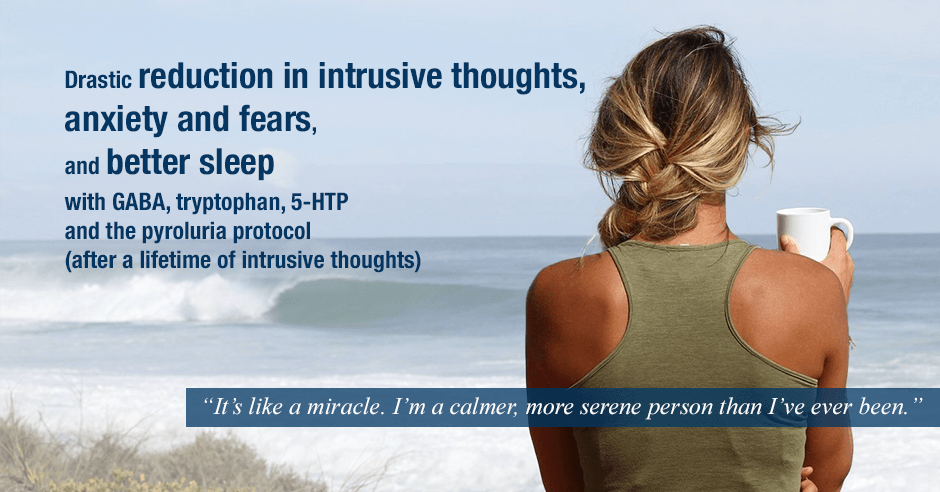
Drastic reduction in intrusive thoughts, anxiety and fears (and better sleep) with GABA, tryptophan, 5-HTP and the pyroluria protocol

May 6, 2022 By Trudy Scott 33 Comments

intrusive thoughts reduction

It’s not uncommon for an adult woman to have had intrusive thoughts her entire life and not even recognize that they are connected to her anxiety levels. She is often unaware that there is anything she can do to actually ease her anxiety and reduce the bad thoughts (such as fearing horrible things happening to her husband and children). Enter the amino acids: GABA, tryptophan, 5-HTP and the pyroluria protocol (zinc, vitamin B6 and evening primrose oil). They can do all of this and more. Kimberly shared her own experience and success on a blog post about intrusive thoughts and these specific nutrients. Here is her story in her own words:

Oh my goodness, I’m realizing after reading this, that intrusive thoughts are something I’ve had my entire life. As a child, this manifested in thoughts of what might happen to my one stable parent when we were apart. More recently, I feared horrible things happening to my husband or children. Like the author of the original blog wrote, these intrusive thoughts reflect a greater anxiety. But I didn’t realize this until I began experimenting with your protocols.

I first tried GABA when I felt extremely anxious, but not on a regular basis. Next, I added the pyroluria protocol, which did bring some relief to the intrusive thoughts. Fast forward to today, when I also take 5-HTP, tryptophan and GABA regularly and have noticed a drastic reduction in those thoughts/fears. It’s like a miracle.

My fear level is maybe 15% of what it used to be, if that.

I also find that I can use extra GABA at night if I wake up and can’t shut off my mind. It works like a charm to help me get back to sleep. What a blessing to have these amino acids.

I’m a calmer, more serene person than I’ve ever been, without (for the most part) the crippling, irrational fears I used to experience. Thank you, as always, Trudy. You are also a tremendous blessing.

I thanked her for sharing and said how glad I was that she is connecting more and more dots. It’s very common to suddenly realize you’ve had these intrusive thoughts your entire life. With her  amazing results, combining all the above nutrients she is a poster child for this approach that I use with my clients. I’m thrilled for her miracle outcome and so very happy for her.

I’m sharing her story here as a new blog so I can provide her with some additional approaches to explore and so you can see how these amino acids and other nutrients have worked for someone else (and get your own insights.) I’m also sharing my feedback on how she approached things.

Additional approaches to her to explore: adjusting what is working for her now

Her fear level is maybe 15% of what it used to be but ideally we want to improve on that by fine-tuning what she is doing and capitalize on what is working. Know this – it’s not unreasonable to expect that to get to zero!

If we were working together this is what I’d suggest (assuming she hasn’t already done this):

  • Review the low GABA and low serotonin questionnaires and adjust the GABA and/or tryptophan/5-HTP based on any symptoms that remain with a score above zero.
  • After that, if there are still some troubling low serotonin symptoms experiment with different doses and timings of tryptophan and 5-HTP – some people do better on one vs the other
  • Also, if there are still some troubling low GABA symptoms, experiment with a few different GABA products. I’ve had folks try up to 5 different products before they find the perfect one for their needs
  • If she can see the social anxiety and other pyroluria signs remain, we’d adjust zinc, vitamin B6 (and possibly add P5P) and evening primrose oil.

With all of the above, I’d have her do one change at a time and carefully document everything in her food-mood log.

Identifying if the remaining fear/intrusive thoughts are more pronounced in the second half of her cycle

It may simply be a matter of identifying if the remaining fear/intrusive thoughts are more pronounced in the second half of her cycle i.e. after ovulation. As I shared on the blog, one study showed that “women in the ‘early luteal’ phase… had more than three times as many intrusive thoughts.”

She may need to adjust the amino acids up during this period and it may be that over the next 2 months she sees these symptoms resolve with her current approach, as her hormones become balanced. It’s typical to see this in 2-3 months.

My feedback on her approach

Here is my feedback on how she did things and why I love her approach:

  • She experimented with GABA some of the time – as needed – based on what she was learning from me from blogs, my book and interviews.
  • She made one change at a time, adding the pyroluria protocol next
  • Then she added tryptophan and 5-HTP (hopefully one at a time)
  • And then her use of the amino acids became regular. This last aspect of consistency is a needle mover for so many of my clients.
  • She now tweaks things and takes extra GABA at night if needed. This may be needed after a tough day or if you’ve been glutened or exposed to insecticides.

I will add that the sequence could have been varied and still have had a similar successful outcome, for example, amino acid consistency from day 1 and then adding the pyroluria protocol (this is what I typically do with clients).

However, it’s my goal to empower women like Kimberly to take charge, learn, make changes, listen to their bodies, learn some more and adjust to see further improvements. It makes me immensely happy when I hear that she is a calmer, more serene person than she’s ever been. I feel confident that she’ll be able to get to zero intrusive thoughts with the tips I shared above.

She may or may not also need to consider other possible root causes of intrusive thoughts: low magnesium, low iron, diet (a low carb/high fat intrusive thoughts case study) and gluten issues.

Psychiatric medication discontinuation syndrome, Lyme disease, mold toxicity, heavy metals, toxins, infections, TBI and trauma can also be factors with intrusive thoughts and anxiety, but with her huge improvement I’d suspect these root causes are unlikely for her.

Resources if you are new to using the amino acids and pyroluria supplements

If you are new to using GABA or tryptophan/5-HTP as a supplement, here is the Amino Acids Mood Questionnaire from The Antianxiety Food Solution (you can see all the low GABA and low serotonin symptoms).

If you suspect low levels of any of the neurotransmitters and do not yet have my book, The Antianxiety Food Solution – How the Foods You Eat Can Help You Calm Your Anxious Mind, Improve Your Mood, and End Cravings, I highly recommend getting it and reading it before jumping in and using amino acids on your own so you are knowledgeable. And be sure to share it with the team you or your loved one is working with.

There is an entire chapter on the amino acids and they are discussed throughout the book in the sections on gut health, blood sugar control, sugar cravings, self-medicating with alcohol and more.

My book also has an entire chapter on pyroluria (with the protocol and questionnaire). The questionnaire is on the blog too, together with many other related posts (simply search for pyroluria).

The book doesn’t include product names (per the publisher’s request) so this blog, The Antianxiety Food Solution Amino Acid and Pyroluria Supplements, lists the amino acids that I use with my individual clients and those in my group programs.

If, after reading this blog and my book, you don’t feel comfortable figuring things out on your own (i.e. doing the symptoms questionnaire and respective amino acids trials), a good place to get help is the GABA Quickstart Program. This is a paid online/virtual group program where you get my guidance and community support.

If you are a practitioner, join us in The Balancing Neurotransmitters: the Fundamentals program. This is also a paid online/virtual program with an opportunity to interact with me and other practitioners who are also using the amino acids.

Do you experience intrusive thoughts or did you have them in the past? Feel free to describe them if you feel comfortable doing so.

And did you think you’d be able to reduce the horrible intrusive thoughts with a nutritional approach?

What helped reduce them for you? If you used a similar approach, how did it look for you?

If you’re a practitioner, have you found this approach to help reduce intrusive thoughts and ease anxiety in your clients/patients?

If you have questions please share them here too.
Filed Under: 5-HTP, Anxiety, GABA, Insomnia, OCD, Tryptophan Tagged With: 5-HTP, amino acids, anxiety, anxious, calmer, can’t shut off my mind, empowering women, evening primrose oil, fear, feared horrible things, fears, GABA, GABA Quickstart program, intrusive thoughts, luteal phase, more serene, practitioner training, pyroluria protocol, sleep, tryptophan, vitamin B6, zinc

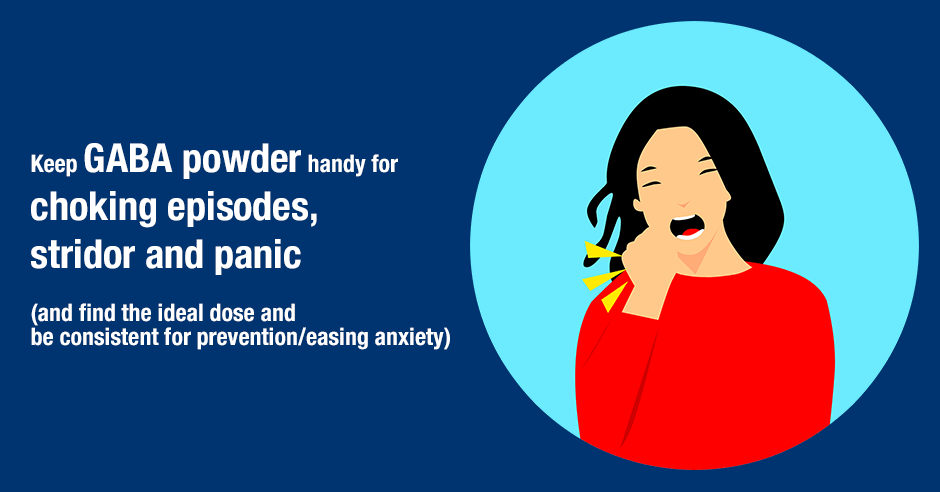
Keep GABA powder handy for choking episodes, stridor and panic (and find the ideal dose and be consistent for prevention/easing anxiety)

April 22, 2022 By Trudy Scott 24 Comments

gaba powder

If you are prone to laryngospasm, “choking” episodes and swallowing problems (also known as dysphagia), it makes sense to keep GABA powder on hand (and in a number of locations) and to find the ideal dose for your unique needs since what works for one person may be too little or too much for you. In today’s blog, I share Shawna’s experience with choking episodes, stridor and panic, and how GABA helped her very quickly. She applied some of what she had read about in this recent blog post: Paroxysmal laryngospasm with low GABA physical-tension-type-anxiety: Is GABA powder rubbed on the inside of the cheek a solution?

Her results were profound (as you’ll read about below, and in her own words) but she could have been better prepared with GABA powder and her dosing was not ideal. I share my insights and advice for her and for you if you are prone to similar episodes.

This is how she describes her choking episodes:

I too experience “choking” episodes/laryngospasm. For me it seems my throat reflex doesn’t kick in quick enough and liquid (often just saliva) will go down the wrong way. It can even happen just as I’m falling asleep. Then my throat seems to close and stridor ensues where I can barely wheeze any air in. It definitely sets off panic in me. The length of the episode is likely only a few minutes but it feels much longer. I’d say it can happen 4 or 5x/year for me.

Shortly after reading the above blog post, Shawna had an episode. She shares this:

This situation actually just happened again to me today, I was sitting on the couch and had a bit of a reflux burp and then all of a sudden … “I can’t get air in.” Luckily I had read Trudy’s article (and am so glad I did! It was good to know I am not alone, and there were possible solutions. It is more common than I thought).

When the stridor happens my adrenaline kicks in, and I really can’t think straight. I did know I needed to go to the kitchen and get my GABA though. Initially I could only find the lozenge, so I rubbed that inside my cheek as I was searching for the capsule.

Once I got the capsule open, I shook some on my finger and rubbed it into my cheek, then I just dumped the rest of the 750 mg GABA capsule right under my tongue.

In a matter of seconds (literally just a couple!) the stridor released, and I could get air in!!! WOW! It really works! I have never had an episode clear that quickly before. I am literally amazed and so very grateful. I will carry GABA powder with me wherever I go now. Thank you SO much Trudy! <3

I am eternally grateful for you sharing this trick, it feels almost life-saving to me!

She also shared what she experienced 45 minutes after dumping 750mg GABA onto her tongue. It stopped the stridor and choking but she had a mild adverse effect:

Within 45 minutes after taking the GABA today, I felt so sleepy – like I needed to sleep, then a weird sensation of heartbeat irregularity and almost like an adrenaline rush that lasted about 5 minutes. Strange!

I thanked her for sharing and said how wonderful to hear about her very quick response. I also asked about sharing her success in a future blog post on this topic. She said yes. I appreciate this opportunity to share a powerful success story with GABA and  to use some of her story as a way to educate my community and hopefully also help her further.

These episodes started over 15 years ago and she had mentioned this to the doctor years ago, saying she had stridor from choking. However, because it was so irregular, the doctor never suggested any testing.

She also shared that she does have symptoms of both low GABA (feeling worried/fearful, unable to relax, insomnia, overactive brain) and low serotonin (anxiety, perfectionism, anxiety that is worse in the winter, disturbed sleep, self-criticism, TMJ). More on this below.

Keep GABA powder handy

I shared that for folks who are prone to these kinds of episodes I recommend keeping GABA powder on hand in various places in the home and when out and about. This could look like little containers of GABA powder in the bedroom, bathroom, living room, kitchen, handbag, gym bag and even in the car.

I also recommend telling family members about the GABA powder and where it’s kept so as to be prepared in the instance of a more severe episode. You can also demonstrate how they can help you – by tipping some GABA powder into the palm of their hand and holding it out for you or even putting some on the inside of your cheek if needed.

If you’re the parent or caregiver, you can also do this for your child or the person you’re caring for i.e. rub some GABA powder on the inside of the cheek.

Find the ideal dose for your choking episodes

The sleepiness and then weird symptoms (heartbeat irregularity and adrenaline-like rush) after the GABA is likely due to the very high dose of 750mg. I typically start clients on 125mg and there is a large variation in dosing, as explained in this blog.

Shawna’s adverse symptoms only lasted 5 minutes but they can be experienced for up to 30-60 minutes in some folks.

It’s important to find the ideal dose for your choking or swallowing episodes. You do this with the trial method, starting low and increasing based on your unique needs. This may mean you won’t get optimal results the first few times.

Another option is to do what Shawna did and use a relatively high dose initially and so you do get results. And then use less the next time if you get adverse effects from too much GABA.

I prefer the former approach – starting low and slow. Typical is 125mg GABA (and less for very sensitive folks) and increasing frequency and or dosing to 250mg after a week of tracking results. And continuing up from there or backing down if adverse effects are seen.

Consistent use for prevention and easing anxiety

Consistent use of GABA is key especially when there are other low GABA symptoms. Shawna mentions feeling worried/fearful, being unable to relax, experiencing insomnia, and having an overactive brain.

Being consistent with GABA – daily use and a few times a day based on your needs – will raise GABA levels and hopefully prevent or at least reduce future choking or swallowing episodes.

Shawna also shared that she currently takes 100mg of GABA in a sleep remedy. Based on my experience this isn’t enough for her needs. The fact that it is part of a sleep remedy makes it challenging to adjust up and down as needed. For this reason I like a GABA-only or GABA-theanine product.

She does have plans on ordering the GABA Calm lozenges for daytime use to “see if that has an overall decrease in my GABA symptoms.” She did however voice her concerns about Calm Calm not being GABA-only and how she’d respond to the taurine and tyrosine in them. This is a valid concern and a trial will provide the answer.

She also feels it’s difficult to find a GABA-only product in such a low dose. My feedback is to get a GABA powder and simply measure out the dose she requires with a tiny measuring spoon or use the 750mg GABA capsules she has, opened and divided into smaller doses.

GABA is always more effective as a powder or used by opening a capsule.

As always, a full functional workup is important to identify all possible triggers and address them.

And be sure to also get a diagnosis, keeping in mind that can be challenging. And keep your doctor informed about GABA and other supplement use.

Address low serotonin-type anxiety with tryptophan too

Shawna also mentions low serotonin-type symptoms: worry-type of anxiety, perfectionism, anxiety that is worse in the winter, disturbed sleep (this can be caused by low serotonin and low GABA), self-criticism and TMJ.

She would need to do a similar trial with tryptophan or 5-HTP to address these low serotonin symptoms. I recommend trialing one amino acid at a time.

She would also need to work with someone to investigate why she has low GABA and low serotonin and also address these triggers (such as gluten issues, leaky gut, low zinc, low B6, parasites, pyroluria, toxins, sugar/alcohol and so on).

In case you’re new to paroxysmal laryngospasm and stridor

If you are new to paroxysmal laryngospasm here is a good definition:

One type of reactive airway obstruction is paroxysmal laryngospasm, which is a rare laryngeal disease in adults. In this condition, the throat is completely closed due to some form of hypersensitivity or a protective laryngeal reflex causing a transient, complete inability to breathe. Paroxysmal laryngospasm onset in patients is often characterized by a sudden and complete inability to breathe, along with voice loss or hoarseness and stridor. Paroxysmal laryngospasm usually lasts from several seconds to several minutes and may be accompanied by obvious causes such as upper respiratory tract infection, emotional agitation or tension, and/or severe coughing.

I wrote about some of the research, hysterical stridor in adult females who are anxious and/or depressed, and my personal use of GABA during a laryngospasm episode in this blog – Paroxysmal laryngospasm with low GABA physical-tension-type-anxiety: Is GABA powder rubbed on the inside of the cheek a solution?.

I also share that stridor is “an abnormal high-pitched sound produced by turbulent airflow through a partially obstructed airway.”) It’s awful and scary to experience, and distressing to hear a loved one struggling with a partially blocked airway.

The following video offers a helpful illustration of “Laryngospasm and Vocal Cord Dysfunction.” It shows how the vocal cords should open and shows what happens when they don’t, and the accompanying stridor sound. I personally find the sound quite distressing so please use your own discretion when watching and listening.

Resources if you are new to using GABA as a supplement

If you are new to using GABA as a supplement, here is the Amino Acids Mood Questionnaire from The Antianxiety Food Solution (you can see all the low GABA symptoms).

If you suspect low levels of any of the neurotransmitters and do not yet have my book, The Antianxiety Food Solution – How the Foods You Eat Can Help You Calm Your Anxious Mind, Improve Your Mood, and End Cravings, I highly recommend getting it and reading it before jumping in and using amino acids on your own so you are knowledgeable. And be sure to share it with the team you or your loved one is working with.

I don’t cover choking or swallowing issues in my book but there is a detailed chapter covering the  amino acids.

The book doesn’t include product names (per the publisher’s request) so this blog, The Antianxiety Food Solution Amino Acid and Pyroluria Supplements, lists the amino acids that I use with my individual clients and those in my group programs.

If you don’t feel comfortable figuring things out on your own (doing the symptoms questionnaire and doing respective trials), after reading this blog and my book, you can get guidance from me in the GABA Quickstart Program (online/virtual).

If you are a practitioner, join us in The Balancing Neurotransmitters: the Fundamentals program. It’s an opportunity to interact with me and other practitioners who are also using the amino acids.

Have you experienced choking episodes/laryngospasm and problems swallowing? And do you have the low GABA physical-tension-type-anxiety symptoms?

If you’ve already been using GABA with success, have you noticed a reduction in these episodes?

Have you ever used GABA in the way Shawna did to stop an episode quickly? And how much helped? Have you done a trial to figure out your ideal dose?

Do you keep GABA powder on hand in various places in your home and when out?

Feel free to ask your questions here too.

Filed Under: Anxiety, GABA Tagged With: anxiety, choking episodes, close, consistent, dysphagia, GABA, GABA powder, GABA Quickstart, I can’t get air in, ideal dose, laryngospasm, panic, paroxysmal laryngospasm, practitioner training, Prevention, stridor, swallowing problems, throat

  • « Go to Previous Page
  • Page 1
  • Interim pages omitted …
  • Page 10
  • Page 11
  • Page 12
  • Page 13
  • Page 14
  • Interim pages omitted …
  • Page 25
  • Go to Next Page »

Primary Sidebar

GABA QuickStart Homestudy

gaba quickstart homestudy

Free Report

9 Great Questions Women Ask about Food, Mood and their Health

You'll also receive a complimentary subscription to my ezine "Food, Mood and Gal Stuff"


Connect with me

Popular Posts

  • Amino Acids Mood Questionnaire from The Antianxiety Food Solution
  • The Antianxiety Food Solution Amino Acid and Pyroluria Supplements
  • Pyroluria Questionnaire from The Antianxiety Food Solution
  • Collagen and gelatin lower serotonin: does this increase your anxiety and depression?
  • Tryptophan for the worry-in-your-head and ruminating type of anxiety
  • GABA for the physical-tension and stiff-and-tense-muscles type of anxiety
  • The Antianxiety Food Solution by Trudy Scott
  • Seriphos Original Formula is back: the best product for anxiety and insomnia caused by high cortisol
  • Am I an anxious introvert because of low zinc and vitamin B6? My response to Huffington Post blog
  • Vagus nerve rehab with GABA, breathing, humming, gargling and key nutrients

Recent Posts

  • Her cravings for chips and peanut butter were triggered by stress: GABA ends cravings and reduces physical tension and fear of heights
  • It is truly miraculous to be able to move through life without crippling anxiety and panic
  • GABA and tryptophan combo provide immediate and noticeable relief for tremors and cervical dystonia in just 7 days
  • Red light therapy for back and neck pain, plantar fasciitis and low mood – a complement to the amino acids GABA, DPA and tryptophan
  • What do I use instead of Seriphos to help lower high cortisol that is affecting my sleep and making me anxious at night?

Categories

  • 5-HTP
  • AB575
  • Addiction
  • ADHD
  • Adrenals
  • Alcohol
  • Allergies
  • Alzheimer's disease
  • Amino Acids
  • Anger
  • Antianxiety
  • Antianxiety Food Solution
  • Antidepressants
  • Anxiety
  • Anxiety and panic
  • Autism
  • Autoimmunity
  • benzodiazapines
  • Bipolar disorder
  • Books
  • Caffeine
  • Cancer
  • Candida
  • Children/Teens
  • Collagen
  • Cooking equipment
  • Coronavirus/COVID-19
  • Cravings
  • Depression
  • Detoxification
  • Diabetes
  • Diet
  • DPA/DLPA
  • Drugs
  • EFT/Tapping
  • EMF
  • EMFs
  • Emotional Eating
  • Endorphins
  • Environment
  • Essential oils
  • Events
  • Exercise
  • Fear
  • Fear of public speaking
  • Fertility and Pregnancy
  • Fish
  • Food
  • Food and mood
  • Functional neurology
  • GABA
  • Gene polymorphisms
  • General Health
  • Giving
  • Giving back
  • Glutamine
  • Gluten
  • GMOs
  • Gratitude
  • Gut health
  • Heart health/hypertension
  • Histamine
  • Hormone
  • Hyperparathyroidism
  • Hypoglycemia
  • Immune system
  • Inflammation
  • Insomnia
  • Inspiration
  • Introversion
  • Joy and happiness
  • Ketogenic diet
  • Lithium orotate
  • Looking awesome
  • Lyme disease and co-infections
  • MCAS/histamine
  • Medication
  • Men's health
  • Mental health
  • Mercury
  • Migraine
  • Mold
  • Movie
  • MTHFR
  • Multiple sclerosis
  • Music
  • NANP
  • Nature
  • Nutritional Psychiatry
  • OCD
  • Osteoporosis
  • Oxalates
  • Oxytocin
  • Pain
  • Paleo
  • Parasites
  • Parkinson’s disease
  • PCOS
  • People
  • PMS
  • Postpartum
  • PTSD/Trauma
  • Pyroluria
  • Questionnaires
  • Real whole food
  • Recipes
  • Research
  • Schizophrenia
  • serotonin
  • SIBO
  • Sleep
  • Special diets
  • Sports nutrition
  • Stress
  • Sugar addiction
  • Sugar and mood
  • Supplements
  • Teens
  • Testimonials
  • Testing
  • The Anxiety Summit
  • The Anxiety Summit 2
  • The Anxiety Summit 3
  • The Anxiety Summit 4
  • The Anxiety Summit 5
  • The Anxiety Summit 6
  • Thyroid
  • Thyroid health
  • Toxins
  • Tryptophan
  • Tyrosine
  • Uncategorized
  • Vegan/vegetarian
  • Women's health
  • Yoga

Archives

  • May 2026
  • April 2026
  • October 2025
  • September 2025
  • August 2025
  • July 2025
  • June 2025
  • May 2025
  • April 2025
  • March 2025
  • February 2025
  • January 2025
  • November 2024
  • October 2024
  • September 2024
  • August 2024
  • July 2024
  • June 2024
  • May 2024
  • April 2024
  • March 2024
  • February 2024
  • January 2024
  • December 2023
  • November 2023
  • October 2023
  • September 2023
  • August 2023
  • July 2023
  • June 2023
  • May 2023
  • April 2023
  • March 2023
  • February 2023
  • January 2023
  • December 2022
  • November 2022
  • October 2022
  • September 2022
  • August 2022
  • July 2022
  • June 2022
  • May 2022
  • April 2022
  • March 2022
  • February 2022
  • January 2022
  • December 2021
  • November 2021
  • October 2021
  • September 2021
  • August 2021
  • July 2021
  • June 2021
  • May 2021
  • April 2021
  • March 2021
  • February 2021
  • January 2021
  • December 2020
  • November 2020
  • October 2020
  • September 2020
  • August 2020
  • July 2020
  • June 2020
  • May 2020
  • April 2020
  • March 2020
  • February 2020
  • January 2020
  • December 2019
  • November 2019
  • October 2019
  • September 2019
  • August 2019
  • July 2019
  • June 2019
  • May 2019
  • April 2019
  • March 2019
  • February 2019
  • January 2019
  • December 2018
  • November 2018
  • October 2018
  • September 2018
  • August 2018
  • July 2018
  • June 2018
  • May 2018
  • April 2018
  • March 2018
  • February 2018
  • January 2018
  • December 2017
  • November 2017
  • October 2017
  • September 2017
  • August 2017
  • July 2017
  • June 2017
  • May 2017
  • April 2017
  • March 2017
  • February 2017
  • January 2017
  • December 2016
  • November 2016
  • October 2016
  • September 2016
  • August 2016
  • July 2016
  • June 2016
  • May 2016
  • April 2016
  • March 2016
  • February 2016
  • January 2016
  • December 2015
  • November 2015
  • October 2015
  • September 2015
  • August 2015
  • July 2015
  • June 2015
  • May 2015
  • April 2015
  • March 2015
  • February 2015
  • January 2015
  • December 2014
  • November 2014
  • October 2014
  • September 2014
  • August 2014
  • July 2014
  • June 2014
  • May 2014
  • April 2014
  • March 2014
  • February 2014
  • January 2014
  • December 2013
  • November 2013
  • October 2013
  • September 2013
  • August 2013
  • July 2013
  • June 2013
  • May 2013
  • April 2013
  • March 2013
  • February 2013
  • January 2013
  • December 2012
  • November 2012
  • October 2012
  • August 2012
  • July 2012
  • June 2012
  • May 2012
  • April 2012
  • March 2012
  • February 2012
  • January 2012
  • December 2011
  • November 2011
  • October 2011
  • September 2011
  • August 2011
  • July 2011
  • June 2011
  • May 2011
  • April 2011
  • March 2011
  • February 2011
  • January 2011
  • December 2010
  • October 2010
  • September 2010
  • July 2010
  • May 2010
  • April 2010
  • March 2010
  • February 2010
  • January 2010
  • November 2009

Share the knowledge!

The above statements have not been evaluated by the Food and Drug Administration. Products listed in this website are not intended to diagnose, treat, cure or prevent any disease.

The information provided on this site is for informational and educational purposes only and is not intended as a substitute for advice from your physician or other health care professional. You should consult with a healthcare professional before starting or modifying any diet, exercise, or supplementation program, before taking or stopping any medication, or if you have or suspect you may have a health problem.


Copyright © 2026 Trudy Scott. All Rights Reserved. | Privacy | Terms and Conditions | Refund Policy | Medical Disclaimer

Free Report

9 Great Questions Women Ask about Food, Mood and their Health

You’ll also receive a complimentary subscription to my ezine “Food, Mood and Gal Stuff”