• Skip to primary navigation
  • Skip to main content
  • Skip to primary sidebar

everywomanover29 blog

Food, Mood and Women's Health – Be your healthiest, look and feel great!

  • Blog
  • About
  • Services
  • Store
  • Resources
  • Testimonials
  • The Book
  • Contact
  • Search this site

worry

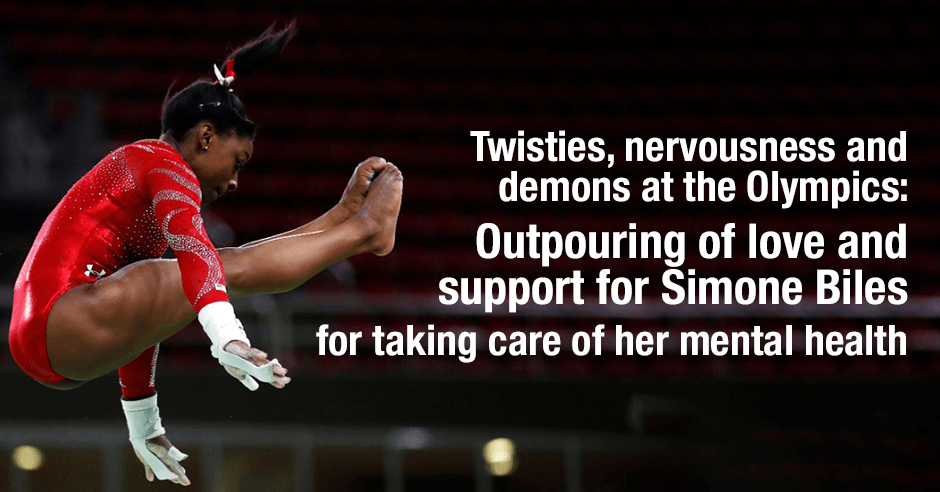
Twisties, nervousness and demons at the Olympics: Outpouring of love and support for Simone Biles for taking care of her mental health

July 30, 2021 By Trudy Scott 10 Comments


twisties olympics

Simone Biles at a training session at the Rio 2016 Summer Olympic Games (Salty View / Shutterstock.com)

There has been an incredible outpouring of love and support for gymnast Simone Biles, as she withdrew from the 2020 Olympics Women’s Team final on Tuesday and All-Around Individual Final on Wednesday. This was due to the twisties, nervousness and mental demons. I’ve decided to gather some of this admiration into a blog post as a testament to Simone who I adore and respect even more than I did before today. I want this to be all about the love and support, but in order to tie it all together, I share more on the twisties (and anxiety), being vulnerable and taking care of yourself, nutritional psychiatry, using amino acids and mental health advocacy below.

Before we get into all that, here is an ET video that explains some of the backstory leading up to this:

Simone shares that she feels good physically but emotionally, her feelings vary by the day. She also talks about the stress of the Olympics and being the star gymnast and that she feels she has the weight of the world on her shoulders.

You’ll also see and hear the love and support she gets from her team members and fellow gymnasts. Two-time Olympian, Aly Raisman, says this about Simone: “She is human too and sometimes people forget that. She is doing the best she can.”

The love and support continued to show up all over social media (and is still showing up)! What follows are some of my favorite posts and mentions.

The love and support – Simone Biles already won

Women Hold Up Half The Sky, a community that empowers women to find their voice and celebrates women in their diversity, shared this powerful post when Simone withdrew:

“Simone Biles already won” and how she has “shattered records to become the world’s most decorated gymnast, has four moves named for her and fought on behalf of abuse survivors.”

simone biles

Simone is one of many young female gymnasts who were sexually abused by disgraced former USA Gymnastics doctor Larry Nassar. This article in Elle covers her story and goal to be an advocate for other young girls.

We are just as proud of you today as yesterday

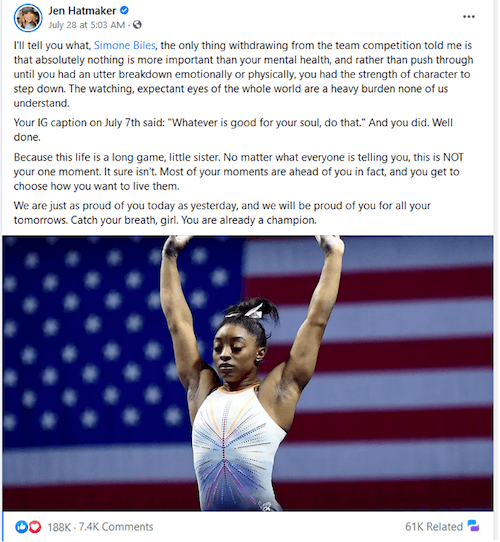
Jen Hatmaker, New York Times bestselling author of “Simple and Free” posts this lovely uplifting message, ending with:

I’ll tell you what, Simone Biles, the only thing withdrawing from the team competition told me is that absolutely nothing is more important than your mental health, and rather than push through until you had an utter breakdown emotionally or physically, you had the strength of character to step down. The watching, expectant eyes of the whole world are a heavy burden none of us understand.

Your IG caption on July 7th said: “Whatever is good for your soul, do that.” And you did. Well done.

Because this life is a long game, little sister. No matter what everyone is telling you, this is NOT your one moment. It sure isn’t. Most of your moments are ahead of you in fact, and you get to choose how you want to live them.

We are just as proud of you today as yesterday, and we will be proud of you for all your tomorrows. Catch your breath, girl. You are already a champion.
simone biles

I wholeheartedly agree, nothing is more important than her metal health. Too often we put on a brave face and push through. Simone didn’t and for that we are super-proud of her – for her own physical and mental health, and for being a role model to girls and women around the world.

Simone Biles and Naomi Osaka are the role models I want for my girls

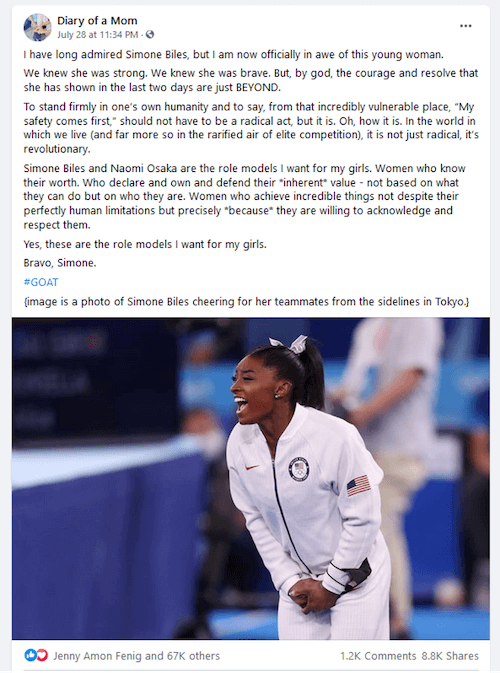
Diary of a Mom, mother, intersectional advocate, believer in the power of community, posted this beautiful message about strength, bravery, vulnerability and Simone and Naomi being role models for her daughters:

I have long admired Simone Biles, but I am now officially in awe of this young woman.

We knew she was strong. We knew she was brave. But, by god, the courage and resolve that she has shown in the last two days are just BEYOND.

To stand firmly in one’s own humanity and to say, from that incredibly vulnerable place, “My safety comes first,” should not have to be a radical act, but it is. Oh, how it is. In the world in which we live (and far more so in the rarified air of elite competition), it is not just radical, it’s revolutionary.

Simone Biles and Naomi Osaka are the role models I want for my girls. Women who know their worth. Who declare and own and defend their *inherent* value – not based on what they can do but on who they are. Women who achieve incredible things not despite their perfectly human limitations but precisely *because* they are willing to acknowledge and respect them.

Yes, these are the role models I want for my girls.

Bravo, Simone.

#GOAT
simone biles

I applaud this strong woman and amazing athlete

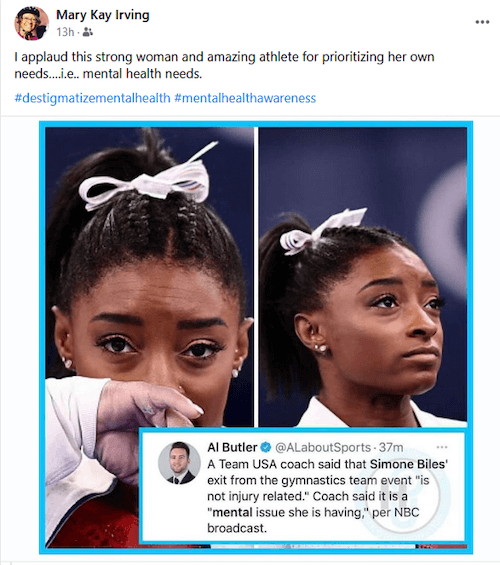
Mary Kay Irving, Therapist/Care Coordinator at Boulder Community Health and Owner at Boulder Center for Health and Nutrition, shares this message.

I applaud this strong woman and amazing athlete for prioritizing her own needs….i.e.. mental health needs. #destigmatizementalhealth #mentalhealthawareness
simone biles

I also applaud Simone and support her decision to take care of her mental health needs no matter how hard it must have been for her!

Simone is an absolute legend!

My friend and colleague Dr. Jessica Drummond, a functional nutrition and integrative women’s health expert, and founder of Integrative Women’s Health Institute, says Simone is an absolute legend:

Simone is an absolute legend. The fact that she landed this AT ALL is AMAZING. I was a gymnast for 13 years. You have to be able to just “feel it” in the air or you literally crash because there’s no awareness of where the floor/ apparatus is. Literally anyone else would have had a serious physical injury from this challenge to her nervous system in mid-air… especially with the amount of pure power that Simone throws around.
simone biles

This is so great for people, especially our youth athletes, to see

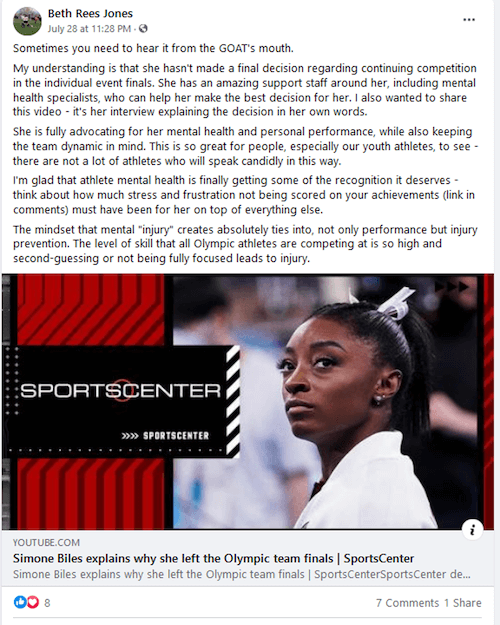
Another friend and colleague, Beth Jones who is a Female/Teen Athlete Wellness & Mindset Coach, posts this.

I’m grateful for athletes like Simone Biles and Naomi Osaka who are coming forward (and professionals as well) to normalize mental health as a key piece of sports training and recovery.

I could not agree more.

In this post, Beth also shares Simone’s press release video where she fully advocates for her mental health and personal performance, keeping the team dynamic in mind, and also sets a wonderful example for young athletes

Sometimes you need to hear it from the GOAT’s mouth.

My understanding is that she hasn’t made a final decision regarding continuing competition in the individual event finals. She has an amazing support staff around her, including mental health specialists, who can help her make the best decision for her. I also wanted to share this video – it’s her interview explaining the decision in her own words.

She is fully advocating for her mental health and personal performance, while also keeping the team dynamic in mind. This is so great for people, especially our youth athletes, to see – there are not a lot of athletes who will speak candidly in this way.

I’m glad that athlete mental health is finally getting some of the recognition it deserves – think about how much stress and frustration not being scored on your achievements (link in comments) must have been for her on top of everything else.

The mindset that mental “injury” creates absolutely ties into, not only performance but injury prevention. The level of skill that all Olympic athletes are competing at is so high and second-guessing or not being fully focused leads to injury.
simone biles

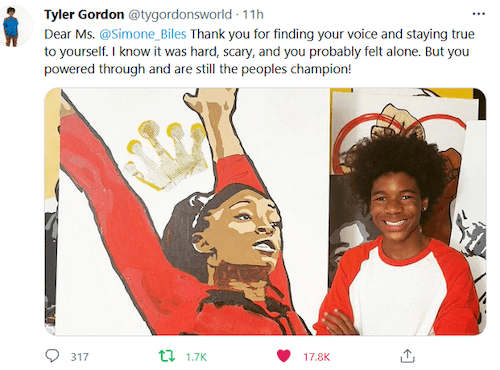
Thank you for finding your voice and staying true to yourself.

Tyler Gordon, a 14-year old artist who seeks to inspire through the stories of heroes in his work, tweeted this sweet message with  his painting of Simone:

Dear Ms. @Simone_Biles Thank you for finding your voice and staying true to yourself. I know it was hard, scary, and you probably felt alone. But you powered through and are still the peoples champion!
simone biles

This young man is kind-hearted and has talent! You can actually watch him painting Simone here.

Unfortunately, there have been way too many negative comments. I believe these are people who don’t understand mental health. You don’t have to have broken your back to have compassion for someone who has but there are still too many people who can’t understand mental health or have empathy until they have experienced it or see a loved one experiencing it. I’m hopeful all this media attention will help create more awareness, compassion and kindness.

The twisties and how stress and anxiety can play a role

In case you are new to this term (like I was until this week), this article explains what the twisties are – Simone Biles Mentioned Having ‘the Twisties’ – Here’s What That Means, and Why It Can Be Dangerous in Gymnastics:

The twisties is an informal term used to refer to a certain kind of mental block that a gymnast can experience as they are in the air during a twisting skill. When someone gets the twisties, there is a disconnect between the brain and body, Jamie Shapiro, PhD, a certified mental performance coach who is the co-director of the Masters in Sport and Performance Psychology program at the University of Denver

In this same article, Dr. Shapiro, a former gymnast herself, shares how this loss of control can have both physical and mental implications:

Physically, the twisties can make a gymnast unable to perform the skills as they were previously able to.

Mentally, that inability to perform the skills can cause anxiety, exacerbating the mental block.

Allie Wagener, PhD, a licensed psychologist who specializes in sport and performance psychology at Premier Sports Psychology and is also a former gymnast shares how dangerous this can be in terms of injuring yourself when “you don’t know where you are in the air and you don’t know how to land.” It’s also terrifying for the gymnast and that worry and fear about it happening again can make things worse.

I wanted to understand more about the “twisties” in gymnastics and asked Jessica Drummond how similar are they to the yips, which happen in golf or baseball, and which I know are closely tied to increased anxiety/stress. The stress/anxiety can be a trigger and then having the yips make your anxiety and fears worse. Jessica confirmed this about the twisties:

Yes, it’s sort of a loop that can get stuck – get lost in the air (cognitive, proprioceptive, vestibular) –> realize how dangerous that is/ was/ could be –> fear –> stress –> exacerbates the original brain-based issue.

I encourage you to read the entire article to see how stress and anxiety, racing/negative/distracted thoughts, fear of failure, high expectations and even focal dystonia (involuntary muscle spasms) can play a role.

The experts also mention a number of possible techniques to help (like progression, focusing on a different skill, using simple cue words to “keep you focused on the skill rather than the fear”), speaking with a sports psychologist and taking a break.

There is no mention of “nutritional psychiatry” as a possible solution (and I share more on this below).

What Simone has shared – I’m a little bit more nervous

Right now, we don’t know exactly why Simone experienced the twisties or if any of the above apply to her, but we do know some of what she has shared with the media up until now.

In this article Simone said she wasn’t physically injured but fighting some mental demons and had experienced a little injury to her pride. She said that “after the performance I did I just didn’t want to go on,” saying it was all in her head. Simone also emphasized the need to protect her body and mind, saying “I have to focus on my mental health and not jeopardize my health and well-being.”

An article in Women’s Health Magazine reports her comments at a press conference after the USA team won the Silver medal. Simone shared how she just doesn’t trust herself as much as she used to, wasn’t having as much fun as usual and admitted that “I’m a little bit more nervous when I do gymnastics.” 

It was here that she announced that she had the twisties.

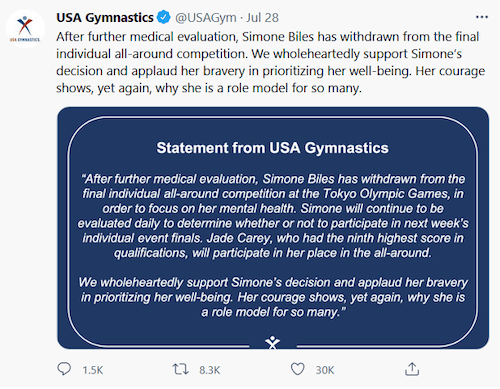
Around this time USA Gymnastics announced Simone had withdrawn to focus on her mental health. They also offered their support:

We wholeheartedly support Simone’s decision and applaud her bravery in prioritizing her well-being. Her courage shows, yet again, why she is a role model for so many.
simone biles

A place for “nutritional psychiatry” and “anxiety nutrition solutions”

My hope is that more and more “nutritional psychiatry” and “anxiety nutrition solutions” (like the use of GABA, tryptophan and other amino acids) will make it into the world of professional (and recreational) sports. I’d like to see this embraced by athletic coaches, registered dieticians and psychologists working with athletes, and hopefully some of the athletes themselves.

Research shows that elite young athletes have high psychological demands:

Elite young athletes have to cope with multiple psychological demands such as training volume, mental and physical fatigue, spatial separation of family and friends or time management problems may lead to reduced mental and physical recovery.

The paper concludes that:

Future research should focus on sports medical and sports psychiatric interventional approaches with the goal to prevent anxiety and depression as well as teaching coping strategies to young athletes.

I recently blogged about how the amino acid tyrosine erased severe performance anxiety in a female musician – to such an extent that she had no more shaking, sweating, panic attacks or passing out. Much of this could be applied to an athletic performance where low dopamine is a factor.

This recent blog resonated with many in my community: What if overthinking, fear, anxiety and worry (caused by low serotonin) is holding you back instead of low motivation/low dopamine? Much of this could also apply to athletes with the twisties or yips with low serotonin as a root cause.

My book, The Antianxiety Food Solution, is a great place to start with the foundations of eating to reduce anxiety (real whole food, no gluten, no caffeine, no sugar, eating for blood sugar control and gut health) and more advanced interventions (like using the amino acids GABA, tryptophan, 5-HTP, tyrosine, DPA and glutamine for balancing brain chemistry, and addressing low zinc and vitamin B6 for pyroluria/social anxiety.)

All this is clearly very needed, and the research and awareness are growing in leaps and bounds, but as Beth Jones, Female/Teen Athlete Wellness & Mindset Coach, shares, what an amazing shift it would be if we could add more “nutritional psychiatry” into the sports psych training:

Coming from 20 years working in sports med with athletes, I keep coming back to wishing there was a degree that combined sports psychology & nutrition (functional & fueling). I started looking into the more mental aspects of performance and healing and then also bringing in more nutrition aligned with healing needs about 15 years ago, but it was all on my own.

What I’ve been learning from you has given me some new tools to share, but you’re right in that they are not well known. I know our US Olympic Committee has amazing health professionals in all areas that work as a team approach for our athletes, but I wonder how many of the RDs are actually having conversations with the mental health team and collaborating taking all of the athlete-specific nuances into consideration.

I know my own therapist suggested that I not pursue sports psych because of the lack of support among therapists out there, but what an amazing shift it would be if we could add more nutritional psychiatry into the sports psych training? Trying to forge a path in this area on my own, but it’s a lot of bush-whacking and little progress.

Beth raises some excellent points and as I said above, hopefully more and more of the “anxiety nutrition solutions” and “nutritional psychiatry” will make it into professional and recreational sports.

It’s ok to say you’re not ok mentally

Simone has noticed and embraced the love and support she’s been receiving. She tweeted this:

The outpouring [of] love & support I’ve received has made me realize I’m more than my accomplishments and gymnastics which, I never truly believed before

She is way more than her accomplishments and gymnastics.

Naomi Osaka penned an article in Time magazine with this title: ‘It’s O.K. Not to Be O.K.’  She wrote this shortly after she withdrew from the French Open to tend to her own mental health. Naomi’s openness has inspired Simone to speak out.

When athletes like Simone and Naomi prioritize their own mental health and are public about it, they are paving the way for it being ok to say you’re not ok mentally. Through their honesty and vulnerability, they have become role models and mental health advocates, and we applaud them for that.

But most of all we applaud them both for taking care of their mental health!

What love and support can you share for Simone and Naomi? Feel free to post in the comments.

Does this motivate and inspire you to be more open about your own anxiety and mental health challenges (if you have not been open yet)?

If you’re an athlete (professional or recreational), does any of this resonate with you and have the amino acids or diet helped you with your anxiety?

If you work with athletes (professional or recreational), I’d love to hear if this resonates with you and if you’re using nutritional psychiatry approaches with them to help ease their anxiety?

If you have connections to athletes (professional or recreational), or coaches, dieticians or psychologists who work with athletes, please share this blog and my work, so we can get nutritional psychiatry resources and anxiety nutrition solutions into their hands and help more athletes.
Filed Under: Anxiety, People, Sports nutrition Tagged With: anxiety, anxiety nutrition solutions, athletes, demons, fear, low dopamine, low serotonin, mental health, mentally, Naomi Osaka, nerves, nervous, nervousness, nutritional psychiatry, Olympics, Simone Biles, twisties, worry

What if overthinking, fear, anxiety and worry (caused by low serotonin) is holding you back instead of low motivation/low dopamine?

July 2, 2021 By Trudy Scott 50 Comments

overthinking

One of the first things that comes to mind when someone is stuck and not able to get things done is low motivation caused by low catecholamines/low dopamine. But what if overthinking, fear, anxiety and worry (caused by low serotonin) is holding you back instead? The following case may help you figure it out if any of this applies to you.

William asked this question on one of the tyrosine blogs, justifiably thinking he may need tyrosine to get unstuck:

Excellent article. I may try tyrosine. I have anxiety and shut down when I am about to start something or my mind overthinks and I shut down with worry. I have problems sleeping. I take a group of things…GABA, glycine, 5-HTP but still wake at 3am.

Anyway I always have GOOD intentions of doing things when I wake in the morning….then it goes downhill. I was not always like this but got worse with STRESS from work and now I FIGHT myself to actually do something I used to LOVE to do. Makes me MAD!

I actually am AFRAID just thinking about taking Tyrosine {Not funny}

I FEAR so much it becomes stupid. I think of doing things and SHUT DOWN with worry.

I want my life back…life is too short to suffer knowing HELP is so close. What do you think? Love your articles…

I think this is a great question many others in my community may relate to so I’ve decided to do this as a blog post with his question and a longer response.

I thanked him for his kind words, saying I can’t offer advice via the blog but can share that we need to be careful with tyrosine when someone has sleep issues or anxiety. I also offered some brief thoughts which I’ll elaborate on here so you can understand my thinking as I work with someone.

Is it low motivation caused by low catecholamines/low dopamine?

The first thing that comes to mind when someone is stuck and not able to get things done is low catecholamines and low dopamine. The classic signs are lack of motivation, fatigue, poor focus and feeling depressed, often using sugary foods or drinks for an energy pick-up (especially in the afternoon).

William may feel that he has low motivation and needs tyrosine because he can’t get things done or he starts something and can’t complete it.

His intentions are good but he has to push himself or as he says “fight myself” to get things done. Because of this he feels tyrosine may be the next amino acid he should trial.

Why I would investigate and address low serotonin

William says he has anxiety and also has trouble sleeping. This could be related to low serotonin and/or low GABA.

However when someone has anxiety and insomnia and I hear the following words/phrases, I immediately think low serotonin should be investigated and addressed:

  • “My mind overthinks”
  • “I shut down with worry”
  • “I actually am AFRAID just thinking about taking Tyrosine”
  • “I fear so much”

All of the above can hold you back and look like low motivation when it is actually worry and fear that is holding you back.

Typically, with low serotonin, you could also second-guess things you do, experience negative self-talk, have a lack of confidence when doing things, get stuck because of perfectionism and may even feel like an imposter. You may also be very controlling and want to do it all yourself and not be willing to delegate – this can hold you back too.

All this and anything else on the list of low serotonin symptoms would further suggest we need to address this first.

Finding the ideal serotonin support for his needs

He is currently taking GABA, glycine and 5-HTP but still wakes at 3am. And he is still anxious.

I would work to optimize 5-HTP dosing (increasing every few days to see if more helps) or switch to tryptophan if the increased dose isn’t helping. Some folks do better one one versus the other and 5-HTP can raise cortisol in some instances causing a wired-tired feeling.

I’d do the same with GABA once the ideal dose of 5-HTP or tryptophan is found. This helps improve sleep and reduce anxiety too.

And I’d look into high cortisol in case this is causing his 3am awakenings.

Once he has ideal serotonin support for his needs, the overthinking will stop, the worry will go away and his fears will vanish – and he will be able to complete things he starts.

Being well rested because of a great night’s sleep is going to help a great deal too.

There may be a need for tyrosine now or later

I may be wrong and there may in fact be a need for tyrosine now. These cases illustrate tyrosine helping when it didn’t seem it would:

  • Tyrosine for alleviating anxiety and panic attacks and creating a feeling of calm focus
  • Tyrosine erases severe performance anxiety in a female musician: no more shaking, sweating, panic attacks and passing out

There may also be a need for tyrosine later and a trial will provide the answers.

Right now William is “AFRAID just thinking about taking Tyrosine” but once his serotonin levels are ideal he should no longer have this fear.

Resources if you are new to using the amino acids as supplements

If you are new to using the amino acids tryptophan/5-HTP, GABA or  tyrosine as supplements, here is the Amino Acids Mood Questionnaire from The Antianxiety Food Solution and a brief overview here, Anxiety and targeted individual amino acid supplements: a summary.

If you suspect low levels of any of the neurotransmitters and do not yet have my book, The Antianxiety Food Solution – How the Foods You Eat Can Help You Calm Your Anxious Mind, Improve Your Mood, and End Cravings, I highly recommend getting it and reading it before jumping in and using amino acids so you are knowledgeable.

The book doesn’t include product names (per the publisher’s request) so this blog, The Antianxiety Food Solution Amino Acid and Pyroluria Supplements, lists the amino acid products that I use with my individual clients and those in my group programs.

As with all individual amino acids we use them for quick relief of symptoms. And we also always focus on the foundations like diet, the gut, adrenals and stress levels.

We appreciate William for asking this question so we all get to learn. Hopefully he’ll jump on and add to the discussion and share his results later.

Can you relate to his lack of motivation showing up as fear, worry and overthinking instead and holding you back?

What about these other low serotonin symptoms keeping you stuck: second-guessing, negative self-talk, lack of confidence, perfectionism, imposter syndrome and controlling?

Has using tryptophan or 5-HTP allowed you to get past some of this so you can get things done?

Did you also have to address low dopamine and actual low motivation, poor focus and fatigue with tyrosine?

Feel free to post any questions here too.

Filed Under: 5-HTP, Anxiety, serotonin, Tryptophan Tagged With: 5-HTP, afraid, anxiety, controlling, fear, GABA, holding you back, imposter, low dopamine, low motivation, low serotonin, my mind overthinks, overthinking, perfectionist, problems sleeping, shut down, stuck, tryptophan, tyrosine, unstuck, worry

Using both tryptophan and GABA supplements together for easing anxiety: questions and answers

June 11, 2021 By Trudy Scott 71 Comments

tryptophan and gaba for anxiety

I get many questions about using both tryptophan and GABA supplements together for easing anxiety and today I’m sharing some of these questions and my answers. This will also give you the opportunity to ask questions you may have related to using both these amino acids together. You’ll also read about some reasons for the confusion about when to use GABA vs tryptophan, some success stories and some research.

Let’s start with this question since it’s one that I get asked many many times:

Should one use GABA and tryptophan together for helping with anxiety symptoms?

I have many clients who need and use both but it’s because they have low GABA and also have low serotonin, both driving different types of anxiety symptoms. It’s important to recognize that each amino acid supplement addresses a very different set of symptoms.

With low GABA levels they will have physical anxiety, tension, stiff and tense muscles and often self-medicate with alcohol in order to relax. Sleep may also be a problem with lying awake feeling tense. Because they also have low serotonin they will have the worry-in-the head type of anxiety, ruminations, and obsessions. They may also have panic attacks, negativity, anger, irritability, PMS, TMJ, lack of confidence and insomnia. (Here is a list of all the low serotonin and low GABA symptoms).

You should only use GABA and tryptophan together if you have both low GABA and low serotonin symptoms.  This will address these particular root causes.

My anxiety has improved significantly with GABA, should I also try tryptophan/5-HTP?

This is another common question I get about using tryptophan and GABA supplements together (paraphrased from one of the blog comments so I could share my feedback here):

I’m using GABA and my anxiety has improved significantly, however, the anxiety I feel in my body immediately upon waking is still bothersome. What would you recommend for the anxiety in my body on waking (that improves when I get out of bed, start moving around and as the day progresses)?

Could I try 5-HTP/tryptophan in addition to GABA?

We always want to capitalize on what is already working. GABA has improved her anxiety significantly, so I’d want to have her figure out how much it’s improved (for example from say 10/10 with 10 being worse to 5/10 with the GABA). Then we’d bump up the GABA to see if additional gains are seen. This could mean a higher dose at night and could also mean a small dose in the morning on waking. And then figure out the improvement and adjust up again if needed.

There is no reason why she shouldn’t try either tryptophan or 5-HTP too but only if she also has other low serotonin symptoms other than morning anxiety. And also, only once she has established the ideal dose for the GABA. She mentions “the anxiety in my body” so I suspect it’s the low GABA physical-tension type of anxiety. We often see low GABA and low serotonin go hand in hand so it’s very likely she’ll also benefit from serotonin support too.

Some reasons for the confusion about when to use GABA vs tryptophan

One reason for this confusion is that there are many combination products on the market that contain both GABA and tryptophan (and other nutrients). The company is trying to make a one-size-fits-all product in the hope it will help many folks. The problem is that it’s not individualized to your unique needs – which may be low GABA or low serotonin or both. Even if it is low GABA and low serotonin that you suffer from, a combination product may not work if, for example, you need a very small amount of GABA and need a much higher dose of tryptophan.

Another reason is that many well-meaning practitioners do not help their client/patients make the distinction between low serotonin and low GABA symptoms. This happens because they often don’t understand this either.

Another reason is that many folks jump in and start using these amino acids without really understanding how and why they work, how to use them and what to look out for. It’s why I highly recommend that everyone planning to use them reads my book first, The Antianxiety Food Solution.

GABA and tryptophan have helped immensely with ruminating thoughts and PTSD – can I stay on them indefinitely?

KJ posted these great results and her question on the blog:

Hi Trudy, I love your blogs and I’ve read your book, The Anti-Anxiety Food Solution – excellent! I have been taking GABA and tryptophan for about 6 months and they have helped me immensely with ruminating thoughts and PTSD. Sometimes I try to go off GABA and Tryptophan for a day or two, but the ruminating thoughts come back, so my question is, can I stay on GABA and Tryptophan indefinitely? I am 59, have no health problems and take no prescription medications.

It’s super to hear GABA and tryptophan have helped with her ruminating thoughts and symptoms of PTSD. I shared that there is no research on long-term use and we should always keep looking for the reasons serotonin and GABA are low and try to address these. Since she has my book I assume she has also implemented all the diet recommendations (no gluten, no caffeine, no sugar, eating for blood sugar control etc), addressed her gut health (candida, parasites, digestive enzymes etc) and looked at low zinc and low vitamin B6 too. There are many other factors to consider – I list 60+ nutritional and biochemical causes of anxiety here.

Jessica says GABA and tryptophan have been life-changing

Here is some feedback from Jessica about how GABA and tryptophan has been life-changing for her – and in only a matter of weeks:

I started taking Gaba and tryptophan about 3 weeks ago after reading about the benefits on this page. It’s been life changing!

I take 1000mg tryptophan at night and 100mg GABA in the morning. Ruminations and obsessive thoughts are almost non-existent now. I have less tension in the jaw and neck. I feel like I’m able to deal with everyday stressors that were overwhelming me prior to starting these supplements.

She started with the tryptophan and added the GABA after about a week.

Jessica clearly had both low serotonin and low GABA symptoms. The ruminations, obsessive thoughts and overwhelm were likely related to low serotonin. The jaw and neck tension are classic low GABA but serotonin support also helps with TMJ too.

Paula would not be able to sleep without GABA and tryptophan

Paula shared this feedback on the blog post where I write about GABA, Heartmath and EFT easing Micki’s mold-induced anxiety and panic attacks:

This was an interesting article because I use both GABA and Tryptophan and would not be able to sleep if I did not use them. I have also had chronic mold exposure. It never occurred to me that the reason I have to take these things in order to sleep is due to the mold in my system.

Toxic mold can impact neurotransmitter production and GABA and tryptophan can provide some relief while the mold is being addressed.

Some research where tryptophan and GABA have been used with success

Here is some research where tryptophan and GABA (and similar amino acids) have been used with success:

  • Essential tremor, dystonia, anxiety and cravings – diet, GABA, tryptophan, zinc and vitamin B6

This study shares the case of a 13-year-old boy with an essential tremor that caused severe functional impairment. He responded to a Mediterranean diet and supplementation with GABA and tryptophan and was able to resume his plans to pursue a musical career as a guitar player.

  • A randomized targeted amino acid therapy with behaviourally at-risk adopted children

The combination of theanine (an amino acid which also supports GABA levels) and 5-HTP (another precursor to serotonin) led to “significant decreases in parent reports of the children’s behaviour problems.”

Resources if you are new to using GABA and tryptophan as  supplements

If you are new to using the amino acid tyrosine as a supplement, here is the Amino Acids Mood Questionnaire from The Antianxiety Food Solution and a brief overview here, Anxiety and targeted individual amino acid supplements: a summary.

As I mentioned above, if you suspect low levels of any of the neurotransmitters and do not yet have my book, The Antianxiety Food Solution – How the Foods You Eat Can Help You Calm Your Anxious Mind, Improve Your Mood, and End Cravings, I highly recommend getting it and reading it before jumping in and using amino acids so you are knowledgeable.

The book doesn’t include product names (per the publisher’s request) so this blog, The Antianxiety Food Solution Amino Acid and Pyroluria Supplements, lists the GABA and tryptophan products that I use with my individual clients and those in my group programs.

As with all individual amino acids we use GABA and tryptophan for quick relief of symptoms. And we also always focus on the foundations like diet, the gut, adrenals and stress levels.

If, after reading this blog and my book, you don’t feel comfortable figuring things out on your own (i.e. doing the symptoms questionnaire and respective amino acids trials), a good place to get help is the GABA QuickStart Program (if you have low GABA symptoms). This is a paid online/virtual group program where you get my guidance and community support. 

If you are a practitioner, join us in The Balancing Neurotransmitters: the Fundamentals program. This is also a paid online/virtual program with an opportunity to interact with me and other practitioners who are also using the amino acids.

Do you have questions about using GABA and tryptophan together?

Have you used the combination of GABA and tryptophan with success? How did they help you and what was your timing and dosing?

Feel free to post your other related questions here too.


Filed Under: Anxiety, GABA, Tryptophan Tagged With: anxiety, can I stay on them indefinitely, GABA, obsessions, physical anxiety, PTSD, ruminations, serotonin, sleep, stiff and tense muscles, tension, TMJ, together, tryptophan, worry

Huge rise in anxiety in college students (and other mental health issues): amino acid supplements and nutritional psychiatry as a solution.

May 21, 2021 By Trudy Scott 17 Comments

anxiety in college students

Is your son or daughter finding college/university overwhelming? Is he or she battling with new or worsening anxiety, worrying about results, has fears about success or fitting in, lying awake imagining the worst outcomes or maybe feeling like a perfectionist and getting stuck? Perhaps they have poor self-confidence, feel like an imposter and may even have panic attacks.  These signs and symptoms are all common with the low serotonin-type of worry-in-the-head anxiety, which may also include PMS (premenstrual syndrome), obsessive tendencies and anger issues.

They may also be experiencing the low GABA type of tension-anxiety, where they lie awake at night stiff and tense and self-medicate with too much sugar, carbs, junk food and/or alcohol (and maybe even pot and other drugs). There may be intrusive thoughts too and panic attacks also triggered by low GABA.

What about focus issues/ADHD and low motivation, no ability to follow-through on tasks and projects, procrastination and missing deadlines? These are all classic signs of low catecholamine, which also includes low energy, and feeling depressed/sad/low/flat. Your son or daughter may just want to crawl up in their dorm bed and not do anything or may spend hours doing mindless activities like binge watching Netflix or scrolling mindlessly through social media.

All of these signs and symptoms point to low levels of neurotransmitters or brain chemicals: low serotonin, low GABA and low dopamine. We need the right raw materials to make these neurotransmitters and the majority of college cafeterias are not providing nutrient-dense foods and/or foods that are unique for each person’s biochemistry (more on this below).

The huge rise in anxiety and other mental health issues in college students

It’s no wonder that we are seeing a huge rise in anxiety and other mental health issues in college students. Way too many students are dropping out and so many are struggling unnecessarily.

This 2019 Harvard blog post shares some alarming stats:

Anxiety in college is very common. According to the American College Health Association Fall 2018 National College Health Assessment, 63% of college students in the US felt overwhelming anxiety in the past year. In the same survey, 23% reported being diagnosed or treated by a mental health professional for anxiety in the past year.

This article in Nature earlier this year, The problem is greater than it’s ever been’: US universities urged to invest in mental-health resources, highlights points from US National Academies of Sciences, Engineering, and Medicine report:

  • 68% of university presidents listed student mental health as one of their most pressing issues
  • the dropout rate for students with diagnosed mental-health problems ranges from 43% to as high as 86%
  • The students who said that they had more trouble with anxiety or depression after the lockdown also reported greater alcohol use

It states that faculty members should “receive formal training to address and support student well-being” and “students should learn about mental-health issues as part of their introductory training.” They also say “Hiring more counsellors could be an important step, but counsellors alone can’t turn the tide.” I agree with all this but recommend adding nutritional psychiatry awareness, training and resources too.

Poor diet and nutritional deficiencies are a major contributing factor even though it’s seldom discussed. The good news is that there are relatively simple solutions – amino acids as supplements for quick relief and diet as the foundation – but it does take work.

Using amino acids as supplements for quick relief

Amino acids, used as supplements, are a quick way to offer immediate relief of symptoms:  tryptophan or 5-HTP (for the low serotonin worry-type anxiety), GABA (for the tension-type anxiety) and tyrosine (for the low dopamine poor-focus and low symptoms). Here are some examples:

  • A 23-year-old female college student, adopted and exposed to alcohol while in the womb, has some learning struggles. She doesn’t want to miss a day of taking 5-HTP, because she says that “it keeps her on her toes,” which she says means that it “keeps me focused,” when studying.
  • Tyrosine helped a young man who was learning new software: “Within an hour the stress just melted away!”, alleviating his anxiety and panic attacks and creating a feeling of calm focus.
  • A newly qualified nutritionist shared how she suffered badly from imposter syndrome at the end of her nutrition degree and she felt socially awkward in so many outings and situations. Her anxiety and stress were through the roof and her sleep was poor. She said these wonderful results: “What really tipped the balance was the supplementation of tyrosine, tryptophan & GABA.”

If you are new to the amino acids, here is the Amino Acids Mood Questionnaire from The Antianxiety Food Solution and additional information on Anxiety and targeted individual amino acid supplements: a summary

This lists The Antianxiety Food Solution Amino Acid and Pyroluria Supplements that I use with my individual clients and those in my group programs.

We use the amino acids for quick relief of symptoms and then focus on the foundations like diet and address other imbalances.

Diet as the foundation for students i.e. nutritional psychiatry

I first blogged about nutritional psychiatry in 2015 when the ISNPR position statement was published in World Psychiatry, the official journal of the World Psychiatric Association. This 2019 paper, Nutritional psychiatry: Towards improving mental health by what you eat provides an overview of the emerging field of nutritional psychiatry:

Does it matter what we eat for our mental health? Accumulating data suggests that this may indeed be the case and that diet and nutrition are not only critical for human physiology and body composition, but also have significant effects on mood and mental wellbeing. While the determining factors of mental health are complex, increasing evidence indicates a strong association between a poor diet and the exacerbation of mood disorders, including anxiety and depression, as well as other neuropsychiatric conditions.

The 2017 SMILES Trial is the first randomized controlled diet depression study and ONE THIRD of the dietary intervention group saw improvements in their depression symptoms.  This was just diet alone and switching from processed/junk food to real food with no specific dietary restrictions. Participants also reported improvements in anxiety symptoms. And the authors even addressed the cost factor, stating it was more affordable to eat this way.

Research supports this connection in college students. This is one of a growing number of studies, Eating behavior and relationships with stress, anxiety, depression and insomnia in university students, that concludes that:

unhealthy eating patterns are common in university populations and are related to anxiety, stress, and depression. Educational interventions to reduce unhealthy food consumption in university students can also result in psychological health improvements and/or vice versa.

Unfortunately, as students get more anxious and depressed their food choices get worse (especially for male students) and it becomes a vicious cycle. This paper, Examining the Role of Anxiety and Depression in Dietary Choices among College Students, reports:

Overall, a decrease in total caloric intake and an increase in sugar consumption were found as self-reported symptoms of anxiety and depression increased. In addition, there were sex differences in the relationship between depression and food choices. Men consumed more saturated fat as well as less fruits and vegetables as self-reported symptoms of depression increased. Results suggest symptoms of depression are a greater risk factor for poor nutrition in male college students than females.

It’s time for colleges/universities to recognize all this and teach about nutritional psychiatry. My book, The Antianxiety Food Solution is an excellent starting point for students, parents and educators (together with other blogs on this site).

Checking out cafeterias and cooking options

When looking at colleges are you also looking at what the cafeteria offers and if they cater for special diets (like gluten-free, dairy-free, Paleo etc) and/or offer real whole food, organic vegetables and fruit, grass-fed meat, wild fish and fermented foods?

Can students use a slow cooker, blender, Instant Pot or electric frying pan in their dorms?

Is there a dorm kitchen and can they take their own pots and pans (so non-stick pans can be avoided) and any of the above appliances?

Are there nearby living options that include a kitchen and a store with quality food for purchase?

I feel colleges/universities should be rated on all of the above in addition to everything else.

It all starts at home before they leave for college

Having a good college cafeteria and dorm kitchens is one step in the right direction, but these young adults also need to understand the impact of a breakfast of bagels and coffee or not having breakfast or the fact that gluten may trigger a panic attack and make them sad. They need to know how to shop and cook if there is a shared dorm kitchen or apartment. And they need to make the right choices when they do eat in the cafeteria or nearby restaurants (assuming good options are available). This all starts at home with you before they leave for college.

Katie shares this about her daughter who plans to use the college cafeteria for some meals and also cook in the apartment kitchen on weekends:

My daughter was just saying today how glad she is that she doesn’t have to figure out [the connection between increased anxiety, fatigue, brain fog, sadness and what they are eating] while learning how to live on her own and go to college. I changed how I ate 8 years ago for my PCOS and about 3 years ago she decided to give it a try after feeling so horrible but seeing my change. I’m so proud of her for embracing a healthier lifestyle in her teen years when everyone around her is subsisting off energy drinks and vending machine food. It makes me think that if we offer them a little education, they’ll make good choices for themselves.

This mom can also feel proud that she led by example for her daughter (and I appreciate them for letting me share here).

But I believe the colleges need to play a role in this too. They are providing food and this is a perfect educational opportunity that will serve their students (and future generations), solve the mental health crisis they are struggling with and prevent drop-outs (which is having an impact on their bottom-line).

Do you believe colleges/universities should be rated on all of the above in addition to everything else? What have you done to check out cafeterias and cooking options for your daughter or son?

Has your son or daughter benefited from any of the amino acids or eating real whole food (and according to their own needs?

Do you work in a college and are you seeing this rise in anxiety and depression? If yes, how do we get these changes implemented?

How do we educate students once they are at college (other than making sure campus food is excellent):

  • a lifestyle/diet/anxiety app with resources and tracking?
  • online training with a nutritionist/coach and access to an online forum and live Q&As?
  • one-on-one campus nutrition coaches?
  • make nutritional psychiatry part of the curriculum?
  • produce a documentary following the lives of students on campus and showing the transformation they experience?

Feel free to post your questions and ideas here too.


Filed Under: Anxiety, Diet, GABA, Nutritional Psychiatry, serotonin Tagged With: ADHD, alcohol, amino acid supplements, anxiety, cafeteria, carbs, college, college students, cooking, daughter, fears, focus issues, GABA, imposter, junk food, low motivation, mental health, nutritional psychiatry, overwhelming, panic attacks, perfectionist, procrastination, rise in anxiety, serotonin, son, stuck, sugar, tension, tryptophan, tyrosine, university, worry, worrying

5-HTP for a calm brain, and a racing mind at night: questions and answers

April 16, 2021 By Trudy Scott 39 Comments

5-HTP q and a

5-HTP is an amino acid, made from the seeds of an African plant, Griffonia simplicifolia, and used as a supplement to ease low serotonin symptoms. With low levels of serotonin you’ll experience the worry-type of anxiety with ruminations, obsessing, panic attacks, insomnia (often lying awake worrying). This type of anxiety is different from the low GABA physical/tension type anxiety. Other low serotonin symptoms include low mood/depression, late afternoon and evening carbohydrate cravings, pain, digestive/IBS symptoms, PMS, irritability, rage and anger, TMJ, low confidence, imposter syndrome and perfectionism.

When I share my low serotonin blogs on Facebook I receive so many great questions about 5-HTP. Today I’m going to share some of these questions and my answers so you can get the benefits too.

Gail asks why 5-HTP stopped working for her when it had been working so amazingly well:

I took 5-HTP and it worked amazingly….for about 6 months. Then it did nothing. Any idea why?

I took 100 mg per day. It’s hard to explain, but it calmed my brain down. I wasn’t so quick to blurt things out during the day and at night I was able to sleep because my mind wasn’t racing. Nothing else changed at that time. That was a few years ago, I think I’ll buy more and try again

I would guess that something did shift around the 6 month mark and would try and identify what it was so you know for the future. It could have been accidental gluten exposure (from the diet or even cosmetics), hormonal shifts (perimenopause or menopause), adding collagen or gelatin on a regular basis (this can lower serotonin in susceptible folks) and/or changes in thyroid health.

If you have pyroluria and were exposed to major stresses (life stresses or toxic mold etc.) you’d lose vitamin B6 and this could affect serotonin production. The addition of the birth control pill and antidepressants can also deplete vitamin B6. I share some possible reasons for low serotonin on this blog on imposter syndrome (as mentioned above, imposter syndrome is a common sign of low serotonin).

With these wonderful benefits Gail experienced, trialing 5-HTP again is worth considering. Because 5-HTP works so quickly she’ll feel that sense of calm right away and she won’t blurt things out during the day (possibly caused by lack of confidence and/or irritability and/or anger?). Also, her mind won’t race at night, she’ll fall asleep quickly and will stay asleep, waking rested, calm, happy, confident and optimistic.

And in future if something like this happens again, I’d try to identify the cause and bump up 5-HTP temporarily.

Wendy asks about headaches as an adverse effect:

What do you recommend if 5-HTP gives you headaches?

Headaches are not a common adverse effect with 5-HTP (compared to the amino acid tyrosine which is recognized to cause headaches and migraines in susceptible folks).

Even if you are seeing benefits – for the worry-type anxiety and other low serotonin symptoms – with 5-HTP you don’t ever want to push through with something like headaches and continue to take it. I have clients use less 5-HTP and observe if they still see the benefits with no headaches.

We also make sure low serotonin is the issue. If it’s not then any amount of 5-HTP will either do nothing or cause adverse effects. If the issue is low serotonin then I have clients do a trial of  tryptophan.

If the 5-HTP is being used to ease low mood/depression caused by low catecholamine or low endorphins depression then neither 5-HTP or tryptophan is going to help and may cause adverse effects. And tyrosine and/or DPA are better choices.

Gerry asks this question after my interview on Your Best Sleep Ever Summit:

Great talk Trudy. When you want to increase serotonin, do you take both 5-HTP & tryptophan or just one or the other?

They can be used alone or both can be used together. I like to have clients add one new amino acid supplement at a time so we know what is working before confounding things with another one. I typically start with tryptophan for low serotonin support simply because I have such good results with it and because 5-HTP can raise cortisol in some folks.

We start with tryptophan mid-afternoon and evening (after doing a trial earlier in the day to make sure it helps).  If tryptophan causes adverse effects or doesn’t work then we do a trial of 5-HTP and then use it afternoon and evening (when serotonin levels tend to drop).

If tryptophan is working in the afternoon and evening, and additional support for worry or ruminations or panic or anxiety is needed earlier in the day, we may consider 5-HTP which can often also help improve focus. We may also consider tryptophan earlier in the day too.

It’s very individualized and we may mix and match to find the ideal combination and dosing based on trials and symptom resolution. It’s important to be aware that some folks do better on 5-HTP and some do better on tryptophan.

Here are some useful blogs related to low serotonin and the amino acids:

  • You can see all the low serotonin symptoms here.
  • Fibromyalgia: tryptophan or 5-HTP for anxiety, depression, pain and insomnia
  • You can see the 5-HTP and tryptophan products I use with my clients here on the supplements blog.
  • You may find this helpful too – GABA for easing physical anxiety and tension: some questions and answers.

As always, it’s not only the low serotonin we need to address. 5-HTP offers quick relief but we must always do a full functional workup looking at diet, nutritional deficiencies, digestion, all hormones, toxins and infections (and so on) so we can address all possible root causes – and why serotonin is low in the first place.

Thanks to these folks for asking good questions and for allowing me to share here.

What questions do you have about 5-HTP?

Which low serotonin symptoms can you relate to and has 5-HTP or tryptophan helped? Or have you found success with a combination.

Feel free to post your questions and feedback in the comments below.

Filed Under: 5-HTP, Anxiety, Insomnia, Tryptophan Tagged With: 5-HTP, anxiety, calm, collagen, cravings, Fibromyalgia, gluten, Headaches, hormonal, insomnia, night, obsessing, panic, racing mind, ruminations, serotonin, stopped working, thyroid, tryptophan, worry

Night eating syndrome: is low serotonin a root cause and is tryptophan a solution?

April 9, 2021 By Trudy Scott 28 Comments

night eating syndrome

According to this paper, Circadian Rhythm Profiles in Women with Night Eating Syndrome, “Patients with night eating syndrome (NES) – first described in 1955 – demonstrate a phase delay in the circadian pattern of food intake, manifested by evening hyperphagia, nocturnal awakenings with food intake, and morning anorexia.”

I would start by asking this question: is low serotonin a root cause and is tryptophan a possible solution? I’ll share why below and where to start in order to find a solution.

Before I do that let me explain the terminology used in the above quote: Circadian means it happens every 24 hours, hyperphagia is obsessive food-seeking behavior, nocturnal awakenings are waking in the night and anorexia refers to restricted eating in the morning.

There is no research supporting the use of serotonin support with either tryptophan or 5-HTP for night eating syndrome but I would still start here for the following reasons:

  • this behavior happens in the evening and at night and it’s well recognized that serotonin levels are lower later in the day and at night
  • carbohydrate cravings and addictions occur with low serotonin and cravings are most intense later in the day (typically afternoon and evening)
  • obsessive behaviors are common with low serotonin
  • insomnia or night-time waking is a common symptom with low serotonin
  • doing a trial with either of these amino acids will very quickly confirm if low serotonin is a contributing factor or will rule it out

I would also have my client look at other low serotonin symptoms which would help confirm that low serotonin may be a factor for them: worry-type of anxiety, ruminations, PMS, irritability, rage or anger, TMJ, panic attacks, perfectionism, depression, low self-esteem and so on. You can see all the low serotonin symptoms here.

We typically start with a trial of tryptophan simply because so many of my clients do so well with it. The other reason is that 5-HTP can raise cortisol and cause a wired-tired feeling. That being said, some folks do better on one vs the other so if tryptophan doesn’t help then we trial 5-HTP.  You can see the products I use with my clients here on the supplements blog.

I would love to see tryptophan or 5-HTP being more extensively – because it works so effectively and quickly, and is addressing the root cause – but also because there is research that does support the serotonin connection to night eating syndrome:

  • Night eating syndome has been associated with “depression, emotional eating, sleep problems, and food addiction as well as with being overweight or with having obesity (especially as people age)” – all low serotonin symptoms.
  • Night eating patients are “responsive to selective serotonin reuptake inhibitor treatment” (antidepressant/SSRI treatment)
  • Bright light therapy may help with night eating because of it’s “serotonergic antidepressant mechanisms of action.” Night eating syndrome also shares features with seasonal affective disorder (SAD) and it’s not uncommon to experience both. The winter blues or SAD is common with low serotonin. I write more about SAD and bright light here.

I’d also consider low blood sugar as a contributing factor. We would need to rule out the use of the sleep medication Ambien/Zolpidem which has been shown to cause amnesia and sleep related eating disorders which resolves when the medication is stopped.

As always, it’s not only the low serotonin we need to address. Tryptophan or 5-HTP offer quick relief but we must always do a full functional workup looking at diet, nutritional deficiencies, digestion, all hormones, toxins and infections (and so on) so we can address all possible root causes – and why serotonin is low in the first place.

I share some possible reasons for low serotonin on this blog on imposter syndrome. Imposter syndrome is another common sign of low serotonin.

Have you been diagnosed with night eating syndrome or do you feel you possibly fit the profile? Does it happen every night and what foods are you drawn to? Which low serotonin symptoms can you relate to and has tryptophan or 5-HTP helped? What about light therapy? And was an  antidepressant prescribed?

Feel free to post your questions and feedback in the comments below.

Filed Under: 5-HTP, Anxiety, Insomnia, Tryptophan Tagged With: 5-HTP, Ambien, anxiety, blood sugar, circadian, food intake, hyperphagia, insomnia, morning anorexia, NES, night eating, Night eating syndrome, nocturnal awakenings, obsessive, panic, SAD, serotonin, SSRI, tryptophan, waking, worry

  • « Go to Previous Page
  • Page 1
  • Page 2
  • Page 3
  • Page 4
  • Go to Next Page »

Primary Sidebar

NEW! GABA QuickStart Homestudy (with special intro pricing)

gaba quickstart homestudy

Free Report

9 Great Questions Women Ask about Food, Mood and their Health

You'll also receive a complimentary subscription to my ezine "Food, Mood and Gal Stuff"


Connect with me

Popular Posts

  • Amino Acids Mood Questionnaire from The Antianxiety Food Solution
  • The Antianxiety Food Solution Amino Acid and Pyroluria Supplements
  • Pyroluria Questionnaire from The Antianxiety Food Solution
  • Collagen and gelatin lower serotonin: does this increase your anxiety and depression?
  • Tryptophan for the worry-in-your-head and ruminating type of anxiety
  • GABA for the physical-tension and stiff-and-tense-muscles type of anxiety
  • The Antianxiety Food Solution by Trudy Scott
  • Seriphos Original Formula is back: the best product for anxiety and insomnia caused by high cortisol
  • Am I an anxious introvert because of low zinc and vitamin B6? My response to Huffington Post blog
  • Vagus nerve rehab with GABA, breathing, humming, gargling and key nutrients

Recent Posts

  • What do I use instead of Seriphos to help lower high cortisol that is affecting my sleep and making me anxious at night?
  • BeSerene™ GABA/theanine cream eases severe muscle tension in her neck/shoulders, prevents her bad headaches and quells her anxiety
  • How the correct approach, dose and sublingual use of GABA can be calming and not cause a flushed and itchy face and neck
  • The amino acid glutamine improves low mood by addressing gut health, and it has calming effects too
  • Flight anxiety with heightened breath, physical tension and also fearing the worst (the role of low GABA and low serotonin)

Categories

  • 5-HTP
  • AB575
  • Addiction
  • ADHD
  • Adrenals
  • Alcohol
  • Allergies
  • Alzheimer's disease
  • Amino Acids
  • Anger
  • Antianxiety
  • Antianxiety Food Solution
  • Antidepressants
  • Anxiety
  • Anxiety and panic
  • Autism
  • Autoimmunity
  • benzodiazapines
  • Bipolar disorder
  • Books
  • Caffeine
  • Cancer
  • Candida
  • Children/Teens
  • Collagen
  • Cooking equipment
  • Coronavirus/COVID-19
  • Cravings
  • Depression
  • Detoxification
  • Diabetes
  • Diet
  • DPA/DLPA
  • Drugs
  • EFT/Tapping
  • EMF
  • EMFs
  • Emotional Eating
  • Endorphins
  • Environment
  • Essential oils
  • Events
  • Exercise
  • Fear
  • Fear of public speaking
  • Fertility and Pregnancy
  • Fish
  • Food
  • Food and mood
  • Functional neurology
  • GABA
  • Gene polymorphisms
  • General Health
  • Giving
  • Giving back
  • Glutamine
  • Gluten
  • GMOs
  • Gratitude
  • Gut health
  • Heart health/hypertension
  • Histamine
  • Hormone
  • Hyperparathyroidism
  • Hypoglycemia
  • Immune system
  • Inflammation
  • Insomnia
  • Inspiration
  • Introversion
  • Joy and happiness
  • Ketogenic diet
  • Lithium orotate
  • Looking awesome
  • Lyme disease and co-infections
  • MCAS/histamine
  • Medication
  • Men's health
  • Mental health
  • Mercury
  • Migraine
  • Mold
  • Movie
  • MTHFR
  • Multiple sclerosis
  • Music
  • NANP
  • Nature
  • Nutritional Psychiatry
  • OCD
  • Osteoporosis
  • Oxalates
  • Oxytocin
  • Pain
  • Paleo
  • Parasites
  • Parkinson’s disease
  • PCOS
  • People
  • PMS
  • Postpartum
  • PTSD/Trauma
  • Pyroluria
  • Questionnaires
  • Real whole food
  • Recipes
  • Research
  • Schizophrenia
  • serotonin
  • SIBO
  • Sleep
  • Special diets
  • Sports nutrition
  • Stress
  • Sugar addiction
  • Sugar and mood
  • Supplements
  • Teens
  • Testimonials
  • Testing
  • The Anxiety Summit
  • The Anxiety Summit 2
  • The Anxiety Summit 3
  • The Anxiety Summit 4
  • The Anxiety Summit 5
  • The Anxiety Summit 6
  • Thyroid
  • Thyroid health
  • Toxins
  • Tryptophan
  • Tyrosine
  • Uncategorized
  • Vegan/vegetarian
  • Women's health
  • Yoga

Archives

  • October 2025
  • September 2025
  • August 2025
  • July 2025
  • June 2025
  • May 2025
  • April 2025
  • March 2025
  • February 2025
  • January 2025
  • November 2024
  • October 2024
  • September 2024
  • August 2024
  • July 2024
  • June 2024
  • May 2024
  • April 2024
  • March 2024
  • February 2024
  • January 2024
  • December 2023
  • November 2023
  • October 2023
  • September 2023
  • August 2023
  • July 2023
  • June 2023
  • May 2023
  • April 2023
  • March 2023
  • February 2023
  • January 2023
  • December 2022
  • November 2022
  • October 2022
  • September 2022
  • August 2022
  • July 2022
  • June 2022
  • May 2022
  • April 2022
  • March 2022
  • February 2022
  • January 2022
  • December 2021
  • November 2021
  • October 2021
  • September 2021
  • August 2021
  • July 2021
  • June 2021
  • May 2021
  • April 2021
  • March 2021
  • February 2021
  • January 2021
  • December 2020
  • November 2020
  • October 2020
  • September 2020
  • August 2020
  • July 2020
  • June 2020
  • May 2020
  • April 2020
  • March 2020
  • February 2020
  • January 2020
  • December 2019
  • November 2019
  • October 2019
  • September 2019
  • August 2019
  • July 2019
  • June 2019
  • May 2019
  • April 2019
  • March 2019
  • February 2019
  • January 2019
  • December 2018
  • November 2018
  • October 2018
  • September 2018
  • August 2018
  • July 2018
  • June 2018
  • May 2018
  • April 2018
  • March 2018
  • February 2018
  • January 2018
  • December 2017
  • November 2017
  • October 2017
  • September 2017
  • August 2017
  • July 2017
  • June 2017
  • May 2017
  • April 2017
  • March 2017
  • February 2017
  • January 2017
  • December 2016
  • November 2016
  • October 2016
  • September 2016
  • August 2016
  • July 2016
  • June 2016
  • May 2016
  • April 2016
  • March 2016
  • February 2016
  • January 2016
  • December 2015
  • November 2015
  • October 2015
  • September 2015
  • August 2015
  • July 2015
  • June 2015
  • May 2015
  • April 2015
  • March 2015
  • February 2015
  • January 2015
  • December 2014
  • November 2014
  • October 2014
  • September 2014
  • August 2014
  • July 2014
  • June 2014
  • May 2014
  • April 2014
  • March 2014
  • February 2014
  • January 2014
  • December 2013
  • November 2013
  • October 2013
  • September 2013
  • August 2013
  • July 2013
  • June 2013
  • May 2013
  • April 2013
  • March 2013
  • February 2013
  • January 2013
  • December 2012
  • November 2012
  • October 2012
  • August 2012
  • July 2012
  • June 2012
  • May 2012
  • April 2012
  • March 2012
  • February 2012
  • January 2012
  • December 2011
  • November 2011
  • October 2011
  • September 2011
  • August 2011
  • July 2011
  • June 2011
  • May 2011
  • April 2011
  • March 2011
  • February 2011
  • January 2011
  • December 2010
  • October 2010
  • September 2010
  • July 2010
  • May 2010
  • April 2010
  • March 2010
  • February 2010
  • January 2010
  • November 2009

Share the knowledge!

The above statements have not been evaluated by the Food and Drug Administration. Products listed in this website are not intended to diagnose, treat, cure or prevent any disease.

The information provided on this site is for informational and educational purposes only and is not intended as a substitute for advice from your physician or other health care professional. You should consult with a healthcare professional before starting or modifying any diet, exercise, or supplementation program, before taking or stopping any medication, or if you have or suspect you may have a health problem.


Copyright © 2026 Trudy Scott. All Rights Reserved. | Privacy | Terms and Conditions | Refund Policy | Medical Disclaimer

Free Report

9 Great Questions Women Ask about Food, Mood and their Health

You’ll also receive a complimentary subscription to my ezine “Food, Mood and Gal Stuff”