• Skip to primary navigation
  • Skip to main content
  • Skip to primary sidebar

everywomanover29 blog

Food, Mood and Women's Health – Be your healthiest, look and feel great!

  • Blog
  • About
  • Services
  • Store
  • Resources
  • Testimonials
  • The Book
  • Contact
  • Search this site

phobias

How to alleviate the fear and anxiety associated with choking and vomiting in Avoidant Restrictive Food Intake Disorder (ARFID)

May 27, 2022 By Trudy Scott 14 Comments

arfid and anxiety

According to The National Eating Disorders Association /NEDA, “Avoidant Restrictive Food Intake Disorder (ARFID) is a new diagnosis in the DSM-5, and was previously referred to as “Selective Eating Disorder.” ARFID is similar to anorexia in that both disorders involve limitations in the amount and/or types of food consumed, but unlike anorexia, ARFID does not involve any distress about body shape or size, or fears of fatness.”

As you can read on this page:

  • “Many children with ARFID also have a co-occurring anxiety disorder, and they are also at high risk for other psychiatric disorders”
  • There are also “fears of choking or vomiting” and
  • There is a “dramatic restriction in types or amount of food eaten” and they will often “only eat certain textures of food”

What we seldom see addressed is the biochemical causes of anxiety and fears which can show up as phobias and ongoing worrying and obsessing about ingesting certain foods. These are all typical low serotonin symptoms.

With low serotonin (you can see all the symptoms here) we use the amino acids tryptophan or 5-HTP to raise serotonin and alleviate these symptoms (often within a few minutes).

However, what do we do when a child (or adult) with ARFID has low serotonin and is too terrified to even consider a trial of tryptophan or 5-HTP? This may be because of fear of choking or vomiting and/or because of an aversion to the taste/texture and/or the fact that they are being offered something new that is not on their “safe foods” list.

There is a similar issue with low GABA which can show up as physical anxiety and tummy issues like “constipation, abdominal pain, upset stomach.” Intrusive thoughts are a common sign of low GABA too and this can manifest as a debilitating fear of choking and dying.

There is the same issue with not being able to have the individual use sublingual GABA as a supplement in order to alleviate these symptoms.

It’s for this reason, we have to be creative and find other ways to support serotonin and GABA.

Other ways to boost serotonin and GABA

The traditional ways that tryptophan/5-HTP and GABA are used is opened onto the tongue or swallowed or chewed. However, there are other ways to boost serotonin and GABA in these kids with ARFID, without further adding to their distress:

  • Experiment with using tryptophan or 5-HTP topically. I’m not aware of a commercial topical product but I recently mixed 500mg tryptophan powder (only tryptophan with no fillers) into a base cream (I used Primal Derma beef tallow) and used it topically with success.
  • Experiment in a similar way with using GABA topically. It could be made at home too (with a GABA only powder) or a product such as Somnium GABA cream is an excellent option (I have used this product with success). I suspect the liposomal GABA/theanine products may also work topically (but have yet to experiment with this option).
  • If tolerated, GABA powder swished in the mouth but not swallowed, may be an option once some of the anxiety and fears have been reduced. GABA powder doesn’t taste bad (it’s slightly sweet) and mixes well in water. By swishing some in the mouth it can help reduce the fear of choking and esophageal spasms (if they are present). It may also help with the sensation of a lump-in-the-throat (called globus pharyngeus) that some kids with ARFID describe.
  • Liquid zinc (zinc sulfate) tastes like water when zinc levels are low and may be tolerated. This 2021 paper, Macro- and Micronutrient Intake in Children with Avoidant/Restrictive Food Intake Disorder, lists low vitamin B1, vitamin B2, vitamin C, vitamin K, zinc, iron, and potassium in kids with ARFID. Zinc, iron and the B vitamins are all needed to make serotonin and GABA, and low zinc can reduce appetite. It’s also possible these children had low levels of some of these nutrients beforehand and that this contributed to their fears and restrictive eating.
  • Magnesium spray or other forms of topical magnesium creams can be used. Magnesium itself is calming and is a cofactor for making serotonin and GABA. An Epsom salts bath also provides magnesium and a warm bath with Epsom salts and an essential oil such as lavender is very calming.

Other less direct but equally effective approaches to include are:

  • gentle yoga (it supports GABA production and is calming)
  • swinging on an outdoor swing (reduces stress, cortisol and anxiety)
  • full spectrum light therapy (boosts serotonin)
  • vagus nerve support “This modern world can lead to overstimulation of the nervous system and you can become desensitized to chronic stress. Over time, this can lead to low vagal tone, which has been linked to a variety of mental and physical health issues.”
  • full spectrum infrared sauna (low heat and of short duration to simulate light exercise)
  • a weighted blanket is calming and improves mood and sleep and
  • essential oils such as orange (topically or diffused) can help with fear and anxiety.

Once serotonin and GABA levels have improved with some of the above measures, and more and more of the fear of choking and vomiting dissipates and food texture and taste aversion is reduced, the amino acids can then hopefully be introduced in the ways they are typically used (more on that below). This will further speed up the anxiety and fear reduction, allowing more and more foods to be slowly introduced.

If you are new to Avoidant Restrictive Food Intake Disorder (ARFID)

Be sure to read more about ARFID on The National Eating Disorders Association /NEDA site: diagnostic criteria, risk factors, warning signs and symptoms (behavioral and psychological, and physical).

As with all eating disorders, the risk factors for ARFID involve a range of biological, psychological, and sociocultural issues. These factors may interact differently in different people, which means two people with the same eating disorder can have very diverse perspectives, experiences, and symptoms.

Resources if you are new to using tryptophan/5-HTP and GABA as  supplements

If you are new to using the amino acids as supplements, here is the Amino Acids Mood Questionnaire from The Antianxiety Food Solution (you can see all the low serotonin and low GABA symptoms).

If you suspect low levels of GABA or any of the neurotransmitters and do not yet have my book, The Antianxiety Food Solution – How the Foods You Eat Can Help You Calm Your Anxious Mind, Improve Your Mood, and End Cravings, I highly recommend getting it and reading it before jumping in and using amino acids on your own so you are knowledgeable. And be sure to share it with the team you or your loved one is working with.

There is an entire chapter on the amino acids and they are discussed throughout the book in the sections on gut health, blood sugar control, sugar cravings, self-medicating with alcohol and more.

The book doesn’t include product names (per the publisher’s request) so this blog, The Antianxiety Food Solution Amino Acid and Pyroluria Supplements, lists the amino acids that I use with my individual clients and those in my group programs.

If, after reading this blog and my book, you don’t feel comfortable figuring things out on your own (i.e. doing the symptoms questionnaire and respective amino acids trials), a good place to get help is the GABA QuickStart Program. This is a paid online/virtual group program where you get my guidance and community support. There are many moms in the program who are having much success with their kids.

If you are a practitioner, join us in The Balancing Neurotransmitters: the Fundamentals program. This is also a paid online/virtual program with an opportunity to interact with me and other practitioners who are also using the amino acids.

If you feel comfortable doing so, please share more about the ARFID struggles of your son or daughter in order to help more parents understand this disorder  – their age, how long they have struggled, their fears and their safe food list.

Do let us know if you have found success with any of these approaches with your loved one with ARFID (or yourself)? And what other approaches have also helped?

If you are a practitioner are you seeing results with approaches like these with your ARFID clients/patients?

If you have questions please share them here too.
Filed Under: 5-HTP, Anxiety, GABA, serotonin, Tryptophan Tagged With: anxiety, ARFID, Avoidant Restrictive Food Intake Disorder, choking, cream, Epsom salts, esophageal spasms, fear, GABA, globus pharyngeus, intrusive thoughts, liposomal, liquid zinc, lump in the throat, magnesium spray, NEDA, obsessing, phobias, serotonin, textures, The National Eating Disorders Association, topical, tryptophan/5-HTP, types of food eaten, vomiting, worrying

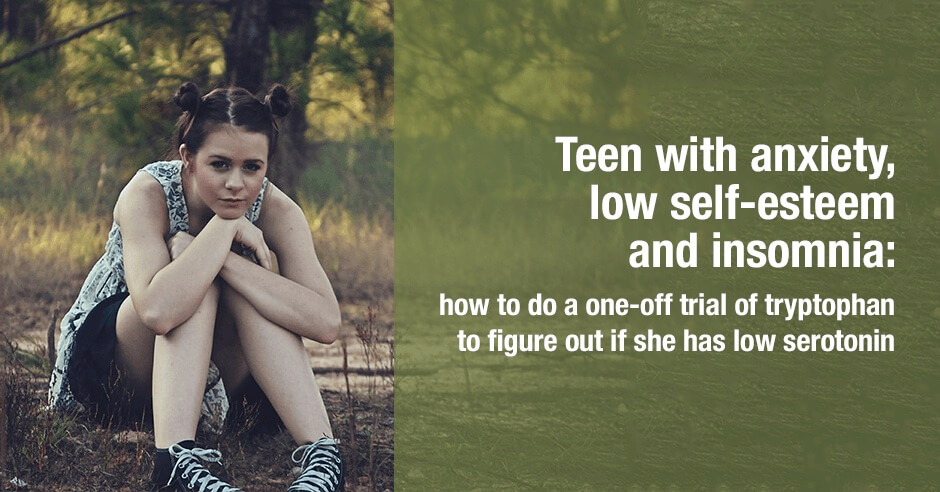
Teen with anxiety, low self-esteem and insomnia: how to do a one-off trial of tryptophan to figure out if she has low serotonin

August 20, 2021 By Trudy Scott 23 Comments


teen anxiety tryptophan serotonin

A mom asks for advice for her teenage daughter who has anxiety, low self-esteem issues,  insomnia, experiences negativity and has phobias. She wants to know if serotonin support may help and where to start. I share my feedback confirming that these are low serotonin symptoms and that I would do a trial of tryptophan. I go deeper in this blog and also go into detail about how I would do a one-off trial (or evaluation) of tryptophan if I was working with this family. I also share why I’d look into low GABA, seasonal allergies and the birth control pill. And I discuss the importance of being proactive given the increasing suicide and self-harm in this age-group, with the pandemic compounding the increase.

Here is the question that Maria asked about her daughter:

My 13-year-old teen has always suffered from insomnia, sometimes light, sometimes a bit heavier, depending on the period. She has suffered from asthma from a young age, even if this issue has improved enormously, it is sometimes present, specially during spring time as she is allergic to different plants. She would suffer from sugar cravings in the past as we were trying to change her diet. Things are going better in this respect as well; however, negativity, phobias, low self esteem and anxiety are always present for her.

Are these signs of low serotonin? How could we help her feel better? Should serotonin pills be applied directly? Would this make the system dependent on it? If amino acids should be supplemented, how should we do this, considering her age?

I responded that yes, negativity, phobias, low self esteem and anxiety (the worry type) are signs of low serotonin. Insomnia can also be caused by low serotonin especially if her daughter is lying awake, overthinking and worrying about things.

I shared that the body does not get dependent on the amino acids and I’d consider a trial of tryptophan to address her symptoms.

Doing a one-off trial/evaluation of tryptophan based on her symptoms

If I was working with this family, I would help this mom figure out for sure if her daughter has low serotonin by reviewing the low serotonin symptom list with her, and helping her rate them on a scale of 1-10 with 10 being the worst.

This can often be challenging for a 13-year old: giving the symptoms a severity rating and being able to identify exactly how she feels. Her ratings may also be reflective of where she is in her cycle at the time and may fluctuate more in the month if her cycle is not yet regular. Working together with mom we can hopefully figure this out. If not, we do the best we can with the information we have.

The next step is picking one or two symptoms that are easy to measure the day we do the initial trial or evaluation. For this young girl I’d pick anxiety/worry and negativity and ask her some questions that would help us assess before and after results of the one-off trial /evaluation of tryptophan:

  • For anxiety and worry she may say it’s also a 9 and give me this example: “I’m really worried about performing in the concert – I keep thinking about it all day long and at night.”
  • For negativity she may say it’s a 9 and give me this example: “I really don’t think I’m good enough to be in the dance class.”

Both tryptophan and 5-HTP can raise serotonin but I like to start with tryptophan. I typically start with 100mg Lidtke chewable tryptophan in children/teens so I’d have her chew one tablet and then check back in the next 2 to 5 minutes (or maybe a little longer for some folks).

This is the kind of feedback I’m looking for:

  • With regards to anxiety and worry she may say: “Gosh, I completely stopped thinking about the concert. I’m not worrying about it at all. Now that you ask I’m thinking about it again but I think my worry/anxiety is about a 5 now.”
  • With regards to negativity she may say: “I think I feel better about being in the dance class. I think I can do it. My negativity feels like it’s a 5 or 6”

Since this teen responded so well, I’d have her start taking tryptophan midafternoon and evening (away from protein) and we’d increase if needed, each week, and based on her symptoms.

I have everyone keep a food mood and supplements log and mom could help her do this too.

GABA, seasonal allergies and the birth control pill

I also always assess low GABA when someone is anxious (especially if she also has physical anxiety, tension, stiff muscles) and has insomnia. We’d do the same one-off trial with a product like GABA Calm (or similar) once we’ve established a good dose of tryptophan for easing her symptoms.

This mom also mentioned Spring time allergies so I also shared this blog with her: 5-HTP and/or tryptophan to help with increased anxiety, panic attacks and depression caused by spring allergies. Depending on the season, her daughter may score higher on some of the low serotonin symptoms.

I’d also want to know if her daughter is on a birth control pill (often prescribed at this age for acne) because it can contribute to anxiety and depression.

Being proactive is wise given the rise in suicide and self-harm in this age group

Being proactive about addressing low serotonin symptoms quickly is wise given the rise in suicide and self-harm in this age group. This 2021 Italian study discusses the role of emotional dysregulation when it comes to and self-injurious thoughts and behaviours in high-school students:

Overall, 11.1% of adolescents reported self-harming behaviours without suicide ideation or attempts, 6.4% declared having thought to suicide without acting a suicide attempt or self-harm, 1.4% declared having attempted suicide and really thought to take away their life.

Unfortunately, the pandemic has also made things worse for many adolescents. This study reports that Canadian adolescents appear to be experiencing “higher rates of self-harm thoughts and behaviours relative to before the pandemic.”

It’s important to keep in mind that pre-teens and teens may not be willing to admit that they are engaging in self-harm like cutting or burning, or thinking about taking their lives.

Resources if you are new to using the amino acids as supplements

If you are new to using the amino acids tryptophan/5-HTP or GABA as supplements and want to know more in case you need them in a future situation, here is the Amino Acids Mood Questionnaire from The Antianxiety Food Solution (you can see all the low serotonin and low GABA symptoms here) and a brief overview here, Anxiety and targeted individual amino acid supplements: a summary.

If you suspect low serotonin or low levels of any of the neurotransmitters and do not yet have my book, The Antianxiety Food Solution – How the Foods You Eat Can Help You Calm Your Anxious Mind, Improve Your Mood, and End Cravings, I highly recommend getting it and reading it before jumping in and using amino acids so you are knowledgeable.

It also covers all the basics of a healthy diet. It’s a comprehensive approach – amino acids AND diet. I’d also want to know what her diet is like right now – gluten-free, sugar-free, caffeine-free, eating protein at breakfast for blood sugar control, real whole foods, grass-fed red meat, wild fish, fermented foods etc?

The book doesn’t include product names (per the publisher’s request) so this blog, The Antianxiety Food Solution Amino Acid and Pyroluria Supplements, lists the amino acid products that I use with my individual clients and those in my group programs.

Thanks to this mom for asking the question and allowing me to use it as a teaching tool for my community. Let’s get her daughter and all teens feeling their best again.

Can you relate to the question this mom asked? Does it sound similar to what your daughter is experiencing right now or a client/patient?

Do you do a one-off trial /evaluation like this to find out if serotonin support is needed? Or have you done this in the past with your daughter, family member or yourself?

What are the before and after questions (and symptom ratings) and did tryptophan help?

Feel free to post any questions here too.

Filed Under: Anxiety, Depression, Teens, Tryptophan Tagged With: 5-HTP, allergic, allergies, anxiety, asthma, birth control pill, cutting, insomnia, low GABA, low self-esteem, low serotonin, negativity, one-off trial, overthinking, pandemic, phobias, seasonal allergies, self-harm, sucide, sugar cravings, teen, teenage, tryptophan, worrying

5-HTP can raise salivary cortisol: does this cause a “wired-tired” feeling?

August 14, 2020 By Trudy Scott 48 Comments

5-htp salivary

Are you aware that 5-HTP – an amino acid supplement that supports serotonin levels – can raise cortisol levels and leave you feeling “wired-tired”? You may be able to relate to this if you’ve ever used 5-HTP to help with anxiety and insomnia and ended up feeling more anxious and more wide-awake despite your exhaustion and need for sleep. You feel “wired-tired” and it’s not pleasant at all.

Both 5-HTP and tryptophan, used as supplements, help to boost serotonin levels so you can feel happy, calm, sleep well and not crave carbs in the afternoon/evening. They also help with panic attacks and phobias, lack of confidence, depression, negativity, imposter syndrome, PMS, irritability, anger issues, pain/fibromyalgia, TMJ and anger. I typically have my clients with low serotonin symptoms start with a trial of tryptophan because I see such excellent results with this amino acid. That being said, some people simply do better on one versus the other and you may do better with 5-HTP.

However there is one big caveat with 5-HTP. I don’t recommend 5-HTP when a client has elevated cortisol levels because we know that it can raise cortisol levels in certain individuals. This can leave you feeling agitated, cranky, as well as wired and yet tired at the same time.

In this 2002 study, L-5-hydroxytryptophan induced increase in salivary cortisol in panic disorder patients and healthy volunteers

Salivary cortisol levels were measured in 24 panic disorder patients and 24 healthy volunteers, following ingestion of 200 mg L-5-hydroxytryptophan or placebo.

The experiment was carried out in the afternoon, “when basal cortisol secretion is more stable.” The first saliva sample was obtained at 1pm and the subjects ingested the 200mg 5-HTP at 2pm. Additional saliva samples were obtained at 2:30pm, 3:00pm and 3:30pm.

They report the following:

A significant rise in cortisol was observed in both patients and controls following ingestion of L-5-hydroxytryptophan. No such effects were seen in the placebo condition.

Here are a few additional comments and my thoughts:

  • This study was done to find evidence for “serotonin receptor hypersensitivity in panic disorder” and not specifically to test for the effects of 5-HTP on cortisol levels but it serves this purpose rather nicely (and it’s one of many similar studies, some of which measure plasma cortisol levels)
  • Keep in mind 200mg of 5-HTP is a large starting dose. It’s typical to start with 50mg so may be a factor to consider
  • In this study they did not assess cortisol levels beyond the 1.5 hours from ingestion of the 5-HTP. It would have been useful to see when levels started to go down
  • We would want to consider the ramifications of using 5-HTP for weeks (whether it’s 50 or 200mg). What impact would that have on cortisol and the adrenals? (I am not aware of a study like this having been done)
  • I’m also not aware of a study being done with 50mg but if you feel worse and feel “wired-tired” with 5-HTP and switch to tryptophan (the equivalent starting dose is 500mg) and your anxiety and other low serotonin symptoms resolve then you have found your solution
  • You may be wondering: “could I use 5-HTP to raise my low cortisol levels”? Theoretically yes and possibly very short-term. But I would question the timing since 5-HTP and tryptophan are best dosed mid-afternoon and later. This is when we would expect our cortisol levels to be on the downward slope as we end our day. I’d also want to nourish the adrenals with B vitamins and herbal adaptogen and remove the trigger/s that are leading to low cortisol.

If you suspect low serotonin symptoms and are new to using the amino acids and do not have my book I highly recommend getting it and reading it before jumping in to taking supplements: The Antianxiety Food Solution – How the Foods You Eat Can Help You Calm Your Anxious Mind, Improve Your Mood, and End Cravings.

There is a complete chapter on the amino acids and one for pyroluria, plus information on real whole food, sugar and blood sugar, gluten, digestion and much more.  If you’re not a reader there is now also an audible version.

Here is the Amino Acids Mood Questionnaire from The Antianxiety Food Solution and additional information on Anxiety and targeted individual amino acid supplements: a summary

Please also read and follow these Amino Acid Precautions.

This lists The Antianxiety Food Solution Amino Acid and Pyroluria Supplements that I use with my individual clients and those in my group programs.

Have you used 5-HTP with success? Or have you used it and felt “wired-tired”? Have you correlated the success or failure of your 5-HTP use with your salivary cortisol levels?

If you switched from 5-HTP to tryptophan did you have success with that?

If you’re a practitioner is this something you see with your clients/patients and take into consideration?

Feel free to post your questions here too.

Filed Under: Antianxiety Tagged With: 5-HTP, adrenals, amino acid, anger, anger issues, calm, cortisol, depression, Fibromyalgia, happy, Imposter syndrome, irritability, L-5-hydroxytryptophan, negativity, pain, panic attacks, Panic disorder, phobias, PMS, serotonin, sleep, TMJ, tryptophan, wired-tired

Copper toxicity: anxiety, phobias, ADHD on the Heavy Metals Summit

December 23, 2017 By Trudy Scott 32 Comments

One of my favorite functional medicine practitioners, Ann Louise Gittleman covers the issue of excess copper on the Heavy Metals Summit, which airs online Jan 29 to Feb 5, 2018.

The topic is – Copper: The Double-Edged Sword – and she shares how copper is probably the most insidious of the toxic metals:

I think what lead was to the ancient Romans, copper is to modern day Americans. And I think it may be the fundamental cause of many of our orphan illnesses, our mystery illnesses, and debilitating and aging biochemical imbalances.

She shares some of the sources of copper that are most prevalent in contributing to excess copper levels and toxicity:

I think first and foremost we have to look at copper plumbing, copper cookware, which is all the rage in this day and time. There’s naturally occurring copper in water. Birth control pills can be a source of copper, because of excessive amounts of estrogen and estrogen is connected to copper the way zinc is connected to progesterone.

There are copper IUDs that are very popular amongst so many of our young women. Even dental amalgams, if they are put in your mouth post 1976 can have a very high copper amalgam percentage. And then, of course, there are fungicides for swimming pools and foods. So that’s just the beginning.

Then there’s the copper that you’re getting in common foods. Whether it’s soy; whether it’s GMO soy or not. You’re getting that in tempeh, tofu, soy protein powders. Nuts and seeds, like cashew nuts and sesame seeds. Avocados; a very healthy fat, but high in copper nevertheless. And some of our shellfish. Then you’ve got your regular tea, your green tea, your white tea, your black tea, your bran, and even your brewer’s yeast.

One of the biggest factors that I see contributing to high copper in my clients who have low zinc and anxiety, is all the baking being done with nuts flours such as almond flour! The next two areas I see as being most problematic for women, is the birth control pill and copper IUDs.  

Ann Louise talks about how excess copper can affect you: hyperactivity and ADD, thyroid issues, tooth decay, dementia, urinary tract infections, candida and functional hypoglycemia.

She also covers the following anxiety symptoms, which I commonly see in my clients and community: nervousness, phobias and unresolved fears, depression and even stuttering.

Here are my contributions to this important discussion:

  • High copper and low zinc (because these two balance each other out), is one of the most common imbalances I see in my community of anxious individuals, and especially in women because of the hormonal influence.
  • Other than removing the source of the copper, one way to address this is via zinc supplementation. If anxiety is a factor, addressing low serotonin and low GABA with amino acids like tryptophan and GABA helps until zinc increases and copper decreases.
  • Good levels of zinc are also needed to make the neurotransmitters so once levels rise (as we get rid of excess copper) we can start to make our own.

Wendy Myers, Christine Schaffner, ND, and Dietrich Klinghardt, MD, PhD, have spent the last few months gathering the right experts, information and protocols to help you understand the danger of heavy metals like copper, mercury, lead, cadmium and others, and what to do about them.

Every day, they help their patients regain health, in some part through heavy metal detoxification. People with incorrect diagnoses of multiple sclerosis, fibromyalgia, anxiety and depression, insomnia, or thyroid issues, just to name a few, have found relief through innovative and individualized protocols to reduce the burden of heavy metals.

Register here to join us on The Heavy Metals Summit January 29 – February 5, 2018. See you on the summit! I know I’m going to learn a lot too!

Have you had issues with high copper and low zinc?

Feel free to comment or post a question below.

Filed Under: Events, Toxins Tagged With: ADHD, anxiety, copper, fear, heavy metals summit, nervousness, phobias, toxicity, zinc

The Antianxiety Food Solution: This Book Is a Total Game Changer!!

July 21, 2017 By Trudy Scott 7 Comments

I write multiple blogs each week and the website is a wealth of information (be sure to check the comments too – I love the community feedback and questions and learn so much from you!) BUT the foundation of all that I teach and how I work with my anxious clients is outlined in great detail in my book The Antianxiety Food Solution, so I recommend this essential reading to make the basic food changes (for some people that’s all they need to do), and before using any of the nutrients, and especially before using targeted individual amino acids.  

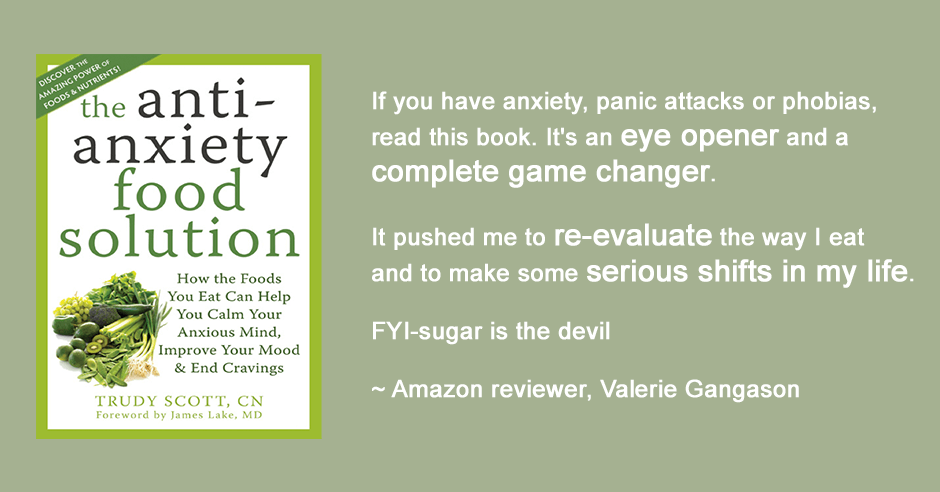
Valerie Gangason posted this wonderful review on Amazon recently: This Book Is a Total Game Changer!!

If you have anxiety, panic attacks or phobias, read this book. It’s an eye opener and a complete game changer. It pushed me to re-evaluate the way I eat and to make some serious shifts in my life. FYI-sugar is the devil

I love the comment about sugar being the devil and commend her for re-evaluating how she eats and for making those serious shifts. It’s how you get results and I ever get tired of feedback like this.

Grab your copy from Amazon here if you don’t yet have it. If you already have a copy I’d love a review on Amazon please! And if you have an older copy with no index you can grab a copy of the index here

Feel free to share your great results or ask questions in the comments.

Filed Under: Books Tagged With: anxiety, anxious, eat, panic attacks, phobias, sugar, the antianxiety food solution, Trudy Scott

Primary Sidebar

NEW! GABA QuickStart Homestudy (with special intro pricing)

gaba quickstart homestudy

Free Report

9 Great Questions Women Ask about Food, Mood and their Health

You'll also receive a complimentary subscription to my ezine "Food, Mood and Gal Stuff"


Connect with me

Popular Posts

  • Amino Acids Mood Questionnaire from The Antianxiety Food Solution
  • The Antianxiety Food Solution Amino Acid and Pyroluria Supplements
  • Pyroluria Questionnaire from The Antianxiety Food Solution
  • Collagen and gelatin lower serotonin: does this increase your anxiety and depression?
  • Tryptophan for the worry-in-your-head and ruminating type of anxiety
  • GABA for the physical-tension and stiff-and-tense-muscles type of anxiety
  • The Antianxiety Food Solution by Trudy Scott
  • Seriphos Original Formula is back: the best product for anxiety and insomnia caused by high cortisol
  • Am I an anxious introvert because of low zinc and vitamin B6? My response to Huffington Post blog
  • Vagus nerve rehab with GABA, breathing, humming, gargling and key nutrients

Recent Posts

  • What do I use instead of Seriphos to help lower high cortisol that is affecting my sleep and making me anxious at night?
  • BeSerene™ GABA/theanine cream eases severe muscle tension in her neck/shoulders, prevents her bad headaches and quells her anxiety
  • How the correct approach, dose and sublingual use of GABA can be calming and not cause a flushed and itchy face and neck
  • The amino acid glutamine improves low mood by addressing gut health, and it has calming effects too
  • Flight anxiety with heightened breath, physical tension and also fearing the worst (the role of low GABA and low serotonin)

Categories

  • 5-HTP
  • AB575
  • Addiction
  • ADHD
  • Adrenals
  • Alcohol
  • Allergies
  • Alzheimer's disease
  • Amino Acids
  • Anger
  • Antianxiety
  • Antianxiety Food Solution
  • Antidepressants
  • Anxiety
  • Anxiety and panic
  • Autism
  • Autoimmunity
  • benzodiazapines
  • Bipolar disorder
  • Books
  • Caffeine
  • Cancer
  • Candida
  • Children/Teens
  • Collagen
  • Cooking equipment
  • Coronavirus/COVID-19
  • Cravings
  • Depression
  • Detoxification
  • Diabetes
  • Diet
  • DPA/DLPA
  • Drugs
  • EFT/Tapping
  • EMF
  • EMFs
  • Emotional Eating
  • Endorphins
  • Environment
  • Essential oils
  • Events
  • Exercise
  • Fear
  • Fear of public speaking
  • Fertility and Pregnancy
  • Fish
  • Food
  • Food and mood
  • Functional neurology
  • GABA
  • Gene polymorphisms
  • General Health
  • Giving
  • Giving back
  • Glutamine
  • Gluten
  • GMOs
  • Gratitude
  • Gut health
  • Heart health/hypertension
  • Histamine
  • Hormone
  • Hyperparathyroidism
  • Hypoglycemia
  • Immune system
  • Inflammation
  • Insomnia
  • Inspiration
  • Introversion
  • Joy and happiness
  • Ketogenic diet
  • Lithium orotate
  • Looking awesome
  • Lyme disease and co-infections
  • MCAS/histamine
  • Medication
  • Men's health
  • Mental health
  • Mercury
  • Migraine
  • Mold
  • Movie
  • MTHFR
  • Multiple sclerosis
  • Music
  • NANP
  • Nature
  • Nutritional Psychiatry
  • OCD
  • Osteoporosis
  • Oxalates
  • Oxytocin
  • Pain
  • Paleo
  • Parasites
  • Parkinson’s disease
  • PCOS
  • People
  • PMS
  • Postpartum
  • PTSD/Trauma
  • Pyroluria
  • Questionnaires
  • Real whole food
  • Recipes
  • Research
  • Schizophrenia
  • serotonin
  • SIBO
  • Sleep
  • Special diets
  • Sports nutrition
  • Stress
  • Sugar addiction
  • Sugar and mood
  • Supplements
  • Teens
  • Testimonials
  • Testing
  • The Anxiety Summit
  • The Anxiety Summit 2
  • The Anxiety Summit 3
  • The Anxiety Summit 4
  • The Anxiety Summit 5
  • The Anxiety Summit 6
  • Thyroid
  • Thyroid health
  • Toxins
  • Tryptophan
  • Tyrosine
  • Uncategorized
  • Vegan/vegetarian
  • Women's health
  • Yoga

Archives

  • October 2025
  • September 2025
  • August 2025
  • July 2025
  • June 2025
  • May 2025
  • April 2025
  • March 2025
  • February 2025
  • January 2025
  • November 2024
  • October 2024
  • September 2024
  • August 2024
  • July 2024
  • June 2024
  • May 2024
  • April 2024
  • March 2024
  • February 2024
  • January 2024
  • December 2023
  • November 2023
  • October 2023
  • September 2023
  • August 2023
  • July 2023
  • June 2023
  • May 2023
  • April 2023
  • March 2023
  • February 2023
  • January 2023
  • December 2022
  • November 2022
  • October 2022
  • September 2022
  • August 2022
  • July 2022
  • June 2022
  • May 2022
  • April 2022
  • March 2022
  • February 2022
  • January 2022
  • December 2021
  • November 2021
  • October 2021
  • September 2021
  • August 2021
  • July 2021
  • June 2021
  • May 2021
  • April 2021
  • March 2021
  • February 2021
  • January 2021
  • December 2020
  • November 2020
  • October 2020
  • September 2020
  • August 2020
  • July 2020
  • June 2020
  • May 2020
  • April 2020
  • March 2020
  • February 2020
  • January 2020
  • December 2019
  • November 2019
  • October 2019
  • September 2019
  • August 2019
  • July 2019
  • June 2019
  • May 2019
  • April 2019
  • March 2019
  • February 2019
  • January 2019
  • December 2018
  • November 2018
  • October 2018
  • September 2018
  • August 2018
  • July 2018
  • June 2018
  • May 2018
  • April 2018
  • March 2018
  • February 2018
  • January 2018
  • December 2017
  • November 2017
  • October 2017
  • September 2017
  • August 2017
  • July 2017
  • June 2017
  • May 2017
  • April 2017
  • March 2017
  • February 2017
  • January 2017
  • December 2016
  • November 2016
  • October 2016
  • September 2016
  • August 2016
  • July 2016
  • June 2016
  • May 2016
  • April 2016
  • March 2016
  • February 2016
  • January 2016
  • December 2015
  • November 2015
  • October 2015
  • September 2015
  • August 2015
  • July 2015
  • June 2015
  • May 2015
  • April 2015
  • March 2015
  • February 2015
  • January 2015
  • December 2014
  • November 2014
  • October 2014
  • September 2014
  • August 2014
  • July 2014
  • June 2014
  • May 2014
  • April 2014
  • March 2014
  • February 2014
  • January 2014
  • December 2013
  • November 2013
  • October 2013
  • September 2013
  • August 2013
  • July 2013
  • June 2013
  • May 2013
  • April 2013
  • March 2013
  • February 2013
  • January 2013
  • December 2012
  • November 2012
  • October 2012
  • August 2012
  • July 2012
  • June 2012
  • May 2012
  • April 2012
  • March 2012
  • February 2012
  • January 2012
  • December 2011
  • November 2011
  • October 2011
  • September 2011
  • August 2011
  • July 2011
  • June 2011
  • May 2011
  • April 2011
  • March 2011
  • February 2011
  • January 2011
  • December 2010
  • October 2010
  • September 2010
  • July 2010
  • May 2010
  • April 2010
  • March 2010
  • February 2010
  • January 2010
  • November 2009

Share the knowledge!

The above statements have not been evaluated by the Food and Drug Administration. Products listed in this website are not intended to diagnose, treat, cure or prevent any disease.

The information provided on this site is for informational and educational purposes only and is not intended as a substitute for advice from your physician or other health care professional. You should consult with a healthcare professional before starting or modifying any diet, exercise, or supplementation program, before taking or stopping any medication, or if you have or suspect you may have a health problem.


Copyright © 2026 Trudy Scott. All Rights Reserved. | Privacy | Terms and Conditions | Refund Policy | Medical Disclaimer

Free Report

9 Great Questions Women Ask about Food, Mood and their Health

You’ll also receive a complimentary subscription to my ezine “Food, Mood and Gal Stuff”