• Skip to primary navigation
  • Skip to main content
  • Skip to primary sidebar

everywomanover29 blog

Food, Mood and Women's Health – Be your healthiest, look and feel great!

  • Blog
  • About
  • Services
  • Store
  • Resources
  • Testimonials
  • The Book
  • Contact
  • Search this site

migraine

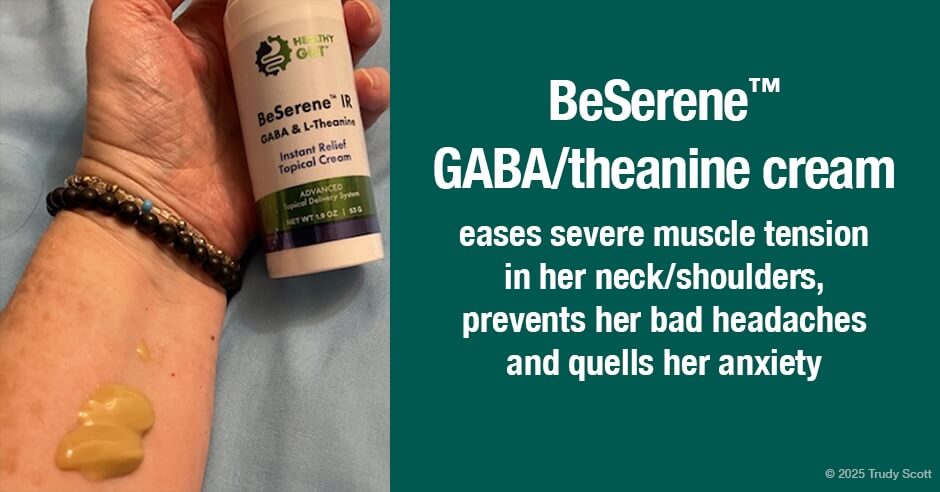
BeSerene™ GABA/theanine cream eases severe muscle tension in her neck/shoulders, prevents her bad headaches and quells her anxiety

October 24, 2025 By Trudy Scott 9 Comments

beserene

Hi there… I wanted to add my ‘two cents’ to the discussion about the BeSerene™ GABA/theanine product that you recommend. I LOVE it! I suffer from low GABA levels, which result in my having severe muscle tension in my neck and shoulders. Often, that resulted in bad muscle tension headaches, for which I couldn’t find anything to bring relief. The BeSerene™ GABA/theanine cream has been a real game changer.

If I wake up with one of those headaches in the middle of the night or in the morning, I use two pumps and rub it on my tight neck and shoulder muscles and within 15 minutes, I can feel the tension melting away! It literally goes away! I have  even been able to prevent a headache from occurring by using it on my neck muscles before I go to bed at night.

Insofar as anxiety, I get relief from that as well, because generally I start to get anxiety once the headaches start, as I never know if it is going to be manageable with just an ibuprofen or two, or if it is going to be one of ‘those’ headaches, i.e. a migraine that lasts for a day or more! Unfortunately, once the anxiety starts, it makes the muscle tension headache worse, which makes the anxiety worse, and it’s just a horrible vicious cycle!

So, since the BeSerene™ cream works so efficiently on the muscle tension, it quells the anxiety that usually follows!

It has changed my life, and I don’t know of any other product I can say that about. I can honestly say that I will not allow myself to ever be without it now!

Thank you so much Trudy, for recommending this product!

Lisa is a woman in the community who reached out to me via email with this message raving about how life-changing this cream has been for her. I am thrilled for her and never get tired of hearing results like this. I’m not surprised either and love to share these kinds of results! She kindly gave me permission to share, saying “I want others to experience what I have with this product!”

Read on below for more about why she gravitated towards using a cream, other benefits you may expect to see (like a reduction in stress-eating and/or drinking too much wine), my insights into when to consider using a GABA/theanine cream like this and how to use it, where to purchase this exact cream and additional resources if you are new to using GABA.

Why did Lisa gravitate to using a GABA/theanine cream?

Lisa shared that she just couldn’t seem to tolerate the sublingual or oral GABA:

I have tried sublingual GABA products but haven’t had much success, as I haven’t been able to find any without alcohol sugars (xylitol, sorbitol, etc.) Those ingredients give me a terrible taste in my mouth and I just can’t tolerate them. (Why can’t they make one with just real sugar from nature?)

Plus, I haven’t had a lot of success with the oral products as they just take too long to work on the headaches/muscle tension.

I’m really glad she recognized her symptoms were due to low GABA – muscle tension and pain, in conjunction with feeling physically anxious are common. And that she didn’t give up on GABA and persevered until she found what works for her symptoms.

What about other forms of GABA?

However, my advice for someone in Lisa’s situation is not to give up on other GABA products if she finds she needs additional support in the future or finds herself without the cream. With regards to taste and time to work, I recommend a GABA-only (or GABA/theanine) capsule opened on to the tongue or a GABA (and/or theanine) powder – both held on the tongue for 1-2 minutes for quick results.

Stress-eating and self-medication with wine are classic signs of low GABA

Interestingly, stress eating is not an issue for her but wine may be:

I’ve never really had any issues with stress-eating. In fact, I usually have no appetite when I’m stressed out! (That’s where the wine comes in…lol!)

We may self-medicate with wine when GABA is low because it relaxes us physically, helps us fit in socially and feels calming and pleasant. It’s mistakenly used to try and improve sleep but typically makes things worse.

Alcohol consumption damages the gut, depletes B vitamins (especially thiamine/vitamin B1) and zinc – and it’s addicting.

GABA can stop that addiction in its tracks so there are no feelings of deprivation. The reasons we are drawn to GABA are addressed too. And amazingly there is research that GABA may actually heal the gut after alcohol consumption.

Bumping up the GABA/theanine cream may help or considering one of the other GABA products mentioned above may be better.

Low GABA symptoms

As a reminder, if you are new to GABA, it’s an amino acid that helps to address low GABA levels and the associated symptoms: physical tension and feeling anxious, feeling worried or fearful, panic attacks, stiff or tense muscles, insomnia, feeling stressed and burned-out, craving carbs/alcohol for relaxation and calming, intrusive thoughts, spinning/poor focus, fear of heights, rectal spasms, burning mouth, and visceral pain/belly pain with IBS. See the most current list of low GABA symptoms here.

When to consider using a GABA/theanine cream like this?

These are some of the applications I consider

  • When other GABA products haven’t worked (like in Lisa’s situation)
  • When looking for something in addition to other GABA products, for example, GABA powder in the day while at work or play, and GABA/theanine cream at night for tension and sleep issues
  • When there is a specific need for a topical application – like with neck and shoulder tension or belly pain or period pain or leg spasms etc
  • For an aging parent with Alzheimer’s disease (and sundowning agitation/anxiety)
  • For a person with ARFID (avoidant-restrictive food intake disorder)
  • For a person with anorexia or other eating disorder
  • When a child or young adult has autism (with anxiety and sensorimotor issues), a child/adult who struggles with taking supplements and other special needs children/adults
  • For someone with multiple sclerosis (for anxiety and muscle spasms/spasticity)
  • When a person has severe digestive issues and prefers a cream
  • When someone just wants to take a break from sublingual/oral/powder GABA
  • For presurgery anxiety since supplements are typically not permitted (even though there is research showing both help)

Where to purchase BeSerene™ IR GABA and theanine cream and how to use it?

This cream can be purchased online with this link (this has my 15% discount built in – you’ll see the discount applied on the checkout page after you add it to the cart).

Purchase BeSerene™ IR

They recommend applying 1-2 pumps to your temples or wrists.

You could also use 1-2 pumps/squirts on your neck and shoulder (like Lisa did), the forearm or inner thigh (before bed for helping improve sleep), and/or belly (especially if belly pain or IBS/SIBO or PMS pain keeps you awake at night). It can also easily be applied if you wake in the night.

Personally, it’s a product I love at bedtime. I apply 2 pumps on my forearm and then rub my belly with any that is left over. It’s calming, improves my sleep and helps with belly pain at night.

I’m sure you can tell by now that this is a product I endorse. I recommend it to clients and to participants in my GABA Quickstart program. In fact, it’s one of the top ten GABA products I recommend and it’s even included in the training materials/handouts of the program!

Additional resources when you are new to using GABA or other amino acids as supplements

We use the symptoms questionnaire to figure out if low GABA (indicating a possible need for GABA or theanine) or low serotonin (indicating a need for tryptophan or 5-HTP) or low endorphins (indicating a possible need for DPA) or other neurotransmitter imbalances may be an issue for you.

If you suspect low levels of any of the neurotransmitters and do not yet have my book, The Antianxiety Food Solution – How the Foods You Eat Can Help You Calm Your Anxious Mind, Improve Your Mood, and End Cravings. I highly recommend getting it and reading it before jumping in and using amino acids on your own so you are knowledgeable. And be sure to share it with the practitioner/health team you or your loved one is working with.

There is an entire chapter on the amino acids and they are discussed throughout the book in the sections on gut health, gluten, blood sugar control, sugar cravings, anxiety and mood issues. The importance of quality animal protein and healthy fats is also covered.

The book doesn’t include product names (per the publisher’s request) so this blog, The Antianxiety Food Solution Amino Acid and Pyroluria Supplements, lists the amino acids that I use with my individual clients and those in my group programs.

If, after reading this blog and my book, you don’t feel comfortable figuring things out on your own (i.e. doing the symptoms questionnaire and respective amino acids trials), a good place to get help is the GABA QuickStart Program (if you have low GABA symptoms). This is a paid online/virtual group program where you get my guidance and community support. We’ll be launching a budget-friendly homestudy version in a few weeks – sign up for the wait list here (the live version with Q&A is offered only a few times a year).

If you also need serotonin support, the Serotonin QuickStart Program is a good place to get help. This is also a paid online/virtual group program where you get my guidance on using tryptophan and 5-HTP safely, and community support during 5 LIVE Q&A calls. You can sign up to be notified when the next live launch of this program is happening.

If you are a practitioner, join us in The Balancing Neurotransmitters: the Fundamentals program. This is also a paid online/virtual program with an opportunity to interact with me and other practitioners who are also using the amino acids.

Now I’d love to hear from you…

I appreciate Lisa’s willingness to share her wonderful results. Now I’d love to hear from you.

Have you used BeSerene™ GABA and theanine cream and how has it helped you?

How does using a GABA/theanine cream compare with other GABA products you have used (feel free to share specific brands and how you used them – sublingual, capsule-opened, liposomal or powder or even another brand of GABA cream)?

As  I shared above, some folks prefer a cream only and many use a combination of cream and sublingual.

Feel free to post your questions here too.
Filed Under: Anxiety, GABA, Pain, Stress Tagged With: anxiety, anxious, BeSerene, BeSerene™ GABA/theanine cream, cream, GABA, GABA cream, GABA Quickstart, Headaches, how to use a GABA cream, low GABA, migraine, muscle tension, neck, pain, shoulders, sleep issues, stress, stress-eating, wine

PharmaGABA vs GABA when you have histamine issues/MCAS: does pharmaGABA ease physical anxiety or make things worse?

April 15, 2022 By Trudy Scott 34 Comments

PharmaGABA vs GABA

If you have histamine issues or MCAS (mast cell activation syndrome) and the low GABA type of physical anxiety (with muscle tension, insomnia and stress eating), you may well want to consider which type of GABA product you use. It may be wise to avoid or use caution with the type of GABA that is produced via fermentation and could actually make your symptoms worse and cause a histamine reaction.

PharmaGABA and GABA (gamma-aminobutyric acid) are the two forms of commercially available GABA products. PharmaGABA is produced via industrial fermentation of the amino acid glutamic acid (glutamate) using Lactobacillus hilgardii. This is the same beneficial bacteria that is used to ferment foods like kimchi, the well-known Korean vegetable fermented product.

However, GABA is not fermented and is a manufactured product. It’s the form I typically have clients start with simply because it’s been around longer than pharmaGABA and I’ve had such excellent results with it.

I’ve also had reliable feedback from folks who have used both, that GABA works best for them. That said, some folks do find that pharmaGABA works better for their needs and I recognize that there is no one-size-fits-all.

How probable is it that someone could have a histamine reaction to pharmaGABA?

It was only recently that I became aware of the possibility that someone could have a histamine reaction to pharmaGABA. Someone asked the question in my GABA Quickstart online group program and I posed the question to folks on Facebook. Today I’m sharing some of that feedback and asking you to please contribute to the discussion so we can all learn.

Based on what I’ve learned so far I believe it’s very feasible and also probable for many individuals who have histamine issues to have a bad response to pharmaGABA. Keep in mind, histamine triggers are not the same across the board, and it’s possible that some individuals may not react initially and may only react as more and more is used. Or they may not not react at all.

Today’s blog is to shine light on the matter because it’s not something I’ve heard about or seen documented in the research or company product specifications or warnings.

PharmaGABA wasn’t tolerated by Calina’s daughter: she had increased ADHD, agitation, rages, tics and was argumentative and very emotional

Calina shared this about her daughter’s reaction to pharmaGABA and asked about a GABA product that isn’t fermented:

My daughter has high histamine and did not tolerate the pharmaGABA at all. She has increased ADHD, agitation, rages, constantly starts arguments, tics and is very emotional. She has the same reactions with fermented foods (like sauerkraut).

Calina shared that she is 20 and was diagnosed with MCAS at 2 years old:

It improved some for many years, but she’s always been very short attention span, anxiety, OCD, ODD, and learning differences.

Her daughter has a number of more recent factors that are likely compounding things for her:

In 2017 after a mold exposure, dog bite, mosquito bites that left bullseye rashes, all of those symptoms intensified to the extreme.

She used to eat sauerkraut daily but became intolerant. She’s always had problems with all fermented foods and supplements.

I suspect her daughter does have a histamine reaction to pharmaGABA. The clue for me is that her reactions to pharmaGABA are the same as when she consumes fermented foods.

And the symptoms are more severe and more varied than what we see when too much GABA or too much pharmaGABA is used. With too much of either we see increased anxiety and/or more sleepiness and/or feeling flushed. Flushing is common with histamine issues/MCAS and it can be challenging to figure out cause and effect, but this mom and daughter have been dealing with this for a long time and are more likely able to identify what is causing what.

If her daughter has low GABA anxiety physical type symptoms (with insomnia, spinning/focus issues, intrusive thoughts, panic attacks, stiff and tense muscles) I would recommend a GABA-only product, with manufactured GABA instead of fermented pharmaGABA.

PharmaGABA didn’t work for Bren and caused a migraine the next day

A common sign of histamine intolerance/MCAS is migraines so it’s possible that pharmaGABA could trigger a migraine in someone with histamine issues.

Bren shared this on my Facebook post:

Ah now I think I understand why Jarrow’s GABA Soothe not only didn’t work nearly as well for me as GABA Calm, but I also had a migraine the next day. Thanks so much for that information.

When I asked if she has histamine issues and if a migraine is a typical histamine reaction for her she shared that is really only just learning about histamine issues:

Until recently I would have said no and have only had the vaguest idea of what that might mean. But I have been struggling to get off Seroquel, which is the reason I started taking GABA, and I recently found out that Seroquel is a potent anti-histamine. So when you posted about people having histamine issues with the pharmaGABA, which seemed to have caused my migraine, I put 2 and 2 together. I may have it all wrong, but if so it is quite a coincidence.

In Bren’s case it’s a bit more challenging to tease out since this is new to her, she doesn’t eat sauerkraut because she doesn’t like them, but she feels there may be other foods that are affecting her.

This Jarrow GABA Soothe product also contains theanine and Ashwagandha extract so it’s hard to know if it was the pharmaGABA itself. In this instance confirming her reaction with a pharmaGABA only product would be better.

Quetiapine, sold under the brand name Seroquel, is an atypical antipsychotic medication and Bren started to make the connections when she saw my question and because she had read about Seroquel being a histamine-blocking medication.

I share her example because you may not know if you have histamine issues but you may have had a less than pleasant reaction. This will hopefully give you some things to think about.

Product labeling of pharmaGABA can be confusing

You may have noticed this product, Jarrow GABA Soothe, has GABA on the front of the bottle and strangely has “Gamma-amino butyric acid (GABA) (PharmaGABA)” on the product label.

This label makes no sense at all and is contributing to consumer and practitioner confusion.

Unfortunately this kind of labeling is not unusual and variations of this is common with many products.

GABA is used interchangeably with pharmaGABA all the time. In fact, I do it here on the blog and did it in my book. Maybe we are going to find we need to be specific.

Is the flush reaction from too much GABA or because of a histamine reaction?

The biggest issue I see with GABA and pharmaGABA is using too high a dose to start. This causes a temporary and uncomfortable tingling niacin-like flush sensation (in the brain and body).

One challenging aspect is figuring out if the flush reaction is from too much pharmaGABA, or if it’s due to a histamine reaction.

I’d suggest lowering the pharmaGABA dose and looking at all the adverse symptoms. For example, the symptoms of  increased ADHD, agitation, rages, tics, being more argumentative and very emotional experienced by Calina’s daughter would not be attributed to too much pharmaGABA but to a histamine reaction (especially when correlated with her similar reactions to high histamine foods.)

If you’re new to histamine issues and MCAS

If you’re new to histamine issues and MCAS (mast cell activation syndrome), Dr. Jill Carnahan has an excellent overview here – Mast Cell Activation Syndrome: Here’s What You Need to Know When Histamine Goes Haywire.

Mast cell activation syndrome is an immune disorder. It’s just one type of mast cell activation disease.

What sets MCAS apart from other mast cell activation diseases is that it isn’t caused by an abnormally large amount of mast cells, and it isn’t a result of pathogen infection. Instead, when you have MCAS, you have a normal amount of mast cells, but they’re overactive and malfunctioning.

When your body is exposed to what it thinks is a threat, these overactive mast cells start to go haywire and secrete massive amounts of chemical mediators stored in the cytoplasm of your cells—degranulation. What’s meant to be a positive, protective response from your mast cells instead triggers both local and systemic negative effects.

When chemical messengers are released into your body, they set off an alarm that triggers an immune system response. And when this response becomes chronic—the chemical messengers are set off too much, too often—the result is mast cell activation syndrome.

In this instance, because pharmaGABA is fermented (and is likely high in histamine for this reason), it’s perceived to be a threat and causes adverse symptoms.

Over the next few months I’ll be sharing additional information about histamine issues and MCAS because of the symptoms of anxiety, insomnia, brain fog, depression and racing heart. Stress is a big trigger and teasing out the role and interplay of neurotransmitter support with GABA and tryptophan is of value.

Resources if you are new to using GABA or pharmaGABA as supplement

If you are new to using the amino acids as supplements, here is the Amino Acids Mood Questionnaire from The Antianxiety Food Solution (you can see all the low GABA symptoms).

If you suspect low levels of any of the neurotransmitters and do not yet have my book, The Antianxiety Food Solution – How the Foods You Eat Can Help You Calm Your Anxious Mind, Improve Your Mood, and End Cravings, I highly recommend getting it and reading it before jumping in and using amino acids on your own so you are knowledgeable. And be sure to share it with the team you or your loved one is working with.

I actually write about pharmaGABA briefly because it was new at the time and I had some clients who were seeing success with GABA, also trial pharmaGABA. The results were not as good as when they used GABA, so I continued to use GABA.

The book doesn’t include product names (per the publisher’s request) so this blog, The Antianxiety Food Solution Amino Acid and Pyroluria Supplements, lists the amino acids that I use with my individual clients and those in my group programs.

If you don’t feel comfortable reading my book and figuring things out on your own (doing the symptoms questionnaire and doing respective trials), you can get guidance from me in the GABA Quickstart Program (online/virtual).

If you are a practitioner, join us in The Balancing Neurotransmitters: the Fundamentals program. It’s an opportunity to interact with me and other practitioners who are also using the amino acids.

If you have histamine issues or have been diagnosed with MCAS:

  • Have you found you can’t tolerate pharmaGABA and do better with GABA for easing physical anxiety, insomnia and/or stress eating?
  • Are your histamine reactions to pharmaGABA similar to when you eat fermented foods and other high histamine foods?
  • Please share which pharmaGABA product you used and how much you used
  • Please share the reactions and the foods that trigger similar reactions so we can build an informal database with the feedback

If you have experienced reactions to pharmaGABA but do well with GABA, do you now have plans to look into the possibility of histamine issues/MCAS? Please share which pharmaGABA product you used and how much you used.

If you’re a practitioner, have you observed these effects with your patients and/or clients and is it something you caution them about?

Feel free to ask your questions here too.

Filed Under: Anxiety, GABA, MCAS/histamine Tagged With: ADHD, agitation, argumentative, emotional, fermentation, flush, GABA, GABA Quickstart, gamma-aminobutyric acid, high histamine, histamine issues, insomnia, Lactobacillus hilgardii, mast cell activation syndrome, MCAS, migraine, muscle tension, pharmaGABA, physical anxiety, practitioner training, rages, stress-eating, tics

GABA, 5-HTP and melatonin isn’t working anymore for my insomnia and tryptophan gives me a migraine – what should I do?

May 11, 2018 By Trudy Scott 20 Comments

Today I’m addressing a great question I received on a recent tryptophan blog about insomnia and the use of the amino acids GABA and 5-HTP in a combination product together with melatonin, and what the next steps should be when you are not getting the expected results. And if continuing with tryptophan is a good idea when it seems to be causing a migraine and isn’t leading to a whole night’s sleep. Here is the question:

I have suffered from insomnia for most of my life. I just got your book and am loving it! Thank you for all that you do. My symptoms seem to be high for both low GABA and low serotonin [here is the questionnaire].

I also believe I have a blood sugar problem, so I’m starting to follow your suggestions for that.

I’ve been taking a supplement for sleep that has both GABA and 5-HTP in it, along with melatonin. It worked for a year, however it just recently stopped working.

I thought maybe I should try tryptophan. After taking only 220 mg per night, along with 5 mg of melatonin, I was able to sleep, but not through the entire night. However, the next day I woke up with a horrible headache/migraine. I know it was the tryptophan because I did a trial and tried a night without it and then again with it and the nights I took it, sure enough, the migraine would return.

I must add that I had bloodwork done and tested low for melatonin, which is why I was adding the melatonin into my protocol.

My question is: do I continue with a higher dose of GABA, 5-HTP and melatonin, since it worked for a year i.e. do I up the dosage of the supplement I’ve been taking? Or do I continue trying different doses of tryptophan?

I shared this response in my comment (with some additions for this blog post).

Always first address the nutritional foundational aspects

Firstly, I was glad to hear she is loving my book The Antianxiety Food Solution (my Amazon link) and implementing dietary changes. This is so foundational to any protocol for both anxiety and insomnia. Too often, someone hears me talking about the amazing amino acids and forgets the nutritional basics of real whole food, quality animal protein (like wild fish, pastured eggs and chicken, grass-fed red meat), organic veggies and fruit, healthy fats (like olive oil, coconut oil and butter), fermented foods and broths, and no gluten, caffeine or sugar.

I don’t ever have clients push through

With regards to her trial of tryptophan I shared that I don’t ever have clients push through on a product that is causing any adverse effects, and especially when it’s a migraine. She was smart and trialed the tryptophan twice to make sure it was the tryptophan that caused the migraine and not something else.

Capitalize on what has worked and increase one at a time

With regards to the GABA, 5-HTP and melatonin I shared that I always like to capitalize on what has worked in the past (or is currently working) and would rather increase the 5-HTP and/or melatonin and/or GABA one at a time.

Notice that I said increase these products one at a time. She is taking a combination product so it’s impossible for her to do this. Maybe her GABA levels are now good (because her progesterone levels have improved due to be on a regular zinc supplement or because she has been doing regular yoga sessions) and maybe she needs more serotonin support (because her estrogen levels are off because of recent exposure to xenoestrogens in plastics).

Even though is research showing that a combination product containing GABA and 5-HTP improved sleep and sleep duration more than the use of either of the two amino acids alone, based on her feedback, if we were working together I would have her do each of the GABA, 5-HTP and melatonin separately. This way it’s easy to mix and match and increase one and possibly lower the other, until the ideal combination is found for her unique needs at this time in her life.

She may even find she only needs GABA or only needs 5-HTP or only melatonin. She may also find she needs sublingual melatonin for helping her fall asleep and timed-release melatonin for helping her stay asleep.

She mentions the amino acid questionnaire so it sounds like she is clear on her symptoms: low GABA physical anxiety affecting her sleep and low serotonin mental worry-type of anxiety affecting her sleep. So as she trials the individual amino acids she can see how she does symptom-wise in order to find the ideal amount.

Other factors to consider with insomnia

It’s often straight-forward with the amino acids and the great thing is that one you have the correct combination you will see results in a few days to a few weeks. But There are other factors we may need to consider with insomnia:

  • Keep in mind that 5-HTP can raise cortisol and low blood sugar can indicate adrenal issues so looking at high cortisol as a factor in the sleep problems would be something to consider. A 4-collection saliva test will measure this and my favorite product for lowering high cortisol is Seriphos. Other nutrients for adrenal support may be needed too.
  • Just addressing low blood sugar can often improve insomnia. Eating to support blood sugar swings, early morning sunlight and no blue light after dark can make a world of difference.
  • Other sleep factors we always want to consider: sex hormone imbalances, parasites (they are more active at night and can keep you awake and play a role in high cortisol), accidental gluten exposure, SIBO (small intestinal bacterial overgrowth), candida, sleep apnea and mouth breathing, EMFs (WiFi in the home, commuting with the iphone on, a new cordless phone etc.) and medication side-effects (benzodiazepines are a common one).

I really appreciate questions like this being posted on the blog so others like you also get to benefit. This question also demonstrates just how our needs for certain nutrients can change over time and how we may to keep adjusting what we are doing.

In case you have questions about specific products that I use with clients, here is my supplements blog and more information on GABA for the physical type of anxiety and 5-HTP/tryptophan for the worry-type of anxiety.

Can you relate to this scenario? Feel free to ask your questions about sleep, GABA, 5-HTP, tryptophan and melatonin and share your experiences with these products and how they have helped you or if you’ve had issues with any of them.

Filed Under: Anxiety, GABA, Insomnia Tagged With: 5-HTP, anxiety, benzodiazepines, cortisol, GABA, insomnia, melatonin, migraine, sleep, tryptophan, worry

Vitamin C, autoimmunity, food sensitivities & visual processing: Chronic Headache & Migraine Summit

July 9, 2017 By Trudy Scott 5 Comments

Guest post by Erin Knight, FDN-P

Did you know that nearly 60% of migraineurs report suffering from anxiety as well? I didn’t. That was one of many surprising things I discovered interviewing functional medicine experts and clinicians with decades of experience helping people overcome their headaches and migraines at the root cause for the Chronic Headache and Migraine Summit.

As much as the high correlation between migraines and anxiety surprised me, I could quickly see some reasons for the connection. People with frequent headaches report that managing life around headaches and missing out on things places an incredible strain on relationships and career that is nearly as bad as the physical pain. In other words, the mental agony of being sidelined by severe headaches is worse than the pain itself and contributes to the stress we carry around each day. But I don’t have to tell you that.

Is this meal going to cause a headache today? Am I going to be able to make it to my daughter’s choir concert? Is my boss going to pass me up for that project because I’ve been out with migraines so many days this year? If you are like me, these questions are always top of mind – creating a vicious circle between worrying – headaches – and more stress.

While it may seem quite obvious that there is this worrying and fear that migraineurs carry around with them each day, you may be surprised to learn from the experts speaking on the summit that there are many underlying root causes that can lead to both anxiety and headaches at a biological level. Some of these include:

  • Poor absorption of nutrients such as magnesium
  • Leaky gut and inflammation in the digestive tract that impacts the production of neurotransmitters like serotonin and hormones like estrogen
  • Emotional trauma in childhood (which is linked to a staggering increase in chronic conditions such migraines, autoimmune diseases, obesity and chronic fatigue

The good news is that there are real solutions to improve your health at a foundational level that can drastically improve or even resolve both headaches/migraines and anxiety at the root cause.

The experts in the Chronic Headache and Migraine Summit talk both about what has helped their clients recover their health as well as natural, simple ways to reduce the pain and intensity of headaches quickly and at home so you can go on with your life.

If you know you experience headaches due to weather changes, sinus stuffiness, neck tension, classic migraine or monthly hormonal changes – there are different relief techniques to employ for each. For example, Jay Davidson  highlights 3 tricks for clearing pressure out of your head when you feel a thunderstorm headache coming on – and they work in minutes! My favorite is to dab frankincense essential oil with your fingertips along the hairline in your neck. I can feel drainage start immediately with this simple technique!

If you think you’ve tried it all and been through the gamut of herbal and homeopathic remedies – I promise you will learn something that surprises you and makes a difference in your journey.

5 things I learned about hosting the Chronic Headache and Migraine Summit that might surprise you too:

  • There are many superstar supplements that can help people with different types of migraines beyond the typical riboflavin and magnesium citrate – for example, Vitamin C, different forms of magnesium, 5-HTP or tryptophan, and glutathione.
  • Migraines are being reclassified as an autoimmune disease. One autoimmune disease that frequently leads to migraines (and anxiety and miscarriages) is the clotting disease called Antiphospholipid Syndrome (featured on day 7 in Trudy Scott’s interview)
  • Food sensitivities may be more important than avoiding trigger foods
  • There is a visual processing disorder that affects 15% of the population and is simple to correct.
  • Toxicity from air and water pollution causes different types of chronic headaches and can be easily identified and reversed.

We are so thrilled to be able to offer this first-of-its-kind resource for people who want to stop managing their headaches, stop watching life pass them by from the sidelines and find natural relief options that really work.

Feel free to share something that surprises YOU from the above in the comments below.

Filed Under: Events, Migraine Tagged With: 5-HTP, antiphospholipid syndrome, anxiety, Autoimmunity, Erin Knight, food sensitivities, headache, migraine, tryptophan, visual processing, vitamin C

Migraines, anxiety, depression and gluten: on the Chronic Headache & Migraine Summit

June 26, 2017 By Trudy Scott 5 Comments

The goal of a 2015 Russian study titled Gluten Migraine, was to study the prevalence of migraine among patients with celiac disease and to assess the efficacy of a gluten-free diet in its treatment. There were 200 celiac disease (CD) patients and the

CD group had migraine syndrome four times more often than the control group. The attacks were more frequent in CD patients who were older than 50 years old.

The migraines disappeared in 25% of patients with migraines who were on the gluten free diet and the reduction in the intensity and/or frequency of attacks was observed in 38% of patients.

This is the study conclusion:

We revealed the clear association between migraine syndrome and CD and the high efficacy of gluten FREE diet in the treatment of migraine symptoms.”

I would suspect similar results if you have gluten sensitivity. And here is some gluten-migraine feedback from 4 different women in my community:

  • HUGE decrease in my migraines now that I eat more cleanly. I used to start to get headaches immediately upon eating gluten-y meals
  • I had them frequently from teenage years right up until my Celiac diagnosis in my thirties. Once gluten was gone so were the migraines
  • Stopping gluten stopped my migraines
  • My migraines always came from gluten and dairy

Of course there is also an anxiety-gluten and the depression-gluten connection so getting the gluten out of your diet will help with both anxiety and depression most of the time too.

I talked about all this on The Chronic Headache & Migraine Summit.

The other topic I covered is the autoimmune condition called Antiphospholipid Syndrome (APS) which is one of many possible contributing factors for both migraines and anxiety. Of course, with any autoimmune condition gluten removal is key.

I also cover low serotonin as one possible cause of migraines (and anxiety) and the use of tryptophan (instead of SSRIs). An amino acid like tryptophan or GABA also helps you break the gluten addiction so you don’t have to rely only on willpower!

Have you got questions or comments? Please post in the comment box below.

Filed Under: Events, Migraine Tagged With: amino acids, anxiety, depression, gluten, headache, migraine, serotonin, tryptophan, willpower

Migraines, Anxiety and Antiphospholipid Syndrome: on the Chronic Headache & Migraine Summit

June 12, 2017 By Trudy Scott 39 Comments

The autoimmune condition called Antiphospholipid Syndrome (APS) is one of many possible contributing factors for both migraines and anxiety. I came across this condition when researching the links between migraine and anxiety in preparation for my interview with Erin Knight, one of the hosts of The Chronic Headache & Migraine Summit. This is one of the reasons I love presenting because I get to learn so much too!

Antiphospholipid syndrome occurs when your immune system attacks some of the normal proteins in your blood. It can cause blood clots in your arteries or veins. And it can cause pregnancy complications, such as miscarriage and stillbirth. (Source: Mayo Clinic)

I share some highlights from a 2015 paper: Antiphospholipid antibodies as biomarkers in psychiatry

  • Antiphospholipid syndrome (APS) has been implicated in a range of neuropsychiatric presentations
  • The link between depression, stroke, and cardiovascular disease could be explained in at least some patients by the presence of aPL antibodies
  • Approximately one in five (20%) strokes in individuals under the age of 45 years are associated with APS
  • Migraine is one of the most commonly observed symptoms in patients with APS
  • aPL antibodies are often found to show low or moderately positive levels which makes this syndrome a diagnostic dilemma in psychiatry. The St. Thomas ‘alternative criteria’ for APS may be a useful clinical tool for psychiatrists. These criteria include cognitive impairment, affective disorders [like depression and anxiety], headaches [or migraines], and livedo reticularis, with improvement after aspirin treatment

In case you are not familiar with livedo reticularis, it is a mottled purplish discoloration of the skin. Having this skin condition does not mean you have APS because livedo reticularis can be a normal condition that is simply more obvious when you are exposed to the cold. It can also be an indicator of impaired circulation.

Phospholipids are a class of lipids that are a major component of all cell membranes and also facilitate neurotransmitters communication so this condition affects serotonin, dopamine, glutamate and GABA levels.

Working with my client’s doctor, I would recommend an autoimmune dietary approach and trials of the respective amino acids to support low serotonin, low GABA (anxiety is common with migraine sufferers) and low dopamine.

We also discuss how effective gluten removal can be for my clients with anxiety and migraines and find it to be a common underlying factor (whether it’s celiac disease or gluten sensitivity). Since gluten is always an important factor for autoimmunity it should always be explored if APS has been diagnosed or is suspected.

We also cover low serotonin as one possible cause of migraines and the how to do a trial of tryptophan (instead of SSRIs). Using tryptophan also addresses the low serotonin that often occurs with APS and is one possible contributing cause of the anxiety, depression, insomnia and migraines.

Hosts of The Chronic Headache & Migraine Summit, Erin Knight, Corey Schuler and Marta Taylor, are familiar with headache pain and migraines; they’ve all experienced severe headache problems. They found functional medicine solutions, which they now share in their health practices each day.

Filed Under: Anxiety and panic, Depression, Events, Migraine Tagged With: antiphospholipid syndrome, anxiety, gluten, headache, livedo reticularis, migraine, serotonin, stroke

  • Page 1
  • Page 2
  • Go to Next Page »

Primary Sidebar

NEW! GABA QuickStart Homestudy (with special intro pricing)

gaba quickstart homestudy

Free Report

9 Great Questions Women Ask about Food, Mood and their Health

You'll also receive a complimentary subscription to my ezine "Food, Mood and Gal Stuff"


Connect with me

Popular Posts

  • Amino Acids Mood Questionnaire from The Antianxiety Food Solution
  • The Antianxiety Food Solution Amino Acid and Pyroluria Supplements
  • Pyroluria Questionnaire from The Antianxiety Food Solution
  • Collagen and gelatin lower serotonin: does this increase your anxiety and depression?
  • Tryptophan for the worry-in-your-head and ruminating type of anxiety
  • GABA for the physical-tension and stiff-and-tense-muscles type of anxiety
  • The Antianxiety Food Solution by Trudy Scott
  • Seriphos Original Formula is back: the best product for anxiety and insomnia caused by high cortisol
  • Am I an anxious introvert because of low zinc and vitamin B6? My response to Huffington Post blog
  • Vagus nerve rehab with GABA, breathing, humming, gargling and key nutrients

Recent Posts

  • What do I use instead of Seriphos to help lower high cortisol that is affecting my sleep and making me anxious at night?
  • BeSerene™ GABA/theanine cream eases severe muscle tension in her neck/shoulders, prevents her bad headaches and quells her anxiety
  • How the correct approach, dose and sublingual use of GABA can be calming and not cause a flushed and itchy face and neck
  • The amino acid glutamine improves low mood by addressing gut health, and it has calming effects too
  • Flight anxiety with heightened breath, physical tension and also fearing the worst (the role of low GABA and low serotonin)

Categories

  • 5-HTP
  • AB575
  • Addiction
  • ADHD
  • Adrenals
  • Alcohol
  • Allergies
  • Alzheimer's disease
  • Amino Acids
  • Anger
  • Antianxiety
  • Antianxiety Food Solution
  • Antidepressants
  • Anxiety
  • Anxiety and panic
  • Autism
  • Autoimmunity
  • benzodiazapines
  • Bipolar disorder
  • Books
  • Caffeine
  • Cancer
  • Candida
  • Children/Teens
  • Collagen
  • Cooking equipment
  • Coronavirus/COVID-19
  • Cravings
  • Depression
  • Detoxification
  • Diabetes
  • Diet
  • DPA/DLPA
  • Drugs
  • EFT/Tapping
  • EMF
  • EMFs
  • Emotional Eating
  • Endorphins
  • Environment
  • Essential oils
  • Events
  • Exercise
  • Fear
  • Fear of public speaking
  • Fertility and Pregnancy
  • Fish
  • Food
  • Food and mood
  • Functional neurology
  • GABA
  • Gene polymorphisms
  • General Health
  • Giving
  • Giving back
  • Glutamine
  • Gluten
  • GMOs
  • Gratitude
  • Gut health
  • Heart health/hypertension
  • Histamine
  • Hormone
  • Hyperparathyroidism
  • Hypoglycemia
  • Immune system
  • Inflammation
  • Insomnia
  • Inspiration
  • Introversion
  • Joy and happiness
  • Ketogenic diet
  • Lithium orotate
  • Looking awesome
  • Lyme disease and co-infections
  • MCAS/histamine
  • Medication
  • Men's health
  • Mental health
  • Mercury
  • Migraine
  • Mold
  • Movie
  • MTHFR
  • Multiple sclerosis
  • Music
  • NANP
  • Nature
  • Nutritional Psychiatry
  • OCD
  • Osteoporosis
  • Oxalates
  • Oxytocin
  • Pain
  • Paleo
  • Parasites
  • Parkinson’s disease
  • PCOS
  • People
  • PMS
  • Postpartum
  • PTSD/Trauma
  • Pyroluria
  • Questionnaires
  • Real whole food
  • Recipes
  • Research
  • Schizophrenia
  • serotonin
  • SIBO
  • Sleep
  • Special diets
  • Sports nutrition
  • Stress
  • Sugar addiction
  • Sugar and mood
  • Supplements
  • Teens
  • Testimonials
  • Testing
  • The Anxiety Summit
  • The Anxiety Summit 2
  • The Anxiety Summit 3
  • The Anxiety Summit 4
  • The Anxiety Summit 5
  • The Anxiety Summit 6
  • Thyroid
  • Thyroid health
  • Toxins
  • Tryptophan
  • Tyrosine
  • Uncategorized
  • Vegan/vegetarian
  • Women's health
  • Yoga

Archives

  • October 2025
  • September 2025
  • August 2025
  • July 2025
  • June 2025
  • May 2025
  • April 2025
  • March 2025
  • February 2025
  • January 2025
  • November 2024
  • October 2024
  • September 2024
  • August 2024
  • July 2024
  • June 2024
  • May 2024
  • April 2024
  • March 2024
  • February 2024
  • January 2024
  • December 2023
  • November 2023
  • October 2023
  • September 2023
  • August 2023
  • July 2023
  • June 2023
  • May 2023
  • April 2023
  • March 2023
  • February 2023
  • January 2023
  • December 2022
  • November 2022
  • October 2022
  • September 2022
  • August 2022
  • July 2022
  • June 2022
  • May 2022
  • April 2022
  • March 2022
  • February 2022
  • January 2022
  • December 2021
  • November 2021
  • October 2021
  • September 2021
  • August 2021
  • July 2021
  • June 2021
  • May 2021
  • April 2021
  • March 2021
  • February 2021
  • January 2021
  • December 2020
  • November 2020
  • October 2020
  • September 2020
  • August 2020
  • July 2020
  • June 2020
  • May 2020
  • April 2020
  • March 2020
  • February 2020
  • January 2020
  • December 2019
  • November 2019
  • October 2019
  • September 2019
  • August 2019
  • July 2019
  • June 2019
  • May 2019
  • April 2019
  • March 2019
  • February 2019
  • January 2019
  • December 2018
  • November 2018
  • October 2018
  • September 2018
  • August 2018
  • July 2018
  • June 2018
  • May 2018
  • April 2018
  • March 2018
  • February 2018
  • January 2018
  • December 2017
  • November 2017
  • October 2017
  • September 2017
  • August 2017
  • July 2017
  • June 2017
  • May 2017
  • April 2017
  • March 2017
  • February 2017
  • January 2017
  • December 2016
  • November 2016
  • October 2016
  • September 2016
  • August 2016
  • July 2016
  • June 2016
  • May 2016
  • April 2016
  • March 2016
  • February 2016
  • January 2016
  • December 2015
  • November 2015
  • October 2015
  • September 2015
  • August 2015
  • July 2015
  • June 2015
  • May 2015
  • April 2015
  • March 2015
  • February 2015
  • January 2015
  • December 2014
  • November 2014
  • October 2014
  • September 2014
  • August 2014
  • July 2014
  • June 2014
  • May 2014
  • April 2014
  • March 2014
  • February 2014
  • January 2014
  • December 2013
  • November 2013
  • October 2013
  • September 2013
  • August 2013
  • July 2013
  • June 2013
  • May 2013
  • April 2013
  • March 2013
  • February 2013
  • January 2013
  • December 2012
  • November 2012
  • October 2012
  • August 2012
  • July 2012
  • June 2012
  • May 2012
  • April 2012
  • March 2012
  • February 2012
  • January 2012
  • December 2011
  • November 2011
  • October 2011
  • September 2011
  • August 2011
  • July 2011
  • June 2011
  • May 2011
  • April 2011
  • March 2011
  • February 2011
  • January 2011
  • December 2010
  • October 2010
  • September 2010
  • July 2010
  • May 2010
  • April 2010
  • March 2010
  • February 2010
  • January 2010
  • November 2009

Share the knowledge!

The above statements have not been evaluated by the Food and Drug Administration. Products listed in this website are not intended to diagnose, treat, cure or prevent any disease.

The information provided on this site is for informational and educational purposes only and is not intended as a substitute for advice from your physician or other health care professional. You should consult with a healthcare professional before starting or modifying any diet, exercise, or supplementation program, before taking or stopping any medication, or if you have or suspect you may have a health problem.


Copyright © 2026 Trudy Scott. All Rights Reserved. | Privacy | Terms and Conditions | Refund Policy | Medical Disclaimer

Free Report

9 Great Questions Women Ask about Food, Mood and their Health

You’ll also receive a complimentary subscription to my ezine “Food, Mood and Gal Stuff”