• Skip to primary navigation
  • Skip to main content
  • Skip to primary sidebar

everywomanover29 blog

Food, Mood and Women's Health – Be your healthiest, look and feel great!

  • Blog
  • About
  • Services
  • Store
  • Resources
  • Testimonials
  • The Book
  • Newsletter
  • Contact
  • Search this site

fear

Transgenerational transmission of aspartame-induced anxiety and changes in glutamate-GABA signaling: a new study and solutions

January 13, 2023 By Trudy Scott 9 Comments

gaba to break addiction

Do you drink diet sodas or use other sugar free products that contain aspartame? Or did you when you were younger? New research has found aspartame induces anxiety and fear via changes in glutamate-GABA signaling. What is even more concerning is that these effects are transgenerational, meaning you could be living with the anxiety-provoking effects of aspartame via the diet soda habits from your father and his father/your grandfather. This study found it impacts 2 generations via the paternal line but I suspect ongoing research may yet find impacts via your mother and grandmother too. Also, keep in mind, your current or prior use of aspartame is very likely going to impact your children and grandchildren. It’s an animal study but we don’t want to ignore yet another issue with artificial sweeteners.

The good news is that we can use the amino acid GABA to help counter the high glutamate and low GABA, and ease this physical anxiety this imbalance causes. And we can use GABA and glutamine and other amino acids to break the addiction to aspartame and other artificial sweeteners.

Here is the abstract of the paper – Transgenerational transmission of aspartame-induced anxiety and changes in glutamate-GABA signaling and gene expression in the amygdala

We report the effects of aspartame on anxiety-like behavior, neurotransmitter signaling and gene expression in the amygdala, a brain region associated with the regulation of anxiety and fear responses. C57BL/6 mice consumed drinking water containing 0.015% or 0.03% aspartame, a dose equivalent of 8 to 15% of the FDA recommended maximum human daily intake, or plain drinking water. Robust anxiety-like behavior (evaluated using open field test and elevated zero maze) was observed in male and female mice consuming the aspartame-containing water. Diazepam, an allosteric modulator of the GABA-A receptor, alleviated the anxiety-like behavior. RNA sequencing of the amygdala followed by KEGG biological pathway analysis of differentially expressed genes showed glutamatergic and GABAergic synapse pathways as significantly enriched. Quantitative PCR showed upregulation of mRNA for the glutamate NMDA receptor subunit 2D (Grin2d) and metabotropic receptor 4 (Grm4) and downregulation of the GABA-A receptor associated protein (Gabarap) mRNA. Thus, taken together, our diazepam and gene expression data show that aspartame consumption shifted the excitation-inhibition equilibrium in the amygdala toward excitation. Even more strikingly, the anxiety-like behavior, its response to diazepam, and changes in amygdala gene expression were transmitted to male and female offspring in two generations descending from the aspartame-exposed males. Extrapolation of the findings to humans suggests that aspartame consumption at doses below the FDA recommended maximum daily intake may produce neurobehavioral changes in aspartame-consuming individuals and their descendants. Thus, human population at risk of aspartame’s potential mental health effects may be larger than current expectations, which only include aspartame-consuming individuals.

A few notes to highlight:

  • Aspartame caused anxiety in both male and female mice but the intergenerational effects were along the paternal line i.e.“the anxiety phenotype, its response to diazepam, and changes in amygdala gene expression were transmitted from the aspartame-exposed male founders to their descendants.”
  • These effects were caused by the equivalent to 2–4 small /8 oz/ 240 ml cans of aspartame-sweetened diet soda.
  • The anxiety-inducing effects of aspartame in humans are potentially far more widespread than what is currently known

There is still no consensus on adverse effects

The paper also highlights a very concerning aspect: there is still no consensus on aspartame’s effects on brain monoamine content (serotonin and the catecholamines dopamine, adrenaline, and noradrenaline) or behaviors such as memory, depression and anxiety. Despite much research, consensus is also still lacking on aspartame’s carcinogenic or cancer-causing effects and the impacts on weight-gain and obesity, and the bad effects on the microbiome.

In fact, “the US government policy and publications indicate that aspartame is safe when consumed within FDA recommended maximum daily intake value of 50 mg/kg.” In this study it was much less than the maximum i.e. the equivalence of just “8 to 15% of the FDA recommended maximum human daily intake” caused the above anxiety and intergenerational effects.

This paper is adding to the body of knowledge but if you’re still consuming aspartame it is time to make your own decisions and quit. This is often easier said than done and I address this below.

GABA and other amino acids as a solution for your diet soda addiction

I address the addictive nature of diet soda in this blog: I need help with my Diet Coke addiction – when I stop, my fatigue, brain fog, anxiety/depression increase big time!

I need help with my Diet Coke addiction. I have been using it for 35 years and I am too appalled to tell you how much I drink.

I have tried to quit many times and ended up in utter failure. When I stop, my fatigue, brain fog, anxiety/depression increase big time. I know this drink is literally killing my health and I am desperate for some answers, suggestions….or a miracle.

Kevin shares this in the comments: “I was VERY addicted to diet coke and Pepsi. I found oxycontin and morphine easier to quit.” And Karen shares this: “I can relate to a Coke/Pepsi (diet and/or regular) addiction because I drank 3 every day, Monday-Friday for years. For me, that first sip in the morning was my “hit” in the morning for this teetotaler.”

When it comes to using amino acids to help break the addiction, pretty much everything I write about in relation to sugar addiction or cravings would also apply to quitting Diet Coke or other diet sodas. You need to figure out what emotions are driving your addiction and use the respective amino acid supplement/s (one or more of them) to help break the addiction and improve your anxiety and mood symptoms at the same time.

This could be glutamine if you drink it when your blood sugar is low and crave the sweet taste, GABA if you drink it when stressed, tryptophan or 5-HTP if you drink it later in the day in order to feel happy, DPA if it’s your reward and tyrosine if it gives you a mood and energy boost. It’s all explained in the above blog post.

The amino acids ease alcohol withdrawal symptoms too. I share a study in this blog – An amino acid supplement with DLPA, glutamine and 5-HTP eases alcohol withdrawal symptoms at an inpatient detoxification program – and practical solutions using these amino acids. Read this and simply substitute alcohol with diet soda. And keep in mind it’s always an individualized approach based on each person’s needs, for endorphin and dopamine support (from the DLPA), blood sugar support (from glutamine) and serotonin support (from 5-HTP).

GABA as a solution for the physical anxiety symptoms

In this study the mice responded well to diazepam, a benzodiazepine prescribed for anxiety. However, given the many issues with long-term benzo use, the amino acid GABA, used as a supplement is a safer choice. It also addresses the root cause of low GABA and high glutamate.

The FDA approved aspartame as a nutritive sweetener in 1981 and for use in carbonated beverages in 1983 so I don’t have the intergenerational impacts. I drank Tab in my early 20s and it contained aspartame for a short time. It was very likely part of the perfect storm of factors that contributed to my anxiety. GABA was a life-saver for me.

Here are a few blog posts on using GABA for easing physical anxiety and fears:

  • GABA is a life saver for anxiety, theanine helps at night (insomnia) and 5-HTP makes a significant difference in lessening daily pain
  • Drastic reduction in intrusive thoughts, anxiety and fears (and better sleep) with GABA, tryptophan, 5-HTP and the pyroluria protocol
  • GABA, Heartmath and EFT ease Micki’s mold-induced anxiety and panic attacks

Be sure to use the search feature to find other similar articles on the blog.

Resources if you are new to using amino acids as supplements

If you are new to using GABA or any of the other amino acids as supplements, here is the Amino Acids Mood Questionnaire from The Antianxiety Food Solution (you can see all the symptoms of neurotransmitter imbalances, including low GABA and low serotonin).

If you suspect low levels of any of the neurotransmitters and do not yet have my book, The Antianxiety Food Solution – How the Foods You Eat Can Help You Calm Your Anxious Mind, Improve Your Mood, and End Cravings, I highly recommend getting it and reading it before jumping in and using amino acids on your own so you are knowledgeable. And be sure to share it with the practitioner/health team you or your loved one is working with.

There is an entire chapter on the amino acids and they are discussed throughout the book in the sections on gut health, gluten, blood sugar control, sugar cravings, self-medicating with alcohol and more.

The book doesn’t include product names (per the publisher’s request) so this blog, The Antianxiety Food Solution Amino Acid and Pyroluria Supplements, lists the amino acids that I use with my individual clients and those in my group programs. You can find them all in my online store.

If, after reading this blog and my book, you don’t feel comfortable figuring things out on your own (i.e. doing the symptoms questionnaire and respective amino acids trials), a good place to get help is the GABA QuickStart Program (if you have low GABA symptoms). This is a paid online/virtual group program where you get my guidance and community support.

If you are a practitioner, join us in The Balancing Neurotransmitters: the Fundamentals program. This is also a paid online/virtual program with an opportunity to interact with me and other practitioners who are also using the amino acids.

Did you drink diet sodas in the past or do you still consume them or other products that contain aspartame?

Do you suspect they may be one root cause of your anxiety? And has stopping helped?

Did GABA help ease your anxiety and fear? And help with breaking the addiction and quitting? What about other amino acids like tyrosine, glutamine, tryptophan/5-HTP or DPA (d-phenylalanine)?

What about suspected intergenerational impacts from your parents and grandparents?

Feel free to post your questions and feedback in the comments below.
Filed Under: Addiction, Anxiety, Diet, GABA Tagged With: addiction, amino acids, amygdala diazepam, anxiety, artificial sweeteners, aspartame, aspartame-induced anxiety, cancer, cognition, diet soda, endorphins, fear, GABA, GABA Quickstart online program; and Balancing Neurotransmitters: the Fundamentals program for practitioners, generations, glutamate, glutamate-GABA, glutamine, obesity, paternal, sugar free, Transgenerational, tryptophan, tyrosine

How to alleviate the fear and anxiety associated with choking and vomiting in Avoidant Restrictive Food Intake Disorder (ARFID)

May 27, 2022 By Trudy Scott 14 Comments

arfid and anxiety

According to The National Eating Disorders Association /NEDA, “Avoidant Restrictive Food Intake Disorder (ARFID) is a new diagnosis in the DSM-5, and was previously referred to as “Selective Eating Disorder.” ARFID is similar to anorexia in that both disorders involve limitations in the amount and/or types of food consumed, but unlike anorexia, ARFID does not involve any distress about body shape or size, or fears of fatness.”

As you can read on this page:

  • “Many children with ARFID also have a co-occurring anxiety disorder, and they are also at high risk for other psychiatric disorders”
  • There are also “fears of choking or vomiting” and
  • There is a “dramatic restriction in types or amount of food eaten” and they will often “only eat certain textures of food”

What we seldom see addressed is the biochemical causes of anxiety and fears which can show up as phobias and ongoing worrying and obsessing about ingesting certain foods. These are all typical low serotonin symptoms.

With low serotonin (you can see all the symptoms here) we use the amino acids tryptophan or 5-HTP to raise serotonin and alleviate these symptoms (often within a few minutes).

However, what do we do when a child (or adult) with ARFID has low serotonin and is too terrified to even consider a trial of tryptophan or 5-HTP? This may be because of fear of choking or vomiting and/or because of an aversion to the taste/texture and/or the fact that they are being offered something new that is not on their “safe foods” list.

There is a similar issue with low GABA which can show up as physical anxiety and tummy issues like “constipation, abdominal pain, upset stomach.” Intrusive thoughts are a common sign of low GABA too and this can manifest as a debilitating fear of choking and dying.

There is the same issue with not being able to have the individual use sublingual GABA as a supplement in order to alleviate these symptoms.

It’s for this reason, we have to be creative and find other ways to support serotonin and GABA.

Other ways to boost serotonin and GABA

The traditional ways that tryptophan/5-HTP and GABA are used is opened onto the tongue or swallowed or chewed. However, there are other ways to boost serotonin and GABA in these kids with ARFID, without further adding to their distress:

  • Experiment with using tryptophan or 5-HTP topically. I’m not aware of a commercial topical product but I recently mixed 500mg tryptophan powder (only tryptophan with no fillers) into a base cream (I used Primal Derma beef tallow) and used it topically with success.
  • Experiment in a similar way with using GABA topically. It could be made at home too (with a GABA only powder) or a product such as Somnium GABA cream is an excellent option (I have used this product with success). I suspect the liposomal GABA/theanine products may also work topically (but have yet to experiment with this option).
  • If tolerated, GABA powder swished in the mouth but not swallowed, may be an option once some of the anxiety and fears have been reduced. GABA powder doesn’t taste bad (it’s slightly sweet) and mixes well in water. By swishing some in the mouth it can help reduce the fear of choking and esophageal spasms (if they are present). It may also help with the sensation of a lump-in-the-throat (called globus pharyngeus) that some kids with ARFID describe.
  • Liquid zinc (zinc sulfate) tastes like water when zinc levels are low and may be tolerated. This 2021 paper, Macro- and Micronutrient Intake in Children with Avoidant/Restrictive Food Intake Disorder, lists low vitamin B1, vitamin B2, vitamin C, vitamin K, zinc, iron, and potassium in kids with ARFID. Zinc, iron and the B vitamins are all needed to make serotonin and GABA, and low zinc can reduce appetite. It’s also possible these children had low levels of some of these nutrients beforehand and that this contributed to their fears and restrictive eating.
  • Magnesium spray or other forms of topical magnesium creams can be used. Magnesium itself is calming and is a cofactor for making serotonin and GABA. An Epsom salts bath also provides magnesium and a warm bath with Epsom salts and an essential oil such as lavender is very calming.

Other less direct but equally effective approaches to include are:

  • gentle yoga (it supports GABA production and is calming)
  • swinging on an outdoor swing (reduces stress, cortisol and anxiety)
  • full spectrum light therapy (boosts serotonin)
  • vagus nerve support “This modern world can lead to overstimulation of the nervous system and you can become desensitized to chronic stress. Over time, this can lead to low vagal tone, which has been linked to a variety of mental and physical health issues.”
  • full spectrum infrared sauna (low heat and of short duration to simulate light exercise)
  • a weighted blanket is calming and improves mood and sleep and
  • essential oils such as orange (topically or diffused) can help with fear and anxiety.

Once serotonin and GABA levels have improved with some of the above measures, and more and more of the fear of choking and vomiting dissipates and food texture and taste aversion is reduced, the amino acids can then hopefully be introduced in the ways they are typically used (more on that below). This will further speed up the anxiety and fear reduction, allowing more and more foods to be slowly introduced.

If you are new to Avoidant Restrictive Food Intake Disorder (ARFID)

Be sure to read more about ARFID on The National Eating Disorders Association /NEDA site: diagnostic criteria, risk factors, warning signs and symptoms (behavioral and psychological, and physical).

As with all eating disorders, the risk factors for ARFID involve a range of biological, psychological, and sociocultural issues. These factors may interact differently in different people, which means two people with the same eating disorder can have very diverse perspectives, experiences, and symptoms.

Resources if you are new to using tryptophan/5-HTP and GABA as  supplements

If you are new to using the amino acids as supplements, here is the Amino Acids Mood Questionnaire from The Antianxiety Food Solution (you can see all the low serotonin and low GABA symptoms).

If you suspect low levels of GABA or any of the neurotransmitters and do not yet have my book, The Antianxiety Food Solution – How the Foods You Eat Can Help You Calm Your Anxious Mind, Improve Your Mood, and End Cravings, I highly recommend getting it and reading it before jumping in and using amino acids on your own so you are knowledgeable. And be sure to share it with the team you or your loved one is working with.

There is an entire chapter on the amino acids and they are discussed throughout the book in the sections on gut health, blood sugar control, sugar cravings, self-medicating with alcohol and more.

The book doesn’t include product names (per the publisher’s request) so this blog, The Antianxiety Food Solution Amino Acid and Pyroluria Supplements, lists the amino acids that I use with my individual clients and those in my group programs.

If, after reading this blog and my book, you don’t feel comfortable figuring things out on your own (i.e. doing the symptoms questionnaire and respective amino acids trials), a good place to get help is the GABA QuickStart Program. This is a paid online/virtual group program where you get my guidance and community support. There are many moms in the program who are having much success with their kids.

If you are a practitioner, join us in The Balancing Neurotransmitters: the Fundamentals program. This is also a paid online/virtual program with an opportunity to interact with me and other practitioners who are also using the amino acids.

If you feel comfortable doing so, please share more about the ARFID struggles of your son or daughter in order to help more parents understand this disorder  – their age, how long they have struggled, their fears and their safe food list.

Do let us know if you have found success with any of these approaches with your loved one with ARFID (or yourself)? And what other approaches have also helped?

If you are a practitioner are you seeing results with approaches like these with your ARFID clients/patients?

If you have questions please share them here too.

Filed Under: 5-HTP, Anxiety, GABA, serotonin, Tryptophan Tagged With: anxiety, ARFID, Avoidant Restrictive Food Intake Disorder, choking, cream, Epsom salts, esophageal spasms, fear, GABA, globus pharyngeus, intrusive thoughts, liposomal, liquid zinc, lump in the throat, magnesium spray, NEDA, obsessing, phobias, serotonin, textures, The National Eating Disorders Association, topical, tryptophan/5-HTP, types of food eaten, vomiting, worrying

Drastic reduction in intrusive thoughts, anxiety and fears (and better sleep) with GABA, tryptophan, 5-HTP and the pyroluria protocol

May 6, 2022 By Trudy Scott 33 Comments

intrusive thoughts reduction

It’s not uncommon for an adult woman to have had intrusive thoughts her entire life and not even recognize that they are connected to her anxiety levels. She is often unaware that there is anything she can do to actually ease her anxiety and reduce the bad thoughts (such as fearing horrible things happening to her husband and children). Enter the amino acids: GABA, tryptophan, 5-HTP and the pyroluria protocol (zinc, vitamin B6 and evening primrose oil). They can do all of this and more. Kimberly shared her own experience and success on a blog post about intrusive thoughts and these specific nutrients. Here is her story in her own words:

Oh my goodness, I’m realizing after reading this, that intrusive thoughts are something I’ve had my entire life. As a child, this manifested in thoughts of what might happen to my one stable parent when we were apart. More recently, I feared horrible things happening to my husband or children. Like the author of the original blog wrote, these intrusive thoughts reflect a greater anxiety. But I didn’t realize this until I began experimenting with your protocols.

I first tried GABA when I felt extremely anxious, but not on a regular basis. Next, I added the pyroluria protocol, which did bring some relief to the intrusive thoughts. Fast forward to today, when I also take 5-HTP, tryptophan and GABA regularly and have noticed a drastic reduction in those thoughts/fears. It’s like a miracle.

My fear level is maybe 15% of what it used to be, if that.

I also find that I can use extra GABA at night if I wake up and can’t shut off my mind. It works like a charm to help me get back to sleep. What a blessing to have these amino acids.

I’m a calmer, more serene person than I’ve ever been, without (for the most part) the crippling, irrational fears I used to experience. Thank you, as always, Trudy. You are also a tremendous blessing.

I thanked her for sharing and said how glad I was that she is connecting more and more dots. It’s very common to suddenly realize you’ve had these intrusive thoughts your entire life. With her  amazing results, combining all the above nutrients she is a poster child for this approach that I use with my clients. I’m thrilled for her miracle outcome and so very happy for her.

I’m sharing her story here as a new blog so I can provide her with some additional approaches to explore and so you can see how these amino acids and other nutrients have worked for someone else (and get your own insights.) I’m also sharing my feedback on how she approached things.

Additional approaches to her to explore: adjusting what is working for her now

Her fear level is maybe 15% of what it used to be but ideally we want to improve on that by fine-tuning what she is doing and capitalize on what is working. Know this – it’s not unreasonable to expect that to get to zero!

If we were working together this is what I’d suggest (assuming she hasn’t already done this):

  • Review the low GABA and low serotonin questionnaires and adjust the GABA and/or tryptophan/5-HTP based on any symptoms that remain with a score above zero.
  • After that, if there are still some troubling low serotonin symptoms experiment with different doses and timings of tryptophan and 5-HTP – some people do better on one vs the other
  • Also, if there are still some troubling low GABA symptoms, experiment with a few different GABA products. I’ve had folks try up to 5 different products before they find the perfect one for their needs
  • If she can see the social anxiety and other pyroluria signs remain, we’d adjust zinc, vitamin B6 (and possibly add P5P) and evening primrose oil.

With all of the above, I’d have her do one change at a time and carefully document everything in her food-mood log.

Identifying if the remaining fear/intrusive thoughts are more pronounced in the second half of her cycle

It may simply be a matter of identifying if the remaining fear/intrusive thoughts are more pronounced in the second half of her cycle i.e. after ovulation. As I shared on the blog, one study showed that “women in the ‘early luteal’ phase… had more than three times as many intrusive thoughts.”

She may need to adjust the amino acids up during this period and it may be that over the next 2 months she sees these symptoms resolve with her current approach, as her hormones become balanced. It’s typical to see this in 2-3 months.

My feedback on her approach

Here is my feedback on how she did things and why I love her approach:

  • She experimented with GABA some of the time – as needed – based on what she was learning from me from blogs, my book and interviews.
  • She made one change at a time, adding the pyroluria protocol next
  • Then she added tryptophan and 5-HTP (hopefully one at a time)
  • And then her use of the amino acids became regular. This last aspect of consistency is a needle mover for so many of my clients.
  • She now tweaks things and takes extra GABA at night if needed. This may be needed after a tough day or if you’ve been glutened or exposed to insecticides.

I will add that the sequence could have been varied and still have had a similar successful outcome, for example, amino acid consistency from day 1 and then adding the pyroluria protocol (this is what I typically do with clients).

However, it’s my goal to empower women like Kimberly to take charge, learn, make changes, listen to their bodies, learn some more and adjust to see further improvements. It makes me immensely happy when I hear that she is a calmer, more serene person than she’s ever been. I feel confident that she’ll be able to get to zero intrusive thoughts with the tips I shared above.

She may or may not also need to consider other possible root causes of intrusive thoughts: low magnesium, low iron, diet (a low carb/high fat intrusive thoughts case study) and gluten issues.

Psychiatric medication discontinuation syndrome, Lyme disease, mold toxicity, heavy metals, toxins, infections, TBI and trauma can also be factors with intrusive thoughts and anxiety, but with her huge improvement I’d suspect these root causes are unlikely for her.

Resources if you are new to using the amino acids and pyroluria supplements

If you are new to using GABA or tryptophan/5-HTP as a supplement, here is the Amino Acids Mood Questionnaire from The Antianxiety Food Solution (you can see all the low GABA and low serotonin symptoms).

If you suspect low levels of any of the neurotransmitters and do not yet have my book, The Antianxiety Food Solution – How the Foods You Eat Can Help You Calm Your Anxious Mind, Improve Your Mood, and End Cravings, I highly recommend getting it and reading it before jumping in and using amino acids on your own so you are knowledgeable. And be sure to share it with the team you or your loved one is working with.

There is an entire chapter on the amino acids and they are discussed throughout the book in the sections on gut health, blood sugar control, sugar cravings, self-medicating with alcohol and more.

My book also has an entire chapter on pyroluria (with the protocol and questionnaire). The questionnaire is on the blog too, together with many other related posts (simply search for pyroluria).

The book doesn’t include product names (per the publisher’s request) so this blog, The Antianxiety Food Solution Amino Acid and Pyroluria Supplements, lists the amino acids that I use with my individual clients and those in my group programs.

If, after reading this blog and my book, you don’t feel comfortable figuring things out on your own (i.e. doing the symptoms questionnaire and respective amino acids trials), a good place to get help is the GABA Quickstart Program. This is a paid online/virtual group program where you get my guidance and community support.

If you are a practitioner, join us in The Balancing Neurotransmitters: the Fundamentals program. This is also a paid online/virtual program with an opportunity to interact with me and other practitioners who are also using the amino acids.

Do you experience intrusive thoughts or did you have them in the past? Feel free to describe them if you feel comfortable doing so.

And did you think you’d be able to reduce the horrible intrusive thoughts with a nutritional approach?

What helped reduce them for you? If you used a similar approach, how did it look for you?

If you’re a practitioner, have you found this approach to help reduce intrusive thoughts and ease anxiety in your clients/patients?

If you have questions please share them here too.

Filed Under: 5-HTP, Anxiety, GABA, Insomnia, OCD, Tryptophan Tagged With: 5-HTP, amino acids, anxiety, anxious, calmer, can’t shut off my mind, empowering women, evening primrose oil, fear, feared horrible things, fears, GABA, GABA Quickstart program, intrusive thoughts, luteal phase, more serene, practitioner training, pyroluria protocol, sleep, tryptophan, vitamin B6, zinc

Paroxysmal laryngospasm with low GABA physical-tension-type-anxiety: Is GABA powder rubbed on the inside of the cheek a solution?

March 4, 2022 By Trudy Scott 42 Comments

Paroxysmal laryngospasm and GABA

One type of reactive airway obstruction is paroxysmal laryngospasm, which is a rare laryngeal disease in adults. In this condition, the throat is completely closed due to some form of hypersensitivity or a protective laryngeal reflex causing a transient, complete inability to breathe. Paroxysmal laryngospasm onset in patients is often characterized by a sudden and complete inability to breathe, along with voice loss or hoarseness and stridor. Paroxysmal laryngospasm usually lasts from several seconds to several minutes and may be accompanied by obvious causes such as upper respiratory tract infection, emotional agitation or tension, and/or severe coughing.

I shared something similar on Facebook and the fact that this had just happened to me when drinking lemon water and starting to talk too quickly after my last sip. I choked on the lemon water and my vocal cords went into a spasm. I could not breathe and I had a violent coughing fit. It was a terrifying experience! A few dabs of GABA powder inside my cheek helped relax my vocal cords – which are muscles –  immediately. I could breathe right away.

I’ve been researching this condition for some time now because I figured out this same solution for a family member who has had this happen about 6 times in the last few years.

The response on Facebook was surprisingly high and I now wonder how common this condition is with those who experience low GABA physical-tension-type-anxiety and if oral GABA powder is a viable solution for more individuals.

The 2020 paper on paroxysmal laryngospasm

The above description comes from this 2020 paper – Paroxysmal Laryngospasm: A Rare Condition That Respiratory Physicians Must Distinguish from Other Diseases with a Chief Complaint of Dyspnea

Let’s review a few terms from the paper:

  • According to Merriam-Webster, a paroxysm is a fit or attack.
  • Laryngospasm “(luh-RING-go-spaz-um) is a transient and reversible spasm of the vocal cords that temporarily makes it difficult to speak or breathe”, according to Mayo Clinic
  • Mayo Clinic describes dyspnea as follows: “Shortness of breath – known medically as dyspnea – is often described as an intense tightening in the chest, air hunger, difficulty breathing, breathlessness or a feeling of suffocation.”
  • According to Medscape, stridor is “an abnormal high-pitched sound produced by turbulent airflow through a partially obstructed airway.”) It’s particularly distressing to hear.

So essentially the title of this paper could be translated to something like this: An attack of temporary spasms of the vocal cord that causes difficulty breathing (0ften with a distressing sound of suffocating).  I would go as far to say: A terrifying attack ….

One of the objectives of the paper is to create more awareness on “how to identify and address paroxysmal laryngospasm from the perspective of respiratory physicians.” The  authors share that otolaryngologists (head and neck surgeons) and anesthesiologists (it happens frequently when undergoing anesthesia) are experts in managing paroxysmal laryngospasm.

They also state it’s rare and generally happens when an individual has gastroesophageal reflux disease (GERD), and share how antireflux therapy i.e. PPIs (proton pump inhibitors) are frequently an effective treatment. My input on this: if it is caused by GERD, address why the GERD is happening and avoid PPIs if possible since they contribute to nutritional deficiencies and osteoporosis.

Hysterical stridor in adult females who are anxious and/or depressed

There is no mention of GABA or addressing spasms in the vocal cords and other muscles in this paper. However, the authors do discuss hysterical stridor as being different from paroxysmal laryngospasm, stating “it has a strong demographic pattern of occurring in young adult females, lasting for minutes to hours, frequently requiring sedation or anxiolytics for treatment, and persisting for years.”

They also share this about hysterical stridor:

Psychological assessment usually reveals multiple sources of life stress, compulsive personality traits, depression, anxiety, maladjustment, or a history of psychosomatic comorbidity. Other psychotherapy interventions, such as antianxiety therapy, depression therapy, sedation therapy, speech therapy, and behavioral therapy, are usually effective.

(note: I’m not thrilled by the term hysterical stridor. The diagnosis of hysteria goes back to the 1880s.)

I’m proposing oral GABA powder be researched as another viable option to address the low GABA anxiety symptoms, the hysterical stridor and the paroxysmal laryngospasm.

Is paroxysmal laryngospasm/hysterical stridor really that rare?

I do wonder if these conditions are really that rare. When I shared my experience on Facebook I had a reasonably big response from people saying it’s happened to them a few times, with some saying it has been happening all their lives. Here are a few of the many examples:

  • Anita shared this: “I have experienced laryngospasm. The experience is a spasmodic tightening of the airway triggered by ‘swallowing wrong’ for me. I have never experienced laryngospasm aside from that. I do have low GABA symptoms of physical tension and have had intrusive thoughts in the past, stress eating, but have never used ‘wine to relax’ as I am a ‘teetotaler.’ The episodes I’ve experienced have always resolved on their own within a minute or so. Scary feeling – that is for sure! I plan to keep GABA powder on hand now just in case of a future episode.”
  • Megan shared this: “I have Laryngospasm. I have total throat closure. It feels like forever but I suppose it’s up to 50 seconds. I’ve had it since I was a child and my mum has it too. Food is probably my main trigger, crumbly or syrup type things, a bad cold or even just swallowing wrong. I had a look at the list and I have quite a lot of the low GABA symptoms. I have generalized anxiety, feeling worried/fearful, panic attacks (but they are under control with Zoloft), tense stiff muscles, feeling stressed and burnt out, intrusive and unwanted thoughts and acrophobia.”

One woman felt she had experienced paroxysmal laryngospasm and she had been told it was a panic attack. A few people mentioned a similar condition called vocal cord disorder (often exercised- induced). Many said they had received no diagnosis or help from their doctor.

Interestingly, there are not many papers on “paroxysmal laryngospasm” or “hysterical stridor” so the research and presumably awareness too, seems to be lacking.

Why did I consider GABA for paroxysmal laryngospasm?

You may wonder why I considered GABA when this happened to me. I’ve personally used GABA with success over the years for spasms in my back muscles, rectal muscle spasms/proctalgia fugax, and vagus nerve and coughing/throat spasm episodes. With the additional knowledge I’ve now gained I suspect the latter was a form of laryngospasm.

I’ve also shared how GABA helps ease globus pharyngeus (a lump-in-the-throat sensation that is associated with anxiety and something I experienced in my late 30s).

I’m prone to low GABA physical-tension-type anxiety and have always done really well with oral sublingual GABA.

And of course, when you look at the low GABA symptoms all this makes perfect sense. GABA  helps with muscle spasms and provides pain relief when muscles are tight. The vocal cords are muscles and the larynx itself contains many muscles.

In case you’re new to GABA, it is a calming amino acid, used as a supplement, to ease low GABA levels. With low GABA you’ll experience physical-tension and stiff-and-tense-muscles type of anxiety, panic attacks and insomnia. You may feel the need to self-medicate to calm down, often with alcohol but sometimes with carbs and sugary foods.

What GABA did I use and how did I use it?

I dumped some GABA powder on the palm of my hand (with the help of a family member who rushed to my aid). I wet my finger with saliva, dabbed it in the GABA powder and rubbed it on the inside of my cheek. I did this a few times.

I don’t know exactly how much I used in total but estimate it to be around 200 mg GABA. I stopped rubbing it on the inside of my cheek as soon as I felt the muscles relaxing and I was able to breathe easily again. It felt like forever but it probably only lasted 30-60 seconds. I’d assume a more intense paroxysmal laryngospasm may require more GABA.

It was really encouraging how quickly GABA relaxed the muscles and stopped the laryngospasm. It’s also taken away the fear about it happening again.

Resources if you are new to using GABA as a supplement

If you are new to using the the amino acid GABA as a supplement, here is the Amino Acids Mood Questionnaire from The Antianxiety Food Solution (you can see the low GABA and other low neurotransmitter symptoms)

If you suspect low levels of GABA or low serotonin and do not yet have my book, The Antianxiety Food Solution – How the Foods You Eat Can Help You Calm Your Anxious Mind, Improve Your Mood, and End Cravings, I highly recommend getting it and reading it before jumping in and using amino acids on your own so you are knowledgeable. And be sure to share it with the team you or your loved one is working with.

The book doesn’t include product names (per the publisher’s request) so this blog, The Antianxiety Food Solution Amino Acid and Pyroluria Supplements, lists the GABA products that I use with my individual clients and those in my group programs.

If you don’t feel comfortable reading my book, doing the low GABA symptoms questionnaire and doing trials of GABA on your own, you can get guidance from me in the GABA Quickstart Program.

If you are a practitioner, join us in The Balancing Neurotransmitters: the Fundamentals program. It’s an opportunity to interact with me and other practitioners who are also using the amino acids.

Have you experienced paroxysmal laryngospasm? And do you have the low GABA physical-tension-type-anxiety symptoms?  What else is a trigger for you?

If you’ve already been using GABA with success, have you noticed a reduction in the paroxysmal laryngospasm episodes?

Have you ever used GABA in the way I did to stop an episode quickly?

Have you received a diagnosis and if yes, what diagnosis?

If you’re a practitioner please share what you have seen?

Feel free to ask your questions here too.

Filed Under: Anxiety, GABA, Women's health Tagged With: anxiety, cheek, closed, coughing, could not breathe, emotional, fear, females, GABA, GABA powder, GABA Quickstart program, hysterical stridor, inability to breathe, insomnia, laryngospasm, panic attacks, paroxysmal laryngospasm, physical-tension, spasm, stridor, throat, vocal cords, voice loss

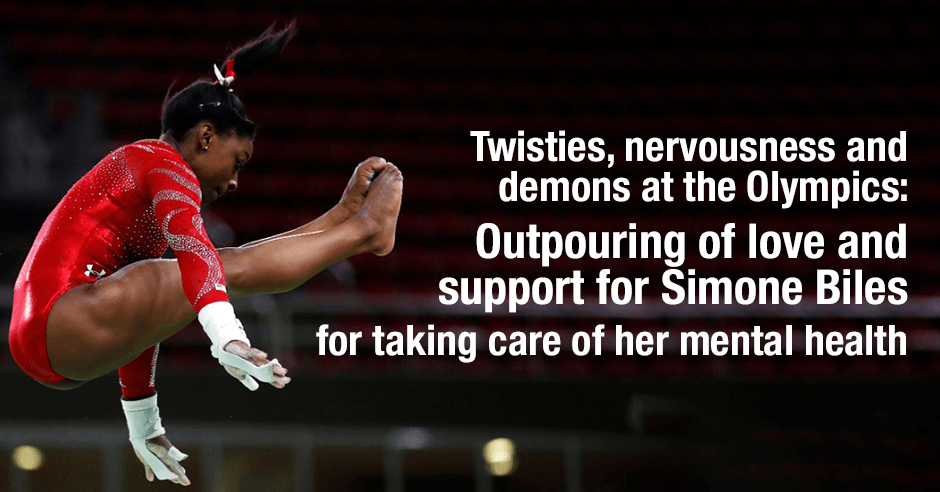
Twisties, nervousness and demons at the Olympics: Outpouring of love and support for Simone Biles for taking care of her mental health

July 30, 2021 By Trudy Scott 10 Comments


twisties olympics

Simone Biles at a training session at the Rio 2016 Summer Olympic Games (Salty View / Shutterstock.com)

There has been an incredible outpouring of love and support for gymnast Simone Biles, as she withdrew from the 2020 Olympics Women’s Team final on Tuesday and All-Around Individual Final on Wednesday. This was due to the twisties, nervousness and mental demons. I’ve decided to gather some of this admiration into a blog post as a testament to Simone who I adore and respect even more than I did before today. I want this to be all about the love and support, but in order to tie it all together, I share more on the twisties (and anxiety), being vulnerable and taking care of yourself, nutritional psychiatry, using amino acids and mental health advocacy below.

Before we get into all that, here is an ET video that explains some of the backstory leading up to this:

Simone shares that she feels good physically but emotionally, her feelings vary by the day. She also talks about the stress of the Olympics and being the star gymnast and that she feels she has the weight of the world on her shoulders.

You’ll also see and hear the love and support she gets from her team members and fellow gymnasts. Two-time Olympian, Aly Raisman, says this about Simone: “She is human too and sometimes people forget that. She is doing the best she can.”

The love and support continued to show up all over social media (and is still showing up)! What follows are some of my favorite posts and mentions.

The love and support – Simone Biles already won

Women Hold Up Half The Sky, a community that empowers women to find their voice and celebrates women in their diversity, shared this powerful post when Simone withdrew:

“Simone Biles already won” and how she has “shattered records to become the world’s most decorated gymnast, has four moves named for her and fought on behalf of abuse survivors.”

simone biles

Simone is one of many young female gymnasts who were sexually abused by disgraced former USA Gymnastics doctor Larry Nassar. This article in Elle covers her story and goal to be an advocate for other young girls.

We are just as proud of you today as yesterday

Jen Hatmaker, New York Times bestselling author of “Simple and Free” posts this lovely uplifting message, ending with:

I’ll tell you what, Simone Biles, the only thing withdrawing from the team competition told me is that absolutely nothing is more important than your mental health, and rather than push through until you had an utter breakdown emotionally or physically, you had the strength of character to step down. The watching, expectant eyes of the whole world are a heavy burden none of us understand.

Your IG caption on July 7th said: “Whatever is good for your soul, do that.” And you did. Well done.

Because this life is a long game, little sister. No matter what everyone is telling you, this is NOT your one moment. It sure isn’t. Most of your moments are ahead of you in fact, and you get to choose how you want to live them.

We are just as proud of you today as yesterday, and we will be proud of you for all your tomorrows. Catch your breath, girl. You are already a champion.

simone biles

I wholeheartedly agree, nothing is more important than her metal health. Too often we put on a brave face and push through. Simone didn’t and for that we are super-proud of her – for her own physical and mental health, and for being a role model to girls and women around the world.

Simone Biles and Naomi Osaka are the role models I want for my girls

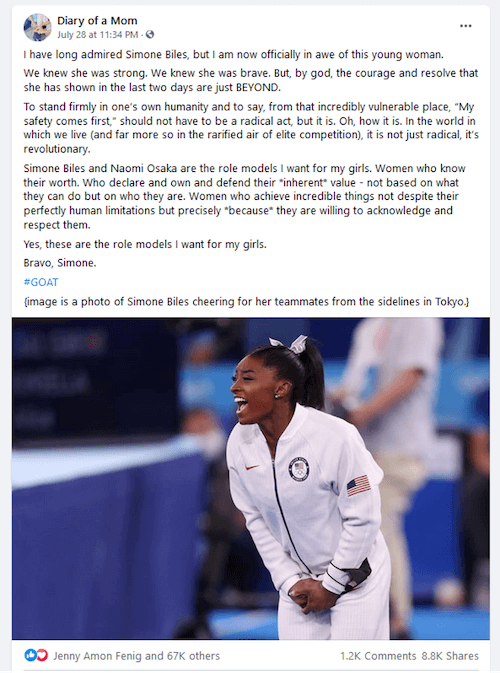
Diary of a Mom, mother, intersectional advocate, believer in the power of community, posted this beautiful message about strength, bravery, vulnerability and Simone and Naomi being role models for her daughters:

I have long admired Simone Biles, but I am now officially in awe of this young woman.

We knew she was strong. We knew she was brave. But, by god, the courage and resolve that she has shown in the last two days are just BEYOND.

To stand firmly in one’s own humanity and to say, from that incredibly vulnerable place, “My safety comes first,” should not have to be a radical act, but it is. Oh, how it is. In the world in which we live (and far more so in the rarified air of elite competition), it is not just radical, it’s revolutionary.

Simone Biles and Naomi Osaka are the role models I want for my girls. Women who know their worth. Who declare and own and defend their *inherent* value – not based on what they can do but on who they are. Women who achieve incredible things not despite their perfectly human limitations but precisely *because* they are willing to acknowledge and respect them.

Yes, these are the role models I want for my girls.

Bravo, Simone.

#GOAT

simone biles

I applaud this strong woman and amazing athlete

Mary Kay Irving, Therapist/Care Coordinator at Boulder Community Health and Owner at Boulder Center for Health and Nutrition, shares this message.

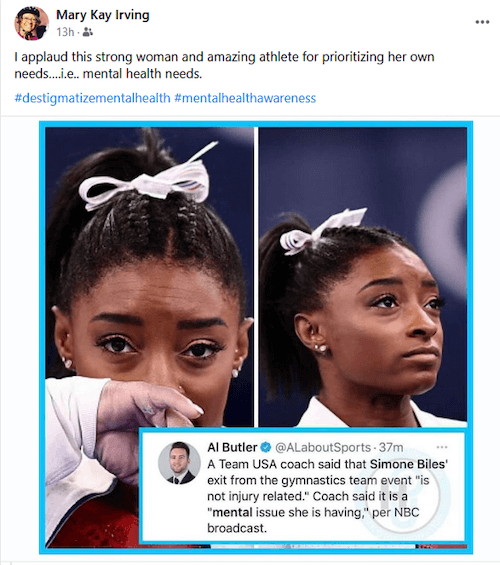
I applaud this strong woman and amazing athlete for prioritizing her own needs….i.e.. mental health needs. #destigmatizementalhealth #mentalhealthawareness

simone biles

I also applaud Simone and support her decision to take care of her mental health needs no matter how hard it must have been for her!

Simone is an absolute legend!

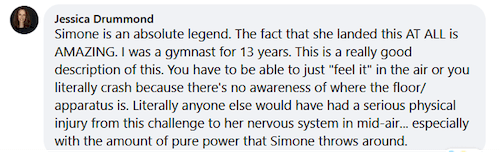
My friend and colleague Dr. Jessica Drummond, a functional nutrition and integrative women’s health expert, and founder of Integrative Women’s Health Institute, says Simone is an absolute legend:

Simone is an absolute legend. The fact that she landed this AT ALL is AMAZING. I was a gymnast for 13 years. You have to be able to just “feel it” in the air or you literally crash because there’s no awareness of where the floor/ apparatus is. Literally anyone else would have had a serious physical injury from this challenge to her nervous system in mid-air… especially with the amount of pure power that Simone throws around.

simone biles

This is so great for people, especially our youth athletes, to see

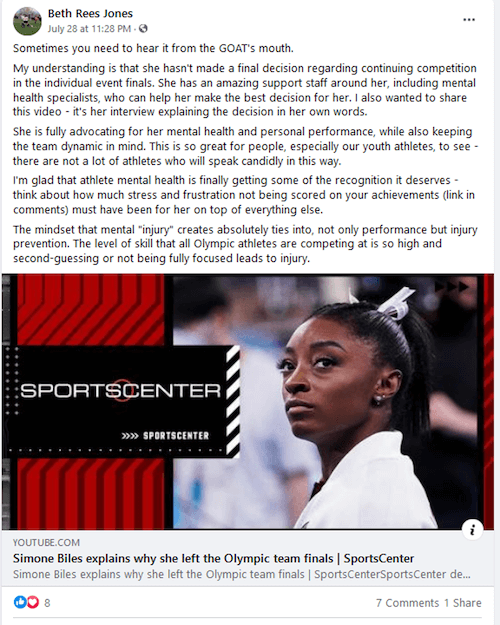
Another friend and colleague, Beth Jones who is a Female/Teen Athlete Wellness & Mindset Coach, posts this.

I’m grateful for athletes like Simone Biles and Naomi Osaka who are coming forward (and professionals as well) to normalize mental health as a key piece of sports training and recovery.

I could not agree more.

In this post, Beth also shares Simone’s press release video where she fully advocates for her mental health and personal performance, keeping the team dynamic in mind, and also sets a wonderful example for young athletes

Sometimes you need to hear it from the GOAT’s mouth.

My understanding is that she hasn’t made a final decision regarding continuing competition in the individual event finals. She has an amazing support staff around her, including mental health specialists, who can help her make the best decision for her. I also wanted to share this video – it’s her interview explaining the decision in her own words.

She is fully advocating for her mental health and personal performance, while also keeping the team dynamic in mind. This is so great for people, especially our youth athletes, to see – there are not a lot of athletes who will speak candidly in this way.

I’m glad that athlete mental health is finally getting some of the recognition it deserves – think about how much stress and frustration not being scored on your achievements (link in comments) must have been for her on top of everything else.

The mindset that mental “injury” creates absolutely ties into, not only performance but injury prevention. The level of skill that all Olympic athletes are competing at is so high and second-guessing or not being fully focused leads to injury.

simone biles

Thank you for finding your voice and staying true to yourself.

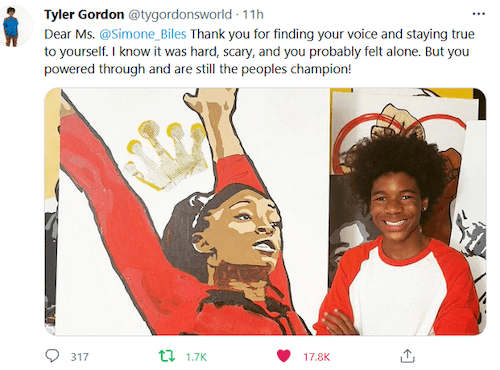
Tyler Gordon, a 14-year old artist who seeks to inspire through the stories of heroes in his work, tweeted this sweet message with  his painting of Simone:

Dear Ms. @Simone_Biles Thank you for finding your voice and staying true to yourself. I know it was hard, scary, and you probably felt alone. But you powered through and are still the peoples champion!

simone biles

This young man is kind-hearted and has talent! You can actually watch him painting Simone here.

Unfortunately, there have been way too many negative comments. I believe these are people who don’t understand mental health. You don’t have to have broken your back to have compassion for someone who has but there are still too many people who can’t understand mental health or have empathy until they have experienced it or see a loved one experiencing it. I’m hopeful all this media attention will help create more awareness, compassion and kindness.

The twisties and how stress and anxiety can play a role

In case you are new to this term (like I was until this week), this article explains what the twisties are – Simone Biles Mentioned Having ‘the Twisties’ – Here’s What That Means, and Why It Can Be Dangerous in Gymnastics:

The twisties is an informal term used to refer to a certain kind of mental block that a gymnast can experience as they are in the air during a twisting skill. When someone gets the twisties, there is a disconnect between the brain and body, Jamie Shapiro, PhD, a certified mental performance coach who is the co-director of the Masters in Sport and Performance Psychology program at the University of Denver

In this same article, Dr. Shapiro, a former gymnast herself, shares how this loss of control can have both physical and mental implications:

Physically, the twisties can make a gymnast unable to perform the skills as they were previously able to.

Mentally, that inability to perform the skills can cause anxiety, exacerbating the mental block.

Allie Wagener, PhD, a licensed psychologist who specializes in sport and performance psychology at Premier Sports Psychology and is also a former gymnast shares how dangerous this can be in terms of injuring yourself when “you don’t know where you are in the air and you don’t know how to land.” It’s also terrifying for the gymnast and that worry and fear about it happening again can make things worse.

I wanted to understand more about the “twisties” in gymnastics and asked Jessica Drummond how similar are they to the yips, which happen in golf or baseball, and which I know are closely tied to increased anxiety/stress. The stress/anxiety can be a trigger and then having the yips make your anxiety and fears worse. Jessica confirmed this about the twisties:

Yes, it’s sort of a loop that can get stuck – get lost in the air (cognitive, proprioceptive, vestibular) –> realize how dangerous that is/ was/ could be –> fear –> stress –> exacerbates the original brain-based issue.

I encourage you to read the entire article to see how stress and anxiety, racing/negative/distracted thoughts, fear of failure, high expectations and even focal dystonia (involuntary muscle spasms) can play a role.

The experts also mention a number of possible techniques to help (like progression, focusing on a different skill, using simple cue words to “keep you focused on the skill rather than the fear”), speaking with a sports psychologist and taking a break.

There is no mention of “nutritional psychiatry” as a possible solution (and I share more on this below).

What Simone has shared – I’m a little bit more nervous

Right now, we don’t know exactly why Simone experienced the twisties or if any of the above apply to her, but we do know some of what she has shared with the media up until now.

In this article Simone said she wasn’t physically injured but fighting some mental demons and had experienced a little injury to her pride. She said that “after the performance I did I just didn’t want to go on,” saying it was all in her head. Simone also emphasized the need to protect her body and mind, saying “I have to focus on my mental health and not jeopardize my health and well-being.”

An article in Women’s Health Magazine reports her comments at a press conference after the USA team won the Silver medal. Simone shared how she just doesn’t trust herself as much as she used to, wasn’t having as much fun as usual and admitted that “I’m a little bit more nervous when I do gymnastics.” 

It was here that she announced that she had the twisties.

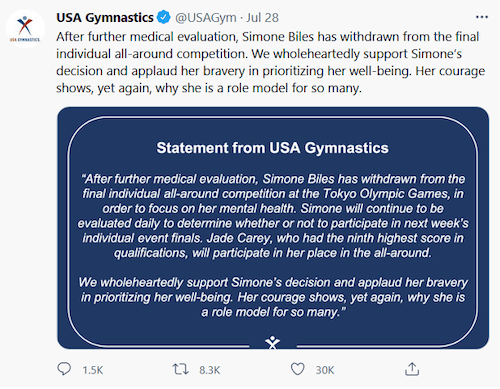
Around this time USA Gymnastics announced Simone had withdrawn to focus on her mental health. They also offered their support:

We wholeheartedly support Simone’s decision and applaud her bravery in prioritizing her well-being. Her courage shows, yet again, why she is a role model for so many.

simone biles

A place for “nutritional psychiatry” and “anxiety nutrition solutions”

My hope is that more and more “nutritional psychiatry” and “anxiety nutrition solutions” (like the use of GABA, tryptophan and other amino acids) will make it into the world of professional (and recreational) sports. I’d like to see this embraced by athletic coaches, registered dieticians and psychologists working with athletes, and hopefully some of the athletes themselves.

Research shows that elite young athletes have high psychological demands:

Elite young athletes have to cope with multiple psychological demands such as training volume, mental and physical fatigue, spatial separation of family and friends or time management problems may lead to reduced mental and physical recovery.

The paper concludes that:

Future research should focus on sports medical and sports psychiatric interventional approaches with the goal to prevent anxiety and depression as well as teaching coping strategies to young athletes.

I recently blogged about how the amino acid tyrosine erased severe performance anxiety in a female musician – to such an extent that she had no more shaking, sweating, panic attacks or passing out. Much of this could be applied to an athletic performance where low dopamine is a factor.

This recent blog resonated with many in my community: What if overthinking, fear, anxiety and worry (caused by low serotonin) is holding you back instead of low motivation/low dopamine? Much of this could also apply to athletes with the twisties or yips with low serotonin as a root cause.

My book, The Antianxiety Food Solution, is a great place to start with the foundations of eating to reduce anxiety (real whole food, no gluten, no caffeine, no sugar, eating for blood sugar control and gut health) and more advanced interventions (like using the amino acids GABA, tryptophan, 5-HTP, tyrosine, DPA and glutamine for balancing brain chemistry, and addressing low zinc and vitamin B6 for pyroluria/social anxiety.)

All this is clearly very needed, and the research and awareness are growing in leaps and bounds, but as Beth Jones, Female/Teen Athlete Wellness & Mindset Coach, shares, what an amazing shift it would be if we could add more “nutritional psychiatry” into the sports psych training:

Coming from 20 years working in sports med with athletes, I keep coming back to wishing there was a degree that combined sports psychology & nutrition (functional & fueling). I started looking into the more mental aspects of performance and healing and then also bringing in more nutrition aligned with healing needs about 15 years ago, but it was all on my own.

What I’ve been learning from you has given me some new tools to share, but you’re right in that they are not well known. I know our US Olympic Committee has amazing health professionals in all areas that work as a team approach for our athletes, but I wonder how many of the RDs are actually having conversations with the mental health team and collaborating taking all of the athlete-specific nuances into consideration.

I know my own therapist suggested that I not pursue sports psych because of the lack of support among therapists out there, but what an amazing shift it would be if we could add more nutritional psychiatry into the sports psych training? Trying to forge a path in this area on my own, but it’s a lot of bush-whacking and little progress.

Beth raises some excellent points and as I said above, hopefully more and more of the “anxiety nutrition solutions” and “nutritional psychiatry” will make it into professional and recreational sports.

It’s ok to say you’re not ok mentally

Simone has noticed and embraced the love and support she’s been receiving. She tweeted this:

The outpouring [of] love & support I’ve received has made me realize I’m more than my accomplishments and gymnastics which, I never truly believed before

She is way more than her accomplishments and gymnastics.

Naomi Osaka penned an article in Time magazine with this title: ‘It’s O.K. Not to Be O.K.’  She wrote this shortly after she withdrew from the French Open to tend to her own mental health. Naomi’s openness has inspired Simone to speak out.

When athletes like Simone and Naomi prioritize their own mental health and are public about it, they are paving the way for it being ok to say you’re not ok mentally. Through their honesty and vulnerability, they have become role models and mental health advocates, and we applaud them for that.

But most of all we applaud them both for taking care of their mental health!

What love and support can you share for Simone and Naomi? Feel free to post in the comments.

Does this motivate and inspire you to be more open about your own anxiety and mental health challenges (if you have not been open yet)?

If you’re an athlete (professional or recreational), does any of this resonate with you and have the amino acids or diet helped you with your anxiety?

If you work with athletes (professional or recreational), I’d love to hear if this resonates with you and if you’re using nutritional psychiatry approaches with them to help ease their anxiety?

If you have connections to athletes (professional or recreational), or coaches, dieticians or psychologists who work with athletes, please share this blog and my work, so we can get nutritional psychiatry resources and anxiety nutrition solutions into their hands and help more athletes.

Filed Under: Anxiety, People, Sports nutrition Tagged With: anxiety, anxiety nutrition solutions, athletes, demons, fear, low dopamine, low serotonin, mental health, mentally, Naomi Osaka, nerves, nervous, nervousness, nutritional psychiatry, Olympics, Simone Biles, twisties, worry

What if overthinking, fear, anxiety and worry (caused by low serotonin) is holding you back instead of low motivation/low dopamine?

July 2, 2021 By Trudy Scott 50 Comments

overthinking

One of the first things that comes to mind when someone is stuck and not able to get things done is low motivation caused by low catecholamines/low dopamine. But what if overthinking, fear, anxiety and worry (caused by low serotonin) is holding you back instead? The following case may help you figure it out if any of this applies to you.

William asked this question on one of the tyrosine blogs, justifiably thinking he may need tyrosine to get unstuck:

Excellent article. I may try tyrosine. I have anxiety and shut down when I am about to start something or my mind overthinks and I shut down with worry. I have problems sleeping. I take a group of things…GABA, glycine, 5-HTP but still wake at 3am.

Anyway I always have GOOD intentions of doing things when I wake in the morning….then it goes downhill. I was not always like this but got worse with STRESS from work and now I FIGHT myself to actually do something I used to LOVE to do. Makes me MAD!

I actually am AFRAID just thinking about taking Tyrosine {Not funny}

I FEAR so much it becomes stupid. I think of doing things and SHUT DOWN with worry.

I want my life back…life is too short to suffer knowing HELP is so close. What do you think? Love your articles…

I think this is a great question many others in my community may relate to so I’ve decided to do this as a blog post with his question and a longer response.

I thanked him for his kind words, saying I can’t offer advice via the blog but can share that we need to be careful with tyrosine when someone has sleep issues or anxiety. I also offered some brief thoughts which I’ll elaborate on here so you can understand my thinking as I work with someone.

Is it low motivation caused by low catecholamines/low dopamine?

The first thing that comes to mind when someone is stuck and not able to get things done is low catecholamines and low dopamine. The classic signs are lack of motivation, fatigue, poor focus and feeling depressed, often using sugary foods or drinks for an energy pick-up (especially in the afternoon).

William may feel that he has low motivation and needs tyrosine because he can’t get things done or he starts something and can’t complete it.

His intentions are good but he has to push himself or as he says “fight myself” to get things done. Because of this he feels tyrosine may be the next amino acid he should trial.

Why I would investigate and address low serotonin

William says he has anxiety and also has trouble sleeping. This could be related to low serotonin and/or low GABA.

However when someone has anxiety and insomnia and I hear the following words/phrases, I immediately think low serotonin should be investigated and addressed:

  • “My mind overthinks”
  • “I shut down with worry”
  • “I actually am AFRAID just thinking about taking Tyrosine”
  • “I fear so much”

All of the above can hold you back and look like low motivation when it is actually worry and fear that is holding you back.

Typically, with low serotonin, you could also second-guess things you do, experience negative self-talk, have a lack of confidence when doing things, get stuck because of perfectionism and may even feel like an imposter. You may also be very controlling and want to do it all yourself and not be willing to delegate – this can hold you back too.

All this and anything else on the list of low serotonin symptoms would further suggest we need to address this first.

Finding the ideal serotonin support for his needs

He is currently taking GABA, glycine and 5-HTP but still wakes at 3am. And he is still anxious.

I would work to optimize 5-HTP dosing (increasing every few days to see if more helps) or switch to tryptophan if the increased dose isn’t helping. Some folks do better one one versus the other and 5-HTP can raise cortisol in some instances causing a wired-tired feeling.

I’d do the same with GABA once the ideal dose of 5-HTP or tryptophan is found. This helps improve sleep and reduce anxiety too.

And I’d look into high cortisol in case this is causing his 3am awakenings.

Once he has ideal serotonin support for his needs, the overthinking will stop, the worry will go away and his fears will vanish – and he will be able to complete things he starts.

Being well rested because of a great night’s sleep is going to help a great deal too.

There may be a need for tyrosine now or later

I may be wrong and there may in fact be a need for tyrosine now. These cases illustrate tyrosine helping when it didn’t seem it would:

  • Tyrosine for alleviating anxiety and panic attacks and creating a feeling of calm focus
  • Tyrosine erases severe performance anxiety in a female musician: no more shaking, sweating, panic attacks and passing out

There may also be a need for tyrosine later and a trial will provide the answers.

Right now William is “AFRAID just thinking about taking Tyrosine” but once his serotonin levels are ideal he should no longer have this fear.

Resources if you are new to using the amino acids as supplements

If you are new to using the amino acids tryptophan/5-HTP, GABA or  tyrosine as supplements, here is the Amino Acids Mood Questionnaire from The Antianxiety Food Solution and a brief overview here, Anxiety and targeted individual amino acid supplements: a summary.

If you suspect low levels of any of the neurotransmitters and do not yet have my book, The Antianxiety Food Solution – How the Foods You Eat Can Help You Calm Your Anxious Mind, Improve Your Mood, and End Cravings, I highly recommend getting it and reading it before jumping in and using amino acids so you are knowledgeable.

The book doesn’t include product names (per the publisher’s request) so this blog, The Antianxiety Food Solution Amino Acid and Pyroluria Supplements, lists the amino acid products that I use with my individual clients and those in my group programs.

As with all individual amino acids we use them for quick relief of symptoms. And we also always focus on the foundations like diet, the gut, adrenals and stress levels.

We appreciate William for asking this question so we all get to learn. Hopefully he’ll jump on and add to the discussion and share his results later.

Can you relate to his lack of motivation showing up as fear, worry and overthinking instead and holding you back?

What about these other low serotonin symptoms keeping you stuck: second-guessing, negative self-talk, lack of confidence, perfectionism, imposter syndrome and controlling?

Has using tryptophan or 5-HTP allowed you to get past some of this so you can get things done?

Did you also have to address low dopamine and actual low motivation, poor focus and fatigue with tyrosine?

Feel free to post any questions here too.

Filed Under: 5-HTP, Anxiety, serotonin, Tryptophan Tagged With: 5-HTP, afraid, anxiety, controlling, fear, GABA, holding you back, imposter, low dopamine, low motivation, low serotonin, my mind overthinks, overthinking, perfectionist, problems sleeping, shut down, stuck, tryptophan, tyrosine, unstuck, worry

  • « Go to Previous Page
  • Page 1
  • Page 2
  • Page 3
  • Page 4
  • Page 5
  • Go to Next Page »

Primary Sidebar

GABA QuickStart Homestudy

gaba quickstart homestudy

Free Report

9 Great Questions Women Ask about Food, Mood and their Health

You'll also receive a complimentary subscription to my ezine "Food, Mood and Gal Stuff"


Connect with me

Popular Posts

  • Amino Acids Mood Questionnaire from The Antianxiety Food Solution
  • The Antianxiety Food Solution Amino Acid and Pyroluria Supplements
  • Pyroluria Questionnaire from The Antianxiety Food Solution
  • Collagen and gelatin lower serotonin: does this increase your anxiety and depression?
  • Tryptophan for the worry-in-your-head and ruminating type of anxiety
  • GABA for the physical-tension and stiff-and-tense-muscles type of anxiety
  • The Antianxiety Food Solution by Trudy Scott
  • Seriphos Original Formula is back: the best product for anxiety and insomnia caused by high cortisol
  • Am I an anxious introvert because of low zinc and vitamin B6? My response to Huffington Post blog
  • Vagus nerve rehab with GABA, breathing, humming, gargling and key nutrients

Recent Posts

  • Her cravings for chips and peanut butter were triggered by stress: GABA ends cravings and reduces physical tension and fear of heights
  • It is truly miraculous to be able to move through life without crippling anxiety and panic
  • GABA and tryptophan combo provide immediate and noticeable relief for tremors and cervical dystonia in just 7 days
  • Red light therapy for back and neck pain, plantar fasciitis and low mood – a complement to the amino acids GABA, DPA and tryptophan
  • What do I use instead of Seriphos to help lower high cortisol that is affecting my sleep and making me anxious at night?

Categories

  • 5-HTP
  • AB575
  • Addiction
  • ADHD
  • Adrenals
  • Alcohol
  • Allergies
  • Alzheimer's disease
  • Amino Acids
  • Anger
  • Antianxiety
  • Antianxiety Food Solution
  • Antidepressants
  • Anxiety
  • Anxiety and panic
  • Autism
  • Autoimmunity
  • benzodiazapines
  • Bipolar disorder
  • Books
  • Caffeine
  • Cancer
  • Candida
  • Children/Teens
  • Collagen
  • Cooking equipment
  • Coronavirus/COVID-19
  • Cravings
  • Depression
  • Detoxification
  • Diabetes
  • Diet
  • DPA/DLPA
  • Drugs
  • EFT/Tapping
  • EMF
  • EMFs
  • Emotional Eating
  • Endorphins
  • Environment
  • Essential oils
  • Events
  • Exercise
  • Fear
  • Fear of public speaking
  • Fertility and Pregnancy
  • Fish
  • Food
  • Food and mood
  • Functional neurology
  • GABA
  • Gene polymorphisms
  • General Health
  • Giving
  • Giving back
  • Glutamine
  • Gluten
  • GMOs
  • Gratitude
  • Gut health
  • Heart health/hypertension
  • Histamine
  • Hormone
  • Hyperparathyroidism
  • Hypoglycemia
  • Immune system
  • Inflammation
  • Insomnia
  • Inspiration
  • Introversion
  • Joy and happiness
  • Ketogenic diet
  • Lithium orotate
  • Looking awesome
  • Lyme disease and co-infections
  • MCAS/histamine
  • Medication
  • Men's health
  • Mental health
  • Mercury
  • Migraine
  • Mold
  • Movie
  • MTHFR
  • Multiple sclerosis
  • Music
  • NANP
  • Nature
  • Nutritional Psychiatry
  • OCD
  • Osteoporosis
  • Oxalates
  • Oxytocin
  • Pain
  • Paleo
  • Parasites
  • Parkinson’s disease
  • PCOS
  • People
  • PMS
  • Postpartum
  • PTSD/Trauma
  • Pyroluria
  • Questionnaires
  • Real whole food
  • Recipes
  • Research
  • Schizophrenia
  • serotonin
  • SIBO
  • Sleep
  • Special diets
  • Sports nutrition
  • Stress
  • Sugar addiction
  • Sugar and mood
  • Supplements
  • Teens
  • Testimonials
  • Testing
  • The Anxiety Summit
  • The Anxiety Summit 2
  • The Anxiety Summit 3
  • The Anxiety Summit 4
  • The Anxiety Summit 5
  • The Anxiety Summit 6
  • Thyroid
  • Thyroid health
  • Toxins
  • Tryptophan
  • Tyrosine
  • Uncategorized
  • Vegan/vegetarian
  • Women's health
  • Yoga

Archives

  • May 2026
  • April 2026
  • October 2025
  • September 2025
  • August 2025
  • July 2025
  • June 2025
  • May 2025
  • April 2025
  • March 2025
  • February 2025
  • January 2025
  • November 2024
  • October 2024
  • September 2024
  • August 2024
  • July 2024
  • June 2024
  • May 2024
  • April 2024
  • March 2024
  • February 2024
  • January 2024
  • December 2023
  • November 2023
  • October 2023
  • September 2023
  • August 2023
  • July 2023
  • June 2023
  • May 2023
  • April 2023
  • March 2023
  • February 2023
  • January 2023
  • December 2022
  • November 2022
  • October 2022
  • September 2022
  • August 2022
  • July 2022
  • June 2022
  • May 2022
  • April 2022
  • March 2022
  • February 2022
  • January 2022
  • December 2021
  • November 2021
  • October 2021
  • September 2021
  • August 2021
  • July 2021
  • June 2021
  • May 2021
  • April 2021
  • March 2021
  • February 2021
  • January 2021
  • December 2020
  • November 2020
  • October 2020
  • September 2020
  • August 2020
  • July 2020
  • June 2020
  • May 2020
  • April 2020
  • March 2020
  • February 2020
  • January 2020
  • December 2019
  • November 2019
  • October 2019
  • September 2019
  • August 2019
  • July 2019
  • June 2019
  • May 2019
  • April 2019
  • March 2019
  • February 2019
  • January 2019
  • December 2018
  • November 2018
  • October 2018
  • September 2018
  • August 2018
  • July 2018
  • June 2018
  • May 2018
  • April 2018
  • March 2018
  • February 2018
  • January 2018
  • December 2017
  • November 2017
  • October 2017
  • September 2017
  • August 2017
  • July 2017
  • June 2017
  • May 2017
  • April 2017
  • March 2017
  • February 2017
  • January 2017
  • December 2016
  • November 2016
  • October 2016
  • September 2016
  • August 2016
  • July 2016
  • June 2016
  • May 2016
  • April 2016
  • March 2016
  • February 2016
  • January 2016
  • December 2015
  • November 2015
  • October 2015
  • September 2015
  • August 2015
  • July 2015
  • June 2015
  • May 2015
  • April 2015
  • March 2015
  • February 2015
  • January 2015
  • December 2014
  • November 2014
  • October 2014
  • September 2014
  • August 2014
  • July 2014
  • June 2014
  • May 2014
  • April 2014
  • March 2014
  • February 2014
  • January 2014
  • December 2013
  • November 2013
  • October 2013
  • September 2013
  • August 2013
  • July 2013
  • June 2013
  • May 2013
  • April 2013
  • March 2013
  • February 2013
  • January 2013
  • December 2012
  • November 2012
  • October 2012
  • August 2012
  • July 2012
  • June 2012
  • May 2012
  • April 2012
  • March 2012
  • February 2012
  • January 2012
  • December 2011
  • November 2011
  • October 2011
  • September 2011
  • August 2011
  • July 2011
  • June 2011
  • May 2011
  • April 2011
  • March 2011
  • February 2011
  • January 2011
  • December 2010
  • October 2010
  • September 2010
  • July 2010
  • May 2010
  • April 2010
  • March 2010
  • February 2010
  • January 2010
  • November 2009

Share the knowledge!

The above statements have not been evaluated by the Food and Drug Administration. Products listed in this website are not intended to diagnose, treat, cure or prevent any disease.

The information provided on this site is for informational and educational purposes only and is not intended as a substitute for advice from your physician or other health care professional. You should consult with a healthcare professional before starting or modifying any diet, exercise, or supplementation program, before taking or stopping any medication, or if you have or suspect you may have a health problem.


Copyright © 2026 Trudy Scott. All Rights Reserved. | Privacy | Terms and Conditions | Refund Policy | Medical Disclaimer

Free Report

9 Great Questions Women Ask about Food, Mood and their Health

You’ll also receive a complimentary subscription to my ezine “Food, Mood and Gal Stuff”