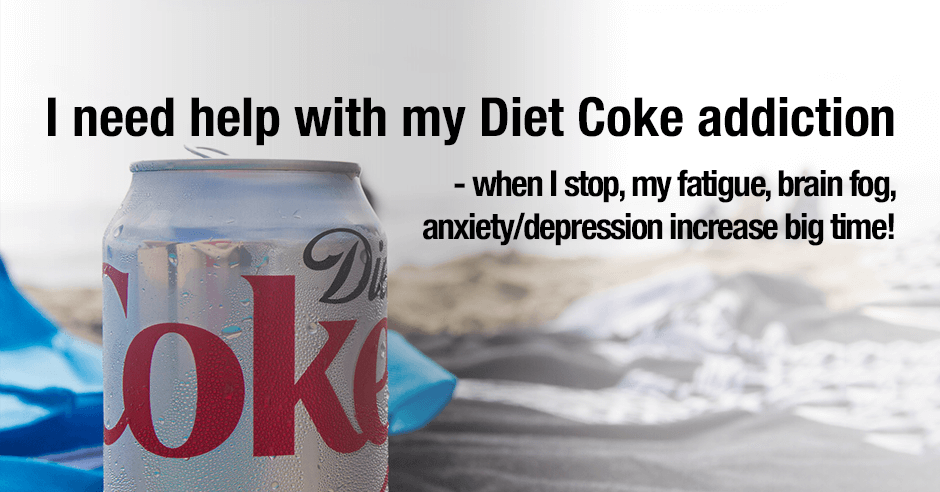
A woman asked for help on the blog, wanting desperately to quit her long-time Diet Coke addiction. This woman knows her addiction is detrimental to her health and she gets withdrawal symptoms when she tries to quit – fatigue, brain fog, anxiety and depression increase big time! And yet she can’t quit. This is not unusual. I share my feedback on the brain chemical imbalances that can drive addictions and how to figure out which amino acids (or more than one) may help her quit easily. This means she doesn’t have to go cold turkey and then fail yet again. Using the amino acids means there is no willpower required and no feelings of deprivation, and it’s addressing an underlying neurotransmitter imbalance i.e. a root cause.
Here is her question:
I need help with my Diet Coke addiction. I have been using it for 35 years and I am too appalled to tell you how much I drink.
I have tried to quit many times and ended up in utter failure. A friend mentioned that phenylalanine may be a booster for my dopamine.
When I stop, my fatigue, brain fog, anxiety/depression increase big time. I know this drink is literally killing my health and I am desperate for some answers, suggestions….or a miracle.
What supplements do you recommend for helping me quit this devil of a habit? Thank you for ALL you do!”
Here is my response …. when it comes to using amino acids to help break the addiction, pretty much everything I write about in relation to sugar addiction or cravings would likely also apply to quitting Diet Coke.
What emotions are driving the addiction?
She needs to figure out what emotions are driving her addiction and use the respective amino acid supplement/s (one or more of them) to help break the addiction and improve the mood symptoms at the same time.
These are the questions I review with my clients who have a Diet Coke addiction (or other diet soda or regular soda addiction):
- If you have to drink it when you haven’t eaten in awhile it’s likely low blood sugar. Glutamine on the tongue stops the desire almost immediately and also helps with the low blood sugar symptoms of shakiness and irritability
- If you stress-drink, your cravings are likely due to low GABA, and GABA will stop the stress-drinking and calm you down too
- If you drink it to feel happy (and especially from late afternoon into the evening) then your cravings are likely due to low serotonin, and tryptophan (or 5-HTP) stops the cravings and boosts mood and reduces anxiety
- If you drink it for comfort or a reward comfort then it’s likely due to low endorphins and DPA (d-phenylalanine) will stop that feeling of “I deserve-it” and also give you a hug-like mood boost
- If you drink it for an energy boost or to give you focus then it’s likely due to low catecholamines and tyrosine will stop those cravings and give you a mood and energy boost, and also help with mental clarity
Based on her question above, she mentions that “my fatigue, brain fog, anxiety/depression increase big time” when she stops. The fatigue, brain fog and depression is a big clue that #5 above will likely apply. She asks about using phenylalanine for dopamine support (dopamine is one of the catecholamines). I prefer tyrosine to l-phenylalanine for boosting levels.
The fact that anxiety also increases when she stops is a clue that #2 or #3 may apply too, and possibly #1. It’s not unusual for someone to have imbalances in multiple areas.
If this is the case, I always recommend doing a trial of one at a time, so it’s easy to see the benefits.
It’s not the same neurotransmitter imbalance that shows up in each person
It’s also not the same neurotransmitter imbalance that shows up in each person with a Diet Coke (or other soda addiction). When I shared this on Facebook and asked what was the driving emotion behind their “self-medication” with Diet Coke this is feedback I received from two women:
- “I had been drinking almost 6 per day for decades. I believe it was comforting.” In this instance, addressing low endorphins with DPA (#4) would have helped. Comfort or reward or treat is a common emotional driver for all addictions.
- “I noticed I would drink Diet Coke when I felt anxious (1 or 2 times a day).” In this instance #2 or #3 would have helped i.e. GABA support if it was physical anxiety and/or tryptophan or 5-HTP for low serotonin if it was worry-type anxiety.
The caffeine addiction and the artificial sweetener Aspartame
Keep in mind, with Diet Coke, there is the caffeine addiction and the artificial sweetener Aspartame that also make it challenging to quit. Tyrosine and addressing low catecholamines (#5 above) and vitamin C can help with the caffeine addiction and quitting so headaches are minimized.
The amino acids can help with the imbalances created by aspartame. This paper, Direct and indirect cellular effects of aspartame on the brain, proposes that “excessive aspartame ingestion might be involved in the pathogenesis of certain mental disorders and also in compromised learning and emotional functioning.” This excerpt from the abstract is relevant to this discussion:
Aspartame is composed of phenylalanine (50%), aspartic acid (40%) and methanol (10%). Phenylalanine plays an important role in neurotransmitter regulation, whereas aspartic acid is also thought to play a role as an excitatory neurotransmitter in the central nervous system. Glutamate, asparagines and glutamine are formed from their precursor, aspartic acid. Methanol, which forms 10% of the broken down product, is converted in the body to formate, which can either be excreted or can give rise to formaldehyde, diketopiperazine (a carcinogen) and a number of other highly toxic derivatives. Previously, it has been reported that consumption of aspartame could cause neurological and behavioural disturbances in sensitive individuals. Headaches, insomnia and seizures are also some of the neurological effects that have been encountered, and these may be accredited to changes in regional brain concentrations of catecholamines, which include norepinephrine, epinephrine and dopamine.
This further supports the need for catecholamine support with tyrsosine (#5 above) and GABA support with the amino acid GABA (#2 above).
Recognizing it’s an issue is a big first step
I acknowledge her for recognizing it’s an issue – that is a big first step! I did also ask her to share how much she was consuming each day because there is no judgement here and we acknowledge it’s an addiction. I’ll report back when I hear from her and will also share which amino acid/s helped her break the addiction.
As always, it’s not only about the amino acids and a comprehensive healing approach is always part of the picture. The amino acids make it easy to get started and then other underlying issues can be addressed: other nutritional deficiencies, dysbiosis, fatty liver, metabolic syndrome and so on. You can see some of the many studies below.
Of course, it’s important to be eating a real whole foods diet with quality animal protein, healthy fats, organic vegetables and fruit, no caffeine, no gluten, no sugar, fermented foods and herbs.
Reconsider your diet soda consumption if you’re on the fence
If you are on the fence about giving up your diet soda consumption here are a few additional papers that will hopefully make you reconsider:
- Diet soda intake and risk of incident metabolic syndrome and type 2 diabetes in the Multi-Ethnic Study of Atherosclerosis (MESA) – “Although these observational data cannot establish causality, consumption of diet soda at least daily was associated with significantly greater risks of select incident metabolic syndrome components and type 2 diabetes.”
- Altered processing of sweet taste in the brain of diet soda drinkers – “there are alterations in reward processing of sweet taste in individuals who regularly consume diet soda.” This has widespread ramifications for driving the need for sugar/carbs and all things sweet
- A comparative study of the effect of diet and soda carbonated drinks on the histology of the cerebellum of adult female albino Wistar rats – “These results suggest that diet soda has adverse effect on the cerebellum of adult female albino Wistar rats,” with “shrunken and degenerated Purkinje cells with hypertrophied dendrites.” Purkinje cells are involved in the release of GABA.
- Soft drinks consumption and nonalcoholic fatty liver disease – “the aspartame sweetener and caramel colorant which are rich in advanced glycation end products … potentially increase insulin resistance and inflammation”
Facts like this help you recognize it’s an issue but even when we have these facts, we often simply cannot quit. This is where the amino acids are so powerful because they work with no willpower required and no feelings of deprivation. And using them addresses the underlying neurotransmitter imbalance/root cause that led to the initial addiction or “self-medication”. They also help address the neurotransmitter deficiencies that are often made worse by diet soda consumption.
Resources if you are new to using the amino acids as supplements
If you are new to using the amino acids as supplements and want to know more, here is the Amino Acids Mood Questionnaire from The Antianxiety Food Solution and a brief overview here, Anxiety and targeted individual amino acid supplements: a summary.
If you suspect low neurotransmitters and do not yet have my book, The Antianxiety Food Solution – How the Foods You Eat Can Help You Calm Your Anxious Mind, Improve Your Mood, and End Cravings, I highly recommend getting it and reading it before jumping in and using amino acids so you are knowledgeable.
What advice do you have if you have been through this yourself and what has helped you?
What do you drink now instead of your diet soda?
If you are a practitioner, how do you help your patients/clients with this kind of addiction?
Feel free to post your questions too.

Thrown in Acetyl-l-carnitine for greater mitochondria energy production.
Use a variety of probiotics and prebiotics.
Dr. Goebel
Thanks for these additional tips. Aspartame has so many far-reaching impacts so good point on mitochondrial support. I just grabbed this paper: Biochemical responses and mitochondrial mediated activation of apoptosis on long-term effect of aspartame in rat brain https://pubmed.ncbi.nlm.nih.gov/25009784/
This may be slightly off-center relative to the topic, but I recently got a weighted blanket. I have read it can increase serotonin and dopamine. I can’t say I “crave” the weighted blanket, but I love, love, love it. I resisted getting one for years because I have persistent issues with feeling trapped, and with getting hot and sweaty in all the least joyful ways ;-). Anyway, I shockingly DO NOT feel trapped or claustrophobic in the least, and I sweat no more than I usually do, or less. It is surprisingly NOT oppressive, and it just feels so good.
Louise
Thanks for sharing and I love the benefits you have seen with a weighted blanket. And it is relevant in this case as it may support low serotonin and low endorphins and could be an additional tool she could use. I don’t know for sure if it supports dopamine but it’s possible.
I’d love to hear which company you purchased yours from? And would you say it helped with low serotonin, low endorphins or low GABA symptoms (if they were a factor with you)?
I’m a big fan and have blogged about this in the past – Anxiety, ADHD, autism and insomnia: how a weighted blanket helps https://www.everywomanover29.com/blog/anxiety-adhd-autism-insomnia-weighted-blankets/
I am an energy worker since 1987 & well into natural remedies & healing. I agree with all of your advice but I believe there is more that is preventing her from deleting soda from her consumption. I truly wish counsellors, doctors & any therapist would take some Energy Training to grasp more of what causes us to do things not helpful fork, us to reach our goals & do what is best for us. Simply what prevents us succeeding. Spirit Attachments have no energy & will attach themselves to people to receive energy from them. If that spirit of a human was a smoker, alcoholic, druggie, sugar addict, etc they will attach to & gravitate to people who are doing & taking in what they need / want. Once attached they help, continue to give power to that craving so much so to them that it is difficult for the person to resist it. I have worked with addicts & the biggest help I can give them is to remove the entities & then to keep them away as well as keep their aura so to make it more difficult for spirits to enter. The person then has to do their own work to keep the spirits away & then make the changes in their lives. I also teach people how to keep the entities away as well as keep their aura in properly. I appreciate your suggestions as they too, will add to helping people to help themselves. Thank you. Betty
Betty
As you know, my expertise is the nutritional realm but thanks for sharing your insights (which are completely new to me).
I am a Specialized Kinesiologist and Clinical Nutritionist withs 45 yrs of practice. A.K. allows me to find anything necessary in the energy fields of the body when these things never show up with lab tests. I suggest that suppressed anger is the driving issue. We all have trauma and perhaps do not realize this, or know how to handle the trauma. The suppressed anger can be over anything persons, relationships, forgiveness is the answer. Try to discern whether you need to forgive another, or need to be forgiven by another. I suggest 3 daily, one with each meal of chromium picolinate, this helps with cravings and addictions. The aminos that show up through accurate A.K. are; Gaba, a relaxant, a product called Tryptophane Plus. another called 5 HTP, and another called, Florassist with Phage Technology a duel stage pre and probiotic, as there is a strong gut-brain connection that must be fed and cared for.
Dorothy
Thanks for sharing your Applied Kinesiology (A.K) insights. I would agree that trauma can be an underlying factor and may need to be addressed.
Also, yes to the possibility of suppressed anger, often caused by low serotonin. And I do like chromium. I recommend something like DFH Twice Daily Multi which does contain 200 mcg of chromium.
I’m pleased to see you also recommend GABA, tryptophan and 5-HTP. I think you’re referring to Life Extension Tryptophan Plus?
And yes to microbiome support. I’m not familiar with this particular product, Florassist but it’s interesting that it includes phages. Have you found this aspect to be of additional benefit for diet soda addictions?
I also like MegaSporeBiotic, a spore based probiotic for microbiome support and liver health https://www.everywomanover29.com/blog/megasporebiotic-a-spore-based-probiotic-for-leaky-gut-ibs-anxiety-depression-liver-health-and-colitis/
Did you know that many diet sodas and Mountain Dew have phenylalanine in them? The amino acid that helps with mood and focus.
So you can offer DLPA (phenylalanine) to those trying to quit but can’t. Aling with other amino. But phenylalanine I believe is the culprit!
Cynthia
Yes aspartame contains phenylalanine. I updated the blog with an excerpt from this paper: Direct and indirect cellular effects of aspartame on the brain.
I’m not sure what you mean by this and think there are some typos: “So you can offer DLPA (phenylalanine) to those trying to quit but can’t. Aling with other amino. But phenylalanine I believe is the culprit!”?
you have lpa (l-phenylalaline), and dpa (d-phenylalaline) en dlpa (dl-phenylalaline).
I also work with dlpa and not dpa.
Kruidje
If you’re asking if they are different yes they are. LPA has effects similar to tyrosine i.e. it supports dopamine production, DLPA support both endorphins and dopamine and DPA supports endorphin production only.
Are you saying you use DLPA and not DPA? For Diet Coke addiction? And it helps? Is yes how does it feel?
I was VERY addicted to diet coke and Pepsi. I found oxycontin and morphine easier to quit . I use to drink it by the gallon. I would have a glass of it on my night table for the middle of the night. I was addicted to it from the mid 80’s to about 6 or eight years ago.The first thing I had to do was stop bringing it home. That is how I control all my weaknesses is to just not bring it home . But as soon as I had a reason to go out ,the first thing was to stop at the corner store for one ,or two, or three .THEN ,one day I decided to have a Perrier for something different. BINGO! I recognized that I was just as addicted to the carbonation as I was the chemicals in the pop. Around that time the Sodastream machines were coming out. I bought one , no pop syrup to put in it.So when I was hanging for a diet coke, I would have some of the carbonated water. It was a very long process . I still treat myself to a can maybe every other week ,but considering that I use to consume gallons of coke ,I would say I’m doing well. I was so surprised that it was something as simple as a craving for carbonation. Hope this helps.
Kevin
Thanks for sharing, especially the aspect about finding oxycontin and morphine easier to quit. That’s a common story I hear. And what a journey you have had! So glad to Perrier helped so much!
You may not want to hear this but when someone is wanting to treat themselves (even every other week) I help my clients address low dopamine and low endorphins (the treat word is the key here). It’s very common to for addictions to linger on when there are neurotransmitter imbalances, even when someone uses willpower so successfully as you have. I acknowledge your journey and resolve and yes you are doing so much better!
hello thank you for all those informations.
my question is how long can you be supplemented with gaba ?
is it a good idea to mix it with picamilon ?
thank you for the exchange
Maika
I have clients use GABA for as long as they need it and we start to address the reasons why GABA is low so it’s not indefinate.
I have not used picamilon. Please share more – do you use it and why? How does it help? Why would you want to use it with GABA?
Hi
I’m desperately trying to stop coffee .. I think I’m also going on the spectrum , has become a routine but also increases my focuse but in between coffees my mood drops struggle no motivation go cold ..
I’m waiting on b12 treatment for PA have some kind of metabolism thing going on ..
But I know coffee is not helping I feel very dehydrated my skin elasticity isn’t goo d ..
I was also sugar free but creeping in little sugar and I have sibo also ..
Feels like I need some thing to make me feel motivated .. also struggle depression a bit as single parent and no respite .. so prob combination of things :/
X
Mand
I start with assessing for and addressing low dopamine with tyrosine when I hear low motivation, depression, needing coffee, focus issues, some sugar creeping in.
If you are new to the amino acids (and other anxiety nutrition solutions like gluten/sugar/caffeine removal, blood sugar control, gut health, pyroluria etc) my book “The Antianxiety Food Solution” is a great place to start. More here https://www.everywomanover29.com/blog/the-antianxiety-food-solution-by-trudy-scott/
Fascinating information, Trudy, thank you. In the email you mention an article about pyroluria and anxiety – I’ve just found out about this and it’s ticking so many boxes. I’m really looking forward to your take on it, I’m doing a test soon to check my levels.
Thank you for all this great information you pass on. I’m a student nutritionist, just about to start my 3rd, and final, year. It’s amazing to have found this passion – took me a long time (I’m almost 64), but it proves that our learning can continue at any age.
Ettaline
Love that you’re a student nutritionist and age means nothing when you have this passion! Good for you! Stay tuned for more on pyroluria and the amino acids. And add my amino acid practitioner training to your list for when you qualify!
Hi. What about sucralose, acesulfame k, áre they Bad?? Si te same, some nutritionist recommend it? And stevia and monk fruti? Is a Bad adicción Also?
Carolina
Yes sucralose and acesulfame k have their own set of issues as do other sweeteners. Some are less of a problem than others but many disrupt the microbiome (stevia does this) and they all lead to the need for something sweet which triggers further desire for sweet. And none address why we want sweet in the first place – brain chemical and nutritional imbalances and dietary issues.
I can relate to a Coke/Pepsi (diet and/or regular) addiction because I drank 3 every day, Monday-Friday for years. For me, that first sip in the morning was my “hit” in the morning for this teetotaler. The combo of sweetness, carbonation and caffeine had me hooked. I gradually stopped by cutting back and stayed away for years. But i missed it, so to treat myself, I started with one small 6 oz can on Fridays. Which of course led to another small can on Mondays. And of course I had to break up the week, so another can on Wednesdays. And before you know it I was drinking one every day and then graduating to the 12 oz can or even the 16 oz bottle! So again, i weaned myself off of it by first switching to diet Sprite/7-Up. Recently I read how caffeine is healthy for you (Steve Barwick of Targeted Nutrients sells a product called Wide Awake), and I remembered how good I felt when I was drinking caffeine. I used to drink 1-2 cups of coffee off and on over the years, but for me coffee was not addictive in the way that diet Coke was. I am considering drinking coffee again for both the health benefits and because drinking water is not something I really enjoy. Looking at Laird’s InstaFuel… and I might bulletproof it by adding butter.
Karen
Thanks for sharing your long and winding addiction story. Well done doing it and acknowledging it was an addiction.
You may not want to hear this but when I hear an ongoing desire for caffeine and justifying it being healthy, plus “I remembered how good I felt when I was drinking caffeine”, and looking for substitutes, I help my clients address low dopamine and low endorphins when they LOVE certain foods or beverages. It’s very common to switch one addiction for another when there are neurotransmitter imbalances.
To my horror, my 12yo son has just started buying/consuming Coke and principally Diet Coke regularly from our village shop. He has got obsessed about collecting the cans, some of which are from his friends’ consumption but more and more from his. He used to hate these drinks but now peer pressure has kicked in and he wants to consume what his friends (who live on the stuff and a horrendous amount of sugar) consume.
I’ve pointed out the ingredients, that they are toxic to his brain. He doesn’t care.
I’ve shown him a brilliant video clip of Renaldo removing coca cola bottles from the press table and promoting water instead (with good effect).
Yet still he keeps buying the stuff.
I’ve made it known with the shopkeeper that I don’t approve of my children buying caffeinated sugary drinks full of neurotoxic ingredients but he doesn’t wish to police my children (though he did give me a refund on the 8 cans he had just sold my son!) which I understand.
Do you have a short summary of why it’s so bad, for children in particular? Either something I could show my children, their friends and/or the shopkeeper?
Is it the caffeine that makes it addictive?
My son does exhibit some challenging behaviours (e.g. torturous noise at home, not able to sit still without fidgeting with things at meals, etc.) but seems to be able to turn this on / off at will. I don’t think he does this at other people’s homes or at school. I can’t say they are necessarily linked to the drinks as they precede the start of him consuming them but I’m certain the drinks cannot help.
Rebble
This is tough but I’m glad you’re horrified and working to do something about it. Sadly many parents have no idea how harmful these drinks are for pre-teens and teens.
When I hear obsessed, peer pressure and challenging behaviors, I immediately think neurotransmitter imbalances and would look into low serotonin and possible low dopamine with the inability to sit still. I’m not clear what torturous noise is? But I would also look at his diet and make sure he is eating for blood sugar stability (quality protein for breakfast with healthy fats + each meal + healthy snacks). And address everything else I cover in my book – gluten, microbiome etc
On one hand you could be surprised the Renaldo press conference clip removing the Cokes didn’t make enough of an impression because having a sporting hero as a role model is powerful. Sharing here for others to read about and watch https://www.theguardian.com/media/2021/jun/18/coca-colas-ronaldo-fiasco-highlights-risk-to-brands-in-social-media-age
BUT on the other hand, based on what I know about soda and diet soda and addiction, role models are unfortunately not enough.
Other things I’d try
1) have someone other than mom tell him about the harmful effects
2) have him do a school project on the topic so he understands the harms and facts + a project hailing Renaldo as a hero (and get his buddies to help with both projects)
3) appeal to things that may make him think about it like acne and not being fit enough to play his favorite sport. Concerns about weight gain may be a driver
4) Help him find something else he likes to drink. Fruit juice isn’t a good option but fizzy fermented drinks are and so is fruit-infused water
5) Be sure the rest of the family is setting an example at home and when you go out
6) Keep planting the seeds with love and encouragement
None of this or flat-out saying he cannot buy sodas will work if there is the addiction aspect and unbalanced brain chemistry. Keep in mind there is a continuum with sugar/carb/artificial sweeteners/caffeine addiction i.e. some kids/adults can quit sugar/carbs/artificial sweeteners/caffeine more easily and others need some nutritional support and some need a lot of support for balancing brain chemistry with amino acids. If there are also behavioral issues/signs that’s the clue they likely need the amino acid support.
Once he has the facts and understands the harm he also has to be willing to make the changes to break the addiction if it’s severe. I have parents gently recommend a month trial to see if it will work. “No diet soda forever” is too much for a pre-teen/teen (and adults too) to grasp and be ok with especially when addicted.
Rebble
I did an entire blog addressing your question and shared additional insights over and above my initial feedback. Here you go: https://www.everywomanover29.com/blog/a-12-year-olds-diet-coke-consumption-and-obsession-with-collecting-the-cans-can-tryptophan-and-tyrosine-help-him-quit-with-ease/
Thanks for asking the question and please let us know how your son is doing
Hey worried mama! I feel your pain!
I’m a kids cooking teach and picky eating expert, but also a former elem. teacher and mom of 4 kids, ages 7-16. So I’m right in there with you.
I asked my husband what he would say if our kids started buying their own soda, and he cringed and said, “Well, I worry that if we completely restricted it that it would make it more desirable.” Which is so true and experience and research supports that. So for him, he would talk about his own journey from being a one to three a day soda drinker to cutting it out entirely maybe 7 years ago now. He wishes he had never had it in his life, and so we would hope our kids would respect that.
For a diet soda in particular, we have exactly two ingredients we completely ban in our house: artificial sweeteners and msg. So I would say to them that they can have anything else in the world in moderation, but not those two. And then we’d talk about it human to human.
I also really like what Gretchen Rubin says about rebels, which all teenagers kind of are, that to be motivated to make a decision, they need “information, consequences, choice.”
So that means we share information on how the substances may hurt their bodies and counterbalance their teenage invincible lens as much as possible, potentially institute some light consequences in our house, such as saying that if they are buying and drinking their own sugar, I will probably stop buying ice cream. And then choice: if they have their own money and transportation, the final choice needs to be up to them, but I can continue to share information and attempt to help them seek balance. I would rather have my kid drink one or two sodas a week then be hiding the fact that they are drinking one or two a day. (And I’d go with the sugar over artificial sweeteners personally, simply because we have NO idea what art. sw. do over a lifetime of consumption and there are is a lot of science about them – https://www.kitchenstewardship.com/dangers-of-artificial-sweeteners/ ) And then again sugar isn’t exactly awesome: https://www.kitchenstewardship.com/kids-eat-white-sugar/ Parenting is so dang hard!
I’m pulling for this to be a PHASE for you, something you can talk about later when he’s in his 20s and has taken ownership of his health, as a tough time but a turning point in his learning about his health and making a decision to care…
All the best, Katie
Katie
Thanks for sharing your insights both as a mom and as a kids cooking teacher/picky eating expert! Love the Gretchen Rubin rebel application to this and yes to this being a phase.
The stats you share in your artificial sweetener blog are concerning: “The most alarming statistic is that artificial sweetener consumption in children increased 200% from 1999-2012.” Thanks for sharing all the places they show up (gum is a huge one for kids) and details about each one. It is also concerning that teachers and so many parents are not aware of the risks. This blog will be a great resource for Rebble to share with the shop-keeper!
And yes “sugar isn’t exactly awesome” either!
Rebble,
Sorry you’re going through this with your son; it’s understandable that you’re in a tough bind here. I wrote a book called, D.R.E.A.M. Wellness: The 5 Keys to Raising Kids for a Lifetime of Physical and Mental Health. I created a short document as a bonus for my readers called 7 STRATEGIES THAT HELP YOU BREAK FREE FROM SODA ADDICTION. It doesn’t give the details of harmful ingredients, but maybe it can give you and your son some strategies to stop drinking it. Give it a read and hopefully it can help make a difference for your son! Best wishes!
https://dreamwellness.com/wp-content/uploads/2021/09/7-Strategies-That-Help-You-Break-Free-from-Soda-Addiction-Chapter-5-20-DREAM-Wellness-book-bonus.pdf
Thanks for another really great and insightful blog post. Food addiction is such an issue and, of course, food producers work very hard to formulate hyper palatable and addictive choices.
Unfortunately in the case of many non-nutritive beverages, such as the Diet Coke referenced by this person, there are other things to keep in mind as well. Many colas tend to have caramel color which is a known carcinogen. Also these carbonated beverages tend to be highly acidic which can be very disruptive to gut function and potentially impact bone health. The gut health aspect is particularly important as it ties into the gut brain connection.
Athena there’s the whole issue of the container that it comes in. If it’s in cans chances are it’s BPA-lined. BPA is an obesogen which can contribute to weight gain and impact hormonal health. If it’s in plastic it’s definitely some sort of a hormone disrupting formulation. Glass is the best option however you need to be aware that even that is not perfect because the lid contains a small amount of BPA.
In my own practice I find that for many people part of the addiction is the mouth feel of the carbonated beverage. Switching to either seltzer waters, homemade or store-bought, or choosing a carbonated fermented beverage such as kombucha can be a good way to satisfy that desire for bubbles.
Mira
Thanks for contributing to the discussion and yes sadly “food producers work very hard to formulate hyper palatable and addictive choices”!
Thanks for the additional information about the caramel color. It’s very unfortunate that it’s not recognized as being an issue (this article covers some this – shared here for other blog readers https://www.webmd.com/cancer/news/20120305/cancer-in-colas-caramel-coloring).
I’m hearing some companies say BPA-free lining and yet they use BPF or BPS or other BPA-like plastics.
Love the tips for other beverages. I love kombucha and water kefir. I know you’ll agree we do have to watch the added fruit juice in a lot of store-bough kombucha now. And in Australia there is now kombucha in cans and the company admitted to using BPA-like plastic to line the can, saying it was safe (of course!).
Thanks for doing this important work to help educate consumers about what’s in the food they eat and beverages they drink!
Can I take gaba as needed? I don’t have anxiety every day anymore, but I do have it when I am around a certain person.
Abby
I have many clients take GABA as needed. I’m sure you know this but best is not be be around a person that increases one’s anxiety and stress levels.
Trudy,
Thank you so much for taking time to write and post all this information! Your book and information has helped me in so many ways. At the moment I am not sure which supplement to start with but I will re-read this article and comments to see if it says. Feeling abit overwhelmed.
I am planning to buy each of the supplements so I will have them on hand.
Thank you again!!
Patti
Patti
You’re most welcome! Do keep us posted as to how you do
Trudy,
You asked how much I drink… I usually drink anywhere from 7-10 (12 oz) a day. It helps me wake up and helps increase my mood. I feel happier and more awake when I drink it. It also helps me when my blood sugar drops. I also use it as an award for myself to go get a fountain drink at Sonic. So maybe I fall into most of the categories. Do you recommend me to start with a particular supplement first?
Thank you for not judging and helping me with this.
Patti
Patti
Thanks for sharing how much you drink – and no judging 🙂
When I hear wake up/more awake and improve mood/happier I think low dopamine
When I hear it helps when blood sugar drops I think low blood sugar
When I hear I use it as a reward I think low endorphins
It’s not uncommon to have imbalances in more than one areas and I have clients pick the issue that is more severe and start with that amino acid and do one at a time.
One more thing….. I am a vegetarian( I do eat eggs) and realize I don’t get enough of all the amino acids. I think I would be better off if I ate meat but I can not stand the texture and have not been able to since childhood. Do you recommend taking a mix of all of the amino acids in a supplement to cover anything I might be lacking? Sorry for all the messages.
Patti
Patti
Brain chemical imbalances are common in vegetarians and a free form amino acids can help. It must be one that does contain tryptophan. I list some here, plus the individual amino acids I use https://www.everywomanover29.com/blog/amino-acids-pyroluria-supplements/
Re red meat aversion – this can often be related to low zinc levels
Hi Trudy,
I have been free of Diet Coke for about 2 1/2 years, in order to help me do this I started a support group on Facebook called “ Diet Soda Coke Drinkers Who Want to Quit” This group has over 2500 members from all over the world. I started the group because I failed many times to quit, I didn’t actually quit until 2-3 years after I started the group.
In February 2021, an article was written in “The Guardian” This article bring in about 1000 new members. Then an article in the New York Times helped bring in another 1000 members.
https://www.theguardian.com/food/2021/feb/02/the-real-thing-my-battle-to-beat-a-27-year-diet-coke-addiction
https://www.nytimes.com/2021/08/11/well/eat/diet-coke-addiction.html
I would love for you to join our group and help many others quit. We have people who are just soda drinkers that are trying to quit, all are welcome.
Thank you for writing your article, a member of my group posted it and shared.
Leatha
Thanks for sharing your story (and good for you for quitting) and Facebook group and these articles here. I’m so pleased that Patti reached out for help and allowed me to share her story (and then shared the blog in your group). The individual amino acids are very powerful for helping to break the addiction relatively easily and to stay off this “drug” without feeling deprived and missing it.
I encourage your members to get familiar with this approach either via all the posts on my blog (I write extensively about the amino acids), my talks (I speak on many summits), my book “The Antianxiety Food Solution” (more here https://www.everywomanover29.com/blog/the-antianxiety-food-solution-by-trudy-scott/) and my online group programs. Since anxiety is really common in these folks the GABA Quickstart program is a great place to start – more on that here https://www.anxietynutritioninstitute.com/gabaquickstart/
I’ve joined the group and will comment from time to time but can’t help folks quit unless they are part of a program and I have some background health information on them.