• Skip to primary navigation
  • Skip to main content
  • Skip to primary sidebar

everywomanover29 blog

Food, Mood and Women's Health – Be your healthiest, look and feel great!

  • Blog
  • About
  • Services
  • Store
  • Resources
  • Testimonials
  • The Book
  • Contact
  • Search this site

GABA

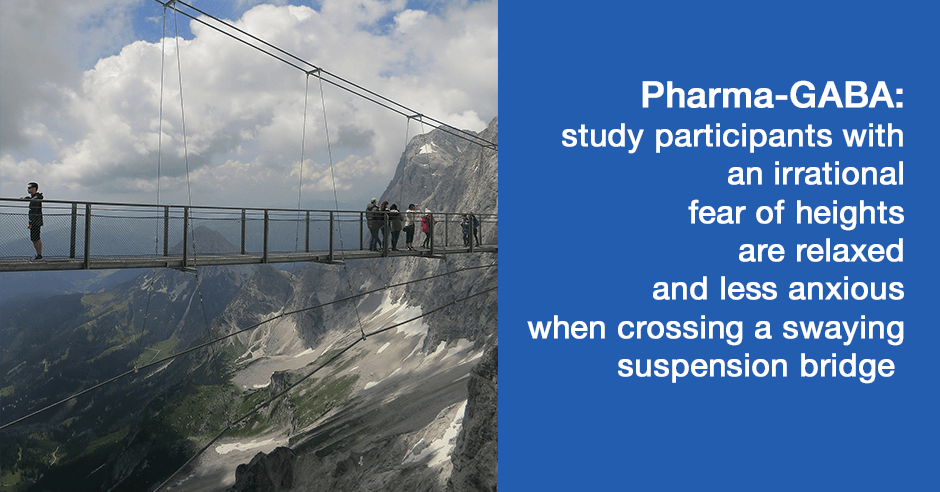
Pharma-GABA: study participants with an irrational fear of heights are relaxed and less anxious when crossing a swaying suspension bridge

September 28, 2018 By Trudy Scott 7 Comments

Based on clinical evidence, we know that gamma-aminobutyric acid (GABA), a calming amino supplement, reduces anxiety. There isn’t as much research on GABA or Pharma-GABA as we’d like to see, so we’ll take small studies that are done on humans.

In a 2006 study, Relaxation and immunity enhancement effects of gamma-aminobutyric acid (GABA) administration in humans, Pharma-GABA was used to determine if it would increase relaxation and reduce anxiety during the stressful event of crossing a suspension bridge:

Eight healthy volunteers, with no clinical evidence of any illness, (5 males and 3 females) aged 25 to 30 years who had a history of acrophobia [extreme or irrational fear of heights], were recruited.

Subjects crossed … a pedestrian suspended bridge at Nara Prefecture, Japan (Totsu River Bridge) with 54 m height, 300 m length, and 2 m width.

I believe it’s also called the Tanize Suspension bridge and is one of the longest suspension bridges in Japan. You can see pictures of the bridge here and here. They say this: “though quite safe, the swaying motion can be disconcerting, or fun, depending on your perspective.”

If we convert that to feet, it’s 177 feet high, almost 1000 feet long (about 3 times the length of a football field) and 6 feet wide.

There were 2 groups: placebo and Pharma-GABA. Salivary immunoglobulin A (IgA) levels (also known as secretary IgA or sIgA) was measured in both groups and used as a marker of relaxation and stress, as well as immunity. Saliva was collected before crossing the bridge, half way across and at the end. The study found that the

placebo group showed marked decrease of their IgA levels, while GABA group showed significantly higher levels.

And concludes as follows:

GABA could work effectively as a natural relaxant and its effects could be seen within 1 hour of its administration to induce relaxation and diminish anxiety. Moreover, GABA administration could enhance immunity under stress conditions.

The paper is reporting about 2 studies and it’s not clear how much Pharma-GABA was used in this bridge study – it was either 100mg or 200mg. Results were observed within 60-90 minutes. Also, this study was conducted by the company who makes the Pharma-GABA product, and they do say that this bridge study includes unpublished data.  Notice that they use the term GABA in the paper – I prefer to differentiate since Pharma-GABA and GABA are actually different.

Other than this and the very small number of participants, I’m always encouraged by any research we have. Clinically, we see very similar results with GABA or Pharma-GABA when someone has a fear of something – heights, flying, spiders etc. – and it typically addresses the physical fear and anxiety symptoms.

Here are some of my thoughts as to why results were only observed after 60 minutes:

  • Pharma-GABA was used in the study and for some folks this is not as effective as using GABA. I typically start my clients on GABA.
  • Using GABA sublingually often has calming results in under 10 minutes, so a chewable Pharma-GABA may have been a better option and would be something I’d recommend
  • Low serotonin is commonly a factor with fears and phobias and I’d recommend a trial of tryptophan

The resources in this blog and my other articles are intended to be used in conjunction with my book: The Antianxiety Food Solution – How the Foods You Eat Can Help You Calm Your Anxious Mind, Improve Your Mood, and End Cravings (Amazon link). If you do not have my book I highly recommend getting it and reading it before jumping in and trialing/taking amino acid supplements: There is a complete chapter on the amino acids and one for pyroluria, plus information on real whole food, sugar and blood sugar, gluten, digestion and much more.

You can find the GABA and tryptophan products I recommend on this blog: The Antianxiety Food Solution Amino Acid and Pyroluria Supplements

How would you feel walking across a swaying suspension bridge like this?

Have you used Pharma-GABA, GABA and/or tryptophan to help you with the stress and anxiety caused by a phobia like this or another phobia?
Filed Under: GABA Tagged With: acrophobia, anxiety, anxious, bridge, fear of heights, GABA, immunity, Pharma-GABA, relaxation, relaxed, sIgA, swaying suspension bridge

GABA reduces the visceral pain of IBS & SIBO, eases anxiety and helps with insomnia

August 23, 2018 By Trudy Scott 6 Comments

I have chronic SIBO (small intestinal bacterial overgrowth) and shared some insights – during an interview on the IBS & SIBO SOS Summit – on what helps me when I’m trying a new protocol or new food and get that awful and painful belly bloat.

It’s so bad that I’m in pain all night, tossing and turning and can’t sleep…. and Iberogast, enzymes and peppermint and lavender essential oil on my bloated belly help so much:

Because of the cellulose in one of the Candibactin products, I was getting the bloating. And the Iberogast taken at night just before I went to bed (together with a few other things) definitely helped with some of the bloating.

For me, the problem with the bloating is the pain (obviously), but worse than that is the lack of sleep. If I’m bloated, it just feels like I’m tossing and turning the whole night. And if I don’t get eight hours of sleep, I’m a mess. So, the biggest issue for me is the impact on my sleep.

But if I’ve got this huge, bloated belly which was happening a lot, I take enzymes that help with carb digestion. I will also rub peppermint essential oil on my belly. So I’ve got a little bowl of coconut oil with a dab of lavender (it’s calming and it helps you sleep as well) and a little bit of peppermint oil.

There’s a number of studies showing that essential oil or peppermint ingested in a capsule can help with IBS. And I’ve found that, topically, it can help too. So that works for me to help with some of the bloating.

I also share about my 2 favorite amino acids – you guessed it – GABA and tryptophan. They just have so many applications! In this instance of painful belly bloating they help with pain and sleep and improve motility:

The other thing that helps is GABA which is one of the amino acids. There is research discussing the role of GABA in stress-induced visceral hypersensitivity. GABA helps with reducing the visceral pain that is seen with IBS/SIBO because we have GABA receptors in various parts of the body, including the digestive system. GABA is amazing for physical tension/anxiety and it can ease that. I’m thinking that this easing of physical tension may be one of the mechanisms as to how it works for some of the pain issues.

I do want to mention something about GABA – it works most effectively when taken sublingually. I just chew a capsule and get the results. And it works within five minutes.

And then, the other one that I use at night is tryptophan. This really helps with the sleep as well by boosting serotonin levels. It actually helps with motility too – there’s research showing this.

If your SIBO causes increased anxiety, these two amino acids would help ease those symptoms too – GABA for the physical anxiety and tryptophan for the worry in the head anxiety:

And then, it helps with anxiety as well if that’s an issue – for many people with IBS and SIBO, anxiety is an issue.

Summit host, Shivan Sarna, shares how LDN (low dose naltrexone) has helped her tremendously (she also has chronic SIBO) and we discuss how too much can increase anxiety and impact your sleep. Since doing this interview I’ve had feedback from two people who successfully used GABA Calm to reduce their anxiety from too high a dose of LDN.

We also touch on some of the possible mechanisms of LDN, I share some of the benefits of berberine, and we discuss benzodiazepines which are so often prescribed for IBS/SIBO (for the anxiety, the insomnia and the pain) and why nutritional approaches are a safer option.

Have topical peppermint/lavender essential oils helped with belly bloat?

Has GABA or tryptophan helped you with the pain, poor motility or anxiety associated with SIBO?

Feel free to post your feedback and questions in the comments below.

Filed Under: GABA Tagged With: anxiety, bloat, GABA, Iberogast, IBS, insomnia, lavender, pain, peppermint, SIBO, visceral pain

GABA, 5-HTP and melatonin isn’t working anymore for my insomnia and tryptophan gives me a migraine – what should I do?

May 11, 2018 By Trudy Scott 20 Comments

Today I’m addressing a great question I received on a recent tryptophan blog about insomnia and the use of the amino acids GABA and 5-HTP in a combination product together with melatonin, and what the next steps should be when you are not getting the expected results. And if continuing with tryptophan is a good idea when it seems to be causing a migraine and isn’t leading to a whole night’s sleep. Here is the question:

I have suffered from insomnia for most of my life. I just got your book and am loving it! Thank you for all that you do. My symptoms seem to be high for both low GABA and low serotonin [here is the questionnaire].

I also believe I have a blood sugar problem, so I’m starting to follow your suggestions for that.

I’ve been taking a supplement for sleep that has both GABA and 5-HTP in it, along with melatonin. It worked for a year, however it just recently stopped working.

I thought maybe I should try tryptophan. After taking only 220 mg per night, along with 5 mg of melatonin, I was able to sleep, but not through the entire night. However, the next day I woke up with a horrible headache/migraine. I know it was the tryptophan because I did a trial and tried a night without it and then again with it and the nights I took it, sure enough, the migraine would return.

I must add that I had bloodwork done and tested low for melatonin, which is why I was adding the melatonin into my protocol.

My question is: do I continue with a higher dose of GABA, 5-HTP and melatonin, since it worked for a year i.e. do I up the dosage of the supplement I’ve been taking? Or do I continue trying different doses of tryptophan?

I shared this response in my comment (with some additions for this blog post).

Always first address the nutritional foundational aspects

Firstly, I was glad to hear she is loving my book The Antianxiety Food Solution (my Amazon link) and implementing dietary changes. This is so foundational to any protocol for both anxiety and insomnia. Too often, someone hears me talking about the amazing amino acids and forgets the nutritional basics of real whole food, quality animal protein (like wild fish, pastured eggs and chicken, grass-fed red meat), organic veggies and fruit, healthy fats (like olive oil, coconut oil and butter), fermented foods and broths, and no gluten, caffeine or sugar.

I don’t ever have clients push through

With regards to her trial of tryptophan I shared that I don’t ever have clients push through on a product that is causing any adverse effects, and especially when it’s a migraine. She was smart and trialed the tryptophan twice to make sure it was the tryptophan that caused the migraine and not something else.

Capitalize on what has worked and increase one at a time

With regards to the GABA, 5-HTP and melatonin I shared that I always like to capitalize on what has worked in the past (or is currently working) and would rather increase the 5-HTP and/or melatonin and/or GABA one at a time.

Notice that I said increase these products one at a time. She is taking a combination product so it’s impossible for her to do this. Maybe her GABA levels are now good (because her progesterone levels have improved due to be on a regular zinc supplement or because she has been doing regular yoga sessions) and maybe she needs more serotonin support (because her estrogen levels are off because of recent exposure to xenoestrogens in plastics).

Even though is research showing that a combination product containing GABA and 5-HTP improved sleep and sleep duration more than the use of either of the two amino acids alone, based on her feedback, if we were working together I would have her do each of the GABA, 5-HTP and melatonin separately. This way it’s easy to mix and match and increase one and possibly lower the other, until the ideal combination is found for her unique needs at this time in her life.

She may even find she only needs GABA or only needs 5-HTP or only melatonin. She may also find she needs sublingual melatonin for helping her fall asleep and timed-release melatonin for helping her stay asleep.

She mentions the amino acid questionnaire so it sounds like she is clear on her symptoms: low GABA physical anxiety affecting her sleep and low serotonin mental worry-type of anxiety affecting her sleep. So as she trials the individual amino acids she can see how she does symptom-wise in order to find the ideal amount.

Other factors to consider with insomnia

It’s often straight-forward with the amino acids and the great thing is that one you have the correct combination you will see results in a few days to a few weeks. But There are other factors we may need to consider with insomnia:

  • Keep in mind that 5-HTP can raise cortisol and low blood sugar can indicate adrenal issues so looking at high cortisol as a factor in the sleep problems would be something to consider. A 4-collection saliva test will measure this and my favorite product for lowering high cortisol is Seriphos. Other nutrients for adrenal support may be needed too.
  • Just addressing low blood sugar can often improve insomnia. Eating to support blood sugar swings, early morning sunlight and no blue light after dark can make a world of difference.
  • Other sleep factors we always want to consider: sex hormone imbalances, parasites (they are more active at night and can keep you awake and play a role in high cortisol), accidental gluten exposure, SIBO (small intestinal bacterial overgrowth), candida, sleep apnea and mouth breathing, EMFs (WiFi in the home, commuting with the iphone on, a new cordless phone etc.) and medication side-effects (benzodiazepines are a common one).

I really appreciate questions like this being posted on the blog so others like you also get to benefit. This question also demonstrates just how our needs for certain nutrients can change over time and how we may to keep adjusting what we are doing.

In case you have questions about specific products that I use with clients, here is my supplements blog and more information on GABA for the physical type of anxiety and 5-HTP/tryptophan for the worry-type of anxiety.

Can you relate to this scenario? Feel free to ask your questions about sleep, GABA, 5-HTP, tryptophan and melatonin and share your experiences with these products and how they have helped you or if you’ve had issues with any of them.

Filed Under: Anxiety, GABA, Insomnia Tagged With: 5-HTP, anxiety, benzodiazepines, cortisol, GABA, insomnia, melatonin, migraine, sleep, tryptophan, worry

GABA oral rinse reduces burning mouth pain

March 2, 2018 By Trudy Scott 47 Comments

Burning Mouth Syndrome (BMS) is a chronic pain condition characterized by persistent burning in the mouth. It affects mostly females, especially postmenopausal women, and conventional approaches are often not very successful. You’ll often see articles and papers with the terms ‘refractory’ and ‘unknown etiology’/unknown causes.

Medications like SRNIs and benzodiazepines

Some studies report limited success with medications like venlafaxine/Effexor, an SRNI and topical and oral use of benzodiazepines such as clonazepam/Klonopin. In this paper, Refractory burning mouth syndrome: clinical and paraclinical evaluation, comorbidities, treatment and outcome, 8 participants saw their pain diminish by half within 3 months.

Another paper, The Effect of Clonazepam Mouthwash on the Symptomatology of Burning Mouth Syndrome: An Open Pilot Study, reports success with a benzodiazepine mouthwash in half the participants.

Other than the poor quality of life and having to continue to live with pain, the bigger concern is the side-effects of medications like these, plus concerns with tolerance and then issues with withdrawal.

New oral GABA research for burning mouth

It’s for this reason that I’m excited about the recent research, γ-Aminobutyric acid (GABA) oral rinse reduces capsaicin-induced burning mouth pain sensation: An experimental quantitative sensory testing study in healthy subjects, that finds that both and men and women experienced immediate benefits when using GABA for burning mouth pain.

The burning mouth pain was caused by the application of capsaicin to the tongues of thirty healthy males and females. Capsaicin is the compound that makes chili peppers hot. (I find it interesting that capsaicin was the compound used to cause the burning mouth sensation because this same compound is used in topical creams and patches to ease pain.)

The study concludes as follows:

Capsaicin-induced burning tongue pain and decreases in WDT (warm detection) and HPT (heat pain) can be ameliorated by rinsing the mouth with lidocaine and GABA solutions.

Rinsing the mouth with an oral GABA containing solution ameliorated burning pain and increased heat sensitivity produced by application of capsaicin to the tongue. This finding suggests that GABA can act as a local analgesic agent in the oral cavity.

Lidocaine, a numbing medication, was part of the GABA solution in this study, but because it has side-effects that may include anxiety, I recommend a trial of a GABA-only solution to ease the burning mouth pain.

Using a GABA-only oral solution

Using a GABA-only oral solution makes sense given that the likely mechanism of action of topical benzodiazepines in burning mouth pain is via local action on peripheral GABAA receptors found in the nerve fibers of the tongue.

This is also very feasible based on how effective GABA is for other pain such as proctalgia fugax/rectal spasms, and the visceral pain and muscle tension in your gut caused by the bloating symptoms of SIBO (small intestinal bacterial overgrowth) and muscular back pain after a fall.

How much GABA will help?

As with any use of GABA and the other amino acids, how much will help depends on each person’s unique biochemistry and needs at the time. In the same way I do a trial of GABA with my anxiety clients to determine how much would help, I do the same with burning mouth pain (and other pain situations).

I recommend a trial of a GABA-only product and starting low with 100 to 200mg of GABA swished held in the mouth with some water for a few minutes. This can be used three or four times a day in between meals and with the mg increased slowly based on results.  You can find the GABA supplements I recommend here.

GABA is an amino acid that is recognized for calming physical anxiety and tension and since anxiety (and depression) is very common in those with burning mouth pain, the GABA is going to provide calming benefits too.

As with any health condition, finding the underlying root causes using a comprehensive functional medicine approach is key. One such root cause may be low GABA and using oral GABA is going to address this one and provide some relief while other root causes are identified and addressed.

These other root causes can be very varied as explained in the paper Burning Mouth Syndrome. They can include: age-related reduction in estrogen and progesterone levels, lower cortisol, diabetes mellitus and hypothyroidism, allergic reactions to foods, additives and even metals in the mouth, autoimmune connective tissue disorders, nutritional deficiencies (B1, B2, B6, B12. folate, and/or zinc), smoking and candida, and medication side-effects as mentioned above.

Have you experienced burning mouth pain and seen relief with GABA or other nutritional approaches?

If you’re a practitioner, is burning mouth pain common in your postmenopausal clients or patients and what approaches have you found most successful? Have you found GABA to be helpful?

If you are still suffering with burning mouth please share the following when you comment:

  • Your age (it seems to be more prevalent in women 59 and older)
  • If you have anxiety and/or depression now and have been prone to either in the past
  • How you score on the low GABA questionnaire and which symptoms you relate to? This will provide a clue that low GABA may be an issue and the oral GABA rinse is more likely to help
  • How you score on the low serotonin questionnaire (same link as GABA questionnaire above) and which symptoms you relate to? SSRIs have been shown to help in some cases and we know tryptophan/5-HTP help with pain so serotonin support may help too. Perhaps a tryptophan or 5-HTP rinse is worth a trial too?
  • How long it’s been an issue, what approaches you’ve tried and which approaches have helped (even if they only helped a short while or helped the pain a little)
  • Current and past medications (burning mouth is caused by certain medications)

I’d love to gather a list of all this so we can help you and more women who suffer with these awful symptoms.

Filed Under: Amino Acids, Anxiety, benzodiazapines, GABA, Pain Tagged With: anxiety, benzodiazepines, burning mouth, burning mouth pain, burning mouth syndrome, depression, GABA, Klonopin, pain

PTSD from 3 tours in Afghanistan: Can GABA help with the anxiety?

February 23, 2018 By Trudy Scott 23 Comments

My husband is suffering from PTSD [post-traumatic stress disorder] from 3 tours in Afghanistan. Can [GABA] help with the anxiety he is experiencing. Your thoughts?

I received the above question in response to one of my blogs addressing GABA for the physical, stiff-and-tense muscle type of anxiety.

It’s very likely that GABA will help ease some of the anxiety he is experiencing. Anxiety can have many root causes and with PTSD I would look into neurotransmitter imbalances first and use three key amino acids to address these three possible root causes, before digging deeper to address other nutrient deficiencies and root causes that may take longer to address.

Amino acids to provide some anxiety relief quickly

In order to provide some anxiety relief as quickly as possible I would assess for low GABA, low serotonin and low blood sugar using the amino acid questionnaire:

  • With low GABA he could be experiencing physical anxiety, muscle tension and the need to self-medicate with alcohol or sugary foods in order to calm down and relax. We would do an amino acid trial with calming GABA. Research also now shows that GABA helps with unwanted obtrusive thoughts which are common with PTSD.
  • With low serotonin he could be experiencing mental anxiety, ruminations, fears, phobias, anger and irritability and probably insomnia. We would do an amino acid trial with tryptophan first and then 5-HTP if the tryptophan isn’t helping and we know cortisol is not high.
  • With low blood sugar he could experience anxiety and feel extra stressed when he goes too long without eating. It’s likely he could also have an intense desire to eat candies and sweet treats. We would do a trial with glutamine and make sure he’s eating a breakfast that contains quality animal protein such eggs and bacon, or a protein smoothie.

High cortisol?

We would also want to determine if high cortisol is a driving factor of the anxiety. I’d want to see the results from a 4-collection cortisol saliva test (on waking, noon, around 5pm and around 10pm).

We would address adrenal issues (either high or low) with adrenal support of a good 50mg B-complex, extra pantothenic acid, vitamin C, and adaptogen such as rhodiola. If cortisol is high this can trigger anxiety and adrenaline-type surges and the phosphorylated serine product Seriphos used a few hours before the high cortisol is the best for lowering the high cortisol.

Recent research finds evidence that orange essential oil reduces fear and anxiety, diminishes immune system markers of stress in mice and may help alleviate PTSD and a blend of lavender, ylang-ylang, marjoram, and neroli (also a citrus oil) reduces stress and lowers cortisol too.

Other factors: gut health, diet, low vitamin D

When it comes to anxiety and PTSD, there are other factors to be considered:

  • gut health and the microbiome – has he picked up parasites or other gut bugs or been impacted by foodborne pathogens
  • diet and the importance of getting back to eating a real whole foods quality diet in order to provide the body with the best nutrients. An example from a recent study report that blueberries boost serotonin and may help ease PTSD
  • addressing low vitamin D: “Through its association with testosterone production, vitamin D deficiency may increase the risk for posttraumatic stress disorder”
  • removal of gluten, sugar and caffeine – all of which can contribute to anxiety and cause nutrient depletions

Possible effects from malaria drugs and other toxic exposures  

If symptoms persist other factors like the effects of medications (or other toxic exposures) must be considered. In one case study, Malaria drug causes brain damage that mimics PTSD, a service member was diagnosed with anxiety, PTSD and a thiamine deficiency. Various treatments, including medication, behavioral therapy and vitamins didn’t help. It was determined that his symptoms were due to the anti-malaria medication mefloquine, which is now known to contribute to neuropsychiatric symptoms in susceptible individuals.

As with any anxiety condition, the root causes and solutions are unique to each individual and the above approach would be adapted based on each person’s unique needs and biochemistry. Additional approaches over and above these listed here may well need to be considered.

Filed Under: GABA, PTSD/Trauma Tagged With: anxiety, depression, GABA, low blood sugar, malaria medications, PTSD, serotonin

How much GABA should I use and which GABA product is best?

December 8, 2017 By Trudy Scott 61 Comments

The most common question I get about GABA (gamma-amino butyric acid) is the one about the blood-brain barrier and does it even work (it certainly does – read here for information on this one).

The next most common question I get about GABA is this one:

How much GABA should I use and which GABA product is best?

This exact question was actually asked of me a number of times last week after I published: Herbal therapy is equivalent to rifaximin for the treatment of small intestinal bacterial overgrowth (SIBO). In this blog I share about my trials of using sublingual GABA for the visceral pain and muscle tension in my gut caused by the bloating symptoms of SIBO.

There is no simple answer! It requires a blog post to provide a good answer because we are all unique, have different needs and these needs can even differ at different times depending on the issue and what is going on in our lives at the moment.

Let’s first do a quick recap of GABA (gamma-amino butyric acid) in case this is new to you. GABA is a calming amino acid that can be used as a supplement to raise GABA levels (GABA is also a neurotransmitter. It’s one of the amino acids I use most frequently with my anxious clients (together with tryptophan). GABA helps with the physical anxiety and tension, as well as panic attacks. New research shows it also helps with inhibition of unwanted thoughts and may also offer gut protection after alcohol consumption. It also helps with stiff and tense muscles and muscle pain and spasms.

How I have benefited from GABA

Here is a quick summary of how I’ve benefited from GABA supplements. I use this information to inform my use of GABA to help with the visceral pain I now experience due to my SIBO (more on that below).

If you have never used GABA or if you’ve used it once or twice, reading this should give you a clue as to why there is no one answer and how we need to use a trial approach to figure out what is best for each situation.

This also illustrates that there is no one size fits all for everyone and even for the same person under different situations.

  1. The anxiety and panic attacks I experienced 15 years ago:
    1. I used 1-2 GABA Calm three times a day and a combination GABA product at night. GABA Calm contains 125mg GABA and the GABA product contains 200mg GABA. My anxiety eased and my panic attacks stopped in a few days, giving me immediate relief and hope while I started to address all the other root causes like gluten sensitivity, adrenal issues, low zinc, gut health, low vitamin B6 and more
    2. The doses of GABA I used for my anxiety and panic attacks are typical amounts my clients benefit from and I would not have someone start on 500mg.
    3. If someone is a “pixie-dust” person and very sensitive I’d have them start with a pinch/dab or ¼ of 125 mg GABA Calm.
  1. The “ice-pick” headaches on the top of the skull that I discovered were caused by neck spasms:
    1. Physical therapy, high doses of GABA and high doses of magnesium were essential.
    2. Because of the low doses of GABA I had used for my anxiety years before this, I started with low doses of GABA increasing slowly from 200mg up to 1000mg GABA. This higher amount worked for me at this time for this injury.
  1. Throat spasms and the loss of my voice due to vagus nerve issues caused by a terrifying plane ride:
    1. Based on my prior ice-pick headache experience I now knew I could tolerate higher doses and started with 500mg GABA and used more as needed.
    2. I must have been really low in GABA because I was actually able to use upwards of 5 (and sometime more) doses of 500mg a day and not feel too wiped out, even during the day.
    3. That’s a lot of GABA for me – as I mentioned above 125mg to 250mg used to be enough for the anxiety I experienced 15 years ago.
    4. I write more about all this here: Vagus nerve rehab with GABA, breathing, humming, gargling and key nutrients (with videos to demonstrate immediate effects when using GABA sublingually)
  1. Rectal spasms/proctalgia fugax. These seem to be related to SIBO/IBS and I still experience these from time to time.
    1. I have found that 250mg to 500mg GABA opened onto my tongue works best for me for this particular muscle spasm.
    2. Again, it eases the spasms and pain in a few minutes. I write more about this here: How GABA eases agonizing rectal pain and spasms in under 2 minutes
  1. A back injury in August causing severe muscle spasms and pain.
    1. Again, based on my previous experiences using GABA, right after my fall I started taking 1000mg of GABA powder every few hours (held in my mouth for 1-2 minutes) and then reduced it to 2 or 3 times a day as needed.
    2. I share more in this blog: Acupuncture boosts GABA to reduce back pain and oral GABA further reduces the pain
    3. In the above blog you can also read some research about the mechanism of how GABA supplements ease inflammation and tracheal spasms associated with asthma.
  1. Visceral pain caused by SIBO.
    1. My SIBO is really well-controlled with diet but I’ve been having pain, bloating and insomnia while doing this herbal SIBO protocol. I suspect the cellulose in one of the herbal products is causing this bloating and pain after dinner. It was getting so bad it was keeping me awake (this is typical when I am accidently exposed to problematic foods and get a flare-up).
    2. SIBO patients can have visceral hypersensitivity where their pain can be due to the pressure of the gas that is produced and the muscles in the digestive system actually contracting against this pressure.
    3. It got me thinking about how effective GABA is for relieving muscle tension and how much it’s helped me in the past. I also use GABA with my clients all the time for relief of their physical anxiety and stiff and tense muscles. There are GABA receptors all over the gut and I recently discovered that GABA is important for motility.
    4. Over the last 2 weeks I’ve trialed 300mg GABA (opened on to the tongue) a few times to ease the pain and pressure and it’s been amazing at how much it’s helped and how quickly it’s eased the pain. I’ve used it as soon as I notice the bloating starting and it GABA helps me sleep too (as does the tryptophan I’ve also added). I suspect I could safely double this dose in the evening and may do this if the lower dose isn’t enough some evenings. I’ve also used it some days the next morning when I wake with the bloated ache in my belly.

How much should I use and which GABA product is best?

I have a blog post listing the products I use with clients: The Antianxiety Food Solution Amino Acid and Pyroluria Supplements

Always read the precautions (there is a link on the above blog) and do the amino acid questionnaire (the link is also on the above blog) before starting a trial. I also recommend reading the amino acids chapter in my book The Antianxiety Food Solution so you are a well-informed savvy consumer.

If you’re doing a trial for anxiety and panic attacks:

  • If you can use tyrosine the Source Naturals GABA Calm product is the one I use with most of my anxious clients.
  • The other GABA products listed on the supplements blog need to be opened onto the tongue and started with a low dose (100-200mg is a good starting dose) and increase based on symptom relief. More can often be used at night, especially if sleep is also an issue – sometimes up to 500mg.

If you have SIBO/IBS and are doing a trial for visceral pain:

  • I’d suggest NOT starting with the Source Naturals GABA Calm because the sugar alcohols can be problematic for some individuals. Or if you do, be aware that it may not help and may make things worse in the short-term. Personally, I have not found this product to be an issue with my SIBO and I have very few clients report an issue.
  • The other GABA products listed on the supplements blog need to be opened onto the tongue and started with a low dose and increased based on symptom relief.
  • For a client totally new to GABA I’d start with 100-200mg in the evening and also increase slowly over a few weeks based on symptom relief, up to 500-1000mg.
  • For early morning belly pain I’d start a client on 100-200mg because too much in the day can make you feel tired.    

If you have other pain issues:

  • For a client totally new to GABA I’d start with 100-200mg in the evening and increase slowly over a few weeks based on symptom relief, up to 500-1000mg.  Depending on the pain more may often be needed and higher doses can often be tolerated during the day.
  • Keep in mind that pain can have any many root causes and it may be more than low just GABA or may not be due to low GABA at all. Other factors to consider include but are not limited to: low serotonin, low magnesium, low endorphins, inflammation, structural damage, low omega-3s, gluten issues, Lyme disease etc.  Physical therapy and acupuncture are wonderful approaches to include too.

As you can see from my experiences above it’s a matter of doing trials to find the ideal amount for you for your particular situation.  

If you’ve used GABA supplements for anxiety, visceral pain or other muscles spasms I’d love to hear from you.

This GABA-pain connection is not well recognized and I’d love to have more people know about this as a possible option. The more we share our experiences the more we all learn.

If you plan a trial similar to any of the above I’d also love to hear your questions and feedback.

Filed Under: GABA, Pain, SIBO Tagged With: anxiety, back spasms, GABA, IBS, muscle, pain, SIBO, tryptophan, vagus nerve, visceral pain

  • « Go to Previous Page
  • Page 1
  • Interim pages omitted …
  • Page 16
  • Page 17
  • Page 18
  • Page 19
  • Page 20
  • Interim pages omitted …
  • Page 25
  • Go to Next Page »

Primary Sidebar

NEW! GABA QuickStart Homestudy (with special intro pricing)

gaba quickstart homestudy

Free Report

9 Great Questions Women Ask about Food, Mood and their Health

You'll also receive a complimentary subscription to my ezine "Food, Mood and Gal Stuff"


Connect with me

Popular Posts

  • Amino Acids Mood Questionnaire from The Antianxiety Food Solution
  • The Antianxiety Food Solution Amino Acid and Pyroluria Supplements
  • Pyroluria Questionnaire from The Antianxiety Food Solution
  • Collagen and gelatin lower serotonin: does this increase your anxiety and depression?
  • Tryptophan for the worry-in-your-head and ruminating type of anxiety
  • GABA for the physical-tension and stiff-and-tense-muscles type of anxiety
  • The Antianxiety Food Solution by Trudy Scott
  • Seriphos Original Formula is back: the best product for anxiety and insomnia caused by high cortisol
  • Am I an anxious introvert because of low zinc and vitamin B6? My response to Huffington Post blog
  • Vagus nerve rehab with GABA, breathing, humming, gargling and key nutrients

Recent Posts

  • What do I use instead of Seriphos to help lower high cortisol that is affecting my sleep and making me anxious at night?
  • BeSerene™ GABA/theanine cream eases severe muscle tension in her neck/shoulders, prevents her bad headaches and quells her anxiety
  • How the correct approach, dose and sublingual use of GABA can be calming and not cause a flushed and itchy face and neck
  • The amino acid glutamine improves low mood by addressing gut health, and it has calming effects too
  • Flight anxiety with heightened breath, physical tension and also fearing the worst (the role of low GABA and low serotonin)

Categories

  • 5-HTP
  • AB575
  • Addiction
  • ADHD
  • Adrenals
  • Alcohol
  • Allergies
  • Alzheimer's disease
  • Amino Acids
  • Anger
  • Antianxiety
  • Antianxiety Food Solution
  • Antidepressants
  • Anxiety
  • Anxiety and panic
  • Autism
  • Autoimmunity
  • benzodiazapines
  • Bipolar disorder
  • Books
  • Caffeine
  • Cancer
  • Candida
  • Children/Teens
  • Collagen
  • Cooking equipment
  • Coronavirus/COVID-19
  • Cravings
  • Depression
  • Detoxification
  • Diabetes
  • Diet
  • DPA/DLPA
  • Drugs
  • EFT/Tapping
  • EMF
  • EMFs
  • Emotional Eating
  • Endorphins
  • Environment
  • Essential oils
  • Events
  • Exercise
  • Fear
  • Fear of public speaking
  • Fertility and Pregnancy
  • Fish
  • Food
  • Food and mood
  • Functional neurology
  • GABA
  • Gene polymorphisms
  • General Health
  • Giving
  • Giving back
  • Glutamine
  • Gluten
  • GMOs
  • Gratitude
  • Gut health
  • Heart health/hypertension
  • Histamine
  • Hormone
  • Hyperparathyroidism
  • Hypoglycemia
  • Immune system
  • Inflammation
  • Insomnia
  • Inspiration
  • Introversion
  • Joy and happiness
  • Ketogenic diet
  • Lithium orotate
  • Looking awesome
  • Lyme disease and co-infections
  • MCAS/histamine
  • Medication
  • Men's health
  • Mental health
  • Mercury
  • Migraine
  • Mold
  • Movie
  • MTHFR
  • Multiple sclerosis
  • Music
  • NANP
  • Nature
  • Nutritional Psychiatry
  • OCD
  • Osteoporosis
  • Oxalates
  • Oxytocin
  • Pain
  • Paleo
  • Parasites
  • Parkinson’s disease
  • PCOS
  • People
  • PMS
  • Postpartum
  • PTSD/Trauma
  • Pyroluria
  • Questionnaires
  • Real whole food
  • Recipes
  • Research
  • Schizophrenia
  • serotonin
  • SIBO
  • Sleep
  • Special diets
  • Sports nutrition
  • Stress
  • Sugar addiction
  • Sugar and mood
  • Supplements
  • Teens
  • Testimonials
  • Testing
  • The Anxiety Summit
  • The Anxiety Summit 2
  • The Anxiety Summit 3
  • The Anxiety Summit 4
  • The Anxiety Summit 5
  • The Anxiety Summit 6
  • Thyroid
  • Thyroid health
  • Toxins
  • Tryptophan
  • Tyrosine
  • Uncategorized
  • Vegan/vegetarian
  • Women's health
  • Yoga

Archives

  • October 2025
  • September 2025
  • August 2025
  • July 2025
  • June 2025
  • May 2025
  • April 2025
  • March 2025
  • February 2025
  • January 2025
  • November 2024
  • October 2024
  • September 2024
  • August 2024
  • July 2024
  • June 2024
  • May 2024
  • April 2024
  • March 2024
  • February 2024
  • January 2024
  • December 2023
  • November 2023
  • October 2023
  • September 2023
  • August 2023
  • July 2023
  • June 2023
  • May 2023
  • April 2023
  • March 2023
  • February 2023
  • January 2023
  • December 2022
  • November 2022
  • October 2022
  • September 2022
  • August 2022
  • July 2022
  • June 2022
  • May 2022
  • April 2022
  • March 2022
  • February 2022
  • January 2022
  • December 2021
  • November 2021
  • October 2021
  • September 2021
  • August 2021
  • July 2021
  • June 2021
  • May 2021
  • April 2021
  • March 2021
  • February 2021
  • January 2021
  • December 2020
  • November 2020
  • October 2020
  • September 2020
  • August 2020
  • July 2020
  • June 2020
  • May 2020
  • April 2020
  • March 2020
  • February 2020
  • January 2020
  • December 2019
  • November 2019
  • October 2019
  • September 2019
  • August 2019
  • July 2019
  • June 2019
  • May 2019
  • April 2019
  • March 2019
  • February 2019
  • January 2019
  • December 2018
  • November 2018
  • October 2018
  • September 2018
  • August 2018
  • July 2018
  • June 2018
  • May 2018
  • April 2018
  • March 2018
  • February 2018
  • January 2018
  • December 2017
  • November 2017
  • October 2017
  • September 2017
  • August 2017
  • July 2017
  • June 2017
  • May 2017
  • April 2017
  • March 2017
  • February 2017
  • January 2017
  • December 2016
  • November 2016
  • October 2016
  • September 2016
  • August 2016
  • July 2016
  • June 2016
  • May 2016
  • April 2016
  • March 2016
  • February 2016
  • January 2016
  • December 2015
  • November 2015
  • October 2015
  • September 2015
  • August 2015
  • July 2015
  • June 2015
  • May 2015
  • April 2015
  • March 2015
  • February 2015
  • January 2015
  • December 2014
  • November 2014
  • October 2014
  • September 2014
  • August 2014
  • July 2014
  • June 2014
  • May 2014
  • April 2014
  • March 2014
  • February 2014
  • January 2014
  • December 2013
  • November 2013
  • October 2013
  • September 2013
  • August 2013
  • July 2013
  • June 2013
  • May 2013
  • April 2013
  • March 2013
  • February 2013
  • January 2013
  • December 2012
  • November 2012
  • October 2012
  • August 2012
  • July 2012
  • June 2012
  • May 2012
  • April 2012
  • March 2012
  • February 2012
  • January 2012
  • December 2011
  • November 2011
  • October 2011
  • September 2011
  • August 2011
  • July 2011
  • June 2011
  • May 2011
  • April 2011
  • March 2011
  • February 2011
  • January 2011
  • December 2010
  • October 2010
  • September 2010
  • July 2010
  • May 2010
  • April 2010
  • March 2010
  • February 2010
  • January 2010
  • November 2009

Share the knowledge!

The above statements have not been evaluated by the Food and Drug Administration. Products listed in this website are not intended to diagnose, treat, cure or prevent any disease.

The information provided on this site is for informational and educational purposes only and is not intended as a substitute for advice from your physician or other health care professional. You should consult with a healthcare professional before starting or modifying any diet, exercise, or supplementation program, before taking or stopping any medication, or if you have or suspect you may have a health problem.


Copyright © 2026 Trudy Scott. All Rights Reserved. | Privacy | Terms and Conditions | Refund Policy | Medical Disclaimer

Free Report

9 Great Questions Women Ask about Food, Mood and their Health

You’ll also receive a complimentary subscription to my ezine “Food, Mood and Gal Stuff”