• Skip to primary navigation
  • Skip to main content
  • Skip to primary sidebar

everywomanover29 blog

Food, Mood and Women's Health – Be your healthiest, look and feel great!

  • Blog
  • About
  • Services
  • Store
  • Resources
  • Testimonials
  • The Book
  • Contact
  • Search this site

taurine

GABA and taurine reduce high blood pressure: the anxiety connection and what do when on blood pressure medication or if blood pressure is already low

September 1, 2023 By Trudy Scott 18 Comments

gaba and taurine

Gamma-amino butyric acid (GABA) is an amino acid that used as a supplement to help ease physical anxiety and help with insomnia, and a host of other symptoms ranging from pain to throat spasms (you can see the most recent list of symptoms here)

Research shows that GABA lowers blood pressure too. This has implications if you have high blood pressure/hypertension and are currently taking blood pressure medication or if you happen to have low blood pressure. The latter is already a precaution I review with my clients i.e. to watch the use of GABA when blood pressure is low. But we do need to add another precaution to cover folks already on blood pressure medications. Read on to learn about these precautions and what they may mean for you, and to read about the GABA (and taurine) hypertension research. And the fact that anxiety is common when you have high blood pressure and can actually be a driving factor.

This paper, United States Pharmacopeia (USP) Safety Review of Gamma-Aminobutyric Acid (GABA), published in 2021, reports the results of a 4-week study that investigated the tolerability of GABA supplementation in mildly hypertensive but otherwise healthy adults:

The authors first established an optimum dose in mildly hypertensive subjects (SBP/systolic blood pressure between 130 and 180 mm Hg) who were randomized to receive oral doses of GABA at 0 (placebo), 20, 40, or 80 mg/day for 4 weeks.

An intake of 80 mg/day of GABA was associated with a significant reduction of the BP in adults with mild hypertension, and no adverse effects were reported.

A subsequent study evaluated long-term effects of GABA at 80 mg daily versus placebo in mildly hypertensive subjects for 8 weeks:

At the end of the 8-week study, SBP [systolic blood pressure i.e. the top number] and DBP [diastolic blood pressure i.e. the bottom number] were on average 5% lower in all the subjects who received 80 mg/day of GABA compared to participants in the placebo group whose blood pressure levels remained above normal.

This is a substantial reduction when 80 mg of GABA a day is considered a very low dose. I typically have my anxious clients start with 125mg GABA and increase from there. They may end up using 125 mg GABA 3 or 4 times a day and sometimes 250 mg a few times a day.

I’m not suggesting using only GABA or taurine (more on this below) when blood pressure is high as there can be many variables and root causes. I would, however, like to see GABA be given more consideration, especially when anxiety is a symptom too.

The existing GABA precautions: a new one if you are taking medication for high blood pressure

If you are currently taking blood pressure medication for high blood pressure and plan to do a trial of GABA, it’s worth monitoring your blood pressure and discussing with your prescribing doctor. GABA may lower your blood pressure enough that your medication can be reduced or possibly stopped.  The above paper states this:

Because some studies showed that GABA was associated with decreases in blood pressure, it is conceivable that concurrent use of GABA with anti-hypertensive medications could increase risk of hypotension [low blood pressure].

I have now added this as a new precaution – High blood pressure and on blood pressure medications: GABA, taurine. You can see it on the Amino Acid Precautions blog.

The existing GABA precautions: watch when you have low blood pressure and don’t use when pregnant or nursing

As you can read in the amino acids chapter of my book and on the above precautions blog, there is already a precaution stating to watch the use of GABA when you have low blood pressure. It’s worth being aware of but is not something I’ve actually seen to be an issue. Occasionally folks reduce their GABA dose because they feel light-headed.

This precaution is already addressed – not to use GABA when pregnant or nursing – but it’s worth repeating here as it’s a frequent question I am asked . The above paper states:

Caution is advised for pregnant and lactating women since GABA can affect neurotransmitters and the endocrine system, i.e., increases in growth hormone and prolactin levels.

Taurine: hypertension, stroke and heart disease

You’ll notice taurine grouped with GABA on the list of precautions. Based on the research, this amino acid also helps reduce blood pressure and is cardio-protective: “Advances in extensive studies on experimental models indicate that taurine is preventive against hypertension, stroke and atherosclerotic arterial diseases.”

This is one of the proposed mechanisms of taurine for lowering blood pressure : “The preventive mechanisms of taurine were ascribed to sympathetic modulation for reducing blood pressure (BP) and anti-inflammatory action.” GABA works in a similar way.

The same precautions would apply: low blood pressure and high blood pressure with blood pressure medication.

As I mentioned above, there is more to hypertension than adding only taurine or GABA. This book by Dr. Mark Houston MD, is an excellent resource – What Your Doctor May Not Tell You About(TM): Hypertension: The Revolutionary Nutrition and Lifestyle Program to Help Fight High Blood Pressure (my Amazon link).

He does mention taurine and recommends 1 to 1.5 g of taurine twice a day for high blood pressure. He does not mention GABA supplementation but does mention how vitamin B6 is important for GABA and serotonin production and improving sympathetic function.

Stress, anxiety and fear affect blood pressure and GABA helps

Dr. Houston shares that “numerous studies have linked stress, anxiety, fear and other negative emotions to an elevation in blood pressure. Conversely, as stress decreases, so does blood pressure. ”

This supports my comments above about giving GABA more consideration when it comes to high blood pressure, especially when anxiety is a symptom too. Here are some cases studies:

  • GABA for the physical-tension and stiff-and-tense-muscles type of anxiety
  • PCOS (polycystic ovarian syndrome): GABA helped ease lifelong anxiety, wean off anxiety medication, ovulate each month and stop PCOS meds
  • Multiple sclerosis: low GABA research and the amino acid GABA for anxiety, muscle stiffness, swallowing/voice issues and pain
  • GABA lessens anxiety, agitation and defiance in 98 year old mother who has been “sundowning” for a couple of years

When GABA is not available taurine is a viable option for anxiety and hypertension.

Resources if you are new to using amino acids as supplements

If you suspect low levels of any of the neurotransmitters and do not yet have my book, The Antianxiety Food Solution – How the Foods You Eat Can Help You Calm Your Anxious Mind, Improve Your Mood, and End Cravings, I highly recommend getting it and reading it before jumping in and using amino acids on your own so you are knowledgeable. And be sure to share it with the practitioner/health team you or your loved one is working with.

There is an entire chapter on the amino acids and they are discussed throughout the book in the sections on gut health, gluten, blood sugar control, sugar cravings, anxiety and mood issues.

The book doesn’t include product names (per the publisher’s request) so this blog, The Antianxiety Food Solution Amino Acid and Pyroluria Supplements, lists the amino acids that I use with my individual clients and those in my group programs. You can find them all in my online store.

If, after reading this blog and my book, you don’t feel comfortable figuring things out on your own (i.e. doing the symptoms questionnaire and respective amino acids trials), a good place to get help is the GABA QuickStart Program (if you have low GABA symptoms too). This is a paid online/virtual group program where you get my guidance and community support.

If you are a practitioner, join us in The Balancing Neurotransmitters: the Fundamentals program. This is also a paid online/virtual program with an opportunity to interact with me and other practitioners who are also using the amino acids.

If you have low blood pressure, has GABA (or taurine) been an issue for you?

Do you have high blood pressure and has GABA (or taurine) lowered it? If yes, how much did you use and how much did your blood pressure improve? And did you have to adjust your blood pressure medication (and which one)?

Has GABA (or taurine) helped ease your physical anxiety and other low GABA symptoms?

If you have questions and other feedback please share in the comments too.
Filed Under: Anxiety, GABA Tagged With: amino acids, anxiety, Balancing Neurotransmitters: the Fundamentals program for practitioners, blood pressure medication, fear, GABA, GABA Quickstart, heart disease, high blood pressure, hypertension, hypertensive, insomnia, low blood pressure, nursing, pain, precaution, pregnant, stress, stroke, systolic blood pressure, taurine, throat spasms

Waking in the night due to environmental toxins: impacts on the liver, gallbladder and fat digestion (making oxalate issues worse)

September 9, 2022 By Trudy Scott 37 Comments

night waking environmental toxins

Today I’m sharing how waking in the night may be caused by oxalate issues that are  made more severe because of home cleaning products, environmental toxins and fragrances/phthalates. It can happen because of the additional detoxification work required and adverse impacts on your liver and gallbladder. This can impact bile production so fat digestion is impaired. And when you have impaired fat digestion this can contribute to more severe oxalate issues because more oxalates are absorbed in the gut. This can lead to increased pain, worsening sleep and/or waking in the night, increased anxiety, fatigue, depression, more severe bladder symptoms, eye problems etc.

Using extra calcium citrate in the night can help in the short term. But improving fat digestion (with lipase, ox bile, taurine, a lipotropic formula, digestive bitters etc.) and supporting the liver/gallbladder is key because it gets to the root of the problem. And of course, avoid the chemical exposure. Sometimes this can’t be done – which is the case when you are traveling – so you have to do your best to reduce exposure.

This is actually my story. I’m traveling in South Africa at the moment and had a flare of my old oxalate issues, with increased foot pain at night, so much so that it was waking me at 3am in the morning. I’d be awake from 3-5am feeling agitated and restless and waiting for the extra calcium citrate to work. I’m a hot mess when I don’t get a solid 8-9 hours sleep so I had to figure out what the issue was and fix it quickly. It was a somewhat convoluted journey (more on that below) but eventually I landed on taurine as the solution and it’s been wonderful to get my solid sleep with no waking in the night!

I do eat a fair amount of fat – plenty of butter on my steamed veggies, olive oil, coconut oil, avocados, the fat from grass-fed meat, chicken skin, full fat cheese and eggs – and didn’t want to cut back.

So when taurine came to the rescue I was thrilled and still am!

I took 500mg before bed the first day and woke briefly twice but went right back to sleep. The second day I took 500mg taurine mid-morning, 500mg taurine mid-afternoon and 500mg before bed (all away from food). That night I woke briefly once and went right back to sleep. The third day I did the same and slept solidly through the night. My goal had been to increase to 3000mg per day but I’ll stick with 1500mg as long as this continues.

There were a few clues that indicated a need for liver-gallbladder support: the 3am waking is classic for liver issues; and my stool had become pale despite nothing else changing.

Impaired fat digestion leads to an increase in oxalate absorption

As mentioned above, when you have impaired fat digestion this can contribute to more severe oxalate issues because more oxalates are absorbed in the gut. This paper, Fat malabsorption induced by gastrointestinal lipase inhibitor leads to an increase in urinary oxalate excretion, summarizes the mechanism well:

Unabsorbed bile acids and fatty acids may react with calcium in the intestinal lumen, forming “soaps” that limit the amount of free calcium binding with oxalate, with a consequent increase in intestinal oxalate absorption leading to hyperoxaluria

In the above study, it’s orlistat (Xenical®), a gastrointestinal lipase inhibitor rather than environmental toxins and bile issues, that causes the increase in oxalates. I share it because it has a helpful explanation of the mechanism.

I share more about my issues with dietary oxalates here – Oxalate crystal disease, dietary oxalates and pain: the research & questions. My main issues in the past have been foot pain and eye pain, with downstream impacts on sleep. This blog has links to a number of other dietary oxalate blogs if this topic is new to you.

Bile production and detoxification

You may recall my wonderful interview with Ann Louise Gittleman on The Anxiety Summit 5: Gut-Brain Axis. The topic was: Why Bile is the Key to Anxiety & Hormone Havoc. I’ll add sleep to that too.

She covered the role of bile in PMS, estrogen imbalance and thyroid health; and importantly, how it’s involved in the removal of toxins from the body:

Bile is the dumping ground for hormones like estrogen. It’s the dumping ground for heavy metals that create anxiety like mercury, as well as too much aluminum and lead. And it’s the dumping ground, also, for a bunch of chemicals. So you got to keep the bile flowing. You have to keep it decongested. You have to thin it out.

She mentions simple tools to improve bile production: bitters (already part of my routine), lemon and water in the morning (also part of my daily routine), coffee (I can’t drink coffee as it makes me anxious), grapefruit and watercress. She also discusses key  nutrients for bile production and quality: choline, inositol, methionine and taurine.

I could not find any lipotropic formula with choline, inositol, methionine (they all had rice flour). And I could not find any products that contained only lipase or ox bile.

While I was looking for something to improve my bile production, I did try a milk thistle extract (for overall liver support) and a liver-gallbladder herbal tincture but both made things worse. So I did some reading on taurine, found a nice taurine only 500mg product and haven’t looked back. Read on for some of the mechanisms.

Taurine and bile acid conjugation and detoxification

Metabolic actions of the amino acid taurine include: “bile acid conjugation, detoxification, membrane stabilization, osmoregulation, and modulation of cellular calcium levels.”

This paper, The Continuing Importance of Bile Acids in Liver and Intestinal Disease, explains the significance of bile acid conjugation with taurine:

After biosynthesis from cholesterol and before excretion from the hepatocyte, bile acid molecules are conjugated with glycine or taurine, which converts a weak acid to a strong acid. As a result, conjugated bile acids are fully ionized at the range of pH values present in the small intestine.

Taurine works on GABA receptors and is a GABA alternative

What is really interesting is that taurine works on GABA receptors and has a synergistic effect with GABA. I suspect this played a role for me too.

In this editorial, Taurine and GABA neurotransmitter receptors, a relationship with therapeutic potential?, the authors share the following::

  • “Taurine exerts its neuronal inhibitory effect through the activation of GABAA receptors (GABAAR) but with less affinity than the specific agonists of each receptor.
  • GABA and taurine act synergistically in extra-synaptic GABA receptors.
  • Some experiments suggest that taurine activates GABAB receptors with high affinity”

In countries where over-the-counter GABA is not available (like the UK, Australia and New Zealand), I will recommend taurine as an option. I don’t find it to be as effective as GABA but it is slightly calming.

You may need to course-correct from time to time

I share this story to illustrate that things can be going well in terms of sleep, pain, anxiety, depression and so on, and then something can happen and you have to course-correct.

I also often hear from folks in my community saying: “GABA and/or tryptophan was working perfectly to help me sleep and all of a sudden it’s no longer working. What is going on?”  A situation like this shows how something else can change and it has nothing to do with the amino acids no longer working.

I do already use GABA, tryptophan (more on these below), melatonin and magnesium at bedtime and continued taking these supplements but I had to fix the root cause – the fat digestion issue.

I will add this: even if you don’t have dietary oxalate issues, this approach may be worth considering if you have no gallbladder, have fat digestion issues, are exposed to environmental toxins, have liver issues and wake in the night.

Resources if you are new to using amino acids as supplements

If you are new to using any of the amino acids as supplements, here is the Amino Acids Mood Questionnaire from The Antianxiety Food Solution (you can see all the symptoms of neurotransmitter imbalances, including low serotonin and low GABA).

If you suspect low levels of any of the neurotransmitters and do not yet have my book, The Antianxiety Food Solution – How the Foods You Eat Can Help You Calm Your Anxious Mind, Improve Your Mood, and End Cravings, I highly recommend getting it and reading it before jumping in and using amino acids on your own so you are knowledgeable. And be sure to share it with the practitioner/health team you or your loved one is working with.

There is an entire chapter on the amino acids and they are discussed throughout the book in the sections on gut health, gluten, blood sugar control, sugar cravings, self-medicating with alcohol and more.

The book doesn’t include product names (per the publisher’s request) so this blog, The Antianxiety Food Solution Amino Acid and Pyroluria Supplements, lists the amino acids that I use with my individual clients and those in my group programs. You can find them all in my online store.

If, after reading this blog and my book, you don’t feel comfortable figuring things out on your own (i.e. doing the symptoms questionnaire and respective amino acids trials), a good place to get help is the GABA QuickStart Program (if you have low GABA symptoms). This is a paid online/virtual group program where you get my guidance and community support.

If you are a practitioner, join us in The Balancing Neurotransmitters: the Fundamentals program. This is also a paid online/virtual program with an opportunity to interact with me and other practitioners who are also using the amino acids.

Have you experienced any adverse symptoms when exposed to environmental toxins? And has this made your oxalate issues worse or affected your fat digestion?

Have you used taurine with success? How much helps you?

Have other liver or gallbladder approaches also helped?

If you have questions please share them here too.

Read all posts in this series:

  • Coronavirus and vitamin C for immune support: new pain or more severe pain due to oxalate issues? (part 1)
  • Oxalate crystal disease, dietary oxalates and pain: the research & questions (part 2)
  • Vitamin C causes oxalate formation resulting in pain, anxiety, and insomnia (when there is a defect in ascorbic acid or oxalate metabolism)? (part 3)
  • Willow’s survival story: Easter Lilies cause acute renal failure in cats and Peace Lilies cause oxalate issues (part 4)
  • Waking in the night due to environmental toxins: impacts on the liver, gallbladder and fat digestion (making oxalate issues worse) (part 5)

Filed Under: GABA, Insomnia, Oxalates, Pain Tagged With: anxiety, Balancing Neurotransmitters: the Fundamentals program for practitioners, bile, bladder symptoms, calcium citrate, depression, detoxification, digestive bitters; GABA Quickstart program, environmental toxins, eye problems, fat digestion, fatigue, fragrances, gallbladder, home cleaning products, insomnia, lipase, lipotropic formula, liver, ox bile, oxalates, pain, phthalates, sleep, taurine, Waking in the night

Why Bile is the Key to Anxiety & Hormone Havoc with Ann Louise Gittleman on The Anxiety Summit 5: Gut-Brain Axis

October 4, 2019 By Trudy Scott 9 Comments

bile anxiety hormone

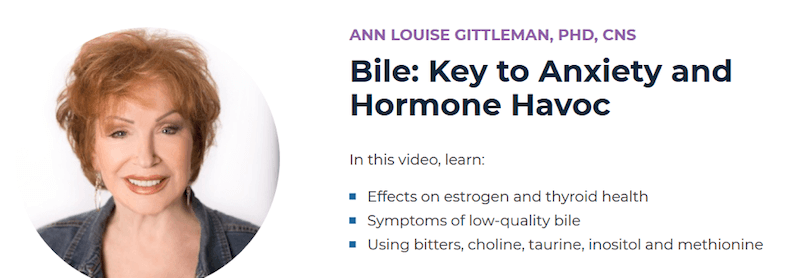
Ann Louise Gittleman is one my guest experts on The Anxiety Summit 5: Gut-Brain Axis and our topic is: Why Bile is the key to Anxiety & Hormone Havoc.

ann louise gittleman on anxiety summit 5

We had such a wonderful interview. She is sharp and funny, and really good with her short catchy phrases like this one: “Let’s make bile as important as probiotics!”

We start with the important role of bile in our bodies:

it emulsifies and digests fat, breaking it down into small particles so that your intestines can absorb them. It also helps escort toxins that your liver has removed out of the body.

We cover some of the many symptoms of low quality bile, such as queasiness, nausea, pale-colored stools, constipation and even motion-sickness.

ann louise gittleman and trudy scott

Here is a snippet from our interview where Ann Louise shares about bitters, bile and the importance of digesting your fats:

I’m all for fat, I’ve written about it for years and have been on the frontlines of essential fatty acids. But if you’re not digesting fats you’re not using them and getting the benefits of your fat soluble vitamins A, D, E and K.

So bile is brilliant! Bring back the importance of bile and we know that bitter is better!

If you can remember all of that you’re on the right track to dealing with your anxiety and hormone havoc.

She covers the role of bile in PMS, estrogen imbalance and thyroid health; how it’s involved in the removal of toxins from the body:

Bile is the dumping ground for hormones like estrogen. It’s the dumping ground for heavy metals that create anxiety like mercury, as well as too much aluminum and lead. And it’s the dumping ground, also, for a bunch of chemicals. So you got to keep the bile flowing. You have to keep it decongested. You have to thin it out.

And simple tools to improve bile production (one of them being the addition of bitter greens to your diet).

You need to keep your bile nice and thinned out so it doesn’t clog up with extra estrogen that it’s not breaking down. And we do that with the bitters. The bitters are going to be the theme throughout. We do that with lemon and water in the morning. We do it with coffee, which is a bitter, believe it or not. And we do it with grapefruit and watercress, which are wonderfully bittered produce, high-end bittered produce. So bitter is very important for this.

We take a deep dive into key  nutrients for bile production and quality: choline, taurine, inositol and methionine:

You want to make sure that you’re taking certain types of lipotropic nutrients. And the magic word here is lipotropic that will help to digest fats. And that would be your methionine, your choline, and your inositol.

Five hundred milligrams of choline, methionine, and inositol three times a day will help your body, particularly your liver, to break down hormones such as estrogen into a non-toxic metabolite like estriol, which is the non-toxic estrogen. And that’s very important. And those three nutrients, my dear friend, are very much deficient in the diet today.

We also go into zinc: copper imbalances and the role this plays in PMS, hormone balance and anxiety. We talk about avocado and almond flour – both are good sources of fats and both need good quality bile to be digested. You may be surprised to hear what Ann Louise shares about these two foods. You’re going to have to tune in to know what I’m talking about. If you’re surprised (or even if you’re not) please let me know in the comments.

You likely know Ann Louise Gittleman as a New York Times Bestselling author of over 30 books on diet, detox, the environment, and women’s health. Beloved by many, she is regarded as a nutritional visionary and health pioneer who has fearlessly stood on the front lines of holistic and integrative medicine.

One of my favorite books of hers is Before the Change: Taking Charge of Your Perimenopause (my Amazon link for the book). This book helped me so much when I was in the midst of my PMS, anxiety and panic attacks in my late 30s. It was this book that taught me about my need for zinc and vitamin B6 and evening primrose oil before I even knew that pyroluria existed. It was one of the many books I read at that time, starting me on my lifelong journey of reading about nutrition, studying to become a nutritionist and attending conferences and summits.

Learn more/purchase now

If you’d like to give feedback or ask a question, please post in the comments section below.

Filed Under: The Anxiety Summit 5 Tagged With: ann louise gittleman, anxiety, anxiety summit, bile, bitters, choline, copper zinc, hormone imbalance, inositol and methionine, taurine, toxins

How to address rectal spasms with GABA, pelvic floor work, gluten removal and squats

July 7, 2017 By Trudy Scott 43 Comments

Last week I wrote about proctalgia fugax, a condition that leads to rectal spasms and sharp fleeting pain in the lower rectum or anus, often described as excruciating and agonizing. Proctalgia fugax actually means anal pain of unknown cause but I am seriously questioning this definition because as you’ll see below there are a number of possible root causes!

I have experienced this horrible pain and was not willing to use medications. Instead, because I could find no other solutions, I experimented with sublingual GABA during an episode and then figured out how to prevent a spasm at the first hint of pain.  You can read all the details on this blog: How GABA eases agonizing rectal pain and spasms in under 2 minutes

I promised to share part 2 with some root causes and other solutions but this article has grown because of all the wonderful feedback on the above blog. I’ve gathered some of it here as additional resources.

What is the pain like?

Here are some additional descriptions of the pain (sharing here so others can relate and feel comforted that this is not something weird):

  • horrible, shooting pain up the lower rectum/spine area
  • I have had this issue since I was about 45 (I’m now 60) at least a few times per year. It lasts usually 15 to 30 minutes and is extremely painful.
  • I have had this pretty much all my life. More common with my period and the spasm lasts for close to 1/2 hour or so. Very deep aching pain.
  • It stops me in my tracks. The pain is so bad sometimes I can’t breathe. It’s scary.

For some people the fear of having a spasm when out and about is extremely traumatic:

It seems no one in the mainstream medical field is concerned about it. It may be physically harmless but I know many people on other forums who live in constant fear of an attack – especially publicly. It is far from psychologically harmless.

I loved all the feedback: pleased to find out there is a name for it and feel comforted to know you’re not alone. Many have been worried and embarrassed to ask for help. And across the board you are all very interested in experimenting with GABA (or theanine or taurine) to see if it helps reduce or eliminate the spasms in the moment.

This GABA approach is a good one because it helps ease the pain and spasms and because stress is a common underlying factor.

Positive feedback about GABA helping

I am pleased to get some positive feedback that GABA is helping:

I used to get these right before my period – hormonally related for me. Interestingly, I have been taking Pharmagaba to help me sleep better and to help me relax…noticed that I haven’t had one of these “butt cramps” as I call them, in months.

And this wonderful result from someone else:

There were times I literally had to sleep in the tub for 5 hours at a time and keep refilling it hot water. Most excruciating pain I’ve ever had and I’ve birthed a child naturally! I’m taking GABA for other reasons and after reading this (facebook post), I realize I haven’t had this since!

Concerns about using GABA

A few of you had concerns about using GABA – for example: GABA causes palpitations for me but I will seriously consider trying it.

I wouldn’t use GABA if it causes palpitations or I would at least experiment with super small amounts. I mentioned I’ve used up to 500mg – for many people this is too much and even 100mg may help. Taurine may be an option too. If you can’t tolerate GABA or taurine the next section covers some other options and how to address some of the possible root causes.

And someone shared that when she took GABA in the past for anxiety it really seemed to make her more anxious:

Since I did not have the expected result for anxiety, I wonder if it would not be the best choice for me in this situation either . . . I would like to use something which works quickly, so the sublingual option would have been appealing. I have used l-theanine with good results (for anxiety) and have never tried taurine before.

I would not recommend GABA for someone who gets more anxious with it. When something does work, like theanine, I’d go with that approach. Or I would consider a very small dose of GABA and build up slowly.

There are some common patterns

When looking at common patterns many who responded on the GABA blog:

  • Have had a hysterectomy, vaginal prolapsing and/or abdominal surgeries like repair of a large umbilical hernia (but not everyone)
  • Have IBS and digestive issues, as well as food sensitivities
  • Identify with stress being a factor and relate to feeling “irritable, perfectionistic, meticulous, obsessional, tense, and anxious.” As I mentioned above, GABA addresses the spasms and also relieves some of the stress and tension. And by addressing low serotonin with tryptophan this eases the worry, irritability and perfectionism
  • Observe spasms during ovulation and/or when menstruating. GABA and tryptophan help with hormone balancing too

Medications for relief

Many find relief with medications but side-effects always need to be considered and it makes the most sense to get to the root causes and address them. Here are some mentioned:

  • Benzodiazepines: I would dissolve a tab under my tongue and it would help the pain within a few minutes. As I would expect benzodiazepines to help but open up another whole can of worms – with tolerance (and needing higher doses), addiction and withdrawal).
  • Naproxen (an NSAID) has side-effects as does a medication like Cyclobenzaprine (a muscle relaxer)

Addressing tight pelvic floor muscles and stress

We always want to get to the root causes of an issue and that is the most logical step. I reached out to the practitioners in my community to ask them how they help their clients and patients with this and what approaches they have used to end the spasm and pain. My colleague, Jessica Drummond, nutritionist and physical therapist, and an expert on female pelvic pain and women’s health, shares this advice:

For women with proctalgia fugax, the acute rectal spasm can come at any time unexpectedly. Usually, this is a sign that your pelvic floor muscles are tight and need to be relaxed. Avoid doing Kegel exercises, and see a physical therapist who is a pelvic floor specialist in order to release the muscles of your pelvic floor.

Additionally, it’s important to be sure that you’re finding time each day to fully relax, breathe deeply, and receive support from your family or friends. Often women with pelvic floor muscle spasm feel stressed or a lack of safety in their lives and bodies. So, working with a skilled professional to address your stress is key.

Lorraine shared these wonderful results with her pelvic floor therapy (on the GABA blog) and how much it’s been helping her:

Anxiety or stressful times was a huge trigger (I am still pretty type A) and I finally learned one reason among many that stress triggers it. My naturopathic doctor sent me to see the ‘guru’ in pelvic floor therapy–Caroline Allen in Ottawa. I suffered for years with anxiety and did not realize that I was still constantly holding my tummy in as an old habit to stress even now that I have overcome my anxiety disorder. She taught me how to relax the core which was a challenge at first and required much conscious thought–those muscles had many years of training to stay tight. I was also breathing incorrectly and she showed me that when our breathing is incorrect, our diaphragm is tight and then it pulls up and tightens the entire pelvic floor. I can often prevent or significantly decrease the severity of an attack by reminding myself to relax certain key muscles and breathing into the pelvic floor.

Gluten sensitivity, other food sensitivities and functional imbalances

Jessica also shares what can worsen pelvic floor function:

You may have nutrient deficiencies or [gluten or other] food sensitivities that can worsen your pelvic floor muscle function. And, if you have IBS or constipation that should be addressed by a nutrition professional who specializes in digestive or pelvic health.

Here is some of the feedback I received on the GABA blog, observing links to gluten sensitivity, other food sensitivities and functional imbalances:

  • Gluten sensitivity
    • I found that once I eliminated gluten from my diet, this almost eliminated the problem.
  • Other food sensitivities – keeping a food-stress-spasm log will help you figure this out
    • We have found a sensitivity to corn, coconut, and nightshades and eating these brings on an attack. I suspect gluten as well but don’t always get an attack the way corn will
    • Food too high in phytic acid is a huge trigger for me…I avoid nuts like the plague
    • I do have gluten intolerance, and have been gluten free since 2009. I also stay away from dairy, all grains, and eggs. Recently I went off of all nightshades and on a lectin free diet. I haven’t seen any difference yet, and it has been over a month, but then again I haven’t had a spasm lately either. Not sure if that is a coincidence or not.
    • I have discovered that the following foods bring it on the next day: gluten, onions, citrus, especially orange juice, and black tea. Staying away from these foods has made a huge difference, but I still get episodes, which makes me think there’s another trigger I haven’t discovered
  • Any functional imbalance
    • I’ve recently been seeing a new naturopathic doctor who addressed SIBO, hormone imbalance as well as a stubborn parasite. My attacks most often occurred in correlation with constipation, digestive upset and ovulation pain (I had low zinc and low progesterone). Addressing all three factors has helped.

Other possible factors that should be considered: low magnesium, low potassium, low serotonin, low vitamin D, low zinc and dehydration, and look at drug-induced nutrient depletions from the BCP, fluroquinolones and proton pump inhibitors.

Jessica provides a comprehensive overview in this article: Physical Therapy and Nutrition: A Powerful Combination To Heal Pelvic Pain. It’s written for health professionals but is an excellent overview for anyone.

Some other possible solutions

I received so much wonderful feedback on the GABA blog that I’ve gathered these other possible solutions into a list:

  • Skullcap and valerian for mild symptoms
  • Designs for Health Gastromend, a product that is healing for entire GI tract helps in 15 minutes. Drinking Aloe juice may be helping
  • Sitting on the toilet and pushing down like with a bowel movement [this doesn’t feel good when I do it] or sitting on my foot to apply upward pressure before the spasm gets to deep will generally shorten the duration. I have found that stretching and holding the stretch for a few minutes will ease the intensity and duration of the spasm.
  • Nothing seems to help me except for a really hot heating pad. It usually takes about 20 minutes or a little longer for the spasms to go away

Squats, reflexology and downward dog for immediate relief

I also received these solutions that provide immediate relief while you’re figuring out and addressing the bigger root causes:

  • My gastroenterogist recommended going into a deep squat when the spasm starts. I tried and it worked!
  • I rub the inner ankle area (above the bone) in an upward motion – both sides. I rub as hard as I can. It takes a few minutes of rubbing but the pain reduces almost immediately. I went to a foot reflexologist and she said that this area relates to the rectum.
  • Downward dog yoga pose

I appreciate all the wonderful feedback on the GABA blog and the opportunity to share this so more of us get answers more quickly! Too often we think it’s just us but I encourage seeking solutions no matter what weird quirks we think we have!

I have one more article to share on the topic so stay tuned for part 3 with an exercise that strengthens the pelvic area and reverses rectal spasms.

Feel free to share what’s worked for you, what your possible triggers are and if GABA or any of these approaches resonate with you.

Filed Under: GABA Tagged With: anal, anus, anxiety, cramp, food senistivities, GABA, gluten, menstruation, pain, pelvic floor, Proctalgia fugax, rectal spasm, stress, taurine

How GABA eases agonizing rectal pain and spasms in under 2 minutes

June 30, 2017 By Trudy Scott 188 Comments

Proctalgia fugax is described as a condition that leads to rectal spasms and sharp fleeting pain in the lower rectum or anus. In some people it can be more than fleeting and is often described as excruciating and agonizing.  

This paper describing proctalgia fugax shares how this pain can

recur over weeks, is localized to the anus or lower rectum, and can last from seconds to several minutes with no pain between episodes. There is no diurnal variation. There are numerous precipitants [preceding factors] including sexual activity, stress, constipation, defecation and menstruation, although the condition can occur without a trigger.

Although the cause of proctalgia fugax is unclear, spasm of the anal sphincter is commonly implicated. The condition may be more likely to occur after sclerotherapy for hemorrhoids and vaginal hysterectomy. There are also associations with other functional pathologies, such as irritable bowel syndrome and anxiety.

My story

I have experienced this awful anal sphincter spasm and pain myself so I want to shine some light on this condition and offer the simplest and most effective solution: oral and sublingual GABA. It works to completely eliminate the pain in 1-2 minutes! And it can also be used to prevent a full-on spasm if you catch it in advance. More about this below.

Let me first share my story so you can relate to the pain. I started to experience this a few years ago. It was right after my aunt died from rectal cancer and my immediate thought was that I was dying of cancer. That’s how bad the pain was. It’s like nothing I’ve ever experienced and I’ve had some pretty bad pain experiences: shingles, a tick bite headache, ice-pick headaches from a neck injury and poking my eye on a tree-branch while hiking.

For me, since it initially used to happen during the night, it felt like I was in bad dream and was lying somewhere injured and in agony. I would half wake-up moaning in pain, not quite grasping how the pain I was feeling could be so bad. Then I would come fully awake and feel the need to bear down (as in needing to have a bowel movement) but this would actually make it worse.

How do others describe the pain?

When I shared this paper on facebook one woman said her rectal pain and spasms last 20-30 minutes and is bad a childbirth.

Someone else shared that her husband “complained of feeling like a knitting needle was being driven through his anus.”

What do I think my triggers are?

I have not had sclerotherapy for hemorrhoids or a vaginal hysterectomy. I do have a history of anxiety and panic attacks (in my late 30s) and do have IBS/SIBO right now and I suspect that both low GABA and IBS/SIBO are my biggest root causes. I no longer have any anxiety but since I respond so well to GABA I assume my GABA levels are not optimal (likely due to the SIBO). I suspect exposure to hidden sources of gluten could also be a factor, and this could also affect my GABA levels.

Medications or heating pads as a solution?

I didn’t ever consider the conventional approaches which include: botox, benzodiazepines, SSRIs, Gabapentin, lidocaine, oral diltiazem, topical glyceryl nitrate, nerve blocks or salbutamol.

A warm bath has been reported to help but I was looking for a 1-2 minute fix (and less if possible). Once you’ve experienced this pain you’ll understand that you not imagine running a bath in the midst of a spasm and waiting to get in it.

Heating pads do also work but can take 20 minutes to take effect and that is simply too long for most people.

The first solution for in-the-moment relief (takes 2 to 12 minutes)

After the first episode I started searching online and because I didn’t know it was called proctalgia fugax I searched for “rectal cramp”, “rectal spasm”, “anal cramp” and came across forums with hundreds of women asking about it and describing their pain.

But no-one really had a solution and many had seen their doctors without much success. The best solution that many people use is 30-60 seconds of finger pressure (with the finger wrapped in toilet paper) in the anal sphincter during a spasm. Sometimes this is needed for up to 2-3 mins and sometimes doing this 2 or 3 times a few minutes apart is needed. Think about how you put pressure on a calf muscle spasm to stop the cramps. This works well but the agony can last for the entire 2 to 12 minutes (depending on how many times it has to be done).  Adding a small amount of arnica cream onto the toilet paper seems to helps too.  

How common is it?

It took more searching and reading and then I discovered what it was called. Once I found a name for it and started looking into I was surprised to see how common it is:

The prevalence of proctalgia fugax in the general population may be as high as 8%–18%. Many patients present to primary health care physicians and often do not require further consultation because the symptoms are fleeting. This condition is more common among women than among men, and usually affects patients between 30 and 60 years of age.

Although it’s more common among women I worked with a male client who experienced this. During one of his episodes, the pain was SO bad he actually passed out and hit his head on the bathroom floor.

The best solution for almost-immediate relief (takes 1 minute)

I know that GABA works amazing well for physical anxiety and stiff and tense muscles and I decided to try GABA in the midst of a spasm. It worked amazingly well and within 1 minute the terrible pain started to ease. It does need to be taken sublingually and I have found that 250mg to 500mg opened onto my tongue works best for me.

Each person would need to find the ideal amount for their needs but at night this should be a reasonable amount. During the day this could be too much and make you sleepy or too relaxed.

I’ve also used a combination of sublingual GABA and theanine with similar results.

I know GABA isn’t readily available everywhere so I did an experiment with taurine and found I needed more (at least 1000 mg) and it did take longer (2-3 minutes) to get relief, but it did work.

THE immediate solution for preventing the spasm

But I have now gotten to the point where I can nip it in the bud and prevent the spasm altogether – by taking sublingual GABA at the very first hint of an ache or twinge. I’ve been fortunate that when this does happen (about once a month and sometimes every 2 months) it’s around 8-11pm.

The long-term solutions for getting to the root cause/s?

We always want to get to the root cause of an issue and that is the next step. I reached out to the practitioners in my community to ask them how they help their clients and patients with this and what approaches they have used to end the spasm and pain. I will be sharing some of their solutions and how to get to some of the root causes in part 2.

UPDATE: Here is part 2 – How to address rectal spasms with GABA, pelvic floor work, gluten removal and squats

I’d love your feedback!

I’d love your feedback so I can learn what works, so we can all learn from each other and so others get answers quicker than I did.

Have you ever experienced this rectal pain and spasms? And what has worked for you?

I’d love to know if it is more common after sclerotherapy for hemorrhoids and vaginal hysterectomy? Have you had either? Or any surgery in the abdominal area?

Do you also have IBS/SIBO?  What about celiac disease or gluten sensitivity?

Do you currently have anxiety or mood issues or have a history of anxiety or mood issues?  How many low GABA and low serotonin symptoms do you have – here is the questionnaire  (a paper from 1965 mentions that patients with proctalgia fugax have been described as irritable, perfectionistic, meticulous, obsessional, tense, and anxious)

If you’ve tried GABA or these other approaches (or decide to try them) please come back and share.  Too many people don’t know about this and it needs to change!

Filed Under: Amino Acids, Antianxiety, GABA, Hormone, Pain, SIBO, Women's health Tagged With: anal sphincter, anus, anxiety, cramp, GABA, pain, Proctalgia fugax, rectal spasm, taurine

Primary Sidebar

NEW! GABA QuickStart Homestudy (with special intro pricing)

gaba quickstart homestudy

Free Report

9 Great Questions Women Ask about Food, Mood and their Health

You'll also receive a complimentary subscription to my ezine "Food, Mood and Gal Stuff"


Connect with me

Popular Posts

  • Amino Acids Mood Questionnaire from The Antianxiety Food Solution
  • The Antianxiety Food Solution Amino Acid and Pyroluria Supplements
  • Pyroluria Questionnaire from The Antianxiety Food Solution
  • Collagen and gelatin lower serotonin: does this increase your anxiety and depression?
  • Tryptophan for the worry-in-your-head and ruminating type of anxiety
  • GABA for the physical-tension and stiff-and-tense-muscles type of anxiety
  • The Antianxiety Food Solution by Trudy Scott
  • Seriphos Original Formula is back: the best product for anxiety and insomnia caused by high cortisol
  • Am I an anxious introvert because of low zinc and vitamin B6? My response to Huffington Post blog
  • Vagus nerve rehab with GABA, breathing, humming, gargling and key nutrients

Recent Posts

  • What do I use instead of Seriphos to help lower high cortisol that is affecting my sleep and making me anxious at night?
  • BeSerene™ GABA/theanine cream eases severe muscle tension in her neck/shoulders, prevents her bad headaches and quells her anxiety
  • How the correct approach, dose and sublingual use of GABA can be calming and not cause a flushed and itchy face and neck
  • The amino acid glutamine improves low mood by addressing gut health, and it has calming effects too
  • Flight anxiety with heightened breath, physical tension and also fearing the worst (the role of low GABA and low serotonin)

Categories

  • 5-HTP
  • AB575
  • Addiction
  • ADHD
  • Adrenals
  • Alcohol
  • Allergies
  • Alzheimer's disease
  • Amino Acids
  • Anger
  • Antianxiety
  • Antianxiety Food Solution
  • Antidepressants
  • Anxiety
  • Anxiety and panic
  • Autism
  • Autoimmunity
  • benzodiazapines
  • Bipolar disorder
  • Books
  • Caffeine
  • Cancer
  • Candida
  • Children/Teens
  • Collagen
  • Cooking equipment
  • Coronavirus/COVID-19
  • Cravings
  • Depression
  • Detoxification
  • Diabetes
  • Diet
  • DPA/DLPA
  • Drugs
  • EFT/Tapping
  • EMF
  • EMFs
  • Emotional Eating
  • Endorphins
  • Environment
  • Essential oils
  • Events
  • Exercise
  • Fear
  • Fear of public speaking
  • Fertility and Pregnancy
  • Fish
  • Food
  • Food and mood
  • Functional neurology
  • GABA
  • Gene polymorphisms
  • General Health
  • Giving
  • Giving back
  • Glutamine
  • Gluten
  • GMOs
  • Gratitude
  • Gut health
  • Heart health/hypertension
  • Histamine
  • Hormone
  • Hyperparathyroidism
  • Hypoglycemia
  • Immune system
  • Inflammation
  • Insomnia
  • Inspiration
  • Introversion
  • Joy and happiness
  • Ketogenic diet
  • Lithium orotate
  • Looking awesome
  • Lyme disease and co-infections
  • MCAS/histamine
  • Medication
  • Men's health
  • Mental health
  • Mercury
  • Migraine
  • Mold
  • Movie
  • MTHFR
  • Multiple sclerosis
  • Music
  • NANP
  • Nature
  • Nutritional Psychiatry
  • OCD
  • Osteoporosis
  • Oxalates
  • Oxytocin
  • Pain
  • Paleo
  • Parasites
  • Parkinson’s disease
  • PCOS
  • People
  • PMS
  • Postpartum
  • PTSD/Trauma
  • Pyroluria
  • Questionnaires
  • Real whole food
  • Recipes
  • Research
  • Schizophrenia
  • serotonin
  • SIBO
  • Sleep
  • Special diets
  • Sports nutrition
  • Stress
  • Sugar addiction
  • Sugar and mood
  • Supplements
  • Teens
  • Testimonials
  • Testing
  • The Anxiety Summit
  • The Anxiety Summit 2
  • The Anxiety Summit 3
  • The Anxiety Summit 4
  • The Anxiety Summit 5
  • The Anxiety Summit 6
  • Thyroid
  • Thyroid health
  • Toxins
  • Tryptophan
  • Tyrosine
  • Uncategorized
  • Vegan/vegetarian
  • Women's health
  • Yoga

Archives

  • October 2025
  • September 2025
  • August 2025
  • July 2025
  • June 2025
  • May 2025
  • April 2025
  • March 2025
  • February 2025
  • January 2025
  • November 2024
  • October 2024
  • September 2024
  • August 2024
  • July 2024
  • June 2024
  • May 2024
  • April 2024
  • March 2024
  • February 2024
  • January 2024
  • December 2023
  • November 2023
  • October 2023
  • September 2023
  • August 2023
  • July 2023
  • June 2023
  • May 2023
  • April 2023
  • March 2023
  • February 2023
  • January 2023
  • December 2022
  • November 2022
  • October 2022
  • September 2022
  • August 2022
  • July 2022
  • June 2022
  • May 2022
  • April 2022
  • March 2022
  • February 2022
  • January 2022
  • December 2021
  • November 2021
  • October 2021
  • September 2021
  • August 2021
  • July 2021
  • June 2021
  • May 2021
  • April 2021
  • March 2021
  • February 2021
  • January 2021
  • December 2020
  • November 2020
  • October 2020
  • September 2020
  • August 2020
  • July 2020
  • June 2020
  • May 2020
  • April 2020
  • March 2020
  • February 2020
  • January 2020
  • December 2019
  • November 2019
  • October 2019
  • September 2019
  • August 2019
  • July 2019
  • June 2019
  • May 2019
  • April 2019
  • March 2019
  • February 2019
  • January 2019
  • December 2018
  • November 2018
  • October 2018
  • September 2018
  • August 2018
  • July 2018
  • June 2018
  • May 2018
  • April 2018
  • March 2018
  • February 2018
  • January 2018
  • December 2017
  • November 2017
  • October 2017
  • September 2017
  • August 2017
  • July 2017
  • June 2017
  • May 2017
  • April 2017
  • March 2017
  • February 2017
  • January 2017
  • December 2016
  • November 2016
  • October 2016
  • September 2016
  • August 2016
  • July 2016
  • June 2016
  • May 2016
  • April 2016
  • March 2016
  • February 2016
  • January 2016
  • December 2015
  • November 2015
  • October 2015
  • September 2015
  • August 2015
  • July 2015
  • June 2015
  • May 2015
  • April 2015
  • March 2015
  • February 2015
  • January 2015
  • December 2014
  • November 2014
  • October 2014
  • September 2014
  • August 2014
  • July 2014
  • June 2014
  • May 2014
  • April 2014
  • March 2014
  • February 2014
  • January 2014
  • December 2013
  • November 2013
  • October 2013
  • September 2013
  • August 2013
  • July 2013
  • June 2013
  • May 2013
  • April 2013
  • March 2013
  • February 2013
  • January 2013
  • December 2012
  • November 2012
  • October 2012
  • August 2012
  • July 2012
  • June 2012
  • May 2012
  • April 2012
  • March 2012
  • February 2012
  • January 2012
  • December 2011
  • November 2011
  • October 2011
  • September 2011
  • August 2011
  • July 2011
  • June 2011
  • May 2011
  • April 2011
  • March 2011
  • February 2011
  • January 2011
  • December 2010
  • October 2010
  • September 2010
  • July 2010
  • May 2010
  • April 2010
  • March 2010
  • February 2010
  • January 2010
  • November 2009

Share the knowledge!

The above statements have not been evaluated by the Food and Drug Administration. Products listed in this website are not intended to diagnose, treat, cure or prevent any disease.

The information provided on this site is for informational and educational purposes only and is not intended as a substitute for advice from your physician or other health care professional. You should consult with a healthcare professional before starting or modifying any diet, exercise, or supplementation program, before taking or stopping any medication, or if you have or suspect you may have a health problem.


Copyright © 2026 Trudy Scott. All Rights Reserved. | Privacy | Terms and Conditions | Refund Policy | Medical Disclaimer

Free Report

9 Great Questions Women Ask about Food, Mood and their Health

You’ll also receive a complimentary subscription to my ezine “Food, Mood and Gal Stuff”