• Skip to primary navigation
  • Skip to main content
  • Skip to primary sidebar

everywomanover29 blog

Food, Mood and Women's Health – Be your healthiest, look and feel great!

  • Blog
  • About
  • Services
  • Store
  • Resources
  • Testimonials
  • The Book
  • Contact
  • Search this site

PMS

How the correct approach, dose and sublingual use of GABA can be calming and not cause a flushed and itchy face and neck

October 10, 2025 By Trudy Scott 12 Comments

correct use of gaba

I started GABA 750mg and think it gently chills out my anxiety a bit, however 20 minutes after I take it, I feel flushed and itchy in my face and neck. This lasts for 5 minutes and then goes away.

I am in a migraine program with a health coach who has referenced your book several times. She recommended I stop it because it sounds like an allergy. I personally would think it would last longer if it was an allergy.

What do you think? Have you heard of this reaction before? I thought it would maybe get better as my body gets used to taking it? I wanted to continue because I think it’s helping. Thank you.

Sharon posted the above feedback about her promising calming results with GABA and her flushed/itchy question on one of the blogs.  She also asked this:

Just read other posts and I’m just beginning to learn all of this info on your site. I’m also getting your book. Looks like I may have started too high? Could I open up one of my capsules and just take powder orally and then work up?

Read on below to learn more about the fact that too much GABA does cause flushing; the correct approach, dose and sublingual use of GABA for Sharon; Holly’s similar story with 750mg GABA; and GABA, serotonin and endorphin support for Sharon’s other symptoms (headaches, migraines, PMS, sleep issues and rectal spasms); plus additional resources when are new to amino acids such as GABA, 5-HTP, DPA and others.

Too much GABA does cause a flush feeling

Firstly, it’s wonderful that GABA gently chills out Sharon’s anxiety a bit. And she is correct – her flush and itchy face and neck is unlikely to be an allergic reaction. Too much GABA does cause a niacin-like flush or tingling feeling and yes, I have heard of this reaction many times. Unfortunately it leads to many people giving up on GABA when they really do need it.

Sharon shared this: “I thought it would maybe get better as my body gets used to taking it?”  Unfortunately, many individuals think the same and end up pushing through the discomfort and it’s not what I advise. She was wise in exercising caution and finding out by reading more on the blog, getting a copy of my book, The Antianxiety Food Solution and asking on the blog.

I have no idea why supplement companies produce such a high dose GABA product and it’s something I caution all my clients and GABA Quickstart program participants about.

The correct approach, dose and sublingual use of GABA for Sharon

Sharon also acknowledges she probably started with too high a dose and asks about opening up the GABA capsule and working her way up. This is exactly what we need to do to get results with GABA and not cause new issues.

Some other options to opening the GABA capsule could be:

  • a GABA only powder
  • a GABA sublingual product (such as GABA Calm)
  • a liposomal GABA product
  • a GABA cream (she reported migraines and neck tension so a cream may be a good option for her too)

I also have clients start with only one amino acid product and find the ideal dose before adding the next amino acid acid. And track results carefully so they can course correct, adjusting up or down as needed.

Sharon did come back and comment a week later sharing this adjustment she had made:

So I have been opening the GABA capsule and taking half a dose (so 375mg) on my tongue in the morning and then in the afternoon. I don’t notice the real calm like I did with the whole capsule though.

She’s on the right track and the next step could be to use three-quarters of a dose twice a day and see how that helps. Another option is half a dose, maybe 4 x day. There is no one-size fits all and it’s a matter of Sharon finding what works best for her unique needs.

Keep in mind that for some individuals even 375mg is too high a dose. I typically have clients start with 125mg GABA and less if they are super-sensitive.

Holly’s story with 750mg GABA is very similar

I’ve actually blogged about this before: Too much GABA causes a tingling niacin-like flush sensation (in the brain and body). It’s awful and very uncomfortable!) and shared Holly’s niacin-like flush result when using the same dose:

I experienced the niacin-like flush when I tried to go from GABA Calm [mostly dissolved in my mouth] to a pill form and didn’t realize the dosage would be way too high all at one time. The pill was 750 mg GABA [and swallowed with food], so it wasn’t going to work well anyway.

The flush lasted about 15-20 minutes. It was awful. I was sure I was going to throw up every time.

It took me a couple of weeks to figure out the cause.  My therapist recommended your website and book and those helped me understand when to take it and why it would help.

When I eliminated the 750 mg GABA  pill the symptoms completely went away.

Now I stick to GABA Calm. I take one in the morning and one before bed and sometimes one midday.

You can read more about this flush feeling on the above blog and another example.

GABA, serotonin and endorphin support for Sharon’s other symptoms

Sharon also has headaches, migraines, PMS, sleep issues and rectal spasms:

I’ve got chronic headaches and frequent migraines. Other weird symptoms are lip dermatitis, hormone imbalance, PMS, and rare rectal spasms which I saw referenced on your site too. Serotonin issues too and I also recently started 5-HTP 200mg at night which seems to be helping my PMS insomnia.

It’s great that 5-HTP is helping her PMS-related sleep issues. Both GABA and 5-HTP (for serotonin support) may help with her hormone balance, which in turn, may help with her headaches and migraines too. She may also want to consider a trial of d-phenylalanine/DPA for endorphin support/pain relief. GABA itself helps to ease neck tension and headaches.

GABA does stop very painful rectal spasms very quickly. More about this here – GABA lozenge relieves excruciating pelvic floor/rectal pain and spasms within 30 seconds: a solution for proctalgia fugax.

As I mentioned above, I have clients and those in the GABA Quickstart program start with GABA and find the ideal dose before adding the next amino acid acid. For Sharon, I’d recommend that she finds her ideal dose of GABA before bumping up her 5-HTP and adding DPA.

Additional resources when you are new to using GABA or other amino acids as supplements

We use the symptoms questionnaire to figure out if low GABA (indicating a possible need for GABA or theanine) or low serotonin (indicating a need for tryptophan or 5-HTP) or low endorphins (indicating a possible need for DPA) or other neurotransmitter imbalances may be an issue for you.

If you suspect low levels of any of the neurotransmitters and do not yet have my book, The Antianxiety Food Solution – How the Foods You Eat Can Help You Calm Your Anxious Mind, Improve Your Mood, and End Cravings. I highly recommend getting it and reading it before jumping in and using amino acids on your own so you are knowledgeable. And be sure to share it with the practitioner/health team you or your loved one is working with.

There is an entire chapter on the amino acids and they are discussed throughout the book in the sections on gut health, gluten, blood sugar control, sugar cravings, anxiety and mood issues. The importance of quality animal protein and healthy fats is also covered.

The book doesn’t include product names (per the publisher’s request) so this blog, The Antianxiety Food Solution Amino Acid and Pyroluria Supplements, lists the amino acids that I use with my individual clients and those in my group programs.

If, after reading this blog and my book, you don’t feel comfortable figuring things out on your own (i.e. doing the symptoms questionnaire and respective amino acids trials), a good place to get help is the GABA QuickStart Program (if you have low GABA symptoms). This is a paid online/virtual group program where you get my guidance and community support.

If you also need serotonin support, the Serotonin QuickStart Program is a good place to get help. This is also a paid online/virtual group program where you get my guidance on using tryptophan and 5-HTP safely, and community support during 5 LIVE Q&A calls. You can sign up to be notified when the next live launch of this program is happening.

If you are a practitioner, join us in The Balancing Neurotransmitters: the Fundamentals program. This is also a paid online/virtual program with an opportunity to interact with me and other practitioners who are also using the amino acids.

Now I’d love to hear from you…

I appreciate Sharon and Holly for sharing their experiences and asking questions. I’m hoping their stories have enlightened you!

And I am thrilled that her migraine health coach referenced my book and told her about GABA. It’s a great book that many practitioners share with their clients and patients.

Have you experienced this uncomfortable feeling when using too much GABA? And did you learn to use less in order to get the calming benefits of GABA?

How much do you find helps? And do you use powder or capsules opened or liposomal or cream?

Has serotonin or endorphin support helped too?

Feel free to share and ask your questions below.
Filed Under: Anxiety, GABA Tagged With: 5-HTP, 750mg, allergy, amino acids, anxiety, calming, chill, dose, DPA, endorphin, flushed, flushing, GABA, Headaches, itchy, migraines, PMS, rectal spasms, serotonin, sleep issues, sublingual, too high

Tryptophan and GABA for relaxation, jaw pain, sleep, anger and mood symptoms

June 13, 2025 By Trudy Scott 10 Comments

tryptophan gaba relaxation

I typically start clients on tryptophan if they have signs of low serotonin: stressed, overwhelmed worry, fears, obsessing, feeling anxious, ruminations, low mood, anger issues/rage, sleep problems, pain issues, PMS, low self-esteem, imposter syndrome, and afternoon/evening carb cravings etc. If we don’t get expected results we switch to 5-HTP as some people do better on one vs the other.

With signs of low GABA – a more physical kind of anxiety, with some overwhelm, intrusive thoughts, tension, sleep issues (often lying awake tense), stress-eating and/or drinking and pain – I typically recommend a GABA only product (as a powder or capsule opened) or GABA Calm (a sublingual). In some cases we may consider theanine and pharmaGABA.

The best way to assess low GABA and low serotonin is the symptoms questionnaire and a trial of the respective amino acids – one at a time. But the key is to find the ideal amount for the unique needs of each person. We do that by methodically and systematically increasing the amino acid slowly and tracking improvements for each increase.

In this blog you can read some success stories from women who used tryptophan and GABA for relaxation, jaw pain, sleep, anger and mood symptoms, and my commentary with some additional insights.

Tryptophan and GABA (as powders) – for her stress and pain

Amy uses both tryptophan and GABA for relaxation and jaw pain:

I use both tryptophan and GABA, I just take them separately. When my jaw was really bad the tryptophan really helped. I also do vagus nerve stimulating exercises that make me yawn and it stretches and releases the jaw.

As for the GABA …when I’m very stressed, I need extra to feel the effects. I use a pinch between the fingers of the Now powder and let it dissolve on my tongue. I feel my body relax in about 30 seconds. If nothing then I take a second pinch. Most days 1 pinch is enough.

I also let tryptophan dissolve in my mouth and most days I feel the same physical relaxation after a few moments. It’s not always obvious with the tryptophan though. I use 1/4 tsp of powder but you can use capsules. I mix the powder with pudding powder because it’s very bitter.

Both tryptophan and GABA can help with pain, and also feeling anxious and stressed.

The benefits are via different mechanisms – tryptophan boosts low serotonin and it’s typically more of a mental type of relaxation. This blog illustrates the use of tryptophan for TMJ (temporomandibular joint) – Tryptophan ends TMJ pain, headaches and worry, and improves mood and sleep: a success story.

The amino acid GABA boots low GABA levels and it provides more of a physical type of relaxation and also helps with pain relief.

I like that Amy is using both amino acids as powder and I’m happy for her. GABA powder tastes pleasant and is much more effective used this way (or capsule opened or sublingual).

Tryptophan can be swallowed but many find it more effective as a powder or capsule opened. As Amy says, it’s very bitter as a powder.

Tryptophan or 5-HTP and different forms of GABA – for sleep, anger and mood symptoms

Kerry tried 5-HTP and pharmaGABA but did better with tryptophan and GABA Calm:

My naturopath had me on 5-HTP but I never felt a benefit, and pharmaGaba was a histamine trigger. After reading your book I tried tryptophan and spent many months on 2 x 500mg at bedtime. This helped with sleep and definitely stopped the surges of anger that happened often.

I read a lady say her staple was 2 x Gaba Calm at bedtime and on rising, so I tried this and it helped.

I now take both tryptophan and Gaba Calm only if I feel niggly mood symptoms.

My previous diet was standard vegetarian, then vegan for several years. I now have lots of protein in the form of beef liver capsules, eggs and protein powder. I don’t like meat.

Kerry shared all this in a recent blog comment, describing how tryptophan and GABA Calm were big game-changers for her, in addition to “a long slow mold detox …addressing nutritional deficiencies and implementing dietary changes.”

Mycotoxins caused by mold, nutritional deficiencies and a poor quality diet can impact neurotransmitter production. The good news is that when you find the right combination of amino acids – in this case tryptophan and GABA Calm – you can get relief  right away while the other factors are being addressed. It reduces the overwhelm, stress and fears too.

Kerry’s approach of consistent use of both amino acids is the best way to go and I’m so happy for her. And once levels are sufficient they can be used as needed, provided other underlying causes (like toxins, diet etc) are being addressed.

I will add that some individuals do better on 5-HTP and some do better on tryptophan so it’s often a matter of doing a trial of both. I typically recommend tryptophan to start because 5-HTP can be an issue if cortisol is high.

I also always recommend starting with some forms of GABA because of the potential histamine issues with pharmaGABA. That said, some individuals do tolerate pharamGABA so it’s worth doing a trial of both. And we may also consider theanine when we want to support low GABA, low serotonin and low dopamine.

Theanine and tryptophan and diet/lifestyle changes – and feeling her best!

Luna worked with a health practitioner to taper off Prozac (very slowly) and used amino acids during the taper and afterwards:

As someone who took Prozac for years and eventually came off, please pay special attention to Trudy’s advice to come off it SLOWLY. I’d say do it so slowly it may seem ridiculous.

I tried three times to get off Prozac and it was only with the help of an ND/PharmD did I finally get the info needed to come off it without *awful* side effects. To do it well, the process takes MONTHS – not weeks as many doctors recommend.

These days, I take L-Theanine and L-Tryptophan. And I’m preparing to add some GABA soon. Combined with daily 45 minute walks outside, and a low-sugar/low-gluten diet, I’m doing the best I have in my adult life.

A comprehensive approach that includes amino acids, dietary changes, and getting out in nature can make a world of difference. I love it when I hear feedback like this.

Additional resources when you are new to using tryptophan and GABA and other amino acids as supplements

As always, I use the symptoms questionnaire to figure out if low serotonin or low GABA or other neurotransmitter imbalances may be an issue.

If you suspect low levels of any of the neurotransmitters and do not yet have my book, The Antianxiety Food Solution – How the Foods You Eat Can Help You Calm Your Anxious Mind, Improve Your Mood, and End Cravings, I highly recommend getting it and reading it before jumping in and using amino acids on your own so you are knowledgeable. And be sure to share it with the practitioner/health team you or your loved one is working with.

There is an entire chapter on the amino acids and they are discussed throughout the book in the sections on gut health, gluten, blood sugar control (this is covered in an entire chapter too), sugar cravings, anxiety and mood issues.

The book doesn’t include product names (per the publisher’s request) so this blog, The Antianxiety Food Solution Amino Acid and Pyroluria Supplements, lists the amino acids that I use with my individual clients and those in my group programs.

If, after reading this blog and my book, you don’t feel comfortable figuring things out on your own (i.e. doing the symptoms questionnaire and respective amino acids trials), a good place to get help is the GABA QuickStart Program (if you have low GABA symptoms). This is a paid online/virtual group program where you get my guidance and community support.

If you are a practitioner, join us in The Balancing Neurotransmitters: the Fundamentals program. This is also a paid online/virtual program with an opportunity to interact with me and other practitioners who are also using the amino acids.

Wrapping up and your feedback

Now I’d love to hear from you – how has tryptophan and GABA helped you or a loved one?

If you’d like to get on the notification list for the next Serotonin Quickstart Program (a paid online/virtual group program where you get my guidance and community support during 5 LIVE Q&A calls), please do so here.

If you’re a practitioner do you use tryptophan and GABA with your clients/patients?

Feel free to share and ask your questions below.
Filed Under: Anxiety, Cravings, GABA, Pain, serotonin, Tryptophan Tagged With: 5-HTP, afternoon/evening carb cravings, anger, fears, feeling anxious, GABA, GABA Calm, Imposter syndrome, intrusive thoughts, jaw pain, low mood, low self-esteem, low serotonin, mood symptoms, obsessing, overwhelmed, pharmaGABA, physical anxiety, PMS, rage, relaxation, ruminations, Serotonin Quickstart, sleep, stress-eating and/or drinking and pain, stressed, tension, theanine, tryptophan, worry

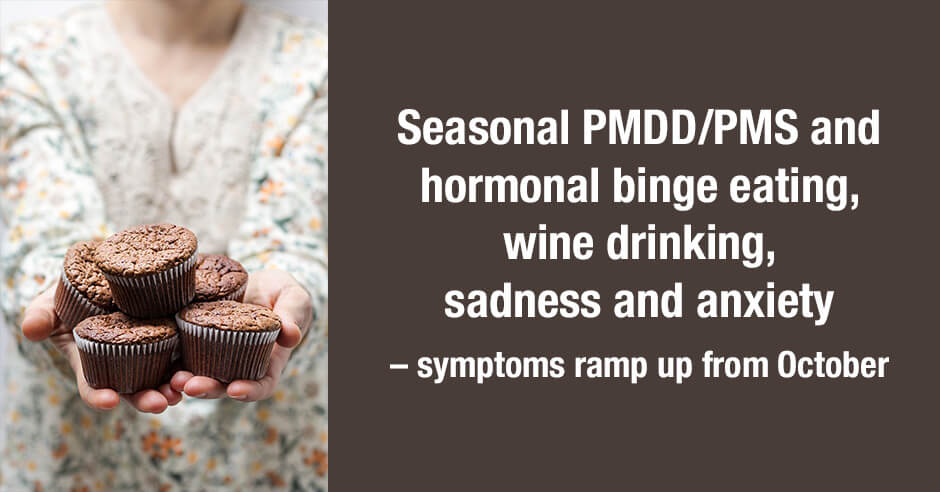
Seasonal PMDD/PMS and hormonal binge eating, wine drinking and anxiety – symptoms ramp up from October

November 17, 2023 By Trudy Scott 3 Comments

seasonal PMDD/PMS

Someone in the community asked for help for the seasonal aspect of her PMDD symptoms i.e. more severe symptoms in winter  …

My PMDD symptoms massively increase around the beginning of October right through to March. Would love some advice.

The binge eating and wine drinking is becoming habitual

She specifically mentions binge eating and wine drinking but I assume her other PMDD symptoms – such as anxiety, tension, anger, irritability, depression, sadness, hopelessness, insomnia, overwhelm, low energy, breast tenderness, headaches, pain, bloating, and/ or weight gain –  are more severe at this time too.

As you can see, her symptoms are much more severe from October through March (winter in the Northern Hemisphere). If you live in the Southern Hemisphere you could expect more severe symptoms from May through September (or thereabouts).

There is a seasonal aspect to PMDD (premenstrual dysphoric disorder) and PMS (premenstrual syndrome and other hormonal imbalances.  It’s not well recognized despite the fact that it’s documented in the research and seen clinically.

My feedback for her is to look into and address low serotonin, low GABA and/or low endorphins with the respective amino acids (adjusting up and down based on the season and symptoms), using recognized SAD (seasonal affective disorder) approaches and addressing pyroluria if needed (the nutrients are cofactors for neurotransmitter production.) I share more about each of these approaches and the research below.

The research: patients with PMDD have substantial seasonal patterns in mood and premenstrual symptoms

Premenstrual dysphoric disorder (PMDD) “accounts for the most severe form of PMS with the greatest impairment of women’s functioning and perceived quality of life, often prompting them to seek treatment.”

This older paper from 1997, Seasonality of symptoms in women with late luteal phase dysphoric disorder

  • Out of 100 patients treated in a subspecialty clinic in a university teaching hospital, “a significantly higher rate of seasonal affective disorder (38% versus 8%) as determined by Seasonal Pattern Assessment Questionnaire criteria.”
  • Also, 25% of the patients with seasonal variations in their premenstrual symptoms, consider them marked or a severe problem

The authors conclude that:

These results suggest that patients with LLPDD [or PMDD] have substantial seasonal patterns in mood and premenstrual symptoms. These seasonal patterns have implications for the clinical assessment and treatment of LLPDD [or PMDD]. For example, light therapy may be beneficial for women with seasonal worsening of LLPDD [or PMDD].

As you look at the research keep in mind the fact that late luteal dysphoric disorder (LLDD),“is now known as premenstrual dysphoric disorder (PMDD)”, as mentioned in the above paper and other older studies.

Seasonal variations in serotonin and GABA

Seasonal variations in serotonin have long been documented with much research on the winter blues. This paper, The chronobiology and neurobiology of winter seasonal affective disorder describes winter seasonal affective disorder (SAD) as “a mood disorder characterized by the predictable onset of depression in the fall/winter months, with spontaneous remissions in the spring/summer period.” They also state that “The typical patient with SAD is a premenopausal woman who experiences carbohydrate craving, hypersomnia, and prominent fatigue during winter depressive episodes.”

There is less awareness about GABA seasonality but GABA levels may also be lower in the winter months. In this animal study, Effect of the pineal gland on 5-hydroxytryptamine and γ-aminobutyric acid secretion in the hippocampus of male rats during the summer and winter, it is reported that: “GABA secretion in the hippocampus of rats had a seasonal rhythm consisting of increased secretion in summer and decreased secretion in the winter.”  I share more about this and the seasonality of GABA here.

It makes sense that supporting these lower levels in winter is going to help with the more severe PMDD symptoms that correlate with each neurotransmitter imbalance.

One solution: address low levels of neurotransmitters with amino acids

As you can see the PMDD symptoms mentioned above could fall into the categories of low GABA, low serotonin and/or low endorphins (and possibly low dopamine/catecholamines and low blood sugar too: binge eating, wine drinking, anxiety, tension, anger, irritability, depression, sadness, hopelessness, insomnia, overwhelm, low energy, breast tenderness, headaches, pain, bloating, and/ or weight gain.

(You can read this StatPearls ebook for the full description of the above symptoms: Premenstrual Dysphoric Disorder)

It’s for this reason I always have clients with PMDD (and other hormonal issues) do the Amino Acids Mood Questionnaire and trials of the respective amino acids.

Using a food mood log and tracking what time of day you binge eat and drink wine (and  all the other symptoms) is a clue as to which amino acids may help most. I would expect tryptophan, GABA and DPA would be at the top of the list, and possibly tyrosine and glutamine too.

Because of the seasonality aspect, a higher dose is likely to be needed in the winter time so if you’re just starting your amino acid trails keep this in mind. If you are already using amino acids with success in summer, then bumping up the amounts during winter is going to help further. And then be sure to reduce amounts once winter is over.

Hopefully you’ve also been working on diet, gut health, liver health, adrenal function, toxin removal and other factors to reduce or eliminate PMDD/PMS so the amino acids are not needed long term.

How targeted individual amino acids may help – some examples

As you can see from one study, tryptophan can help with premenstrual dysphoria/sadness, mood swings, tension, and irritability.

Low endorphins and low dopamine may also be a factor. I share more on this blog: DLPA (DL-Phenylalanine) eases PMDD/PMS symptoms in women who experience declining endorphin levels in the second half of their cycles

Here are some specific amino acid cases around binge eating/cravings and excessive wine drinking:

  • Would using 5-HTP or tryptophan help when you crave sugar (as a sort of antidepressant) late afternoon/evening?
  • Tryptophan had the added benefit of turning me completely off alcohol when I took it to improve mood and sleep during perimenopause
  • GABA for ending sugar cravings (and anxiety and insomnia)

None of the above are specific to seasonal changes in symptoms but illustrate the use of amino acids.

Supportive solutions: a SAD lamp when serotonin is low and addressing pyroluria

The late luteal phase dysphoric disorder paper above doesn’t mention amino acids (which is unfortunate but not surprising)  but it does mention light therapy. I do recommend the use of a SAD lamp (full spectrum light) when there are low serotonin symptoms that get more severe in the winter.

With PMDD/PMS and other hormonal imbalances, we also always consider pyroluria and the use of higher amounts of zinc, vitamin B6 and evening primrose oil. The “stress” of winter and increased sugar consumption can deplete zinc and vitamin B6 for everyone but more so if you have pyroluria. These nutrients are also key for hormonal imbalances.

Additional resources when you are new to using amino acids as supplements

We use the symptoms questionnaire to figure out if low GABA or low serotonin or low endorphins or low dopamine or low blood sugar may be an issue with your seasonal PMDD/PMS.

If you suspect low levels of any of the neurotransmitters and do not yet have my book, The Antianxiety Food Solution – How the Foods You Eat Can Help You Calm Your Anxious Mind, Improve Your Mood, and End Cravings, I highly recommend getting it and reading it before jumping in and using amino acids on your own so you are knowledgeable. And be sure to share it with the practitioner/health team you or your loved one is working with.

There is an entire chapter on the amino acids and they are discussed throughout the book in the sections on gut health, gluten, blood sugar control, sugar cravings, anxiety and mood issues.

The book doesn’t include product names (per the publisher’s request) so this blog, The Antianxiety Food Solution Amino Acid and Pyroluria Supplements, lists the amino acids that I use with my individual clients and those in my group programs. You can find them all in my online store.

If, after reading this blog and my book, you don’t feel comfortable figuring things out on your own (i.e. doing the symptoms questionnaire and respective amino acids trials), a good place to get help is the GABA QuickStart Program (if you have low GABA symptoms too). This is a paid online/virtual group program where you get my guidance and community support.

Another option is the budget-friendly GABA QuickStart Homestudy program.

If you also need serotonin support, the Serotonin QuickStart Program is a good place to get help. This is also a paid online/virtual group program where you get my guidance on using tryptophan and 5-HTP safely, and community support during 5 LIVE Q&A calls. You can sign up to be notified when the next live launch of this program is happening.

If you are a practitioner, join us in The Balancing Neurotransmitters: the Fundamentals program. This is also a paid online/virtual program with an opportunity to interact with me and other practitioners who are also using the amino acids.

Now I’d like to hear from you

Does any of this resonate with you? If yes, has any of the above helped with the seasonal aspect of your PMDD, PMS or other hormonal issues?

Feel free to share and ask your questions below.
Filed Under: Anxiety, Cravings, GABA, Tryptophan, Women's health Tagged With: amino acids, anger, anxiety, Balancing Neurotransmitters: the Fundamentals program for practitioners, binge eating, depression, endorphins, GABA, GABA Quickstart, hopelessness, hormonal, insomnia, irritability, PMDD, PMS, premenstrual dysphoric disorder, premenstrual syndrome, sadness, seasonal affective disorder, seasonal PMDD, seasonal PMS, serotonin, tension, wine drinking, winter, winter blues

DLPA (DL-Phenylalanine) eases PMDD/PMS symptoms in women who experience declining endorphin levels in the second half of their cycles

March 18, 2022 By Trudy Scott 23 Comments

dlpa

Mood swings, intense sugar cravings, comfort/binge eating, sadness, anxiety, crying, cramps and increased pain, irritability, anger, fatigue, cognitive dysfunction, overwhelm, feelings of unease and dissatisfaction, aggression, heartache, and/or insomnia are common for many women during the second half of the menstrual cycle i.e. in the luteal phase. You may relate to all or some of these symptoms. And you may have been diagnosed with or may identify with PMS (premenstrual syndrome) or PMDD (premenstrual dysphoric disorder – similar to PMS but more serious).

Research shows improvements of these symptoms with the amino acids tryptophan (which provides serotonin support) and GABA (which supports GABA levels). Although there is no research that the pyroluria protocol improves symptoms it’s something I see clinically all the time. (I’ve written about this extensively and share more on this below)

A really interesting study published in 1989 identified low endorphins and low catecholamines as a probable cause for some women – Prevention of Late Luteal Phase Dysphoric Disorder Symptoms with DL-Phenylalanine in Women with Abrupt β-Endorphin Decline: A Pilot Study

I recently came across the above paper and prior to this, had not considered this as a primary root cause. Here is the excerpt from the abstract:

Twenty-two women with late luteal phase dysphoric disorder were treated with DL-phenylalanine during the 15 days prior to menses in a double-blind crossover study.

DL-Phenylalanine was shown to be more effective than placebo in attenuating many symptoms characteristic of luteal phase dysphoric disorder. This amino acid was chosen because of its hypothesized actions in attenuating the symptoms associated with the sharp decline in central β-endorphin levels during the late luteal phase in women with luteal phase dysphoric disorder.

Let’s review a few terms… Late luteal phase dysphoric disorder is a synonym for PMDD. The luteal phase is one stage of the menstrual cycle and occurs after ovulation and before your period. When you feel dysphoric you feel very unhappy, uneasy, or dissatisfied. With the downward endorphin shift at this time, period pain and other pain can be worse, and weepiness and emotional symptoms increase. The need for comfort or reward eating also increases. The study authors suggest these PMDD symptoms may “closely resemble those seen during morphine or heroin withdrawal.”

Based on my experience I do feel comfortable extrapolating these findings to PMS and even peri and post-menopausal women who experience some or all of these symptoms (other than actual periods and period issues in post-menopausal women).

Study participants, dosing and timing of DLPA and improvements

The participants in the study were white, middle-class, and between 24 and 29. Each woman took one 750 mg of DLPA at breakfast and lunch for the 15 days prior to the expected onset of their periods.

In the study groups, it was found that “initial improvement started at the end of the first month of DLPA therapy. Continued therapy brought increased relief from symptoms by the end of the second month. Interestingly, the greatest period of improvement occurred during the washout period” at the end of the third month possibly due to a delayed action of DL-phenylalanine.

The authors make the following conclusion:

DL-phenylalanine was found to be safe, well-accepted, and without significant side effects. The significant improvement it produced with many of the symptoms characteristic of Late Luteal Phase Dysphoric Disorder [PMDD] suggests that it may prove a useful addition to the therapeutic armamentarium for this syndrome.

Keep in mind that a typical starting dose of DLPA is 500mg used 2-3 x per day and it’s typically used between meals for best effects. Ideal is also to customize dosing to your unique needs. In this study, everyone received the same dose at the same time. For these reasons it’s even more impressive to see results like they did.

It makes sense but I have just not used DPLA alone and only in the second half of the cycle

It’s a very small pilot study but given my experience with the amino acids DLPA, DPA and tyrosine, and the vast number of women I have worked with who had symptoms like the above, it makes sense. Using the above three amino acids in combination with dietary changes, tryptophan, GABA and the pyroluria protocol, this approach has offered relief for many of my clients. I have just not used DPLA alone and only in the second half of the cycle.

In case you’re wondering why I mention the three amino acids DLPA, DPA and tyrosine above, it’s because:

  • DLPA (the amino acid used in this study) supports both endorphins and catecholamines (dopamine is one of them)
  • Or DPA (supports endorphins only) can be used with tyrosine (supports catecholamines only) instead of DLPA which does both

I blog about the differences between DLPA and DPA here, together with all the symptoms we look at when considering doing a trial.

In this study, they used DLPA which boosts endorphins and catecholamines. As I share in my DPA vs DLPA blog, I prefer DPA (d-phenylalanine) for endorphin support when symptoms are severe. But DPA is not always available so DLPA is a good alternative, assuming the person can handle the catecholamine support. Some people can’t and there are some contraindications too.

I’d love to see follow-on research covering the following:

  • A larger group of women using DLPA
  • Individualizing the dosing of DLPA to each person’s unique needs
  • Correlating results with the low endorphin and low catecholamine symptoms questionnaire
  • Comparing DLPA alone with a combination of DPA + tyrosine (with each individualized based on unique needs)

Serotonin and GABA support for PMS/PMDD, and the pyroluria protocol

In this paper, Premenstrual Dysphoric Disorder the authors share that PMDD

comprises emotional and physical symptoms and functional impairment that lie on the severe end of the continuum of premenstrual symptoms. Women with PMDD have a differential response to normal hormonal fluctuations.

It’s recognized that serotonin and GABA play a role:

This susceptibility may involve the serotonin system, altered sensitivity of the GABAA receptor to the neurosteroid allopregnanalone [a naturally occurring neurosteroid which is made from the hormone progesterone], and altered brain circuitry involving emotional and cognitive functions.

They share SSRIs that are considered as the first-line treatment. Second-line treatments include oral contraceptives, calcium, chasteberry, and cognitive-behavioral therapy.

However, as I share in this blog, research supports the use of tryptophan – Tryptophan for PMS: premenstrual dysphoria, mood swings, tension, and irritability

A study published in 1999, A placebo-controlled clinical trial of L-tryptophan in premenstrual dysphoria, tryptophan was found to reduce symptoms of PMS when used in the luteal phase or second half of the cycle (i.e. after ovulation).

I mention GABA in this blog and the fact that many anxious women I work with also have pyroluria or signs of low zinc and low vitamin B6 and adding these nutrients, together with evening primrose oil, provide additional hormonal and neurotransmitter support, and help with the social anxiety.

Resources if you are new to using DLPA (or other amino acids) as supplements

If you are new to using DLPA or the other amino acids as supplements, here is the Amino Acids Mood Questionnaire from The Antianxiety Food Solution (you can see the low endorphin and low catecholamine symptoms.)

If you suspect low levels of endorphins and/or low levels of catecholamine and do not yet have my book, The Antianxiety Food Solution – How the Foods You Eat Can Help You Calm Your Anxious Mind, Improve Your Mood, and End Cravings, I highly recommend getting it and reading it before jumping in and using amino acids on your own so you are knowledgeable. And be sure to share it with the team you or your loved one is working with. Blog posts like this are intended to add value to the chapter on amino acids, which contains detailed information on doses and time of the day for dosing.

The book doesn’t include product names (per the publisher’s request) so this blog, The Antianxiety Food Solution Amino Acid and Pyroluria Supplements, lists the amino acid products that I use with my individual clients and those in my group programs.

If you are a practitioner, join us in The Balancing Neurotransmitters: the Fundamentals program. It’s an opportunity to interact with me and other practitioners who are also using the amino acids.

Have you considered that there may be different types of PMS (premenstrual syndrome) or PMDD (premenstrual dysphoric disorder) i.e. a different combination of root causes and therefore different solutions?

And have you had success with DLPA alone (providing both endorphin and dopamine support) or by using a combination of DPA (endorphin support only) and tyrosine (catecholamine support only).

If you’re peri or post menopausal have you also seen success with any of these amino acids?

Have the other amino acids, tryptophan and GABA or the pyroluria protocol helped too?

If you’re a practitioner please share what you’ve seen with clients/patients.

Feel free to ask your questions here too.

Filed Under: Amino Acids, Anxiety, Hormone, PMS, Women's health Tagged With: aggression, anger, anxiety, catecholamines, Cognitive dysfunction, comfort/binge eating, cramps, crying, dissatisfaction, dl-phenylalanine, DLPA, endorphin, fatigue, feelings of unease, GABA, heartache, increased pain, insomnia, intense sugar cravings, irritability, luteal phase. premenstrual syndrome, menstrual cycle, mood swings, overwhelm, PMDD, PMS, premenstrual dysphoric disorder, pyroluria, sadness, second half of their cycles, serotonin, tryptophan

Increasing tryptophan or 5-HTP temporarily when a winter dip in serotonin causes more severe anxiety, OCD and/or the winter blues

December 24, 2021 By Trudy Scott 30 Comments

tryptophan and 5htp during winter

Don’t forget that serotonin takes a dip in winter when the days are shorter and there is less light. If you’re currently using tryptophan or 5-HTP to boost low serotonin and ease low serotonin symptoms – worry-type anxiety, panic attacks, insomnia, ruminations, PMS, irritability, negativity, perfectionism, obsessiveness, lack of confidence, anger/rage, afternoon/evening cravings – you may find you need to increase your dose for a few months.

This will especially be the case if you check off winter blues or more severe winter anxiety (yes it’s a thing and published in the research) on the low serotonin symptoms list.

I shared this on Facebook last week and the feedback ranged from surprised to curious to confirmatory.

In this blog I’m sharing some of the feedback and some of the supporting evidence, as well as other factors to consider.

The addition of 5-HTP in the morning and a light box

Kathy thanked me for the reminder and shared the changes she makes in the winter months:

Thanks for the reminder! I need to increase my dose this time of year… I can feel myself feeling “down”. I take 500 mg Tryptophan before bed and 100 mg 5-HTP in the morning before breakfast. I also use a light box in the morning while eating breakfast, which helps.

This is an increase from her typical dosing in the spring and summer when she only takes tryptophan at night before bed.

She also only uses her light box or SAD (seasonal affective disorder) lamp in winter. You can read more about SAD/full spectrum lamps here. They are also a wonderful way to boost serotonin and mood in the winter.

My daughter’s anxiety and OCD goes through the roof

Mark shared about his daughter’s anxiety and OCD (obsessive compulsive disorder):

Every year from October – March, my daughter’s anxiety and OCD goes through the roof. At first we thought it was the transition from summer to school, then the craziness of the winter holidays and suspected mold allergy. Now, based on this information, a winter/less light induced dip in serotonin may be an additional factor we hadn’t considered. We’ll try adjusting her 5-HTP dose and see if we gain some improvement. Thanks for the tip.

It’s really common for families to attribute the more severe anxiety and OCD to the stress and craziness of the winter holidays. And of course suspected mold issues do need to be looked into and addressed. But even then, the dip in serotonin can compound all these factors.

Planned tryptophan bump for Christmas sugar cravings and holiday family stress

Carol shared this about her plans to temporarily boost serotonin:

I am one of those light weights that was able to do one 500 mg pill a day of tryptophan. But I do think that it would help to bump it up to two a day to get me through the Christmas sugar cravings AND holiday family stressful get togethers! I’m all about taking the minimum effective dose but this is helpful to know that there could be a temporary boost just to get you through this time!

It’s wonderful that 500mg tryptophan is enough for her and I’m all for a minimum effective dose! However the winter dip in serotonin – and increased sugar cravings and family stress – is a common reason many folks bump up the dose for a month or more.

You may also find you made the change intuitively. Linda shared this: “I had made the adjustment. I just did not realize the reason why.”

A question about timing of 5-HTP and what to do in Spring

Suzanne shared that she uses a SAD light (also called a light box) and finds that it helps. She asks:

Can I just take the 5-HTP on days with no sun or is it better to have it build up in my system? When spring rolls around, do I taper off or can I just stop taking it?

This is my feedback: I haven’t had anyone just use 5-HTP on cloudy days but it’s worth a trial.  If you are noticing increased anxiety and mood changes only on cloudy days and using the SAD lamp on those days helps, then using 5-HTP on those days may be enough. If not, use 5-HTP consistently/daily through the winter months.

Amino acids do not need to be tapered but I find my clients do better when they are reduced over a few weeks. Some folks also choose to just stop taking them and do fine.

I appreciate all the feedback and the great questions. I’ll report back when I hear how Mark’s daughter does with the adjusted 5-HTP and how Carol does with the bump in tryptophan (and any other feedback I get from these folks).

Some of the research and possible mechanisms

There are many studies that support serotonin changes and seasonal variations in mood. Here are just two of them:

  • Effect of sunlight and season on serotonin turnover in the brain “Alterations in monoaminergic neurotransmission in the brain are thought to underlie seasonal variations in mood, behaviour, and affective disorders… turnover of serotonin by the brain was lowest in winter. Moreover, the rate of production of serotonin by the brain was directly related to the prevailing duration of bright sunlight… Our findings are further evidence for the notion that changes in release of serotonin by the brain underlie mood seasonality and seasonal affective disorder.”
  • Sunshine, Serotonin, and Skin: A Partial Explanation for Seasonal Patterns in Psychopathology? “one contributory facet may be the role of sunshine on human skin. Human skin has an inherent serotonergic system that appears capable of generating serotonin.”

Other factors to consider: low vitamin D, sugar, pyroluria and phenols

There are other low-serotonin related factors to consider too:

  • Low vitamin D is common in the winter and sufficient levels are needed for making serotonin. This paper, Vitamin D and the omega-3 fatty acids control serotonin synthesis and action, part 2: relevance for ADHD, bipolar disorder, schizophrenia, and impulsive behavior describes how“Brain serotonin is synthesized from tryptophan by tryptophan hydroxylase 2, which is transcriptionally activated by vitamin D hormone. Inadequate levels of vitamin D (∼70% of the population) and omega-3 fatty acids are common, suggesting that brain serotonin synthesis is not optimal.”
  • The increased consumption of sugar at this time can lead to reduced zinc, magnesium and B vitamins (like vitamin B6 and thiamine) and this can further reduce serotonin levels, which relies on these nutrients as cofactors for production. By boosting serotonin with additional tryptophan or 5-HTP you can actually reduce some of the cravings.
  • If you have the social anxiety condition called pyroluria, the added stress of family and holiday gatherings can also contribute to zinc and vitamin B6 being dumped, and further impacting serotonin production.
  • Christmas tree phenols can be a trigger for anger, meltdowns, anxiety, hyperactivity, insomnia, aggression, self-injury and autistic symptoms in susceptible individuals

Resources if you are new to using tryptophan and 5-HTP as supplements

If you are new to using the amino acids as supplements, here is the Amino Acids Mood Questionnaire from The Antianxiety Food Solution (you can see the low serotonin symptoms here) and a brief overview here, Anxiety and targeted individual amino acid supplements: a summary.

If you suspect low serotonin or low levels of any of the neurotransmitters and do not yet have my book, The Antianxiety Food Solution – How the Foods You Eat Can Help You Calm Your Anxious Mind, Improve Your Mood, and End Cravings, I highly recommend getting it and reading it before jumping in and using amino acids so you are knowledgeable. And be sure to share it with the team you or your loved one is working with.

The book doesn’t include product names (per the publisher’s request) so this blog, The Antianxiety Food Solution Amino Acid and Pyroluria Supplements, lists the amino acid products that I use with my individual clients and those in my group programs.

If, after reading this blog and my book, you don’t feel comfortable figuring things out on your own (i.e. doing the symptoms questionnaire and respective amino acids trials), a good place to get help is the GABA QuickStart Program (if you have low GABA symptoms). This is a paid online/virtual group program where you get my guidance and community support. 

Another option is the budget-friendly GABA QuickStart Homestudy program.

If you also need serotonin support, the Serotonin QuickStart Program is a good place to get help. This is also a paid online/virtual group program where you get my guidance on using tryptophan and 5-HTP safely, and community support during 5 LIVE Q&A calls. You can sign up to be notified when the next live launch of this program is happening.

If you are a practitioner, join us in The Balancing Neurotransmitters: the Fundamentals program. This is also a paid online/virtual program with an opportunity to interact with me and other practitioners who are also using the amino acids.

Wrapping up and your feedback

Have you noticed this winter dip in serotonin and made adjustments to your 5-HTP or tryptophan? And do you feel less anxious, less obsessive, not as low and with fewer sugar cravings?

Do you find that using a SAD lamp/full spectrum light at this time helps even further?

Were you aware that serotonin dipped in winter and could be playing a role for you? Or did you think it was just the stress and overwhelm of the holidays (and /or some of the emotional upheaval some of us face at this time)?

If you’re a practitioner, have you seen this with clients or patients?

Have you also noticed you need to adjust your GABA and other amino acids at this time too (both GABA and dopamine show seasonality)?

Feel free to ask your questions here too.

Filed Under: 5-HTP, Anxiety, Depression, serotonin, Tryptophan Tagged With: 5-HTP, anger, anxiety, dip in serotonin, holiday family stress, insomnia, irritability, lack of confidence, less light, light box, low vitamin D, negativity, obsessiveness, OCD, panic attacks, perfectionism, Phenols, PMS, pyroluria, rage, ruminations, serotonin, shorter days, skin, sugar, sugar cravings, tryptophan, winter, winter blues, worry-type anxiety

Timing/combinations of tryptophan and 5-HTP for anxiety, depression and bad sleep (premenstrual dysphoric disorder/PMDD)

August 6, 2021 By Trudy Scott 28 Comments

tryptophan 5-htp timing

Naomi asked these questions about tryptophan timing, using it in the morning and her PMDD (premenstrual dysphoric disorder) symptoms of anxiety, depression and bad sleep: 

I heard your talk on the Biology of Trauma summit, thank you it was great. When’s the best time to take tryptophan? I want to try it for PMDD depression & anxiety along with accompanied bad/little sleep.

I’ve read it needs to be taken on an empty stomach. If I take it in the mornings will it make me drowsy for the day? I struggle with having an empty stomach in the evenings as I often need to eat something close to bedtime to have the energy to sleep through.

I thanked Naomi for her kind words and shared that tryptophan is best used mid-afternoon and evening when serotonin levels take a downwards dip. And tryptophan (and the other amino acids) must always be taken on an empty stomach/away from protein. I also shared how she may want to experiment with also using 5-HTP at various times in the day and in different combinations (more on that below).

Regarding the evening dose, tryptophan can be used between dinner and a bedtime snack if a snack is necessary for blood sugar stability (for improving sleep).

I shared this blog as an additional resource for her – Tryptophan for PMS: premenstrual dysphoria, mood swings, tension, and irritability

In a study published in 1999, A placebo-controlled clinical trial of L-tryptophan in premenstrual dysphoria, tryptophan was found to reduce symptoms of PMS when used in the luteal phase or second half of the cycle (i.e. after ovulation).

I’ve seen both tryptophan and 5-HTP improve symptoms in 2-3 cycles (often in conjunction with GABA) and other steps I outline in the above blog. I don’t typically have clients only use it after ovulation but this is one way a trial could be approached.

Using a combination of tryptophan and 5-HTP

Regarding Naomi’s question about taking tryptophan in the morning and her concern about it making her drowsy during the day, this is my feedback about possibly experimenting with also using 5-HTP at various times in the day and in different combinations:

  • Many folks do not need serotonin support earlier in the day since it goes down at the end of the day but there are some women who do
  • If you are someone who does need serotonin support earlier in the day, you may do very well with tryptophan i.e. it may not make you sleepy
  • If you are someone who does need serotonin support earlier in the day, you may find that tryptophan does make you sleepy and you do better with 5-HTP earlier in the day. In this case, you would use 5-HTP in the morning (as needed, possibly on waking and/or mid-morning) and tryptophan in the afternoon and evening.

And just to add to the mix of variations, keep in mind that some folks do better on 5-HTP (at any time of the day) and some folks with high cortisol find 5-HTP too stimulating.

The way to figure out which amino acid and which combination works best for you is to do a trial of the various combinations and keep a careful log of your responses.

I really do recommend my book when you are new to the amino acids

I also reminded her that when you are new to the amino acids I really do recommend my book “The Antianxiety Food Solution” so you understand exactly how to use them. There is an entire chapter on the amino acids.

I also cover other anxiety nutrition solutions like gluten/sugar/caffeine removal (all important for anxiety, depression and sleep), blood sugar control (often a factor in not being able to sleep through the night and daytime anxiety), gut health (affects mood and can also affect sleep), pyroluria (the zinc, vitamin B6 and evening primrose oil are key for hormone health). I reminded her that it’s the amino acids and diet we must work on.

If you’ve been reading my blog posts and following me for awhile, you know I speak on many summits. I see these interviews as a great introduction for folks new to the amino acids but cannot possibly cover everything in 45-60 minutes.

Additional information on PMDD and low serotonin

Here is additional information on PMDD and low serotonin – Premenstrual Dysphoric Disorder: Epidemiology and Treatment:

It is possible that women with PMDD are more sensitive to [the] effects of estrogens on serotonergic function. Women with PMDD or PMS exhibit specific serotonin abnormalities that are particularly apparent in the late luteal phase [or second half of the cycle] when estrogen levels have declined. These include a deficiency in whole blood serotonin, blunted serotonin production in response to l-tryptophan challenge and, and aggravated premenstrual symptoms during tryptophan depletion.

Be aware that the authors recommend antidepressants as the first-line treatment for PMDD and unfortunately do not mention using tryptophan, GABA or a dietary approach.

I always use this approach when serotonin is low

Keep in mind that this discussion about tryptophan and 5-HTP timing and combinations is not necessarily only applicable for PMDD or PMS but can be used across the board when serotonin support is needed.  I always use this approach when serotonin is low i.e. someone has worry-type ruminating anxiety, depression, afternoon and evening cravings, irritability, anger issues.

Resources if you are new to using the amino acids as supplements

If you are new to using the amino acids tryptophan/5-HTP or GABA as supplements, here is the Amino Acids Mood Questionnaire from The Antianxiety Food Solution (you can see all the low serotonin symptoms here) and a brief overview here, Anxiety and targeted individual amino acid supplements: a summary.

As I mentioned above, if you suspect low serotonin or low levels of any of the neurotransmitters and do not yet have my book, The Antianxiety Food Solution – How the Foods You Eat Can Help You Calm Your Anxious Mind, Improve Your Mood, and End Cravings, I highly recommend getting it and reading it before jumping in and using amino acids so you are knowledgeable. And be sure to share it with the team you or your loved one is working with.

The book doesn’t include product names (per the publisher’s request) so this blog, The Antianxiety Food Solution Amino Acid and Pyroluria Supplements, lists the amino acid products that I use with my individual clients and those in my group programs.

Have you (or a loved one) been diagnosed with PMDD, PMS or have low serotonin symptoms?

Has tryptophan or 5-HTP helped and what combination and what timing has worked best for you?

Feel free to post any questions here too.

Filed Under: Anxiety, Tryptophan, Women's health Tagged With: 5-HTP, anxiety, bad sleep, combinations, depression, drowsy, empty stomach, GABA, insomnia, morning, PMDD, PMS, premenstrual dysphoric disorder, serotonin, Timing, tryptophan

  • Page 1
  • Page 2
  • Page 3
  • Go to Next Page »

Primary Sidebar

NEW! GABA QuickStart Homestudy (with special intro pricing)

gaba quickstart homestudy

Free Report

9 Great Questions Women Ask about Food, Mood and their Health

You'll also receive a complimentary subscription to my ezine "Food, Mood and Gal Stuff"


Connect with me

Popular Posts

  • Amino Acids Mood Questionnaire from The Antianxiety Food Solution
  • The Antianxiety Food Solution Amino Acid and Pyroluria Supplements
  • Pyroluria Questionnaire from The Antianxiety Food Solution
  • Collagen and gelatin lower serotonin: does this increase your anxiety and depression?
  • Tryptophan for the worry-in-your-head and ruminating type of anxiety
  • GABA for the physical-tension and stiff-and-tense-muscles type of anxiety
  • The Antianxiety Food Solution by Trudy Scott
  • Seriphos Original Formula is back: the best product for anxiety and insomnia caused by high cortisol
  • Am I an anxious introvert because of low zinc and vitamin B6? My response to Huffington Post blog
  • Vagus nerve rehab with GABA, breathing, humming, gargling and key nutrients

Recent Posts

  • What do I use instead of Seriphos to help lower high cortisol that is affecting my sleep and making me anxious at night?
  • BeSerene™ GABA/theanine cream eases severe muscle tension in her neck/shoulders, prevents her bad headaches and quells her anxiety
  • How the correct approach, dose and sublingual use of GABA can be calming and not cause a flushed and itchy face and neck
  • The amino acid glutamine improves low mood by addressing gut health, and it has calming effects too
  • Flight anxiety with heightened breath, physical tension and also fearing the worst (the role of low GABA and low serotonin)

Categories

  • 5-HTP
  • AB575
  • Addiction
  • ADHD
  • Adrenals
  • Alcohol
  • Allergies
  • Alzheimer's disease
  • Amino Acids
  • Anger
  • Antianxiety
  • Antianxiety Food Solution
  • Antidepressants
  • Anxiety
  • Anxiety and panic
  • Autism
  • Autoimmunity
  • benzodiazapines
  • Bipolar disorder
  • Books
  • Caffeine
  • Cancer
  • Candida
  • Children/Teens
  • Collagen
  • Cooking equipment
  • Coronavirus/COVID-19
  • Cravings
  • Depression
  • Detoxification
  • Diabetes
  • Diet
  • DPA/DLPA
  • Drugs
  • EFT/Tapping
  • EMF
  • EMFs
  • Emotional Eating
  • Endorphins
  • Environment
  • Essential oils
  • Events
  • Exercise
  • Fear
  • Fear of public speaking
  • Fertility and Pregnancy
  • Fish
  • Food
  • Food and mood
  • Functional neurology
  • GABA
  • Gene polymorphisms
  • General Health
  • Giving
  • Giving back
  • Glutamine
  • Gluten
  • GMOs
  • Gratitude
  • Gut health
  • Heart health/hypertension
  • Histamine
  • Hormone
  • Hyperparathyroidism
  • Hypoglycemia
  • Immune system
  • Inflammation
  • Insomnia
  • Inspiration
  • Introversion
  • Joy and happiness
  • Ketogenic diet
  • Lithium orotate
  • Looking awesome
  • Lyme disease and co-infections
  • MCAS/histamine
  • Medication
  • Men's health
  • Mental health
  • Mercury
  • Migraine
  • Mold
  • Movie
  • MTHFR
  • Multiple sclerosis
  • Music
  • NANP
  • Nature
  • Nutritional Psychiatry
  • OCD
  • Osteoporosis
  • Oxalates
  • Oxytocin
  • Pain
  • Paleo
  • Parasites
  • Parkinson’s disease
  • PCOS
  • People
  • PMS
  • Postpartum
  • PTSD/Trauma
  • Pyroluria
  • Questionnaires
  • Real whole food
  • Recipes
  • Research
  • Schizophrenia
  • serotonin
  • SIBO
  • Sleep
  • Special diets
  • Sports nutrition
  • Stress
  • Sugar addiction
  • Sugar and mood
  • Supplements
  • Teens
  • Testimonials
  • Testing
  • The Anxiety Summit
  • The Anxiety Summit 2
  • The Anxiety Summit 3
  • The Anxiety Summit 4
  • The Anxiety Summit 5
  • The Anxiety Summit 6
  • Thyroid
  • Thyroid health
  • Toxins
  • Tryptophan
  • Tyrosine
  • Uncategorized
  • Vegan/vegetarian
  • Women's health
  • Yoga

Archives

  • October 2025
  • September 2025
  • August 2025
  • July 2025
  • June 2025
  • May 2025
  • April 2025
  • March 2025
  • February 2025
  • January 2025
  • November 2024
  • October 2024
  • September 2024
  • August 2024
  • July 2024
  • June 2024
  • May 2024
  • April 2024
  • March 2024
  • February 2024
  • January 2024
  • December 2023
  • November 2023
  • October 2023
  • September 2023
  • August 2023
  • July 2023
  • June 2023
  • May 2023
  • April 2023
  • March 2023
  • February 2023
  • January 2023
  • December 2022
  • November 2022
  • October 2022
  • September 2022
  • August 2022
  • July 2022
  • June 2022
  • May 2022
  • April 2022
  • March 2022
  • February 2022
  • January 2022
  • December 2021
  • November 2021
  • October 2021
  • September 2021
  • August 2021
  • July 2021
  • June 2021
  • May 2021
  • April 2021
  • March 2021
  • February 2021
  • January 2021
  • December 2020
  • November 2020
  • October 2020
  • September 2020
  • August 2020
  • July 2020
  • June 2020
  • May 2020
  • April 2020
  • March 2020
  • February 2020
  • January 2020
  • December 2019
  • November 2019
  • October 2019
  • September 2019
  • August 2019
  • July 2019
  • June 2019
  • May 2019
  • April 2019
  • March 2019
  • February 2019
  • January 2019
  • December 2018
  • November 2018
  • October 2018
  • September 2018
  • August 2018
  • July 2018
  • June 2018
  • May 2018
  • April 2018
  • March 2018
  • February 2018
  • January 2018
  • December 2017
  • November 2017
  • October 2017
  • September 2017
  • August 2017
  • July 2017
  • June 2017
  • May 2017
  • April 2017
  • March 2017
  • February 2017
  • January 2017
  • December 2016
  • November 2016
  • October 2016
  • September 2016
  • August 2016
  • July 2016
  • June 2016
  • May 2016
  • April 2016
  • March 2016
  • February 2016
  • January 2016
  • December 2015
  • November 2015
  • October 2015
  • September 2015
  • August 2015
  • July 2015
  • June 2015
  • May 2015
  • April 2015
  • March 2015
  • February 2015
  • January 2015
  • December 2014
  • November 2014
  • October 2014
  • September 2014
  • August 2014
  • July 2014
  • June 2014
  • May 2014
  • April 2014
  • March 2014
  • February 2014
  • January 2014
  • December 2013
  • November 2013
  • October 2013
  • September 2013
  • August 2013
  • July 2013
  • June 2013
  • May 2013
  • April 2013
  • March 2013
  • February 2013
  • January 2013
  • December 2012
  • November 2012
  • October 2012
  • August 2012
  • July 2012
  • June 2012
  • May 2012
  • April 2012
  • March 2012
  • February 2012
  • January 2012
  • December 2011
  • November 2011
  • October 2011
  • September 2011
  • August 2011
  • July 2011
  • June 2011
  • May 2011
  • April 2011
  • March 2011
  • February 2011
  • January 2011
  • December 2010
  • October 2010
  • September 2010
  • July 2010
  • May 2010
  • April 2010
  • March 2010
  • February 2010
  • January 2010
  • November 2009

Share the knowledge!

The above statements have not been evaluated by the Food and Drug Administration. Products listed in this website are not intended to diagnose, treat, cure or prevent any disease.

The information provided on this site is for informational and educational purposes only and is not intended as a substitute for advice from your physician or other health care professional. You should consult with a healthcare professional before starting or modifying any diet, exercise, or supplementation program, before taking or stopping any medication, or if you have or suspect you may have a health problem.


Copyright © 2026 Trudy Scott. All Rights Reserved. | Privacy | Terms and Conditions | Refund Policy | Medical Disclaimer

Free Report

9 Great Questions Women Ask about Food, Mood and their Health

You’ll also receive a complimentary subscription to my ezine “Food, Mood and Gal Stuff”