• Skip to primary navigation
  • Skip to main content
  • Skip to primary sidebar

everywomanover29 blog

Food, Mood and Women's Health – Be your healthiest, look and feel great!

  • Blog
  • About
  • Services
  • Store
  • Resources
  • Testimonials
  • The Book
  • Contact
  • Search this site

pharmaGABA

PharmaGABA vs GABA when you have histamine issues/MCAS: does pharmaGABA ease physical anxiety or make things worse?

April 15, 2022 By Trudy Scott 34 Comments

PharmaGABA vs GABA

If you have histamine issues or MCAS (mast cell activation syndrome) and the low GABA type of physical anxiety (with muscle tension, insomnia and stress eating), you may well want to consider which type of GABA product you use. It may be wise to avoid or use caution with the type of GABA that is produced via fermentation and could actually make your symptoms worse and cause a histamine reaction.

PharmaGABA and GABA (gamma-aminobutyric acid) are the two forms of commercially available GABA products. PharmaGABA is produced via industrial fermentation of the amino acid glutamic acid (glutamate) using Lactobacillus hilgardii. This is the same beneficial bacteria that is used to ferment foods like kimchi, the well-known Korean vegetable fermented product.

However, GABA is not fermented and is a manufactured product. It’s the form I typically have clients start with simply because it’s been around longer than pharmaGABA and I’ve had such excellent results with it.

I’ve also had reliable feedback from folks who have used both, that GABA works best for them. That said, some folks do find that pharmaGABA works better for their needs and I recognize that there is no one-size-fits-all.

How probable is it that someone could have a histamine reaction to pharmaGABA?

It was only recently that I became aware of the possibility that someone could have a histamine reaction to pharmaGABA. Someone asked the question in my GABA Quickstart online group program and I posed the question to folks on Facebook. Today I’m sharing some of that feedback and asking you to please contribute to the discussion so we can all learn.

Based on what I’ve learned so far I believe it’s very feasible and also probable for many individuals who have histamine issues to have a bad response to pharmaGABA. Keep in mind, histamine triggers are not the same across the board, and it’s possible that some individuals may not react initially and may only react as more and more is used. Or they may not not react at all.

Today’s blog is to shine light on the matter because it’s not something I’ve heard about or seen documented in the research or company product specifications or warnings.

PharmaGABA wasn’t tolerated by Calina’s daughter: she had increased ADHD, agitation, rages, tics and was argumentative and very emotional

Calina shared this about her daughter’s reaction to pharmaGABA and asked about a GABA product that isn’t fermented:

My daughter has high histamine and did not tolerate the pharmaGABA at all. She has increased ADHD, agitation, rages, constantly starts arguments, tics and is very emotional. She has the same reactions with fermented foods (like sauerkraut).

Calina shared that she is 20 and was diagnosed with MCAS at 2 years old:

It improved some for many years, but she’s always been very short attention span, anxiety, OCD, ODD, and learning differences.

Her daughter has a number of more recent factors that are likely compounding things for her:

In 2017 after a mold exposure, dog bite, mosquito bites that left bullseye rashes, all of those symptoms intensified to the extreme.

She used to eat sauerkraut daily but became intolerant. She’s always had problems with all fermented foods and supplements.

I suspect her daughter does have a histamine reaction to pharmaGABA. The clue for me is that her reactions to pharmaGABA are the same as when she consumes fermented foods.

And the symptoms are more severe and more varied than what we see when too much GABA or too much pharmaGABA is used. With too much of either we see increased anxiety and/or more sleepiness and/or feeling flushed. Flushing is common with histamine issues/MCAS and it can be challenging to figure out cause and effect, but this mom and daughter have been dealing with this for a long time and are more likely able to identify what is causing what.

If her daughter has low GABA anxiety physical type symptoms (with insomnia, spinning/focus issues, intrusive thoughts, panic attacks, stiff and tense muscles) I would recommend a GABA-only product, with manufactured GABA instead of fermented pharmaGABA.

PharmaGABA didn’t work for Bren and caused a migraine the next day

A common sign of histamine intolerance/MCAS is migraines so it’s possible that pharmaGABA could trigger a migraine in someone with histamine issues.

Bren shared this on my Facebook post:

Ah now I think I understand why Jarrow’s GABA Soothe not only didn’t work nearly as well for me as GABA Calm, but I also had a migraine the next day. Thanks so much for that information.

When I asked if she has histamine issues and if a migraine is a typical histamine reaction for her she shared that is really only just learning about histamine issues:

Until recently I would have said no and have only had the vaguest idea of what that might mean. But I have been struggling to get off Seroquel, which is the reason I started taking GABA, and I recently found out that Seroquel is a potent anti-histamine. So when you posted about people having histamine issues with the pharmaGABA, which seemed to have caused my migraine, I put 2 and 2 together. I may have it all wrong, but if so it is quite a coincidence.

In Bren’s case it’s a bit more challenging to tease out since this is new to her, she doesn’t eat sauerkraut because she doesn’t like them, but she feels there may be other foods that are affecting her.

This Jarrow GABA Soothe product also contains theanine and Ashwagandha extract so it’s hard to know if it was the pharmaGABA itself. In this instance confirming her reaction with a pharmaGABA only product would be better.

Quetiapine, sold under the brand name Seroquel, is an atypical antipsychotic medication and Bren started to make the connections when she saw my question and because she had read about Seroquel being a histamine-blocking medication.

I share her example because you may not know if you have histamine issues but you may have had a less than pleasant reaction. This will hopefully give you some things to think about.

Product labeling of pharmaGABA can be confusing

You may have noticed this product, Jarrow GABA Soothe, has GABA on the front of the bottle and strangely has “Gamma-amino butyric acid (GABA) (PharmaGABA)” on the product label.

This label makes no sense at all and is contributing to consumer and practitioner confusion.

Unfortunately this kind of labeling is not unusual and variations of this is common with many products.

GABA is used interchangeably with pharmaGABA all the time. In fact, I do it here on the blog and did it in my book. Maybe we are going to find we need to be specific.

Is the flush reaction from too much GABA or because of a histamine reaction?

The biggest issue I see with GABA and pharmaGABA is using too high a dose to start. This causes a temporary and uncomfortable tingling niacin-like flush sensation (in the brain and body).

One challenging aspect is figuring out if the flush reaction is from too much pharmaGABA, or if it’s due to a histamine reaction.

I’d suggest lowering the pharmaGABA dose and looking at all the adverse symptoms. For example, the symptoms of  increased ADHD, agitation, rages, tics, being more argumentative and very emotional experienced by Calina’s daughter would not be attributed to too much pharmaGABA but to a histamine reaction (especially when correlated with her similar reactions to high histamine foods.)

If you’re new to histamine issues and MCAS

If you’re new to histamine issues and MCAS (mast cell activation syndrome), Dr. Jill Carnahan has an excellent overview here – Mast Cell Activation Syndrome: Here’s What You Need to Know When Histamine Goes Haywire.

Mast cell activation syndrome is an immune disorder. It’s just one type of mast cell activation disease.

What sets MCAS apart from other mast cell activation diseases is that it isn’t caused by an abnormally large amount of mast cells, and it isn’t a result of pathogen infection. Instead, when you have MCAS, you have a normal amount of mast cells, but they’re overactive and malfunctioning.

When your body is exposed to what it thinks is a threat, these overactive mast cells start to go haywire and secrete massive amounts of chemical mediators stored in the cytoplasm of your cells—degranulation. What’s meant to be a positive, protective response from your mast cells instead triggers both local and systemic negative effects.

When chemical messengers are released into your body, they set off an alarm that triggers an immune system response. And when this response becomes chronic—the chemical messengers are set off too much, too often—the result is mast cell activation syndrome.

In this instance, because pharmaGABA is fermented (and is likely high in histamine for this reason), it’s perceived to be a threat and causes adverse symptoms.

Over the next few months I’ll be sharing additional information about histamine issues and MCAS because of the symptoms of anxiety, insomnia, brain fog, depression and racing heart. Stress is a big trigger and teasing out the role and interplay of neurotransmitter support with GABA and tryptophan is of value.

Resources if you are new to using GABA or pharmaGABA as supplement

If you are new to using the amino acids as supplements, here is the Amino Acids Mood Questionnaire from The Antianxiety Food Solution (you can see all the low GABA symptoms).

If you suspect low levels of any of the neurotransmitters and do not yet have my book, The Antianxiety Food Solution – How the Foods You Eat Can Help You Calm Your Anxious Mind, Improve Your Mood, and End Cravings, I highly recommend getting it and reading it before jumping in and using amino acids on your own so you are knowledgeable. And be sure to share it with the team you or your loved one is working with.

I actually write about pharmaGABA briefly because it was new at the time and I had some clients who were seeing success with GABA, also trial pharmaGABA. The results were not as good as when they used GABA, so I continued to use GABA.

The book doesn’t include product names (per the publisher’s request) so this blog, The Antianxiety Food Solution Amino Acid and Pyroluria Supplements, lists the amino acids that I use with my individual clients and those in my group programs.

If you don’t feel comfortable reading my book and figuring things out on your own (doing the symptoms questionnaire and doing respective trials), you can get guidance from me in the GABA Quickstart Program (online/virtual).

If you are a practitioner, join us in The Balancing Neurotransmitters: the Fundamentals program. It’s an opportunity to interact with me and other practitioners who are also using the amino acids.

If you have histamine issues or have been diagnosed with MCAS:

  • Have you found you can’t tolerate pharmaGABA and do better with GABA for easing physical anxiety, insomnia and/or stress eating?
  • Are your histamine reactions to pharmaGABA similar to when you eat fermented foods and other high histamine foods?
  • Please share which pharmaGABA product you used and how much you used
  • Please share the reactions and the foods that trigger similar reactions so we can build an informal database with the feedback

If you have experienced reactions to pharmaGABA but do well with GABA, do you now have plans to look into the possibility of histamine issues/MCAS? Please share which pharmaGABA product you used and how much you used.

If you’re a practitioner, have you observed these effects with your patients and/or clients and is it something you caution them about?

Feel free to ask your questions here too.
Filed Under: Anxiety, GABA, MCAS/histamine Tagged With: ADHD, agitation, argumentative, emotional, fermentation, flush, GABA, GABA Quickstart, gamma-aminobutyric acid, high histamine, histamine issues, insomnia, Lactobacillus hilgardii, mast cell activation syndrome, MCAS, migraine, muscle tension, pharmaGABA, physical anxiety, practitioner training, rages, stress-eating, tics

GABA Calm is in short supply – what other GABA products are there for easing anxiety?

January 22, 2021 By Trudy Scott 90 Comments

gaba calm alternatives

Sheila contacted me via the blog asking about Source Naturals GABA Calm ~ I am from Brussels/Belgium. I cannot find the Source Naturals GABA Calm sublingual anymore. The one you recommend. I’ve been recommending this for years to clients since I read your book “The Antianxiety Food Solution.” I already contacted Source Naturals a few times but no response. Do you know why they have stopped selling this in Europe?

After doing some checking around and contacting Source Naturals it seems there is a world-wide shortage of Source Naturals GABA Calm 125mg lozenges. When I reached out to them I was told it’s indefinite (with no reason why) and to check back at the end of January. Two other people were told it would be available mid-January and mid-February so the messages are mixed.

Today I’m sharing some other GABA product options until GABA Calm comes back or in case it doesn’t or if there is another shortage in the future. It’s such a pity since it is so effective for so many folks as you can see in these blogs:

  • Source Naturals GABA Calm™: Why I recommend it for anxiety
  • GABA Calm instead of Xanax for panic attacks, heightened stress and anxiety: questions and my feedback
  • GABA for children: ADHD, focus issues, irritability, anxiety and tantrums

I also posted this message on Facebook to let my community there know and to find out what they were using instead.

gaba calm alternative question facebook

This is some of the feedback I received:

  • Mary ~ Oh my goodness! I just found it in my local Vitamin Shoppe tonight! There was one bottle left.
  • Diana ~I noticed. My son uses this, I’m a little worried.

I shared that there are other products that will hopefully work as well and asked everyone who was using something else: Do  you use it opened onto the tongue or swallowed? And if you’ve used Source Naturals GABA Calm in the past how does it compare for you?

A number of people said they like Thorne pharmaGABA capsules, someone said she like Now GABA Powder and a few people like Natural Factors pharmaGABA chewables:

  • Tara ~ I’ve only used Thorne PharmaGABA because of how it’s derived [fermented]. I just swallow the capsule and I’m immediately calm within 5-15 mins. I was previously prescribed a benzo & this is much better. 100mg is all I take when I feel a panic attack coming on. I’ve been thru a few years of absolute hell of benzo withdrawal coming off of my klonopin prescription. The GABA feels almost the exact same as the benzo except the benzo would actually cause rebound panic attacks (I didn’t realize it at the time) & the GABA does not.
  • Jane ~I use Now Foods GABA powder. A little under the tongue works well.I have found both effective. Powder good for rapid effect at home (1/4 teaspoon as needed). GABA Calm good to take out with you.
  • Meesh ~ I use the Natural Factors pharmaGABA (100mg) and it works great. I use it in combo with L-theanine 250mg (which also contains 20mg of magnesium)… and the combination is magic

I’ve updated the supplements blog with the above products and a few additional similar products so you have many options to select from based on your unique needs and taste preferences, and what’s available at the time:

  • Thorne PharmaGABA-100: the label says Gamma-Aminobutyric Acid (GABA) 100 mg but it also states that the product uses Pharma Foods International’s Gamma-Aminobutyric Acid (PharmaGABA®).  This is also pleasant-tasting when opened on to the tongue and is most effective when used this way. [AS OF NOV 24, 2021 THIS MAY ALSO BE UNAVAILABLE]
  • Thorne PharmaGABA-250: as above but contains 250mg of PharmaGABA®. This is also pleasant-tasting when opened on to the tongue and is most effective when used this way. [AS OF NOV 24, 2021 THIS MAY ALSO BE UNAVAILABLE]
  • Designs for Health PharmaGABA Chewables: gamma-amino butyric acid (pharmaGABA) 200 mg in 2 chewable tablets. It’s quick-acting and convenient like GABA-Calm because it’s chewable. This does contain xylitol, natural flavors, stevia and some other ingredients so taste may be a factor and xylitol can cause gas, bloating and diarrhea when too much is consumed.
  • Natural Factors PharmaGABA: gamma-amino butyric acid (pharmaGABA) 200 mg in 2 chewable tablets. It’s quick-acting and convenient like GABA-Calm because it’s chewable. However it also contains organic cane sugar and natural fruit flavors so it’s a little too candy-like for my preference, especially if you have low GABA-related sugar cravings. Also 2 chewable tablets – 4g of carbs which is almost 1 teaspoon of sugar!
    [January 22, 2021: I’ve included this as a stand-by option for occasional use until Source Naturals GABA Calm is readily available again or if Designs for Health PharmaGABA Chewables are not available.]
  • Now Foods GABA Powder: 1/4 Level Teaspoon (500mg). This is pleasant-tasting when opened on to the tongue and is most effective when used this way. The only challenge with powder like this is making sure you don’t use too much by mistake. And it’s especially challenging when you only need 100mg.
  • Quicksilver Scientific Liposomal GABA with L-Theanine: 2ml (4 Pumps) provides (Gamma Amino Butyric Acid) 240mg, L-Theanine 100mg and Phosphatidylcholine 120mg (from purified sunflower seed lecithin). It does contain ethanol so would not be suitable for alcoholics or young children.
  • GABA-Pro Calming Effect Chewable: This is a chewable that contains 100 mg of pharmaGABA in 1 tablet. It is pharmaGABA even though the product says GABA-Pro on the front and the label states Gamma Amino Butyric Acid (GABA). This product is a reasonable replacement for Source Naturals GABA Calm.  It does contain natural flavors and xylitol.
  • GABA-Pro Calming Effect: This contains 100 mg of pharmaGABA in 1 tablet. It is pharmaGABA even though the product says GABA-Pro on the front and the label states Gamma Amino Butyric Acid (GABA). This capsule can be opened onto the tongue.  It does contain rice flour which can be an issue if you have a rice allergy/sensitivity and/or SIBO.

I do want to add that Nutritional Fundamentals for Health GABA-T SAP is still a firm favorite of mine: gamma-Aminobutyric acid (GABA) 300 mg, l-Theanine 150 mg. This is pleasant-tasting when opened on to the tongue and works very well when GABA Calm can’t be used (because of the tyrosine or taste or sugar alcohols). It is also often used with GABA Calm – like GABA Calm in the day and GABA-T SAP at night or some combination.  I find best results when it is used opened on to the tongue and it offers a feeling of calm focus. It could easily be used as a substitute for GABA Calm in the short-term.

In case you’re new to GABA you can read more about it here: GABA for the physical-tension and stiff-and-tense-muscles type of anxiety.

UPDATE Nov 24, 2021:
=================

Source Naturals GABA Calm is in short supply again, so I’ve updated this blog with some other options (above) because the Thorne Products may also be unavailable for now:

  • GABA-Pro Calming Effect Chewable
  • GABA-Pro Calming Effect

Is Source Naturals GABA Calm a favorite of yours? And how has it helped you?  What have you found works as well – for physical anxiety, tension, insomnia, pain, sugar cravings, muscle spasms – when it’s not available?

If you’ve used a GABA product in capsules, do you use it opened onto the tongue or swallowed? And if you’ve used Source Naturals GABA Calm in the past how does it compare for you?

If you’re a practitioner do you use GABA Calm and/or other GABA products?

Please do share in the comments below and let me know if you found this helpful or if you have questions. And thanks for the questions and contributions so far!

Filed Under: Amino Acids, Anxiety, GABA Tagged With: ADHD, chewable, cravings, GABA, GABA Calm, insomnia, irritability, opened onto tongue, panic, pharmaGABA, powder, Source Naturals GABA Calm, sublingual, sugar, tension

PharmaGABA eases physical anxiety in a young man who has recently given up Adderall, alcohol and nicotine

December 11, 2020 By Trudy Scott 45 Comments

pharmaGABA and physical anxiety

Today’s blog is about a young man diagnosed with ADD (attention deficit disorder) in his early twenties and prescribed Adderal (a stimulant). He was a cigarette smoker and drank alcohol too. His mother shared this encouraging feedback about the recent changes he has made and the benefits he reports with pharmaGABA on a recent blog. She aslo has a question about the GABA timing.

If you’re new to the low GABA type of anxiety, here is a recap: with low GABA the anxiety is the physical anxiety type with stiff and tense muscles and there is often the need to self-medicate with alcohol in order to relax, feel calm and fit in socially. Cigarettes can also be calming for many folks. Anxiety can cause poor focus issues and the inability to focus can drive up anxiety.

Here is her feedback and question:

I have a son that just started GABA after I recommended it from following you all these years. He has given up Adderall, alcohol, and nicotine all this past six months and is feeling so much better than the past ten years of his life. He is 32. He had been diagnosed with ADD in his early twenties.

He has symptoms that fall under low GABA and tried a chewable PharmaGABA 100mg tablet yesterday. He took 2 tablets (200mg total) with his meals three times the past two days and said he felt it work immediately. I told him I thought perhaps on a podcast I heard dosing 30 minutes before meals or an hour after was best?

This was my feedback for this mom about the timing of the pharmaGABA:

  • It’s wonderful to hear that the chewable pharmaGABA worked immediately to ease his low GABA physical anxiety symptoms
  • The amino acid GABA is best used away from protein so, yes, 30 minutes before meals with protein or an hour after is best.
  • Your son will likely find he needs less GABA doing it this way and it’ll be more effective.

I had this encouragement and feedback about quitting and using GABA:

  • Good for him getting off Adderall and quitting alcohol and nicotine. It can be tough when using just will-power alone.
  • The amino acids actually make it easier to quit because of the self-medication aspect and alcohol and nicotine are often used as a way to ease anxiety.
  • Even so, addressing low GABA levels after the fact will make it so much easier for him to stay away from nicotine and alcohol without having to use will-power.
  • There is also research showing that GABA may offer gut protection after alcohol consumption
  • As I mention above, anxiety can cause poor focus issues and the inability to focus can drive up anxiety. GABA can help improve focus and reduce anxiety)

Imbalances of other neurotransmitter (like low serotonin and low endorphins)

If I was working with young man I would also consider imbalances of other neurotransmitter too (like low serotonin and low endorphins) especially because alcohol and nicotine addictions are so often replaced by sugar and carb addictions.

In this randomized, double blind study, The use of a food supplementation with D-phenylalanine (DPA), L-glutamine and L-5-hydroxytriptophan in the alleviation of alcohol withdrawal symptoms, amino acids were “used to replenish a lack in neurotransmitters and alleviate the symptoms of alcohol withdrawal.”

In the study 20 patients were given these amino acids before quitting alcohol and this combination was found to alleviate withdrawal symptoms. Based on my experience even when will-power is used to quit (as in this case), many of these withdrawal symptoms linger.

Another reason to look at all the neurotransmitter imbalances is that low blood sugar and gut damage is often a factor with drinkers so glutamine may also be helpful for blood sugar stability and gut healing.

Finally, poor focus can also be caused by low catecholamines, so looking into this and considering a trial with tyrosine may also be worthwhile. This may also prevent the caffeine addiction we see once someone quits alcohol too.

Addressing his diet and probable nutrient deficiencies would be the next step for him. Also looking into adrenal health, possible candida and gut issues and food sensitivities.

Additional resources when you are new to using GABA and other amino acids as supplements

As always, I use the symptoms questionnaire to figure out if low GABA may be an issue. The low GABA symptoms include: physical tension, overwhelm, fears, anxiousness, stiff and tense muscles, sleep issues, feelings of panic and stress-eating and drinking.

If you suspect low levels of any of the neurotransmitters and do not yet have my book, The Antianxiety Food Solution – How the Foods You Eat Can Help You Calm Your Anxious Mind, Improve Your Mood, and End Cravings, I highly recommend getting it and reading it before jumping in and using amino acids on your own so you are knowledgeable. And be sure to share it with the practitioner/health team you or your loved one is working with.

There is an entire chapter on the amino acids and they are discussed throughout the book in the sections on gut health, gluten, blood sugar control (this is covered in an entire chapter too), sugar cravings, anxiety and mood issues.

The book doesn’t include product names (per the publisher’s request) so this blog, The Antianxiety Food Solution Amino Acid and Pyroluria Supplements, lists the amino acids that I use with my individual clients and those in my group programs.

If, after reading this blog and my book, you don’t feel comfortable figuring things out on your own (i.e. doing the symptoms questionnaire and respective amino acids trials), a good place to get help is the GABA QuickStart Program (if you have low GABA symptoms). This is a paid online/virtual group program where you get my guidance and community support.

If you are a practitioner, join us in The Balancing Neurotransmitters: the Fundamentals program. This is also a paid online/virtual program with an opportunity to interact with me and other practitioners who are also using the amino acids.

Wrapping up and your feedback

I appreciate this mom for sharing and applaud her for telling her son about GABA. I also take my hat off to this young man for making these huge changes in his life and being willing to try GABA.

Have you successfully used GABA or any of the other amino acid to help quit alcohol or cigarettes? Or have you used them after you quit to prevent sygar cravings taking the place of alcohol or cigarettes?

Has GABA or pharmGABA helped ease the physical anxiety you experienced and also helped with focus issues?

Feel free to post your questions here on the blog too.

Filed Under: Anxiety Tagged With: 5-HTP, ADD, alcohol, anxiety, GABA, glutamine, low blood sugar, neurotransmitters, nicotine, pharmaGABA, serotonin

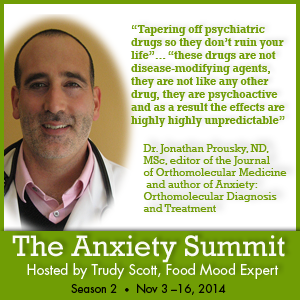
The Anxiety Summit – Tapering off psychiatric drugs so they don’t ruin your life

November 13, 2014 By Trudy Scott 53 Comments

Dr. Jonathan ProuskyQuote_Anxiety2

Dr. Jonathan Prousky, MSc, ND, editor of the Journal of Orthomolecular Medicine and author of Anxiety: Orthomolecular Diagnosis and Treatment was interviewed by host of the Anxiety Summit, Trudy Scott, Food Mood Expert and Nutritionist, author of The Antianxiety Food Solution.

Tapering off psychiatric drugs so they don’t ruin your life

  • The process of reducing or discontinuing psychotropic medications
  • Difficulties patients have in overcoming pharmacological dependence
  • Reactions when someone discontinues SSRIs and benzodiazapines
  • Tapering approach, duration and improving outcomes
  • The importance of diet and lifestyle
  • Melatonin and niacinamide during benzodiazepine withdrawal
  • Using Neurapas Balance, rhodiola and GABA during a taper protocol
  • A tapering schedule case report

Here are a few snippets from our interview:

prescribed psychiatric drugs…. They are not like any other medication. These drugs are not disease-modifying agents, so they’re not like taking a drug for diabetes. These drugs are psychoactive.

That’s exactly how they work. They influence, basically, how one thinks, feels and behaves and, of course, physiology and, as a result, their effects are highly, highly unpredictable and what I constantly see in my own practice is how doctors are failing our patients and not really discussing all of what is necessary when prescribing these drugs because these drugs tend to have some significant effects. and I don’t consider any of the effects of these psychoactive drug’s effects and they can be either positive, negative or neutral

I think what’s important for people to realize is there’s no specific clinical manifestation that would be appropriate for all patients that are on SSRI drugs, whether that’s something like Paxil or Prozac or Celexa. It doesn’t matter. There’s no one manifestation that all patients coming off those drugs are going to experience. Essentially, because these drugs have very, I would say, unpredictable psychoactive effects then, when somebody is coming off of them, the effects from tapering are also rather unpredictable. So, people can experience either regression of their symptoms that brought them to a physician in the first place and one of the reasons why they were prescribed the drug in the first place, so patients can certainly regress and start having a return of their previous symptoms. Patients can have incredible sleep issues where they just cannot sleep, and they literally are feeling so concerned and they start worrying about not being able to fall asleep even before they sleep because it becomes such an issue.

Patients can feel very restless and they can get an inner restlessness that sometimes can drive them, literally almost like, as if, they’re going crazy, it’s called agathusia. There’s like this inner restlessness that torments people. Sometimes that can even happen as they taper down. Sometimes people can develop some weird, neurological manifestations whether it’s ticks or just strange or abnormal body movements, which we call dyskinesias. Patients can start having the sweats or feelings of derealization where they don’t feel grounded in reality.

They can have brain zaps where their brain just feels like it’s being zapped or as if someone’s electrocuting them. They can feel their whole body shaking and sort of becoming very jittery or even they can have cold sweats and shiver a lot. Essentially, there’s not a manifestation that you and I couldn’t think of that couldn’t happen to somebody coming off of these drugs because, as I said, they’re so unpredictable.

During the interview we discussed a number of papers written by Dr. Prousky. Here is a link to his publications.

Here is the Harm Reduction Guide to Coming Off Psychiatric Drugs by Will Hall

Dr. Prousky discussed this paper about pharmaGABA: Relaxation and immunity enhancement effects of gamma-aminobutyric acid (GABA) administration in humans.

GABA could work effectively as a natural relaxant and its effects could be seen within 1 hour of its administration to induce relaxation and diminish anxiety.

I talked more about GABA in my interview: Targeted individual amino acids for eliminating anxiety: practical applications

Dr. Prousky shared a case study of an SSRI and rhodiola taken together leading to tachyarrhythmia: Herbal medicine–sets the heart racing!

We report the case of a young previously healthy woman who had a significant tachyarrhythmia whilst taking a combination of escitalopram and the over the counter herbal medicine Rhodiola. Escitalopram, a SSRI, increases serotonin levels in the brain by selectively inhibiting re-uptake of serotonin. It is metabolised by the cytochrome P450 (CYP) isoenzymes CYP2C19, CYP2D6 and CYP3A4. Rhodiola also increases serotonin levels by inhibiting monoamine oxidase. It is a potent inhibitor of CYP3A4 and P-Glycoprotein. Consequently both agents taken by a patient can augment serotonin levels.

Dr. Prousky discussed the risks of SSRIs during pregnancy and shared this paper: The risks of selective serotonin reuptake inhibitor use in infertile women: a review of the impact on fertility, pregnancy, neonatal health and beyond

Antidepressant use during pregnancy is associated with increased risks of miscarriage, birth defects, preterm birth, newborn behavioral syndrome, persistent pulmonary hypertension of the newborn and possible longer term neurobehavioral effects.

Dr. Prousky is the editor of the Journal of Orthomolecular medicine.

The CSOM/Canadian Society for Orthomolecular Medicine holds an annual conference in Toronto and you can learn more here. The 2015 conference will be April 24-26.

If you are not already registered for the Anxiety Summit you can get live access to the speakers of the day here www.theAnxietySummit.com

Filed Under: Anxiety and panic, benzodiazapines, Drugs, The Anxiety Summit 2 Tagged With: anxiety, Dr Jonathan Prousky, GABA, niacin, pharmaGABA, psychiatric drugs, rhodiola, SSRIs, the anxiety summit, Trudy Scott

  • « Go to Previous Page
  • Page 1
  • Page 2

Primary Sidebar

NEW! GABA QuickStart Homestudy (with special intro pricing)

gaba quickstart homestudy

Free Report

9 Great Questions Women Ask about Food, Mood and their Health

You'll also receive a complimentary subscription to my ezine "Food, Mood and Gal Stuff"


Connect with me

Popular Posts

  • Amino Acids Mood Questionnaire from The Antianxiety Food Solution
  • The Antianxiety Food Solution Amino Acid and Pyroluria Supplements
  • Pyroluria Questionnaire from The Antianxiety Food Solution
  • Collagen and gelatin lower serotonin: does this increase your anxiety and depression?
  • Tryptophan for the worry-in-your-head and ruminating type of anxiety
  • GABA for the physical-tension and stiff-and-tense-muscles type of anxiety
  • The Antianxiety Food Solution by Trudy Scott
  • Seriphos Original Formula is back: the best product for anxiety and insomnia caused by high cortisol
  • Am I an anxious introvert because of low zinc and vitamin B6? My response to Huffington Post blog
  • Vagus nerve rehab with GABA, breathing, humming, gargling and key nutrients

Recent Posts

  • What do I use instead of Seriphos to help lower high cortisol that is affecting my sleep and making me anxious at night?
  • BeSerene™ GABA/theanine cream eases severe muscle tension in her neck/shoulders, prevents her bad headaches and quells her anxiety
  • How the correct approach, dose and sublingual use of GABA can be calming and not cause a flushed and itchy face and neck
  • The amino acid glutamine improves low mood by addressing gut health, and it has calming effects too
  • Flight anxiety with heightened breath, physical tension and also fearing the worst (the role of low GABA and low serotonin)

Categories

  • 5-HTP
  • AB575
  • Addiction
  • ADHD
  • Adrenals
  • Alcohol
  • Allergies
  • Alzheimer's disease
  • Amino Acids
  • Anger
  • Antianxiety
  • Antianxiety Food Solution
  • Antidepressants
  • Anxiety
  • Anxiety and panic
  • Autism
  • Autoimmunity
  • benzodiazapines
  • Bipolar disorder
  • Books
  • Caffeine
  • Cancer
  • Candida
  • Children/Teens
  • Collagen
  • Cooking equipment
  • Coronavirus/COVID-19
  • Cravings
  • Depression
  • Detoxification
  • Diabetes
  • Diet
  • DPA/DLPA
  • Drugs
  • EFT/Tapping
  • EMF
  • EMFs
  • Emotional Eating
  • Endorphins
  • Environment
  • Essential oils
  • Events
  • Exercise
  • Fear
  • Fear of public speaking
  • Fertility and Pregnancy
  • Fish
  • Food
  • Food and mood
  • Functional neurology
  • GABA
  • Gene polymorphisms
  • General Health
  • Giving
  • Giving back
  • Glutamine
  • Gluten
  • GMOs
  • Gratitude
  • Gut health
  • Heart health/hypertension
  • Histamine
  • Hormone
  • Hyperparathyroidism
  • Hypoglycemia
  • Immune system
  • Inflammation
  • Insomnia
  • Inspiration
  • Introversion
  • Joy and happiness
  • Ketogenic diet
  • Lithium orotate
  • Looking awesome
  • Lyme disease and co-infections
  • MCAS/histamine
  • Medication
  • Men's health
  • Mental health
  • Mercury
  • Migraine
  • Mold
  • Movie
  • MTHFR
  • Multiple sclerosis
  • Music
  • NANP
  • Nature
  • Nutritional Psychiatry
  • OCD
  • Osteoporosis
  • Oxalates
  • Oxytocin
  • Pain
  • Paleo
  • Parasites
  • Parkinson’s disease
  • PCOS
  • People
  • PMS
  • Postpartum
  • PTSD/Trauma
  • Pyroluria
  • Questionnaires
  • Real whole food
  • Recipes
  • Research
  • Schizophrenia
  • serotonin
  • SIBO
  • Sleep
  • Special diets
  • Sports nutrition
  • Stress
  • Sugar addiction
  • Sugar and mood
  • Supplements
  • Teens
  • Testimonials
  • Testing
  • The Anxiety Summit
  • The Anxiety Summit 2
  • The Anxiety Summit 3
  • The Anxiety Summit 4
  • The Anxiety Summit 5
  • The Anxiety Summit 6
  • Thyroid
  • Thyroid health
  • Toxins
  • Tryptophan
  • Tyrosine
  • Uncategorized
  • Vegan/vegetarian
  • Women's health
  • Yoga

Archives

  • October 2025
  • September 2025
  • August 2025
  • July 2025
  • June 2025
  • May 2025
  • April 2025
  • March 2025
  • February 2025
  • January 2025
  • November 2024
  • October 2024
  • September 2024
  • August 2024
  • July 2024
  • June 2024
  • May 2024
  • April 2024
  • March 2024
  • February 2024
  • January 2024
  • December 2023
  • November 2023
  • October 2023
  • September 2023
  • August 2023
  • July 2023
  • June 2023
  • May 2023
  • April 2023
  • March 2023
  • February 2023
  • January 2023
  • December 2022
  • November 2022
  • October 2022
  • September 2022
  • August 2022
  • July 2022
  • June 2022
  • May 2022
  • April 2022
  • March 2022
  • February 2022
  • January 2022
  • December 2021
  • November 2021
  • October 2021
  • September 2021
  • August 2021
  • July 2021
  • June 2021
  • May 2021
  • April 2021
  • March 2021
  • February 2021
  • January 2021
  • December 2020
  • November 2020
  • October 2020
  • September 2020
  • August 2020
  • July 2020
  • June 2020
  • May 2020
  • April 2020
  • March 2020
  • February 2020
  • January 2020
  • December 2019
  • November 2019
  • October 2019
  • September 2019
  • August 2019
  • July 2019
  • June 2019
  • May 2019
  • April 2019
  • March 2019
  • February 2019
  • January 2019
  • December 2018
  • November 2018
  • October 2018
  • September 2018
  • August 2018
  • July 2018
  • June 2018
  • May 2018
  • April 2018
  • March 2018
  • February 2018
  • January 2018
  • December 2017
  • November 2017
  • October 2017
  • September 2017
  • August 2017
  • July 2017
  • June 2017
  • May 2017
  • April 2017
  • March 2017
  • February 2017
  • January 2017
  • December 2016
  • November 2016
  • October 2016
  • September 2016
  • August 2016
  • July 2016
  • June 2016
  • May 2016
  • April 2016
  • March 2016
  • February 2016
  • January 2016
  • December 2015
  • November 2015
  • October 2015
  • September 2015
  • August 2015
  • July 2015
  • June 2015
  • May 2015
  • April 2015
  • March 2015
  • February 2015
  • January 2015
  • December 2014
  • November 2014
  • October 2014
  • September 2014
  • August 2014
  • July 2014
  • June 2014
  • May 2014
  • April 2014
  • March 2014
  • February 2014
  • January 2014
  • December 2013
  • November 2013
  • October 2013
  • September 2013
  • August 2013
  • July 2013
  • June 2013
  • May 2013
  • April 2013
  • March 2013
  • February 2013
  • January 2013
  • December 2012
  • November 2012
  • October 2012
  • August 2012
  • July 2012
  • June 2012
  • May 2012
  • April 2012
  • March 2012
  • February 2012
  • January 2012
  • December 2011
  • November 2011
  • October 2011
  • September 2011
  • August 2011
  • July 2011
  • June 2011
  • May 2011
  • April 2011
  • March 2011
  • February 2011
  • January 2011
  • December 2010
  • October 2010
  • September 2010
  • July 2010
  • May 2010
  • April 2010
  • March 2010
  • February 2010
  • January 2010
  • November 2009

Share the knowledge!

The above statements have not been evaluated by the Food and Drug Administration. Products listed in this website are not intended to diagnose, treat, cure or prevent any disease.

The information provided on this site is for informational and educational purposes only and is not intended as a substitute for advice from your physician or other health care professional. You should consult with a healthcare professional before starting or modifying any diet, exercise, or supplementation program, before taking or stopping any medication, or if you have or suspect you may have a health problem.


Copyright © 2026 Trudy Scott. All Rights Reserved. | Privacy | Terms and Conditions | Refund Policy | Medical Disclaimer

Free Report

9 Great Questions Women Ask about Food, Mood and their Health

You’ll also receive a complimentary subscription to my ezine “Food, Mood and Gal Stuff”