• Skip to primary navigation
  • Skip to main content
  • Skip to primary sidebar

everywomanover29 blog

Food, Mood and Women's Health – Be your healthiest, look and feel great!

  • Blog
  • About
  • Services
  • Store
  • Resources
  • Testimonials
  • The Book
  • Contact
  • Search this site

magnesium

The role of low serotonin, low vitamin B6 and low iron in anxiety and panic attacks

December 7, 2018 By Trudy Scott 17 Comments

Low serotonin can cause anxiety and panic attacks. Because vitamin B6 and iron are required raw materials for making serotonin, we know that low levels of these two nutrients often contribute to anxiety and panic attacks.

We have some pretty recent research supporting all this: Low serum concentrations of vitamin B6 and iron are related to panic attack and hyperventilation attack

Reduced serotonin level is known as one of the causes of panic attacks and hyperventilation attacks ….

In the serotonin synthesis system of the brain, vitamin B6 is a coenzyme for tryptophan hydroxylase, which is involved in the conversion of tryptophan into 5-hydroxytryptophan and iron serves as a cofactor for aromatic L-amino acid decarboxylase involved in the formation of serotonin from 5-hydroxytryptophan. Therefore, a reduction in vitamin B6 and iron levels can suppress the progression of the serotonin synthesis.

The study authors measured serum levels of vitamins B2, B6, and B12 and iron in 21 premenopausal women who had been admitted to the emergency room with panic attacks.

The results were compared with lab values from 20 volunteers, also premenopausal women, and this is what they reported:

We found that both vitamin B6 and iron levels were significantly lower in the panic attack/hyperventilation attack group than in the volunteer group. There was no significant difference in the serum levels of vitamins B2 or B12.

These results suggest that low serum concentrations of vitamin B6 and iron are involved in panic attacks and hyperventilation attacks.

This certainly confirms what I see with my clients. When I’m working with someone with anxiety, we always assess for low serotonin, low iron and low vitamin B6 levels, and when we address low levels we almost always see improvements – both in the reduction of anxiety and panic attacks. We’ll often see a mood boost too, sleep improvements and a reduction in carb cravings.

Here are some additional factors to consider:

  • Vitamin B6 can be challenging to measure in serum so I like to also use the pyroluria questionnaire and poor dream recall as a clue. The authors mention that serum pyridoxal 5-phosphate (PLP) is often used as an indication of B6 status, however they opted to use pyridoxal (PAL) after conversion from PLP.
  • Supplementing with vitamin B6 can often lead to some improvements in a few weeks with many folks who have pyroluria reporting feeling less anxious and more social within a week.
  • There is the potential for vitamin B6 toxicity. I have yet to see any signs of toxicity in my clients, but I have also not ever recommended more than 500mg/day. However, there are some individuals who have issues with very small amounts of vitamin B6. Unfortunately, I do not know why this happens.
  • Testing ferritin levels are an excellent way to assess iron levels and iron should never be supplemented unless iron is low. Dr. Izabella Wentz, shares in her book Hashimoto’s Protocol and blog that the optimal ferritin level for thyroid function is between 90-110 ng/m. Addressing low iron levels can take awhile to see a shift in labs.
  • Because zinc and magnesium are also cofactors for making serotonin, low levels may also need to be addressed. I would have loved to see these included in this study,
  • As always, we assess for low serotonin levels using the amino acid questionnaire and start on tryptophan or 5-HTP right away, based on doing trials – so we can see anxiety reduction and relief from panic attacks right away, while the other changes are starting to provide the raw materials for serotonin production.

Keep in mind that low serotonin and low iron and/or low vitamin B6 – although very common with anxiety and panic attacks – are not the only root cause and many other factors may also need to be addressed.

We’d love to hear if addressing low iron and/or low vitamin B6 levels have helped you? Did you use tryptophan and/or 5-HTP at the same time?

If you’re a practitioner, are often do you see low iron and/or low vitamin B6 in your anxious clients/patients?

Filed Under: Anxiety Tagged With: 5-HTP, anxiety, ferritin, hyperventilation attacks, iron, magnesium, panic attacks, premenopausal, serotonin, tryptophan, vitamin B6, women, zinc

Nutritional and lifestyle support for mercury toxicity and detoxification in general

February 4, 2018 By Trudy Scott 7 Comments


I’ve poured through most of the transcripts of the Heavy Metals Summit and there is so much information on nutritional and lifestyle support for mercury toxicity and the detoxification process in general:

  • sweating and using a sauna in order to detox through the skin
  • broccoli sprouts (due to a glutathione boost from sulforaphane, an organosulfur compound – in Julie Matthews’s interview)
  • reducing EMF/ELF and microwave exposure – in Dr. Mercola’s talk! He shares how all this can make matters worse and has some simple approaches like turning off power in the bedroom at night! This was new to me and a brilliant approach!
  • eating organic (to minimize GMO/glyphosate effects on a leaky gut and a leaky blood brain barrier) and never using Roundup
  • addressing low zinc and low selenium
  • supporting methylation so the body can detox on it’s own
  • supporting the liver and increasing bile production which is needed for detoxification
  • addressing low stomach acid which is needed for bile production and absorption of minerals like zinc (which is depleted by heavy metals)
  • avoiding meds like PPIs (which reduce stomach acid) and NSAIDs (which contribute to leaky gut)
  • thyroid support/iodine (as needed)
  • getting the brain’s glymphatic system working with sufficient sleep, melatonin (liposomal) and even liposomal GABA (in Dr. Christine Schaffer’s interview)
  • supporting the vagus nerve in order to improve digestion and detoxification
  • using an air filter and water filters
  • using foods/products like curcumin, ginger, probiotics, apple pectin
  • adding DPP-4 enzyme for gluten issues (mercury depletes this)
  • avoid energy-efficient bulbs (they are high mercury)
  • having Epsom salts baths
  • improving elimination from the bowels and much more

This is the support I offer as a nutritionist and it’s wonderful to hear all these doctors/practitioners discuss about all this with a tie back to mercury, lead and other metals.

Whey is not mentioned on the summit but since someone shared how it’s benefiting her (in the comments of the Boyd Haley blog) I’m sharing here too since it helps with glutathione production. In this paper “a case is made for the use of hydrolyzed whey protein to support metal detoxification and neurological function.” I recommend whey to clients if tolerated.

Many years ago I heard a presentation by a biological dentist who then became a nutritionist – he shared that he used whey with mercury toxic patients (together with other nutrients) and saw metals go up in hair analysis and then come down as their symptoms improved.

As I’ve mentioned in the past, mercury chelation is a controversial topic and you’ll see comments very divided on what the safest approach is. This is not my area of expertise and I’m very cautious with recommendations in this area as I’ve had reports of harm from individuals using all the approaches you’ll hear about on the summit (and even the Andy Cutler protocol which is not covered). My best advice is to follow all the nutritional/lifestyle recommendations and if you do decide to go the chelation root, do your homework, find a practitioner to work with and listen to your gut. If what you’re doing doesn’t feel right then stop doing it.

As with any chronic health condition, mercury detox is a comprehensive approach and very individualized.

There is also a discussion about safe removal of amalgams/mercury fillings. They do need to be done safely so as not to cause further issues. The IOMT also offers excellent guidelines.

The summit also covers other metals like copper (Ann Louise Gittleman covers this and I blog about it here), arsenic (Dr. Joseph Pizzorno covers this – reducing consumption is a big factor; and non-organic chicken is a source) and aluminum.

You can still register here to hear day 7 interviews and the encores: The Heavy Metals Summit.

Have you seen benefits with a nutritional approach?

Filed Under: Events Tagged With: anxiety, broccoli, detox, detoxification, heavy metals summit, liver support, magnesium, mercury, mercury toxicity, minerals, nutritional, nutritional support, sauna, sleep, zinc

The Anxiety Summit – Nutritional Influences on Anxiety and Musculoskeletal Pain

May 11, 2015 By Trudy Scott 20 Comments


Joe Tatta DPT, CCN, Musculoskeletal Pain Expert, was interviewed by host of the Anxiety Summit, Trudy Scott, Food Mood Expert and Nutritionist, author of The Antianxiety Food Solution.

Nutritional Influences on Anxiety and Musculoskeletal Pain

  • Link between anxiety and chronic musculoskeletal problems
  • Fear avoidance behaviors and pain
  • Headaches, back pain, joint pain and nutritional influences
  • An exercise prescription for anxiety

Here are some snippets from our interview:

People used to think depression was more linked to chronic pain but we are learning its more anxiety driven

The chronic anxiety that people have on a daily basis kicks off the pain process

Negative thoughts, worry, doom-and-gloom about the future all come in to play, with fear being the most common emotion leading to pain

Here is the very recent 2015 paper that discusses this – Psychological functioning of people living with chronic pain: A meta-analytic review.

Joe tied fear and anxiety to adrenalin release and the effects on the muscles, specifically how the smaller muscles around the spine and in the neck are turned off. You then have less blood flow, less oxygen and less nutrients going to those muscles and that’s when the pain starts.

Joe shared the staggering number of people who suffer from chronic pain:

more than those who suffer from heart disease, diabetes and cancer combined!

We also discussed migraines and magnesium, and this paper: Why all migraine patients should be treated with magnesium

Magnesium, the second most abundant intracellular cation, is essential in many intracellular processes and appears to play an important role in migraine pathogenesis. Routine blood tests do not reflect true body magnesium stores since <2% is in the measurable, extracellular space, 67% is in the bone and 31% is located intracellularly. Lack of magnesium may promote cortical spreading depression, hyperaggregation of platelets, affect serotonin receptor function, and influence synthesis and release of a variety of neurotransmitters.

There is strong evidence that magnesium deficiency is much more prevalent in migraine sufferers than in healthy controls.

Considering these features of magnesium, the fact that magnesium deficiency may be present in up to half of migraine patients, and that routine blood tests are not indicative of magnesium status, empiric treatment with at least oral magnesium is warranted in all migraine sufferers.

If you are not already registered for the Anxiety Summit you can get live access to the speakers of the day here: www.theAnxietySummit.com

Missed this interview or can’t listen live? Or want this and the other great interviews for your learning library? Purchase the MP3s or MP3s + transcripts and listen when it suits you.

You can find your purchasing options here: Anxiety Summit Season 1, Anxiety Summit Season 2, and Anxiety Summit Season 3.

Filed Under: Antianxiety, Anxiety and panic, Depression, Pain, The Anxiety Summit 3 Tagged With: anxiety, butterbur, chronic pain, cortisol, fear, Joe Tatta, magnesium, migraine, pain, the anxiety summit, Trudy Scott

The Anxiety Summit – Take magnesium and melt your anxiety away

November 11, 2014 By Trudy Scott 36 Comments

Dr. Carolyn DeanQuote_Anxiety2

Dr. Carolyn Dean, MD, ND, author of The Magnesium Miracle was interviewed  by host of the Anxiety Summit, Trudy Scott, Food Mood Expert and Nutritionist, author of The Antianxiety Food Solution.

Take magnesium and melt your anxiety away

  • how important is magnesium: enzymatic processes, mitochondria, heart health, anxiety
  • how important is magnesium compared to calcium; and the vitamin D connection
  • the medication fluoride concern and magnesium impact
  • the symptoms of magnesium deficiency
  • why we are deficient in magnesium
  • dietary sources of magnesium and why diet is often not enough
  • how to test your magnesium level

Here are some snippets from our interview:

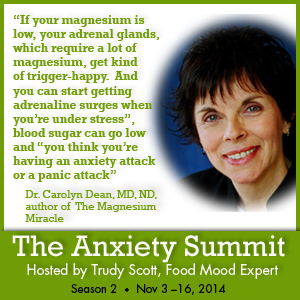
If your magnesium is low, your adrenal glands, which require a lot of magnesium, get kind of trigger-happy. And you can start getting adrenaline surges when you’re under stress, blood sugar can go low and you think you’re having an anxiety attack or a panic attack.

Now, your cholesterol depends on a magnesium enzyme to balance cholesterol. If you have too much, it brings it down; if you have too little, it brings it up. It’s done through the mechanism of magnesium. But the statin drugs kill that particular enzyme! And, as well, they cause more magnesium deficiency because many of the statin drugs actually have a fluoride molecule attached, and that fluoride molecule will bind up more magnesium.

Here is one of the 2014 studies we mentioned: Effect of oral magnesium supplementation on physical performance in healthy elderly women involved in a weekly exercise program: a randomized controlled trial

Daily magnesium oxide supplementation for 12 wk seems to improve physical performance in healthy elderly women. These findings suggest a role for magnesium supplementation in preventing or delaying the age-related decline in physical performance.

Here’s the blog post: When magnesium makes me worse  It also has information about magnesium RBC testing with RequestaTest.com and fluoride in medications.

This is the last study Carolyn mentioned – Magnesium deficiency induces anxiety and HPA axis dysregulation: modulation by therapeutic drug treatment.

Overall, the present findings demonstrate the robustness and validity of the Mg(2+) deficiency model as a mouse model of enhanced anxiety, showing sensitivity to treatment with anxiolytics and antidepressants. It is further suggested that dysregulations in the HPA axis may contribute to the hyper-emotionality in response to dietary induced hypomagnesaemia.

Carolyn’s gift 4 Weeks of 2 Year Wellness Program PLUS Invisible Minerals

If you are not already registered for the Anxiety Summit you can get live access to the speakers of the day here www.theAnxietySummit.com

Filed Under: Antianxiety, The Anxiety Summit 2 Tagged With: anxiety, Carolyn Dean, fluoride, magnesium, the anxiety summit, Trudy Scott, vitamin D

  • « Go to Previous Page
  • Page 1
  • Page 2

Primary Sidebar

NEW! GABA QuickStart Homestudy (with special intro pricing)

gaba quickstart homestudy

Free Report

9 Great Questions Women Ask about Food, Mood and their Health

You'll also receive a complimentary subscription to my ezine "Food, Mood and Gal Stuff"


Connect with me

Popular Posts

  • Amino Acids Mood Questionnaire from The Antianxiety Food Solution
  • The Antianxiety Food Solution Amino Acid and Pyroluria Supplements
  • Pyroluria Questionnaire from The Antianxiety Food Solution
  • Collagen and gelatin lower serotonin: does this increase your anxiety and depression?
  • Tryptophan for the worry-in-your-head and ruminating type of anxiety
  • GABA for the physical-tension and stiff-and-tense-muscles type of anxiety
  • The Antianxiety Food Solution by Trudy Scott
  • Seriphos Original Formula is back: the best product for anxiety and insomnia caused by high cortisol
  • Am I an anxious introvert because of low zinc and vitamin B6? My response to Huffington Post blog
  • Vagus nerve rehab with GABA, breathing, humming, gargling and key nutrients

Recent Posts

  • What do I use instead of Seriphos to help lower high cortisol that is affecting my sleep and making me anxious at night?
  • BeSerene™ GABA/theanine cream eases severe muscle tension in her neck/shoulders, prevents her bad headaches and quells her anxiety
  • How the correct approach, dose and sublingual use of GABA can be calming and not cause a flushed and itchy face and neck
  • The amino acid glutamine improves low mood by addressing gut health, and it has calming effects too
  • Flight anxiety with heightened breath, physical tension and also fearing the worst (the role of low GABA and low serotonin)

Categories

  • 5-HTP
  • AB575
  • Addiction
  • ADHD
  • Adrenals
  • Alcohol
  • Allergies
  • Alzheimer's disease
  • Amino Acids
  • Anger
  • Antianxiety
  • Antianxiety Food Solution
  • Antidepressants
  • Anxiety
  • Anxiety and panic
  • Autism
  • Autoimmunity
  • benzodiazapines
  • Bipolar disorder
  • Books
  • Caffeine
  • Cancer
  • Candida
  • Children/Teens
  • Collagen
  • Cooking equipment
  • Coronavirus/COVID-19
  • Cravings
  • Depression
  • Detoxification
  • Diabetes
  • Diet
  • DPA/DLPA
  • Drugs
  • EFT/Tapping
  • EMF
  • EMFs
  • Emotional Eating
  • Endorphins
  • Environment
  • Essential oils
  • Events
  • Exercise
  • Fear
  • Fear of public speaking
  • Fertility and Pregnancy
  • Fish
  • Food
  • Food and mood
  • Functional neurology
  • GABA
  • Gene polymorphisms
  • General Health
  • Giving
  • Giving back
  • Glutamine
  • Gluten
  • GMOs
  • Gratitude
  • Gut health
  • Heart health/hypertension
  • Histamine
  • Hormone
  • Hyperparathyroidism
  • Hypoglycemia
  • Immune system
  • Inflammation
  • Insomnia
  • Inspiration
  • Introversion
  • Joy and happiness
  • Ketogenic diet
  • Lithium orotate
  • Looking awesome
  • Lyme disease and co-infections
  • MCAS/histamine
  • Medication
  • Men's health
  • Mental health
  • Mercury
  • Migraine
  • Mold
  • Movie
  • MTHFR
  • Multiple sclerosis
  • Music
  • NANP
  • Nature
  • Nutritional Psychiatry
  • OCD
  • Osteoporosis
  • Oxalates
  • Oxytocin
  • Pain
  • Paleo
  • Parasites
  • Parkinson’s disease
  • PCOS
  • People
  • PMS
  • Postpartum
  • PTSD/Trauma
  • Pyroluria
  • Questionnaires
  • Real whole food
  • Recipes
  • Research
  • Schizophrenia
  • serotonin
  • SIBO
  • Sleep
  • Special diets
  • Sports nutrition
  • Stress
  • Sugar addiction
  • Sugar and mood
  • Supplements
  • Teens
  • Testimonials
  • Testing
  • The Anxiety Summit
  • The Anxiety Summit 2
  • The Anxiety Summit 3
  • The Anxiety Summit 4
  • The Anxiety Summit 5
  • The Anxiety Summit 6
  • Thyroid
  • Thyroid health
  • Toxins
  • Tryptophan
  • Tyrosine
  • Uncategorized
  • Vegan/vegetarian
  • Women's health
  • Yoga

Archives

  • October 2025
  • September 2025
  • August 2025
  • July 2025
  • June 2025
  • May 2025
  • April 2025
  • March 2025
  • February 2025
  • January 2025
  • November 2024
  • October 2024
  • September 2024
  • August 2024
  • July 2024
  • June 2024
  • May 2024
  • April 2024
  • March 2024
  • February 2024
  • January 2024
  • December 2023
  • November 2023
  • October 2023
  • September 2023
  • August 2023
  • July 2023
  • June 2023
  • May 2023
  • April 2023
  • March 2023
  • February 2023
  • January 2023
  • December 2022
  • November 2022
  • October 2022
  • September 2022
  • August 2022
  • July 2022
  • June 2022
  • May 2022
  • April 2022
  • March 2022
  • February 2022
  • January 2022
  • December 2021
  • November 2021
  • October 2021
  • September 2021
  • August 2021
  • July 2021
  • June 2021
  • May 2021
  • April 2021
  • March 2021
  • February 2021
  • January 2021
  • December 2020
  • November 2020
  • October 2020
  • September 2020
  • August 2020
  • July 2020
  • June 2020
  • May 2020
  • April 2020
  • March 2020
  • February 2020
  • January 2020
  • December 2019
  • November 2019
  • October 2019
  • September 2019
  • August 2019
  • July 2019
  • June 2019
  • May 2019
  • April 2019
  • March 2019
  • February 2019
  • January 2019
  • December 2018
  • November 2018
  • October 2018
  • September 2018
  • August 2018
  • July 2018
  • June 2018
  • May 2018
  • April 2018
  • March 2018
  • February 2018
  • January 2018
  • December 2017
  • November 2017
  • October 2017
  • September 2017
  • August 2017
  • July 2017
  • June 2017
  • May 2017
  • April 2017
  • March 2017
  • February 2017
  • January 2017
  • December 2016
  • November 2016
  • October 2016
  • September 2016
  • August 2016
  • July 2016
  • June 2016
  • May 2016
  • April 2016
  • March 2016
  • February 2016
  • January 2016
  • December 2015
  • November 2015
  • October 2015
  • September 2015
  • August 2015
  • July 2015
  • June 2015
  • May 2015
  • April 2015
  • March 2015
  • February 2015
  • January 2015
  • December 2014
  • November 2014
  • October 2014
  • September 2014
  • August 2014
  • July 2014
  • June 2014
  • May 2014
  • April 2014
  • March 2014
  • February 2014
  • January 2014
  • December 2013
  • November 2013
  • October 2013
  • September 2013
  • August 2013
  • July 2013
  • June 2013
  • May 2013
  • April 2013
  • March 2013
  • February 2013
  • January 2013
  • December 2012
  • November 2012
  • October 2012
  • August 2012
  • July 2012
  • June 2012
  • May 2012
  • April 2012
  • March 2012
  • February 2012
  • January 2012
  • December 2011
  • November 2011
  • October 2011
  • September 2011
  • August 2011
  • July 2011
  • June 2011
  • May 2011
  • April 2011
  • March 2011
  • February 2011
  • January 2011
  • December 2010
  • October 2010
  • September 2010
  • July 2010
  • May 2010
  • April 2010
  • March 2010
  • February 2010
  • January 2010
  • November 2009

Share the knowledge!

The above statements have not been evaluated by the Food and Drug Administration. Products listed in this website are not intended to diagnose, treat, cure or prevent any disease.

The information provided on this site is for informational and educational purposes only and is not intended as a substitute for advice from your physician or other health care professional. You should consult with a healthcare professional before starting or modifying any diet, exercise, or supplementation program, before taking or stopping any medication, or if you have or suspect you may have a health problem.


Copyright © 2026 Trudy Scott. All Rights Reserved. | Privacy | Terms and Conditions | Refund Policy | Medical Disclaimer

Free Report

9 Great Questions Women Ask about Food, Mood and their Health

You’ll also receive a complimentary subscription to my ezine “Food, Mood and Gal Stuff”