• Skip to primary navigation
  • Skip to main content
  • Skip to primary sidebar

everywomanover29 blog

Food, Mood and Women's Health – Be your healthiest, look and feel great!

  • Blog
  • About
  • Services
  • Store
  • Resources
  • Testimonials
  • The Book
  • Newsletter
  • Contact
  • Search this site

low serotonin

What if overthinking, fear, anxiety and worry (caused by low serotonin) is holding you back instead of low motivation/low dopamine?

July 2, 2021 By Trudy Scott 50 Comments

overthinking

One of the first things that comes to mind when someone is stuck and not able to get things done is low motivation caused by low catecholamines/low dopamine. But what if overthinking, fear, anxiety and worry (caused by low serotonin) is holding you back instead? The following case may help you figure it out if any of this applies to you.

William asked this question on one of the tyrosine blogs, justifiably thinking he may need tyrosine to get unstuck:

Excellent article. I may try tyrosine. I have anxiety and shut down when I am about to start something or my mind overthinks and I shut down with worry. I have problems sleeping. I take a group of things…GABA, glycine, 5-HTP but still wake at 3am.

Anyway I always have GOOD intentions of doing things when I wake in the morning….then it goes downhill. I was not always like this but got worse with STRESS from work and now I FIGHT myself to actually do something I used to LOVE to do. Makes me MAD!

I actually am AFRAID just thinking about taking Tyrosine {Not funny}

I FEAR so much it becomes stupid. I think of doing things and SHUT DOWN with worry.

I want my life back…life is too short to suffer knowing HELP is so close. What do you think? Love your articles…

I think this is a great question many others in my community may relate to so I’ve decided to do this as a blog post with his question and a longer response.

I thanked him for his kind words, saying I can’t offer advice via the blog but can share that we need to be careful with tyrosine when someone has sleep issues or anxiety. I also offered some brief thoughts which I’ll elaborate on here so you can understand my thinking as I work with someone.

Is it low motivation caused by low catecholamines/low dopamine?

The first thing that comes to mind when someone is stuck and not able to get things done is low catecholamines and low dopamine. The classic signs are lack of motivation, fatigue, poor focus and feeling depressed, often using sugary foods or drinks for an energy pick-up (especially in the afternoon).

William may feel that he has low motivation and needs tyrosine because he can’t get things done or he starts something and can’t complete it.

His intentions are good but he has to push himself or as he says “fight myself” to get things done. Because of this he feels tyrosine may be the next amino acid he should trial.

Why I would investigate and address low serotonin

William says he has anxiety and also has trouble sleeping. This could be related to low serotonin and/or low GABA.

However when someone has anxiety and insomnia and I hear the following words/phrases, I immediately think low serotonin should be investigated and addressed:

  • “My mind overthinks”
  • “I shut down with worry”
  • “I actually am AFRAID just thinking about taking Tyrosine”
  • “I fear so much”

All of the above can hold you back and look like low motivation when it is actually worry and fear that is holding you back.

Typically, with low serotonin, you could also second-guess things you do, experience negative self-talk, have a lack of confidence when doing things, get stuck because of perfectionism and may even feel like an imposter. You may also be very controlling and want to do it all yourself and not be willing to delegate – this can hold you back too.

All this and anything else on the list of low serotonin symptoms would further suggest we need to address this first.

Finding the ideal serotonin support for his needs

He is currently taking GABA, glycine and 5-HTP but still wakes at 3am. And he is still anxious.

I would work to optimize 5-HTP dosing (increasing every few days to see if more helps) or switch to tryptophan if the increased dose isn’t helping. Some folks do better one one versus the other and 5-HTP can raise cortisol in some instances causing a wired-tired feeling.

I’d do the same with GABA once the ideal dose of 5-HTP or tryptophan is found. This helps improve sleep and reduce anxiety too.

And I’d look into high cortisol in case this is causing his 3am awakenings.

Once he has ideal serotonin support for his needs, the overthinking will stop, the worry will go away and his fears will vanish – and he will be able to complete things he starts.

Being well rested because of a great night’s sleep is going to help a great deal too.

There may be a need for tyrosine now or later

I may be wrong and there may in fact be a need for tyrosine now. These cases illustrate tyrosine helping when it didn’t seem it would:

  • Tyrosine for alleviating anxiety and panic attacks and creating a feeling of calm focus
  • Tyrosine erases severe performance anxiety in a female musician: no more shaking, sweating, panic attacks and passing out

There may also be a need for tyrosine later and a trial will provide the answers.

Right now William is “AFRAID just thinking about taking Tyrosine” but once his serotonin levels are ideal he should no longer have this fear.

Resources if you are new to using the amino acids as supplements

If you are new to using the amino acids tryptophan/5-HTP, GABA or  tyrosine as supplements, here is the Amino Acids Mood Questionnaire from The Antianxiety Food Solution and a brief overview here, Anxiety and targeted individual amino acid supplements: a summary.

If you suspect low levels of any of the neurotransmitters and do not yet have my book, The Antianxiety Food Solution – How the Foods You Eat Can Help You Calm Your Anxious Mind, Improve Your Mood, and End Cravings, I highly recommend getting it and reading it before jumping in and using amino acids so you are knowledgeable.

The book doesn’t include product names (per the publisher’s request) so this blog, The Antianxiety Food Solution Amino Acid and Pyroluria Supplements, lists the amino acid products that I use with my individual clients and those in my group programs.

As with all individual amino acids we use them for quick relief of symptoms. And we also always focus on the foundations like diet, the gut, adrenals and stress levels.

We appreciate William for asking this question so we all get to learn. Hopefully he’ll jump on and add to the discussion and share his results later.

Can you relate to his lack of motivation showing up as fear, worry and overthinking instead and holding you back?

What about these other low serotonin symptoms keeping you stuck: second-guessing, negative self-talk, lack of confidence, perfectionism, imposter syndrome and controlling?

Has using tryptophan or 5-HTP allowed you to get past some of this so you can get things done?

Did you also have to address low dopamine and actual low motivation, poor focus and fatigue with tyrosine?

Feel free to post any questions here too.
Filed Under: 5-HTP, Anxiety, serotonin, Tryptophan Tagged With: 5-HTP, afraid, anxiety, controlling, fear, GABA, holding you back, imposter, low dopamine, low motivation, low serotonin, my mind overthinks, overthinking, perfectionist, problems sleeping, shut down, stuck, tryptophan, tyrosine, unstuck, worry

Botox injections (cosmetic or non-cosmetic): are they a root cause of anxiety and panic attacks?

March 6, 2020 By Trudy Scott 71 Comments

botox injections

New research shows Botox injections are being considered for severe depression and bipolar disorder because it stops frowning and this lack of frowning has a positive impact on neurotransmitters and mood. I recently posted this on Facebook and asked this question:

I’m curious if you have had Botox injections or would consider it (for cosmetic reasons) or perhaps for migraines, dystonia, proctalgia fugax or depression/bipolar?

If you have had Botox injections are you happy with the result or did you have any adverse effects like increased anxiety, panic attacks or anything else?

The response was varied with most folks saying they would never consider using Botox for cosmetic reasons, some folks saying they used Botox for cosmetic reasons and had issues and some folks saying they’ve used Botox for cosmetic reasons and love it, and others who have used Botox for non-cosmetic reasons.

All the practitioners who commented have concerns about Botox saying results are mixed with some of their clients having severe reactions and some doing fine. As I looked further into this topic I’ve gained additional insights and my biggest concern for you, and my community, is that Botox can lead to very severe anxiety and panic attacks.

I encourage you to keep an open mind about my Botox concerns if you have chronic anxiety that is not resolving and it started (or got worse) after receiving Botox injections, or if  you’re considering Botox injections.

Anxiety, panic attacks, inability to handle stress, body shaking

I gained my biggest insights from the Botox Dysport (Side Effects) Support group. Someone suggested I look into this group and I requested an invite to join so I could learn more. So many of the members of this support group  report anxiety, panic attacks, inability to handle stress, body shaking and problems connecting socially.  This is what one member shared:

…just joining the dots, I’ve been unwell for a few years since getting Botox but didn’t put it together until having it last week and going into panic attacks / ER.

Since then extreme anxiety and I’ve ended up in a mental health facility on benzodiazepines (ativan/valium). Reactions / withdrawal has been severe, have started to put it all together whilst reading through this page.

I’m realising that my decline, immune system failure (chronic epstein barr) fatigue, loss of motivation, loss of appetite, shaking in my body, muscle atrophy, anxiety, no motivation to connect socially, can’t handle any stress, can’t relax, tinnitus, breathing trouble and the list goes on is from botox…. scared to say the least as doesn’t seem to be a solution, I was worried to get Botox originally and obviously am eating myself up with regret, thought I would share if anyone has a similar story.

There are many similar posts to this one and it’s heart-breaking, especially because they say they are not being heard by their doctors.

I had a short online conversation with one of the moderators and she shared they suspect Botox is impacting the hypothalamic-pituitary-adrenal (HPA) axis leading to high cortisol and causing their anxiety symptoms. Many of the members find relief with Seriphos, which is a phosphorylated serine product I’ve had great success with. Here is my blog post on Seriphos for anxiety and insomnia related to high cortisol.

I asked if any of the members find GABA or serotonin support helpful and for some GABA helps ease the physical tension and for other members tryptophan or 5-HTP helps ease the worry type of anxiety. However for others, the amino acids seem to have a paradoxical effect and make symptoms worse.

I’ve never been in favor of Botox for cosmetic reasons simply because I’m not a fan of putting foreign objects/toxins into the body and because I believe in aging gracefully with confidence. I do find that many women feel the need for cosmetic Botox injections and other ways to try and look younger (such as breast implants and hair dye) because of low self-esteem and lack of confidence caused by low serotonin.

Botox for non-cosmetic purposes

Botox is also used for non-cosmetic purposes. Some of my neurologist colleagues also have concerns about cosmetic use and will only use Botox injections for the following:

  • severe cases of dystonia
  • migraines (to relax forehead muscles)
  • proctalgia fugax /rectal spasms

Botox may also be used for multiple sclerosis (MS) symptoms, pelvic pain and bladder issues, for TMJ, after a stroke and for chronic anal fissures in colitis (sphincter spasms can prevent anal fissures from healing).

I would love to see safer approaches for non-cosmetic Botox injections being researched and explored by practitioners. For example:

  • Relief of dystonia symptoms using diet, GABA, tryptophan, zinc and vitamin B6
  • Sublingual GABA to help to relax forehead muscles in those with migraines
  • Sublingual GABA for the extremely painful proctalgia fugax. Could this also be considered in colitis patients?

Botox for mental health – we can do better with nutritional psychiatry

At the beginning of this blog I mentioned the new research that shows Botox injections are being considered for severe depression and bipolar disorder because it stops frowning. This lack of frowning has a positive impact on neurotransmitters and mood.

A study published in 2018, Clinical analysis of 86 botulism cases caused by cosmetic injection of botulinum toxin (BoNT), reports that botulism is a severe side effect of Botox injections with symptoms including: “headache, dizziness, insomnia, fatigue, blurred vision, eye opening difficulty, slurred speech, dysphagia [difficulty swallowing], constipation, and anxiety.”

The authors report these symptoms occur in the first 36 days after the Botox injections and that all symptoms resolved after botulinum antitoxin serum injections.

This conclusion clearly doesn’t address why there are so many folks in the Botox Dysport (Side Effects) Support group continue to experience long-term severe symptoms.

We also have research reporting a possible connection between Botox injections and thyroid autoimmunity.

I feel we can do better especially with what we know about nutritional psychiatry, the use of targeted individual amino acids, nutrients like lithium orotate, the gut-brain connections and everything covered in my book The Antianxiety Food Solution (my Amazon link) and on this blog.

A note of appreciation

I’d like to end with a note of appreciation to everyone who commented on my Facebook post, to the members of Botox Dysport (Side Effects) Support group on facebook (with over 5700 members as of this writing).

I’d also like to thank Diane Kazer for asking bold questions about Botox injections as part of her Non-Toxic Beauty Revolution Summit which addresses Botox, breast implant illness, toxins in your cosmetics and so much more. In my interview we talked extensively about the low serotonin/low self-esteem connections which I feel is a big missing piece for helping women who feel the desire or need to use cosmetic Botox in order to feel good and love themselves.

Diane writes about Botox here: Is Botox Safe? Top 3 Concerns & What to do if you’ve had it, sharing a brief history of botox, what she has uncovered about toxicity issues and possible detox solutions.

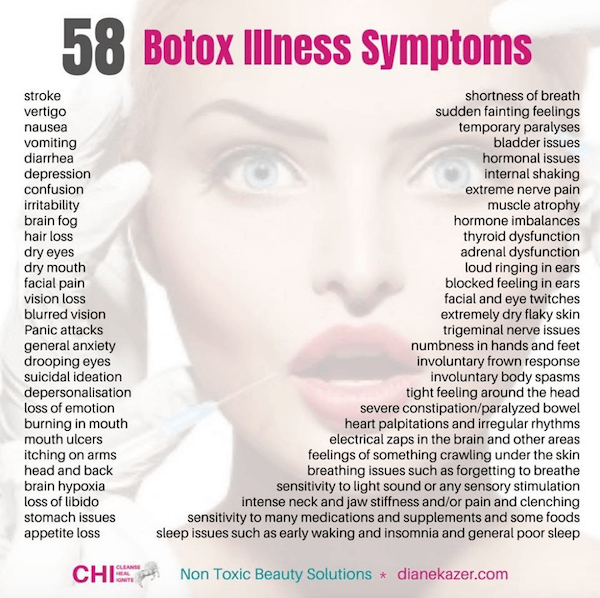
She also created this list of 58 Botox Illness Symptoms which she gave me permission to share here. She compiled this list from 1000+ people who have had Botox injections.

58 botox illness symptoms

Because of Diane asking questions and this initial research I’ve done, I’m adding a question about past history of Botox injections to my client intake form and will be gathering more information from my community of anxious women to see if there are patterns as to why some folks have such bad reactions.

I do feel we need to be asking if Botox injections (cosmetic or non-cosmetic) are a possible root cause of anxiety and panic attacks because they are adding to the toxic burden in susceptible folks.

But I do acknowledge it’s challenging to unwind all the contributing factors because it depends on what is going on with each person, such as their gut health, other medications (benzodiazepines themselves can be problematic), past trauma, infections, poor adrenal health, low GABA, low serotonin, poor detox capacity, low bile production, genetics etc. Unfortunately there is no way to know in advance who will be harmed and if Botox is the tipping point.

Please comment below if you’ve had Botox injections and had adverse reactions or have benefited from them with no adverse reactions. And if you have not had Botox would you ever consider it? Feel free to post your questions too.

Filed Under: Anxiety, Thyroid, Toxins Tagged With: 5-HTP, anxiety, bladder, Botox, botox injections, cosmetic, dystonia, GABA, low confidence, low serotonin, migraines, MS, panic attacks, pelvic, self-esteem, serotonin, TMJ, tryptophan

Imposter syndrome and low serotonin: is tryptophan the solution?

February 28, 2020 By Trudy Scott 75 Comments

imposter syndrome

An article published on Psychology Today states that imposter syndrome and “feelings of inadequacy are surprisingly common” and cites the results of a 2020 systematic review:

62 studies with over 14,000 participants found that a staggering 56 percent to 82 percent of individuals, across genders, backgrounds, and ages, experienced imposter feelings at some point.

In case you aren’t familiar with the term imposter syndrome, many of my clients who appear to have very successful careers will say to me … “I feel like I’m an imposter. They’re going to catch me out at what I’m doing. I’m not really as good as everyone thinks I am.” Perhaps you can relate to this? You just don’t feel that you’re good enough – you’re faking it until you make it and putting on a brave face.

No-one is talking about the biochemical and low serotonin aspect of imposter syndrome and the role tryptophan plays. This really does need to be part of the discussion and part of the solution.

Read on for examples of imposter syndrome you may resonate with and the typical tools that are offered to help you reframe and be kind to yourself (hint: it’s hard work when it’s a biochemical imbalance); and the simple biochemical solution i.e. addressing low serotonin. You also need to figure out why serotonin is low and address this. There is no research supporting this low serotonin connection but there is a proposal to investigate serotonin, oxytocin, and dopamine systems among those who suffer with imposter syndrome. You’ll also find additional resources if you need guidance using amino acids like tryptophan/5-HTP and GABA.

There is more awareness but it’s really hard work to reframe and be kind to yourself

Valerie Young’s excellent book, The Secret Thoughts of Successful Women: Why Capable People Suffer from the Impostor Syndrome and How to Thrive in Spite of It, [my Amazon link] has created the awareness we need and offers so much in terms of recognizing the way imposter syndrome mani­fests in our lives. She shares these examples which you may also resonate with:

From the high-achieving Ph.D. candidate convinced she’s only been admitted to the program because of a clerical error to the senior executive who worries others will find out she’s in way over her head, a shocking number of accomplished women in all ca­reer paths and at every level feel as though they are faking it – impostors in their own lives and careers.

This article in Harvard Business Review, Overcoming Imposter Syndrome, states

Imposter syndrome can be defined as a collection of feelings of inadequacy that persist despite evident success. ‘Imposters’ suffer from chronic self-doubt and a sense of intellectual fraudulence that override any feelings of success or external proof of their competence.

The article mentions phrases such as “I must not fail”, “I feel like a fake” and “it’s all down to luck”, offering these tools: recognize the imposter feelings, reframe, talk about how you feel, be kind to yourself, visualize success and seek support.

This is all great advice but it’s hard work when you’re already struggling and when it’s actually a biochemical imbalance! What if there was a simple solution that involved addressing low serotonin with an amino acid supplement such as tryptophan or 5-HTP?

What if there was a simple biochemical solution i.e. address low serotonin?

If your serotonin is low you WILL feel like this: plenty of self-doubt, lack of confidence and negative self talk. It’s common to feel anxious and inadequate, have ruminating thoughts, do lots of reprocessing and overthinking, and be a perfectionist (you may get stuck because of the perfectionism and overthinking things). This often occurs together with carb cravings (especially late afternoon and evening), PMS/perimenopausal/menopausal symptoms. Insomnia is common and this is when much of the ruminations and negative self-talk occurs.

There is a very simple solution. Figure out if low serotonin is the issue and address it with tryptophan or 5-HTP.  Using co-factors like zinc, vitamin B6, iron, magnesium, and diet and lifestyle changes may be necessary too. Other neurotransmitter imbalances like low GABA, low endorphins and low dopamine may also be factors.

I can relate to all this personally. I had a very successful corporate job in my late 30s and I started to feel sure I was useless and that I was going to lose my job. I felt like they were going to figure I didn’t really know what I was doing despite my leadership abilities! Then the dreadful perimenopausal symptoms and anxiety and panic attacks started. And then I figured out it was low serotonin, low GABA and hormone imbalances, and a number of other root causes that contributed to my low neurotransmitters.  I list many typical root causes below.

Why is serotonin low (and address the root causes)

You need to figure out why serotonin is low and address this. Low serotonin may be caused by many factors such as:

  • dysbiosis and a messed up microbiome (we make so much serotonin in the gut)
  • stress and the adrenals (cortisol affects your sex hormone production)
  • the birth control pill (which lowers zinc and vitamin B6, both of which are needed for serotonin production)
  • gluten issues (leading to low serotonin and other nutritional deficiencies)
  • not consuming enough quality animal protein (amino acids are the building blocks of our neurotransmitters, and grass fed red meat provides zinc, iron and omega-3s – all needed to make serotonin)
  • low stomach acid (meaning you can’t digest the protein you’re consuming)
  • sex hormone imbalances (serotonin and estrogen are very closely linked)
  • liver issues (affecting how you process xenoestrogens)
  • low bile production (so you’re not digesting the healthy fats you’re eating)
  • statins (leading to cholesterol that is too low)
  • not getting enough exercise, sunshine or nature
  • mold exposure
  • heavy metal toxicity
  • Lyme disease and other co-infections
  • and more

I’ve poured through the research on imposter syndrome and there is no mention of serotonin. A few articles – like this one in Forbes, Why You Need To Understand The Neuroscience Of Imposter Syndrome – do mention serotonin and dopamine:

feelings of “not deserving” correlate with lower levels of the neurotransmitter serotonin which relates to mood, and low levels of dopamine which are connected to reward and motivation

There is no mention of tryptophan (or 5-HTP) or any of the above approaches for raising serotonin (other than exercise) or tyrosine to help raise dopamine. However, clinically we see all the signs of imposter syndrome disappear once low serotonin is addressed, and motivation improve once low dopamine is addressed.

New 2020 research:  the need to explore the role of serotonin and other neurotransmitters

A paper published in 2020, shortly after this blog was published, Focusing on the Neuro-Psycho-Biological and Evolutionary Underpinnings of the Imposter Syndrome, does mention the need to explore the role of serotonin and other neurotransmitters:

exploring the serotonin, oxytocin, and dopamine systems among imposterism sufferers could be a worthy research pursuit. Likewise, it would be intriguing to know how these neuro-hormones and other bioactive molecules are functionally interconnected, and how they are related to the feelings of self-doubt in the syndromal imposters.

Based on my experience, I suspect research will eventually confirm that low serotonin is a major factor with imposter syndrome but also that many other neurotransmitters play a role too – with low levels of oxytocin, dopamine, endorphins and GABA.  The above paper also mentions a possible role of cortisol and sex hormones.  And just as we see with anxiety, fears and worries, the combination of root cause factors will likely be unique for each person.

Additional resources when you are new to using tryptophan and other amino acids as supplements

As always, I use the symptoms questionnaire to figure out if low serotonin or other neurotransmitter imbalances may be an issue.

If you suspect low levels of any of the neurotransmitters and do not yet have my book, The Antianxiety Food Solution – How the Foods You Eat Can Help You Calm Your Anxious Mind, Improve Your Mood, and End Cravings, I highly recommend getting it and reading it before jumping in and using amino acids on your own so you are knowledgeable. And be sure to share it with the practitioner/health team you or your loved one is working with.

There is an entire chapter on the amino acids and they are discussed throughout the book in the sections on gut health, gluten, blood sugar control (this is covered in an entire chapter too), sugar cravings, anxiety and mood issues.

The book doesn’t include product names (per the publisher’s request) so this blog, The Antianxiety Food Solution Amino Acid and Pyroluria Supplements, lists the amino acids that I use with my individual clients and those in my group programs.

If, after reading this blog and my book, you don’t feel comfortable figuring things out on your own (i.e. doing the symptoms questionnaire and respective amino acids trials), and you need serotonin support, the Serotonin QuickStart Program is a good place to get help. This is a paid online/virtual group program where you get my guidance on using tryptophan and 5-HTP safely, and community support during 5 LIVE Q&A calls. You can sign up to be notified when the next live launch of this program is happening.

The next way to get help is the GABA QuickStart Program (if you have low GABA symptoms too). This is a paid online/virtual group program where you get my guidance and community support. Another option is the budget-friendly GABA QuickStart Homestudy Program.

If you are a practitioner, join us in The Balancing Neurotransmitters: the Fundamentals program. This is also a paid online/virtual program with an opportunity to interact with me and other practitioners who are also using the amino acids.

Imposter syndrome and low serotonin? Have you made the connection and can you relate?

Please comment below if imposter syndrome resonates with you so we can all learn from each other. I’d love to hear:

  • how imposter syndrome shows up in your life and how you’d describe it to your best friend?
  • when do you feel like this – at work, all the time (work and home life) or only certain situations?
  • are these new feelings and if yes when did they start?  or have you always felt like this?
  • what type of job do you have? or are you an entrepreneur?
  • have you sought help for imposter syndrome and what has helped?
  • are you surprised to learn there is a biochemical aspect and nutritional solutions?
  • what other low serotonin symptoms do you have?
  • have you used tryptophan (or 5-HTP) for other low serotonin symptoms (like anxiety, ruminations, insomnia etc) and then realized that imposter syndrome is no longer an issue for you?
  • have you figured out and addressed some of the root causes of your low serotonin?
  • have you found that other neurotransmitter support has helped too – such as GABA (for low GABA) or DPA (for low endorphins) or tyrosine (for low dopamine) or glutamine (for low blood sugar)?

(if you feel more comfortable sharing some of this anonymously feel free to use a nickname when commenting – I’m aware that there is a stigma to admitting this in the corporate world)

Feel free to post your questions too.

Filed Under: Anxiety Tagged With: 5-HTP, anxiety, fake, fraud, Imposter syndrome, inadequate, low serotonin, overthinking, perfectionist, reprocessing, self-doubt, serotonin, The Secret Thoughts of Successful Women, tryptophan, Valerie Young

  • « Go to Previous Page
  • Page 1
  • Page 2
  • Page 3

Primary Sidebar

GABA QuickStart Homestudy

gaba quickstart homestudy

Free Report

9 Great Questions Women Ask about Food, Mood and their Health

You'll also receive a complimentary subscription to my ezine "Food, Mood and Gal Stuff"


Connect with me

Popular Posts

  • Amino Acids Mood Questionnaire from The Antianxiety Food Solution
  • The Antianxiety Food Solution Amino Acid and Pyroluria Supplements
  • Pyroluria Questionnaire from The Antianxiety Food Solution
  • Collagen and gelatin lower serotonin: does this increase your anxiety and depression?
  • Tryptophan for the worry-in-your-head and ruminating type of anxiety
  • GABA for the physical-tension and stiff-and-tense-muscles type of anxiety
  • The Antianxiety Food Solution by Trudy Scott
  • Seriphos Original Formula is back: the best product for anxiety and insomnia caused by high cortisol
  • Am I an anxious introvert because of low zinc and vitamin B6? My response to Huffington Post blog
  • Vagus nerve rehab with GABA, breathing, humming, gargling and key nutrients

Recent Posts

  • Her cravings for chips and peanut butter were triggered by stress: GABA ends cravings and reduces physical tension and fear of heights
  • It is truly miraculous to be able to move through life without crippling anxiety and panic
  • GABA and tryptophan combo provide immediate and noticeable relief for tremors and cervical dystonia in just 7 days
  • Red light therapy for back and neck pain, plantar fasciitis and low mood – a complement to the amino acids GABA, DPA and tryptophan
  • What do I use instead of Seriphos to help lower high cortisol that is affecting my sleep and making me anxious at night?

Categories

  • 5-HTP
  • AB575
  • Addiction
  • ADHD
  • Adrenals
  • Alcohol
  • Allergies
  • Alzheimer's disease
  • Amino Acids
  • Anger
  • Antianxiety
  • Antianxiety Food Solution
  • Antidepressants
  • Anxiety
  • Anxiety and panic
  • Autism
  • Autoimmunity
  • benzodiazapines
  • Bipolar disorder
  • Books
  • Caffeine
  • Cancer
  • Candida
  • Children/Teens
  • Collagen
  • Cooking equipment
  • Coronavirus/COVID-19
  • Cravings
  • Depression
  • Detoxification
  • Diabetes
  • Diet
  • DPA/DLPA
  • Drugs
  • EFT/Tapping
  • EMF
  • EMFs
  • Emotional Eating
  • Endorphins
  • Environment
  • Essential oils
  • Events
  • Exercise
  • Fear
  • Fear of public speaking
  • Fertility and Pregnancy
  • Fish
  • Food
  • Food and mood
  • Functional neurology
  • GABA
  • Gene polymorphisms
  • General Health
  • Giving
  • Giving back
  • Glutamine
  • Gluten
  • GMOs
  • Gratitude
  • Gut health
  • Heart health/hypertension
  • Histamine
  • Hormone
  • Hyperparathyroidism
  • Hypoglycemia
  • Immune system
  • Inflammation
  • Insomnia
  • Inspiration
  • Introversion
  • Joy and happiness
  • Ketogenic diet
  • Lithium orotate
  • Looking awesome
  • Lyme disease and co-infections
  • MCAS/histamine
  • Medication
  • Men's health
  • Mental health
  • Mercury
  • Migraine
  • Mold
  • Movie
  • MTHFR
  • Multiple sclerosis
  • Music
  • NANP
  • Nature
  • Nutritional Psychiatry
  • OCD
  • Osteoporosis
  • Oxalates
  • Oxytocin
  • Pain
  • Paleo
  • Parasites
  • Parkinson’s disease
  • PCOS
  • People
  • PMS
  • Postpartum
  • PTSD/Trauma
  • Pyroluria
  • Questionnaires
  • Real whole food
  • Recipes
  • Research
  • Schizophrenia
  • serotonin
  • SIBO
  • Sleep
  • Special diets
  • Sports nutrition
  • Stress
  • Sugar addiction
  • Sugar and mood
  • Supplements
  • Teens
  • Testimonials
  • Testing
  • The Anxiety Summit
  • The Anxiety Summit 2
  • The Anxiety Summit 3
  • The Anxiety Summit 4
  • The Anxiety Summit 5
  • The Anxiety Summit 6
  • Thyroid
  • Thyroid health
  • Toxins
  • Tryptophan
  • Tyrosine
  • Uncategorized
  • Vegan/vegetarian
  • Women's health
  • Yoga

Archives

  • May 2026
  • April 2026
  • October 2025
  • September 2025
  • August 2025
  • July 2025
  • June 2025
  • May 2025
  • April 2025
  • March 2025
  • February 2025
  • January 2025
  • November 2024
  • October 2024
  • September 2024
  • August 2024
  • July 2024
  • June 2024
  • May 2024
  • April 2024
  • March 2024
  • February 2024
  • January 2024
  • December 2023
  • November 2023
  • October 2023
  • September 2023
  • August 2023
  • July 2023
  • June 2023
  • May 2023
  • April 2023
  • March 2023
  • February 2023
  • January 2023
  • December 2022
  • November 2022
  • October 2022
  • September 2022
  • August 2022
  • July 2022
  • June 2022
  • May 2022
  • April 2022
  • March 2022
  • February 2022
  • January 2022
  • December 2021
  • November 2021
  • October 2021
  • September 2021
  • August 2021
  • July 2021
  • June 2021
  • May 2021
  • April 2021
  • March 2021
  • February 2021
  • January 2021
  • December 2020
  • November 2020
  • October 2020
  • September 2020
  • August 2020
  • July 2020
  • June 2020
  • May 2020
  • April 2020
  • March 2020
  • February 2020
  • January 2020
  • December 2019
  • November 2019
  • October 2019
  • September 2019
  • August 2019
  • July 2019
  • June 2019
  • May 2019
  • April 2019
  • March 2019
  • February 2019
  • January 2019
  • December 2018
  • November 2018
  • October 2018
  • September 2018
  • August 2018
  • July 2018
  • June 2018
  • May 2018
  • April 2018
  • March 2018
  • February 2018
  • January 2018
  • December 2017
  • November 2017
  • October 2017
  • September 2017
  • August 2017
  • July 2017
  • June 2017
  • May 2017
  • April 2017
  • March 2017
  • February 2017
  • January 2017
  • December 2016
  • November 2016
  • October 2016
  • September 2016
  • August 2016
  • July 2016
  • June 2016
  • May 2016
  • April 2016
  • March 2016
  • February 2016
  • January 2016
  • December 2015
  • November 2015
  • October 2015
  • September 2015
  • August 2015
  • July 2015
  • June 2015
  • May 2015
  • April 2015
  • March 2015
  • February 2015
  • January 2015
  • December 2014
  • November 2014
  • October 2014
  • September 2014
  • August 2014
  • July 2014
  • June 2014
  • May 2014
  • April 2014
  • March 2014
  • February 2014
  • January 2014
  • December 2013
  • November 2013
  • October 2013
  • September 2013
  • August 2013
  • July 2013
  • June 2013
  • May 2013
  • April 2013
  • March 2013
  • February 2013
  • January 2013
  • December 2012
  • November 2012
  • October 2012
  • August 2012
  • July 2012
  • June 2012
  • May 2012
  • April 2012
  • March 2012
  • February 2012
  • January 2012
  • December 2011
  • November 2011
  • October 2011
  • September 2011
  • August 2011
  • July 2011
  • June 2011
  • May 2011
  • April 2011
  • March 2011
  • February 2011
  • January 2011
  • December 2010
  • October 2010
  • September 2010
  • July 2010
  • May 2010
  • April 2010
  • March 2010
  • February 2010
  • January 2010
  • November 2009

Share the knowledge!

The above statements have not been evaluated by the Food and Drug Administration. Products listed in this website are not intended to diagnose, treat, cure or prevent any disease.

The information provided on this site is for informational and educational purposes only and is not intended as a substitute for advice from your physician or other health care professional. You should consult with a healthcare professional before starting or modifying any diet, exercise, or supplementation program, before taking or stopping any medication, or if you have or suspect you may have a health problem.


Copyright © 2026 Trudy Scott. All Rights Reserved. | Privacy | Terms and Conditions | Refund Policy | Medical Disclaimer

Free Report

9 Great Questions Women Ask about Food, Mood and their Health

You’ll also receive a complimentary subscription to my ezine “Food, Mood and Gal Stuff”