• Skip to primary navigation
  • Skip to main content
  • Skip to primary sidebar

everywomanover29 blog

Food, Mood and Women's Health – Be your healthiest, look and feel great!

  • Blog
  • About
  • Services
  • Store
  • Resources
  • Testimonials
  • The Book
  • Contact
  • Search this site

low GABA

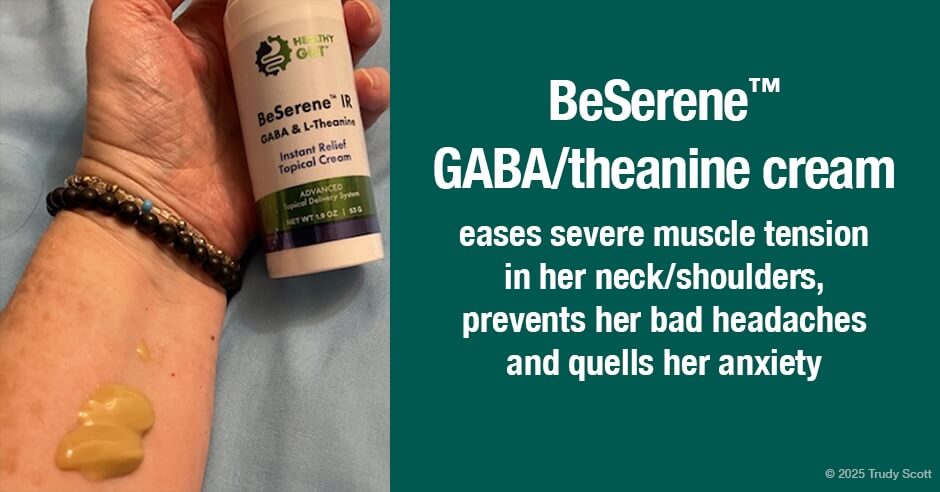
BeSerene™ GABA/theanine cream eases severe muscle tension in her neck/shoulders, prevents her bad headaches and quells her anxiety

October 24, 2025 By Trudy Scott 9 Comments

beserene

Hi there… I wanted to add my ‘two cents’ to the discussion about the BeSerene™ GABA/theanine product that you recommend. I LOVE it! I suffer from low GABA levels, which result in my having severe muscle tension in my neck and shoulders. Often, that resulted in bad muscle tension headaches, for which I couldn’t find anything to bring relief. The BeSerene™ GABA/theanine cream has been a real game changer.

If I wake up with one of those headaches in the middle of the night or in the morning, I use two pumps and rub it on my tight neck and shoulder muscles and within 15 minutes, I can feel the tension melting away! It literally goes away! I have  even been able to prevent a headache from occurring by using it on my neck muscles before I go to bed at night.

Insofar as anxiety, I get relief from that as well, because generally I start to get anxiety once the headaches start, as I never know if it is going to be manageable with just an ibuprofen or two, or if it is going to be one of ‘those’ headaches, i.e. a migraine that lasts for a day or more! Unfortunately, once the anxiety starts, it makes the muscle tension headache worse, which makes the anxiety worse, and it’s just a horrible vicious cycle!

So, since the BeSerene™ cream works so efficiently on the muscle tension, it quells the anxiety that usually follows!

It has changed my life, and I don’t know of any other product I can say that about. I can honestly say that I will not allow myself to ever be without it now!

Thank you so much Trudy, for recommending this product!

Lisa is a woman in the community who reached out to me via email with this message raving about how life-changing this cream has been for her. I am thrilled for her and never get tired of hearing results like this. I’m not surprised either and love to share these kinds of results! She kindly gave me permission to share, saying “I want others to experience what I have with this product!”

Read on below for more about why she gravitated towards using a cream, other benefits you may expect to see (like a reduction in stress-eating and/or drinking too much wine), my insights into when to consider using a GABA/theanine cream like this and how to use it, where to purchase this exact cream and additional resources if you are new to using GABA.

Why did Lisa gravitate to using a GABA/theanine cream?

Lisa shared that she just couldn’t seem to tolerate the sublingual or oral GABA:

I have tried sublingual GABA products but haven’t had much success, as I haven’t been able to find any without alcohol sugars (xylitol, sorbitol, etc.) Those ingredients give me a terrible taste in my mouth and I just can’t tolerate them. (Why can’t they make one with just real sugar from nature?)

Plus, I haven’t had a lot of success with the oral products as they just take too long to work on the headaches/muscle tension.

I’m really glad she recognized her symptoms were due to low GABA – muscle tension and pain, in conjunction with feeling physically anxious are common. And that she didn’t give up on GABA and persevered until she found what works for her symptoms.

What about other forms of GABA?

However, my advice for someone in Lisa’s situation is not to give up on other GABA products if she finds she needs additional support in the future or finds herself without the cream. With regards to taste and time to work, I recommend a GABA-only (or GABA/theanine) capsule opened on to the tongue or a GABA (and/or theanine) powder – both held on the tongue for 1-2 minutes for quick results.

Stress-eating and self-medication with wine are classic signs of low GABA

Interestingly, stress eating is not an issue for her but wine may be:

I’ve never really had any issues with stress-eating. In fact, I usually have no appetite when I’m stressed out! (That’s where the wine comes in…lol!)

We may self-medicate with wine when GABA is low because it relaxes us physically, helps us fit in socially and feels calming and pleasant. It’s mistakenly used to try and improve sleep but typically makes things worse.

Alcohol consumption damages the gut, depletes B vitamins (especially thiamine/vitamin B1) and zinc – and it’s addicting.

GABA can stop that addiction in its tracks so there are no feelings of deprivation. The reasons we are drawn to GABA are addressed too. And amazingly there is research that GABA may actually heal the gut after alcohol consumption.

Bumping up the GABA/theanine cream may help or considering one of the other GABA products mentioned above may be better.

Low GABA symptoms

As a reminder, if you are new to GABA, it’s an amino acid that helps to address low GABA levels and the associated symptoms: physical tension and feeling anxious, feeling worried or fearful, panic attacks, stiff or tense muscles, insomnia, feeling stressed and burned-out, craving carbs/alcohol for relaxation and calming, intrusive thoughts, spinning/poor focus, fear of heights, rectal spasms, burning mouth, and visceral pain/belly pain with IBS. See the most current list of low GABA symptoms here.

When to consider using a GABA/theanine cream like this?

These are some of the applications I consider

  • When other GABA products haven’t worked (like in Lisa’s situation)
  • When looking for something in addition to other GABA products, for example, GABA powder in the day while at work or play, and GABA/theanine cream at night for tension and sleep issues
  • When there is a specific need for a topical application – like with neck and shoulder tension or belly pain or period pain or leg spasms etc
  • For an aging parent with Alzheimer’s disease (and sundowning agitation/anxiety)
  • For a person with ARFID (avoidant-restrictive food intake disorder)
  • For a person with anorexia or other eating disorder
  • When a child or young adult has autism (with anxiety and sensorimotor issues), a child/adult who struggles with taking supplements and other special needs children/adults
  • For someone with multiple sclerosis (for anxiety and muscle spasms/spasticity)
  • When a person has severe digestive issues and prefers a cream
  • When someone just wants to take a break from sublingual/oral/powder GABA
  • For presurgery anxiety since supplements are typically not permitted (even though there is research showing both help)

Where to purchase BeSerene™ IR GABA and theanine cream and how to use it?

This cream can be purchased online with this link (this has my 15% discount built in – you’ll see the discount applied on the checkout page after you add it to the cart).

Purchase BeSerene™ IR

They recommend applying 1-2 pumps to your temples or wrists.

You could also use 1-2 pumps/squirts on your neck and shoulder (like Lisa did), the forearm or inner thigh (before bed for helping improve sleep), and/or belly (especially if belly pain or IBS/SIBO or PMS pain keeps you awake at night). It can also easily be applied if you wake in the night.

Personally, it’s a product I love at bedtime. I apply 2 pumps on my forearm and then rub my belly with any that is left over. It’s calming, improves my sleep and helps with belly pain at night.

I’m sure you can tell by now that this is a product I endorse. I recommend it to clients and to participants in my GABA Quickstart program. In fact, it’s one of the top ten GABA products I recommend and it’s even included in the training materials/handouts of the program!

Additional resources when you are new to using GABA or other amino acids as supplements

We use the symptoms questionnaire to figure out if low GABA (indicating a possible need for GABA or theanine) or low serotonin (indicating a need for tryptophan or 5-HTP) or low endorphins (indicating a possible need for DPA) or other neurotransmitter imbalances may be an issue for you.

If you suspect low levels of any of the neurotransmitters and do not yet have my book, The Antianxiety Food Solution – How the Foods You Eat Can Help You Calm Your Anxious Mind, Improve Your Mood, and End Cravings. I highly recommend getting it and reading it before jumping in and using amino acids on your own so you are knowledgeable. And be sure to share it with the practitioner/health team you or your loved one is working with.

There is an entire chapter on the amino acids and they are discussed throughout the book in the sections on gut health, gluten, blood sugar control, sugar cravings, anxiety and mood issues. The importance of quality animal protein and healthy fats is also covered.

The book doesn’t include product names (per the publisher’s request) so this blog, The Antianxiety Food Solution Amino Acid and Pyroluria Supplements, lists the amino acids that I use with my individual clients and those in my group programs.

If, after reading this blog and my book, you don’t feel comfortable figuring things out on your own (i.e. doing the symptoms questionnaire and respective amino acids trials), a good place to get help is the GABA QuickStart Program (if you have low GABA symptoms). This is a paid online/virtual group program where you get my guidance and community support. We’ll be launching a budget-friendly homestudy version in a few weeks – sign up for the wait list here (the live version with Q&A is offered only a few times a year).

If you also need serotonin support, the Serotonin QuickStart Program is a good place to get help. This is also a paid online/virtual group program where you get my guidance on using tryptophan and 5-HTP safely, and community support during 5 LIVE Q&A calls. You can sign up to be notified when the next live launch of this program is happening.

If you are a practitioner, join us in The Balancing Neurotransmitters: the Fundamentals program. This is also a paid online/virtual program with an opportunity to interact with me and other practitioners who are also using the amino acids.

Now I’d love to hear from you…

I appreciate Lisa’s willingness to share her wonderful results. Now I’d love to hear from you.

Have you used BeSerene™ GABA and theanine cream and how has it helped you?

How does using a GABA/theanine cream compare with other GABA products you have used (feel free to share specific brands and how you used them – sublingual, capsule-opened, liposomal or powder or even another brand of GABA cream)?

As  I shared above, some folks prefer a cream only and many use a combination of cream and sublingual.

Feel free to post your questions here too.

Filed Under: Anxiety, GABA, Pain, Stress Tagged With: anxiety, anxious, BeSerene, BeSerene™ GABA/theanine cream, cream, GABA, GABA cream, GABA Quickstart, Headaches, how to use a GABA cream, low GABA, migraine, muscle tension, neck, pain, shoulders, sleep issues, stress, stress-eating, wine

Flight anxiety with heightened breath, physical tension and also fearing the worst (the role of low GABA and low serotonin)

September 19, 2025 By Trudy Scott Leave a Comment

flight anxiety

Do you have suggestions for supplements for flight anxiety, something to make flying bearable without heightened breath, etc, or is that out of the supplement realm?

I also have physical tension and fear the worst. Any kind of turbulence or warnings of turbulence makes me extremely nervous.

K asked this question on one of my blogs and I responded that this is very much in the supplement realm! And what we use depends on the type of anxiety someone is experiencing.

I would first consider serotonin support before and during flying – tryptophan or 5-HTP – because she fears the worst and feels extremely nervous. With low serotonin there may also be  worry and fear leading up to the trip, as well as feelings of panic and imagining the worst during the flight.

GABA support – using the amino acid GABA or theanine – should also be considered for the more physical symptoms of heightened breath and physical tension. With low GABA there can be other physical symptoms such as excessive sweating (like the palms), a racing or pounding heart and a dry mouth. These amino acids could also be used leading up to the flight and during the trip if needed.

Read on for more on my insights on using these amino acids in a situation like this, additional information about fear of flying and a success story with GABA.

Serotonin and/or GABA support for fear of flying

In an ideal situation I would want to address both low serotonin and low GABA before flying and have her use extra during the flight, as needed. It’s very likely that many of the low serotonin and low GABA symptoms are present in some way in her day to day life too.

This means she can be methodical about doing a trial of the respective amino acids and figure out the optimal dose of each in familiar surroundings – using powder, capsule opened, sublingual, chewable or liposomal.

As always we trial one at a time so we know which one is working best. Keep in mind some folks do better with tryptophan and some do better with 5-HTP so both may need to be trialed. The same can be said for GABA and theanine.

Once the product and dose of each has been figured out, she’ll need to find a suitable option for use while traveling i.e. a sublingual or chewable tablet

It’s always a comprehensive approach

It’s a comprehensive approach – amino acids AND diet so I recommend eating real whole food, quality animal protein, eating for blood sugar stability, going gluten-free, sugar-free and caffeine-free, eating healthy fats, organic vegetables and fruit and fermented foods. My book “The Antianxiety Food Solution”  is a great place to start when you are new to the amino acids and other anxiety nutrition solutions like gluten/sugar/caffeine removal, blood sugar control, gut health, pyroluria etc.

During travel it’s important to be prepared with healthy travel foods and drinks. I share some ideas here.

The definition of a specific phobia such as the fear of flying

The fear of flying is called aviophobia and it’s one of many common phobias about something specific. According to this ebook

Specific phobia is an anxiety disorder characterized by excessive and irrational fear of a particular object, situation, or activity. The anxiety response goes beyond normal apprehension and leads to avoidance behavior. The intensity of the fear is often disproportionate to the actual danger posed by the phobic stimulus.

Common examples of specific phobias include fear of heights (acrophobia), fear of spiders (arachnophobia), fear of flying (aviophobia), and fear of needles (trypanophobia). People with specific phobias may experience intense anxiety or panic attacks when exposed to the feared object or situation.

This Australian article reports that “One in six people have a significant fear that prevents them from flying, and about one in five regular flyers use alcohol or prescription drugs to “help” them through a flight, according to Victoria’s Department of Health.”

Using the amino acids to address low serotonin and/or low GABA addresses the root cause and does away with the need for alcohol and antianxiety meds (and the associated side-effects).

Cognitive behavior therapy (CBT) and exposure therapy is often recommended for aviophobia but doesn’t always help, and doesn’t address the biochemical imbalances.

A success story with GABA before and during a flight – cool as a cucumber

Melissa started using Source Naturals GABA Calm in anticipation of holiday travel and holiday gatherings and shared this:

I’m glad I saw the post about GABA on your FB page a couple weeks ago. I bought Source Naturals GABA Calm and have been taking 1-3 per day for two weeks.

I’m glad I bought it before travelling home for Christmas – I was cool as a cucumber at the airport and was much calmer when visiting family and friends compared to last year! The true test of its efficacy will be in two weeks when the semester starts. For now, I notice a general calmness and am sleeping well.

Notice that she started using it in the 2 weeks leading up to her trip and not on the flight itself.

Additional resources when you are new to using tryptophan or GABA and other amino acids as supplements

We use the symptoms questionnaire to figure out if low serotonin or low GABA or other neurotransmitter imbalances may be an issue for you.

If you suspect low levels of any of the neurotransmitters and do not yet have my book, The Antianxiety Food Solution – How the Foods You Eat Can Help You Calm Your Anxious Mind, Improve Your Mood, and End Cravings. I highly recommend getting it and reading it before jumping in and using amino acids on your own so you are knowledgeable. And be sure to share it with the practitioner/health team you or your loved one is working with.

There is an entire chapter on the amino acids and they are discussed throughout the book in the sections on gut health, gluten, blood sugar control (this is covered in an entire chapter too), sugar cravings, anxiety and mood issues. The importance of quality animal protein and healthy fats is also covered.

The book doesn’t include product names (per the publisher’s request) so this blog, The Antianxiety Food Solution Amino Acid and Pyroluria Supplements, lists the amino acids that I use with my individual clients and those in my group programs.

If, after reading this blog and my book, you don’t feel comfortable figuring things out on your own (i.e. doing the symptoms questionnaire and respective amino acids trials), a good place to get help is the GABA QuickStart Program (if you have low GABA symptoms too). This is a paid online/virtual group program where you get my guidance and community support.

If you need serotonin support, the Serotonin QuickStart Program is a good place to get help. This is also a paid online/virtual group program where you get my guidance on using tryptophan and 5-HTP safely, and community support during 5 LIVE Q&A calls. You can sign up to be notified when the next live launch of this program is happening.

If you are a practitioner, join us in The Balancing Neurotransmitters: the Fundamentals program. This is also a paid online/virtual program with an opportunity to interact with me and other practitioners who are also using the amino acids.

Have you had success using serotonin and/or GABA support for your fear of flying (or other phobia/s)? If yes, which amino acids have helped you?

Did you have any success with CBT or exposure therapy or other approaches?

Feel free to share and ask your questions below.

Filed Under: Amino Acids, Anxiety, GABA, serotonin Tagged With: 5-HTP, amino acids, anxiety, aviophobia, dry mouth, fear, fear the worst, fearing the worst, flight anxiety, flying, GABA, heightened breath, low GABA, low serotonin, nervous, panic, physical-tension, racing heart, supplement, sweating, theanine, tryptophan, turbulence, worry

Pathological Demand Avoidance (PDA) in children with autism – how much is behavioral and how much is due to low serotonin?

June 9, 2023 By Trudy Scott 14 Comments

pda in children with autism

Pathological Demand Avoidance (PDA) is a condition associated with Autism Spectrum Disorder (ASD). It is a rare behavioral phenotype of ASD that is characterized by an overwhelming or obsessional need to resist or avoid demands, which can often lead to sensory overwhelm causing meltdowns and violent outbursts.

Although children in general may often try to avoid demands, children with PDA engage in avoidant behaviors at a greater level.

The key underlying factor is the extreme levels of anxiety associated with a loss of control, which can feel like a panic attack. Because of high levels of anxiety, they will often respond with a “No” even to tasks or activities that they normally enjoy and can spend a great deal of energy trying to gain control of situations and people.

(from an Australian PDA article: What is Pathological Demand Avoidance (PDA) and how can we address it? so I changed the spelling of behavioural and characterised to be American)

This is a typical overview of PDA and the common recommendations (as outlined in the above article) are all behavioral interventions: be an active listener and build trust, depersonalize requests, provide indirect praise, use humor and so on. Many parents find these helpful but the biochemical imbalances that trigger these behaviors are being ignored and/or there is a lack of awareness. I’d like to change this so more children and teens get quick relief.

There may be many different root causes such as low serotonin, low GABA, low blood sugar, gluten sensitivities, low zinc, low vitamin B6, low vitamin D, toxins, infections, phenols, salicylates etc. Today I’m going to discuss low serotonin and my rationale for reaching this conclusion. It’s also one of the quickest root causes to confirm (more on that below).

My rationale for proposing that Pathological Demand Avoidance (PDA) in children with autism is related to low serotonin

If we take the description above, all of these symptoms are classically found when a child (or adult) has low serotonin:

  • Extreme levels of anxiety
  • Can feel like a panic attack
  • Overwhelm
  • Meltdowns and violent outbursts
  • Loss of control
  • Spending a great deal of energy trying to gain control of situations and people (i.e. controlling)
  • Obsessional need to resist (any kind of obsessing is common when serotonin is low)

The second reason I suspect low serotonin with PDA is the timing of these behaviors i.e. later in the day. The article mentions that “A child with PDA can be very calm, cool and compliant at school and behave much worse at home. This is not because of incompetent parenting but because they have reached their tolerance levels and need to release that suppressed anxiety.”

This may well be a factor, however low serotonin symptoms are recognized as being more severe in the afternoon/evening when serotonin levels start to decline. If these children have low serotonin then it makes sense that these symptoms would start to increase once they get home.

My third reason is that low serotonin is common in autism/autism spectrum disorder (ASD).

Low serotonin is common in autism/autism spectrum disorder (ASD)

This paper, Vitamin D hormone regulates serotonin synthesis. Part 1: relevance for autism, summarizes it as follows: “The disruption of the serotonergic system is one of the most consistent observations associated with autism. Serotonin in the brain promotes prosocial behavior and correct assessment of emotional social cues.”  

Their recommendations are vitamin D and tryptophan supplementation which they say “may be a simple method of increasing brain serotonin without negative side effects.”

Testing for low levels of vitamin D and supplementing accordingly is important.

Are there other low serotonin symptoms and using a trial of tryptophan to confirm

As mentioned above, low serotonin is also one of the quickest root causes to confirm. As always, regardless of the diagnosis, we assess for low serotonin by rating symptoms on a scale of 1 to 10 (with 10 being most severe) and do a trial of tryptophan (chewed or a capsule opened on to the tongue). You will have your answer very quickly because we rate improvements in symptoms in the next 5 to 30 minutes.

In addition to the above symptoms we also look for these: worry-in-your-head and ruminating type of anxiety, phobias, lack of confidence, depression, negativity, imposter syndrome, PMS, irritability, insomnia and afternoon/evening cravings for carbs and sugar.

Lidtke is the only brand of tryptophan that I recommend simply because I see it work so well and because of quality issues with tryptophan in the past. Here are the Lidtke tryptophan products I recommend:

  • Lidtke Chewable Tryptophan 100 mg is a good for doing a trial and works when lower doses are needed as with children.
  • Lidtke Tryptophan 500 mg can be used for doing a trial. I open the capsule and use 100mg for a child. Going forward this product is helpful when higher doses are needed, especially at night. When opened it doesn’t taste very good but can be mixed with inositol or even glutamine powder or mashed banana.

You can read more on this blog: Tryptophan for the worry-in-your-head and ruminating type of anxiety, see the full list of low serotonin symptoms here and find the tryptophan products on the supplements blog here.

If you’re new to PDA, the DSM and low serotonin/other biochemical factors

Professor Elizabeth Newson was a developmental psychologist known for her work with children in the autism spectrum. This is her 2003 paper on the topic – Pathological demand avoidance syndrome: a necessary distinction within the pervasive developmental disorders

It’s not part of the DSM-5, the standard classification of mental disorders used by mental health professionals in the United States. This article, A Brief History of Pathological Demand Avoidance, offers a good backstory and shares why families want it to be part of the DSM.

Whether or not it becomes a distinct condition or autism subtype in the DSM, I’d like to see low serotonin (and likely low vitamin D) being recognized as one root cause. And acknowledging that there may be many other biochemical/nutritional approaches that should also be explored.

These symptoms are listed in the above article, in addition to avoidance behaviors, and all could fall into typical low serotonin symptoms:

  • verbal and physical aggression when feeling loss of control
  • self-injurious behavior
  • property destruction
  • refusal to participate in self-care such as bathing or brushing teeth (is this depression?)
  • inability to attend social events (is this fear and social anxiety?)
  • controlling what noises are allowed in a home, such as no music, or only certain music
  • inability to allow parents to have friends visit the home (is this also controlling?)
  • are often combative with siblings
  • issues with food, what to eat, when to eat, who to eat with
  • conflict with siblings

As mentioned above we also look into low GABA and low blood sugar (trials of GABA and glutamine will give quick confirmation too), gluten sensitivity, low zinc, low vitamin B6, toxins, infections, phenols, salicylates and so on. Of course, Nutritional and Dietary Intervention for Autism Spectrum Disorder is crucial.

Some success stories and connecting the dots with low serotonin

These two success stories illustrate how successful tryptophan and GABA can be and also how quickly they offer relief:

  • Rage, anxiety, cravings & insomnia in 11-year old girl with RAD/reactive attachment disorder: chewable tryptophan turns things around
  • Half a crushed GABA Calm for my autistic child: sleep, anxiety and sensorimotor skills (writing, horse riding and swimming) improve

This blog post illustrates similar low serotonin symptoms and end-of-the-day timing in adults with Alzheimer’s – Sundowning in Alzheimer’s and dementia: melatonin/tryptophan for the agitation, restlessness, anxiety, disturbed sleep and aggression. It’s low serotonin that is the cause, regardless of the diagnosis.

This blog illustrates another mechanism for these types of disruptive behaviors: Christmas tree phenols as a trigger for anger, meltdowns, anxiety, hyperactivity, insomnia, aggression, self-injury and autistic symptoms? There is a serotonin connection when there are phenol issues too.

Resources if you are new to using amino acids as supplements

If you are new to using amino acids as supplements, here is the Amino Acids Mood Questionnaire from The Antianxiety Food Solution (you can see all the symptoms of neurotransmitter imbalances, including low GABA, low serotonin and low endorphins).

If you suspect low levels of any of the neurotransmitters and do not yet have my book, The Antianxiety Food Solution – How the Foods You Eat Can Help You Calm Your Anxious Mind, Improve Your Mood, and End Cravings, I highly recommend getting it and reading it before jumping in and using amino acids on your own so you are knowledgeable. And be sure to share it with the practitioner/health team you or your loved one is working with.

There is an entire chapter on the amino acids and they are discussed throughout the book in the sections on gut health, gluten, blood sugar control, sugar cravings, anxiety and mood issues.

The book doesn’t include product names (per the publisher’s request) so this blog, The Antianxiety Food Solution Amino Acid and Pyroluria Supplements, lists the amino acids that I use with my individual clients and those in my group programs. You can find them all in my online store.

If, after reading this blog and my book, you don’t feel comfortable figuring things out on your own (i.e. doing the symptoms questionnaire and respective amino acids trials), if you need serotonin support, the Serotonin QuickStart Program is a good place to start. This is a paid online/virtual group program where you get my guidance on using tryptophan and 5-HTP safely, and community support during 5 LIVE Q&A calls. You can sign up to be notified when the next live launch of this program is happening. We take a deep dive into product options including Lidtke products and others if you’re not able to access Lidtke.

If you also have low GABA symptoms, the next step to get help is the GABA QuickStart Program.This is also a paid online/virtual group program where you get my guidance and community support. Another option is the budget-friendly GABA QuickStart Homestudy program.

If you are a practitioner, join us in The Balancing Neurotransmitters: the Fundamentals program. This is also a paid online/virtual program with an opportunity to interact with me and other practitioners who are also using the amino acids.

Now I’d like to hear from you

Have you been told your child may have Pathological Demand Avoidance (PDA)? Have you only been offered behavioral change tools and how have they helped?

Has low serotonin (and other biochemistry imbalances) been discussed too?

What symptoms does your child have and are things worse later in the day?

Has tryptophan helped reduce the above low serotonin symptoms in your child? How much helps and how quickly?

Or do you find 5-HTP works better? If yes, how much helps and how quickly?

What other biochemical changes have helped?

If you’re a practitioner, are you hearing about increased discussion of Pathological Demand Avoidance (PDA) and do you address low serotonin with your clients/patients?

Feel free to post your feedback and questions here in the comments.

Filed Under: Anger, Anxiety, Autism, Children/Teens, Depression, Tryptophan Tagged With: amino acids, anxiety, ASD, autism, behavioral, behavioural, biochemical imbalances, control, demands, GABA, gluten, infections, low blood sugar, low GABA, low serotonin, meltdowns, neurotransmitters, obsessional, outbursts, overwhelming, panic attack, Pathological Demand Avoidance, PDA, Phenols, salicylates, sensory overwhelm, the GABA Quickstart online program; and Balancing Neurotransmitters: the Fundamentals program for practitioners, toxins, tryptophan, violent, vitamin D

“I’m In An Abusive Relationship That I Will Never Walk Away From”: tryptophan, a gluten-free diet, lithium and other nutritional solutions

March 10, 2023 By Trudy Scott 16 Comments

abusive relationship - nutrition solutions

This mom’s story really struck a nerve for me… “I’m in an abusive relationship that I will never walk away from.” She shares this …

I can’t exactly pinpoint when I first felt the shift between our dynamic. One minute, things were as they always were. Before I could blink, though, I found myself engrossed in an alternate reality that resembled less and less of life as I knew it with each passing week. Trickles of rage and anger bubbled to the surface, threatening to break through until they could no longer be harnessed. I’ve been riding the waves ever since.

I currently exist in a heightened state of fear and anxiety, unsure of what each day will bring. When I wake each morning, I silently hope that today will be a “good” day; that he won’t be angry. That he won’t hurt me. Sometimes I’m lucky, and I get my person back. Other times, it feels like I’m living in a battle ground.

Her story really struck a nerve for me because of what she is going through but also because NO solutions are provided for her son. Stories like this help create awareness, make you feel less alone, create empathy and better understanding – which is important – but we want to offer nutritional solutions to families who are dealing with this.

(You can read her entire story on the ScaryMommy blog.)

Functional medicine and nutritional psychiatry as a solution

My heart goes out to this mom, this young man and the rest of the family. My hope is that this mom and all mom’s in similar situations are open to functional medicine, nutritional psychiatry and the power of food and nutrients to dramatically reduce and in many cases reverse behavioral issues like this in the child.

Sugar, caffeine and junk food must go and a gluten-free diet will very possibly make a difference. Having her son eat for blood sugar control is key too. It may also mean switching to a low-salicylate and/or, low-oxalate and low histamine diet. And addressing low lithium, low zinc, low vitamin D, low vitamin B12, high copper, low magnesium and/or low vitamin B6. Low serotonin and low GABA are common and this is where I would start with this young man (more on this below). They may also need to address his gut health/parasites, infections (like Lyme), PANS/PANDAS, mold toxicity, metals and environmental toxins etc.

I’ll highlight many of these in this blog and share links for further reading, plus the approaches I may consider. The important thing to recognize is that there is not one-size-fits-all.

Address low serotonin and low GABA

For a mom in the midst of all this, it can seem overwhelming and very daunting but when you start by addressing low serotonin and low GABA it becomes so much easier. Her son gets some relief very quickly and all the root causes can be figured out and addressed one by one. It also gives mom and the family a much-needed glimmer of hope. As I mentioned above, this is where I would start.

These are clues from her story as to why we’d want to look into and address low serotonin: her son’s explosive anger and rage, the physical and mental abuse, threats to hurt himself (self-harm) and his mother and siblings, and being argumentative.

You can see how the above fits into the list of low serotonin symptoms here. The amino acid that addresses low serotonin is tryptophan or 5-HTP and you can expect to see results in a few days.

I worked with an 11 year old girl with explosive rage issues (and anxiety, cravings & insomnia)  and chewable tryptophan started to turn things around very quickly. You can read more about this here.

If he has low GABA symptoms of physical tension and anxiety, we’d do a trial of GABA next.

A gluten-free diet and eating for blood sugar control

The next change I’d make is to have him start to make dietary changes, starting to switch to gluten-free eating and real whole food. As you can see from the above blog, a gluten-free diet and getting the 11 year old off the sugar made a big difference too. Tryptophan helped with this process, making it easy to break the addiction and not feel deprived.

Gluten issues (celiac disease and gluten sensitivity) are typically associated with gut issues but the psychiatric symptoms are less recognized. This 2023 paper, Psychiatric and Neurological Manifestations of Celiac Disease in Adults states that “Celiac disease is associated with mood disorders, such as manic-depressive disease, schizophrenia, and bipolar disorder, as well as other disorders such as depression and anxiety.”

In this blog I share how gluten was found to be the cause of a childhood case of obsessive-compulsive disorder. Symptoms resolved on a gluten-free diet.

Having him starting to eat for blood sugar stability may help with the irritability and mood swings, and may also help with his rageful outbursts.

Low dose lithium orotate for the rollercoaster of emotions

Next I’d likely explore the possibility of low dose lithium orotate as something that may help this young man too. The hallmark of low lithium is a rollercoaster of emotions and this mom shares how there are really good times amongst the really tough times.  I use this lithium questionnaire with clients. In addition to the ups and downs, these are clues that he may benefit: he’s rebellious, exhibits disruptive behavior and aggressiveness, is irritable, restless and engages in risky behavior.

Next steps: explore all the possible root causes and do nutritional testing

We’d want to explore all possible root causes and next steps would be decided based on his specific situation. Here is a list of 60+ root causes that I work through and the nutritional/functional testing that I do with my clients. You can replace anxiety with anger/rage in the blogs – for some people their symptoms show up as rage and for others it’s anxiety.

And here are some links for further reading:

  • Bartonella infection in mom and both sons: anxiety, panic attacks, insomnia, inconsolable crying, irritability, ADHD, rage and pain
  • Christmas tree phenols as a trigger for anger, meltdowns, anxiety, hyperactivity, insomnia, aggression, self-injury and autistic symptoms? (dietary salicylates – a type of phenol – can cause similar issues)
  • Sex and Aggression Characteristics in a Cohort of Patients with Pediatric Acute-Onset Neuropsychiatric Syndrome “Among patients with PANS, males exhibit more aggressive behavior when compared with females” (typically the clue it may be PANDAS/PANS is sudden onset of symptoms, although it’s not the case in all instances)
  • Neuropsychiatric Lyme Disease by Dr. Suruchi Chandra Lyme disease “can remain dormant for years and then later mimic a number of psychiatric illnesses, including anxiety disorders, mood disturbances, psychosis, and autism-like behaviors.”

This is not a conclusive list but a good start for seeing what the possibilities may be. Feel free to search the blog for more on some of the above and some of the other factors mentioned above and in the 60+ root causes blog.

As you can see above, we start with the simple changes – amino acids and a few simple dietary changes (all covered in my book) and lithium orotate – and then continue to dig deeper.

Mom and the other children need nutritional/trauma support too

This mom and the other children need support too – from family and community, from a therapist who specializes in trauma – and with GABA/tryptophan, adrenal support and B vitamins. You can read more about nutritional solutions for psychological stress here.

Resources if you are new to using tryptophan or GABA as supplements

If you are new to using tryptophan or GABA as supplements, here is the Amino Acids Mood Questionnaire from The Antianxiety Food Solution (you can see all the symptoms of neurotransmitter imbalances, including low GABA and low serotonin).

If you suspect low levels of any of the neurotransmitters and do not yet have my book, The Antianxiety Food Solution – How the Foods You Eat Can Help You Calm Your Anxious Mind, Improve Your Mood, and End Cravings, I highly recommend getting it and reading it before jumping in and using amino acids on your own so you are knowledgeable. And be sure to share it with the practitioner/health team you or your loved one is working with.

There is an entire chapter on the amino acids and they are discussed throughout the book in the sections on gut health, gluten, blood sugar control, sugar cravings, anxiety and mood issues (which include rage/anger/irritability/self-harm).

The book doesn’t include product names (per the publisher’s request) so this blog, The Antianxiety Food Solution Amino Acid and Pyroluria Supplements, lists the amino acids that I use with my individual clients and those in my group programs. You can find them all in my online store. The above oral lavender products are available in my online store too.

If, after reading this blog and my book, you don’t feel comfortable figuring things out on your own (i.e. doing the symptoms questionnaire and respective amino acids trials), a good place to get help is the GABA QuickStart Program (if you have low GABA symptoms). This is a paid online/virtual group program where you get my guidance and community support.

If you are a practitioner, join us in The Balancing Neurotransmitters: the Fundamentals program. This is also a paid online/virtual program with an opportunity to interact with me and other practitioners who are also using the amino acids.

Have you found tryptophan, GABA and/or lithium orotate to help in a situation like this?

What about a gluten-free diet and eating for blood sugar control?

What bigger root causes were found to be contributing factors too?

If you have questions and other feedback please share it here too.

Filed Under: Gluten, Lithium orotate, Nutritional Psychiatry, serotonin, Teens, Tryptophan Tagged With: abuse, abusive relationship, amino acids, anger, angry, anxiety, bartonella, blood sugar, emotions, fear, functional medicine, GABA Quickstart online program; and Balancing Neurotransmitters: the Fundamentals program for practitioners, gluten-free, irritability, lithium orotate, low GABA, low serotonin, Lyme Disease, nutritional psychiatry, nutritional solutions, PANS, Phenols, rage, rollercoaster, self-harm, Solutions, tryptophan

Teen with anxiety, low self-esteem and insomnia: how to do a one-off trial of tryptophan to figure out if she has low serotonin

August 20, 2021 By Trudy Scott 23 Comments


teen anxiety tryptophan serotonin

A mom asks for advice for her teenage daughter who has anxiety, low self-esteem issues,  insomnia, experiences negativity and has phobias. She wants to know if serotonin support may help and where to start. I share my feedback confirming that these are low serotonin symptoms and that I would do a trial of tryptophan. I go deeper in this blog and also go into detail about how I would do a one-off trial (or evaluation) of tryptophan if I was working with this family. I also share why I’d look into low GABA, seasonal allergies and the birth control pill. And I discuss the importance of being proactive given the increasing suicide and self-harm in this age-group, with the pandemic compounding the increase.

Here is the question that Maria asked about her daughter:

My 13-year-old teen has always suffered from insomnia, sometimes light, sometimes a bit heavier, depending on the period. She has suffered from asthma from a young age, even if this issue has improved enormously, it is sometimes present, specially during spring time as she is allergic to different plants. She would suffer from sugar cravings in the past as we were trying to change her diet. Things are going better in this respect as well; however, negativity, phobias, low self esteem and anxiety are always present for her.

Are these signs of low serotonin? How could we help her feel better? Should serotonin pills be applied directly? Would this make the system dependent on it? If amino acids should be supplemented, how should we do this, considering her age?

I responded that yes, negativity, phobias, low self esteem and anxiety (the worry type) are signs of low serotonin. Insomnia can also be caused by low serotonin especially if her daughter is lying awake, overthinking and worrying about things.

I shared that the body does not get dependent on the amino acids and I’d consider a trial of tryptophan to address her symptoms.

Doing a one-off trial/evaluation of tryptophan based on her symptoms

If I was working with this family, I would help this mom figure out for sure if her daughter has low serotonin by reviewing the low serotonin symptom list with her, and helping her rate them on a scale of 1-10 with 10 being the worst.

This can often be challenging for a 13-year old: giving the symptoms a severity rating and being able to identify exactly how she feels. Her ratings may also be reflective of where she is in her cycle at the time and may fluctuate more in the month if her cycle is not yet regular. Working together with mom we can hopefully figure this out. If not, we do the best we can with the information we have.

The next step is picking one or two symptoms that are easy to measure the day we do the initial trial or evaluation. For this young girl I’d pick anxiety/worry and negativity and ask her some questions that would help us assess before and after results of the one-off trial /evaluation of tryptophan:

  • For anxiety and worry she may say it’s also a 9 and give me this example: “I’m really worried about performing in the concert – I keep thinking about it all day long and at night.”
  • For negativity she may say it’s a 9 and give me this example: “I really don’t think I’m good enough to be in the dance class.”

Both tryptophan and 5-HTP can raise serotonin but I like to start with tryptophan. I typically start with 100mg Lidtke chewable tryptophan in children/teens so I’d have her chew one tablet and then check back in the next 2 to 5 minutes (or maybe a little longer for some folks).

This is the kind of feedback I’m looking for:

  • With regards to anxiety and worry she may say: “Gosh, I completely stopped thinking about the concert. I’m not worrying about it at all. Now that you ask I’m thinking about it again but I think my worry/anxiety is about a 5 now.”
  • With regards to negativity she may say: “I think I feel better about being in the dance class. I think I can do it. My negativity feels like it’s a 5 or 6”

Since this teen responded so well, I’d have her start taking tryptophan midafternoon and evening (away from protein) and we’d increase if needed, each week, and based on her symptoms.

I have everyone keep a food mood and supplements log and mom could help her do this too.

GABA, seasonal allergies and the birth control pill

I also always assess low GABA when someone is anxious (especially if she also has physical anxiety, tension, stiff muscles) and has insomnia. We’d do the same one-off trial with a product like GABA Calm (or similar) once we’ve established a good dose of tryptophan for easing her symptoms.

This mom also mentioned Spring time allergies so I also shared this blog with her: 5-HTP and/or tryptophan to help with increased anxiety, panic attacks and depression caused by spring allergies. Depending on the season, her daughter may score higher on some of the low serotonin symptoms.

I’d also want to know if her daughter is on a birth control pill (often prescribed at this age for acne) because it can contribute to anxiety and depression.

Being proactive is wise given the rise in suicide and self-harm in this age group

Being proactive about addressing low serotonin symptoms quickly is wise given the rise in suicide and self-harm in this age group. This 2021 Italian study discusses the role of emotional dysregulation when it comes to and self-injurious thoughts and behaviours in high-school students:

Overall, 11.1% of adolescents reported self-harming behaviours without suicide ideation or attempts, 6.4% declared having thought to suicide without acting a suicide attempt or self-harm, 1.4% declared having attempted suicide and really thought to take away their life.

Unfortunately, the pandemic has also made things worse for many adolescents. This study reports that Canadian adolescents appear to be experiencing “higher rates of self-harm thoughts and behaviours relative to before the pandemic.”

It’s important to keep in mind that pre-teens and teens may not be willing to admit that they are engaging in self-harm like cutting or burning, or thinking about taking their lives.

Resources if you are new to using the amino acids as supplements

If you are new to using the amino acids tryptophan/5-HTP or GABA as supplements and want to know more in case you need them in a future situation, here is the Amino Acids Mood Questionnaire from The Antianxiety Food Solution (you can see all the low serotonin and low GABA symptoms here) and a brief overview here, Anxiety and targeted individual amino acid supplements: a summary.

If you suspect low serotonin or low levels of any of the neurotransmitters and do not yet have my book, The Antianxiety Food Solution – How the Foods You Eat Can Help You Calm Your Anxious Mind, Improve Your Mood, and End Cravings, I highly recommend getting it and reading it before jumping in and using amino acids so you are knowledgeable.

It also covers all the basics of a healthy diet. It’s a comprehensive approach – amino acids AND diet. I’d also want to know what her diet is like right now – gluten-free, sugar-free, caffeine-free, eating protein at breakfast for blood sugar control, real whole foods, grass-fed red meat, wild fish, fermented foods etc?

The book doesn’t include product names (per the publisher’s request) so this blog, The Antianxiety Food Solution Amino Acid and Pyroluria Supplements, lists the amino acid products that I use with my individual clients and those in my group programs.

Thanks to this mom for asking the question and allowing me to use it as a teaching tool for my community. Let’s get her daughter and all teens feeling their best again.

Can you relate to the question this mom asked? Does it sound similar to what your daughter is experiencing right now or a client/patient?

Do you do a one-off trial /evaluation like this to find out if serotonin support is needed? Or have you done this in the past with your daughter, family member or yourself?

What are the before and after questions (and symptom ratings) and did tryptophan help?

Feel free to post any questions here too.

Filed Under: Anxiety, Depression, Teens, Tryptophan Tagged With: 5-HTP, allergic, allergies, anxiety, asthma, birth control pill, cutting, insomnia, low GABA, low self-esteem, low serotonin, negativity, one-off trial, overthinking, pandemic, phobias, seasonal allergies, self-harm, sucide, sugar cravings, teen, teenage, tryptophan, worrying

Primary Sidebar

NEW! GABA QuickStart Homestudy (with special intro pricing)

gaba quickstart homestudy

Free Report

9 Great Questions Women Ask about Food, Mood and their Health

You'll also receive a complimentary subscription to my ezine "Food, Mood and Gal Stuff"


Connect with me

Popular Posts

  • Amino Acids Mood Questionnaire from The Antianxiety Food Solution
  • The Antianxiety Food Solution Amino Acid and Pyroluria Supplements
  • Pyroluria Questionnaire from The Antianxiety Food Solution
  • Collagen and gelatin lower serotonin: does this increase your anxiety and depression?
  • Tryptophan for the worry-in-your-head and ruminating type of anxiety
  • GABA for the physical-tension and stiff-and-tense-muscles type of anxiety
  • The Antianxiety Food Solution by Trudy Scott
  • Seriphos Original Formula is back: the best product for anxiety and insomnia caused by high cortisol
  • Am I an anxious introvert because of low zinc and vitamin B6? My response to Huffington Post blog
  • Vagus nerve rehab with GABA, breathing, humming, gargling and key nutrients

Recent Posts

  • What do I use instead of Seriphos to help lower high cortisol that is affecting my sleep and making me anxious at night?
  • BeSerene™ GABA/theanine cream eases severe muscle tension in her neck/shoulders, prevents her bad headaches and quells her anxiety
  • How the correct approach, dose and sublingual use of GABA can be calming and not cause a flushed and itchy face and neck
  • The amino acid glutamine improves low mood by addressing gut health, and it has calming effects too
  • Flight anxiety with heightened breath, physical tension and also fearing the worst (the role of low GABA and low serotonin)

Categories

  • 5-HTP
  • AB575
  • Addiction
  • ADHD
  • Adrenals
  • Alcohol
  • Allergies
  • Alzheimer's disease
  • Amino Acids
  • Anger
  • Antianxiety
  • Antianxiety Food Solution
  • Antidepressants
  • Anxiety
  • Anxiety and panic
  • Autism
  • Autoimmunity
  • benzodiazapines
  • Bipolar disorder
  • Books
  • Caffeine
  • Cancer
  • Candida
  • Children/Teens
  • Collagen
  • Cooking equipment
  • Coronavirus/COVID-19
  • Cravings
  • Depression
  • Detoxification
  • Diabetes
  • Diet
  • DPA/DLPA
  • Drugs
  • EFT/Tapping
  • EMF
  • EMFs
  • Emotional Eating
  • Endorphins
  • Environment
  • Essential oils
  • Events
  • Exercise
  • Fear
  • Fear of public speaking
  • Fertility and Pregnancy
  • Fish
  • Food
  • Food and mood
  • Functional neurology
  • GABA
  • Gene polymorphisms
  • General Health
  • Giving
  • Giving back
  • Glutamine
  • Gluten
  • GMOs
  • Gratitude
  • Gut health
  • Heart health/hypertension
  • Histamine
  • Hormone
  • Hyperparathyroidism
  • Hypoglycemia
  • Immune system
  • Inflammation
  • Insomnia
  • Inspiration
  • Introversion
  • Joy and happiness
  • Ketogenic diet
  • Lithium orotate
  • Looking awesome
  • Lyme disease and co-infections
  • MCAS/histamine
  • Medication
  • Men's health
  • Mental health
  • Mercury
  • Migraine
  • Mold
  • Movie
  • MTHFR
  • Multiple sclerosis
  • Music
  • NANP
  • Nature
  • Nutritional Psychiatry
  • OCD
  • Osteoporosis
  • Oxalates
  • Oxytocin
  • Pain
  • Paleo
  • Parasites
  • Parkinson’s disease
  • PCOS
  • People
  • PMS
  • Postpartum
  • PTSD/Trauma
  • Pyroluria
  • Questionnaires
  • Real whole food
  • Recipes
  • Research
  • Schizophrenia
  • serotonin
  • SIBO
  • Sleep
  • Special diets
  • Sports nutrition
  • Stress
  • Sugar addiction
  • Sugar and mood
  • Supplements
  • Teens
  • Testimonials
  • Testing
  • The Anxiety Summit
  • The Anxiety Summit 2
  • The Anxiety Summit 3
  • The Anxiety Summit 4
  • The Anxiety Summit 5
  • The Anxiety Summit 6
  • Thyroid
  • Thyroid health
  • Toxins
  • Tryptophan
  • Tyrosine
  • Uncategorized
  • Vegan/vegetarian
  • Women's health
  • Yoga

Archives

  • October 2025
  • September 2025
  • August 2025
  • July 2025
  • June 2025
  • May 2025
  • April 2025
  • March 2025
  • February 2025
  • January 2025
  • November 2024
  • October 2024
  • September 2024
  • August 2024
  • July 2024
  • June 2024
  • May 2024
  • April 2024
  • March 2024
  • February 2024
  • January 2024
  • December 2023
  • November 2023
  • October 2023
  • September 2023
  • August 2023
  • July 2023
  • June 2023
  • May 2023
  • April 2023
  • March 2023
  • February 2023
  • January 2023
  • December 2022
  • November 2022
  • October 2022
  • September 2022
  • August 2022
  • July 2022
  • June 2022
  • May 2022
  • April 2022
  • March 2022
  • February 2022
  • January 2022
  • December 2021
  • November 2021
  • October 2021
  • September 2021
  • August 2021
  • July 2021
  • June 2021
  • May 2021
  • April 2021
  • March 2021
  • February 2021
  • January 2021
  • December 2020
  • November 2020
  • October 2020
  • September 2020
  • August 2020
  • July 2020
  • June 2020
  • May 2020
  • April 2020
  • March 2020
  • February 2020
  • January 2020
  • December 2019
  • November 2019
  • October 2019
  • September 2019
  • August 2019
  • July 2019
  • June 2019
  • May 2019
  • April 2019
  • March 2019
  • February 2019
  • January 2019
  • December 2018
  • November 2018
  • October 2018
  • September 2018
  • August 2018
  • July 2018
  • June 2018
  • May 2018
  • April 2018
  • March 2018
  • February 2018
  • January 2018
  • December 2017
  • November 2017
  • October 2017
  • September 2017
  • August 2017
  • July 2017
  • June 2017
  • May 2017
  • April 2017
  • March 2017
  • February 2017
  • January 2017
  • December 2016
  • November 2016
  • October 2016
  • September 2016
  • August 2016
  • July 2016
  • June 2016
  • May 2016
  • April 2016
  • March 2016
  • February 2016
  • January 2016
  • December 2015
  • November 2015
  • October 2015
  • September 2015
  • August 2015
  • July 2015
  • June 2015
  • May 2015
  • April 2015
  • March 2015
  • February 2015
  • January 2015
  • December 2014
  • November 2014
  • October 2014
  • September 2014
  • August 2014
  • July 2014
  • June 2014
  • May 2014
  • April 2014
  • March 2014
  • February 2014
  • January 2014
  • December 2013
  • November 2013
  • October 2013
  • September 2013
  • August 2013
  • July 2013
  • June 2013
  • May 2013
  • April 2013
  • March 2013
  • February 2013
  • January 2013
  • December 2012
  • November 2012
  • October 2012
  • August 2012
  • July 2012
  • June 2012
  • May 2012
  • April 2012
  • March 2012
  • February 2012
  • January 2012
  • December 2011
  • November 2011
  • October 2011
  • September 2011
  • August 2011
  • July 2011
  • June 2011
  • May 2011
  • April 2011
  • March 2011
  • February 2011
  • January 2011
  • December 2010
  • October 2010
  • September 2010
  • July 2010
  • May 2010
  • April 2010
  • March 2010
  • February 2010
  • January 2010
  • November 2009

Share the knowledge!

The above statements have not been evaluated by the Food and Drug Administration. Products listed in this website are not intended to diagnose, treat, cure or prevent any disease.

The information provided on this site is for informational and educational purposes only and is not intended as a substitute for advice from your physician or other health care professional. You should consult with a healthcare professional before starting or modifying any diet, exercise, or supplementation program, before taking or stopping any medication, or if you have or suspect you may have a health problem.


Copyright © 2026 Trudy Scott. All Rights Reserved. | Privacy | Terms and Conditions | Refund Policy | Medical Disclaimer

Free Report

9 Great Questions Women Ask about Food, Mood and their Health

You’ll also receive a complimentary subscription to my ezine “Food, Mood and Gal Stuff”