• Skip to primary navigation
  • Skip to main content
  • Skip to primary sidebar

everywomanover29 blog

Food, Mood and Women's Health – Be your healthiest, look and feel great!

  • Blog
  • About
  • Services
  • Store
  • Resources
  • Testimonials
  • The Book
  • Contact
  • Search this site

Serotonin Quickstart

The correlation between terrible anxiety/panic attacks and collagen

July 25, 2025 By Trudy Scott 14 Comments

collagen and anxiety

Bea shared her collagen experience and insights on one of the collagen blogs:

I discovered the correlation between terrible anxiety and collagen myself several years ago! Couldn’t find any data about it then so just assumed I was a weirdo. But then my 26 yr old daughter started having terrible panic attacks. And bam! She too had started a collagen supplement! So I realized at least 2 ladies have this trouble! Got me to think about how many women seek anti-aging help with collagen and then also end up on prescriptions to help calm terrible anxiety without seeing the connection. Practitioners don’t seem to know about this. But every vitamin shop I visit hears from me on the anxiety/collagen connection. Perhaps grassroots word of mouth will help others eventually.

And yesssss… for me, bone broth is equally horrible!! Even if it is simmered for only 30 mins.

Thank you for explaining, Trudy!! How fascinating to learn it’s the drop in serotonin! I’ve never tried Tryptophan… just a bit nervous. But I think it’s time. I sure need the bone broth for my waning gut health. And I’m weary of ruminating thoughts lately! Thank you immensely for shining a needed light on how these amino acids help! I only wish I could share lunch with you and pass along my grateful hug!

God bless you, Trudy!

I’m so glad Dea found this correlation for herself and her daughter! Collagen use is on the rise and there is little awareness about these effects on serotonin levels in susceptible individuals. Read on for many of the anti-aging benefits of collagen, more information about tryptophan depletion studies, another similar story, other possible causes, and other blog resources on this topic.

Collagen use as we age: for skin, joints and bone health

Her comment about an increase in collagen use for anti-aging is so true. This 2023 paper, Collagen supplementation in skin and orthopedic diseases: A review of the literature, discusses the many age-related benefits of collagen:

hydrolyzed collagen supplementation promotes skin changes, such as decreased wrinkle formation; increased skin elasticity; increased hydration; increased collagen content, density, and synthesis, which are factors closely associated with aging-related skin damage.

Regarding orthopedic changes, collagen supplementation increases bone strength, density, and mass; improves joint stiffness/mobility, and functionality; and reduces pain. These aspects are associated with bone loss due to aging and damage caused by strenuous physical activity.

This paper mentions these aspects about collagen, that it’s low in tryptophan and that it is not a complete protein i.e. it’s a low biological value protein:

  • Notably, collagen is a low-tryptophan protein, an essential amino acid for humans.
  • Collagen is a source of conditionally essential amino acids (glycine and proline), which are important in some physiological situations.
  • Collagen is a low biological value protein, since its amino acid composition is poor in essential amino acids. However, it has a positive intrinsic value because its amino acid composition is equivalent to that of human connective tissue.

This supports what we have learned from acute tryptophan depletion studies causing low serotonin.

Tryptophan-depletion studies to study the relationship between low serotonin and depression

Here is my first blog explaining acute tryptophan depletion studies (published in 2017) – Collagen and gelatin lower serotonin: does this increase your anxiety and depression?.

Tryptophan-depletion studies have been done for years, as a way to study the relationship between low serotonin and depression.  Often a tryptophan-deficient amino acid mixture is used for this purpose.  More recently, collagen and gelatin are being used.

Collagen and gelatin are an excellent source of these amino acids: proline, glycine, glutamine and arginine, but they do not contain the amino acid tryptophan.

This paper, Pharmacokinetics of acute tryptophan depletion using a gelatin-based protein in male and female Wistar rats summarizes what we find in a number of studies that use gelatin for the purpose of lowering serotonin levels, in order to study the relationship between serotonin and behavior:

The essential amino acid tryptophan is the precursor of the neurotransmitter serotonin. By depleting the body of tryptophan, brain tryptophan and serotonin levels are temporarily reduced. In this paper, several experiments are described in which dose and treatment effects of acute tryptophan depletion (ATD) using a gelatin-based protein-carbohydrate mixture were studied in male and female Wistar rats.

I encourage you to read the above blog to learn about who may be more susceptible to these effects.

I also share my personal experience with collagen consumption and can totally relate to Bea’s story and what clients and those in my community have shared.

Toni used collagen for 8 months – anxiety and panic attacks are off the charts

Toni experienced something similar:

I’ve been using Organic collagen for about 8 months now… love the hair and skin results. My tummy felt better at first but not currently. My anxiety and panic attacks are off the charts: panic attacks, heart racing, sweating, brain fog. I want to escape – like fight or flight. Definitely obsessing and fears. Memory difficulty. I have an upcoming GI appointment to check for Candida /SIBO… but I had no idea this could add to my anxiety. I’ll be looking forward to more information, Seriously.

And a few weeks after stopping the collagen she shared this:

I stopped using collagen. Since then, my anxiety and panic have decreased by less than half. Mild in comparison. I’m definitely taking a long break.

Instead of stopping collagen altogether, my advice is to figure out if low serotonin is the cause and address this with tryptophan or 5-HTP so collagen can be used for its many anti-aging and health benefits.

Is their anxiety due to reduced serotonin or histamine, glutamate or oxalate issues

Keep in mind tryptophan will help and allow collagen, gelatin and broth to be consumed without the increase in anxiety and panic attacks (and sleep issues) only if it is due to low serotonin.

Presumably both Dea and her daughter have other low serotonin symptoms – in addition to anxiety and panic attacks – such as sleep issues, worry, fears, afternoon/evening cravings etc (here is the list of symptoms).  As you can see from Toni’s feedback (above), she does have many low serotonin symptoms.

A trial of tryptophan and symptom reduction (initially until the ideal dose is found) will confirm symptoms are related to low serotonin very quickly. This will also help Dea with her nervousness and ruminating thoughts, help her daughter ease the feelings of panic and help Toni too.

It’s also often helpful to also rule out histamine, glutamate and oxalate issues from collagen, gelatin and broth intake – as all of these factors can contribute to an increase in anxiousness too.

Additional blog posts on the topic of collagen

In case you are new to these potential issues, here are additional blog posts on the topic:

  • Collagen causes anxiety and sleep problems for some people. I would never have connected the dots but apparently I am one of those people
  • I have osteoporosis – within a week of starting collagen I experienced profound insomnia, was much more anxious and had tons of worrying thoughts
  • Collagen causes increased anxiety, low mood, irritability, insomnia, gut issues and an itchy skin: some questions and my answers
  • Gelatin triggers Enid’s anxiety in 2 weeks but also lowers her high blood sugar
  • Collagen Can Cause Anxiety and Insomnia with Trudy Scott: The Anxiety Summit 5

If you are new to this topic and are still skeptical about all this, do read the many comments and stories on these blogs. It’s a way more common issue than you’d think!

Additional resources when you are new to using tryptophan and other amino acids as supplements

As always, I use the symptoms questionnaire to figure out if low serotonin or other neurotransmitter imbalances may be an issue.

If you suspect low levels of any of the neurotransmitters and do not yet have my book, The Antianxiety Food Solution – How the Foods You Eat Can Help You Calm Your Anxious Mind, Improve Your Mood, and End Cravings, I highly recommend getting it and reading it before jumping in and using amino acids on your own so you are knowledgeable. And be sure to share it with the practitioner/health team you or your loved one is working with.

There is an entire chapter on the amino acids and they are discussed throughout the book in the sections on gut health, gluten, blood sugar control (this is covered in an entire chapter too), sugar cravings, anxiety and mood issues.

The book doesn’t include product names (per the publisher’s request) so this blog, The Antianxiety Food Solution Amino Acid and Pyroluria Supplements, lists the amino acids that I use with my individual clients and those in my group programs.

If, after reading this blog and my book, you don’t feel comfortable figuring things out on your own (i.e. doing the symptoms questionnaire and respective amino acids trials), a good place to get help is the GABA QuickStart Program (if you have low GABA symptoms). This is a paid online/virtual group program where you get my guidance and community support. You can sign up to be notified when the next live launch is happening.

If you need serotonin support, the Serotonin QuickStart Program is a good place to get help. This is also a paid online/virtual group program where you get my guidance on using tryptophan and 5-HTP safely, and community support during 5 LIVE Q&A calls. You can sign up to be notified when the next live launch of this program is happening.

If you are a practitioner, join us in The Balancing Neurotransmitters: the Fundamentals program. This is also a paid online/virtual program with an opportunity to interact with me and other practitioners who are also using the amino acids.

Wrapping up and your feedback

I appreciate Dea for sharing her story on the blog and for sharing this information at vitamin stores – we do need more awareness, hence this new blog on the topic to further help create awareness.

It’s very likely that this is one big contributing factor to the rise in anxiety and sleep issues in perimenopause and menopause. And this is probably made worse because so many practitioners are still not aware.

I thanked her for her kind words, and said I’ll take a virtual lunch and a virtual hug from her.

Have you experienced any adverse effects from collagen, gelatin or bone broth?

Have you been able to continue using them by adding tryptophan?

And why do you use collagen/how is it helping?

If you’re a practitioner are you aware of this issue for certain susceptible individuals?

Feel free to share and ask your questions below.

Filed Under: Anxiety, Collagen, Depression, Insomnia, serotonin Tagged With: amino acids, anti-aging, anxiety, brain fog, collagen, fears, GABA Quickstart, gut health, hair, heart racing, nervous, obsessing, panic, panic attacks, practitioners, ruminating thoughts, serotonin, Serotonin Quickstart, skin, sweating, tryptophan, tryptophan depletion studies

My kids and I used GABA to get through Hurricane Helene – I recommend it for everyone’s 72-hr kit now

July 15, 2025 By Trudy Scott 2 Comments

gaba in hurricane

My kids and I used GABA to get through Hurricane Helene. Freeways broken in 3 directions, no comms, no gas, no power, etc. GABA noticeably kept us calmer even as the days went by. It helped us stay calm enough to think about our escape plan and jump on opportunities to find gas and water.

So grateful we learned about it [from you years ago] and had it on hand… I recommend it for everyone’s 72-hr [emergency preparedness] kit now.

Alecia shared her wonderful results with GABA on a Facebook post. I’m sorry they went through this but I am so happy GABA helped. I also wish everyone had GABA on hand for situations like this.

She now also uses a manual device for vagus nerve stimulation (VNS) and feels a combination of “GABA and VNS would have been incredible.” I’m a big fan of a B complex too and zinc and extra B6 if you have pyroluria because the added stress depletes these nutrients and makes things worse. And serotonin and endorphin support can often be helpful too. More on all this below and details about the GABA product she used and what dose helped her.

Which GABA product helped her and her family and how much did she use?

I asked Alecia to share how much GABA helped during and after the hurricane and which product worked for her? And if she had been using it before for day-to-day low GABA symptoms of feeling anxious, stressed, overwhelmed with physical tension and sleep issues.

We use the pharmaGABA by Natural Factors. I usually only need 100 – 200 mg in my regular life. During the hurricane I needed 300 mg pharmaGABA a couple of times a day. And more when waiting in a gas line. Such intense stress. GABA really took the edge off.

It’s always helpful to know your baseline dose i.e. what you use on a day-to-day basis. And to expect that dose to increase in times of the added stress in the midst of the hurricane and the immediate aftermath – as it did for Alecia. She needed a higher dose and used it more frequently.

You may often find you need to continue with the higher dose for a few weeks to months after the disaster, especially during the clean-up and rebuilding period.

One other factor to consider is the form of GABA. She used pharmaGABA with much success and many do very well on this form but I find more folks do better with GABA. GABA works best when used sublingually, capsule-opened, powder (all held on the tongue 1-2 mins) or cream, and a low starting dose is used, and increased to find the optimal dose.

Vagus nerve stimulation (VNS) as an added benefit

Alecia now also uses a manual device for vagus nerve stimulation (VNS). She had it during Hurricane Helene but had not yet used it:

A combo of GABA and VNS would have been incredible. I found out my mom was diagnosed with stage 4 cancer the next week and finally started using both GABA and VNS. Game changer combo.

She has the Hoolest veRelief Prime device and says this:

I love the Hoolest VNS. It helps with anxiety, sleep, digestion, and higher performance. I like level 4 but my kids prefer level 1.

I used it daily for about 4-6 months and then I started to heal deeply. Now I only need it once every week or two.

(I did hear that her mom’s treatments are working)

Vagus nerve stimulation, anxiety, GABA and the potential with VNS devices

This paper, Vagus nerve stimulation: a physical therapy with promising potential for central nervous system disorders, discusses how “vagus nerve stimulation influences the central nervous system through the GABA system” and the fact that “VNS has been shown to alleviate anxiety symptoms”, depression, obsessive-compulsive disorder (OCD), panic disorder, and post-traumatic stress disorder (PTSD). Much of the research has been done with implantable vagus nerve stimulation (iVNS) but the potential with non-invasive vagus nerve stimulation devices is really exciting.

What is so interesting is that “Vagus nerve stimulation influences the central nervous system through the GABA system” and it’s “speculated that part of VNS’s therapeutic effects …might involve the GABA system.”

VNS benefits are also seen via impacts on serotonin and dopamine, BDNF (brain-derived neurotrophic factor), by reducing inflammation and the secretion of inflammatory cytokines and promoting neuroprotection.

You can read more about vagus nerve support on this blog: Vagus nerve rehab with GABA, breathing, humming, gargling and key nutrients. I share my vagus nerve/throat issue and how manual vagus nerve support exercises and GABA helped me.

Using a good B complex and the pyroluria protocol too

I told Alecia that I’m a big fan of a good B complex and the pyroluria protocol too. I share more in this blog – Nutrition solutions for psychological stress after a natural disaster.

If this is all that can be managed it would be my first choice for everyone. In fact, if you live in an area prone to hurricanes, floods, fires etc. I’d recommend being on a B complex all the time.

My colleagues Bonnie Kaplin and Julia Rucklidge published this paper in 2015: A randomised trial of nutrient supplements to minimise psychological stress after a natural disaster. Those consuming a B-Complex and a broad-spectrum mineral/vitamin formula showed significantly greater improvement in stress and anxiety than study participants consuming a vitamin D supplement.

It is well known that pyroluria symptoms are made worse in times of heightened stress. If you are on protocol for pyroluria, additional zinc and vitamin B6/P5P is likely going to be needed short-term too.

In addition to GABA I also mention serotonin and endorphin support:

  • Serotonin support with tryptophan or 5-HTP, especially if you’re feeling sad, worried, imagining the worst, feeling fearful and having problems sleeping. More on tryptophan products.
  • Endorphin support with Lidtke DPA if you’re feeling especially emotional and weepy and grieving the loss of your home and community. More on endorphins here.

And I also include some resources for disaster preparedness and things to consider after the fangers have passed (like mold toxicity).

Additional resources when you are new to using GABA and other amino acids as supplements

As always, I use the symptoms questionnaire to figure out if low GABA or low serotonin or other neurotransmitter imbalances may be an issue.

If you suspect low levels of any of the neurotransmitters and do not yet have my book, The Antianxiety Food Solution – How the Foods You Eat Can Help You Calm Your Anxious Mind, Improve Your Mood, and End Cravings, I highly recommend getting it and reading it before jumping in and using amino acids on your own so you are knowledgeable. And be sure to share it with the practitioner/health team you or your loved one is working with.

There is an entire chapter on the amino acids and they are discussed throughout the book in the sections on gut health, gluten, blood sugar control (this is covered in an entire chapter too), sugar cravings, anxiety and mood issues.

The book doesn’t include product names (per the publisher’s request) so this blog,The Antianxiety Food Solution Amino Acid and Pyroluria Supplements, lists the amino acids that I use with my individual clients and those in my group programs.

If, after reading this blog and my book, you don’t feel comfortable figuring things out on your own (i.e. doing the symptoms questionnaire and respective amino acids trials), a good place to get help is the GABA QuickStart Program (if you have low GABA symptoms). This is a paid online/virtual group program where you get my guidance and community support. You can sign up to be notified when the next live launch is happening.

If you need serotonin support, the Serotonin QuickStart Program is a good place to get help. This is also a paid online/virtual group program where you get my guidance on using tryptophan and 5-HTP safely, and community support during 5 LIVE Q&A calls. You can sign up to be notified when the next live launch of this program is happening.

If you are a practitioner, join us in The Balancing Neurotransmitters: the Fundamentals program. This is also a paid online/virtual program with an opportunity to interact with me and other practitioners who are also using the amino acids.

Wrapping up and your feedback

I appreciate Alecia for sharing her story and giving me permission to share on the blog.

Do you have GABA on hand all the time and include them in your 72-hr emergency preparedness kit?

Have you found vagus nerve stimulation (VNS) to be helpful – either manual exercises (which ones help you) or using a device (which one helps you)?

What about B vitamins and the pyroluria protocol – do they help too?

If you’re a practitioner do you recommend GABA, VNS, B vitamins and the pyroluria protocol?

Feel free to share and ask your questions below.
Filed Under: Anxiety, Fear, GABA Tagged With: 72-hr kit, B-complex, B6, calm, calmer, disaster, dopamine, emergency, endorphin, GABA, GABA Quickstart, Hurricane Helene, pharmaGABA, pyroluria, serotonin, Serotonin Quickstart, stress, vagus, vagus nerve stimulation, VNS, zinc

Tryptophan and GABA for relaxation, jaw pain, sleep, anger and mood symptoms

June 13, 2025 By Trudy Scott 10 Comments

tryptophan gaba relaxation

I typically start clients on tryptophan if they have signs of low serotonin: stressed, overwhelmed worry, fears, obsessing, feeling anxious, ruminations, low mood, anger issues/rage, sleep problems, pain issues, PMS, low self-esteem, imposter syndrome, and afternoon/evening carb cravings etc. If we don’t get expected results we switch to 5-HTP as some people do better on one vs the other.

With signs of low GABA – a more physical kind of anxiety, with some overwhelm, intrusive thoughts, tension, sleep issues (often lying awake tense), stress-eating and/or drinking and pain – I typically recommend a GABA only product (as a powder or capsule opened) or GABA Calm (a sublingual). In some cases we may consider theanine and pharmaGABA.

The best way to assess low GABA and low serotonin is the symptoms questionnaire and a trial of the respective amino acids – one at a time. But the key is to find the ideal amount for the unique needs of each person. We do that by methodically and systematically increasing the amino acid slowly and tracking improvements for each increase.

In this blog you can read some success stories from women who used tryptophan and GABA for relaxation, jaw pain, sleep, anger and mood symptoms, and my commentary with some additional insights.

Tryptophan and GABA (as powders) – for her stress and pain

Amy uses both tryptophan and GABA for relaxation and jaw pain:

I use both tryptophan and GABA, I just take them separately. When my jaw was really bad the tryptophan really helped. I also do vagus nerve stimulating exercises that make me yawn and it stretches and releases the jaw.

As for the GABA …when I’m very stressed, I need extra to feel the effects. I use a pinch between the fingers of the Now powder and let it dissolve on my tongue. I feel my body relax in about 30 seconds. If nothing then I take a second pinch. Most days 1 pinch is enough.

I also let tryptophan dissolve in my mouth and most days I feel the same physical relaxation after a few moments. It’s not always obvious with the tryptophan though. I use 1/4 tsp of powder but you can use capsules. I mix the powder with pudding powder because it’s very bitter.

Both tryptophan and GABA can help with pain, and also feeling anxious and stressed.

The benefits are via different mechanisms – tryptophan boosts low serotonin and it’s typically more of a mental type of relaxation. This blog illustrates the use of tryptophan for TMJ (temporomandibular joint) – Tryptophan ends TMJ pain, headaches and worry, and improves mood and sleep: a success story.

The amino acid GABA boots low GABA levels and it provides more of a physical type of relaxation and also helps with pain relief.

I like that Amy is using both amino acids as powder and I’m happy for her. GABA powder tastes pleasant and is much more effective used this way (or capsule opened or sublingual).

Tryptophan can be swallowed but many find it more effective as a powder or capsule opened. As Amy says, it’s very bitter as a powder.

Tryptophan or 5-HTP and different forms of GABA – for sleep, anger and mood symptoms

Kerry tried 5-HTP and pharmaGABA but did better with tryptophan and GABA Calm:

My naturopath had me on 5-HTP but I never felt a benefit, and pharmaGaba was a histamine trigger. After reading your book I tried tryptophan and spent many months on 2 x 500mg at bedtime. This helped with sleep and definitely stopped the surges of anger that happened often.

I read a lady say her staple was 2 x Gaba Calm at bedtime and on rising, so I tried this and it helped.

I now take both tryptophan and Gaba Calm only if I feel niggly mood symptoms.

My previous diet was standard vegetarian, then vegan for several years. I now have lots of protein in the form of beef liver capsules, eggs and protein powder. I don’t like meat.

Kerry shared all this in a recent blog comment, describing how tryptophan and GABA Calm were big game-changers for her, in addition to “a long slow mold detox …addressing nutritional deficiencies and implementing dietary changes.”

Mycotoxins caused by mold, nutritional deficiencies and a poor quality diet can impact neurotransmitter production. The good news is that when you find the right combination of amino acids – in this case tryptophan and GABA Calm – you can get relief  right away while the other factors are being addressed. It reduces the overwhelm, stress and fears too.

Kerry’s approach of consistent use of both amino acids is the best way to go and I’m so happy for her. And once levels are sufficient they can be used as needed, provided other underlying causes (like toxins, diet etc) are being addressed.

I will add that some individuals do better on 5-HTP and some do better on tryptophan so it’s often a matter of doing a trial of both. I typically recommend tryptophan to start because 5-HTP can be an issue if cortisol is high.

I also always recommend starting with some forms of GABA because of the potential histamine issues with pharmaGABA. That said, some individuals do tolerate pharamGABA so it’s worth doing a trial of both. And we may also consider theanine when we want to support low GABA, low serotonin and low dopamine.

Theanine and tryptophan and diet/lifestyle changes – and feeling her best!

Luna worked with a health practitioner to taper off Prozac (very slowly) and used amino acids during the taper and afterwards:

As someone who took Prozac for years and eventually came off, please pay special attention to Trudy’s advice to come off it SLOWLY. I’d say do it so slowly it may seem ridiculous.

I tried three times to get off Prozac and it was only with the help of an ND/PharmD did I finally get the info needed to come off it without *awful* side effects. To do it well, the process takes MONTHS – not weeks as many doctors recommend.

These days, I take L-Theanine and L-Tryptophan. And I’m preparing to add some GABA soon. Combined with daily 45 minute walks outside, and a low-sugar/low-gluten diet, I’m doing the best I have in my adult life.

A comprehensive approach that includes amino acids, dietary changes, and getting out in nature can make a world of difference. I love it when I hear feedback like this.

Additional resources when you are new to using tryptophan and GABA and other amino acids as supplements

As always, I use the symptoms questionnaire to figure out if low serotonin or low GABA or other neurotransmitter imbalances may be an issue.

If you suspect low levels of any of the neurotransmitters and do not yet have my book, The Antianxiety Food Solution – How the Foods You Eat Can Help You Calm Your Anxious Mind, Improve Your Mood, and End Cravings, I highly recommend getting it and reading it before jumping in and using amino acids on your own so you are knowledgeable. And be sure to share it with the practitioner/health team you or your loved one is working with.

There is an entire chapter on the amino acids and they are discussed throughout the book in the sections on gut health, gluten, blood sugar control (this is covered in an entire chapter too), sugar cravings, anxiety and mood issues.

The book doesn’t include product names (per the publisher’s request) so this blog, The Antianxiety Food Solution Amino Acid and Pyroluria Supplements, lists the amino acids that I use with my individual clients and those in my group programs.

If, after reading this blog and my book, you don’t feel comfortable figuring things out on your own (i.e. doing the symptoms questionnaire and respective amino acids trials), a good place to get help is the GABA QuickStart Program (if you have low GABA symptoms). This is a paid online/virtual group program where you get my guidance and community support.

If you are a practitioner, join us in The Balancing Neurotransmitters: the Fundamentals program. This is also a paid online/virtual program with an opportunity to interact with me and other practitioners who are also using the amino acids.

Wrapping up and your feedback

Now I’d love to hear from you – how has tryptophan and GABA helped you or a loved one?

If you’d like to get on the notification list for the next Serotonin Quickstart Program (a paid online/virtual group program where you get my guidance and community support during 5 LIVE Q&A calls), please do so here.

If you’re a practitioner do you use tryptophan and GABA with your clients/patients?

Feel free to share and ask your questions below.
Filed Under: Anxiety, Cravings, GABA, Pain, serotonin, Tryptophan Tagged With: 5-HTP, afternoon/evening carb cravings, anger, fears, feeling anxious, GABA, GABA Calm, Imposter syndrome, intrusive thoughts, jaw pain, low mood, low self-esteem, low serotonin, mood symptoms, obsessing, overwhelmed, pharmaGABA, physical anxiety, PMS, rage, relaxation, ruminations, Serotonin Quickstart, sleep, stress-eating and/or drinking and pain, stressed, tension, theanine, tryptophan, worry

Lidtke tryptophan 100mg chewable is back! It’s great for anxious, worried, raging kids and pixie dust adults who have trouble sleeping too

June 6, 2025 By Trudy Scott 26 Comments

Lidtke tryptophan 100mg chewable

The Lidtke tryptophan 100mg chewable product has been out of stock for close to a year and it’s now back, hence this blog post. This product has been a firm favorite of mine for many years and I’ve used it successfully with children and adults with signs of low serotonin. If you’re new to tryptophan, it’s an amino acid that is a precursor or raw material for the production of your feel-good neurotransmitter called serotonin.

I’ve used this product in the past with children who are anxious, worried, raging, having problems sleeping and craving sugar and carbs. I’ve also used it with “pixie dust” clients who do well with a small dose and prefer a chewable form of tryptophan. And I often recommend clients use it to do the initial one-off trial to figure out if low serotonin is the issue (and before moving on to a typical starting dose of 500mg tryptophan twice a day).

In this blog you’ll see the label of the newly formulated tryptophan 100mg chewable and some of the many advantages of tryptophan as a low-dose chewable. You’ll also see some feedback on the previous formulation, a success story with a young girl and my personal experience too.

The newly formulated Lidtke L-Tryptophan Chewable

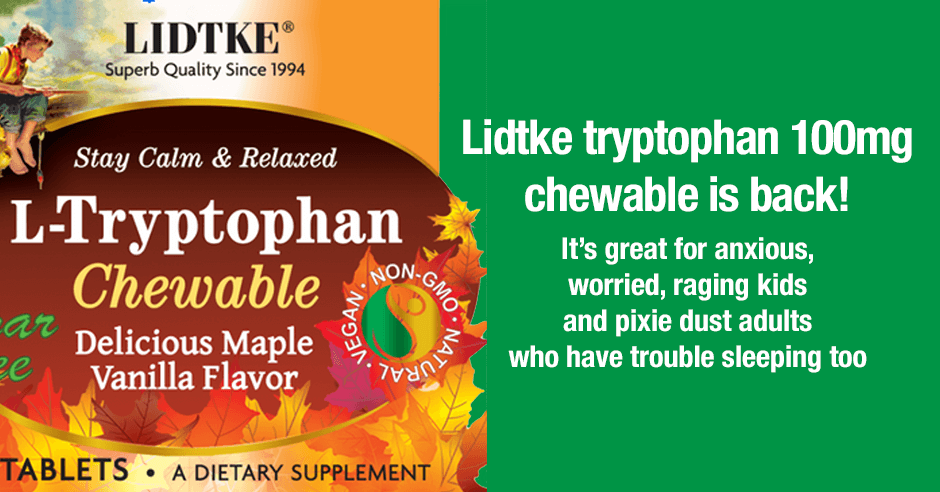
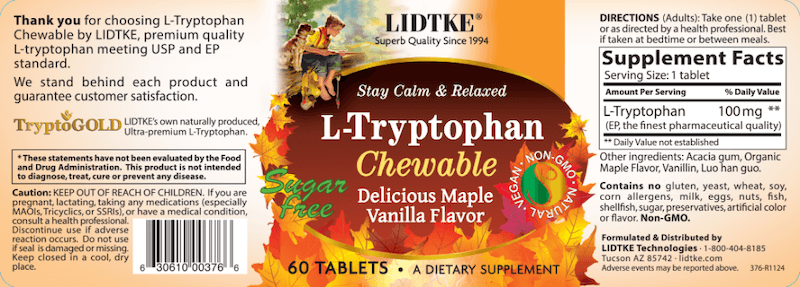
Here is the new label for the Lidtke L-Tryptophan 100mg Chewable. This product has been a firm favorite of mine for many years and the formulation has shifted over the years.

lidtke tryptophan chewable label

This formulation still contains 100mg tryptophan and a different sweetener – luo han guo, also known as monk fruit. It’s a zero-calorie natural sweetener that does not affect blood sugar. Monk fruit does belong to the gourd family and would need to be avoided if there are allergies to these foods (such as cucumbers, melons, zucchini etc).  Also, some individuals do not like the aftertaste of monk fruit.

It does contain flavors – maple and vanillin – which may be problematic for sensitive individuals. Acacia gum (or gum arabic) is low FODMAP and typically well tolerated, but may cause bloating for some.

The chewable has not been available for about a year so this is very welcome news.

Chewable tryptophan for a young girl with anxiety, rage, sleep issues and strong cravings

As I mentioned I’ve been using chewable tryptophan with success for many years. I often share the success story of a young girl with anxiety, rage, sleep issues and strong cravings for candies in documentaries and summit interviews and – and how addressing low serotonin with a chewable tryptophan quickly helped:

So sitting in my office with this young girl and her mom, we started to talk about the sweets and the candies and the need to give up the candies. She was fuming with me. She was sitting in a swivel chair. She turned her back on me and didn’t want to talk about having to give up candy at all.

I said, “Look, let’s not even talk about that, but would you take this chewable tryptophan here? And we’ll talk about it in a second.” I gave her 100 mg of the chewable tryptophan and continued discussing things with her mom.  She had no idea what it was going to do or how it would make her feel.

Within five minutes she turned her chair back, looked at me and she said, smilingly, “Yes, let’s do it. I can give up the candy.” She was smiling and she was happy.

So long story short, with this young girl, we started her on [chewable] tryptophan [and it turned things around quickly].

You can read her entire story here on the blog –  Rage, anxiety, cravings & insomnia in 11-year old girl with RAD/reactive attachment disorder: chewable tryptophan turns things around (she also went gluten-free and addressed low iron levels and the change was transformative.)

Some of the many advantages of tryptophan as a low-dose chewable

Here are some of the many advantages of tryptophan as a low-dose chewable:

  • The low dose is suitable for sensitive adults and pixie-dust folks (i.e. a small amount goes a long way)
  • It can be easily broken apart if an even lower dose works well
  • It’s pleasant tasting
  • It’s easy to have available to use on the go when traveling or out and about
  • The dose dose and taste is suitable for children and kids who are picky eaters
  • The dose dose and taste is suitable for older adults with dementia or Alzheimer’s, adults with special needs or Parkinson’s
  • One less capsule to swallow and more pleasant that tryptophan powder on the tongue
  • A good tool for doing the initial one-off trial to confirm low serotonin symptoms before embarking on titrating up to a higher dose of tryptophan

My personal experience with chewable tryptophan

Personally, I have used tryptophan over the years with much success. It’s helped me with sleep issues, the worry type of ruminating anxiety and PMS symptoms.

I also used it when I was grieving after my mom passed away and found it particularly helpful a few months after her passing when I’d start to feel more sad after dinner and go searching for sugar as a pick-up. It worked well because serotonin takes a dip later afternoon/evening.

Most of the time I’ve used 500mg and above – capsules opened and powder.

However I like to try what I recommend (if possible) so I have tried a few bottles of the previous formulation of the chewable tryptophan. It worked well and the taste and texture was pleasant. But because I do better on a higher dose I was needing to chew too many!

I have yet to try this new formulation myself but will report back as soon as I have had a chance to do so – on the taste, the texture and the effectiveness.

Positive feedback on the previous chewable tryptophan product

Until I get feedback on the new formulation, here is some general feedback from individuals in the community.

Jean is a practitioner who uses it herself and with patients:

It works within 15 minutes to stop looping thoughts/anxiety and the dose isn’t too sedating during the day. I never find it too sweet and wouldn’t let the taste keep me from such rapid relief.

I like the 100 mg chewable because it only has tryptophan and I didn’t want the other ingredients in the [Lidtke tryptophan] Complete for my needs.

I’ve had patients do well with tryptophan with the 100 mg chewable and others with the higher dose capsule.

Kelly likes the low 100mg dose compared to the 500mg capsules:

I purchased the adult pills and they were too strong. I was groggy in the morning.

Erin is also a practitioner and mom:

I have used this [the chewable tryptophan 100mg] with my 8 year old when he’s in a rage or showing signs of excessive worry and it works great! So glad it’s coming back. I recommend it to clients all the time.

Ali is also happy the chewable is coming back:

Great news!! I love the chewable and I prefer 100 mg early evening for anxiety and sleep. Sometimes 200mg but not often.

I appreciate them all sharing and hope to get updates from them when they try the new formulation.

Negative feedback on the new tryptophan chewable formulation

Update: June 14, 2025

Unfortunately, since publishing this blog and sharing on Facebook, the negative feedback has been coming in fast and furiously. Here is some of what people are sharing:

  • Melissa: “Love this company. I like that it’s chewable but it’s a large tablet and flavor is awful. Tastes like when you put maple syrup on a burnt pancake to try and cover up the burnt . I will finish the bottle though. I wish there were other chewable options, like GABA calm’s orange flavor.“
  • PS: “Revolting. Aftertaste like artificial sweetener. Smoother texture, last longer. Made me suspicious they were fake and I spat it out.“
  • Tamar: “I recently bought a few bottles of the maple sugar chewable. Taste is quite sweet and artificial, IMO. I don’t like chewing them because the product gets jammed in my teeth and stays there. I’ve been letting them dissolve, which takes a very long time.”

And these are comments from this blog:

  • Erin: “I was so excited to get this back, especially for my 8 year old son who has symptoms of ADHD rage. However, the new flavor is bitter and gets stuck in our teeth and now I can’t get him to take it!”
  • Nikki: “I got these about two weeks ago…. Truthfully I think it tastes horrible but that’s just me. Just unpleasant. Kind of sour and stale. They smell amazing but you get one in your mouth and it’s so hard to chew and swallow.” 
  • Tara: “The new formulation of the Lidtke does taste horrible. Initially I thought oh this smells lovely, tried to have my daughter take it and she said ick mom. So I said ok let me try it and ICK was right, the sweetener was gross and it did have a stale taste. So unfortunate as I had hope for this to help my daughter dealing with a lot of fears, worry, upset stomach and negative self talk at 9 yo and rage and sugar cravings.”

As of now I am NOT recommending this product.

The good news is that Nikki emailed Lidtke and shared this: “I just got an email back from Lidtke. Her name was Jessica and she stated: So, I’ve talked to the owner and let him know how many people are complaining about this new formula. He told me he was not aware it was changed and we are having a new batch made using the old formula that everyone loves. Going to take a month maybe a little more but we are definitely having this fixed.”

I appreciate her for emailing them and sharing this update. I’ve been communicating with someone else at the company and was told they have no plans to make any changes so if this is true it’s really good news!

Stay tuned for further updates and please share your own feedback in the comments below.

Additional resources when you are new to using tryptophan and other amino acids as supplements

As always, I use the symptoms questionnaire to figure out if low serotonin or other neurotransmitter imbalances may be an issue.

If you suspect low levels of any of the neurotransmitters and do not yet have my book, The Antianxiety Food Solution – How the Foods You Eat Can Help You Calm Your Anxious Mind, Improve Your Mood, and End Cravings, I highly recommend getting it and reading it before jumping in and using amino acids on your own so you are knowledgeable. And be sure to share it with the practitioner/health team you or your loved one is working with.

There is an entire chapter on the amino acids and they are discussed throughout the book in the sections on gut health, gluten, blood sugar control (this is covered in an entire chapter too), sugar cravings, anxiety and mood issues.

The book doesn’t include product names (per the publisher’s request) so this blog, The Antianxiety Food Solution Amino Acid and Pyroluria Supplements, lists the amino acids that I use with my individual clients and those in my group programs.

If, after reading this blog and my book, you don’t feel comfortable figuring things out on your own (i.e. doing the symptoms questionnaire and respective amino acids trials), a good place to get help is the GABA QuickStart Program (if you have low GABA symptoms). This is a paid online/virtual group program where you get my guidance and community support.

We are also offering the Serotonin Quickstart Program, a paid online/virtual group program where you get my guidance and community support during 5 LIVE Q&A calls.

If you are a practitioner, join us in The Balancing Neurotransmitters: the Fundamentals program. This is also a paid online/virtual program with an opportunity to interact with me and other practitioners who are also using the amino acids.

Wrapping up and your feedback

Now I’d love to hear from you – have you used the chewable tryptophan with success in the past? And how has it helped you or a loved one?

(once you try the new formulation I’d love to hear your feedback on taste, texture and effectiveness)

If you’d like to get on the notification list for the next Serotonin Quickstart Program (a paid online/virtual group program where you get my guidance and community support during 5 LIVE Q&A calls), please do so here.

If you’re a practitioner have you used chewable tryptophan with your clients/patients?

Feel free to share and ask your questions below.
Filed Under: Anxiety, Cravings, serotonin, Tryptophan Tagged With: 100mg chewable, 500mg tryptophan, adults, anxious, carbs, chewable tryptophan, children, craving, grief, kids, Lidtke tryptophan, neurotransmitter, one-off trial, pixie dust, rage, raging, sensitive, serotonin, Serotonin Quickstart, sleep, sugar, tryptophan, worried

Primary Sidebar

NEW! GABA QuickStart Homestudy (with special intro pricing)

gaba quickstart homestudy

Free Report

9 Great Questions Women Ask about Food, Mood and their Health

You'll also receive a complimentary subscription to my ezine "Food, Mood and Gal Stuff"


Connect with me

Popular Posts

  • Amino Acids Mood Questionnaire from The Antianxiety Food Solution
  • The Antianxiety Food Solution Amino Acid and Pyroluria Supplements
  • Pyroluria Questionnaire from The Antianxiety Food Solution
  • Collagen and gelatin lower serotonin: does this increase your anxiety and depression?
  • Tryptophan for the worry-in-your-head and ruminating type of anxiety
  • GABA for the physical-tension and stiff-and-tense-muscles type of anxiety
  • The Antianxiety Food Solution by Trudy Scott
  • Seriphos Original Formula is back: the best product for anxiety and insomnia caused by high cortisol
  • Am I an anxious introvert because of low zinc and vitamin B6? My response to Huffington Post blog
  • Vagus nerve rehab with GABA, breathing, humming, gargling and key nutrients

Recent Posts

  • What do I use instead of Seriphos to help lower high cortisol that is affecting my sleep and making me anxious at night?
  • BeSerene™ GABA/theanine cream eases severe muscle tension in her neck/shoulders, prevents her bad headaches and quells her anxiety
  • How the correct approach, dose and sublingual use of GABA can be calming and not cause a flushed and itchy face and neck
  • The amino acid glutamine improves low mood by addressing gut health, and it has calming effects too
  • Flight anxiety with heightened breath, physical tension and also fearing the worst (the role of low GABA and low serotonin)

Categories

  • 5-HTP
  • AB575
  • Addiction
  • ADHD
  • Adrenals
  • Alcohol
  • Allergies
  • Alzheimer's disease
  • Amino Acids
  • Anger
  • Antianxiety
  • Antianxiety Food Solution
  • Antidepressants
  • Anxiety
  • Anxiety and panic
  • Autism
  • Autoimmunity
  • benzodiazapines
  • Bipolar disorder
  • Books
  • Caffeine
  • Cancer
  • Candida
  • Children/Teens
  • Collagen
  • Cooking equipment
  • Coronavirus/COVID-19
  • Cravings
  • Depression
  • Detoxification
  • Diabetes
  • Diet
  • DPA/DLPA
  • Drugs
  • EFT/Tapping
  • EMF
  • EMFs
  • Emotional Eating
  • Endorphins
  • Environment
  • Essential oils
  • Events
  • Exercise
  • Fear
  • Fear of public speaking
  • Fertility and Pregnancy
  • Fish
  • Food
  • Food and mood
  • Functional neurology
  • GABA
  • Gene polymorphisms
  • General Health
  • Giving
  • Giving back
  • Glutamine
  • Gluten
  • GMOs
  • Gratitude
  • Gut health
  • Heart health/hypertension
  • Histamine
  • Hormone
  • Hyperparathyroidism
  • Hypoglycemia
  • Immune system
  • Inflammation
  • Insomnia
  • Inspiration
  • Introversion
  • Joy and happiness
  • Ketogenic diet
  • Lithium orotate
  • Looking awesome
  • Lyme disease and co-infections
  • MCAS/histamine
  • Medication
  • Men's health
  • Mental health
  • Mercury
  • Migraine
  • Mold
  • Movie
  • MTHFR
  • Multiple sclerosis
  • Music
  • NANP
  • Nature
  • Nutritional Psychiatry
  • OCD
  • Osteoporosis
  • Oxalates
  • Oxytocin
  • Pain
  • Paleo
  • Parasites
  • Parkinson’s disease
  • PCOS
  • People
  • PMS
  • Postpartum
  • PTSD/Trauma
  • Pyroluria
  • Questionnaires
  • Real whole food
  • Recipes
  • Research
  • Schizophrenia
  • serotonin
  • SIBO
  • Sleep
  • Special diets
  • Sports nutrition
  • Stress
  • Sugar addiction
  • Sugar and mood
  • Supplements
  • Teens
  • Testimonials
  • Testing
  • The Anxiety Summit
  • The Anxiety Summit 2
  • The Anxiety Summit 3
  • The Anxiety Summit 4
  • The Anxiety Summit 5
  • The Anxiety Summit 6
  • Thyroid
  • Thyroid health
  • Toxins
  • Tryptophan
  • Tyrosine
  • Uncategorized
  • Vegan/vegetarian
  • Women's health
  • Yoga

Archives

  • October 2025
  • September 2025
  • August 2025
  • July 2025
  • June 2025
  • May 2025
  • April 2025
  • March 2025
  • February 2025
  • January 2025
  • November 2024
  • October 2024
  • September 2024
  • August 2024
  • July 2024
  • June 2024
  • May 2024
  • April 2024
  • March 2024
  • February 2024
  • January 2024
  • December 2023
  • November 2023
  • October 2023
  • September 2023
  • August 2023
  • July 2023
  • June 2023
  • May 2023
  • April 2023
  • March 2023
  • February 2023
  • January 2023
  • December 2022
  • November 2022
  • October 2022
  • September 2022
  • August 2022
  • July 2022
  • June 2022
  • May 2022
  • April 2022
  • March 2022
  • February 2022
  • January 2022
  • December 2021
  • November 2021
  • October 2021
  • September 2021
  • August 2021
  • July 2021
  • June 2021
  • May 2021
  • April 2021
  • March 2021
  • February 2021
  • January 2021
  • December 2020
  • November 2020
  • October 2020
  • September 2020
  • August 2020
  • July 2020
  • June 2020
  • May 2020
  • April 2020
  • March 2020
  • February 2020
  • January 2020
  • December 2019
  • November 2019
  • October 2019
  • September 2019
  • August 2019
  • July 2019
  • June 2019
  • May 2019
  • April 2019
  • March 2019
  • February 2019
  • January 2019
  • December 2018
  • November 2018
  • October 2018
  • September 2018
  • August 2018
  • July 2018
  • June 2018
  • May 2018
  • April 2018
  • March 2018
  • February 2018
  • January 2018
  • December 2017
  • November 2017
  • October 2017
  • September 2017
  • August 2017
  • July 2017
  • June 2017
  • May 2017
  • April 2017
  • March 2017
  • February 2017
  • January 2017
  • December 2016
  • November 2016
  • October 2016
  • September 2016
  • August 2016
  • July 2016
  • June 2016
  • May 2016
  • April 2016
  • March 2016
  • February 2016
  • January 2016
  • December 2015
  • November 2015
  • October 2015
  • September 2015
  • August 2015
  • July 2015
  • June 2015
  • May 2015
  • April 2015
  • March 2015
  • February 2015
  • January 2015
  • December 2014
  • November 2014
  • October 2014
  • September 2014
  • August 2014
  • July 2014
  • June 2014
  • May 2014
  • April 2014
  • March 2014
  • February 2014
  • January 2014
  • December 2013
  • November 2013
  • October 2013
  • September 2013
  • August 2013
  • July 2013
  • June 2013
  • May 2013
  • April 2013
  • March 2013
  • February 2013
  • January 2013
  • December 2012
  • November 2012
  • October 2012
  • August 2012
  • July 2012
  • June 2012
  • May 2012
  • April 2012
  • March 2012
  • February 2012
  • January 2012
  • December 2011
  • November 2011
  • October 2011
  • September 2011
  • August 2011
  • July 2011
  • June 2011
  • May 2011
  • April 2011
  • March 2011
  • February 2011
  • January 2011
  • December 2010
  • October 2010
  • September 2010
  • July 2010
  • May 2010
  • April 2010
  • March 2010
  • February 2010
  • January 2010
  • November 2009

Share the knowledge!

The above statements have not been evaluated by the Food and Drug Administration. Products listed in this website are not intended to diagnose, treat, cure or prevent any disease.

The information provided on this site is for informational and educational purposes only and is not intended as a substitute for advice from your physician or other health care professional. You should consult with a healthcare professional before starting or modifying any diet, exercise, or supplementation program, before taking or stopping any medication, or if you have or suspect you may have a health problem.


Copyright © 2026 Trudy Scott. All Rights Reserved. | Privacy | Terms and Conditions | Refund Policy | Medical Disclaimer

Free Report

9 Great Questions Women Ask about Food, Mood and their Health

You’ll also receive a complimentary subscription to my ezine “Food, Mood and Gal Stuff”