• Skip to primary navigation
  • Skip to main content
  • Skip to primary sidebar

everywomanover29 blog

Food, Mood and Women's Health – Be your healthiest, look and feel great!

  • Blog
  • About
  • Services
  • Store
  • Resources
  • Testimonials
  • The Book
  • Contact
  • Search this site

medication

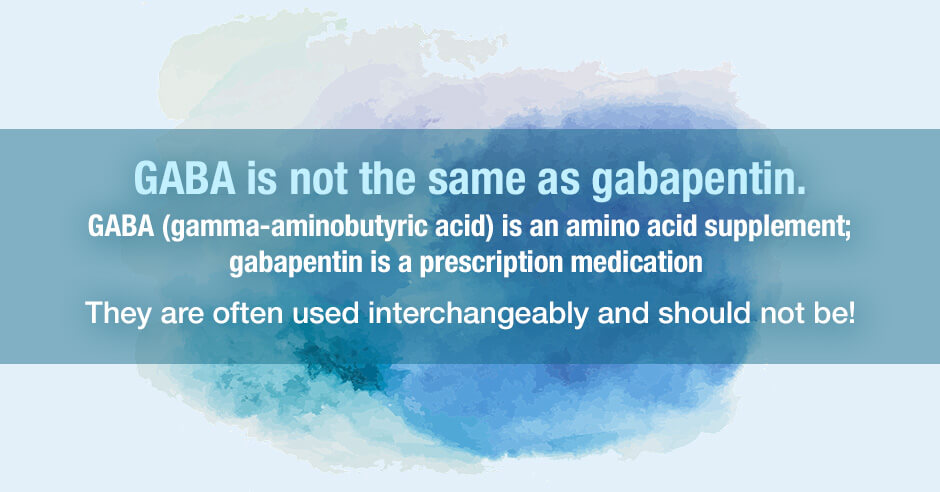
GABA is not the same as gabapentin. GABA (gamma-aminobutyric acid) is an amino acid supplement; gabapentin is a prescription medication

December 23, 2022 By Trudy Scott 53 Comments

gaba and gabapentin

One common question I hear from folks who are new to my work is this: “is GABA the same as gabapentin?”  Quite frankly it has always surprised me to get this question since they are different words – why would you think they are the same? But I’d carefully explain the difference, educate the person and move on. A few months ago I shared a blog post on how the amino acid GABA was effective for an 11 year old with ADHD, irritability, anxiety and tantrums and someone asked this question again: “GABA sold at health store or prescription Gabapentin?”

I decided it was finally time to ask why she thought they may be the same thing. I first explained what GABA is (an amino acid supplement), shared some links to products and said “no, not prescription Gabapentin – I’m curious why you’d think that?”

She replied that “some people refer to GABA the same as Gabapentin” and thanked me for the clarification.

I appreciate her response but it did still concern me that the amino acid GABA is lumped together with prescription gabapentin. My next step was a facebook post sharing the above dialogue and asking my community there for feedback: “Have you heard GABA and gabapentin used interchangeably? Did you think they were the same thing at one stage?”

The response was enlightening, hence this blog post to provide clarification if you’re not sure either or if you know exactly what GABA is but have had confused conversations with your practitioner, family members, friends and/or colleagues. And to also get your feedback on this topic.

GABA is not the same as gabapentin. GABA (gamma-aminobutyric acid) is an amino acid supplement and neurotransmitter; gabapentin is a prescription medication. They are often used interchangeably (as you’ll read below) and should not be!

GABA and gabapentin is used interchangeably by a variety of practitioners

Here are some of the many responses showing how GABA and gabapentin is used interchangeably by a variety of practitioners:

Jennifer shared this: Yes in the vet world, gabapentin is often called gaba. Not surprising since western medicine likes to pretend that supplements don’t exist. I didn’t know GABA existed as a supplement for many years. I always explain what it is when I talk about it, to make sure there’s no confusion.

Val shared this: I was just at the dentist and I shared that I take Gaba to help me sleep. She said “Gabapentin?” I said “no I don’t take a synthetic medication, instead I take Gaba which is an amino acid.” It’s good to share with all who are willing to listen.

Katie shared this: I have never heard them used interchangeably but, whenever I talk about GABA, I say “GABA otc amino acid, not gabapentin the prescription” to be extra clear and educational.

Heather said: I was wondering this earlier in the week. My husband’s [nurse practitioner] suggested gabapentin temporarily for a back injury but she used the term “gaba”. I quickly got clarification. Hopefully she won’t do that again. But I understand it. Her field is all pain management.

Theresa shared this: Nurses who don’t know medicine often do that. I’ve found that [gaba] is listed in my med list when they don’t seem to know the difference.

Laura shared this: I always knew that they were different but I have had psychiatrists use them interchangeably. 

Bonnie shared this: I mentioned GABA to my dad’s nurse and she got all upset, thinking I meant Gabapentin. At the time I didn’t know it was two different things. Dad was in the hospital and I suggested gaba to calm him. She said, no, no, no! I didn’t realize we were speaking of two different things.

Lisa shared this: When I told my primary doctor [an MD] that I was taking Gaba instead of prescription drugs she asked “gabapentin?” I said “no, Gaba which is a supplement”. She looked confused.

Lindy shared this: It’s a common assumption. I think some GPs (general practitioners) shorten gapapentin to gaba.

Jane shared this: “Yes – I am very careful to say the “supplement GABA.” I mentioned it to an Anesthesiologist when I had surgery. I normally don’t tell the medical profession my supplements – they have no idea what they are. I do specify the “supplement GABA” to holistic providers – I don’t want any misunderstanding. I was on Gabapentin and Lyrica for a long time. Horrific medications with severe consequences

If you relate to any of this feedback, keep sharing in order to educate, explain the difference and clarify to make sure there is no confusion.

What is GABA?

If you are new to the amino acid GABA, it’s a supplement that is used to raise low GABA (the neurotransmitter) levels and ease the physical-tension and stiff-and-tense-muscles type of anxiety.

The other symptoms we see with low GABA are panic attacks, physical tension in certain settings like public speaking or driving, and the need to self-medicate to calm down, often with alcohol but sometimes with carbs and sugary foods. Insomnia can also be due to low GABA and you’ll experience physical tension (rather than the ruminating thoughts which is the low serotonin type of insomnia – although it’s not uncommon to experience both). GABA also helps with muscle spasms and pain relief when muscles are tight.

You can read this blog, GABA for the physical-tension and stiff-and-tense-muscles type of anxiety for my biggest takeaways for using GABA effectively.  I also share a number of GABA products and some feedback from folks who have experienced the benefits. One example is this:

I have used GABA (several brands, just open a capsule and sprinkle a small amount under the tongue) for years now, with calming results within minutes.

With regards to the question about GABA being available in health stores: there are amino acid supplements that are available over the counter at a health store and also via my online health store here (these are products I have vetted and use with clients).

Here is the blog I referred to above: GABA for children: ADHD, focus issues, irritability, anxiety and tantrums. My blog is a wealth of information when it comes to GABA so be sure to use the search feature.

What is gabapentin?

Per the Cleveland Clinic site:

Gabapentin is a prescription medication known as a gamma aminobutyric acid (GABA) analogue. GABA reduces the excitability of nerve cells (neurons) in the brain, which play a role in seizures and the transmission of pain signals. Gabapentin mirrors the effects of GABA calming excited neurons. Gabapentin is in a class of medications called anticonvulsants.

It’s been approved for seizures and nerve pain caused by shingles, however, off-label use is common when it comes to other types of pain, anxiety and depression. This  paper, Outpatient Off-Label Gabapentin Use for Psychiatric Indications Among U.S. Adults, 2011-2016 warns of

risks associated with gabapentin combined with central nervous system depressant (CNS-D) drugs, which are commonly prescribed in psychiatric treatment….Over 6 years, 58.4% of off-label gabapentin visits listed one or more concomitant CNS-D medications, most frequently antidepressants (24.3%), opioids (22.9%), and benzodiazepines (17.3%).

The above Cleveland Clinic site lists some brand names – Horizant®, Gralise® and Neurontin® – but it is known by many different names in other countries. You can look it up in your country here.

You’ll also see all the side effects and the fact that dependence and withdrawal is downplayed despite the growing evidence that these are very real issues. More on that below.

There are many issues with gabapentin dependence and withdrawal

This blog post is really about terminology and the interchangeable use of GABA and gabapentin, but if you’re new to gabapentin, it’s important to be aware that there are many issues with dependence and withdrawal (often similar to benzodiazepines):

  • Withdrawal symptoms after gabapentin discontinuation

On day 3 of hospitalization, she developed restlessness, disorientation, confusion, agitation, and anxiety. She was presumed to be suffering from ethanol withdrawal and was treated with benzodiazepines but had no improvement in symptoms. During days 4 and 5, the patient became increasingly confused, agitated, and anxious, with complaints of headache, light sensitivity, and increasing nervousness. On day 5, gabapentin was reinitiated, and the patient’s confusion and agitation improved that evening. The next morning, the patient was calm, alert, and cooperative.

  • Akathisia induced by gabapentin withdrawal

To our knowledge, this is the first reported cases of akathisia induced by gabapentin withdrawal. Available case reports suggest that gabapentin withdrawal can occur at doses ranging from 400-8000 mg/day. Patients experienced symptoms similar to those that develop with benzodiazepine withdrawal and were taking gabapentin for as little as 3 weeks to as long as 5 years.

  • Gabapentin dependence and withdrawal requiring an 18-month taper in a patient with alcohol use disorder: a case report

This case highlights the need for patient-centered slow tapers in patients with severe gabapentin dependence and withdrawal.

The withdrawal took 18 months.

There is one case report of macular edema after gabapentin use and gabapentinoid (pregabalin/Lyrica) more so than gabapentin/Neurontin) prescriptions increased risk of suicidal behavior and unintentional overdose.

This 2017 paper, Gabapentin and pregabalin: do the benefits outweigh the harms? summarizes as follows: “Prescribers should be aware of the very limited clinical evidence for use of gabapentin and pregabalin outside their licensed indications, as well as their capacity to do harm.”

The amino acid GABA has none of these issues.

Why it may be confusing for practitioners

Other than the fact that gabapentin is described as a GABA analogue, I can see why it may be confusing for practitioners who don’t yet know about my work and the amino acid GABA.

The fact that GABA is an amino acid supplement and also a neurotransmitter may also be contributing to some of the confusion.

The other fact that I believe is adding to the confusion is because of how gabapentin is often referred to in the research. Let’s take this 2020 paper as an example: γ-Aminobutyric Acid and Derivatives Reduce the Incidence of Acute Pain after Herpes Zoster – A Systematic Review and Meta-analysis

It has γ-aminobutyric acid and derivatives in the paper title and as part of the aim, is mentioned in the results and elsewhere too:

  • The aim of the present study was to investigate the effectiveness of GABA and its derivatives in reducing acute pain incidence in patients having HZ.
  • The results showed that the treatment with GABA and its derivatives significantly reduced the number of patients with acute zoster pain.
  • There is no guideline for using and dosing GABA and its derivatives to prevent acute HZ pain.

And elsewhere they refer to GABA-like compounds:

  • The optimal dosage of GABA-like compounds is still to be determined.
  • Nevertheless, the presently available data indicate that the application of GABA-like compounds in this respect is very promising.

The entire review is about gabapentin/neurontin and is not about the amino acid GABA at all, even though the search terms used for this paper included: gamma-aminobutyric acid and gaba.

This is just one example of many such papers. I know what the amino acid GABA is and I was initially confused when reading the title and abstract, and even when reading the full paper (initially hopeful the paper would also be discussing the amino acid GABA).

Resources if you are new to using GABA and other amino acids as supplements

If you are new to using GABA or any of the other amino acids as supplements, here is the Amino Acids Mood Questionnaire from The Antianxiety Food Solution (you can see all the symptoms of neurotransmitter imbalances, including low GABA and low serotonin).

If you suspect low levels of any of the neurotransmitters and do not yet have my book, The Antianxiety Food Solution – How the Foods You Eat Can Help You Calm Your Anxious Mind, Improve Your Mood, and End Cravings, I highly recommend getting it and reading it before jumping in and using amino acids on your own so you are knowledgeable. And be sure to share it with the practitioner/health team you or your loved one is working with.

There is an entire chapter on the amino acids and they are discussed throughout the book in the sections on gut health, gluten, blood sugar control, sugar cravings, self-medicating with alcohol and more.

The book doesn’t include product names (per the publisher’s request) so this blog, The Antianxiety Food Solution Amino Acid and Pyroluria Supplements, lists the amino acids that I use with my individual clients and those in my group programs. You can find them all in my online store.

If, after reading this blog and my book, you don’t feel comfortable figuring things out on your own (i.e. doing the symptoms questionnaire and respective amino acids trials), a good place to get help is the GABA QuickStart Program (if you have low GABA symptoms). This is a paid online/virtual group program where you get my guidance and community support.

If you are a practitioner, join us in The Balancing Neurotransmitters: the Fundamentals program. This is also a paid online/virtual program with an opportunity to interact with me and other practitioners who are also using the amino acids.

I appreciate these women for sharing their interactions with practitioners so we can all be enlightened.

Have you heard GABA and gabapentin used interchangeably? Did you think they were the same thing at one stage?

How do you refer to GABA and gabapentin in order to avoid confusion?

If you’ve been prescribed gabapentin what was/is it prescribed for? And did you/do you also have a prescription for an antidepressant, opioid or benzodiazepine?

Have you had/do you have any issues using gabapentin?

Have you had success using the amino acid GABA? If yes, what for?

Feel free to post your questions and feedback in the comments below.
Filed Under: Anxiety, GABA, Medication Tagged With: ADHD, amino acid, Antidepressants, anxiety, benzodiazepines, dependence, depression, GABA, GABA Quickstart online program; Balancing Neurotransmitters: the Fundamentals program for practitioners, gabapentin, gamma-aminobutyric acid, irritability, is GABA the same as gabapentin?, medication, off-label use, opioids, pain, prescription, some people refer to GABA the same as Gabapentin, supplement, withdrawal

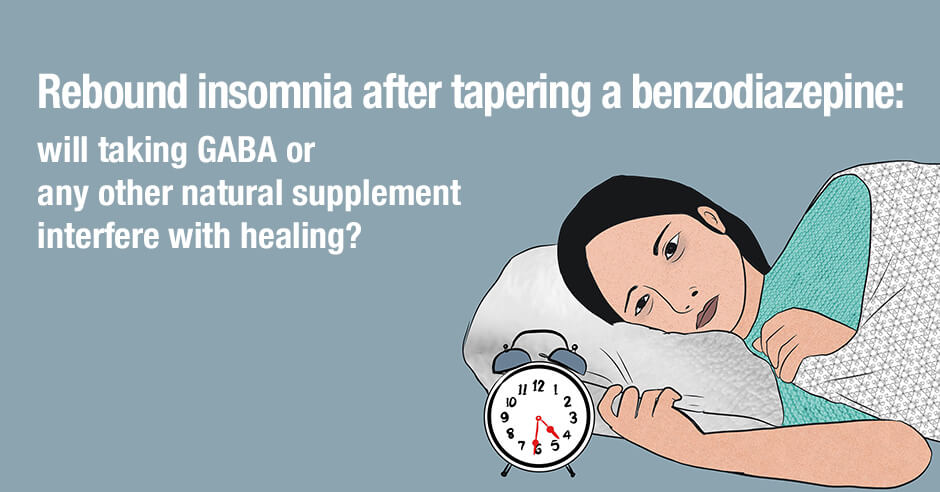
Rebound insomnia after tapering a benzodiazepine: will taking GABA or any other natural supplement interfere with healing?

August 26, 2022 By Trudy Scott 16 Comments

rebound insomnia after tapering

This question was posted on one of the GABA blog posts by Fran, asking about about using GABA for insomnia shortly after having tapered a benzodiazepine she had used for 15 years:

I am a senior who took benzodiazepines (clonazepam) on advice of my doctor for sleep because of chronic fatigue for 15 years. Last year I weaned myself off the medication and it has been just over 10 months. No one tells you that when you stop taking them you go into a rebound insomnia phase and it can last a long time. The doctor still won’t admit that!

I joined benzo buddies, a group I found out about on your site and found much encouragement from the posts of many brave and determined people. One post mentioned that the drug actually overrides your GABA receptors so when you stop taking it they have to heal to become active again. My question is: Will taking GABA or any other natural supplement interfere with that healing. The writer of the post feels taking nothing is best for the brain to return to normal and that only time will do that.

I said I was sorry to hear about her struggles with her benzodiazepine prescription. Sadly it’s all too common and it’s seldom that folks are cautioned about the rebound insomnia and other issues seen with benzodiazepines.

I love benzo buddies and other benzo support groups and often recommend that clients join one of these groups for the community support aspect. I am really happy that Fran found encouragement.

However, I  respectfully disagree with their message that GABA supplements or other supplements should not be used and that you should just wait for time to heal. We want to use everything at our disposal in order to heal as quickly as possible. And quality sleep is imperative for healing.

Also many of the most severely affected folks are part of these support groups, so it may well be all that they know, hence the advice they dispense.

Many do get relief with GABA during and post benzo taper and it won’t affect long-term healing (with a very low dose)

It is true that GABA receptors can be affected by benzodiazepines but despite this, many of my clients and others in my community do get relief from GABA during this period. Since we are all unique, some folks may have an issue, so we always do a trial with GABA if someone has rebound insomnia (and other low GABA symptoms of physical tension/anxiety, stiff and tense muscles, stress eating etc).

When someone can’t tolerate GABA they will know very quickly – typically in 1-2 days. If you can’t tolerate GABA it may feel the same as someone who takes GABA and doesn’t need it (i.e. GABA isn’t low) or when someone takes too much. This could make you feel light-headed, dizzy, feel a flush and/or feel too tired. You may even feel more anxious. Vitamin C is a wonderful antidote to all this and these short-term adverse reactions won’t interfere with long-term healing.

We also start with a very small dose – I typically have someone start with 25mg GABA and go up from there – and only use sublingual GABA. For some very sensitive folks we will start even lower as in this example where Syd gets sleep and body anxiety benefits with just 1.5 mg to 3 mg GABA.

Other nutrients that may also help with insomnia

We may also use other nutrients to help with sleep support and rebound anxiety (which is also common) and other symptoms, all based on each person’s unique needs. These may include tryptophan or 5-HTP if serotonin is also low (this can affect sleep and cause worry/ruminating type anxiety), melatonin if that is low (either sublingual or timed-release) and Seriphos if cortisol is high too. We may also combine GABA with theanine (research shows the combination may help some folks).

A full functional medicine and nutritional workup is recommended in order to be as nutritionally stable as possible. Ideally this happens before tapering starts but even if it’s done after the fact it can help with healing and symptom relief. Addressing histamine imbalances is one factor to consider as this can impact sleep (more on that below).

This is an important question that many folks ask so I appreciate her asking so I could share it as a blog post for others in a similar situation.

I am waiting to hear back about what happened when she did use GABA and how much she used. She mentioned that she did take GABA for a time at first but it only worked for a while. I find that during the taper and post taper, GABA needs can fluctuate as healing starts to take place. I have clients adjust up and down as needed.

More on benzodiazepine withdrawal and histamine issues

These medications have the most debilitating withdrawal reactions in all of medicine and Valium blocks DAO/impacts histamine levels:

  • World Benzodiazepine Awareness Day 2017: Awareness and Anxiety Nutrition Solutions

Benzodiazepines (Xanax, Klonopin, Ativan, Valium, Librium, and others) as well as Z-drugs (Ambien, Lunesta and others), which are similar, have the most debilitating withdrawal reactions in all of medicine.

This happens in regular, everyday people who are taking the medications exactly as their doctor prescribed. It also happens to people on what they think are “low doses” and is not just a “high dose” problem.

  • The benzodiazepine valium blocks DAO and impacts histamine levels: wisdom from Yasmina Ykelenstam and a tribute to her brilliance

Many people doing a benzodiazepine taper are often switched to Valium which is a DAO [diamine oxidase blocker (or histamine liberator)] and this further prevents histamine from being removed from the body [and can lead to increased anxiety].

Dyes are also triggers…the pink Xanax can be problematic.

GABA is as effective as benzodiazepines (which should only be prescribed for short-term use)

Many folks who have used benzos in the past, find GABA to be as effective. Another woman in my community, Dee, shared that she had taken Xanax in the past for panic attacks and her functional medicine doctor suggested GABA Calm as she wanted a natural product. This is her encouraging feedback: “I was amazed how it works just like the Xanax did – instant calm feeling within 10 mins of taking 2 capsules. I use them as needed when I am having heightened stress and anxiety.”

Ideally we want to use GABA instead of one of the benzodiazepines – which are all too commonly prescribed for anxiety, insomnia and pain – in order to avoid tolerance issues, dependence and withdrawal/tapering issues. The fact that they are used long term – like 15 years for Fran – further compounds the issues. Even a few months can be problematic for some folks. It’s important to be aware that this class of medication is intended for short-term use  i.e. 2-4 weeks only.

Resources if you are new to using the GABA and other amino acids as supplements

If you are new to using GABA and any of other the amino acids as supplements, here is the Amino Acids Mood Questionnaire from The Antianxiety Food Solution (you can see all the symptoms of neurotransmitter imbalances, including low GABA).

If you suspect low levels of any of the neurotransmitters and do not yet have my book, The Antianxiety Food Solution – How the Foods You Eat Can Help You Calm Your Anxious Mind, Improve Your Mood, and End Cravings, I highly recommend getting it and reading it before jumping in and using amino acids on your own so you are knowledgeable. And be sure to share it with the practitioner/health team you or your loved one is working with.

There is an entire chapter on the amino acids and they are discussed throughout the book in the sections on gut health, gluten, blood sugar control, sugar cravings, self-medicating with alcohol and more.

The book doesn’t include product names (per the publisher’s request) so this blog, The Antianxiety Food Solution Amino Acid and Pyroluria Supplements, lists the amino acids that I use with my individual clients and those in my group programs. You can find them all in my online store.

If, after reading this blog and my book, you don’t feel comfortable figuring things out on your own (i.e. doing the symptoms questionnaire and respective amino acids trials), a good place to get help is the GABA QuickStart Program (if you have low GABA symptoms). This is a paid online/virtual group program where you get my guidance and community support.

If you are a practitioner, join us in The Balancing Neurotransmitters: the Fundamentals program. This is also a paid online/virtual program with an opportunity to interact with me and other practitioners who are also using the amino acids.

Have you used GABA with success while tapering a benzodiazepine or shortly after tapering is complete?

Have you used other nutrients to help while tapering or post taper? If yes, which ones?

Did you find that GABA was not helpful? (which product and how much did you use?)

If you have questions please share them here too.

Filed Under: Anxiety, benzodiazapines, GABA, Insomnia Tagged With: 5-HTP, amino acids, Balancing Neurotransmitters: the Fundamentals program for practitioners, benzo buddies, benzodiazepine, clonazepam, DAO enzyme, GABA, GABA Quickstart program, GABA receptors, healing, histamine, insomnia, medication, melatonin, natural supplement, Rebound insomnia, seriphos, sleep, tapering, theanine, tryptophan, Xanax

Thailand cave rescue: yes to calming meditation and GABA, no to antianxiety medication

July 13, 2018 By Trudy Scott 3 Comments

The cave rescue of 12 teens and their soccer coach in Thailand is such a beautiful story of hope, courage, resilience, volunteerism and the whole world coming together! I’ve been following the news about this from day 1 (as I’m sure you were) and felt such relief and joy on hearing they had all been safely rescued and appear to be physically and mentally fine.

I’m weighing in on the fact that meditation seems to have played a major role in keeping them calm, using GABA or theanine instead of antianxiety medications and B vitamins for ongoing psychological support.

Meditation seems to have played a role in keeping them calm

Meditation seems to have played a role in keeping them calm, according to this report from the UK

The 12 Thai boys and their football coach who were trapped in a cave in Thailand got through the ordeal by practicing meditation, family members have said.

According to a mother of one of the boys, the team were meditating in the widely shared video of their discovery by two British divers.

Look at how calm they were sitting there waiting. No one was crying or anything. It was astonishing.

The coach who was rescued from the cave on Tuesday, trained as a Buddhist monk for 12 years before he decided to coach the Wild Boars soccer team.

‘He could meditate up to an hour,’ said his aunt, Tham Chanthawong. ‘It has definitely helped him and probably helps the boys to stay calm.’

Here is the video of their lovely smiling calm faces when they were first found.


In this paper, Meditation Programs for Psychological Stress and Well-Being, they report that

Meditation programs, in particular mindfulness programs, reduce multiple negative dimensions of psychological stress [such as anxiety, depression, stress, distress, well-being, positive mood, attention]

Meditation has also been shown to improve dopamine and serotonin transporter binding, which appears to have reduced fatigue and improved mood in this study, likely because there are higher levels of these neurotransmitters available.

In a study done with young adults, Effects of mindfulness meditation on serum cortisol of medical students, meditation lowered cortisol levels, suggesting reduced feelings of stress.

Meditation and GABA/theanine instead of antianxiety medications

It was clearly an extremely difficult rescue and the Australian doctor, Adelaide anaesthetist Dr Richard Harris, risked his life to go into the cave and stayed with the boys and their coach for several days. He assessed their health and made sure they were ready for the rescue.

He used his medical expertise and rescue diving experience to decide to have each of them use antianxiety medication for the arduous 8-hour plus rescue (I suspect it was Dr. Harris’ decision). It was confirmed by Thai Prime Minister Prayuth Chan-ocha – to help calm their nerves – and it’s likely they were given a benzodiazepine, hopefully only the one time.

Even though very short term acute situations like this, is actually the intended use of benzodiazepines, it concerns me that these young boys were medicated, especially since adverse paradoxical reactions can be caused by benzodiazepines and are difficult to predict and diagnose.

The following adverse reactions can occur: “unanticipated restlessness and agitated episode,” sometimes aggression, hostility, and rage, as well as “an increased state of anxiety.” An adverse reaction during the actual rescue would have been very serious.

There were also reports of elevated white blood cells (WBC) and signs of a lung infection in some of the boys, and one boy had low blood pressure. These are all be side-effects of benzodiazepines. It’s difficult to know what caused any of this – was the medication, the rescue itself and the fact that were under water or spending all that time in the cave?

My intention is not to be critical of the medical decisions that were made in these very dire circumstances. I’ve done caving or spelunking as it was called in England and it’s pretty scary being underground and in the dark, wading through running water – and we were safely in control of things!

I’m sharing about benzodiazepines simply to raise awareness about other options and some of the many risks. And we haven’t even explored the fact that long-term use of benzodiazepines do more harm than good. More than a week to 2 weeks is considered too long, and for some this is even too long.

I really do look forward to the day when benzodiazepines are not the first approach but rather that:

  • meditation is recognized as being as effective, if not a more effective calming approach (I suspect the mediation benefits these boys had been experiencing would likely have carried them through the rescue)
  • the amino acids GABA or theanine are recognized for the calming benefits they offer (especially since the “mechanism of benzodiazepine action is through the gamma-aminobutyric acid [or GABA] receptors.”

B vitamins and other nutrition solutions after psychological stress

Thailand’s Department of Mental Health shared that

People who endure such an intense and dangerous event can go on to suffer lasting anxiety, depression and other symptoms of post-traumatic stress disorder.

I was so pleased to hear that the boys and their coach are being given B vitamins. There is evidence-based research on the psychological benefits of B vitamins after a trauma (like an earthquake or flood), thanks to my colleagues Julia Rucklidge, PhD and Bonnie Kaplan PhD​.

I do hope the B vitamins are continued and is offered to worried family members and all the wonderful rescuers who must be exhausted and stressed too.

Hopefully the boys will also continue to meditate with their soccer coach and share some of the benefits they experienced with family and friends.

How did you feel when you heard the rescue was over? Good news gives us such feel-good warm emotions doesn’t it!?

Do you meditate and have you used calming GABA or theanine?

Let us know if you have questions too.

Filed Under: Anxiety, Insomnia Tagged With: antianxiety, anxiety, B vitamins, benzodiazepine, medication, meditation, rescue, stress, Thailand cave

Medication tapering and withdrawal: an interview with Dr. Kelly Brogan

April 8, 2016 By Trudy Scott 80 Comments

mind-of-your-own-meme

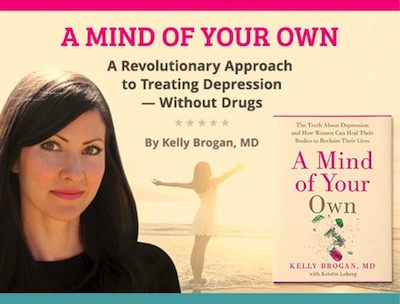
I recently had the absolute pleasure of interviewing Dr. Kelly Brogan, holistic women’s health psychiatrist and author of the new bestseller, A Mind of Your Own. I’ve had the section on medication tapering and withdrawal effects transcribed because it’s so valuable.

=================================================================

Kelly: Now much of my practice is devoted to psychiatric medications tapers. Guess what? I didn’t learn that in my training. There wasn’t a single hour of education on this subject. I have learned how to do this from patients, and really from patients globally who are educating each other and frankly educating physicians about how to engage in a safe and responsible psychiatric medication tapers……

…when you try to taper off a medication after long-term exposure, either because you’re no longer deriving that initial benefit from it, or because something has changes about your life circumstance and you want to try a different kind of healthcare maybe, they you might learn that these are some of the most habit forming medications, I would say habit forming substances, on the planet.

I wouldn’t believe this if I haven’t seen it with my very own eyes, but this is what actually compelled me to put down my prescription pad for good. After I read that book, I began to take patients, or at least offer them the opportunity to taper them off of medication. Even when we did it responsibly, I was essentially running an outpatient rehab. I mean from neurologic symptoms to psychiatric symptoms, physical symptoms, autoimmune diseases flaring, patients developing impulsive behavior and even violence. It was beyond description.

Then I began to see that actually a lot of patients around the world are talking about this. They’re talking about withdrawal from anti-depressant specifically, but of course other medications as well. Their doctors are totally ill-equipped to help them because we don’t learn about how to do this in our training. We actually in fact dismiss patients when they talk about these being addictive medications. Of course, now finally Fava is a group of researchers who have finally begun to publish the reality of this withdrawal syndrome, and how disabling it can be.

Since I have 4 grounded lifestyle interventions, and actually begun with nutrition such that I don’t even begin a medication taper until about 2 months into lifestyle change, everything is different now in my practice. I feel that once you can optimize your physiology, you really put yourself in a much, much better position to safely and strategically taper. Wow. Isn’t that something you would want to know before taking your first prescription? I certainly never told any patients that it could be like a horror show and you might never be able come off of a psychiatric medication if you’re taking it for longer than a year or so. I never informed patients of that.

A lot of what I discuss and describe in this book is in service of presenting people with a full picture of what the science has to say before they make a decision. I think we really wish that there was a magic pill. We really wish there was a safe effective quick fix. Unfortunately, what is available is really anything but that.

Trudy: Yeah. We want that quick fix. I’ve got a few follow on questions, because this is a lot of good information here. The fact that you see all these problems when people are coming off the meds, is there a time frame, or is that really dependent on each person?

Kelly: It’s very, very dependent on each person. That ends up being the take home that we are talking about. What I like to call end of one medicine. We’re talking about the fact that our levels of biochemical individuality have ever been more relevant than when we’re exploring how we interact with chemicals in our environment, in our pharmaceuticals. We really need to understand that every single person is an individual.

When I taper patients off of meds, I normally do what’s called a test dose decrease, which often is around 20% to 25% of the dose. We come down by that. Again, this is after we’ve done the initial months at least of fairly strict dietary compliance working with relaxation response, doing 20 minutes or more of movement, working on sleep. All of this has to happen first. Then we begin, and so we start with a test dose. If we see in about 2 to 4 weeks that test dose is completely well-tolerated, meaning you don’t even notice the difference, then we probably can work in bigger increments. That’s actually a godsend. These tapers, when we’re working in 10% and less doses, could take literally years.

You want to begin to learn about what your body is capable of bouncing back from. We begin with 25%. If that’s not a pretty picture, then we’ll just scale it back to about 10% of the initial dose, and work with that 10% increment at about every 2 to 4 weeks, sometimes unfortunately slower. The increment and then the speed are 2 variables that we have to learn for each patient.

I don’t know what I would do without a compounding pharmacy. While many of these medications are available in liquid form, and some of them, like Effexor for example, have beads inside a capsule, to be able to tailor and personalize the dosage to each individual patient is wonderful and that I have that option through compounding pharmacy. I work with one in Massachusetts named Johnson Compounding, and they’ve just been a wonderful support over the years to my patients.

Trudy: Wonderful. Very slow and then obviously very individualized. Now I’m very familiar with the effects of benzodiazepines and the slow taper process that’s needed for someone on the anti-anxiety benzodiazepine medication. Would you say that SSRIs can have comparable effects in some people, or are they not as bad as the benzodiazepines?

Kelly: That’s a great question. What we’ve observed in psychiatry is that there’s really been a transition from using benzodiazepine as sort of like a spot treatment to transitioning into using anti-depressants long-term. When I was in my training, the typical gold standard protocol would be to start somebody on both benzodiazepine and anti-depressant, and then taper them off to benzodiazepine and leave on the anti-depressant with the thinking being that benzodiazepine are acknowledged for their habit forming properties and anti-depressants are totally safe.

What we are learning is in fact, that group that Fava runs, with the papers that they’re putting out, they are essentially equating the anti-depressant withdrawal phenomenon to benzodiazepines. In my clinical experience, I would actually argue that SSRIs are worse with long-term exposure. A lot of people at this point, given that it’s been decades since Prozac, have been on these medications for more than 10 years. We’re really talking about a level of habituation that could be challenging to undo. It’s not that I haven’t. I struggled a lot with Klonopin for example. It’s not that I haven’t encountered challenges with benzodiazepines.

A patient in my practice I’m taking off of Lexapro a thousandth of a milligram a month. I’ve never heard of something like that. Heroin, crack, cocaine, oxycontin: show me something that would ever require that. It’s unbelievable. I think it’s at least comparable I would say, and that’s what the literature is beginning to demonstrate, is that there are actually comparable phenomenon, but we really never ever talked about anti-depressants in this way, so it really is a game changing perspective.

Trudy: The fact that you say people are not told that this could be a possibility, and the fact that you’re talking about this and writing about it I think is so important, because people need to know. They would choose not to do this if they did know. I see there is this MA bill going through [correction: being proposed – you can read more here]. It’s about benzodiazepines and people needing to consent to the fact that it’s going to possibly cause them issues. It sounds like we need to do the same with these anti-depressants.

Kelly: Absolutely, 100%.

Trudy: Now, I’ve heard that certain SSRIs are worse than others. I’ve heard that Paxil can be really bad. Have you seen a difference between different medications?

Kelly: Basically we look at half-life of these medications, and we extrapolate from there. Assuming that Prozac would be the easiest, and there are medications like Paxil and Effexor that are more challenging. In my experience, there are 2 ways of discontinuation – the field likes to call it discontinuations issues. The first is acute. It’s within 72 hours of a dose change where you can get brain zaps and headache, and gastrointestinal distress, you feel agitated. The Paxils of the world are much more likely to cause those more immediate withdrawal symptoms.

What I have found is unfortunately there’s no free lunch. There isn’t a medication that actually is effortless to come off for everyone, so that even when you’re on Prozac, for example, for a long period of time, even though it has this long half-life, it should be easy to come off of, in my experience, it can often be challenging as well. These other medications often manifest as second waves. What I have found is almost uncanny – after about 2 months, it’s almost always 6 to 8 weeks after the final dose or after a major dose change. It’s like the other shoe can drop.

You have those immediate withdrawal symptoms, and then about 2 months later, you can begin to have what has historically been categorized as a relapse. This is when your doctor will tell you, “You see, you should have never even tried to go off your medication. You need it for life. Now you know.” That’s what we’re taught to say. In fact, it’s actually a protracted withdrawal phenomenon. Again, this has now been documented that this can occur for unfortunately, I don’t want to scare anyone, it can occur for months and months and even years after the final dose. That being said, there is a medication that spares you from that arm of this problem.

Even I went for years tapering patients off of Wellbutrin and thinking, “Well, this is the easy one. I can even come down by 50% of the dose, and it’s not a problem.” Right now, I have in my practice, a patient who has been completely destabilized coming down by 25 milligrams of Wellbutrin. Again, it’s a very individualized process, and I don’t think that there are any obvious choices in terms of medications that are easier come off of after long-term exposure.

Trudy: Thank you for sharing that. It’s scary, but the good thing is that there are solutions. People on these medications must do the slow taper and make all the changes that you’ve talked about. I’m glad that you mentioned, “Don’t rush into this, make all the food changes.” We’re going to talk about some of the things that you recommend in a second, but get yourself in a better place to start making these changes. If you’re listening to this and you’re thinking, “Oh my gosh. This is terrible.” Don’t go and rush out and just stop. You simply don’t want to stop cold turkey. You want to be working with someone. Then obviously read the book and get resources so you can be in a good place when you’re starting to make these changes.

Kelly: Absolutely. That’s all incredibly important. Yes. Please don’t ever consider just stopping your medication.

Trudy: Absolutely. I have one final question on the medication aspect. You’ve got a small section in the book where you talk about using amino acids are helping people taper, and as you know, my community is very into using the amino acids. I find them very helpful for helping people with mood and anxiety issues. Can you talk a little bit about how you use the aminos and how beneficial you find them when someone is doing this taper?

Kelly: Yes. Absolutely. I am quite certain that there are many, many, many roads to physiologic and psycho spiritual resiliency. I, in no way, intend to position myself as having the answer by any means. I am very much trying to create a space for all of those who are passionate about natural healing, including yourself and our colleagues, because I think that just about everything in the natural health arena offers you the potential for very high yield, very low-risk healthcare.

I certainly don’t consider myself an expert in amino acids and don’t have a fraction of the knowledge that you have about this arena. That being said, I do use them for tapers specifically. If I use supplements I wait after a month of dietary change before introducing any supplements, mostly because I want to, I don’t know, send patients the message of what a single intervention, in terms of lifestyle, what a dietary intervention can do in terms of moving the needle of their health. I often don’t want to cloud the picture with other interventions like even supplements or even detox.

After that period, if it is necessary, I’ll often lead with some of the supplements that I talk about, whether it’s probiotic or glandulars, I use a lot based on my work with the only mentor I’ve ever had, Dr. Nicholas Gonzales. I learned a lot about using glandulars, using specific minerals, using fatty acids, that sort of thing. Well, we’re working with SSRIs. I tend to use tryptophan more often than 5-HTP. I do use tryptophan even in the 3 to 6 gram range before dinner and before bed. I would say that it’s helpful often, not in every case, with a lot of the insomnia specifically. It’s about the worst thing that can happen in the setting of a taper. It’s the kind of insomnia that’s induced by psychiatric medication taper.

I have several tricks up my sleeve, and that’s certainly one of them. Through my own self-education, and again, you may have a more sophisticated perspective on this that when you use 5-HTP or tryptophan for the longest period of time, meaning over a couple of weeks, so you want to balance it out with tyrosine or DL-phenylalanine. If we are using it for a period of time, I might incorporate that. I have found that when I work with Wellbutrin tapers, it’s extremely helpful. Tyrosine and actually an herb called mucuna support dopamine.

Then all of my patients who are tapering – I have them on a blend of amino acids.

=================================================================

We cover much more than the medication taper and withdrawal and you can listen to the entire interview here:

https://s3-us-west-2.amazonaws.com/axmisc/kelly-brogan-mind-of-your-own-interview-spr16.mp3


A Mind of Your Own: The Truth about Depression and How Women Can Heal Their Bodies to Reclaim Their Lives is superb, brave, bold, science-based (which I love!) and offers holistic solutions for depression (and anxiety). Get the book from Amazon or better yet, get a copy from your local book store (ask them to get it if they don’t carry it)!

mind-of-your-own-meme2

It launched March 16th and there is a grass-roots effort to share this book widely because of the mainstream media blackout.  Join the grassroots effort and help share this valuable message!

Take a picture with the book and post on social media with #amindofyourown and you can have an impact. You’ll also automatically show up in “hall of fame” on the tagboard.

mind-of-your-own-meme3

You can go and get the first chapter of the book if you’re on the fence (get it here: http://kellybroganmd.com/amindofyourown/?ref=35). After reading the first chapter, I know you’ll want to get the book and join the grass roots effort.

If you already have the book lets us know in the comments what you think.

Feel free to post questions on the blog and please do share your SSRI or benzodiazepine taper and withdrawal story so we can all be better informed.

PS. Both Kelly Brogan and myself will be presenting at the Mindd Conference in Sydney in May. We’ll also be presenting at IMMH/Integrative Medicine for Mental Health Conference in September in Washington DC. Come along to those events, and you can hear Kelly Brogan speak live, and you can hear me speak live as well.

Filed Under: Antidepressants, benzodiazapines, Books, Depression, Drugs, Events Tagged With: a mind of your own, antianxiety, antidepressant, anxiety, benzodiazepine, depressed, interview, Kelly Brogan, medication, SSRI, taper, withdrawal

Primary Sidebar

NEW! GABA QuickStart Homestudy (with special intro pricing)

gaba quickstart homestudy

Free Report

9 Great Questions Women Ask about Food, Mood and their Health

You'll also receive a complimentary subscription to my ezine "Food, Mood and Gal Stuff"


Connect with me

Popular Posts

  • Amino Acids Mood Questionnaire from The Antianxiety Food Solution
  • The Antianxiety Food Solution Amino Acid and Pyroluria Supplements
  • Pyroluria Questionnaire from The Antianxiety Food Solution
  • Collagen and gelatin lower serotonin: does this increase your anxiety and depression?
  • Tryptophan for the worry-in-your-head and ruminating type of anxiety
  • GABA for the physical-tension and stiff-and-tense-muscles type of anxiety
  • The Antianxiety Food Solution by Trudy Scott
  • Seriphos Original Formula is back: the best product for anxiety and insomnia caused by high cortisol
  • Am I an anxious introvert because of low zinc and vitamin B6? My response to Huffington Post blog
  • Vagus nerve rehab with GABA, breathing, humming, gargling and key nutrients

Recent Posts

  • What do I use instead of Seriphos to help lower high cortisol that is affecting my sleep and making me anxious at night?
  • BeSerene™ GABA/theanine cream eases severe muscle tension in her neck/shoulders, prevents her bad headaches and quells her anxiety
  • How the correct approach, dose and sublingual use of GABA can be calming and not cause a flushed and itchy face and neck
  • The amino acid glutamine improves low mood by addressing gut health, and it has calming effects too
  • Flight anxiety with heightened breath, physical tension and also fearing the worst (the role of low GABA and low serotonin)

Categories

  • 5-HTP
  • AB575
  • Addiction
  • ADHD
  • Adrenals
  • Alcohol
  • Allergies
  • Alzheimer's disease
  • Amino Acids
  • Anger
  • Antianxiety
  • Antianxiety Food Solution
  • Antidepressants
  • Anxiety
  • Anxiety and panic
  • Autism
  • Autoimmunity
  • benzodiazapines
  • Bipolar disorder
  • Books
  • Caffeine
  • Cancer
  • Candida
  • Children/Teens
  • Collagen
  • Cooking equipment
  • Coronavirus/COVID-19
  • Cravings
  • Depression
  • Detoxification
  • Diabetes
  • Diet
  • DPA/DLPA
  • Drugs
  • EFT/Tapping
  • EMF
  • EMFs
  • Emotional Eating
  • Endorphins
  • Environment
  • Essential oils
  • Events
  • Exercise
  • Fear
  • Fear of public speaking
  • Fertility and Pregnancy
  • Fish
  • Food
  • Food and mood
  • Functional neurology
  • GABA
  • Gene polymorphisms
  • General Health
  • Giving
  • Giving back
  • Glutamine
  • Gluten
  • GMOs
  • Gratitude
  • Gut health
  • Heart health/hypertension
  • Histamine
  • Hormone
  • Hyperparathyroidism
  • Hypoglycemia
  • Immune system
  • Inflammation
  • Insomnia
  • Inspiration
  • Introversion
  • Joy and happiness
  • Ketogenic diet
  • Lithium orotate
  • Looking awesome
  • Lyme disease and co-infections
  • MCAS/histamine
  • Medication
  • Men's health
  • Mental health
  • Mercury
  • Migraine
  • Mold
  • Movie
  • MTHFR
  • Multiple sclerosis
  • Music
  • NANP
  • Nature
  • Nutritional Psychiatry
  • OCD
  • Osteoporosis
  • Oxalates
  • Oxytocin
  • Pain
  • Paleo
  • Parasites
  • Parkinson’s disease
  • PCOS
  • People
  • PMS
  • Postpartum
  • PTSD/Trauma
  • Pyroluria
  • Questionnaires
  • Real whole food
  • Recipes
  • Research
  • Schizophrenia
  • serotonin
  • SIBO
  • Sleep
  • Special diets
  • Sports nutrition
  • Stress
  • Sugar addiction
  • Sugar and mood
  • Supplements
  • Teens
  • Testimonials
  • Testing
  • The Anxiety Summit
  • The Anxiety Summit 2
  • The Anxiety Summit 3
  • The Anxiety Summit 4
  • The Anxiety Summit 5
  • The Anxiety Summit 6
  • Thyroid
  • Thyroid health
  • Toxins
  • Tryptophan
  • Tyrosine
  • Uncategorized
  • Vegan/vegetarian
  • Women's health
  • Yoga

Archives

  • October 2025
  • September 2025
  • August 2025
  • July 2025
  • June 2025
  • May 2025
  • April 2025
  • March 2025
  • February 2025
  • January 2025
  • November 2024
  • October 2024
  • September 2024
  • August 2024
  • July 2024
  • June 2024
  • May 2024
  • April 2024
  • March 2024
  • February 2024
  • January 2024
  • December 2023
  • November 2023
  • October 2023
  • September 2023
  • August 2023
  • July 2023
  • June 2023
  • May 2023
  • April 2023
  • March 2023
  • February 2023
  • January 2023
  • December 2022
  • November 2022
  • October 2022
  • September 2022
  • August 2022
  • July 2022
  • June 2022
  • May 2022
  • April 2022
  • March 2022
  • February 2022
  • January 2022
  • December 2021
  • November 2021
  • October 2021
  • September 2021
  • August 2021
  • July 2021
  • June 2021
  • May 2021
  • April 2021
  • March 2021
  • February 2021
  • January 2021
  • December 2020
  • November 2020
  • October 2020
  • September 2020
  • August 2020
  • July 2020
  • June 2020
  • May 2020
  • April 2020
  • March 2020
  • February 2020
  • January 2020
  • December 2019
  • November 2019
  • October 2019
  • September 2019
  • August 2019
  • July 2019
  • June 2019
  • May 2019
  • April 2019
  • March 2019
  • February 2019
  • January 2019
  • December 2018
  • November 2018
  • October 2018
  • September 2018
  • August 2018
  • July 2018
  • June 2018
  • May 2018
  • April 2018
  • March 2018
  • February 2018
  • January 2018
  • December 2017
  • November 2017
  • October 2017
  • September 2017
  • August 2017
  • July 2017
  • June 2017
  • May 2017
  • April 2017
  • March 2017
  • February 2017
  • January 2017
  • December 2016
  • November 2016
  • October 2016
  • September 2016
  • August 2016
  • July 2016
  • June 2016
  • May 2016
  • April 2016
  • March 2016
  • February 2016
  • January 2016
  • December 2015
  • November 2015
  • October 2015
  • September 2015
  • August 2015
  • July 2015
  • June 2015
  • May 2015
  • April 2015
  • March 2015
  • February 2015
  • January 2015
  • December 2014
  • November 2014
  • October 2014
  • September 2014
  • August 2014
  • July 2014
  • June 2014
  • May 2014
  • April 2014
  • March 2014
  • February 2014
  • January 2014
  • December 2013
  • November 2013
  • October 2013
  • September 2013
  • August 2013
  • July 2013
  • June 2013
  • May 2013
  • April 2013
  • March 2013
  • February 2013
  • January 2013
  • December 2012
  • November 2012
  • October 2012
  • August 2012
  • July 2012
  • June 2012
  • May 2012
  • April 2012
  • March 2012
  • February 2012
  • January 2012
  • December 2011
  • November 2011
  • October 2011
  • September 2011
  • August 2011
  • July 2011
  • June 2011
  • May 2011
  • April 2011
  • March 2011
  • February 2011
  • January 2011
  • December 2010
  • October 2010
  • September 2010
  • July 2010
  • May 2010
  • April 2010
  • March 2010
  • February 2010
  • January 2010
  • November 2009

Share the knowledge!

The above statements have not been evaluated by the Food and Drug Administration. Products listed in this website are not intended to diagnose, treat, cure or prevent any disease.

The information provided on this site is for informational and educational purposes only and is not intended as a substitute for advice from your physician or other health care professional. You should consult with a healthcare professional before starting or modifying any diet, exercise, or supplementation program, before taking or stopping any medication, or if you have or suspect you may have a health problem.


Copyright © 2026 Trudy Scott. All Rights Reserved. | Privacy | Terms and Conditions | Refund Policy | Medical Disclaimer

Free Report

9 Great Questions Women Ask about Food, Mood and their Health

You’ll also receive a complimentary subscription to my ezine “Food, Mood and Gal Stuff”