• Skip to primary navigation
  • Skip to main content
  • Skip to primary sidebar

everywomanover29 blog

Food, Mood and Women's Health – Be your healthiest, look and feel great!

  • Blog
  • About
  • Services
  • Store
  • Resources
  • Testimonials
  • The Book
  • Contact
  • Search this site

kids

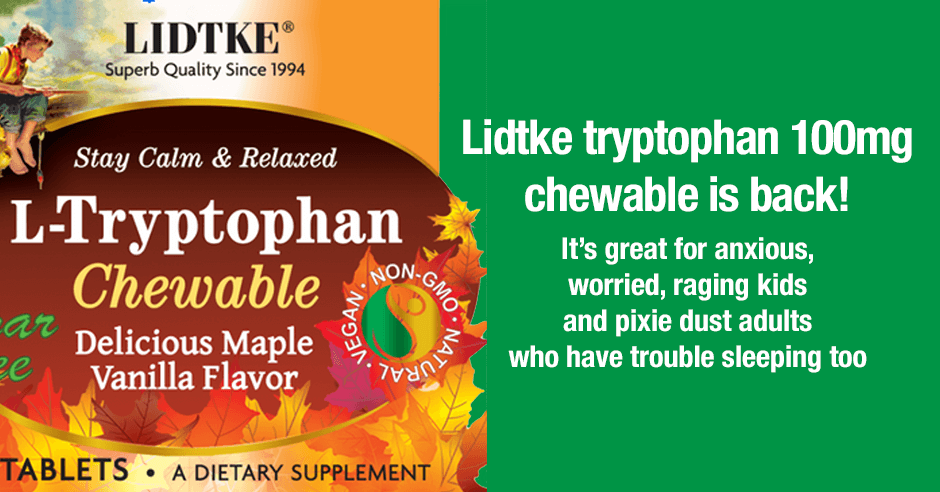
Lidtke tryptophan 100mg chewable is back! It’s great for anxious, worried, raging kids and pixie dust adults who have trouble sleeping too

June 6, 2025 By Trudy Scott 26 Comments

Lidtke tryptophan 100mg chewable

The Lidtke tryptophan 100mg chewable product has been out of stock for close to a year and it’s now back, hence this blog post. This product has been a firm favorite of mine for many years and I’ve used it successfully with children and adults with signs of low serotonin. If you’re new to tryptophan, it’s an amino acid that is a precursor or raw material for the production of your feel-good neurotransmitter called serotonin.

I’ve used this product in the past with children who are anxious, worried, raging, having problems sleeping and craving sugar and carbs. I’ve also used it with “pixie dust” clients who do well with a small dose and prefer a chewable form of tryptophan. And I often recommend clients use it to do the initial one-off trial to figure out if low serotonin is the issue (and before moving on to a typical starting dose of 500mg tryptophan twice a day).

In this blog you’ll see the label of the newly formulated tryptophan 100mg chewable and some of the many advantages of tryptophan as a low-dose chewable. You’ll also see some feedback on the previous formulation, a success story with a young girl and my personal experience too.

The newly formulated Lidtke L-Tryptophan Chewable

Here is the new label for the Lidtke L-Tryptophan 100mg Chewable. This product has been a firm favorite of mine for many years and the formulation has shifted over the years.
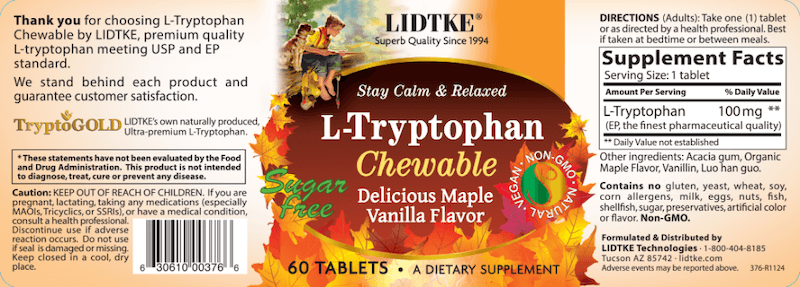
lidtke tryptophan chewable label

This formulation still contains 100mg tryptophan and a different sweetener – luo han guo, also known as monk fruit. It’s a zero-calorie natural sweetener that does not affect blood sugar. Monk fruit does belong to the gourd family and would need to be avoided if there are allergies to these foods (such as cucumbers, melons, zucchini etc).  Also, some individuals do not like the aftertaste of monk fruit.

It does contain flavors – maple and vanillin – which may be problematic for sensitive individuals. Acacia gum (or gum arabic) is low FODMAP and typically well tolerated, but may cause bloating for some.

The chewable has not been available for about a year so this is very welcome news.

Chewable tryptophan for a young girl with anxiety, rage, sleep issues and strong cravings

As I mentioned I’ve been using chewable tryptophan with success for many years. I often share the success story of a young girl with anxiety, rage, sleep issues and strong cravings for candies in documentaries and summit interviews and – and how addressing low serotonin with a chewable tryptophan quickly helped:

So sitting in my office with this young girl and her mom, we started to talk about the sweets and the candies and the need to give up the candies. She was fuming with me. She was sitting in a swivel chair. She turned her back on me and didn’t want to talk about having to give up candy at all.

I said, “Look, let’s not even talk about that, but would you take this chewable tryptophan here? And we’ll talk about it in a second.” I gave her 100 mg of the chewable tryptophan and continued discussing things with her mom.  She had no idea what it was going to do or how it would make her feel.

Within five minutes she turned her chair back, looked at me and she said, smilingly, “Yes, let’s do it. I can give up the candy.” She was smiling and she was happy.

So long story short, with this young girl, we started her on [chewable] tryptophan [and it turned things around quickly].

You can read her entire story here on the blog –  Rage, anxiety, cravings & insomnia in 11-year old girl with RAD/reactive attachment disorder: chewable tryptophan turns things around (she also went gluten-free and addressed low iron levels and the change was transformative.)

Some of the many advantages of tryptophan as a low-dose chewable

Here are some of the many advantages of tryptophan as a low-dose chewable:

  • The low dose is suitable for sensitive adults and pixie-dust folks (i.e. a small amount goes a long way)
  • It can be easily broken apart if an even lower dose works well
  • It’s pleasant tasting
  • It’s easy to have available to use on the go when traveling or out and about
  • The dose dose and taste is suitable for children and kids who are picky eaters
  • The dose dose and taste is suitable for older adults with dementia or Alzheimer’s, adults with special needs or Parkinson’s
  • One less capsule to swallow and more pleasant that tryptophan powder on the tongue
  • A good tool for doing the initial one-off trial to confirm low serotonin symptoms before embarking on titrating up to a higher dose of tryptophan

My personal experience with chewable tryptophan

Personally, I have used tryptophan over the years with much success. It’s helped me with sleep issues, the worry type of ruminating anxiety and PMS symptoms.

I also used it when I was grieving after my mom passed away and found it particularly helpful a few months after her passing when I’d start to feel more sad after dinner and go searching for sugar as a pick-up. It worked well because serotonin takes a dip later afternoon/evening.

Most of the time I’ve used 500mg and above – capsules opened and powder.

However I like to try what I recommend (if possible) so I have tried a few bottles of the previous formulation of the chewable tryptophan. It worked well and the taste and texture was pleasant. But because I do better on a higher dose I was needing to chew too many!

I have yet to try this new formulation myself but will report back as soon as I have had a chance to do so – on the taste, the texture and the effectiveness.

Positive feedback on the previous chewable tryptophan product

Until I get feedback on the new formulation, here is some general feedback from individuals in the community.

Jean is a practitioner who uses it herself and with patients:

It works within 15 minutes to stop looping thoughts/anxiety and the dose isn’t too sedating during the day. I never find it too sweet and wouldn’t let the taste keep me from such rapid relief.

I like the 100 mg chewable because it only has tryptophan and I didn’t want the other ingredients in the [Lidtke tryptophan] Complete for my needs.

I’ve had patients do well with tryptophan with the 100 mg chewable and others with the higher dose capsule.

Kelly likes the low 100mg dose compared to the 500mg capsules:

I purchased the adult pills and they were too strong. I was groggy in the morning.

Erin is also a practitioner and mom:

I have used this [the chewable tryptophan 100mg] with my 8 year old when he’s in a rage or showing signs of excessive worry and it works great! So glad it’s coming back. I recommend it to clients all the time.

Ali is also happy the chewable is coming back:

Great news!! I love the chewable and I prefer 100 mg early evening for anxiety and sleep. Sometimes 200mg but not often.

I appreciate them all sharing and hope to get updates from them when they try the new formulation.

Negative feedback on the new tryptophan chewable formulation

Update: June 14, 2025

Unfortunately, since publishing this blog and sharing on Facebook, the negative feedback has been coming in fast and furiously. Here is some of what people are sharing:

  • Melissa: “Love this company. I like that it’s chewable but it’s a large tablet and flavor is awful. Tastes like when you put maple syrup on a burnt pancake to try and cover up the burnt . I will finish the bottle though. I wish there were other chewable options, like GABA calm’s orange flavor.“
  • PS: “Revolting. Aftertaste like artificial sweetener. Smoother texture, last longer. Made me suspicious they were fake and I spat it out.“
  • Tamar: “I recently bought a few bottles of the maple sugar chewable. Taste is quite sweet and artificial, IMO. I don’t like chewing them because the product gets jammed in my teeth and stays there. I’ve been letting them dissolve, which takes a very long time.”

And these are comments from this blog:

  • Erin: “I was so excited to get this back, especially for my 8 year old son who has symptoms of ADHD rage. However, the new flavor is bitter and gets stuck in our teeth and now I can’t get him to take it!”
  • Nikki: “I got these about two weeks ago…. Truthfully I think it tastes horrible but that’s just me. Just unpleasant. Kind of sour and stale. They smell amazing but you get one in your mouth and it’s so hard to chew and swallow.” 
  • Tara: “The new formulation of the Lidtke does taste horrible. Initially I thought oh this smells lovely, tried to have my daughter take it and she said ick mom. So I said ok let me try it and ICK was right, the sweetener was gross and it did have a stale taste. So unfortunate as I had hope for this to help my daughter dealing with a lot of fears, worry, upset stomach and negative self talk at 9 yo and rage and sugar cravings.”

As of now I am NOT recommending this product.

The good news is that Nikki emailed Lidtke and shared this: “I just got an email back from Lidtke. Her name was Jessica and she stated: So, I’ve talked to the owner and let him know how many people are complaining about this new formula. He told me he was not aware it was changed and we are having a new batch made using the old formula that everyone loves. Going to take a month maybe a little more but we are definitely having this fixed.”

I appreciate her for emailing them and sharing this update. I’ve been communicating with someone else at the company and was told they have no plans to make any changes so if this is true it’s really good news!

Stay tuned for further updates and please share your own feedback in the comments below.

Additional resources when you are new to using tryptophan and other amino acids as supplements

As always, I use the symptoms questionnaire to figure out if low serotonin or other neurotransmitter imbalances may be an issue.

If you suspect low levels of any of the neurotransmitters and do not yet have my book, The Antianxiety Food Solution – How the Foods You Eat Can Help You Calm Your Anxious Mind, Improve Your Mood, and End Cravings, I highly recommend getting it and reading it before jumping in and using amino acids on your own so you are knowledgeable. And be sure to share it with the practitioner/health team you or your loved one is working with.

There is an entire chapter on the amino acids and they are discussed throughout the book in the sections on gut health, gluten, blood sugar control (this is covered in an entire chapter too), sugar cravings, anxiety and mood issues.

The book doesn’t include product names (per the publisher’s request) so this blog, The Antianxiety Food Solution Amino Acid and Pyroluria Supplements, lists the amino acids that I use with my individual clients and those in my group programs.

If, after reading this blog and my book, you don’t feel comfortable figuring things out on your own (i.e. doing the symptoms questionnaire and respective amino acids trials), a good place to get help is the GABA QuickStart Program (if you have low GABA symptoms). This is a paid online/virtual group program where you get my guidance and community support.

We are also offering the Serotonin Quickstart Program, a paid online/virtual group program where you get my guidance and community support during 5 LIVE Q&A calls.

If you are a practitioner, join us in The Balancing Neurotransmitters: the Fundamentals program. This is also a paid online/virtual program with an opportunity to interact with me and other practitioners who are also using the amino acids.

Wrapping up and your feedback

Now I’d love to hear from you – have you used the chewable tryptophan with success in the past? And how has it helped you or a loved one?

(once you try the new formulation I’d love to hear your feedback on taste, texture and effectiveness)

If you’d like to get on the notification list for the next Serotonin Quickstart Program (a paid online/virtual group program where you get my guidance and community support during 5 LIVE Q&A calls), please do so here.

If you’re a practitioner have you used chewable tryptophan with your clients/patients?

Feel free to share and ask your questions below.
Filed Under: Anxiety, Cravings, serotonin, Tryptophan Tagged With: 100mg chewable, 500mg tryptophan, adults, anxious, carbs, chewable tryptophan, children, craving, grief, kids, Lidtke tryptophan, neurotransmitter, one-off trial, pixie dust, rage, raging, sensitive, serotonin, Serotonin Quickstart, sleep, sugar, tryptophan, worried

Is DPA stimulating; can it be used with kids and someone with bipolar disorder; can it be used with a benzo/SSRI? (and other questions)

July 22, 2022 By Trudy Scott 12 Comments

dpa questions

DPA (d-phenylalanine) is an amino acid that destroys the enzyme that breaks down endorphins. Endorphins are feel-good chemicals that you experience with an endorphin rush when you go for a run or when someone gives you a big hug, when you show kindness to someone or someone does something nice for you. The amino acid DPA helps to raise your endorphins. With low endorphins you can feel very weepy, overly emotional, be extra sensitive to emotional pain, be sensitive to physical pain, and indulge in comfort/reward eating. Today I’m sharing some questions (and my feedback) as to whether it’s stimulating, can it be used with kids and someone with bipolar disorder, can it be used with a benzo/SSRI and more.

Misha has had success with DPA and wants to know if it is considered too stimulating. Here is her feedback and question:

I first tried DPA after reading about it on your blog and found it helpful for raising my mood. The DPA definitely helped curb my weepiness. I used Lidtke Endorphigen 1 cap/day. I have chronic Lyme which creates severe difficulty with sleep, anxiety and depression. Six months ago my neurologist took me off DPA saying it would be too stimulating to my nervous system.

I have since begun using DPA again; I really need the endorphin boost. Do you have any insights on whether DPA is considered stimulating? Whether it interferes with sleep (unfortunately my sleep is bad whether I take DPA or not)? Or suggestions for time of day to take it?

Here is my feedback for Misha: There is no evidence that DPA is too stimulating whereas DLPA (dl-phenylalanine) is known to be stimulating (it works like a combination of DPA and tyrosine).

And when I hear all this it tells me the person needs endorphin support:

  • “found it helpful for raising my mood”
  • “The DPA definitely helped curb my weepiness”
  • “I have since begun using DPA again; I really need the endorphin boost”

That said anything is possible which is why using the amino acids is based on the questionnaire and trials to see how a person responds. The best way to know if sleep is affected is to monitor sleep when using it and when not using it. She says her sleep is bad whether she takes DPA or not so I would recommend going back to her neurologist, sharing this information and the fact that it’s helping her so much. And look for other causes of her sleep issues.

Anna asks if DPA and other amino acids are safe for kids and how high doses? This is her question:

My 10 yr old has been diagnosed with social anxiety and she ticks off most of the boxes for low endorphins, low GABA, low serotonin. She’s very sensitive and very very emotional. We tried, but can’t seem to find a naturopath that can help her much. I feel after a while they all reach a dead end. I have been following you for a year and recently got your book. It looks relatively easy to follow, however I’m a bit reluctant, as she’s a kid.

My feedback: I work with women and once they have figured out the amino acids and neurotransmitter imbalances themselves they find it much easier to help their children who often have similar issues. When that is not the case working with a practitioner is ideal. That being said many moms become informed and educated enough to trial the amino acids on their own (like this mom who had her daughter use GABA with much success).

Anna says her daughter is very sensitive and very very emotional so I’d consider using 125 mg DPA to start (500 mg is an adult starting dose).With kids we also always start with dietary changes as laid out in my book. A good place to start is with a gluten-free and sugar-free diet and DPA (and the other amino acids) can help curb the cravings and feelings of deprivation.

Anon has bipolar disorder and likes comfort foods. This is her question:

I have bipolar disorder and wonder if the DPA will send me into a manic state. It’s one of the reasons I can’t take anti-depressants or stimulants otherwise I go manic. But I can eat for comfort so I only have food in the house I’m going to eat according to meal schedules. So I want to try the DPA.

Here is my feedback: I have not seen DPA to be an issue with bipolar disorder and it’s fabulous when you are a comfort-eater. If you have bipolar disorder and are on medications, it’s always advised to discuss new supplements with your prescribing doctor. You can share that DPA is not on the list of amino acids that have precautions with bipolar disorder.

I would not recommend the use of DLPA (dl-phenylalanine) with bipolar disorder because some of this increases dopamine (which can trigger a manic state).

Kristie is doing a benzodiazepine taper and would like to use DPA:

I am currently going through a benzo taper & there are numerous wonderful products that I am unable to mix with benzos. Would this be safe for me?

This is my feedback: I have not had issues with DPA with clients who are doing a benzo taper and there are no documented contraindications. DPA can help with some of the emotional blunting caused by benzos and the emotional fragility we often see during a benzo taper.  I know some of the great benzo support groups say not to use GABA but I find it very helpful when tapering too.

The medication question is a common one. Someone else described her depression as weepy and is using the SSRI. There are also no documented contraindications when using DPA with a SSRI. But again, best to discuss with the prescribing doctor.

Arleen has a question about blood pressure and the DPA product I recommend (Lidtke Endorphigen):

1) Is this product gluten free and 2) What effect if any would it have on blood pressure (mine is naturally low)

Here is my feedback: Lidtke Endorphigen is gluten-free and I have not seen it or other DPA products to be an issue with low blood pressure.

Jan wants to use GABA and DPA. She asks:

Can I use Gaba 125mg and also take DPA? Would either offset the other?

If someone has low GABA symptoms and GABA helps with the physcal anxiety and they also have low endorphin symptoms and DPA helps then they are absolutely fine to use together and even at the same time. However, I have clients trial one at a time in order to find the ideal dose and so you know how each one is working.

Resources if you are new to using the amino acids as supplements

If you are new to using any of the amino acids as supplements, here is the Amino Acids Mood Questionnaire from The Antianxiety Food Solution (you can see all the symptoms of neurotransmitter imbalances, including low endorphins).

If you suspect low levels of any of the neurotransmitters and do not yet have my book, The Antianxiety Food Solution – How the Foods You Eat Can Help You Calm Your Anxious Mind, Improve Your Mood, and End Cravings, I highly recommend getting it and reading it before jumping in and using amino acids on your own so you are knowledgeable. And be sure to share it with the practitioner/health team you or your loved one is working with.

There is an entire chapter on the amino acids and they are discussed throughout the book in the sections on gut health, gluten, blood sugar control, sugar cravings, self-medicating with alcohol and more.

The book doesn’t include product names (per the publisher’s request) so as mentioned above, this blog, The Antianxiety Food Solution Amino Acid and Pyroluria Supplements, lists the amino acids that I use with my individual clients and those in my group programs.

As mentioned above, Lidtke Endorphigen is the DPA product I’ve had the most success with (and it can be found in my online store). Doctor’s Best D-phenylalanine is also a good product.

If, after reading this blog and my book, you don’t feel comfortable figuring things out on your own (i.e. doing the symptoms questionnaire and respective amino acids trials), a good place to get help is the GABA Quickstart Program (if you have low GABA symptoms). This is a paid online/virtual group program where you get my guidance and community support. There are many moms in the program who are having much success with their kids.

You can then use this knowledge to then trial DPA and other amino acids or move on to the Amazing Aminos for Anxiety Program and get help there.

If you are a practitioner, join us in The Balancing Neurotransmitters: the Fundamentals program. This is also a paid online/virtual program with an opportunity to interact with me and other practitioners who are also using the amino acids with success with their clients/patients.

Have you used DPA with success and if yes how has it helped?

If you’re a practitioner, do you use DPA with your clients/patients?

If you have questions please share them here too.

Filed Under: Amino Acids, DPA/DLPA, Endorphins, Supplements Tagged With: amino acid, anxiety, Balancing Neurotransmitters: the Fundamentals, benzo, bipolar disorder, comfort/reward eating, d-phenylalanine, DPA, emotional, emotional pain, endorphin-boosting, endorphins, GABA, GABA Quickstart program, kids, low blood pressure, mood, physical pain, SSRI, stimulating, weepiness, weepy

More kids are showing up in ERs with anxiety, depression and other common mental health problems: why isn’t nutritional psychiatry part of the discussion?

November 16, 2018 By Trudy Scott 23 Comments

This article on NBC news, More kids are showing up in ERs (Emergency Rooms) with mental health crises, reports large increases across the country.

Dr. Anna Abrams, a pediatrician and researcher at Children’s National Medical Center in Washington, finds the numbers both shocking and disheartening.

In the 5-year period from 2012 to 2016, when looking at ER mental health admissions in 45 children’s hospitals, they found the following increases:

  • 48 % in white children
  • 64% in non-Hispanic black children
  • 77% increase in Hispanic children

with about a 55 % increase overall.

Dr. Abrams and her colleagues presented these findings at the American Academy of Pediatrics conference in earlier this month.

Other than the very large increases, there is something else to be concerned about: the researchers say they aren’t sure why we are seeing these increases, speculating it “could be due to the scarcity of mental health professionals who can help children” and “People are also talking more openly about depression, anxiety and other common mental health problems and that may make parents feel more comfortable about seeking help for their children.”

While these are very valid reasons, we really do need to be incorporating nutritional psychiatry (a term coined in 2015) and functional medicine (Dr. Mark Hyman is one of the leaders in functional medicine) into these discussions, studies and conferences. Other than poor diets and nutritional deficiencies we need to be considering stress, exposure to toxins, poor gut health and increasing Wifi exposure, to name a few.

If we look at diet alone, there is so much recent research supporting the connection between diet and mental health. Here are two of many new studies:

  • Is there an association between diet and depression in children and adolescents? A systematic review

Despite some contradictory results, overall there was support for an association between healthy dietary patterns or consumption of a high-quality diet and lower levels of depression or better mental health. Similarly, there was a relationship between unhealthy diet and consumption of low-quality diet and depression or poor mental health.

  • A Pro-Inflammatory Diet Is Associated With an Increased Odds of Depression Symptoms Among Iranian Female Adolescents: A Cross-Sectional Study

These data suggest that Iranian adolescent females eating a pro-inflammatory diet…had greater odds of having at least moderate depressive symptoms.

And here are just a few other factors to consider:

  • Integrative Medicine Approach to Pediatric Obsessive-Compulsive Disorder and Anxiety – in this case study gluten removal was a big factor
  • GABA for children: ADHD, focus issues, irritability, anxiety and tantrums With this pre-teen young girl, her mom reports that “She’s almost like different child. GABA has truly changed our life.“

How do we get this nutritional psychiatry research and case studies into the hands of those who can change actually policy and the way mental health is addressed? I believe it has to be a grass-roots effort from the bottom up and I have these suggestions:

  • share this blog and the research with your doctor and/or allied health practitioner
  • reach out to study authors, journalists and legislators and share research and success stories like the above, and your own personal results
  • if you’re a practitioner, write blogs like this sharing the good results you see with your clients and patients – with researchers, journalists and legislators
  • share in forums and on social media, and with your neighbors, friends and family
  • comment on blogs like this – with success stories in your family or with clients – so more people get to see what really is working

Every little bit helps! I’d love to hear your ideas too.

Filed Under: Children/Teens, Mental health Tagged With: adolescents, anxiety, children, depression, diet, ERs, GABA, gluten, kids, mental health, nutrition, nutritional psychiatry

Healthy travel food, first aid and avoiding anxiety and motion sickness when flying

November 3, 2017 By Trudy Scott 15 Comments

Updated: June 28, 2024

In today’s blog I share what I eat on a long international flight, plus what “first-aid” goodies I take in my carry-on luggage, how to stay cool, calm and collected when flying and demonstrate my favorite wrist bands for preventing motion sickness.

Even though I order gluten-free meals, I’m sure you’ll agree that the food on planes is pretty horrible and sometimes you can’t even be sure you’ll get your special meal.  One flight we ordered gluten-free only to be told on the plane that they don’t serve gluten-free meals! Fortunately we did a layover in Hawaii and were able to buy a salad and some fruit after a lot of searching but it was not what you’d expect. It was a good thing we did take some snacks with us too but I am now way more prepared when I travel.

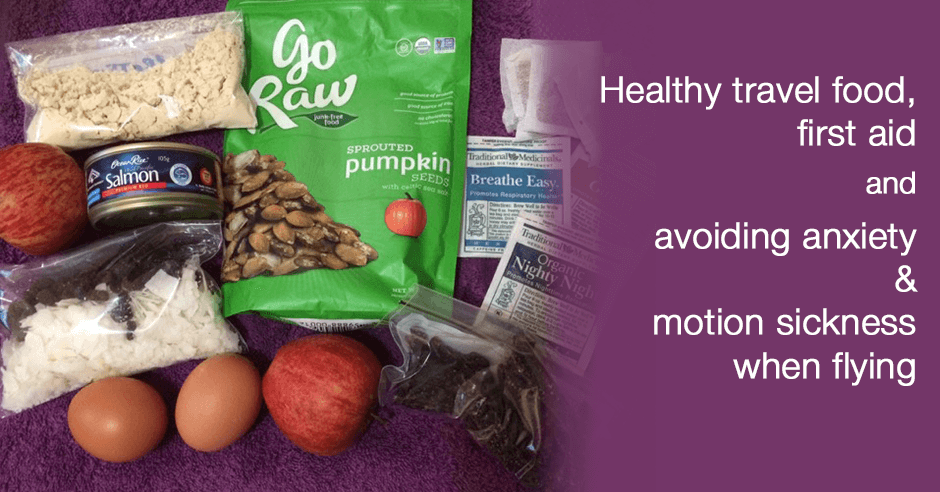
As you can see from the above image, this is the typical travel food (or “padkos” as we call it in South Africa) for a 13-hour flight:

  • 2 organic apples
  • 2 organic boiled eggs and some sea salt
  • Homemade biltong from grass fed beef (a South African version of jerky) made with sea salt, coriander and pepper
  • Coconut flakes and organic raisins
  • Sprouted pumpkin seeds (many nuts and seeds are medium and high oxalate but a few tablespoons of pumpkin seeds are low oxalate – more on oxalates here)
  • A selection of herbal tea bags: ginger (which is great for motion sickness), Nighty night which contains chamomile and is relaxing), Breathe Easy (in case of congestion) and rooibos (great for stress and an excellent source of polyphenols)
  • A can of wild salmon
  • Pea protein powder or whey or beef protein powder (as tolerated)

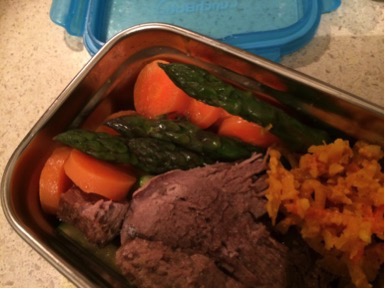
I also packed a meal of roast lamb with a veggie selection of carrots, zucchini and asparagus, plus some cauliflower sauerkraut. This was really delicious!

Also, to be safe, I take a selection of “first-aid” products in my carry-on luggage.

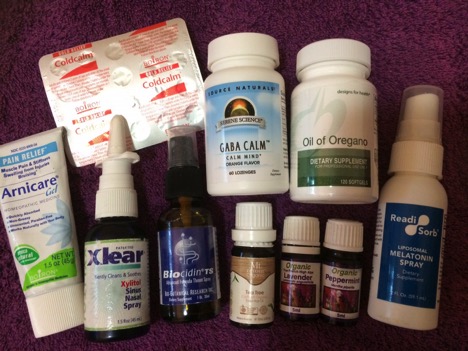
Here is some of what I typically pack for “first-aid”:

  • Arnicare which is an arnica gel * (for muscle pain)
  • Xlear nasal spray * and Biocidin throat spray * – I find that using these two products before boarding the plane and half way into the flight prevents me from picking up any bugs and getting sick
  • Tree tree oil *
  • Essential oils of lavender * (for relaxation and sleep) and peppermint * (for energy and a headache). Both are antibacterial too.
  • Melatonin spray * to help reset my circadian rhythm and help with jetlag
  • Designs for Health Oil of Oregano * and garlic supplements (not shown) for bug protection
  • Source Naturals GABA Calm for tension and anxiety. I didn’t use it/need it this trip but after my scary plane ride last year leading to vagus nerve issues, I’ve decided to always have some on hand when flying
  • Boiron Cold Calm, one of my favorite homeopathic cold remedies

I also take a few of each of the following in a supplement box: Designs for Health Inflammatone * (a natural anti-inflammatory), DPP-IV enzymes * (for accidental gluten exposure), activated charcoal * (also for accidental gluten exposure) and my daily supplements.

Note: the products marked with a * above can all be found on my Fullscript supplement store. And tryptophan, mentioned below, is also available on Fullscript.

Here is a video I did for the Healthy Travelers Global summit, an online event that was hosted by my good friend Robyn Benson in 2015 (just ignore the summit promo and enjoy the tips and demonstrations).

I share the following:

  • A quick demonstration using Xlear (notice that I actually miss my nose by mistake!) and Biocidin Throat Spray for avoiding bugs
  • The pressure-point wrist-bands I use for motion sickness (find them on Amazon here). Many people with pyroluria are more prone to morning nausea and may be very prone to motion sickness (and it’s commonly a sign of low vitamin B6). In order to be effective they do need to be put on BEFORE you start to travel and the position is key).
  • I don’t mention it in the video but motion sickness can be a sign of low bile production or poor quality bile. I share more about how I’ve been using ox bile to improve fat digestion and help with oxalate issues here. Hopefully this will help even more with my motion sickness.
  • Amino acids for travel anxiety (GABA for the physical anxiety and tryptophan for the fearful, worrying-about-flying anxiety)
  • Healthy travel snacks

Enjoy the beautiful Rocky Mountains! When I filmed this I was on a trip to St Paul, MN for the National Association of Nutrition Professionals conference and wanted to share just how I travel.

Additional resources when you are new to using amino acids such as GABA or tryptophan as supplements

As always, I use the symptoms questionnaire to figure out if low GABA or low serotonin may be an issue.

When considering them for flying I have clients do a trial before they leave and figure out optimal doses for their unique needs. And then use GABA and/or tryptophan as needed on the flight.

If you suspect low levels of any of the neurotransmitters and do not yet have my book, The Antianxiety Food Solution – How the Foods You Eat Can Help You Calm Your Anxious Mind, Improve Your Mood, and End Cravings, I highly recommend getting it and reading it before jumping in and using amino acids on your own so you are knowledgeable. And be sure to share it with the practitioner/health team you or your loved one is working with.

There is an entire chapter on the amino acids and they are discussed throughout the book in the sections on gut health, gluten, blood sugar control (this is covered in an entire chapter too), sugar cravings, anxiety and mood issues.

The book doesn’t include product names (per the publisher’s request) so this blog, The Antianxiety Food Solution Amino Acid and Pyroluria Supplements, lists the amino acids that I use with my individual clients and those in my group programs.

If, after reading this blog and my book, you don’t feel comfortable figuring things out on your own (i.e. doing the symptoms questionnaire and respective amino acids trials), a good place to get help is the GABA QuickStart Program (if you have low GABA symptoms too). This is a paid online/virtual group program where you get my guidance and community support.

If you are a practitioner, join us in The Balancing Neurotransmitters: the Fundamentals program. This is also a paid online/virtual program with an opportunity to interact with me and other practitioners who are also using the amino acids.

Wrapping up and your feedback

I hope this is all helpful for your next long flight or even a road-trip you have coming up. Do keep in mind that some of this can be adapted for a day out shopping or a day at the beach too.

I’d love to hear about your favorite travel foods and first-aid goodies that you take on a trip.

Feel free to share and ask your questions below.
Filed Under: Anxiety Tagged With: anxiety, anxiety nutrition solutions, depression, DPA, GABA, iPhone, kids, teen, Teen Depression and Anxiety: Why the Kids Are Not Alright, teens, tryptophan

Teen Depression and Anxiety: Why the Kids Are Not Alright – my response

October 27, 2017 By Trudy Scott 10 Comments

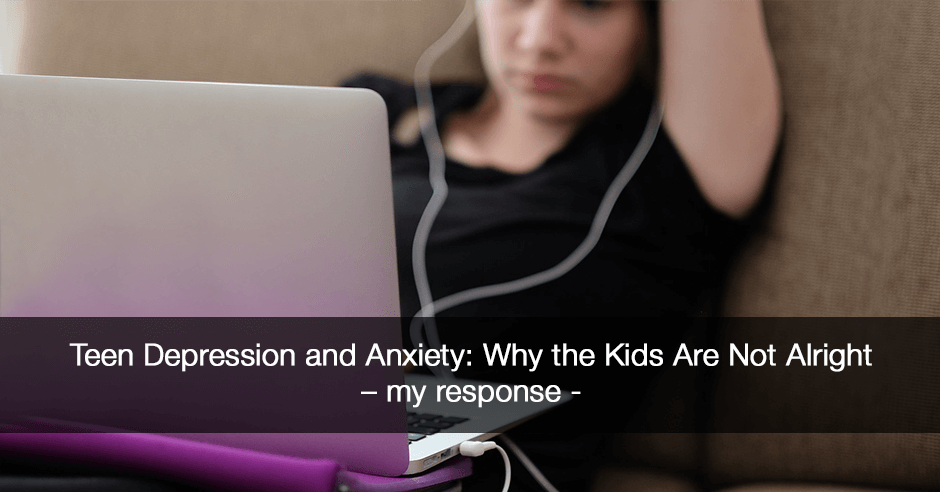
Teens suffer from so much anxiety and their anxiety symptoms are now more of an issue than depression; they are cutting and self-harming as a way to feel normal; they are super-stressed; social media and iPhone use is taking over their lives, and in general, they seem to have poor coping skills.

This article in TIME magazine is a sad and concerning read: Teen Depression and Anxiety: Why the Kids Are Not Alright. It was written last year but is still very relevant. The author writes:

“Adolescents today have a reputation for being more fragile, less resilient and more overwhelmed than their parents were when they were growing up”

It’s an excellent article for creating awareness and to get an understanding of the extent of the issues and does highlight the crazy online world of teens:

It’s hard for many adults to understand how much of teenagers’ emotional life is lived within the small screens on their phones, but a CNN special report in 2015 conducted with researchers at the University of California, Davis, and the University of Texas at Dallas examined the social-media use of more than 200 13-year-olds. Their analysis found that ‘there is no firm line between their real and online worlds.’

Here is my response to the article and how I feel we can do better.

No solutions other than coping mechanisms

These teens are hopeless and resigned to the fact that this is how they are going to have to live i.e. simply managing their symptoms. It breaks my heart and it’s not alright!

Unfortunately (like the recent Xanax anxiety article in the New York Times) it offers no solutions other than coping mechanisms.

No mention of the importance of diet or nature

I agree that these kids are under a lot of stress (certainly more than when I was a teen) BUT there is ZERO mention of a real foods diet (that includes quality animal protein), a nourishing breakfast with protein (balancing blood sugar makes such a difference for reducing anxiety levels), the removal of caffeine, gluten and sugar, the importance of addressing nutritional deficiencies and poor gut health.

I love the movie project but there is no encouragement to get these teens out into nature (and maybe take up bouldering or gardening, both of which have been shown to reduce anxiety and depression).

No mention of DPA or GABA or tryptophan for self-harming, anxiety and addiction

The article makes the connections between the endorphin/opioid system and pain and the comfort these teens get from self-harming and cutting:

Scientists want to better understand how self-harm engages the endogenous opioid system–which is involved in the pain response in the brain–and what happens if and when it does

However, there is NO nutritional solution offered and NO mention of the amino acid DPA (d-phenylalanine), which can often be very effective for the cutting and self-harming, because it creates a similar endorphin boost that the cutting provides.  

There is also NO mention of the calming amino acid GABA or the happy and worry-free amino acid tryptophan for the anxiety and worry.

All the above amino acid also address addictions and may well offer neurotransmitter support to help with the addictive nature of their “drug-of-choice” i.e. their iPhones, games and other devices.

We have a plethora of nutritional solutions

We have a plethora of nutritional solutions to consider. Here are some relevant blogs that need to be part of the conversation for these teens:

  • GABA for children: ADHD, focus issues, irritability, anxiety and tantrums
  • My interview with psychiatric nurse practitioner, Zendi Moldenhauer, on the Anxiety Summit – Anxiety in children, adolescents and young adults: an integrative psychiatric approach
  • My discussion with Dr. Nicole Beurkens at the end of one of Integrative Medicine for Mental Health conferences to talk about anxiety and the impact of both low zinc and low GABA. Nicole shares her perspectives on working with children and I share what I see with the adult women I work with.

Something as simple as a weighted blanket may help ease the anxiety some of these teens are experiencing.

We can do better than simply discussing the problem teens face. I’ve worked with both children and teens and we’ve shifted things in a matter of months. It really can be done but we need to share the powerful nutritional psychiatry solution, especially because research shows that most children with anxiety relapse, regardless of conventional treatment approaches.

Do you have a teenager who is experiencing anxiety and what has helped her/him?

Do you work with teens and do you incorporate some of these approaches?

How do we get this information into the hands of parents, schools, organizations, doctors, mental health practitioners and others those who can help make this happen?

Filed Under: Anxiety, Children/Teens, Teens Tagged With: anxiety, anxiety nutrition solutions, depression, DPA, GABA, iPhone, kids, teen, Teen Depression and Anxiety: Why the Kids Are Not Alright, teens, tryptophan

Integrative Medicine Approach to Pediatric Obsessive-Compulsive Disorder and Anxiety

April 29, 2016 By Trudy Scott 18 Comments

pediatric-ocd-anxiety

Gluten was found to be the cause of a childhood case of obsessive-compulsive disorder (OCD). In this case report, published in January this year: Integrative Medicine Approach to Pediatric Obsessive-Compulsive Disorder and Anxiety, the authors state

This case study is the first reported case of OCD associated with non-celiac gluten sensitivity.

Pediatric obsessive-compulsive disorder (OCD) is prevalent in 1% to 2% of the population. Emerging studies have correlated non-celiac gluten sensitivity with psychiatric conditions such as schizophrenia, depression, mania, and anxiety.

The 7-year-old boy was treated at an integrative medicine practice in the United States and experienced these results on a gluten-free diet together with other integrative medicine modalities:

marked reduction of OCD symptoms and anxiety along with marked improvement of social behavior and school work

The authors conclude the following and recommend further research:

The patient’s rapid response without side effects behooves the medical research community to further investigate the association of non-celiac gluten sensitivity and pediatric OCD.

These are truly amazing results and I always recommend that anyone with any mental health condition needs to consider the effects of gluten. I have all my clients go gluten-free for this very reason. Even if you don’t have a diagnosis of OCD, going gluten-free frequently helps with the obsessive thinking, ruminating thoughts, negative self-talk, anxiety and worry.

Of course, this approach or this approach alone, may not work with everyone with OCD (severe or mild) since the root cause can be multi-faceted.

Other approaches for OCD could also include (with or without a gluten-free diet, although I’d err on the side of caution and always remove gluten):

  • Addressing low serotonin with 5-HTP or tryptophan. Inositol is also very helpful for obsessive thoughts and/or behaviors. I blogged about a success story here: Anxiety and OCD: Inositol instead of tryptophan or 5-HTP?
  • Addressing nutritional deficiencies using a multi-vitamin and -mineral combination. In this study, an 8-year-old boy with OCD and explosive rage issues benefited from this approach.  In this case study, an 18-year-old who had not benefited much from CBT, saw mood stabilization, anxiety reduction, and obsessions in remission after just 8 weeks on the multi-vitamin and -mineral combination. His symptoms retuned when he stopped taking it and improved when he added it back.
  • Addressing pediatric autoimmune neuropsychiatric disorders associated with streptococcal infections (or PANDAS) and pediatric acute-onset neuropsychiatric syndrome (PANS) which can cause OCD type behaviors, bed-wetting, tics, night-time fears, separation anxiety, learning regression, and handwriting disabilities.

Please share if you’ve found benefits from any of the above approaches for OCD, obsessive thinking or anxiety.

Filed Under: Gluten, OCD Tagged With: kids, non-gluten, pediatric anxiety, pediatric ocd

Primary Sidebar

NEW! GABA QuickStart Homestudy (with special intro pricing)

gaba quickstart homestudy

Free Report

9 Great Questions Women Ask about Food, Mood and their Health

You'll also receive a complimentary subscription to my ezine "Food, Mood and Gal Stuff"


Connect with me

Popular Posts

  • Amino Acids Mood Questionnaire from The Antianxiety Food Solution
  • The Antianxiety Food Solution Amino Acid and Pyroluria Supplements
  • Pyroluria Questionnaire from The Antianxiety Food Solution
  • Collagen and gelatin lower serotonin: does this increase your anxiety and depression?
  • Tryptophan for the worry-in-your-head and ruminating type of anxiety
  • GABA for the physical-tension and stiff-and-tense-muscles type of anxiety
  • The Antianxiety Food Solution by Trudy Scott
  • Seriphos Original Formula is back: the best product for anxiety and insomnia caused by high cortisol
  • Am I an anxious introvert because of low zinc and vitamin B6? My response to Huffington Post blog
  • Vagus nerve rehab with GABA, breathing, humming, gargling and key nutrients

Recent Posts

  • What do I use instead of Seriphos to help lower high cortisol that is affecting my sleep and making me anxious at night?
  • BeSerene™ GABA/theanine cream eases severe muscle tension in her neck/shoulders, prevents her bad headaches and quells her anxiety
  • How the correct approach, dose and sublingual use of GABA can be calming and not cause a flushed and itchy face and neck
  • The amino acid glutamine improves low mood by addressing gut health, and it has calming effects too
  • Flight anxiety with heightened breath, physical tension and also fearing the worst (the role of low GABA and low serotonin)

Categories

  • 5-HTP
  • AB575
  • Addiction
  • ADHD
  • Adrenals
  • Alcohol
  • Allergies
  • Alzheimer's disease
  • Amino Acids
  • Anger
  • Antianxiety
  • Antianxiety Food Solution
  • Antidepressants
  • Anxiety
  • Anxiety and panic
  • Autism
  • Autoimmunity
  • benzodiazapines
  • Bipolar disorder
  • Books
  • Caffeine
  • Cancer
  • Candida
  • Children/Teens
  • Collagen
  • Cooking equipment
  • Coronavirus/COVID-19
  • Cravings
  • Depression
  • Detoxification
  • Diabetes
  • Diet
  • DPA/DLPA
  • Drugs
  • EFT/Tapping
  • EMF
  • EMFs
  • Emotional Eating
  • Endorphins
  • Environment
  • Essential oils
  • Events
  • Exercise
  • Fear
  • Fear of public speaking
  • Fertility and Pregnancy
  • Fish
  • Food
  • Food and mood
  • Functional neurology
  • GABA
  • Gene polymorphisms
  • General Health
  • Giving
  • Giving back
  • Glutamine
  • Gluten
  • GMOs
  • Gratitude
  • Gut health
  • Heart health/hypertension
  • Histamine
  • Hormone
  • Hyperparathyroidism
  • Hypoglycemia
  • Immune system
  • Inflammation
  • Insomnia
  • Inspiration
  • Introversion
  • Joy and happiness
  • Ketogenic diet
  • Lithium orotate
  • Looking awesome
  • Lyme disease and co-infections
  • MCAS/histamine
  • Medication
  • Men's health
  • Mental health
  • Mercury
  • Migraine
  • Mold
  • Movie
  • MTHFR
  • Multiple sclerosis
  • Music
  • NANP
  • Nature
  • Nutritional Psychiatry
  • OCD
  • Osteoporosis
  • Oxalates
  • Oxytocin
  • Pain
  • Paleo
  • Parasites
  • Parkinson’s disease
  • PCOS
  • People
  • PMS
  • Postpartum
  • PTSD/Trauma
  • Pyroluria
  • Questionnaires
  • Real whole food
  • Recipes
  • Research
  • Schizophrenia
  • serotonin
  • SIBO
  • Sleep
  • Special diets
  • Sports nutrition
  • Stress
  • Sugar addiction
  • Sugar and mood
  • Supplements
  • Teens
  • Testimonials
  • Testing
  • The Anxiety Summit
  • The Anxiety Summit 2
  • The Anxiety Summit 3
  • The Anxiety Summit 4
  • The Anxiety Summit 5
  • The Anxiety Summit 6
  • Thyroid
  • Thyroid health
  • Toxins
  • Tryptophan
  • Tyrosine
  • Uncategorized
  • Vegan/vegetarian
  • Women's health
  • Yoga

Archives

  • October 2025
  • September 2025
  • August 2025
  • July 2025
  • June 2025
  • May 2025
  • April 2025
  • March 2025
  • February 2025
  • January 2025
  • November 2024
  • October 2024
  • September 2024
  • August 2024
  • July 2024
  • June 2024
  • May 2024
  • April 2024
  • March 2024
  • February 2024
  • January 2024
  • December 2023
  • November 2023
  • October 2023
  • September 2023
  • August 2023
  • July 2023
  • June 2023
  • May 2023
  • April 2023
  • March 2023
  • February 2023
  • January 2023
  • December 2022
  • November 2022
  • October 2022
  • September 2022
  • August 2022
  • July 2022
  • June 2022
  • May 2022
  • April 2022
  • March 2022
  • February 2022
  • January 2022
  • December 2021
  • November 2021
  • October 2021
  • September 2021
  • August 2021
  • July 2021
  • June 2021
  • May 2021
  • April 2021
  • March 2021
  • February 2021
  • January 2021
  • December 2020
  • November 2020
  • October 2020
  • September 2020
  • August 2020
  • July 2020
  • June 2020
  • May 2020
  • April 2020
  • March 2020
  • February 2020
  • January 2020
  • December 2019
  • November 2019
  • October 2019
  • September 2019
  • August 2019
  • July 2019
  • June 2019
  • May 2019
  • April 2019
  • March 2019
  • February 2019
  • January 2019
  • December 2018
  • November 2018
  • October 2018
  • September 2018
  • August 2018
  • July 2018
  • June 2018
  • May 2018
  • April 2018
  • March 2018
  • February 2018
  • January 2018
  • December 2017
  • November 2017
  • October 2017
  • September 2017
  • August 2017
  • July 2017
  • June 2017
  • May 2017
  • April 2017
  • March 2017
  • February 2017
  • January 2017
  • December 2016
  • November 2016
  • October 2016
  • September 2016
  • August 2016
  • July 2016
  • June 2016
  • May 2016
  • April 2016
  • March 2016
  • February 2016
  • January 2016
  • December 2015
  • November 2015
  • October 2015
  • September 2015
  • August 2015
  • July 2015
  • June 2015
  • May 2015
  • April 2015
  • March 2015
  • February 2015
  • January 2015
  • December 2014
  • November 2014
  • October 2014
  • September 2014
  • August 2014
  • July 2014
  • June 2014
  • May 2014
  • April 2014
  • March 2014
  • February 2014
  • January 2014
  • December 2013
  • November 2013
  • October 2013
  • September 2013
  • August 2013
  • July 2013
  • June 2013
  • May 2013
  • April 2013
  • March 2013
  • February 2013
  • January 2013
  • December 2012
  • November 2012
  • October 2012
  • August 2012
  • July 2012
  • June 2012
  • May 2012
  • April 2012
  • March 2012
  • February 2012
  • January 2012
  • December 2011
  • November 2011
  • October 2011
  • September 2011
  • August 2011
  • July 2011
  • June 2011
  • May 2011
  • April 2011
  • March 2011
  • February 2011
  • January 2011
  • December 2010
  • October 2010
  • September 2010
  • July 2010
  • May 2010
  • April 2010
  • March 2010
  • February 2010
  • January 2010
  • November 2009

Share the knowledge!

The above statements have not been evaluated by the Food and Drug Administration. Products listed in this website are not intended to diagnose, treat, cure or prevent any disease.

The information provided on this site is for informational and educational purposes only and is not intended as a substitute for advice from your physician or other health care professional. You should consult with a healthcare professional before starting or modifying any diet, exercise, or supplementation program, before taking or stopping any medication, or if you have or suspect you may have a health problem.


Copyright © 2026 Trudy Scott. All Rights Reserved. | Privacy | Terms and Conditions | Refund Policy | Medical Disclaimer

Free Report

9 Great Questions Women Ask about Food, Mood and their Health

You’ll also receive a complimentary subscription to my ezine “Food, Mood and Gal Stuff”