• Skip to primary navigation
  • Skip to main content
  • Skip to primary sidebar

everywomanover29 blog

Food, Mood and Women's Health – Be your healthiest, look and feel great!

  • Blog
  • About
  • Services
  • Store
  • Resources
  • Testimonials
  • The Book
  • Contact
  • Search this site

GABA Quickstart program

Lactium® (alpha-s1 casein hydrolysate/hydrolyzed casein) for lowering high cortisol, reducing anxiety and improving sleep

October 14, 2022 By Trudy Scott 29 Comments

lactium cortisol anxiety

Lactium® is my second choice for lowering high cortisol and reducing the type of anxiety that we see when cortisol is high i.e. anxiety that feels like an adrenaline-type surge.  It is especially helpful when cortisol is high as you wake up. This can be confirmed by a 4 collection saliva test. The reason why Lactium® is the best choice in a situation like this is because Seriphos (a phosphorylated serine product) is most effective for lowering high cortisol when it’s used 3 hours before the high cortisol measurement and you can’t do this when anxiety and adrenaline-type surges happen on waking in the morning. This is where Lactium® shines. It also helps to reduce anxiety at other times in the day and to improve sleep.

The Lactium® research

There is research supporting the use of Lactium® for improving sleep, reducing anxiety and lowering high cortisol. The number of Lactium® studies are not extensive but the results are very promising and correlate with what we see clinically. Here are a few of them:

  • Effects of a tryptic hydrolysate from bovine milk alphaS1-casein on hemodynamic responses in healthy human volunteers facing successive mental and physical stress situations

“The study subjects were (double blind) randomly allocated to ingest three times, 12 hours apart, two capsules containing either 200 mg of alphaS1-casein hydrolysate or bovine skimmed milk powder as a placebo.” They were then subjected to successive stress situations. There was a significant decrease of plasma cortisol concentrations and heart rate remained stable in the Lactium® group. The study conclusion is as follows: “On the basis of blood pressure and cortisol changes, these results suggest an anti stress profile of this alphaS1-casein hydrolysate in human subjects.”

  • A Double-Blind, Randomized, Placebo-Controlled Crossover Clinical Study of the Effects of Alpha-s1 Casein Hydrolysate on Sleep Disturbance

48 participants exhibited mild to moderate degree of sleep disturbance and after 4 weeks of Lactium® use, “overall perceived sleep profiles in sleep diaries were significantly improved … represented by increased total sleep time and sleep efficiency, as well as decreased sleep latency and wake after sleep onset.” It was concluded that Lactium® “was well tolerated and could improve sleep quality, with possible cumulative beneficial effects with long-term administration.”

  • Effect of Alpha-S1-Casein Tryptic Hydrolysate and L-Theanine on Poor Sleep Quality: A Double Blind, Randomized Placebo-Controlled Crossover Trial

39 subjects were given a supplement containing Lactium® and theanine for four weeks. The authors concluded that “given its beneficial effects without notable adverse events, it would be advantageous to use these nutraceutical ingredients to promote better sleep quality” (and in a larger study).

You’ll see Lactium® referred to as alpha-s1 casein hydrolysate, hydrolyzed casein concentrate, and tryptic hydrolysate from bovine milk alphaS1-casein.

INGREDIA of France manufactures Lactium and you will see some of the studies have been initiated and/or co-authored by them.

The product I use is called Biotics Research De-Stress. It contains 150mg Lactium® in one capsule. I’ve had clients use 1-2 capsules at a time, based on symptoms and the relief they feel.

Lactium® works on GABAA receptors

What is really interesting is an animal study that reports Lactium® works on the GABAA receptor: A tryptic hydrolysate from bovine milk αs1-casein enhances pentobarbital-induced sleep in mice via the GABAA receptor

It was found that Lactium® “enhanced the sleep induced by pentobarbital sodium in mice. It also promoted slow-wave (delta) EEG activity in rats; a pattern indicative of sleep or relaxation.” The authors state that the effects are “probably mediated through the GABAA receptor-chloride ion channel complex.”

As you may already know, GABA is one of the amino acids I use extensively with folks with low GABA physical anxiety and related sleep issues. There is also compelling research on the benefits of GABA and theanine for improving sleep and easing anxiety.

I have found that many of my clients do well on both GABA (when GABA levels are low) and Lactium® (when cortisol is high).  Lactium® can be used in the daytime and at night when cortisol is high (and so can Seriphos).

Seriphos and other ways to lower high cortisol

As I mentioned above, Seriphos is my first choice for lowering high cortisol and easing this type of anxiety, especially when cortisol is high during the night. Seriphos is a phosphorylated serine product and I find it much more effective than regular phosphatidylserine products.

If you’re new to Seriphos here is my blog post – Seriphos Original Formula is back: the best product for anxiety and insomnia caused by high cortisol

There are other ways to lower cortisol too:

  • Relora – Magnolia officinalis and Phellodendron amurense (Relora®) lowers cortisol and reduces stress and anxiety
  • Forest bathing – Anxiety, stress and high cortisol: forest bathing to the rescue
  • Reducing Wi-Fi exposure – Wi-Fi is an important threat to human health and may contribute to unresolved anxiety, SIBO, oxalate issues and high cortisol
  • Tapping – Tapping (or EFT) for reducing anxiety, depression, pain and cravings, plus physiological changes in cortisol, heart rate, blood pressure and SigA
  • Essential oils – Orange essential oil to alleviate PTSD, fear, stress and anxiety

Resources if you are new to using GABA and other amino acids as supplements

If you are new to using any of the amino acids as supplements, here is the Amino Acids Mood Questionnaire from The Antianxiety Food Solution (you can see all the symptoms of neurotransmitter imbalances, including low GABA).

If you suspect low levels of any of the neurotransmitters and do not yet have my book, The Antianxiety Food Solution – How the Foods You Eat Can Help You Calm Your Anxious Mind, Improve Your Mood, and End Cravings, I highly recommend getting it and reading it before jumping in and using amino acids on your own so you are knowledgeable. And be sure to share it with the practitioner/health team you or your loved one is working with.

There is an entire chapter on the amino acids and they are discussed throughout the book in the sections on gut health, gluten, blood sugar control, sugar cravings, self-medicating with alcohol and more.

The book doesn’t include product names (per the publisher’s request) so this blog, The Antianxiety Food Solution Amino Acid and Pyroluria Supplements, lists the amino acids that I use with my individual clients and those in my group programs. You can find them all in my online store.

You can also find Biotics Research De-Stress in my online store (see link above for how to set up an account and purchase).

If, after reading this blog and my book, you don’t feel comfortable figuring things out on your own (i.e. doing the symptoms questionnaire and respective amino acids trials), a good place to get help is the GABA QuickStart Program (if you have low GABA symptoms). This is a paid online/virtual group program where you get my guidance and community support.

If you are a practitioner, join us in The Balancing Neurotransmitters: the Fundamentals program. This is also a paid online/virtual program with an opportunity to interact with me and other practitioners who are also using the amino acids.

Have you used Lactium® for improving your sleep, reducing anxiety and/or lowering your high cortisol?

Have you also used any of the above approaches to lower cortisol or reduce anxiety too?

How quickly did each one help?

If you’re a practitioner do you use Lactium® with success?

If you have questions please share them here too.
Filed Under: Anxiety, Insomnia Tagged With: adrenaline-type surge, alpha-s1 casein hydrolysate, anxiety, Balancing Neurotransmitters: the Fundamentals program for practitioners, cortisol, GABA Quickstart program, high cortisol, hydrolyzed casein, insomnia, lactium, phosphorylated serine, saliva test, seriphos, sleep

Does 5-HTP (an amino acid) cause nightmares or does it help prevent nightmares (and also support low serotonin symptoms)?

October 7, 2022 By Trudy Scott 24 Comments

5-htp and nightmares

How do you do with using the amino acid 5-HTP for supporting your low serotonin symptoms of anxiety, worry, ruminating, fears, depression and insomnia?  Does it help or does it cause nightmares? On a recent Facebook thread someone shared that 5-HTP causes really bad nightmares, so she had to stop using it. A few others posted saying 5-HTP also caused them nightmares. I’ve not had any clients report nightmares, so I was surprised to hear this feedback.  However, most folks on the same Facebook thread shared that 5-HTP works very well for them and does not cause nightmares. There is also research that supports the use of 5-HTP for night terrors. I suspect it may have to do with low vitamin B6 and share more on that below.

Here is her experience with 5-HTP and nightmares and some of my feedback:

I don’t know how anyone takes 5-HTP. The horrific nightmares I got from taking it made me stop 50 mg. I tried 3 times thinking it was a fluke and it happened every time. Too scary for me.

My first try was suggested from my Naturopath, Metagenics SeroSyn. 200 mg. First morning waking up I had a nightmare so bad I can’t even share it. I also woke up feeling unable to wake up, drugged almost. So I waited, did more research and googled 5-HTP and nightmares just to see if there was a connection. I found it. I read to lower the dosage. So I went to Pure Encapsulations 50 mg. Same thing happened. I tried 2 more times, same thing happened. When I researched, I found so many people talking about “vivid dreams” and after my last attempt the dream was so real I thought my son was in my home when I woke up and had to process reality from my dream. That did it for me. Now I’m terrified of it. Just my own experience. I did get help from depression though! But I cannot go through one evil for another. Now I’m stuck looking for help and answers.

I thanked her for sharing and agreed it does help to do a few experiments to be sure it was the 5-HTP. I also shared that I would not consider the Metagenics SeroSyn a good 5-HTP to test because of all the other ingredients. But it also happened with Pure Encapsulations 50 mg 5-HTP – that was a good test to confirm.

I also shared that some folks do better on 5-HTP and some on tryptophan so if 5-HTP did help with low serotonin symptoms then I’d consider a trial of tryptophan especially since she did say using the 5-HTP helped with her depression.

We would also look for other ways to support serotonin – saffron, turmeric, St. John’s Wort, theanine (it supports GABA, serotonin and dopamine) and of course diet (real whole food, quality animal protein, no gluten/sugar/caffeine, fermented foods, organic vegetables and fruit, healthy fats etc), gut health and more.

I’d also look into and address low zinc and low vitamin B6 as both are needed to make serotonin and the other neurotransmitters. More on low vitamin B6, pyroluria and nightmares below.

Here is some of the feedback from other folks who also had issues with 5-HTP:

  • 5-HTP didn’t mix well with my body either. Taken at night, horrible dreams, and 50mg Pure Encapsulations formula in the morning made me feel so dark, spaced out and terrible nausea.
  • I appreciate this post. I had nightmares from a magnesium supplement that included 5-HTP! Now I know I’m not alone.

And here is some of the feedback from folks who do well with 5-HTP (the majority of those who responded):

  • I take 100 mg of 5-HTP in the morning (Natural Factors) and about 350 mg of tryptophan before bed (Lidtke). It works well for me. No nightmares although I do dream a lot. Mostly noticed improvement in mood and ruminating thoughts. Also taking Sam-e which also helps.
  • I take chewable natural factors Tranquil Sleep. It contains other ingredients (like theanine) as well but it’s really easy to dose. If I take 2 it’s too much. I get weird dreams and a headache. So 1 1/2 it is.
  • 5-htp helped me so much! But I had to take it in the morning. 250mg was perfect for me. I was using this for my debilitating anxiety which would keep me in flight or fight all day and I would ruminate. Really helped me along with therapy. I no longer need it.
  • I’ve just started taking 50mg 5-HTP at night. It’s a micronized version I buy from a compounding chemist in Australia. No negative side effects so far.
  • Grateful for the reminder … I did great on 5-htp myself. Have had all dose amounts, given at different times too. I deal with chronic pain and trauma/stress.
  • My sister gets anxiety on 5-HTP but it helps me so much! I have not tracked regular consumption compared to my sleep (I get too much REM without it and wake up exhausted). I also no longer need it as a daily and can take it as needed. I take 200mg, forget the brand but it’s a single ingredient.
  • I take 50 mg of 5-HTP from Seeking Health and do very well on it. It has helped me with depression, worry, fear, more energy and motivation and no nightmares.
  • I take the Now brand, 100mg at bedtime along with the same brand of L theanine. No nightmares and I’ve been doing this for about 5 years.
  • I use 50mg Seeking Health 5-HTP and I love it. It gives me energy and motivation, helps with intrusive thoughts and anxiety. I’ve used the Jarrow brand in the past without results. No nightmares. P5P, on the other hand, I cannot take. It gives me such clear, vivid nightmares I would wake up crying. Never again.

We are all unique and there is clearly no one-size fits all.

Low vitamin B6 can cause nightmares or poor dream recall

It’s well recognized that low vitamin B6 can cause nightmares or poor dream recall. In this study, Effects of Vitamin B6 (Pyridoxine) and a B Complex Preparation on Dreaming and Sleep (which was randomized, double-blind and placebo-controlled), 100 participants from across Australia were given 240 mg vitamin B6 (pyridoxine hydrochloride) before bed for five consecutive days. Other study participants were given a B complex. This is the outcome of the study:

  • vitamin B6 significantly increased the amount of dream content participants recalled but did not significantly affect dream vividness, bizarreness, or color, nor did it significantly affect other sleep-related variables
  • participants in the B complex group showed significantly lower self-rated sleep quality and significantly higher tiredness on waking

This vitamin B6/dream recall research is of particular interest to me because of my work with pyroluria, a social anxiety condition which responds really well to supplementation with zinc, vitamin B6 or P5P (pyridoxal-5-phosphate) or a combination of both, and a few other key nutrients.  Here is the pyroluria questionnaire.

One of the classic signs of pyroluria is poor dream recall, stressful or bizarre dreams, or nightmares, signs which the late Carl Pfeiffer, MD attributed to low vitamin B6 status. He suggested that your dreams and dream recall serve as a good indicator of your need for vitamin B6. You should dream every night and you should remember your dreams. They should be pleasant – the kind of dreams where you wake up and want to close your eyes and continue dreaming.

Could it be that folks who get nightmares with 5-HTP, happen to also have pyroluria? Or perhaps they simply have low vitamin B6 status? I have all my anxious clients supplement with vitamin B6 and/or P5P and this may be why nightmares with 5-HTP was news to me.

5-HTP can increase cortisol – does this affect nightmares?

There is research and clinical evidence supporting that, for some individuals, 5-HTP can raise cortisol. I’ve blogged about this here:

This is not always the case. Someone in the same Facebook thread shared this: “My cortisol measured above the reference range, but 5-HTP is the only thing I’ve found that’s helping me sleep recently.”

I’m not aware of a high cortisol-nightmare connection but it’s possible. In one study, nightmares triggered high cortisol the next morning, but I donut this has relevance in this situation.

5-HTP induces long-term improvement of sleep terrors in children

There clearly is a subset of folks who don’t do well with 5-HTP and yet there is evidence that it can actually improve sleep terrors. In a small open label clinical trial of 45 children, it was found that 5-HTP was able to “modulate the arousal level in children and to induce a long-term improvement of sleep terrors” (in the majority of children in the trial). There were 34 male and 11 female children ranging in age from 3.2-10.6 years.

After the first visit, L -5-HTP was administered (2 mg/kg per day) at bedtime to 31 randomly selected patients for a single period of 20 consecutive days. After 1 month of treatment, 29/31 (93.5%) of patients showed a positive response. In the comparison group without drug therapy, after 1 month, the episodes disappeared only in four children (28.6%) while ten children (71.4%) showed the persistence of episodes with the same frequency as before. After 6 months, 26/31 (83.9%) of children treated with L -5HTP were sleep terror-free, while in five children (16.1%) sleep terror episodes persisted. Of the children in the comparison group, ten (71.4%) continued to show sleep terrors at 6-month follow-up.

If we assume a 10-year-old weighs, 70lb or close to 32kg, they would have been given 60mg 5-HTP (i.e. 2 mg/kg).

Typical adult dosing of 5-HTP is 50mg twice a day, mid-afternoon and evening. For a 10-year-old we may start with a quarter of this dose i.e. 12.5mg or 25mg 5-HTP twice a day, for a total of 25mg or 50mg a day – which is close to what was used in this study.

You can read more about this in the paper here: L -5-Hydroxytryptophan treatment of sleep terrors in children

Resources if you are new to using 5-HTP and other amino acids as supplements

If you are new to using any of the amino acids as supplements, here is the Amino Acids Mood Questionnaire from The Antianxiety Food Solution (you can see all the symptoms of neurotransmitter imbalances, including low serotonin and low GABA).

If you suspect low levels of any of the neurotransmitters and do not yet have my book, The Antianxiety Food Solution – How the Foods You Eat Can Help You Calm Your Anxious Mind, Improve Your Mood, and End Cravings, I highly recommend getting it and reading it before jumping in and using amino acids on your own so you are knowledgeable. And be sure to share it with the practitioner/health team you or your loved one is working with.

There is an entire chapter on the amino acids and they are discussed throughout the book in the sections on gut health, gluten, blood sugar control, sugar cravings, self-medicating with alcohol and more.

The book doesn’t include product names (per the publisher’s request) so this blog, The Antianxiety Food Solution Amino Acid and Pyroluria Supplements, lists the amino acids that I use with my individual clients and those in my group programs. You can find them all in my online store.

If, after reading this blog and my book, you don’t feel comfortable figuring things out on your own (i.e. doing the symptoms questionnaire and respective amino acids trials), a good place to get help is the GABA QuickStart Program (if you have low GABA symptoms). This is a paid online/virtual group program where you get my guidance and community support.

If you are a practitioner, join us in The Balancing Neurotransmitters: the Fundamentals program. This is also a paid online/virtual program with an opportunity to interact with me and other practitioners who are also using the amino acids.

How do you do with 5-HTP for low mood, worry-type of low serotonin anxiety, cravings, PMS, negative self-talk, anger/rage/irritability, insomnia, ruminating thoughts, winter blues etc? Does it help?

Or does it give you nightmares that are bad enough that you have had to stop?

Please share how much you used? And if tryptophan or other serotonin support helped instead?

Did the addition of vitamin B6 or P5P help prevent the nightmares when using 5-HTP?

And do you have pyroluria or suspect you may have it? Do you have high cortisol?

If you’re a practitioner I’d love to hear your experiences with 5-HTP and nightmares.

If you have questions please share them here too.
Filed Under: 5-HTP, Anxiety, Insomnia Tagged With: 5-HTP, amino acid, anxiety, Balancing Neurotransmitters: the Fundamentals program for practitioners, cortisol, depression, fears, GABA Quickstart program, insomnia, low serotonin, night terrors, Nightmares, P5P, pyroluria, ruminating, sleep, vitamin B6, worry

Urinary neurotransmitter testing reports elevated GABA when it’s really low: using the low GABA symptoms and a trial of GABA is best

September 23, 2022 By Trudy Scott 4 Comments

elevated gaba when low

Francoise posted this feedback and her surprise about her elevated GABA levels – as reported on a urinary neurotransmitter test. She was justifiably confused because she had looked at the low GABA symptoms and resonated with them i.e. physical anxiety/tension, stiff and tense muscles, stress eating, self-medicating with alcohol, insomnia and intrusive thoughts etc:

I previously bought Gaba Calm after reading your blog since my symptoms seemed to match your description [of low GABA].

However, I recently did an exhaustive neurotransmitter test to realize that it was the exact opposite, having a significantly high level of GABA.

Unfortunately, I’ve looked all over the internet after talking to my doctor, and it seems that no one knows how to downregulate GABA.

Not sure what to do from there, but thought I should let you know that the situation exists despite not being common.

I posted this feedback for her:  I do not use urinary neurotransmitter testing as it’s not accurate. I use the low GABA symptoms questionnaire and we do a trial of GABA if low GABA symptoms are present.

She said it perfectly – “I previously bought Gaba Calm after reading your blog since my symptoms seemed to match your description” i.e. it’s very likely she does in fact have low GABA symptoms and if we were working together I’d have her do  trial of GABA.

I did ask her what her doctor and the lab recommended and to share the name of the lab/test and have yet to hear back. I will share when I do.

Someone else also had the neurotransmitter report high GABA so she stopped taking her GABA supplements

When I shared Francoise’s comment and my feedback on Facebook, I had someone share a very similar outcome. Kristin had already figured out that she had low GABA levels (based on the symptoms questionnaire), was already taking GABA with good results and was then told to stop taking GABA because the urinary neurotransmitter test reported elevated GABA levels!

This is what Kristin shared on Facebook:  “I just did the neurotransmitter test. It said I was high in GABA as well, so I stopped taking it.”

These were the questions I asked her: Why were you taking GABA at the time – was it because you had/have low GABA symptoms and was GABA helping to ease these symptoms? I also asked which lab did the test and what her practitioner recommended? She shared the following:

I was  taking GABA for anxiety. It was helping. .

My doctor recommended that I stop the GABA and use supplements to support the areas I was low in, which were: Dopamine, Norepinephrine, Epinephrine, and Serotonin (was VERY low).

Doctor’s Data is the company. And it wasn’t a cheap test.

I was surprised that even though GABA was helping Kristin, the doctor said to stop using it. What does also concern me too is that supporting dopamine, norepinephrine and epinephrine without supporting GABA can actually increase anxiety. I’ve seen this backfire a number of times.

After seeing my post and our Facebook back and forth she decided to start back on the GABA products she had been taking: GABA Calm 1-3 tablets a day and if  she is struggling terribly with morning anxiety, then 1/2 to 1 tablet as needed.  In the evening she takes 2 capsules of Neurocalm which has 100 mg of GABA (and some other ingredients).

Kristin confirmed that, once again, GABA was helping to ease her intrusive thoughts, anxiety and physical tension, all low GABA symptoms.

I said to Kristin that I’d reach out to Doctor’s Data and have done so. I shared all this and I am hoping to hear back from them. I’ll keep you posted when I do.

Kristin has offered to share this blog with her integrative doctor who prescribed this test. I’m hoping she does and you do too.

I appreciate both these women sharing their experiences so I can share with you.

Urinary neurotransmitter testing falls short and other practitioners weigh in too

I find many functional tests extremely useful and Doctor’s Data is well regarded in functional medicine. However, I do find it very unfortunate that so many practitioners continue to use and recommend this test when it’s not useful, doesn’t correlate with symptoms and so often causes confusion, like in these instances (which are just two of many similar cases). By the way, they are not the only lab offering urinary neurotransmitter testing.

Be sure to read this older blog: Urinary neurotransmitter testing falls short where I share more about why I’m not in favor of this testing.

This feedback from Nora Gedgaudas, author of Primal Body Primal Mind sums up what I often hear from other practitioners:

I have considered the urinary testing approach and was even enamored of the concept at first. Once I looked into the idea more closely, though, it just didn’t add up for me. I have been using amino acids now to address issues of mood, health and cognitive functioning for over 20 years. I have never used anything other than mood/symptomatic screening to guide amino acid supplementation. Results tend to be uniformly good to excellent. The sheer overwhelming complexity of amino acid/neurotransmitter activity in the human body/brain-and the compartmentalized nature of the biochemistry of each seems to best lend itself to a more functional and symptom-related evaluation. Lab testing simply falls short of the mark here.

A colleague and good friend of mine, Dr. Josh Friedman posted this in the comments section of the above blog post (back in 2014), further supporting what practitioners are reporting about this testing:

About a year ago I got excited about urinary neurotransmitter testing. I had been using Julia Ross’ pencil and paper neurotransmitter deficiency assessment for many years with good success. Over the past year I have done the neurotransmitter testing on about 10 people with very inconsistent results. With 2-3 we hit a home run, where the recommended supplements were just the right thing to diminish the presenting symptoms. More often than not the recommended supplements seemed to give little relief or even make the symptoms worse. Additionally the testing and supplements are quite expensive.

I have since given up on the testing and as I have found the pencil and paper NT deficiency sheet to be a more effective guide to treatment. When I am unable to make progress I will often turn to serum amino acid testing and the neurotransmitter markers on the Organic acid test offered by many functional medicine labs. In addition to information about neurotransmitter functioning, the Organic Acid Test provides information about other factors involved in mental health symptoms including levels of the yeast Candida, the bacterial infection Clostridia and others.

Of course, I wholeheartedly agree with both of them.

As you can see from these two cases (and the many others in my book and on this blog), using the low GABA symptoms and a trial of GABA is best. It’s the most effective way to determine if you need GABA initially and to monitor how it’s helping. It also doesn’t cost you anything more than your time and the GABA product/s.

Resources if you are new to using amino acids as supplements

If you are new to using any of the amino acids as supplements, here is the Amino Acids Mood Questionnaire from The Antianxiety Food Solution (you can see all the symptoms of neurotransmitter imbalances, including low serotonin and low GABA).

If you suspect low levels of any of the neurotransmitters and do not yet have my book, The Antianxiety Food Solution – How the Foods You Eat Can Help You Calm Your Anxious Mind, Improve Your Mood, and End Cravings, I highly recommend getting it and reading it before jumping in and using amino acids on your own so you are knowledgeable. And be sure to share it with the practitioner/health team you or your loved one is working with.

There is an entire chapter on the amino acids and they are discussed throughout the book in the sections on gut health, gluten, blood sugar control, sugar cravings, self-medicating with alcohol and more.

The book doesn’t include product names (per the publisher’s request) so this blog, The Antianxiety Food Solution Amino Acid and Pyroluria Supplements, lists the amino acids that I use with my individual clients and those in my group programs. You can find them all in my online store.

If, after reading this blog and my book, you don’t feel comfortable figuring things out on your own (i.e. doing the symptoms questionnaire and respective amino acids trials), a good place to get help is the GABA QuickStart Program (if you have low GABA symptoms). This is a paid online/virtual group program where you get my guidance and community support.

If you are a practitioner, join us in The Balancing Neurotransmitters: the Fundamentals program. This is also a paid online/virtual program with an opportunity to interact with me and other practitioners who are also using the amino acids.

Have you done urinary neurotransmitter testing and did any of it correlate with the neurotransmitter deficiency symptoms?

Have you been told to stop GABA that was helping to ease your symptoms – based on labs showing high GABA?

If you’re a practitioner I’d love to hear your experiences using the urinary neurotransmitter testing.

If you have questions please share them here too.
Filed Under: Anxiety, GABA, Testing Tagged With: anxiety, Balancing Neurotransmitters: the Fundamentals program for practitioners, GABA, GABA Calm, GABA Quickstart program, insomnia, intrusive thoughts, low GABA symptoms, neurotransmitter, physical anxiety, self-medicating with alcohol, stiff and tense muscles, stress-eating, symptoms questionnaire, tension, trial of GABA, urinary neurotransmitter testing

GABA is a life saver for anxiety, theanine helps at night (insomnia) and 5-HTP makes a significant difference in lessening daily pain

September 16, 2022 By Trudy Scott 16 Comments

aminos help

Joie has Sjogren’s, Hashimoto’s, fibromyalgia & collagenous colitis (all diagnosed after severe mold exposure) and shared how GABA is a life saver for her anxiety, how theanine helps at night with her insomnia and how 5-HTP makes a significant difference in lessening her daily pain. Here is her wonderful feedback in her own words (my feedback for her follows):

I was diagnosed with Sjogrens several years ago. I also have Hashimoto’s, Fibromyalgia & Collagenous Colitis. All of these happened after a severe mold exposure which destroyed my pituitary, and caused Exocrine Pancreatic Insufficiency (EPI). I have to take human growth hormone injections daily, as my pituitary isn’t working, digestive enzymes for the EPI, and have experienced the anxiety and depression you’ve written about.

The GABA has been a life saver for me (for my anxiety), and I share this with all I know who experience anxiety. I also use L-theanine at night because of insomnia. The 5-HTP has helped somewhat for sleep. L-tryptophan didn’t seem to make a difference. However the 5-HTP has made a significant difference in lessening my daily pain levels, which I am most grateful for.

Unfortunately, I am also taking Klonopin and Gabapentin, both of which I have tried to get off of but keep finding myself back on both in order to have greater than 5 hours of sleep at night. Even with these, I often awaken after 4-6 hours and take 1-2 chewable GABA which allows me to go back to sleep and get 2-4 more hours of sleep.

She shared this on the blog, Sjogren’s syndrome: tryptophan and GABA for anxiety, and moisturizing for dry skin and inflammation?, where I write about the prevalence of anxiety and depression in this autoimmune condition, and the fact that serotonin and GABA are often low.

I shared how sorry I was to hear how mold has impacted her but that it was wonderful to hear the GABA has been a lifesaver for you in terms of anxiety (and when waking in the night) and that theanine helps her sleep. It’s wonderful that 5-HTP helps ease her daily pain (here is fibromyalgia research on 5-HTP) and helps somewhat with her sleep issues.

Has she increased the amino acids to the optimal doses for her unique needs?

My question for her was this: “how much of each of these amino acids are you using and have you increased them to the optimal doses for your unique needs?” I asked this because many folks don’t do this and we always want to capitalize on what is working.

Here are some examples that relate to Joie:

  • When 5-HTP helps with pain relief we also do afternoon and bedtime trials to see if it can improve sleep further. And we always explore some of the reasons why serotonin may be low and address those too. You can read more on that here: what causes low serotonin

I shared that tryptophan doesn’t work for everyone and some do better with 5-HTP, but I do also consider melatonin when sleep is an issue, especially timed release to prevent waking in the night.

  • Since GABA is a lifesaver for her in terms of her anxiety and also helps when she wakes, trialing higher doses at bedtime may prevent the early morning waking. The same could be said for trialing a higher dose of theanine and using both GABA and theanine together at night (a 2019 study shows the combination decreases sleep latency and improves NREM sleep).

High cortisol, rebound sleep issues with meds and/or poor fat digestion?

If she has already done the above, I’d explore high cortisol and do a 5-collection an adrenal saliva test). When cortisol is high during the night, the use of Seriphos can be a game-changer for many.

Unfortunately both Klonopin and Gabapentin (especially the former) can cause rebound insomnia even when they seem to be helping in the short-term.

I also mentioned that my recent blog post many be helpful since she mentions exocrine pancreatic insufficiency, which could affect sleep by impacting her fat digestion – Waking in the night due to environmental toxins: impacts on the liver, gallbladder and fat digestion (making oxalate issues worse). This has relevance whether or not oxalates are an issue.

Autoimmune-Paleo (AIP) diet, pyroluria and moisturizing for reducing inflammation

It goes without saying that since Sjogren’s, Hashimoto’s and even Collagenous Colitis are autoimmune conditions, following an Autoimmune-Paleo (AIP) diet is key too. I have links to some AIP resources on the above Sjogren’s blog post.

In this blog I also mention pyroluria which may be relevant for someone with Collagenous Colitis and is crucial to address when there has been toxic mold exposure or other chronic issues like Lyme disease or MCAS. More on this here.

And you can also read about the value of moisturizing for reducing inflammation.

I thanked her and said I plan to share her results and my response as a new blog as I feel it will help others and give hope!

Resources if you are new to using amino acids as supplements

If you are new to using any of the amino acids as supplements, here is the Amino Acids Mood Questionnaire from The Antianxiety Food Solution (you can see all the symptoms of neurotransmitter imbalances, including low serotonin and low GABA).

If you suspect low levels of any of the neurotransmitters and do not yet have my book, The Antianxiety Food Solution – How the Foods You Eat Can Help You Calm Your Anxious Mind, Improve Your Mood, and End Cravings, I highly recommend getting it and reading it before jumping in and using amino acids on your own so you are knowledgeable. And be sure to share it with the practitioner/health team you or your loved one is working with.

There is an entire chapter on the amino acids and they are discussed throughout the book in the sections on gut health, gluten, blood sugar control, sugar cravings, self-medicating with alcohol and more.

The book doesn’t include product names (per the publisher’s request) so this blog, The Antianxiety Food Solution Amino Acid and Pyroluria Supplements, lists the amino acids that I use with my individual clients and those in my group programs. You can find them all in my online store.

If, after reading this blog and my book, you don’t feel comfortable figuring things out on your own (i.e. doing the symptoms questionnaire and respective amino acids trials), a good place to get help is the GABA QuickStart Program (if you have low GABA symptoms). This is a paid online/virtual group program where you get my guidance and community support.

If you are a practitioner, join us in The Balancing Neurotransmitters: the Fundamentals program. This is also a paid online/virtual program with an opportunity to interact with me and other practitioners who are also using the amino acids.

Has GABA helped with your anxiety and insomnia? What about theanine? And 5-HTP for your pain? Or melatonin for sleep?

Have you used taurine with success for fat digestion? Or Seriphos for high cortisol?

What else has helped you with symptoms like these ones?

If you have questions please share them here too.
Filed Under: 5-HTP, Anxiety, GABA, Insomnia, Pain Tagged With: 5-HTP, anxiety, Balancing Neurotransmitters: the Fundamentals program for practitioners, collagenous colitis, depression, Exocrine Pancreatic Insufficiency, Fibromyalgia, GABA, GABA Quickstart program, gabapentin, hashimoto's, Inflammation, insomnia, Klonopin, lessening daily pain, moisturizing, mold exposure, pain, serotonin, Sjogren’s, sleep, theanine, tryptophan

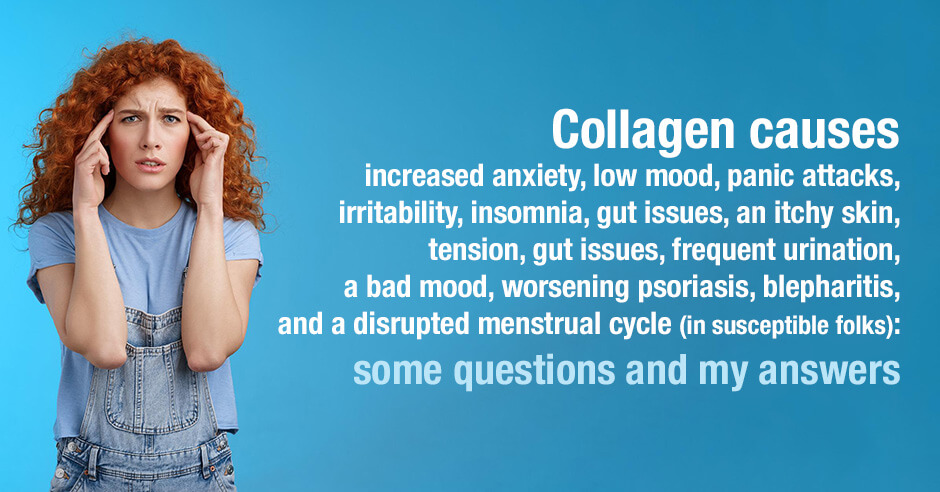
Collagen causes increased anxiety, low mood, irritability, insomnia, gut issues and an itchy skin: some questions and my answers

September 2, 2022 By Trudy Scott 37 Comments

collagen anxiety

Today we have some feedback from folks on some of the negative impacts they experienced when consuming collagen. I’m sharing their questions and the feedback I gave them in the hope this will help you too. Not everyone experiences unpleasant symptoms when consuming collagen but those who are susceptible may experience the following: increased anxiety or new anxiety, feeling low, inability to sleep or worsening sleep, tension, irritability, gut issues, itchy skin, frequent urination, a bad mood, worsening psoriasis, blepharitis, panic attacks and a disrupted menstrual cycle.

The causes of these symptoms can be due to the serotonin-lowering effects of collagen, the dietary oxalate impact, a histamine reaction and/or a glutamate reaction to collagen.

Beth shares how she feels low and anxious after using marine collagen for five days:

Have just recently begun receiving your emails. I read the above article and wanted to let you know of my experience. I started taking Vital Proteins marine collagen to see if it would improve sun damage to my skin. I took one scoop for about five days. On the fifth day I felt very low. So low that it made me somewhat anxious. As I have trouble with anxiety I stopped it immediately. Felt better the next day. The container lists 19 amino acids including tryptophan but the amount of it is zero mg. I hadn’t noticed that when I started taking it. After reading your article I’m fairly sure that that is why I felt depressed.

I shared this: for individuals who have observed a mood dip or increase in anxiety since using collagen or gelatin, I suggest they stop using collagen/gelatin and see how they feel, then add it back and see how they feel (sometimes more than once if they are not certain).

If they do see a correlation, look at the low serotonin symptoms and do a trial of tryptophan or 5-HTP (after checking the precautions) to see if this improves their low mood and reduces their anxiety when using collagen/gelatin. This confirms if their symptoms are due to the serotonin-lowering effects and allows them to continue using it for the benefits it provides.

Be sure to read the above collagen/serotonin blog for some of the research on what makes some folks more susceptible to the serotonin-lowering effects: a current depression/anxiety or history of depression/anxiety (even a family history), prior use of antidepressants, OCD / obsessive compulsive disorder, MAOA and/or 5-HTTLPR (the serotonin transporter gene) polymorphisms, smokers or former smokers, and women polydrug ecstasy users. This is not a conclusive list.

It’s interesting that she mentions her product has tryptophan listed with zero mg. When I looked online I didn’t see it listed on the product at all. Maybe it’s a change they have made to the label.

I also  shared  that when you are new to the amino acids (and other anxiety nutrition solutions like real whole food, quality animal protein, fermented foods, organic produce, health fats, gluten/sugar/caffeine removal, blood sugar control, gut health, pyroluria etc) my book “The Antianxiety Food Solution” is a great place to start.

The above question and the following questions come from the popular blog, Collagen and gelatin lower serotonin: does this increase your anxiety and depression?

How long after stopping bone broth does it take for this anxious feeling to leave?

Diane asks about bone broth and collagen and how it causes extreme anxiety and sleep problems:

I just finished your book and have to say how awesome it is ! A wealth of information. As I am struggling with many of the issues, I do have a question on bone broth and collagen. I have definitely noticed extreme anxiety and inability to sleep with bone broth and collagen supplement.(plus spring allergies are at play as well) I even tried a piece of Turkey with my bone broth this week to see if that helped. I have such gut issues I was really hoping to use bone broth. Anyway, my question is how long after stopping bone broth does it take for this anxious feeling to leave? Days or weeks? I want it cleared out before I try adding tryptophan with the broth.

I thanked her for the great feedback on my book. It’s wonderful to have the foundational stuff in place and she’s getting that from my book.

I don’t have an answer on how long symptoms can last as it’s very individualized. Typically if the effects are caused by serotonin being lowered, using either tryptophan or 5-HTP can result in significantly less anxiety and better sleep in a few days, provided the optimal dose is used.

Keep in mind that spring allergies can often make things worse and more tryptophan or 5-HTP may be needed during the allergy period. The dose would then need to be reduced once allergy season has passed. I blog about spring allergies and increased anxiety here.

My advice would be to use the tryptophan or 5-HTP to resolve the anxiety and insomnia and then once resolved, consider adding back the collagen and monitoring how she is doing. At this time she may need to bump up her tryptophan or 5-HTP yet again.

Is it a histamine reaction rather than low serotonin? (or an oxalate or glutamate reaction?)

Kelly believes her symptoms may be a histamine reaction and not caused by low serotonin:

If you become anxious, tense, irritable, can’t sleep AND have some issues with itchy skin, frequent urination, worsened gut issues, etc., then it’s a histamine problem from the collagen/glycine, and not serotonin at all.

I shared that these symptoms could actually be both since low serotonin can also cause anxiety, tension, irritability and insomnia. But I agree the itchy skin, frequent urination, worsened gut issues are a big clue it’s a histamine issue too or perhaps only a histamine issue.  Gut issues would happen with both low serotonin and histamine.

I’d start with a trial of tryptophan or 5-HTP because if it is low serotonin you will know very quickly. You can see what symptoms resolve and by how much.

Challenges with dietary oxalates could cause all the symptoms she experiences. So it’s a matter of figuring it out for each person. If you already know you have histamine or oxalate issues it’s also relatively easy to figure out by simply stopping the collagen and/or adding the counter-measures you typically use – like quercetin for histamine reactions and calcium citrate for oxalate issues.

It’s possible that some of these symptoms are a glutamate reaction too – like anxiety, tension, irritability and insomnia – and the amino acid GABA may help in this instance.

A bad mood, insomnia, psoriasis, blepharitis, panic attacks, hormone imbalance – oxalates or serotonin-lowering effects?

Em shares how she had a really bad mood, full blown insomnia, worsening psoriasis, blepharitis, panic attacks and disrupted menstrual cycle:

I am soooo glad I found this article. I started taking Oslo Skin Labs collagen (Verisol, so it is considered good quality) half way through December 2021. Looking back, that is when the problems started. I started sleeping restlessly and it got really bad in January. Full blown insomnia. My psoriasis got much worse, the blepharitis too. I have severe Endometriosis and was worried that if these other inflammation issues (psoriasis causes skin inflammation and blepharitis causes eye inflammation) were worse then maybe my endo was worse also since that can’t be checked on the outside.

Besides the inflammation symptoms I was experiencing extremely bad moods, feeling tense to the point of bordering on panic attacks and also a disrupted menstrual cycle.

I have been on Amitriptyline for 1,5 years and it worked wonders on my mood and sleep and I just couldn’t figure out why it wasn’t working any more. Then I realized that the only thing I changed was adding collagen to my diet in my fruit/vegetable smoothie ( I don’t drink coffee). So I started Googeling and found your article and stopped the collagen immediately. Have stopped for 2 days now and already my eyes are less red and inflamed. Pfew! It’s crazy and also scary how serious the side effects of collagen have been.

Do you think that besides the tryptophan lowering side effect that also the histamine might have played a part in my case? I don’t dare try the collagen with tryptophan supplement as the potential side effects are too serious to play around with. But I’m very bummed out about missing out on the skin and hair benefits.

Would love to hear your thoughts. I follow a vegetarian diet by the way and eat super healthy.

With Em I’d suspect an oxalate issue first because of the worsening psoriasis, blepharitis and endometriosis. She is also a vegetarian and this diet is often high in dietary oxalates. I write about oxalates and pain here.

However, with the “bad moods, feeling tense to the point of bordering on panic attacks and also a disrupted menstrual cycle”, I’d also suspect a serotonin-lowering impact. As mentioned above, a history of mood issues and antidepressant use can be a predisposing factor.  She would need to work with her prescribing doctor if she wanted to use tryptophan or 5-HTP because Amitriptyline has the potential to cause serotonin syndrome.

It’s also possible that her symptoms are caused in part by a histamine or glutamate reaction too.

With appreciation for helping to create awareness about these issues with collagen

I have much appreciation for each of these women for asking these questions and sharing their symptoms so we can all learn. There is not much awareness about collagen being problematic for some susceptible folks and it’s a very rude awakening when you start using something for the health benefits and have a bad reaction.  Hopefully their stories and others like this will help create more awareness.

The good news is that once you identify your cause/s and address them as above, you can often continue to consume collagen.

Resources if you are new to using tryptophan/5-HTP and other amino acids as supplements

If you are new to using any of the amino acids as supplements, here is the Amino Acids Mood Questionnaire from The Antianxiety Food Solution (you can see all the symptoms of neurotransmitter imbalances, including low serotonin and low GABA).

If you suspect low levels of any of the neurotransmitters and do not yet have my book, The Antianxiety Food Solution – How the Foods You Eat Can Help You Calm Your Anxious Mind, Improve Your Mood, and End Cravings, I highly recommend getting it and reading it before jumping in and using amino acids on your own so you are knowledgeable. And be sure to share it with the practitioner/health team you or your loved one is working with.

There is an entire chapter on the amino acids and they are discussed throughout the book in the sections on gut health, gluten, blood sugar control, sugar cravings, self-medicating with alcohol and more.

The book doesn’t include product names (per the publisher’s request) so this blog, The Antianxiety Food Solution Amino Acid and Pyroluria Supplements, lists the amino acids that I use with my individual clients and those in my group programs. You can find them all in my online store.

If, after reading this blog and my book, you don’t feel comfortable figuring things out on your own (i.e. doing the symptoms questionnaire and respective amino acids trials), a good place to get help is the GABA QuickStart Program (if you have low GABA symptoms). This is a paid online/virtual group program where you get my guidance and community support.

If you are a practitioner, join us in The Balancing Neurotransmitters: the Fundamentals program. This is also a paid online/virtual program with an opportunity to interact with me and other practitioners who are also using the amino acids.

Have you experienced any adverse symptoms when using collagen? Please share the symptoms so we can all learn from each other .

And were you able to figure out if it was due to low serotonin, a histamine or glutamate reaction or because of dietary oxalates?

If it was low serotonin, has tryptophan or 5-HTP helped so you can continue to use collagen?

If you have questions please share them here too.
Filed Under: 5-HTP, Anxiety, Collagen, GABA, Insomnia, Tryptophan Tagged With: a bad mood, an itchy skin, anxiety, Balancing Neurotransmitters: the Fundamentals program for practitioners, blepharitis, collagen, dietary oxalate, disrupted menstrual cycle, frequent urination, GABA Quickstart program, glutamate reaction, gut issues, histamine reaction, insomnia, irritability, low mood, panic attacks, serotonin-lowering effects, tension, worsening psoriasis

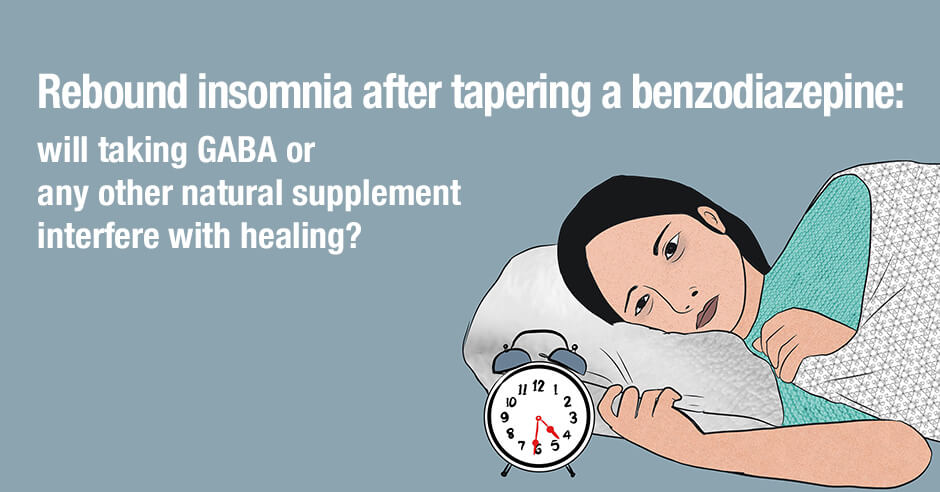
Rebound insomnia after tapering a benzodiazepine: will taking GABA or any other natural supplement interfere with healing?

August 26, 2022 By Trudy Scott 16 Comments

rebound insomnia after tapering

This question was posted on one of the GABA blog posts by Fran, asking about about using GABA for insomnia shortly after having tapered a benzodiazepine she had used for 15 years:

I am a senior who took benzodiazepines (clonazepam) on advice of my doctor for sleep because of chronic fatigue for 15 years. Last year I weaned myself off the medication and it has been just over 10 months. No one tells you that when you stop taking them you go into a rebound insomnia phase and it can last a long time. The doctor still won’t admit that!

I joined benzo buddies, a group I found out about on your site and found much encouragement from the posts of many brave and determined people. One post mentioned that the drug actually overrides your GABA receptors so when you stop taking it they have to heal to become active again. My question is: Will taking GABA or any other natural supplement interfere with that healing. The writer of the post feels taking nothing is best for the brain to return to normal and that only time will do that.

I said I was sorry to hear about her struggles with her benzodiazepine prescription. Sadly it’s all too common and it’s seldom that folks are cautioned about the rebound insomnia and other issues seen with benzodiazepines.

I love benzo buddies and other benzo support groups and often recommend that clients join one of these groups for the community support aspect. I am really happy that Fran found encouragement.

However, I  respectfully disagree with their message that GABA supplements or other supplements should not be used and that you should just wait for time to heal. We want to use everything at our disposal in order to heal as quickly as possible. And quality sleep is imperative for healing.

Also many of the most severely affected folks are part of these support groups, so it may well be all that they know, hence the advice they dispense.

Many do get relief with GABA during and post benzo taper and it won’t affect long-term healing (with a very low dose)

It is true that GABA receptors can be affected by benzodiazepines but despite this, many of my clients and others in my community do get relief from GABA during this period. Since we are all unique, some folks may have an issue, so we always do a trial with GABA if someone has rebound insomnia (and other low GABA symptoms of physical tension/anxiety, stiff and tense muscles, stress eating etc).

When someone can’t tolerate GABA they will know very quickly – typically in 1-2 days. If you can’t tolerate GABA it may feel the same as someone who takes GABA and doesn’t need it (i.e. GABA isn’t low) or when someone takes too much. This could make you feel light-headed, dizzy, feel a flush and/or feel too tired. You may even feel more anxious. Vitamin C is a wonderful antidote to all this and these short-term adverse reactions won’t interfere with long-term healing.

We also start with a very small dose – I typically have someone start with 25mg GABA and go up from there – and only use sublingual GABA. For some very sensitive folks we will start even lower as in this example where Syd gets sleep and body anxiety benefits with just 1.5 mg to 3 mg GABA.

Other nutrients that may also help with insomnia

We may also use other nutrients to help with sleep support and rebound anxiety (which is also common) and other symptoms, all based on each person’s unique needs. These may include tryptophan or 5-HTP if serotonin is also low (this can affect sleep and cause worry/ruminating type anxiety), melatonin if that is low (either sublingual or timed-release) and Seriphos if cortisol is high too. We may also combine GABA with theanine (research shows the combination may help some folks).

A full functional medicine and nutritional workup is recommended in order to be as nutritionally stable as possible. Ideally this happens before tapering starts but even if it’s done after the fact it can help with healing and symptom relief. Addressing histamine imbalances is one factor to consider as this can impact sleep (more on that below).

This is an important question that many folks ask so I appreciate her asking so I could share it as a blog post for others in a similar situation.

I am waiting to hear back about what happened when she did use GABA and how much she used. She mentioned that she did take GABA for a time at first but it only worked for a while. I find that during the taper and post taper, GABA needs can fluctuate as healing starts to take place. I have clients adjust up and down as needed.

More on benzodiazepine withdrawal and histamine issues

These medications have the most debilitating withdrawal reactions in all of medicine and Valium blocks DAO/impacts histamine levels:

  • World Benzodiazepine Awareness Day 2017: Awareness and Anxiety Nutrition Solutions

Benzodiazepines (Xanax, Klonopin, Ativan, Valium, Librium, and others) as well as Z-drugs (Ambien, Lunesta and others), which are similar, have the most debilitating withdrawal reactions in all of medicine.

This happens in regular, everyday people who are taking the medications exactly as their doctor prescribed. It also happens to people on what they think are “low doses” and is not just a “high dose” problem.

  • The benzodiazepine valium blocks DAO and impacts histamine levels: wisdom from Yasmina Ykelenstam and a tribute to her brilliance

Many people doing a benzodiazepine taper are often switched to Valium which is a DAO [diamine oxidase blocker (or histamine liberator)] and this further prevents histamine from being removed from the body [and can lead to increased anxiety].

Dyes are also triggers…the pink Xanax can be problematic.

GABA is as effective as benzodiazepines (which should only be prescribed for short-term use)

Many folks who have used benzos in the past, find GABA to be as effective. Another woman in my community, Dee, shared that she had taken Xanax in the past for panic attacks and her functional medicine doctor suggested GABA Calm as she wanted a natural product. This is her encouraging feedback: “I was amazed how it works just like the Xanax did – instant calm feeling within 10 mins of taking 2 capsules. I use them as needed when I am having heightened stress and anxiety.”

Ideally we want to use GABA instead of one of the benzodiazepines – which are all too commonly prescribed for anxiety, insomnia and pain – in order to avoid tolerance issues, dependence and withdrawal/tapering issues. The fact that they are used long term – like 15 years for Fran – further compounds the issues. Even a few months can be problematic for some folks. It’s important to be aware that this class of medication is intended for short-term use  i.e. 2-4 weeks only.

Resources if you are new to using the GABA and other amino acids as supplements

If you are new to using GABA and any of other the amino acids as supplements, here is the Amino Acids Mood Questionnaire from The Antianxiety Food Solution (you can see all the symptoms of neurotransmitter imbalances, including low GABA).

If you suspect low levels of any of the neurotransmitters and do not yet have my book, The Antianxiety Food Solution – How the Foods You Eat Can Help You Calm Your Anxious Mind, Improve Your Mood, and End Cravings, I highly recommend getting it and reading it before jumping in and using amino acids on your own so you are knowledgeable. And be sure to share it with the practitioner/health team you or your loved one is working with.

There is an entire chapter on the amino acids and they are discussed throughout the book in the sections on gut health, gluten, blood sugar control, sugar cravings, self-medicating with alcohol and more.

The book doesn’t include product names (per the publisher’s request) so this blog, The Antianxiety Food Solution Amino Acid and Pyroluria Supplements, lists the amino acids that I use with my individual clients and those in my group programs. You can find them all in my online store.

If, after reading this blog and my book, you don’t feel comfortable figuring things out on your own (i.e. doing the symptoms questionnaire and respective amino acids trials), a good place to get help is the GABA QuickStart Program (if you have low GABA symptoms). This is a paid online/virtual group program where you get my guidance and community support.

If you are a practitioner, join us in The Balancing Neurotransmitters: the Fundamentals program. This is also a paid online/virtual program with an opportunity to interact with me and other practitioners who are also using the amino acids.

Have you used GABA with success while tapering a benzodiazepine or shortly after tapering is complete?

Have you used other nutrients to help while tapering or post taper? If yes, which ones?

Did you find that GABA was not helpful? (which product and how much did you use?)

If you have questions please share them here too.

Filed Under: Anxiety, benzodiazapines, GABA, Insomnia Tagged With: 5-HTP, amino acids, Balancing Neurotransmitters: the Fundamentals program for practitioners, benzo buddies, benzodiazepine, clonazepam, DAO enzyme, GABA, GABA Quickstart program, GABA receptors, healing, histamine, insomnia, medication, melatonin, natural supplement, Rebound insomnia, seriphos, sleep, tapering, theanine, tryptophan, Xanax

  • Page 1
  • Page 2
  • Page 3
  • Go to Next Page »

Primary Sidebar

NEW! GABA QuickStart Homestudy (with special intro pricing)

gaba quickstart homestudy

Free Report

9 Great Questions Women Ask about Food, Mood and their Health

You'll also receive a complimentary subscription to my ezine "Food, Mood and Gal Stuff"


Connect with me

Popular Posts

  • Amino Acids Mood Questionnaire from The Antianxiety Food Solution
  • The Antianxiety Food Solution Amino Acid and Pyroluria Supplements
  • Pyroluria Questionnaire from The Antianxiety Food Solution
  • Collagen and gelatin lower serotonin: does this increase your anxiety and depression?
  • Tryptophan for the worry-in-your-head and ruminating type of anxiety
  • GABA for the physical-tension and stiff-and-tense-muscles type of anxiety
  • The Antianxiety Food Solution by Trudy Scott
  • Seriphos Original Formula is back: the best product for anxiety and insomnia caused by high cortisol
  • Am I an anxious introvert because of low zinc and vitamin B6? My response to Huffington Post blog
  • Vagus nerve rehab with GABA, breathing, humming, gargling and key nutrients

Recent Posts

  • What do I use instead of Seriphos to help lower high cortisol that is affecting my sleep and making me anxious at night?
  • BeSerene™ GABA/theanine cream eases severe muscle tension in her neck/shoulders, prevents her bad headaches and quells her anxiety
  • How the correct approach, dose and sublingual use of GABA can be calming and not cause a flushed and itchy face and neck
  • The amino acid glutamine improves low mood by addressing gut health, and it has calming effects too
  • Flight anxiety with heightened breath, physical tension and also fearing the worst (the role of low GABA and low serotonin)

Categories

  • 5-HTP
  • AB575
  • Addiction
  • ADHD
  • Adrenals
  • Alcohol
  • Allergies
  • Alzheimer's disease
  • Amino Acids
  • Anger
  • Antianxiety
  • Antianxiety Food Solution
  • Antidepressants
  • Anxiety
  • Anxiety and panic
  • Autism
  • Autoimmunity
  • benzodiazapines
  • Bipolar disorder
  • Books
  • Caffeine
  • Cancer
  • Candida
  • Children/Teens
  • Collagen
  • Cooking equipment
  • Coronavirus/COVID-19
  • Cravings
  • Depression
  • Detoxification
  • Diabetes
  • Diet
  • DPA/DLPA
  • Drugs
  • EFT/Tapping
  • EMF
  • EMFs
  • Emotional Eating
  • Endorphins
  • Environment
  • Essential oils
  • Events
  • Exercise
  • Fear
  • Fear of public speaking
  • Fertility and Pregnancy
  • Fish
  • Food
  • Food and mood
  • Functional neurology
  • GABA
  • Gene polymorphisms
  • General Health
  • Giving
  • Giving back
  • Glutamine
  • Gluten
  • GMOs
  • Gratitude
  • Gut health
  • Heart health/hypertension
  • Histamine
  • Hormone
  • Hyperparathyroidism
  • Hypoglycemia
  • Immune system
  • Inflammation
  • Insomnia
  • Inspiration
  • Introversion
  • Joy and happiness
  • Ketogenic diet
  • Lithium orotate
  • Looking awesome
  • Lyme disease and co-infections
  • MCAS/histamine
  • Medication
  • Men's health
  • Mental health
  • Mercury
  • Migraine
  • Mold
  • Movie
  • MTHFR
  • Multiple sclerosis
  • Music
  • NANP
  • Nature
  • Nutritional Psychiatry
  • OCD
  • Osteoporosis
  • Oxalates
  • Oxytocin
  • Pain
  • Paleo
  • Parasites
  • Parkinson’s disease
  • PCOS
  • People
  • PMS
  • Postpartum
  • PTSD/Trauma
  • Pyroluria
  • Questionnaires
  • Real whole food
  • Recipes
  • Research
  • Schizophrenia
  • serotonin
  • SIBO
  • Sleep
  • Special diets
  • Sports nutrition
  • Stress
  • Sugar addiction
  • Sugar and mood
  • Supplements
  • Teens
  • Testimonials
  • Testing
  • The Anxiety Summit
  • The Anxiety Summit 2
  • The Anxiety Summit 3
  • The Anxiety Summit 4
  • The Anxiety Summit 5
  • The Anxiety Summit 6
  • Thyroid
  • Thyroid health
  • Toxins
  • Tryptophan
  • Tyrosine
  • Uncategorized
  • Vegan/vegetarian
  • Women's health
  • Yoga

Archives

  • October 2025
  • September 2025
  • August 2025
  • July 2025
  • June 2025
  • May 2025
  • April 2025
  • March 2025
  • February 2025
  • January 2025
  • November 2024
  • October 2024
  • September 2024
  • August 2024
  • July 2024
  • June 2024
  • May 2024
  • April 2024
  • March 2024
  • February 2024
  • January 2024
  • December 2023
  • November 2023
  • October 2023
  • September 2023
  • August 2023
  • July 2023
  • June 2023
  • May 2023
  • April 2023
  • March 2023
  • February 2023
  • January 2023
  • December 2022
  • November 2022
  • October 2022
  • September 2022
  • August 2022
  • July 2022
  • June 2022
  • May 2022
  • April 2022
  • March 2022
  • February 2022
  • January 2022
  • December 2021
  • November 2021
  • October 2021
  • September 2021
  • August 2021
  • July 2021
  • June 2021
  • May 2021
  • April 2021
  • March 2021
  • February 2021
  • January 2021
  • December 2020
  • November 2020
  • October 2020
  • September 2020
  • August 2020
  • July 2020
  • June 2020
  • May 2020
  • April 2020
  • March 2020
  • February 2020
  • January 2020
  • December 2019
  • November 2019
  • October 2019
  • September 2019
  • August 2019
  • July 2019
  • June 2019
  • May 2019
  • April 2019
  • March 2019
  • February 2019
  • January 2019
  • December 2018
  • November 2018
  • October 2018
  • September 2018
  • August 2018
  • July 2018
  • June 2018
  • May 2018
  • April 2018
  • March 2018
  • February 2018
  • January 2018
  • December 2017
  • November 2017
  • October 2017
  • September 2017
  • August 2017
  • July 2017
  • June 2017
  • May 2017
  • April 2017
  • March 2017
  • February 2017
  • January 2017
  • December 2016
  • November 2016
  • October 2016
  • September 2016
  • August 2016
  • July 2016
  • June 2016
  • May 2016
  • April 2016
  • March 2016
  • February 2016
  • January 2016
  • December 2015
  • November 2015
  • October 2015
  • September 2015
  • August 2015
  • July 2015
  • June 2015
  • May 2015
  • April 2015
  • March 2015
  • February 2015
  • January 2015
  • December 2014
  • November 2014
  • October 2014
  • September 2014
  • August 2014
  • July 2014
  • June 2014
  • May 2014
  • April 2014
  • March 2014
  • February 2014
  • January 2014
  • December 2013
  • November 2013
  • October 2013
  • September 2013
  • August 2013
  • July 2013
  • June 2013
  • May 2013
  • April 2013
  • March 2013
  • February 2013
  • January 2013
  • December 2012
  • November 2012
  • October 2012
  • August 2012
  • July 2012
  • June 2012
  • May 2012
  • April 2012
  • March 2012
  • February 2012
  • January 2012
  • December 2011
  • November 2011
  • October 2011
  • September 2011
  • August 2011
  • July 2011
  • June 2011
  • May 2011
  • April 2011
  • March 2011
  • February 2011
  • January 2011
  • December 2010
  • October 2010
  • September 2010
  • July 2010
  • May 2010
  • April 2010
  • March 2010
  • February 2010
  • January 2010
  • November 2009

Share the knowledge!

The above statements have not been evaluated by the Food and Drug Administration. Products listed in this website are not intended to diagnose, treat, cure or prevent any disease.

The information provided on this site is for informational and educational purposes only and is not intended as a substitute for advice from your physician or other health care professional. You should consult with a healthcare professional before starting or modifying any diet, exercise, or supplementation program, before taking or stopping any medication, or if you have or suspect you may have a health problem.


Copyright © 2026 Trudy Scott. All Rights Reserved. | Privacy | Terms and Conditions | Refund Policy | Medical Disclaimer

Free Report

9 Great Questions Women Ask about Food, Mood and their Health

You’ll also receive a complimentary subscription to my ezine “Food, Mood and Gal Stuff”