• Skip to primary navigation
  • Skip to main content
  • Skip to primary sidebar

everywomanover29 blog

Food, Mood and Women's Health – Be your healthiest, look and feel great!

  • Blog
  • About
  • Services
  • Store
  • Resources
  • Testimonials
  • The Book
  • Contact
  • Search this site

anxiety summit

The Anxiety Summit – Gluten and anxiety: the testing conundrum solution

June 8, 2016 By Trudy Scott 26 Comments

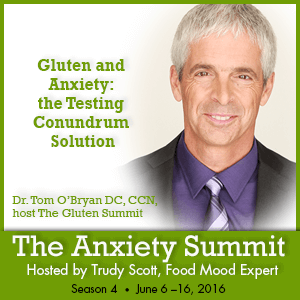
Tom O’Bryan_Anxiety4

Dr. Tom O’Bryan DC, CCN, DACBN was interviewed on the Anxiety Summit by host of the Anxiety Summit, Trudy Scott, Food Mood Expert and Nutritionist, author of The Antianxiety Food Solution.

Gluten and anxiety: the testing conundrum solution

  • How gluten damages the gut lining and why gut healing is key for brain health
  • Alpha-gliadin and the limitations with current testing
  • Cyrex array 3: 10 peptides and 3 types of transglutaminase
  • Transglutaminase-6 and the brain on fire
  • Cyrex array 5: cerebellum, myelin and other brain antibodies
  • Cross-reactive foods: spinach, milk, coffee, chocolate
  • Autism: testing kids and their moms

In season 2, Dr. O’Bryan presented on this topic: Gluten’s impact on the inflamed brain: reducing anxiety and depression

  • “No human on the planet can digest gluten”
  • Terminology and why it’s not called gluten intolerance but sensitivity
  • Is gluten sensitivity just a fad and the recent FODMAPs research
  • The multitude of diseases and symptoms caused by gluten sensitivity
  • Gluten sensitivity as a contributing factor to psychiatric manifestations/anxiety/depression and new 2014 research from Italy
  • Suicide rates in kids with celiac disease (even when they quit gluten
  • We touched on the conundrum with testing

This interview goes deeper into testing and offers a solution to the conundrum. 

Here are some gems from our interview:

The most common peptide from poorly digested wheat is 33 pearls long.  It’s called alpha-gliadin, 33 pearls.  It’s a big peptide.  And 50 percent of people with celiac disease have alpha-gliadin elevated but the others don’t.  But wait a minute.  We know that celiac disease is a sensitivity to wheat.  How come these other people don’t have elevated antibodies to the 33 pearl peptide?  It’s because the immune system is fighting other peptides of wheat, not the 33.  It might be the 17.  It might be the 9. It might be the 11.  It might be the 22.  There are over 60 different peptides of wheat that have been identified to cause or trigger an immune response, over 60.  And every lab in the country is only testing one called alpha-gliadin, the 33 pearl.  Now that’s an important one to test but it’s not the only one to test.

So what happens when people have one of those peptides that the immune system is fighting that’s not the 33 and you do a blood test for gluten sensitivity.  If your doctor orders the common blood test for gluten sensitivity and it looks for alpha-gliadin and it comes back negative and your doctors says you’re fine eating wheat.  See, here’s the blood test.  Well you can get a false negative meaning it says there’s no problem when there really is because your body’s fighting other peptides of wheat.

Here are the arrays that Cyrex offers.  We covered parts of arrays 3, 4 and 5.

Gluten Summit gifts – register here and get these audio interviews:

  • Natasha Campbell-McBride: The Critical Nature of Gut Health and its Impact on Children’s Brains 
  • David Perlmutter: Eliminating Gluten as the 1st Step in Preventing Brain Conditions.   

Here is the link to the Certified Gluten-free Practitioner training  we discussed

If you are not already registered for the Anxiety Summit you can get live access to the speakers of the day here: www.theAnxietySummit.com

Missed this interview or can’t listen live? Or want this and the other great interviews for your learning library? Purchase the MP3s or MP3s + transcripts and listen when it suits you.

You can find your purchasing options here.: Anxiety Summit Season 1, Anxiety Summit Season 2, Anxiety Summit Season 3, and Anxiety Summit Season 4.
Filed Under: Events, The Anxiety Summit 4 Tagged With: anxiety, anxiety summit, gluten, testing, tom o’bryan, Trudy Scott

The Anxiety Summit – Nutrients that Fuel Brain Power and Reduce Anxiety

June 8, 2016 By Trudy Scott 35 Comments

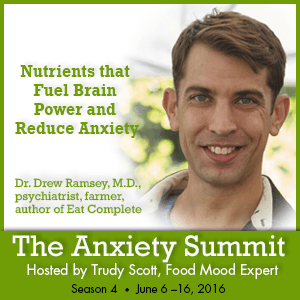
Drew Ramsey_Anxiety4

Dr. Drew Ramsey, M.D., psychiatrist, farmer, author of Eat Complete, was interviewed on the Anxiety Summit by host of the Anxiety Summit, Trudy Scott, Food Mood Expert and Nutritionist, author of The Antianxiety Food Solution.

Nutrients that Fuel Brain Power and Reduce Anxiety

  • The nutritional psychiatry movement and food as medicine
  • The impact of food on brain health, neurogenesis and BDNF
  • The hippocampus and your diet
  • The 21 nutrients that are key for brain health
  • The impacts of low zinc, low B12 and low choline diets
  • How to get these nutrients in your diet

Here are some gems from our interview:

One, oftentimes mental health symptoms stem from dietary insufficiencies.  So people can feel more down, more anxious, more cloudy in their thinking based on the types of food that they’re eating.  And then secondly the strongest data is in terms of prevention.  So if you do have a disorder – if you have an anxiety disorder or you do really struggle in a way with your mood there’s some data that both the development of depression and the recurrence of depression – it’s very highly correlated with your dietary pattern.  And so nutritional psychiatry in summary is looking at mental health through the lens of food and then adding nutrition as a tool to our toolbox as clinicians.  I suspect most folks who are listening, maybe you’ve seen a mental health clinician.  If you think back to that initial intake was there really detailed dietary history that understood you as an eater?  And usually the answer is no.  And even in my own practice until a number of years ago that was no.  And I’ve trained at some of the best places when it comes to mental health.

No fault of those organizations but it feels to me that this has been a tremendous blind spot for us both in medicine and in mental health.  So I’m very excited to see this growing movement.  We have the new International Society of Nutrition and Psychiatry Research. There’s been tremendous interest from the American Psychiatry Association in terms of how do we get this into our treatment standards.  So it’s a very exciting moment I think in mental health.  And I also personally like it because it allows me to talk about some other subjects besides psychotherapy or medications with my patients.  And so it’s a lot of fun to be talking about kale salads and do you know how to make ceviche and have you ever made mussels at home.

I love that Dr. Ramsey says: “I eat for a bigger hippocampus.” The hippocampus is an area of your brain involved in emotional regulation and learning. We talked about this in the context of the research published by Dr. Felice Jacka and her team: Western diet is associated with a smaller left hippocampus and anxiety

Dr. Ramsey talks about zinc and animal protein:

Zinc is a mineral and minerals tend to be more absorbable in animal forms.  I think a lot of people are very confused about meat and seafood and often intimidated and scared.  And then we’ve had this message to go plant based and even vegan which is not a diet that is healthy for the brain.

And low choline and anxiety:

And if you look especially in terms of anxiety really there’s not a lot of data, not a lot of scientific data about anxiety disorders and food.  There’s some but the clearest data signal comes from the Hordaland study that looked at correlations of anxiety disorders and different nutrients and found people with lower choline had much higher rates of anxiety. 

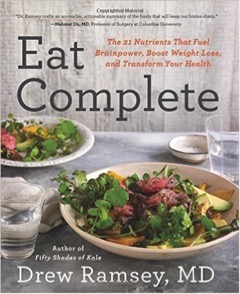
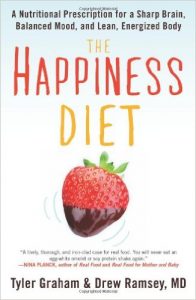
Dr. Ramsey has written some wonderful books.  Here are two of them:

Eat Complete: The 21 Nutrients That Fuel Brainpower, Boost Weight Loss, and Transform Your Health

eat-complete

The Happiness Diet: A Nutritional Prescription for a Sharp Brain, Balanced Mood, and Lean, Energized Body

happiness diet

Here is Dr. Ramsey’s 7-Day Brain Boost

If you are not already registered for the Anxiety Summit you can get live access to the speakers of the day here: www.theAnxietySummit.com

Missed this interview or can’t listen live? Or want this and the other great interviews for your learning library? Purchase the MP3s or MP3s + transcripts and listen when it suits you.

You can find your purchasing options here.: Anxiety Summit Season 1, Anxiety Summit Season 2, Anxiety Summit Season 3, and Anxiety Summit Season 4.
Filed Under: Events, The Anxiety Summit 4 Tagged With: anxiety, anxiety summit, brain, drew ramsey, Trudy Scott

The Anxiety Summit – Anxiety and the Importance of Community

June 7, 2016 By Trudy Scott 24 Comments

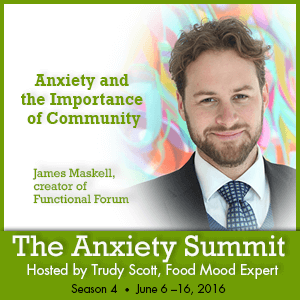
James Maskell_Anxiety4

James Maskell, creator of Functional Forum,  was interviewed on the Anxiety Summit by host of the Anxiety Summit, Trudy Scott, Food Mood Expert and Nutritionist, author of The Antianxiety Food Solution.

Anxiety and the Importance of Community

  • The definition of community and examples
  • The Functional Forum and a medication talk by Dr. Hyla Cass
  • The effect of social support on HPA axis function during pregnancy.
  • Social support for parents of autistic children
  • An interview with Kelly Brogan: the role of community in mental health
  • Community and social anxiety/introversion

Here are some gems from our interview:

…the solution to chronic disease is integrative or functional medicine because it’s preventive, it’s proactive, it’s participatory on behalf of the patient.  And so our goal and our vision is big Trudy.  The first thing has been to increase the supply of these functional medicine doctors because you need them and they can’t be replaced by technology.  The human element is a really big part.  But the first step is to get enough of those doctors and then the next step is to galvanize those practitioners into a really efficient system that takes the best use of technology.  It takes the best use of human interaction and uses practitioners in the most efficient way to be able to keep and get people well as effectively as possible.

What we need is people to work together.  We need collaboration, not competition.  We need people to really see the gifts of everyone.  And really we need it to be a meritocracy [definition: a social system in which people’s success in life depends primarily on their talents, abilities, and effort]. 

Here is the big take-away from James – when it comes to community:

…the real results that we see that are most powerful Trudy is where people have been able to pair getting together into a community with other healthy behaviors.  So getting a group of people together to go on a run or to go on a walk together.  You get the power of the community plus you get the power of everyone getting the exercise together

Just going back to your idea of supporting each other, doing something together with a common goal.  Going back to the Benzo Buddies story.  Imagine if that group had local groups getting together.  So they’ve got this online forum supporting each other but if they got together and cooked a meal together and also meditated together and then supported each other getting off the benzodiazepine.  So that would be what you’re talking about the getting together and also supporting each other online.

Here are some of the studies we discussed in the interview:

The aim of this study, Effect of social support on HPA axis function during pregnancy,  was to assess whether individual differences in social support alter psychological distress and cortisol during pregnancy. There were 82 pregnant women in the study. Psychological distress and cortisol were assessed in all three trimesters. It was found that:

Pregnant women receiving inadequate social support secrete higher levels of cortisol in response to psychological distress as compared with women receiving effective social support. Social support during pregnancy may be beneficial because it decreases biological sensitivity to psychological distress, potentially shielding the fetus from the harmful effects of stress-related increases in cortisol.

New research also shows that for parents of autistic children, more social support means better health, protection against stress-induced immune problems and reduced inflammation

Dr. Hyla Cass, MD, integrative psychiatrist shares how to safely get of SSRIs and antianxiety medications and how to maintain good mental health once you are off them. She is addressing physicians but the information is valuable for anyone.  This was filmed at the Functional Neuropsychiatry meeting of the Functional Forum in January 2016.

Dr Kelly Brogan, integrative psychiatrist, another past speaker on the Anxiety Summit and author of the brilliant new book “A Mind of Your Own” discusses the role community can play in mental health.

I tied community and social anxiety/introversion together with the discussion about pyroluria.

Here is the link to the next Functional Forum , a wonderful resource for integrative practitioners in the world of functional medicine (doctors, therapists, nutritionists etc).

If you are not already registered for the Anxiety Summit you can get live access to the speakers of the day here: www.theAnxietySummit.com

Missed this interview or can’t listen live? Or want this and the other great interviews for your learning library? Purchase the MP3s or MP3s + transcripts and listen when it suits you.

You can find your purchasing options here.: Anxiety Summit Season 1, Anxiety Summit Season 2, Anxiety Summit Season 3, and Anxiety Summit Season 4.
Filed Under: Events, The Anxiety Summit 4 Tagged With: anxiety, anxiety summit, community, james maskell, Trudy Scott

The Anxiety Summit – Opening: benzos, electroshock, blueberries, sauerkraut and the vagus nerve

June 7, 2016 By Trudy Scott 56 Comments

Trudy Scott_opening_Anxiety4 other

The host of the Anxiety Summit, Trudy Scott, Food Mood Expert and Nutritionist, author of The Antianxiety Food Solution opens up the Anxiety Summit Season 4.

Anxiety Summit opening: benzos, electroshock, blueberries, sauerkraut and the vagus nerve

  • My vagus nerve story and how GABA helped
  • Why we need an integrative approach: Electroshock, LSD, BPA, zinc deficiencies, medication side-effects
  • An update on benzodiazepines and what we can learn from the Swiss and Blue Zones
  • Anxiety: new research on blueberries, gluten, sauerkraut, low vitamin B6 and iron, foods rich in polyphenols
  • An overview of the speakers and topics on this summit

My vagus nerve story – the videos document the journey with GABA and vagus nerve exercises 3-6-6 breathing and happy birthday humming.

This article published just last month is just so distressing to even contemplate: American Psychiatric Association Lobbies FDA to Electroshock Children

While the APA looks to seizure-inducing, brain-disabling, electricity as a form of ‘treatment,’ lobbying the FDA to make ECT available for children, no one in medicine, let alone psychiatry, has a clue how ECT machines ‘work’ or how passing large amounts of electricity into a child’s brain ‘treats’ the subjective mental disorder.  

Also published last month is an article in the New York Times called: LSD Like Drugs Are Out of the Haze and Back in the Labs.

modern scientists are picking up where their forerunners of the ’50s and ’60s left off. They are studying hallucinogens’ potential to help smokers kick the habit, to undo addictions to drugs and alcohol, to cope with cluster headaches and depression, and to deal with obsessive-compulsive and post-traumatic stress disorders.

Earlier this year a bill was put forward in Massachusetts proposing informed consent for benzodiazepine use. They will be submitting it again in a future session.

Here is the blog post and research on blueberries and serotonin: Blueberries boost serotonin and may help with PTSD and anxiety

Rats that were fed blueberries saw an increase in serotonin levels and the study authors suggest that the neuroprotection offered by the blueberries may offer support for those with PTSD. Presumably this could help those with anxiety and depression too, since low serotonin can also be an underlying factor.

Here is the blog post and research on gluten and OCD: Integrative Medicine Approach to Pediatric Obsessive-Compulsive Disorder and Anxiety 

The 7-year-old boy was put on a gluten-free diet and they saw a huge reduction in his OCD symptoms and anxiety and an improvement in social behavior and school work.

A paper published in August 2015: Fermented foods, neuroticism, and social anxiety suggests that:

consumption of fermented foods that contain probiotics may serve as a low-risk intervention for reducing social anxiety

Here are some of the other papers I mentioned:

  • Low serum concentrations of vitamin B6 and iron are related to panic attack and hyperventilation attack
  • Zinc-deficient ASD mice study: Gender Dependent Evaluation of Autism like Behavior in Mice Exposed to Prenatal Zinc Deficiency

  • Polyphenols / what foods can help fight the risk of chronic inflammation?
  • Bisphenol A exposure and children’s behavior:  A systematic review 

Here is the master blog with all the speakers, their topics and their individual blog posts with additional information, links to studies, books and other resources – The Anxiety Summit Season 4: All the speakers and topics (keep in mind that the speaker blog links will be live/active from the day of the speaker interview)

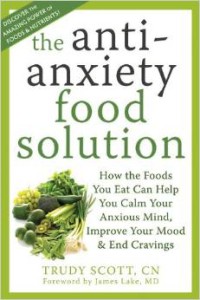
If you already have my book The Antianxiety Food Solution: How the Foods You Eat Can Help You Calm Your Anxious Mind, Improve Your Mood, and End Cravings, I recommend that you skim through it again and review the chapters on the food basics, gluten, amino acids, pyroluria and digestion.  If you don’t yet have a copy, I highly recommend getting a copy so you can be educated as well as empowered.

trudy scott the antianxiety food solution

Here is my gift to you, a song called Top of the World (grab the mp3 at this link)

A new beginning, a brand new day
All of my fears are gone away
I feel so calm, so free, so whole
Right now, I’m feeling on top of the world

On top the world
Right now, I’m feeling on top of the world


And here is another special gift: transcript of this entire talk!
Download the transcript here (right-click on the link and select “Save link as” or “Save target as” to download the file to your computer)

If you are not already registered for the Anxiety Summit you can get live access to the speakers of the day here: www.theAnxietySummit.com

Missed this interview or can’t listen live? Or want this and the other great interviews for your learning library? Purchase the MP3s or MP3s + transcripts and listen when it suits you.

You can find your purchasing options here.: Anxiety Summit Season 1, Anxiety Summit Season 2, Anxiety Summit Season 3, and Anxiety Summit Season 4.
Filed Under: Events, Food and mood, GABA, The Anxiety Summit 4 Tagged With: anxiety, anxiety summit, Trudy Scott, vagus nerve

The Anxiety Summit – Anxiety: the SCD diet, carbs, adrenals and leaky gut

June 7, 2016 By Trudy Scott 25 Comments

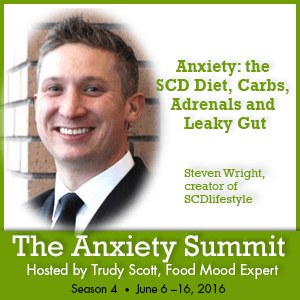
Steven Wright_Anxiety4

Steven Wright, creator of SCDlifestyle, was interviewed on the Anxiety Summit by host of the Anxiety Summit, Trudy Scott, Food Mood Expert and Nutritionist, author of The Antianxiety Food Solution.

Anxiety: the SCD diet, carbs, adrenals and leaky gut

  • The Specific Carbohydrate Diet /SCD: the history and the basics
  • The GAPs diet – the similarities and differences
  • Stressful times and panic attacks and recovering
  • Adrenal health and restricting carbs too much
  • Leaky gut and glutamine

Here are some gems from our interview (I really enjoy Steve’s common-sense advice, especially when you are feeling overwhelmed):

And so if you can adopt the mindset of hey, you know what, this is just an exploration of food.  I’m just going to throw out all my beliefs for six months and I’m going to try buying that weird fruit at the grocery store; I’m going to buy a new pan; I’m going to burn some things and just try to make it an exploration, like try to mess it up.  If you can do that, if you can get some sort of mindset shift there where it becomes a fun little game, what I would do is I would have a spice of the week and I would put that spice on everything.  I don’t care what they say in cookbooks or chef schools, I’ve never been to chef school actually.  I would like love to go maybe sometime.  But I would just take like oregano and I would put oregano on everything.  I’d put it on my vegetables; I’d put it on my fish; I’d put it on the beef; I’d put it on the chicken I cooked just to see what it tasted like.  Like somebody says you should never put rosemary on your whatever you’re cooking.  Well how do they know?  Why don’t you make up the choice for yourself?  

We cover leaky gut, autoimmunity and anxiety:

So your immune system is concentrated in your gut.  It’s remarkable to think of that, but the reason why is in case these different molecules of the wrong size or the wrong type get into your gut then they gum in and they just kind of like start to attack it and it creates a war.  And so if your gut is chronically leaky, like it is for essentially anyone with an autoimmune condition, because that’s per Dr. Fasano’s theory, that’s essentially the way in which you become autoimmune, you’re going to have a war raging in your bloodstream, in your body, in your gut for all day all night.  And so that consumes a lot of resources; it creates a lot of inflammatory cytokines; it also regulates some other pathways, which can be circulated, end up in the brain and end up causing anxiety and depression.  And so I do believe that there is a subset of people who have anxiety who have either leaky gut as one of their main causes or at least it’s contributing to it.  And so digestive health is really important for anxiety in my opinion.  

This article:  Diet and Inflammatory Bowel Disease, discusses the diets commonly recommended to IBD patients and reviews the supporting data for the low-fermentable oligosaccharide, disaccharide, monosaccharide, and polyol diet; the specific carbohydrate diet; the anti-inflammatory diet; and the Paleolithic diet.  The authors of this paper do say that the role of dietary interventions in the management of IBD still needs to be tested vigorously in patients.

Here is the SCD Quick Start Guide

And for health practitioners wanting to learn how to get their message out in a bigger way and help more people: The Practitioner Liberation Project

If you are not already registered for the Anxiety Summit you can get live access to the speakers of the day here: www.theAnxietySummit.com

Missed this interview or can’t listen live? Or want this and the other great interviews for your learning library? Purchase the MP3s or MP3s + transcripts and listen when it suits you.

You can find your purchasing options here.: Anxiety Summit Season 1, Anxiety Summit Season 2, Anxiety Summit Season 3, and Anxiety Summit Season 4.
Filed Under: Events, The Anxiety Summit 4 Tagged With: adrenals, anxiety, anxiety summit, carbs, leaky gut, scd, Steven Wright, Trudy Scott

The Anxiety Summit – Is Coffee Your Hidden Anxiety Trigger and How to Substitute It with Delicious and Healing Drinks

June 7, 2016 By Trudy Scott 25 Comments

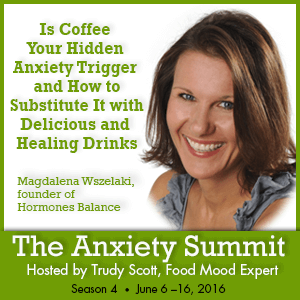
Magdalena Wszelaki_Anxiety4

Magdalena Wszelaki, founder of Hormones Balance, was interviewed on the Anxiety Summit by host of the Anxiety Summit, Trudy Scott, Food Mood Expert and Nutritionist, author of The Antianxiety Food Solution.

Is Coffee Your Hidden Anxiety Trigger and How to Substitute It with Delicious and Healing Drinks

  • Caffeine, anxiety and panic attacks and our genetics
  • How coffee impacts blood sugar and increases sugar cravings
  • Coffee: the gut, adrenals, sex hormones and the thyroid
  • Is decaf ok?
  • How to use chicory, dandelion, carob and reishi as great alternatives
  • Rooibos and tulsi/holy basil as anti-stress herbal teas

Here are some gems from our interview:

If you’re having type 2 adrenal fatigue so that means sometimes it’s s super high.  Your adrenals are pumping out too much cortisol.  Sometimes it’s too low, sometimes it’s just okay.  You can get that done through testing – hormone testing, saliva testing with cortisol.  The issue is that in times of low cortisol release you’re going to be pretty brain dead and this is when we want to bring the cortisol level up with coffee. 

The problem is the adrenals are already exhausted and that’s the reason why they are firing off with the wrong timing.  Sometimes it’s too high, sometimes it’s too low.  Women who have this “I’m tired and wired” thing going on late at night where they’re just lying in bed exhausted, can’t fall asleep.  That’s very often adrenal fatigue stage 2 with higher cortisol levels at night.  And so this is where coffee just exhausts your adrenals even further.  So you might get that instant release as in like you’re getting this clarity in your head.  You’re getting that energy to get through the day. But in the long term coffee is really going to just exhaust the adrenals to the maximum.

Here are some of the studies on anxiety and coffee discussed in the interview:

Caffeine can cause anxiety and panic attacks.  This study showed that people with panic disorder and social anxiety may be more sensitive to the anxiety-causing effects of caffeine.

In this paper, Caffeine abstention in the management of anxiety disorders, the participants had generalized anxiety disorder and panic disorder.  They had been on medication and they’d been on therapy and they drank one-and-a-half to three-and-a-half cups of coffee a day.  None of them had benefitted from either the therapy or the medication.  When they stopped the coffee within a week the anxiety disappeared. 

Here are additional studies we discussed:

  • Coffee and gastrointestinal function: facts and fiction. A review.
  • Caffeine as an intensifier of stress-induced hormonal and pathophysiologic changes in mice
  • Maternal caffeine consumption during pregnancy and the risk of miscarriage: a prospective cohort study
  • Caffeine and caffeinated beverage consumption and fecundability in a preconception cohort
  • Caffeine effects on sleep taken 0, 3, or 6 hours before going to bed.


magdalena roasted chicory latte

Here is Magdalena’s recipe for ROASTED CHICORY ROOT LATTE

Time to prepare: 15 minutes; Time to steep: 10minutes; Serves: 1; Equipment: blender

Ingredients

1 tbsp roasted chicory root

2 cups water

1 tbsp ghee, coconut butter or butter (if tolerated)

1 pitted date

fresh nutmeg (nut or powder)

How to make:

  1. Bring water to a boil, add chicory root and steep for 10 minutes.
  2. Strain and transfer to a blender.
  3. Add the ghee (or any fat you decide to use) and the date. Blend for 1 minute at high speed.
  4. Top with freshly grated nutmeg and enjoy.


I shared my carob recipe: Carob Cinnamon Delight instead of coffee – a calming hot beverage and mentioned rooibos tea how it’s A Functional Food in the Management of Stress (an interview from a prior anxiety summit)

Here is Magdalena’s gift: Finding Hormonal Balance Through Food and Essential Oils


hormone-balancing-workshop

And here is Magdalena’s wonderful no-cost introductory Hormone Balancing Workshop/webinar   (many of my clients have attended and love learning about eating for hormone balance from Magdalena)

If you are not already registered for the Anxiety Summit you can get live access to the speakers of the day here: www.theAnxietySummit.com

Missed this interview or can’t listen live? Or want this and the other great interviews for your learning library? Purchase the MP3s or MP3s + transcripts and listen when it suits you.

You can find your purchasing options here.: Anxiety Summit Season 1, Anxiety Summit Season 2, Anxiety Summit Season 3, and Anxiety Summit Season 4.
Filed Under: Events, The Anxiety Summit 4 Tagged With: anxiety, anxiety summit, caffeine, coffee, Magdalena Wszelaki, Trudy Scott

  • « Go to Previous Page
  • Page 1
  • Interim pages omitted …
  • Page 5
  • Page 6
  • Page 7
  • Page 8
  • Page 9
  • Page 10
  • Go to Next Page »

Primary Sidebar

NEW! GABA QuickStart Homestudy (with special intro pricing)

gaba quickstart homestudy

Free Report

9 Great Questions Women Ask about Food, Mood and their Health

You'll also receive a complimentary subscription to my ezine "Food, Mood and Gal Stuff"


Connect with me

Popular Posts

  • Amino Acids Mood Questionnaire from The Antianxiety Food Solution
  • The Antianxiety Food Solution Amino Acid and Pyroluria Supplements
  • Pyroluria Questionnaire from The Antianxiety Food Solution
  • Collagen and gelatin lower serotonin: does this increase your anxiety and depression?
  • Tryptophan for the worry-in-your-head and ruminating type of anxiety
  • GABA for the physical-tension and stiff-and-tense-muscles type of anxiety
  • The Antianxiety Food Solution by Trudy Scott
  • Seriphos Original Formula is back: the best product for anxiety and insomnia caused by high cortisol
  • Am I an anxious introvert because of low zinc and vitamin B6? My response to Huffington Post blog
  • Vagus nerve rehab with GABA, breathing, humming, gargling and key nutrients

Recent Posts

  • What do I use instead of Seriphos to help lower high cortisol that is affecting my sleep and making me anxious at night?
  • BeSerene™ GABA/theanine cream eases severe muscle tension in her neck/shoulders, prevents her bad headaches and quells her anxiety
  • How the correct approach, dose and sublingual use of GABA can be calming and not cause a flushed and itchy face and neck
  • The amino acid glutamine improves low mood by addressing gut health, and it has calming effects too
  • Flight anxiety with heightened breath, physical tension and also fearing the worst (the role of low GABA and low serotonin)

Categories

  • 5-HTP
  • AB575
  • Addiction
  • ADHD
  • Adrenals
  • Alcohol
  • Allergies
  • Alzheimer's disease
  • Amino Acids
  • Anger
  • Antianxiety
  • Antianxiety Food Solution
  • Antidepressants
  • Anxiety
  • Anxiety and panic
  • Autism
  • Autoimmunity
  • benzodiazapines
  • Bipolar disorder
  • Books
  • Caffeine
  • Cancer
  • Candida
  • Children/Teens
  • Collagen
  • Cooking equipment
  • Coronavirus/COVID-19
  • Cravings
  • Depression
  • Detoxification
  • Diabetes
  • Diet
  • DPA/DLPA
  • Drugs
  • EFT/Tapping
  • EMF
  • EMFs
  • Emotional Eating
  • Endorphins
  • Environment
  • Essential oils
  • Events
  • Exercise
  • Fear
  • Fear of public speaking
  • Fertility and Pregnancy
  • Fish
  • Food
  • Food and mood
  • Functional neurology
  • GABA
  • Gene polymorphisms
  • General Health
  • Giving
  • Giving back
  • Glutamine
  • Gluten
  • GMOs
  • Gratitude
  • Gut health
  • Heart health/hypertension
  • Histamine
  • Hormone
  • Hyperparathyroidism
  • Hypoglycemia
  • Immune system
  • Inflammation
  • Insomnia
  • Inspiration
  • Introversion
  • Joy and happiness
  • Ketogenic diet
  • Lithium orotate
  • Looking awesome
  • Lyme disease and co-infections
  • MCAS/histamine
  • Medication
  • Men's health
  • Mental health
  • Mercury
  • Migraine
  • Mold
  • Movie
  • MTHFR
  • Multiple sclerosis
  • Music
  • NANP
  • Nature
  • Nutritional Psychiatry
  • OCD
  • Osteoporosis
  • Oxalates
  • Oxytocin
  • Pain
  • Paleo
  • Parasites
  • Parkinson’s disease
  • PCOS
  • People
  • PMS
  • Postpartum
  • PTSD/Trauma
  • Pyroluria
  • Questionnaires
  • Real whole food
  • Recipes
  • Research
  • Schizophrenia
  • serotonin
  • SIBO
  • Sleep
  • Special diets
  • Sports nutrition
  • Stress
  • Sugar addiction
  • Sugar and mood
  • Supplements
  • Teens
  • Testimonials
  • Testing
  • The Anxiety Summit
  • The Anxiety Summit 2
  • The Anxiety Summit 3
  • The Anxiety Summit 4
  • The Anxiety Summit 5
  • The Anxiety Summit 6
  • Thyroid
  • Thyroid health
  • Toxins
  • Tryptophan
  • Tyrosine
  • Uncategorized
  • Vegan/vegetarian
  • Women's health
  • Yoga

Archives

  • October 2025
  • September 2025
  • August 2025
  • July 2025
  • June 2025
  • May 2025
  • April 2025
  • March 2025
  • February 2025
  • January 2025
  • November 2024
  • October 2024
  • September 2024
  • August 2024
  • July 2024
  • June 2024
  • May 2024
  • April 2024
  • March 2024
  • February 2024
  • January 2024
  • December 2023
  • November 2023
  • October 2023
  • September 2023
  • August 2023
  • July 2023
  • June 2023
  • May 2023
  • April 2023
  • March 2023
  • February 2023
  • January 2023
  • December 2022
  • November 2022
  • October 2022
  • September 2022
  • August 2022
  • July 2022
  • June 2022
  • May 2022
  • April 2022
  • March 2022
  • February 2022
  • January 2022
  • December 2021
  • November 2021
  • October 2021
  • September 2021
  • August 2021
  • July 2021
  • June 2021
  • May 2021
  • April 2021
  • March 2021
  • February 2021
  • January 2021
  • December 2020
  • November 2020
  • October 2020
  • September 2020
  • August 2020
  • July 2020
  • June 2020
  • May 2020
  • April 2020
  • March 2020
  • February 2020
  • January 2020
  • December 2019
  • November 2019
  • October 2019
  • September 2019
  • August 2019
  • July 2019
  • June 2019
  • May 2019
  • April 2019
  • March 2019
  • February 2019
  • January 2019
  • December 2018
  • November 2018
  • October 2018
  • September 2018
  • August 2018
  • July 2018
  • June 2018
  • May 2018
  • April 2018
  • March 2018
  • February 2018
  • January 2018
  • December 2017
  • November 2017
  • October 2017
  • September 2017
  • August 2017
  • July 2017
  • June 2017
  • May 2017
  • April 2017
  • March 2017
  • February 2017
  • January 2017
  • December 2016
  • November 2016
  • October 2016
  • September 2016
  • August 2016
  • July 2016
  • June 2016
  • May 2016
  • April 2016
  • March 2016
  • February 2016
  • January 2016
  • December 2015
  • November 2015
  • October 2015
  • September 2015
  • August 2015
  • July 2015
  • June 2015
  • May 2015
  • April 2015
  • March 2015
  • February 2015
  • January 2015
  • December 2014
  • November 2014
  • October 2014
  • September 2014
  • August 2014
  • July 2014
  • June 2014
  • May 2014
  • April 2014
  • March 2014
  • February 2014
  • January 2014
  • December 2013
  • November 2013
  • October 2013
  • September 2013
  • August 2013
  • July 2013
  • June 2013
  • May 2013
  • April 2013
  • March 2013
  • February 2013
  • January 2013
  • December 2012
  • November 2012
  • October 2012
  • August 2012
  • July 2012
  • June 2012
  • May 2012
  • April 2012
  • March 2012
  • February 2012
  • January 2012
  • December 2011
  • November 2011
  • October 2011
  • September 2011
  • August 2011
  • July 2011
  • June 2011
  • May 2011
  • April 2011
  • March 2011
  • February 2011
  • January 2011
  • December 2010
  • October 2010
  • September 2010
  • July 2010
  • May 2010
  • April 2010
  • March 2010
  • February 2010
  • January 2010
  • November 2009

Share the knowledge!

The above statements have not been evaluated by the Food and Drug Administration. Products listed in this website are not intended to diagnose, treat, cure or prevent any disease.

The information provided on this site is for informational and educational purposes only and is not intended as a substitute for advice from your physician or other health care professional. You should consult with a healthcare professional before starting or modifying any diet, exercise, or supplementation program, before taking or stopping any medication, or if you have or suspect you may have a health problem.


Copyright © 2026 Trudy Scott. All Rights Reserved. | Privacy | Terms and Conditions | Refund Policy | Medical Disclaimer

Free Report

9 Great Questions Women Ask about Food, Mood and their Health

You’ll also receive a complimentary subscription to my ezine “Food, Mood and Gal Stuff”