• Skip to primary navigation
  • Skip to main content
  • Skip to primary sidebar

everywomanover29 blog

Food, Mood and Women's Health – Be your healthiest, look and feel great!

  • Blog
  • About
  • Services
  • Store
  • Resources
  • Testimonials
  • The Book
  • Newsletter
  • Contact
  • Search this site

The Anxiety Summit 3

Anxiety and targeted individual amino acid supplements: a summary

May 8, 2015 By Trudy Scott 58 Comments

woman-looking-evening 

The targeted use of individual amino acid supplements will balance brain chemistry to alleviate anxiety, fear, worry, panic attacks, and feeling stressed or overwhelmed. They can also be helpful in addressing other problems that contribute to or exacerbate anxiety, such as sugar cravings and addictions. In addition, they can help with depression and insomnia, which often co-occur with anxiety. When you balance your brain chemistry, not only will you alleviate symptoms of anxiety, you’ll also have a great mood, eliminate cravings, sleep well, and have good energy and mental focus.

This is a collection of past blog posts on the topic of amino acids in preparation for my season 3 interview on the Anxiety Summit: “Pyroluria, Amino Acids and Anxiety: Troubleshooting when you are not getting results”

In season 1 of the Anxiety Summit, I interviewed my hero, Julia Ross, MFT, pioneer in the field of Amino Acid Therapy and the author of best sellers The Mood Cure. The topic was Eliminating Anxiety – Amino Acid Therapy and Adrenal Balancing

I just love this quote from our interview:

On a scale of zero to ten, zero is not an unrealistic goal when it comes to anxiety.  It’s really the human potential and GABA and tryptophan give us access to it

And then this was the topic of my interview on season 2 of the Anxiety Summit: Targeted individual amino acids for eliminating anxiety: practical applications

  • Glutamine: how it’s calming and helps with blood sugar balancing
  • GABA: how it eases physical tension
  • Tryptophan: how it eases anxiety in the head/busy ruminations (and when not to use 5-HTP)
  • DPA and tyrosine: how they help you quit the comfort-eating and coffee
  • Precautions when using individual amino acids
  • Factors that make them more effective and factors that make them less effective

My interview on season 3 will be taking a deeper dive in to this last bullet: Factors that make them more effective and factors that make them less effective, and how to troubleshoot when they are not working.

Today I’d love feedback, comments and questions from you. I want to address your questions. I encourage you to read the blog posts I’m linking to below and learn if this is new to you. Or read them and get a recap if you’ve been following me for awhile. And then PLEASE ASK YOUR QUESTIONS in the comments section below.

Here is the Amino Acids Mood Questionnaire from The Antianxiety Food Solution. I encourage you to do and see which sections may be an issue for you (or see how much you’ve improved if you’ve been using amino acids)

There are some precautions to be aware of when taking supplemental amino acids. Here are the Amino Acid Precautions

If you are prone to low blood sugar and have adrenal issues glutamine is wonderful: Glutamine for low blood sugar and calming effects

Of course, if you need them, the aminos are also very effective for eliminating emotional eating and comfort eating. I write about this here:

  • Amazing Amino Acids for Ending Emotional Eating – No Willpower Required! Really!!
  • End emotional eating – no willpower required!

Of course I have to share some great success stories because the amino acids really are amazing:

The Anxiety Summit: amazing amino acids client success with Meme Grant

Meme had anxiety, had panic attacks, didn’t enjoy speaking in public, had insomnia and was an emotional eater. She found answers with the amazing aminos acids and the pyroluria protocol.

No coffee, adrenal support and amino acids: free of anxiety, high energy and great sleep!

The above great client testimonial shows how a few small changes can make the world of difference; that you don’t have to resort to drugs for anxiety or sleep or energy drinks for fatigue! And that you can feel on top on the world!

Unfortunately not everyone responds as expected when using amino acids. Some people

  • Don’t get any benefits
  • Get some benefits but they are marginal
  • Get an adverse reaction and may even feel more anxious
  • Get benefits that seem to come and go

My troubleshooting interview will be addressing the above scenarios and other related amino acid questions that come up. PLEASE ASK YOUR QUESTIONS in the comments section below.

If you’re not already signed up do join us here: season 3 of The Anxiety Summit


Filed Under: Anxiety and panic, Depression, Food and mood, The Anxiety Summit 3 Tagged With: supplements, targeted individual amino acid

The Anxiety Summit – Sauerkraut for Gut Healing and Reducing Anxiety

May 8, 2015 By Trudy Scott 36 Comments


Summer Bock, Master Fermentationist, was interviewed on the Anxiety Summit by host of the Anxiety Summit, Trudy Scott, Food Mood Expert and Nutritionist, author of The Antianxiety Food Solution.

Sauerkraut for Gut Healing and Reducing Anxiety

  • Summer’s journey and recovery from allergies, gut problems, anxiety and panic attacks, and how fermented foods turned things round for her
  • The good bacteria we get from fermented foods: psychobiotics and anxiety
  • Sauerkraut: a “promising nutraceutical for the treatment of malnutrition-induced diseases” and how it helps with asthma, IBS and inflammatory bowel disease
  • The 3 categories of fermented foods: Functional Ferments, Increased Assimilation Ferments and Primarily Preservation Ferments
  • The history of kefir
  • How to buy sauerkraut in the store
  • How to make your own sauerkraut at home and why

Summer discovered that all the symptoms she was having (food and environmental allergies, anxiety and panic attacks, skin problems) were connected to her gut and that she needed probiotics.

With me being a herbalist and purist, I wanted to know how my ancestors did it. If I don’t have probiotics in my diet how do I get them? What is the whole food version of probiotics? It was when I discovered sauerkraut and kefir and all of these fermented foods and started including them in my diet, that’s when I started to see improvements in my health.

Sauerkraut is a whole food version of probiotics. The probiotics are one thing but raw (unpasteurized) sauerkraut also contains lactic acid which serves as a natural antibiotic.

I mentioned my season 2 interview with Dr. Ted Dinan, MD, PhD. Professor of Psychiatry at University College Cork: Microbes in the gut and psychobiotics as a potential treatment for anxiety and depression

we define a psychobiotic as a live organism that, when ingested in adequate amounts, produces a health benefit in patients suffering from psychiatric illness

This is Dr. Dinan’s most recent paper, published April this year: Gut Microbiota: The Conductor in the Orchestra of Immune-Neuroendocrine Communication

We discussed this paper at length: A MINI REVIEW ON THE MICROBIOCHEMICAL PROPERTIES OF SAUERKRAUT.

Healthy colons of humans contain some beneficial bacteria which feed on digestive wastes, thereby producing lactic acid. Without these beneficial bacteria, the digestive tracts become a thriving zone for pathogenic bacteria and yeasts, resulting in candidiasis. However, it is suggested that the consumption of lacto-fermented sauerkraut could help re-establish lactobacilli.

could be a promising nutraceutical for the treatment of malnutrition-induced diseases. Also, it could be suggested that the consumption of lacto-fermented sauerkraut could help reestablish lactobacilli-opportunistic infective agents equilibrium

lacto-fermented sauerkraut provides an array of lactobacilli probiotics, vitamin C, dietary folates, manganese and pyridoxine

If you are not already registered for the Anxiety Summit you can get live access to the speakers of the day here: www.theAnxietySummit.com

Missed this interview or can’t listen live? Or want this and the other great interviews for your learning library? Purchase the MP3s or MP3s + transcripts and listen when it suits you.

You can find your purchasing options here: Anxiety Summit Season 1, Anxiety Summit Season 2, and Anxiety Summit Season 3.

Filed Under: Antianxiety, Food and mood, Real whole food, The Anxiety Summit 3 Tagged With: anxiety, depression, microbiome, probiotics, sauerkraut, summer bock, the anxiety summit, Trudy Scott

The Anxiety Summit – Your Brain on Food: The Science and Alchemy of Yum for Alleviating Anxiety!

May 6, 2015 By Trudy Scott 18 Comments


Rebecca Katz MS, culinary translator, author of The Healthy Mind Cookbook, was interviewed on the Anxiety Summit by host of the Anxiety Summit, Trudy Scott, Food Mood Expert and Nutritionist, author of The Antianxiety Food Solution.

Your Brain on Food: The Science and Alchemy of Yum for Alleviating Anxiety!

  • The wonderful definition of alchemy
  • Brain boosting ingredients from Rebecca’s culinary pharmacy: lentils, mint, pumpkin seeds, cauliflower, #goodmoodsardines
  • The tricks to building flavor great taste and flavor
  • How to make the most of your time in the kitchen
  • Tips and tricks to feel less overwhelmed in the kitchen and how to prevent recipe reading anxiety
  • The secret of dollops for yum and why they are like edible makeup

Here are a few snippets from my interview with Rebecca Katz, the queen of yum!

Pumpkin seeds are “nature’s smallest antidepressant next to a snowflake”

Pumpkin seeds are a source of iron which has been shown to boost cognitive performance, especially in women of childbearing years. Iron is also a co-factor for making our neurotransmitters

Parsley and mint are so accessible and eating them “is like eating oxygen”

What we put on the end of our fork does affect our brain

Cooking can be a meditation in motion and stress-relieving project

Sardines are like Prozac in a can

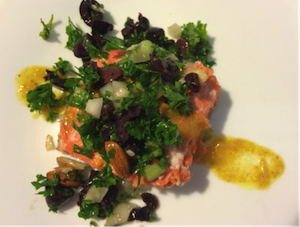
I recently shared the delicious pomegranate olive mint salsa recipe from Rebecca’s new Healthy Mind Cookbook.  Here it is on top of the yummy salmon we made!

healthy-mind-recipe2

Here is a new recipe for you…it’s what Rebecca calls My everything drizzle

After interviewing Rebecca I have a new appreciation for mint and parsley and use it way more than I used to!  I just love this picture of her with mint – lots of it!

mintgirl

Rebecca and I both LOVE sardines and she mentioned her  wonderful source for great quality sardines and other fish: Vital Choice. They are “a trusted source for fast home delivery of the world’s finest wild seafood and organic fare, harvested from healthy, well-managed wild fisheries and farms.”

I have met the founder Randy Hartnell a few times, had him speak on season 2 of the Anxiety Summit, and I love this company and everything that they stand for!

“We capture the fresh-caught quality of fine, sustainably harvested Alaskan salmon and other Alaskan and northwest Pacific seafood by cleaning and flash-freezing it within hours of harvest.

The fisheries that supply most of our seafood are certified sustainable by MSC (look for their blue logo) or the State of Alaska, or are widely considered sustainable.”

After our interview I saw this great picture of Rebecca “in front of the National Gallery of Art in Washington DC, after delivering a talk at DHHS for their White House Panel on Alzheimer’s & Dementia. The topic? Food for a Healthy Mind.”

Rebecca in DC

This is just so exciting to hear! Bravo Rebecca! When I asked her about it, this is what she said:

There were 30 members on the panel and standing room only in the room. The talk, which centered around 25 slides of “food porn” was very well received. They even got a chocolate cherry walnut truffle out of the deal. Perhaps what was most touching was a man in his late 50’s with early on set dementia that gave us a look into his world. I felt humbled by the whole experience.

Here are two of her wonderful books:

  • The Healthy Mind Cookbook: Big-Flavor Recipes to Enhance Brain Function, Mood, Memory, and Mental Clarity
  • The Cancer-Fighting Kitchen: Nourishing, Big-Flavor Recipes for Cancer Treatment and Recovery

If you are not already registered for the Anxiety Summit you can get live access to the speakers of the day here: www.theAnxietySummit.com

Missed this interview or can’t listen live? Or want this and the other great interviews for your learning library? Purchase the MP3s or MP3s + transcripts and listen when it suits you.

You can find your purchasing options here: Anxiety Summit Season 1, Anxiety Summit Season 2, and Anxiety Summit Season 3.

Filed Under: Antianxiety, Books, Food and mood, The Anxiety Summit 3 Tagged With: anxiety, brain, dementia, Rebecca Katz, sardines, the anxiety summit, The Healthy Mind Cookbook, Trudy Scott

The Anxiety Summit – What if… Nutrition could Treat Anxiety and Depression?

May 6, 2015 By Trudy Scott 18 Comments


Julia Rucklidge PhD, Professor of Clinical Psychology in the Department of Psychology at the University of Canterbury, Christchurch, New Zealand, was interviewed on the Anxiety Summit by host of the Anxiety Summit, Trudy Scott, Food Mood Expert and Nutritionist, author of The Antianxiety Food Solution.

Julia has over 75 peer-reviewed studies and is passionate about helping people find alternative treatments to medications for their psychiatric symptoms. Her current research interests can be found at the University of Canterbury site here.

What if… Nutrition could Treat Anxiety and Depression?

  • The increasing prevalence of mental health problems and medication side-effects
  • Why diet is so important when it comes to mental health (anxiety, depression, ADHD and even schizophrenia)
  • Nutritional medicine as mainstream in psychiatry and ISNPR (International Society for Nutritional Psychiatry Research)
  • The problems with food: pesticides, soil quality, Roundup
  • Micronutrient research for ADHD, anxiety, bipolar and PTSD
  • The emerging field of nutritional mental health: Inflammation, the microbiome, oxidative stress, and mitochondrial function

Here are some snippets from our interview:

Why is nutrition important? As a scientist I can just say because the data says it’s important. So if we start with the wonderful work that has really been spearheaded from Felice Jacka and there are other people in Spain and in Japan who have published similar studies showing that the more you eat a processed, western type of diet, the higher your risk for mental illness. They’ve published data on depression and anxiety, but also other mental illness as well. And the more you eat what we call, a prudent or a healthier Mediterranean type of diet, the lower your risk for depression and anxiety.

How long is it going to take our society to pay attention to the research that shows that suboptimal nutrition is contributing to the epidemic of mental illness? Are we just going to sit around and ignore this evidence to our peril? Or are we going to start paying attention and start to invest in the really important research that needs to happen?

Here is an earlier blog post I did on Dr. Rucklidge’s excellent TEDX talk: The surprisingly dramatic role of nutrition in mental health

Here is part of the recent paper titled “What if nutrients could treat mental illness?”

We are at a tipping point in psychiatry.

The growing body of literature on the effect of nutrients on mental health is compelling enough and consistent enough for us to pay attention. It is time to revisit the role of diet and supplementary nutrients in the treatment of mental illness and to invest in this line of research.

Here is the smoking and cannabis study we talked about: Use of micronutrients attenuates cannabis and nicotine abuse as evidenced from a reversal design: a case study.

This case adds to a growing body of research supporting the use of micronutrients in the treatment of psychiatric symptoms and suggests it may extend to substance dependence. Micronutrients, by assisting with mood regulation and reductions in anxiety, may assist with successful cessation of drug use.

We discussed this earthquake paper, a favorite of hers: Shaken but unstirred? Effects of micronutrients on stress and trauma after an earthquake: RCT evidence comparing formulas and doses.

This study supports micronutrients as an inexpensive and practical treatment for acute stress following a natural disaster with a slight advantage to higher doses

If you are not already registered for the Anxiety Summit you can get live access to the speakers of the day here: www.theAnxietySummit.com

Missed this interview or can’t listen live? Or want this and the other great interviews for your learning library? Purchase the MP3s or MP3s + transcripts and listen when it suits you.

You can find your purchasing options here: Anxiety Summit Season 1, Anxiety Summit Season 2, and Anxiety Summit Season 3.

Filed Under: Antianxiety, Food and mood, PTSD/Trauma, Research, The Anxiety Summit 3 Tagged With: ADHD, anxiety, depression, Julia Rucklidge, nutrition, Nutritional medicine, psychiatry, the anxiety summit, Trudy Scott

The Anxiety Summit – New 2015 Food/Nutrient Research on Anxiety and Speaker Highlights

May 6, 2015 By Trudy Scott 107 Comments


The host of the Anxiety Summit, Trudy Scott, Food Mood Expert and Nutritionist, author of The Antianxiety Food Solution opens up the Anxiety Summit Season 3.

New 2015 Food/Nutrient Research on Anxiety and Speaker Highlights

  • Nutritional medicine as mainstream in psychiatry
  • What if nutrients could treat mental illness?
  • The gut microbiome and diet in psychiatry, and the guts of remote Amazon dwellers
  • Dietary guidelines from Brazil, exercise, mindfulness, caffeine and social interaction
  • Preschoolers on Medicaid being prescribed psychotropic drugs and other medication news
  • Speaker highlights, gems and connections

“Nutritional Medicine as Mainstream in Psychiatry” published in January this year.

Psychiatry is at an important juncture, with the current pharmacologically focused model having achieved modest benefits in addressing the burden of poor mental health worldwide. Although the determinants of mental health are complex, the emerging and compelling evidence for nutrition as a crucial factor in the high prevalence and incidence of mental disorders suggests that diet is as important to psychiatry as it is to cardiology, endocrinology, and gastroenterology. Evidence is steadily growing for the relation between dietary quality (and potential nutritional deficiencies) and mental health, and for the select use of nutrient-based supplements to address deficiencies, or as monotherapies or augmentation therapies.

The abstract concludes as follows:

We present a viewpoint from an international collaboration of academics (members of the International Society for Nutritional Psychiatry Research), in which we provide a context and overview of the current evidence in this emerging field of research, and discuss the future direction. We advocate recognition of diet and nutrition as central determinants of both physical and mental health.

I blogged about this earlier this year and you can read more here

Here is part of “What if nutrients could treat mental illness?”

We are at a tipping point in psychiatry.

The growing body of literature on the effect of nutrients on mental health is compelling enough and consistent enough for us to pay attention. It is time to revisit the role of diet and supplementary nutrients in the treatment of mental illness and to invest in this line of research.

Here are the other studies I mentioned:

  • “A randomized controlled trial to test the effect of multispecies probiotics on cognitive reactivity to sad mood”
  • “Indigenous Bacteria from the Gut Microbiota Regulate Host Serotonin Biosynthesis”

Here are 2014 dietary guidelines of Brazil  What is your takeaway? who will you teach to cook? Will you take cooking lessons?  Will you plan more family sit-down meals?

Here is the information on Preschoolers on Medicaid being prescribed psychotropic drugs – very disturbing and sad! 

And here are all the speakers of Season 3 of The Anxiety Summit.

Here are some of the words from Top of the World

A new beginning, a brand new day
All of my fears are gone away
I feel so calm, so free, so whole
Right now, I’m feeling on top of the world
You’ll find the link to download the song on the replay page. Enjoy and share!
 

A few final words from me –

  • Please don’t tolerate how you feel
  • Don’t ever give up hope and keep looking for answers until you have zero anxiety – there may be one root cause, there may be many but you can end your anxiety!
  • Finally ….“You deserve to feel your absolute best, and can and should feel on top of the world – always!”
If you are not already registered for the Anxiety Summit you can get live access to the speakers of the day here: www.theAnxietySummit.com


Missed this interview or can’t listen live? Or want this and the other great interviews for your learning library? Purchase the MP3s or MP3s + transcripts and listen when it suits you.

You can find your purchasing options here: Anxiety Summit Season 1, Anxiety Summit Season 2, and Anxiety Summit Season 3.

Filed Under: Antianxiety, Anxiety and panic, Drugs, The Anxiety Summit 3 Tagged With: anxiety, cooking, diet, drugs, microbiome, micronutrients, the anxiety summit, Trudy Scott

Nutrition Solutions from the Anxiety Summit: New Research, Trends and Opinions

May 1, 2015 By Trudy Scott 4 Comments

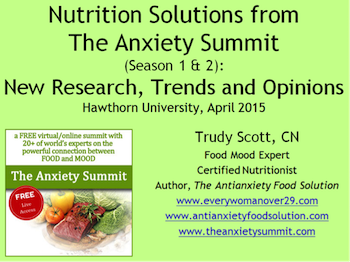
AS-hawthorn

“Could diet and nutrition be central determinants of mental health? Find out when Trudy Scott, CN, provides evidence presented at The Anxiety Summit, seasons 1 and 2, which has showcased vitally important research now available to integrative practitioners and to people who suffer with anxiety, panic attacks, social anxiety and OCD. The gut-brain connection and microbiome, methylation, adverse effects of benzodiazapines, the role of inflammation, and controversial opinions about serotonin, GABA and urinary neurotransmitter testing are a few of the concepts that will be shared.”

This is the blurb describing my recent online presentation/webinar at Hawthorn University, a Leader in Online Holistic Nutrition Education. Doing this presentation: “Nutrition Solutions from The Anxiety Summit: New Research, Trends and Opinions” was a fabulous opportunity to highlight some of the incredible season 1 and season 2 speakers and share some of the exciting research.   I also had the opportunity to share quite a few differences of opinions around GABA, serotonin and neurotransmitter testing.

Here is the presentation – enjoy!


Here are a few snippets from the presentation:

Dr. Felice Jacka, Principal Research Fellow at Deakin University, Melbourne, Australia shared this in our interview titled: “The Research – Food to prevent and treat anxiety and depression?”

We’ve now seen data from right around the world right across every continent and across age ranges, showing that diet really does matter to the prevalence and incidence of depression and anxiety.

Dr. Kelly Brogan, MD and Holistic women’s health psychiatry, shared this in our interview titled: “Psychoneuroimmunology, the new psychiatry”

it’s about no longer looking at psychiatry as a head up phenomenon, which at best can result in limited outcomes and at worst, can be quite dangerous”… and it “also sort of ropes in the gut and the endocrine system with the implication being that you cannot treat one without knowledge about the other.

In my talk “Targeted individual amino acids for eliminating anxiety: practical applications,” I shared this:

You’ll hear some practitioners say GABA molecules are too large to cross the blood brain barrier so GABA won’t work or if it does work you must have a leaky blood brain barrier

I have seen research indicating that GABA’s relaxing effect may be due to peripheral effects rather than the effect on/in the brain.

You can access a PDF copy of the presentation on the Hawthorn University site. While you’re there, do check out their other webinars and program offerings.

If you tuned in for season 1 and season 2, this gives you a nice recap. If you didn’t listen to season 1 and season 2 and enjoyed these highlights, be sure to check out all the The Anxiety Summit Season 1 and The Anxiety Summit Season 2 speakers and topics.  

Either way I hope it has inspired you to want to hear more on season 3 which starts next week! I’ll be taking a deeper dive into troubleshooting when you are using (or recommending) amino acids and what to do when the pyroluria protocol is not working for you.

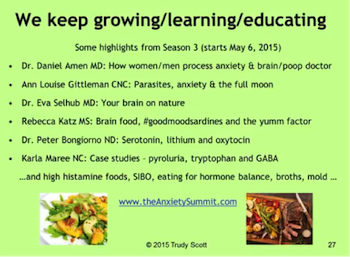
Here are just a few other highlights from Season 3:

keep-learningWe have a whole set of new topics, new speakers and new research to share – so you can learn more nutritional solutions for anxiety.  Join us here: season 3 of The Anxiety Summit.


Filed Under: Anxiety and panic, Events, The Anxiety Summit 3 Tagged With: felice jacka, Hawthorn University, Kelly Brogan

  • « Go to Previous Page
  • Page 1
  • Interim pages omitted …
  • Page 3
  • Page 4
  • Page 5
  • Page 6
  • Go to Next Page »

Primary Sidebar

GABA QuickStart Homestudy

gaba quickstart homestudy

Free Report

9 Great Questions Women Ask about Food, Mood and their Health

You'll also receive a complimentary subscription to my ezine "Food, Mood and Gal Stuff"


Connect with me

Popular Posts

  • Amino Acids Mood Questionnaire from The Antianxiety Food Solution
  • The Antianxiety Food Solution Amino Acid and Pyroluria Supplements
  • Pyroluria Questionnaire from The Antianxiety Food Solution
  • Collagen and gelatin lower serotonin: does this increase your anxiety and depression?
  • Tryptophan for the worry-in-your-head and ruminating type of anxiety
  • GABA for the physical-tension and stiff-and-tense-muscles type of anxiety
  • The Antianxiety Food Solution by Trudy Scott
  • Seriphos Original Formula is back: the best product for anxiety and insomnia caused by high cortisol
  • Am I an anxious introvert because of low zinc and vitamin B6? My response to Huffington Post blog
  • Vagus nerve rehab with GABA, breathing, humming, gargling and key nutrients

Recent Posts

  • Her cravings for chips and peanut butter were triggered by stress: GABA ends cravings and reduces physical tension and fear of heights
  • It is truly miraculous to be able to move through life without crippling anxiety and panic
  • GABA and tryptophan combo provide immediate and noticeable relief for tremors and cervical dystonia in just 7 days
  • Red light therapy for back and neck pain, plantar fasciitis and low mood – a complement to the amino acids GABA, DPA and tryptophan
  • What do I use instead of Seriphos to help lower high cortisol that is affecting my sleep and making me anxious at night?

Categories

  • 5-HTP
  • AB575
  • Addiction
  • ADHD
  • Adrenals
  • Alcohol
  • Allergies
  • Alzheimer's disease
  • Amino Acids
  • Anger
  • Antianxiety
  • Antianxiety Food Solution
  • Antidepressants
  • Anxiety
  • Anxiety and panic
  • Autism
  • Autoimmunity
  • benzodiazapines
  • Bipolar disorder
  • Books
  • Caffeine
  • Cancer
  • Candida
  • Children/Teens
  • Collagen
  • Cooking equipment
  • Coronavirus/COVID-19
  • Cravings
  • Depression
  • Detoxification
  • Diabetes
  • Diet
  • DPA/DLPA
  • Drugs
  • EFT/Tapping
  • EMF
  • EMFs
  • Emotional Eating
  • Endorphins
  • Environment
  • Essential oils
  • Events
  • Exercise
  • Fear
  • Fear of public speaking
  • Fertility and Pregnancy
  • Fish
  • Food
  • Food and mood
  • Functional neurology
  • GABA
  • Gene polymorphisms
  • General Health
  • Giving
  • Giving back
  • Glutamine
  • Gluten
  • GMOs
  • Gratitude
  • Gut health
  • Heart health/hypertension
  • Histamine
  • Hormone
  • Hyperparathyroidism
  • Hypoglycemia
  • Immune system
  • Inflammation
  • Insomnia
  • Inspiration
  • Introversion
  • Joy and happiness
  • Ketogenic diet
  • Lithium orotate
  • Looking awesome
  • Lyme disease and co-infections
  • MCAS/histamine
  • Medication
  • Men's health
  • Mental health
  • Mercury
  • Migraine
  • Mold
  • Movie
  • MTHFR
  • Multiple sclerosis
  • Music
  • NANP
  • Nature
  • Nutritional Psychiatry
  • OCD
  • Osteoporosis
  • Oxalates
  • Oxytocin
  • Pain
  • Paleo
  • Parasites
  • Parkinson’s disease
  • PCOS
  • People
  • PMS
  • Postpartum
  • PTSD/Trauma
  • Pyroluria
  • Questionnaires
  • Real whole food
  • Recipes
  • Research
  • Schizophrenia
  • serotonin
  • SIBO
  • Sleep
  • Special diets
  • Sports nutrition
  • Stress
  • Sugar addiction
  • Sugar and mood
  • Supplements
  • Teens
  • Testimonials
  • Testing
  • The Anxiety Summit
  • The Anxiety Summit 2
  • The Anxiety Summit 3
  • The Anxiety Summit 4
  • The Anxiety Summit 5
  • The Anxiety Summit 6
  • Thyroid
  • Thyroid health
  • Toxins
  • Tryptophan
  • Tyrosine
  • Uncategorized
  • Vegan/vegetarian
  • Women's health
  • Yoga

Archives

  • May 2026
  • April 2026
  • October 2025
  • September 2025
  • August 2025
  • July 2025
  • June 2025
  • May 2025
  • April 2025
  • March 2025
  • February 2025
  • January 2025
  • November 2024
  • October 2024
  • September 2024
  • August 2024
  • July 2024
  • June 2024
  • May 2024
  • April 2024
  • March 2024
  • February 2024
  • January 2024
  • December 2023
  • November 2023
  • October 2023
  • September 2023
  • August 2023
  • July 2023
  • June 2023
  • May 2023
  • April 2023
  • March 2023
  • February 2023
  • January 2023
  • December 2022
  • November 2022
  • October 2022
  • September 2022
  • August 2022
  • July 2022
  • June 2022
  • May 2022
  • April 2022
  • March 2022
  • February 2022
  • January 2022
  • December 2021
  • November 2021
  • October 2021
  • September 2021
  • August 2021
  • July 2021
  • June 2021
  • May 2021
  • April 2021
  • March 2021
  • February 2021
  • January 2021
  • December 2020
  • November 2020
  • October 2020
  • September 2020
  • August 2020
  • July 2020
  • June 2020
  • May 2020
  • April 2020
  • March 2020
  • February 2020
  • January 2020
  • December 2019
  • November 2019
  • October 2019
  • September 2019
  • August 2019
  • July 2019
  • June 2019
  • May 2019
  • April 2019
  • March 2019
  • February 2019
  • January 2019
  • December 2018
  • November 2018
  • October 2018
  • September 2018
  • August 2018
  • July 2018
  • June 2018
  • May 2018
  • April 2018
  • March 2018
  • February 2018
  • January 2018
  • December 2017
  • November 2017
  • October 2017
  • September 2017
  • August 2017
  • July 2017
  • June 2017
  • May 2017
  • April 2017
  • March 2017
  • February 2017
  • January 2017
  • December 2016
  • November 2016
  • October 2016
  • September 2016
  • August 2016
  • July 2016
  • June 2016
  • May 2016
  • April 2016
  • March 2016
  • February 2016
  • January 2016
  • December 2015
  • November 2015
  • October 2015
  • September 2015
  • August 2015
  • July 2015
  • June 2015
  • May 2015
  • April 2015
  • March 2015
  • February 2015
  • January 2015
  • December 2014
  • November 2014
  • October 2014
  • September 2014
  • August 2014
  • July 2014
  • June 2014
  • May 2014
  • April 2014
  • March 2014
  • February 2014
  • January 2014
  • December 2013
  • November 2013
  • October 2013
  • September 2013
  • August 2013
  • July 2013
  • June 2013
  • May 2013
  • April 2013
  • March 2013
  • February 2013
  • January 2013
  • December 2012
  • November 2012
  • October 2012
  • August 2012
  • July 2012
  • June 2012
  • May 2012
  • April 2012
  • March 2012
  • February 2012
  • January 2012
  • December 2011
  • November 2011
  • October 2011
  • September 2011
  • August 2011
  • July 2011
  • June 2011
  • May 2011
  • April 2011
  • March 2011
  • February 2011
  • January 2011
  • December 2010
  • October 2010
  • September 2010
  • July 2010
  • May 2010
  • April 2010
  • March 2010
  • February 2010
  • January 2010
  • November 2009

Share the knowledge!

The above statements have not been evaluated by the Food and Drug Administration. Products listed in this website are not intended to diagnose, treat, cure or prevent any disease.

The information provided on this site is for informational and educational purposes only and is not intended as a substitute for advice from your physician or other health care professional. You should consult with a healthcare professional before starting or modifying any diet, exercise, or supplementation program, before taking or stopping any medication, or if you have or suspect you may have a health problem.


Copyright © 2026 Trudy Scott. All Rights Reserved. | Privacy | Terms and Conditions | Refund Policy | Medical Disclaimer

Free Report

9 Great Questions Women Ask about Food, Mood and their Health

You’ll also receive a complimentary subscription to my ezine “Food, Mood and Gal Stuff”