• Skip to primary navigation
  • Skip to main content
  • Skip to primary sidebar

everywomanover29 blog

Food, Mood and Women's Health – Be your healthiest, look and feel great!

  • Blog
  • About
  • Services
  • Store
  • Resources
  • Testimonials
  • The Book
  • Newsletter
  • Contact
  • Search this site

Food and mood

Food does improve mood: 2012 research

August 21, 2012 By Trudy Scott 19 Comments

A recent blog post on the GoodTherapy.org site featured this article: “Can Social Anxiety Be Caused by a Nutritional Deficiency?”. I was thrilled to have been quoted and to have shared my experience with pyroluria, a form of social anxiety, shyness and inner tension, that responds very well to the supplements vitamin B6, zinc and evening primrose oil.  It was also a wonderful opportunity to get folks thinking about the role that food and nutrients play in mental health.

I was rather surprised by this comment from Nerina Garcia-Arcement, a licensed clinical psychologist and clinical assistant professor at the NYU School of Medicine: “Having a healthy and balanced diet is overall beneficial, but it won’t cure social anxiety or a mood disorder. I am more likely to recommend my clients get enough sun exposure to improve their moods (seasonal affective disorder) than recommend diet changes.”

I certainly support the recommendation for sun exposure and write this blog post to provide additional resources for those who may be unfamiliar with the recent food mood research. And I will address pyroluria, zinc and vitamin B6 in a separate post.

Here is just some of the 2012 food mood research:

Dias GP, Cavegn N et al. 2012. The role of dietary polyphenols on adult hippocampal neurogenesis: molecular mechanisms and behavioural effects on depression and anxiety. 2012. Oxidative Medicine and Cellular Longevity Epub 2012 Jun 28

“Studies on the effects of dietary polyphenols” (such as those found in green tea and turmeric), “on behaviour and AHN” (adult hippocampal neurogenesis), “may play an important role in the approach to use diet as part of the therapeutic interventions for mental-health-related conditions.”

Michalak J, Zhang XC et al. 2012 Vegetarian diet and mental disorders: results from a representative community survey. International Journal of Behavioral Nutrition and Physical Activity. Jun 7;9(1):67. [Epub ahead of print]

“Vegetarians displayed elevated prevalence rates for depressive disorders, anxiety disorders and somatoform disorders.” The authors also state that because “vegetarians exhibit a wide diversity of dietary practices, future research should more carefully define vegetarian diet to enable closer examination of the associations between diet and risk of mental disorders.”  Since this was an epidemiological study, it shows association only. But it’s a great start.

Davison KM, Kaplan BJ. 2012. Nutrient Intakes Are Correlated With Overall Psychiatric Functioning in Adults With Mood Disorders. Canadian Journal of Psychiatry. 57:85-92

This study looked at Canadian adults with mood disorders. Intake of carbs, fiber, total fat, linoleic acid, riboflavin, niacin, folate, vitamin B6, B12, pantothenic acid, calcium, phosphorus, potassium, iron, magnesium and zinc were measured and “higher levels of nutrients equated to better mental health.” (This study was included on my poster presentation at the 2012 Anxiety Disorders Association of America conference)

One of the study authors, Dr Kaplan, PhD was quoted as saying: “Doctors should consider counseling their patients to eat unprocessed, natural, healthy foods and refer them to a nutrition professional if specialized dietary consultation is needed.”

Torres SJ, Nowson CA. 2012. A moderate-sodium DASH-type diet improves mood in postmenopausal women. Nutrition. Sep;28(9):896-900. Epub 2012 Apr 4.

“In addition to the health benefits of a moderate-sodium Dietary Approaches to Stop Hypertension diet on blood pressure and bone health, this diet had a positive effect on improving mood in postmenopausal women.”  This diet did include lean red meat, which “was associated with a decrease in depression.”

Dr Felice Jacka, an Australian researcher, has a number of papers that I’ve blogged about in the past. A more recent one from 2011 looked at Norwegian adult men and women, and found that “those with better quality diets were less likely to be depressed” and that a “higher intake of processed and unhealthy foods was associated with increased anxiety.”

In a recent bipolar post, I also mention some of the research around eating a real food traditional diet and a lower risk of bipolar disorder, and the relationship between gluten and bipolar disorder.

All in all, there is much recent evidence pointing to some very real benefits for making dietary changes in order to improve mental health outcomes. Clearly, more research is needed, but we have growing evidence that the food mood connection is NOT “just a bunch of hooey” (as one of the readers stated) and we need to keep our minds open if we are to help those in need of our services!


Filed Under: Antianxiety Food Solution, Food and mood Tagged With: anxiety, depression, food and mood, GoodTherapy.org, pyroluria, research

Eat to be Happy and Calm in Chatelaine Magazine!

July 2, 2012 By Trudy Scott 8 Comments


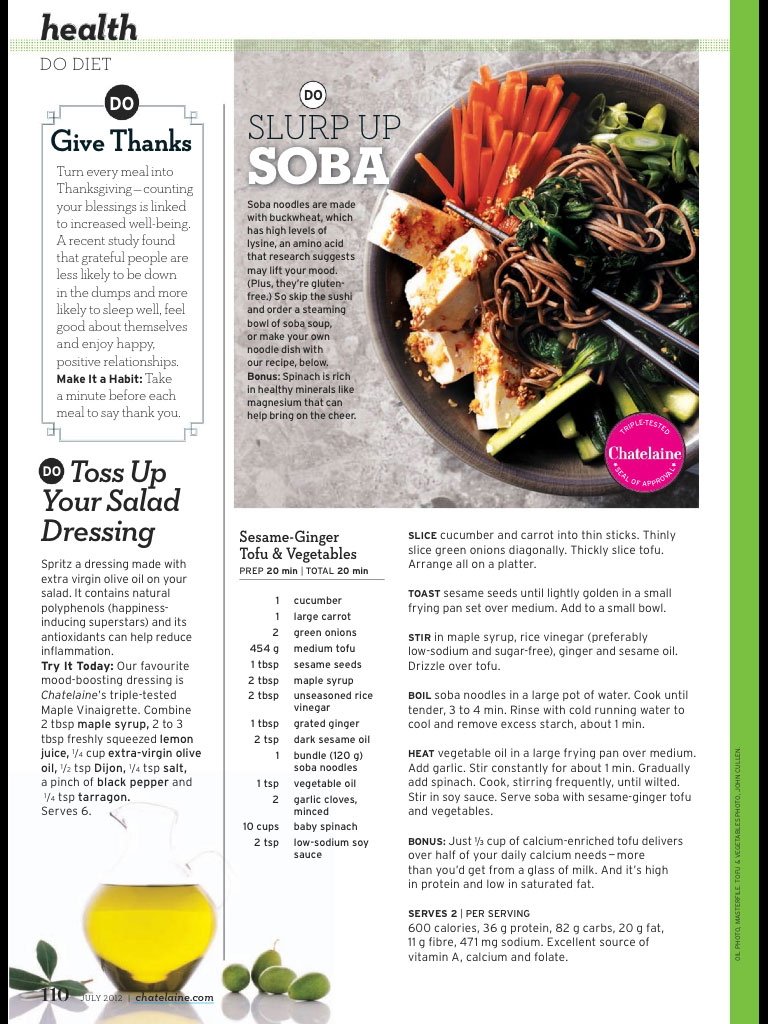
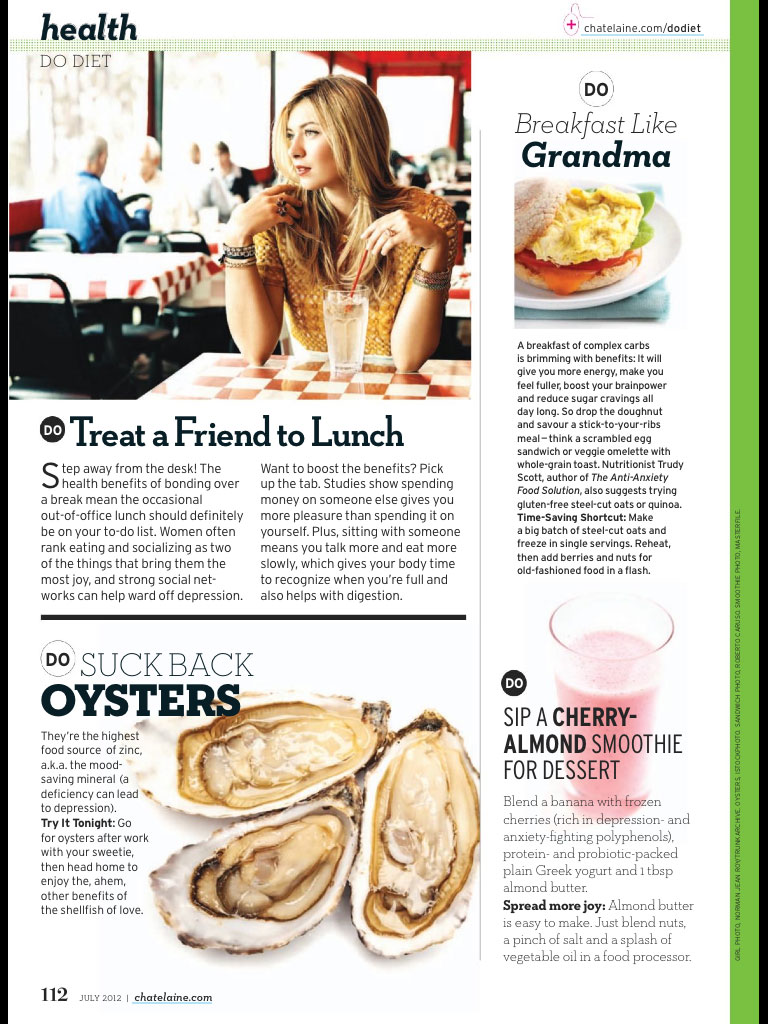
What do these have in common? grass-fed red meat, pumpkin seeds, real food, oysters and home-made salad dressing? They are all foods that are part of the Happy Diet, and featured in the July edition of the Chatelaine Magazine. I’m thrilled to have contributed to this super article and am happy to share it with you here! I really enjoyed working with Kat Tancock. I hope you enjoy it – and enjoy the wonderful pictures too!

Eating real foods like this, and doing things like treating a friend to lunch can bring you great joy and happiness, as well as keep anxiety and stress at bay.

(Click on each image below to enlarge.)

The author Kat Tancock (www.kattancock.com) holds the copyright to this article. Please contact her regarding reproduction or any questions you may have.

Filed Under: Antianxiety Food Solution, Anxiety and panic, Food and mood, Joy and happiness, Real whole food Tagged With: anxiety, calm, Chatelaine magazine, happy, joy

Antianxiety Food Solution review on Psychcentral.com

June 18, 2012 By Trudy Scott 5 Comments

Although some mental health professionals believe there isn’t proof of the link between behavior, mental health and diet, today most current research shows there is definitely a very important correlation if not an outright causal relationship.

The above is an excerpt from a wonderful review of The Antianxiety Food Solution by C.R. and Richard Zwolinski on their PsychCentral.com blog called Therapy Soup. What a wonderful gift on the one-year anniversary of my book!

You can read the whole PsychCentral.com review here.

I’d like to highlight a few of their comments in the review:

Richard and I give the Anti-Anxiety Food Solution 5 1/2 cups of soup—we really loved this book and plan to recommend it to patients with anxiety.

The book contains simple tests you can take to determine if you have any food intolerances or allergies which may be not only triggering anxiety symptoms but also wreaking havoc on your digestion.

C.R. took some of the tests and figured out that she needed vitamin B6 and GABA and she says:

I’ve started taking the B6 and the GABA and though it’s only been two weeks, I do feel less burned out even though my workload has recently increased.

I am a big fan of all the recent food-mood research and making this information easy for everyone to use and I appreciate these comments from the reviewers:

I especially like that the author has referenced all her information so you can see for yourself why she makes the recommendations she does. I also like that the information, while comprehensive, is accessible and easy to understand.

And I appreciate and support their holistic approach:

Therapy Soup readers know that we believe body, mind and soul are intricately linked and that a holistic approach to treatment for mental illness and/or addiction (or any health or personality issue) is truly necessary.

This holistic approach is reflected in their other very interesting blogs like this one on nosebleeds, mental illness and possible food intolerances and this one on autism, schizophrenia and nutrition. Of course I write about this food mood connection all the time and more recently have written about the bipolar-blood sugar- gluten link and the anxiety-panic-caffeine-gluten link.

Be sure to check out their other blog posts on PsychCentral Therapy Soup.

C.R. Zwolinski is a writer, editor, consultant living in New York. For more about naturally healthy nutrition (with a Jewish twist) visit C.R. at healthyjewishcooking.com. Learn about the benefits of sourdough bread, sprouting, organically grown foods and more.

Richard (Moshe) Zwolinski is a licensed psychotherapist in the fields of mental health and addiction. He’s the author of Therapy Revolution: Find Help, Get Better, and Move On (Without Wasting Time or Money), and blogs at Therapy Soup on the top-rated international web site, Psychcentral.com. He’s an anxiety and addiction specialist with over 25 years experience. He encourages you to focus on achieving spiritual, emotional, mental, and physical health so you can live the happy, productive, meaningful life you were meant to live. He also volunteers with youth at risk and lives in Brooklyn, New York.

The Antianxiety Food Solution: How the Foods You Eat Can Help You Calm Your Anxious Mind, Improve Your Mood and End Cravings, is available in major books stores, at Amazon and via www.antianxietyfoodsolution.com.

Filed Under: Antianxiety Food Solution, Food and mood

Bipolar, disruptive mood or gluten and junk food?

May 29, 2012 By Trudy Scott 27 Comments

A national study published in 2007 showed a surge in use of the bipolar diagnosis in children: the frequency of visits to doctors’ offices by youths 19 and younger for treatment of the condition increased from 25 per 100,000 visits in 1994-95 to 1,003 per 100,000 visits in 2002-03. I wonder what the numbers are now?

The above quote is from a story that appeared in the Boston Globe earlier this month [thanks to my friend in Boston who shared this story with me and urged me to write a commentary!]

The story, “Proposed diagnosis for bipolar disorder divides psychiatrists” by Patricia Wen, discusses issues with proposed revisions to the Diagnostic and Statistical Manual of Mental Disorders IV (DSMIV). The psychiatric association is expected to make final decisions for its fifth revised edition to be published in May 2013.

A panel appointed by the American Psychiatric Association is urging that a new, potentially more transient and less-stigmatizing diagnosis – “disruptive mood dysregulation disorder’’ – be added to the official manual of mental illnesses, which is undergoing a sweeping revision [this new disorder would be included in the manual in addition to the existing bipolar disorder, and this is where the division is].

The new condition would apply to children who have chronic irritability, as well as recurrent temper outbursts – three or more times a week, on average – that are “grossly out of proportion’’ to the situation the child confronts.

It can be as disabling to a young child as bipolar disorder, but would probably be treated with antidepressants, not antipsychotic drugs. As adults, these children would be more likely to develop anxiety or depression, rather than bipolar disorder.

Wow! chronic irritability, recurrent temper outbursts, “grossly out of proportion’’ to the situation, likely to develop anxiety or depression as adults

This sounds a lot like a combination of poor diet/junk food and food intolerances. And it’s no surprise when you consider what diets kids are eating these days! Let’s also throw in low blood sugar for good measure – how many kids do you know who eat a good breakfast that includes protein?

Let’s first look at food quality and bipolar disorder:

In the Journal of Affective Disorders, a 2012 paper titled “Diet quality in bipolar disorder in a population-based sample of women”, found a lower risk of bipolar disorder in those eating a quality traditional foods diet. Granted, this is epidemiological evidence, but this is exactly why more research is imperative. The authors do actually state: “Longitudinal studies are warranted”.

Lead author of the above paper, Dr. Felice Jacka , is also the lead author in a 2011 PLoS One paper that found diet quality in adolescents was associated with a lower risk of mental health issues. The author stated that this “study highlights the importance of diet in adolescence and its potential role in modifying mental health over the life course”

Let’s also look at gluten and bipolar disorder:

In the journal Psychiatry Research, a 2012 paper titled “Markers of gluten sensitivity in acute mania: A longitudinal study” states that individuals “with mania had significantly increased levels of IgG antibodies to gliadin” “which is derived from the wheat protein gluten”.

When I read this section in the Boston Globe story a light bulb went off….

What is ultimately added, subtracted, or revised in the Diagnostic and Statistical Manual of Mental Disorders, first put out by the American Psychiatric Association in 1952, is loaded with practical and cultural implications.

It will help define what is considered normal behavior. It largely determines how clinicians diagnose conditions; what health insurers will pay for; what drugs are made and marketed; and what research will be funded by governments and foundations

Perhaps the division between bipolar disorder and disruptive mood dysregulation disorder is less important than my whole-hearted proposal to add gluten intolerance and celiac disease, junk food addict (and low blood sugar and a host of other nutritional factors) to the DSMIV!!!

I’m obviously saying this tongue-in-cheek but imagine a world where we:

  • Do get government research funding and studies done on mental health issues related to or directly caused by gluten intolerance and a junk food diet
  • Do get insurance coverage for nutrition coaching and consulting
  • Do see subsidies for organic food farmers
  • Do make this the first approach instead of medications…or at least use this approach in conjunction with lower doses of medications
  • Do see huge improvements …leading to say a 40-fold (or more) decrease in bipolar diagnoses in children (and adults) in a less than a year!

Yes! Add these now… please! If we need research for it to become mainstream then so be it! I’m volunteering to be part of any research in these areas. It works – I already know this, as do countless of other practitioners and people who have made these changes. Just read Michael Ellsberg’s compelling bipolar story on Forbes to be inspired!

Dr Katherine Falk, MD is in private practice in New York City and is certified by the American Board of Psychiatry and Neurology. She endorsed my book The Antianxiety Food Solution and said this:

Trudy Scott is an expert on the relationship of food and mood, an often neglected area in the health of persons with mental illness. This book provides practical information, clearly presented, which I believe to be an important adjunct in the treatment of not only anxiety and depression, but also of serious mental illness.

I would like to end by saying that I have no intention of minimizing the seriousness of bipolar disorder or any mental illness, I just believe there is so much more we can do on the food-mood front!

Filed Under: Antianxiety Food Solution, Anxiety and panic, Bipolar disorder, Food and mood, Real whole food Tagged With: antianxiety diet, Antianxiety Food Solution, anxiety, Bipolar, depression, gluten, junk food, mood

Melissa McLean Jory: Should we all be gluten-free to get the Gluten-Free Edge?

May 15, 2012 By Trudy Scott 30 Comments

Did you know that 1 in 100 Americans have celiac disease and most don’t know it? And that celiac disease is 5 times more common now than 50 years ago? And that osteoporosis and anemia are the two most common adult presentations of celiac disease?

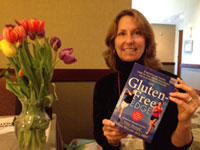
I recently attended a great talk on gluten by Melissa McLean Jory, MNT. Melissa was one of the many great speakers at the annual NANP/National Association of Nutrition Professionals conference in San Francisco. Her talk was titled The Gluten-Free Edge: Digestive Health and Sports Nutrition for Active People.

Melissa said this: “There is no biological value in gluten” – for anyone! I find this so interesting because I’m beginning to think the same thing. In fact, I find that the majority of my clients with mood problems do better on a gluten-free diet.

Gluten can affect you in so many ways, whether you have celiac disease or gluten sensitivity.  Melissa shared this list of gluten-related disorders:

  • Depression and anxiety, social phobia, schizophrenia […I added the last three here]
  • Gastrointestinal problems, nutrient deficiencies, fat malabsorption
  • Neurological complications, fatigue, headaches, ataxia, peripheral neuropathy, poor concentration
  • Dermatitis herpetiformis, skin rashes, vitiligo, alopecia
  • Dental enamel abnormalities, canker sores
  • Anemia (iron, B12, folic acid deficiencies)
  • Osteoporosis, osteopenia, arthritis, Dupuytren’s contracture, bone abnormalities
  • Reduced fertility in men and women, recurrent miscarriages
  • Endocrine conditions, type 1 diabetes, thyroid disease, Addison’s disease

What was new to me and fascinating was the athlete-gluten-performance connection that Melissa refers to as the “Gluten-Free Edge”. Over 60% of endurance athletes experience digestive problems such as abdominal pain and discomfort, diarrhea, constipation, gas and bloating. And because gluten causes inflammation, this can inhibit athletic performance and impair or delay recovery. The higher the sport intensity, the more likely the problem. Melissa shared that the Garmin Cycling Team went gluten-free for the 2008 season. They were the first pro-team to do so and this is what they found:

  • Less bloated and “heavy” feeling
  • Mentally sharper
  • Fewer stomach problems
  • Less stress on the immune system
  • Stronger performances

Wow! As Melissa says “Go gluten free – you have nothing to lose and everything to gain!”

Here is information on how to do a gluten elimination challenge.  I suggest you try it and see how you do

Melissa is wonderful and is so passionate about sharing this information. From her website: “I am Nutrition Therapist, have a degree in Exercise Science, am certified to teach yoga, and have a personal interest and expertise in celiac disease, gluten sensitivity, and holistic health. I’m on a mission to increase awareness of celiac disease and help people navigate the gluten-free lifestyle with confidence, strength, optimal nutrition, and renewed vitality. I know how difficult that can be because I have celiac disease and so does my daughter, but with the right lifestyle changes, optimal health is not only achievable, it can be fun and taste good too!”

Melissa’s new book will be available in June and you can preorder it now. I can’t wait to read it! The Gluten-Free Edge: A Nutrition and Training Guide for Peak Athletic Performance and an Active Gluten-Free Life by Peter Bronski and Melissa McLean Jory.

The whole NANP conference was superb! Other highlights included: The Consequences of Undiagnosed Vitamin B12 Deficiency by Sally Pacholok and Clinical Tools for Working with Libido by Bari Mandelbaum, NC, B Sc., I’ll share gems from these and other talks in future blog posts.

Filed Under: Antianxiety Food Solution, Books, Food and mood, General Health, Gluten, People, Real whole food Tagged With: anxiety, athletes, food and mood, gluten, gluten-free edge, Melissa McLean Jory, mood

Aubrey Huff anxiety attack: could it be a food-mood issue?

May 15, 2012 By Trudy Scott 11 Comments

Photo by Jeffjeff08 (from Wikimedia Commons)

Do world-class athletes actually have performance anxiety and panic attacks? And could there be a food mood and nutrient connection?  Yes, food does have a big impact on our mood. And yes, anxiety can affect anyone and many athletes are affected! The most recent example is baseball player Aubrey Huff, from the San Francisco Giants. Henry Schulman wrote about Aubrey’s panic attack in SFGate in an article titled Aubrey Huff opens up about his anxiety attacks :

Aubrey Huff says his first panic attack lasted for eight hours.

Aubrey Huff was standing in his New York hotel room at 5 o’clock in the morning in the early stages of what would be an eight-hour panic attack. The Giant were to play a doubleheader against the Mets that afternoon and evening. Baseball was the last thing on Huff’s mind.

“I couldn’t breathe,” Huff recalled. “I felt I was taking short breaths. Right then and there I thought I was having a heart attack. I told myself, ‘I’ll be damned if I’m going to be sitting in this hotel room and die of a heart attack. I’ve got to get out of here.'”

I used to have social anxiety and panic attacks and it was horrible! And very scary! I really feel for Aubrey and would love to be able to help!

If I was working with Aubrey this is what I’d have him do (this is my approach for anyone who is experiencing anxiety and anxiety attacks/panic attacks):

  1. I’d have him keep a 3 day food diary and we’d look at his intake of real whole food (including grass-fed meat) compared to junk food and fast food
  2. We’d look at caffeine and sugar intake and reduce this and eventually eliminate it. Caffeine can induce anxiety and for many people it’s a tough one to eliminate so we’d have to address the underlying fatigue and reason for “self-medication”. For Aubrey, it could possibly be burned out adrenals. High sugar consumption also affects the adrenals and results in nutrient depletion of minerals like zinc and magnesium, both of which help with anxiety
  3. We’d also look at his gluten intake and assess for gluten intolerance and/or celiac disease and have him start right away on a 2 week gluten elimination trial. Whether or not gluten is a contributing factor to the anxiety, as Melissa Mclean Jory says in the Gluten-Free Edge, athletes perform better when gluten is not a part of their diets
  4. We’d have him start on the first of the 4 antianxiety diets: real whole food, good quality protein, good fats, plenty of organic veggies and fruit, and with no gluten. And make sure he eating a good breakfast that does include protein – keeping blood sugar stable is key for anxiety
  5. We must also always consider neurotransmitter imbalances. In the same SF gate interview Aubrey said this “I couldn’t control one thought in my head. There were so many thoughts going through”. Low serotonin can cause anxiety, panic attacks and ruminating thoughts, so assessing for low serotonin would be key. If low serotonin is a factor then using the amino acid supplements tryptophan or 5-HTP would be worth considering. Research supports the use of 5-HTP for panic. GABA is a calming amino acid and it’s likely that Aubrey would benefit from this too, especially if he has stiff and tense muscles
  6. I would also consider the possibility of pyroluria. In an interview on his blog, Aubrey stated: “I was very shy in high school, if you can believe it. I broke out of my shell at the University of Miami when I got around guys like Burrell. I learned how to believe in myself – and I learned how to project confidence even when I didn’t feel very confident.” As reported by Carey Vanderborg, “the Social Anxiety Institute says that social anxiety disorder, also known as performance anxiety, is a persistent fear of performance situations–such as an athletic event–in which you’re exposed to unfamiliar people or to possible judgment by others.” Zinc, vitamin B6 and evening primrose oil can completely eliminate social anxiety in someone with pyroluria. Here is the pyroluria questionnaire that I’d have Aubrey use for assessing if this is part of the issue. Raising serotonin levels also helps with boosting confidence so it doesn’t have to be learned or forced.

Each person has their own unique biochemistry and there may be other factors involved but this would be a great start. This is what I wish for Aubrey Huff with this food-mood approach: totally free of anxiety, no more panic attacks, zero performance anxiety, feeling super-confident, have no ruminating thoughts, plus playing his best baseball ever!

I would LOVE to send a copy of my book to Aubrey so if you know how to get fan-mail to him please let me know. I tried the Giants office and didn’t have any luck.

You can find out more in The Antianxiety Food Solution: How the Foods You Eat Can Help You Calm Your Anxious Mind, Improve Your Mood and End Cravings, available in major books stores, at Amazon and via www.antianxietyfoodsolution.com.

Filed Under: Antianxiety Food Solution, Anxiety and panic, Food and mood, Gluten, People Tagged With: antianxiety diet, Antianxiety Food Solution, anxiety, anxiety attack, Aubrey Huff, mood, panic attack, pyroluria

  • « Go to Previous Page
  • Page 1
  • Interim pages omitted …
  • Page 11
  • Page 12
  • Page 13
  • Page 14
  • Page 15
  • Interim pages omitted …
  • Page 22
  • Go to Next Page »

Primary Sidebar

GABA QuickStart Homestudy

gaba quickstart homestudy

Free Report

9 Great Questions Women Ask about Food, Mood and their Health

You'll also receive a complimentary subscription to my ezine "Food, Mood and Gal Stuff"


Connect with me

Popular Posts

  • Amino Acids Mood Questionnaire from The Antianxiety Food Solution
  • The Antianxiety Food Solution Amino Acid and Pyroluria Supplements
  • Pyroluria Questionnaire from The Antianxiety Food Solution
  • Collagen and gelatin lower serotonin: does this increase your anxiety and depression?
  • Tryptophan for the worry-in-your-head and ruminating type of anxiety
  • GABA for the physical-tension and stiff-and-tense-muscles type of anxiety
  • The Antianxiety Food Solution by Trudy Scott
  • Seriphos Original Formula is back: the best product for anxiety and insomnia caused by high cortisol
  • Am I an anxious introvert because of low zinc and vitamin B6? My response to Huffington Post blog
  • Vagus nerve rehab with GABA, breathing, humming, gargling and key nutrients

Recent Posts

  • Her cravings for chips and peanut butter were triggered by stress: GABA ends cravings and reduces physical tension and fear of heights
  • It is truly miraculous to be able to move through life without crippling anxiety and panic
  • GABA and tryptophan combo provide immediate and noticeable relief for tremors and cervical dystonia in just 7 days
  • Red light therapy for back and neck pain, plantar fasciitis and low mood – a complement to the amino acids GABA, DPA and tryptophan
  • What do I use instead of Seriphos to help lower high cortisol that is affecting my sleep and making me anxious at night?

Categories

  • 5-HTP
  • AB575
  • Addiction
  • ADHD
  • Adrenals
  • Alcohol
  • Allergies
  • Alzheimer's disease
  • Amino Acids
  • Anger
  • Antianxiety
  • Antianxiety Food Solution
  • Antidepressants
  • Anxiety
  • Anxiety and panic
  • Autism
  • Autoimmunity
  • benzodiazapines
  • Bipolar disorder
  • Books
  • Caffeine
  • Cancer
  • Candida
  • Children/Teens
  • Collagen
  • Cooking equipment
  • Coronavirus/COVID-19
  • Cravings
  • Depression
  • Detoxification
  • Diabetes
  • Diet
  • DPA/DLPA
  • Drugs
  • EFT/Tapping
  • EMF
  • EMFs
  • Emotional Eating
  • Endorphins
  • Environment
  • Essential oils
  • Events
  • Exercise
  • Fear
  • Fear of public speaking
  • Fertility and Pregnancy
  • Fish
  • Food
  • Food and mood
  • Functional neurology
  • GABA
  • Gene polymorphisms
  • General Health
  • Giving
  • Giving back
  • Glutamine
  • Gluten
  • GMOs
  • Gratitude
  • Gut health
  • Heart health/hypertension
  • Histamine
  • Hormone
  • Hyperparathyroidism
  • Hypoglycemia
  • Immune system
  • Inflammation
  • Insomnia
  • Inspiration
  • Introversion
  • Joy and happiness
  • Ketogenic diet
  • Lithium orotate
  • Looking awesome
  • Lyme disease and co-infections
  • MCAS/histamine
  • Medication
  • Men's health
  • Mental health
  • Mercury
  • Migraine
  • Mold
  • Movie
  • MTHFR
  • Multiple sclerosis
  • Music
  • NANP
  • Nature
  • Nutritional Psychiatry
  • OCD
  • Osteoporosis
  • Oxalates
  • Oxytocin
  • Pain
  • Paleo
  • Parasites
  • Parkinson’s disease
  • PCOS
  • People
  • PMS
  • Postpartum
  • PTSD/Trauma
  • Pyroluria
  • Questionnaires
  • Real whole food
  • Recipes
  • Research
  • Schizophrenia
  • serotonin
  • SIBO
  • Sleep
  • Special diets
  • Sports nutrition
  • Stress
  • Sugar addiction
  • Sugar and mood
  • Supplements
  • Teens
  • Testimonials
  • Testing
  • The Anxiety Summit
  • The Anxiety Summit 2
  • The Anxiety Summit 3
  • The Anxiety Summit 4
  • The Anxiety Summit 5
  • The Anxiety Summit 6
  • Thyroid
  • Thyroid health
  • Toxins
  • Tryptophan
  • Tyrosine
  • Uncategorized
  • Vegan/vegetarian
  • Women's health
  • Yoga

Archives

  • May 2026
  • April 2026
  • October 2025
  • September 2025
  • August 2025
  • July 2025
  • June 2025
  • May 2025
  • April 2025
  • March 2025
  • February 2025
  • January 2025
  • November 2024
  • October 2024
  • September 2024
  • August 2024
  • July 2024
  • June 2024
  • May 2024
  • April 2024
  • March 2024
  • February 2024
  • January 2024
  • December 2023
  • November 2023
  • October 2023
  • September 2023
  • August 2023
  • July 2023
  • June 2023
  • May 2023
  • April 2023
  • March 2023
  • February 2023
  • January 2023
  • December 2022
  • November 2022
  • October 2022
  • September 2022
  • August 2022
  • July 2022
  • June 2022
  • May 2022
  • April 2022
  • March 2022
  • February 2022
  • January 2022
  • December 2021
  • November 2021
  • October 2021
  • September 2021
  • August 2021
  • July 2021
  • June 2021
  • May 2021
  • April 2021
  • March 2021
  • February 2021
  • January 2021
  • December 2020
  • November 2020
  • October 2020
  • September 2020
  • August 2020
  • July 2020
  • June 2020
  • May 2020
  • April 2020
  • March 2020
  • February 2020
  • January 2020
  • December 2019
  • November 2019
  • October 2019
  • September 2019
  • August 2019
  • July 2019
  • June 2019
  • May 2019
  • April 2019
  • March 2019
  • February 2019
  • January 2019
  • December 2018
  • November 2018
  • October 2018
  • September 2018
  • August 2018
  • July 2018
  • June 2018
  • May 2018
  • April 2018
  • March 2018
  • February 2018
  • January 2018
  • December 2017
  • November 2017
  • October 2017
  • September 2017
  • August 2017
  • July 2017
  • June 2017
  • May 2017
  • April 2017
  • March 2017
  • February 2017
  • January 2017
  • December 2016
  • November 2016
  • October 2016
  • September 2016
  • August 2016
  • July 2016
  • June 2016
  • May 2016
  • April 2016
  • March 2016
  • February 2016
  • January 2016
  • December 2015
  • November 2015
  • October 2015
  • September 2015
  • August 2015
  • July 2015
  • June 2015
  • May 2015
  • April 2015
  • March 2015
  • February 2015
  • January 2015
  • December 2014
  • November 2014
  • October 2014
  • September 2014
  • August 2014
  • July 2014
  • June 2014
  • May 2014
  • April 2014
  • March 2014
  • February 2014
  • January 2014
  • December 2013
  • November 2013
  • October 2013
  • September 2013
  • August 2013
  • July 2013
  • June 2013
  • May 2013
  • April 2013
  • March 2013
  • February 2013
  • January 2013
  • December 2012
  • November 2012
  • October 2012
  • August 2012
  • July 2012
  • June 2012
  • May 2012
  • April 2012
  • March 2012
  • February 2012
  • January 2012
  • December 2011
  • November 2011
  • October 2011
  • September 2011
  • August 2011
  • July 2011
  • June 2011
  • May 2011
  • April 2011
  • March 2011
  • February 2011
  • January 2011
  • December 2010
  • October 2010
  • September 2010
  • July 2010
  • May 2010
  • April 2010
  • March 2010
  • February 2010
  • January 2010
  • November 2009

Share the knowledge!

The above statements have not been evaluated by the Food and Drug Administration. Products listed in this website are not intended to diagnose, treat, cure or prevent any disease.

The information provided on this site is for informational and educational purposes only and is not intended as a substitute for advice from your physician or other health care professional. You should consult with a healthcare professional before starting or modifying any diet, exercise, or supplementation program, before taking or stopping any medication, or if you have or suspect you may have a health problem.


Copyright © 2026 Trudy Scott. All Rights Reserved. | Privacy | Terms and Conditions | Refund Policy | Medical Disclaimer

Free Report

9 Great Questions Women Ask about Food, Mood and their Health

You’ll also receive a complimentary subscription to my ezine “Food, Mood and Gal Stuff”