• Skip to primary navigation
  • Skip to main content
  • Skip to primary sidebar

everywomanover29 blog

Food, Mood and Women's Health – Be your healthiest, look and feel great!

  • Blog
  • About
  • Services
  • Store
  • Resources
  • Testimonials
  • The Book
  • Contact
  • Search this site

worry

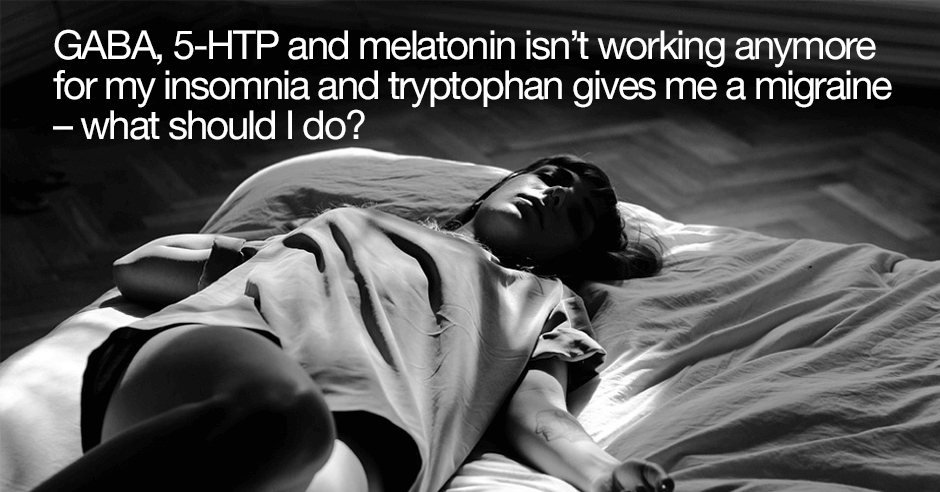
GABA, 5-HTP and melatonin isn’t working anymore for my insomnia and tryptophan gives me a migraine – what should I do?

May 11, 2018 By Trudy Scott 20 Comments

Today I’m addressing a great question I received on a recent tryptophan blog about insomnia and the use of the amino acids GABA and 5-HTP in a combination product together with melatonin, and what the next steps should be when you are not getting the expected results. And if continuing with tryptophan is a good idea when it seems to be causing a migraine and isn’t leading to a whole night’s sleep. Here is the question:

I have suffered from insomnia for most of my life. I just got your book and am loving it! Thank you for all that you do. My symptoms seem to be high for both low GABA and low serotonin [here is the questionnaire].

I also believe I have a blood sugar problem, so I’m starting to follow your suggestions for that.

I’ve been taking a supplement for sleep that has both GABA and 5-HTP in it, along with melatonin. It worked for a year, however it just recently stopped working.

I thought maybe I should try tryptophan. After taking only 220 mg per night, along with 5 mg of melatonin, I was able to sleep, but not through the entire night. However, the next day I woke up with a horrible headache/migraine. I know it was the tryptophan because I did a trial and tried a night without it and then again with it and the nights I took it, sure enough, the migraine would return.

I must add that I had bloodwork done and tested low for melatonin, which is why I was adding the melatonin into my protocol.

My question is: do I continue with a higher dose of GABA, 5-HTP and melatonin, since it worked for a year i.e. do I up the dosage of the supplement I’ve been taking? Or do I continue trying different doses of tryptophan?

I shared this response in my comment (with some additions for this blog post).

Always first address the nutritional foundational aspects

Firstly, I was glad to hear she is loving my book The Antianxiety Food Solution (my Amazon link) and implementing dietary changes. This is so foundational to any protocol for both anxiety and insomnia. Too often, someone hears me talking about the amazing amino acids and forgets the nutritional basics of real whole food, quality animal protein (like wild fish, pastured eggs and chicken, grass-fed red meat), organic veggies and fruit, healthy fats (like olive oil, coconut oil and butter), fermented foods and broths, and no gluten, caffeine or sugar.

I don’t ever have clients push through

With regards to her trial of tryptophan I shared that I don’t ever have clients push through on a product that is causing any adverse effects, and especially when it’s a migraine. She was smart and trialed the tryptophan twice to make sure it was the tryptophan that caused the migraine and not something else.

Capitalize on what has worked and increase one at a time

With regards to the GABA, 5-HTP and melatonin I shared that I always like to capitalize on what has worked in the past (or is currently working) and would rather increase the 5-HTP and/or melatonin and/or GABA one at a time.

Notice that I said increase these products one at a time. She is taking a combination product so it’s impossible for her to do this. Maybe her GABA levels are now good (because her progesterone levels have improved due to be on a regular zinc supplement or because she has been doing regular yoga sessions) and maybe she needs more serotonin support (because her estrogen levels are off because of recent exposure to xenoestrogens in plastics).

Even though is research showing that a combination product containing GABA and 5-HTP improved sleep and sleep duration more than the use of either of the two amino acids alone, based on her feedback, if we were working together I would have her do each of the GABA, 5-HTP and melatonin separately. This way it’s easy to mix and match and increase one and possibly lower the other, until the ideal combination is found for her unique needs at this time in her life.

She may even find she only needs GABA or only needs 5-HTP or only melatonin. She may also find she needs sublingual melatonin for helping her fall asleep and timed-release melatonin for helping her stay asleep.

She mentions the amino acid questionnaire so it sounds like she is clear on her symptoms: low GABA physical anxiety affecting her sleep and low serotonin mental worry-type of anxiety affecting her sleep. So as she trials the individual amino acids she can see how she does symptom-wise in order to find the ideal amount.

Other factors to consider with insomnia

It’s often straight-forward with the amino acids and the great thing is that one you have the correct combination you will see results in a few days to a few weeks. But There are other factors we may need to consider with insomnia:

  • Keep in mind that 5-HTP can raise cortisol and low blood sugar can indicate adrenal issues so looking at high cortisol as a factor in the sleep problems would be something to consider. A 4-collection saliva test will measure this and my favorite product for lowering high cortisol is Seriphos. Other nutrients for adrenal support may be needed too.
  • Just addressing low blood sugar can often improve insomnia. Eating to support blood sugar swings, early morning sunlight and no blue light after dark can make a world of difference.
  • Other sleep factors we always want to consider: sex hormone imbalances, parasites (they are more active at night and can keep you awake and play a role in high cortisol), accidental gluten exposure, SIBO (small intestinal bacterial overgrowth), candida, sleep apnea and mouth breathing, EMFs (WiFi in the home, commuting with the iphone on, a new cordless phone etc.) and medication side-effects (benzodiazepines are a common one).

I really appreciate questions like this being posted on the blog so others like you also get to benefit. This question also demonstrates just how our needs for certain nutrients can change over time and how we may to keep adjusting what we are doing.

In case you have questions about specific products that I use with clients, here is my supplements blog and more information on GABA for the physical type of anxiety and 5-HTP/tryptophan for the worry-type of anxiety.

Can you relate to this scenario? Feel free to ask your questions about sleep, GABA, 5-HTP, tryptophan and melatonin and share your experiences with these products and how they have helped you or if you’ve had issues with any of them.
Filed Under: Anxiety, GABA, Insomnia Tagged With: 5-HTP, anxiety, benzodiazepines, cortisol, GABA, insomnia, melatonin, migraine, sleep, tryptophan, worry

Help! I’m worried all the time! Soothe with supplements and tame worry with food!

April 20, 2018 By Trudy Scott 3 Comments

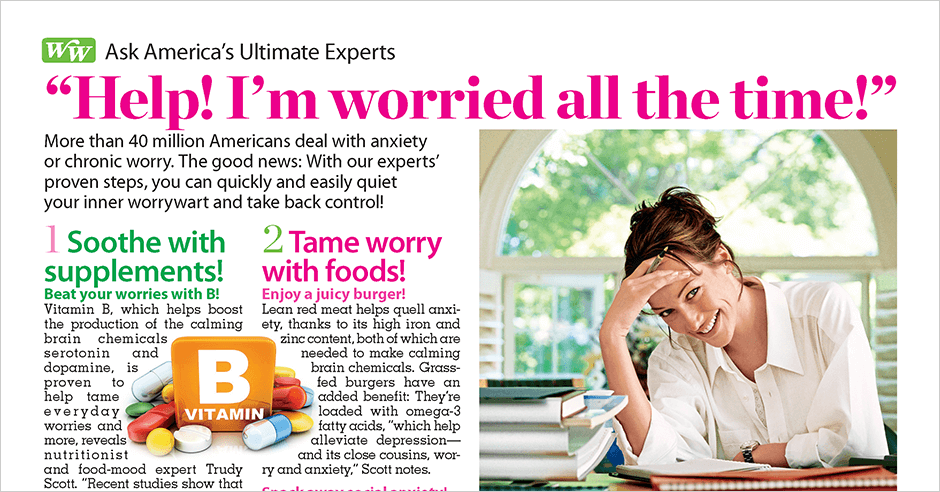
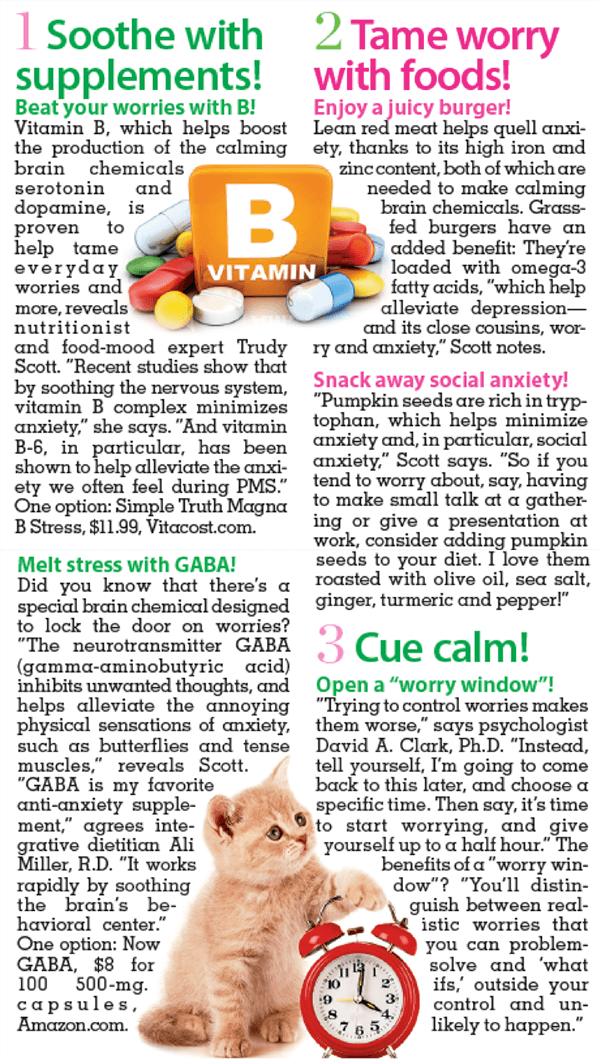
Some of my simple tips for worry were shared in the April edition of Women’s World so here they are for you to enjoy in case you didn’t see them in the magazine. I’m quite chuffed to see it’s for a piece called “Ask America’s Ultimate Experts.”

I share tips about the benefits of a B- complex vitamin (for adrenal support), vitamin B6 (especially for PMS-type anxiety and worry, the calming amino acid called GABA, plus the mood-boosting and calming benefits of a grass-fed burger (loaded with zinc, iron and omega-3s) and pumpkin seeds as a snack (because they’re rich in both tryptophan and zinc)

Here are my tips from the article:

#1 Soothe with supplements

Here are some supporting articles and research for some of the above tips. A good B- complex vitamin for adrenal support has been shown to minimize psychological stress after a natural disaster and vitamin B6 (or pyridoxine) helps with PMS-type anxiety and worry.

A paper titled Pyridoxine in the treatment of premenstrual syndrome: a retrospective survey in 630 patients, reports the following results:

The daily doses of pyridoxine hydrochloride varied from 40 to 100 mg early in the study and from 120 to 200 mg in the later period of the investigations. The response to treatment was recorded as good (no significant residual complaints) in 40 per cent or more of patients taking 100-150 mg pyridoxine daily and in 60 per cent of patients treated with 160-200 mg daily. Together with partial response (useful benefit but still some significant complaints), the positive effect of the treatment increased to 65-68 per cent and 70-88 per cent respectively. No symptoms consistent with a diagnosis of peripheral neuropathy were reported

The calming amino acid called GABA helps with the physical-tension and stiff-and-tense-muscles type of anxiety and helps with worry and inhibition of unwanted thoughts.

#2 Tame worry with foods

Professor Felice Jacka, nutritional psychiatry researcher, discusses the mood-boosting and calming benefits of grass-fed beef (loaded with zinc, iron and omega-3s) on our Anxiety Summit interview: The Research – Food to prevent and treat anxiety and depression?

Pumpkin seeds are rich in tryptophan and zinc and research shows that a functional food made from these seeds actually helps with social anxiety.

Here are a few minor discrepancies in the above sections:

  • In #1 dopamine is not a calming brain chemical but instead it’s stimulating and helps with focus and motivation. The B vitamin mentioned contain folic acid whereas methyl folate is the preferred choice.
  • In #2 the GABA product recommended is 500mg and I find starting much lower is a more effective approach with my clients.

#3 Cue calm – open a worry window

Opening a worry window is a new approach for me and I’d love to hear if it helps you now or has helped you in the past.

Anti-anxiety gummies and low serotonin

Ali Miller, RD, shares a recipe for anti-anxiety gummies (you can see it in the PDF) and I love that it includes coconut water, ginger and turmeric. I’d replace the cup of orange juice (which is high in sugar) with water and use 2 tablespoons instead. Be sure to watch that these gelatin gummies don’t make your anxiety (or depression or sleep worse). It’s a small amount of gelatin but if you’re eating a lot of them and you’re prone to low serotonin, this may be a problem for you. I write about this in a blog post here – Collagen and gelatin lower serotonin: does this increase your anxiety and depression? If it does cause an adverse reaction it doesn’t mean you can’t eat them, instead it simply means you may need to take tryptophan when eating them (if low serotonin is the issue.

If you’d like a PDF of the article you can grab a copy here.

I’d love to hear if any of these approaches have helped you or your clients/patients. Keep in mind that it’s a fun article that is by no means comprehensive in terms of addressing all the possible root causes of anxiety.

Filed Under: Anxiety Tagged With: anxiety, B-complex, food, GABA, grass-fed red meat, omega-3s, pumpkin seeds, supplements, vitamin B6, Women’s World, worry, zinc

GABA helps with inhibition of unwanted thoughts

November 17, 2017 By Trudy Scott 74 Comments

There is plenty of research and clinical evidence showing that low serotonin promotes worry and ruminating thoughts and we know that using tryptophan (or 5-HTP) can help with easing these worries and unwanted thoughts i.e. the worry-in-the-head type of anxiety.

The calming supplement GABA has long been recognized to help ease the more physical type of anxiety where you feel body tension and may have stiff and tense muscles.

Over the last year I’ve been getting feedback from women in my community saying that oral GABA supplements also helps some of the head symptoms too and now we have some new research supporting the possible mechanism of this – Scientists identify mechanism that helps us inhibit unwanted thoughts:

We are sometimes confronted with reminders of unwanted thoughts – thoughts about unpleasant memories, images or worries. When this happens, the thought may be retrieved, making us think about it again even though we prefer not to. While being reminded in this way may not be a problem when our thoughts are positive, if the topic was unpleasant or traumatic, our thoughts may be very negative, worrying or ruminating about what happened, taking us back to the event.

Scientists have identified a key chemical within the ‘memory’ region of the brain that allows us to suppress unwanted thoughts, helping explain why people who suffer from disorders such as anxiety, post-traumatic stress disorder (PTSD), depression, and schizophrenia often experience persistent intrusive thoughts when these circuits go awry.

Professor Anderson, Dr. Schmitz and colleagues showed that the ability to inhibit unwanted thoughts relies on a neurotransmitter – a chemical within the brain that allows messages to pass between nerve cells – known as GABA.

GABA is the main ‘inhibitory’ neurotransmitter in the brain, and its release by one nerve cell can suppress activity in other cells to which it is connected.

Anderson and colleagues discovered that GABA concentrations within the hippocampus – a key area of the brain involved in memory – predict people’s ability to block the retrieval process and prevent thoughts and memories from returning.

The study is looking at GABA concentrations within the hippocampus and there is no mention of the use of GABA supplementation to enhance this process:

While the study does not examine any immediate treatments, Professor Anderson believes it could offer a new approach to tackling intrusive thoughts in these disorders.

Ideally the next step will be to study the use of oral GABA supplementation.

Here is the study abstract: Hippocampal GABA enables inhibitory control over unwanted thoughts

UPDATE Jan 28, 2022:

This 2021 paper, Astroglia and Obsessive Compulsive Disorder, supports the low GABA mechanism when it comes to obsessive compulsive disorder/OCD which is characterized by persistent intrusive thoughts (obsessions) and repetitive behaviors (compulsions).

The researcher shares the most prominent theory regarding the underlying mechanisms of OCD and persistent intrusive thoughts (and compulsions):

an increased excitation to inhibition (E/I) ratio due to increased glutamatergic excitation or reduced GABAergic inhibition.

And states that, in astrocytes (a subtype of glial cells), both the glutamate transporter GLT1 and GABA transporter GAT-3 are critical for regulating this balance.   

Feedback on GABA helping with overactive brain and perseveration

When I shared this research on facebook two people commented on how the Source Naturals GABA Calm product I recommend helps them with this aspect of anxiety.

Tiffany shares how Source Naturals GABA Calm helps calm her overactive brain:

I have definitely noticed that sublingual GABA Calm that you suggest helps calm my overactive brain.

Dawn shares how this same GABA product has helped her a lot:

I have an old TBI [traumatic brain injury] and the physiology of PTSD, from childhood trauma, so a double whammy. This sublingual lozenge makes a big difference in my day if I start to get anxious, or begin to perseverate on something that really isn’t all that important.

Perseverate is not a word I use very much and in case you’re not familiar with this term, the Oxford dictionary defines it as follows: “repeat or prolong an action, thought, or utterance after the stimulus that prompted it has ceased.” It’s also defined as: “the tendency of an idea to stick in your mind or recur, or getting stuck on something mentally and not being able to shift gears.” In psychiatry it’s “the persistent and pathological repetition of a verbal or motor response, often seen in organic brain disease and schizophrenia.”

Updating the GABA questionnaire and GABA blog

I’m using this research and feedback to make an update of the low GABA section on the amino acid questionnaire:

  • Do you have intrusive thoughts, perseverate or have an overactive brain? Or do you have unwanted thoughts – thoughts about unpleasant memories, images or worries?

I’ve also updated this recent blog post – Anxiety, compulsive thinking, counting behaviors: gluten, tryptophan and inositol where I to share my feedback on a question I received on how to approach working with a child with anxiety, compulsive thinking and counting behaviors. I mentioned GABA as a possibility but with her symptoms and this new research, a GABA trial would definitely be something to pursue.

Resources if you are new to using GABA as a supplement

If you are new to using the the amino acid GABA as a supplement, here is the Amino Acids Mood Questionnaire from The Antianxiety Food Solution (you can see the low GABA and other low neurotransmitter symptoms) and a brief overview here: Anxiety and targeted individual amino acid supplements: a summary.

If you suspect low levels of GABA and do not yet have my book, The Antianxiety Food Solution – How the Foods You Eat Can Help You Calm Your Anxious Mind, Improve Your Mood, and End Cravings, I highly recommend getting it and reading it before jumping in and using amino acids so you are knowledgeable. And be sure to share it with the team you or your loved one is working with.

The book doesn’t include product names (per the publisher’s request) so this blog, The Antianxiety Food Solution Amino Acid and Pyroluria Supplements, lists the GABA products that I use with my individual clients and those in my group programs.

I’d love your feedback

  • Do you resonate with any of this and have you seen this benefit when using GABA, in addition to the relief of physical anxiety?
  • If you’ve also observed improvements in your ruminating thoughts when using tryptophan, I’d love you to try and share how GABA helps and how tryptophan helps i.e. how you feel before and after with each supplement?
  • Also, if you are also using tryptophan and/or 5-HTP how do you know if it’s these amino acids or the GABA that is helping?
  • I’m really looking for the differences you observe as you support low GABA vs low serotonin?  Are they clear or are they blurred?
  • If you’re a practitioner what feedback do you get from your clients/patients about low GABA vs low serotonin?

As I mention above I would love to see follow-on research showing that sublingual GABA supplements can actually shift this. Sharing what we see clinically will be very helpful so your feedback is valuable and appreciated.

Feel free to ask your questions here too.

Filed Under: GABA Tagged With: anxiety, GABA, intrusive thoughts, overactive brain, perseverate, ruminating thoughts, tryptophan, worry

GABA is calming for me, doesn’t work for my daughter’s anxiety and makes my son sleepy

June 23, 2017 By Trudy Scott 10 Comments

I’m sharing this question I received on my GABA Calm blog to illustrate how different people respond to GABA and how some people may not even have the low GABA type of anxiety. Here is the question this mom posted:

I have used GABA (several brands, just open capsule and sprinkle small amount under tongue) for years now, with calming results within minutes. It was recommended to me by 2 family members, both bi-polar, who were tested by Dr. Amen. I have also used it with my children (now adults); my daughter says it doesn’t work for her. (She has anxiety issues and occasional panic attacks, and Rescue Remedy helps her.) It does work to calm my 3 sons, but one says it makes him sleepy, and lasts into the next day, so he won’t take it. Trudy, have you heard of this reaction? It seems extreme for such a small amount used. He is a college student and ‘medicates’ with caffeine, if that makes a difference.

She shared that she uses 500mg or 750mg capsules of GABA, and get several doses from a single cap (so maybe 100mg per dose).

This is what I shared with her: we are all biochemically different and one form of GABA (or GABA combined with other amino acids/nutrients such as GABA Calm) may work for one person and not another. Also one person may need more and another may do fine with much much less. Also anxiety has many underlying causes, with low GABA only being one of them.

If I was working with your daughter I’d have her trial higher amounts of GABA for the anxiety and panic attacks. I’d also look into low serotonin and a trial of tryptophan too especially if her anxiety is the worry, ruminating anxiety with insomnia and the blues, with increased afternoon and evening cravings for carbs and chocolates.

If I was working with your son, because it does work to calm him, I’d start by having him trial just 25mg of GABA and increase slowly from there, monitoring how he feels. His anxiety may also be related to his caffeine consumption – which can also affect sleep and the fatigue he feels in the morning could be related to that.

Note: She did ask this question on the GABA Calm blog and was planning to have them trial this form of GABA. I typically don’t have clients use GABA Calm at night (because of the tyrosine) but it’s certainly worth a trial especially with her son.

If you’re completely new to the amino acids for anxiety here is an overview with questionnaire, precautions and how to do a trial.

Filed Under: GABA Tagged With: anxiety, calming, GABA, GABA Calm, serotonin, sleepy, worry

The S3xy Younger You series

October 3, 2012 By Trudy Scott 4 Comments


I’m loving the SYY series hosted by Robin Nielsen, NC, and Dr. Anna Cabeca. I’m getting gems from everyone!

Do you want to learn from 25 leading health and relationship experts (including yours truly!) who will teach you how to reclaim a healthier, more vibrant and s3xy you—at any age!

Do you jump out of bed with tons of energy and feel on top of the world every single day? Or are you starting to feel your age? Creaky? Aches and pains? More tired and less vibrant? Blah? More stressed and anxious? Have hormonal imbalances? Are moody? If you answered yes to any of these, then you must join us!

Here are a few gems from some of the speakers I’ve heard so far:

Liz Lipski, author of Digestive Wellness, spoke on the importance of digestive health and she said “Food is the most intimate contact we have with our external environment”. She also talked about the digestive benefits of eating umbeloshi plums and how they help increase low stomach acid.

Jonny Bowden, the Rogue Nutritionist and author of The 150 Healthiest Foods on Earth, talked about our need for good quality supplements. He said “we don’t NEED indoor plumbing and do we want minimum-wage health or optimal health?” Jonny had a lot of good stuff to say about heart disease and cholesterol. “If you are taking statin medications, add CoQ10 right away!” and that “red yeast rice must also be taken with CoQ10.” But he ended by saying “I don’t think lowering cholesterol is important, rather worry about inflammation”. I’m so on board with this approach.

Leanne Ely said “Cooking a meal for someone is an act of love”. She shared great information on the dangers of GMOs. She also talked about her very affordable hard clay water filtration system that makes pond water potable. It’s called the Berkefeld, was created during World War II and lasts years and years! I’m definitely going to look into this one!

Dr. Alan Christianson is author of The Complete Idiot’s Guide to Thyroid Disease and his interview about thyroid health was so informative! Something that I found so interesting was this: if you have an underactive thyroid, too much thyroid support can actually lead to worse symptoms. There is a delicate balance for you to feel ideal.

There are still many great speakers yet to come so please do join us. The best part is this – if you listen live (or listen to the 24 hour replays) there’s no cost to attend. If you’d like to purchase recordings or transcripts, you have this option too.

It’s happening right here, on your computer or telephone. And you can participate from anywhere in the world.

This series is top-quality cutting-edge health advice from amazing practitioners and everyone needs to hear this information! I am thrilled and honored that Robin and Dr Anna have asked me to be one of their 25 expert speakers. I’ll be sharing how to overcome midlife anxiety with a nutritional and lifestyle approach – so you can say goodbye to anxiety, stress, overwhelm, panic attacks, mood swings, depression and sugar cravings.

Filed Under: Anxiety and panic, Food and mood, Joy and happiness, Real whole food, Women's health Tagged With: anxiety, Dr Anna Cabeca, Robin Nielsen, sexy younger you, worry

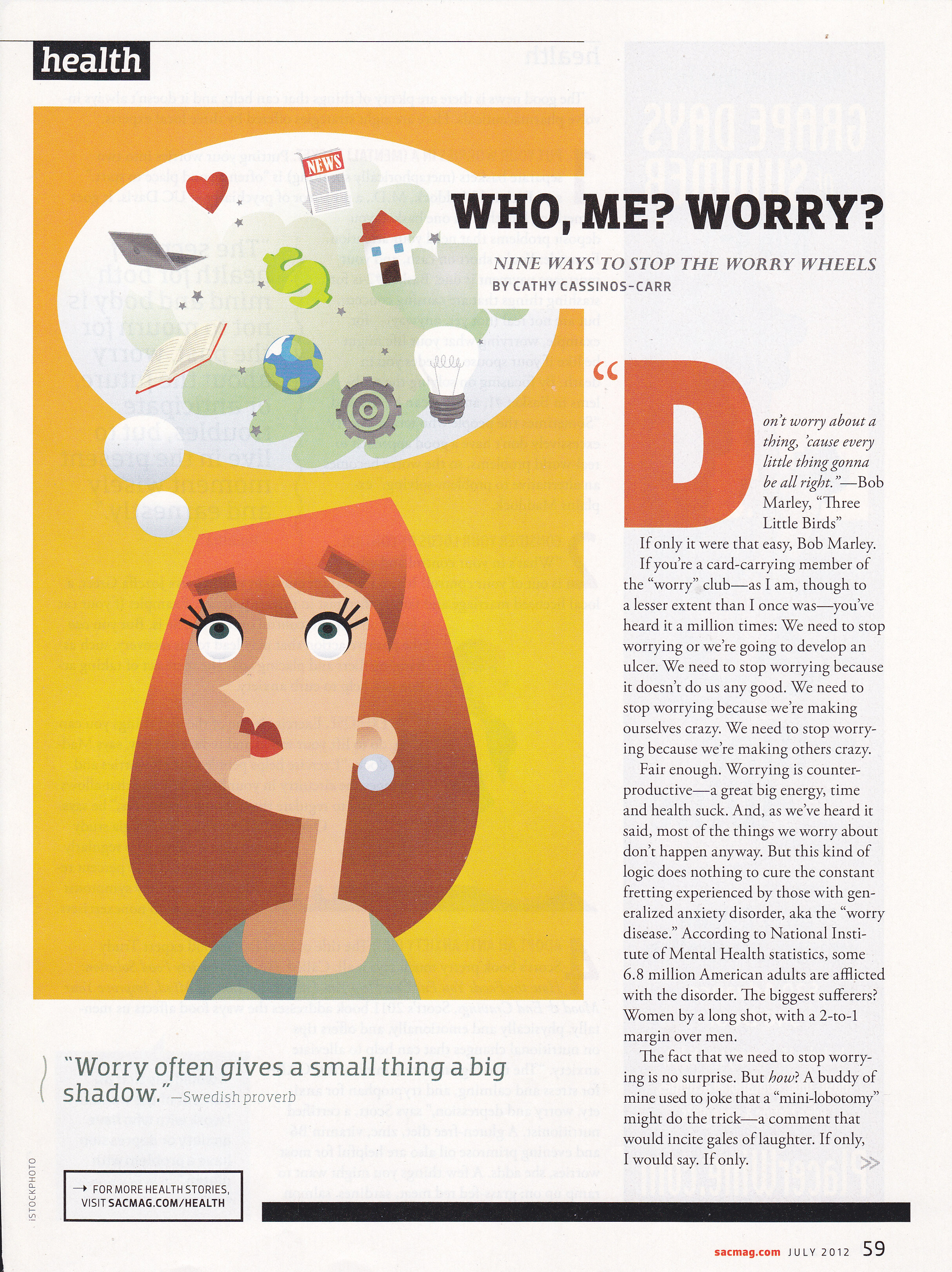
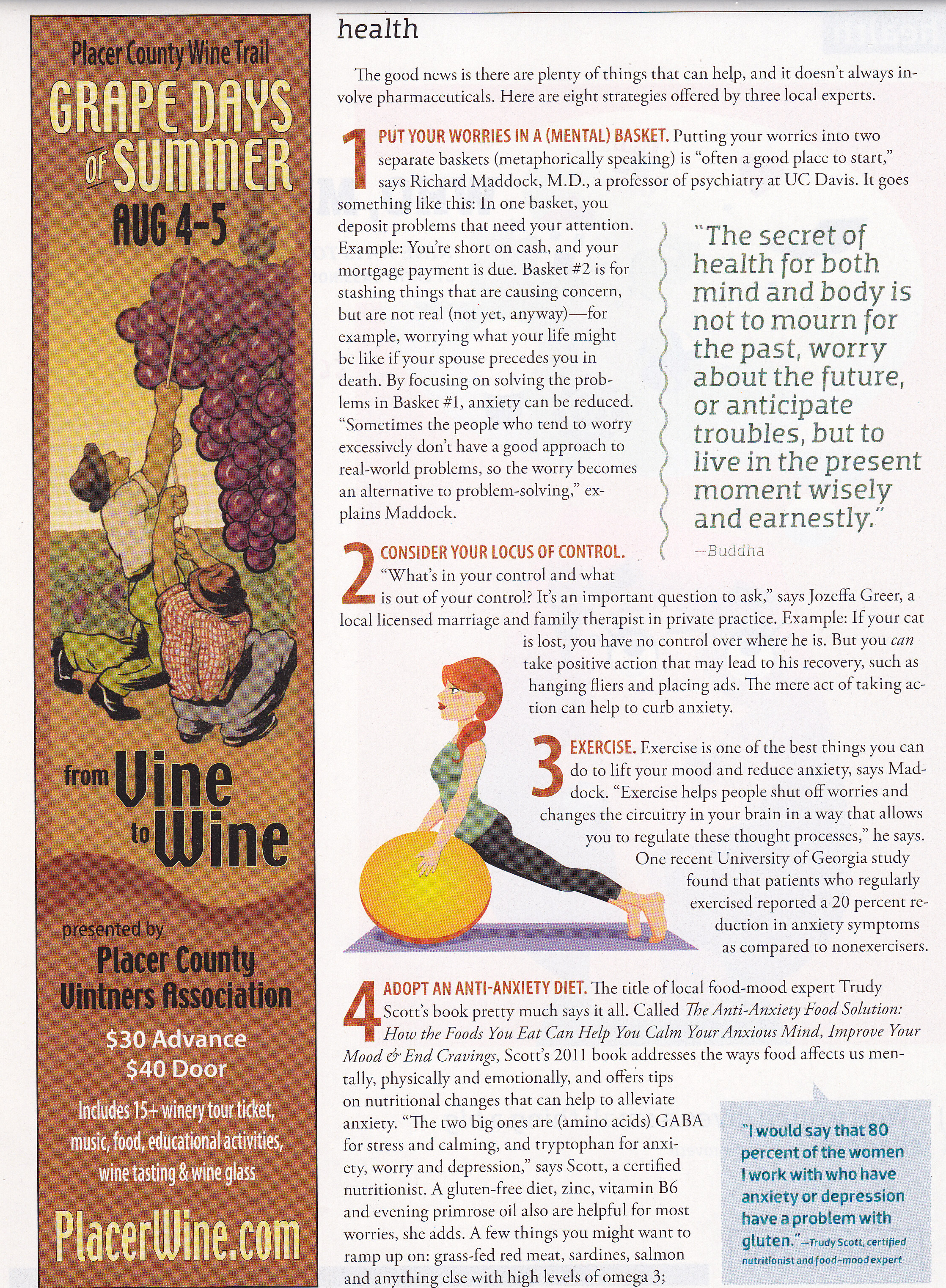
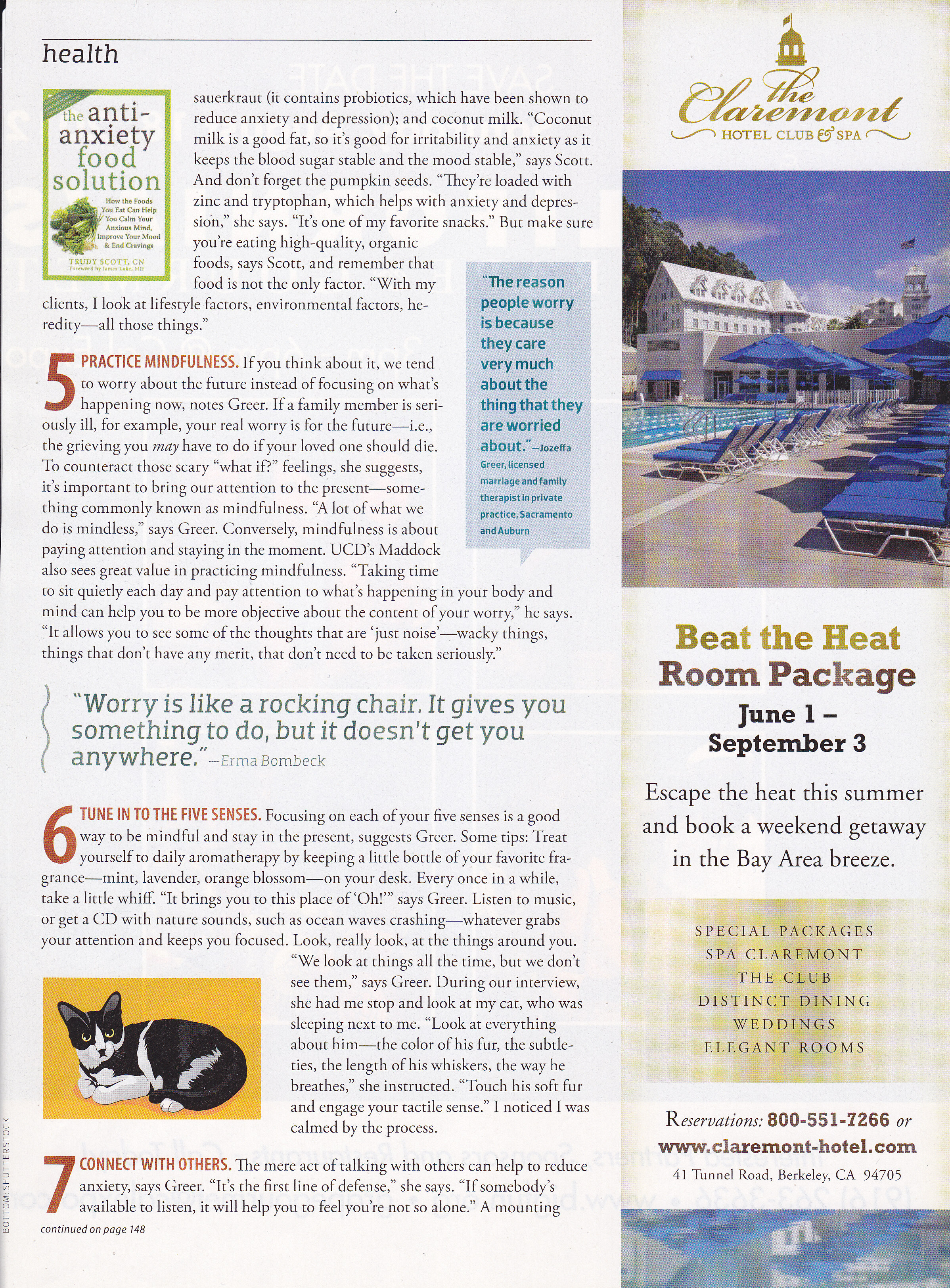
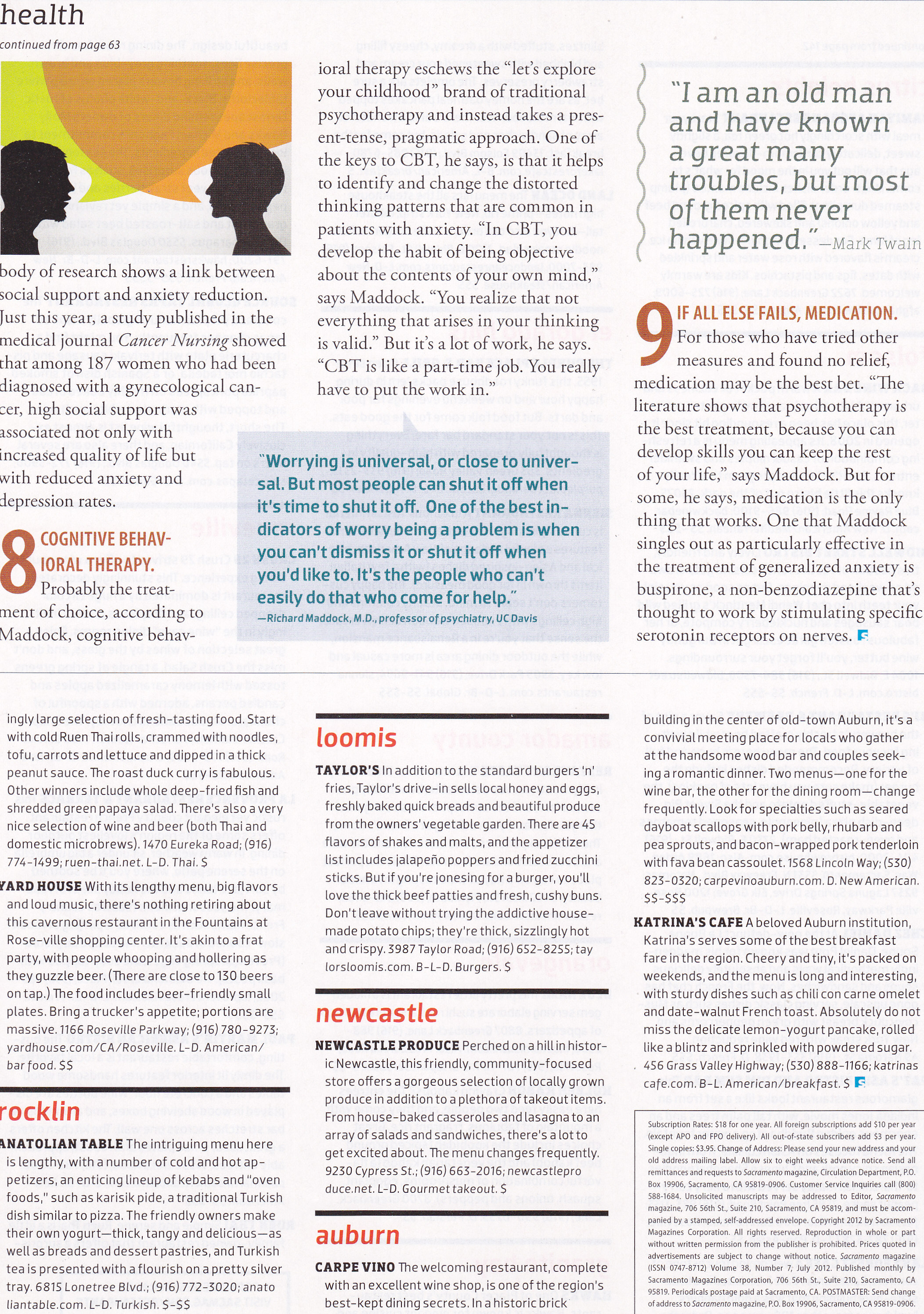
Nine Ways to Stop the Worry Wheels in the Sacramento Magazine

October 3, 2012 By Trudy Scott 10 Comments

Here are Nine Ways to Stop the Worry Wheels. These were featured in the July edition of the Sacramento Magazine. I’m thrilled to have contributed to this super article and I am happy to share it with you here! I hope you enjoy it and find these nine ways helpful for stopping your worry wheels and anxiety.

  1. Put your worries in a (mental) basket
  2. Consider your locus of control
  3. Exercise
  4. Adopt an antianxiety diet
  5. Practice mindfulness
  6. Tune in to the five senses
  7. Connect with others
  8. Cognitive behavioral therapy
  9. If all else fails, medication

I really like that this fits in perfectly with the holistic approach that Richard and C.R. Zwolinki advocate on their Therapy Soup blog on Psychcentral

(Click on each image below to enlarge.)

Yet again, writer Cathy Cassinos-Carr has done an excellent job with this article. You can read another of her great articles here: Sweet Misery: Seven spoonfuls of wisdom about sugar

If you’d like more information on the antianxiety diet, a great resource is my book The Antianxiety Food Solution: How the Foods You Eat Can Help You Calm Your Anxious Mind, Improve Your Mood and End Cravings, available in major books stores, at Amazon and via www.antianxietyfoodsolution.com

Filed Under: Antianxiety Food Solution, Anxiety and panic, Food and mood, Joy and happiness, Real whole food Tagged With: antianxiety diet, anxiety, exercise, Sacramento magazine, worry

  • « Go to Previous Page
  • Page 1
  • Page 2
  • Page 3
  • Page 4

Primary Sidebar

NEW! GABA QuickStart Homestudy (with special intro pricing)

gaba quickstart homestudy

Free Report

9 Great Questions Women Ask about Food, Mood and their Health

You'll also receive a complimentary subscription to my ezine "Food, Mood and Gal Stuff"


Connect with me

Popular Posts

  • Amino Acids Mood Questionnaire from The Antianxiety Food Solution
  • The Antianxiety Food Solution Amino Acid and Pyroluria Supplements
  • Pyroluria Questionnaire from The Antianxiety Food Solution
  • Collagen and gelatin lower serotonin: does this increase your anxiety and depression?
  • Tryptophan for the worry-in-your-head and ruminating type of anxiety
  • GABA for the physical-tension and stiff-and-tense-muscles type of anxiety
  • The Antianxiety Food Solution by Trudy Scott
  • Seriphos Original Formula is back: the best product for anxiety and insomnia caused by high cortisol
  • Am I an anxious introvert because of low zinc and vitamin B6? My response to Huffington Post blog
  • Vagus nerve rehab with GABA, breathing, humming, gargling and key nutrients

Recent Posts

  • What do I use instead of Seriphos to help lower high cortisol that is affecting my sleep and making me anxious at night?
  • BeSerene™ GABA/theanine cream eases severe muscle tension in her neck/shoulders, prevents her bad headaches and quells her anxiety
  • How the correct approach, dose and sublingual use of GABA can be calming and not cause a flushed and itchy face and neck
  • The amino acid glutamine improves low mood by addressing gut health, and it has calming effects too
  • Flight anxiety with heightened breath, physical tension and also fearing the worst (the role of low GABA and low serotonin)

Categories

  • 5-HTP
  • AB575
  • Addiction
  • ADHD
  • Adrenals
  • Alcohol
  • Allergies
  • Alzheimer's disease
  • Amino Acids
  • Anger
  • Antianxiety
  • Antianxiety Food Solution
  • Antidepressants
  • Anxiety
  • Anxiety and panic
  • Autism
  • Autoimmunity
  • benzodiazapines
  • Bipolar disorder
  • Books
  • Caffeine
  • Cancer
  • Candida
  • Children/Teens
  • Collagen
  • Cooking equipment
  • Coronavirus/COVID-19
  • Cravings
  • Depression
  • Detoxification
  • Diabetes
  • Diet
  • DPA/DLPA
  • Drugs
  • EFT/Tapping
  • EMF
  • EMFs
  • Emotional Eating
  • Endorphins
  • Environment
  • Essential oils
  • Events
  • Exercise
  • Fear
  • Fear of public speaking
  • Fertility and Pregnancy
  • Fish
  • Food
  • Food and mood
  • Functional neurology
  • GABA
  • Gene polymorphisms
  • General Health
  • Giving
  • Giving back
  • Glutamine
  • Gluten
  • GMOs
  • Gratitude
  • Gut health
  • Heart health/hypertension
  • Histamine
  • Hormone
  • Hyperparathyroidism
  • Hypoglycemia
  • Immune system
  • Inflammation
  • Insomnia
  • Inspiration
  • Introversion
  • Joy and happiness
  • Ketogenic diet
  • Lithium orotate
  • Looking awesome
  • Lyme disease and co-infections
  • MCAS/histamine
  • Medication
  • Men's health
  • Mental health
  • Mercury
  • Migraine
  • Mold
  • Movie
  • MTHFR
  • Multiple sclerosis
  • Music
  • NANP
  • Nature
  • Nutritional Psychiatry
  • OCD
  • Osteoporosis
  • Oxalates
  • Oxytocin
  • Pain
  • Paleo
  • Parasites
  • Parkinson’s disease
  • PCOS
  • People
  • PMS
  • Postpartum
  • PTSD/Trauma
  • Pyroluria
  • Questionnaires
  • Real whole food
  • Recipes
  • Research
  • Schizophrenia
  • serotonin
  • SIBO
  • Sleep
  • Special diets
  • Sports nutrition
  • Stress
  • Sugar addiction
  • Sugar and mood
  • Supplements
  • Teens
  • Testimonials
  • Testing
  • The Anxiety Summit
  • The Anxiety Summit 2
  • The Anxiety Summit 3
  • The Anxiety Summit 4
  • The Anxiety Summit 5
  • The Anxiety Summit 6
  • Thyroid
  • Thyroid health
  • Toxins
  • Tryptophan
  • Tyrosine
  • Uncategorized
  • Vegan/vegetarian
  • Women's health
  • Yoga

Archives

  • October 2025
  • September 2025
  • August 2025
  • July 2025
  • June 2025
  • May 2025
  • April 2025
  • March 2025
  • February 2025
  • January 2025
  • November 2024
  • October 2024
  • September 2024
  • August 2024
  • July 2024
  • June 2024
  • May 2024
  • April 2024
  • March 2024
  • February 2024
  • January 2024
  • December 2023
  • November 2023
  • October 2023
  • September 2023
  • August 2023
  • July 2023
  • June 2023
  • May 2023
  • April 2023
  • March 2023
  • February 2023
  • January 2023
  • December 2022
  • November 2022
  • October 2022
  • September 2022
  • August 2022
  • July 2022
  • June 2022
  • May 2022
  • April 2022
  • March 2022
  • February 2022
  • January 2022
  • December 2021
  • November 2021
  • October 2021
  • September 2021
  • August 2021
  • July 2021
  • June 2021
  • May 2021
  • April 2021
  • March 2021
  • February 2021
  • January 2021
  • December 2020
  • November 2020
  • October 2020
  • September 2020
  • August 2020
  • July 2020
  • June 2020
  • May 2020
  • April 2020
  • March 2020
  • February 2020
  • January 2020
  • December 2019
  • November 2019
  • October 2019
  • September 2019
  • August 2019
  • July 2019
  • June 2019
  • May 2019
  • April 2019
  • March 2019
  • February 2019
  • January 2019
  • December 2018
  • November 2018
  • October 2018
  • September 2018
  • August 2018
  • July 2018
  • June 2018
  • May 2018
  • April 2018
  • March 2018
  • February 2018
  • January 2018
  • December 2017
  • November 2017
  • October 2017
  • September 2017
  • August 2017
  • July 2017
  • June 2017
  • May 2017
  • April 2017
  • March 2017
  • February 2017
  • January 2017
  • December 2016
  • November 2016
  • October 2016
  • September 2016
  • August 2016
  • July 2016
  • June 2016
  • May 2016
  • April 2016
  • March 2016
  • February 2016
  • January 2016
  • December 2015
  • November 2015
  • October 2015
  • September 2015
  • August 2015
  • July 2015
  • June 2015
  • May 2015
  • April 2015
  • March 2015
  • February 2015
  • January 2015
  • December 2014
  • November 2014
  • October 2014
  • September 2014
  • August 2014
  • July 2014
  • June 2014
  • May 2014
  • April 2014
  • March 2014
  • February 2014
  • January 2014
  • December 2013
  • November 2013
  • October 2013
  • September 2013
  • August 2013
  • July 2013
  • June 2013
  • May 2013
  • April 2013
  • March 2013
  • February 2013
  • January 2013
  • December 2012
  • November 2012
  • October 2012
  • August 2012
  • July 2012
  • June 2012
  • May 2012
  • April 2012
  • March 2012
  • February 2012
  • January 2012
  • December 2011
  • November 2011
  • October 2011
  • September 2011
  • August 2011
  • July 2011
  • June 2011
  • May 2011
  • April 2011
  • March 2011
  • February 2011
  • January 2011
  • December 2010
  • October 2010
  • September 2010
  • July 2010
  • May 2010
  • April 2010
  • March 2010
  • February 2010
  • January 2010
  • November 2009

Share the knowledge!

The above statements have not been evaluated by the Food and Drug Administration. Products listed in this website are not intended to diagnose, treat, cure or prevent any disease.

The information provided on this site is for informational and educational purposes only and is not intended as a substitute for advice from your physician or other health care professional. You should consult with a healthcare professional before starting or modifying any diet, exercise, or supplementation program, before taking or stopping any medication, or if you have or suspect you may have a health problem.


Copyright © 2026 Trudy Scott. All Rights Reserved. | Privacy | Terms and Conditions | Refund Policy | Medical Disclaimer

Free Report

9 Great Questions Women Ask about Food, Mood and their Health

You’ll also receive a complimentary subscription to my ezine “Food, Mood and Gal Stuff”