• Skip to primary navigation
  • Skip to main content
  • Skip to primary sidebar

everywomanover29 blog

Food, Mood and Women's Health – Be your healthiest, look and feel great!

  • Blog
  • About
  • Services
  • Store
  • Resources
  • Testimonials
  • The Book
  • Contact
  • Search this site

migraines

How the correct approach, dose and sublingual use of GABA can be calming and not cause a flushed and itchy face and neck

October 10, 2025 By Trudy Scott 12 Comments

correct use of gaba

I started GABA 750mg and think it gently chills out my anxiety a bit, however 20 minutes after I take it, I feel flushed and itchy in my face and neck. This lasts for 5 minutes and then goes away.

I am in a migraine program with a health coach who has referenced your book several times. She recommended I stop it because it sounds like an allergy. I personally would think it would last longer if it was an allergy.

What do you think? Have you heard of this reaction before? I thought it would maybe get better as my body gets used to taking it? I wanted to continue because I think it’s helping. Thank you.

Sharon posted the above feedback about her promising calming results with GABA and her flushed/itchy question on one of the blogs.  She also asked this:

Just read other posts and I’m just beginning to learn all of this info on your site. I’m also getting your book. Looks like I may have started too high? Could I open up one of my capsules and just take powder orally and then work up?

Read on below to learn more about the fact that too much GABA does cause flushing; the correct approach, dose and sublingual use of GABA for Sharon; Holly’s similar story with 750mg GABA; and GABA, serotonin and endorphin support for Sharon’s other symptoms (headaches, migraines, PMS, sleep issues and rectal spasms); plus additional resources when are new to amino acids such as GABA, 5-HTP, DPA and others.

Too much GABA does cause a flush feeling

Firstly, it’s wonderful that GABA gently chills out Sharon’s anxiety a bit. And she is correct – her flush and itchy face and neck is unlikely to be an allergic reaction. Too much GABA does cause a niacin-like flush or tingling feeling and yes, I have heard of this reaction many times. Unfortunately it leads to many people giving up on GABA when they really do need it.

Sharon shared this: “I thought it would maybe get better as my body gets used to taking it?”  Unfortunately, many individuals think the same and end up pushing through the discomfort and it’s not what I advise. She was wise in exercising caution and finding out by reading more on the blog, getting a copy of my book, The Antianxiety Food Solution and asking on the blog.

I have no idea why supplement companies produce such a high dose GABA product and it’s something I caution all my clients and GABA Quickstart program participants about.

The correct approach, dose and sublingual use of GABA for Sharon

Sharon also acknowledges she probably started with too high a dose and asks about opening up the GABA capsule and working her way up. This is exactly what we need to do to get results with GABA and not cause new issues.

Some other options to opening the GABA capsule could be:

  • a GABA only powder
  • a GABA sublingual product (such as GABA Calm)
  • a liposomal GABA product
  • a GABA cream (she reported migraines and neck tension so a cream may be a good option for her too)

I also have clients start with only one amino acid product and find the ideal dose before adding the next amino acid acid. And track results carefully so they can course correct, adjusting up or down as needed.

Sharon did come back and comment a week later sharing this adjustment she had made:

So I have been opening the GABA capsule and taking half a dose (so 375mg) on my tongue in the morning and then in the afternoon. I don’t notice the real calm like I did with the whole capsule though.

She’s on the right track and the next step could be to use three-quarters of a dose twice a day and see how that helps. Another option is half a dose, maybe 4 x day. There is no one-size fits all and it’s a matter of Sharon finding what works best for her unique needs.

Keep in mind that for some individuals even 375mg is too high a dose. I typically have clients start with 125mg GABA and less if they are super-sensitive.

Holly’s story with 750mg GABA is very similar

I’ve actually blogged about this before: Too much GABA causes a tingling niacin-like flush sensation (in the brain and body). It’s awful and very uncomfortable!) and shared Holly’s niacin-like flush result when using the same dose:

I experienced the niacin-like flush when I tried to go from GABA Calm [mostly dissolved in my mouth] to a pill form and didn’t realize the dosage would be way too high all at one time. The pill was 750 mg GABA [and swallowed with food], so it wasn’t going to work well anyway.

The flush lasted about 15-20 minutes. It was awful. I was sure I was going to throw up every time.

It took me a couple of weeks to figure out the cause.  My therapist recommended your website and book and those helped me understand when to take it and why it would help.

When I eliminated the 750 mg GABA  pill the symptoms completely went away.

Now I stick to GABA Calm. I take one in the morning and one before bed and sometimes one midday.

You can read more about this flush feeling on the above blog and another example.

GABA, serotonin and endorphin support for Sharon’s other symptoms

Sharon also has headaches, migraines, PMS, sleep issues and rectal spasms:

I’ve got chronic headaches and frequent migraines. Other weird symptoms are lip dermatitis, hormone imbalance, PMS, and rare rectal spasms which I saw referenced on your site too. Serotonin issues too and I also recently started 5-HTP 200mg at night which seems to be helping my PMS insomnia.

It’s great that 5-HTP is helping her PMS-related sleep issues. Both GABA and 5-HTP (for serotonin support) may help with her hormone balance, which in turn, may help with her headaches and migraines too. She may also want to consider a trial of d-phenylalanine/DPA for endorphin support/pain relief. GABA itself helps to ease neck tension and headaches.

GABA does stop very painful rectal spasms very quickly. More about this here – GABA lozenge relieves excruciating pelvic floor/rectal pain and spasms within 30 seconds: a solution for proctalgia fugax.

As I mentioned above, I have clients and those in the GABA Quickstart program start with GABA and find the ideal dose before adding the next amino acid acid. For Sharon, I’d recommend that she finds her ideal dose of GABA before bumping up her 5-HTP and adding DPA.

Additional resources when you are new to using GABA or other amino acids as supplements

We use the symptoms questionnaire to figure out if low GABA (indicating a possible need for GABA or theanine) or low serotonin (indicating a need for tryptophan or 5-HTP) or low endorphins (indicating a possible need for DPA) or other neurotransmitter imbalances may be an issue for you.

If you suspect low levels of any of the neurotransmitters and do not yet have my book, The Antianxiety Food Solution – How the Foods You Eat Can Help You Calm Your Anxious Mind, Improve Your Mood, and End Cravings. I highly recommend getting it and reading it before jumping in and using amino acids on your own so you are knowledgeable. And be sure to share it with the practitioner/health team you or your loved one is working with.

There is an entire chapter on the amino acids and they are discussed throughout the book in the sections on gut health, gluten, blood sugar control, sugar cravings, anxiety and mood issues. The importance of quality animal protein and healthy fats is also covered.

The book doesn’t include product names (per the publisher’s request) so this blog, The Antianxiety Food Solution Amino Acid and Pyroluria Supplements, lists the amino acids that I use with my individual clients and those in my group programs.

If, after reading this blog and my book, you don’t feel comfortable figuring things out on your own (i.e. doing the symptoms questionnaire and respective amino acids trials), a good place to get help is the GABA QuickStart Program (if you have low GABA symptoms). This is a paid online/virtual group program where you get my guidance and community support.

If you also need serotonin support, the Serotonin QuickStart Program is a good place to get help. This is also a paid online/virtual group program where you get my guidance on using tryptophan and 5-HTP safely, and community support during 5 LIVE Q&A calls. You can sign up to be notified when the next live launch of this program is happening.

If you are a practitioner, join us in The Balancing Neurotransmitters: the Fundamentals program. This is also a paid online/virtual program with an opportunity to interact with me and other practitioners who are also using the amino acids.

Now I’d love to hear from you…

I appreciate Sharon and Holly for sharing their experiences and asking questions. I’m hoping their stories have enlightened you!

And I am thrilled that her migraine health coach referenced my book and told her about GABA. It’s a great book that many practitioners share with their clients and patients.

Have you experienced this uncomfortable feeling when using too much GABA? And did you learn to use less in order to get the calming benefits of GABA?

How much do you find helps? And do you use powder or capsules opened or liposomal or cream?

Has serotonin or endorphin support helped too?

Feel free to share and ask your questions below.
Filed Under: Anxiety, GABA Tagged With: 5-HTP, 750mg, allergy, amino acids, anxiety, calming, chill, dose, DPA, endorphin, flushed, flushing, GABA, Headaches, itchy, migraines, PMS, rectal spasms, serotonin, sleep issues, sublingual, too high

Botox injections (cosmetic or non-cosmetic): are they a root cause of anxiety and panic attacks?

March 6, 2020 By Trudy Scott 71 Comments

botox injections

New research shows Botox injections are being considered for severe depression and bipolar disorder because it stops frowning and this lack of frowning has a positive impact on neurotransmitters and mood. I recently posted this on Facebook and asked this question:

I’m curious if you have had Botox injections or would consider it (for cosmetic reasons) or perhaps for migraines, dystonia, proctalgia fugax or depression/bipolar?

If you have had Botox injections are you happy with the result or did you have any adverse effects like increased anxiety, panic attacks or anything else?

The response was varied with most folks saying they would never consider using Botox for cosmetic reasons, some folks saying they used Botox for cosmetic reasons and had issues and some folks saying they’ve used Botox for cosmetic reasons and love it, and others who have used Botox for non-cosmetic reasons.

All the practitioners who commented have concerns about Botox saying results are mixed with some of their clients having severe reactions and some doing fine. As I looked further into this topic I’ve gained additional insights and my biggest concern for you, and my community, is that Botox can lead to very severe anxiety and panic attacks.

I encourage you to keep an open mind about my Botox concerns if you have chronic anxiety that is not resolving and it started (or got worse) after receiving Botox injections, or if  you’re considering Botox injections.

Anxiety, panic attacks, inability to handle stress, body shaking

I gained my biggest insights from the Botox Dysport (Side Effects) Support group. Someone suggested I look into this group and I requested an invite to join so I could learn more. So many of the members of this support group  report anxiety, panic attacks, inability to handle stress, body shaking and problems connecting socially.  This is what one member shared:

…just joining the dots, I’ve been unwell for a few years since getting Botox but didn’t put it together until having it last week and going into panic attacks / ER.

Since then extreme anxiety and I’ve ended up in a mental health facility on benzodiazepines (ativan/valium). Reactions / withdrawal has been severe, have started to put it all together whilst reading through this page.

I’m realising that my decline, immune system failure (chronic epstein barr) fatigue, loss of motivation, loss of appetite, shaking in my body, muscle atrophy, anxiety, no motivation to connect socially, can’t handle any stress, can’t relax, tinnitus, breathing trouble and the list goes on is from botox…. scared to say the least as doesn’t seem to be a solution, I was worried to get Botox originally and obviously am eating myself up with regret, thought I would share if anyone has a similar story.

There are many similar posts to this one and it’s heart-breaking, especially because they say they are not being heard by their doctors.

I had a short online conversation with one of the moderators and she shared they suspect Botox is impacting the hypothalamic-pituitary-adrenal (HPA) axis leading to high cortisol and causing their anxiety symptoms. Many of the members find relief with Seriphos, which is a phosphorylated serine product I’ve had great success with. Here is my blog post on Seriphos for anxiety and insomnia related to high cortisol.

I asked if any of the members find GABA or serotonin support helpful and for some GABA helps ease the physical tension and for other members tryptophan or 5-HTP helps ease the worry type of anxiety. However for others, the amino acids seem to have a paradoxical effect and make symptoms worse.

I’ve never been in favor of Botox for cosmetic reasons simply because I’m not a fan of putting foreign objects/toxins into the body and because I believe in aging gracefully with confidence. I do find that many women feel the need for cosmetic Botox injections and other ways to try and look younger (such as breast implants and hair dye) because of low self-esteem and lack of confidence caused by low serotonin.

Botox for non-cosmetic purposes

Botox is also used for non-cosmetic purposes. Some of my neurologist colleagues also have concerns about cosmetic use and will only use Botox injections for the following:

  • severe cases of dystonia
  • migraines (to relax forehead muscles)
  • proctalgia fugax /rectal spasms

Botox may also be used for multiple sclerosis (MS) symptoms, pelvic pain and bladder issues, for TMJ, after a stroke and for chronic anal fissures in colitis (sphincter spasms can prevent anal fissures from healing).

I would love to see safer approaches for non-cosmetic Botox injections being researched and explored by practitioners. For example:

  • Relief of dystonia symptoms using diet, GABA, tryptophan, zinc and vitamin B6
  • Sublingual GABA to help to relax forehead muscles in those with migraines
  • Sublingual GABA for the extremely painful proctalgia fugax. Could this also be considered in colitis patients?

Botox for mental health – we can do better with nutritional psychiatry

At the beginning of this blog I mentioned the new research that shows Botox injections are being considered for severe depression and bipolar disorder because it stops frowning. This lack of frowning has a positive impact on neurotransmitters and mood.

A study published in 2018, Clinical analysis of 86 botulism cases caused by cosmetic injection of botulinum toxin (BoNT), reports that botulism is a severe side effect of Botox injections with symptoms including: “headache, dizziness, insomnia, fatigue, blurred vision, eye opening difficulty, slurred speech, dysphagia [difficulty swallowing], constipation, and anxiety.”

The authors report these symptoms occur in the first 36 days after the Botox injections and that all symptoms resolved after botulinum antitoxin serum injections.

This conclusion clearly doesn’t address why there are so many folks in the Botox Dysport (Side Effects) Support group continue to experience long-term severe symptoms.

We also have research reporting a possible connection between Botox injections and thyroid autoimmunity.

I feel we can do better especially with what we know about nutritional psychiatry, the use of targeted individual amino acids, nutrients like lithium orotate, the gut-brain connections and everything covered in my book The Antianxiety Food Solution (my Amazon link) and on this blog.

A note of appreciation

I’d like to end with a note of appreciation to everyone who commented on my Facebook post, to the members of Botox Dysport (Side Effects) Support group on facebook (with over 5700 members as of this writing).

I’d also like to thank Diane Kazer for asking bold questions about Botox injections as part of her Non-Toxic Beauty Revolution Summit which addresses Botox, breast implant illness, toxins in your cosmetics and so much more. In my interview we talked extensively about the low serotonin/low self-esteem connections which I feel is a big missing piece for helping women who feel the desire or need to use cosmetic Botox in order to feel good and love themselves.

Diane writes about Botox here: Is Botox Safe? Top 3 Concerns & What to do if you’ve had it, sharing a brief history of botox, what she has uncovered about toxicity issues and possible detox solutions.

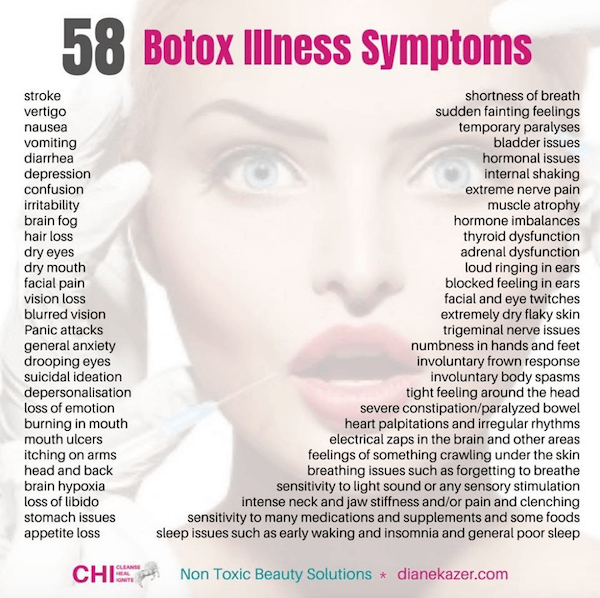
She also created this list of 58 Botox Illness Symptoms which she gave me permission to share here. She compiled this list from 1000+ people who have had Botox injections.

58 botox illness symptoms

Because of Diane asking questions and this initial research I’ve done, I’m adding a question about past history of Botox injections to my client intake form and will be gathering more information from my community of anxious women to see if there are patterns as to why some folks have such bad reactions.

I do feel we need to be asking if Botox injections (cosmetic or non-cosmetic) are a possible root cause of anxiety and panic attacks because they are adding to the toxic burden in susceptible folks.

But I do acknowledge it’s challenging to unwind all the contributing factors because it depends on what is going on with each person, such as their gut health, other medications (benzodiazepines themselves can be problematic), past trauma, infections, poor adrenal health, low GABA, low serotonin, poor detox capacity, low bile production, genetics etc. Unfortunately there is no way to know in advance who will be harmed and if Botox is the tipping point.

Please comment below if you’ve had Botox injections and had adverse reactions or have benefited from them with no adverse reactions. And if you have not had Botox would you ever consider it? Feel free to post your questions too.

Filed Under: Anxiety, Thyroid, Toxins Tagged With: 5-HTP, anxiety, bladder, Botox, botox injections, cosmetic, dystonia, GABA, low confidence, low serotonin, migraines, MS, panic attacks, pelvic, self-esteem, serotonin, TMJ, tryptophan

The best food-mood-nutrient topics of 2017

December 29, 2017 By Trudy Scott Leave a Comment

As we move into 2018, it’s time to recap and share the best of 2017 – from both blog posts and facebook posts. Hopefully these topics have helped you move forward as you address your anxiety symptoms and will help you (and your clients/patients if you’re a practitioner) take even bigger leaps as you move into 2018!

Most popular blog posts

Here are the most popular blog posts of 2017, based on comments and questions. If you have already read one of these and found it interesting at the time of publication, it’s worth a re-read for all the valuable comments/questions and my feedback.

Collagen and gelatin lower serotonin: does this increase your anxiety and depression?

I see everyone raving about gelatin and collagen – and rightly so – they have amazing health benefits. However, no-one is addressing the fact that gelatin is actually used in tryptophan-depletion studies to lower serotonin.

Some people get more anxious and depressed when consuming collagen, some do just fine and some even use it to lower their serotonin. Many need to use it with added tryptophan. I recently made some additional updates to this blog and have more to add so stay tuned for more on this topic.

How much GABA should I use and which GABA product is best?

There is no simple answer! It requires a blog post to provide a good answer because we are all unique, have different needs and these needs can even differ at different times depending on the issue and what is going on in our lives at the moment.

My Kid is Not Crazy and PANS/PANDAS awareness day 2017

PANDAS (Pediatric Autoimmune Neuropsychiatric Disorders Associated with Streptococcal Infections) occurs when strep triggers a misdirected immune response results in inflammation on a child’s brain. In turn, the child quickly begins to exhibit life changing symptoms such as OCD, anxiety, tics, personality changes, decline in math and handwriting abilities, sensory sensitivities, restrictive eating, and more.

Anxiety, compulsive thinking, counting behaviors: gluten, tryptophan and inositol

Today I’m going to share my feedback on a question I received on how to approach working with a child with anxiety, compulsive thinking and counting behaviors in the hope it can help you or someone you know (or are working with if you’re a practitioner)

DPA for weepiness, pain and comfort and reward eating

This amino acid is a favorite with so many of my clients because it helps with [weepiness, pain and comfort and reward eating] by boosting your endorphins and when you chew a capsule you feel like you just got a big hug.

How to Beat Anxiety and Resolve Panic Attacks with Targeted Amino Acids: Wellness Mama podcast

I share my wonderful interview with Katie, the “Wellness Mama”. We talk about my favorite topic: How to Beat Anxiety and Resolve Panic Attacks with Targeted Amino Acids, with some extra questions about pregnancy and nursing that I’m not often asked about.

GABA for the physical-tension and stiff-and-tense-muscles type of anxiety

I’m going to review some GABA products for the physical-tension and stiff-and-tense-muscles type of anxiety, and share some additional resources for you….

I share that sublingual is best, do a trial and start low, my favorite GABA products and when it works and when it doesn’t.

Tryptophan for the worry-in-your-head and ruminating type of anxiety

I’m going to review some tryptophan products for the worry-in-your-head and ruminating type of anxiety… Lidtke is the only brand of tryptophan that I recommend simply because I see it work so well and because of quality issues with tryptophan in the past.

I also share when to use tryptophan and when to use GABA, and tryptophan for PMS.

GABA: an amino acid supplement for neurotransmitter support and anxiety relief

I recently attended the first international meeting of International Society for Nutritional Psychiatry Research and was honored and thrilled to present my poster – GABA: an amino acid supplement for neurotransmitter support and anxiety relief Because you were not able to be there, here are the contents of my poster word for word.

How GABA eases agonizing rectal pain and spasms in under 2 minutes

Proctalgia fugax is described as a condition that leads to rectal spasms and sharp fleeting pain in the lower rectum or anus. In some people it can be more than fleeting and is often described as excruciating and agonizing.

I have experienced this awful anal sphincter spasm and pain myself so I want to shine some light on this condition and offer the simplest and most effective solution: oral and sublingual GABA. It works to completely eliminate the pain in 1-2 minutes! And it can also be used to prevent a full-on spasm if you catch it in advance.

Migraines, Anxiety and Antiphospholipid Syndrome: on the Chronic Headache & Migraine Summit

The autoimmune condition called Antiphospholipid Syndrome (APS) is one of many possible contributing factors for both migraines and anxiety.

Cognitive impairment, strokes and livedo reticularis is common.

GABA protects against hypothyroidism caused by fluoride and reduces anxiety

To the best of our knowledge, this is the first study to establish the therapeutic efficacy of GABA as a natural antioxidant in inducing thyroprotection against fluoride-induced toxicity.

GABA for children: ADHD, focus issues, irritability, anxiety and tantrums

My daughter hasn’t been diagnosed with ADHD but has a lot of ADHD qualities. We were having a huge amount of behavior problems as she is getting older (she’s 11). I did some research and went to the health food store and bought a bottle [of GABA Calm]. At this point I was mentally exhausted from all the fighting and drama at home and at school. I was desperate and didn’t want to put her on any hard medication.

She has had amazing behavior at school and at home since giving it to her. She’s almost like different child. GABA has truly changed our life. She’s been taking it for almost 2 months.

Anxiety: when to use GABA and tryptophan and how much to use

When you have anxiety it can be confusing trying to figure out the root cause. I like to start by assessing for low GABA and low serotonin because when you address these with targeted individual amino acids you typically see results right away and feel hopeful (and now have time to look for other root causes like gluten issues, high cortisol, gut issues, dietary changes etc).

But there may still be some confusion about when to use GABA and when to use tryptophan and how much of each of these amino acids to use.

Vulvodynia: oxalates, GABA, tryptophan and physical therapy

I just listened to the webinar talking about oxalates. I was shocked and delighted to hear the mention of the connection between high oxalates and vulvodynia.

Research shows there is serotonin involvement with vulvodynia and SSRIs are often prescribed, as are benzodiazepines. My recommendation is trials of tryptophan and/or GABA.

Seriphos Original Formula is back: the best product for anxiety and insomnia caused by high cortisol

If you have high nighttime cortisol (as measured by an adrenal saliva test) it can cause insomnia and anxiety. Using 1-3 x Seriphos about 1-3 hours before the high cortisol is the best way I know for lowering the high cortisol and providing relief.

The product was reformulated and didn’t work like it used to and then the original formula was brought back.

GABA takes some of the anxiety edge away and now I want to add tryptophan: how do I do this?

I would say this – ask yourself what low GABA anxiety symptoms (this is the physical anxiety) have improved with the GABA and how much (rate each one before – out of 10; and what are they now – out of 10). From your question it sounds like they could improve more – so if we were working together I’d continue to increase GABA before adding something new.

The most popular facebook posts

And here are some of the most popular Facebook posts on TrudyScottAntianxietyFoodSolution (based on comments and shares). Many of these link to other sources like the research or other blogs with additional information. Most of them have a great back and forth discussion on the Facebook post so feel free to join in there.

Canola oil linked to worsened memory and learning ability in Alzheimer’s

Canola oil is one of the most widely consumed vegetable oils in the world, yet surprisingly little is known about its effects on health. Now, a new study published online December 7 in the journal Scientific Reports by researchers at the Lewis Katz School of Medicine at Temple University (LKSOM) associates the consumption of canola oil in the diet with worsened memory, worsened learning ability and weight gain in mice which model Alzheimer’s disease. The study is the first to suggest that canola oil is more harmful than healthful for the brain.

Canola oil is not something I’ve ever recommended and I’m really glad to see this research. You have to read labels because it’s in a lot of salad dressings and processed foods!

Nestle to buy vitamin maker Atrium Innovations for $2.3 billion

The following brands are now owned by Nestle: Garden of Life, Douglas Laboratories, Pure Encapsulations.

This is not good! Other than the fact that the formulations will likely be changed, there is much to be said about Nestle and their ethics.

The Big Vitamin D Mistake

This could lead to a recommendation of 1000 IU for children <1 year on enriched formula and 1500 IU for breastfed children older than 6 months, 3000 IU for children >1 year of age, and around 8000 IU for young adults and thereafter. Actions are urgently needed to protect the global population from vitamin D deficiency.

Do you use a zinc supplement every day?

1) how much and what form? and with or without copper?
2) how did you decide to add zinc (or was it recommended by a practitioner)
3) how did you assess your zinc status (alk phos? zinc challenge/tally? mood symptoms? white flecks on nails? poor digestion? pyroluria questionnaire? blood work? other?)
4) how it helps you? (less anxious? more social? less depressed? less cravings? better digestion? better skin? less aches/pains? better blood sugar control? less PMS/hormone symptoms? better adrenal health? better immunity? other?)

Scary new information about benzodiazepine deaths

The five most frequently occurring drugs found in decedents were ethyl alcohol (5,318), benzodiazepines (5,167, including 1,851 alprazolam occurrences), cocaine (2,882), cannabinoids (2,292), and morphine (2,040).

With teen mental health deteriorating over five years, there’s a likely culprit

In a new paper published in Clinical Psychological Science, my colleagues and I found that the increases in depression, suicide attempts and suicide appeared among teens from every background – more privileged and less privileged, across all races and ethnicities and in every region of the country. All told, our analysis found that the generation of teens I call “iGen” – those born after 1995 – is much more likely to experience mental health issues than their millennial predecessors.

What happened so that so many more teens, in such a short period of time, would feel depressed, attempt suicide and commit suicide? After scouring several large surveys of teens for clues, I found that all of the possibilities traced back to a major change in teens’ lives: the sudden ascendance of the smartphone.

Gabapentin and pregabalin are as problematic as benzodiazepines

Crippling toll of the new valium that’s ruining the lives of MILLIONS

Can you relate to the term high-functioning anxiety?

Busy and in control. High-achieving and perfectionistic. Driven by details and order in a desperate attempt to calm racing thoughts, worry, and the fear that invade every ounce of the mind and body. An over-thinker with a tendency to perseverate, dwell, and stew on everything.

I used to be like this before the panic attacks and it’s a big clue that it’s time to do something about it but too often we push and push and push and then it gets really bad. I would love to be able to reach women (and men) at this stage before it gets really bad!

Great article about squatting and the benefits

How often do you squat? and do you use a device like the Squatty Potty?

Screen time might boost depression, suicide behaviors in teens

A new study finds that teens, especially girls, who spend several hours per day on phones and tablets are more likely to be depressed and have suicide-related outcomes.

When it comes to cravings, addiction and appetite we have this research supporting the use of glutamine

– Glutamine and glutamatergic metabolism is a factor in cravings and alcohol dependence
– A combination of tyrosine, lecithin, glutamine and 5-HTP helped withdrawal syndromes and mental symptoms in detoxified heroin addicts
– Glutamine has been shown to decrease secretion of ghrelin, the hormone that impacts appetite regulation. High levels of ghrelin appear to make high-calorie foods look more appealing.

Why the vaginal mesh scandal could be ‘bigger than thalidomide’

More than 92,000 women had vaginal mesh implants between 2007 and 2015 in England, and about one in 11 is said to have complications. More than 800 of these women are now taking legal action against the NHS and mesh manufacturers.

Please be aware of the dangers of vaginal mesh (and other procedures that use mesh) – it’s something I’ve always warned my clients about and it needs to become common knowledge

Do you take probiotics on a daily basis and do they help? Have you had to stop taking probiotics because of any adverse effects?

Melatonin–estrogen interactions in breast cancer

Individualized protocols in Dr. Nalini Chilkov’s OutSmart Cancer system include melatonin at 10-20mg at bedtime (to match nature’s cycling of melatonin…not for sleep issues) . MANY breast cancer patients have low or aberrant melatonin patterns.

The anti antidepressant. Depression affects 16 million Americans.

One third don’t respond to treatment. A surprising new drug may change that: ketamine.

I’m quite surprised how many women who are smart and savvy when it comes to eating and natural health continue to color their hair (or straighten or perm or treat).

I’m curious if you are one of those people ? And if yes why? Do you know the risks or would you just prefer not to know?

Excellent article on toxic sunscreen ingredients

I have always avoided conventional sunscreens and teach my clients about this but wish more people were aware of these issues. It’s not just sunscreens either…so many skin care products, makeup, hair products and household products have ingredients that are endocrine disrupters, cause DNA and oxidative damage and affect our health – both physically and mentally! What sunscreen do you use?

My favorite protein powder

I love this one because _______. I use it in these ways ______, _______, ________.

Right now my favorite protein powder is a pea protein (made by Nuzest). I love this one because it’s gluten-free, dairy and soy free, GMO-free and is pea only (no other ingredients!). I just found out it’s also available in USA and other countries.

My favorite healthy protein bar

I love it because _______ AND/OR I tried ______ and don’t like it because ________. My clients are always looking for protein bars for a quick healthy snack but so many are loaded with sugar OR don’t have enough protein and fat OR are full of processed soy OR contain a ton of nuts OR aren’t gluten-free.

Thank you for being such a huge part of this community, for sharing your stories and successes and for offering words of encouragement to others in the community. Thank you too, for asking your questions. Keep the questions coming – they keep me on my toes and help me to learn too!

I’d love to hear how the above topics have helped you and what topics you’d like me to cover in 2018, plus which areas you’d like me to take an even deeper dive into.

Filed Under: Antianxiety Tagged With: anxiety, collagen, cravings, depression, DPA, GABA, melatonin, mesh, migraines, PANDAS, seriphos, serotonin, teens, tryptophan, vitamin D, vulvodynia, zinc

Primary Sidebar

NEW! GABA QuickStart Homestudy (with special intro pricing)

gaba quickstart homestudy

Free Report

9 Great Questions Women Ask about Food, Mood and their Health

You'll also receive a complimentary subscription to my ezine "Food, Mood and Gal Stuff"


Connect with me

Popular Posts

  • Amino Acids Mood Questionnaire from The Antianxiety Food Solution
  • The Antianxiety Food Solution Amino Acid and Pyroluria Supplements
  • Pyroluria Questionnaire from The Antianxiety Food Solution
  • Collagen and gelatin lower serotonin: does this increase your anxiety and depression?
  • Tryptophan for the worry-in-your-head and ruminating type of anxiety
  • GABA for the physical-tension and stiff-and-tense-muscles type of anxiety
  • The Antianxiety Food Solution by Trudy Scott
  • Seriphos Original Formula is back: the best product for anxiety and insomnia caused by high cortisol
  • Am I an anxious introvert because of low zinc and vitamin B6? My response to Huffington Post blog
  • Vagus nerve rehab with GABA, breathing, humming, gargling and key nutrients

Recent Posts

  • What do I use instead of Seriphos to help lower high cortisol that is affecting my sleep and making me anxious at night?
  • BeSerene™ GABA/theanine cream eases severe muscle tension in her neck/shoulders, prevents her bad headaches and quells her anxiety
  • How the correct approach, dose and sublingual use of GABA can be calming and not cause a flushed and itchy face and neck
  • The amino acid glutamine improves low mood by addressing gut health, and it has calming effects too
  • Flight anxiety with heightened breath, physical tension and also fearing the worst (the role of low GABA and low serotonin)

Categories

  • 5-HTP
  • AB575
  • Addiction
  • ADHD
  • Adrenals
  • Alcohol
  • Allergies
  • Alzheimer's disease
  • Amino Acids
  • Anger
  • Antianxiety
  • Antianxiety Food Solution
  • Antidepressants
  • Anxiety
  • Anxiety and panic
  • Autism
  • Autoimmunity
  • benzodiazapines
  • Bipolar disorder
  • Books
  • Caffeine
  • Cancer
  • Candida
  • Children/Teens
  • Collagen
  • Cooking equipment
  • Coronavirus/COVID-19
  • Cravings
  • Depression
  • Detoxification
  • Diabetes
  • Diet
  • DPA/DLPA
  • Drugs
  • EFT/Tapping
  • EMF
  • EMFs
  • Emotional Eating
  • Endorphins
  • Environment
  • Essential oils
  • Events
  • Exercise
  • Fear
  • Fear of public speaking
  • Fertility and Pregnancy
  • Fish
  • Food
  • Food and mood
  • Functional neurology
  • GABA
  • Gene polymorphisms
  • General Health
  • Giving
  • Giving back
  • Glutamine
  • Gluten
  • GMOs
  • Gratitude
  • Gut health
  • Heart health/hypertension
  • Histamine
  • Hormone
  • Hyperparathyroidism
  • Hypoglycemia
  • Immune system
  • Inflammation
  • Insomnia
  • Inspiration
  • Introversion
  • Joy and happiness
  • Ketogenic diet
  • Lithium orotate
  • Looking awesome
  • Lyme disease and co-infections
  • MCAS/histamine
  • Medication
  • Men's health
  • Mental health
  • Mercury
  • Migraine
  • Mold
  • Movie
  • MTHFR
  • Multiple sclerosis
  • Music
  • NANP
  • Nature
  • Nutritional Psychiatry
  • OCD
  • Osteoporosis
  • Oxalates
  • Oxytocin
  • Pain
  • Paleo
  • Parasites
  • Parkinson’s disease
  • PCOS
  • People
  • PMS
  • Postpartum
  • PTSD/Trauma
  • Pyroluria
  • Questionnaires
  • Real whole food
  • Recipes
  • Research
  • Schizophrenia
  • serotonin
  • SIBO
  • Sleep
  • Special diets
  • Sports nutrition
  • Stress
  • Sugar addiction
  • Sugar and mood
  • Supplements
  • Teens
  • Testimonials
  • Testing
  • The Anxiety Summit
  • The Anxiety Summit 2
  • The Anxiety Summit 3
  • The Anxiety Summit 4
  • The Anxiety Summit 5
  • The Anxiety Summit 6
  • Thyroid
  • Thyroid health
  • Toxins
  • Tryptophan
  • Tyrosine
  • Uncategorized
  • Vegan/vegetarian
  • Women's health
  • Yoga

Archives

  • October 2025
  • September 2025
  • August 2025
  • July 2025
  • June 2025
  • May 2025
  • April 2025
  • March 2025
  • February 2025
  • January 2025
  • November 2024
  • October 2024
  • September 2024
  • August 2024
  • July 2024
  • June 2024
  • May 2024
  • April 2024
  • March 2024
  • February 2024
  • January 2024
  • December 2023
  • November 2023
  • October 2023
  • September 2023
  • August 2023
  • July 2023
  • June 2023
  • May 2023
  • April 2023
  • March 2023
  • February 2023
  • January 2023
  • December 2022
  • November 2022
  • October 2022
  • September 2022
  • August 2022
  • July 2022
  • June 2022
  • May 2022
  • April 2022
  • March 2022
  • February 2022
  • January 2022
  • December 2021
  • November 2021
  • October 2021
  • September 2021
  • August 2021
  • July 2021
  • June 2021
  • May 2021
  • April 2021
  • March 2021
  • February 2021
  • January 2021
  • December 2020
  • November 2020
  • October 2020
  • September 2020
  • August 2020
  • July 2020
  • June 2020
  • May 2020
  • April 2020
  • March 2020
  • February 2020
  • January 2020
  • December 2019
  • November 2019
  • October 2019
  • September 2019
  • August 2019
  • July 2019
  • June 2019
  • May 2019
  • April 2019
  • March 2019
  • February 2019
  • January 2019
  • December 2018
  • November 2018
  • October 2018
  • September 2018
  • August 2018
  • July 2018
  • June 2018
  • May 2018
  • April 2018
  • March 2018
  • February 2018
  • January 2018
  • December 2017
  • November 2017
  • October 2017
  • September 2017
  • August 2017
  • July 2017
  • June 2017
  • May 2017
  • April 2017
  • March 2017
  • February 2017
  • January 2017
  • December 2016
  • November 2016
  • October 2016
  • September 2016
  • August 2016
  • July 2016
  • June 2016
  • May 2016
  • April 2016
  • March 2016
  • February 2016
  • January 2016
  • December 2015
  • November 2015
  • October 2015
  • September 2015
  • August 2015
  • July 2015
  • June 2015
  • May 2015
  • April 2015
  • March 2015
  • February 2015
  • January 2015
  • December 2014
  • November 2014
  • October 2014
  • September 2014
  • August 2014
  • July 2014
  • June 2014
  • May 2014
  • April 2014
  • March 2014
  • February 2014
  • January 2014
  • December 2013
  • November 2013
  • October 2013
  • September 2013
  • August 2013
  • July 2013
  • June 2013
  • May 2013
  • April 2013
  • March 2013
  • February 2013
  • January 2013
  • December 2012
  • November 2012
  • October 2012
  • August 2012
  • July 2012
  • June 2012
  • May 2012
  • April 2012
  • March 2012
  • February 2012
  • January 2012
  • December 2011
  • November 2011
  • October 2011
  • September 2011
  • August 2011
  • July 2011
  • June 2011
  • May 2011
  • April 2011
  • March 2011
  • February 2011
  • January 2011
  • December 2010
  • October 2010
  • September 2010
  • July 2010
  • May 2010
  • April 2010
  • March 2010
  • February 2010
  • January 2010
  • November 2009

Share the knowledge!

The above statements have not been evaluated by the Food and Drug Administration. Products listed in this website are not intended to diagnose, treat, cure or prevent any disease.

The information provided on this site is for informational and educational purposes only and is not intended as a substitute for advice from your physician or other health care professional. You should consult with a healthcare professional before starting or modifying any diet, exercise, or supplementation program, before taking or stopping any medication, or if you have or suspect you may have a health problem.


Copyright © 2026 Trudy Scott. All Rights Reserved. | Privacy | Terms and Conditions | Refund Policy | Medical Disclaimer

Free Report

9 Great Questions Women Ask about Food, Mood and their Health

You’ll also receive a complimentary subscription to my ezine “Food, Mood and Gal Stuff”