
• Skip to primary navigation
  • Skip to main content
  • Skip to primary sidebar

everywomanover29 blog

Food, Mood and Women's Health – Be your healthiest, look and feel great!

  • Blog
  • About
  • Services
  • Store
  • Resources
  • Testimonials
  • The Book
  • Contact
  • Search this site

gluten

Pyroluria and focal musician’s dystonia or musician’s cramp

February 6, 2015 By Trudy Scott 50 Comments

Pyroluria and focal musician’s dystonia

In May 2014 a gentleman named Jay asked this question on my Pyroluria Questionnaire blog: “have you come across a connection between pyroluria and focal musician’s dystonia (musician’s cramp)?

I responded saying “I have not and until I looked it up I was not aware of this condition. I’m curious why you’re asking? Do you or someone you know have symptoms of pyroluria and focal musician’s dystonia?”

I’m a very curious person and always turn to the research and like to look for connections. I started to dig and came across the The Dystonia Society, a UK based organization that provides support, advocacy and information for anyone affected by the neurological movement condition known as dystonia. They have this definition on the About Dystonia page:

Dystonia is a neurological movement disorder. Faulty signals from the brain cause muscles to spasm and pull on the body incorrectly. This forces the body into twisting, repetitive movements or abnormal postures.

The various types of dystonia are listed and they discuss managing symptoms and say:

Remission from symptoms does sometimes occur but is rare – occurring in around 5-10% of cases.

I posted some feedback, starting a dialogue (both in the comments and via email) that led to me learning a whole lot more about dystonia and the finding out there does seem to be a connection to pyroluria, a social anxiety condition that is not well-recognized in the medical or mental health community. Symptoms include inner tension and discomfort in big groups. Many introverts relate to the symptoms of pyroluria too.

In the process Jay saw wonderful results, we heard from Dave and his success. And we’re getting to share this information in the hope of helping others like him and Dave.

Much of the information is buried in comments on various blogs so I’ve decided it needs a separate blog post – with the connections and research I discovered and some of the inspiring feedback from Jay and Dave.

Dystonia and possible connections with pyroluria

This is most of what I originally posted (with a few slight revisions).

I do see some overlaps with dystonia and mood so it’s possible there is a connection between pyroluria and musician’s dystonia:

(1) The Dystonia Society is a wealth of information and has this on their mental health page: “it is now thought that people affected by dystonia are more likely to experience mental health conditions such as depression, anxiety and OCD even before the physical symptoms of dystonia appear. It is not known why this is – but it appears that whatever causes dystonia may also affect mood and behaviour in some way.”  Now I wonder how common social anxiety is for those with dystonia?

(2) “An additional relation between dystonia and mental health conditions is that some drugs used to treat psychoses can cause tardive dystonia / dyskinesia. With the new generation of these drugs (called dopamine receptor blockers) this is much less likely than it used to be – but unfortunately a small risk remains.” (this is also from the above dystonia page)

(3) The drug treatments they recommend are also often used for anxiety and depression. I’d suggest assessing for low GABA, low serotonin and low catecholamines first (using the amino acid questionnaire and determining if targeted individual amino acids may give the same relief. I would avoid benzodiazapines – Dr. Catherine Pittman shared the many side-effects and withdrawal effects during the Anxiety Summit.

(4) If you have pyroluria, you’ll also have low levels of zinc and vitamin B6, key co-factors in making serotonin and GABA and other neurotransmitters which affect anxiety and depression.

(5) Depression, anxiety, pyroluria and dystonia have a possible autoimmune/gluten/diet connection. This paper “Movement disorders in autoimmune diseases” discusses how “Tremors, dystonia, chorea, ballism, myoclonus, parkinsonism, and ataxia may be the initial and even the only presentation of these autoimmune diseases.” And here is a case study where the dystonia resolved on a gluten-free diet: “She had complete resolution of her neurological symptoms with introduction of a gluten-free diet.” We know gluten can damage the gut and lead to low levels of nutrients such as zinc and also cause low serotonin.

(6) Wilson’s disease (a serious condition of high copper/low zinc) can have symptoms of dystonia. This 2012 paper states: “The clinical manifestations of neurologic Wilson’s disease include variable combinations of dysarthria, dystonia, tremor, parkinsonism, ataxia, and choreoathetosis.”

I’m so pleased Jay asked this question. I learned a lot by looking in to this initially and since then have learned a great deal more.

Jay and Dave: their results implementing the pyroluria protocol

And take a look at the fabulous results Jay and Dave saw when they implemented only the pyroluria protocol (the starting dose I use with clients is 100mg vitamin B6 and 30mg zinc and 1300mg Evening Primrose Oil):

From Jay in June 2014

I started taking B6 (Pyridoxine Hydrochloride) 120mg and Zinc USP 60mg 2 weeks ago and do find some relief already. As you may have guessed, I have had dystonia for a long time and had to put a professional musician’s career on hold, and when I read your site, I found that I have a large number of symptoms from your list – I am hopeful.

From Jay in September 2014

I think it is, at this point, safe to say that the pyroluria treatment is, at least in my case, the cure for pyroluria and dystonia. 90%+ of my symptoms have disappeared, I am working extensively on repertoire and I am thinking about getting back into performing.

Dave in September 2014

just writing here to say that i too have battled focal dystonia over the past 8+ years.  actually started as writer’s cramp and then worked it’s way into my guitar playing.  about  3 years ago i noticed symptoms lessened based on different things i ate and shortly after came across pyroluria.  in all questionairs i answer yes to most if not all questions.  

anyway,  for the past 2 years i’ve been on zinc and b6 and have had vast improvements.  for me, the muscle disorders don’t go away without retraining, but the b6 and especially zinc make retraining much more successful.   however, sometimes i do hit the jackpot and my hands work almost normal without the efforts of retraining.  my dose fluctuates between 25-60 mg zinc and 50-100 mg b6 which i seem to have more trouble taking.  i also experimented with methyl b12 but that led to a very painful rash.

the funny thing about all of this is that i feel nowadays that focal dystonia was only the canary in the coal mine for other symptoms that paid little or no attention to because i was only focused on being a musician.  as a result of taking supplements most of those other symptoms are much better and i’m soooooo close now to having proper movement in my fingers.

it’s really great to see what you and jay have posted here because it really validates what i’ve been doing.  i too believe there are many that can be helped by this.

Jay in October 2014

I am so happy to read this dystonia related success story! After my own experience, I still say an experience akin to rebirth as a musician and also as a person, this was the reason for me to post on this blog – to help get this out to musicians who are victims of dystonia and inadequate medical treatment.

Low GABA levels in focal and cervical dystonia

Update: Dec 6, 2024

I’m adding this section on a GABA connection to dystonia because cervical dystonia came up as a question in the GABA Quickstart 2.0 program this week. The research finds that there seems to be a low GABA connection to many different types of dystonia.

This 2002 paper, Impaired brain GABA in focal dystonia, reports on patients with writer’s cramp, a task specific dystonia, revealing “that brain GABA levels are decreased in specific brain regions of the focal dystonia patients compared to normal controls” and concludes that the “reduction of brain GABA in dystonia patients may explain the clinical symptomatology of focal dystonia.”

Cervical dystonia, “also called spasmodic torticollis, is a painful condition in which your neck muscles contract involuntarily, causing your head to twist or turn to one side. Cervical dystonia can also cause your head to uncontrollably tilt forward or backward.”

The objective of this 2021 paper, Cervical Dystonia Is Associated With Aberrant Inhibitory Signaling Within the Thalamus, was “to investigate whether alterations in the neurotransmission of gamma-aminobutyric acid (GABA) in the thalamus are present in patients with cervical dystonia compared to healthy controls.”

The authors report that “aberrant inhibitory signaling within the thalamus contributes to the pathophysiology of cervical dystonia. Additionally, these results suggest that an inadequate ability to compensate for the loss of GABA through upregulation of GABAA receptors may underlie more severe symptoms.”

Keep in mind that zinc and vitamin B6 are cofactor nutrients that are needed to make GABA. It’s common for someone with low GABA symptoms to also be on the pyroluria protocol.

I would be exploring low GABA in addition to low zinc and low vitamin B6 (and possibly pyroluria if someone has any type of dystonia.

Additional resources when you are new to using GABA and other amino acids as supplements

As always, I use the symptoms questionnaire to figure out if low GABA or other neurotransmitter imbalances may be an issue.

If you suspect low levels of any of the neurotransmitters and do not yet have my book, The Antianxiety Food Solution – How the Foods You Eat Can Help You Calm Your Anxious Mind, Improve Your Mood, and End Cravings, I highly recommend getting it and reading it before jumping in and using amino acids on your own so you are knowledgeable. And be sure to share it with the practitioner/health team you or your loved one is working with.

There is an entire chapter on the amino acids and they are discussed throughout the book in the sections on gut health, gluten, blood sugar control (this is covered in an entire chapter too), sugar cravings, anxiety and mood issues.

The book doesn’t include product names (per the publisher’s request) so this blog, The Antianxiety Food Solution Amino Acid and Pyroluria Supplements, lists the amino acids that I use with my individual clients and those in my group programs.

If, after reading this blog and my book, you don’t feel comfortable figuring things out on your own (i.e. doing the symptoms questionnaire and respective amino acids trials), a good place to get help is the GABA QuickStart Program (if you have low GABA symptoms). This is a paid online/virtual group program where you get my guidance and community support.

If you are a practitioner, join us in The Balancing Neurotransmitters: the Fundamentals program. This is also a paid online/virtual program with an opportunity to interact with me and other practitioners who are also using the amino acids.

Wrapping up and your feedback

I appreciate Jay and Dave for sharing their dystonia success stories. I am curious if using GABA too would have helped them see results more quickly.

We’re hoping we can generate some interest from various dystonia organizations/groups/forums and help more musicians find symptom resolution – certainly more than the 5-10% the Dystonia Society reports. The more people reporting success, the more likely approaches like this will be studied, accepted by the mainstream medical community and included on sites like the Dystonia Society.

If you relate to any of this please do comment and let us know what your results have been.

If you know someone with musician’s dystonia (or another form of dystonia) and pyroluria/social anxiety please do share this with them.
Filed Under: Introversion, Music, Pyroluria Tagged With: anxiety, depression, dystonia, gluten, introverts, musiciaian's dystonia, pyroluria, vitamin B6

The Anxiety Summit – Gluten’s impact on the inflamed brain: reducing anxiety and depression

November 4, 2014 By Trudy Scott 32 Comments

Tom

Dr. Tom O’Bryan, DC host of ‘The Gluten Summit – A Grain of Truth’ is interviewed  by host of the Anxiety Summit, Trudy Scott, Food Mood Expert and Nutritionist, author of The Antianxiety Food Solution.

Gluten’s impact on the inflamed brain: reducing anxiety and depression

  • Terminology and why it’s not called gluten intolerance but sensitivity
  • Is gluten sensitivity just a fad and the recent FODMAPs research
  • The multitude of diseases and symptoms caused by gluten sensitivity
  • Gluten sensitivity as a contributing factor to psychiatric manifestations/anxiety/depression and new 2014 research from Italy
  • Suicide rates in kids with celiac disease (even when they quit gluten), and kids celiac camps
  • The conundrum with testing
  • Doing an elimination and then challenge?
  • Can anyone eat wheat or should we all be gluten-free

One of my favorite quotes in my anxiety food talks is this one from a 2012 paper by Jackson and Fasano called Neurologic and psychiatric manifestations of celiac disease and gluten sensitivity

gluten sensitivity remains undertreated and underrecognized as a contributing factor to psychiatric and neurologic manifestations.

Here are some snippets from our interview:

73% of kids with celiac disease have social phobia, 63% still have social phobia on a gluten-free diet. You have to also heal the gut and address nutritional deficiencies

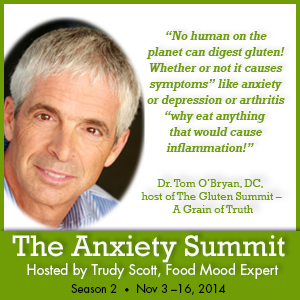
No human on the planet can digest gluten! Whether or not it causes symptoms like anxiety or depression or arthritis why eat anything that would cause inflammation!

He shares recent research published in BMC Medicine. The study looking at Italians with non-celiac gluten sensitivity, found that 68% of participants felt “a lack of well-being” and 39% experienced anxiety. In the large majority of patients, the time lapse between gluten ingestion and the appearance of symptoms varied from a few hours to 1 day.

No human on the planet can digest gluten! Whether or not it causes symptoms” like anxiety or depression or arthritis “why eat anything that would cause inflammation”

The gluten-FODMAPs discussion and non-celiac gluten sensitivity is a fad:

  • No effects of gluten in patients with self-reported non-celiac gluten sensitivity after dietary reduction of fermentable, poorly absorbed, short-chain carbohydrates.
  • The article in Forbes : Gluten Intolerance May Not Exist
  • Randomised clinical trial: gluten may cause depression in subjects with non-coeliac gluten sensitivity – an exploratory clinical study.

Dr. O’Bryan summed it up like this:

it took two studies to do this but it appears to be the FODMAPs in the wheat that cause the GI complaints (the bloating, the gas, the abdominal pain) but it’s the proteins that cause symptoms in the brain and other parts of the body

I write about gluten often. Here are some additional links for you:

  • I was interviewed on Gaiam TV and discussed the gluten-mood connection
  • I presented a poster called Gluten and the serious effects on mental health at the 2013 annual conference of the Anxiety and Depression Association of America/ADAA
  • and here part 1 of a 2 part blog on gluten and mood

Last year Dr. O’Bryan hosted the fantastic Gluten Summit and you can grab a copy of one of the interviews here: Dr. Marsh’s Gluten Summit interview: Why the Early Stages of Celiac Disease Must be Taken Seriously

If you are not already registered for the Anxiety Summit you can get live access to the speakers of the day here www.theAnxietySummit.com

Filed Under: Antianxiety, Gluten, The Anxiety Summit 2 Tagged With: anxiety, celiac, depression, gluten, Inflammation, suicide, the anxiety summit, tom o’bryan, Trudy Scott

Anxiety: food based solutions with Trudy Scott on The Randy and Christa show

April 25, 2014 By Trudy Scott 7 Comments

I met Christa Orrechio at a conference earlier this year and was thrilled to be invited to speak on The Randy and Christa show. They are doing a fabulous job getting the wellness message out into the world! I also love how they have such fun doing this show!

During my segment we talked about the following:

  • Why read my book The Antianxiety Food Solution: if you’re stressed, have panic attacks, fears, phobias and even sugar cravings
  • “80-90% of my clients do better off gluten”
  • My client who went gluten-free: her eczema cleared up and she felt calmer
  • Amino acid supplements (like GABA and tryptophan) help you break the gluten addiction/craving
  • Low serotonin causes anxiety, sadness, excessive worry in the head, depression, afternoon and evening cravings, PMS, winter blues and sleep problems (see the whole questionnaire here)
  • Tryptophan (500mg is the starting dose) midafternoon and evening raises serotonin so you’ll feel calmer, hopeful and optimistic
  • Some people may do better on 5-HTP but it can raise cortisol levels
  • Too much of the amino acids can have a reverse effect – use what you need. You may need less than the starting dose
  • The amino acids are a short-term approach – you also need to be addressing diet and low blood sugar etc
  • Low GABA causes physical tension and anxiety (Randy finds GABA helps him sleep)
  • Caffeine is a problem for many people with anxiety – give it up! If it doesn’t make you anxious make sure it’s organic
  • Zinc and vitamin B6 are important for making GABA and serotonin
  • A good source of zinc and B6 is red meat. It’s also a good source of iron and omega-3s (as much omega3-s as salmon!). Of course it does need to be grass-fed!
  • The starting dose for vitamin B6 is 100mg
  • Magnesium is a calming mineral
  • Sign up for your free report “5 Simple Steps to Reduce Anxiety Now“

Be sure to listen to Randy and Christa when I drop off as they continue the discussion (12:30 minutes).

Regarding the red meat discussion they had a bit later, I’d like to add that I find many of my clients with mood issues – both anxiety and depression – do better with more red meat than just once or twice a week. Having it every day is just fine! As Christa said, it has all the amino acids to make our neurotransmitters/brain chemicals.

Christa Orecchio is a clinical and holistic nutritionist, and founder of The Whole Journey, a nutrition practice and informational website. She is on a mission to help as many people as possible to heal by addressing the root cause (and not just the symptom) of why they don’t feel good and concurrently teaches people how to use food as their medicine to heal their bodies so they can ultimately live a thriving, vibrant life.

Christa has a TV show on FOX in San Diego called “Food as Medicine” and is the co-host of her own nationally syndicated health talk show “The Randy and Christa Show”.


Filed Under: Antianxiety Food Solution, Anxiety and panic, Food and mood, Gluten, Real whole food Tagged With: amino acids, anxiety, food, gluten, Randy and Christa, serotonin, Trudy Scott, tryptophan

Anxiety and Depression Association of America 2013 conference highlights

April 12, 2013 By Trudy Scott 14 Comments

My gluten-mood poster at the 2013 ADAA conference

Last weekend I attended the annual conference of the Anxiety and Depression Association of America / ADAA and am pleased to share some of the highlights.

  • The keynote was presented by Dr. James Fowler and was fascinating! He shared how we are all connected and how your friends’ friends’ friends affect everything you feel, think and do! Check out his site and book Connected, The Surprising Power of Our Social Networks 
  • Gluten does have such a big impact on mood for so many people and I had many interested and curious visitors at my poster presentation (see the above picture)  “Evidence-based Research On The Serious Effects Of Gluten On Mental Health, With An In-depth Look At Testing And The Gluten-free Diet.” A number of people shared how gluten removal had eliminated their anxiety and/or depression too: a mom whose daughter quit gluten and found that this eliminated her panic attacks, a Canadian MD who didn’t know about gluten intolerance and infertility and the director of an anxiety clinic in Argentina. I was also honored to have Dr. Jerrold Rosenbaum, MD, ADAA Past President, Chief of Psychiatry, Massachusetts General Hospital and Professor of Psychiatry, Harvard Medical School, stop by. He said “interesting… everyone where I live is going gluten-free.” I asked him “and what kind of feedback are you getting?” Dr. Rosenbaum: “They’re all feeling better!”
  • I attended a great presentation by Dr. Teri Pearlstein: “Treatment of Perinatal Mood and Anxiety Disorders”. Dr. Pearlstein shared studies that show that babies born to depressed moms may have similar health problems as those born to moms taking anti-depressant medications i.e. lower birth weight and smaller head circumference. However, I also learned this: in a JAMA Psychiatry study of more than 1800 children, investigators found an adjusted 2-fold increased risk for ASD (autism spectrum disorder) among mothers who used an SSRI during the year before delivery and a 3-fold increased risk when SSRIs were ingested during the first trimester. The study was done in 2011 so it’s not new but it’s still an important finding. To me, this provides a very big incentive for using drug-free solutions for pregnancy – which is why the amino acids, fish oils and other nutrients that I cover in The Antianxiety Food Solution are worth investigating as a better option.  We really need some research in this area!

I’ll be sharing some other interesting posters (like “Mindful-based stress reduction for stress and cognition in older adults”) and presentations (like Benzodiazapine side-effects and tolerance) in my next post on the ADAA.

Filed Under: Antianxiety Food Solution, Events, Fertility and Pregnancy, Food and mood, Gluten Tagged With: ADAA, Antianxiety Food Solution, Anxiety and Depression association, fertility, gluten, pregnancy, SSRI, Trudy Scott

Gluten and the serious effects on mental health: ADAA 2013

April 1, 2013 By Trudy Scott 14 Comments

logo_adaa

The 2013 annual conference of the Anxiety and Depression Association of America  is April 5-7 at the Hyatt Regency La Jolla at Aventine (La Jolla, California).  It’s a wonderful conference to hear all the latest research on anxiety and depression.  The focus of the conference is primarily therapy and medications with some presentations and posters on exercise, nutrients, guided imagery, yoga and one topic on gluten (mine!)

I’m doing a poster presentation Friday, April 5, 6:30 – 8pm, “Evidence-based Research On The Serious Effects Of Gluten On Mental Health, With An In-depth Look At Testing And The Gluten-free Diet.” 

This poster will identify what gluten is, where it is found and if the gluten-free diet is a fad or very real concern for those with mental health disorders. The following will be explained: gluten sensitivity, celiac disease, and wheat allergies. Evidence-based research will be reviewed, showing the serious impacts of gluten on various mental health disorders: anxiety, social phobia, panic attacks, depression, schizophrenia and bipolar disorder.

Here are a few examples of some the research that will be reviewed: 

  • “gluten sensitivity remains undertreated and underrecognized as a contributing factor to psychiatric and neurologic manifestations” (Jackson, Psychiatric Quarterly 2011)
  • Spectrum of gluten-related disorders: consensus on new nomenclature and classification (Sapone, BMC Medicine, 2012)
  • Celiac disease, wheat allergy, and gluten sensitivity: when gluten free is not a fad. (Pietzak, Journal of Parenteral and Enteral Nutrition 2012)
  • Gluten-free diet may alleviate depressive and behavioural symptoms in adolescents with coeliac disease (Pynnönen , BMC Psychiatry 2005)
  • Social phobia in coeliac disease (Addolorato, Scandinavian Journal of Gastroenterology 2008)

There will be an in-depth discussion of the various testing options and the many associated health problems that may be associated with gluten intolerance. This session will clearly define gluten-containing versus gluten-free foods when it comes to eating a gluten-free diet.

Filed Under: Antianxiety, Events, Food and mood, Gluten Tagged With: ADAA, anxiety, depression, gluten, mental health, social phobia, Trudy Scott

Figure out if gluten is making you anxious or depressed and win a book

November 30, 2012 By Trudy Scott 12 Comments

Even wholegrain bread may be a problem

Wouldn’t you like to know if gluten is making you anxious or depressed (or causing other health issues). I teamed up with Richard and C.R. Zwolinksi on their Therapy Soup blog on Psychcentral.com to show you how to do a gluten elimination and challenge.

And you have a chance to win one of two copies of my book The Antianxiety Food Solution: How the Foods You Eat Can Help You Calm Your Anxious Mind, Improve Your Mood and End Cravings – keep reading and I’ll share the link below. The deadline is December 3, 2012.

Here is the series of very informative blogs with everything you’ll need.

#1 Introducing the Gluten-free Challenge

“Although sugar and junk and fast foods cause health problems for many, one major dietary culprit that has been getting a lot of attention is gluten. For the next few weeks, Trudy, C.R. and I are going to talk about the importance of diet, and specifically gluten, as it affects your mental health. Many people don’t realize that they might have gluten a intolerance, or even an allergy to gluten….” More about Introducing the Gluten-free Challenge

#2 Getting Rid of Gluten

“A list of foods that contain gluten so you can avoid them”…”Several gluten-free menu suggestions”… “Suggestions for how you can keep track of what you’re eating and what kinds of symptoms might be present or lessened” More about Getting Rid of Gluten

#3 The Gluten-Mood Connection

“There are many studies supporting the gluten-mood connection – anxiety, social phobia, depression and even schizophrenia”… “Dr. Fasano is one of the leading researchers in this field and states that gluten sensitivity is undertreated and underrecognized as a contributing factor to psychiatric & neurologic manifestations.” You’ll see from some of the comments that many people are not yet ready to accept the research based evidence! More about The Gluten-Mood Connection

#4 Your Gluten-Free Shopping List

“Buckwheat is acceptable, as are the wonderful ancient grains like quinoa and amaranth. Starchy vegetables like sweet potato and squashes are a wonderfully nutritious source of carbohydrates. Rather than simply replacing the problem grain with another grain, consider incorporating more vegetables like these into your diet.” More about Your Gluten-Free Shopping List

# 5 Your Gluten-free Food and Mood Log

#6 Gluten-free Menus to Improve Your Mood.

C.R posted some lovely menu ideas and some recipes from her food blog, healthyjewishcooking.com, “(her blog is not completely gluten-free but many individual recipes are), followed by some links to gluten-free resources” More about Gluten-free Menus to Improve Your Mood

#7 I want my turkey and stuffing.

“We got an email from a reader who says she doesn’t want to miss the traditional turkey and stuffing during Thanksgiving. And she doesn’t want to “experiment” with gluten-free stuffing. So, we asked nutritionist Trudy Scott whether or not it’s okay to add back in the gluten a bit early.” More on I want my turkey and stuffing

#8 Win a free copy of The Antianxiety Food Solution

Read this blog to find out how to win one of two copies of the book. “We’d love to hear your gluten-free story if you want to include it in your email entry. If you like, please briefly describe your gluten-free experience.” Deadline for entries is Monday, December 3rd.

It’s been a lot of fun (and a real pleasure working with the Zwolinkis) and I hope you get as much out of it as we have! We will be sharing more in the coming week, talking about some testing options and how the amazing amino acids can help if you have quit but feel deprived and are using will-power.

Filed Under: Antianxiety Food Solution, Anxiety and panic, Food and mood, Real whole food Tagged With: Antianxiety Food Solution, anxiety, depression, gluten, gluten elimination, psychcentral.com, Therapy Soup

  • « Go to Previous Page
  • Page 1
  • Interim pages omitted …
  • Page 4
  • Page 5
  • Page 6
  • Page 7
  • Go to Next Page »

Primary Sidebar

NEW! GABA QuickStart Homestudy (with special intro pricing)

gaba quickstart homestudy

Free Report

9 Great Questions Women Ask about Food, Mood and their Health

You'll also receive a complimentary subscription to my ezine "Food, Mood and Gal Stuff"


Connect with me

Popular Posts

  • Amino Acids Mood Questionnaire from The Antianxiety Food Solution
  • The Antianxiety Food Solution Amino Acid and Pyroluria Supplements
  • Pyroluria Questionnaire from The Antianxiety Food Solution
  • Collagen and gelatin lower serotonin: does this increase your anxiety and depression?
  • Tryptophan for the worry-in-your-head and ruminating type of anxiety
  • GABA for the physical-tension and stiff-and-tense-muscles type of anxiety
  • The Antianxiety Food Solution by Trudy Scott
  • Seriphos Original Formula is back: the best product for anxiety and insomnia caused by high cortisol
  • Am I an anxious introvert because of low zinc and vitamin B6? My response to Huffington Post blog
  • Vagus nerve rehab with GABA, breathing, humming, gargling and key nutrients

Recent Posts

  • What do I use instead of Seriphos to help lower high cortisol that is affecting my sleep and making me anxious at night?
  • BeSerene™ GABA/theanine cream eases severe muscle tension in her neck/shoulders, prevents her bad headaches and quells her anxiety
  • How the correct approach, dose and sublingual use of GABA can be calming and not cause a flushed and itchy face and neck
  • The amino acid glutamine improves low mood by addressing gut health, and it has calming effects too
  • Flight anxiety with heightened breath, physical tension and also fearing the worst (the role of low GABA and low serotonin)

Categories

  • 5-HTP
  • AB575
  • Addiction
  • ADHD
  • Adrenals
  • Alcohol
  • Allergies
  • Alzheimer's disease
  • Amino Acids
  • Anger
  • Antianxiety
  • Antianxiety Food Solution
  • Antidepressants
  • Anxiety
  • Anxiety and panic
  • Autism
  • Autoimmunity
  • benzodiazapines
  • Bipolar disorder
  • Books
  • Caffeine
  • Cancer
  • Candida
  • Children/Teens
  • Collagen
  • Cooking equipment
  • Coronavirus/COVID-19
  • Cravings
  • Depression
  • Detoxification
  • Diabetes
  • Diet
  • DPA/DLPA
  • Drugs
  • EFT/Tapping
  • EMF
  • EMFs
  • Emotional Eating
  • Endorphins
  • Environment
  • Essential oils
  • Events
  • Exercise
  • Fear
  • Fear of public speaking
  • Fertility and Pregnancy
  • Fish
  • Food
  • Food and mood
  • Functional neurology
  • GABA
  • Gene polymorphisms
  • General Health
  • Giving
  • Giving back
  • Glutamine
  • Gluten
  • GMOs
  • Gratitude
  • Gut health
  • Heart health/hypertension
  • Histamine
  • Hormone
  • Hyperparathyroidism
  • Hypoglycemia
  • Immune system
  • Inflammation
  • Insomnia
  • Inspiration
  • Introversion
  • Joy and happiness
  • Ketogenic diet
  • Lithium orotate
  • Looking awesome
  • Lyme disease and co-infections
  • MCAS/histamine
  • Medication
  • Men's health
  • Mental health
  • Mercury
  • Migraine
  • Mold
  • Movie
  • MTHFR
  • Multiple sclerosis
  • Music
  • NANP
  • Nature
  • Nutritional Psychiatry
  • OCD
  • Osteoporosis
  • Oxalates
  • Oxytocin
  • Pain
  • Paleo
  • Parasites
  • Parkinson’s disease
  • PCOS
  • People
  • PMS
  • Postpartum
  • PTSD/Trauma
  • Pyroluria
  • Questionnaires
  • Real whole food
  • Recipes
  • Research
  • Schizophrenia
  • serotonin
  • SIBO
  • Sleep
  • Special diets
  • Sports nutrition
  • Stress
  • Sugar addiction
  • Sugar and mood
  • Supplements
  • Teens
  • Testimonials
  • Testing
  • The Anxiety Summit
  • The Anxiety Summit 2
  • The Anxiety Summit 3
  • The Anxiety Summit 4
  • The Anxiety Summit 5
  • The Anxiety Summit 6
  • Thyroid
  • Thyroid health
  • Toxins
  • Tryptophan
  • Tyrosine
  • Uncategorized
  • Vegan/vegetarian
  • Women's health
  • Yoga

Archives

  • October 2025
  • September 2025
  • August 2025
  • July 2025
  • June 2025
  • May 2025
  • April 2025
  • March 2025
  • February 2025
  • January 2025
  • November 2024
  • October 2024
  • September 2024
  • August 2024
  • July 2024
  • June 2024
  • May 2024
  • April 2024
  • March 2024
  • February 2024
  • January 2024
  • December 2023
  • November 2023
  • October 2023
  • September 2023
  • August 2023
  • July 2023
  • June 2023
  • May 2023
  • April 2023
  • March 2023
  • February 2023
  • January 2023
  • December 2022
  • November 2022
  • October 2022
  • September 2022
  • August 2022
  • July 2022
  • June 2022
  • May 2022
  • April 2022
  • March 2022
  • February 2022
  • January 2022
  • December 2021
  • November 2021
  • October 2021
  • September 2021
  • August 2021
  • July 2021
  • June 2021
  • May 2021
  • April 2021
  • March 2021
  • February 2021
  • January 2021
  • December 2020
  • November 2020
  • October 2020
  • September 2020
  • August 2020
  • July 2020
  • June 2020
  • May 2020
  • April 2020
  • March 2020
  • February 2020
  • January 2020
  • December 2019
  • November 2019
  • October 2019
  • September 2019
  • August 2019
  • July 2019
  • June 2019
  • May 2019
  • April 2019
  • March 2019
  • February 2019
  • January 2019
  • December 2018
  • November 2018
  • October 2018
  • September 2018
  • August 2018
  • July 2018
  • June 2018
  • May 2018
  • April 2018
  • March 2018
  • February 2018
  • January 2018
  • December 2017
  • November 2017
  • October 2017
  • September 2017
  • August 2017
  • July 2017
  • June 2017
  • May 2017
  • April 2017
  • March 2017
  • February 2017
  • January 2017
  • December 2016
  • November 2016
  • October 2016
  • September 2016
  • August 2016
  • July 2016
  • June 2016
  • May 2016
  • April 2016
  • March 2016
  • February 2016
  • January 2016
  • December 2015
  • November 2015
  • October 2015
  • September 2015
  • August 2015
  • July 2015
  • June 2015
  • May 2015
  • April 2015
  • March 2015
  • February 2015
  • January 2015
  • December 2014
  • November 2014
  • October 2014
  • September 2014
  • August 2014
  • July 2014
  • June 2014
  • May 2014
  • April 2014
  • March 2014
  • February 2014
  • January 2014
  • December 2013
  • November 2013
  • October 2013
  • September 2013
  • August 2013
  • July 2013
  • June 2013
  • May 2013
  • April 2013
  • March 2013
  • February 2013
  • January 2013
  • December 2012
  • November 2012
  • October 2012
  • August 2012
  • July 2012
  • June 2012
  • May 2012
  • April 2012
  • March 2012
  • February 2012
  • January 2012
  • December 2011
  • November 2011
  • October 2011
  • September 2011
  • August 2011
  • July 2011
  • June 2011
  • May 2011
  • April 2011
  • March 2011
  • February 2011
  • January 2011
  • December 2010
  • October 2010
  • September 2010
  • July 2010
  • May 2010
  • April 2010
  • March 2010
  • February 2010
  • January 2010
  • November 2009

Share the knowledge!

The above statements have not been evaluated by the Food and Drug Administration. Products listed in this website are not intended to diagnose, treat, cure or prevent any disease.

The information provided on this site is for informational and educational purposes only and is not intended as a substitute for advice from your physician or other health care professional. You should consult with a healthcare professional before starting or modifying any diet, exercise, or supplementation program, before taking or stopping any medication, or if you have or suspect you may have a health problem.


Copyright © 2026 Trudy Scott. All Rights Reserved. | Privacy | Terms and Conditions | Refund Policy | Medical Disclaimer

Free Report

9 Great Questions Women Ask about Food, Mood and their Health

You’ll also receive a complimentary subscription to my ezine “Food, Mood and Gal Stuff”