• Skip to primary navigation
  • Skip to main content
  • Skip to primary sidebar

everywomanover29 blog

Food, Mood and Women's Health – Be your healthiest, look and feel great!

  • Blog
  • About
  • Services
  • Store
  • Resources
  • Testimonials
  • The Book
  • Contact
  • Search this site

GABA Calm

Phenibut for anxiety and insomnia: FDA warns 3 companies to cease distribution of their products

April 19, 2019 By Trudy Scott 71 Comments

Earlier this week, on April 16, 2019, the FDA issued warning letters to 3 companies have products that are marketed as dietary supplements with a label saying they contain Phenibut. These companies have been told to stop distribution of the current products and to let the FDA know within 15 days what they plan to do to be compliant with the law.

Quite frankly, I’m surprised it’s taken this long, and I actually agree with the decision. However, there are some major problems that are being overlooked with a decision like this, such as the dire consequences for susceptible individuals currently tapering from Phenibut or needing to do a slow taper once they no longer have access to Phenibut (more on that below).

The good news is that GABA, when used correctly i.e. used sublingually as part of a trial process to find the ideal amount for each person, is as effective and with none of the dependence and withdrawal issues.

Here is the announcement on the FDA site:

Phenibut has been found in products labeled as dietary supplements, sometimes marketed for uses such as a sleep aid. Phenibut does not meet the definition of a dietary ingredient Under the Federal Food, Drug, and Cosmetic Act (FD&C Act). Products labeled as dietary supplements that list phenibut as a dietary ingredient are misbranded.

Phenibut is also known as:

  • fenibut
  • phenigam
  • PhGaba
  • Phenigamma
  • Phenygam
  • 4-Amino-3-phenylbutanoic acid
  • β-(aminomethyl)benzenepropanoic acid
  • beta-(Aminomethyl)hydrocinnamic acid
  • β-phenyl-γ-aminobutyric acid

The companies have 15 business days from the date of receipt of the letter to communicate to the agency the specific steps they will take to bring their products into compliance with the law. The warning letters also caution the companies that the FDA may take enforcement action without further notice if they do not immediately cease distribution of the products.

A reaffirmed commitment to traditional advisory and enforcement actions, such as warning letters, in combination with the newly launched rapid-response tool, the Dietary Supplement Ingredient Advisory List, are integral parts of the FDA’s overall effort to strengthen the agency’s regulation and oversight of dietary supplements. We continue to look for ways to modernize our approach to protecting consumers from misbranded, unsafe, or otherwise unlawful dietary supplements.

I have always been very open with my warnings and have never recommended Phenibut because of the dependence issues and the fact that withdrawal can be similar to benzodiazepines. I blogged about my concerns back in 2016: Why I recommend GABA for anxiety instead of Phenibut

Here are a few highlights from this blog:

  • I have concerns with Phenibut and I don’t feel anyone should be using it
  • It is widely used in Russia as a prescription medication for anxiety, tension, fear, to improve sleep, pre- or post-operatively, depression, post-traumatic stress, stuttering and vestibular disorders
  • It’s available over-the-counter and as a supplement in the USA and the UK. It’s no longer available in Australia as a supplement
  • It’s very effective for anxiety and insomnia and this is why anxious individuals really love it and many practitioners recommend it before they start to see problems
  • One of the reasons Phenibut seems to work so well is because it is so similar to benzodiazepines.
  • The adverse effects can be similar to those experienced with benzos. This case study is one of many that report physical dependence can develop, including tolerance and withdrawal

Here are a few more recent case studies, reviews and papers on Phenibut:

  • Phenibut exposures and clinical effects reported to a regional poison center (the numbers are small: “56 exposure calls over 19 years with 48 (85.7%) calls within the past five years” but we know not everyone feels the need to call poison control)
  • Phenibut (β-Phenyl-γ-Aminobutyric Acid): an Easily Obtainable “Dietary Supplement” With Propensities for Physical Dependence and Addiction

Over the last several years, multiple case reports have highlighted phenibut’s potential to produce the conditions of physical dependence, withdrawal, and addiction. In cases involving intoxication, patients have presented with a varying degree of mental status changes, from being minimally responsive to manifesting symptoms of an agitated delirium. Phenibut is a potent psychoactive substance with GABAB agonist properties, which is emerging as a drug of misuse through growing internet sales. Its marketing as a “dietary supplement” is inaccurate and misleading, given its pharmacological profile and ability to induce the physiological changes associated with withdrawal and physical dependence

  • Acute phenibut withdrawal: A comprehensive literature review and illustrative case report . In many of the published cases “Patients were typically younger and had coexisting substance abuse disorders to other drugs” but based on feedback I’ve had from folks in my community and elsewhere this is certainly not the case across the board. However it may be that prior benzodiazepine or fluoroquinolone use may play a role in individuals being more susceptible to issues.
  • Phenibut (β-Phenyl-γ-Aminobutyric Acid) Psychosis. This case study was a situation of recreational abuse but even so it shows how severe symptoms can be.

I see no reason to use a product like Phenibut given the potential to cause harm and because GABA (when used correctly i.e. used sublingually as part of a trial process to find the ideal amount for each person) is as effective and with none of the dependence and withdrawal issues.

Phenibut: initially very promising results and then rebound anxiety, panic and insomnia

I’d like to share a story from someone in my community who posted on the 2016 blog above. He shared this about the addictive aspects he observed when he used a Phenibut product called GABA Wave, saying his initial reaction was very positive and quite extreme compared to his previous trials of GABA:

The initial response in the first couple of weeks was great, especially a couple of hours after taking it. The effects were a marked elevation in mood to the point of euphoria, enhanced appreciation for music, improved focus and cognition initially (but that became memory difficulty), marked relief of anxiety, increased motivation, renewed interest in things, being more talkative, a significant calming/relaxation effect, generally a deep and great night’s sleep the night of the morning it is taken.

He then shares how this changed after a few weeks with rebound insomnia, panic and anxiety, and other adverse symptoms:

However, after a few weeks it was the reaction on the following day of taking it that kicked me in the butt, literally. On the following day I began to feel very low, groggy and spaced out, almost like a hangover and then during the following night I began having brutal insomnia – a complete turn-around from the night before. A kind of rebound response. I imagine that’s when the tolerance and addiction begins to develop because one craves the next dose to provide the good night’s sleep after the bad sleep on the second night. Other side effects included mood swings, irritability, rebound anxiety, panic, loss of short-term memory, total and utter loss of any form of libido and constipation!

He shared that his diet and self-care are excellent, but he is dealing with and working past emotional and psychological traumas – and this may make him more susceptible to the adverse effects.

And this is one of the problems with Phenibut – you’ll hear excellent initial reports and for some people this continues. Not everyone is adversely affected but you just don’t know in advance if you will be someone who is adversely affected or just how badly you’ll be affected.

Merry has had very severe ongoing adverse effects from Phenibut.

Merry Citoli shares her warnings about benzodiazepine, lunesta and Phenibut withdrawal

Merry Citoli shares her warnings about benzodiazepine, lunesta and Phenibut withdrawal. Lunesta and then Phenibut were recommended to help her taper from the benzodiazepine she was prescribed for perimenopausal anxiety. At the time of this recording, she had tapered off the benzo and lunesta, but was having great difficulties tapering off Phenibut – almost as bad as her benzo taper.

You can learn more about Merry on Follow Your Bliss. She shares how cathartic it is to share her story and the desire to help stop others going through what she has been through. I’d like to acknowledge Merry for doing this (and all of you for sharing your stories and posting encouraging messages here on the blog for each other).

I’d also like to give a shout out to the Benzodiazepine Information Coalition who is doing amazing advocacy and educational work about these awful medications.

The comments in my 2016 blog: Why I recommend GABA for anxiety instead of Phenibut are worth a read if this affects you. You’ll see there are some very different thoughts on Phenibut safety and folks saying GABA won’t work. This is typical of what you can expect to hear elsewhere online.

I don’t have all the answers

I know many Phenibut users are going to be very concerned about this and we’ll be dealing with many withdrawal issues and folks looking for an alternative. I recognize that this is not going to be easy if there is no Phenibut available for tapering. There are also very serious concerns for those who can’t go cold-turkey off Phenibut and won’t have the time to taper. Abrupt discontinuation of Phenibut may result in withdrawal which can be severe and require hospitalization.

What I don’t know:

  • if other companies and products will be targeted too?
  • if Phenibut will be made available as prescription in some form or another?
  • what resources are in place or going to be put in place for individuals who are in the process for trying to taper from Phenibut right now (or if there is even the awareness that this is an issue and very needed? For people like Merry, cold-turkeying off Phenibut could be life-threatening)
  • what advocacy groups and benzo support groups know and what advice do they have?
  • what my colleagues know and are planning to do?
  • why so many practitioners recommended it and why so many companies made it available as a supplement, given the research/case studies and the issues so many individuals report?
  • if there will be a place to submit concerns and complaints?

What I do know – GABA and the foundations

Give GABA serious consideration for safe and comfortable tapering (assuming there is enough Phenibut to do slow tapers) and for ongoing support of the low GABA symptoms of physical anxiety and tension.

It’s really best that you work with your practitioner. As with a benzodiazepine, before starting a Phenibut taper, I’ve always found it’s best to get nutritionally stable as possible first and address all root causes of anxiety before starting to taper and then tapering Phenibut very very very slowly. For some folks it’s just very uncomfortable for a few weeks and for others it’s a long-term ordeal.

I use GABA sublingually after an initial trial to find the ideal amount for each person. I have found that for both a benzo and Phenibut taper, very very tiny amounts (like a pinch or dab) will be enough for some folks.

Other nutrients are used based on each person’s need – such as theanine, tryptophan, melatonin, niacinamide, zinc and vitamin B6 and others. Light therapy, exercise, yoga, meditation, getting out in nature and essential oils like lavender, citrus and jasmine are also wonderful to incorporate. Of course, diet, blood sugar control and gut health are the foundation.

These are various GABA products I use. You can find some examples on my supplements blog here:

  • Source Naturals GABA Calm (with additional information here)
  • Nutritional Fundamentals for Health GABA-T SAP: gamma-aminobutyric acid (GABA) 300 mg, l-theanine 150 mg. This is pleasant-tasting when opened on to the tongue and works very well when GABA Calm can’t be used.  I find best results when it is used opened on to the tongue.
  • Enzymatic Therapy GABA: gamma-aminobutyric acid (GABA) 250 mg. This is also pleasant-tasting when opened on to the tongue and works very well when GABA Calm can’t be used.  As with all GABA products, I find best results when it is used opened on to the tongue.
  • ProThera 500mg GABA: gamma-aminobutyric acid (GABA) 500 mg.  You will likely need to open this up and start with less than a full capsule during the day. A full capsule may be fine at night for some individuals.

They can all be purchased from my online store here.

As you can see, I don’t have all the answers about this FDA announcement, but I wanted to share what I do know so you are aware of what’s going on.

In the next few weeks I’m going to be reaching out to benzodiazepine groups, colleagues, the companies affected and individuals who are in the process for trying to taper from Phenibut. As I learn more, I’ll share what I learn.

In the meantime, please post questions you may have, and I’ll do my best to either answer them now or find answers for you.

And please do share your Phenibut stories (both good and bad), your concerns, and any resources you may have.

And do share if GABA has help you taper from Phenibut.
Filed Under: Anxiety Tagged With: anxiety, fda, GABA, GABA Calm, insomnia, panic, phenibut, theanine, tolerance, withdrawal

GABA Calm instead of Xanax for panic attacks, heightened stress and anxiety: questions and my feedback

April 12, 2019 By Trudy Scott 42 Comments

Last month I shared Dee’s wonderful results with using GABA Calm for her panic attacks, heightened stress and anxiety. I posted the following on Facebook and it led to some really good questions so here they are with my feedback in case you have similar questions about using GABA, which is a calming amino acid. This is Dee’s feedback:

I have taken Xanax in the past for panic attacks. My functional medicine doctor suggested GABA Calm as I wanted a natural product. I was amazed how it works just like the Xanax did – instant calm feeling within 10 mins of taking 2 capsules. I use them as needed when I am having heightened stress and anxiety.

These are wonderful results for Dee and what a great functional medicine doctor she has. I get feedback like this all the time with my clients. In fact, I had this positive feedback on the Facebook post:

  • “Yes absolutely treat the anxiety while finding root cause” – I agree with this but would add that low GABA is one of the root causes we are addressing right away
  • I have GAD enzyme deficiency. B6, Magnesium, theanine, and GABA are a must
  • GABA saved my life – my functional medicine doctor gave me the same thing!


(1) The first question I received was about which product and which form of GABA:

The Gaba Calm that is being mentioned by Dee says 2 capsules – would you please provide a link for that? I see the one you mention as a lozenge – which I’d like to try as well. Do they contain pharmaGaba or synthetic GABA? I read that the pharmaGaba is superior – your thoughts on this?

This is the GABA product Dee is referring to: Source Naturals GABA Calm and she used 2 sublingual lozenges.

As a recap (in case you’re new to the low GABA type of anxiety) when you have low GABA levels you will have physical anxiety with stiff and tense muscles as well as feelings of stress, overwhelm and may even have panic attacks.

The amino acid GABA helps to raise GABA levels and ease these symptoms very quickly. I find that all GABA products are most effective when taken sublingually or opened on to the tongue. This is why I recommend the Source Naturals GABA Calm™ product.

This is my most popular and most effective form of GABA I use with my clients. It is a pleasant-tasting sublingual product that you can buy at your local health-store and in my online supplement store.

I prefer to start with GABA with my clients but folks do better with pharmaGABA so it’s matter of doing a trial to figure it out.

(2) Someone also asked if you can you take it if you are on antidepressants?

There are no known issues that I am aware of and I use GABA calm with clients who are prescribed antidepressants.

(3) One woman had a concern about her prior use and how GABA made her feel worse:

2 capsules at what dosage? I tried one at 750 mg and made me feel more panicked. Maybe it’s the strength?

I always have my clients start LOW, typically at 125mg, which is the amount in one GABA Calm lozenge. We start even lower (like ¼ of a lozenge) if they are very sensitive to supplement or medications. Higher doses like 750mg (and even 500mg for some people) is way too much for most folks to start on and can make you feel worse and even cause a panic attack, make you feel flushed and light-headed and very sleepy.

(4) One woman said, “unfortunately GABA didn’t work for me” but lithium orotate (5-10 mg per day did help her – “Great mood stabilizer”

When GABA doesn’t help to ease anxiety, it could be for a number of reasons:

  • the root cause of the anxiety wasn’t due to low GABA (perhaps it’s the low serotonin anxiety) or
  • it wasn’t enough GABA (we titrate up from 125mg until we find the ideal amount for each person) or
  • too much GABA was used (as above) or
  • it wasn’t actually GABA that was used (some people say GABA when they used the medication gabapentin or used Phenibut) or
  • the GABA was not used sublingually (this is the best way to use it for quickest results) or
  • the person has thyroid issues (the amino acids are less effective in this instance)

I do like lithium orotate as a mood stabilizer and find that for some individuals this does make the amino acids more effective. The fact that lithium worked for her makes me think there is some GABA involvement in her anxiety because lithium seems to support increased levels of GABA. Dr. Peter Bongiorno writes about this in his book Put Anxiety Behind You.

(5) One person shared her success with exposure therapy and acceptance and cognitive behavior therapy (CBT) instead of using GABA, and a concern about a lifetime need for GABA. I’m paraphrasing some of the discussion:

I have recovered from GAD, panic disorder, OCD and depression from exposure therapy and acceptance and cognitive behavior therapy (CBT). It takes a lot of work and understanding but anxiety and panic can be recovered, and you don’t have use ANY external substances.

We can’t take GABA for a whole life time and it isn’t a permanent solution. Anxiety comes with a LOT more than uncomfortable feelings. Unfortunately for myself and many others GABA had no significant impact on anxiety. No external substance is going to correct a cognitive disorder.

GABA is not a life-time solution. The goal is to take GABA short-term and address other root causes that are leading to low GABA such as poor gut health, gluten issues, diet (not enough quality protein or health fats), stress/adrenals, sex hormone imbalances, heavy metals, Lyme disease and so on.

As I mention in #4 above there are reasons when the GABA doesn’t work or doesn’t seem to work.

I respectfully disagree that “No external substance is going to correct a cognitive disorder.” I’m all for CBT but many folks have to address their biochemistry too for lasting results. I also have many therapist colleagues who share that CBT and other therapy is often more effective when someone is nutritionally stable and with no deficiencies or biochemical imbalances. I say let’s use everything at our disposal to feel good again!

I’m really pleased she found results with acceptance and cognitive behavior therapy. I will admit that I’m not a big fan of exposure therapy as I’m concerned about the added stress for someone who is already anxious. I’ve also worked with a number of clients who have not seen long-term results with exposure therapy.

Here are three additional GABA success stories:

  • GABA for children: ADHD, focus issues, irritability, anxiety and tantrums
  • GABA helps with Lyme anxiety (while addressing the underlying disease)
  • GABA for ending sugar cravings (and anxiety and insomnia)

In case this is relevant for you, the product mentioned in this blog can be found in my online store:

  • Source Naturals GABA Calm (with additional information here)

If for some reason GABA Calm isn’t the best product for you, a low dose GABA-only product or combination GABA/theanine product can easily be opened onto the tongue in order to provide similar benefits to the lozenge. You can find some examples on my supplements blog here and purchased from my online store:

  • Nutritional Fundamentals for Health GABA-T SAP: gamma-aminobutyric acid (GABA) 300 mg, l-theanine 150 mg. This is pleasant-tasting when opened on to the tongue and works very well when GABA Calm can’t be used.  I find best results when it is used opened on to the tongue.
  • Enzymatic Therapy GABA: gamma-aminobutyric acid (GABA) 250 mg. This is also pleasant-tasting when opened on to the tongue and works very well when GABA Calm can’t be used.  As with all GABA products, I find best results when it is used opened on to the tongue.
  • ProThera 500mg GABA: gamma-aminobutyric acid (GABA) 500 mg.  You will likely need to open this up and start with less than a full capsule during the day. A full capsule may be fine at night for some individuals)

I’d love to hear if these questions and my feedback have been helpful for you as you navigate the low GABA type of anxiety? Do you have additional GABA questions for me? Or a GABA success story to share? Please post in the comments below.

Filed Under: GABA Tagged With: anxiety, CBT, exposure therapy, GABA, GABA Calm, panic attacks, Source naturals, stress, theanine, Xanax

Why does chewable GABA make me run to the bathroom and what GABA do I use instead?

January 4, 2019 By Trudy Scott 9 Comments

The amino acid GABA (gamma-amino butyric acid) helps to raise GABA neurotransmitter levels and ease the physical symptoms of anxiety: stiff and tense muscles as well as feelings of stress, overwhelm and often panic attacks and overthinking/unwanted thoughts too. It can also help with the visceral pain of IBS/SIBO and insomnia. GABA eases symptoms very quickly, often within 5 minutes but is most effective when taken sublingually, is chewed or is opened on to the tongue.

I often get feedback from individuals in my community saying GABA doesn’t work for them for one reason or another. Digestive issues are a common problem and one question I often hear is the one about chewable GABA and gas, bloating and/or diarrhea.

Rav asks this question on the blog:

What about individuals with IBS (irritable bowel syndrome) or Colitis who cannot take chewable tablets? I used to take the GABA-Pro by Bioclinic Naturals and it just made me run to the bathroom. Should those with digestive trouble steer clear from chewable forms of GABA?

This is an excellent question and something you always need to consider when having digestive upset: is it due to a new supplement I’ve recently added? You have to find a product that works for you and we’re all different. Just like we need to read labels with food we need to read and understand the labels of supplements too.

There are a number of factors to consider: sugar alcohols, natural flavors and plant-based cellulose ingredients.

Let’s look at sugar alcohols first

Many of the chewable or sublingual forms of GABA contain sugar alcohols which can be problematic and cause digestive upset and often explosive diarrhea. Sugar alcohols include xylitol, sorbitol, mannitol and erythritol. Your reaction will depend on the amount of sugar alcohols used, how many chewable tablets you use and how accustomed you are to sugar alcohols. You may get used to them and eventually be fine with consuming small amounts and yet for others the tiniest amount is an issue.

Many of the chewable forms also contain natural flavors which could potentially be problematic for you.

Let’s now look at cellulose and rice flour

I’m also starting to see more and more folks have digestive distress and gas from products with plant-based cellulose ingredients, especially when someone has IBS or SIBO (small intestinal bacterial overgrowth). For example, you may see hydroxypropylcellulose on the label. This helps the chewable keep its shape and stay intact longer when in the mouth.

With capsules you may see cellulose, methylcellulose or hypromellose on the “Other Ingredients” section on the label, with these vegetable-based ingredients replacing the gelatin capsule. This also often causes bloating and gas when IBS/SIBO is an issue.

The rice flour filler in many products can also be problematic for some folks with IBS/SIBO.

Reading the label

The product Rav mentions – GABA-Pro by Bioclinic Naturals – is not one I’m familiar with but a quick check shows these ingredients in addition to the GABA:

Xylitol, stearic acid, hydroxypropylcellulose, silica, natural tropical fruit flavour (banana, pomegranate, pineapple, mango, passionfruit, orange, tangerine, mandarin), citric acid, vegetable grade magnesium stearate (lubricant).

The xylitol is a sugar alcohol, the hydroxypropylcellulose is plant-based cellulose and there are many natural flavors in this product. Any one or all could be the issue.

Magnesium stearate, a bulking agent and lubricant, is often reported as being problematic but since it’s in so many products, it’s unlikely to be causing digestive distress in this case. If you’d like to learn more, Dr Josh Axe has a great blog addressing some of the hype around magnesium stearate concluding it’s safe to consume.

Interestingly, the product label says GABA (gamma-amino butyric acid) when in actual fact it contains pharma GABA (a fermented form of GABA). It’s unlikely that this is the issue for Rav but I do find it a strange way to label a product.

Finally, it’s always important to check quality and make sure there are no artificial colors, preservatives, or sweeteners, no dairy, no gluten and no GMO ingredients in the supplement. This product passes this test.

What GABA do I use instead?

One option is to switch to another chewable such as GABA Calm. This is one of my favorite GABA products because  it works so well, is a nice low dose of GABA, is convenient when you’re out and about and actually tastes good. This one does contain the sugar alcohols sorbitol and mannitol, as well as a natural flavor which may well also be an issue, although I’ve had few complaints from clients and those in my community.

The other option is to use a GABA-only product or a combination GABA and theanine product (such as NFH GABA-T SAP) opened onto the tongue. It’s not as convenient but if it gets you the calming results you’re looking for then it’s a non-issue.

And finally, you could do a trial of using the chewable during the day and the opened GABA capsule at night so you’re consuming less sugar alcohols overall (if that’s your issue).

You can find the GABA Calm, NFH GABA-T SAP and Enzymatic Therapy GABA on the supplements blog here. To be clear, I’m not saying the GABA-Pro product isn’t a good choice in general, rather that it may not be ideal for you, based on your unique needs and what is going on with your gut at any one time.

How do you do with these chewable GABA products (or others like this). Do you do well on them or do you end up running to the toilet or battle with gas and/or bloating?

Or do you prefer a GABA-only or GABA/theanine combination product (opened onto the tongue)?

Filed Under: GABA Tagged With: anxiety, bathroom, bloating, cellulose, diarrhea, digestive trouble, GABA, GABA Calm, gas, magnesium stearate, quality GABA T-SAP, stiff and tense muscles, sugar alcohols, toilet

GABA for the physical-tension and stiff-and-tense-muscles type of anxiety

September 6, 2017 By Trudy Scott 179 Comments

Today I’m going to review some GABA products for the physical-tension and stiff-and-tense-muscles type of anxiety, and share some additional resources for you.

The other symptoms we see with low GABA are panic attacks, physical tension in certain settings like public speaking or driving, and the need to self-medicate to calm down, often with alcohol but sometimes with carbs and sugary foods. Insomnia can also be due to low GABA and you’ll experience physical tension (rather than the ruminating thoughts which is the low serotonin type of insomnia – although it’s not uncommon to experience both). GABA also helps with muscle spasms and pain relief when muscles are tight.

The biggest take-aways with GABA:

  • Sublingual is best. I find that GABA works best when used sublingually and this is one reason I like Source Naturals GABA Calm so much. If this is not an option (it does contain sugar alcohols that some clients can’t or won’t use and does contain tyrosine which as some contraindications) then opening a capsule of a GABA-only or a GABA-theanine combination are my next choices when working with someone.
  • Start very low and increase as needed. I have found 125mg to be a good starting dose but some pixie dust clients do well on a dab or pinch
  • Do a trial to determine if the anxiety in in fact due to low GABA. I always do this with clients before starting any amino acid. Be sure to read how to do an amino acid trial – it has the low GABA questionnaire, the precautions and information on how to use targeted individual amino acids.

Here are some of the actual GABA products I recommend and use with clients:

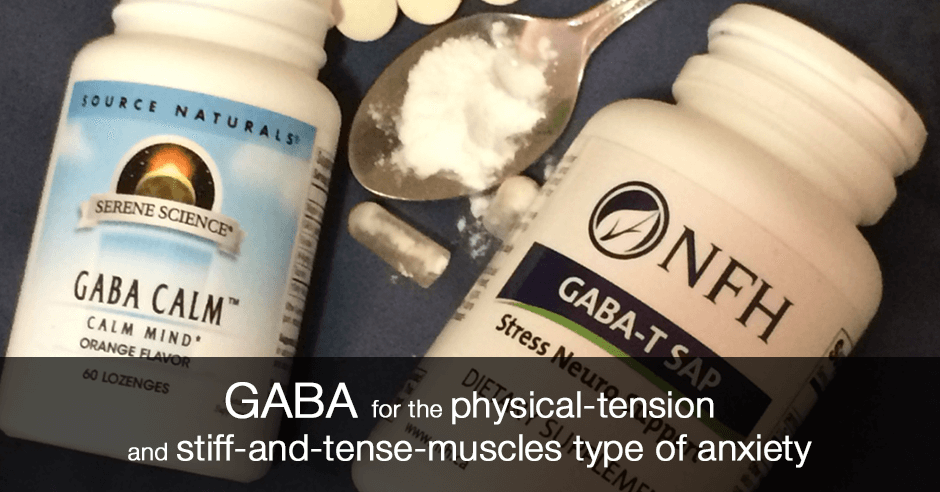
  • Source Naturals GABA Calm. This is a pleasant-tasting sublingual product that is my most popular and most effective form of GABA I use with my clients. It contains 125 mg GABA and some glycine, taurine and magnesium, and a small amount of tyrosine to counter the calming effects. You can see the lozenges in the picture above.
  • Nutritional Fundamentals for Health GABA-T SAP: gamma-Aminobutyric acid (GABA) 300 mg, l-Theanine 150 mg. This is pleasant-tasting when opened on to the tongue and works very well when GABA Calm can’t be used.  I find best results when it is used opened on to the tongue and I really like that it’s a low dose of GABA. Some of my clients do well with half a capsule. You can see an opened capsule in the picture above.
  • Enzymatic Therapy GABA: gamma-Aminobutyric acid (GABA) 250 mg. This is also pleasant-tasting when opened on to the tongue and works very well when GABA Calm can’t be used.  As with all GABA products, I find best results when it is used opened on to the tongue.
  • ProThera 500mg GABA: gamma-aminobutyric acid (GABA) 500 mg.  You will likely need to open this up and start with less than a full capsule during the day and increase as needed based on the trial. A full capsule may be fine at night for some individuals and more than one works in some situations.

There are a number of other great GABA products. When I reached out on Facebook for feedback I heard from one mom who likes Kirkman Labs GABA with Niacinamide and Inositol for her son who is on the spectrum, and someone else shared she likes Thorne PharmaGABA better than GABA products.

A few people shared this feedback when using GABA: one person felt too tired, someone else felt a niacin-type flush and someone else got an electric shock feeling in her brain. How you respond depends on the dose and with GABA and the other amino acids there is no one recommended dose for anyone. It’s very individualized which is why I have clients do a trial and start low. GABA helps many people tapering from benzodiazepines but some people are so sensitive that even a pinch is too much.

One person asked how to get GABA from food as she is fearful of taking medications and supplements. I always recommend a real whole foods diet with quality animal protein and organic produce, together with health fats and fermented veggies – so this is a great foundation. It may not be enough and when there is fear and phobias I immediately think of low serotonin and would determine if this is a factor an address this first. I covered low serotonin and tryptophan in the product review last week.

Here are some additional GABA resources for you:

Source Naturals GABA Calm™: Why I recommend it for anxiety

It’s a great product to use with children. Trish Soderstrom shared how she used this product with her daughter’s Lyme anxiety.

We’ve used Source Naturals GABA Calm sublinguals with good results. I learned about GABA helping anxiety and because I was treating my young daughter I purchased this because it was easy for her to take.But there may still be some confusion about when to use GABA and when to use tryptophan and how much of each of these amino acids to use.

GABA is calming for me, doesn’t work for my daughter’s anxiety and makes my son sleepy

I have used GABA (several brands, just open capsule and sprinkle small amount under tongue) for years now, with calming results within minutes. It was recommended to me by 2 family members, both bi-polar, who were tested by Dr. Amen. I have also used it with my children (now adults); my daughter says it doesn’t work for her. (She has anxiety issues and occasional panic attacks, and Rescue Remedy helps her.) It does work to calm my 3 sons, but one says it makes him sleepy, and lasts into the next day, so he won’t take it.

GABA for children: ADHD, focus issues, irritability, anxiety and tantrums

My daughter hasn’t been diagnosed with ADHD but has a lot of ADHD qualities. We were having a huge amount of behavior problems as she is getting older (she’s 11). I did some research and went to the health food store and bought a bottle. At this point I was mentally exhausted from all the fighting and drama at home and at school. I was desperate and didn’t want to put her on any hard medication.

She has had amazing behavior at school and at home since giving it to her. She’s almost like different child. GABA has truly changed our life. She’s been taking it for almost 2 months.

The blog has many other posts on GABA and serotonin and simply use the “search” function to find them.

This blog post is part of the series of amino acid product reviews:

  • Tryptophan for low serotonin (worry-in-the-head anxiety)
  • Glutamine for calming, intense sugar cravings, gut healing and low blood sugar
  • DPA for weepiness, pain and comfort and reward eating
  • Tyrosine for focus, motivation, energy, a good mood and possibly even anxiety

The resources in this blog and my other articles are intended to be used in conjunction with my book: The Antianxiety Food Solution – How the Foods You Eat Can Help You Calm Your Anxious Mind, Improve Your Mood, and End Cravings. If you do not have my book I highly recommend getting it and reading it before jumping in and taking the amino acid supplements:

There is a complete chapter on the amino acids and one for pyroluria, plus information on real whole food, sugar and blood sugar, gluten, digestion and much more.

You can find the GABA products and the others I recommend here on this blog: The Antianxiety Food Solution Amino Acid and Pyroluria Supplements


I’d love to hear what GABA product has worked for you and how it’s helped?

If you have questions please post them below or on the supplements blog

Filed Under: GABA, Supplements Tagged With: anxiety, GABA, GABA Calm, insomnia, pain, physical-tension, stiff and tense muscles, theanine

GABA is calming for me, doesn’t work for my daughter’s anxiety and makes my son sleepy

June 23, 2017 By Trudy Scott 10 Comments

I’m sharing this question I received on my GABA Calm blog to illustrate how different people respond to GABA and how some people may not even have the low GABA type of anxiety. Here is the question this mom posted:

I have used GABA (several brands, just open capsule and sprinkle small amount under tongue) for years now, with calming results within minutes. It was recommended to me by 2 family members, both bi-polar, who were tested by Dr. Amen. I have also used it with my children (now adults); my daughter says it doesn’t work for her. (She has anxiety issues and occasional panic attacks, and Rescue Remedy helps her.) It does work to calm my 3 sons, but one says it makes him sleepy, and lasts into the next day, so he won’t take it. Trudy, have you heard of this reaction? It seems extreme for such a small amount used. He is a college student and ‘medicates’ with caffeine, if that makes a difference.

She shared that she uses 500mg or 750mg capsules of GABA, and get several doses from a single cap (so maybe 100mg per dose).

This is what I shared with her: we are all biochemically different and one form of GABA (or GABA combined with other amino acids/nutrients such as GABA Calm) may work for one person and not another. Also one person may need more and another may do fine with much much less. Also anxiety has many underlying causes, with low GABA only being one of them.

If I was working with your daughter I’d have her trial higher amounts of GABA for the anxiety and panic attacks. I’d also look into low serotonin and a trial of tryptophan too especially if her anxiety is the worry, ruminating anxiety with insomnia and the blues, with increased afternoon and evening cravings for carbs and chocolates.

If I was working with your son, because it does work to calm him, I’d start by having him trial just 25mg of GABA and increase slowly from there, monitoring how he feels. His anxiety may also be related to his caffeine consumption – which can also affect sleep and the fatigue he feels in the morning could be related to that.

Note: She did ask this question on the GABA Calm blog and was planning to have them trial this form of GABA. I typically don’t have clients use GABA Calm at night (because of the tyrosine) but it’s certainly worth a trial especially with her son.

If you’re completely new to the amino acids for anxiety here is an overview with questionnaire, precautions and how to do a trial.

Filed Under: GABA Tagged With: anxiety, calming, GABA, GABA Calm, serotonin, sleepy, worry

Low zinc and low GABA contributing to anxiety in children and women

October 7, 2016 By Trudy Scott 18 Comments

low-zinc-gaba-video

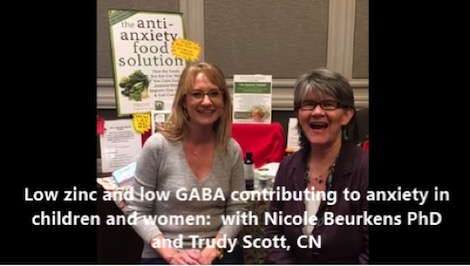
Dr. Nicole Beurkens and I sit down together at the end of the recent Integrative Medicine for Mental Health conference to talk about anxiety and the impact of both low zinc and low GABA. Nicole shares her perspectives on working with children and I share what I see with the adult women I work with. We don’t specifically talk about older adults or men but it’s applicable to everyone.

Dr. Nicole Beurkens PhD, a special educator, clinical psychologist and nutritionist, is author of the new book Life Will Get Better: Simple Solutions for Parents of Children with Attention, Anxiety, Mood and Behavior Challenges

In case you’re new to my community, this is my book: The Antianxiety Food Solution: How the Foods You Eat Can Help You Calm Your Anxious Mind, Improve Your Mood, and End Cravings

Here are some of the highlights from our conversation about zinc:

  • Zinc is a very common deficiency and can be a contributing factor in both anxiety and ADHD
  • Zinc is depleted by sugar consumption, stress and exercise
  • Zinc sulfate used as a zinc challenge is one way to determine your zinc status
  • Nicole’s response to the zinc challenge: fuzzy, strong yukky taste – which means good zinc levels
  • Most people coming to the booth had very little reaction to the zinc challenge – which means low zinc levels
  • Level 1, 2, 3 and 4 are used to figure out your zinc status (you can read about the zinc taste test here)
  • My response to the zinc challenge: metallic, gross, horrible and I got goosebumps – – which means good zinc levels
  • Nicole shares that most of kids and young adults at her clinic have level 1 or level 2 zinc status, and it’s an easy test to do with kids
  • Many people at the conference were on zinc and were surprised they were not tasting the zinc sulfate. Other than sugar consumption, stress and exercise, low HCl (stomach acid) can affect your absorption. I also found that many of these folks were on a gluten-free or Paleo or GAPs diet and eating a lot of nuts or using nut flours. Nuts are high in copper and this can counteract the zinc.
  • We talk about the importance of good quality zinc supplements and finding a zinc product and multi that is copper-free. Here are the products I recommend.

Then we talk about GABA Calm, a calming amino acid that we both love! Here are some of the highlights from this section:

  • It’s a lozenge/sublingual, is easy to take and helps in situations where the anxiety can quickly escalate into panic attacks. Nicole likes the peppermint flavor and finds many of the children and young adults she works with prefer the orange flavor. Personally I also prefer the orange flavor.
  • For adults, if you use wine at the end of the day to de-stress, you may be low in GABA and self-medicating, and using something like GABA-Calm often helps.
  • Moms will take their GABA Calm with them and use as needed and give to their kids if needed too.  
  • I share how effective it is for Lyme anxiety and how it can be used instead of benzodiazepines (I interviewed Trish about this on the recent Anxiety Summit)
  • GABA Calm can help when you’re on a benzodiazepine and even very severe anxiety or depression can be alleviated with diet and nutrients.
  • Nicole shares how common benzodiazepine prescriptions are in teens and young adults; and the issues with dependence and wanting to quit but not being able to. It can sometimes take years to reduce the medications.
  • I share about the first World Benzo Awareness Day on July 11 – so many people are in trouble and are not cautioned.

We were both so encouraged being at this conference and seeing so many physicians, psychiatrists, psychotherapists, psychiatric nurse practitioners and others practitioners who are really interested in learning more about these approaches. They are seeing the same issues we see with some of the medications (and not getting to the root cause of anxiety) and they are excited to expand their knowledge base. It’s just so exciting to see the pendulum swinging!

We both really appreciate the Integrative Medicine for Mental Health conference. If you’re a practitioner and haven’t attended it’s a must-attend event. If you were there you know what I mean. It was also super to meet so many of you after my talk and at my booth. If you’re not a practitioner do tell your doctor about it. Save the date for 2017: September 28 – October 1 in Orange County, California.

We did this as a live video feed on Facebook hence the references to posting questions and Facebook. It was also the end of the event and the people next to us were packing boxes and using a lot of tape so apologies for the weird noises.  

Feel free to share your results with zinc and GABA Calm and any questions you may have.

Filed Under: GABA Tagged With: anxiety, benzodiazepines, children, GABA, GABA Calm, Integrative Medicine for Mental Health conference, Nicole Beurkens, Trudy Scott, women, zinc

  • « Go to Previous Page
  • Page 1
  • Interim pages omitted …
  • Page 3
  • Page 4
  • Page 5
  • Page 6
  • Go to Next Page »

Primary Sidebar

NEW! GABA QuickStart Homestudy (with special intro pricing)

gaba quickstart homestudy

Free Report

9 Great Questions Women Ask about Food, Mood and their Health

You'll also receive a complimentary subscription to my ezine "Food, Mood and Gal Stuff"


Connect with me

Popular Posts

  • Amino Acids Mood Questionnaire from The Antianxiety Food Solution
  • The Antianxiety Food Solution Amino Acid and Pyroluria Supplements
  • Pyroluria Questionnaire from The Antianxiety Food Solution
  • Collagen and gelatin lower serotonin: does this increase your anxiety and depression?
  • Tryptophan for the worry-in-your-head and ruminating type of anxiety
  • GABA for the physical-tension and stiff-and-tense-muscles type of anxiety
  • The Antianxiety Food Solution by Trudy Scott
  • Seriphos Original Formula is back: the best product for anxiety and insomnia caused by high cortisol
  • Am I an anxious introvert because of low zinc and vitamin B6? My response to Huffington Post blog
  • Vagus nerve rehab with GABA, breathing, humming, gargling and key nutrients

Recent Posts

  • What do I use instead of Seriphos to help lower high cortisol that is affecting my sleep and making me anxious at night?
  • BeSerene™ GABA/theanine cream eases severe muscle tension in her neck/shoulders, prevents her bad headaches and quells her anxiety
  • How the correct approach, dose and sublingual use of GABA can be calming and not cause a flushed and itchy face and neck
  • The amino acid glutamine improves low mood by addressing gut health, and it has calming effects too
  • Flight anxiety with heightened breath, physical tension and also fearing the worst (the role of low GABA and low serotonin)

Categories

  • 5-HTP
  • AB575
  • Addiction
  • ADHD
  • Adrenals
  • Alcohol
  • Allergies
  • Alzheimer's disease
  • Amino Acids
  • Anger
  • Antianxiety
  • Antianxiety Food Solution
  • Antidepressants
  • Anxiety
  • Anxiety and panic
  • Autism
  • Autoimmunity
  • benzodiazapines
  • Bipolar disorder
  • Books
  • Caffeine
  • Cancer
  • Candida
  • Children/Teens
  • Collagen
  • Cooking equipment
  • Coronavirus/COVID-19
  • Cravings
  • Depression
  • Detoxification
  • Diabetes
  • Diet
  • DPA/DLPA
  • Drugs
  • EFT/Tapping
  • EMF
  • EMFs
  • Emotional Eating
  • Endorphins
  • Environment
  • Essential oils
  • Events
  • Exercise
  • Fear
  • Fear of public speaking
  • Fertility and Pregnancy
  • Fish
  • Food
  • Food and mood
  • Functional neurology
  • GABA
  • Gene polymorphisms
  • General Health
  • Giving
  • Giving back
  • Glutamine
  • Gluten
  • GMOs
  • Gratitude
  • Gut health
  • Heart health/hypertension
  • Histamine
  • Hormone
  • Hyperparathyroidism
  • Hypoglycemia
  • Immune system
  • Inflammation
  • Insomnia
  • Inspiration
  • Introversion
  • Joy and happiness
  • Ketogenic diet
  • Lithium orotate
  • Looking awesome
  • Lyme disease and co-infections
  • MCAS/histamine
  • Medication
  • Men's health
  • Mental health
  • Mercury
  • Migraine
  • Mold
  • Movie
  • MTHFR
  • Multiple sclerosis
  • Music
  • NANP
  • Nature
  • Nutritional Psychiatry
  • OCD
  • Osteoporosis
  • Oxalates
  • Oxytocin
  • Pain
  • Paleo
  • Parasites
  • Parkinson’s disease
  • PCOS
  • People
  • PMS
  • Postpartum
  • PTSD/Trauma
  • Pyroluria
  • Questionnaires
  • Real whole food
  • Recipes
  • Research
  • Schizophrenia
  • serotonin
  • SIBO
  • Sleep
  • Special diets
  • Sports nutrition
  • Stress
  • Sugar addiction
  • Sugar and mood
  • Supplements
  • Teens
  • Testimonials
  • Testing
  • The Anxiety Summit
  • The Anxiety Summit 2
  • The Anxiety Summit 3
  • The Anxiety Summit 4
  • The Anxiety Summit 5
  • The Anxiety Summit 6
  • Thyroid
  • Thyroid health
  • Toxins
  • Tryptophan
  • Tyrosine
  • Uncategorized
  • Vegan/vegetarian
  • Women's health
  • Yoga

Archives

  • October 2025
  • September 2025
  • August 2025
  • July 2025
  • June 2025
  • May 2025
  • April 2025
  • March 2025
  • February 2025
  • January 2025
  • November 2024
  • October 2024
  • September 2024
  • August 2024
  • July 2024
  • June 2024
  • May 2024
  • April 2024
  • March 2024
  • February 2024
  • January 2024
  • December 2023
  • November 2023
  • October 2023
  • September 2023
  • August 2023
  • July 2023
  • June 2023
  • May 2023
  • April 2023
  • March 2023
  • February 2023
  • January 2023
  • December 2022
  • November 2022
  • October 2022
  • September 2022
  • August 2022
  • July 2022
  • June 2022
  • May 2022
  • April 2022
  • March 2022
  • February 2022
  • January 2022
  • December 2021
  • November 2021
  • October 2021
  • September 2021
  • August 2021
  • July 2021
  • June 2021
  • May 2021
  • April 2021
  • March 2021
  • February 2021
  • January 2021
  • December 2020
  • November 2020
  • October 2020
  • September 2020
  • August 2020
  • July 2020
  • June 2020
  • May 2020
  • April 2020
  • March 2020
  • February 2020
  • January 2020
  • December 2019
  • November 2019
  • October 2019
  • September 2019
  • August 2019
  • July 2019
  • June 2019
  • May 2019
  • April 2019
  • March 2019
  • February 2019
  • January 2019
  • December 2018
  • November 2018
  • October 2018
  • September 2018
  • August 2018
  • July 2018
  • June 2018
  • May 2018
  • April 2018
  • March 2018
  • February 2018
  • January 2018
  • December 2017
  • November 2017
  • October 2017
  • September 2017
  • August 2017
  • July 2017
  • June 2017
  • May 2017
  • April 2017
  • March 2017
  • February 2017
  • January 2017
  • December 2016
  • November 2016
  • October 2016
  • September 2016
  • August 2016
  • July 2016
  • June 2016
  • May 2016
  • April 2016
  • March 2016
  • February 2016
  • January 2016
  • December 2015
  • November 2015
  • October 2015
  • September 2015
  • August 2015
  • July 2015
  • June 2015
  • May 2015
  • April 2015
  • March 2015
  • February 2015
  • January 2015
  • December 2014
  • November 2014
  • October 2014
  • September 2014
  • August 2014
  • July 2014
  • June 2014
  • May 2014
  • April 2014
  • March 2014
  • February 2014
  • January 2014
  • December 2013
  • November 2013
  • October 2013
  • September 2013
  • August 2013
  • July 2013
  • June 2013
  • May 2013
  • April 2013
  • March 2013
  • February 2013
  • January 2013
  • December 2012
  • November 2012
  • October 2012
  • August 2012
  • July 2012
  • June 2012
  • May 2012
  • April 2012
  • March 2012
  • February 2012
  • January 2012
  • December 2011
  • November 2011
  • October 2011
  • September 2011
  • August 2011
  • July 2011
  • June 2011
  • May 2011
  • April 2011
  • March 2011
  • February 2011
  • January 2011
  • December 2010
  • October 2010
  • September 2010
  • July 2010
  • May 2010
  • April 2010
  • March 2010
  • February 2010
  • January 2010
  • November 2009

Share the knowledge!

The above statements have not been evaluated by the Food and Drug Administration. Products listed in this website are not intended to diagnose, treat, cure or prevent any disease.

The information provided on this site is for informational and educational purposes only and is not intended as a substitute for advice from your physician or other health care professional. You should consult with a healthcare professional before starting or modifying any diet, exercise, or supplementation program, before taking or stopping any medication, or if you have or suspect you may have a health problem.


Copyright © 2026 Trudy Scott. All Rights Reserved. | Privacy | Terms and Conditions | Refund Policy | Medical Disclaimer

Free Report

9 Great Questions Women Ask about Food, Mood and their Health

You’ll also receive a complimentary subscription to my ezine “Food, Mood and Gal Stuff”