• Skip to primary navigation
  • Skip to main content
  • Skip to primary sidebar

everywomanover29 blog

Food, Mood and Women's Health – Be your healthiest, look and feel great!

  • Blog
  • About
  • Services
  • Store
  • Resources
  • Testimonials
  • The Book
  • Newsletter
  • Contact
  • Search this site

Children/Teens

More kids are showing up in ERs with anxiety, depression and other common mental health problems: why isn’t nutritional psychiatry part of the discussion?

November 16, 2018 By Trudy Scott 23 Comments

This article on NBC news, More kids are showing up in ERs (Emergency Rooms) with mental health crises, reports large increases across the country.

Dr. Anna Abrams, a pediatrician and researcher at Children’s National Medical Center in Washington, finds the numbers both shocking and disheartening.

In the 5-year period from 2012 to 2016, when looking at ER mental health admissions in 45 children’s hospitals, they found the following increases:

  • 48 % in white children
  • 64% in non-Hispanic black children
  • 77% increase in Hispanic children

with about a 55 % increase overall.

Dr. Abrams and her colleagues presented these findings at the American Academy of Pediatrics conference in earlier this month.

Other than the very large increases, there is something else to be concerned about: the researchers say they aren’t sure why we are seeing these increases, speculating it “could be due to the scarcity of mental health professionals who can help children” and “People are also talking more openly about depression, anxiety and other common mental health problems and that may make parents feel more comfortable about seeking help for their children.”

While these are very valid reasons, we really do need to be incorporating nutritional psychiatry (a term coined in 2015) and functional medicine (Dr. Mark Hyman is one of the leaders in functional medicine) into these discussions, studies and conferences. Other than poor diets and nutritional deficiencies we need to be considering stress, exposure to toxins, poor gut health and increasing Wifi exposure, to name a few.

If we look at diet alone, there is so much recent research supporting the connection between diet and mental health. Here are two of many new studies:

  • Is there an association between diet and depression in children and adolescents? A systematic review

Despite some contradictory results, overall there was support for an association between healthy dietary patterns or consumption of a high-quality diet and lower levels of depression or better mental health. Similarly, there was a relationship between unhealthy diet and consumption of low-quality diet and depression or poor mental health.

  • A Pro-Inflammatory Diet Is Associated With an Increased Odds of Depression Symptoms Among Iranian Female Adolescents: A Cross-Sectional Study

These data suggest that Iranian adolescent females eating a pro-inflammatory diet…had greater odds of having at least moderate depressive symptoms.

And here are just a few other factors to consider:

  • Integrative Medicine Approach to Pediatric Obsessive-Compulsive Disorder and Anxiety – in this case study gluten removal was a big factor
  • GABA for children: ADHD, focus issues, irritability, anxiety and tantrums With this pre-teen young girl, her mom reports that “She’s almost like different child. GABA has truly changed our life.“

How do we get this nutritional psychiatry research and case studies into the hands of those who can change actually policy and the way mental health is addressed? I believe it has to be a grass-roots effort from the bottom up and I have these suggestions:

  • share this blog and the research with your doctor and/or allied health practitioner
  • reach out to study authors, journalists and legislators and share research and success stories like the above, and your own personal results
  • if you’re a practitioner, write blogs like this sharing the good results you see with your clients and patients – with researchers, journalists and legislators
  • share in forums and on social media, and with your neighbors, friends and family
  • comment on blogs like this – with success stories in your family or with clients – so more people get to see what really is working

Every little bit helps! I’d love to hear your ideas too.
Filed Under: Children/Teens, Mental health Tagged With: adolescents, anxiety, children, depression, diet, ERs, GABA, gluten, kids, mental health, nutrition, nutritional psychiatry

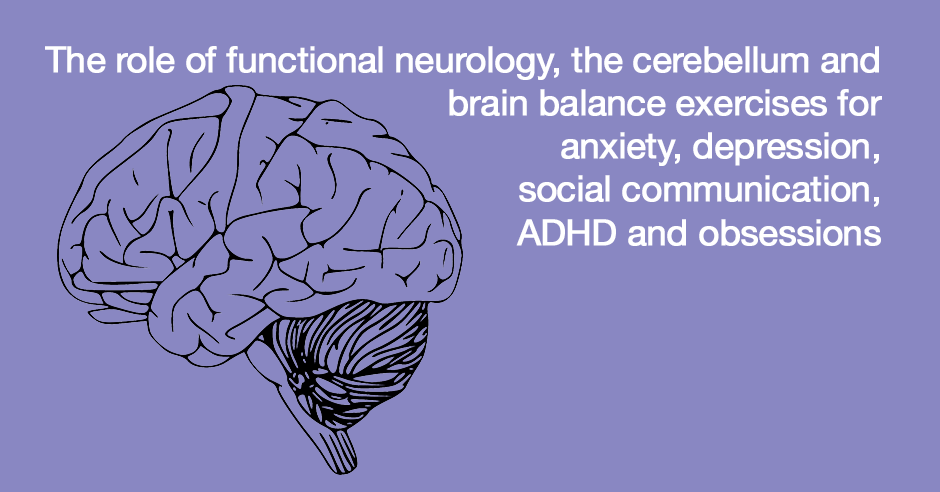
The role of functional neurology, the cerebellum and brain balance exercises for anxiety, depression, social communication, ADHD and obsessions

June 20, 2018 By Trudy Scott 29 Comments

Here are some snippets from a fascinating interview sharing cutting edge information on functional neurology and the cerebellum on the Autism, ADHD and Sensory Processing Disorder Summit.

Dr. Peter Scire, DC covers: How to Induce Neuroplastic Change in Your Teenager and Make it Fun. He shares how brain hemisphere imbalances and misfiring can be assessed and corrected with very specific exercises to induce neuroplastic change (in both children and even adults). 

I want to bring attention to, really what Schmahmann calls the cerebellum cognitive affective syndrome, so CCAS. It’s been in the literature now for 20 years. And now he’s developed a way to actually do a checklist and to look at these different aspects. But ultimately what he’s saying is that the cerebellum networks have huge relationships to your cognition of executive functions: like working memory, linguistics (your ability to generate language and to actually comprehend language), your affect, so your mood and your emotional stability. Being able to not only generate emotions, but also be able to receive emotions.

These are things that we thought for a long time were at the higher center of the brain, more of the frontal lobe specifically….. But again, the more that we’re looking at the neuro anatomy through neuroimaging, we’re able to really say, guess what? There are certain pockets of the cerebellum that specifically drive these networks.

He talks about the 3 major parts of the cerebellum, 10 subparts and how 5 of these subparts actually deal with non-motor aspects (i.e. mood and emotions, ADHD etc.). It’s this latter aspect – the non-moto aspects – that is not recognized in mainstream neurology and that forms the some of the central aspects of functional neurology: 

What we know about the cerebellum is that we have three major parts to it, and then there’s actually like 10 sub parts to it. And these 10 sub parts to it have different connections and when you look at the 10 sub parts, the first 5 have to do with more sensory motor aspects of the cerebellum. And then really the other 10 or so, give or take, are really dealing with non-motor aspects.

We have areas from the cortex that speak back to the cerebellum. We call them cerebral cerebellum loops. And then we have cerebellum back to the cerebrum. It kind of makes this bio directional system. Now it’s a little bit more complicated than that. There are other parts of the motor center, the basal ganglia and these other parts in the limbic system and stuff like that. But from a simple standpoint, for most of our attendees that understand brain gut access, just think about it in that sense. Cerebellum … brain, cerebellum, cerebellum back to the brain, okay?

And so we can have dysfunction in those systems. But again, most of the clinical model has always been looking at brain to cerebellum, not cerebellum back to the brain. And I think in my experience over the last 15 plus years, most of the work in functional neurology has actually been centered around, even chiropractic per se has been centered around cerebellum to brain, but we now are even getting more specific with our therapeutic entities.

Dr. Scire discusses the under-recognized relationships between the cerebellum networks and ADHD, social communication, mood, and emotional aspects, relationships, obsessions, compulsions, anxiety and depression: 

Again, when you look at the different phases of his work, you want to look at executive function – the whole ADHD population. You look at the linguistic processing. Obviously, we know language and social communication for autism spectrum disorders. Looking at spatial cognition so visual spatial information, visual memory aspects. Then you can begin to look at not only mood, and emotional aspects, but also relationships, obsessions, compulsions, anxiety and depression.

All this continuum of symptomatology can be traced back to the cerebellum. I agree with Doctor Melillo on this hemisphere communication model. But at the same time, in my opinion, I think that we can take it one step further and even get into the specifics of starting with these networks in the cerebellum. It starts out with this very specific examination to say okay, I want to look at motor functions of the cerebellum and I also want to look at non-motor functions of the cerebellum. And then my therapeutic entity is going to be based on that.

Dr. Scire shares the research published by Dr. Schmahmann. In this paper, The neuropsychiatry of the cerebellum – insights from the clinic they discuss the behaviors that they witnessed and that were described by patients and families:

distractibility and hyperactivity, impulsiveness, disinhibition, anxiety, ritualistic and stereotypical behaviors, illogical thought and lack of empathy, as well as aggression and irritability. Ruminative and obsessive behaviors, dysphoria and depression, tactile defensiveness and sensory overload, apathy, childlike behavior, and inability to appreciate social boundaries and assign ulterior motives were also evident.

He also recommends Dr. Robert Melillo’s book: Disconnected Kids: The Groundbreaking Brain Balance Program for Children with Autism, ADHD, Dyslexia, and Other Neurological Disorders (my Amazon link). I’ve skimmed it and will be doing a review –the functional neurology information is brilliant. I’d love to see the dietary information expanded upon.

In this interview you will learn…

  • What the latest research says about the role of the cerebellum in cognition and motor planning [and the role it also plays in anxiety, depression and ADHD]
  • What to look for when assessing cerebellar function.
  • How the cerebellum impacts executive function.
  • How to rehabilitate the brain and the importance of movement.
  • How to treat young adults with neurological disorders.
  • How what may seem to be “simple” exercises you can do at home with your child can have a major impact on their cognitive function.

I learned so much from his interview and will be delving into this aspect of functional neurology in order to add this element for clients who need this support beyond nutrition and functional medicine.

If you’re new to my work and the targeted individual amino acids be sure to catch my interview: Self-care strategies for parents that are stressed out, anxious and depressed – without using medications.

Using the targeted individual amino acids (such as tryptophan, GABA and DPA) provides quick relief from anxiety and overwhelm, giving my clients hope from day one.  And then we start to dig deeper for other root causes which can often take some time.

In this interview my focus was for stress and overwhelm support for parents but the use of amino acids is very applicable to children (and was the topic I covered in my interview in the first season).

As I learn more I expect to find that the amino acids used in conjunction with functional neurology is going to provide more comprehensive results for many individuals who also have cerebellum dysfunctions.

This event brings together 30+ of the leading doctors, nutritionists, and researchers working to help parents by sharing the latest information and strategies for achieving recovery for children with Autism, ADHD and Sensory Processing Disorder.

If you have (or a loved one has) anxiety, depression, OCD,  social anxiety, anger issues and other behavioral symptoms this event is one I highly recommend. Alzheimer’s disease, dementia and Parkinson’s disease are also covered in Dr. Scire’s interview.  This information has a wider application than autism, Asperger’s syndrome, ADHD and SPD and you will learn a great deal.

If you’ve benefited from functional neurology and these brain balancing exercises please do share in the comments. Feel free to post questions too.

Filed Under: Amino Acids, Anxiety, Autism, Children/Teens, Functional neurology, OCD, Teens Tagged With: ADHD, amino acids, anxiety, cerebellum, Dr Scire, Functional neurology, obsessions, OCD, social anxiety

Associations between Parental Anxiety/Depression and Child Behavior Problems

June 10, 2018 By Trudy Scott 2 Comments

In my interview on the Autism, ADHD and Sensory Processing Disorder Summit (June 11 to June 20, 2018) I discuss Self-care strategies for parents that are stressed out, anxious and depressed – without using medications.

You may think “why do I need research to show what I already feel and know?” but I can share that many of the moms I’ve worked find this validating and almost a relief to know they are not alone in this.

The paper, Associations between Parental Anxiety/Depression and Child Behavior Problems Related to Autism Spectrum Disorders: The Roles of Parenting Stress and Parenting Self-Efficacy reports that

Parents of children with autism spectrum disorders (ASDs) have been shown to experience increases in stress, depression, and anxiety, which are also associated with child behavior problems related to ASDs.

The paper lists some reasons for the increased parental stress, anxiety and depression:

  1. First and foremost, the realization that there is no cure for the disorder may serve to increase parenting stress.
  2. Aspects of the child’s behavior, specifically socially inappropriate and aggressive behaviors typically associated with ASD, have been found to be associated with increases in parenting stress… due to a lack of understanding of ASD
  3. Additionally, raising a child with ASD typically involves allocating extra time to meet the needs of the children.

This event addresses all of the above and more by providing you with insights and tools on how to recover your child using a biomedical and nutritional approach together with traditional behavioral models (#1 addressed). This event also helps you understand what some of the underlying causes of socially inappropriate and aggressive behaviors may be – like pyroluria and low serotonin and gluten issues (#2 addressed). And finally, the planning resources that Tara offers via her coaching program help you manage your time while you’re figuring all this out (#3 addressed).

And as an added bonus you get my nutritional advice to help make you more resilient and better able to handle the stress and worry that comes with parenting a cild with ASD or other developmental disorder.

As always, I share about the amazing amino acids that provide anxiety-relief and end the overwhelm, spinning mind, second guessing from day one while you’re figuring everything else out.

In my interview (which airs on day 1), I share:

  • How amino acids can provide instantaneous relief to symptoms of anxiety
  • Low serotonin anxiety, what are the symptoms, and what nutrients can help
  • Low GABA anxiety, how to identify and how to help
  • How to trial amino acids to see if they can help you (and your child)
  • How caring for a child with a neurodevelopmental disorder can be equivalent to combat and result in a form of PTSD
  • B vitamins and adaptogenic herbs for PTSD nutritional support
  • The benefits of a ketogenic diet for caregivers and our children
  • How collagen can actually make anxiety, depression and insomnia worse.
  • EMFs role in our health and how they are contributing to our stress.

This event brings together 30+ of the leading doctors, nutritionists, and researchers working to help parents by sharing the latest information and strategies for achieving recovery for children with Autism, ADHD and Sensory Processing Disorder.

Having a child with Autism, ADHD or Sensory Processing Disorder is challenging. Figuring out what to do to help them is just as challenging. Join us for 10 days of eye-opening information into the root causes of your child’s neurological dysfunction. Imagine learning about what may have caused their symptoms and how to address them with nutrition and biomedical approaches and leverage the power of positive neuroplasticity to improve function, health, and their lives.

Anxiety, stress, depression and PTSD-like symptoms are common in any caregiver situation, so even if you don’t have a child with a neurological disorder, this may be of interest to you if you are taking care of an older parent, a sibling, a spouse or expect to in the near future.

Register for the summit here

Hope to see you there.

Filed Under: Autism, Children/Teens, Events Tagged With: ADHD, amino acids, autism, PTSD, Self-care, spd

Teen Depression and Anxiety: Why the Kids Are Not Alright – my response

October 27, 2017 By Trudy Scott 10 Comments

Teens suffer from so much anxiety and their anxiety symptoms are now more of an issue than depression; they are cutting and self-harming as a way to feel normal; they are super-stressed; social media and iPhone use is taking over their lives, and in general, they seem to have poor coping skills.

This article in TIME magazine is a sad and concerning read: Teen Depression and Anxiety: Why the Kids Are Not Alright. It was written last year but is still very relevant. The author writes:

“Adolescents today have a reputation for being more fragile, less resilient and more overwhelmed than their parents were when they were growing up”

It’s an excellent article for creating awareness and to get an understanding of the extent of the issues and does highlight the crazy online world of teens:

It’s hard for many adults to understand how much of teenagers’ emotional life is lived within the small screens on their phones, but a CNN special report in 2015 conducted with researchers at the University of California, Davis, and the University of Texas at Dallas examined the social-media use of more than 200 13-year-olds. Their analysis found that ‘there is no firm line between their real and online worlds.’

Here is my response to the article and how I feel we can do better.

No solutions other than coping mechanisms

These teens are hopeless and resigned to the fact that this is how they are going to have to live i.e. simply managing their symptoms. It breaks my heart and it’s not alright!

Unfortunately (like the recent Xanax anxiety article in the New York Times) it offers no solutions other than coping mechanisms.

No mention of the importance of diet or nature

I agree that these kids are under a lot of stress (certainly more than when I was a teen) BUT there is ZERO mention of a real foods diet (that includes quality animal protein), a nourishing breakfast with protein (balancing blood sugar makes such a difference for reducing anxiety levels), the removal of caffeine, gluten and sugar, the importance of addressing nutritional deficiencies and poor gut health.

I love the movie project but there is no encouragement to get these teens out into nature (and maybe take up bouldering or gardening, both of which have been shown to reduce anxiety and depression).

No mention of DPA or GABA or tryptophan for self-harming, anxiety and addiction

The article makes the connections between the endorphin/opioid system and pain and the comfort these teens get from self-harming and cutting:

Scientists want to better understand how self-harm engages the endogenous opioid system–which is involved in the pain response in the brain–and what happens if and when it does

However, there is NO nutritional solution offered and NO mention of the amino acid DPA (d-phenylalanine), which can often be very effective for the cutting and self-harming, because it creates a similar endorphin boost that the cutting provides.  

There is also NO mention of the calming amino acid GABA or the happy and worry-free amino acid tryptophan for the anxiety and worry.

All the above amino acid also address addictions and may well offer neurotransmitter support to help with the addictive nature of their “drug-of-choice” i.e. their iPhones, games and other devices.

We have a plethora of nutritional solutions

We have a plethora of nutritional solutions to consider. Here are some relevant blogs that need to be part of the conversation for these teens:

  • GABA for children: ADHD, focus issues, irritability, anxiety and tantrums
  • My interview with psychiatric nurse practitioner, Zendi Moldenhauer, on the Anxiety Summit – Anxiety in children, adolescents and young adults: an integrative psychiatric approach
  • My discussion with Dr. Nicole Beurkens at the end of one of Integrative Medicine for Mental Health conferences to talk about anxiety and the impact of both low zinc and low GABA. Nicole shares her perspectives on working with children and I share what I see with the adult women I work with.

Something as simple as a weighted blanket may help ease the anxiety some of these teens are experiencing.

We can do better than simply discussing the problem teens face. I’ve worked with both children and teens and we’ve shifted things in a matter of months. It really can be done but we need to share the powerful nutritional psychiatry solution, especially because research shows that most children with anxiety relapse, regardless of conventional treatment approaches.

Do you have a teenager who is experiencing anxiety and what has helped her/him?

Do you work with teens and do you incorporate some of these approaches?

How do we get this information into the hands of parents, schools, organizations, doctors, mental health practitioners and others those who can help make this happen?

Filed Under: Anxiety, Children/Teens, Teens Tagged With: anxiety, anxiety nutrition solutions, depression, DPA, GABA, iPhone, kids, teen, Teen Depression and Anxiety: Why the Kids Are Not Alright, teens, tryptophan

  • « Go to Previous Page
  • Page 1
  • Page 2
  • Page 3
  • Page 4

Primary Sidebar

GABA QuickStart Homestudy

gaba quickstart homestudy

Free Report

9 Great Questions Women Ask about Food, Mood and their Health

You'll also receive a complimentary subscription to my ezine "Food, Mood and Gal Stuff"


Connect with me

Popular Posts

  • Amino Acids Mood Questionnaire from The Antianxiety Food Solution
  • The Antianxiety Food Solution Amino Acid and Pyroluria Supplements
  • Pyroluria Questionnaire from The Antianxiety Food Solution
  • Collagen and gelatin lower serotonin: does this increase your anxiety and depression?
  • Tryptophan for the worry-in-your-head and ruminating type of anxiety
  • GABA for the physical-tension and stiff-and-tense-muscles type of anxiety
  • The Antianxiety Food Solution by Trudy Scott
  • Seriphos Original Formula is back: the best product for anxiety and insomnia caused by high cortisol
  • Am I an anxious introvert because of low zinc and vitamin B6? My response to Huffington Post blog
  • Vagus nerve rehab with GABA, breathing, humming, gargling and key nutrients

Recent Posts

  • Her cravings for chips and peanut butter were triggered by stress: GABA ends cravings and reduces physical tension and fear of heights
  • It is truly miraculous to be able to move through life without crippling anxiety and panic
  • GABA and tryptophan combo provide immediate and noticeable relief for tremors and cervical dystonia in just 7 days
  • Red light therapy for back and neck pain, plantar fasciitis and low mood – a complement to the amino acids GABA, DPA and tryptophan
  • What do I use instead of Seriphos to help lower high cortisol that is affecting my sleep and making me anxious at night?

Categories

  • 5-HTP
  • AB575
  • Addiction
  • ADHD
  • Adrenals
  • Alcohol
  • Allergies
  • Alzheimer's disease
  • Amino Acids
  • Anger
  • Antianxiety
  • Antianxiety Food Solution
  • Antidepressants
  • Anxiety
  • Anxiety and panic
  • Autism
  • Autoimmunity
  • benzodiazapines
  • Bipolar disorder
  • Books
  • Caffeine
  • Cancer
  • Candida
  • Children/Teens
  • Collagen
  • Cooking equipment
  • Coronavirus/COVID-19
  • Cravings
  • Depression
  • Detoxification
  • Diabetes
  • Diet
  • DPA/DLPA
  • Drugs
  • EFT/Tapping
  • EMF
  • EMFs
  • Emotional Eating
  • Endorphins
  • Environment
  • Essential oils
  • Events
  • Exercise
  • Fear
  • Fear of public speaking
  • Fertility and Pregnancy
  • Fish
  • Food
  • Food and mood
  • Functional neurology
  • GABA
  • Gene polymorphisms
  • General Health
  • Giving
  • Giving back
  • Glutamine
  • Gluten
  • GMOs
  • Gratitude
  • Gut health
  • Heart health/hypertension
  • Histamine
  • Hormone
  • Hyperparathyroidism
  • Hypoglycemia
  • Immune system
  • Inflammation
  • Insomnia
  • Inspiration
  • Introversion
  • Joy and happiness
  • Ketogenic diet
  • Lithium orotate
  • Looking awesome
  • Lyme disease and co-infections
  • MCAS/histamine
  • Medication
  • Men's health
  • Mental health
  • Mercury
  • Migraine
  • Mold
  • Movie
  • MTHFR
  • Multiple sclerosis
  • Music
  • NANP
  • Nature
  • Nutritional Psychiatry
  • OCD
  • Osteoporosis
  • Oxalates
  • Oxytocin
  • Pain
  • Paleo
  • Parasites
  • Parkinson’s disease
  • PCOS
  • People
  • PMS
  • Postpartum
  • PTSD/Trauma
  • Pyroluria
  • Questionnaires
  • Real whole food
  • Recipes
  • Research
  • Schizophrenia
  • serotonin
  • SIBO
  • Sleep
  • Special diets
  • Sports nutrition
  • Stress
  • Sugar addiction
  • Sugar and mood
  • Supplements
  • Teens
  • Testimonials
  • Testing
  • The Anxiety Summit
  • The Anxiety Summit 2
  • The Anxiety Summit 3
  • The Anxiety Summit 4
  • The Anxiety Summit 5
  • The Anxiety Summit 6
  • Thyroid
  • Thyroid health
  • Toxins
  • Tryptophan
  • Tyrosine
  • Uncategorized
  • Vegan/vegetarian
  • Women's health
  • Yoga

Archives

  • May 2026
  • April 2026
  • October 2025
  • September 2025
  • August 2025
  • July 2025
  • June 2025
  • May 2025
  • April 2025
  • March 2025
  • February 2025
  • January 2025
  • November 2024
  • October 2024
  • September 2024
  • August 2024
  • July 2024
  • June 2024
  • May 2024
  • April 2024
  • March 2024
  • February 2024
  • January 2024
  • December 2023
  • November 2023
  • October 2023
  • September 2023
  • August 2023
  • July 2023
  • June 2023
  • May 2023
  • April 2023
  • March 2023
  • February 2023
  • January 2023
  • December 2022
  • November 2022
  • October 2022
  • September 2022
  • August 2022
  • July 2022
  • June 2022
  • May 2022
  • April 2022
  • March 2022
  • February 2022
  • January 2022
  • December 2021
  • November 2021
  • October 2021
  • September 2021
  • August 2021
  • July 2021
  • June 2021
  • May 2021
  • April 2021
  • March 2021
  • February 2021
  • January 2021
  • December 2020
  • November 2020
  • October 2020
  • September 2020
  • August 2020
  • July 2020
  • June 2020
  • May 2020
  • April 2020
  • March 2020
  • February 2020
  • January 2020
  • December 2019
  • November 2019
  • October 2019
  • September 2019
  • August 2019
  • July 2019
  • June 2019
  • May 2019
  • April 2019
  • March 2019
  • February 2019
  • January 2019
  • December 2018
  • November 2018
  • October 2018
  • September 2018
  • August 2018
  • July 2018
  • June 2018
  • May 2018
  • April 2018
  • March 2018
  • February 2018
  • January 2018
  • December 2017
  • November 2017
  • October 2017
  • September 2017
  • August 2017
  • July 2017
  • June 2017
  • May 2017
  • April 2017
  • March 2017
  • February 2017
  • January 2017
  • December 2016
  • November 2016
  • October 2016
  • September 2016
  • August 2016
  • July 2016
  • June 2016
  • May 2016
  • April 2016
  • March 2016
  • February 2016
  • January 2016
  • December 2015
  • November 2015
  • October 2015
  • September 2015
  • August 2015
  • July 2015
  • June 2015
  • May 2015
  • April 2015
  • March 2015
  • February 2015
  • January 2015
  • December 2014
  • November 2014
  • October 2014
  • September 2014
  • August 2014
  • July 2014
  • June 2014
  • May 2014
  • April 2014
  • March 2014
  • February 2014
  • January 2014
  • December 2013
  • November 2013
  • October 2013
  • September 2013
  • August 2013
  • July 2013
  • June 2013
  • May 2013
  • April 2013
  • March 2013
  • February 2013
  • January 2013
  • December 2012
  • November 2012
  • October 2012
  • August 2012
  • July 2012
  • June 2012
  • May 2012
  • April 2012
  • March 2012
  • February 2012
  • January 2012
  • December 2011
  • November 2011
  • October 2011
  • September 2011
  • August 2011
  • July 2011
  • June 2011
  • May 2011
  • April 2011
  • March 2011
  • February 2011
  • January 2011
  • December 2010
  • October 2010
  • September 2010
  • July 2010
  • May 2010
  • April 2010
  • March 2010
  • February 2010
  • January 2010
  • November 2009

Share the knowledge!

The above statements have not been evaluated by the Food and Drug Administration. Products listed in this website are not intended to diagnose, treat, cure or prevent any disease.

The information provided on this site is for informational and educational purposes only and is not intended as a substitute for advice from your physician or other health care professional. You should consult with a healthcare professional before starting or modifying any diet, exercise, or supplementation program, before taking or stopping any medication, or if you have or suspect you may have a health problem.


Copyright © 2026 Trudy Scott. All Rights Reserved. | Privacy | Terms and Conditions | Refund Policy | Medical Disclaimer

Free Report

9 Great Questions Women Ask about Food, Mood and their Health

You’ll also receive a complimentary subscription to my ezine “Food, Mood and Gal Stuff”